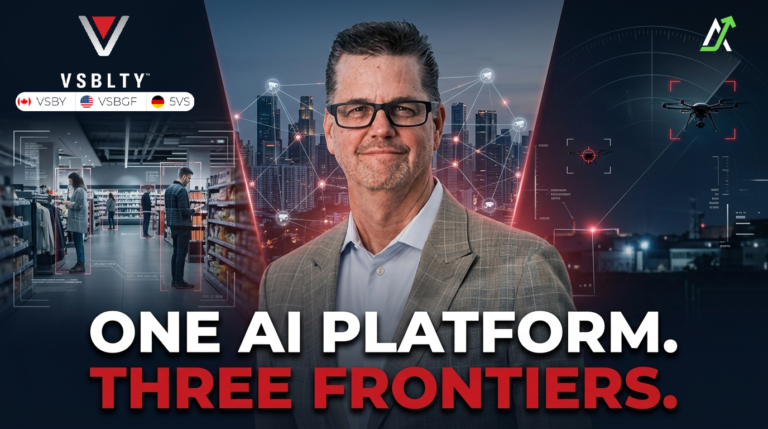
When one software stack can power in-store camera analytics and help integrate sensors designed to detect hostile drones, you know the AI era has crossed that line from buzzword to practical utility. In this anchor interview, CEO Jay Hutton discusses how VSBLTY’s computer vision and multi-sensor intelligence are being positioned across retail media, smart-city safety and national defense. VSBLTY Groupe Technologies Corp. sits at the intersection of enterprise AI, sensor fusion and retail media, combining camera and sensor data to support real-time analysis and operational decisions. With a disclosed defense pilot purchase order capped at approximately US$2.5 million, a retail media joint venture involving AB InBev subsidiary Grupo Modelo, an India platform licensing partnership and a Philippines collaboration framework, the company is working to demonstrate its model at larger scale across multiple markets.
WHAT YOU NEED TO KNOW
- Retail Intel: The company’s retail technology uses computer vision to analyze audience engagement and support digital advertising at the point of sale.
- Defense Fusion: Its defense platform is designed to combine inputs from radar, drones, satellite data, radio frequency monitoring, acoustic sensors and video. Hutton describes an agentic AI layer that lets operators query that combined information in plain language.
- Grupo Modelo JV: VSBLTY participates in Winkel Media alongside Retailigent Media and Grupo Modelo, an AB InBev subsidiary. Hutton says the network now reaches several thousand stores, while acknowledging that growth has been slower than originally anticipated.
- India Licensing Partnership: QuadGen has secured a license to VSBLTY’s platform for smart-city and public safety applications across India’s government markets. The platform includes an edge device co-developed with AirBrij.
- Gulf and Philippines: VSBLTY has announced the availability of its drone detection platform in the Gulf region and signed a binding LOI with Brightside to jointly pursue defense, public safety and infrastructure opportunities in the Philippines.
STRATEGIC IMPLICATIONS
Cameras and sensors can generate enormous volumes of information, but turning those feeds into timely, useful intelligence remains a challenge. In retail, advertisers want better measurement of engagement near the shelf and cooler. In cities and defense, operators need ways to bring separate video, radar and other sensor inputs into a clearer operational picture.
VSBLTY’s model addresses that challenge by processing information close to where it is collected and combining multiple data sources. In retail, that means measuring audience engagement and supporting relevant advertising near the point of purchase. In smart cities and defense, it means integrating video, radar, radio frequency monitoring and other sensor inputs to support situational awareness, early warning and infrastructure protection.
Hutton describes an additional layer of agentic AI that allows operators to ask questions about the combined information in everyday language. The objective is to help users move from separate sensor feeds to a more useful understanding of a potential threat. He also clarifies VSBLTY’s role in defense: its software provides detection and intelligence that can inform separate countermeasure systems, with those systems handling the physical response.
Processing information locally can also change deployment economics. Hutton says one application in India reduced telecom costs by 85% when an edge architecture replaced a centralized approach. He explicitly cautions that this is a specific example, rather than a standard saving investors should assume across deployments.
The commercial approach relies heavily on partners. Its defense pilot involves CRS Inc., a U.S. systems integrator serving a national defense customer outside North America. In India, QuadGen provides a route into government smart-city and public safety markets. In the Philippines, the Brightside LOI establishes a framework to pursue projects combining VSBLTY’s AI platform with satellite infrastructure.
The company’s November 5 announcement also points to India’s certification changes and domestic manufacturing requirements as potential drivers of demand. These developments create opportunities for locally delivered technology, but converting partnerships and prospective projects into deployments, recognized revenue and cash collections remains the central execution test.
STRATEGIC FOCUS
The interview explores Hutton’s strategy for extending VSBLTY’s technology across retail, smart cities and defense through regional partners and systems integrators. His focus is on combining the company’s software with partners’ local relationships and delivery capabilities, then executing methodically as opportunities develop. He acknowledges that the scale of the India relationship has yet to be proven.
INVESTOR TAKEAWAY
VSBLTY’s story now spans retail media, smart cities and defense, with a common technology foundation and partners providing routes into each market. The interview explains what that means in practice: combining sensor information, allowing operators to query it in plain language and processing data locally to reduce reliance on centralized infrastructure.
The commercial milestones are at different stages. The defense pilot carries a purchase order ceiling of approximately US$2.5 million, QuadGen has licensed the platform for India, and the Brightside LOI establishes a framework to pursue opportunities in the Philippines. For investors, the next chapter is execution: delivering existing commitments and converting partner relationships into additional contracts, revenue and cash collections.
Last modified: November 11, 2026