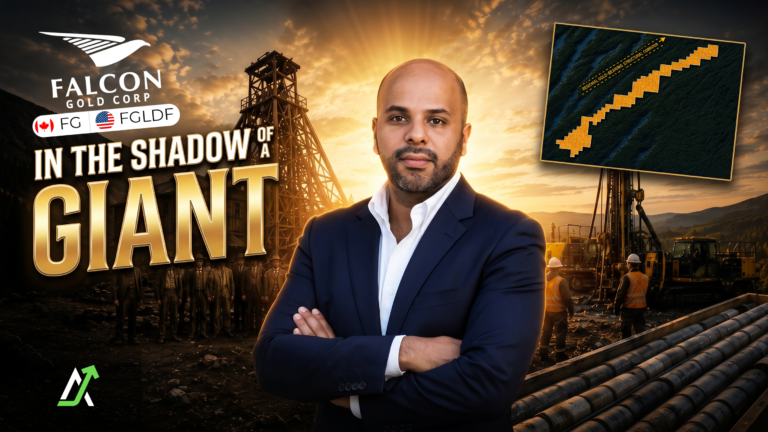
Most junior gold explorers begin with a geological theory, while Falcon Gold Corp. (TSXV: FG | OTC Pink: FGLDF) begins with more than a century of evidence. Its 100% owned Central Canada Gold Project near Atikokan, Ontario, has seen shafts, underground workings, historical milling and modern drilling that returned visible gold and several high grade intersections. Falcon has now received an exploration permit for up to 20 diamond drill holes totalling approximately 2,500 metres, setting the stage for the company to test how much of that known mineralization may connect. The project sits approximately 20 kilometres southeast of Agnico Eagle’s multi million ounce Hammond Reef Gold Project. Proximity does not mean the same mineralization exists at Central Canada, but it places Falcon within an established gold district where geology, infrastructure and decades of exploration provide a meaningful head start.
WHAT YOU NEED TO KNOW
- Permit Secured: Falcon is permitted for up to 20 diamond drill holes totalling approximately 2,500 metres.
- High Grade Results: Previous drilling returned 10.17 g/t Au over 3.0 metres, 18.6 g/t Au over 1.0 metre with visible gold and 2.8 g/t Au over 7.5 metres.
- Historic Development: Work completed between 1930 and 1934 included 1,829 metres of drilling, a 45 metre shaft, underground workings and a 75 ton per day gold mill.
- Conceptual Target: Falcon has outlined approximately 500,000 to 1.2 million tonnes grading 8 to 12 g/t Au. This is a conceptual exploration target, not an NI 43-101 mineral resource, and further drilling is required.
- Infrastructure Advantage: Year round road access, power and existing regional infrastructure can help direct more of the exploration budget toward drilling.
- Expanded Position: Falcon has optioned the 156 claim West Hammond Contact Property, covering approximately 3,068 hectares within the broader district.
STRATEGIC IMPLICATIONS
The central question is no longer whether gold is present. Historical work and Falcon’s 2020 and 2021 drilling have already answered that. What remains unknown is whether the identified zones belong to a larger connected system with enough continuity, width and scale to support a defined resource.
Management estimates that only approximately 20% of the project has been explored across a geological trend extending roughly 20 kilometres. Previous drilling reached approximately 300 to 350 metres, with the mineralized system described as open at depth and down dip.
The upcoming program is therefore about more than producing another high grade intercept. Falcon intends to test continuity between known zones, assess how wide the mineralization may be and determine whether it extends farther north, south and at depth.
Infrastructure makes that work more practical. While remote exploration programs can consume significant capital through helicopters, camps, access construction and weather delays, Central Canada offers existing road access and power in a recognized Ontario gold district.
Falcon is also building a broader regional position through West Hammond. Management’s longer term thesis is that higher grade opportunities surrounding Hammond Reef could become strategically relevant as potential supplemental feed if that project is ultimately developed and placed into production. This remains a future scenario that depends on Hammond Reef being developed and Falcon first demonstrating continuity and scale across its own properties.
CEO KARIM RAYANI
“We have the history, we have the results, we have the infrastructure, and now we just gotta build this out.”
INVESTOR TAKEAWAY
Management identified Q1 2027 as the realistic target for commencing drilling, subject to contractor availability and scheduling. The program is expected to take approximately three weeks, followed by an estimated two to three months for assays, creating the potential for initial results around Q2 2027 depending on laboratory turnaround times.
Falcon is not asking investors to imagine gold on a blank map. It is returning to a historically explored project with modern results, existing infrastructure and a permitted drill program that could begin answering the most important question surrounding Central Canada: how much of the gold system can Falcon connect?
Last modified: September 8, 2026