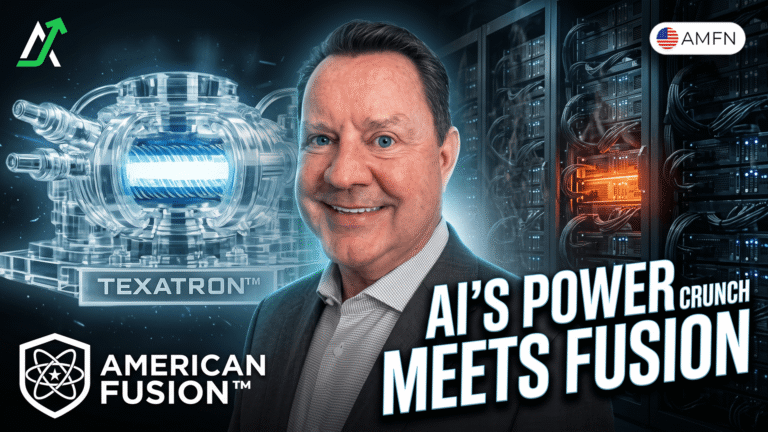
Artificial intelligence may be built on chips and software, but every system depends on something more basic: a dependable supply of electricity.
In a recent long form interview with AGORACOM, American Fusion Inc. (OTCQB: AMFN) Executive Chairman Brent Nelson explained why the company believes its Texatron™ Fusion Engine™ could eventually help meet that need. The company is developing a compact fusion system intended to produce electricity at customer locations, reducing reliance on traditional grids that can take years to add capacity.
American Fusion has taken delivery of a physical 5 megawatt preproduction system, commissioned 10 megawatt and 20 megawatt systems with its Texas fabricator and received authorization from Texas to test 12 planned Texatron™ Fusion Engine™ sizes ranging from approximately 500 kilowatts to 1 gigawatt. Those figures describe intended system sizes, not electricity output already demonstrated.
AGORACOM Beyond The Mic Feature Article Issued On Behalf of American Fusion Inc.
September 14, 2026
The Power Question Behind the AI Boom
Nelson said a U.S. Army power official told him the country faced a 1.65 terawatt power shortage. He compared that figure with U.S. electricity use of approximately 4 to 4.5 terawatts and said the grid would need to grow by roughly 30 percent to meet present demand.
“The grid is just constrained, and it just can’t do it,” Nelson said.
American Fusion plans to install Texatron™ Fusion Engine™ systems at customer sites and sell the electricity they may produce under power purchase agreements. This is known as behind the meter generation. In plain language, the power would be produced where it is needed instead of first travelling through the wider grid.
For data centers investing billions of dollars in new equipment, years spent waiting for a larger grid connection can become a serious commercial obstacle. That makes them the first market American Fusion intends to pursue.
The Texatron™ Fusion Engine™ in Plain English
The system is designed to use electricity to create a doughnut shaped magnetic field that holds extremely hot fuel in place. It would combine deuterium and helium-3 in controlled pulses. Nelson said each pulse would place pressure on the magnetic field and produce excess electrons that could be captured as electricity.
“Our device is super simple. It’s like confining plasma in a donut,” Nelson said.
Nelson described the intended reaction as aneutronic. In everyday language, the goal is to avoid long lasting radioactive waste. He said the main result would be helium-4, the type used in balloons, while acknowledging that some secondary reactions could potentially produce neutrons.
The concept is straightforward to explain, but difficult to achieve. Nelson said the planned reaction requires temperatures of approximately 600 million to 700 million degrees Celsius, far hotter than the center of the sun. He did not say that the Texatron™ Fusion Engine™ has already operated at those temperatures. Reaching the necessary conditions and documenting the outcome are part of the work still ahead.
Why the Texas Testing Matters
Nelson said the team conducted thousands of plasma confinement tests while developing the technology. American Fusion is now preparing to produce monitored results through its Texas testing program.
Texas has authorized the company to test all 12 planned Texatron™ Fusion Engine™ sizes. This covers the testing process, not the technology’s performance or its ability to produce commercial electricity.
According to Nelson, the authorization took approximately three or four months and cost about $670. He contrasted that with an earlier estimate from the company’s valuation firm suggesting the process could require eight years and approximately $80 million.
American Fusion has worked with Texas Tech for nearly five years. The company intends to use the university’s underground testing bunker, subject to scheduled access.
The immediate objective is what Nelson called “unity or beyond unity,” followed by capturing the resulting energy and converting it into usable electricity. Management hopes to reach that milestone by the end of 2026, with American Thanksgiving identified as an internal target.
The timing depends on how testing proceeds. If the results support the company’s expectations, management hopes to deploy a test unit in 2027 and potentially begin commercial production and electricity sales that year.
“Commercial production, we’re going to be charging for the power we make, is hopefully going to be 2027,” Nelson said.
Planned Scale and Customer Interest
The Texatron™ Fusion Engine™ is planned in 12 sizes beginning at approximately 500 kilowatts and extending to 1 gigawatt. Beyond the delivered 5 megawatt preproduction system and commissioned 10 megawatt and 20 megawatt systems, Nelson said he expected 2x 30 megawatt systems to be ordered by the end of September 2026.
The larger systems are intended to support further testing and future customer demonstrations. Nelson said some configurations could fit in the back of a pickup truck, while complete packaged systems could be housed in shipping containers.
Nelson also cited an internal estimate, prepared about a year earlier, that contemplated up to 1,000 units annually after production begins. He separately said the Texas fabricator was willing to ramp. Neither statement represents current capacity or a firm production commitment.
American Fusion is already speaking with several major technology companies and data center builders.
“If you talk about our proposals that are out to date, they’re in the tens of billions of dollars,” Nelson said.
That amount represents the potential value management associates with proposals under discussion. It is not signed business or booked revenue, and Nelson acknowledged that prospective customers are waiting for further test results.
The planned business model is based on selling electricity rather than selling Texatron™ Fusion Engine™ systems. Nelson said pricing would depend on location, regulation and deployment time. He also identified mining operations, military installations, remote locations and islands dependent on diesel generation as possible markets beyond data centers.
How American Fusion Views the Competition
Nelson estimated that approximately 52 companies are pursuing different forms of fusion. Within the deuterium and helium-3 category, he identified only one other company known to American Fusion.
“We think that we’re hopefully seven or eight years ahead of them to commercialization,” Nelson said.
That is management’s assessment, not an independently established ranking. Nelson also acknowledged that private companies and government programs may be developing technology that American Fusion cannot see.
Investor Takeaway: What Comes Next
American Fusion has physical equipment, authorization to test its planned system range, a relationship with Texas Tech and a fabricator involved in larger planned systems. It has also begun conversations with potential customers about selling electricity at their locations.
The decisive work is still ahead. The current Texas testing program has not demonstrated unity, usable electricity or commercial operation. Nelson’s 2027 target depends on successful testing, documented performance and the company’s ability to move from preproduction systems into manufacturing and field deployment.
“I think we’ve hit every milestone that we set out at the beginning of the year to hit,” Nelson concluded. “Now it’s basically technological testing and things like that. Some things are in our control, some things aren’t.”
For investors, the next phase comes down to results: what the Texatron™ Fusion Engine™ demonstrates through documented testing and whether that performance can support American Fusion’s targeted move toward commercial deployment.
TO WATCH THE FULL VIDEO GO TO: https://www.youtube.com/playlist?list=PLEXlaXBRVL_E
AGORACOM Beyond the Mic is Powered by AGORACOM’s AI Content Agents.
American Fusion Inc. Is A Client Of AGORACOM Investor Relations Corp.
Last modified: September 14, 2026