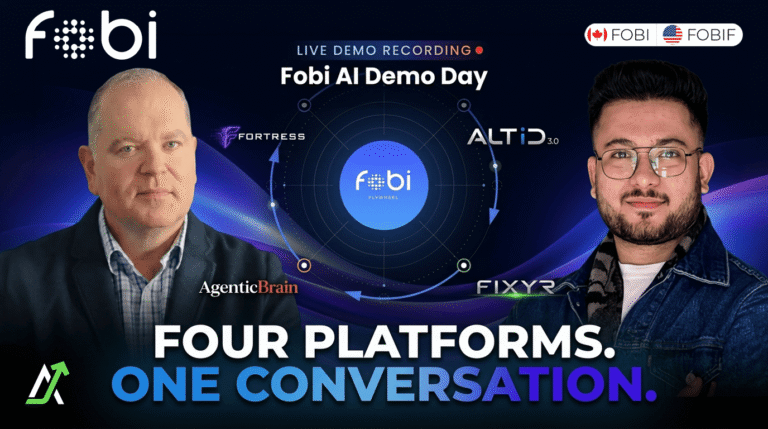
In a recent long form video interview with AGORACOM (see link at the end of this article), Fobi AI Inc. (TSXV: FOBI) (Pink: FOBIF) hosted its first live interactive demonstration of the Fobi Flywheel, the company’s integrated ecosystem connecting sovereign enterprise AI, quantum-secured identity, intelligent orchestration, and conversational interaction. CEO Rob Anson and CTO Uddeshya Agrawal walked investors through how FORTRESS, AltID, FIXYR, and AgenticBrain work together to transform how businesses interact with customers and deploy AI at scale.
The demonstration provided investors with their first live view of how the four products work together in practice. After months of introducing each product individually, Fobi showed how the four platforms connect into a single, frictionless experience where a customer can book tickets, verify identity, modify reservations, and receive digital credentials entirely through WhatsApp, without ever opening a website or downloading an app.
AGORACOM Beyond The Mic Feature Article Issued On Behalf of Fobi AI Inc.
January 8, 2025 10:00 AM EST
From Four Products to One Seamless Experience
The live demo began with Agrawal demonstrating a ticketing scenario using WhatsApp. He sent a simple text message requesting two tickets to an event. What happened next illustrated the power of the integrated Flywheel.
The system immediately recognized that he had not yet completed identity verification through AltID, Fobi’s quantum-secured digital identity platform. It automatically sent a verification link. Within seconds, Agrawal captured a selfie, created a post-quantum secure credential, and received an AltID pass that was added directly to his Apple Wallet.
Once verified, the system presented seating options. He selected two orchestra seats, and the tickets appeared instantly in his wallet. Moments later, he requested a change to aisle seats. The system confirmed availability, processed the change at no extra charge, and automatically updated both digital tickets in his wallet—all without leaving the messaging thread.
“Easy is the most hard thing to develop in technology, and that’s what we have achieved today,” Agrawal explained during the presentation. “Today, it’s me who is talking to this business using WhatsApp. Tomorrow, it will be my AI agent who will be talking to the other agent of the other companies.”
Understanding What Happened Under the Hood
While the customer experience appeared simple, the demonstration revealed the sophisticated orchestration happening behind the scenes. Four distinct Fobi platforms worked together seamlessly:
AgenticBrain provided the conversational layer, allowing natural language interaction through WhatsApp (or any messaging channel an enterprise chooses, including Telegram, iMessage, or website chat widgets).
AltID 3.0 established verified identity using post-quantum cryptography (specifically MLDSA and MLKEM standards recommended by the National Institute of Standards and Technology), biometric verification, and satellite-based location attestation using the Galileo positioning system. This created a reusable digital credential the customer controls from their own device.
FORTRESS served as the sovereign intelligence layer, connecting to the enterprise’s inventory systems, pricing data, and business logic while keeping all proprietary information on infrastructure the organization controls—not on third-party platforms like OpenAI or Anthropic.
FIXYR orchestrated the entire workflow, managing the communication between systems, calling the appropriate APIs, issuing wallet passes, and handling service requests autonomously.
“The system clearly identified who am I, am I authorized to do this, am I authenticated to do this,” Agrawal noted. “The system knew who is the person who’s talking to it. The system was well connected to all the inventory, all the management platforms, and it had access to create wallet passes, issue tickets on my behalf, and call the internal APIs.”
Why This Matters: The End of Websites and Apps
One of the most striking claims Agrawal made during the demonstration was that “websites and apps are about to become obsolete.” The reasoning is straightforward: as consumers increasingly delegate tasks to personal AI assistants—tools like Meta’s newly launched Muse, OpenAI’s Dots, or Grok’s chatbot—they will stop navigating websites manually.
Instead, a customer’s AI agent will communicate directly with a business’s AI agent. The customer simply states an intent (“book me a round trip to Chicago next week”), and their personal AI handles the rest—searching, comparing, booking, and confirming.
But for that future to work, businesses need infrastructure that allows AI agents to securely discover, authenticate, and transact with them. That’s the gap Fobi is addressing.
“If my AI agent will have difficulty talking to Air Canada, it will go to a different airline,” Agrawal explained, using a hypothetical example. “So if Air Canada does not upgrade themselves to make it easy for their infrastructure to talk to my AI agent, the communication will never be established, and when that breaks, Air Canada loses business.”
Anson echoed this point: “We believe the future of customer experience will move from navigating websites and applications to simply having a conversation. AgenticBrain positions Fobi directly in front of that shift.”
The Enterprise View: Control, Sovereignty, and Speed
The demonstration then shifted to show what enterprise administrators see. Agrawal walked through the Fobi workspace dashboard, where businesses can configure and monitor all four Flywheel products.
The enterprise interface revealed detailed activity logs showing every request, every API call, every workflow execution—all tracked for compliance and auditability. Administrators can see which services AgenticBrain called, which wallet passes were issued, which customer flows were completed.
For FORTRESS deployment, enterprises select their preferred AI model (compact, general, reasoning, or specialist) and choose where to run it: on local machines, enterprise workstations, or private cloud infrastructure like AWS or RunPod. This flexibility allows organizations to maintain complete control over their intelligence and data.
“This is how you own your intelligence,” Agrawal emphasized. “Because now this model runs on your hardware, where you prefer to run it on. It’s all still on their server, nothing touches us. It’s all in their servers.”
AgenticBrain configuration is equally straightforward. Enterprises upload their API documentation, define which endpoints agents can access, and set role-based permissions. For example, an agent might be allowed to read customer records but not delete them. This granular control ensures systems remain secure even as AI agents gain broader access to enterprise infrastructure.
AltID configuration lets organizations define what types of identities they’ll verify (people, AI agents, or workloads), select post-quantum cryptographic profiles, and enable location attestation. Every identity verification event is logged, creating an auditable trust layer.
FIXYR allows enterprises to identify patterns in customer support requests and create automated workflows. If a common issue like account access recovery appears repeatedly, the system can detect that pattern and build an autonomous resolution workflow—all described in plain English rather than code.
Real-World Application: The Law Firm Example
Agrawal also demonstrated FORTRESS Command Center, an internal AI environment Fobi uses to manage its own operations. He showed a law firm example where the firm uploaded decades of case files, engagement proposals, client intake policies, and practice knowledge into FORTRESS.
Employees can then query this proprietary knowledge base through AI agents. One agent might handle client intake, another might provide cost estimates for service agreements, another might draft documents. Each agent has access to the firm’s accumulated intelligence, operates within defined boundaries, and works in an isolated computing environment for security.
“Samsung lost a lot of millions of dollars in lawsuit because their employee decided to use OpenAI to write code,” Agrawal noted. “We see these problems happening every day. AI is great for enterprises, but enterprises can’t just use it. They are banned from using it. And that’s where this comes into play.”
Fobi itself uses this architecture extensively. Agrawal revealed that the company operates at what he calls “400 to 1” AI density—400 AI agents for every human employee. These agents manage everything from email triage to project updates to customer workflows.
“We have an AI agent in our Whatsapp group that takes all of Rob’s feedback and insights, breaks them down into tickets, and adds that to our Jira board,” Agrawal explained, illustrating how deeply Fobi has integrated its own technology into daily operations.
Integration Speed and Flexibility
When asked how difficult it is for enterprises to integrate the Flywheel, Agrawal emphasized speed and simplicity.
“It’s a matter of days to integrate the entire flywheel in your system,” he said. “This is something that plugs and plays into your existing systems. One thing we care about is the onboarding. We don’t like to give customers a new problem to worry about.”
Enterprises can also start with a single product. Many customers begin with FORTRESS to establish sovereign intelligence, then gradually add AltID for identity verification and AgenticBrain for conversational access as their needs expand.
“This is offered as a managed service,” Agrawal noted. “If an enterprise wants to onboard to Flywheel, we will definitely give them an onboarding.” The company also provides extensive documentation, video tutorials, and even an AI agent that can answer integration questions.
Why FORTRESS When Everyone Can Access Powerful AI
One investor question cut to the heart of Fobi’s value proposition: if every company can access powerful AI models from OpenAI, Anthropic, or open-source providers, why would they need FORTRESS?
Agrawal’s answer was direct: “If everyone can access the powerful models, then the advantage in accessing the powerful models is lost. Then the advantage is that what and which company allows you to connect those models with your data, connect those models with your intelligence, and don’t use your data for their benefit.”
He compared it to renting someone else’s brain versus using your own. FORTRESS lets enterprises control which models to use, what data those models can access, and what actions they can take—all while ensuring proprietary information never leaves the organization’s infrastructure.
This sovereign approach addresses growing enterprise concerns about data exposure, competitive intelligence leakage, and regulatory compliance. As AI agents gain the ability to take actions (not just answer questions), the stakes for security and control rise dramatically.
Investor Response and Market Timing
The live demonstration drew enthusiastic responses from attendees. One investor with a technical and security background commented: “The way your software integrates seamlessly with Apple and Google Wallet apps and uses secure facial recognition on top of the other proprietary Fobi security layers is incredible. The use cases are limitless.”
Anson acknowledged the timing could not be better. “We’re in budget season for enterprise and government, which is an exciting time to be out on the road,” he said. “This is built and in action today. This isn’t hypothetical.”
He also noted the overwhelmingly positive feedback from enterprise decision-makers and CTOs in pitch meetings. “Simplicity sells,” Anson explained. “The hardest thing to do is make something appear to be easy. That’s the capabilities here. When people see how easily these all integrate together, or likewise stand as one, it’s the pencil drop on the pad of paper.”
The speed claim particularly resonates. While most enterprise AI integrations are quoted at six to twelve months, Fobi talks about days. “That’s really what people are noticing—the simplicity, the relevancy,” Anson said.
Looking Forward: Not the End, but the Beginning
Both Anson and Agrawal emphasized that the Flywheel demonstration represents a starting point, not a conclusion. The platform continues to evolve, and additional capabilities are in development.
“This isn’t the end of the flywheel. This is simply just the beginning,” Anson said. “There’s some quite amazing things that Udesh has been working on that we’ll be launching soon as well.”
The demonstration also illustrated how Fobi has internally validated every component before bringing it to market. “We ate our dog food first, we used this platform first,” Agrawal noted. “All the bugs that you won’t see ever is something that we saw first and solved it.”
For investors who have followed Fobi’s transformation from a mobile wallet company into an AI infrastructure provider, the live Flywheel demo offered the clearest picture yet of how the pieces connect and why the company believes it is positioned for the shift toward agentic, conversational enterprise AI.
As Agrawal put it during the demonstration: “I literally feel like Steve Jobs revealing iPhone while doing this demo today.”
The difference, of course, is that this is not consumer hardware. It’s enterprise infrastructure designed for a world where AI agents—both personal and corporate—become the primary interface between customers and businesses. Whether Fobi can capitalize on that shift will depend on execution, customer adoption, and continued product development. But the technology, as demonstrated, is live and working today.
Conclusion
The Fobi Flywheel demonstration showed how FORTRESS, AltID 3.0, FIXYR, and AgenticBrain work together to address key enterprise challenges: sovereign intelligence, quantum-secured identity, autonomous orchestration, and conversational access. The live demo illustrated how these four platforms enable businesses to interact with customers through natural language while maintaining control over data and AI infrastructure. For enterprises seeking to deploy AI securely while preparing for a future where AI agents handle customer interactions, Fobi presented a working system that is operational and available today.
TO WATCH THE FULL VIDEO GO TO: https://www.youtube.com/playlist?list=PLfL457LW0vdKRzZ61NXeYFyshLOXxNJO2
AGORACOM Beyond the Mic is Powered by AGORACOM’s AI Content Agents.
Fobi AI Inc. Is A Client Of AGORA Internet Relations Corp. https://agoracom.com/ir/Agoracomupdates/forums/discussion/topics/796135-DISCLAIMER-AND-DISCLOSURE/messages/2399000
Last modified: October 8, 2026