Agoracom Blog Home

Author Archive

PyroGenesis $PYR.ca Announces 2018 Results: Revenues of $5.03MM; Gross Margin of 22%; Current Backlog $7.7MM $LMT $RTN $NOC $UTX $HPQ.ca $DDD.ca $SSYS $PRLB

Posted by AGORACOM-JC at 8:29 AM on Wednesday, May 1st, 2019
  • Revenues of $5,030,116
  • Gross margin of 22.1%
  • Backlog of signed contracts of $7.7MM

MONTREAL, April 30, 2019 – PyroGenesis Canada Inc. (http://pyrogenesis.com) (TSX-V: PYR) (OTCQB: PYRNF), a high-tech company, (the “Company”, the “Corporation” or “PyroGenesis”) that designs, develops, manufactures and commercializes plasma atomized metal powder, plasma waste-to-energy systems and plasma torch products, today announced its financial and operational results for the fourth quarter and the fiscal year ended December 31, 2018.

“2018 was significantly affected by management’s decision to pursue strategic partnerships at the expense of revenues. However, as a result, we have press released imminent contracts in excess of $32MM with associated future revenues in excess of that,” said Mr. P. Peter Pascali, President and CEO of PyroGenesis. “Therefore if 2018 was the year in which the Company successfully positioned itself with unique and strategic partnerships, geared to effectively accelerate commercialization, then 2019 is the year that bears the fruit of that strategy. We strongly recommend that these financials be viewed in this context.”

2018 was a year in which PyroGenesis posted:

  • Revenues of $5,030,116, a decrease of 30% from $7,192,861 year over year;
  • Gross margin of 22.1% a decrease of 21.4% year over year;
  • R&D costs of $892K, an increase of 208% from $290K year over year, the increase is related to torch development and plasma atomization related expenses;
  • Leasehold improvements of $821K were spent to build a clean room for Plasma atomization system;
  • A Modified EBITDA loss of $5.3MM compared to a Modified EBITDA loss of $1.45MM year over year;
  • Backlog of signed contracts as of the date of this writing is $7.7MM;
  • Cash on hand on December 31, 2018 was $645K (December 31, 2017: $623K).

Outlook

2018 was a year in which PyroGenesis successfully positioned each of its commercial business lines for rapid growth by strategically partnering with multi-billion-dollar entities who have identified PyroGenesis’ offerings to be unique, in demand, and of such a commercial nature as to warrant such unique relationships.

By the end of 2018 PyroGenesis could boast of a unique relationship with a multi-billion-dollar entity in each of its three commercial offerings:

1) The US Navy within the Military/Environmental sector;
2) A Japanese trading house within the DROSRITETM (tolling) offering;
3) Aubert & Duval within the Additive Manufacturing/3D printing (“AM”) offering.

Most companies would be thankful for one such relationship, but PyroGenesis has successfully developed three.

It became readily apparent to management that partnering with the right entity could significantly accelerate commercialization in each of its new business lines. This however, would come with a cost in 2018. In order to succeed, PyroGenesis would have to dedicate significant resources to demonstrating the value proposition, and capabilities, to these entities. This meant that assets which should have been dedicated to sales now had to be deployed to developing these relationships. This not only impacted revenues, but it also increased costs of non-paying projects.

If 2018 was the year in which the Company successfully positioned itself with unique and strategic partnerships, geared to effectively accelerate commercialization, then 2019 is the year that bears the fruit of that strategy.

To date, PyroGenesis has announced that it should be awarded a two-ship build for its PAWDS unit shortly, for approximately $12.5MM. Add to this the recently announced potential contract with 1st year revenues of $20MM ($30-$50MM in subsequent years revenues) and the impact of this strategy is apparent: over $30 MM in revenues over the next 18 months. Approximately 6x 2018 revenues.

With these two contracts in hand alone, 2019 will be a profitable year.

2019 should also be the year in which the Company takes steps, outside of the ordinary course of business, to unlock additional value for investors.

One such step that has been announced is the spin-off of the Company’s additive manufacturing capabilities.  Management has decided that, given all it knows, that a spin off at this time should unlock additional value for investors as it would:

(i)Attract an investor base best suited to the Company’s AM value proposition, particular business operations, and financial characteristics. There are large pools of money interested in investing in the AM space, but have no desire to have their funds comingled with unrelated business lines. A spin-off would assure them that such funds would be used for AM alone.
(ii)Maximize shareholder value by placing the spin-off in a better position to generate revenues and develop strategic relationships than had it remained part of the PyroGenesis stable of technologies
(iii) Simplify the offering making it easier for analysts to understand and value it properly. As it stands now PyroGenesis Additive is part of PyroGenesis Canada Inc’s offerings which include Drosrite™, US Military, and Purevap™, just to name a few, and as such makes it complicated to analyze.  Last but not least, a spin-off creates a well understood entity with which interested parties could joint venture or acquire.

Another step, which is likewise outside the ordinary course of business, and is geared to unlocking shareholder value, is the previously announced up-listing of the Company’s stock to a more senior exchange other than the one the Company is currently on.

There are other steps, outside the ordinary course of business, that the Company is considering to increase shareholder value and these will each be announced in due course.

2019 is positioned to be the first year, of many, that will bear the fruit of strategic decisions made in the recent past.

Financial Summary

Revenue

PyroGenesis recorded revenue of $5,030,116 in the year of 2018, representing a decrease of 30% compared with $7,192,861 recorded in the year of 2017.

Revenues recorded in fiscal 2018 were generated primarily from:

(i)PUREVAP™ related sales of $1,781,009 (2017 – $2,330,691);
(ii)DROSRITE™ related sales of $1,237,740 (2017 – $98,391));
(iii)Support services related to PAWDS-Marine Systems supplied to the US Navy $1,451,998 (2017 – $4,337,681).
(iv)Other sales and services $559,369 (2017 – $426,098)

Cost of Sales and Services and Gross Margins

Cost of sales and services before amortization of intangible assets was $3,860,493 in 2018, representing a decrease of 5% compared with $4,065,894 in 2017.

In 2018, employee compensation, direct materials and manufacturing overhead decreased to $3,590,381 (2017 – $4,338,252) while subcontracting increased to $364,463 (2017- $98,256). The gross margin for 2018 was $1,109,297 or 22.1% of revenue compared to a gross margin of $3,126,967 or 43.5% of revenue for 2017.

The gross margin for 2018, was $1,109,297, or 22.1% of revenue. This compares with a gross margin of $3,126,961 (43.5% of revenue) for 2017.

As a result of the type of contracts being executed, the nature of the project activity had a significant impact on the gross margin and the overall level of cost of sales and services reported in a period, as well as the composition of the cost of sales and services, as the mix between labour, materials and subcontracts may be significantly different. The cost of sales and services for 2018 and 2017 are in line with management’s expectations.

The amortization of intangible assets of $60,326 in 2018 and $Nil for 2017 relates to patents and deferred development costs. Of note, these expenses are non-cash items and will be amortized over the duration of the patent lives.

Selling, General and Administrative Expenses

Included within Selling, General and Administrative expenses (“SG&A”) are costs associated with corporate administration, business development, project proposals, operations administration, investor relations and employee training.

SG&A expenses for 2018 excluding the costs associated with share-based compensation (a non-cash item in which options vest principally over a four-year period), were $5,864,528, representing an increase of 33% compared with $4,394,837 reported for 2017. 

The increase in SG&A expenses in 2018 over the same period in 2017 is mainly attributable to the net effect of:

  • an increase of 32% in employee compensation due primarily to additional headcount,
  • an increase of 55% for professional fees, primarily due to an increase in consulting fees, legal fees and patent expenses,
  • an increase of 6% in office and general expenses, due to an increase in telephone & internet expenses and stationary & office expenses,
  • travel costs increased by 21%, due to an increase in travel abroad,
  • depreciation on property and equipment increased by 90% due to higher amounts of property and equipment being depreciated. In 2018, depreciation was taken on the Plasma atomization system (previously asset under development). In 2017 there was no depreciation on asset under development,
  • government grants increased by 100% due to a government grant contribution for a maximum amount of $350,000 for the period 2018-2020,
  • other expenses increased by 35%, primarily due to an increase in marketing expenses, and in sub-contracting expenses.

Separately, share based payments decreased by 11% in 2018 over the same period in 2017 as a result of the vesting structure of the stock option plan including the stock options granted in 2018.

Research and Development (“R&D”) Costs

The Company incurred $892,045 of R&D costs, net of government grants, on internal projects in 2018, an increase of 208% as compared with $289,851 in 2017. The increase in 2018 is related to torch development and plasma atomization related expenses.

In addition to internally funded R&D projects, the Company also incurred R&D expenditures during the execution of client funded projects. These expenses are eligible for Scientific Research and Experimental Development (“SR&ED”) tax credits. SR&ED tax credits on client funded projects are applied against cost of sales and services.

Inventory       

The Company’s inventory as at December 31, 2018 was $382,832 which includes powders, raw material and spare parts compared with $123,735 for the same period in 2017.

Net Comprehensive Loss

The net comprehensive loss for 2018 of $7,845,800 compared to a loss of $6,174,303, in 2017, represents an increase of 27% year-over-year.

The increase of $1,671,497 in net comprehensive loss in 2018 is primarily attributable to the factors described above, which have been summarized as follows:

(i)a decrease in product and service-related revenue of $2,162,745 arising in 2018,
(ii)a decrease in cost of sales and services totaling $145,075, primarily due to an increase in an increase in subcontracting, a decrease in investment tax credits, and an increase in amortization of intangible assets.
(iii)an increase in SG&A expenses of $1,383,927 arising in 2018 primarily due to an increase in employee compensation, professional fees, travel, depreciation on property & equipment, and other expenses,
(iv)an increase in R&D expenses of $602,194 primarily due to the increase in employee compensation, subcontracting, materials & equipment and other expenses,
(v)a decrease due to the settlement of the claim related to the IP debt balance of $3,215,643, an increase in net finance costs of $883,349 in 2018.

EBITDA

The EBITDA loss in 2018 was $6,864,461 compared with an EBITDA loss of $5,558,640 for 2017, representing an increase of 23% year-over-year. The increase in the EBITDA loss in 2018 compared with 2017 is due to the increase in comprehensive loss of $1,671,497, offset by an increase depreciation on property and equipment of $100,685, an increase amortization of intangible assets of $60,326 and an increase in finance charges of $204,665.

Adjusted EBITDA loss in 2018 was $6,191,212 compared with an Adjusted EBITDA loss of $1,583,985 for 2017. The increase of $4,607,227 in the Adjusted EBITDA loss in 2018 is attributable to an increase in EBITDA loss of $1,305,821, offset by a decrease of $85,764 in share-based payments and a decrease in the settlement of a claim related the long-term debt of $3,215,643.

The Modified EBITDA loss in 2018 was $5,271,749 compared with a Modified EBITDA loss of $1,445,785 for 2017, representing an increase of 265%. The increase in the Modified EBITDA loss in 2018 is attributable to the increase as mentioned above in the Adjusted EBITDA of $4,607,227 and a decrease in change of fair value of investments of $781,263.

Liquidity

The Company has incurred, in the last several years, operating losses and negative cash flows from operations, resulting in an accumulated deficit of $51,066,540 and a negative working capital of $4,101,429 as at December 31, 2018 (December 31, 2017 – $43,200,708 and $9,527,105 respectively). Furthermore, as at December 31, 2018, the Company’s current liabilities and expected level of expenses for the next twelve months exceed cash on hand of $644,981 (December 31, 2017 – $622,846). The Company has relied upon external financings to fund its operations in the past, primarily through the issuance of equity, debt, and convertible debentures, as well as from investment tax credits.

Separately, PyroGenesis is pleased to announce that Mr. Lelio Lato has joined the Company as V.P. Finance. As a CPA and CFA with over 20 years of experience, he has worked in various senior management roles across small cap technology companies with extensive capital markets knowledge.

About PyroGenesis Canada Inc.

PyroGenesis Canada Inc., a high-tech company, is the world leader in the design, development, manufacture and commercialization of advanced plasma processes and products. We provide engineering and manufacturing expertise, cutting-edge contract research, as well as turnkey process equipment packages to the defense, metallurgical, mining, advanced materials (including 3D printing), oil & gas, and environmental industries. With a team of experienced engineers, scientists and technicians working out of our Montreal office and our 3,800 m2 manufacturing facility, PyroGenesis maintains its competitive advantage by remaining at the forefront of technology development and commercialization. Our core competencies allow PyroGenesis to lead the way in providing innovative plasma torches, plasma waste processes, high-temperature metallurgical processes, and engineering services to the global marketplace. Our operations are ISO 9001:2015 and AS9100D certified, having been since 1997. PyroGenesis is a publicly-traded Canadian Corporation on the TSX Venture Exchange (Ticker Symbol: PYR) and on the OTCQB Marketplace. For more information, please visit www.pyrogenesis.com.

This press release contains certain forward-looking statements, including, without limitation, statements containing the words “may”, “plan”, “will”, “estimate”, “continue”, “anticipate”, “intend”, “expect”, “in the process” and other similar expressions which constitute “forward- looking information” within the meaning of applicable securities laws. Forward-looking statements reflect the Corporation’s current expectation and assumptions and are subject to a number of risks and uncertainties that could cause actual results to differ materially from those anticipated. These forward-looking statements involve risks and uncertainties including, but not limited to, our expectations regarding the acceptance of our products by the market, our strategy to develop new products and enhance the capabilities of existing products, our strategy with respect to research and development, the impact of competitive products and pricing, new product development, and uncertainties related to the regulatory approval process. Such statements reflect the current views of the Corporation with respect to future events and are subject to certain risks and uncertainties and other risks detailed from time-to-time in the Corporation’s ongoing filings with the securities regulatory authorities, which filings can be found at www.sedar.com, or at www.otcmarkets.com. Actual results, events, and performance may differ materially. Readers are cautioned not to place undue reliance on these forward-looking statements. The Corporation undertakes no obligation to publicly update or revise any forward- looking statements either as a result of new information, future events or otherwise, except as required by applicable securities laws.
Neither the TSX Venture Exchange, its Regulation Services Provider (as that term is defined in the policies of the TSX Venture Exchange) nor the OTCQB accepts responsibility for the adequacy or accuracy of this press release.

SOURCE PyroGenesis Canada Inc.

INTERVIEW: BetterU $BTRU.ca On The Move In India With Partnerships, Products and Personnel $ARCL $CPLA $BPI $FC.ca

Posted by AGORACOM-JC at 8:30 AM on Wednesday, April 24th, 2019

BetterU (BTRU:TSXV) has been taking some heat in 2019 for delays of a very significant financing, which quite frankly has been out of their hands.  However, while funders get themselves sorted out, BTRU has been on the move in a big way with new content partners, updating their product offering with some head snapping features and the addition of some great personnel.  Specifically,  Gurmit Singh, Former Managing Director of Yahoo India and CEO Forbes India has entered into an agreement to support BTRU.


Watch this video interview with Company CEO, Brad Loiselle to get the full story about what has happened in 2019 and the exciting things to to look forward to for the remainder of the year.

INTERVIEW: Bougainville $BOG.ca Accelerates Vertical Integration With 5 Marijuana Locations In Alberta + Hemp CBD In Oregon $CROP.ca $VP.ca NF.ca $MCOA

Posted by AGORACOM-JC at 6:09 PM on Tuesday, April 23rd, 2019

Bougainville (BOG:CSE) has laid a strong foundation for growth – literally – by establishing itself as the landlord to smaller USA marijuana growers that needed a turnkey solution.  With it’s first tenant moving into 10,000 square feet this June in Washington State and adding another 20,000 thereafter, the Company is confidently branching out to become a vertically integrated producer and retailer in Canada. 

Most companies would be happy with two lines of business but BOG is adding a 3rd line via Hemp CBD production in Oregon.

Watch this video to learn more about Bougainville Ventures (BOG:CSE).

North Bud Farms Inc. $NBUD.ca – #Pot stocks are soaring and the #cannabis industry is poised for ‘tons of growth’ $WEED.ca $CGC $ACB $APH $CRON.ca $HEXO.ca $TRST.ca $OGI.ca

Posted by AGORACOM-JC at 12:00 PM on Tuesday, April 23rd, 2019

SPONSOR: North Bud Farms Inc. (NBUD:CSE) Sustainable low cost, high quality cannabinoid production and procurement focusing on both bio-pharmaceutical development and Cannabinoid Infused Products. Learn More.

NBUD: CSE

—————

Pot stocks are soaring and the cannabis industry is poised for ‘tons of growth’

  • Publicly traded cannabis companies have reported strong sales since Canada legalized pot last October and several US states voted to approve recreational and medical marijuana use
  • Cannabis has also gone mainstream thanks to big investments and partnerships between marijuana sellers and blue chip consumer companies.

New York (CNN Business) For decades, though nobody was really sure why, April 20 has been the unofficial holiday for marijuana users and a joke by and about them. Now, though, it’s also a reminder of how quickly marijuana is moving from illegal and a joke to a multi-billion dollar legal business — and a good time for us to take another look at how well cannabis stocks have been doing. Publicly traded cannabis companies have reported strong sales since Canada legalized pot last October and several US states voted to approve recreational and medical marijuana use. Cannabis has also gone mainstream thanks to big investments and partnerships between marijuana sellers and blue chip consumer companies. Corona owner Constellation Brands (STZ) has a more than 35% stake in Canopy Growth (CGC), a Canadian cannabis company that intends to take a bigger step into the United States with plans to buy American cannabis firm Acreage Holdings. Constellation also disclosed Thursday it may eventually boost its stake in Canopy to 50%.   Pot stocks may be a bubble that needs to burst Marlboro-owner Altria (MO) invested $1.8 billion in cannabis producer Cronos Group (CRON). And Tilray (TLRY) is working on cannabis-infused drinks with Budweiser owner AB InBev (BUD). But many of these stocks have soared this year already — Cronos is up nearly 60% so far while Canopy has gained 70% — leading to questions about whether this is just a speculative mania like tulips and dot-com companies.

Bubble or bargain?

“This business is still in its infancy. It’s like investing in alcohol post-Prohibition. There will be tons of growth,” said Dan Ahrens, chief operating officer with investment firm AdvisorShares. “But there are going to be home runs and there will be lots of strikeouts.” Ahrens thinks that investors need to be patient and selective. But he believes they will be rewarded — that is, if they wind up picking the winners. “These are new, up and coming companies. There is going to be volatility so you have to be selective,” Ahrens said, adding that he favors companies that haven’t already shot up because they’ve done big deals like Canopy and Cronos have.   Ex-NFL player Tiki Barber now invests in pot AdvisorShares just launched the Pure Cannabis ETF (YOLO), an actively managed fund that invests in cannabis stocks. Some of its top holdings are Canadian cannabis companies CannTrust (CTST), Aphria (APHA) and Hexo (HEXO).   Canopy Growth co-CEO: Product opportunity is ‘substantial’05:27 Rob Almeida, global investment strategist with MFS Investment Management, said investors may be getting ahead of themselves. He’s worried that cannabis stocks are going to turn out to be an investing fad like 3D printing and blockchain companies. “Cannabis is not going to have parabolic growth,” Almeida told CNN Business. “There is a lot of hope and enthusiasm.”

Cannabis prices are falling

One cause for concern: Now that more states are legalizing marijuana use, prices are dropping as competition has increased. Research firm BDS Analytics, which calculates a consumer price index for the cannabis industry in the United States, recently reported that overall prices in February for products such as ingestibles, topical creams, vaporizers and vape pens and pre-rolled joints, fell 2.7% from February of 2018. Prices were down nearly 2% from the prior month. Many of the publicly traded cannabis companies have been reporting a drop in the retail price in Canada since legalization last October as well. Aphria, for example, reported sales this week that missed forecasts. Shares plunged nearly 15% on the news. But the stock is still up more than 40% so far in 2019.

More deals likely on the way

A lot of the excitement has to do with expectations of more mergers and partnerships. Aurora Cannabis (ACB), a Canadian company whose stock has soared 80% this year, recently announced that it was adding legendary investor and deal maker Nelson Peltz as an adviser. That’s led to speculation that Peltz may help Aurora team up with a consumer products or healthcare company. Tilray, for example, also has a strategic relationship with generic drug maker Sandoz, a subisidiary of Novartis (NVS). So other cannabis firms may look to team up with Big Pharma.   Canopy’s plans to buy Acreage could lead to another wave of consolidation too. Matt Hawkins, managing principal at Cresco Capital Partners and an investor in Acreage, said in an email to CNN Business that “this is the moment the cannabis sector knew was coming — consolidation.”   Hawkins added that the deal “will lead to a rush of cannabis companies merging in order to compete with Canopy/Acreage” and that “it’s now going to be very hard for early start-ups to enter the space and compete with the growing/emerging conglomerates.” In other words, there’s another sign that cannabis is going legit: It’s starting to function just like any other major consumer industry.   Source: https://www.cnn.com/2019/04/19/investing/cannabis-stocks-420/index.html

Iconic $ICM.ca Announces 2019 Exploration Plans Bonnie Claire Lithium Project in Nevada $LI.ca $MGG.ca $PAC.ca $CYP.ca $NEV.ca $SX.ca

Posted by AGORACOM-JC at 10:38 AM on Tuesday, April 23rd, 2019
  • Finalized plans for its 2019 drilling program at Bonnie Claire
  • Five drill holes averaging 90 meters (300 feet) depth will be drilled in the southern portion of the project area in an area of anomalous surface lithium values and interpreted faults

Vancouver, British Columbia–(April 23, 2019) –  Iconic Minerals Ltd. (TSXV: ICM) (OTC Pink: BVTEF) (FSE: YQGB) (“Company” or “Iconic”) has finalized plans for its 2019 drilling program (the “Drilling Program”) at Bonnie Claire. Five drill holes averaging 90 meters (300 feet) depth will be drilled in the southern portion of the project area in an area of anomalous surface lithium values and interpreted faults. The purpose of the Drilling Program is to define shallow lithium mineralization which the Company can utilize for bulk sampling and extend the resource to the south. If results are favorable, one or more of the shallow holes will be deepened to +600 meters (2,000 feet) to further enlarge the resource. A map of the drilling, surface lithium sampling results and interpreted faults can be found on the Company website (www.iconicmineralsltd.com).

The Drilling Program is located 2-5 kilometers (1.3-3.1 miles) south of drill hole BC1602 (see map). The shallow holes will be drilled using a tracked or buggy reverse circulation (RC) rig suitable for the salt flats being tested. Down-hole sediment samples will be collected continuously in 6 meter (20 feet) intervals and sent to a geochem lab for analysis.

Drilling will be initiated when the wet season has ended and the salt flats dry sufficiently to allow access. This year has seen the fourth wettest season in history.

The Bonnie Claire Lithium Property Characteristics:

The Property is located within Sarcobatus Valley that is approximately 30 km (19 miles) long and 20 km (12 miles) wide. Quartz-rich volcanic tuffs, that contain anomalous amounts of lithium, occur within and adjacent to the valley. Geochemical analysis of the local salt flats has yielded lithium values up to 340 ppm. The gravity low within the valley is 20 km (12 miles) long, and the current estimates of depth to basement rocks range from 600 to 1,200 meters (2,000 to 4,000 feet). Four drill holes have identified an open ended, 43-101 compliant resource of 28.58 billion kilograms of lithium carbonate equivalent. The drilling that defined the current resource only covered an area of 3.0 km2 (1.2mi2), while previously run MT geophysics show a potentially mineralized area of 27.3 km2 (10.5mi2). Drilling to date has shown strong correlation between the MT results and the lithium mineralization. The thickness of the lithium mineralization is unknown, but drilling indicates it is greater than 600 meters (2,000 feet). The current claim block covers an area of 57.5 km2 (22.2mi2). Further drilling has been permitted and metallurgy to determine the most efficient recovery method is currently in progress.

Richard Kern, Certified Professional Geologist (#11494) and CEO of Iconic is the Qualified Person who has prepared and reviewed this press release in accordance with NI 43-101 reporting standards.

On behalf of the Board of Directors

SIGNED: “Richard Kern”

Richard Kern, President and CEO
Contact: Keturah Nathe, VP Corporate Development (604) 336-8614

For further information on ICM, please visit our website at www.iconicmineralsltd.com. The Company’s public documents may be accessed at www.sedar.com

Forward Statement: This news release includes certain forward-looking statements or information. All statements other than statements of historical fact included in this release are forward-looking statements that involve various risks and uncertainties. There can be no assurance that such statements will prove to be accurate and actual results and future events could differ materially from those anticipated in such statements. Iconic expressly disclaims any intention or obligation to update or revise any forward-looking statements whether as a result of new information, future events or otherwise except as otherwise required by applicable securities legislation.

Neither the TSX Venture Exchange nor its Regulation Services Provider (as that term is defined in the policies of the TSX Venture Exchange) accepts responsibility for the adequacy or accuracy of this release.

To view the source version of this press release, please visit https://www.newsfilecorp.com/release/44232

Gurmit Singh, Former Managing Director of #Yahoo India and CEO #Forbes #India enters into agreement to support betterU $BTRU.ca $ARCL $CPLA $BPI $FC.ca

Posted by AGORACOM-JC at 8:47 AM on Tuesday, April 23rd, 2019
  • Former Managing Director of Yahoo India and CEO Forbes India enters into agreement to support betterU
  • Mr. Singh comes to betterU with over 20 years of experience, including most recently as the Managing Director of Yahoo! India Pvt. Ltd. (formerly known as Yahoo! Inc.).

OTTAWA, April 23, 2019 — betterU Education Corp. (the “Company” or “betterU”) is pleased to announce that Mr. Gurmit Singh through his firm DAUWAU will work as a consultant in order to support the Company’s efforts in providing access to education across India.

Mr. Singh comes to betterU with over 20 years of experience, including most recently as the Managing Director of Yahoo! India Pvt. Ltd. (formerly known as Yahoo! Inc.). Mr. Singh managed Yahoo!’s business in India and was responsible for its growth in the country since 2012. Prior to this, he served as the Chief Executive Officer of Forbes India at Network 18. During his career, he held many leadership roles across consumer products, music, entertainment and media sectors, working for companies such as Sony Music, Hindustan Times, India Today Group, Rajshri Media, Marico Industries and Network 18.  

As India continues to grow and evolve, education plays one of the most critical roles in the country’s success. Access to quality education and skills development is one of the country’s key priorities. Currently skill initiatives such as the Government’s ‘Skills India’ push has been working to solve the skilling of over 150 million people across all sectors.  Mr. Singh, having overseen the growth of Yahoo! India, has first-hand experience with the high level of content consumption in India. After exiting from his role at Yahoo!, Mr. Singh initiated more in-depth research into the education market, which led him to betterU.  “I was pleasantly surprised to hear of the efforts betterU has been making in India. I believe that what they have been building could pioneer a shift in access to education that could support everyone everywhere. This is only possible by bringing together as many partners that betterU has been able to accomplish. When Brad Loiselle, CEO of betterU and I first spoke, I was excited to not only learn more, but to offer my support in helping them get their company more known,” said Mr. Singh.

Online education in India continues to grow at an exponential rate and according to a report by Google and KPMG, by 2021 the Indian online learning market will reach close to $2 billion in revenues.  UNESCO stated that by 2030 there will be a shortage of over 65 million teachers globally. This will have a significant impact on the world’s ability to provide access to quality education unless the world’s educators come together to solve this problem. “betterU has been focused on this problem for many years and I was thrilled that someone with Gurmit’s experience saw the value in what we have been building for India.  My team and I are looking forward to working with Gurmit and advancing betterU’s nation efforts in India,” said Brad Loiselle, President and CEO, betterU.

About betterU – www.betterU.in

betterU, a global education-to-employment platform, aims to provide access to quality education from around the world to foster growth and opportunity to those who want to better their lives. The company plans to bridge the prevailing gap in the education and job industry and enhance the lives of its prospective learners by developing an integrated education-to-employment ecosystem. betterU’s offerings can be categorized into several broad functions: to complement school programs with flexible KG-12 programs preparing children for next stage of education, to provide access to global educational opportunities from leading educators, to foster an exceptional educational environment by providing befitting skills that lead to a better career, to bridge the gap between one’s existing education and prospective job requirement by training them and lastly, to connect the end user to various job opportunities.

Neither TSX Venture Exchange nor its Regulation Services Provider (as that term is defined in policies of the TSX Venture Exchange) accepts responsibility for the adequacy or accuracy of this release.

This press release may contain forward-looking statements and information, which may involve risks and uncertainties. The results or events predicted in these statements may differ materially from actual results or events. Factors that might cause a difference include, but are not limited to, competitive developments, risks associated with betterU’s growth, the state of the financial markets, regulatory risks and other factors. There can be no assurance or guarantees that any statements of forward-looking information contained in this release will prove to be accurate. Actual results and future events could differ materially from those anticipated in such statements. These and all subsequent written and oral statements containing forward-looking information are based on the estimates and opinions of management on the dates they are made and expressly qualified in their entirety by this notice. Unless otherwise required by applicable securities laws, betterU disclaims any intention or obligation to update or revise any forward-looking statements, whether because of new information, future events or otherwise. Readers should not place undue reliance on any statements of forward-looking information that speak only as of the date of this release. Further information on betterU’s public filings, including their most recent audited consolidated financial statements, are available at www.sedar.com.

On behalf of the Board of Directors,
betterU Education Corp.
Brad Loiselle, CEO

CONTACT INFORMATION

Investor Relations
1-613-695-4100
Email: [email protected]

Esports Entertainment Group $GMBL – Vinik-backed #Esports group gets $21.5 million investment $TECHF $ATVI $TTWO $GAME $EPY.ca $FDM.ca $TNA.ca

Posted by AGORACOM-JC at 9:00 PM on Monday, April 22nd, 2019
SPONSOR: Esports Entertainment $GMBL Esports audience is 350M, growing to 590M, Esports wagering is projected at $23 BILLION by 2020. The company has launched VIE.gg esports betting platform and has accelerated affiliate marketing agreements with 190 Esports teams. Click here for more information
GMBL: OTCQB

———————–

Vinik-backed esports group gets $21.5 million investment

  • Los Angeles-based AXiomatic LLC raised $21.5 million earlier this month
  • In 2016, the organization dove into the esports industry with the acquisition of esports brand Team Liquid.

By Lauren Coffey  – Reporter, Tampa Bay Business Journal

While the esports sector continues to rise in the technology industry, Tampa Bay Lightning owner Jeff Vinik‘s own esports investment is following suit.

Los Angeles-based AXiomatic LLC raised $21.5 million earlier this month, according to an SEC filing. The company requested $25 million and received the $21.5 from an unnamed investor. Calls to AXiomatic were not returned by Monday afternoon.

AXiomatic was founded in 2015, formerly called TLC eSports LLC. In 2016, the organization dove into the esports industry with the acquisition of esports brand Team Liquid.

Vinik is a co-executive chairman of aXiomatic and one of five people on aXiomatic’s board, after joining in 2017. In June 2017, aXiomatic raised $16 million in a Series A funding round in part from Vinik. In October 2018, former NBA star Michael Jordan joined Vinik and the other investors by leading a $26 million round of funding.

Vinik originally rose to fame with Fidelity Magellan Fund in the 1990’s and is now a major investor in a slew of real estate and tech projects in the region, including Water Street, tutoring app Knack and innovation hub Embarc Collective.

AXiomatic is a heavy investor in other gaming companies, most recently in January of this year with Pokémon Go developer Niantic with a $245 million Series C funding round.

Source: https://www.bizjournals.com/tampabay/news/2019/04/22/vinik-backed-esports-group-gets-21-5-million.html

BetterU Education Corp. $BTRU.ca – Bringing #edtech solutions to the next half billion $ARCL $CPLA $BPI $FC.ca

Posted by AGORACOM-JC at 3:35 PM on Monday, April 22nd, 2019
SPONSOR:  Betteru Education Corp. Connecting global leading educators to the mass population of India. BetterU Education has ability to reach 100 MILLION potential learners each week. Click here for more information.
BTRU: TSX-V

————————

Bringing edtech solutions to the next half billion

As entrepreneurs ride the internet wave to build and provide disruptive edtech solutions, it is important to remember that we’re only just scratching the surface with its possibilities.

  • Today, there are about 260 million students in K12 schools and 30 million in higher education institutions
  • Further, there are 75 million children in the 3-6 year early childhood category, while at the other end of the age spectrum there are hundreds of millions of working professionals in need of constant upskilling due to the evolving nature of their jobs.

By Namita Dalmia

Today, there are about 260 million students in K12 schools and 30 million in higher education institutions. Further, there are 75 million children in the 3-6 year early childhood category, while at the other end of the age spectrum there are hundreds of millions of working professionals in need of constant upskilling due to the evolving nature of their jobs.

Families rely on education as a gateway to opportunity and a meaningful life. Hence, 40% of K12 students go to private schools and one-fourth students, from both government and private schools, opt for after-school tuitions. Despite this, learning and employability outcomes remain poor. Only 26% of Grade 5 students can do a simple division (ASER 2016), 38% of youth in age 14-18 can apply mathematics to the real-world problem of calculating ‘discount’ (ASER 2017), and 56% of employers continue to report talent shortage (Manpower Group 2018).

However, it isn’t all bad news. India’s increasingly mobile-first outlook offers the solution. In July 2018, 390 million Indians were consuming nearly 8GB internet data each month. Over the next five years, half a billion more will come online for the first time due to declining internet prices and improving connectivity. Given the education outcomes gap and India’s growth in mobile penetration, education technology or edtech provides us a tool to level the field. But in order to capitalise on this opportunity, edtech entrepreneurs will have to build trust with the users, just like many other sectors have—for example, bill payments, travel and online shopping. Over the last few years, we have learnt the following ways in which edtech can overcome some of these trust issues:

Rooting in sound, holistic pedagogy: Great teachers focus on deep conceptual learning, real-life applications, personalised feedback and continuous motivation. While most edtech provides some of these, they miss out on other crucial elements. These solutions then rely on successful implementation—at home by parents or in-class by teachers, which is often lacking. Vedantu—a full-stack, live teaching solution—bridges this gap by combining the skills of a great teacher with an AI-personalised platform for individual learning support and providing an academic mentor for motivational support.

Keeping users at centre: Any edtech solution must keep both teachers and students at the centre of the solution. For a decade, a large amount of content has been created and made available but has failed to see significant pull from users. Doubtnut, a learning app, on the other hand sees organic adoption and engagement with its doubt resolution feature that solves pain point of students when they get stuck solving tricky problems.

Linking & ensuring outcomes: Exam results and competitive examinations ranks are yardsticks that help parents and schools to measure outcomes. Offline players like tuition classes have created brands on the back of the outcomes. Edtechs have surfaced but need to accelerate outcomes in order to win in the long run. Similarly, upskilling programmes for working professionals, English language learning for vocational learners and coding boot camps for university students can demonstrate success through job placements or increased wages.

Going beyond ‘academic’ outcomes: Developing competencies like critical thinking and creativity, and mindsets such as grit and empathy are vital to quality learning and crucial for learners to succeed as the workforce of the future. There is an opportunity for entrepreneurs to build solutions that focus on building 21st century skills and integrating these in the pedagogy of academic subjects. Code.org is an example of a platform for building logic, creativity, algorithmic thinking skills by teaching students how to code.

Optimising pricing: Edtech sold direct to learners will eventually need to replace offline purchases and not just remain supplemental in order to create value through monetisation. It must reduce the burden on both parents’ wallets and students’ time and so a full-stack solution has higher potential than a fragmented offering. Moreover, offering trials or small-size purchase options before a full purchase is a useful strategy to break trust barriers with first-time customers.

Building cultural relevance: A majority of learners are comfortable in vernacular or bilingual medium of instructions, even when they go to “English-medium” schools. Platforms like Khan Academy, DIKSHA, Doubtnut cater to this need. Besides localising content offerings, edtech entrepreneurs should adopt relevant UI/UX and product flow strategies that will work with their target segments.

As education entrepreneurs ride the internet wave to build and provide disruptive edtech solutions, it is important to remember we’re only just scratching the surface with its possibilities. But there’s no doubt that the education sector is ready more than ever for disruption at scale.

The author is principal, Investments, Omidyar Network India, an investment firm focused on social impact

Source: https://www.financialexpress.com/education-2/bringing-edtech-solutions-to-the-next-half-billion/1554971/

Enthusiast Gaming $EGLX.ca – As millions of dollars pour in, #Esports teams offer varying visions of the future $EPY.ca $FDM.ca $WINR $TCEHF $ATVI $TNA.ca

Posted by AGORACOM-JC at 9:00 PM on Sunday, April 21st, 2019

SPONSOR: Enthusiast Gaming Holdings Inc. (TSX-V: EGLX) Uniting gaming communities with 80 owned and affiliated websites, currently reaching over 75 million monthly visitors. The company’s partial 2018 (first 9 months) revenue of $7.4 million representing a 625% increase over the same period in 2017.

Images
EGLX: TSX-V
———————————-

As millions of dollars pour in, esports teams offer varying visions of the future

  • Tens of millions of dollars continue to flow towards top esports organizations, with Gen.G announcing a $46 million investment round Wednesday,
  • A raise featuring money from a mix of Silicon Valley venture capital firms, figures in traditional sports and actor Will Smith.

Gen.G., the parent company of the Overwatch League’s Seoul Dynasty, recently brought in $46 million in fundraising. (Robert Paul/Robert Paul) ByNoah Smith April 17

Tens of millions of dollars continue to flow towards top esports organizations, with Gen.G announcing a $46 million investment round Wednesday, a raise featuring money from a mix of Silicon Valley venture capital firms, figures in traditional sports and actor Will Smith.

Flush with cash, and in some cases strengthened by the enforced scarcity of a franchise model in publisher-driven leagues built around games such as Overwatch and League of Legends, esports organizations are starting to embark on long-term visions to shore up their positions for the future. The visions themselves are far from uniform however, as some seek to emulate traditional sports teams while others see something quite different, operating more like full-on corporations than merely a competitive organization.

Akin to European sports clubs that have teams which compete in various sports — think Maccabi Tel Aviv, Real Madrid, and Bayern Munich — esports organizations are companies that own teams which participate in several different video games. But for some their business model extends into other areas as well, including content creation and apparel. In this way esports organizations are breaking from the established business models of traditional sports, based heavily on television broadcast revenue and box office receipts, to reimagine their place in a new, online and global industry. The financial ecosystem around many such outfits encompasses competitive video games, player streaming on platforms like Twitch and Mixer, original unscripted content and even gambling.

Cloud9, which raised $50 million last year and $25 million in 2017, has decided to place some of its upcoming focus and capital on creating a competitive structure for young players.

“Imagine baseball was invented last week, what would Little League look like?” said Dan Fiden, president of Cloud9. Fiden said that, unlike traditional sports which have youth leagues, esports for kids is completely unstructured.

“Some of the players we sign have never been coached in anything ever,” he said.

The organization’s planned Los Angeles headquarters will feature a public space where fans can meet up, interact with players, watch games and it will also contain the “equivalent of the esports little league diamond,” according to Fiden.

“We want to continue to continue to launch programs like this to learn how best to organize and coach kids. We want to figure out the curriculum,” Fiden said, but noted his organization’s core business remains trying to win games.

Gen.G is also trying to move beyond the footprints of existing sports teams via its international focus and content production, both common in an industry that has been always been international and which considers South Korea to be its Mecca. For content, fans expect access to top players through Twitch and YouTube.

“We don’t have to just build versions of what we’ve seen yesterday,” said Gen,G CEO Chris Park, who was previously a senior executive for Major League Baseball.

Park said his company will continue to place a heavy focus on growing in China, Korea (they own the Seoul Dynasty team in Overwatch League), and the United States.

In a departure from traditional sports, he said Gen.G will not only be looking to attract top players, but top content creators as well, since they plan to “create content that shows gaming is a culture and way of life.”

The 100 Thieves franchise, which received a high profile investment from singer Drake, has established itself as an apparel company, with its limited edition gear quickly selling out after its becomes available online.

The differing approaches illustrate that esports is still very much amorphous and in its very early stages, even as investor attention — and money — has arrived en masse. Park said that his organization was “oversubscribed within hours” of announcing their latest raise. Fiden said there has been “strong interest” in Cloud9 from investors since 2017.

Last year’s notable raises, in addition to Cloud9, include $38 million for Echo Fox, $37 million for TeamSoloMid, and $26 million, including money from Michael Jordan, for Team Liquid.

A 2018 Goldman Sachs report stated that esports have landed venture capital investment totaling $3.3 billion since 2013, and $1.4 billion as of the middle of last year.

“We [the esports industry] look like the NBA did in late 60s, early 70s,” said Canaan Partners’ Maha Ibrahim, who has led the firm’s investment in Gen.G.

Driving the spiraling valuations and investments, according to Ibrahim and fellow investor in Gen.G, Roger Lee, of Battery Ventures, are a mix of Overwatch League’s exposure on ESPN and an overwhelming amount of data to support the viability of the enterprise. Seventy-nine percent of esports viewers are under 35 years old and this audience, on Twitch and YouTube, outstrips HBO, Netflix, and ESPN combined, according to Goldman Sachs.

Lee believes top esports teams have more visibility than a comparable baseball team, and that once esports starts “generating more interest, they’ll be worth the same amount.”

Ibrahim agreed, saying, “Teams will be billion-dollar entities, of that I am sure.”

For now, valuations, like those for many start-ups, are based on the hope that attention will be converted to revenue at some future date. A plurality of team revenue is from sponsorships, according to Goldman Sachs, which projects that by 2022 that will shift to come from media rights.

Video games, including the professional competitive element, are not widely seen as a threat by traditional sports leagues or teams — especially those like the NBA and most of its franchises, which have co-opted them. But in Hollywood, games like the Fortnite are increasingly seen as a threat. Netflix, which is expected to spend $15 billion on shows this year said in a recent shareholder letter that, “We compete with (and lose to) Fortnite more than HBO.”

“This is more than a movement, it’s the next generation of media and media consumption,” Ibrahim said.

Source: https://www.washingtonpost.com/sports/2019/04/17/millions-dollars-pour-esports-teams-offer-varying-visions-future/?utm_term=.bef4a811e2d1

New Age Metals Inc. $NAM.ca – Supply And Demand Outlook Favors #Palladium Vs. Platinum $WG.ca $XTM.ca $WM.ca $PDL.ca

Posted by AGORACOM-JC at 12:16 PM on Thursday, April 18th, 2019

SPONSOR: New Age Metals Inc. The company owns one of North America’s largest primary platinum group metals deposit in Sudbury, Canada. Updated NI 43-101 Mineral Resource Estimate 2,867,000 PdEq Measured and Indicated Ounces, with an additional 1,059,000 PdEq Ounces in the Inferred. Learn More.

NAM: TSX-V

———————

Supply And Demand Outlook Favors Palladium Vs. Platinum

  • Palladium has outperformed platinum ever since the fundamentals of supply and demand have changed due to the diesel emissions scandal.
  • The gap between platinum and palladium has shrunk in recent weeks, which would break the current trend of palladium outperforming platinum if it continues.
  • Both the fundamental and technical pictures point to the trend staying in place relative to platinum and palladium despite the recent hiccup.

The biggest source of demand for platinum (PPLT) and palladium (PALL) is the automotive industry where emission standards are becoming increasingly stringent. These standards are driving demand for platinum and palladium due to their ability to help reduce harmful emissions. The result has been a sort of competition between the two of them.

However, the competition has become somewhat one-sided ever since the platinum market was rocked in 2015 by the emissions scandal or “Diesel Gate” involving Volkswagen (OTCPK:VWAGY). The reason is because platinum is heavily used in vehicles with diesel engines. On the other hand, palladium is associated with gasoline engines.

Cars powered by diesel engines have since fallen out of favor, and people are now turning towards cars powered by gasoline engines. This trend does not look to change anytime soon, but it’s set to continue for the foreseeable future. This is bullish for palladium and bearish for platinum. The result can be seen in the supply and demand equation for palladium and platinum.

The market for palladium has a deficit with a surplus for platinum

The emissions scandal has fundamentally altered the landscape for vehicles powered by diesel and gasoline engines and, by extension, platinum and palladium. The former is seeing demand decrease, and the latter is seeing demand increase as there is a shift away from diesel-powered cars towards gasoline-powered cars.

The two tables reveal that the platinum market has a surplus, with supply exceeding net demand. Except for industrial demand, every other segment, including autocatalyst, jewelry, and investment, is in decline. While supplies from mining have stayed roughly the same, platinum recycling is adding to the surplus of platinum in the market. The trend is clearly bearish for platinum.

Platinum supply and demand (Unit: 1000 oz)
Supply 2016 2017 2018
South Africa 4392 4449 4471
Russia 717 703 657
Others 988 953 980
Total supply 6097 6105 6108
Demand
Autocatalyst 3342 3218 3052
Jewelry 2412 2400 2363
Industrial 1806 2022 2321
Investment 620 361 89
Total demand 8180 8001 7825
Recycling -1934 -2072 -2215
Net demand 6246 5929 5610
Surplus/deficit -149 176 498

Source: Johnson Matthey

The opposite is true for palladium. Supply of palladium falls short of net demand and is driven primarily by the increased demand in the autocatalyst segment. Recycling has made more palladium available, but supplies have yet to eliminate the deficit in the market for palladium. Overall, the trend for palladium looks to be a lot better compared to platinum.

Palladium supply and demand (Unit: 1000 oz)
Supply 2016 2017 2018
South Africa 2570 2550 2590
Russia 2773 2406 2840
Others 1417 1405 1450
Total supply 6760 6361 6880
Demand
Autocatalyst 7951 8428 8655
Jewelry 191 173 166
Industrial 1875 1832 1855
Investment -646 -386 -555
Total demand 9371 10047 10121
Recycling -2491 -2899 -3212
Net demand 6880 7148 6909
Surplus/deficit -120 -787 -29

The forecast for 2019 calls for more of the same, assuming there are no unforeseen events that could disrupt the supply and demand equation. Platinum will have a surplus, and palladium, a deficit. The trend established in recent years as shown in the two tables is not expected to change. That is bullish for palladium, but bearish for platinum.

Divergence in prices for platinum and palladium

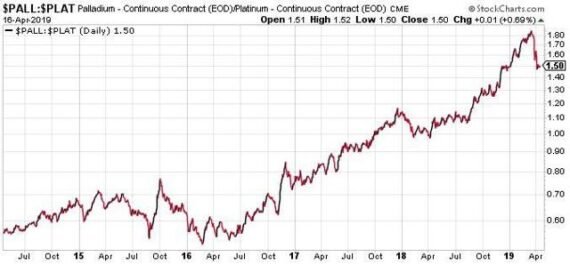
As a result of a favorable outlook, palladium prices have vastly outperformed platinum. While platinum used to command a much higher price than palladium, the roles have now been reversed, and palladium is now worth more. The chart below tracks the relationship between platinum and palladium prices.

Notice that at its peak in March, a troy ounce of palladium was worth almost two ounces of platinum. That ratio has now come down, and palladium is now worth 1.5 ounces of platinum. A significant change, but still far removed from the days when platinum was more expensive than palladium.

However, the fact remains that the gap between platinum and palladium has shrunk with platinum outperforming palladium during this time frame. The gap could continue to shrink, but it could also begin to widen as before. Which of the two is more likely to happen will depend on a few factors that should be taken into consideration.

Can platinum and palladium be substituted for one another in the manufacture of an autocatalyst?

The short answer is yes, but only to a certain extent. While platinum and palladium are more suitable and preferred in diesel and gasoline vehicles, respectively, it is not absolutely necessary. The more expensive palladium becomes relative to platinum, the more manufacturers may be inclined to look into replacing palladium with platinum in the manufacture of an autocatalyst. Not necessarily completely, but at least partially.

In theory, this should act as a cap on palladium relative to platinum. If the gap in prices between the two becomes too extreme, precious metal substitution could force the ratio between palladium and platinum to reverse and narrow. There would be less demand for palladium and demand for platinum would increase under these conditions. However, in practice, it is difficult to replace more expensive palladium with cheaper platinum.

The two precious metals are only needed in trace amounts, and the price difference would have to be very severe to make a noticeable difference in the final cost of a vehicle. It also takes a lot of time and expense to test that changes in precious metal composition in an autocatalyst meet desired specifications. In a nutshell, while it’s possible, it’s almost certainly not worth the trouble to replace platinum with palladium or vice versa.

Why gold prices affect platinum more than palladium

Unlike palladium, platinum prices are more prone to being influenced by the price of gold (GLD). The reason is because platinum is heavily used in jewelry, much more than palladium. Because of this, platinum is in direct competition with gold. In fact, people often have to decide which of the two, gold or platinum, they will select in a purchase.

People will more often than not pick gold, but they may be tempted to go for platinum if the former is much more expensive than the latter. Rising gold prices are, therefore, good for platinum because it makes platinum a more attractive substitute. But if gold prices fall, then there is less need for platinum because most people tend to prefer gold.

It’s, therefore, necessary that we look at gold when considering where platinum will go relative to palladium. The ratio between gold and platinum prices has changed recently as gold prices have gone down. A previous article discussing why gold is likely to face pressure can be found here.

The chart above tracks the relationship between platinum and gold prices. Notice that while an ounce of platinum was roughly equal to 60% of gold at its low, the ratio has gone up and is now at almost 70%. What this basically means is that platinum’s appeal as an alternative has declined versus gold. This should be seen as a negative for platinum demand, which could put downward pressure on the price of platinum.

Palladium looks to be priming itself for a big move

Palladium prices have been going sideways after a big drop from their recent highs. In fact, the chart pattern for palladium resembles that of a symmetrical triangle or a coil. If this technical analysis is correct, then a big move may be coming once consolidation is done. The triangle could resolve to the downside, but it’s more likely to continue the long-term trend, which is up.

Both the fundamental and technical pictures suggest that a move to the upside is the most probable outcome. In contrast, platinum is being held back by a number of issues as a previous article explains here. This would reverse the narrowing of the spread between platinum and palladium and, instead, widen the gap that exists.

The ratio between palladium and platinum has been stuck at around 1.5, as previous charts reveal. This ratio could decrease further, but the most likely path is for the ratio to resume its previous uptrend after the time it has spent consolidating. This would be consistent with the price of palladium outperforming that of platinum.

Palladium will outperform platinum

It’s important to mention that the long-term picture for platinum and palladium in terms of demand is not a good one. Recent research suggests that it will one day be possible to make an autocatalyst without the need for any precious metals such as platinum and palladium. If this happens, then both metals will be left without their biggest source of demand.

Furthermore, electrical vehicles are on the rise, and they do not emit the harmful emissions that platinum and palladium are tasked with reducing. The challenge for platinum and palladium will be to find new applications where they can be used. Otherwise, the future of platinum and palladium does not look all that bright.

Having said that, palladium is most likely to outperform platinum with both charts and supply and demand in its favor. There is still a shortage of palladium that the market will not be able to resolve in the short term. The supply deficit, combined with the recent consolidation in prices after a major correction, will most likely result in palladium rising again.

On the other hand, gold is under pressure, and it’s hard to see platinum doing well when gold is struggling. There is also a surplus of platinum that will not go away anytime soon. Therefore, barring a major supply disruption, such as a major strike that drastically reduces supplies, platinum is highly unlikely to do as well as palladium. Platinum may have outperformed palladium in recent weeks, but that should soon reverse.

Source: https://seekingalpha.com/article/4255191-supply-demand-outlook-favors-palladium-vs-platinum