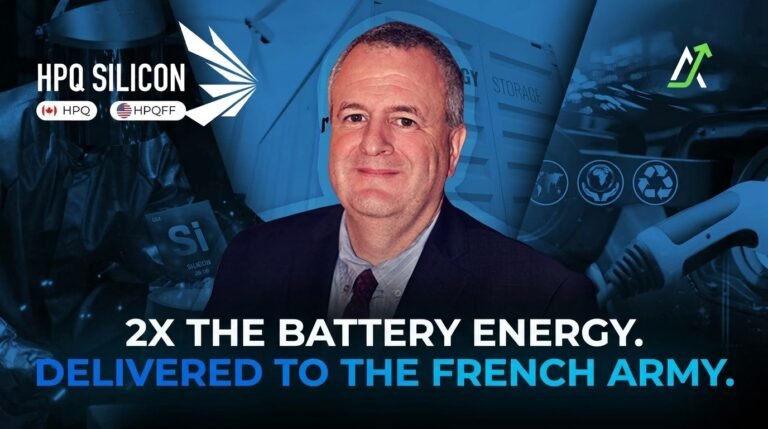
HPQ Silicon’s strategic partner Novacium has delivered the first batch of prototype tactical radio batteries to the French Army Technical Section (STAT) in Q3 2026, doubling the energy capacity of batteries currently in service while maintaining compatibility with existing connectors, chargers and interfaces. The design required only minor changes to dimensions and mass. For HPQ Silicon, which holds a 36.8% ownership stake in Novacium, the delivery marks a step toward evaluating its partner’s silicon anode battery technology under operational military conditions. In the interview, CEO Bernard Tourillon said the existing supplier had told the military that the requested improvement was not possible. Novacium has now delivered its first version of a solution, with field evaluation to follow.
WHAT YOU NEED TO KNOW
- Double the Energy: Batteries delivered to STAT in Q3 2026 pack 144 watt-hours of energy versus 72 Wh in the reference batteries, a 2X improvement with minor dimensional and mass changes.
- Engineering Advance: Novacium transitioned from 18650 to GEN3 21700 cells, achieving pack energy density of 261 Wh/kg versus 160 Wh/kg, approximately a 63% increase, while preserving compatibility with existing connectors, chargers and interfaces.
- Military Contract: STAT awarded the development and supply contract at the end of June 2026. Operational field evaluation and detailed user feedback (RETEX), expected in the coming weeks, will guide adjustments before the second batch.
- GEN4 Incoming: The second batch is planned to integrate GEN4 cells exceeding 6,500 mAh capacity, with the objective of increasing energy capacity at the same mass and improving potential operating time.
- Allied Forces Opportunity: If STAT’s evaluation confirms expected performance, the program could provide a technical basis for offering the solution to other allied forces with comparable requirements. Additional compatibility work may be needed for other militaries.
STRATEGIC IMPLICATIONS
The significance of this delivery is the combination of greater energy capacity and compatibility with equipment already in service. According to Tourillon’s interview account, the existing supplier had told the military that the requested improvement was not possible. Novacium developed and delivered a prototype solution under a STAT contract. That establishes a concrete engineering milestone, while operational performance remains subject to evaluation.
Novacium integrated its silicon-based anode expertise into GEN3 21700 cells and redesigned the pack arrangement and enclosure to double onboard energy while retaining existing connectors and chargers. Under a comparable usage profile, the battery is intended to provide up to twice the operating time of the reference battery. That could reduce battery changes or the number of spare batteries needed for a mission, but actual operating time and practical benefits will be assessed by STAT.
The potential extends beyond this French program, although broader adoption remains conditional. Tourillon said in the interview that businesses supplying other NATO militaries had approached Novacium to discuss possible cooperation. He also explained that the current battery was designed specifically for France and that a version with broader NATO compatibility would require further work. Separately, Novacium received an order for 100 drone battery packs from Alta Ares, announced September 17, 2026, and an order for French Army drone battery packs through LN’INNOV, announced August 19, 2026. These orders demonstrate commercial interest in its defence applications, rather than completed operational validation.
CEO Bernard Tourillon:
“The delivery of this first batch illustrates Novacium’s ability to transform its anode-material expertise into batteries designed for critical applications. If the evaluation phase confirms the expected performance, this program could provide a technical basis for offering the solution to other allied forces with comparable requirements. For HPQ, this program also illustrates the strategic value of our 36.8% interest in Novacium and of its activities in the defence sector.”
INVESTOR TAKEAWAY
HPQ Silicon’s October 6, 2026 announcement confirms that Novacium delivered the first prototype batch in Q3 2026 under a contract awarded at the end of June. The milestone moves the program from battery development and internal testing into a STAT operational evaluation. Novacium has reported achieving the project’s initial objectives of doubling energy capacity and limiting geometric modifications to preserve equipment compatibility. The next stage will determine how the batteries perform under operational conditions.
A successful evaluation could strengthen Novacium’s technical reference for discussions with other allied forces and potential customers. Its announced drone battery orders provide additional evidence of customer interest. However, the supplied sources do not establish completed field validation for those applications, wider NATO adoption or larger production contracts.
HPQ holds exclusive North American commercialization rights to the technologies developed with Novacium, including its GEN3 and GEN4 silicon-based anode technologies. The next checkpoint is STAT’s operational evaluation and the RETEX feedback expected in the coming weeks. That feedback will guide a second batch incorporating GEN4 cells and design adjustments, with the aim of evaluating robustness, ergonomics and reproducibility for potential larger-scale deployment. For investors, the significance is a delivered prototype under a military development contract, with further evaluation and commercialization steps still ahead.
Last modified: October 6, 2026