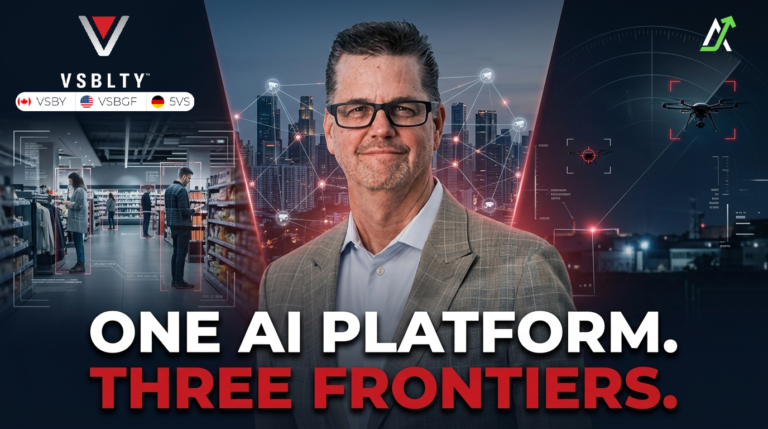
In a recent video interview with AGORACOM, VSBLTY Groupe Technologies Corp. CEO Jay Hutton explained how the company is working to transform cameras from passive recording devices into tools that help operators identify and respond to events in real time.
The discussion covered three markets: retail analytics and media, smart cities and public safety, and defense. Across those applications, VSBLTY combines a common software foundation with specialized capabilities and regional partners.
With an announced defense pilot purchase order of up to approximately US$2.5 million, a retail media joint venture involving Grupo Modelo, and partnerships targeting India and the Philippines, the interview gives investors a closer look at the company’s commercial strategy.
Hutton also describes a $1.5 billion opportunity. That is management’s estimate of prospective business, rather than contracted backlog or recognized revenue. The interview does not specify the currency or calculation methodology.
AGORACOM Beyond The Mic Feature Article
Issued On Behalf Of VSBLTY Groupe Technologies Corp.
The Core Problem: Cameras Everywhere, Intelligence Needed
Cameras are widespread across stores, buildings, streets and infrastructure. Their usefulness, however, depends on how effectively people can interpret the information they collect.
VSBLTY’s proposition is to help operators identify relevant events as they unfold.
Hutton describes a shared technology foundation serving three principal markets:
- Retail marketing analytics
• Smart cities and public safety
• Defense and drone detection
The company uses edge computing, which processes information close to cameras and sensors, alongside software that combines different data inputs.
In retail, the objective is to help brands understand shopper engagement near the point of purchase. In public safety and defense, the objective is to help operators interpret activity, identify potential threats and direct their attention where needed.
Hutton emphasizes that the technology is intended to augment human operators.
Retail Validation: The Grupo Modelo Joint Venture
One of VSBLTY’s established commercial relationships is Winkel Media, a joint venture involving VSBLTY, Retailigent Media and Grupo Modelo, an AB InBev subsidiary.
The venture’s stated objective has included building a retail media network reaching up to 50,000 locations over its life.
Hutton says the network now reaches several thousand stores. He also acknowledges that growth has been slower than originally anticipated and that it has not reached the 50,000 location objective.
He describes a relationship that has continued through challenges, including COVID-related disruption, and has involved partner-funded development of additional software capabilities.
The commercial proposition centers on understanding what happens near the shelf and cooler. Hutton says VSBLTY’s technology helps brands measure audience characteristics and engagement with in-store media, providing information that has historically been easier to collect online.
That information can support advertising and promotions near the point of purchase.
Hutton also discusses potential expansion beyond Latin America. He presents that as an expectation, rather than a completed rollout or guaranteed timetable.
For investors, the relationship provides an established commercial application to follow. The financial test is how network activity translates into revenue and cash collections for VSBLTY.
Defense Breakthrough: An Initial Pilot And Multi-Sensor Fusion
Defense is another major strategic focus.
On April 9, 2026, VSBLTY announced a contract and initial purchase order from CRS Inc., a U.S. systems integrator, supporting a national defense organization outside North America.
The pilot purchase order covers services and software licensing, with a not-to-exceed value of approximately US$2.5 million.
The announcement establishes an initial program. It does not establish that a broader production rollout has been completed or that the full purchase order value has been recognized as revenue.
In the interview, Hutton explains the underlying challenge through an illustrative mountain pass scenario: how can operators understand activity across difficult terrain when information comes from multiple sources?
Those sources can include:
- Radar and cameras
• Drones and satellite data
• Radio frequency monitoring
• Acoustic and other ground sensors
VSBLTY’s software is designed to combine those inputs into a unified intelligence environment.
The value, as Hutton describes it, comes from correlating observations. One sensor may provide limited information, while several inputs together can help operators develop a clearer understanding of a potential threat.
Hutton also clarifies where VSBLTY fits within a defense system. Its software provides detection and intelligence that can inform separate countermeasure systems. Those systems handle the physical response.
His references to particular weapons systems illustrate that distinction and should not be interpreted as confirmation of integrations with those systems.
Market Opportunity And The Drone Detection Imperative
The interview explores how evolving airborne threats can create demand for different detection approaches.
Hutton’s central argument is that no single sensor provides every answer. Different technologies can reveal different aspects of a potential threat, making the ability to combine information valuable.
For VSBLTY, potential applications include:
- Defense installations and borders
• Energy facilities and pipelines
• Data centers
• Other critical infrastructure
The company’s opportunity is to supply software that helps operators interpret sensor information and supports response decisions.
These applications provide context for VSBLTY’s strategy. Their commercial significance will depend on customer requirements, procurement decisions, successful integration and delivery.
Broad demand for infrastructure protection does not, by itself, establish future contracts or revenue for the company.
Strategic Partnerships: India, Saudi Arabia And The Philippines
VSBLTY’s international approach relies on working with organizations that already understand their local markets.
Hutton explains that the company aims to contribute software capabilities that complement partners’ relationships, infrastructure and delivery resources.
That approach allows VSBLTY to pursue opportunities without building a large direct sales operation in every country.
India: QuadGen Wireless And The Smart-City Opportunity
India is a recurring focus throughout the interview.
VSBLTY’s November 5 announcement describes a strategic platform licensing partnership with QuadGen Wireless Solutions, a Bangalore-based smart-city infrastructure company.
The license includes VSBLTY’s edge device, edge perception, multi-sensor data fusion, operational intelligence and analytics software.
The partnership targets smart-city and public safety applications across India’s government markets.
The company’s announcement identifies certification changes and domestic manufacturing requirements as potential drivers of demand for locally delivered solutions.
Hutton says VSBLTY has undertaken development and validation work to support its India strategy. He also acknowledges that the scale of the QuadGen relationship has yet to be proven.
A key technology component is VSBLTY Edge, co-developed with AirBrij Technology.
The device processes AI close to connected cameras, reducing reliance on sending video to a centralized data center for analysis.
Hutton also describes the ability to switch to available cellular, Wi-Fi or satellite connections when a primary connection fails.
The potential economic benefit is illustrated by one application in India. Hutton says an edge architecture reduced telecom costs by 85% compared with the centralized approach it replaced.
He explicitly cautions that the result is one example, rather than a template for every deployment.
The QuadGen partnership provides a route into the market. Its financial contribution will depend on subsequent project awards and execution.
Saudi Arabia: Regional Relationships And Market Access
Hutton discusses relationships involving Burkhan and Al Jaber Group as part of VSBLTY’s efforts in Saudi Arabia and the broader region.
He describes Al Jaber Group as a significant shareholder group and says its relationships have helped the company pursue traction in Saudi Arabia.
VSBLTY has also announced the availability of its drone detection and intelligence platform for the Gulf region.
The strategic point is market access: working with organizations that bring local knowledge and relationships.
Those connections provide context for prospective business. They do not establish that every opportunity discussed in the interview has become an awarded contract.
The Philippines: Brightside And Satellite-Connected Intelligence
In April 2026, VSBLTY announced a binding Letter of Intent with Brightside Group S.A. to collaborate on opportunities combining AI intelligence with satellite infrastructure in the Philippines.
The announcement identifies binding confidentiality and noncircumvention provisions and a commitment to jointly pursue defense, public safety, critical infrastructure and commercial opportunities.
The proposed approach connects local sensors, AI processing and communications infrastructure to support intelligence applications in environments where connectivity may be constrained.
In the interview, Hutton discusses prospective ground infrastructure, intelligence applications and body-worn camera opportunities.
He describes eight projects, while emphasizing that the work is at an early, “blueprint level” stage and will take time to generate revenue.
That qualification matters. The LOI provides a framework for pursuing business, rather than confirmation that the contemplated projects have been awarded to VSBLTY.
The Technology: Edge AI And A Shared Operational Picture
A common software foundation connects VSBLTY’s retail, smart-city and defense applications.
Edge processing allows information to be analyzed close to where it is collected. Depending on the deployment, that can reduce the need to transmit video to centralized facilities and help address customer requirements for local processing.
It does not automatically establish privacy compliance, uninterrupted connectivity or data sovereignty in every application.
In defense, Hutton describes combining separate sensor inputs into a shared operational view.
He uses the analogy of operators at different monitoring stations who traditionally coordinate by talking to one another. VSBLTY’s software is designed to help bring those observations together.
Hutton also describes an agentic AI layer that allows operators to ask questions about the combined information in plain language.
His example involves follow-up questions about people detected near a border crossing. It illustrates the intended functionality, rather than documenting a specific operational incident.
Across the applications, the proposition is to help people make better use of the information available to them.
Looking Ahead: Management’s $1.5 Billion Pipeline Estimate
Near the end of the interview, Hutton describes a $1.5 billion opportunity pipeline.
The interview does not specify the currency, calculation methodology, expected timing or probability of individual opportunities converting into contracts.
The figure should therefore be understood as management’s estimate of prospective business.
Hutton’s closing emphasis is on methodical execution. He says management intends to focus on advancing opportunities and delivering the business rather than allowing short-term market movements to dictate its decisions.
For investors, the measurable milestones remain:
- Delivery against existing commitments
• Conversion of opportunities into signed contracts
• Revenue recognition and cash collection
• The resources required to support execution
VSBLTY’s interview presents a company applying a shared technology foundation across three markets, with commercial relationships at different stages.
Winkel Media provides an established retail joint venture relationship. The CRS defense pilot provides an initial purchase order with a defined value ceiling. QuadGen provides an India licensing partnership. Brightside provides an LOI framework for pursuing opportunities in the Philippines.
The next chapter is whether those relationships and capabilities translate into repeatable deployments, sustainable revenue and cash.
TO WATCH THE FULL VIDEO GO TO: https://youtube.com/playlist?list=PLfL457LW0vdKCin6ZCNyXUQIkzbRYajTj&si=2ZEIM5naMmNB2fDe
AGORACOM Beyond the Mic is Powered by AGORACOM’s AI Content Agents.
VSBLTY Groupe Technologies Corp. Is A Client Of AGORA Internet Relations Corp. https://agoracom.com/ir/Agoracomupdates/forums/discussion/topics/796135-DISCLAIMER-AND-DISCLOSURE/messages/2399000
Last modified: November 12, 2026