Posted by AGORACOM-JC
at 3:46 PM on Wednesday, March 18th, 2020
SPONSOR: Tartisan Nickel (TN:CSE)
Kenbridge Property has a measured and indicated resource of 7.14
million tonnes at 0.62% nickel, 0.33% copper. Tartisan also has
interests in Peru, including a 20 percent equity stake in Eloro
Resources and 2 percent NSR in their La Victoria property. Click her for more information
—————————-
Volkswagen to start using high-nickel EV batteries
Volkswagen is aiming to produce 3 million electric cars by 2025.
Company is also embarking on producing EV battery as well.
Reuters
FRANKFURT: Volkswagen will raise the amount of nickel
used in it electric car battery cells to 80% in the next year from 65%
at present, Frank Blome, head of battery cells at the carmaker said on
Tuesday.
Volkswagen’s current electric car battery cell contains 65% nickel, 15% cobalt and 20% manganese. Next generation batteries will have 80% nickel, 10% cobalt and 10% manganese, Blome told analysts on a call.
Volkswagen
is embarking on a mass production push to build 3 million electric cars
by 2025, requiring 300 gigawatt hours worth of battery cells, mainly in
Asia and Europe, he said.
Ramping up manufacturing battery packs
at scale will help the carmaker to cut battery cell costs far below
$100 per kilowatt hour by 2025, he said.
Posted by AGORACOM-JC
at 2:50 PM on Wednesday, March 18th, 2020
SPONSOR: BetterU Education Corp.
aims to provide access to quality education from around the world. The
company plans to bridge the prevailing gap in the education and job
industry and enhance the lives of its prospective learners by developing
an integrated ecosystem. Click here for more information.
FROM THE DESK OF BRAD LOISELLE:
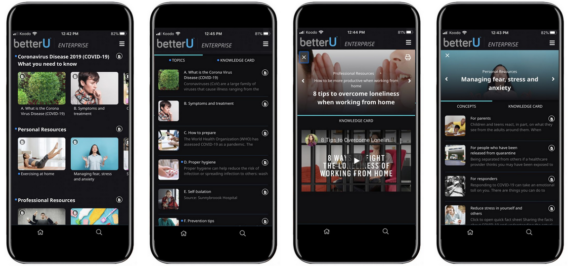
I hope you are well. betterU, in partnership with several of our content partners, have decided to assemble a COVID-19 All-In-One
resource toolkit available on mobile through betterU’s Ready-To-Go
platform. We have decided to make it available for FREE to support you,
your families, coworkers, employees, friends and our communities. We
want to get this in the hands of as many people as possible so feel free
to share the link.
The noise of the media is creating confusion, fear and panic, while
becoming more difficult to determine what is true or false. The app
includes access to all the most relevant COVID-19 information assembled
from leading sources around the world such as the World Health
Organization, CDC and more. It includes content in the form of videos,
text, PDFs, graphics and links. It also includes resources to support
your personal well-being as well as professional challenges of working
from home. We will be adding more content to continue to support
community needs.
Posted by AGORACOM-JC
at 1:03 PM on Wednesday, March 18th, 2020
SPONSOR: CardioComm Solutions (EKG: TSX-V)
– The heartbeat of cardiovascular medicine and telemedicine. Patented
systems enable medical professionals, patients, and other healthcare
professionals, clinics, hospitals and call centres to access and manage
patient information in a secure and reliable environment.
Why 5G enabled healthcare is important for patients and spatial computing
By empowering new tools, 5G enabled healthcare may help aid in caring for patients and preparing for complex medical procedures.
While augmented reality (AR), virtual reality (VR) and spatial computing are already being used in healthcare on a limited basis, 5G enabled healthcare may eventually further enhance a doctor’s ability to deliver innovative, less invasive treatments.
Among 5G’s many ultimate potential applications, some of the most exciting involve its role in simulating complex medical scenarios and enabling alternative treatments for the critically ill.
5G enabled healthcare
5G is the fifth generation of cellular wireless technology, which can
offer massive connection power and fast internet speed for data
transfer. Implementation of 5G technology accelerated the demand for
various healthcare technologies such as the Internet of Medical Things, AR/VR, artificial intelligence (AI), remote medical learning, and remote patient monitoring to name a few.
Patient real time information is important data for doctors to take
decisions in a critical situation. This has accelerated the demand for
advanced technologies in the healthcare sector. For instance,
telemedicine requires an advanced network that offers support in real
time, providing high-quality video communication without slowing down
the facility’s network. Integration of 5G network in existing
infrastructure provides real time data transfer of images, documents,
and real time videos for video-based medical consultations, to improve
the quality of care.
North America held a dominant share of the global 5G enabled
healthcare services market in 2019. It is expected to continue its
dominance throughout the forecast period. The US and Canada are the
major countries that drive the 5G enabled healthcare services market in
the region.
Demand for 5G
The aging population is expected to increase the demand for advanced
solutions such as mHealth solutions, and home healthcare, which require
high-speed internet. According to the Population Reference Bureau, in
2018, 15% of the total North American population was above the age of 65
and is expected to reach 23% by 2050. Hence, the increasing aging
population is accelerating the demand for 5G enabled healthcare
services.
The 5G enabled healthcare services market in Asia Pacific is expected
to expand at a fast-paced CAGR during the forecast period. India,
China, Japan, and Australia are major countries of the 5G enabled
healthcare services market in the region.
Increasing adoption of advanced communication solutions in the
healthcare industry, majorly in developing countries where health care
systems are often unprepared to tackle the challenges of a growing
elderly population, has raised the need for high-speed internet services
in the healthcare sector. Hence, this augments the adoption rate of 5G
services in the healthcare industry.
Tags: EKG, mhealth, small cap stocks, stocks, tsx, tsx-v Posted in CardioComm Solutions | Comments Off on Why #5G enabled healthcare #Mhealth is important for patients and spatial computing SPONSOR: CardioComm Solutions $EKG.ca – $ATE.ca $TLT.ca $OGI.ca $ACST.ca $IPA.ca
Posted by AGORACOM-JC
at 12:53 PM on Wednesday, March 18th, 2020
SPONSOR: Datametrex AI Limited
(TSX-V: DM) A revenue generating small cap A.I. company that NATO and
Canadian Defence are using to fight fake news & social media
threats. The company announced three $1M contacts in Q3-2019. Click here for more info.
This stance-detecting AI will help us fact-check fake news
Fighting fake news has become a growing problem in the past few years, and one that begs for a solution involving artificial intelligence
Verifying the near-infinite amount of content being generated on news websites, video streaming services, blogs, social media, etc. is virtually impossible
Fighting fake news is a much more complicated challenge.
Fact-checking websites such as Snopes, FactCheck.org, and PolitiFact do a
decent job of impartially verifying rumors, news, and remarks made by
politicians. But they have limited reach.
It would be unreasonable to expect current artificial intelligence
technologies to fully automate the fight against fake news. But there’s
hope that the use of deep learning can help automate some of the steps of the fake news detection pipeline and augment the capabilities of human fact-checkers.
In a paper presented at the 2019 NeurIPS AI conference,
researchers at DarwinAI and Canada’s University of Waterloo presented
an AI system that uses advanced language models to automate stance
detection, an important first step toward identifying disinformation.
The automated fake-news detection pipeline
Before creating an AI system that can fight fake news, we must first
understand the requirements of verifying the veracity of a claim. In
their paper, the AI researchers break down the process into the
following steps:
Retrieving documents that are relevant to the claim
Detecting the stance or position of those documents with respect to the claim
Calculating a reputation score for the document, based on its source and language quality
Verify the claim based on the information obtained from the relevant documents
Instead of going for an end-to-end AI-powered fake-news detector that
takes a piece of news as input and outputs “fake†or “realâ€, the
researchers focused on the second step of the pipeline. They created an
AI algorithm that determines whether a certain document agrees,
disagrees, or takes no stance on a specific claim.
Using transformers to detect stance
This is not the first effort to use AI for stance detection. Previous
research has used various AI algorithms and components, including
recurrent neural networks (RNN), long short-term memory (LSTM) models,
and multi-layer perceptrons, all relevant and useful artificial neural network (ANN) architectures.
The efforts have also leveraged other research done in the field, such
as work on “word embeddings,†numerical vector representations of
relationships between words that make them understandable for neural
networks.
However, while those techniques have been efficient for some tasks
such as machine translation, they have had limited success on stance
detection. “Previous approaches to stance detection were typically
earmarked by hand-designed features or word embeddings, both of which
had limited expressiveness to represent the complexities of language,â€
says Alex Wong, co-founder and chief scientist at DarwinAI.
The new technique uses a transformer, a type of deep learning
algorithm that has become popular in the past couple of years.
Transformers are used in state-of-the-art language models such as GPT-2 and Meena. Though transformers still suffer from the fundamental flaws, they are much better than their predecessors in handling large corpora of text.
Transformers use special techniques to find the relevant bits of
information in a sequence of bytes instead. This enables them to become
much more memory-efficient than other deep learning algorithms in
handling large sequences. Transformers are also an unsupervised machine learning algorithm, which means they don’t require the time- and labor-intensive data-labeling work that goes into most contemporary AI work.
“The beauty of bidirectional transformer language models is that they
allow very large text corpuses to be used to obtain a rich, deep
understanding of language,†Wong says. “This understanding can then be
leveraged to facilitate better decision-making when it comes to the
problem of stance detection.â€
Transformers come in different flavors. The University of Waterloo
researchers used a variation of BERT (RoBERTa), also known as deep
bidirectional transformer. RoBERTa, developed by Facebook in 2019, is an open-source language model.
Transformers still require very large compute resources in the training phase (our back-of-the-envelope calculation of Meena’s training costs amounted
to approx. $1.5 million). Not everyone has this kind of money to spare.
The advantage of using ready models like RoBERTa is that researchers
can perform transfer learning,
which means they only need to fine-tune the AI for their specific
problem domain. This saves them a lot of time and money in the training
phase.
“A significant advantage of deep bidirectional transformer language
models is that we can harness pre-trained models, which have already
been trained on very large datasets using significant computing
resources, and then fine-tune them for specific tasks such as
stance-detection,†Wong says.
Using transfer learning, the University of Waterloo researchers were
able to fine-tune RoBERTa for stance-detection with a single Nvidia
GeForce GTX 1080 Ti card (approx. $700).
The stance dataset
For stance detection, the researchers used the dataset used in the Fake News Challenge (FNC-1),
a competition launched in 2017 to test and expand the capabilities of
AI in detecting online disinformation. The dataset consists of 50,000
articles as training data and a 25,000-article test set. The AI takes as
input the headline and text of an article, and outputs the stance of
the text relative to the headline. The body of the article may agree or
disagree with the claim made in the headline, may discuss it without
taking a stance, may be unrelated to the topic.
The RoBERTa-based stance-detection model presented by the University
of Waterloo researchers scored better than the AI models that won the
original FNC competition as well as other algorithms that have been
developed since.
Fake News Challenge (FNC-1) results: The first three rows are the
language models that won the original competition (2017). The next five
rows are AI models that have been developed in the following years. The
final row is the transformer-based approach proposed by researchers at
the University of Waterloo.
The organizers of FNC-1 have gone to great lengths to make the
benchmark dataset reflective of real-world scenarios. They have derived
their data from the Emergent Project, a real-time rumor tracker created
by the Tow Center for Digital Journalism at Columbia University. But
while the FNC-1 dataset has proven to be a reliable benchmark for stance
detection, there is also criticism that it is not distributed enough to represent all classes of outcomes.
“The challenges of fake news are continuously evolving,†Wong says.
“Like cybersecurity, there is a tit-for-tat between those spreading
misinformation and researchers combatting the problem.â€
The limits of AI-based stance detection
One of the very positive aspects of the work done by the researchers
of the University of Waterloo is that they have acknowledged the limits
of their deep learning model (a practice that I wish some large AI
research labs would adopt as well).
For one thing, the researchers stress that this AI system will be one
of the many pieces that should come together to deal with fake news.
Other tools that need to be developed in the area of gathering
documents, verifying their reputation, and making a final decision about
the claim in question. Those are active areas of research.
The researchers also stress the need to integrate AI tools into
human-controlled procedures. “Provided these elements can be developed,
the first intended end-users of an automated fact-checking system should
be journalists and fact-checkers. Validation of the system through the
lens of experts of the fact-checking process is something that the
system’s performance on benchmark datasets cannot provide,†the
researchers observe in their paper.
The researchers explicitly warn about the consequences of blindly
trusting machine learning algorithms to make decisions about truth. “A
potential unintended negative outcome of this work is for people to take
the outputs of an automated fact-checking system as the definitive
truth, without using their own judgment, or for malicious actors to
selectively promote claims that may be misclassified by the model but
adhere to their own agenda,†the researchers write.
Image credit: Depositphotos
This is one of many projects that show the benefits of combining artificial intelligence and human expertise.
“In general, we combine the experience and creativity of human beings
with the speed and meticulousness afforded by AI. To this end, AI
efforts to combat fake news are simply tools that fact-checkers and
journalists should use before they decide if a given article is
fraudulent,†Wong says. “What an AI system can do is provide some statistical assurance about
the claims in a given news piece. That is, given a headline, they can
surface that, for example, 5,000 ‘other’ articles disagree with the
claim whereas only 50 support it. Such as distinction would serve a
warning to the individual to doubt the veracity of what they are
reading.â€
One of the central efforts of DarwinAI, Wong’s company, is to tackle AI’s explainability problem.
Deep learning algorithms develop very complex representations of their
training data, and it’s often very difficult to understand the factors
behind their output. Explainable AI aims to bring transparency to deep
learning decision-making. “In the case of misinformation, our goal is to
provide journalists with an understanding of the critical factors that
led to a piece of news being classified as fake,†Wong says.
The team’s next step is to tackle reputation-assessment to validate
the truthfulness of an article through its source and linguistics
characteristics.
Posted by AGORACOM-JC
at 3:43 PM on Tuesday, March 17th, 2020
SPONSOR: Spyder Cannabis (SPDR:TSXV)
An established chain of high-end vape stores. Aggressive expansion
plan is already in place that will focus on Canadian retail and US Hemp
derived kiosks in high traffic areas. Click here for more info.
COVID-19 restrictions sparking a run on cannabis stores
By: Bruce Barcott and David Downs
They’re not closed yet! Customers are stocking up on cannabis this weekend, preparing for what could be more retail store restrictions in coming days.
As governors and mayors across North America order the shutdown of
bars, restaurants, and gathering events, cannabis stores are
experiencing a dramatic surge in sales that started over the weekend and
now continues into the work week. (Leafly has an updated page tracking store closures, openings, and new delivery allowances.)
Consumers are stocking up now, eyeing their potential future over in
Europe, where some nations have closed all retail outlets except food
stores and pharmacies.
Cannabis and coronavirus: Here’s what you need to know
On Saturday, Boston’s WGBH
broadcast images of customers lining up outside New England Treatment
Access (NETA) in Brookline, one of the few licensed cannabis stores
operating in Massachusetts. WGBH’s Tori Bedford reported:
In Brookline, marijuana dispensary New England Treatment Access has
eliminated all walk-in orders due to a high volume of customers, and
will now only serve customers who place orders in advance. “In light of
the current environment, we will remain open,†an announcement on the
NETA website reads, “but will move to Reserve Ahead only starting on
Saturday.â€
Inside the Brookline store, employees wear latex gloves, and bottles
of hand sanitizer and disinfectant spray sit beside each checkout
station. The process is efficient, a quick in-and-out, as compared to
the massive lines seen snaking around the parking lot of the shop in the
past few days, according to NETA employees.
Later Sunday, Boston Mayor Mary Walsh imposed new restrictions
on the city’s bars and restaurants. Those establishments will have to
cut their capacity in half, and close by 11pm every night. As of now,
there are no unusual restrictions on cannabis stores.
Also Sunday, the governors of Ohio and Illinois ordered all bars and restaurants closed. By mid-day Monday, similar orders had been issued in too many states to mention.
Posted by AGORACOM-JC
at 1:40 PM on Tuesday, March 17th, 2020
SPONSOR: NORTHBUD (NBUD:CSE) Sustainable low cost, high quality cannabinoid production and procurement focusing on both bio-pharmaceutical development and Cannabinoid Infused Products. The company recently received Canadian Cultivation Licence for its Quebec Facility. Learn More.
Amid coronavirus, Canadian cannabis stores see ‘unprecedented’ sales surge
Cannabis stores in Ontario and Alberta reported “unprecedented demand†as the country hunkers down to fight a worsening coronavirus outbreak, industry sources say
Executives told Marijuana Business Daily there is no threat to supply chains at this time, and safety measures have been put into place for employees and consumers.
Spiritleaf CEO Darren Bondar said his 46 stores “experienced an
unprecedented demand for cannabis over the weekend with sales up 20%
over the previous one and a record number of customers served.
“The supply chain remains in place, stores are stocked and we have seen an uptick in edible purchases.â€
Spiritleaf is encouraging online ordering via click-and-collect programs in British Columbia, Alberta and Ontario.
In most of Canada, provinces retain monopolies over cannabis
e-commerce with delivery. The click-and-collect program allows privately
owned stores to take payment online so customers can pick up their
orders in stores.
Ontario up 80%
Sales surged week-over-week at Ontario’s monopoly online cannabis
store, but some of that increased demand is attributable to lower
prices.
The government-owned store aggressively dropped prices on some products as part of an ongoing drive to improve competitiveness.
Mike Ravkine, who operates the popular price-tracking and inventory tool WhatsMyPot, recorded significant price drops at the Ontario Cannabis Store.
“The last three days have seen a marked increase in volume in sales
on OCS.ca and a high demand for our same day/next day delivery option
where it is available,†Daffyd Roderick, OCS communications director,
wrote in an email to Marijuana Business Daily.
“Some authorized retail stores are also reporting an increase in
customer volume. Saturday saw almost 3,000 orders, an 80% increase over
an average Saturday.â€
The OCS’ 4,000 orders Sunday represent a 100% increase from the previous week, officials told MJBizDaily.
Roderick said the OCS has sufficient inventory to meet demand.
“We are working closely with our partners and currently delivering and receiving as per our normal schedule,†he said.
Physical stores in Ontario are also seeing an increase in orders, noted Sessions Cannabis CEO Steven Fry.
“Not unlike major grocery retailers, Sessions Cannabis has seen a
significant increase in sales this week due to growing concerns
regarding COVID-19 social distancing protocols,†he wrote in an email.
Compared to the previous week, Fry said the Sessions on the Beach location in Toronto saw approximately:
A 10% more transactions per day.
A 10% increase in dollars spent per transaction.
A 21% overall sales growth.
B.C. ‘steady’
British Columbia’s online monopoly BC Cannabis Stores has not seen any new sales trends.
A spokesperson for the BC Liquor Distribution Branch (BCLDB), which
operates the store as well as the province’s cannabis wholesale system,
said there has been no change in sales online.
The BCLDB spokesperson also said sales on the wholesale side remain “very flat, steady.â€
Alberta Cannabis, the only legal online store in the province, said it is not sharing any information.
Quebec bump
Quebec’s monopoly online store also saw increased sales.
“Indeed, we have seen an increase in sales over the last days,†spokesman Fabrice Giguere wrote in an email to MJBizDaily.
Giguere said inventory levels, both online and in stores, are stable.
“We invite all customers returning from a trip abroad or who
experience flu-like symptoms to do their shopping directly online,†he
noted.
Safety first
Physical cannabis stores are taking measures to increase the health
and safety of customers and employees to support social distancing.
“Sessions Cannabis is taking extra measures to ensure the safety of
our customers and staff through increased cleaning and sanitation
measures and we will continue to monitor the situation to ensure a safe
shopping experience,†Fry said.
Bondar said Spiritleaf continues to follow all advice and government guidelines.
“All surfaces, door handles and employee stations are being sanitized
throughout the workday to maintain a clean, safe environment for all of
us,†he said.
“We encourage customers to check on store hours in the event that
they may change to accommodate various staff members’ needs to take care
of family members or who are returning from vacation and in
self-isolation, which has been happening at a few locations across the
country.
Posted by AGORACOM-JC
at 12:53 PM on Tuesday, March 17th, 2020
SPONSOR: BetterU Education Corp.
aims to provide access to quality education from around the world. The
company plans to bridge the prevailing gap in the education and job
industry and enhance the lives of its prospective learners by developing
an integrated ecosystem. Click here for more information.
Indian edtech industry to grow at an incredible rate in 2020
Not everyone has access to quality academic resources at school, but more and more people have a phone in their hands nowindicating how edtech is helping democratize education
At the same time, the consumer base is increasing phenomenally, paving way for opportunities not just in the academic space, but in vocational courses and skill development as well
With a robust rise in smartphone ownership and internet adoption, learning has become more personalized, convenient, and all-encompassing. Not everyone has access to quality academic resources at school, but more and more people have a phone in their hands nowindicating how edtech is helping democratize education. At the same time, the consumer base is increasing phenomenally, paving way for opportunities not just in the academic space, but in vocational courses and skill development as well.
AMIDST ALL THESE DEVELOPMENTS, HERE ARE SOME TRENDS THAT SIGNIFY HOW
THE EDTECH INDUSTRY IN INDIA WILL CONTINUE GROWING AT AN INCREDIBLE RATE
IN 2020, AND BEYOND:
With the proliferation of smartphones, there has been a significant
shift towards mobile-first solutions and products. In the edtech space,
mobile-first approach will become central for learner experience. There
are many effective ways for mobile learning to be tapped into which can
provide consumers an enhanced experience within a short-time span.
Because of this and other such factors, mobile-first learning products
will explode in the country’s edtech space.
There lies a massive opportunity in the space of vernacular content. A
report by Google India and KPMG estimated that as much as 73% of the
Indian internet users are going to interact in a regional language by
2021. Amid this, having an English-only approach for the platform will
limit the consumer base to a significant extent. Therefore, there is a
lot of scope for business in the vernacular market, and further scope
for them to play a role in bridging the country’s digital divide.
Indians are more than willing to pay for digital services now. Due to
a rise in disposable income, there has been certain income elasticity
towards expenditure on education-related products. This indicates how
across various income levels, Indian consumers are willing to invest in
value-added online learning products and platforms. The ‘freemium’ model
has also led to the rise of paid models by facilitating free trials for
better decision-making on the consumers’ end.
These are some of the several innovations and developments taking
place in various fields of edtech, leading to new delivery methods,
improvement in student engagement tactics, democratized access to
education, personalized experiences, and more. India has a large
consumer base and there are diverse categories of learners, learning
modes, courses, and outcomes that entrepreneurs in the edtech space, or
edupreneurs’ can explore. With our classrooms, workplaces, and job
markets changing owing to the rapidly emerging technologies, edtech has
become all the more relevant today, and will continue to positively
impact more and more people across the country in 2020, and beyond.
Authored article by Micha Borkowski, CEO and co-founder of Brainly, an edutech startup.
Posted by AGORACOM-JC
at 9:50 AM on Tuesday, March 17th, 2020
(NAM:TSXV)
A Green Metals Company
New Age Metals has two divisions which focus on the exploration and development of green metals: Platinum Group Metals and Lithium
i.) PGM Division: focus on development of the 100% owned River Valley PGM Project.
ii.) Lithium Canada: focus on exploration of hard rock lithium, in Manitoba, Canada.
Eric Sprott is a strategic shareholder and has an 18.56% ownership of the Company’s current issued and outstanding shares on a post conversion beneficial ownership basis
Largest 100% owned undeveloped primary PGM project in North America, Palladium is the main payable metal accounting for 65% of revenue stream based on 2019 PEA.
1:0.4 (Pd:Pt).
Excellent infrastructure and within 100 kilometers of the Sudbury Metallurgical Complex.
NI 43-101 Mineral Resource Estimation Q1 2019.
PEA Q3 2019.
2020 plan to follow up on PEA recommendations.
Preliminary Economic Assessment demonstrates positive economics for a large-scale open pit mining operation.
PEA Highlights (CDN$):
Life of mine (LOM) of 14 years, with 6 million tonnes annually of potential process plant feed at an average grade of 0.88 g/t Palladium Equivalent (PdEq) and process recovery rate of 80%, resulting in an annual average payable PdEq production of 119,000 ounces.
Pre-Production capital requirements: $495 M.
Undiscounted cash flow before income and mining taxes of $586M.
Undiscounted cash flow after income and mining taxes of $384M.
Average unit operating cost of $19.50/tonne over the life-of-mine.
Potential for up to 325 jobs at the peak of production.
Using March 11, 2020 spot Palladium price (US$2,275/oz) River Valley Project After-tax IRR is 30% and After-tax NPV (5%) is $C858M.
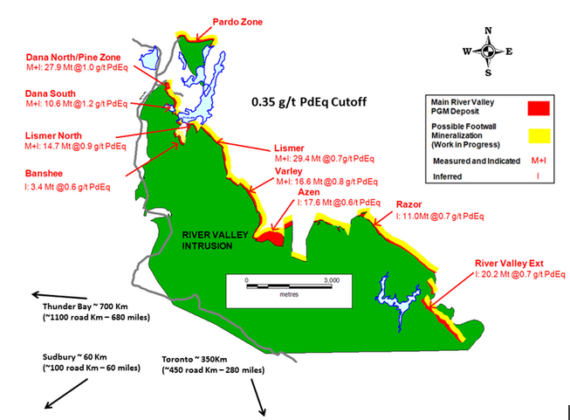
Figure 1: River Valley Project site map including results from the 2019 Mineral Resource Estimate by zone.2020 River Valley Project Exploration & Development Plan
Management has developed a three-phase exploration and development plan for the balance of 2020.
Phase One will focus on drilling to expand the boundaries of the Pine Zone discovery and to generate rhodium data for future mineral resource estimations.
Phase Two will involve drill testing further geophysical targets in the Northern area of the project, identified in the 2017/2018 induced polarization surveys. The target areas to be drill tested in this program are outlined in Figure 1.
Finally, Phase 3 will be focused on metallurgy – with the primary objective being to improve process recoveries of platinum metals, particularly palladium and including rhodium. We plan to start Phase 1 in early Q2-2020.
Note that each phase is contingent on success from the previous phase.
On April 18, 2018 New Age Metals acquired the Genesis Platinum Group Metals Project.
Figure 3: Genesis Project location map. The road accessible Genesis PGM-Cu-Ni Project adjacent to Richardson Highway and 138 kv electric lines. The project is 460 road kilometers to Fairbanks, Alaska and 120 road kilometers to the all-weather port city of Valdez
The Genesis project’s PGM-Cu-Ni mineralization is hosted in the Tonsina mafic-ultramafic complex, an undrilled, virtually unexplored layered mafic-ultramafic complex. Recent petrology indicates the Genesis mineralization is similar to the Stillwater and Great Dyke complexes.
Known PGM mineralization covers a distance of 9 km across the prospect.
The Genesis PGM-Cu-Ni Project is an under explored, highly prospective multi-prospect drill ready property that warrants follow-up drilling, additional surface mapping, sampling to expand the known footprint of mineralization and to determine the ultimate size and grade of the layered mineralization outlined to date.
The stable land status, ease of access and superb infrastructure make this project prospective for year-around exploration, development and production.
Summer 2019 exploration efforts doubled the strike length of prospective mineralization at our road accessible Genesis PGM-Ni-Cu Project in Alaska.
Currently, New Age is seeking an Option/Joint Venture Partner to assist in the exploration and development of this project.
New Age Metals is the largest mineral claim holder in the prolific, Winnipeg River – Cat Lake Pegmatite Field. All of the claims are held by Lithium Canada Development, a 100% owned Lithium Division of New Age Metals. The company presently has eight Lithium Projects in the region which are along strike of the Tanco Pegmatite and the claims encompass several pegmatite groups.
Situated around the Tanco Mine which in 2019 was acquired by Chinese miner Sinomine, the projects are located 140 kilometres northeast of Winnipeg, Manitoba.
Three of the projects are considered drill ready. Lithium One, Lithium Two and Lithman West
Active exploration of the claim holdings is ongoing.
New Age Metals has signed an exploration agreement with the Sagkeeng
First Nation in regards to the exploration and development of any of
the company’s claims that are located on traditional Sagkeeng
territories.
The Tanco Mine was one of North America’s only producers of
Tantalum, Cesium and Lithium minerals (Spodumene), with the mine opening
in 1969. Owned by the Cabot Corporation as of 1993 until 2019, when
Chinese miner Sinomine purchased from Cabot for US$130M.
Presently the Tanco Mine produces Cesium Formate, a completion fluid for the petroleum industry.
Management is actively seeking a qualified
and dedicated Option Joint Venture Partner to assist in the exploration
and development of these highly prospective projects.
COLUMBUS, Ohio -With 9 in 10 Americans favoring legalization of Marijuana for recreation or medicinal purposes and New York weeks away from a decision, aging expert Lisa Cini shares details of marijuana and cannabidiol (CBD) usage among the 11,000+ boomers who responded to her marijuana survey and answered a variety of questions on marijuana consumption, opinion, and usage.
“It’s time to mainstream senior-friendly tools for using marijuana,
and consider implications for designing seniors’ living spaces, or help
those marijuana-using seniors living in multi-generational homes to
partake in designated ways and areas as not to offend family members who
don’t use, including children and grandchildren.â€Tweet this
“I’m not surprised that 83% of the respondents are using some form of
cannabis for recreational and medical reasons. 66% partake daily and
believe that marijuana and/or CBD use is an important component of their
lives,†says Lisa Cini, senior living expert and author of BOOM: The Baby Boomers Guide to Leveraging Technology, so that you can Preserve Your Independent Lifestyle & Thrive. “Don’t
forget that much of the boomer generation grew up smoking weed. Some
never stopped, resumed in retirement, or when they were no longer
raising children. Because the aging process is unforgiving as it relates
to pain, seniors are finding relief from achy bones and joints,
arthritis, sleeplessness, and many other ailments, proving that there’s a
great deal more to marijuana than just getting high, especially for
those battling health and comfort challenges.â€
Seniors are using weed in any number of ways, from smoking to baking
and preparing full meals with cannabutter for many perceived health
benefits including relief from insomnia, anxiety, chronic pain,
depression, muscle tension, arthritis, and migraines in addition to
getting high.
For those who desire CBD without THC, popular brands like vitafusion™
now offer gummy vitamins with full spectrum hemp extract and natural
phytocannabinoids (225mg & 10mg CBD per gummy), Blissful Sleep with
5mg Melatonin (300mg with 10mg CBD per gummy) to induce sleep, and
Chillaxed Mood with natural phytocannabinoids & 10mg L-Theanine (300
mg & 10mg CBD per gummy) to promote calm mental alertness, in
contrast to the restless energy sometimes produced by caffeine. CBD
creams and other skin care products are touted for anti-aging and appeal
to boomers. CBD Anti-Aging Cream with Apple Stem Cells, was voted #1
Best Anti-Aging CBD Skin Cream in 2019 and for those with sensitive
skin, Abinoid Botanicals Face Serum – Blue Chamomile & Hemp was
voted #2 best hemp cream.
“Marijuana and CBD use is a reality that can no longer be ignored, as
it’s very much a part of the daily lives of so many,†adds Cini. “It’s
time to mainstream senior-friendly tools for using marijuana, and
consider implications for designing seniors’ living spaces, or help
those marijuana-using seniors living in multi-generational homes to
partake in designated ways and areas as not to offend family members who
don’t use, including children and grandchildren.â€
Posted by AGORACOM-JC
at 5:22 PM on Monday, March 16th, 2020
SPONSOR: Datametrex AI Limited
(TSX-V: DM) A revenue generating small cap A.I. company that NATO and
Canadian Defence are using to fight fake news & social media
threats. The company announced three $1M contacts in Q3-2019. Click here for more info.
Synthetic media: The real trouble with deepfakes
By M. Mitchell Waldrop
The snapshots above look like people you’d know. Your daughter’s best friend from college, maybe? That guy from human resources at work? The emergency-room doctor who took care of your sprained ankle? One of the kids from down the street?
“Deepfakes play to our weaknesses,†explains Jennifer Kavanagh, a political scientist at the RAND Corporation and coauthor of “Truth Decay,â€
Nope. All of these images are “deepfakes†— the nickname for
computer-generated, photorealistic media created via cutting-edge
artificial intelligence technology. They are just one example of what
this fast-evolving method can do. (You could create synthetic images
yourself at ThisPersonDoesNotExist.com.) Hobbyists, for example, have used the same AI techniques to populate YouTube with a host of startlingly lifelike video spoofs
— the kind that show real people such as Barack Obama or Vladimir Putin
doing or saying goofy things they never did or said, or that revise
famous movie scenes to give actors like Amy Adams or Sharon Stone the
face of Nicolas Cage. All the hobbyists need is a PC with a high-end
graphics chip, and maybe 48 hours of processing time.
It’s good fun, not to mention jaw-droppingly impressive. And coming
down the line are some equally remarkable applications that could make
quick work out of once-painstaking tasks: filling in gaps and scratches
in damaged images or video; turning satellite photos into maps; creating
realistic streetscape videos to train autonomous vehicles; giving a
natural-sounding voice to those who have lost their own; turning
Hollywood actors into their older or younger selves; and much more.
Deepfake artificial-intelligence methods can map the face of, say,
actor Nicolas Cage onto anyone else — in this case, actor Amy Adams in
the film Man of Steel.
Yet this technology has an obvious — and potentially enormous — dark
side. Witness the many denunciations of deepfakes as a menace,
Facebook’s decision in January to ban (some) deepfakes outright and
Twitter’s announcement a month later that it would follow suit.
“Deepfakes play to our weaknesses,†explains Jennifer Kavanagh, a political scientist at the RAND Corporation and coauthor of “Truth Decay,â€
a 2018 RAND report about the diminishing role of facts and data in
public discourse. When we see a doctored video that looks utterly real,
she says, “it’s really hard for our brains to disentangle whether that’s
true or false.†And the internet being what it is, there are any number
of online scammers, partisan zealots, state-sponsored hackers and other
bad actors eager to take advantage of that fact.
“The threat here is not, ‘Oh, we have fake content!’†says Hany
Farid, a computer scientist at the University of California, Berkeley,
and author of an overview of image forensics in the 2019 Annual Review of Vision Science.
Media manipulation has been around forever. “The threat is the
democratization of Hollywood-style technology that can create really
compelling fake content.†It’s photorealism that requires no skill or
effort, he says, coupled with a social-media ecosystem that can spread
that content around the world with a mouse click.