What You Need To Know
- Commercial-grade fumed silica achieved at pilot scale, triggering inbound interest
- New technology demand could push fumed silica beyond existing global capacity
- UL 1642 cell-level certification opens U.S. battery commercialization pathways
- Hydrogen is advancing toward defined remote and industrial energy use cases
Here’s how HPQ Silicon is moving from technical validation toward commercial execution across three advancing platforms.
FROM LAB RESULTS TO MARKET PULL
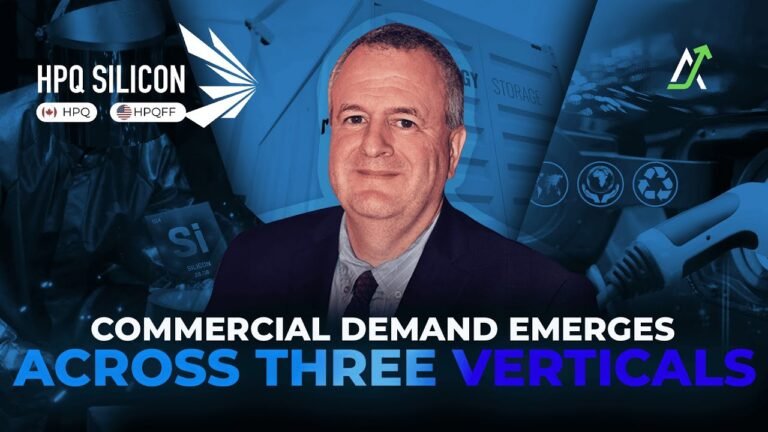
In this wide ranging discussion, Bernard Tourillon joins usto unpack what management describes as a turning point year. After years of development across three advanced material platforms, the conversation makes clear that HPQ is no longer operating in a purely R&D driven phase.
The shift began when HPQ successfully replicated commercial grade fumed silica at pilot scale. That milestone did more than validate the process. It triggered unsolicited outreach from multiple external groups tied to advanced technology infrastructure.
FUMED SILICA MOVES INTO STRATEGIC TERRITORY
Management outlined why fumed silica is increasingly being viewed as a strategic material rather than a niche industrial input. Emerging technology infrastructure requires materials that can withstand higher performance thresholds, and existing supply chains may not be positioned to respond quickly.
Today, roughly half of global fumed silica supply is produced in China. At the same time, traditional producers face long construction timelines, complex permitting, and high energy intensity when adding new capacity.
HPQ’s process takes a different approach by converting quartz directly into fumed silica in a single step. This enables faster permitting, simpler plant construction, and modular expansion once the first commercial facility is built.
The company believes this structural advantage could become increasingly relevant if demand accelerates faster than incumbents can scale.
BATTERY MATERIALS CROSS A COMMERCIAL GATE
On the battery side, HPQ achieved UL 1642 cell level certification, which management repeatedly described as a critical inflection point. Without this certification, customers face barriers related to insurance, transportation, and regulatory compliance.
With certification now in place, discussions can move from technical interest to practical execution.
According to Tourillon, this allows conversations to advance into customer qualification, volume planning, and partnership structures, particularly in the U.S. market. The company is now developing multiple battery iterations tailored to different performance profiles, including applications such as drones and mobility platforms.
Government involvement was also highlighted as a form of validation rather than dependence. Funding is structured to support ongoing scale up as milestones are met, rather than requiring full capital commitment in advance.
HYDROGEN SHIFTS FROM CONCEPT TO USE CASE
While hydrogen remains earlier in its commercialization timeline, management emphasized that its role is becoming more concrete. The technology is designed for decentralized energy environments where diesel remains the default option due to logistics and reliability constraints.
Examples discussed include northern housing developments, mining camps, and remote industrial sites. HPQ’s approach uses recycled aluminum as a stable energy carrier that can be stored indefinitely and activated on demand to produce energy and heat.
Tourillon noted that economics and demand visibility are improving, with expectations that early 2026 will begin to demonstrate clearer commercial validation for this platform.
THE SUM OF THE PARTS QUESTION
One of the most consequential moments in the interview came during a candid discussion about corporate structure. With all three platforms advancing simultaneously, management acknowledged that the current structure may not fully reflect underlying value.
“The reality is that the sum of our parts is bigger than the company.”
Tourillon confirmed that 2026 is likely the year when formal separation processes begin, with fumed silica identified as the most probable first candidate for independence. The company is already structurally prepared for this outcome through existing subsidiaries.
THE INVESTOR TAKEAWAY
This conversation was not about distant promise. It was about technologies that have reached validation, are attracting real world interest, and are now moving into monetization focused execution.
For investors, the key shift is not just progress within each vertical, but management’s willingness to address structure, prioritization, and value realization head on. HPQ is entering a phase where market results, not just technical milestones, are expected to define the next chapter.
Last modified: July 27, 2026