Posted by AGORACOM-JC
at 10:47 AM on Tuesday, January 7th, 2020
SPONSOR:ThreeD Capital Inc. (IDK:CSE)
Led by legendary financier, Sheldon Inwentash, ThreeD is a
Canadian-based venture capital firm that only invests in best of breed
small-cap companies which are both defensible and mass scalable. More
than just lip service, Inwentash has financed many of Canada’s biggest
small-cap exits. Click Here For More Information.
Bitcoin 2020: The Bottom is In and Prices are About to Surge, Several Analysts Claim
Bitcoin corrected by over 50% from the 2019 high of $13,880.
With the retracement in the last six months, some analysts believe that the bottom is in.
The number one crypto is flashing accumulation signals convincing
popular traders that the cryptocurrency has turned bullish in 2020.
Bitcoin may have started 2019 strong but ever since it posted a high
of $13,880 in June, the top cryptocurrency has been correcting. It
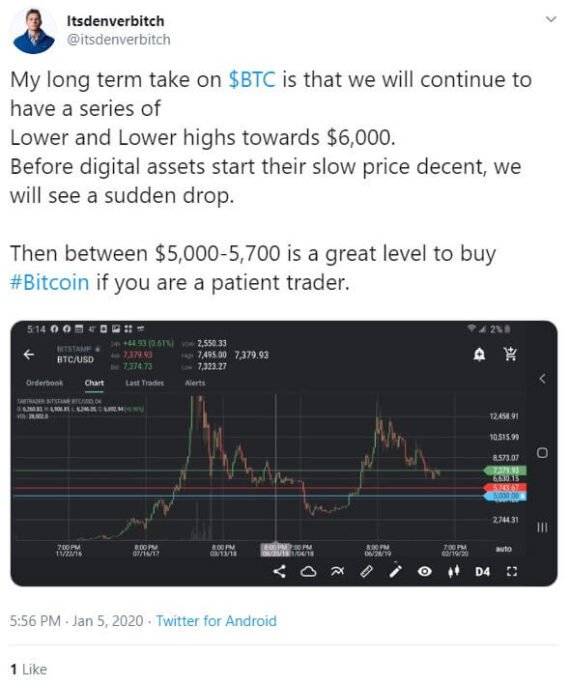
dropped to as low as $6,425 in December. At that point, bearish calls
for a revisit to $5,000 levels were strong.
One analyst expecting bitcoin to drop to $5,000. | Source: Twitter
Those who have been waiting to buy below $6,000 have been left out.
The digital gold is now trading above $7,000 and analysts are expecting
bitcoin to leave this price area soon. Many see a base being formed,
which can propel the number one cryptocurrency to greater heights early
this year.
Analysts Claim Bitcoin Has Bottomed Out
After a weak second half of 2019, it appears that the worst is behind
for the most dominant cryptocurrency. A number of widely-followed
analysts on Twitter say that bitcoin is carving a bottom.
For instance, Faisal Sohail believes that the cryptocurrency has
already tapped the bottom when it dropped to $6,475 in December. He
believes that the digital asset will trade between $7,000 and $12,000
before the halving.
” alt=”” aria-hidden=”true” />
Bitcoin to start climbing before the May 2020 halving. | Source: Twitter
User Bitcoin Macro supports Faisal’s view. In an emphatic tweet,
Bitcoin Macro exclaims that the bottom is already in. He also tells his
followers not to get shaken out.
Majin, Crypto Twitter’s biggest bull, has also turned bullish after
months of uncertainty. The liquidity game theorist believes bitcoin will
take off and leave $7,000 behind.
Accumulation Pattern to Send Bitcoin Above $11,600
BTC has been range trading between $6,700 and $7,600 since November
20, 2019. That’s a $900 range over 45 days. To many analysts, this is a
sign that a new base is being built to prepare bitcoin for the next leg
up, hence, the call for a bottom.
Charles Edwards, head of digital investment firm Capriole, sees a
potential accumulation pattern forming. More importantly, he believes
that the bottom is already in. According to Edwards, his bias would be
confirmed once bitcoin trades above $8,000.
Charles Edwards sees a Wyckoff accumulation pattern developing in bitcoin. | Source: Twitter
Edwards is not alone in seeing a pattern indicating that whales and
other smart money investors are accumulating the largest cryptocurrency.
Trader CryptoWolf also sees an accumulation pattern
developing. His bias will be confirmed once the price goes above
$8,090. A move above that level would also trigger the breakout from a
large falling wedge.
CryptoWolf’s initial target is $9,550 and then $11,600.
Bitcoin needs to take out $8,090 to gain bullish momentum. | Source: Twitter
Traders Starting to Have a Rosy Outlook
With these signals, other traders are expressing their optimism on
the prospects of the top cryptocurrency. The popular trader The Crypto
Dog tweeted that he’s bullish on bitcoin.
It is not everyday that The Crypto Dog posts bullish tweets on bitcoin | Source: Twitter
The widely-followed Crypto Rand shares The Crypto Dog’s upbeat outlook on the dominant cryptocurrency.
The Crypto Rand is also bullish on bitcoin | Source: Twitter
Is it a coincidence that the top analysts are tweeting bullish
statements on bitcoin as the top cryptocurrency prints an accumulation
pattern? Probably not. It’s very likely that these analysts are also
seeing the bottom or base-building signals on the number one coin. If
they’re right, then strap in. Bitcoin’s 2020 price action might start off with fireworks.
Posted by AGORACOM-JC
at 4:03 PM on Monday, January 6th, 2020
SPONSOR: New Age Metals Inc.
The company owns one of North America’s largest primary platinum
group metals deposit in Sudbury, Canada. Updated NI 43-101 Mineral
Resource Estimate 2,867,000 PdEq Measured and Indicated Ounces, with an
additional 1,059,000 PdEq Ounces Inferred. Learn More.
Palladium – The Prospects For A Repeat Performance
A fantastic year in 2019.
A rally for the ages since 2016.
A new decade poses threats to the rally.
Of the four precious metals that trade on the NYMEX and COMEX
divisions of the Chicago Mercantile Exchange, palladium is the least
liquid. As of December 27, the total number of open long and short
positions in the gold futures market stood at 765,653 contracts, a
record high representing 76.65 million ounces of the yellow metal.
Silver’s open interest was at 225,753 contracts that contain a total of
over 1.128 billion ounces of silver. A gold future represents 100 ounces
of the metal, while a silver contract has 5,000 ounces.
In platinum, 98,042 contracts hold over 4.9 million ounces of
platinum metal, as each contract is for 50 ounces. A palladium contract
is for 100 ounces of the platinum group metal. As of December 27, 23,735
contracts represented 2,373,500 ounces. Markets with less liquidity
when it comes to volume and open interest tend to be more volatile than
those with higher degrees of liquidity. Palladium has lived up to that
tendency since early 2016 as the price has been explosive on the upside.
The Aberdeen Standard Physical Palladium Shares ETF product (PALL)
replicates the price action in the palladium market. At the same time,
the Aberdeen Standard Physical Precious Metals Basket Shares ETF (GLTR) holds palladium as well as gold, silver, and platinum bullion.
A fantastic year in 2019
Palladium was, by far, the best-performing precious metal that trades
on the NYMEX or COMEX exchanges in 2019. Palladium’s price action was
impressive considering that as of December 27, gold, silver, and even
platinum have posted double-digit percentage gains compared to their
closing prices as of December 31, 2018.
Source: CQG
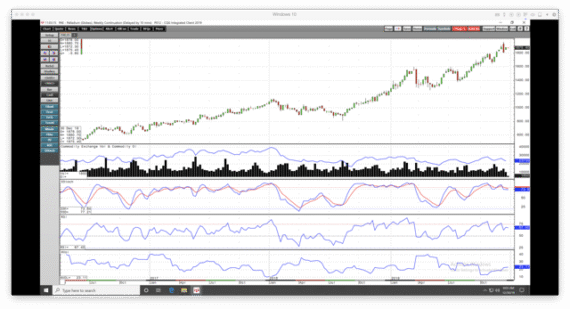
As the weekly chart highlights, palladium moved from $1197.50 on the
final day of 2018 to $1875.40 as of December 30, a gain of 56.6%.
Palladium climbed to its most recent continuous contract high of $1963
per ounce in December while the March futures contract peaked at
$1974.60.
Both price momentum and relative strength indicators were in
overbought territory on December 30, but the metrics came down from
recent highs given the correction on Friday, December 20. On the weekly
charts, palladium put in a bearish reversal during the week of December
16. On a year-on-year basis, the total number of open long and short
positions in the NYMEX palladium futures market edged lower in 2019,
falling from 26,773 to 23,735 contracts from the end of 2018. Meanwhile,
weekly historical volatility at 23.12% was just below the midpoint of
the year for the metric.
2019 was such a good year for palladium that it was the
best-performing commodity that trades on US exchanges of all during the
period.
A rally for the ages since 2016
The bull market in palladium kept going in 2019, but it dates back four years to the beginning of 2016.
Source: CQG
The monthly chart illustrates what has been a parabolic trend in the
precious metal since it found a bottom at $451.50 in January 2016. At
$1875.40, the price was over four times higher since the 2016 bottom.
Over four years, every price correction has been a buying opportunity in
the precious and industrial metal. The most recent decline from $1963
to $1808.80 during the week of December 16 was looking like another
opportunity to purchase palladium as the price recovered quickly to
around the midpoint as of December 30.
A new decade poses threats to the rally
Palladium has been nothing short of a bullish beast since early 2016.
The metal that cleanses toxins from the air in gasoline-powered
automobile catalytic converters has experienced significant demand
growth. With tighter pollution regulations around the world, and
specifically in China, the requirements for the metal continue to rise.
The vast majority of palladium output each year comes from South
Africa and Russia. According to Johnson Matthey, 2019 was the eighth
consecutive year of a deficit between supply and demand in the palladium
market, which continues to fuel price gains.
Source: Johnson Matthey
The chart shows that in May 2019, Johnson Matthey projected an
809,000-ounce deficit. The supply shortage was likely even higher as the
price of the metal rose from a low of $1256.50 in early May to over
$1875 per ounce at the end of 2019. The deficit remains significant as
the total annual global output of the metal is around seven million
ounces or 218 metric tons, and gross demand was 11.154 million ounces.
While recycled metal provided additional supplies of 3.349 million
ounces, it was not nearly enough to meet the growing demand.
While fundamentals could be telling us that the $2000 per ounce level
will give way in 2020, platinum is a denser metal with higher
resistance to heat than palladium.
Source: Johnson Matthey
The chart shows that Johnson Matthey projected that platinum would
also move into a deficit in 2019 after a surplus weighed on the price of
the precious metal in 2017 and 2018. Platinum rose from under $790 in
May to the $958 per ounce level on December 30.
Meanwhile, at an over $900 per ounce discount to palladium,
industrial consumers could begin to substitute platinum for palladium in
2020 as the deficit looks set to continue. Any improvement in global
economic conditions would likely increase demand for both platinum and
palladium in 2020.
The downside risk in the palladium market has increased dramatically,
given the four-fold price increase since January 2016. The bearish
price action and correction on December 20 could be a sign of things to
come as volatility is likely to continue to rise with the price of the
metal in 2020. Sudden price spikes to the downside could become the
norm, and if the deficit expands, price vacuums to the upside could
follow. Trading and investing in highly volatile commodities can be like
riding a psychotic horse through a burning barn. The parabolic price
action in the palladium market looks set to continue into the new
decade. However, the path to higher prices could be a wild ride.
PALL is the palladium ETF product
The most direct route for a risk position or investment in palladium
is via the physical market for bars and coins. The deficit and limited
supplies can make premiums to the market price very expensive for these
products. The NYMEX palladium futures have a delivery mechanism, which
guarantees smooth convergence between physical and futures prices during
delivery periods.
The Aberdeen Standard Physical Palladium Shares ETF product provides
an alternative to physical or futures. The most recent holdings of PALL
include:
Source: Yahoo Finance
PALL has net assets of $280.49 million, trades an average of 31,912
shares each day, and charges holders a 0.60% expense ratio. As of
December 30, the price of palladium was 56.6% higher in 2019.
Source: Barchart
The chart shows that PALL moved from $119.05 on December 31, 2018, to
$179.82 on December 30, 2019, an increase of 51% as it marginally
underperformed the price action in the continuous palladium futures
contract.
GLTR has some exposure to palladium, but is diversified
For those looking for a more diversified approach to precious metals
in 2020, the Aberdeen Standard Physical Precious Metals Basket Shares
ETF holds physical palladium as well as gold, silver, and platinum. The
most recent top holdings of GLTR include:
Source: Yahoo Finance
GLTR has net assets of $463.08 million, trades an average of 24,328 shares each day, and charges holders a 0.60% expense ratio.
Source: Barchart
GLTR closed at $63.16 at the end of 2018. At $76.13 per share on
December 30, the ETF product was a bit over 20.54% higher on the year.
Palladium looks like higher prices could be on the horizon in 2020 as
the metal approaches the $2000 per ounce level. However, it could be a
very bumpy ride as parabolic markets can suffer brutal setbacks. A 50%
rise in 2020 would put palladium over $2800 per ounce. If the price of
the metal is heading there, gold, silver, and platinum are likely to
experience significant gains.
The Hecht Commodity Report
is one of the most comprehensive commodities reports available today
from the #2 ranked author in both commodities and precious metals. My
weekly report covers the market movements of 20 different commodities
and provides bullish, bearish and neutral calls; directional trading
recommendations, and actionable ideas for traders. I just reworked the
report to make it very actionable!
I am offering a 20% discount for an annual subscription to my
service, The Hecht Commodity Report, through December 2019. With the
holiday spirit in mind, I am offering a free trial to the service. You
can sign up via this link. My seven comprehensive quarterly reports for subscribers will come out starting on the first day of 2020.
Disclosure: I/we have no positions in any stocks mentioned, and no plans to initiate any positions within the next 72 hours. I
wrote this article myself, and it expresses my own opinions. I am not
receiving compensation for it (other than from Seeking Alpha). I have no
business relationship with any company whose stock is mentioned in this
article.
Additional disclosure: The author always has
positions in commodities markets in futures, options, ETF/ETN products,
and commodity equities. These long and short positions tend to change on
an intraday basis.
Posted by AGORACOM-JC
at 3:53 PM on Monday, January 6th, 2020
SPONSOR: Tartisan Nickel (TN:CSE)
Kenbridge Property has a measured and indicated resource of 7.14
million tonnes at 0.62% nickel, 0.33% copper. Tartisan also has
interests in Peru, including a 20 percent equity stake in Eloro
Resources and 2 percent NSR in their La Victoria property. Click her for more information
Demand for nickel in PH to spike due to growing demand for electric vehicles
The nickel industry in the Philippines can expect a brighter prospect for 2020 as the global demand is expected to increase for the manufacturing of electric vehicles (EVs).
Cha Olea, Philippine Nickel Association (PNIA) executive director,
said in an interview on Friday that the association has seen an
increasing trend for electric vehicles worldwide, including the
Philippines, leading to a possible industry boom as a result of a shift
from fossil-run vehicles to more environment friendly electricity-run
vehicles to curb carbon emission.
“The primary component of EV battery is nickel because of the
batteries,†she said. Aside from nickel, Olea said the batteries also
need cobalt and magnesium, but 50 percent of the batteries for EVs are
made of nickel.
The executive added that manufacturing plants’ demand for stainless steel, which is also derived from nickel, would increase.
Members of the European Union targets to totally eradicate carbon
emission by 2030, while the United States has been slowly replacing
fossil-run vehicles with EVs, by offering incentives to owners of
electric vehicles.
“Nickel has a very good prospect in the future, especially that
Europe’s direction by 2030 is zero carbon emission. They are shifting to
electric vehicles,†Olea said.
She said the Philippines is one of the biggest producers of nickel in
the world, producing an estimated volume of 30 million metric tons last
year. Of which, around 90% had been exported to China while the
remaining 10% to Japan, Australia, and EU.
“Globally, they are looking for Philippines. Of course, we have to position ourselves strategically,†she said.
She noted that in the Philippines, some public utility vehicles had been replaced with e-tricycles and e-jeepneys.
Olea said at least 70% of the nickel ore extracted from the
Philippines would be used for stainless steel, 3% for other components,
6% for batteries of EVs, 2% for castings, 6% for plating, 9% non-ferrous
metals, and 4% for alloy steel.
She said the new opportunities in the global market would benefit the
domestic nickel industry. According to her, the mining industry in the
Philippines employs some 250,000 workers. (Antonio L. Colina IV /
MindaNews)
Tags: CSE, nickel, nickel demand, stocks, tsx, tsx-v Posted in All Recent Posts | Comments Off on Tartisan #Nickel $TN.ca – Demand for nickel to spike due to growing demand for electric vehicles #EV $ROX.ca $FF.ca $EDG.ca $AGL.ca $ANZ.ca
Posted by AGORACOM-JC
at 2:22 PM on Monday, January 6th, 2020
Patient Self-Monitoring Extends Physicians’ Reach for Proactive Monitoring of Atrial Fibrillation Recurrence and any Arrhythmia.
Confirms market traction with orders being placed by physician groups for the newly launched HeartCheck™ CardiBeat Handheld ECG monitor and GEMS™ Mobile Smartphone app for prescribed in-home arrhythmia monitoring
Dr. Yaariv Khaykin, Physician Lead at PACE and Chief Medical Information Officer at Southlake Regional Health Centre, stated, “We are very excited at the opportunity to introduce the use of this home-based ECG/arrhythmia monitoring technology to our patients empowering them to take greater charge of their health.”
TORONTO, ONTARIO / January 6, 2020 / CardioComm Solutions, Inc. (TSX VENTURE:EKG) (“CardioComm” or the “Company“), a global provider of consumer heart monitoring and electrocardiogram (“ECG“) device and software solutions, confirms market traction with orders being placed by physician groups for the newly launched HeartCheck™ CardiBeat Handheld ECG monitor and GEMS™ Mobile Smartphone app for prescribed in-home arrhythmia monitoring.
Partners in Advanced Cardiac Evaluation (“PACE“),
the largest arrhythmia practice in Ontario (Canada) placed a first order
of the HeartCheck™ CardiBeat Handheld ECG monitors and is recommending
its patients to use the devices for one year of in-home, self-monitoring
with an emphasis on detecting a recurrence of Atrial Fibrillation (“AF“)
following cardiac ablation treatment for AF. The Company confirms that
additional hospital affiliated physician groups have also purchased the
HeartCheck™ CardiBeat ECG devices for evaluation in their respective
practices with additional orders expected in early 2020.
AF is a life-threatening arrhythmia that is difficult to treat.
Cardiac ablation is a procedure commonly used to correct AF; however, AF
recurrence after ablation is common and can be “silent”, occuring
without any symptoms, discomfort or warning to the patient (See Note 1).
PACE patients will use the GEMS™ Mobile Smartphone app to record ECGs
taken by the HeartCheck™ CardiBeat which will then be automatically
forwarded by CardioComm’s SMART Monitoring ECG service directly into the
patient’s cardiologist’s Electronic Medical Record (“EMR”). Should any
submitted ECG recordings show a recurrence of AF or a presence of other
cardiac arrhythmias, the patients are contacted by PACE and follow-up
visits scheduled. ECG reports generated through GEMS™ Mobile are
eligible for medical service reimbursement in both Canada and the US.
Dr. Yaariv Khaykin, Physician Lead at PACE and Chief Medical
Information Officer at Southlake Regional Health Centre, stated, “We are
very excited at the opportunity to introduce the use of this home-based
ECG/arrhythmia monitoring technology to our patients empowering them to
take greater charge of their health.”
The GEMS™ Mobile app is available in Android and Apple Smartphone
compatible versions as a free downloadable app and allows users to
generate unlimited ECG reports to show to their physician. The app also
allows users to request their ECG to be reviewed by CardioComm’s SMART
Monitoring ECG reading service where the user does not have direct
connectivity to their treating physician.
To learn more about CardioComm’s products and for further updates
regarding HeartCheck™ ECG device integrations, please visit the
Company’s websites at www.cardiocommsolutions.com and www.theheartcheck.com.
CardioComm Solutions’ patented and proprietary technology is used in
products for recording, viewing, analyzing and storing
electrocardiograms for diagnosis and management of cardiac patients.
Products are sold worldwide through a combination of an external
distribution network and a North American-based sales team. CardioComm
Solutions has earned the ISO 13485:2016 MDSAP certification, is HIPAA
compliant and holds clearances from the European Union (CE Mark), the
USA (FDA) and Canada (Health Canada).
This release may contain certain forward-looking statements and
forward-looking information with respect to the financial condition,
results of operations and business of CardioComm Solutions and certain
of the plans and objectives of CardioComm Solutions with respect to
these items. Such statements and information reflect management’s
current beliefs and are based on information currently available to
management. By their nature, forward-looking statements and
forward-looking information involve risk and uncertainty because they
relate to events and depend on circumstances that will occur in the
future and there are many factors that could cause actual results and
developments to differ materially from those expressed or implied by
these forward-looking statements and forward-looking information.
In evaluating these statements, readers should not place undue
reliance on forward-looking statements and forward-looking information.
The Company does not assume any obligation to update the forward-looking
statements and forward-looking information contained in this release
other than as required by applicable laws, including without limitation,
Section 5.8(2) of National Instrument 51-102 (Continuous Disclosure Obligations).
Neither TSX Venture Exchange nor its Regulation Services Provider (as
that term is defined in policies of the TSX Venture Exchange) accepts
responsibility for the adequacy or accuracy of this release.
Tags: EKG, mhealth, small cap stocks, stocks, tsx, tsx-v Posted in CardioComm Solutions | Comments Off on Physician Groups Order The Heartcheck(TM) Cardibeat For In-Home Arrhythmia And Atrial Fibrillation Monitoring – CardioComm Solutions $EKG.ca $ATE.ca $TLT.ca $OGI.ca $ACST.ca $IPA.ca
Posted by AGORACOM-JC
at 11:57 AM on Monday, January 6th, 2020
SPONSOR: BetterU Education Corp.
aims to provide access to quality education from around the world.
The company plans to bridge the prevailing gap in the education and job
industry and enhance the lives of its prospective learners by developing
an integrated ecosystem. Click here for more information.
The Future Of Edtech And Learning In India From An AR/VR Lens
Educators around the globe today have realised that AR/VR are big breakthroughs when it comes to learning — for a method as well as outcomes.
As Ankur Aggarwal, founder of VR-based edtech startup Veative told us the enduring objective of edtech is to improve the yearning to learn and AR/VR helps implement it in a spectacular manner.
In the 21st century, technology is taking over education — be it
skill-building programmes in universities, real-world technical training
and learning of abstract concepts in schools. The shift from
conventional means to experiential methods of transacting learning has
seen new-age technologies like augmented reality (AR), virtual reality
(VR) and mixed reality — a combination of AR/VR — have been playing a
key role in driving learning and edtech engagement.
Educators around the globe today have realised that AR/VR are big
breakthroughs when it comes to learning — for a method as well as
outcomes. As Ankur Aggarwal,
founder of VR-based edtech startup Veative told us the enduring
objective of edtech is to improve the yearning to learn and AR/VR helps
implement it in a spectacular manner.
“AR/VR has great potential in democratising the educational process
and making it a personalised learning experience for learners of all
stripes. AR/VR is not a gimmick when deployed correctly. They allow
learners to explore abstract concepts in a distraction-free environment
and allow them to connect with the concept,†Aggarwal added.
And that is not a lone opinion. Vivek Goyal, cofounder of AR edtech startup Playshifu, emphasises that learning today means much more than just remembering the facts. Anumukonda Ramesh,
country manager for the Indian subcontinent, Unity Technologies, one of
the biggest gaming engines in the world, also ascertains that the
Indian education system needs to leverage new technologies in order to
stay relevant in an ever-changing world.
What Is The Difference Between AR And VR?
While both are visual technologies that rely on non-traditional
interactions, AR and VR are fundamentally different. When used together,
it is often referred to as mixed reality. Reliance Jio is looking to
make mixed reality mainstream in India with the acquisition of deeptech startup Tesseract which has made an MR product called Holoboard.
Simply put, augmented reality or AR is a multi-sensory interactive
experience that involves real-world elements in a virtual environment.
It is known to offer perceptually-enriched experiences to users by using
real-world elements and adding a layer of information or visual aid on
top of it in a natural manner.
The most common examples of AR technology is seen in animated emojis
these days on smartphones such as Apple iPhones, Samsung Galaxy series
and more. In the industrial context, AR applications can help with
on-the-go learning for maintenance and troubleshooting, systems
maintenance work and other computer-aided learning and training.
On the other hand, virtual reality is a simulated experience
that can either offer a very realistic virtual experience that mimics
the real world or fantastically new visual experiences that transcend
the boundaries of reality and surrealism. Currently, standard virtual
reality systems either use VR headsets or multi-projected environments
to generate images, sounds and other sensations. VR applications have
found use in healthtech, edtech and consumer services sectors.
What Future Does AR/VR Have In Edtech?
As PlayShifu’s Goyal explains, we can broadly divide formal education
into three segments — early, secondary and tertiary learning (higher
education). For early learners, playing is the way to learn and AR/VR
can make a significant impact as it enhances any play experience 10x.
Learning about core fundamental skills like alphabets, numbers, logical
reasoning can be made so much more fun and engaging with AR-enabled
gameplay.
“For more advanced ages, we are already seeing a lot of hardware
development being done in terms of AR glasses. These will enable
grasping and practicing concepts more profoundly with the help of
life-size 3D animated content that students can manipulate and observe
in their learning space,†Goyal added.
Here are the primary reasons why AR/VR are believed to be the future of learning and education.
Boosts Learning Retention
Personalised Learning Experiences
Increases Possibilities Of Experimentation
Reduces Reliance On Learning By Rote
Empowering Educators And Learners
Encouraging Active Learning
The founders we spoke to believe that AR and VR technology can have
an impact not just for young ages but also for reskilling, corporate
learning, industrial applications and more.
AR/VR Boosts Learning Retention
Veative’s Aggarwal adds example of the ‘Cone of Learning’, created in 1969 by US educator Edgar Dale.
Aggarwal explained that after two weeks, the human brain tends to
remember just 10% of what it has read, 20% of what it hears, 30% of what
it sees and up to 90% of the actions performed or simulated.
This means immersive and innovative digital tools will facilitate
experiential learning in more effective ways. This will enhance the
learning process and help learners connect multiple concepts, work at
their own pace and according to their level of proficiency.
This brings us to personalised learning. Interactivity is the key
reason why AR/VR is so attractive for education purposes and this
purpose get more value when AI is introduced with this technology. This
will provide highly personalised learning experiences based on learning
patterns and behaviour. The seamless integration of AR and VR in the
education landscape will help to personalise learning and upskill
learners.
Other entrepreneurs such as Simulanis founder Raman Talwar and Skillveri founder Sabarinath Nair
also agreed with this. “We are witnessing a transgression from
one-size-fits-all learning methodology to a personalised and
experiential one, where learners’ learn by doing,†Talwar told us.
Increases Possibilities Of Experimentation
Unity’s Ramesh added that AR/VR provide safe sandboxes for complex
learning exercises, like giving children their own virtual chemistry lab
to kindle experimentation.
To cite an example, Apple’s ARKit platform is an incredible leap
towards immersive learning. It helps teachers create AR experiences in
which students explore 3D models of the human body. With its advanced
detection feature, they can see a computer-generated, detailed
simulation of the male and female anatomy. And what’s more, they can
manually trigger motions between the different parts of the human body
in the virtual space.
“Not only does this enable learners to visualise and design different
scenarios, but it also improves their manual dexterity. Thus, it
ensures a higher level of motivation and engagement,†added Next
Education’s CEO and founder Beas Dev Ralhan.
Reducing Reliance On Learning By Rote
Next Education’s Ralhan further adds that the biggest advantage of
using AR in the classroom environment is that it offers
visually-impressive experiences. AR/VR-based immersive and experiential
learning environment creates chances for focus and attention on a topic
or idea, which should positively affect retention rates of the subject
matter.
“An open and enthusiastic mind, in a distraction-free environment,
means that there is a far greater chance to get to higher-order thinking
skills, which are always more difficult to learn and to teach,†added
Veative’s Aggarwal.
Empowering Educators And Learners
Educators too have a lot to benefit from leveraging AR/VR techniques
for teaching, paired with the right content. Regardless of the medium,
content is king, and always will be, edtech startups told us. Just like
textbooks, without the right content, VR headsets will only gather dust
on a shelf.
With virtual labs, social media learning, and gamification, learning
can be made more engaging for learners and students. We will see AR/VR
could open a wide range of simulations. Books in the future could be
digital, infused with AR technology and educators can place helpful
milestones in the real world for students to stumble upon for practical
and hands-on learning. Subjects and digital counterparts of real-world
objects will make delivery of lessons simpler. New games with AR-enabled
assistants and immersive VR experiences can revolutionise the learning
and coaching experience for students.
Encouraging Active Learning
The AR/VR is a uniquely personal experience and should be used as
such. If providing a distraction-free environment which promoted focused
concentration on a subject was the only benefit to VR, then that alone
might be enough to justify using this tool.
Veative’s Aggarwal added that learners have a natural curiosity about
VR. “We never have a problem getting them interested in using the VR.
This very simple fact means that a young learner is coming into the
device with an open and curious mind, which is the best starting point
for learning to happen.
What Is The Market Opportunity For AR/VR In Edtech Space?
The education sector is forecast to spend more than $6 Bn annually on
augmented and virtual reality technologies by 2023, said Simulanis’
Talwar. “Funding for the technologies remains a major hurdle to
adoption, but price points for equipment are dropping rapidly, according
to a new market forecast from ABI Research,†he added.
Another report, “Augmented and Virtual Reality in Education,†added
that the market for augmented reality in education will hit $5.3 Bn in
2023, with the market for virtual reality head-mounted displays trailing
at $640 Mn.
Further, as Playshifu’s Goyal highlighted, anything that comes at a
relatively low cost is a big win for the schools. “As AR/VR hardware and
experiences hit sub-$300 price point in the next five years, we
anticipate a wave of mass adoption,†he said.
Ralhan also indicates towards the role AR/VR will be playing in
building future workforce. The government plans on building the first
augmented-reality based skill training center in IIT (Banaras Hindu
University) in Varanasi. Furthermore, since AR applications can work on
most modern smartphones, students do not have to spend extra money on
devices.
“Such initiatives call for more active participation from AR solution
providers in India such as Simulanis, Hedgehog Lab, IndiaNIC Infotech
Limited, Hyperlink InfoSystem, Chetu, Plutomen, and Intellify,†added
Ralhan.
AR/VR Trends, According To Edtech Startups
Classrooms in the future will not look like they do today. Founders
believe that AR will see a prominent push in the next 3 to 5 years in
India, and most schools will have dedicated tools. Higher education will
see faster adoption for AR and VR tools, given that the technology is
already present in such institutions.
India being the second-largest consumer of mobile phones (nearly 800
million) AR/VR offers students the flexibility to access educational
content seamlessly across devices. It could also open an opportunity for
social collaboration and spatial communication in a room-scale
environment, where teachers can teach students remotely, and students
can collaborate on various interactive and immersive experiences.
As the saturation point for regular school content is reached, more
companies would start focussing on the vocational training using AR/VR
content and simulations, in addition to the regular K-12. While these
applications are at a nascent stage currently, the central government is
working on promoting digital learning and improving teaching standards.
The Existing Gaps In AR/VR Adoption In Education?
Skillveri’s Nair highlighted a crucial challenge for AR/VR startups here. “These
technologies have to be seen as a means to an end, instead of an end in
itself. A framework is to be used to decide if a particular content or
concept will be better delivered through AR/VR, instead of mindlessly
applying the technology for everything,†he told Inc42.
The biggest barrier is the lack of knowledge about AR/VR across the
education ecosystem. Additionally, the existing curriculum has a proven
record of its efficacy, whereas AR/VR, being a new technology, still
needs approval by the school management hierarchy involving teachers,
and principals.
“The decision-making process should be streamlined in such a way that
relevant information about new tools are collected, experimented and
finally deployed to provide unprecedented learning opportunities to the
students,†said Talwar.
Here are some other existing challenges in the sector, according to entrepreneurs:
Cultural Diversity: For a country as diverse as
India — in terms of social, economic, linguistic, and cultural
conditions—like India, making a uniform and standardised AR-enabled
school curriculum is difficult. Unless private firms bring the costs
down and make content more region-specific, state governments will not
give adequate subsidy in the purchase and distribution of learning
material, or bring AR support to schools.
Learning Capacity Variance: Despite the fact that AR
is made to be self-learning with comprehensive guidelines for
first-time learners, not all students have the same learning capacity or
grasping potential. Therefore, adequate educator training is also very
important in AR.
Financial Constraints: State-run schools far
outnumber private schools in India. The majority of these schools have
severe financial constraints, so public-private partnerships can help
these schools to re-establish themselves to become part of the new
revolution in the teaching-learning process.
Lack Of Technical Know-How: AR/VR isn’t simple or
intuitive for first timers. There are regions in India where computer
skills are missing among teachers and students. So VR developers should
keep in mind about tech illiterate population for VR to truly shine in
education circle.
Shallow or Inadequate Learning Content: While VR
content developers have more recently gained prominence, most learning
content is not deep enough to have an impact or borders on the
cartoonish or childish. It’s hard to create the diversity of content
required for all kinds of learners. And most founders believe it will
take a long time to bring relevant VR content for all use-cases.
The Evolution Of Edtech Innovation
India is on the brink of an evolution in its education ecosystem.
This is perhaps the most exciting and disruptive stage of this sector
and innovators are ready to redesign the future of learning.
2020 is expected to be the start of a new era in online learning,
with edtech creating big waves. Learning and schools will incorporate
concepts of global collaboration, personalised learning, simulations,
AI, real-world learning systems, mobile classrooms and immersive
learning experiences.
As Ajit K. Chauhan, chairman, Amity University Online and Amity
Future Academy told us with an influx of educational technologies it is
very likely that the future years will see further integration of
blockchain, cloud computing, AR/VR, collaborative learning and edge
computing.
“Artificial intelligence is emerging as an integral part of the
eLearning ecosystem. We see several AI educational solutions coming to
the fore. It is predicted that AI can fill the need-gaps in learning and
teaching. It is expected to broaden the purview of schools and
teachers.â€
Posted in betterU Education Corp | Comments Off on The Future Of #Edtech And Learning In India From An AR/VR Lens SPONSOR: BetterU Education Corp. $BTRU.ca $ARCL $CPLA $BPI $FC.ca
Posted by AGORACOM-JC
at 10:34 AM on Monday, January 6th, 2020
SPONSOR:ThreeD Capital Inc. (IDK:CSE)
Led by legendary financier, Sheldon Inwentash, ThreeD is a
Canadian-based venture capital firm that only invests in best of breed
small-cap companies which are both defensible and mass scalable. More
than just lip service, Inwentash has financed many of Canada’s biggest
small-cap exits. Click Here For More Information.
Hundreds of Institutions Are Already Investing in Crypto: Coinbase CEO
According to the CEO of one of the biggest cryptocurrency exchanges
globally, institutions are already actively investing in the emerging
asset class and the trend is likely to continue throughout 2020.
Will institutions further bolster the crypto market in 2020?
Prior to 2019, institutional investors only really had Bitcoin
Investment Trust (GBTC) by Grayscale and CME Group’s futures market to
invest in bitcoin.
“We’ve already started to see small institutions enter the
cryptocurrency space. Hundreds have joined Coinbase Custody in the past
18 months. I would expect this rapid growth to continue in 2020, with
larger and larger institutions coming on board. Eventually just about
every financial institution will have some sort of cryptocurrency
operation, and most funds will keep a portion of their assets in
cryptocurrencies, partially due to the uncorrelated returns.â€
“Bakkt will be likely first a trickle and then a flood. The reality
is that most regulated futures contracts get low adoption on day1 simply
b/c not all futures brokers are ready to clear it, many ppl want to
wait and see, the tickers are not even populated on risk systems, etc,â€
Three Arrows Capital CEO Su Zhu said.
Independent funds seeing more institutional inflow
Despite a noticeable decrease in deal value in the latter half of
2019, in October of last year, Anthony Pompliano of Morgan Creek Digital
said that the firm’s crypto fund secured $60 million from institutional
investors.
Posted by AGORACOM-JC
at 9:21 AM on Monday, January 6th, 2020
SPONSOR: NORTHBUD (NBUD:CSE)
Sustainable low cost, high quality cannabinoid production and
procurement focusing on both bio-pharmaceutical development and
Cannabinoid Infused Products. Learn More.
Teas and edibles and vapes, oh my!
By: Kyle Mack
The latest in cannabis products will be available for legal sale in Ontario.
The Ontario Cannabis Store (OCS) is releasing 59 new products
including edibles, beverages, lotions, and concentrates in stores today
but online Jan 16.
Prices of edibles range from $7.50 to $16 per item while beverages
can cost between $4 to $10 and vapes falling between $25 – $125. Daniel
Safayeni, Director of Policy at The Ontario Chamber of Commerce has
previously released a statement on the THC limit per edible stating,
“The OCC supports a THC limit of 10-milligrams per discrete unit of
edibles, as well as the sale of multi-packs or multiple products—up to a
maximum of 100-milligrams of THC per package—within child-proof
packaging. As we outline in the report, single-packs are costly, while
multi-packs would allow licensed producers to create economies of scale.
The proposed regulations, however, limit the amount of THC per package
to only 10 milligrams, which is significantly lower than illegal
alternatives and lower in other U.S. jurisdictions where recreational
cannabis is legalâ€.
The THC cap may act as a barrier to shifting cannabis shoppers from
making illicit purchases, where higher THC contents can be found.
Posted by AGORACOM-JC
at 2:38 PM on Friday, January 3rd, 2020
SPONSOR: NORTHBUD (NBUD:CSE)
Sustainable low cost, high quality cannabinoid production and
procurement focusing on both bio-pharmaceutical development and
Cannabinoid Infused Products. Learn More.
Edibles, vapes and tea coming to legal Ontario cannabis shops Monday
Ontario’s cannabis distributor says dozens of new marijuana products will be available in retail shops starting Monday but supplies will be limited.
Unveiled 59 new items today including a variety of vapes, edibles and a tea.
TORONTO – Ontario’s cannabis distributor says dozens of new marijuana products will be available in retail shops starting Monday but supplies will be limited.
The Ontario Cannabis Store unveiled 59 new items today including a variety of vapes, edibles and a tea.
The products will be available in the province’s legal cannabis
retail stores starting next week and Cannabis edibles to hit store
shelves in January.
The distributor estimates that products will be in short supply until March as manufacturers ramp up production to meet demand.
The number of products will grow to 100 in the coming months as they receive regulatory approval.
The OCS says the new selection will help it combat black market sales across the province.
Posted by AGORACOM-JC
at 12:21 PM on Friday, January 3rd, 2020
SPONSOR: Tartisan Nickel (TN:CSE)
Kenbridge Property has a measured and indicated resource of 7.14
million tonnes at 0.62% nickel, 0.33% copper. Tartisan also has
interests in Peru, including a 20 percent equity stake in Eloro
Resources and 2 percent NSR in their La Victoria property. Click her for more information
THE nickel mining industry group is bracing for the possible increase in the global demand of nickel brought about by the boom of electric vehicles.
“The direction globally is really the EV (electric vehicle) industry and we have that global competitiveness because more than 50 percent of the component of the entire electric vehicle is really nickel. The batteries itself and the body need more nickel,†Philippine Nickel Industry Association (PNIA) Executive director Charmaine Capili said in a press conference, Friday. Capili explained battery companies are currently experimenting on putting more nickel mineral in batteries for electric vehicles.
“At present, the composition of the battery that is being used is six nickel, two cobalt, and two magnesium. [By] Late 2018, they already tried to use eight nickel, one cobalt, and one magnesium because they said it has lower production cost and higher efficiency, but they still have to test the durability and further its efficiency,†she said.
She said the growing demand for nickel is also foreseen in the goal of European countries to have zero-carbon emission by 2030 by shifting to electric vehicles.
She added that the demand is not only exclusive to other countries as it has been observed in the Philippine transportation.
“Daghang mga LGUs (local government units) karon nga naga-shift na especially sa Manila e-trike, e-jeep (A lot of LGUs right now are shifting into using electric-powered tricycle and electric-powered jeepneys),†Capili said.
Apart from batteries, she said the stainless steel used for the body of electric vehicles also has nickel in it.
Although the Philippines is one of the largest producers of the mineral’s ore along with Indonesia which is leading in the industry, she admitted there are still factor preventing the country to compete globally.
She said among the challenges are the limitations of exploring other areas because of the moratorium imposed by Executive Order (EO) 79.
“May limitations po sa explorations, no new permits. Kung ano lang yung na approved [areas] for existing operations, doon lang (We are only allowed to mine on those areas approved for operations),†she said.
“We have 9 million hectares available in the Philippines for minerals that is copper, gold, nickel. But the Philippines right now is only maximizing only 2 percent out of the 9 million [hectares], and out of the 2 percent, only 1 to 1.5 percent is operating. There is a very big potential,†she said citing data from the Department of Environment and Natural Resources – Mines and Geoscience Bureau (DENR-MGB).
She shared other challenges confronting the industry is the amount of resources, the low grade of nickel, high cost of electricity to process the mineral, and the technologies of extracting ores or for processing it.
Capili bared that to address these issues, PNIA, an association of seven mining companies operating in Surigao, Palawan, and Agusan is working with the DENR and the Department of Trade and Industry to establish a Nickel Industry Roadmap.
She said the roadmap also aims to create stable policies for the nickel mining industry and other industries reliant on nickel as well as programs that promote the sustainability of nickel mining in the country.
She also hoped that the moratorium will be lifted soon for the country to be globally competitive.
“Hopefully, by middle of this year, we can already share and launch the roadmap but we are still creating the composition of the Technical Working Group because we want to get inputs from the government, business sectors, European Chamber of Commerce in the Philippines, the Electric Vehicles Association of the Philippines, other nongovernmental organizations and academe,†she said.
Posted by AGORACOM-JC
at 11:36 AM on Friday, January 3rd, 2020
SPONSOR:ThreeD Capital Inc. (IDK:CSE)
Led by legendary financier, Sheldon Inwentash, ThreeD is a
Canadian-based venture capital firm that only invests in best of breed
small-cap companies which are both defensible and mass scalable. More
than just lip service, Inwentash has financed many of Canada’s biggest
small-cap exits. Click Here For More Information.
Why 2020 will be a big year for crypto
2020 is going to be a big year for crypto.Â
The “Crypto Winter†of 2018/2019 flushed out much (but certainly not all) of the nonsense, and the market has significantly matured over the last few years.
In 2020, I expect accelerating crypto asset adoption, and key
building blocks will come into place for crypto to achieve its long-term
potential of revolutionizing how value is stored and transferred around
the world.
I think my 85 theses from ~7 months ago have aged pretty well. Here, I’ll focus on the 15 most impactful developments I expect to see in 2020.
Institutional Investing
The Global Macro Investors Come In
Ray Dalio clearly laid out the global macro thesis for crypto when he said:
“So, the big question worth pondering at this time is which
investments will perform well in a reflationary environment accompanied
by large liabilities coming due and with significant internal conflict
between capitalists and socialists, as well as external conflicts. It is
also a good time to ask what will be the next-best currency or
storehold of wealth to have when most reserve currency central bankers
want to devalue their currencies in a fiat currency system.â€
Ray’s conclusion was to buy gold. In 2020, I believe large global
macro hedge fund investors (potentially even Ray) will publicly take the
position that bitcoin is a logical asset to hold if you believe this
narrative.
Traditional Asset Managers Continue to Trickle In
I am very encouraged by the State Street survey indicating 94% of their clients hold digital assets or related products, and a survey of endowment funds in which 94% of them stated that they invested in crypto assets over the last year.
I expect these types of traditional asset managers to continue to
show strong interest in crypto in 2020, but do not expect massive
inflows from this segment.
The primary reason for this is that portfolio manager incentives are not conducive to encouraging large crypto allocations. Currently,
crypto is still a non-consensus investment. If a portfolio manager gets
behind investing in crypto, and it does well, they probably get a nice
bonus (but not the types of payouts available to those investing their
own money or 2/20 hedge funds); however, if it does poorly (or they lose
money in an operational issue like an exchange hack), they get fired
for losing client funds in “magical internet money.â€
The portfolio manager who sticks with the consensus position of not
taking a meaningful bet on crypto keeps their cushy job. Eventually, I
believe the consensus will shift to the position that crypto has a role
to play in a diversified portfolio, but not this year.
For active retail traders looking for quick gains, long-tail altcoin
trading was once the place to find the volatility and potential they
sought.
Now, with altcoins down 90%+ from highs, active traders are
increasingly moving to leveraged bitcoin derivatives trading, which
offers the volatility they seek, in an asset that is not on its way to
zero.
I expect volumes on U.S. regulated crypto derivatives exchanges
(e.g., CME, Bakkt) to grow strongly, but the center of activity this
space will continue to come from exchanges that cater to non-U.S. retail
traders (BitMEX and the like).
Stats Get Stacked (and Earn Interest)
While derivatives are great for active traders, the more important
developments for those accumulating crypto are those that enable them to
easily grow their holdings.
In 2020, this will happen in two ways: 1) The ability to earn crypto
for retail activity will accelerate as more ecommerce and payment
companies integrate this into their offerings, and 2) Crypto holdings
will increasingly migrate to places where they earn interest, such as
BlockFi, Celsius, and Voyager.
Automated Tax-Loss Harvesting Becomes Available
Crypto taxes are a disaster not only due to the horrendous reporting
from many exchanges but also because investors are missing out on the
ability to significantly reduce their taxes via automated tax-loss
harvesting.
Personal Capital and robo-advisors made tax-loss harvesting
mainstream for traditional assets, and in 2020, this will finally come
to crypto (along with better tax reporting).
Market Structure
Fewer Exchanges, More Brokerages
The number of crypto exchanges exploded over the last few years. In
2020, I expect this to rationalize. Exchanges are inherently network
effect businesses (liquidity begets liquidity), and smaller players will
fall behind, and either be acquired, fold, or pivot their business
models.
I expect those that excel at acquiring and servicing customers will
become brokerages and source their liquidity from other exchanges or
large liquidity providers.
Use of Third-Party Custodians Increases
Exchanges and brokerages will increasingly use third-party custodians
as they focus on their core competencies. This will make the market
safer (as assets are custodied with best-in-class providers) and will
eventually increase capital efficiency, as assets held at major
custodians will provide buying power across multiple exchanges.
The emergence of instant crypto settlement solutions (think
Silvergate Exchange Network for crypto) from large crypto custodians
will also be a major development in 2020, and further increase the
utility of market participants holding their assets with these
custodians.
Crypto Friendly Banks Scale
Obtaining fiat banking accounts and payment services has been, and
will continue to be, one of the biggest issues for crypto companies.
Around the world, large risk adverse banks will continue to shy away
from banking the crypto industry, providing an opening for new entrants
and smaller players to fill the gap as technology-driven intermediaries,
or full-stack de novo banks. In 2020, I expect some new entrants to run
into significant issues with regulators, while those that are able to
navigate regulatory pressures will scale impressively.
Lending Market Grows
The crypto lending/borrowing market flourished in 2019, let by companies such as Genesis, BlockFi, and Celsius.
I expect volumes will continue to significantly expand in 2020 across
several vectors: 1) Traders borrowing crypto to short and overcome
capital inefficiencies, 2) Investors borrowing dollars using their
crypto as collateral (much more tax efficient then selling), and 3)
Crypto companies becoming de facto banks by taking stablecoin deposits
and making stablecoin loans.
Counterparty Risk Flares Up
The counterparty risks from holding assets with exchanges (e.g.,
hacks) and payment processors (e.g., Bitfinex / Crypto Capital debacle)
have been the most notable to date.
This year, counterparty risk from defaults by uncollateralized crypto
borrowers and from direct counterparties failing to deliver on trades
(i.e., Herstatt Risk) could also come to light if we see significant
downside volatility.
These are likely to be smaller flare-ups vs. systematic blow-ups and
will help the market mature as market participants become more
discerning in selecting counterparties and using solutions to minimize
these risks.
Stablecoins
USD Stablecoin Market Cap and Volumes Accelerate
Tether’s remarkable resilience has demonstrated insatiable demand by
market participants not directly served by U.S. banks to have USD
denominated accounts to settle trades and store value. Despite
significant regulatory uncertainty, I expect Tether’s market cap to
continue to continue to grow in 2020.
The regulated fiat-backed USD stablecoin market (USDC, TUSD, PAX)
will experience huge growth rates (off a relatively small base) as they
become the money transfer rail for use cases the need a solution that 1)
is regulated and 2) runs on a open network (anyone with a crypto wallet
can send/receive).
This will be a compelling position that sits between the Silvergate
Exchange Network (regulated + closed network) and Tether (unregulated +
open network).
International Stablecoins Grow
I expect stablecoins for many other major currencies will also start
to gain traction as a regulated, open money movement rail for those
currencies.
Longer term, things get really interesting as liquid markets develop
between stablecoins of various currencies and provide a 24/7, global,
highly efficient FX market that is accessible to everyone (and sidesteps
the correspondent banking system). Eventually, I expect the market cap
of stablecoins will surpass that of bitcoin.
Central Bank Digital Currencies (CBDCs) Remain Mostly Conceptual
Most contemplated CBDCs are significantly different than stablecoins
such as USDC. With CBDCs, the recordkeeping of the value owned by
individuals and businesses is centralized with a central bank. There are
only a few situations where a central bank / government is likely to
take over this recordkeeping function (e.g., China).
I do not expect any major CBDCs to be launched in 2020 (other than
small scale PoCs) but do expect significant developments in 2021 and
beyond.
Emerging Markets Usage
Emerging Market Adoption Continues to Grow
The adoption of crypto assets in markets with hyperinflation has
grown significantly and will continue to do so. The interesting question
will be if bitcoin or stablecoins emerge as the primary winner in these
regions.
My heart hopes that it’s bitcoin, but my head says it will be stablecoins.
DeFi
Impressive Innovation, Little Adoption
The most innovative developments in crypto continue to be in DeFi
(decentralized lending, derivatives, exchange, prediction markets,
etc.), but 2020 breakout growth in this area is highly unlikely.
Currently, these solutions simply do not solve problems better than
centralized options, and each of the smart contract platforms have
issues that will complicate adoption (with ETH it is the complexity of
their development roadmap).