Agoracom Blog Home

Author Archive

Esports Entertainment Group $GMBL – Esports Trends in 2019: From Mobile Esports to Endemic Partnerships $ATVI $TTWO $GAME $EPY.ca $TCEHF

Posted by AGORACOM-JC at 3:57 PM on Thursday, January 10th, 2019
SPONSOR: Esports Entertainment $GMBL Esports audience is 350M, growing to 590M, Esports wagering is projected at $23 BILLION by 2020. The company has launched VIE.gg esports betting platform and has accelerated affiliate marketing agreements with an additional 42 Esports teams, bringing total to 176 Esports teams. Click here for more information
—————-

Esports Trends in 2019: From Mobile Esports to Endemic Partnerships

  • China to tighten control on video games
  • Southeast Asia (SEA) esports will rise in 2019
  • Esports venues will continue to develop around the world
  • College competitive video gaming is becoming more popular in North America
  • The future of mobile esports in 2019
  • Esports players will be featured in more marketing campaigns by non-endemic companies
  • Steam won’t be the only leading marketplace for video games in 2019

At the beginning of the year, marketing intelligence firm Newzoo released a list of trends focusing on the gaming and esports landscape in 2019. The company covered topics as diverse as the rise of digital stores, China’s regulatory clamp-down on the gaming industry, and the intensifying frequency of partnerships between non-endemic brands and esports competitors.

Newzoo’s trends to watch in 2019. Photo credit: Newzoo trends.

China’s Ethics Committee Takes an Aim at the Video Gaming Industry

At the end of 2018, a newly-set regulatory body in China, the Ethics Game Committee, issued recommendations to several high-grossing games in the country, outlining issues with the “morality and values” propagated by the titles that had made it on the list.

While not banning the games outright, as clarified by The Esports Observer (TEO), the Committee charted a course for 2019 where the government would have a much greater say in what games arrive on the market. As a result, companies will have to either adapt.

Domestic tech giants, such as Tencent, are already thinking of avoiding part of these regulations by setting-up a digital store in Hong Kong and selling their games abroad. The newly-outlined provisions will also force the hand of foreign developers to either adjust their titles or focus on other emerging and well-developed markets, such as Southeast Asia, Japan, South Korea and the established bastions of gaming to the West.

The Rise of Southeast Asia (SEA) Gaming

Southeast Asia (SEA) is going to prove a particularly vibrant market with the global audience reaching 31.9 million, according to Newzoo. Malaysia already played host to one of the largest Dota 2 events in 2018, The Kuala Lumpur Major, as part of the new competitive season for the popular MOBA title.

“Southeast Asia (SEA) boasts the fastest-growing esports audience, which will reach 31.9 million in 2019.” – Newzoo Click To Tweet

Places like Malaysia are marked by a strong grassroots community with organizations such as Geek Farm successful launching teams across multiple high-grossing titles, including PlayerUnknown’s Battlegrounds (PUBG), Dota 2 and mobile esports games, such as Mobile Legends: Bang Bang. Streaming is also a popular segment in SEA where entire esports communities are formed in social media around the idea of sharing streams in pursuit of recognition.

According to Newzoo, up and coming titles in the region include games, such as Hearthstone, NBA 2K and Tekken 7. Another important development in the region is the arrival of the 2019 Southeast Asian Games which will introduce esports as a medaled discipline.

There is a lot of untapped potential in SEA that western companies and event organizers are only now beginning to realize. Again, in Asia, the MMA League ONE has decided to expand into esports, vowing to run multiple events across Asia, drawing on its expertise in organizing large competitions.

Building Esports Venues Is Gathering Steam

The idea of esports arenas where fans can attend in person has been gaining traction, fast-tracked by organizations such as the Overwatch League (OWL) and even the Call of Duty World League (CWL). Official competitive events part of the LoL World Championship and Dota 2 International has attracted significant interest, but it’s league formats as the OWL and CWL that are changing the game by creating permanent locations for fans to flock to during competitive seasons and in the interim periods.

We want to say thank you to the #HyperXFamily and VIP guests of #CES who joined us during tonight’s mixer! #HyperXESALV pic.twitter.com/qbxgA5YWEx

— HyperX Esports Arena Las Vegas (@HyperXESALV) January 10, 2019

In 2018, the HyperX Esports Las Vegas Arena at the Luxor became one of the first venues to offer both a place for competitive gameplay and spaces for gamers of varying skill levels to interact. Apart from the fully decked-out arenas, HyperX unveiled its Esports Truck arena, mobile venue caring high-quality gear and a dedicated broadcasting studio.

Full Sail University’s $6-million arena project in Florida will be the largest arena for collegiate esports. Click To Tweet

Esports venues are not built just by game developers and leagues. Full Sail University’s $6-million arena project in Florida will be the largest arena for collegiate esports. Full Sail University is part of the National Association of Collegiate Esports (NACE).

The Esports Insider recently reported on the expansion of Asia’s largest esports café brand in central London, with the news exciting some mutually-exclusive opinions.

Collegiate Esports Seem to be on a Fast-Track to Success

Collegiate esports are another fast-developing culture in North America. NACE has so far signed over 100 institutions of higher learning, fielding competitors among multiple competitions, including Overwatch, League of Legends, and most recently Hi-Rez Studios’ SMITE and Paladins.

Universities have been quick to develop their varsity programs, introducing a number of opportunities for those interested in esports as a competitive format and those keen on assuming a managerial role within the industry.

Some universities are already stepping up their game by attracting top gaming talent, such as Philadelphia Fusion’s Overwatch player Joe “Joemeister” Gramano signing up with Harrisburg University as their Overwatch coach.

Mobile Esports in 2019

According to Newzoo, the mobile experience will become far more engrossing in 2019, creating even more engaging titles. So far, some of the most popular games on mobile to qualify as esports have been:

  • Mobile Legends: Bang Bang
  • Arena of Valor
  • Honor of Kings
  • Fornite
  • PUBG
  • Clash Royale
  • Clash of Titans

Admittedly, not all of these titles are excessively popular, although Fortnite iOS raked in nearly $455 million in 2018 alone in terms of game revenue. The game pulled off $69 million in December (although that number clearly fluctuated throughout 2018), Sensor Tower reported recently.

Arena of Valor is another title that left its mark on 2018, with 1.120.455 people watching the Arena of Valor International Championship 2018, as per Esports Charts’ data.

Meanwhile, Supercell’s Clash Royale and Clash of Titans have been expanding their communities, although the preferred choice of entertainment (from esports standpoint) has been Clash Royale. The game already features 44 esports organizations worldwide, which has landed it traction and despite the fairly fresh concept of “mobile esports” in the West, the segment has been doing just fine.

In 2018, Blizzard announced Diablo Immortal and stated their plans to launch every game they have for mobile. While the news wasn’t particularly well-met, by Blizzard fans especially. Neverhtless, the company seems confident in pushing ahead with its mobile ambitions. Meanwhile, Diablo Immortal’s official trailer must be one of the most down-voted game teasers in history (at least on YouTube).

More Player Branding Partnerships Arriving in 2019

“RAMZES doesn’t have enough facial hair to be the face of Gillette” – Roman Dvoryankin, Virtus Pro Manager

In 2018, we saw League of Legends player Uzi become part of the Nike Chinese “Dribble &” marketing campaign alongside mainstream athletes such as LeBron James. Dota 2 Virtus.Pro’s Alexey “Solo” Berezin was featured in a Head & Shoulders campaign while teammate Roman “RAMZES666” Kushnarev was the face of a new Gillette commercial.

Source: https://www.gamblingnews.com/news/esports-trends-in-2019-from-mobile-esports-to-endemic-partnerships/

North Bud Farms Inc. $NBUD.ca – More big consumer companies will bet on pot this year $ACB $WEED.ca $HIP.ca

Posted by AGORACOM-JC at 3:11 PM on Thursday, January 10th, 2019

SPONSOR: North Bud Farms Inc. (NBUD:CSE) Sustainable low cost, high quality cannabinoid production and procurement focusing on both bio-pharmaceutical development and Cannabinoid Infused Products. Click Here For More Information

  • Marijuana is going mainstream and Wall Street has started to notice. Recreational marijuana is now legal in Canada.
  • And even though there is still a federal ban on pot in the United States, Washington has started to loosen some regulations on other products derived from cannabis, including hemp, following the recent passage of the Farm Bill.

By Paul R. La Monica, CNN Business

New York (CNN Business)Marijuana is going mainstream and Wall Street has started to notice. Recreational marijuana is now legal in Canada. And even though there is still a federal ban on pot in the United States, Washington has started to loosen some regulations on other products derived from cannabis, including hemp, following the recent passage of the Farm Bill.

Several states have also legalized recreational and medical marijuana. That’s why Vivien Azer of Cowen & Co. is extremely bullish about the prospects for cannabis companies.  

Azer is the first analyst at a major stock research firm to start coverage of cannabis companies. She held a call with reporters on Tuesday to discuss her views on the sector. Azer covers Canada’s Canopy Growth (CGC) and Tilray (TLRY) as well as US-based cannabis packaging maker KushCo (KSHB).   She now thinks the market for cannabis in the United States will reach $80 billion by 2030. That sales potential has already attracted the interest of several alcoholic beverage and tobacco giants seeking growth as booze and cigarette sales slump.  

Marlboro owner Altria invests $1.8 billion in cannabis company Cronos   Beer and wine giant Constellation Brands (STZ), which owns Corona, has made a $4 billion investment in Canopy Growth. Budwesier brewer Anheuser-Busch InBev (BUD) has a deal to work with Tilray in Canada. And Marlboro maker Altira (MO) recently bought a 45% stake in Canada’s Cronos (CRON).  

Azer expects more deals like this, particularly from the beverage makers. The rationale: Drink companies view cannabis as a product that could lessen demand for beer, wine and hard alcohol, particularly as more US states legalize marijuana.   “Consumers say they cut back on alcohol when they mix alcohol and cannabis,” Azer said during the conference call Tuesday, adding that she would not be surprised to see Diageo (DEO), the maker of Johnnie Walker, Ketel One and Guinness, to eventually make a deal to get into the cannabis market along with other spirits companies.  

Although Azer is predicting strong demand for legal cannabis in Canada, the United States and other parts of the world, she still thinks that many of the pot stocks got ahead of themselves leading up to the legalization of marijuana in Canada in October — and that is why many of them have fallen in the past few months.  

She added that some dispensaries in Canada were faced with shortages of marijuana and also couldn’t handle demand for online orders. Some were forced to delay shipments. That’s led to some choppy sales in the first few weeks since legalization.   “It comes down to fundamentals. So is it surprising to see the cannabis stocks sell off after Canada’s legalization? No. The runup was too far too fast and there were some companies that reported revenue misses,” Azer said.  

A worker collects cuttings from a marijuana plant at the Canopy Growth Corporation facility in Smiths Falls, Ontario.   Azer concedes that the stocks may remain volatile for a bit because they have attracted so much interest from more fickle individual investors, as opposed to big institutions like mutual funds and hedge funds.  

But she argues that the stocks will stabilize once more long-term investors join some of the short-term traders and start buying them. That might happen sooner rather than later as Wall Street recognizes that marijuana is becoming a legitimate consumer product.  

Piper Jaffray initiated coverage on Canopy and Tilray on Wednesday with outperform ratings. Canadian companies Aurora (ACB) and Aphria (APHA) have recently begun listing in the US, too, which means analysts may begin covering them as well.   Source: https://www.cnn.com/2019/01/09/investing/cannabis-stocks-canopy-tilray-alcohol-tobacco-cowen/index.html

ThreeD Capital Inc. $IDK.ca – The $100B Blockchain Proof Of Concept Hiding In Plain Sight $HIVE.ca $BLOC.ca $CODE.ca

Posted by AGORACOM-JC at 2:03 PM on Thursday, January 10th, 2019

SPONSOR: ThreeD Capital Inc. (IDK:CSE) Led by legendary financier, Sheldon Inwentash, ThreeD is a Canadian-based venture capital firm that only invests in best of breed small-cap companies which are both defensible and mass scalable. More than just lip service, Inwentash has financed many of Canada’s biggest small-cap exits. Click Here For More Information.

Idk large
——————————

The $100B Blockchain Proof Of Concept Hiding In Plain Sight

  • Last year, perceptions of blockchain technology were caught in the crossfire of both cryptocurrency’s swift peak and dramatic plunge.
  • It’s not surprising: cryptocurrency is the first and most visible application of blockchains, and many people think they are one and the same.

Alison McCauley

What’s hiding behind crypto winter? Blockchain development, gathering disruptive energy.Getty

Are you measuring the health of the blockchain industry by the cryptocurrency market? If so, you’re missing the real story.

Last year, perceptions of blockchain technology were caught in the crossfire of both cryptocurrency’s swift peak and dramatic plunge. It’s not surprising: cryptocurrency is the first and most visible application of blockchains, and many people think they are one and the same. It may be convenient and easy to use price or market cap to summarize the industry narrative. But it’s incorrect. The blockchain space is vast, spanning industries, each with different adoption curves and opportunities—and the nuanced value of the nascent technology isn’t reflected in these numbers. In fact, focusing on these metrics obscures what is really happening inside the space, putting execs at risk of developing blind spots that hide potentially disruptive development as it gathers steam.

But as billions poured into cryptocurrency in 2018, we did we learn something meaningful.  The world got a high-stakes proof of concept exploring if blockchains could really be a way to safely transfer digital value from one party to another. Even as large-scale hacks of companies with poor custody practices filled the news, millions of people around the world contributed to a global battle test to see if the technology could safely hold or transfer, at times, well over a hundred billion dollars of digital value in the form of blockchain-driven cryptocurrency. This revealed challenges ahead (the need to evolve consensus and governance mechanisms, improve user experience, and get to regulatory clarity, to name just a few). But it also showed us that yes, blockchains can safely transfer digital value.

So how are businesses reacting? Corporations are paying attention, working hard to understand how this functionality translates to their industry, and how it shapes potential disruption. Here are several insider perspectives on where we are today, and where companies are investing in the technology as we go into 2019:

Jessica Groopman, Industry Analyst and Founding Partner, Kaleido Insights:

The market seems to be entering a winter, as AI did two or three times before its commercial boom. These kinds of shakeouts are ultimately a good thing because they help distinguish fact from fantasy. There are signals that suggest this will be a mild winter, rather than a full hibernation. First, several adjacent spaces that will influence adoption are growing, like AI, encryption techniques, and digital identity management. Second, we see some steps towards mainstreaming, with regulatory actions, consolidation in crypto-exchanges like Coinbase, and virtually all of the world’s largest technology companies building dedicated blockchain-based teams and products. Third, investment is moving away from speculation, such as in ICOs, and towards practical investmentslike smart contracts platforms, data exchanges, and prime use cases. One of most powerful things blockchain has done for business is teach us to think blockchain, i.e. to question the efficacy of centralized processes and think about value chains more strategically.

Brian Lio, CEO of research and advisory firm Smith + Crown:

The current markets are a poor reflection of the actual pace and type of development that is going on right now. We are seeing increasingly large brands and sophisticated multi-national organizations realize this technology has the potential for both disruption and opportunity. They are starting to perceive there is risk in leaving it up to others to figure out first. More and more companies are understanding they need to build their front lines, to understand the power this technology offers so they can start to prepare for or even take a lead in building what a blockchain-influenced future looks like for their particular industry. It’s happening across quite a few industries. Companies are becoming more public about their exploration, but we are also seeing thoughtful, innovative foundational work being done behind the scenes as well.

David Post, Managing Director, IBM Blockchain Ventures

We have a high degree of confidence that 2019 will be the year that enterprise blockchain networks—especially those addressing strategic industry use cases—will begin to emerge at scale. Blockchain business models will continue to mature, with both companies and the venture community helping to shape how these blockchain networks evolve. A variety of compelling concepts are emerging in financial services, supply chain, and media and entertainment. And we will see strategically important networks move to production, as companies partner with startups to solve complex challenges via the improved trust and transparency delivered by blockchains.

Linda Pawczuk, principal at Deloitte Consulting LLP

As we head into 2019, supply chain continues to be one of the largest enterprise applications for the technology—in a recent survey we found 53% of the execs surveyed stated they have ongoing supply chain use cases for blockchain. We’re seeing pharmaceutical companies, logistics providers, retailers, government agencies, and technology firms all working to enhance logistics network visibility via blockchain technology. We’re also seeing increased investment in digital recordation, digital identity and IoT from corporates. In the same survey, greater than 44% claimed to be working on an active use case using blockchain in at least one of these spaces.

Lou Kerner, Founding Partner of venture firm and advisory CryptoOracle:

Shakeouts are a natural part of our economic system.  Economies with no shakeouts are the unhealthy ones.  We’re still in the infrastructure phase of investing, building the rails that the industry will use to grow applications and services, and companies like R3 (enterprise blockchain), Coinbase (trading platform), Circle (finance company), and Ledger (wallet) are still attracting investment. The crypto bulls, like myself, believe crypto is a thing.  The question is less ‘if’, than ‘when’.  The companies getting the most funding today either have rapidly growing user bases or have great teams going after large opportunities, like stablecoins.

These insiders paint a measured counterpoint to the gloom and doom of headlines focused on crypto markets. However, “crypto winter” has certainly impacted blockchain entrepreneurs, with the price drop triggering sometimes fatal collateral damage to young businesses. Smith + Crown’s ICO Tracker shows the Initial Coin Offering (ICO) market chilled from 113 in December 2017 to just three in December 2018 . Poor treasury management practices created cash crises for upstart companies that kept funds in cryptocurrency after an ICO. Consensys and Steemit, two well-known firms in the space, reported layoffs in December while many smaller companies are quietly shutting down.

But as the market plunged, it released another kind of pressure. The misperception of cryptocurrency price as an indicator of blockchain potential had triggered overinflated expectations of blockchain technology. In the (relative) quiet after the fall, blockchain entrepreneurs now have the space in which to explore how to build on last year’s work to create something truly meaningful. From the outside, and next to 2018’s drama, measured but steady progress may feel almost boring. But inside the community, something very exciting continues to brew. It just requires more nuanced perception to see it.

I am the founder and CEO of Unblocked Future, a consultancy that helps executives to drive adoption at the forefront of emerging tech. We help companies communicate their vision, resonate with stakeholders, and activate communities for change. I’m also the author of ‘Unblock…

Source: https://www.forbes.com/sites/mitsubishiheavyindustries/2018/12/11/these-innovative-technologies-are-making-the-steel-industry-more-efficient/#689fcaaeb861

CLIENT FEATURE: Tartisan Nickel $TN.ca Kenbridge Property Hosts M&I Resource of 7.14 Million Tonnes at 0.62% Nickel, 0.33% Copper

Posted by AGORACOM-JC at 11:17 AM on Thursday, January 10th, 2019

Investment Highlights

  • Kenbridge property has a measured and indicated resource of 7.14 million tonnes at 0.62% nickel, 0.33% copper
  • 17.5 (21.8 fully diluted) percent equity stake in Eloro Resources and 2 percent NSR in their La Victoria property

Kenbridge Ni Project (ON, Canada)

  • Advanced  stage  deposit  remains open  in  three  directions,  is  equipped with a 623m  deep  shaft  and  has  never  been  mined. 
  • Preliminary  Economic Assessment completed and updated returned robust project 
    economics and operating costs including  a  NPV  of  C$253M  and  cash costs of US$3.47/lb of nickel net of  
    copper credits.
  • Plans for Kenbridge include updating PEA, advancing the project through to feasibility and exploring the open mineralization at depth

FULL DISCLOSURE: Tartisan Nickel Corp. is an advertising client of AGORA Internet Relations Corp.

CardioComm Solutions $EKG.ca Completes Work on Arrhythmia Detection Algorithms with Artificial Intelligence-Based Learning

Posted by AGORACOM-JC at 9:11 AM on Thursday, January 10th, 2019


  • Collaboration with the University of Victoria opens the pathway to three FDA applications
  • Leading the way to a release of artificial intelligence enhancements to CardioComm’s Global ECG Management Solution and reporting software technologies

Toronto, Ontario–(January 10, 2019) – CardioComm Solutions, Inc. (TSXV: EKG) (“CardioComm” or the “Company“), a leading global provider of consumer heart monitoring and electrocardiogram (“ECG“) acquisition and management software solutions, confirms completion of a six month collaborative project with researchers at the University of Victoria, Canada, leading the way to a release of artificial intelligence (“AI“) enhancements to CardioComm’s Global ECG Management Solution (“GEMS™”) and reporting software technologies (“GEMSTM Rhythm“).

GEMS™ Rhythm will support the management of large‐scale, long-term ECG data recordings on computers and smartphones.

CardioComm provides innovative software solutions for information management systems in cardiovascular medicine, telemedicine and consumer markets supporting near real-time ECG transmitting devices for a range of ECG monitoring use cases including recording periods from a few seconds to up to 30 consecutive days. CardioComm’s software is device-agnostic providing a market advantage by allowing it to be plug and play with many different approved outpatient and over-the-counter (“OTC“) ECG recording devices. Not all such devices are capable of ECG arrhythmia classification and so the burden of analysis will reside server-side in the hands of ECG technicians and physicians or on Smart devices as point of care diagnostic tools. New generations of wearable and smaller devices with less firmware based processing capabilities are being developed that will place more ECG management responsibility software side.

GEMS™ Rhythm will provide fast and accurate review of very large ECG data pools and will address important challenges in the denoising and processing of ECG data where recording quality is not optimal or where ECGs are recorded from different devices with different sampling rates. While GEMS™ Rhythm classifies ECGs for the presence of clinically-relevant abnormalities, it will do so while using much less computational power, allowing it to be run much faster on weaker platforms such as embedded microcontrollers. GEMS™ Rhythm will also be capable of running on smartphones, removing the need for immediate access to cloud-based systems for the collection and interpretation of ECG data.

The work conducted with the University of Victoria was funded in part by the Government of Canada through an Engage Grant set up to facilitate university-industry partnerships. Under the terms of the grant, any intellectual property (“IP“) arising from the project belongs to CardioComm. The Company expects to use the IP in three separate FDA software-as-a-medical device applications. The first application will be for GEMS™ Rhythm itself, which will provide a full suite of arrhythmia detection tools designed to support hospital and ECG scanning service installations of GEMSTM. The second and third applications, named GEMS™ AF and GEMS™ QT, will both be marketed as smartphone applications used for AF detection and QT interval determination, respectively. QT interval abnormalities are seen simply as aberrantly shorter or longer parts of an ECG trace that is associated with sudden cardiac death. These interval abnormalities are sometimes seen in athletes and in patients prescribed certain medications.

To learn more about CardioComm’s products and for further updates regarding HeartCheck™ ECG device integrations please visit the Company’s websites at www.cardiocommsolutions.com and www.theheartcheck.com.

About CardioComm Solutions

CardioComm Solutions’ patented and proprietary technology is used in products for recording, viewing, analyzing and storing electrocardiograms for diagnosis and management of cardiac patients. Products are sold worldwide through a combination of an external distribution network and a North American-based sales team. CardioComm Solutions has earned the ISO 13485:2016 certification, is HIPAA compliant and holds clearances from the European Union (CE Mark), the USA (FDA) and Canada (Health Canada).

FOR FURTHER INFORMATION PLEASE CONTACT:
Etienne Grima, Chief Executive Officer
1-877-977-9425 x227[email protected]
[email protected]

Forward-looking statements

This release may contain certain forward-looking statements and forward-looking information with respect to the financial condition, results of operations and business of CardioComm Solutions and certain of the plans and objectives of CardioComm Solutions with respect to these items. Such statements and information reflect management’s current beliefs and are based on information currently available to management. By their nature, forward-looking statements and forward-looking information involve risk and uncertainty because they relate to events and depend on circumstances that will occur in the future and there are many factors that could cause actual results and developments to differ materially from those expressed or implied by these forward-looking statements and forward-looking information.

In evaluating these statements, readers should not place undue reliance on forward-looking statements and forward-looking information. The Company does not assume any obligation to update the forward-looking statements and forward-looking information contained in this release other than as required by applicable laws, including without limitation, Section 5.8(2) of National Instrument 51-102 (Continuous Disclosure Obligations).

Neither TSX Venture Exchange nor its Regulation Services Provider (as that term is defined in policies of the TSX Venture Exchange) accepts responsibility for the adequacy or accuracy of this release.

PyroGenesis $PYR.ca Announces that the US Navy is Moving Forward with a Two-Ship Buy; 12.5 Million Dollar Contract Imminent

Posted by AGORACOM-JC at 8:47 AM on Thursday, January 10th, 2019
  • U.S. Navy has reached an agreement with the shipbuilder, Huntington Ingalls Industries (HII), to move forward with the purchase of two Ford-class aircraft carriers.
  • “This is great news for PyroGenesis as we are the proud supplier of plasma-based waste destruction systems to the U.S. Navy.  We are in the design of the aircraft carrier, and have delivered two systems to date,” said Mr. P. Peter Pascali, President and CEO of PyroGenesis. “

MONTREAL, Jan. 10, 2019 — PyroGenesis Canada Inc. (http://pyrogenesis.com) (TSX-V: PYR) (OTCQB: PYRNF) (Frankfurt: 8PY: FRA)  a TSX Venture 50® high-tech company, (the “Company”, the “Corporation” or “PyroGenesis”) a Company that designs, develops, manufactures and commercializes plasma atomized metal powder, plasma waste-to-energy systems and plasma torch products, is pleased to announce today that, further to an earlier press release dated October 10th, 2018 on the topic (PyroGenesis Announces US Congress Support For the Purchase of Two Aircraft Carriers), the U.S. Navy has reached an agreement with the shipbuilder, Huntington Ingalls Industries (HII), to move forward with the purchase of two Ford-class aircraft carriers. This transaction will cover CVN 80 (the Enterprise) and CVN 81 (yet-to-be-named), which are the third and fourth carriers of the Gerald R. Ford-class.

“This is great news for PyroGenesis as we are the proud supplier of plasma-based waste destruction systems to the U.S. Navy.  We are in the design of the aircraft carrier, and have delivered two systems to date,” said Mr. P. Peter Pascali, President and CEO of PyroGenesis. “The original schedule envisioned ordering one aircraft carrier in 2018. Amending this schedule for a two-ship buy required various approvals causing some minor delays which, as we see from today’s press release, have all been overcome.”

According to the Daily Press, “The Navy has reached an agreement with HII for a block purchase of two aircraft carriers. James F. Geurts, the Navy’s chief weapons buyer, told Congress in November that he expected a decision on a two-carrier purchase by year’s end (2018). The deadline was made with a few hours to spare, with first word of the deal coming Monday afternoon, New Year’s Eve. That day, the Defense Department notified select members of Congress, in a letter, that it had reached an agreement.  Capt. Danny Hernandez, a spokesman for Geurts [the Navy’s chief weapons buyer], confirmed the agreement and said more details would be forthcoming after the contract award.1

HII spokesperson Beci Brenton said in a statement that a two-ship buy is “a significant step toward building these ships more affordably…it is important to note that the multi-ship purchase of aircraft carriers helps stabilize the Newport News Shipbuilding workforce, enables the purchase of material in quantity, and permits a fragile supplier base of more than 2,000 in 46 states to phase work more efficiently.”

“The U.S. Navy, and the shipbuilder, have effectively come to an agreement to build two aircraft carriers at the same time, instead of one,” said Mr. P. Peter Pascali, President and CEO of PyroGenesis. “The order is for approximately $12.5MM and will represent the largest commercial contract to date.  The Company has been put on notice that an order is imminent.  One system typically takes between 12-15 months to build so we would expect a two-order contract to take a few more months.”

About PyroGenesis Canada Inc.

PyroGenesis Canada Inc., a TSX Venture 50® high-tech company, is the world leader in the design, development, manufacture and commercialization of advanced plasma processes and products. We provide engineering and manufacturing expertise, cutting-edge contract research, as well as turnkey process equipment packages to the defense, metallurgical, mining, advanced materials (including 3D printing), oil & gas, and environmental industries. With a team of experienced engineers, scientists and technicians working out of our Montreal office and our 3,800 m2 manufacturing facility, PyroGenesis maintains its competitive advantage by remaining at the forefront of technology development and commercialization. Our core competencies allow PyroGenesis to lead the way in providing innovative plasma torches, plasma waste processes, high-temperature metallurgical processes, and engineering services to the global marketplace. Our operations are ISO 9001:2015 certified and have been since 1997. PyroGenesis is a publicly-traded Canadian Corporation on the TSX Venture Exchange (Ticker Symbol: PYR) and on the OTCQB Marketplace. For more information, please visit www.pyrogenesis.com

This press release contains certain forward-looking statements, including, without limitation, statements containing the words “may”, “plan”, “will”, “estimate”, “continue”, “anticipate”, “intend”, “expect”, “in the process” and other similar expressions which constitute “forward- looking information” within the meaning of applicable securities laws. Forward-looking statements reflect the Corporation’s current expectation and assumptions and are subject to a number of risks and uncertainties that could cause actual results to differ materially from those anticipated. These forward-looking statements involve risks and uncertainties including, but not limited to, our expectations regarding the acceptance of our products by the market, our strategy to develop new products and enhance the capabilities of existing products, our strategy with respect to research and development, the impact of competitive products and pricing, new product development, and uncertainties related to the regulatory approval process. Such statements reflect the current views of the Corporation with respect to future events and are subject to certain risks and uncertainties and other risks detailed from time-to-time in the Corporation’s ongoing filings with the securities regulatory authorities, which filings can be found at www.sedar.com, or at www.otcmarkets.com. Actual results, events, and performance may differ materially. Readers are cautioned not to place undue reliance on these forward-looking statements. The Corporation undertakes no obligation to publicly update or revise any forward- looking statements either as a result of new information, future events or otherwise, except as required by applicable securities laws.

Neither the TSX Venture Exchange, its Regulation Services Provider (as that term is defined in the policies of the TSX Venture Exchange) nor the OTCQB accepts responsibility for the adequacy or accuracy of this press release.

SOURCE PyroGenesis Canada Inc.

For further information please contact: Clémence Bertrand-Bourlaud, Marketing Manager/Investor Relations, Phone: (514) 937-0002, E-mail: [email protected]  

RELATED LINKS: http://www.pyrogenesis.com/

[1] According to Daily Press’ article “Huntington Ingalls, Navy reach deal on two-carrier purchase” January 3rd, 2019 https://www.dailypress.com/news/military/dp-nws-two-carrier-purchase-20190102-story.html

The Lung Association – Ontario and Tetra Bio-Pharma $TBP.ca partner to help fill the gaps in #cannabis research

Posted by AGORACOM-JC at 8:24 AM on Thursday, January 10th, 2019
  • Lung Association – Ontario and Tetra Bio-Pharma are excited to be partnering to fill that gap by funding a research program that will investigate various health impacts of cannabis use
  • The goal of this program will be to better support patients and healthcare providers with evidence-based information.

TORONTO, Jan. 10, 2019 /- With the recent legalization of recreational cannabis in Canada, a major gap has been revealed, and that is a lack of scientific research on the health effects of its use – both on the recreational and medical side.

The Lung Association – Ontario and Tetra Bio-Pharma are excited to be partnering to fill that gap by funding a research program that will investigate various health impacts of cannabis use. The goal of this program will be to better support patients and healthcare providers with evidence-based information.

“It has become very clear that more research is needed to fully understand both the effects of smoking cannabis on your lungs, and the utility of medical cannabis as a viable option for chronic disease pain management and treatment,” says George Habib, President and CEO of The Lung Association – Ontario. “The Lung Association is thrilled to be taking the lead in filling these gaps in knowledge.”

The results of these important research projects will ensure there is a larger evidence-base to pull from when educating the public and healthcare providers about the impact of cannabis use on lung health. It will offer healthcare providers more resources to better inform the decisions they make on behalf of their patients around the use of cannabis.

“Tetra Bio-Pharma is excited to join forces with The Lung Association – Ontario to expand knowledge on the impact of smoking a cannabinoid-derived product through several pioneering research projects,” said Dr. Guy Chamberland, CEO and CSO of Tetra Bio-Pharma. “Access to cannabinoid-derived medical therapies is severely limited because of an absence of rigorous safety and efficacy data. We are committed to supporting research excellence to enable innovation but also to establish the evidence that regulators, physicians and insurance companies are waiting for.”

The research funded as a result of this collaboration will be driven by The Lung Association – Ontario. It will be fully peer reviewed and administered in a completely arms-length manner from the Funder. Funding recipients will be announced on March 28, 2019.

About The Lung Association – Ontario                                                      
The Lung Association â€“ Ontario is a not-for-profit organization dedicated to helping all Ontarians breathe. Our community of donors, patients, researchers, volunteers and professional staff work to ensure Ontarians have healthy lungs, bodies and clean air necessary to breathe. We achieve this by promoting healthy breathing, supporting those living with lung disease and finding future solutions. All of this is done with the goal of delivering a future of better breathing for all.

About Tetra Bio-Pharma Inc.
Tetra Bio-Pharma (TSX-V: TBP) (OTCQB: TBPMF) is a biopharmaceutical leader in cannabinoid-based drug discovery and development with a Health Canada approved, and FDA reviewed, clinical program aimed at bringing novel prescription drugs and treatments to patients and their healthcare providers. The Company has several subsidiaries engaged in the development of an advanced and growing pipeline of Bio Pharmaceuticals, Natural Health and Veterinary Products containing cannabinoid-derived molecules and other medicinal plant-based elements. With patients at the core of what we do, Tetra Bio-Pharma is focused on providing rigorous scientific validation and safety data required for inclusion into the existing bio pharma industry by regulators, physicians and insurance companies. For more information visit: www.tetrabiopharma.com.

Clone Production at Marijuana Company of America’s $MCOA Scio Oregon Hemp Project Underway – Hemp Growers License Renewed for 2019 $AERO $CBDS $CGRW $APH.ca $GBLX $ACG $ACB $WEED.ca $HIP.ca

Posted by AGORACOM-JC at 8:22 AM on Thursday, January 10th, 2019
  • Clone production for the 2019 season at their Scio, Oregon High Yielding CBD Hemp project is now in high gear, in preparation for an “as early as possible” planting this year
  • Unlike 2018, which had a late start to planting due to delays in finalizing the acquisition of the project’s 109 acre farm, preparations are underway so that planting of this year’s crop can begin in late May to early June.

ESCONDIDO, Calif., Jan. 10, 2019 – via NetworkWire – MARIJUANA COMPANY OF AMERICA INC. (“MCOA” or the “Company”) (OTC: MCOA), an innovative hemp and cannabis corporation, and its Joint Venture partner Global Hemp Group Inc. (CSE: GHG/ OTC: GBHPF/ FRA: GHG) are pleased to announce that clone production for the 2019 season at their Scio, Oregon High Yielding CBD Hemp project is now in high gear, in preparation for an “as early as possible” planting this year. Unlike 2018, which had a late start to planting due to delays in finalizing the acquisition of the project’s 109 acre farm, preparations are underway so that planting of this year’s crop can begin in late May to early June. This will provide an additional 45 to 60 days of growing time compared to last year, allowing time for the hemp plants to get considerably larger, which will generate a greater quantity of biomass.

For 2019, the project will cultivate three hemp strains which will offer high CBD content, substantial biomass yield, and ultra low THC levels, along with superior pest resistance and disease tolerance. These strains also have a shorter flowering period, which will allow for an earlier harvest, before the usual Fall rainy season begins in the region.

The hardiest phenotypes were selected for mother plants that will feed the cloning process, which began back in November 2018 soon after the recent harvest and drying operation was complete. This cloning operation will produce the approximately 40,000+ clones required to plant on the farm’s lower 35 acres.

The Scio team is now upgrading the lighting and electrical in the greenhouses for continued expansion of the cloning operation.  It is expected that the cloning operations will produce an excess of clones beyond what is required for the Scio project, which will allow for the sale to other farms in the area. The team continues to talk with local farmers that are interested in partnering to cultivate hemp for the coming season. On-site clone operations will eliminate the need of capital outlay to purchase clones from other growers as was required in 2018 as the result of the late start, an expense of over US$200,000.

In addition, the project’s operating company, Covered Bridge Acres (CBA), has received its registration to cultivate hemp for 2019 from the Oregon Department of Agriculture. Also, for the 2019 season, CBA is now registered to produce or handle agricultural hemp seed, so that the company can establish a breeding program that will potentially generate additional revenue for the project.

Management is currently searching for an offsite warehouse to store biomass and complete hammer mill processing of the material produced from the 2018 harvest. Once the location has been secured, CBA will complete its Land Use Compatibility Statement (LUCS) and apply for its 2019 Industrial Hemp Handler registration that will enable CBA to further process (extract) its material. Management is in ongoing discussions with several potential off takers and processing partners in an effort to monetize the 2018 biomass and prepare for the upcoming 2019 season which will produce significantly more material.

About Marijuana Company of America, Inc.
MCOA is a corporation which participates in: (1) product research and development of legal hemp-based consumer products under the brand name “hempSMART™â€, that targets general health and well-being; (2) an affiliate marketing program to promote and sell its legal hemp-based consumer products containing CBD; (3) leasing of real property to separate business entities engaged in the growth and sale of cannabis in those states and jurisdictions where cannabis has been legalized and properly regulated for medicinal and recreations use; and, (4) the expansion of its business into ancillary areas of the legalized cannabis and hemp industry, as the legalized markets and opportunities in this segment mature and develop.

About Our hempSMART Products Containing CBD
The United States Food and Drug Administration (FDA) has not recognized CBD as a safe and effective drug for any indication. Our products containing CBD derived from industrial hemp are not marketed or sold based upon claims that their use is safe and effective treatment for any medical condition as drugs or dietary supplements subject to the FDA’s jurisdiction.

About Global Hemp Group Inc.
Global Hemp Group Inc. (CSE: GHG) (OTC: GBHPF) (FRANKFURT: GHG), is focused on a multi-phased strategy to build a strong presence in the industrial hemp industry in both Canada and the United States. The Company is headquartered in Vancouver, British Columbia, with hemp cultivation operations in New Brunswick and Oregon. The first phase of this strategy is to develop hemp cultivation with the objective of extracting cannabinoids (CBD, CBG, CBN & CBC) and creating a near term revenue stream that will allow the Company to expand and develop successive phases of the strategy. The second phase of the plan will focus on the development of value-added industrial hemp products utilizing the processing of the whole hemp plant, as envisioned in the Company’s Hemp Agro-Industrial Zone (HAIZ) strategy.

Forward Looking Statements
This news release contains “forward-looking statements” which are not purely historical and may include any statements regarding beliefs, plans, expectations or intentions regarding the future. Such forward-looking statements include, among other things, the development, costs and results of new business opportunities and words such as “anticipate”, “seek”, intend”, “believe”, “estimate”, “expect”, “project”, “plan”, or similar phrases may be deemed “forward-looking statements” within the meaning of the Private Securities Litigation Reform Act of 1995. Actual results could differ from those projected in any forward-looking statements due to numerous factors. Such factors include, among others, the inherent uncertainties associated with new projects, the future U.S. and global economies, the impact of competition, and the Company’s reliance on existing regulations regarding the use and development of cannabis-based products. These forward-looking statements are made as of the date of this news release, and we assume no obligation to update the forward-looking statements, or to update the reasons why actual results could differ from those projected in the forward-looking statements. Although we believe that any beliefs, plans, expectations and intentions contained in this press release are reasonable, there can be no assurance that any such beliefs, plans, expectations or intentions will prove to be accurate. Investors should consult all of the information set forth herein and should also refer to the risk factors disclosure outlined in our annual report on Form 10-12G, our quarterly reports on Form 10-Q and other periodic reports filed from time-to-time with the Securities and Exchange Commission. For more information, please visit www.sec.gov.

For more information, please visit the Company’s websites at:

MarijuanaCompanyofAmerica.com
hempSMART.com
NetworkNewsWire/MCOA

Corporate Communications Contact:
NetworkNewsWire (NNW)
New York, New York
www.NetworkNewsWire.com
212.418.1217 Office
[email protected]

ThreeD Capital Inc. $IDK.ca – US Department of Energy to Fund #Blockchain Research Projects $HIVE.ca $BLOC.ca $CODE.ca

Posted by AGORACOM-JC at 5:08 PM on Wednesday, January 9th, 2019

SPONSOR: ThreeD Capital Inc. (IDK:CSE) Led by legendary financier, Sheldon Inwentash, ThreeD is a Canadian-based venture capital firm that only invests in best of breed small-cap companies which are both defensible and mass scalable. More than just lip service, Inwentash has financed many of Canada’s biggest small-cap exits. Click Here For More Information.

Idk large
———————–
  • The U.S. Department of Energy has announced federal funding of up to $4.8 million for universities working on R&D projects, including those related to blockchain.

Yogita Khatri

The U.S. Department of Energy has announced federal funding of up to $4.8 million for universities working on R&D projects, including those related to blockchain.

Announced Monday, the funding is being made available through the department’s Office of Fossil Energy as a part of the “University Training and Research” initiative aimed to develop fossil energy applications.

Projects under the initiative are aimed at achieving various objectives, including the development of early-stage technologies for more affordable domestic energy resources and improved electric grids, the department said.

One of the areas being targeted for funding is blockchain technology that would “secure process signal data and other information flows within distributed sensor networks for fossil-based power generation systems.”

Other potential projects not necessarily including blockchain include those that would explore advanced computing resources for coal plants to generate analytical results, improve water reuse processes, and investigate physical and biological sciences to measure chemical elements within coal fly ash.

The department said it funds research and development projects to reduce the “risk and cost” of advanced fossil fuel-based energy technologies and make more sustainable use of fossil resources in the U.S.

This is not the first time that the department has looked to explore blockchain for technological improvements. Last January, it partnered with BlockCypher to develop solutions allowing energy transactions to be settled across multiple blockchains.

And, in July 2018, the department awarded a grant of nearly $1 million to a Colorado-based blockchain startup Grid7 in a move aimed to advance the development of a decentralized energy grid.

Source: https://www.coindesk.com/us-department-of-energy-to-fund-blockchain-research-projects

New Age Metals Inc. $NAM.ca – The Palladium Play – Part 1 $WG.ca $XTM.ca $WM.ca $PDL.ca

Posted by AGORACOM-JC at 9:41 AM on Wednesday, January 9th, 2019

SPONSOR: New Age Metals Inc. (TSX-V: NAM) The company’s new Lithium Division has already made significant acquisitions in Canada and the USA. The company also owns one of North America’s largest primary platinum group metals deposit in Sudbury, Canada. Learn More.

NAM: TSX-V

——————————

The Palladium Play – Part 1

Palladium: The White-Hot Metal Climbed 18% in 2018 and Doubled in Three Years

BY John Ciampaglia

Part 1 in our palladium series provides a primer; Part 2 will explore the unique supply/demand fundamentals that support our bullish outlook.

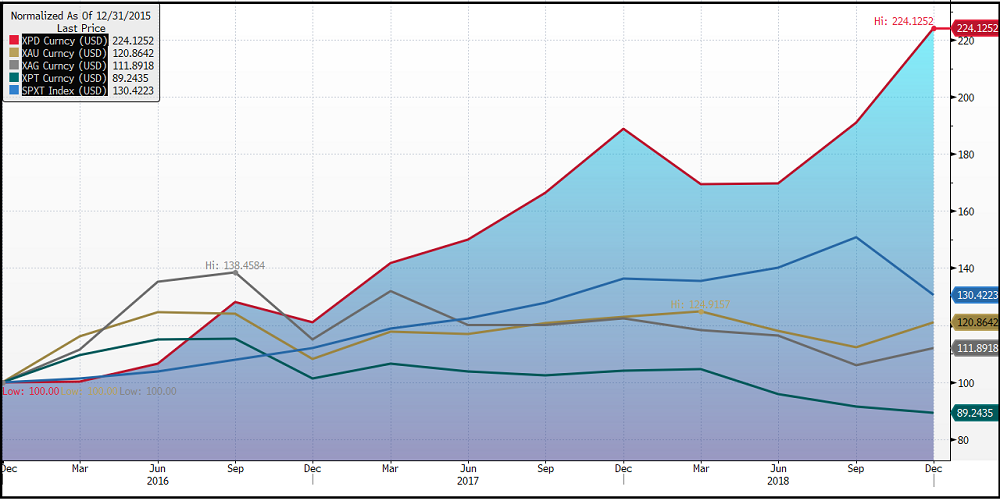
Palladium has been on a multi-year run that shows few signs of abating. For the tumultuous market year 2018, spot palladium gained 18.6% and is up 124% since the beginning of 2016. In comparison, spot gold, platinum and silver all declined last year (1.6%, 14.5%, and 8.5%, respectively), while U.S. equities lost 4.4% in 2018, as measured by the S&P 500 Total Return Index.1

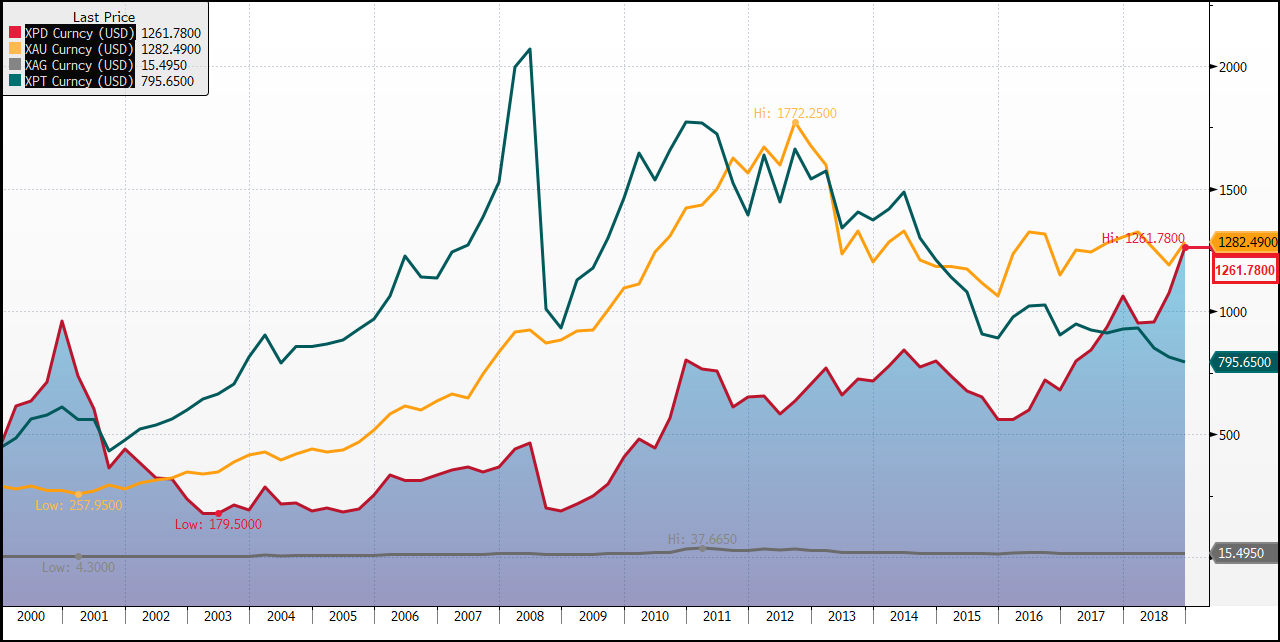
Palladium is close to becoming the most “precious” of precious metals. Palladium passed the $1,000 per ounce mark in late 2017 for the first time since 2001. Palladium’s momentum accelerated in 2018, with its $1,262 price-per-ounce edging close to gold’s $1,282 price by year-end.Palladium was named by its discoverer William Wollaston in 1803, after the asteroid Pallas.

While the escalating U.S.-China trade war hurt many commodities in 2018, it couldn’t dent palladium’s rise. The white metal is primarily used in catalytic converters that reduce pollution from gasoline internal combustion engines (ICEs). Demand for palladium was especially robust last year, as environmental concerns have prompted a global shift from diesel to gasoline and hybrid vehicles. Not even the 2018 slowdown in China’s auto market, the world’s largest, dampened demand.

Palladium’s Stellar Rise

Figure 1. The Hat Trick 

Source: Bloomberg. XPT represents platinum; XAU represents gold; XPD represents palladium, XAG represents silver; SPXT represents S&P 500 Total Return Index.

Figure 2. Annual Performance 2016 – 2018

DatePalladium Price% Annual Change
12/31/2015$ 562.98
12/31/2016$ 680.9620.96%
12/31/2017$ 1,063.5256.18%
12/31/2018$ 1,261.7818.64%
Cumulative Change124.13%

Source: Bloomberg.

Figure 3. The Long View: Palladium Price vs. Gold, Platinum, Silver 2000-2018

Source: Bloomberg. XPT represents platinum; XAU represents gold; XPD represents palladium, XAG represents silver.

Palladium is Very “Precious”

Palladium (chemical symbol “Pd”) is primarily used as an industrial metal and is considered a “precious” metal along with platinum, gold and silver. Both palladium and platinum are far rarer than gold and represent smaller markets. Recent world production of palladium and platinum has averaged about 200 and 175 tonnes per year, respectively, while gold production tallies approximately 3,000 tonnes per year (Read more about Platinum).

Also known as “white gold” or the “bright white metals,” palladium and platinum are members of the Platinum Group Metals (also known as “PGMs,” which also include ruthenium, rhodium, osmium and iridium) and typically co-occur in ore deposits. Their shared chemical origins give palladium and platinum similar characteristics, such as being relatively inert and having high melting points – part of their appeal as catalysts in industrial and automotive applications.

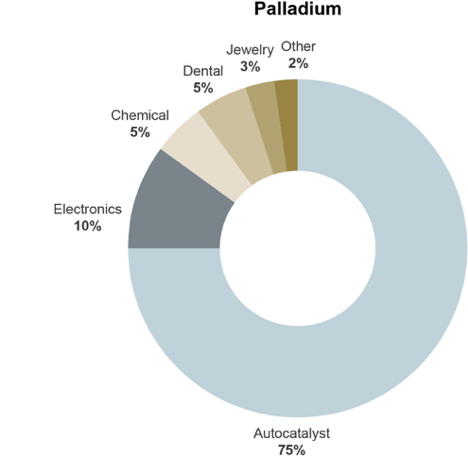
Figure 4. The Automotive Industry is the Largest Pd Consumer – Catalytic Converters

Automakers, who have little flexibility to produce cars without palladium, are being forced to push the price higher to secure their critical supply.

Source: Johnson Matthey. 

Palladium’s primary application is within the auto sector. Though historically more expensive than palladium, platinum was long the primary metal used in catalytic converters, partly because of its stability at the high temperatures required to achieve the conversion. However, in the past decade, automakers have developed technology to achieve nearly the same results with palladium, at a significantly lower cost, causing the automotive industry to transition to palladium.

While palladium is also used in jewelry, electronics, chemical and dental applications, the automotive industry’s need for catalytic converters is the primary factor driving palladium demand. If palladium’s price continues to outpace platinum’s, automakers may return to using platinum. However, analysts predict that any move back to platinum would take at least 18 to 24 months.

Palladium’s Supply Constraints

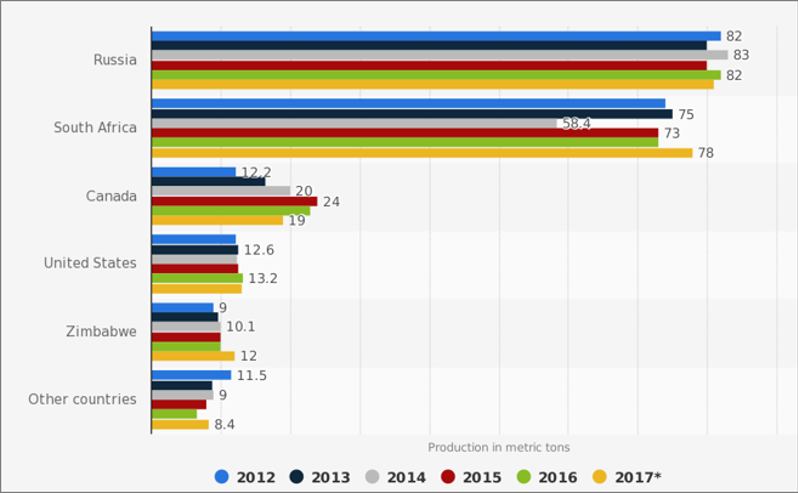
Supply shortages continue to support palladium’s performance, with strong multi-year growth in palladium demand now straining a fixed supply. Palladium is especially scarce and its supply is inelastic since it is usually a by-product of ores that are being mined for other metals, like platinum and rhodium. It is rarely mined on its own. Russia is the world’s largest palladium-producing country, followed by South Africa, Canada, the U.S. and Zimbabwe.

The official level of palladium reserves in Russia is a state secret and many industry participants believe that Russia’s stockpiles of palladium have been largely sold, constraining supply. Supply concerns were further heightened in April 2018 when the U.S. levied more sanctions against Russia.

Figure 5. Palladium Mine Production by Country (Metric Tonnes) 2012-2017

Source: U.S. Geological Survey.

Global demand for palladium, net of the supply provided through recycling, was expected to reach 7.1 million oz. in 2018, exceeding a total supply of 6.9 million oz. This shortfall extends a seven-year trend leading to a current total deficit in the market of 801,000 oz., according to the chemical company, Johnson Matthey.2

Shifting Automotive Demand but Positive Outlook

While no country has outlawed new combustion engines, Norway, China and Germany, among many countries, have implemented frameworks to discontinue long-term ICE production and encourage demand for electric vehicles (EVs) and hybrid-electric vehicles.

The growth of EVs3 could pose a risk to the palladium sector since EVs do not require catalytic converters. On the other hand, the rise of hybrid-electric vehicles could drive palladium demand, since they too require palladium to control pollution. The mining company Norilsk Nickel forecasts that combined palladium use in hybrid and plug-in hybrid — or rechargeable — vehicles in 2019 will be nearly triple that of 2016.

Today, catalytic converter demand accounts for 70% of the palladium demand worldwide. While any threat to palladium’s role within catalytic converters could impact its long-term price outlook, our view is that palladium’s fundamentals should remain strong for at least the next 24 months.

Source: http://sprott.com/insights/the-palladium-play-part-1/