Posted by AGORACOM-JC
at 11:01 AM on Wednesday, June 5th, 2019
SPONSOR: Esports Entertainment
$GMBL Esports audience is 350M, growing to 590M, Esports wagering is
projected at $23 BILLION by 2020. The company has launched VIE.gg
esports betting platform and has accelerated affiliate marketing
agreements with 190 Esports teams. Click here for more information
GMBL: OTCQB
———————–
Betting is esports’ biggest and most underappreciated opportunity
Above: Overwatch League
Image Credit: Robert Paul for Blizzard Entertainment
As one of the fastest growing categories in online gambling, esports betting is on pace to reach up to $8 billion USD in total wagers this year, equating to $560 million in revenue at an industry average margin of 7%.
Growth estimates point to more than $16 billion in annual wagers in coming years.
Betting is the single biggest opportunity in esports. It has uncapped upside and is one of the least encumbered by the video game publisher…but it’s also one of the least talked about. The recent investment wave in esports has been primarily focused on the most visible assets in the space being esports organizations, influencer agencies, and content/competition assets. I believe it’s important people understand that verticals like betting are a huge part of the potential of esports now that interest in the space has skyrocketed.
As one of the fastest growing categories in online gambling, esports betting is on pace to reach up to $8 billion
USD in total wagers this year, equating to $560 million in revenue at
an industry average margin of 7%. Growth estimates point to more than $16 billion in annual wagers in coming years. This compares to an estimated $1 billion
in revenue to be earned in 2019 for the rest of esports, however, when
adjusting for publisher owned/operated assets revenue, I believe the
number is closer to half that. This adjustment nets out game publisher
fees, merch and ticketing at major publisher run events, a proportion of
media rights, and a percentage of sponsorship and advertising.
The benefits of esports betting
We make this adjustment as the investable esports ecosystem,
everything making headlines lately, is non-publisher assets, companies
building around the IP of publishers. Unlike these categories, betting
is IP-agnostic as it requires no franchise or licensing fees paid to the
publisher, which is seen in categories such as esports teams or
tournament organizers. It is also game-agnostic, not being exposed to
game cyclicality, which is the mark of the video game industry and
esports.
Gamers are fickle and it’s impossible to predict the longevity of a
new title. Betting is a platform that can easily offer whatever is being
watched. Lastly, it is API-agnostic, seeing no reliance on publisher
logins or other third-party API’s such as Twitch which can be found in
other verticals. This is why I believe the magnitude of the opportunity
in betting exceeds every other vertical in esports and will continue to
do so long-term.
The rapid & challenging rise of esports betting
How did it begin? The first major wave came with the use of virtual
in-game aesthetics as unregulated casino chips back in 2013/2014. Valve
games, Counter Strike: Global Offensive and Dota 2, the second and third
most popular esports (behind League of Legends), have highly liquid
real money economies using in-game aesthetics termed skins, which fans
began to use for gambling on esports.
Nearly all the skins gambling sites were operating illegally, rarely
doing any requisite Know Your Customer (KYC) compliance to ensure the
customer is in a legal jurisdiction and over 18, had little to no
Anti-Money Laundering (AML) controls, and certainly no gambling license.
Unfortunately, this meant many underage kids often from illegal markets
gambled, and the skins betting market quickly swelled to $5 billion in total wagers. After multiple scams and a class action lawsuit, Valve sent cease & desist notices to all major skins gambling sites toward the end of 2016, resulting in a material reduction in skins betting.
Although the illegal skins sites did not directly make the transition
to regulated esports betting, they were a key step in the process. The
advantage of those sites is they were totally unregulated. You could
build one and get it up and running in 30 days. A regulated gambling
site takes a year if you move quick. As a consequence, we saw
effectively nobody switch. However, the companies making regulated
esports specific betting products took product and marketing cues from
those sites as they serve the same customer base.
That unregulated market kicked off regulated wagering on esports. At
one point, before it was shut down, the skins betting market was an
estimated ten times bigger than the regulated esports betting market.
Without the skins betting market its unlikely esports betting would have
taken off as quickly, and then when it eventually got shut down by
regulators it created a big wave into regulated esports betting. This
created much of the opportunity we are discussing in this article. Like a
lot of new tech, it starts off in the unregulated side before it
matures.
Now in 2019 esports betting is one of the most exciting categories in
the regulated gambling industry. Even more so when combined with a U.S.
sports betting market opening up state by state. With the nature of
esports being video games, it creates unlimited possibilities for unique
bets such as round-by-round betting in first person shooters, or
hyper-contextual bets like first Baron kill (provides a team buff) in
the world’s most popular esport game, League of Legends. With new game
titles constantly being released, and an ever-increasing population of
esports fans, the trend is clear.
Many ways to bet on esports
The current options available
for esports fans to bet with is varied. You have legacy sportsbooks
with an esports offering, purist esports sportsbooks sites, crypto
betting offerings, and still some illegal skins betting sites. The
challenge and opportunity as I see it is not attracting the gambler to
bet on esports, but rather attracting and onboarding the esports fan.
What appeals to a 23-year-old esports fan that has less experience with
betting is different from what is currently being offered to a
35-year-old football fan.
Similar to any traditional service being offered to a new generation
requiring a major user experience overhaul (as financial tech has). I
believe it isn’t enough to just display the odds. Sportsbooks need to
offer more contextual betting, team/match data, content/community
offerings, deep partnership engagements and more. The exciting thing is
that the code has not been cracked, and the room for innovation is vast.
Significant opportunity for new sportsbooks
Online gambling has spent more than 20 years focused on traditional
sports. Creating and curating the optimal offering, marketing schemes,
and bonus/reward programs. Converting brick and mortar bettors to online
ones. Over that period gambling regulation has evolved, sports fans
have aged, and the market has become relatively saturated with
operators.
The emergence of esports as a sport, and consequently, a betting
market, represents the first instance in a long time of a new generation
entering the fold. This is unprecedented and the interest from the
traditional gambling world is immense. For the first time they are
facing a generation born and bred on the internet. Solving for that when
you have spent so long solving for the inverse is challenging. It means
a window of opportunity is open for new operators, new investors, new
strategies, new ideas, and it’s incredibly exciting. All that said, it’s
a thrilling time to be in esports, betting, and the development of
sports and media for the next generation. This is just the beginning.
Kevin Wimer was a professional gamer in the early 2000’s, and is
currently Chief Marketing Officer at esports sportsbook Rivalry.
Addressing India’s Reskilling Challenge – A Report By AIM
Even with the third-largest developer base and a substantial tech-savvy talent pool, India lags behind its peers on major AI indicators.
This is despite a thriving startup ecosystem, high-growth companies which have made a substantial investment in setting up CoEs and the Government investing in building a robust tech infrastructure.
Behind the AI and data analytics boom, lies the story of a massive talent gap as workforce struggles to remain employable. The skills’ shelf life has shortened, with technology changing exponentially over the last decade, skills that were relevant at the beginning of the career have become obsolete. In order to remain employable, the workforce needs to reskill to take advantage of new opportunities. The rise of edtech companies in India is not surprising, given the huge clamour for continuous learning that has taken root in the professional sphere. This is backed by the rise of emerging technologies — artificial intelligence, its subset machine learning and data science which has spawned a booming job market revolving around new technologies that has substantially transformed India’s IT labour market.
The changing job economy has resulted in new opportunities for the
Indian workforce. As estimated by a consulting major, AI has the
potential to add US$957 billion, or 15 percent of India’s current gross
value in 2035. The booming economy, fuelled by AI and advanced analytics
requires more Indians to enter the workforce with a different
skill-set. As per our estimate, close to 97,000 AI positions lie vacant
in India.
But,
the challenges are also increasing multifold — on the one hand India
Inc is struggling with disruptions like automation that are redefining
jobs and secondly, it is grappling with finding the right talent with
the right skillset for AI/ML and data science teams. Meanwhile, the
upcoming generation that will enter the workforce soon is fed on an
outdated curriculum that hasn’t kept up with the industry’s demands.In
our report, we dig into the educational stakeholder landscape to see how
they are transforming the skills market by developing training courses
and certification programmes that correspond to in-demand skills
required today. We look at the type of educational institutions offering
data and analytics programs; how the educational landscape is changing
in response to the heightened demand for analytics skills and what needs
to be done to fill the skill gap.
The second half of the report looks at our last three years ranking
data to find out the winning attributes that have helped analytics
institutes rank on top consistently and how other training institutes
have fared over the last three years.Key Highlights
The online reskilling market is estimated to be $93 million and is expected to grow at a rate of 38%.
As compared to other educational categories (secondary supplemental
education providers and GMAT/ GRE/GATE test preparation providers) the
reskilling market is more mature
Current market is largely B2C driven but educational stakeholders are also actively catering to the B2B segment
Reskilling market in India is driven by the needs of a large working population looking for industry-relevant skills
Online key players are also moving towards blended educational
solutions by creating offline touchpoints to provide peer interaction
Emphasis on personalised learning has led to mentorship and offline
touchpoints that helps students gain handson experience for particular
concepts
Business Analytics course was the starting point, besides this,
other courses that are gaining traction are Artificial Intelligence,
Machine Learning, Data Science & Analytics & Data Engineering
Partnerships between analytics education providers and universities in offering niche courses
Higher demand for short-term diploma courses in in-demand areas such as Blockchain, Data Science and Machine Learning
Virtual classroom concept that began in 2014 has brought high quality analytics education more accessible
Key tools learnt are R, SAS, Python, on big data end Hive, Pig, Hadoop and in AI/ML end Tensorflow and Keras
Key Players In The Reskilling Market
In order to capitalise on these opportunities, IT companies,
educators and policymakers need to develop a deeper understanding of the
existing workforce, the skill-set required in the future, and the gaps
that will need to be addressed. This implies that these three key
players need to align the broader economic developer agenda with the
shifting job market and work towards building a strong talent that has
the baseline and digital skills required for current landscape. At the
Government level, policy makers will have to assess secondary and
postsecondary education and align it with the skills that are required
for tomorrow. Many leading Indian IT majors have undertaken
employer-training initiatives, pre-employment training and have also
provided their own courseware. Collectively, the key stakeholders can
foster a workforce development ecosystem and provide domain specific
training with a job-first approach. Given this scenario — educational
stakeholders have made a very strong business case for reskilling the
workforce and have actively partnered with renowned educational
institutions to launch technical certifications and degree programmes
tailored to fill the skill gap.
Analytics Education Landscape
The nature of analytics education has evolved over the last few years
and a mix of models have emerged in the online and offline space to
accommodate the changing requirements of students. Learners seek a
career-focused analytics education augmented by classroom setting that
prepare them for job functions in data analytics space.
• In cases where learning is delivered purely online, participants
look for realtime learning in a format that allows learners to pursue it
at their own pace
• Candidates look for course content created by top instructors, with
industry and university collaboration to provide a well-rounded
analytics education
• Executive programs are also in high demand as these are intended
for senior professionals who want to renew their skillset and understand
how data can be helpful in managerial decision making
• In case of executive analytics courses, technical skills such as
data management are augmented by soft skills such as business
understanding and communication
• Analytics education providers in India mostly offer Business
Analytics (BA) and Business Intelligence (BI) programs that combine
analytical number crunching, reporting and visualization techniques
Learning Formats
The learning formats can be broadly put under 4 categories:
Self-paced learning delivered via recorded video content
Instructor-Led live classroom sessions delivered online
Blended learning format with classroom and online delivery
Bootcamps for intensive, in-person learning that provides a hands-on experience
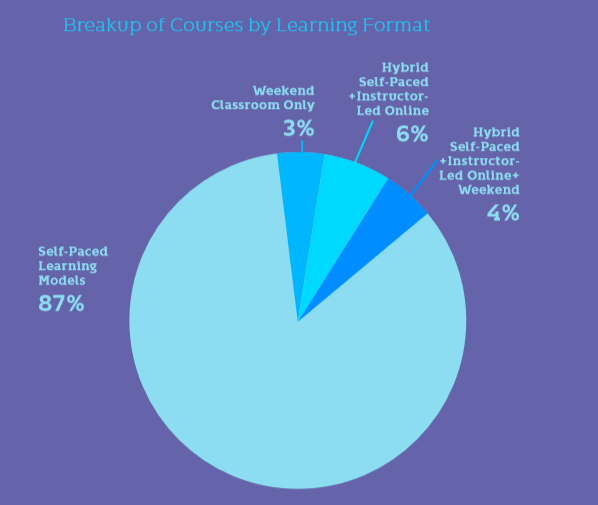
Around 87 percent of analytics courses from private training institutes are delivered in the self-paced learning models
6 percent are delivered in the hybrid (Self-paced and Instructor-Led
online) format and 4 percent in Instructor Led weekend and self-paced
format
There’s only a 3 percent uptake for weekend classroom format
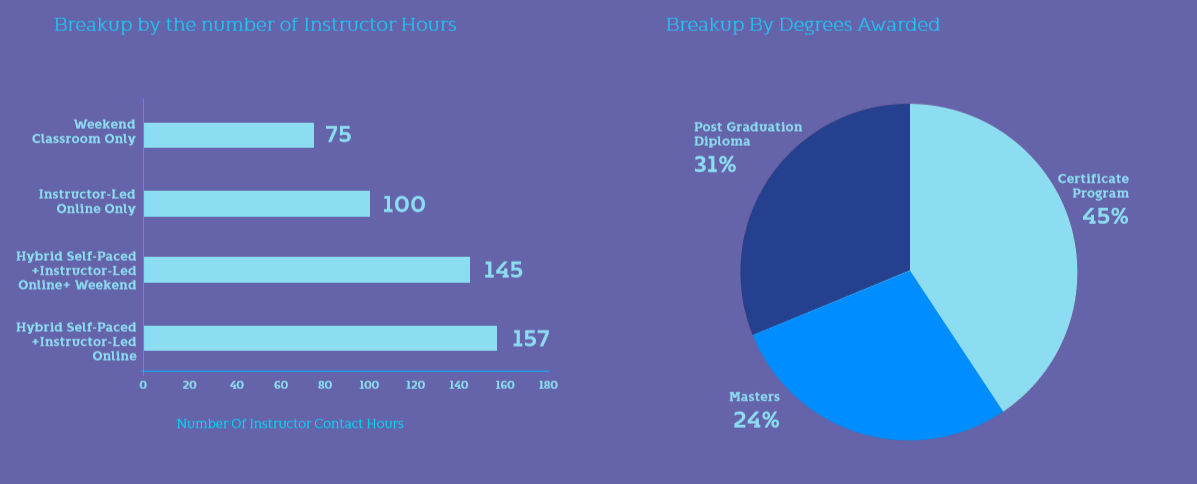
On average, analytics courses by private institutes offer 105 hours of instructor contact hours
The hybrid model of self-paced + online Instructor-Led courses has the highest number of contact hours at 157.
The blended learning opportunity allows learners to get continuous feedback and participate in real-time assessment
Weekend-only model has the least contact hours at 75
For those looking for face-to-face learning environment, weekend model is the best fit
Posted by AGORACOM-JC
at 2:07 PM on Tuesday, June 4th, 2019
1,198 patient visits generating revenue of $152,846
“Our cost cutting and restructuring efforts are now showing in the financial statements and balance sheet, so our shareholders, investors and partners should take comfort knowing the Company is substantially more stable and poised to execute on the main growth initiatives we have identified.â€
VANCOUVER, June 4, 2019 –EMPOWER CLINICS INC. (CSE: CBDT) (Frankfurt 8EC) (“Empower” or the “Company“) has filed today its unaudited interim condensed consolidated financial statements and related management’s discussion and analysis, both of which are available at www.SEDAR.com. All financial information in this press release is reported in United States dollars, unless otherwise indicated.
“After the complete overhaul of our accounting, audit and financial control systems to complete the December 31st,
2018 year end audit, our outstanding accounting team had a much easier
job in preparing our Q1 results, with a solid and professional finance
team in place,” said Steven McAuley, Chairman & CEO of Empower.
“Our cost cutting and restructuring efforts are now showing in the
financial statements and balance sheet, so our shareholders, investors
and partners should take comfort knowing the Company is substantially
more stable and poised to execute on the main growth initiatives we have
identified.”
Q1 2019 Highlights
1,198 patient visits generating revenue of $152,846, compared to 2,242 patient visits generating $302,142 for Q1 2018.
Net loss of $398,541, compared to $2,282,676
for Q1 2018, which was primarily driven by significantly reducing
operating costs through aggressive headcount cuts and facility changes
and lower stock based compensation expense.
Cash used in operating activities was $219,212, compared to $202,712 for Q1 2018.
Cash at March 31, 2019 of $1,974,483, compared to $157,668 at December 31, 2018, which was primarily driven by equity financings during the three months ended March 31, 2019.
Recent Highlights
Strategic redirection: The Company has been
re-positioning its overall strategy to become a vertically integrated
health and wellness company that connects to its 120,000 patients using a
data driven focus to improve patients’ lives with products, technology
and health systems.
Strengthened Management Team: In January 2019, seasoned entrepreneur and executive officer and former GE Capital Managing Director Steven McAuley
was appointed as Empower’s Chairman & CEO. The Empower management
team has since been augmented with critical hires made from the ranks of
investment banking, accounting, marketing and clinic operations among
other disciplines. CFO Mat Lee, appointed on March 19, 2019,
is an experienced accounting and finance executive. To further support
financial and accounting restructuring, the Company engaged the services
of Invictus Accounting Group, a top-tier boutique advisory firm based
in Vancouver, BC.
Strategic Acquisition: On April 30, 2019, the Company completed the acquisition of Sun Valley Certification Clinics Holdings LLC (“Sun Valley”) from Andrea Klein and Dustin Klein
and a minority shareholder, through its wholly-owned subsidiary,
Empower Healthcare Assets Inc., for cash and share consideration having
an aggregate value of $3,835,000 (CAD$5,160,376). Sun Valley operates a network of professional medical cannabis and pain management practices, with five clinics in Arizona, one clinic in Las Vegas, a tele-medicine platform serving California, and a fully developed franchise business model for domestic and international markets.
Strategic Development: On February 28, 2019 the Company announced that it intends to open a fully functioning hemp-based CBD extraction facility in greater Portland, Oregon
in Q2 2019 with the first extraction system expected to have the
capacity to produce 6,000 kg of extracted product per year. The new
facility has been secured and the Company takes possession June 1, 2019.
2019 Outlook and Catalysts
Enhanced Corporate Governance: The Company has
prioritized strengthening corporate governance practices under the
leadership of its Board of Directors and Chairman Steven McAuley, in order to address certain best practices suggested by North American securities regulators and senior stock exchanges.
Improved Capital Markets Profile: Empower is
diversifying its business model to become a vertically integrated
operator in the global cannabis sector with a focus on patient care, CBD
product distribution, research & development and CBD product
extraction. The Company believes this will appeal to a broader base of
shareholders and investors and provide greater access to capital and
improved trading liquidity.
Increased Patient Access: With a rapidly expanding company-owned clinic network and significant expansion opportunity through the Sun Valley
franchise model, Empower anticipates it will grow its total patient
list substantially in the years ahead. This is expected to provide
greater opportunity for treatment analysis using artificial intelligence
(AI), validating the Company as a leader in understanding the efficacy
of cannabis-related therapies.
Focus on CBD Product Sales: Empower’s patient base and
customers are expected to benefit from access to high margin derivative
products, including CBD lotion, tinctures, spectrum oils, capsules,
lozenges, patches, e-drinks, topical lotions, gel caps, hemp extract
drops and pet elixir hemp extract drops. Patients and customers will be
able to access Empower’s customer service, home delivery and e-commerce
platform.
Market Leading Technology: Empower utilizes a
market-leading patient electronic management and POS system that is
HIPAA compliant and provides deep insight to patient care. The Company
supports remote patients using its tele-medicine portal, enabling
patients who do not live near one of its clinic locations, or are
disabled or unable to come to a location, to still benefit from a doctor
consultation.
Financial Summary
$, except where noted
Three months endedMarch 31,
2019
2018
Patient visits
1,198
2,242
Clinic Revenues
152,846
302,142
Direct Clinic Expenses
(39,413)
(105,165)
Loss from operations
(279,308)
(2,051,463)
Net loss
(398,541)
(2,282,676)
Net loss per share
(0.01)
(0.05)
Financial Performance
Clinic revenues for Q1 2019 was $152,846, compared to Q1 2018 revenues of $302,142. This decrease over prior year is attributable to three factors. The introduction of recreational cannabis to Oregon,
a reduction in marketing spend while we reposition our brand and its
treatment through online, social and mobile upgrades and competitive
introduction and pressure. The Company believes all three areas are
being addressed effectively and will be reflected in future revenues.
Direct clinic expenses for Q1 2019 was $39,413, compared to Q1 2018 direct clinic expenses of $105,165. This decrease over prior year is attributable to the decrease in number of patient visits described above.
Net loss from operations for Q4 2019 was $113,433, compared to Q1 2018 net loss of $2,051,463.
This decrease in loss below prior year is primarily attributable two
factors. Operating expense decreased due to a decrease in salaries and
benefits as a result of aggressive headcount cuts and facility changes.
Additionally, share-based payments decreased as the RTO in Q1 2018
resulted in options being granted to Adira Energy Ltd. option holders
and new members of management.
Net loss for Q1 2019 was $398,541, respectively, compared to Q1 2018 net loss of $2,282,676.
This decrease below prior year is primarily attributable to the
decrease in operating expenses and share-based compensation expense.
During the three months ended March 31, 2019, the Company used $219,212
in cash from operations after changes in non-cash working capital. The
Company invested $nil towards property and equipment and raised $2,036,027 via proceeds from various issuances of shares and notes.
Please refer to the Company’s unaudited condensed interim
consolidated financial statements, related notes and accompanying
Management Discussion and Analysis for a full review of the operations.
About Empower
Empower is a leading multi-state operator of a network of
physician-staffed clinics focused on helping patients improve and
protect their health through innovative physician recommended treatment
options. It is expected that Empower’s proprietary product line
“Sollievo” will offer patients a variety of delivery methods of doctor
recommended cannabidiol (CBD) based products in its clinics, online and
at major retailers. With over 165,000 patients, an expanding clinic
footprint, a focus on new technologies, including tele-medicine, and an
expanded product development strategy, Empower is undertaking new growth
initiatives to be positioned as a vertically integrated, diverse,
market-leading service provider for complex patient requirements in 2019
and beyond.
ON BEHALF OF THE BOARD OF DIRECTORS: Steven McAuley Chief Executive Officer
DISCLAIMER FOR FORWARD-LOOKING STATEMENTS
This news release contains certain “forward-looking statements”
or “forward-looking information” (collectively “forward looking
statements”) within the meaning of applicable Canadian securities laws.
All statements, other than statements of historical fact, are
forward-looking statements and are based on expectations, estimates and
projections as at the date of this news release. Forward-looking
statements can frequently be identified by words such as “plans”,
“continues”, “expects”, “projects”, “intends”, “believes”,
“anticipates”, “estimates”, “may”, “will”, “potential”, “proposed” and
other similar words, or information that certain events or conditions
“may” or “will” occur. Forward-looking statements in this news release
include, but are not limited to, statements regarding the direction and
growth prospects of the Company, the expansion of the company’s clinic
and distribution network, the expected effect of the Vendors in their
new roles with the Company, the effect on the lives of patients, the
growth into a national brand, the effect of the Transaction, the
diversification of the Company’s business model, the potential appeal to
shareholders, the growth of the Company’s patient list and the effect
thereof, the expected benefits for the company’s patient base and
customers, the release of the cash consideration, the release of Shares
being held in escrow in connection with the Transaction and statements
regarding the Company’s proprietary product line “Sollievo”. Such
statements are only projections, are based on assumptions known to
management at this time, and are subject to risks and uncertainties that
may cause actual results, performance or developments to differ
materially from those contained in the forward-looking statements,
including that the Company may not be able to expand, that the
Transaction may not have the expected results, and other factors beyond
the Company’s control. No assurance can be given that any of the events
anticipated by the forward-looking statements will occur or, if they do
occur, what benefits the Company will obtain from them. Readers are
cautioned not to place undue reliance on the forward-looking statements
in this release, which are qualified in their entirety by these
cautionary statements. The Company is under no obligation, and expressly
disclaims any intention or obligation, to update or revise any
forward-looking statements in this release, whether as a result of new
information, future events or otherwise, except as expressly required by
applicable laws.
Investors: Steve Low, Boom Capital Markets, 647-620-5101; Steven McAuley, CEO, 604-789-2146, [email protected]; French inquiries: Remy Scalabrini, Maricom Inc., 604-789-2146, [email protected] CNW Group 2019
Posted by AGORACOM-JC
at 12:31 PM on Tuesday, June 4th, 2019
7,607 patient visits generating revenue of $1,091,386
Company has been re-positioning its overall strategy to become a vertically integrated health and wellness company that connects to its 120,000 patients using a data driven focus to improve patients’ lives with products, technology and health systems
VANCOUVER, June 4, 2019 – EMPOWER CLINICS INC. (CSE: CBDT) (Frankfurt 8EC) (“Empower” or the “Company“) has filed today its audited consolidated financial statements and related management’s discussion and analysis, both of which are available at www.SEDAR.com. All financial information in this press release is reported in United States dollars, unless otherwise indicated.
“The Company has worked extremely hard over the past few months to
vastly improve its overall efficiency by significantly reducing
operating costs with aggressive headcount cuts and facility changes,
resulting in a much leaner organization that is positioned for new
growth. We dramatically improved financial accounting and reporting
controls to ensure we have the best possible corporate governance
systems in place to protect our shareholder interests.” Said Steven McAuley, Chairman & CEO of Empower.
“With our improved stable foundation, the closing of our two recent
financings and the closing of the Sun Valley Clinics acquisition, we are
positioned to take advantage of the many growth initiatives ahead of
us, as we continue on our path to becoming a growth-oriented global
health & wellness brand.”
2018 Highlights
7,607 patient visits generating revenue of $1,091,386 or $0.02 per share, compared to 9,705 patient visits generating $1,507,050 or $0.03 per share for fiscal 2017.
Net loss of $3,789,918 or $0.06 per share, compared to $3,109,921 or $0.06 per share for fiscal 2017, which was primarily driven by the Company’s listing fee of $1,308,808 as part of the Company’s listing on to the Canadian Securities Exchange.
Cash used in operating activities was $2,835,710 or $0.04 per share, compared to $1,587,760 or $0.03 per share for fiscal 2017.
Cash at December 31, 2018 of $157,668, compared to bank indebtedness of $7,148 at December 31, 2017, which was primarily driven by equity and debt financings during the year ended December 31, 2018.
On April 23, 2018, the Company completed its previously
disclosed reverse takeover transaction (“RTO”) of Adira Energy Ltd.
Following the RTO, on April 30, 2018 the Company listed on
the Canadian Securities Exchange (the “CSE”) under ticker symbol “CBDT”,
on the OTC, part of the OTC Markets Group, under the ticker “EPWCF” and
on the Frankfurt Stock Exchange under the ticker “8EC”. On closing of
the RTO, the Company’s name was changed from Adira Energy Ltd to Empower
Clinics Inc.
Recent Highlights Subsequent to Year End
Strategic redirection: The Company has been
re-positioning its overall strategy to become a vertically integrated
health and wellness company that connects to its 120,000 patients using a
data driven focus to improve patients’ lives with products, technology
and health systems.
Strengthened Management Team: In January 2019, seasoned entrepreneur and executive officer and former GE Capital Managing Director Steven McAuley
was appointed as Empower’s Chairman & CEO. The Empower management
team has since been augmented with critical hires made from the ranks of
investment banking, accounting, marketing and clinic operations among
other disciplines. CFO Mat Lee, appointed on March 19, 2019,
is an experienced accounting and finance executive. To further support
financial and accounting restructuring, the Company engaged the services
of Invictus Accounting Group, a top-tier boutique advisory firm based
in Vancouver, BC.
Strategic Acquisition: On April 30, 2019,
the Company completed the acquisition of Sun Valley Certification
Clinics Holdings LLC (“Sun Valley”) from Andrea Klein and Dustin Klein
and a minority shareholder, through its wholly-owned subsidiary, Empower
Healthcare Assets Inc., for cash and share consideration having an
aggregate value of $3,835,000 (CAD$5,160,376). Sun Valley operates a
network of professional medical cannabis and pain management practices,
with five clinics in Arizona, one clinic in Las Vegas, a tele-medicine
platform serving California, and a fully developed franchise business
model for domestic and international markets.
Strategic Development: On February 28, 2019 the Company announced that it intends to open a fully functioning hemp-based CBD extraction facility in greater Portland, Oregon
in Q2 2019 with the first extraction system expected to have the
capacity to produce 6,000 kg of extracted product per year. The new
facility has been secured and the Company takes possession June 1, 2019.
2019 Outlook and Catalysts
Enhanced Corporate Governance: The Company has
prioritized strengthening corporate governance practices under
the leadership of its Board of Directors and Chairman Steven McAuley, in order to address certain best practices suggested by North American securities regulators and senior stock exchanges.
Improved Capital Markets Profile: Empower is
diversifying its business model to become a vertically integrated
operator in the global cannabis sector with a focus on patient care, CBD
product distribution, research & development and CBD product
extraction. The Company believes this will appeal to a broader base of
shareholders and investors and provide greater access to capital and
improved trading liquidity.
Increased Patient Access: With a rapidly expanding
company-owned clinic network and significant expansion opportunity
through the Sun Valley franchise model, Empower anticipates it will grow
its total patient list substantially in the years ahead. This is
expected to provide greater opportunity for treatment analysis using
artificial intelligence (AI), validating the Company as a leader in
understanding the efficacy of cannabis-related therapies.
Focus on CBD Product Sales: Empower’s patient base and
customers are expected to benefit from access to high margin derivative
products, including CBD lotion, tinctures, spectrum oils, capsules,
lozenges, patches, e-drinks, topical lotions, gel caps, hemp extract
drops and pet elixir hemp extract drops. Patients and customers will be
able to access Empower’s customer service, home delivery and e-commerce
platform.
Market Leading Technology: Empower utilizes a
market-leading patient electronic management and POS system that is
HIPAA compliant and provides deep insight to patient care. The Company
supports remote patients using its tele-medicine portal, enabling
patients who do not live near one of its clinic locations, or are
disabled or unable to come to a location, to still benefit from a doctor
consultation.
Financial Summary
$, except where noted
Three months endedDecember 31,
Year ended December 31,
2018
2017
2018
2017
Patient visits
1,314
1,893
7,607
9,705
Clinic Revenues
196,909
291,721
1,091,386
1,507,050
Direct Clinic Expenses
(115,655)
(114,252)
(417,047)
(638,834)
Loss from operations
(592,899)
(560,231)
(4,309,373)
(2,408,638)
Net income (loss)
1,342,930
(814,539)
(3,789,918)
(3,109,921)
Net income (loss) per share
0.01
(0.02)
(0.06)
(0.06)
Financial Performance
Clinic revenues for Q4 and full year 2018 were $196,909 and $1,091,386, respectively, compared to Q4 and full year 2017 revenues of $291,721 and $1,507,050, respectively. This decrease over prior year is attributable to three factors. The introduction of recreational cannabis to Oregon,
a reduction in marketing spend while we reposition our brand and its
treatment through online, social and mobile upgrades and competitive
introduction and pressure. The Company believes all three areas are
being addressed effectively and will be reflected in future revenues.
Direct clinic expenses for Q4 and full year 2018 were $115,655 and $417,047, respectively, compared to Q4 and full year 2017 direct clinic expenses of $114,252 and $638,834, respectively. This decrease over prior year is attributable to the decrease in number of patient visits described above.
Net loss from operations for Q4 and full year 2018 were $592,899 and $4,309,373, respectively, compared to Q4 and full year 2017 net loss of $560,231 and $2,408,638,
respectively. This increase over prior year is primarily attributable
two factors. Operating expense increased due to an increase in salaries
and benefits during fiscal 2018 as a result of additional senior
management joining the Company in conjunction with the RTO.
Additionally, share-based payments increased as a result of the RTO
which resulted in options being granted to Adira option holders and new
members of management.
Net income for Q4 and net loss for the full year 2018 were $1,342,930 and $3,789,918, respectively, compared to Q4 and full year 2017 net loss of $814,539 and $3,109,921, respectively. This increase over prior year is primarily attributable to the listing fee of $1,308,808 as a result of the RTO, share-based compensation expense of $892,417
and restructuring expenses incurred during the year as the Company
completed several changes towards its new strategic direction. Partially
offsetting these one-time expense is a $1,598,425 gain on change in fair value of the warrant liability and a $890,136
gain on change in conversion option on convertible debentures that
resulted from the decrease in the Company’s share price and therefore
the value of the warrants and convertible debentures exercisable.
During the year ended December 31, 2018, the Company used $2,835,710 in cash from operations after changes in non-cash working capital. The Company invested $100,227 towards property and equipment and raised $3,093,604 via proceeds from various issuances of shares, notes, and convertible debentures.
Please refer to the Company’s audited consolidated financial
statements, related notes and accompanying Management Discussion and
Analysis for a full review of the operations.
About Empower
Empower is a leading multi-state operator of a network of
physician-staffed clinics focused on helping patients improve and
protect their health through innovative physician recommended treatment
options. It is expected that Empower’s proprietary product line
“Sollievo” will offer patients a variety of delivery methods of doctor
recommended cannabidiol (CBD) based products in its clinics, online and
at major retailers. With over 165,000 patient records, an expanding
clinic footprint, a focus on new technologies, including tele-medicine,
and an expanded product development strategy, Empower is undertaking new
growth initiatives to be positioned as a vertically integrated,
diverse, market-leading service provider for complex patient
requirements in 2019 and beyond.
ON BEHALF OF THE BOARD OF DIRECTORS: Steven McAuley Chief Executive Officer
DISCLAIMER FOR FORWARD-LOOKING STATEMENTS
This news release contains certain “forward-looking statements”
or “forward-looking information” (collectively “forward looking
statements”) within the meaning of applicable Canadian securities laws.
All statements, other than statements of historical fact, are
forward-looking statements and are based on expectations, estimates and
projections as at the date of this news release. Forward-looking
statements can frequently be identified by words such as “plans”,
“continues”, “expects”, “projects”, “intends”, “believes”,
“anticipates”, “estimates”, “may”, “will”, “potential”, “proposed” and
other similar words, or information that certain events or conditions
“may” or “will” occur. Forward-looking statements in this news release
include, but are not limited to, statements regarding the direction and
growth prospects of the Company, the expansion of the company’s clinic
and distribution network, the expected effect of the Vendors in their
new roles with the Company, the effect on the lives of patients, the
growth into a national brand, the effect of the Transaction, the
diversification of the Company’s business model, the potential appeal to
shareholders, the growth of the Company’s patient list and the effect
thereof, the expected benefits for the company’s patient base and
customers, the release of the cash consideration, the release of Shares
being held in escrow in connection with the Transaction and statements
regarding the Company’s proprietary product line “Sollievo”. Such
statements are only projections, are based on assumptions known to
management at this time, and are subject to risks and uncertainties that
may cause actual results, performance or developments to differ
materially from those contained in the forward-looking statements,
including that the Company may not be able to expand, that the
Transaction may not have the expected results, and other factors beyond
the Company’s control. No assurance can be given that any of the events
anticipated by the forward-looking statements will occur or, if they do
occur, what benefits the Company will obtain from them. Readers are
cautioned not to place undue reliance on the forward-looking statements
in this release, which are qualified in their entirety by these
cautionary statements. The Company is under no obligation, and expressly
disclaims any intention or obligation, to update or revise any
forward-looking statements in this release, whether as a result of new
information, future events or otherwise, except as expressly required by
applicable laws.
Investors: Steve Low, Boom Capital Markets, 647-620-5101; Steven McAuley, CEO, 604-789-2146, [email protected]; French inquiries: Remy Scalabrini, Maricom Inc., 604-789-2146Copyright CNW Group 2019
Tags: Cannabis, CSE, Hemp, Marijuana, stocks, tsx, tsx-v, weed Posted in Empower Clinics Inc. | Comments Off on Empower Clinics $CBDT.ca Reports Fiscal 2018 Results – Over $1M in 2018 Revenues $WEED.ca $CGC $ACB $APH $CRON.ca $HEXO.ca $TRST.ca $OGI.ca
Digging Deeper: India’s ed-tech space is more than Byju’s
While trying to understand India’s edtech space, it is worth remembering what a huge market it is.
A joint study by Google and KPMG had estimated that the online education sector in India would grow at a compounded annual growth rate (CAGR) of 52% to $1.96 billion by 2021.
Due to acute disparity in learning levels caused by social, economic,
geographic and other factors, India may be in the danger of
under-utilising or losing out on the untapped capital of human
potential. Education technology (edu-tech/edtech) could play a vital
role in meeting the learning needs of underserved sections of the
populace. In this space, the name we hear loudest is Byju’s, the
Bangalore-based company valued at over four billion dollars (or five,
according to some estimates), which raised $540 million from Naspers and
others just last year. It is the fourth most valued startup in the
country. Unacademy, which much like Byju’s also offers online tutoring
to students, has raised 38.5 million dollars to date. Last year in
December, Toppr, another edtech startup which claims to have six million
users, had raised $35 million led by education-focused investor Kaizen
Private Equity. CollegeDekho has raised upwards of 13 millions dollars
to date. Even Mukesh Ambani seems to want a slice of the Indian edtech
pie considering he bought a 38.5% stake in Noida-based startup
Extramarks. Byju’s might have put Indian edtech on the global map, but
increasingly, the space is more than just Byju’s.
India’s education market, estimated to grow to $5.7 billion by 2020,
has emerged as a lucrative opportunity for edtech startups and VCs
alike. On this edition of Digging Deeper with Moneycontrol, we will try
to understand both the potential of edtech startups and the reasons why
some of them have succeeded spectacularly in what was, just a few years
ago, a relatively unexplored field.
Growing interest
A recent Financial Express report cited a study by Karthik
Muralidharan of the University of California at San Diego, Abhijeet
Singh of the Stockholm School of Economics and Alejandro J Ganimian of
the NYU Steinhardt School, according to which, incorporation of
educational technology can help accurately assess learning levels and
customise pedagogical support to bridge intra-classroom gaps.
Andhra Pradesh, we are told, is pioneering tech-enabled pedagogy, and
as an early-bird adopter of edu-tech, it will be leagues ahead of other
states. The piece said, “The state, from the current academic year,
will be using Personalised Adaptive Learning (PAL), or software-based
assessment of the academic standing of the students in a classroom. PAL
will first assess the student’s comprehension levels and then prescribe
targeted learning. Students will take the test online, and based on
their individual reports, remedial coaching will be provided. Apart from
facilitating tailored learning, PAL will also ease monitoring of impact
of remedial classes via dashboards for individual students where
teachers can track progress.â€
PAL is being rolled out in over 2,600 schools in Andhra Pradesh.
After tests in 56 schools proved successful, many schools will engage
with PAL via laptop but others will do so over tablets.
The initiative, as per a report in The New Indian Express, will
involve intensive training of teachers, school administration and
bureaucrats, and is expected to impact over 2.5 million children. Andhra
Pradesh is, in fact, experimenting with edtech in a big way.
According to the piece, after introducing QR codes in non-language
subject textbooks, the state is now doing the same for language
textbooks for classes VI-X.
The NIE said, “Scanning the QR codes assigned to different chapters,
students can access supplementary video lectures or tutorials. They can
also use the QR codes to take quick, online assessment tests that will
help them, their parents and teachers measure their actual levels of
comprehension.
Such an ecosystem surely makes addressing gaps in learning levels
easier than the conventional method, of remedial classes. Also, given
boards like CBSE are now increasing reliance on schools’ own assessment
of learning levels, by mandating compulsory internal assessment for
boards, pedagogy propped by technology can be made to deliver more
efficiently.â€
At another level, edtech start ups are benefitting from growing interest not just in India but also from overseas markets.
Big numbers
The News Minute carried a report recently which spoke about how New
Delhi-based edtech startup XploraBox raised an undisclosed amount in
funding from SucSEED Venture partners. The four founders of XploraBox
include Rishi and Shweta Das, Dhirendra Meena and Rishabh Gupta. The
startup was founded in 2015. The funds will be used to scale up and
establish overseas presence beginning with North America and GCC
countries as it targets a revenue of Rs 100 crore in 3 years. The other
investors to have participated in this round include Green Shoots
Capital, Metaform Ventures LLC, JITO Angel Network, SWAN Angel Network
etc.
And what has Xplorabox been up to? Well, it has come up with a
business model that has a subscription box for learning through play in
children. We quote, “The basic objective is to try and wean away the
kids, aged between two and twelve, from TV and mobile and channelise
their attention to other constructive activities. Learning through fun’
is their mantra, with fun stories and educational activities which are
offered through their boxes. The company has served more than 50,000
customers and dispatching kits to over 500 cities every month.â€
According to Rishi, on an average, children are spending over 3 hours
every day in front of screens and that is impacting their brain
development. Xplorabox provides modules to boost essential developmental
skills of the children. The startup believes that the 50,000 customers
they have serviced so far have reported excellent response and more
products could get launched in the coming months.
The aim is to provide learning aids that can enhance various
developmental skills like motor skills, cognitive skills etc in children
to counter issues like Computer Vision Syndrome (CVS), unhealthy
posture, and increasing cases of myopia (shortsightedness).
The startup is looking at prospects running into billions with the
large population of kids in the target age group and hopes to tap into
more potential markets.
Wider horizons
The edtech market keeps expanding and reinventing itself. In a recent
development, Byju’s and Disney may launch a co-branded new app
targeting kindergarten to Class 3 students. The Economic Times reported,
“The partnership is in line with Byju’s aspirations to expand beyond
India into other large English-speaking markets such as the US, UK, and
Australia.
Disney Byju’s Early Learn, as the service is called, will be a
standalone app that is likely to go live sometime next week. There have
been talks that Disney has made a financial investment into Byju’s, but
that has not come through yet, sources said. Apart from using the name
of the Burbank, California-headquartered company, the app will boast of
characters from popular Disney brands such as Cars, Toy Story and
Frozen.â€
Byju’s has entered into a revenue-sharing agreement with the media
company. While the exact terms of the deal could not be ascertained, it
is learnt to be in the range of a 10-15% revenue share that Disney
usually sets.
ET said, “While Byju’s will oversee all content created for the app,
Disney is expected to work closely with the edtech firm to ensure
stories are weaved around its characters. Kids using the app will get to
watch video-based tutorials that will feature its popular cartoon
characters. Even though the current deal with Disney is strictly a
revenue-sharing agreement, Byju’s has been in talks with the media giant
to explore an opportunity for investments as well. In March, when
Byju’s raised $25 million in funding from General Atlantic, its
valuation jumped to $5.4 billion, making it the fourth most valuable
private Internet company in India.â€
Customer acquisition and other challenges
With time, edtech companies are dealing with challenges like growing
customer acquisition costs. A recent ETtech piece addresses this very
issue. It points out how India’s fast-growing educational technology
space is now going full steam ahead to build organic user acquisition
channels.
The average cost-per-click on digital channels goes up 5-7% every
year organically, but it could be around 30% year-on-year for edtech
since it is seasonal for most players, according to industry-watchers.
Moreover, India suffers from extremely low conversion rates as courses
are often large-ticket purchases.
The report says increasing cost of user acquisition has forced
players like Edureka to acquire 60% users organically through free
YouTube videos and high-quality blogs. Still, the company spends Rs 1
crore every month on digital marketing.
Lovleen Bhatia, co-founder and CEO of Edureka says and we quote, “You
can’t win with Google and Facebook, so you need to find other channels
of acquiring customers. For us, our blog, community and YouTube videos
have worked well so far.â€
Edureka is also working on an AI chatbot that will advise users on
how to build their careers and Bhatia hopes that the counselling bot,
which they are trying to make open source, will add to customer
acquisition .
Byju’s, mentions the piece, a leader in the K12 education sector, is
looking at television as it freezes digital ad spends. The company has
begun advertising regionally, with celebrity endorsers. They have
launched campaigns with Mohanlal in Kerala and Mahesh Babu in AP and
Telangana and plan to launch many regional ads in the coming year and
their spend on TV advertising will be roughly 20% of their total
revenue. Byju’s reported Rs 1,400 crore in revenues in the previous
fiscal, and is expecting a twofold growth in the current year.
The piece also mentions Simplilearn, another e-learning platform for
tech professionals, which gets 1.5 million monthly visitors on its site,
out of which 50,000 convert into enquiries. Out of that, 10,000-12,000
end up buying its services. Krishna Kumar, CEO of Simplilearn, says in
the piece that 40% of its inbounds are from referrals and another big
chunk from free video uploads on YouTube. It would have otherwise spent
$1.5 million each month on digital channels just to sustain current
inbound traffic, he says.
Eruditus, an online executive training platform, says a majority of
its users come through ads on Google, Facebook, LinkedIn and Pinterest.
Ashwin Damera, CEO of Eruditus, says in the article, the cost per lead
for its course on Design Thinking, which it does in partnership with
MIT, is $15 in India versus $35 in the US. However, acquiring users in
India is more expensive as conversion rates are five times lower than in
the US.
Big players
On an earlier podcast, we had examined the boom in the e-learning
business scape in India and profiled e-learning companies like Vedantu,
which in November 2018, had managed to raise $11 million in a Series B
funding round. Vedantu, as is well-known, is an interactive online
tutoring platform where teachers provide school tuitions to students
over the internet, using a real-time virtual learning environment named
WAVE, a technology built in-house.
This brings us to the point we began with. Such technological
development initiatives push e-learning beyond regular pedagogical
methods. Companies are making learning sessions more personalized by
tracking the student’s attention span and concept understanding using
machine learning, facial recognition etc.
While trying to understand India’s edtech space, it is worth
remembering what a huge market it is. A joint study by Google and KPMG
had estimated that the online education sector in India would grow at a
compounded annual growth rate (CAGR) of 52% to $1.96 billion by 2021.
The idea that brick and mortar structures are obsolete for expansive learning is at the core of the e-learning boom in India.
It’s not just Vedantu, but most e-learning businesses including
Byju’s and Unacademy understand the limitations of conventional teaching
and learning and the potential of technology-driven educational models
that can reinvent themselves to keep up with the evolving needs of the
students. Technology has undoubtedly a wider reach than brick and mortar
structures and content startups can reach up to 200-300 million new
internet users from tier 2 and tier 3 cities.
Just to refresh your memory, Unacademy has raised a neat $21 million
in a Series C round and Byju’s unicorn status as India’s fourth most
valuable start-up behind Paytm, Ola, and Oyo, is only too well known.
What is a unicorn in business terms? Well, it is a privately held
startup company valued at over $1 billion. The term was coined in 2013
by venture capitalist Aileen Lee, choosing the mythical animal to
represent the statistical rarity of such successful ventures. The
brand’s success story is now a Harvard Business School case study no
less.
What are the factors contributing to this boom?
The upsurge in e-learning enterprises could partly be attributed to
inexpensive data costs and the increased access to high-speed internet,
and with half a billion more Indians expected to be online for the first
time in the near future, there is no reason to think small.
Some other big dreamers in this space are Meritnation, Cuemath and Toppr and Byju’s is a success story to emulate for many.
Mint has reported and we quote, “Byju’s is part of a small but
growing number of tech startups that have rapidly grown their businesses
and consistently attracted blue-chip investors. In July 2017, Byju’s
raised about $40 million from Tencent Holdings Ltd, months after raising
$30 million from Verlinvest. Since starting out in 2008, Byju’s has
raised over $240 million from Tencent, Verlinvest, Chan Zuckerberg
Initiative, Sequoia Capital, Lightspeed Venture Partners and Aarin
Capital, among others.â€
Quality education is not equally dispersed in India and that has
fuelled the need for e-learning modules. Roman Saini, co-Âfounder and
chief educator of Unacademy had written in Hindustan Times on November
8, 2018 and we quote, “The education divide in India with respect to
quality and accessibility has existed for far too long. It is difficult
for the existing physical infrastructure to meet the learning needs of
the burgeoning population of our country which will touch 1.5B by 2030
and 1.7B by 2050 (equal to the population of China and USA combined).
Digital is gaining acceptance across numerous sectors and it is only
right that the education sector too reaps benefits of this digital
transformation.â€
There are barriers created by inadequate infrastructure, concentrated
content and language issues that prevent large numbers of
knowledge-hungry demographics from the benefits of a global education.
As he says, “It is impossible to have great teachers in each and
every village/district in India. Similarly, the best teachers should not
be restricted to certain institutes of the world. This is where
e-learning comes in. It can level the playing field for all students.
Students, in both rural and urban areas, can get access to the best
learning resources, learn at their own pace and in the comfort of their
own homes. Another key advantage with e-learning is that it is much
easier to design courses with the latest online reference material than
publishing crores of books.â€
The possibility that online education could benefit India’s youth,
that forms more than 50% of the population, is exciting for e-learning
entrepreneurs, educators and potential learners.
New methodologies
E-learning predictably expands the scope, depth and reach of
information with interactive tools, AI and technology as well as live
online interaction.
Byju Raveendran believes e-learning can develop and inculcate
personal initiative in students and that bodes well for their future
success as opposed to the “spoon feeding†that conventional education
dispenses.
He told Mint in April 2017, that even when he was not an education
entrepreneur, he was known for pre-exam hacks and shortcuts that made
him an exceptional student. After nailing a perfect score in CAT twice,
and after turning down interview calls from all the Indian Institutes of
Management (IIMs), and working abroad for a couple of years, he decided
to take six months out to see what would happen if what he had learnt
was taught with a structure.
So successful was his module, recalls Mint, that Raveendran started
conducting workshops on the weekend, with the classes growing in
popularity. When one classroom wasn’t enough to accommodate students, he
booked an auditorium with a seating capacity of 1,200. From jet setting
across India to teach, he decided to take his modules to students and a
success story was born in 2011.
At the core of his teaching module and business model is not
derivation but independence, logic and life skills. Soon he started
using a video format. As Mint informed, his high-production-value videos
and content caters to the K-12 (kindergarten-Class XII) segment, with
more than 500 members in the research and development team.
Mint also reported that there are about 20 million children between
Classes VI and XII in India who have access to the Internet and take
private coaching classes, which translates to an addressable market
opportunity of about $2.5 billion, according to research by consulting
firm RedSeer Consulting. Not surprising then that since launching in
2015, the Byju’s app has had more than six million downloads. The number
of people who buy its premium service is growing every month, claims
the firm.
What also benefits the company is that a student starting young with
Byju’s will possibly continue with the company and it is then looking at
a four-year or seven-year timeline with the same user.
Byju’s has also designed personalized learning through what it calls a
“knowledge graph.†The app learns which concepts a student may need
more practice at, and adjusts learning plans accordingly.
Raveendran also told Mint and we quote, “Our product and go-to-market
are both targeted at students. B2C is our only channel. We’re not
trying to change the system. It can easily coexist with the system. It’s
not a replacement of teachers.â€
Byju’s dream is to take education deeper and try and bridge India’s
rural and urban divide and to create a learning culture where students
learn and not just memorize. And develop a life-long thirst for
knowledge that was earlier restricted by the fear of exams. The Byju’s
smartphone app—and portal apart from offering study material for classes
4-12, also offers help to succeed at competitive exams like JEE, NEET,
CAT, IAS, GRE and GMAT.
The positively disruptive force of e-learning
A Sunday Guardian piece by Priya Singh about just how digital
technology has proved to be a disruptive force for the education sector
in India and has changed the old paradigms of teaching.
She wrote, “According to this new model of education, driven for the
most part by digital technology, the teacher is sidelined, as content—as
learning—takes centre stage.â€
She also cites Byju’s success to prove her point, and mentions the
numbers that deserve to be repeated here. The platform now has over 22
million registered users, 1.4 million paid subscribers, an addition of
1.5 million registered users every month, more than 100% growth and the
pride of becoming the first Asian company to get investment from the
Chan Zuckerberg Initiative, the philanthropic organisation founded by
Facebook’s boss Mark Zuckerberg and his wife Priscilla Chan. And all
this was achieved in just three years.
The possibilities of learning online are inexhaustible and Coursera, a
California-based online learning platform that offers certified courses
from the world’s best universities—including Yale, Princeton and
Stanford—has been adding rapidly to its subscriber base in India.
Raghav Gupta, Director, India and APAC, Coursera told Sunday
Guardian, “India has a lot to gain from online learning. About one
million people enter the workforce every month with no guarantee that
they will have the competencies to succeed in jobs of the future. Even
as technology renders many skills obsolete, online learning will be the
transformative force that empowers millions to acquire new skills. We
see this trend reflected in our growth in India. We now have 3.3 million
Indian learners on the platform, while adding 60,000 new users every
month. Our platform is giving employers and professionals the
much-needed opportunity to access the best and most relevant content the
world has to offer and learn the skills needed to compete in the new
economy.â€
Another big player, says the piece, is edX, a “massive open online
course†(MOOC) platform, founded by the Massachusetts Institute of
Technology and Harvard University. It offers courses on subjects like
artificial intelligence, machine learning, data science, business and
management, leadership, soft skills, and so on.
And not just students but teachers can benefit from e-learning by
referring to online courses taught by world-class professors and adopt
flip-learning pedagogy.
Observers and most e-learning businesses agree though that classroom learning cannot be replaced but it can surely be updated.
The piece quotes Divya Gokulnath of Byju’s, “Technology has played a
key role in disrupting this sector and will continue to shape the
teacher-student relationship by offering better accessibility,
distribution and formats of delivery.â€
The dream of learning from a Harvard professor in a small Indian town,
no longer seems impossible and the chalk and talk module may be in for a
long-term overhaul. The world is becoming a smaller place each day, and
with it, the dreams of children everywhere in the world are becoming
bigger. And edtech is helping them realizing these dreams.
Source: https://www.moneycontrol.com/news/podcast/digging-deeper-indias-ed-tech-space-is-more-than-byjus-4053471.html
Posted by AGORACOM-JC
at 10:39 AM on Tuesday, June 4th, 2019
Investment Highlights
Kenbridge property has a measured and indicated resource of 7.14 million tonnes at 0.62% nickel, 0.33% copper
17.5 (21.8 fully diluted) percent equity stake in Eloro Resources and 2 percent NSR in their La Victoria property
Signed Binding Letter of Intent to Purchase Sill Lake Lead-Silver Property, Ontario Read More
Kenbridge Ni Project (ON, Canada)
Advanced stage deposit remains open in three directions, is
equipped with a 623m deep shaft and has never been mined.
Preliminary Economic Assessment completed and updated returned robust project economics and operating costs including a NPV of C$253M and cash costs of US$3.47/lb of nickel net of copper credits.
Plans for Kenbridge include updating PEA,
advancing the project through to feasibility and exploring the open
mineralization at depth
FULL DISCLOSURE: Tartisan Nickel Corp. is an advertising client of AGORA Internet Relations Corp.
Posted by AGORACOM-JC
at 10:19 AM on Tuesday, June 4th, 2019
SPONSOR: ThreeD Capital Inc. (IDK:CSE) Led by
legendary financier, Sheldon Inwentash, ThreeD is a Canadian-based
venture capital firm that only invests in best of breed small-cap
companies which are both defensible and mass scalable. More than just
lip service, Inwentash has financed many of Canada’s biggest small-cap
exits. Click Here For More Information.
——————-
Apple Publishes Bitcoin Icons & ‘CryptoKit’; iPhone Crypto Wallet Coming?
The new Mac Pro is grabbing the headlines while a ‘CryptoKit’ for developers is getting crypto adopters excited. | Source: Photo by Brittany Hosea-Small
By CCN: Apple’s Worldwide Developer Conference (WWDC) is underway, and while most of the focus is on iOS3, Apple quietly revealed a new upgrade for developers called CryptoKit.
Apple also released its new icon set for designers which feature four bitcoin logo
It begs the question, what are Apple’s plans for cryptocurrency integration?
Apple’s Frederic Jacobs announced new CryptoKit for developers
Apple CryptoKit: a path to a hardware wallet?
CryptoKit provides developers with a new toolkit for cryptographic
functionality. It means app developers can integrate operations like hashing, key generation, and encryption. In particular, CryptoKit will facilitate the use of public and private key management.
“Use public-key cryptography to create and evaluate digital
signatures, and to perform key exchange. In addition to working with
keys stored in memory, you can also use private keys stored in and
managed by the Secure Enclave.â€
Viktor Radchenko, founder of TrustWallet, said CryptoKit brings Apple one step closer to full hardware wallet functionality.
“Only a few steps away before you can turn your phone into a hardware wallet.â€
TrustWallet’s Viktor Radchenko said Apple is one step closer to facilitating a hardware wallet
Apple’s Frederic Jacobs, part of the cryptographic and security
engineering team, said CryptoKit is “a fast and secure Swift API to
perform cryptographic operations.â€
Jacobs did not respond to a request for further comment at the time of publishing.
Apple bitcoin icons
The company also released the new San Francisco icon set designed for
iOS3. Among the set of 1,000 icons are four bitcoin logos. Two circular
BTC logos and two square. There are no ethereum logos or any other
cryptocurrency.
Apple releases new icon set complete with bitcoin logos
The new icon set means developers can easily integrate bitcoin icons into their apps.
Apple’s CryptoKit will allow developers to perform common cryptographic operations, such as:
“Compute and compare cryptographically secure digests†and “generate
symmetric keys, and use them in operations like message authentication
and encryption.â€
For developers, it provides a toolkit to build more secure apps and frees apps from handling raw pointers.
The tech giant will reveal more about CryptoKit in a WWDC session on Wednesday.
Still too early to predict Apple’s crypto plans
It’s too early to draw any conclusions about Apple’s cryptocurrency
plans, if there are any. But at least Apple is providing the tools for
cryptocurrency developers to build on iOS. For now, consider this the
start of a much longer story.
Ben is a journalist with a decade of experience covering financial
markets. His writing has appeared in The Huffington Post and he worked
at Block Explorer, the world’s longest-running source of Blockchain
data. Reach him at benjamin-brown.uk
Posted by AGORACOM-JC
at 9:23 AM on Tuesday, June 4th, 2019
Awarded a contract of approximately $20M (first year revenues),
plus a net present value (using a 5% discount rate) of all subsequent year’s revenues of $35M,
Gives the Contract a total value of over $55M.
MONTREAL, June 04, 2019 — PyroGenesis Canada Inc. (http://pyrogenesis.com) (TSX-V: PYR) (OTCQB: PYRNF) (FRA: 8PY), a high-tech company, (the “Company”, the “Corporation†or “PyroGenesis”) that designs, develops, manufactures and commercializes plasma atomized metal powder, plasma waste-to-energy systems and plasma torch products, today announced, further to the Press Release dated April 29th, 2019, that it has been awarded a contract (“Contractâ€) of approximately $20M (first year revenues), plus a net present value (using a 5% discount rate) of all subsequent year’s revenues of $35M, giving the Contract a total value of over $55M. For competitive reasons, the client and the business line cannot be disclosed at this time, other than to say it is not military-related. However, we except that both will be announced once the Contract is signed.
What now remains is a site visit under normal due diligence, which
the Company has passed on numerous occasions with other very discerning
clients. Management expects this to be completed shortly.
“This is indeed a watershed moment in PyroGenesis’ history. It is the
single largest contract that the Company has been awarded,†commented
Mr. P. Peter Pascali, President and CEO of PyroGenesis. “With the
revenues from this Contract, we do not foresee raising capital for
working capital purposes in the foreseeable future as the Company, with
this Contract, which is cash flow positive from the start, will be
profitable.â€
As previously disclosed, the Company does not need additional infrastructure or personnel to complete this Contract.
About PyroGenesis Canada Inc.
PyroGenesis Canada Inc., a high-tech company, is the world leader in
the design, development, manufacture and commercialization of advanced
plasma processes and products. We provide engineering and manufacturing
expertise, cutting-edge contract research, as well as turnkey process
equipment packages to the defense, metallurgical, mining, advanced
materials (including 3D printing), oil & gas, and environmental
industries. With a team of experienced engineers, scientists and
technicians working out of our Montreal office and our 3,800 m2
manufacturing facility, PyroGenesis maintains its competitive advantage
by remaining at the forefront of technology development and
commercialization. Our core competencies allow PyroGenesis to lead the
way in providing innovative plasma torches, plasma waste processes,
high-temperature metallurgical processes, and engineering services to
the global marketplace. Our operations are ISO 9001:2015 and AS9100D
certified, and have been since 1997. PyroGenesis is a publicly-traded
Canadian Corporation on the TSX Venture Exchange (Ticker Symbol: PYR)
and on the OTCQB Marketplace. For more information, please visit www.pyrogenesis.com This
press release contains certain forward-looking statements, including,
without limitation, statements containing the words “may”, “plan”,
“will”, “estimate”, “continue”, “anticipate”, “intend”, “expect”, “in
the process” and other similar expressions which constitute “forward-
looking information” within the meaning of applicable securities laws.
Forward-looking statements reflect the Corporation’s current expectation
and assumptions and are subject to a number of risks and uncertainties
that could cause actual results to differ materially from those
anticipated. These forward-looking statements involve risks and
uncertainties including, but not limited to, our expectations regarding
the acceptance of our products by the market, our strategy to develop
new products and enhance the capabilities of existing products, our
strategy with respect to research and development, the impact of
competitive products and pricing, new product development, and
uncertainties related to the regulatory approval process. Such
statements reflect the current views of the Corporation with respect to
future events and are subject to certain risks and uncertainties and
other risks detailed from time-to-time in the Corporation’s ongoing
filings with the securities regulatory authorities, which filings can be
found at www.sedar.com, or at www.otcmarkets.com. Actual
results, events, and performance may differ materially. Readers are
cautioned not to place undue reliance on these forward-looking
statements. The Corporation undertakes no obligation to publicly update
or revise any forward- looking statements either as a result of new
information, future events or otherwise, except as required by
applicable securities laws. Neither the TSX Venture Exchange, its
Regulation Services Provider (as that term is defined in the policies of
the TSX Venture Exchange) nor the OTCQB accepts responsibility for the
adequacy or accuracy of this press release.
Posted by AGORACOM-JC
at 9:19 AM on Tuesday, June 4th, 2019
Announced the appointment of Mr. Gaetano Di Pietro as the new Chief Financial Officer (CFO).Â
Gaetano is a result-oriented experienced CFO and has been active in providing advisory services and sourcing acquisition capital for his client base focusing on Mergers & Acquisition
TORONTO, June 04, 2019 – Peeks Social Ltd. (TSX.V: PEEK) (OTCQB: PKSLF) (“Peeks Social†or “the Companyâ€) is pleased to announce the appointment of Mr. Gaetano Di Pietro as the new Chief Financial Officer (CFO).Â
Gaetano is a result-oriented experienced CFO and has been active in
providing advisory services and sourcing acquisition capital for his
client base focusing on Mergers & Acquisition. From 2013 to present,
Gaetano has been an independent consultant and has successfully
sourced, structured, and executed attractive debt financing for the
digital media market, leading real estate developers, SMEs in the
renewable energy sector, auto industry, and the manufacturing industry.
Previously, Gaetano was the Director of Finance at Arclin, North
America’s leading paper laminates and resin manufacturer. Gaetano has
also worked and consulted at KPMG, CIBC, BMO, Citi, Capital One,
Shoppers Drug Mart and Sears Canada.
Gaetano holds a CPA designation and received an Executive MBA from the University of Western Ontario.
“We are pleased to have Gaetano leading our finance team, he
complements the growth driven and performance culture of the Company. We
believe his executive level experience will allow the company to
execute our plans and achieve results,” said Mark Itwaru, Chairman & CEO
The appointment of Gaetano Di Pietro to the position of Chief
Financial Officer is subject to the review and approval of the TSX
Venture Exchange. His role has been effective as of May 8, 2019.
The Peeks Social App can be downloaded in either the Google or Apple AppStores, or by visiting www.peeks.social.
The Personas Social App can be downloaded in either the Google or Apple AppStores.
For further information, please contact:
Peeks Social Ltd. Mark Itwaru Chairman & Chief Executive Officer 416-635-5339 [email protected]
David Vinokurov Director Investor Relations 416-716-9281 [email protected]
Neither the TSX Venture Exchange nor its Regulation Services
Provider (as that term is defined in the policies of the TSX Venture
Exchange) has reviewed or accepts responsibility for the adequacy or
accuracy of this Release.
Tags: apps, stocks, tsx, tsx-v Posted in Peeks Social Ltd. | Comments Off on Peeks Social $PEEK.ca Announces Appointment of New CFO $BCOV $AVID
Posted by AGORACOM-JC
at 4:29 PM on Monday, June 3rd, 2019
Further to the Press Release dated April 29th, 2019, that it has been awarded a contract of approximately $20M (first year revenues), plus a net present value (using a 5% discount rate) of all subsequent year’s revenues of $35M, giving the Contract a total value of over $55M.
For competitive reasons, the client and the business line cannot be disclosed at this time, other than to say it is not military-related. However, we except that both will be announced once the Contract is signed.
MONTREAL, June 03, 2019 — PyroGenesis Canada Inc. (http://pyrogenesis.com) (TSX-V: PYR) (OTCQB: PYRNF) (FRA: 8PY), a high-tech company, (the “Company”, the “Corporation†or “PyroGenesis”) that designs, develops, manufactures and commercializes plasma atomized metal powder, plasma waste-to-energy systems and plasma torch products, today announced, further to the Press Release dated April 29th, 2019, that it has been awarded a contract (“Contractâ€) of approximately $20M (first year revenues), plus a net present value (using a 5% discount rate) of all subsequent year’s revenues of $35M, giving the Contract a total value of over $55M. For competitive reasons, the client and the business line cannot be disclosed at this time, other than to say it is not military-related. However, we except that both will be announced once the Contract is signed.
What now remains is a site visit under normal due diligence, which
the Company has passed on numerous occasions with other very discerning
clients. Management expects this to be completed shortly.
“This is indeed a watershed moment in PyroGenesis’ history. It is the
single largest contract that the Company has been awarded,†commented
Mr. P. Peter Pascali, President and CEO of PyroGenesis. “With the
revenues from this Contract, we do not foresee raising capital for
working capital purposes in the foreseeable future as the Company, with
this Contract, which is cash flow positive from the start, will be
profitable.â€
As previously disclosed, the Company does not need additional infrastructure or personnel to complete this Contract.
About PyroGenesis Canada Inc.
PyroGenesis Canada Inc., a high-tech company, is the world leader in
the design, development, manufacture and commercialization of advanced
plasma processes and products. We provide engineering and manufacturing
expertise, cutting-edge contract research, as well as turnkey process
equipment packages to the defense, metallurgical, mining, advanced
materials (including 3D printing), oil & gas, and environmental
industries. With a team of experienced engineers, scientists and
technicians working out of our Montreal office and our 3,800 m2
manufacturing facility, PyroGenesis maintains its competitive advantage
by remaining at the forefront of technology development and
commercialization. Our core competencies allow PyroGenesis to lead the
way in providing innovative plasma torches, plasma waste processes,
high-temperature metallurgical processes, and engineering services to
the global marketplace. Our operations are ISO 9001:2015 and AS9100D
certified, and have been since 1997. PyroGenesis is a publicly-traded
Canadian Corporation on the TSX Venture Exchange (Ticker Symbol: PYR)
and on the OTCQB Marketplace. For more information, please visit www.pyrogenesis.com This
press release contains certain forward-looking statements, including,
without limitation, statements containing the words “may”, “plan”,
“will”, “estimate”, “continue”, “anticipate”, “intend”, “expect”, “in
the process” and other similar expressions which constitute “forward-
looking information” within the meaning of applicable securities laws.
Forward-looking statements reflect the Corporation’s current expectation
and assumptions and are subject to a number of risks and uncertainties
that could cause actual results to differ materially from those
anticipated. These forward-looking statements involve risks and
uncertainties including, but not limited to, our expectations regarding
the acceptance of our products by the market, our strategy to develop
new products and enhance the capabilities of existing products, our
strategy with respect to research and development, the impact of
competitive products and pricing, new product development, and
uncertainties related to the regulatory approval process. Such
statements reflect the current views of the Corporation with respect to
future events and are subject to certain risks and uncertainties and
other risks detailed from time-to-time in the Corporation’s ongoing
filings with the securities regulatory authorities, which filings can be
found at www.sedar.com, or at www.otcmarkets.com. Actual
results, events, and performance may differ materially. Readers are
cautioned not to place undue reliance on these forward-looking
statements. The Corporation undertakes no obligation to publicly update
or revise any forward- looking statements either as a result of new
information, future events or otherwise, except as required by
applicable securities laws. Neither the TSX Venture Exchange, its
Regulation Services Provider (as that term is defined in the policies of
the TSX Venture Exchange) nor the OTCQB accepts responsibility for the
adequacy or accuracy of this press release.