Agoracom Blog Home

Posts Tagged ‘tsx-v’

New Age Metals Inc. $NAM.ca – The Palladium Play – Part 1 $WG.ca $XTM.ca $WM.ca $PDL.ca

Posted by AGORACOM-JC at 9:41 AM on Wednesday, January 9th, 2019

SPONSOR: New Age Metals Inc. (TSX-V: NAM) The company’s new Lithium Division has already made significant acquisitions in Canada and the USA. The company also owns one of North America’s largest primary platinum group metals deposit in Sudbury, Canada. Learn More.

NAM: TSX-V

——————————

The Palladium Play – Part 1

Palladium: The White-Hot Metal Climbed 18% in 2018 and Doubled in Three Years

BY John Ciampaglia

Part 1 in our palladium series provides a primer; Part 2 will explore the unique supply/demand fundamentals that support our bullish outlook.

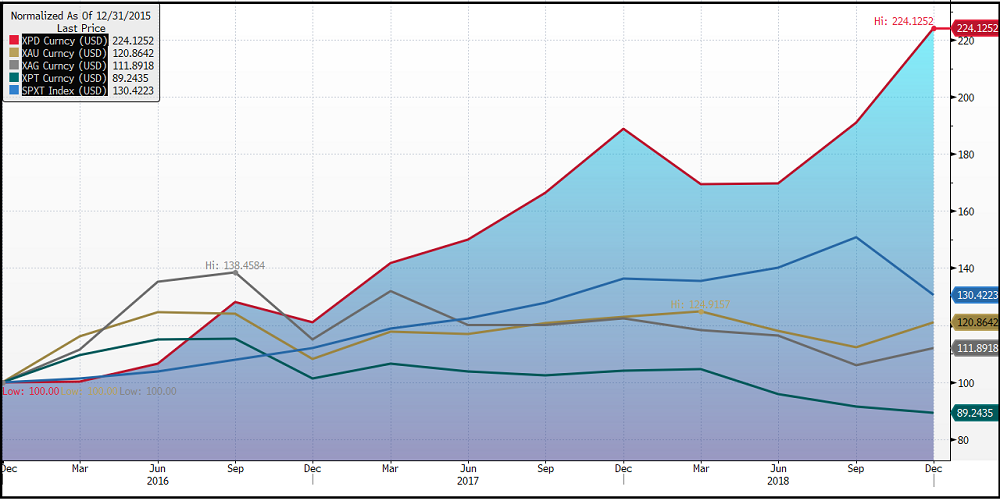
Palladium has been on a multi-year run that shows few signs of abating. For the tumultuous market year 2018, spot palladium gained 18.6% and is up 124% since the beginning of 2016. In comparison, spot gold, platinum and silver all declined last year (1.6%, 14.5%, and 8.5%, respectively), while U.S. equities lost 4.4% in 2018, as measured by the S&P 500 Total Return Index.1

Palladium is close to becoming the most “precious” of precious metals. Palladium passed the $1,000 per ounce mark in late 2017 for the first time since 2001. Palladium’s momentum accelerated in 2018, with its $1,262 price-per-ounce edging close to gold’s $1,282 price by year-end.Palladium was named by its discoverer William Wollaston in 1803, after the asteroid Pallas.

While the escalating U.S.-China trade war hurt many commodities in 2018, it couldn’t dent palladium’s rise. The white metal is primarily used in catalytic converters that reduce pollution from gasoline internal combustion engines (ICEs). Demand for palladium was especially robust last year, as environmental concerns have prompted a global shift from diesel to gasoline and hybrid vehicles. Not even the 2018 slowdown in China’s auto market, the world’s largest, dampened demand.

Palladium’s Stellar Rise

Figure 1. The Hat Trick 

Source: Bloomberg. XPT represents platinum; XAU represents gold; XPD represents palladium, XAG represents silver; SPXT represents S&P 500 Total Return Index.

Figure 2. Annual Performance 2016 – 2018

DatePalladium Price% Annual Change
12/31/2015$ 562.98
12/31/2016$ 680.9620.96%
12/31/2017$ 1,063.5256.18%
12/31/2018$ 1,261.7818.64%
Cumulative Change124.13%

Source: Bloomberg.

Figure 3. The Long View: Palladium Price vs. Gold, Platinum, Silver 2000-2018
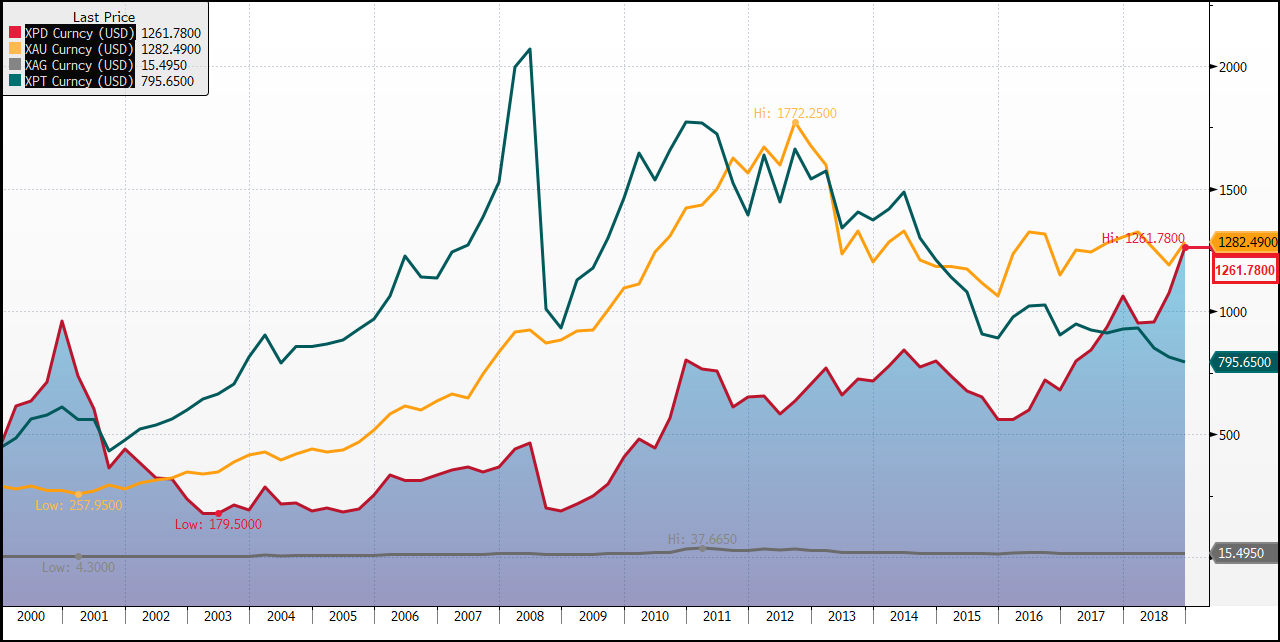
Source: Bloomberg. XPT represents platinum; XAU represents gold; XPD represents palladium, XAG represents silver.

Palladium is Very “Precious”

Palladium (chemical symbol “Pd”) is primarily used as an industrial metal and is considered a “precious” metal along with platinum, gold and silver. Both palladium and platinum are far rarer than gold and represent smaller markets. Recent world production of palladium and platinum has averaged about 200 and 175 tonnes per year, respectively, while gold production tallies approximately 3,000 tonnes per year (Read more about Platinum).

Also known as “white gold” or the “bright white metals,” palladium and platinum are members of the Platinum Group Metals (also known as “PGMs,” which also include ruthenium, rhodium, osmium and iridium) and typically co-occur in ore deposits. Their shared chemical origins give palladium and platinum similar characteristics, such as being relatively inert and having high melting points – part of their appeal as catalysts in industrial and automotive applications.

Figure 4. The Automotive Industry is the Largest Pd Consumer – Catalytic Converters
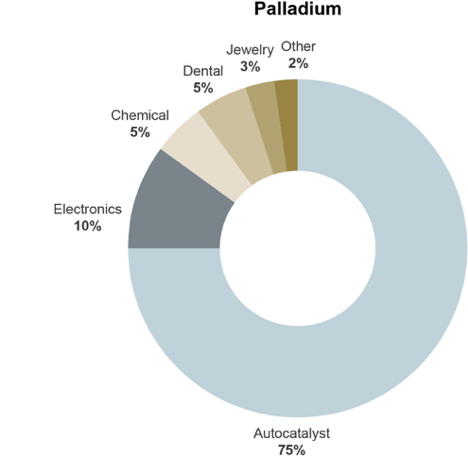
Automakers, who have little flexibility to produce cars without palladium, are being forced to push the price higher to secure their critical supply.

Source: Johnson Matthey. 

Palladium’s primary application is within the auto sector. Though historically more expensive than palladium, platinum was long the primary metal used in catalytic converters, partly because of its stability at the high temperatures required to achieve the conversion. However, in the past decade, automakers have developed technology to achieve nearly the same results with palladium, at a significantly lower cost, causing the automotive industry to transition to palladium.

While palladium is also used in jewelry, electronics, chemical and dental applications, the automotive industry’s need for catalytic converters is the primary factor driving palladium demand. If palladium’s price continues to outpace platinum’s, automakers may return to using platinum. However, analysts predict that any move back to platinum would take at least 18 to 24 months.

Palladium’s Supply Constraints

Supply shortages continue to support palladium’s performance, with strong multi-year growth in palladium demand now straining a fixed supply. Palladium is especially scarce and its supply is inelastic since it is usually a by-product of ores that are being mined for other metals, like platinum and rhodium. It is rarely mined on its own. Russia is the world’s largest palladium-producing country, followed by South Africa, Canada, the U.S. and Zimbabwe.

The official level of palladium reserves in Russia is a state secret and many industry participants believe that Russia’s stockpiles of palladium have been largely sold, constraining supply. Supply concerns were further heightened in April 2018 when the U.S. levied more sanctions against Russia.

Figure 5. Palladium Mine Production by Country (Metric Tonnes) 2012-2017
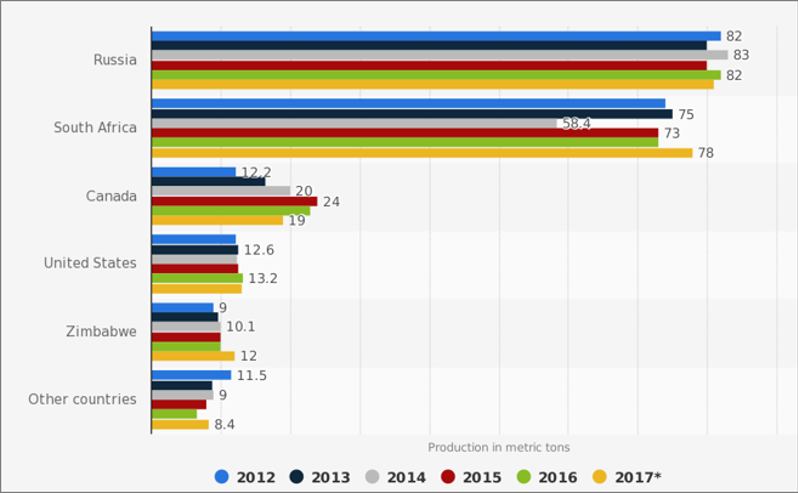
Source: U.S. Geological Survey.

Global demand for palladium, net of the supply provided through recycling, was expected to reach 7.1 million oz. in 2018, exceeding a total supply of 6.9 million oz. This shortfall extends a seven-year trend leading to a current total deficit in the market of 801,000 oz., according to the chemical company, Johnson Matthey.2

Shifting Automotive Demand but Positive Outlook

While no country has outlawed new combustion engines, Norway, China and Germany, among many countries, have implemented frameworks to discontinue long-term ICE production and encourage demand for electric vehicles (EVs) and hybrid-electric vehicles.

The growth of EVs3 could pose a risk to the palladium sector since EVs do not require catalytic converters. On the other hand, the rise of hybrid-electric vehicles could drive palladium demand, since they too require palladium to control pollution. The mining company Norilsk Nickel forecasts that combined palladium use in hybrid and plug-in hybrid — or rechargeable — vehicles in 2019 will be nearly triple that of 2016.

Today, catalytic converter demand accounts for 70% of the palladium demand worldwide. While any threat to palladium’s role within catalytic converters could impact its long-term price outlook, our view is that palladium’s fundamentals should remain strong for at least the next 24 months.

Source: http://sprott.com/insights/the-palladium-play-part-1/

Monarques Gold Corp. $MQR.ca – #Gold price likely buoyed by safe haven demand: HSBC

Posted by AGORACOM-JC at 12:09 PM on Tuesday, January 8th, 2019

SPONSOR: Monarques Gold Corp. produced 4,695 ounces of gold in the recent quarter with revenues of $10 million. Monarques owns close to 300 km² of gold properties, including the Wasamac deposit (measured and indicated resource of 2.6 million ounces of gold), the Beaufor Mine, the Croinor Gold, McKenzie Break and Swanson advanced projects and the Camflo and Beacon mills. Click here for more information.

MQR: TSX-V

—————-

Gold price likely buoyed by safe haven demand: HSBC

  • Gold price gains will likely be driven by fresh safe haven demand on equity concerns, higher financial volatility and economic uncertainty, said HSBC, leading the bank to lift its 2019 average dollar price for the yellow metal to $1,314/oz Tuesday.

London — Gold price gains will likely be driven by fresh safe haven demand on equity concerns, higher financial volatility and economic uncertainty, said HSBC, leading the bank to lift its 2019 average dollar price for the yellow metal to $1,314/oz Tuesday.

The original estimate was $1,292/oz, according to HSBC’s chief precious metals analyst James Steel.

“Gold prices are recovering from heavy investor liquidation and losses throughout much of 2018. Recent equity market declines, higher financial market volatility and other risks are triggering renewed investor demand for bullion,” Steel said. “Geopolitical and trade risks, which unusually did not lift gold last year (due to the strong US dollar), also appear to be turning positive. We believe gold is set to move higher in 2019, especially if the global economic outlook remains uncertain.”

Gold has been toying with the $1,300/oz marker so far in 2019, although for now that target has alluded bullion. Gold was spot bid at $1,284/oz as of 1420 GMT Tuesday.

“Our FX view is for a stronger USD, which may present the greatest threat to gold and will at the least limit rallies. Gold is inversely related to US equities, and we believe an important price driver in 2019 will be equity direction and volatility. Recent equity weakness has buoyed gold,” Steel added.

Looking at positioning, Steel noted that COMEX was net short in 2018 for the first time since 2001, which has since been scaled back. “Further short-covering and builds in longs are likely in 2019,” the analyst said.

Industry lobby group the World Gold Council said Tuesday that gold-backed ETFs continued to rally in December against a backdrop of market volatility, marking the third consecutive month of inflows. Global ETFs increased 3%. or by $3.1 billion, driven by North American and European fund activity, WGC said.

–Ben Kilbey, [email protected]

Source: https://www.spglobal.com/platts/en/market-insights/latest-news/metals/010819-gold-price-likely-buoyed-by-safe-haven-demand-hsbc

Bougainville Ventures Inc $BOG.ca – Canada’s Cannabis Laws And 5 Burning Questions For 2019 $CROP.ca $VP.ca NF.ca $MCOA

Posted by AGORACOM-JC at 10:06 AM on Tuesday, January 8th, 2019
SPONSOR:  Bougainville Ventures Inc (CSE: BOG) Converting irrigated farmland to greenhouse-equipped farmland. Bougainville does not “touch the plant” and only provides agricultural infrastructure as a landlord for licensed marijuana growers. Click here for more info.
BOG:CSE

—————————————
  • 2018 was a momentous year for cannabis advocates as Canada became the second country (after Uruguay) to legalize recreational marijuana use.
  • Canadians and cannabis companies alike eagerly awaited legalization, but the rollout hasn’t been as smooth as they would have liked.

Andre Bourque Contributor

A marijuana law breakdown by Canadian Province, and five burning industry questions for 2019.Shopify Partners

This is the initial post in what will be a five-part series on the 5 Burning Questions for Canadian Cannabis in 2019. 

2018 was a momentous year for cannabis advocates as Canada became the second country (after Uruguay) to legalize recreational marijuana use. Canadians and cannabis companies alike eagerly awaited legalization, but the rollout hasn’t been as smooth as they would have liked.

The most pressing problem facing the country’s legal weed market is the fact that, in the majority of provinces, suppliers are unable to meet demand. According to MarketWatch, the complexity of scaling up a national legal cannabis supply chain has left many retailers with just a fraction of the promised products. In many areas, the supply shortage may last well into 2019.

Some experts say the bottleneck exists in the regulatory approval by Health Canada of Licensed Processors and Cultivators. “The cultivation and processing capacity exists, but the lack of licensing is keeping that production off the shelves,” Rob McIntyre, CFO of Salvation Botanicals Ltd., told me. His Canadian extraction and formulation company recently agreed to produce cannabis products for U.S.-based Medical Marijuana, Inc. for the Canadian market.

“Health Canada has added significant resources to attempt to shorten the approval process, but the backlog is significant,” McIntyre explained. “In the coming months, we expect to see this supply shortage ease.”

A shortage of marijuana in Canada threatens to undermine one aim of legalization: to tame an illegal trade estimated at about 5.3 billion Canadian dollars annually. Angry consumers say they are returning to their illegal dealers. https://t.co/dZQogk8xGY

— New York Times World (@nytimesworld) November 7, 2018

On the opposite end of a product shortage is strong product pricing for cannabis producers and retailers. A gram of high-quality cannabis in Vancouver, Canada, for example, sold for $752 a gram in November 2018. Meanwhile, in Portland, Oregon, where an overabundance of marijuana is begging to cross state lines, you could buy an entire ounce of similar high-quality cannabis as recently as December.

These initial gains, however short-term they may be, will help Canadian cannabis companies offset their startup costs. “This will quickly help companies recoup the costs of building expensive cultivation facilities,” said Debra Borchardt, CEO of Green Market Report, and Canadian cannabis industry expert. “Once production begins to meet demand, then the prices will fall, which is great for consumers, but will come at a cost to the producers.”

Another less obvious issue is the diversity of cannabis regulations from province-to-province. Though weed is legal everywhere in Canada, for smokers and businesses, where you are in the country will have a huge impact.

Currently, the only constants from province-to-province under the federal Cannabis Act are a possession limit of up to 30g of dried flower (or an equivalent) and a ban on consumption in vehicles. Beyond that, everything from the legal age to the rules on public consumption can be different—though the provinces all share a common goal in discouraging underage use and exposure.

Nationwide, the biggest change in 2019 is the legalization of edible sales, which will occur no later than October 17, 2019—one year after marijuana legalization. Since edibles are more appealing to children, Canadian officials are being much more circumspect about rolling these products out. As Vice points out, it is unclear how the regulations around edibles will play out, since the government hasn’t ruled exactly what it means for a product not to “appeal” to a young person.

Provincial Laws

Here’s a quick breakdown of the current laws in each province, plus news on any upcoming changes in 2019:

.@liftandco produced an easy-to-digest graphic of the new Canadian marijuana laws and retailers by province. The country’s outlets include both the government and private sectors. pic.twitter.com/CDbHa6aArJ

— Andre F Bourque ♕ (@SocialMktgFella) January 8, 2019

Alberta:

You must be 18 years old to consume, buy, possess, and grow. Public consumption laws are the same as tobacco, though you can’t smoke near children. Home cultivation is allowed (up to four plants).

Though the province originally planned for 250 licensed retail stores managed by Alberta Gaming, Liquor, and Cannabis, supply constraints mean it will be 6-18 months before the next stores open after the first 65 opened. The province also allows online sales controlled by the government.

British Columbia:

You must be 19 years old to consume, buy, possess, and grow. Public consumption laws are the same as tobacco, though you can’t smoke near children. Home cultivation is allowed (up to four plants), though they must be hidden from street view.

British Columbia has not put a cap on the number of retail locations, but the licensing process has been slow. The first store opened up in December in Vancouver. Like Alberta, British Columbia allows online sales controlled by the government.

Manitoba:

You must be 19 years old consume, buy, and possess. Public consumption is almost completely restricted. Unlike other provinces, you won’t be able to grow your own weed at home.

By the end of November 2018, only fourteen retailers had been granted licenses. The province will allow for private online and retail stores.

In 2019, the Safe and Responsible Retailing of Cannabis Act will take effect, adding on a 6 percent tax on revenues of licensed cannabis retailers as a “Social Responsibility Fee.”

New Brunswick:

You must be 19 to consume, buy, possess, and grow. You will only be allowed to consume it in a private residence. Up to four household plants are allowed, as long as they are locked and secured.

The province will have 20 government-run locations and permit government-controlled online sales. Like many other provinces, New Brunswick has seen a spate of store shutdowns due to a lack of supply.

Newfoundland and Labrador:

You must be 19 to consume, buy, possess, and grow. You will only be allowed to consume it in a private residence. You can grow up to four plants per household.

Newfoundland and Labrador have a hybrid retail model, with private retailers receiving licenses to sell products controlled by the Newfoundland and Labrador Liquor Corporation. Online sales will go through the government-controlled NLC as well.

Nova Scotia:

You must be 19 to consume, buy, possess, and grow. You will only be allowed to consume it in designated public places. You can grow up to four plants per household, as long as they’re inside.

Nova Scotia Liquor Corporation, a government-run entity, will control online and retail stores, with 12 physical locations available at launch. Similar to other provinces, Nova Scotia faced shortages throughout 2018.

Ontario:

You must be 19 years old to consume to buy, use, posses, and grow. Public consumption laws are the same as tobacco in the province, meaning many public areas—especially ones where children may be—are off limits. There’s a four plant limit per household.

On April 1, 2019, Ontario will begin allowing private retail stores, but for now the only place to get it is through retail and online stores—the aptly names Ontario Cannabis Store—controlled by the Ontario LCBO. Thus far, the rollout has been…buggy. A questionable supply chain has been plagued by mold, mislabeled products, and mites, leading many to return to the black market in the region.

Prince Edward Island:

You must be 19 to consume, buy, possess, and grow. You will only be allowed to consume it in private residences at present. You can grow up to four plants per household, as long as they’re inside and not in reach of children.

Like many other provinces, a government-run entity, the Prince Edward Island Cannabis Management Corporation, will operate retail locations and online sales. At launch, there were four licensed retail locations. Compared to other areas, PEI’s rollout has been relatively smooth.

Quebec:

You must be 18 years old to consume, buy, and possess. Public consumption follows the same rules as tobacco, with smoking at schools and universities expressly prohibited. That may all change if newly proposed laws pass in 2019 which would raise the legal age to 21 and prohibit any smoking in public. Regardless, you cannot grow plants at home.

All online and retail sales are controlled by the Société Québécoise du Cannabis (SQDC). Since pot was legalized in October, retail locations have been closed several days of the week because of the lack of supply.

Saskatchewan:

You must be 19 years old to consume, buy, possess, and grow. Public consumption is prohibited. Four household plants are allowed per household.

Unlike many other provinces, Saskatchewan will have a private distribution system. The province handed out 51 licenses prior to Oct. 17, the day sales became legal, but as of December only a handful of those stores have opened because of supply issues. Online sales are allowed through private retailers.

5 Burning Questions for 2019

2019 marks the first full year of legal cannabis in Canada. 2018 was full of excitement for legalization, plus a whole bunch of disappointment as supply issues affected many parts of the country.

As we head into the new year, these are the biggest questions Canada’s cannabis industry will need to answer.

  1. Will There Be Enough (Legal) Pot in Canada?

It would be an understatement to say that cannabis consumers were not best of buds with the country’s suppliers.

  1. What Trends Will Dominate?

For consumers, the biggest trends for the upcoming year will be the emergence of the edibles market and the expansion of CBD products.

  1. Which IPOs Will Take Flight?

Look for even more U.S.-based companies to offer IPOs in Canada’s markets—and vice versa.

  1. Does the U.S. Legalizing Hemp Jeopardize Canada’s Industry?

In December 2018, the U.S. Congress passed the Farm Bill, an omnibus bill that, among other things, legalized the cultivation of industrial hemp and allows for interstate commerce of hemp-based products for the first time in decades. Though this brings competition to hemp production in North America for the first time, Canada has decades of research and growing experience under its belt already.

  1. How Does Legal Weed Play Out on the International Stage?

As the second country to legalize recreational cannabis-use, Canadians are reveling in their newfound freedom. But it’s unclear how cannabis use will affect international relations.

For better or worse, 2019 will be a telling year for the Canadian cannabis market. Let me know what you think’s going to happen on Twitter (@SocialMktgFella).

Disclaimer: I have no financial interest or positions in the aforementioned companies. This information is for educational purposes and does not constitute financial and/or legal advice.

Andre Bourque (@SocialMktgFella) is a cannabis industry media influencer, brand executive and advisor, blockchain marketer, and cannabis columnist. He specializes in cannabis industry partnerships, distribution, and funding. Andre is the managing director of the cannabis div…MORE

Andre is a cannabis connector and the VP of Bus. Dev. for Verdantis Advisors, a full-service consulting agency.

Source: https://www.forbes.com/sites/andrebourque/2019/01/08/canadas-cannabis-laws-by-province-and-5-burning-questions-for-2019/#1548c5dd4eb3

ThreeD Capital Inc. $IDK.ca – Apple $AAPL and Tesla $TSLA shares on the #blockchain could be the next big thing in #crypto $HIVE.ca $BLOC.ca $CODE.ca

Posted by AGORACOM-JC at 9:15 AM on Tuesday, January 8th, 2019

SPONSOR: ThreeD Capital Inc. (IDK:CSE) Led by legendary financier, Sheldon Inwentash, ThreeD is a Canadian-based venture capital firm that only invests in best of breed small-cap companies which are both defensible and mass scalable. More than just lip service, Inwentash has financed many of Canada’s biggest small-cap exits. Click Here For More Information.

Idk large
———————–
  • Security tokens — digital versions of financial securities like stocks and bonds — are becoming a new buzzword in crypto.
  • Analysts and executives in the industry see security tokens as a development that could reinvigorate the cryptocurrency space.
  • A key difference setting security tokens apart from other cryptocurrencies is that they are asset-backed and fall within regulatory parameters, experts say.

The Apple logo is displayed at the Nasdaq MarketSite just before the opening bell in New York on Thursday, Aug. 25, 2011. Scott Eells | Bloomberg | Getty Images

Cryptocurrencies had a wild 2018, tumbling well below some of the record highs seen toward the end of 2017.

Bitcoin, once worth almost $20,000, plunged last year, closing out 2018 at a price below $4,000. Other major virtual currencies, including XRP and ether, also fell steeply.

Analysts and executives in the industry are increasingly pointing to a fairly new development that could reinvigorate the space: putting securities like stocks and bonds on the blockchain.

So-called security tokens are becoming a new buzzword in crypto. The term is part of a phenomenon in the industry known as “tokenization” — turning real-world assets into digital tokens.

In the case of security tokens, tradable assets like equity and fixed income are transformed into digital assets that use blockchain technology, the virtual ledger of activity that underpins cryptocurrencies like bitcoin.

Security tokens had been talked about for some time, but now one firm is looking to put them to the test.

On Monday, DX.Exchange, an Estonia-based crypto firm, launched a trading platform that lets investors buy shares of popular Nasdaq-listed companies, including Apple, Tesla, Facebook and Netflix, indirectly through security tokens.

Each token is backed by one share of the company traders want to invest in and entitles them to the same cash dividends.

“The crypto community has been talking about security tokens for well over a year now without much progress, so we think the impact will be huge,” Amedeo Moscato, DX’s chief operating officer, told CNBC by email over the weekend.

“By tokenizing stocks of some of the biggest publicly-traded companies like Google, Amazon, Facebook and more, we are opening an untapped market of millions of old and new traders around the globe cutting out the middleman. ”

watch now VIDEO02:40 What is a security token?

Investors will be able to trade the digital stocks round-the-clock, even after markets close, DX says.

“The ability to trade around the clock, with a range of currencies, offers investors both convenience and liquidity,” Dan Doney, co-founder and chief executive of fintech firm Securrency told CNBC by email over the weekend.

But Doney questioned whether DX’s exchange was sound on the regulatory front.

“We’re unsure and even skeptical of DX.Exchange’s model because we don’t think that it’s acceptable to list tokenized shares of a company without shareholder consent,” he said.

“However, we do think that the model can meet regulatory standards if executed properly.”

DX stressed that its digital stocks are classed as derivatives — with the underlying asset being equity of 10 Nasdaq-listed firms — and that its platform is regulated under the European Union’s Mifid II directive. Mifid II, a set of reforms to EU investment services regulation, aims to protect investors and increase transparency and confidence in the industry post-crisis.

Cyprus-licensed firm MPS MarketPlace Securities is holding the stocks in a segregated account. DX built the platform on top of Nasdaq’s Matching Engine technology, which is used across more than 70 international markets.

Experts are pointing to the model as one that could provide a solid form of investment for traders — versus cryptocurrencies like bitcoin, which have proven at times to be highly volatile — as well as a new potential source of fundraising for start-ups and large firms alike. ‘STO’

New security tokens can be issued and sold to investors, similar to how new digital tokens are sold through a crowdfunding method known as an initial coin offering (ICO). This is what’s known as a security token offering (STO).

ICOs were a source of much controversy in the crypto sphere in both 2017 and 2018, with China and South Korea banning the practice and the U.S. Securities and Exchange Commission rapping a number of ventures and founders over alleged illegal activities.

One supposed cryptocurrency start-up called Giza made off with more than $2 million through a fake ICO scam, a CNBC investigation last year showed.

Dubious as the murky world of ICOs is, the funding method at one point eclipsed early-stage venture capital funding. ICO projects raked in almost $6.6 billion in 2017 and $21.5 billion in 2018, according to data provided by ICO listing site CoinSchedule.

The difference with STOs, experts say, is that security tokens are asset-backed and fall within regulatory parameters.

“Security tokens use blockchain to allow for efficient transactions like cryptocurrencies, but are different in all other ways,” Securrency’s Doney said.

”(They) emphasize regulatory compliance, automated regulatory reporting, and represent share interest in value-producing assets. This ultimately provides stable value versus the volatility of crypto.”

Crowdfunding site Indiegogo delved into the world of STOs last year, hosting a platform that let investors indirectly own shares of a luxury ski resort by buying security tokens. That token sale brought in $18 million, according to VentureBeat.

Security tokens and STOs have been compared to “stablecoins,” cryptocurrencies pegged 1:1 to government-backed currencies to avoid the volatility typically seen in the cryptocurrency market. Stablecoins are seen as another potential area for growth in the crypto industry.

Goldman Sachs-backed fintech start-up Circle launched a stablecoin pegged to the U.S. dollar last year, and Chief Executive Jeremy Allaire has told CNBC he thinks “all fiat currency will be crypto” one day.

“Cryptocurrencies and STOs will continue to evolve, and digital stocks are another step in that process,” Daniel Skowronski, DX’s chief executive, told CNBC by email. STOs to ‘ramp into the market’ by mid-2019

Advocates also say that security tokens could reduce the cost of listing a company on the stock market and that they will make it easier to trade less liquid assets like private equity.

And though it may be early days, one expert thinks the trend of tokenizing securities will become a major theme by mid-2019.

“In terms of timing, we hear that mid-2019 is the time-frame when most STOs will be able to ramp into the market,” Lex Soklin, partner and global director of fintech strategy at Autonomous Research, told CNBC by email.

“Given a longer regulatory approval process for these assets (rather than none for ICOs), entrepreneurs have a slower path to market. But perhaps a more stable one.”

Some even believe that, eventually, everything from artwork to real estate will be transformed into digital tokens.

“Over the next decade, we could very well see the tokenization of the entire financial markets,” Mati Greenspan, senior market analyst at eToro, said in a note last week.

“Essentially, anything that has value and can be traded can also be represented as a digital token and traded on a blockchain.”

Source: https://www.cnbc.com/2019/01/07/bitcoin-security-token-and-sto-explained.html

PyroGenesis $PYR.ca Signs Mutually Exclusive Partnership Agreement with Aubert & Duval to Supply Plasma Atomized Titanium Powder to European Union Additive Manufacturing/3D Printing Market

Posted by AGORACOM-JC at 8:19 AM on Tuesday, January 8th, 2019
  • Announced today that it has signed a mutually exclusive Partnership Agreement with Aubert & Duval, together the “Parties”, a subsidiary of the ERAMET Group (2017: Sales: > Can$5.4 Billion; Assets: > Can$4.9 billion; Paris Stock Exchange: ERA.PA).
  • Agreement outlines a multi-step strategy between the Parties to supply plasma atomized titanium powder, on a mutually exclusive basis, to the Additive Manufacturing Market in Europe

MONTREAL, Jan. 08, 2019 – PyroGenesis Canada Inc. (http://pyrogenesis.com) (TSX-V: PYR) (OTCQB: PYRNF) (Frankfurt: 8PY: FRA)  a TSX Venture 50® high-tech company, (the “Company”, the “Corporation” or “PyroGenesis”) a Company that designs, develops, manufactures and commercializes plasma atomized metal powder, plasma waste-to-energy systems and plasma torch products, is pleased to announce today that it has signed a mutually exclusive Partnership Agreement (the “Agreement”) with Aubert & Duval, together the “Parties”), a subsidiary of the ERAMET Group (2017: Sales: > Can$5.4 Billion; Assets: > Can$4.9 billion; Paris Stock Exchange: ERA.PA). The Agreement outlines a multi-step strategy between the Parties to supply plasma atomized titanium powder, on a mutually exclusive basis, to the Additive Manufacturing (“AM”) Market in Europe (the “Market”). The Agreement envisions establishing production capability in the Market on mutually agreeable terms.

Aubert & Duval is a world leader in industrializing high-performance steel, super alloy, aluminum and titanium alloys for over a century. More specifically, they are a recognized supplier of metal powders for additive manufacturing, serving the Aerospace, Energy, Transport, Medical, Defense, Automotive and other large scale, demanding markets.

“Aubert & Duval, founded in 1907, is a recognized supplier of fine metallic powders for AM in demanding markets such as aerospace, energy, medical, defense and automotive,” said Mr. Massimo Dattilo, Vice President of PyroGenesis Additive. “They have a strong metallurgical expertise, and a long history in powder atomization. The addition of PyroGenesis’ capabilities complements their current product offerings in a field in which they are an established supplier. Aubert & Duval has a history of supporting their customers in AM, from the development of product to mass production, and we are happy to partner with them.”

“This Agreement establishes the framework within which Aubert & Duval and PyroGenesis shall work together to distribute the titanium powders manufactured by PyroGenesis to the Market. There are provisions for the expansion of the Market upon mutual agreement by the Parties,” said Mr. P. Peter Pascali, President and CEO of PyroGenesis. “This relationship will undoubtably accelerate our growth in our AM business line and complements our corporate strategy to team up with established players who have an impeccable reputation and a strong balance sheet, to accelerate our growth.  This is a very significant milestone not only for PyroGenesis and Aubert & Duval, but for the industry as a whole.  This strategic partnership speaks to the Parties’ complementary strengths: PyroGenesis’ extensive plasma expertise as the inventor of Plasma Atomization, and Aubert & Duval’s large network of customers, strong balance sheet, and extensive knowledge of the market.”

In a press release issued January 8th, 2019, Jérôme Fabre, Eramet Group’s Deputy CEO in charge of the Alloys division, described the benefits of the partnership as follows: “With our metallurgical expertise for demanding markets such as aeronautics and energy, this partnership with PyroGenesis allows us to complete our offer of metal powders for additive manufacturing, including 3D printing, a growing market of the industry of the future.”

About PyroGenesis Canada Inc.

PyroGenesis Canada Inc., a TSX Venture 50® high-tech company, is the world leader in the design, development, manufacture and commercialization of advanced plasma processes and products. We provide engineering and manufacturing expertise, cutting-edge contract research, as well as turnkey process equipment packages to the defense, metallurgical, mining, advanced materials (including 3D printing), oil & gas, and environmental industries. With a team of experienced engineers, scientists and technicians working out of our Montreal office and our 3,800 m2 manufacturing facility, PyroGenesis maintains its competitive advantage by remaining at the forefront of technology development and commercialization. Our core competencies allow PyroGenesis to lead the way in providing innovative plasma torches, plasma waste processes, high-temperature metallurgical processes, and engineering services to the global marketplace. Our operations are ISO 9001:2015 certified and have been since 1997. PyroGenesis is a publicly-traded Canadian Corporation on the TSX Venture Exchange (Ticker Symbol: PYR) and on the OTCQB Marketplace. For more information, please visit www.pyrogenesis.com

About Eramet:

Eramet is one of the world’s leading producers of:
Manganese and nickel, used to improve the properties of steels, and mineral sands (titanium dioxide and zircon), parts and semi-finished products in alloys and high-performance special steels used by industries such as aerospace, power generation, and tooling.

Eramet is also developing activities with strong growth potential, such as lithium extraction and recycling, called to play a key role in the energy transition and the mobility of the future.

The Group employs around 12,600 people in 20 countries. www.eramet.com

About Aubert & Duval:        

Aubert & Duval, a subsidiary of the Alloys division of the Eramet group, is a metallurgist expert and one of the world leaders in high-performance steels, superalloys, titanium and aluminum. Aubert & Duval designs and develops advanced metallurgical solutions in the form of closed-die forged or forged parts, long products or metal powders for projects in the most demanding industries: aeronautics, energy, defense, nuclear, medical. www.aubertduval.com

This press release contains certain forward-looking statements, including, without limitation, statements containing the words “may”, “plan”, “will”, “estimate”, “continue”, “anticipate”, “intend”, “expect”, “in the process” and other similar expressions which constitute “forward- looking information” within the meaning of applicable securities laws. Forward-looking statements reflect the Corporation’s current expectation and assumptions and are subject to a number of risks and uncertainties that could cause actual results to differ materially from those anticipated. These forward-looking statements involve risks and uncertainties including, but not limited to, our expectations regarding the acceptance of our products by the market, our strategy to develop new products and enhance the capabilities of existing products, our strategy with respect to research and development, the impact of competitive products and pricing, new product development, and uncertainties related to the regulatory approval process. Such statements reflect the current views of the Corporation with respect to future events and are subject to certain risks and uncertainties and other risks detailed from time-to-time in the Corporation’s ongoing filings with the securities regulatory authorities, which filings can be found at www.sedar.com, or at www.otcmarkets.com. Actual results, events, and performance may differ materially. Readers are cautioned not to place undue reliance on these forward-looking statements. The Corporation undertakes no obligation to publicly update or revise any forward- looking statements either as a result of new information, future events or otherwise, except as required by applicable securities laws.

Neither the TSX Venture Exchange, its Regulation Services Provider (as that term is defined in the policies of the TSX Venture Exchange) nor the OTCQB accepts responsibility for the adequacy or accuracy of this press release.

SOURCE PyroGenesis Canada Inc.

For further information please contact: Clémence Bertrand-Bourlaud, Marketing Manager/Investor Relations, Phone: (514) 937-0002, E-mail: [email protected]

RELATED LINKS: http://www.pyrogenesis.com/

BREAKING: Enthusiast Gaming $EGLX to Acquire “The Sims Resource”, the World’s Largest Female Video Gaming Website $ATVI $TTWO $GAME $EPY.ca $TCEHF

Posted by AGORACOM-JC at 12:07 PM on Monday, January 7th, 2019

Transformative acquisition to add approximately 35% to Enthusiast’s rapidly growing revenue base

  • Company to acquire 100% of the assets of The Sims Resource from Generatorhallen AB and IBIBI HB on an arm’s length basis for US$18 million in cash and US$2 million in stock for an aggregate purchase price of US$20 million
  • TSR generated C$7 million in revenue and C$5.25 million in Adjusted EBITDA2  and approximately C$4.5 million in net income
  • world’s largest female video gaming content and community destination online.
  • Sims™ franchise has sold nearly 200 million copies worldwide and is widely considered one of the best-selling video games series of all time.

TORONTO, Jan. 07, 2019 — Enthusiast Gaming Holdings Inc. (“Enthusiast” or the “Company”) (TSXV: EGLX), is pleased to announce that it has, through a wholly-owned subsidiary, signed a definitive agreement on January 3, 2019 (the “Agreement“) for the Company to acquire 100% of the assets of The Sims Resource (“TSR”) from Generatorhallen AB and IBIBI HB (the “Vendors”) on an arm’s length basis for US$18 million in cash and US$2 million in stock for an aggregate purchase price of US$20 million (the “Purchase Price“).  Thirty percent (30%) of the Purchase Price is payable on closing and the balance payable by the first anniversary date of closing, subject to certain customary adjustments (the “Transaction“). Completion of the Transaction is subject to satisfaction of a number of customary conditions, including the approval of the TSX Venture Exchange and is expected to close prior to February 15, 2019.

THE SIMS RESOURCE

Established in 1999, TSR (www.thesimsresource.com) has grown to become the world’s largest female video gaming content and community destination online.1 The website offers custom content built around the popular Sims™ video game franchise, which can be downloaded by users to alter and/or expand gameplay. Published by Electronic Arts, The Sims™ franchise has sold nearly 200 million copies worldwide and is widely considered one of the best-selling video games series of all time.

“The Sims Resource is one of the largest video game communities, ranking in the top 5 independent sites in total views in the US, Canada and the UK.  It currently generates more than 10% of the total views of Twitch.com, the largest video game website, which was acquired by Amazon in 2014 for approximately US$1 billion,” said Menashe Kestenbaum, CEO of Enthusiast Gaming (Source: Comscore Media Metrix Multi-Platform/®, Games – Gaming Information, Total Views, November 2018, U.S., Canada, U.K.). “Further, with the rapidly growing female video game segment, TSR provides us with immediate reach into this valuable audience.”

  • TSR is the largest female video gaming content site in the world generating in excess of 2.5 billion page views per year (Google Analytics);
  • Comscore’s Gaming Information category currently ranks TSR in the top 5 independent video game websites;
  • The site ranks #7 on Quantcast’s Top 25 websites with the highest concentration of female audience in the United States, closely behind Oprah.com and Bravotv.com (Quantcast, Top 25 websites with the most female audience, 2017);
  • In 2018 TSR generated C$7 million in revenue and C$5.25 million in Adjusted EBITDA2  and approximately C$4.5 million in net income (CohnReznick LLP unaudited “Quality of Earnings” report prepared for Enthusiast); and
  • Approximately 60% of revenue is derived from advertising with 40% received from monthly recurring subscribers.

“We see three key growth opportunities associated with this acquisition,” Kestenbaum continued. “Initially we intend to drive significant organic growth in advertising revenue via direct sales, an area of strategic importance to Enthusiast in recent months. Further, we now have an opportunity to monetize with advertisers seeking a large female video game audience. Finally, TSR’s subscription model has the potential to add considerable revenue across our entire portfolio.”

TRANSACTION TERMS

  • As consideration for the acquired assets, Enthusiast will pay, at closing, an initial amount of US$4 million in cash and US$2 million in common shares in the capital of the Company valued at C$1.00 per share;
  • The Company will pay a deferred payment (the “Deferred Payment”) of US$14 million on or before the first anniversary of closing;
  • Enthusiast will enter into a transition services agreement, pursuant to which the Vendors will manage, operate and administer the acquired assets and in particular the relationships with the TSR community for a period of up to one year;
  • Until the Deferred Payment is made, the Company has agreed on a profit-sharing split of 70% in favour of the Vendors, which decreases proportionally if the Company elects to prepay a portion of the Deferred Payment; and
  • Pursuant to the Transaction, the Company will acquire all of the assets related to TSR, including, but not limited to, customer and supplier lists, trade names, business goodwill, intellectual property, software, the domain name, website content, social media accounts and the Company will not assume any liabilities or obligations of the Vendors outside of those normally assumed in relation to employment and certain other contractual obligations.       

The acquisition of TSR is the largest acquisition to date for Enthusiast and follows the successful completion of seven strategic acquisitions in 2018. The Company anticipates that it will need to secure financing in order to meet the Deferred Payment. The Company expects to continue to grow through a combination of organic growth and acquisition utilizing its balance sheet as well as being opportunistic with respect to additional equity and/or debt financing to execute on its defined growth strategy.

About Enthusiast

Founded in 2014, Enthusiast is the fastest-growing online community of video gamers. Through the Company’s unique acquisition strategy, it has a platform of over 80 owned and affiliated websites and currently reaches over 75 million monthly visitors with its unique and curated content. Enthusiast also owns and operates Canada’s largest gaming expo, Enthusiast Gaming Live Expo, EGLX, (www.eglx.ca). Over 30,000 people attended EGLX in October 2018. For more information on the Company, visit www.enthusiastgaming.com.

CONTACT:

Julia Becker
Head, Investor Relations & Marketing
(604) 785-0850
[email protected] 

Eric Bernofsky
COO, SVP Finance
(416) 623-9360
[email protected] 

This news release contains certain statements that may constitute forward-looking information under applicable securities laws. All statements, other than those of historical fact, which address activities, events, outcomes, results, developments, performance or achievements that Enthusiast anticipates or expects may or will occur in the future (in whole or in part) should be considered forward-looking information. Such information may involve, but is not limited to, comments with respect to strategies, expectations, planned operations and future actions of the Company. Often, but not always, forward-looking information can be identified by the use of words such as “plans”, “expects”, “is expected”, “budget”, “scheduled”, “estimates”, “forecasts”, “intends”, “anticipates”, or “believes” or variations (including negative variations) of such words and phrases, or statements formed in the future tense or indicating that certain actions, events or results “may”, “could”, “would”, “might” or “will” (or other variations of the forgoing) be taken, occur, be achieved, or come to pass. Forward-looking information is based on currently available competitive, financial and economic data and operating plans, strategies or beliefs as of the date of this news release, but involve known and unknown risks, uncertainties, assumptions and other factors that may cause the actual results, performance or achievements of Enthusiast to be materially different from any future results, performance or achievements expressed or implied by the forward-looking information. Such factors may be based on information currently available to Enthusiast, including information obtained from third-party industry analysts and other third-party sources, and are based on management’s current expectations or beliefs regarding future growth, results of operations, future capital (including the amount, nature and sources of funding thereof) and expenditures. Any and all forward-looking information contained in this press release is expressly qualified by this cautionary statement. Trading in the securities of the Company should be considered highly speculative.

Neither the TSX Venture Exchange nor its Regulation Services Provider (as that term is defined in the policies of the TSX Venture Exchange) accepts responsibility for the adequacy or accuracy of this release.

The securities of the Corporation have not been and will not be registered under the United States Securities Act of 1933, as amended and may not be offered or sold in the United States absent registration or an applicable exemption from the registration requirement. This press release shall not constitute an offer to sell or the solicitation of an offer to buy nor shall there be any sale of the securities in any jurisdiction in which such offer, solicitation or sale would be unlawful.

____________________
1 See Comscore Media Metrix Multi-Platform and Quantcast report referenced below.

2 Adjusted EBITDA as used by the Company means earnings before interest and financing costs (net of interest income), income taxes, depreciation and amortization, stock-based compensation, restructuring and other non-recurring costs, and non-controlling interests. Adjusted EBITDA is a non-IFRS measure. Enthusiast believes this non-IFRS financial measure provides useful information to both management and investors in measuring financial performance, the ability to fund future working capital needs, to service outstanding debt, and to fund future capital expenditures. This measure does not have a standard meaning prescribed by IFRS and therefore may not be comparable to similarly titled measurers presented by other publicly traded companies and should not be construed as an alternative to other financial measures determined in accordance with IFRS.

Betteru Education Corp. $BTRU.ca – Indian e-learning startup Byju’s eyes US deals after raising $540m

Posted by AGORACOM-JC at 9:52 AM on Monday, January 7th, 2019
SPONSOR:  Betteru Education Corp. Connecting global leading educators to the mass population of India. BetterU Education has ability to reach 100 MILLION potential learners each week. Click here for more information.
——–

Indian e-learning startup Byju’s eyes US deals after raising $540m

  • Indian online tutorial startup Byju’s, which recently received $540 million in investment from South African fund Naspers and the Canada Pension Plan Investment Board, has begun talks with four or five U.S. peers toward an acquisition to speed its global expansion.

World’s most valuable education tech unicorn has global expansion plans, CEO says ROSEMARY MARANDI, Nikkei staff writer January 04, 2019 14:22 JST

MUMBAI — Indian online tutorial startup Byju’s, which recently received $540 million in investment from South African fund Naspers and the Canada Pension Plan Investment Board, has begun talks with four or five U.S. peers toward an acquisition to speed its global expansion.

The world’s top education technology unicorn, valued at $3.8 billion, seeks to finalize a deal within six months, using part of the money from its recent fundraising round, founder and CEO Byju Raveendran told the Nikkei Asian Review in an interview.

Byju’s wants to make an acquisition “that will eventually help us launch in a new market,” Raveendran said. “We are also looking for products that will have a global offering because we don’t know today which country we want to launch in.”

The company also is considering tie-ups with, as well as acquisitions of, content distribution companies for its platform.

“If both can come together, nothing like it, but there are not many options where you get a good product offering and a significant amount of reach,” the CEO said.

Byju’s, formally known as Think & Learn, has seen rapid growth in India, where it has reached 2 million paid subscribers and over 30 million general users.

The company, which began as a provider of preparation for competitive exams such as the GMAT and GRE, also enjoys backing from investors such as Chinese internet giant Tencent Holdings, Facebook founder Mark Zuckerberg’s multibillion-dollar philanthropy venture and the World Bank Group’s International Finance Corp. Together, they have invested around $800 million in several rounds of funding.

Byju’s doubled its revenue over the past three years and expects to triple the amount to 15 billion rupees ($209 million) during the fiscal year that ends in March.

  Byju’s founder and CEO Byju Raveendran is eager for a U.S. deal that would mark the startup’s fourth acquisiton since it began in 2015. (Photo by Rosemary Marandi)

By the July-September quarter, Byju’s will make its app available in the U.S. and some Commonwealth countries such as the U.K., Australia and New Zealand to test its traction in these markets.

The startup will introduce its signature high-production-value videos and content — which simplify subjects such as math and science for Indian students as young as kindergarten age — for 5- to 8-year-olds in these countries.

Byju’s has brought in teachers from across English-speaking countries to record videos in its studios in Bangalore. These teachers are chosen from popular educators on YouTube, and Byju’s is hoping their fans will follow them to its learning app.

Byju’s “has aggressive plans for international market expansion and will make bold investments in technology that will help to further personalize learning for students,” according to the company.

A U.S. deal would mark Byju’s fourth acquisition since its launch in 2015. In July, the unicorn acquired Bangalore-based education startup Math Adventures for an undisclosed amount. The team of Math Adventures now forms a part of Byju’s content and research and development team.

In 2017, it acquired two companies, TutorVista and Edurite, from London-based education group Pearson, the former owner of the Financial Times. It also bought student assessment platform Vidyartha that year.

Other Indian e-learning startups are moving beyond the country’s borders to boost their revenue.

Education technology startup Mindler, for instance, is already present in five countries, including Russia and Singapore. Fellow startup Aspiring Minds has entered countries such as China and the U.S., while Xseed Education is present in the Philippines, Singapore and the Middle East.

These startups believe in the fitness of their products to attract markets abroad.

According to a study by Google and accounting group KPMG, India’s online education industry is expected to grow eightfold to $1.96 billion by 2021, with the number of paid users rising sixfold to 9.6 million from 1.6 million now.

Source: https://asia.nikkei.com/Business/Startups/Indian-e-learning-startup-Byju-s-eyes-US-deals-after-raising-540m

PyroGenesis $PYR.ca Announces Winning Tender (>CAD $1MM) for 900 kW Plasma Torch System Sale

Posted by AGORACOM-JC at 8:40 AM on Monday, January 7th, 2019
  • Announced today that it has been awarded a contract for a 900 kW plasma torch system for more than CAD $1MM.
  • This contract was won in a competitive bid put out by RISE Energy Technology Center AB of Sweden

MONTREAL, Jan. 07, 2019 — PyroGenesis Canada Inc. (http://pyrogenesis.com) (TSX-V: PYR) (OTCQB: PYRNF), a TSX Venture 50® high-tech company, (the “Company”, the “Corporation” or “PyroGenesis”) a Company that designs, develops, manufactures and commercializes plasma atomized metal powder, plasma waste-to-energy systems and plasma torch products, is pleased to announce today that it has been awarded a contract for a 900 kW plasma torch system for more than CAD $1MM. This contract was won in a competitive bid put out by RISE Energy Technology Center AB of Sweden (the “Client” or “RISE”).

The invitation to participate was announced on November 11th, 2018 and the deadline for submitting applications was December 12th, 2018. Technical and commercial discussions took place in Sweden December 18-21st, 2018. The competition was narrowed down to two other companies besides PyroGenesis. The 10-day standstill period, in which participants could contest the decision based on procedure, expired January 2nd, 2019, and as such the contract was awarded to PyroGenesis. The Client and PyroGenesis are now in the process of finalizing contract terms. The torch is scheduled to be delivered by Q3 2019.

Mr. P. Peter Pascali, President and CEO of PyroGenesis, provides further information in the following Q&A format:

Q. You announced today a 900KW torch system sale. What does this mean for the Company exactly?

A. This is a giant step forward for PyroGenesis and its torch sale strategy, for three reasons.

First, we won this contract against stiff competition. One was a European powerhouse, and the other was a local company. Being the only non-European competitor did not help either. We were determined to win this contract, and not sacrifice our margins, and we did.

Second, as you know, we are plasma torch experts, and have sold plasma torches in the past. Our main lines of business typically use torches between 10-550 kW so that is what we typically sell as well. However, there is a significant market for high powered plasma torches ( ~ 1 MW range), and one we have targeted for some time now. Notwithstanding the fact that our businesses do not use 1 MW torches, we developed this capability in-house, with support from the Canadian National Research Council, with our eyes set on addressing this market. This announcement today is the first step in that direction.

Third, we announced on October 26, 2017 that we were granted two US patents, one of which was a torch patent targeting this exact application.

Q. And what application is that?

A. Iron ore pelletization.

It is a process in which fossil fuel burners are typically used in abundance. Fossil fuel burners are naturally bad for the environment in that they generate greenhouse gases. Amongst its many advantages, PyroGenesis’ Plasma torches do not.

We are extremely happy to be working with RISE on this project as we share many of their views and values. Sweden is committed to becoming a zero-carbon dioxide emission society and, as such, is developing fossil free technologies across all sectors. This contract is aimed at developing fossil-free energy-mining-iron-steel value chains and thereby provide a basis for governance and industrial strategies for transformative change across all of Sweden.

We are proud to be part of this initiative by providing our patented torch technology (US patent #9,752,206 entitled Plasma heated furnace for iron ore pellet induration) as a basis for this change.

Q. When do you think you will conclude the contract?

A. Within the next six weeks.

Q. Any risk it won’t be signed?

A. There are always risks, but we are highly confident it will be signed. Maybe even sooner than what we expect.

Q. Last but not least, what is your goal for this market?

A. We have one of the largest concentrations of plasma expertise under one roof. We make some of the most unique plasma torches in the world. We run torches on air, oxygen, argon, helium, and even water which is quite uncommon. Our torches are compact, lightweight, easy to operate, fully-automated, with high levels of safety, and impressive reliability. PyroGenesis torches can operate for extremely long periods without maintenance, and they can easily restart without manual intervention.

Winning this public tender not only speaks to our capability of meeting existing needs, but also to our ability to develop new plasma torches for unique and demanding situations.

We have effectively expanded our plasma torch offerings to now include high powered plasma torches and, as such, we expect to very quickly become a significant player in this market segment.

About PyroGenesis Canada Inc.

PyroGenesis Canada Inc., a TSX Venture 50® high-tech company, is the world leader in the design, development, manufacture and commercialization of advanced plasma processes and products. We provide engineering and manufacturing expertise, cutting-edge contract research, as well as turnkey process equipment packages to the defense, metallurgical, mining, advanced materials (including 3D printing), oil & gas, and environmental industries. With a team of experienced engineers, scientists and technicians working out of our Montreal office and our 3,800 m2 manufacturing facility, PyroGenesis maintains its competitive advantage by remaining at the forefront of technology development and commercialization. Our core competencies allow PyroGenesis to lead the way in providing innovative plasma torches, plasma waste processes, high-temperature metallurgical processes, and engineering services to the global marketplace. Our operations are ISO 9001:2015 certified, and have been since 1997. PyroGenesis is a publicly-traded Canadian Corporation on the TSX Venture Exchange (Ticker Symbol: PYR) and on the OTCQB Marketplace. For more information, please visit www.pyrogenesis.com

This press release contains certain forward-looking statements, including, without limitation, statements containing the words “may”, “plan”, “will”, “estimate”, “continue”, “anticipate”, “intend”, “expect”, “in the process” and other similar expressions which constitute “forward- looking information” within the meaning of applicable securities laws. Forward-looking statements reflect the Corporation’s current expectation and assumptions and are subject to a number of risks and uncertainties that could cause actual results to differ materially from those anticipated. These forward-looking statements involve risks and uncertainties including, but not limited to, our expectations regarding the acceptance of our products by the market, our strategy to develop new products and enhance the capabilities of existing products, our strategy with respect to research and development, the impact of competitive products and pricing, new product development, and uncertainties related to the regulatory approval process. Such statements reflect the current views of the Corporation with respect to future events and are subject to certain risks and uncertainties and other risks detailed from time-to-time in the Corporation’s ongoing filings with the securities regulatory authorities, which filings can be found at www.sedar.com, or at www.otcmarkets.com. Actual results, events, and performance may differ materially. Readers are cautioned not to place undue reliance on these forward-looking statements. The Corporation undertakes no obligation to publicly update or revise any forward- looking statements either as a result of new information, future events or otherwise, except as required by applicable securities laws. Neither the TSX Venture Exchange, its Regulation Services Provider (as that term is defined in the policies of the TSX Venture Exchange) nor the OTCQB accepts responsibility for the adequacy or accuracy of this press release.

SOURCE PyroGenesis Canada Inc.

For further information please contact: Clémence Bertrand-Bourlaud, Marketing Manager/Investor Relations, Phone: (514) 937-0002, E-mail: [email protected]

RELATED LINKS: http://www.pyrogenesis.com/

Esports Entertainment Group $GMBL – Five predictions for the #esports industry in 2019 $ATVI $TTWO $GAME $EPY.ca $TCEHF

Posted by AGORACOM-JC at 3:46 PM on Friday, January 4th, 2019
SPONSOR: Esports Entertainment $GMBL Connecting global leading educators to the mass population of India. BetterU Education has ability to reach 100 MILLION potential learners each week. Click here for more information

Mobile esports on the rise

  • These days, you can pick up your mobile phone and play against other people in real time – all you need is a decent internet connection.
  • This is a major part of why mobile esports is on the rise and why many predict it will take off in a huge way in the not-so-distant future.

Five predictions for the esports industry in 2019

By Adam Fitch -January 4, 2019

2018 is over, and nobody will deny that it was a ridiculous year for the esports industry. Celebrity investors, new competitions, almost-unbelievable organisation valuations, and a plethora of incredible game play have all made it a year to remember, but what’s to be expected in 2019?

Here at Esports Insider we cover the business side of esports so, naturally, our predictions will be based on such. Of course, we’d love to speculate on how Astralis will fare in CS:GO in the new year and whether the FGC will ever stop squabbling or not, but business is what we live and breathe.

Let’s get into our five predictions for the esports industry in 2019!

Overwatch League troubles?

Activision Blizzard has brought in eight new investors to own expansion teams in the Overwatch League at $30-60 million a piece, but things aren’t perfect. A vocal portion of esports fans think the game is too hectic to follow (which could well make the game less accessible to new viewers), average viewership – excluding China and potential bots – declined steadily over the course of the inaugural season, and the developer is fully in control of everything that happens in the competition which is a scary prospect.

Overwatch League

A slew of inappropriate behaviour and, subsequently, suspensions were present in the first season of the premier Overwatch competition, which isn’t attractive to sponsors. The OWL has acquired a roster of prominent sponsors and secured a ludicrous amount of money at the same time – but what happens if they decide to drop out? How easy will it be to acquire new sponsors if everything isn’t as great as it’s being portrayed?

The second season of the Overwatch League kicks off on February 14th, and we feel as if it’ll be pivotal. If the aforementioned problems are addressed as much as possible and faith in the game is restored in those who have become disillusioned in it, then things could be OK for the foreseeable future. If not, then franchise owners could well start to feel a little iffy about the future of their trusty investments.

Battle Royale remains relevant

2018 was undoubtedly the year of the Battle Royale genre. With PlayerUnknown’s Battlegrounds and Fortnite both having their fair share of the limelight in terms of player base and viewing figures, the genre was truly put on the map in a casual basis; it’s had a harder time from a competitive viewpoint, however. From H1Z1 Pro League coming and going, PUBG’s dwindling popularity, and Epic Games’ questionable esports efforts, there’s plenty of room for the genre to grow when competition is involved.

We predict that Battle Royale titles will continue to thrive in 2019 – with games similar to Call of Duty’s Blackout being released and making a wave in the market, albeit briefly – but people will still argue over the genre’s status as a legitimate competitive format. PUBG Corp. is launching six Pro Leagues with three additional pro circuits and Epic Games still has millions of dollars to give out over the course of the year, so it’s an interesting time for the industry.

Traditional sports clubs continue to invest

Over the last couple of years there have been a number of trends in the esports industry, many of which aren’t as significant as traditional sports clubs and their involvements in video games. Whether it’s straight-up acquiring majority shares in organisations (such as OpTic Gaming and compLexity Gaming), investing and partnering with local companies (Pittsburgh Knights and the Pittsburgh Steelers, most recently), or entering the scene through a safe route (football teams expanding into FIFA, for example), there’s been an abundance of instances in recent times.

Pittsburgh Knights joins forces with Pittsburgh Steelers

It’s hard to imagine this will slow down. With that being said, if a bunch of clubs that have already invested decide to back out of esports now as is hasn’t been immediately fruitful monetarily, then it may heed a warning for those looking for a quick cash-grab. This isn’t a bad thing for the esports industry at all, though. In 2019, we expect to see more and more crossover between traditional sports and esports when it comes to ownership of organisations and teams.

Mobile esports on the rise

These days, you can pick up your mobile phone and play against other people in real time – all you need is a decent internet connection. This is a major part of why mobile esports is on the rise and why many predict it will take off in a huge way in the not-so-distant future.

When we attended the Clash Royale League World Finals in Tokyo, Japan, we saw a potential glimpse into the future. Not too different from esports as we currently know it, the arena was filled with impassioned fans that were happy to pay to see the best players in the world compete.

Accessibility is a huge factor in the attractiveness of mobile esports, but titles such as Clash Royale have proven that mobile games don’t need to merely be a portable version of PC titles. MOBAs such as Dota 2 and League of Legends are undeniably popular and so it’s understandable that mobile versions of the genre are flooding the scene, but originality may well trump all. We truly think we’ll find out more in regards to this theory in 2019.

Course corrections

Even as valuations for organisations and companies continue to rise, it hasn’t all been smooth sailing in 2018. Echo Fox announced that it would undergo an organisational restructure in October to better position itself for profitable and sustainability in the future – releasing its Call of Duty and Gears of War rosters, as well as fighting game competitors and other select players.

On a bigger scale, Infinite Esports and Entertainment – the parent company of OpTic Gaming, Obey Alliance, the now-defunct Allegiance and a host of supporting companies – released a whole host of staff members around the same time as Echo Fox. Growing too fast was where blame was placed, following a rapid expansion and a suite of acquisitions following the majority share sale of OpTic Gaming in November 2017.

We wouldn’t be surprised to see this happen at other prominent companies and organisations in the upcoming year, too. Spend is ridiculously high when you occupy spots in League of Legends and the Overwatch League, player demands are ever-growing, and contract buyouts are nearing unfathomable heights. Sometimes you have to take a step backwards to move forward in a stronger state, and it should be expected as the industry edges towards a potential bubble.

Source: https://esportsinsider.com/2019/01/5-predictions-esports-2019/

Betteru Education Corp. $BTRU.ca – #Google $GOOG and #KPMG estimates #India’s online education #edtech industry to grow eight-fold to reach $1.96 billion by 2021

Posted by AGORACOM-JC at 2:34 PM on Thursday, January 3rd, 2019
SPONSOR:  Betteru Education Corp. Connecting global leading educators to the mass population of India. BetterU Education has ability to reach 100 MILLION potential learners each week. Click here for more information.
——–

Google and KPMG estimates India’s online education industry to grow eight-fold to reach $1.96 billion by 2021

Growing EdTech Market in India: Key Catalyst

  • India is witnessing demographic dividends, implying more and more people, students and professionals alike are undertaking smart courses in order to improve knowledge base to gain a competitive edge in their careers.
  • This phenomenon has convinced analysts of the immense growth prospects of the burgeoning EdTech industry in India.
  • Reducing internet costs and increasing internet penetration in the country are other notable factors favoring the growth prospects of EdTech industry.
  • In fact, a research report from Google and KPMG estimates India’s online education industry to grow eight-fold to reach $1.96 billion by 2021. Further, the study projects paid users in EdTech to grow six times from 1.6 million in 2016 to 9.6 million in 2021.

By Zacks Equity Research, Zacks.com

Microsoft MSFT has introduced Surface Go tablet in India exclusively through Bengaluru, India-based e-commerce company, Flipkart. Recently, the company commenced shipping of the device, with prices ranging from INR 38,599 to INR 50,999.

The different variants of the new tablet series come with storage capacity of 64 GB and 128 GB, with 4 GB and 8 GB RAM, respectively.

Notably, Surface Go was introduced by Microsoft in a bid to explore the low-priced tablet market to take on Apple’s budget iPads, and Alphabet’s lower-priced Chromebook.

The company had unveiled Surface Go device around Jul 10, 2018 which was made available in early August, with prices ranging from $399 to $549 in the United States.

We believe that availability of Surface Go in India will position the company well to capitalize on the emerging EdTech market. Furthermore, the enhanced security and performance features hold promise in the growing enterprise market in the country.

Microsoft is likely to benefit from the competitive pricing of its Surface Go device. The latest Samsung Galaxy Tab S4 with 64 GB capacity is priced approximately at INR 57,900.

Microsoft Corporation Revenue (TTM)

Microsoft Corporation Revenue (TTM) | Microsoft Corporation Quote

In the words of Country General Manager, Consumer & Devices at Microsoft India, Priyadarshi Mohapatra, “Globally and in India, it’s encouraging to see the rapidly growing Surface community in both consumer and enterprise.”

Enhanced Security & Performance Features Hold Key

The compact Surface Go features a 10-inch screen and weighs 522 grams (or 1.15 pounds), lighter than its prevailing Surface counterparts. Further, the latest series is equipped with Intel’s INTC processor and graphic chips.

Additionally, the device has a decent nine hour battery life and canfunction with optional keyboard, mouse and Surface Pen 2.

Surface Go’s Windows Hello facial recognition option feature for logging-in and Windows 10 S mode, makes it a compelling option.

In a bid to enhance security and performance, users can utilize Microsoft Store appsincluding Microsoft Edge to browse safely.

Enterprises may avail Windows 10 Proto safeguard business infrastructure with robust security features. Windows Autopilot enables users to configure Surface Go from the cloud, in turn simplifying the IT processes a great deal.

Growing EdTech Market in India: Key Catalyst

India is witnessing demographic dividends, implying more and more people, students and professionals alike are undertaking smart courses in order to improve knowledge base to gain a competitive edge in their careers. This phenomenon has convinced analysts of the immense growth prospects of the burgeoning EdTech industry in India.

Reducing internet costs and increasing internet penetration in the country are other notable factors favoring the growth prospects of EdTech industry.

In fact, a research report from Google and KPMG estimates India’s online education industry to grow eight-fold to reach $1.96 billion by 2021. Further, the study projects paid users in EdTech to grow six times from 1.6 million in 2016 to 9.6 million in 2021.

Enemy’s Enemy an Ally?

One important point to note in this latest development is that Microsoft selected Flipkart’s e-commerce platform to launch Surface Go in India. Notably, Amazon AMZN and Flipkart are the two major players in Indian e-commerce market. Additionally, Walmart WMT acquired a 77% stake in Flipkart.

Microsoft Azure directly competes with Amazon’s cloud platform Amazon Web Services (“AWS”) in the cloud market. Walmart which competes with Amazon in the retail and e-commerce market has selected Azure cloud platform.

When we join the loose ends, it makes sense to say that “my enemy’s enemy is my friend.”

Our Take

Microsoft is well poised to benefit from robust adoption of Surface Go on the back of improving EdTech and enterprise scenario in India.

We believe the availability of Surface Go will aid the company in bolstering competitive strength in the direct consumer market, primarily in EdTech market in India.

Notably, Surface revenues increased 14% (same at cc) in first-quarter fiscal 2019 on a year-over-year basis on the back of strong performance of the latest editions – Surface Book 2 and Surface Go.

Moreover, Microsoft Surface series of devices have registered considerable double-digit growth in India in this year, as per Priyadarshi Mohapatra’s statement to IANS. The incremental sales from India will eventually benefit the top line.

Source: https://www.nasdaq.com/article/microsoft-msft-debuts-surface-go-in-india-via-flipkart-cm1076740