WHAT YOU NEED TO KNOW
- Certification secured, enabling global shipment of HPQ’s ENDURA+ lithium-ion battery cells
- Production capacity targeted at up to 1.5 million batteries per year
- Battery samples delivered to prospective customers, with active commercial discussions underway
- Initial battery revenue targeted for early 2026
HPQ Silicon is moving from laboratory validation to real-world commercialization at a pace few early-stage battery companies achieve. CEO Bernard Tourillon outlines how a critical regulatory milestone, early customer engagement, and federal backing are converging to open near-term revenue pathways for the company’s silicon-enhanced lithium-ion batteries.
“Projects like HPQ Silicon’s strengthen Canada’s ability to manufacture components for high-performance batteries, and are creating a world-class battery ecosystem. ” – The Honourable Tim Hodgson, Minister of Energy and Natural Resources
THE MILESTONE THAT CHANGES EVERYTHING
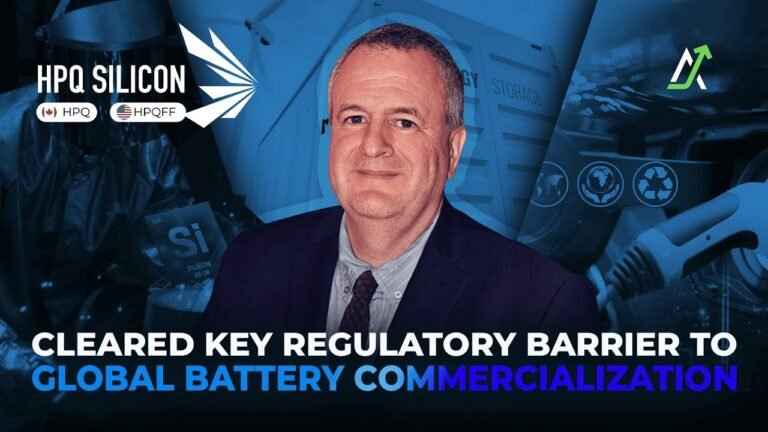
HPQ recently secured UN38.3 certification for its ENDURA+ 18650 and 21700 lithium-ion cells. For investors, this is not a technical footnote. UN38.3 is the global safety standard required to ship lithium batteries by air, sea, or land. Without it, commercial sales at scale are impossible.
Tourillon explains that this certification clears what he calls “the logistical barrier,” allowing HPQ to move from limited sampling to meaningful customer orders and global distribution.
“On our first full test run, we had no issues at all. That gives a very high level of confidence that our battery infrastructure is doing things the right way.”
FROM VALIDATION TO COMMERCIAL SCALE
With certification secured, HPQ now has the ability to ship batteries in volume and support customer testing programs that lead to production orders. Management has confirmed current manufacturing capacity of approximately 1.5 million cells per year, a meaningful starting point for niche but fast-growing markets.
Key commercialization signals discussed in the interview include:
- Battery samples already shipped to potential customers
- Active discussions underway with multiple prospective buyers
- At least one strategic customer described as “very close” to initial orders
- Management targeting the start of battery-related revenue in early 2026
Tourillon emphasized that certification timing was deliberate. Rather than rushing to market, HPQ chose to fully validate safety and quality, reducing the risk of recalls or failures that have derailed competitors.
WHERE THE DEMAND IS COMING FROM
HPQ is not chasing mass-market commodity batteries. Instead, it is targeting applications where performance, longevity, and supply-chain security matter most.
Discussed end markets include:
- E-bikes and electric mobility
- Drones and specialized industrial equipment
- Handheld and professional-grade power tools
- Stationary energy storage systems using 18650 and 21700 cells
A recurring theme in the discussion was growing interest from customers seeking non-Chinese battery supply. According to Tourillon, geopolitical risk and supply-chain concentration are driving new conversations that did not exist even two years ago.
STRONGER ECONOMICS BY SELLING THE FINISHED CELL
One of the more important insights for investors was HPQ’s shift toward selling finished batteries rather than only supplying silicon-based anode material. Tourillon noted that margins on battery cells are expected to exceed those achievable by selling materials alone.
In simple terms, HPQ captures more value by controlling the final product while keeping the option open to partner with larger manufacturers in the future.
FEDERAL BACKING AND STRATEGIC OPTIONALITY
HPQ’s progress is reinforced by up to $3 million in Canadian federal funding to support battery manufacturing infrastructure. Management views this as both validation and leverage, enabling the company to pursue a hybrid strategy: selling batteries directly today while retaining flexibility to license materials or partner at scale later.
The company is also advancing other verticals, including hydrogen technologies and fumed silica, which Tourillon described as opening “unexpected” new market opportunities now that commercial-grade material has been achieved.
THE BIGGER PICTURE FOR INVESTORS
This interview highlights a company transitioning from promise to execution. HPQ now has certified products, early customer traction, government support, and a clear path toward first revenues. While execution risk remains, the pieces required for commercialization are largely in place.
For investors seeking small cap opportunities approaching an inflection point, HPQ Silicon is no longer just a technology story. It is increasingly a commercialization story, with multiple shots on goal and tangible milestones already behind it.
Last modified: July 27, 2026