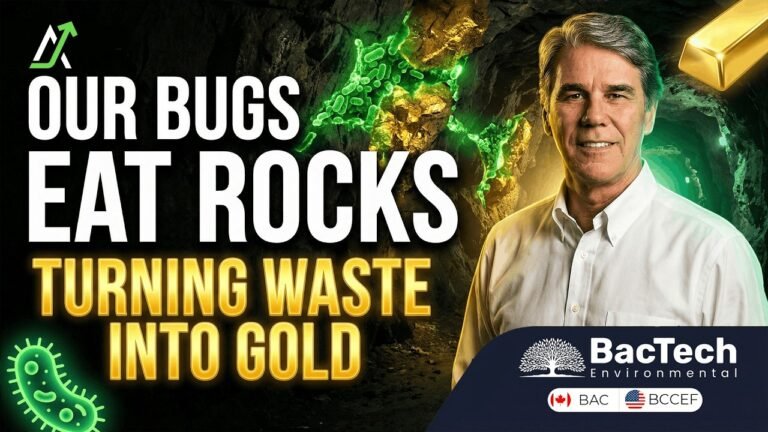
What if one of the most compelling ideas in mining could be summed up in a single concept: bacteria breaking down rock to release trapped metals?
It may sound unconventional, but it’s already being applied in real-world operations.
BacTech Environmental uses naturally occurring bacteria to process sulphide-rich material, unlocking gold, silver, and other metals that would otherwise remain difficult and costly to recover. These microorganisms act on the rock itself, triggering reactions that separate valuable metals without relying on high heat or chemical-intensive methods.
The approach shifts how certain types of material can be viewed, turning what was once uneconomic or overlooked into something potentially viable.
This is not theoretical. Bioleaching has been used in commercial plants in Australia, Tasmania, and China, with BacTech involved in building and operating multiple facilities over time.
The company is now advancing its flagship project in Tenguel, Ecuador. The fully permitted, construction-ready plant is expected to serve more than 100 small mines, providing a processing solution for material that few others are equipped to handle.
WHAT YOU NEED TO KNOW
Bugs Eat: Bioleaching is a commercially established process, previously deployed in plants across Australia, Tasmania and China. BacTech’s 50 tpd Ecuador facility is designed to process material from over 100 small mines that currently lack viable treatment options.
Gold Math: Tenguel’s updated BFS outlines 30,900 oz/year of gold, a pre-tax NPV(5%) of US$60.7M and a 57.9% IRR at US$1,600/oz gold. With approximately US$22M in projected capex, annual earnings approach US$30M at higher gold prices. Dr. Paul C. Miller, Ph.D., C.Eng., MIMM, is the Qualified Person.
Government Framework: An International Protection Agreement in Ecuador provides 12 years of tax relief and access to international arbitration, supporting project stability.
Zero Tailings: BacTech has filed patents on a process designed to convert mine waste into usable products like iron, fertilizer, and metals such as nickel and copper.
Global Waste: An estimated 80 billion tonnes of tailings exist globally, with roughly 12 billion tonnes added annually. BacTech is advancing a licensing model to address portions of this inventory.
STRATEGIC IMPLICATIONS
Conventional mining often relies on smelting, chemical processing, and tailings storage, which can create long-term environmental and financial liabilities. High-arsenic concentrates are increasingly difficult to process, with smelters applying penalties or refusing material altogether.
BacTech’s model uses bacteria to extract metals and stabilize contaminants, converting arsenic into ferric arsenate suitable for dry stacking, while producing additional outputs such as magnetite and fertilizer. The result is a multi-product flowsheet that differs from traditional single-commodity processing.
This approach intersects with several broader trends, including higher gold prices relative to feasibility assumptions, tightening environmental regulations, and increasing demand for critical minerals and alternative fertilizer sources.
CEO ROSS ORR
“People hear ‘our bugs eat rocks’ and think it’s some new science experiment. It’s not – we’ve designed and built bioleach plants four times before. Now we’re keeping more of the value for our shareholders. We’ve gone from proving the tech works to proving we can own and operate it ourselves.”
INVESTOR TAKEAWAY
This story combines a near-term operating asset with a longer-term platform opportunity.
Tenguel represents a fully permitted, 100% owned project with a defined development path, supported by a third-party feasibility study and projected annual production of approximately 30,900 ounces of gold. A planned Phase 2 expansion could increase throughput and output materially.
Separately, the Zero Tailings process introduces a potential licensing and royalty model tied to large-scale tailings remediation. Early test work suggests that a significant portion of revenue may come from iron and fertilizer outputs, rather than metals alone.
Execution remains dependent on financing and initial commercial deployments, but BacTech is now advancing from a technology validation phase toward potential project-level and platform-level scale.
Last modified: July 27, 2026