Agoracom Blog Home

Posts Tagged ‘gold’

Renforth Resources: Two Flagship Assets, One Expanding Québec Discovery Story

Posted by Brittany McNabb at 5:04 PM on Tuesday, April 28th, 2026

Renforth Resources Inc. is advancing a broadened exploration strategy in Québec’s prolific Abitibi mining district, where renewed field activity at its Parbec Gold Deposit and evolving targeting work at its Victoria Polymetallic Deposit reflect a growing emphasis on scale, structural understanding, and discovery growth.

Issued on behalf of Renforth Resources Inc.

The company’s latest update marks a significant operational restart, with exploration recommencing across both flagship assets near Malartic. The announcement builds on a series of technical milestones over the past year, including resource growth at Parbec, confirmation of platinum and palladium at Victoria, and increasing integration of advanced exploration tools into the company’s district-scale approach.

Parbec Field Program Expands Structural Focus

At the Parbec Gold Deposit, mobilization is underway to resume stripping within the open-pit footprint, extending work initiated through the company’s late-2025 stripping and more recent chipping programs.

The current campaign is centered around a structurally significant area where the gold-bearing Cadillac Break intersects the “Diorite Splay,” a feature extending into the Pontiac sediments that management believes may represent an important control on mineralization. Renforth has noted geological similarities between this setting and structures associated with the neighboring Canadian Malartic system, one of Canada’s most prominent gold camps.

Surface work now spans roughly 320 metres by 120 metres and is designed to progress toward the area above a targeted underground bulk sample location, while also expanding exposure over underexplored portions of the mineralized system.

The work complements broader efforts underway at Parbec, including permitting initiatives tied to an underground bulk sample concept and continued geological model refinement, including consideration of underground development scenarios.

Together, these programs suggest a strategy that goes beyond traditional step-out exploration, focusing increasingly on how structural understanding may inform both resource growth and future development pathways.

Victoria Expands From Resource Definition to Discovery Platform

While Parbec advances on the gold side, Renforth is broadening its vision for the Victoria Polymetallic Deposit and the wider Malartic Metals Package.

The company has commenced an AI-enabled spectral targeting program that combines satellite remote sensing, LiDAR, regional geology, and proprietary data analysis tools to generate new exploration targets across the broader property.

For a district-scale land package such as Malartic Metals, this represents more than a technical upgrade — it reflects a shift toward systematic targeting across both known mineralized zones and less-tested ground.

That broader opportunity continues to be a recurring theme at Victoria. The existing 125-million-tonne inferred resource outlined only 2.5 kilometres of an interpreted 20-kilometre mineralized trend, while adjacent zones such as Lalonde and Beaupré have reinforced the multi-target nature of the property.

Recent confirmation of platinum and palladium as a deposit-wide characteristic at Victoria added another dimension to that story, expanding the critical minerals profile of the system and strengthening interest in future resource evolution.

Now, with a drill permit received and planning underway for a new drill campaign, the focus appears to be moving from foundational resource definition toward targeted expansion and new discovery testing.

Technology and Jurisdiction as Strategic Differentiators

A notable element of Renforth’s evolving strategy is how it combines conventional field exploration with emerging technologies and established jurisdictional advantages.

The use of AI-assisted targeting, coupled with previous ore sorting, metallurgical and sustainability-related studies at Victoria, points toward a broader effort to de-risk exploration through layered technical inputs.

At the same time, both flagship assets benefit from infrastructure uncommon for early-stage projects — road access, hydroelectric power, nearby processing infrastructure, and proximity to operating mines in one of the world’s most active mining regions.

That combination of geological scale and logistical advantage continues to shape Renforth’s positioning as it advances both gold and critical minerals.

Momentum Building Across Two Complementary Assets

What distinguishes the current phase of activity is the simultaneous advancement of two complementary resource themes.

At Parbec, renewed stripping and structural follow-up continue to build on the company’s gold strategy.

At Victoria, advanced targeting tools and pending drilling support a broader district-scale critical minerals narrative.

Rather than treating those as separate stories, Renforth increasingly appears to be advancing them as parallel components of one larger exploration thesis.

As exploration activity resumes in earnest, the company enters a phase defined not simply by additional work programs, but by a more integrated effort to expand opportunity across both precious and critical metals in one of Canada’s premier mining districts.

https://renforthresources.com/2026/04/23/2026-spring-exploration/


YOUR NEXT STEPS

Visit $RFR HUB On AGORACOM:https://agoracom.com/ir/RenforthResources

Visit $RFR 5 Minute Research Profile On AGORACOM:https://agoracom.com/ir/RenforthResources/profile

Visit $RFR Official Verified Discussion Forum On AGORACOM:https://agoracom.com/ir/RenforthResources/forums/discussion


DISCLAIMER AND DISCLOSURE

This record is published on behalf of the featured company or companies mentioned (Collectively “Clients”), which are paid clients of Agora Internet Relations Corp or AGORACOM Investor Relations Corp. (Collectively “AGORACOM”)


AGORACOM.com is a platform. AGORACOM is an online marketing agency that is compensated by public companies to provide online marketing, branding and awareness through Advertising in the form of content on AGORACOM.com, its related websites (smallcapepicenter.com; smallcappodcast.com; smallcapagora.com) and all of their social media sites (Collectively “AGORACOM Network”) .  As such please assume any of the companies mentioned above have paid for the creation, publication and dissemination of this article / post.

You understand that AGORACOM receives either monetary or securities compensation for our services, including creating, publishing and distributing content on behalf of Clients, which includes but is not limited to articles, press releases, videos, interview transcripts, industry bulletins, reports, GIFs, JPEGs, (Collectively “Records”) and other records by or on behalf of clients. Although AGORACOM compensation is not tied to the sale or appreciation of any securities, we stand to benefit from any volume or stock appreciation of our Clients.  In exchange for publishing services rendered by AGORACOM on behalf of Clients, AGORACOM receives annual cash and/or securities compensation of typically up to $125,000.


Facts relied upon by AGORACOM are generally provided by clients or gathered by AGORACOM from other public sources including press releases, SEDAR and/or EDGAR filings, website, powerpoint presentations.  These facts may be in error and if so, Records created by AGORACOM may be materially different. In our video interviews or video content, opinions are those of our guests or interviewees and do not necessarily reflect the opinion of AGORACOM.

From time to time, reference may be made in our marketing materials to prior Records we have published. These references may be selective, may reference only a portion of an article or recommendation, and are likely not to be current. As markets change continuously, previously published information and data may not be current and should not be relied upon.


NO INVESTMENT ADVICE

This record, and any record we publish by or on behalf of our clients, should not be construed as an offer or solicitation to buy or sell products or securities.

You understand and agree that no content in this record or published by AGORACOM constitutes a recommendation that any particular security, portfolio of securities, transaction, or investment strategy is suitable or advisable for any specific person and that no such content is tailored to any specific person’s needs. We will never advise you personally concerning the nature, potential, advisability, value or suitability of any particular security, portfolio of securities, transaction, investment strategy, or other matter.


Neither the writer of this record nor AGORACOM is an investment advisor.  Both are neither licensed to provide nor are making any buy or sell recommendations. For more information about this or any other company, please review their public documents to conduct your own due diligence.


If you have any questions, please direct them to [email protected]

For our full website disclaimer, please visithttps://agoracom.com/terms-and-conditions
BEYOND THE MIC – The Fault That Produced Millions of Ounces – Metals Creek Controls 8km Along It

Posted by AGORACOM-JC at 10:49 AM on Wednesday, April 15th, 2026

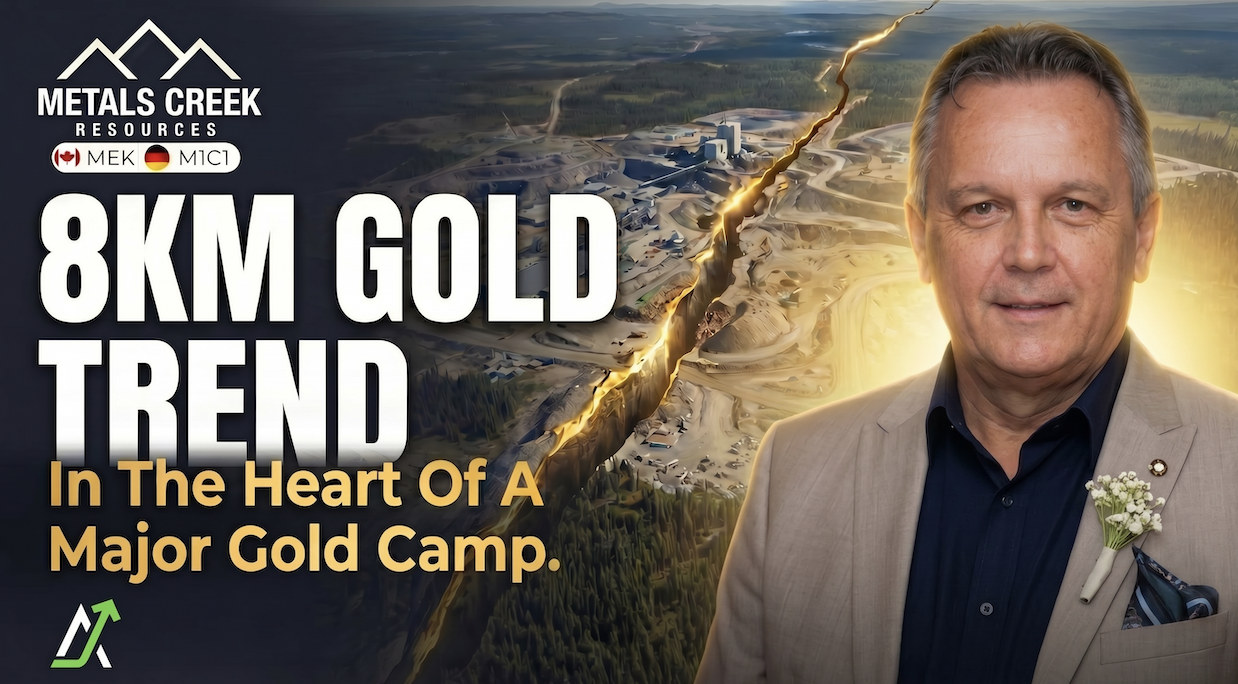
In a recent long form video interview with AGORACOM (see link at the end of this article), Metals Creek Resources Corp. CEO Alexander (Sandy) Stares outlined the company’s flagship Ogden Gold Project in Ontario’s Timmins Gold Camp and discussed upcoming exploration plans targeting gold mineralization along the Porcupine-Destor Fault.

AGORACOM Beyond The Mic Feature Article Issued On Behalf of Metals Creek Resources Corp.

April 15, 2026

Key Highlights

  • Strategic Timmins Location – The Ogden project covers approximately 8 kilometers of strike length along the Porcupine-Destor Fault, a major gold-bearing structure in the Timmins Camp, located near existing and past-producing operations
  • 50/50 Joint Venture with Discovery Silver – Metals Creek operates the Ogden project as a 50/50 joint venture with Discovery Silver Corp., with Discovery contributing to exploration costs following its acquisition of Newmont’s Timmins assets
  • Historical Exploration Results – Previous drilling at the Thomas Ogden Zone reported high-grade gold intercepts, including 210.19 g/t gold over 12.53 meters (2013), and the property hosts the past-producing Naybob Mine
  • Planned 1,500-Meter Drill Program – Drilling is expected to commence shortly, targeting the Thomas Ogden Zone with updated drill orientations based on structural interpretation
  • Project Generator Model – The company advances a portfolio of projects through partnerships, including a recent option agreement on the Yellow Fox antimony property in Newfoundland

Leadership Perspective

“We’re basically looking for elephants in elephant country,” said Stares, referencing the Timmins Camp’s long history of gold production. “The dome mill is eight kilometers away, operated by Discovery Silver. Should we prove something up at Ogden, it could provide a nearby processing option.”

Stares also commented on exploration timing and activity in the region, noting increased interest following recent developments in the Timmins Camp.

Investor Context

Metals Creek is advancing exploration at Ogden with a joint venture partner and proximity to established infrastructure in one of Canada’s historically significant gold districts. The upcoming drill program is designed to test refined geological targets, with potential for expanded exploration depending on results.

TO WATCH THE FULL VIDEO GO TO: https://www.youtube.com/playlist?list=PLfL457LW0vdLbNNhvgydEAUPPQKSstr2B

AGORACOM Beyond the Mic is Powered by AGORACOM’s AI Content Agents.

Metals Creek Resources Corp. Is A Client Of AGORA Internet Relations Corp.

https://agoracom.com/ir/Agoracomupdates/forums/discussion/topics/796135-DISCLAIMER-AND-DISCLOSURE/messages/2399000

BEYOND THE MIC – BacTech Bugs Eat Rocks Highlighting A Potential ~$30M Annual Opportunity

Posted by AGORACOM-JC at 1:00 PM on Monday, April 13th, 2026

BEYOND THE MIC – BacTech Bugs Eat Rocks Highlighting A Potential ~$30M Annual Opportunity

In a recent long form video interview with AGORACOM (see link at the end of this article), BacTech Environmental CEO Ross Orr made the case for what might be one of the most elegant solutions in mining: using naturally occurring bacteria to unlock metals that conventional processes can’t economically touch.

The company’s pitch is simple but striking. “Our bugs eat rocks,” Orr explained — a reference to bioleaching, a biological process that uses microorganisms to break down sulfide minerals and release the valuable metals trapped inside. It’s not new science, but BacTech has spent decades proving it works at commercial scale. Now, the company is positioning itself to build and operate its own facilities, capturing the full value chain rather than licensing the technology to others.

AGORACOM Beyond The Mic Feature Article Issued On Behalf of BacTech Environmental Corp.

April 13, 2026 2:30 PM EST

A Proven Technology With a Commercial Track Record

Bioleaching has been around since the mid-1980s, when Gold Fields of South Africa pioneered the first commercial plant. BacTech’s lineage traces back to research conducted at King’s College in London during the energy crisis, initially aimed at removing sulfur from coal. Australian researchers saw broader potential and brought the technology to Perth, where BacTech built its first commercial bioleach plant in 1994.

Since then, the company has designed and built four commercial-scale plants — in Australia (1994), Tasmania at Beaconsfield (1997, which ran for 15 years until the mine was depleted), and two in China (2001, expanded in 2008). The technology works by feeding sulfide concentrates — the material that contains the metals — into tanks where bacteria consume the sulfur, breaking down the rock and freeing gold, silver, and other metals for recovery.

What sets bioleaching apart is what it avoids: high heat, toxic chemicals, and the environmental liabilities that come with conventional smelting. The process produces ferric arsenate, a stable form of arsenic that the U.S. Environmental Protection Agency has approved as landfillable. That’s critical in regions where arsenic-rich concentrates are otherwise difficult or impossible to process cleanly.

“This is not our first rodeo,” Orr said. “We’ve been there, we’ve done it, and we’ve scoped out the Ecuador project to the point where we know pretty much what the capex exactly is.”

The Ecuador Opportunity: Serving 100 Small Mines With Material No One Else Wants

BacTech’s flagship project is a fully permitted, construction-ready bioleach processing plant in Tenguel, Ecuador, strategically located near the Ponce Enriquez mining district. The region is home to over 100 small-scale mines producing high-arsenic, high-gold concentrates — material that virtually no one else will touch at fair prices.

The problem for these miners is stark. Chinese buyers currently dominate the market for arsenopyrite concentrates (a sulfide mineral containing arsenic, iron, and often gold). But in 2021, China imposed a 13% import tax on high-arsenic concentrates, and buyers passed that cost directly to the miners. Today, Ecuadorian miners receive roughly 50 cents on the dollar for the gold contained in their concentrates.

BacTech’s solution is to process the material in-country, pay the miners more, and eliminate the need to ship concentrates halfway around the world. The company completed a bankable feasibility study that modeled the project using conservative assumptions: $1,600 per ounce gold and $18 per ounce silver. Even at those prices, the study projected $22 million in capex, annual production of approximately 30,000 ounces of gold, and over $11 million in pre-tax annual profit.

With gold now trading above $4,600 per ounce, the economics look significantly stronger. Orr noted that at current gold prices, projected after-tax earnings could exceed $30 million per year for Phase 1 alone.

The project also benefits from an International Protection Agreement (IPA) with the Ecuadorian government, which grants BacTech a 12-year tax holiday and provides for international arbitration in the event of disputes. Government support has been strong, Orr explained, in part because BacTech’s process is cleaner than conventional methods and provides local employment and better compensation for regional miners.

“The Indigenous people in Ecuador are not big fans of mining,” Orr said. “By introducing a technology that is going to do it cleaner than what’s being done right now, we’re bringing something to the table that the government values.”

Phase 2 of the Tenguel project, which BacTech is committed to building under the IPA, would scale throughput from 50 tonnes per day to 250 tonnes per day — enough to handle the entire output of the Ponce Enriquez district. At that scale, the company projects annual production could reach 125,000 ounces of gold, generating substantial cash flow.

Beyond Gold: The Zero Tailings Platform

While the Ecuador project focuses on gold recovery from arsenopyrite concentrates, BacTech has developed a second platform that could have even broader applications: a patented Zero Tailings process that converts mine waste into multiple saleable products.

Mine tailings — the material left over after metals are extracted — are a massive global problem. An estimated 80 billion tonnes of tailings sit on surface worldwide, and the mining industry adds approximately 10 billion tonnes per year. These tailings often contain residual sulfides that oxidize over time, generating sulfuric acid that can leach into waterways and carry heavy metals with it. Tailings dam failures, like the catastrophic breach at Mount Polley in Canada and the Brumadinho disaster in Brazil, have caused loss of life and billions in environmental damage.

BacTech’s Zero Tailings process uses bioleaching to extract the residual metals from tailings while simultaneously producing high-purity magnetite iron (for steel production), ammonium sulphate fertilizer (an organic agricultural product), and critical minerals like nickel, copper, and cobalt. What’s left behind is inert silica sand that can be used for paste backfill or construction materials.

The process has been piloted in Sudbury, Canada, in partnership with MIRARCO Mining Innovation and Vale, one of the world’s largest mining companies. Vale provided pyrrhotite tailings for testing — a volatile iron-sulfide mineral that oxidizes rapidly and has historically been discarded as waste.

Orr emphasized that approximately 75% of the revenue from the Zero Tailings process comes from the iron and fertilizer byproducts, not the base metals. That diversification makes the economics far more resilient to commodity price swings and opens up applications across a wide range of mining operations.

“Imagine having your own internal fertilizer production,” Orr said. “Canada imports something like $150 million a year of organic fertilizer, mostly from the Far East. This is all about uncoupling yourself and your dependence on Chinese producers, much like we’re doing in critical minerals.”

The technology could also address a major financial burden for mining companies: the bonding requirements associated with tailings storage. By eliminating tailings and turning waste into revenue, companies could potentially free up hundreds of millions of dollars in balance sheet liabilities.

Licensing Strategy and Market Validation

BacTech does not plan to build and operate Zero Tailings facilities on its own balance sheet. Instead, the company intends to license the technology on a regional or country-by-country basis, collecting licensing fees and long-term royalties.

“We can’t do that on our balance sheet,” Orr said. “When there’s 80 billion tons of tailings sitting on surface globally, this is something that needs to be rolled out quickly.”

The company is in discussions with major mining companies and government entities. Following the recent PDAC mining conference in Toronto, BacTech signed multiple non-disclosure agreements with interested parties. Orr noted that the response has been strong, particularly from companies sitting on legacy tailings deposits that represent both environmental liabilities and stranded value.

In 2026, BacTech expects to advance toward building a demonstration plant, which Orr estimated could cost $40 to $50 million. That plant would not generate meaningful economic returns on its own but would serve as proof of concept at commercial scale, de-risking the technology for larger rollouts.

The company is also exploring partnerships with global engineering firms that could deploy the technology across multiple jurisdictions.

Financing: The Challenge and the Opportunity

When asked about risks, Orr was candid. The biggest challenge facing BacTech is securing financing for the Tenguel project. Unlike traditional mining companies, BacTech does not own an ore deposit, which eliminates the possibility of securing financing from royalty or streaming companies that require an asset to seize in the event of default.

“What am I going to do with a bioleach plant if you can’t make it work?” Orr recalled one financier asking. “I can sell it for scrap, but it’s going to be nowhere near $22 million.”

Additionally, Ecuador’s country risk — while improving — remains a concern for some institutional investors. Orr emphasized that he travels to the site regularly and has never encountered safety issues, and that the project has overwhelming local support. Employees currently working on the 100-acre Tenguel property (which includes a cocoa plantation) stand to see their annual incomes rise from roughly $2,000 per year to $60,000 per year once the plant is operational, thanks to a government-mandated 15% profit-sharing program.

Despite the financing challenges, Orr expressed confidence that a deal is within reach. The company is in active discussions with multiple parties, and recent activity suggests interest is building.

“I think we’re getting closer,” Orr said. “It may be a deal that’s not related to Ecuador at all. It might be something brand new. But all of them are situations where people are in production or near to production, so it’s not like it’s a five-year project.”

A Pipeline Beyond Tenguel

Orr described the Tenguel project as the first domino in a longer strategic rollout. Behind it are potential projects in Peru (both north and south), Chile, and even Canada, particularly in regions like Timmins and Val-d’Or, where arsenopyrite tailings and deposits remain untapped due to processing challenges.

When pressed on a five-year forecast, Orr recalled an internal projection that envisioned building one plant per year, eventually reaching combined annual production of 350,000 ounces of gold — worth over $1 billion at current prices. Net margins, he noted, could range around 20%, depending on jurisdiction and tax treatment.

“When you can sell something this small for $4,600, it doesn’t take you long to build up the revenue line,” he said.

PDAC Response and Near-Term Catalysts

Following the March 2026 PDAC conference, Orr reported strong interest from both major mining companies and government-backed entities. The company signed multiple NDAs and is advancing discussions around potential partnerships, licensing deals, and project collaborations.

While much of the pipeline remains under wraps due to confidentiality, Orr suggested that 2026 could bring material developments — though he was careful to avoid specifics.

“There’s so much stuff going on in the background that you can’t talk about until you actually ink something,” he said. “If the dominoes start to fall, we’re going to be busier than a one-armed paper hanger.”

Conclusion

In the interview, BacTech CEO Ross Orr discussed the company’s decades of commercial bioleaching experience and its strategy to build and operate its first own-account facility in Ecuador. He outlined the Tenguel project’s economics at current gold prices, the company’s Zero Tailings platform for critical minerals recovery and tailings remediation, and the strategic pipeline of potential projects across multiple jurisdictions. Orr acknowledged that securing financing remains the primary near-term challenge, while expressing confidence in the company’s technology, government support in Ecuador, and growing interest from major industry players following recent conference activity.

TO WATCH THE FULL VIDEO GO TO: https://www.youtube.com/playlist?list=PLfL457LW0vdLWQWy01mnNDAUxmUWQbxgU 

AGORACOM Beyond the Mic is Powered by AGORACOM’s AI Content Agents.

BacTech Environmental Corp. Is A Client Of AGORA Internet Relations Corp. https://agoracom.com/ir/Agoracomupdates/forums/discussion/topics/796135-DISCLAIMER-AND-DISCLOSURE/messages/2399000

VIDEO – BacTech Bugs Eat Rocks Unlocking A Potential ~$30M Annual Gold Opportunity

Posted by AGORACOM-JC at 5:43 PM on Wednesday, April 8th, 2026

What if one of the most compelling ideas in mining could be summed up in a single concept: bacteria breaking down rock to release trapped metals?

It may sound unconventional, but it’s already being applied in real-world operations.

BacTech Environmental uses naturally occurring bacteria to process sulphide-rich material, unlocking gold, silver, and other metals that would otherwise remain difficult and costly to recover. These microorganisms act on the rock itself, triggering reactions that separate valuable metals without relying on high heat or chemical-intensive methods.

The approach shifts how certain types of material can be viewed, turning what was once uneconomic or overlooked into something potentially viable.

This is not theoretical. Bioleaching has been used in commercial plants in Australia, Tasmania, and China, with BacTech involved in building and operating multiple facilities over time.

The company is now advancing its flagship project in Tenguel, Ecuador. The fully permitted, construction-ready plant is expected to serve more than 100 small mines, providing a processing solution for material that few others are equipped to handle.

WHAT YOU NEED TO KNOW

Bugs Eat: Bioleaching is a commercially established process, previously deployed in plants across Australia, Tasmania and China. BacTech’s 50 tpd Ecuador facility is designed to process material from over 100 small mines that currently lack viable treatment options.

Gold Math: Tenguel’s updated BFS outlines 30,900 oz/year of gold, a pre-tax NPV(5%) of US$60.7M and a 57.9% IRR at US$1,600/oz gold. With approximately US$22M in projected capex, annual earnings approach US$30M at higher gold prices.  Dr. Paul C. Miller, Ph.D., C.Eng., MIMM, is the Qualified Person.

Government Framework: An International Protection Agreement in Ecuador provides 12 years of tax relief and access to international arbitration, supporting project stability.

Zero Tailings: BacTech has filed patents on a process designed to convert mine waste into usable products like iron, fertilizer, and metals such as nickel and copper.

Global Waste: An estimated 80 billion tonnes of tailings exist globally, with roughly 12 billion tonnes added annually. BacTech is advancing a licensing model to address portions of this inventory.

STRATEGIC IMPLICATIONS

Conventional mining often relies on smelting, chemical processing, and tailings storage, which can create long-term environmental and financial liabilities. High-arsenic concentrates are increasingly difficult to process, with smelters applying penalties or refusing material altogether.

BacTech’s model uses bacteria to extract metals and stabilize contaminants, converting arsenic into ferric arsenate suitable for dry stacking, while producing additional outputs such as magnetite and fertilizer. The result is a multi-product flowsheet that differs from traditional single-commodity processing.

This approach intersects with several broader trends, including higher gold prices relative to feasibility assumptions, tightening environmental regulations, and increasing demand for critical minerals and alternative fertilizer sources.

CEO ROSS ORR

“People hear ‘our bugs eat rocks’ and think it’s some new science experiment. It’s not – we’ve designed and built bioleach plants four times before. Now we’re keeping more of the value for our shareholders. We’ve gone from proving the tech works to proving we can own and operate it ourselves.”

INVESTOR TAKEAWAY

This story combines a near-term operating asset with a longer-term platform opportunity.

Tenguel represents a fully permitted, 100% owned project with a defined development path, supported by a third-party feasibility study and projected annual production of approximately 30,900 ounces of gold. A planned Phase 2 expansion could increase throughput and output materially.

Separately, the Zero Tailings process introduces a potential licensing and royalty model tied to large-scale tailings remediation. Early test work suggests that a significant portion of revenue may come from iron and fertilizer outputs, rather than metals alone.

Execution remains dependent on financing and initial commercial deployments, but BacTech is now advancing from a technology validation phase toward potential project-level and platform-level scale.


Magma Silver Moves Niñobamba from Acquisition to Drill-Ready Execution in Peru

Posted by Brittany McNabb at 2:20 PM on Thursday, February 26th, 2026

Magma Silver Corp. has moved quickly from building a project portfolio to advancing a clear exploration plan at its Niñobamba silver-gold project in Peru. In a sector where timelines are often defined by permitting, community engagement, and technical readiness, the Company’s recent progress has centered on turning historical work into actionable next steps—positioning Niñobamba for a drilling-led year ahead.

Company Overview and Positioning

Magma Silver is a natural resources exploration company focused on acquiring, exploring, developing, and operating precious metal mining projects. Its primary asset is the advanced Niñobamba silver-gold project in Peru, a mining-friendly jurisdiction and one of the world’s leading silver-producing countries. Niñobamba spans an 8-kilometre mineralized corridor in a prolific geological belt associated with a high-sulphidation epithermal system, and it has benefited from extensive historical exploration by major operators including Newmont, AngloGold Ashanti, Bear Creek, and Rio Silver.

By early 2025, Magma secured 100% control of Niñobamba and established operational footing in Peru, supported by a regional technical team with deep in-country experience. The Company has emphasized modern geological modelling and structured exploration planning to build on the project’s existing data foundation.

Key Highlights and Milestones

A central milestone arrived in October 2025, when Peru’s Ministerio de Energía y Minas granted a drill permit for the Joramina zone. The permit, issued October 17, 2025, has a fourteen-month duration and authorizes drilling from 20 drill pads, with the ability to conduct multiple directional drill holes from each pad. Magma has stated it believes the permit framework is sufficient to complete its planned drilling at Joramina.

That permit builds on field work completed in 2025 aimed at validating historical results and sharpening drill targeting. In a Phase 2 Q3 field campaign focused on the Joramina and Randypata properties, Magma’s team documented and sampled old mine workings, including a 157-metre drift located on the main Joramina zone that had not been documented in prior operator programs. Composite chip sampling from the drift returned two consecutive samples totalling 10 metres of 2.32 grams gold per tonne, while the best silver result reported was a 5-metre composite returning 4.085 ounces of silver per tonne. Additional sampling approximately 100 metres northeast of the drift returned 0.70 metres of 17.41 grams gold per tonne and 13.94 ounces of silver per tonne. At Randypata, sampling over a historic 2-kilometre silver anomaly—an area described as untested by drilling—returned 0.20 grams gold per tonne and 8.55 ounces of silver per tonne from a random composite grab sample.

Alongside technical progress, Magma has also outlined how it intends to fund the next stage of work. The Company completed a $5 million non-brokered private placement in October 2025, and stated it intended to use proceeds for exploration at Niñobamba as well as working capital and general corporate purposes. The financing included participation by Eric Sprott through a company beneficially owned by him, with the related disclosure describing his resulting holdings.

Strategic Direction and What Sets It Apart

Magma’s strategy at Niñobamba has focused on leveraging the scale of historical work while applying new geological interpretation to improve the next drill program. The Company has stated it holds Newmont’s work program results, including drill logs, assay reports, and collar locations, and that its technical team’s review of historical drilling suggests previous holes were not oriented in the most optimal direction. Magma has also indicated it plans to modify its current permit to reflect new drill sites, noting that adding or modifying pads is permitted by Peru’s mining ministry when pads are located within the existing permitted area.

The Company has also highlighted the operational advantage of identifying underground access. Magma has stated it may be able to drill from inside the Joramina drift, which would require a modification to the drill permit.

Forward-Looking Context

Looking ahead, Magma has provided a detailed outline of a planned drill program targeted for Q2 2026. The program is described as two phases totalling 4,000 metres. Phase 1 is planned as 2,000 metres from Pad A, designed to determine the orientation and size of the gold zone intersected by historical Newmont drilling. For reference, Magma cited Newmont’s 2010 hole JOR-001, which returned 72.3 metres of 1.19 grams gold per tonne starting at a depth of 53 metres, while noting that true widths cannot be determined from a single hole and that additional drilling is required to establish lateral and vertical extent.

Phase 2 is described as contingent on Phase 1 results and intended to extend gold-silver mineralization, test undrilled surface anomalies outlined by Newmont and confirmed by Magma’s geologist, and test mineralization exposed in a 160-metre adit recently sampled by the company. Magma has also stated it allocated US$1,000,000 (CAD$1,400,000) for the Joramina exploration and drill program, describing this as a significant increase from the original plan and part of an effort to thoroughly test and confirm historical results. The Company has said it will issue a future news release outlining the full Joramina drill program, including drill locations, and timing when available.

Closing

Magma Silver’s recent updates show a Company focused on execution: securing permits, validating legacy data with fresh fieldwork, and converting that technical foundation into a defined drill plan. With an advanced silver-gold project in Peru supported by extensive historical exploration, and a Q2 2026 drill program structured in phases to refine orientation and scale, Magma is moving Niñobamba toward the kind of disciplined, drill-driven opportunity that can clarify a project’s next chapter.

https://agoracom.com/ir/Agoracomupdates/forums/discussion/topics/796135-DISCLAIMER-AND-DISCLOSURE/messages/2399000


Gold Without Mining: nGRND is defining the sustainable ownership of the world’s oldest store of value

Posted by Brittany McNabb at 1:54 PM on Monday, February 2nd, 2026

Gold is trading at historic highs, with analysts projecting continued strength into 2026 and beyond. Yet for junior and senior developers, the traditional path to mining gold still comes with major challenges: mining is expensive, slow, and often environmentally and socially destructive.

There are, however, high barriers to entry for investors. The opportunity to benefit from these historic highs in the price of gold are made difficult by the limited supply, substantial costs of physical storage, security, auditability, insurance, shifts towards more sustainable investments and significant premiums over the spot price. While modern financial instruments like Exchange Traded Funds (ETFs) and digital gold tokens have improved accessibility, traditional, high-trust forms of investment remain restricted by high capital requirements and limited, in many regions, to high-net-worth individuals or institutional players.

That tension is exactly where nGRND believes the next evolution of gold ownership begins.

In a recent interview with AGORACOM founder George Tsiolis, Professor Lisa Wilson, the CEO of nGRND Inc., outlined a new model that challenges centuries of convention: what if gold could create economic value without ever being mined?

Rather than extracting gold, nGRND focuses on acquiring the long-term rights to sites with known verified in-ground gold Mineral Resources and enables their monetisation through alternative land usage from avoided mining. nGRND sponsor a fully regulated and licensed issuer to generate real world 100% asset-backed ownership structures – allowing the verified gold to remain untouched beneath the surface in-ground.

“We go out to globally to find known, verified Mineral Resources” Professor Wilson explained, “procure those assets for a minimum of 30 years, and create an alternative way of valuing and monetising that gold in-ground.”

The outcome is a new category of sustainable gold ownership designed for a world where investors are increasingly expecting hard-asset stability and environmental accountability.

Unlocking the value from gold that is currently uneconomical to mine.

One of the most striking points in the interview is the sheer scale of verified gold that already exists in the ground—but remains economically stranded.

Wilson noted that there are nearly six billion ounces of known in-situ gold resources globally. Much of it is held by junior developers and exploration companies, many based in Canada. Yet these ounces often remain unmonetised because advancing a project to production is an enormous undertaking and in many cases currently uneconomical.

Key barriers include:

  • Long development timelines, often 7 to 20 years
  • Massive capital requirements to build a mine
  • Permitting complexity and increasingly difficult environmental approvals
  • Sites that may be currently uneconomical or environmentally sensitive

For many resource owners, this leaves gold trapped in a frustrating limbo: valuable in theory, but difficult to turn into an economic reality.

nGRND’s proposition is to change that equation.

nGRND Inc. offers an alternative monetisation pathway that keeps the gold in-situ while still recognising its value proposition.

A new value proposition for verified resource owners

Traditionally, junior development companies seeking liquidity or capital for further development are often forced to sell assets at steep discounts to major producers or obtain royalty and streaming agreements.

Professor Wilson described conventional in-ground transactions as frequently yielding at the top end only $60 to $90 per ounce, and often sometimes far less.

nGRND offers something materially different.

According to Professor Wilson, the company aims to provide resource owners roughly 250% more than traditional in-situ pricing, which is approximately $210 to $220 per ounce at current gold levels – while allowing them to retain land ownership and avoid decades of uncertainty.

This liquidity can then be used to:

  • Strengthen balance sheets
  • Continue exploration and resource classification upgrading
  • Reduce dependence on dilutive financing
  • Potentially return value to shareholders

In Professor Wilson’s words this gives junior developers “cash on their books” and an option beyond “crumbs” offered by the traditional system.

Gold as a store of value – whilst in remains underground

A natural question arises: If the gold stays underground, how can it still function as an asset?

Professor Wilson’s answer is simple: Gold is gold, whether it is above ground or still in the earth. It has the same properties in-situ as extracted. The only thing you cannot do is wear it!

Lisa offered a modern analogy:

“Every time you look at your digital bank account, you don’t physically see the cash – but you still recognise it as value.”

In nGRND’s view, verified in-ground gold can serve the same purpose as physical gold stored in a vault, as a scarce, real store of value, but preserved rather than extracted.

Regulated real-world asset ownership through Tokinvest

A defining feature of nGRND’s approach is its emphasis on verification and regulatory structure.

The company does not generate or issue tokens directly. Instead, it sponsors the development of a 100% asset-backed gold ownership structure generated, issued and sold by Tokinvest, a licensed and VARA-regulated entity in Dubai.

Professor Wilson stressed that this regulated architecture is part of what differentiates nGRND from earlier, unsuccessful attempts to digitise in-ground gold ownership.

Key safeguards include:

  • Auditability, provenance and verification of the gold
  • Resource verification must meet recognised standards such as NI 43-101, JORC, or SAMREC, or equivalent
  • Tokens remain in an Token Generation Event (TGE) escrow pool until they are fully backed by contracted verified ounces obatined through nGRND Inc Site Programmes
  • nGRND Gold Tokens are only released by Tokinvest when they are 100% backed by an equivalent verified gold resource

“No verification, no tokens,” Wilson emphasised.

This framework is designed to expand the potential investor base beyond retail participants to include volume trades by institutions already familiar with gold ETFs and regulated commodity products.

A parallel revenue engine: ESG and Carbon Programmes

nGRND’s model extends beyond gold.

By keeping gold in the ground  – what Professor Wilson calls “avoided mining” nGRND Inc. enables alternative land-use programmes that can generate additional revenue independent of gold price movements.

These Site Programmes will have Carbon and ESG feasibility , invesatbility and origination conducted by independent partners CarbonPlanet and Foresteam. The Site Programmes will include:

  • Carbon offset standards accrediting origination from greater than 540 methodologies
  • Land rehabilitation and biodiversity restoration
  • Renewable energy development
  • Environmental restoration of brownfield sites

Crucially, Wilson explained that these programmes remain structurally separate from the gold-backed asset itself.

The gold ownership structure is treated as a commodity-backed asset, while ESG and carbon revenues form an independent dual distribution stream for nGRND Inc and nGRND Gold Token holders.

In Professor Wilson’s framing, this creates investment exposure to two uncorrelated commodity assets and themes:

  • Gold as a store of value and traditional commodity
  • Carbon and environmental assets as a rapidly emerging and high growth asset class

Early momentum and a 2026 rollout timeline

nGRND Inc has only just exited “stealth mode”, but Professor Wilson indicated that traction has materialised quickly and very strongly during its development and the weeks post.

“Before we even exited stealth mode, we had a signed LOI to take over a property,” Lisa said, adding that the company has already surpassed its internal 2029 mineral ounce pipeline targets.

The company expects the Token Generation Event by Tokinvest to occur around April 2026, with regulated professional and retail access to follow shortly thereafter through Tokinvest.

This rollout is structured, verification-gated, and designed to scale over time as additional site programmes are secured.

Why investors are paying attention now?

nGRND Inc. sits at the intersection of several powerful global forces:

  • Rising gold demand in uncertain macro environments
  • Increasing investor focus on sustainability and ESG accountability
  • Institutional adoption of regulated digital asset infrastructure
  • A growing need to separate resource value from environmental cost

In short, nGRND is positioning itself with the vision of being the world’s largest resource company who don’t mine!

The bottom line: A structural shift in how gold Is monetised

For centuries, gold ownership has depended on extraction.

nGRND is delivering something fundamentally different. Verified gold can be monetised, preserved, and owned sustainably – without the delays, costs, and environmental disruption of mining.

With long-term control of Site Programmes with known verified in-ground resources, regulated issuance through Tokinvest, and parallel ESG and carbon programme development through CarbonPlanet and Foresteam, nGRND is advancing a model that will reshape how the world thinks about natural wealth.

As Professor Wilson put it:

“Gold is gold. Whether it is above ground or in the ground, it has the same properties as a store of value. We have created a way to monetise it without destroying the land or waiting decades to build a mine.”

For investors watching the evolution of real-world asset ownership, sustainable finance, and gold’s role in the modern economy, nGRND is emerging as one of the most innovative and closely watched new entrants in the space.

DISCLAIMER AND DISCLOSURE

This record is published on behalf of the featured company or companies mentioned (Collectively “Clients”), which are paid clients of Agora Internet Relations Corp or AGORACOM Investor Relations Corp. (Collectively “AGORACOM”)

 AGORACOM.com is a platform. AGORACOM is an online marketing agency that is compensated by public companies to provide online marketing, branding and awareness through Advertising in the form of content on AGORACOM.com, its related websites (smallcapepicenter.com; smallcappodcast.com; smallcapagora.com) and all of their social media sites (Collectively “AGORACOM Network”) .  As such please assume any of the companies mentioned above have paid for the creation, publication and dissemination of this article / post.

You understand that AGORACOM receives either monetary or securities compensation for our services, including creating, publishing and distributing content on behalf of Clients, which includes but is not limited to articles, press releases, videos, interview transcripts, industry bulletins, reports, GIFs, JPEGs, (Collectively “Records”) and other records by or on behalf of clients. Although AGORACOM compensation is not tied to the sale or appreciation of any securities, we stand to benefit from any volume or stock appreciation of our Clients.

In exchange for publishing services rendered by AGORACOM on behalf of Clients, AGORACOM receives annual cash and/or securities compensation of typically up to $125,000. 

Facts relied upon by AGORACOM are generally provided by clients or gathered by AGORACOM from other public sources including press releases, SEDAR and/or EDGAR filings, website, powerpoint presentations.  These facts may be in error and if so, Records created by AGORACOM may be materially different. In our video interviews or video content, opinions are those of our guests or interviewees and do not necessarily reflect the opinion of AGORACOM.

Gold without mining: nGRND empowers a new model for sustainable ownership of in-ground gold

Posted by Brittany McNabb at 5:16 PM on Friday, January 23rd, 2026

WHAT INVESTORS NEED TO KNOW? 

  • nGRND enables the monetisation of verified known Resources of in-ground gold without mining it, empowering new sustainable ownership of gold and a multiple value opportunity framework
  • The company has already exceeded its 2029 Resource mineral ounce targets while only just emerging from stealth mode
  • Institutional, professional and retail access to investment in, and ownership of gold is delivered through tokenisation of the in-situ gold as an RWA by a VARA regulated and licensed issuer, Tokinvest
  • Resource owners receive materially higher value than traditional in-situ gold transactions
  • ESG and Carbon Programmes, originated by CarbonPlanet for nGRND Inc. create independent, recurring revenue streams in addition to the goods
  • nGRND Inc enables the dual value potential from the high growth potential of  two uncorrelated commodity assets – gold and carbon

A STRUCTURAL SHIFT IN HOW GOLD IS MONETISED SUSTAINABLY

As gold prices continue to break historical levels, investors are increasingly focused on where sustainable value creation will occur across the gold ecosystem. Traditional mining remains capital intensive, slow to commercialise, and constrained by permitting and intense environmental pressures.

nGRND is advancing and empowering  a new sustainable and multi value potential alternative approach. Rather than extracting gold, the company acquires from site owners the long-term rights to known verified in-ground gold Resources and empowers their monetisation independently through a regulated VARA issuer. Tokinvest tokenises the gold as a fully backed RWA nGRND Gold Token  through their rigorous processes and  financial infrastructure, monetising its value immediately but leaving the gold  in place, in the ground and retaining its attributes such as a store of value.

CEO Professor Lisa Wilson summarises the this succinctly:

 “Gold is gold. Whether it is above ground or in the ground, it has the same properties as a store of value. We have created a way to monetise it without destroying the land or waiting decades to build a mine.”

UNLOCKING VALUE FROM STRANDED GOLD ASSETS

Globally, billions of ounces of gold are classified as mineral Resources that currently cannot advance to production due to economic unviability such as cost, timelines, or environmental constraints. For junior developers, these assets often remain stranded and unable to be fully monetised on balance sheets.

nGRND offers an alternative monetisation pathway. Resource owners receive higher per-ounce value than conventional in-situ sales, while retaining land ownership and avoiding many headaches like long development timelines and costly environmental difficulties. Capital can be redirected toward exploration to further increase gold Resource classification and balance sheet strength, and shareholder returns instead of dilution or debt.

This approach transforms geological potential into near-term financial optionality.

REGULATED TOKENISATION WITH INSTITUTIONAL REACH

A defining feature of nGRND’s strategy is segregated and regulatory architecture. The company sponsors the generation of  a real-world asset (RWA) nGRND Gold Token by an independent entity regulated and licensed  by the Virtual Assets Regulatory Authority in the UAE. Each nGRND Gold Token must be  fully backed by verified ounces of in-ground gold that are under long-term control by nRGND Inc. Site Programes, before the issuer can release,  sell or allocate the tokens from the Token Generation Event escrow pool.

This digitised structure positions tokenised gold within a framework very familiar to institutions that are already active in gold ETFs and digital gold commodity products.

According to Professor Wilson, demand has materialised early:

 “Before we even exited stealth mode, we executed a signed letter of intent with a Resource owner, and our pipeline already exceeds our 2029 Resource ounce targets  and we’ve just publicly entered the market.”

A PARALLEL REVENUE ENGINE THROUGH ESG AND CARBON

Avoided mining, enables nGRND Inc to sponsor alternative land-use programmes that will generate carbon credits and revenue independent of gold price movements. These  carbon credit origination and environmental restoration initiatives and projects will be originated and developed by CarbonPlanet for nGRND Inc. and the assets verified by third parties.

Carbon assets are increasingly viewed as a distinct, uncorrelated asset class, with institutional adoption accelerating as their potential is viewed as an investment grade asset with significant predicted growth returns that are quite apart from other obvious opportunities as climate compliance requirements expand. For investors, these distributed revenues are additional to the growth from gold exposure. It offers a dual commodity growth and new revenue distribution opportunity. 

WHY THIS MODEL IS GAINING ATTENTION

nGRND sits at the intersection of several converging forces: sustained demand for gold as a store of value, an environment that expects regulatory clarity for real-world assets, institutional adoption of tokenisation and digital assets, and rising pressure for mining to separate resource value from environmental impact.

nGRND positions itself as a mining alternative: the largest resource company that doesn’t mine!

THE OUTLOOK

With verified mineral Resource assets under long term control, regulated independent token issuance in place, clear pathways for ESG andCarbon Origination, and growing interest from both resource owners and capital markets, nGRND is advancing a model that challenges how gold has been monetised for centuries. For investors seeking differentiated exposure to gold with a clear commercialisation pathway and additional distributed value  from ESG and Carbon investment grade assets, this interview highlights a company approaching a meaningful and profound inflection point.

From 363K oz Gold to 413M lbs Nickel — Renforth Resources Powers Ahead with Dual-Track Growth Strategy

Posted by Brittany McNabb at 11:56 AM on Tuesday, November 11th, 2025

From 363K oz Gold to 413M lbs Nickel — Renforth Resources Powers Ahead with Dual-Track Growth Strategy

Renforth Resources Inc. (CSE: RFR; OTCQB: RFHRF; FSE: 9RR) continues to advance its dual focus on gold and critical minerals in Quebec’s Abitibi mining district — one of the world’s most prolific and infrastructure-rich jurisdictions. With 100% ownership of both the Parbec Gold Deposit and the Victoria Nickel-Polymetallic System, Renforth is strategically positioned at the intersection of two enduring global trends: gold’s role as a store of value and the accelerating demand for energy-transition metals such as nickel, copper, and cobalt.

Parbec Gold Deposit: Surface Work Strengthens Geological Model

Renforth recently completed a successful stripping program at the Parbec Gold Deposit, located adjacent to Agnico Eagle’s Canadian Malartic Mine. Covering approximately 2,200 square metres within the open-pit design area, the campaign marked the company’s first large-scale surface exposure program at Parbec.

Field crews identified several previously unrecognized faults and structural features intersecting the Cadillac Break — a prolific, gold-bearing corridor responsible for millions of ounces of historical production across the Abitibi. Visual observations and sampling confirmed lithologies previously observed only in drill core. These discoveries reinforce Renforth’s interpretation of Parbec as a structurally complex, open-ended system with meaningful near-surface potential.

While cold weather limited full channel sampling, grab samples were collected and dispatched for assay. Additional trenching, mapping, and sampling are planned for spring. This fieldwork supports Parbec’s updated 2025 mineral resource estimate of approximately 363,000 ounces of gold, representing a 29% increase from prior estimates, with 87% of ounces contained within an optimized open-pit shell.

Victoria Nickel-Polymetallic System: NI 43-101 Technical Report Filed

Renforth also filed its NI 43-101 Technical Report for the Malartic Metals Package, including the maiden Inferred Mineral Resource Estimate for the Victoria Nickel Sulphide Polymetallic Deposit. The resource outlines 125 million tonnes grading 0.15% nickel equivalent (NiEq) — approximately 413 million pounds of contained NiEq within a 2.5-kilometre section of a 20-kilometre-long mineralized trend.

The Technical Report confirms that Victoria remains open along strike and at depth, with drilling extending to 320 metres below surface. The open-pit model features a strip ratio of less than 1:1, indicating potential for efficient extraction. Hosted within interlayered ultramafic and black-shale units, the deposit also contains cobalt, copper, zinc, and precious-metal credits, providing exposure to multiple critical-mineral markets.

The report further highlights additional regional targets within the Malartic Metals Package — including the Beaupré copper discovery (stripped and sampled over 180 metres of strike), the Lac Surimau gold zone, and lithium anomalies near Victoria. Together, these prospects underscore the district-scale, multi-metal potential of the property, supported by ready access to roads, hydro power, and nearby processing infrastructure.

Strengthened Technical Foundation and Financing Momentum

Renforth’s field progress has been supported by the first tranche of its ongoing financing to advance exploration and technical programs across both Parbec and Victoria. The company’s disciplined strategy — combining targeted fieldwork with continued resource definition — is solidifying its technical foundation and operational readiness.

At Parbec, the emphasis on surface exposure and geologic refinement is designed to convert modeled mineralization into demonstrable, near-surface ounces. At Victoria, the completion of the NI 43-101 report establishes a baseline for future economic and development studies — a critical step in defining the project’s long-term potential.

Outlook: Balanced Growth for a Changing Market

Renforth’s dual-track strategy reflects balance and foresight — advancing a proven gold asset in a world-class mining district while building exposure to the metals essential for the energy transition. Both projects benefit from road access, grid power, and proximity to established infrastructure, enabling efficient, low-impact exploration.

As work resumes in 2026, Renforth remains focused on two complementary objectives: unlocking near-surface gold value at Parbec and expanding its nickel-polymetallic footprint at Victoria. This balanced approach continues to strengthen the company’s position as a diversified Quebec-based explorer poised to benefit from both stability in precious metals and growth in the critical-minerals economy.

YOUR NEXT STEPS

Visit $RFR HUB On AGORACOM:https://agoracom.com/ir/RenforthResources

Visit $RFR 5 Minute Research Profile On AGORACOM:https://agoracom.com/ir/RenforthResources/profile

Visit $RFR Official Verified Discussion Forum On AGORACOM:https://agoracom.com/ir/RenforthResources/forums/discussion


DISCLAIMER AND DISCLOSURE

This record is published on behalf of the featured company or companies mentioned (Collectively “Clients”), which are paid clients of Agora Internet Relations Corp or AGORACOM Investor Relations Corp. (Collectively “AGORACOM”)


AGORACOM.com is a platform. AGORACOM is an online marketing agency that is compensated by public companies to provide online marketing, branding and awareness through Advertising in the form of content on AGORACOM.com, its related websites (smallcapepicenter.com; smallcappodcast.com; smallcapagora.com) and all of their social media sites (Collectively “AGORACOM Network”) .  As such please assume any of the companies mentioned above have paid for the creation, publication and dissemination of this article / post.

You understand that AGORACOM receives either monetary or securities compensation for our services, including creating, publishing and distributing content on behalf of Clients, which includes but is not limited to articles, press releases, videos, interview transcripts, industry bulletins, reports, GIFs, JPEGs, (Collectively “Records”) and other records by or on behalf of clients. Although AGORACOM compensation is not tied to the sale or appreciation of any securities, we stand to benefit from any volume or stock appreciation of our Clients.  In exchange for publishing services rendered by AGORACOM on behalf of Clients, AGORACOM receives annual cash and/or securities compensation of typically up to $125,000.


Facts relied upon by AGORACOM are generally provided by clients or gathered by AGORACOM from other public sources including press releases, SEDAR and/or EDGAR filings, website, powerpoint presentations.  These facts may be in error and if so, Records created by AGORACOM may be materially different. In our video interviews or video content, opinions are those of our guests or interviewees and do not necessarily reflect the opinion of AGORACOM.

From time to time, reference may be made in our marketing materials to prior Records we have published. These references may be selective, may reference only a portion of an article or recommendation, and are likely not to be current. As markets change continuously, previously published information and data may not be current and should not be relied upon.


NO INVESTMENT ADVICE

This record, and any record we publish by or on behalf of our clients, should not be construed as an offer or solicitation to buy or sell products or securities.

You understand and agree that no content in this record or published by AGORACOM constitutes a recommendation that any particular security, portfolio of securities, transaction, or investment strategy is suitable or advisable for any specific person and that no such content is tailored to any specific person’s needs. We will never advise you personally concerning the nature, potential, advisability, value or suitability of any particular security, portfolio of securities, transaction, investment strategy, or other matter.


Neither the writer of this record nor AGORACOM is an investment advisor.  Both are neither licensed to provide nor are making any buy or sell recommendations. For more information about this or any other company, please review their public documents to conduct your own due diligence.


If you have any questions, please direct them to [email protected]

For our full website disclaimer, please visithttps://agoracom.com/terms-and-conditions
 

363K oz Gold at Parbec + 413 M lb NiEq at Victoria – Renforth Strengthens Dual-Asset Position in Québec

Posted by Brittany McNabb at 3:46 PM on Wednesday, October 29th, 2025

A dual-track push in gold and critical minerals underscores the junior’s scale ambitions in Canada’s Abitibi mining hub.

Background and Context

Renforth Resources Inc. (CSE: RFR; OTCQB: RFHRF; FSE: 9RR) operates in Quebec’s Abitibi, one of the world’s most established mining districts. The company controls two 100%-owned cornerstone assets: the Parbec gold deposit, situated on the Cadillac Break near Agnico Eagle’s Canadian Malartic operation, and the Victoria nickel-polymetallic system within Renforth’s ~300 km² Malartic Metals Package. Two new developments move each asset a step forward: field work has begun to expose and sample gold at surface at Parbec, and Renforth has declared an initial, pit-constrained mineral resource at Victoria.

For investors tracking both bullion and the energy transition, the pairing is notable: near-surface gold on one side; nickel, copper, zinc and precious-metal credits on the other—each with road access and hydro power in a Tier-1 jurisdiction.

Parbec: Surface Program Targets a 12.2-Meter Gold Channel

Renforth has commenced stripping and chipping overburden on the Parbec deposit inside the area outlined by its May 2025 mineral resource model. The immediate target is a surface channel that graded 1.43 grams per tonne gold over 12.2 meters on the Diorite Splay, a structure interpreted to interact with the Cadillac Break. Once exposed, the team will prospect, map and sample the newly opened bedrock to confirm continuity and test for extensions.

Why this matters: bringing modeled mineralization to surface can sharpen geologic controls, refine near-surface ounces, and inform future bulk-sampling plans. Parbec mineralization starts at surface, is largely contained within a Whittle pit, and remains open along strike and at depth; the pit shell in prior modeling does not extend below ~300 meters. The property benefits from year-round road access in close proximity to the Canadian Malartic complex.

Renforth also disclosed a non-brokered financing initiative of up to C$500,000 in units priced at C$0.02 to support ongoing work programs.

Victoria: First Nickel Polymetallic Resource Establishes Scale

On the critical-minerals side, Renforth released its maiden mineral resource estimate for the Victoria system in Malartic, Quebec: 125 million tonnes grading 0.15% nickel equivalent (NiEq), pit-constrained, representing approximately 413 million pounds of NiEq in situ. The estimate is Inferred, based on ~10,000 meters of drilling across 2.5 kilometers of strike within a ~20-kilometer mineralized trend, and remains open along strike and at depth. The deepest pierce point to date is ~320 meters; modeled pit slopes are 50 degrees with a strip ratio of less than 1:1.

Victoria’s mineralization is hosted in interlayered ultramafic units carrying nickel, cobalt, platinum and palladium, and black shale horizons bearing zinc, copper, silver and gold. Up to three stacked horizons have been intersected at surface and in drilling across a package approaching 500 meters in thickness. Two potential starter-pit subsets leverage shallow geometry and nearby infrastructure.

What Stands Out: Practical Advantages, Not Just Geology

  • Tier-1 setting: Roads, hydro power and nearby processing facilities reduce logistical risk and cost.
  • Shallow geometry: Both Parbec and Victoria emphasize near-surface mineralization that can be evaluated with rapid, lower-cost surface programs.
  • Optionality: Gold exposure at Parbec alongside nickel-polymetallic exposure at Victoria provides commodity diversification.
  • Process pathway work: Prior TOMRA ore-sorting trials and early metallurgical studies at Victoria indicate potential to pre-concentrate and float sulphide minerals, an approach aimed at reducing throughput and inputs.

Executive and Technical Commentary

Today’s Initial MRE establishes Victoria as a large-scale, near-surface polymetallic nickel system in a top-tier jurisdiction,” said President and CEO Nicole Brewster. “With our land package, hydro power, roads and nearby plants we see a path to scale. Next steps include optimization of sorting and continued step-out and infill drilling ahead of a PEA.”

Vice President of Exploration Martin Demers called the resource “an important milestone to initiate economic evaluation,” adding that geophysical anomalies point to a broader footprint and that ongoing integration of data will guide targeting within what may be a larger magmatic system.

Potential Impact and Significance

At Parbec, confirming and extending surface gold in the Diorite Splay could strengthen near-surface resource confidence and inform development sequencing inside the open-pit shell. At Victoria, the first resource converts a district-scale target into a quantified asset with room to grow. Together, the updates frame a practical work program: surface stripping, mapping and sampling at Parbec; step-outs, infill drilling and process optimization at Victoria.

Challenges and Considerations

The Victoria estimate is categorized as Inferred, reflecting early-stage confidence that will require additional drilling to upgrade to Indicated and Measured levels. Economic viability has not been demonstrated, and future studies will need to address metallurgy, recoveries, capital needs, environmental permitting and market conditions. At Parbec, translating surface channels into mineable inventory depends on consistent continuity, validated grades and subsequent technical work.

Conclusion

Renforth’s latest steps advance two parallel narratives in Quebec’s Abitibi: a surface-driven gold program at Parbec aimed at sharpening near-term understanding, and a first-pass resource at Victoria that establishes scale in nickel and associated metals. With shallow geometry, road access and power, the company is aligning field work with practical development pathways in a jurisdiction built for mining.

YOUR NEXT STEPS

Visit $RFR HUB On AGORACOM:https://agoracom.com/ir/RenforthResources

Visit $RFR 5 Minute Research Profile On AGORACOM:https://agoracom.com/ir/RenforthResources/profile

Visit $RFR Official Verified Discussion Forum On AGORACOM:https://agoracom.com/ir/RenforthResources/forums/discussion


DISCLAIMER AND DISCLOSURE

This record is published on behalf of the featured company or companies mentioned (Collectively “Clients”), which are paid clients of Agora Internet Relations Corp or AGORACOM Investor Relations Corp. (Collectively “AGORACOM”)

AGORACOM.com is a platform. AGORACOM is an online marketing agency that is compensated by public companies to provide online marketing, branding and awareness through Advertising in the form of content on AGORACOM.com, its related websites (smallcapepicenter.com; smallcappodcast.com; smallcapagora.com) and all of their social media sites (Collectively “AGORACOM Network”) .  As such please assume any of the companies mentioned above have paid for the creation, publication and dissemination of this article / post.

You understand that AGORACOM receives either monetary or securities compensation for our services, including creating, publishing and distributing content on behalf of Clients, which includes but is not limited to articles, press releases, videos, interview transcripts, industry bulletins, reports, GIFs, JPEGs, (Collectively “Records”) and other records by or on behalf of clients. Although AGORACOM compensation is not tied to the sale or appreciation of any securities, we stand to benefit from any volume or stock appreciation of our Clients.  In exchange for publishing services rendered by AGORACOM on behalf of Clients, AGORACOM receives annual cash and/or securities compensation of typically up to $125,000.

Facts relied upon by AGORACOM are generally provided by clients or gathered by AGORACOM from other public sources including press releases, SEDAR and/or EDGAR filings, website, powerpoint presentations.  These facts may be in error and if so, Records created by AGORACOM may be materially different. In our video interviews or video content, opinions are those of our guests or interviewees and do not necessarily reflect the opinion of AGORACOM.

From time to time, reference may be made in our marketing materials to prior Records we have published. These references may be selective, may reference only a portion of an article or recommendation, and are likely not to be current. As markets change continuously, previously published information and data may not be current and should not be relied upon.


NO INVESTMENT ADVICE

This record, and any record we publish by or on behalf of our clients, should not be construed as an offer or solicitation to buy or sell products or securities.

You understand and agree that no content in this record or published by AGORACOM constitutes a recommendation that any particular security, portfolio of securities, transaction, or investment strategy is suitable or advisable for any specific person and that no such content is tailored to any specific person’s needs. We will never advise you personally concerning the nature, potential, advisability, value or suitability of any particular security, portfolio of securities, transaction, investment strategy, or other matter.

Neither the writer of this record nor AGORACOM is an investment advisor.  Both are neither licensed to provide nor are making any buy or sell recommendations. For more information about this or any other company, please review their public documents to conduct your own due diligence.


If you have any questions, please direct them to [email protected]

For our full website disclaimer, please visithttps://agoracom.com/terms-and-conditions
 

From Acquisition to Restart — LaFleur Minerals Reboots Beacon Mill, Targeting ‘26 Gold Production and Up To 30,000 Ounces Gold in Annual Output Potential

Posted by Alavaro Coronel at 11:26 AM on Thursday, October 16th, 2025

“We bought these assets when nobody was funding mining. At $4,000 gold, it feels like we won the lottery,” Executive Chairman of LaFleur Minerals

FROM EXPLORATION TO PRODUCTION IN RECORD TIME

With gold prices surpassing US $4,000 per ounce, LaFleur Minerals (CSE: LFLR) (OTCQB: LFLRF)(FSE: 3WK0) is seizing a generational opportunity in Quebec’s Abitibi Gold Belt. The company’s fully permitted, recently upgraded Beacon Gold Mill—valued above $71 million replacement value, positions it among the few small caps ready to transition from exploration to production without years of permitting delays or heavy capital outlay. Feed for the mill will come from LaFleur’s 100%-owned Swanson Gold Deposit as primary source, which holds 123,000 oz indicated and 64,500 oz inferred gold, just 60 kilometres away from the mill.

BUILDING QUEBEC’S NEXT GOLD PRODUCER

The Executive Chairman describes LaFleur’s model as built for near-term cash flow:

“Our mill last operated when gold was $1,600. We’re restarting it at $4,000 an ounce. The economics speak for themselves.” 

Trial runs are targeted for December 2025, with commercial production expected by early 2026. LaFleur aims to produce up to 30,000 ounces per year, translating to roughly C$168 million in potential annual output at today’s gold prices.

KEY ADVANTAGES

  • Fully permitted Beacon Gold Mill ready for restart that underwent $20 million in refurbishments in 2022
    • Swanson Gold Deposit on a mining lease requiring minimal new permitting, district-scale property primed for consolidation with surrounding claims to expand footprint
    • Strategic location in Quebec’s world-class Abitibi district, surrounded by over 100 historical and operational mines, allowing for rapid monetization of mineralized material from nearby gold deposits
    • Nearby deposits creating a pipeline for future M&A expansion

PROVEN TEAM, PERFECT TIMING

The Executive Chairman through Bullrun Capital, has a track record of financing and building high-growth ventures—including Patriot One Technologies (TSX: PAT) and Xtract One (TSX:XTRA) and brings deep access to institutional capital. Acquiring the Beacon assets out of bankruptcy in 2022, when gold was ~$1,600 and funding was scarce, now looks like a masterstroke.

THE OUTLOOK

LaFleur plans to ramp up from 900 tons per day to 5,000 tons per day within three years. The company plans expanding its resource base to 3–5 million ounces through targeted acquisitions. With a debt-free, royalty-free mill, a strong Quebec-based operating team, and record-high gold prices, LaFleur Minerals is one of the few juniors positioned to turn ounces into dollars now, not years from now.