Agoracom Blog Home

Author Archive

#Palladium Weekly: Long-Term Uptrend Remains Intact – SPONSOR: New Age Metals $NAM.ca $WG.ca $XTM.ca $WM.ca $PDL.ca $GLEN #PGM

Posted by AGORACOM-JC at 2:55 PM on Monday, April 13th, 2020

SPONSOR: New Age Metals Inc. The company owns one of North America’s largest primary platinum group metals deposit in Sudbury, Canada. Updated NI 43-101 Mineral Resource Estimate 2,867,000 PdEq Measured and Indicated Ounces, with an additional 1,059,000 PdEq Ounces Inferred. Learn More.

Palladium Weekly: Long-Term Uptrend Remains Intact

  • PALL has rebounded by nearly 50% since it crashed to its lowest since last August at $137.51 on March 16, taking bears by surprise.
  • The rebound in palladium prices has been driven by a broad-based recovery in the precious metals space following the COVID-19 panic last month.
  • Palladium’s outperformance since late March confirms our view that palladium enjoys the relatively tightest fundamental backdrop.
  • Financial flows are absent, with speculators and ETF investors reducing further exposure to palladium. This confirms that there is no bubble in the palladium market for now.
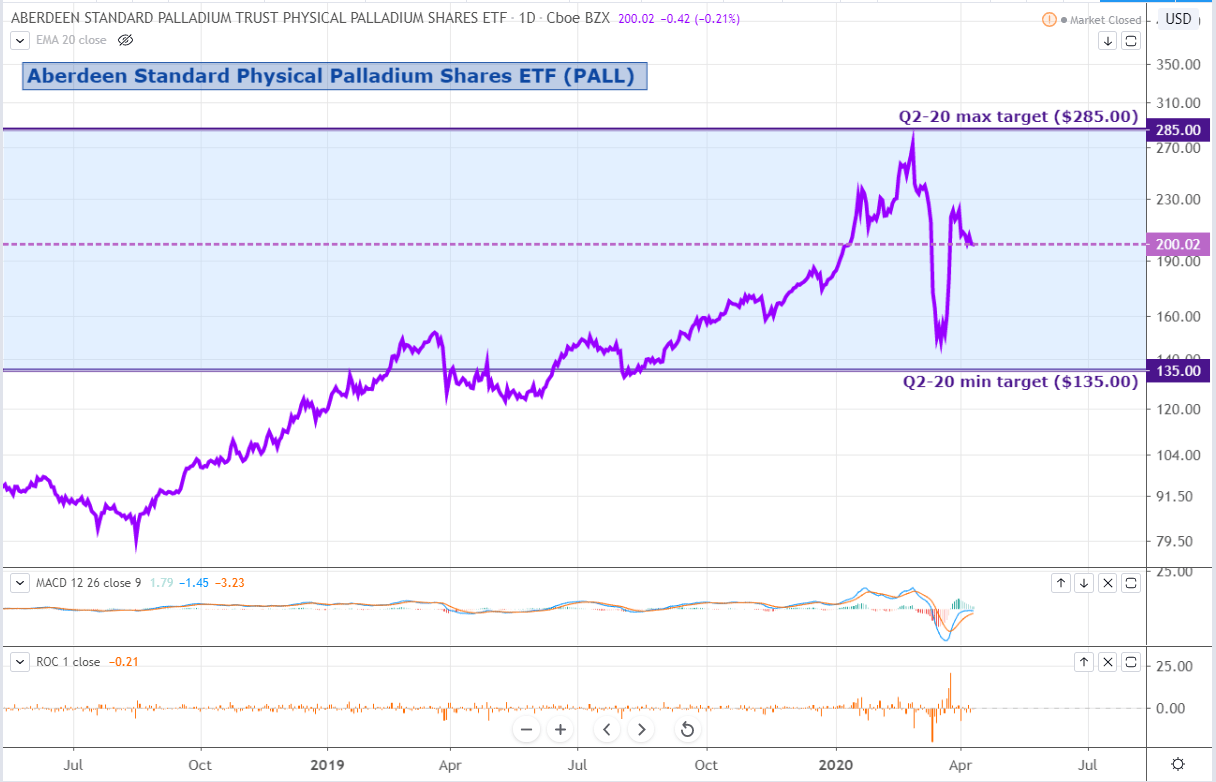
  • For Q2, we see PALL trading between $135 and $285 per share.

Orchid Research

Thesis

Welcome to Orchid’s Palladium Weekly report, in which we discuss palladium prices through the lenses of the Aberdeen Standard Physical Palladium Shares ETF (PALL).

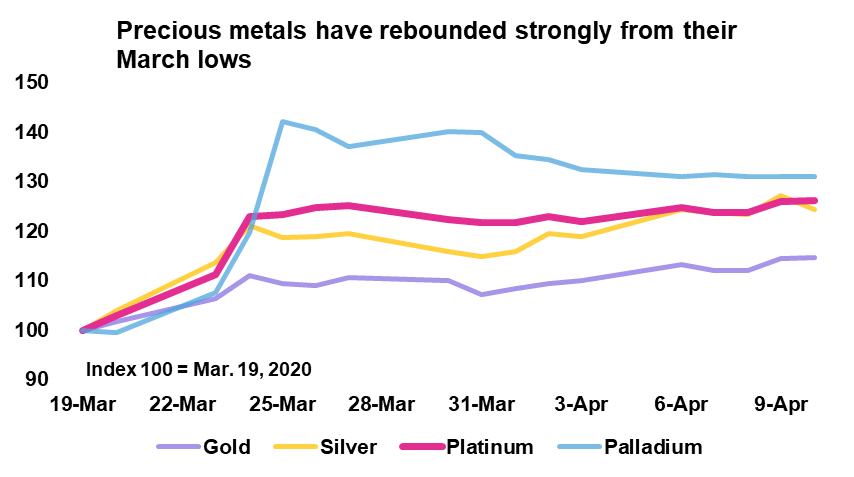
PALL has rebounded by nearly 50% since it crashed to its lowest since last August at $137.51 on March 16, taking bears by surprise.

The rebound in palladium prices has been driven by a broad-based recovery in the precious metals space following the wave of ugly deleveraging caused by the COVID-19 panic last month.

That said, palladium is the clear winner, which we attribute to its relatively stronger fundamental backdrop. Before COVID-19, the palladium market was expected to register a deficit exceeding 1 million ounces this year. Although the deficit is likely to be much smaller than initially envisaged due to the likely contraction in automotive demand for palladium, the market is forward-looking and therefore, rises on expectations for a large deficit in 2021.
Source: Bloomberg, Orchid Research

Against this, we express the view that the long-term uptrend in PALL remains intact.

For Q2, we see PALL trading between $135 and $285 per share.
Source: Trading View, Orchid Research

About PALL

For investors seeking exposure to the fluctuations of palladium prices, PALL is an interesting investment vehicle because it seeks to track spot palladium prices by physically holding palladium bars, which are located in JPM vaults in London and Zurich. The vaults are inspected twice a year, including once randomly.

The Fund summary is as follows:

PALL seeks to reflect the performance of the price of physical palladium, less the Trust’s expenses.

Its expense ratio is 0.60%. In other words, a long position in PALL of $10,000 held over 12 months would cost the investor $60.

Liquidity conditions are poorer than that for platinum. PALL shows an average daily volume of $3 million and an average spread (over the past two months) of 0.33%.

Speculative positioning

Source: CFTC, Orchid Research

Non-commercials cut marginally by the equivalent of ~19 koz and their net long position in NYMEX palladium in the week to April 7, according to the CFTC. This was the 12th week of decline in palladium’s net spec length over the past 13.

Over March 31-April 7, the NYMEX palladium price tumbled 6.1%. This suggests the presence of additional OTC selling activity.

Non-commercials have slashed by the equivalent of around 1 million oz their net long positions in NYMEX palladium since the start of the year, which represents 15% of annual supply. Yet, the NYMEX palladium price remains up 14% on the year, even outperforming gold (which is up 11% YTD), a clear confirmation of fundamental strength.

Implications for PALL: The absence of speculative participation in the palladium market in spite of 1)the strong uptrend in prices since 2016 and 2)the tight fundamentals of the market makes us even more bullish on PALL. We would turn cautious on PALL once palladium’s spec positioning becomes too bullish.

Investment positioning
Source: Orchid Research

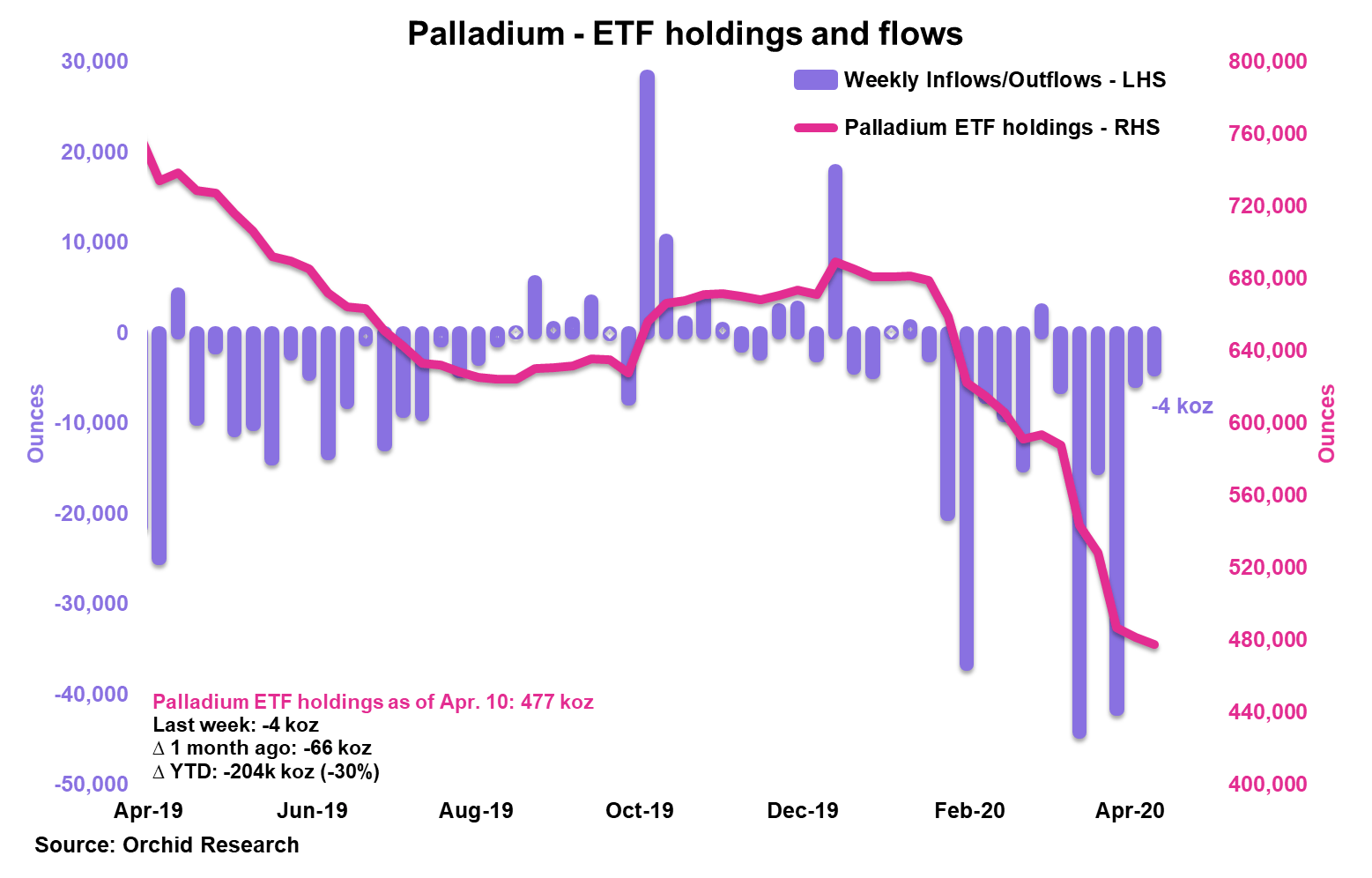
ETF investors sold 4 koz of palladium in the week to April 10, marking a 6th straight week of selling.

In March, ETF investors liquidated 106 koz, representing the largest monthly net outflow since October 2018.

ETF holdings are now below 500 koz, which represents an extremely low level of visible inventories when remembering that the palladium market was supposed to post a 1+ moz deficit this year.

Implications for PALL: The palladium ETF activity has had a muted impact on the NYMEX palladium price because volumes exchanged are impactless on the global palladium market. Low visible inventories are bullish for PALL over the long term.

Seasonal patterns
Source: Bloomberg, Orchid Research

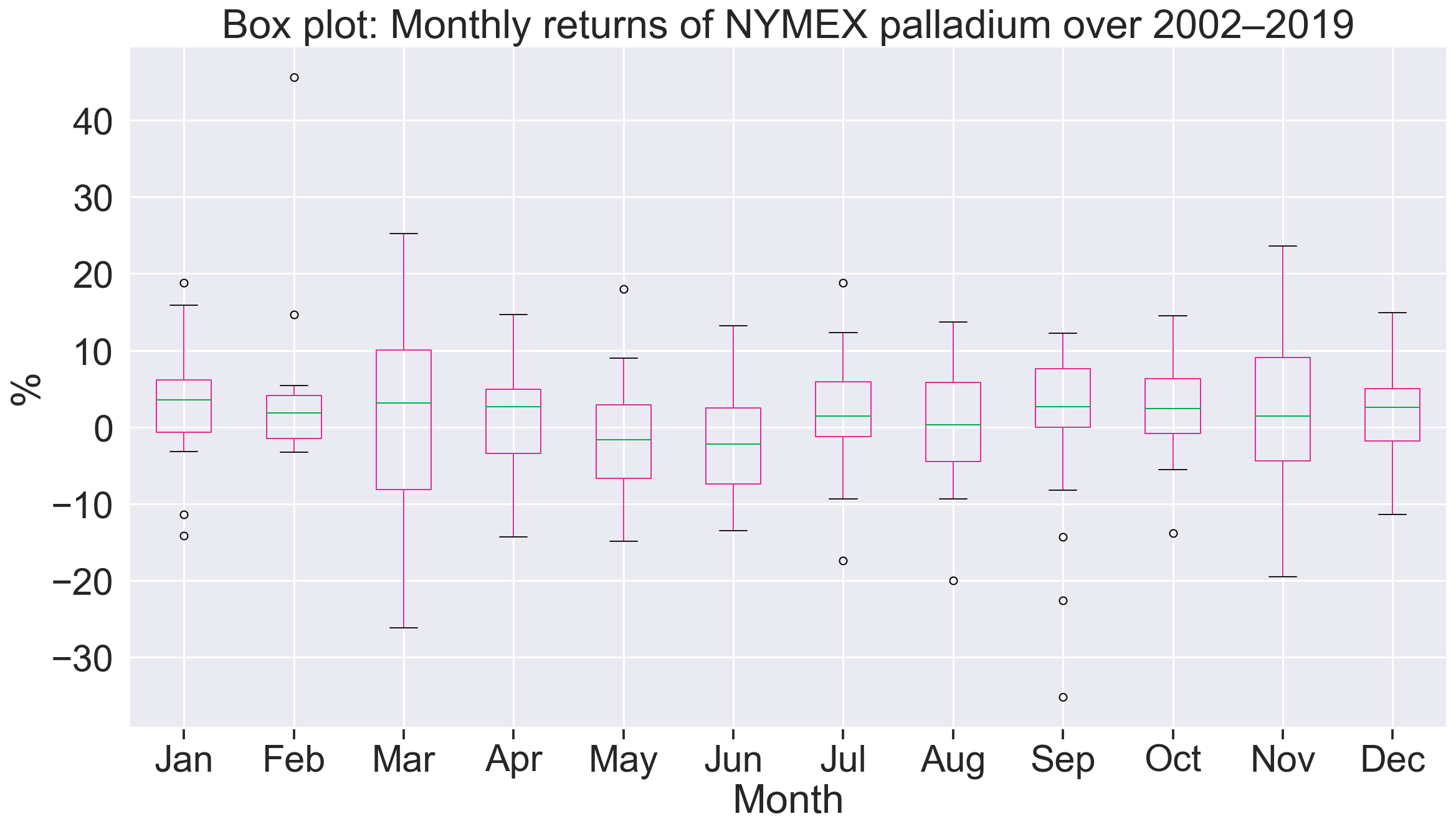
As the chart above shows, the volatility in palladium prices tends to be extreme in March. 2020 did not disappoint in this regard. Lower volatility in the months ahead should be expected based on palladium’s seasonal patterns.

For April, the seasonality is slightly friendly, with palladium prices recording a median performance of +2.7% (over 2002-2019).

Implications for PALL: The high volatility regime is behind us, in our view. The seasonality is positive for the NYMEX palladium price and thus PALL in April.

Closing thoughts

The recent outperformance of palladium over the rest of its complex confirms our view that palladium enjoys the relatively strongest fundamental backdrop.

The absence of financial flows in palladium despite its price uptrend since 2016 leads us to believe that 1)there is no bubble in the palladium market yet and 2)prices are essentially driven by their fundamental dynamics.

The sudden sell-off in PALL in March was exacerbated by the COVID-19 panic. Although palladium’s fundamentals will prove weaker than expected in 2020 due to a likely contraction in automotive demand, the market seems increasingly focused on 2021 when a large deficit is likely to re-emerge as global economic growth bounces back and automotive demand rebounds.

We maintain that PALL is in a clear long-term uptrend and even though volatility cannot be ruled out, we would only turn cautious when investor sentiment reaches an extreme high. We are far from it.

For Q2, we see PALL trading between $135 and $285 per share.

Source: https://seekingalpha.com/article/4337297-palladium-weekly-long-term-uptrend-remains-intact


Cannabis sales spike after lockdown measures in legalised areas – SPONSOR: Spyder #Cannabis $SPDR.ca – $CGC $ACB $APH $CRON.ca $OGI.ca

Posted by AGORACOM-JC at 12:37 PM on Monday, April 13th, 2020

SPONSOR: Spyder Cannabis (SPDR:TSXV) An established chain of high-end vape stores. Aggressive expansion plan is already in place that will focus on Canadian retail and US Hemp derived kiosks in high traffic areas. Click here for more info.

Cannabis sales spike after lockdown measures in legalised areas

  • As more people are confined to their homes, and can’t get out to unwind in other ways, they bought cannabis products at higher rates, and in bigger amounts than they have before

by Sanjana Varghese

Around the world, precautions against the spread of coronavirus have meant that people are confined to their homes for a while. Everyone has their own plans, which has included stockpiling loo roll, food and medicine. 

For people who realise that they may want to relax, those preparations include stockpiling cannabis too – in Canada, the Netherlands, and states in the US where cannabis is legal to buy, the coronavirus lockdown has caused a surge in demand for cannabis products, particularly online and at dispensaries. 

As more people are confined to their homes, and can’t get out to unwind in other ways, they bought cannabis products at higher rates, and in bigger amounts than they have before.

Now that lockdown measures have been in place for several weeks, cannabis companies and other retailers have been able to take stock of how their businesses have fared.

In the middle of March, several marijuana businesses throughout the US saw a spike in people buying all kinds of products. People also tended to be buying it in larger quantities than they would normally.

In California, sales had gone up 159 per cent compared to the sales in March of 2019. 

In general, the legal cannabis industry is a growing one, so there will be more people buying it “officially” than the year before. Even so, the kind of spike that cannabis business owners around the world saw in mid-March coincided exactly with announcements of cannabis lockdowns.  

But is this a good thing? Information from the World Health Organisation suggests that smoking cannabis can weaken the lungs, which isn’t a good thing when we have a global pandemic of a virus which attacks the respiratory system.

However, it seems people may have thought of this.

Data from Headset suggests that while sales of cannabis were up 10 per cent, edibles surged in demand too – by 28 per cent – and that people are shifting away from pre-rolled products when thinking about what they would want to stock up on for a few weeks. 

In Ontario, Canada there were almost 3,000 orders on the last Saturday before full lockdown at the Ontario Cannabis Store. That was an 80 per cent increase over a typical Saturday.  

Daffyd Roderick, the communications director at the OCS, said that they had seen a significant increase in demand for same-day and next day delivery options, in addition to a higher volume of purchases.

Other cannabis stores, in the province of Quebec, also said that they had seen a spike in sales of cannabis over the weekend. Additionally, many shops have started to operate a click and collect service – where people can come and pick up their orders themselves. These kinds of services could offer a chance for people to keep stocked up on the products they want, but they minimise social contact as much as possible. Measures like this are possible in Canada, where individual provinces maintain a monopoly on the sales of cannabis – so they can implement changes more quickly than elsewhere.

In the Netherlands, photos circulated on social media of people in towns and cities lining up to buy cannabis and weed from coffee shops before a government-imposed quarantine would put the country on lockdown. 

While cannabis is illegal in the Netherlands, it is decriminalised for personal use, and posts from social media users showed lines of more than 20 or 30 people waiting to stock up in various cities, from Amsterdam to Utrecht.

The day after the announcement was made, cafes and coffee shops were allowed to re-open as long as they were only offering takeaway services

The situation around cannabis in the US is different from places like Canada and the Netherlands because federal policy governs whether cannabis is legal, as well as whether there are other restrictions on what dispensaries can do with their stock. In eight states that have imposed stay-at-home orders, recreational cannabis can still be sold, and over 15 others have continued to allow the sale of medical cannabis only. 

In states like California and Washington, dispensaries have reported huge increases in demand for their products since mid March.

In Oakland, a dispensary’s whole supply was sold out by 2pm on the day that the lockdown measures were announced.

Delivery services in San Francisco said they had seen an increase in demand for cannabis delivery too, although they weren’t as severe as recent spikes. 

In Pennsylvania, Governor Tom Wolfe declared marijuana dispensaries an essential business, which brought in changes that had otherwise been passing slowly through legislation. Telemedicine – where people are prescribed medication over the phone – mean cannabis has become much more accessible, and for people who needed cannabis to treat illnesses or reduce their symptoms, getting the adequate documentation happened much more quickly too.

Some dispensaries have also transitioned to offering drive-through services too, to minimise contact. 

Other elements of the legal cannabis industry have changed in response to Covid-19. 

The government in Oregon increased the minimum amount of cannabis that you could buy in one go, to stop people from making more trips.

Websites like Leafly, which focus on the world of cannabis, have created guides on disinfecting cannabis product packaging and taking other safety precautions. For business owners, it’s an opportunity to strengthen online vendor systems and figure out whether a drive through system is possible. 

As lockdown measures are extended around the world, cannabis business owners are attempting to figure out what they should be doing next – in some cases, they ordered in extra stock and increased hours for workers. In others, they’ve been encouraging customers to place their orders online, rather than coming into town.

Currently, the length of the lockdown measures remains uncertain, so you might as well be well prepared, whether you’re buying or selling.

Source: https://www.indy100.com/article/coronavirus-cannabis-marijuana-sales-legal-lockdown-9459851

Healthcare communication post-COVID 19: Need for new approaches and protocols to achieve resilience – SPONSOR: Datametrex AI Limited $DM.ca

Posted by AGORACOM-JC at 12:00 PM on Monday, April 13th, 2020

SPONSOR: Datametrex AI Limited (TSX-V: DM) A revenue generating small cap A.I. company that NATO and Canadian Defence are using to fight fake news & social media threats. The company is working with US Government agencies on Covid19 and Coronavirus fake news and disinformation Click here for more info.

Healthcare communication post-COVID 19: Need for new approaches and protocols to achieve resilience

– Health communication was never so important in controlling the disease outbreaks as it is in COVID 19 pandemic

– The alarmingly increasing risk of misinformation through fake news on social media, termed as infodemic by the World Health Organization (WHO); and fear of such outbreaks in the future has put the communication at the core of resilience and response policies.

By: Siddheshwar Shukla

However, the scariest part of this pandemic is infodemic – a huge amount of misinformation and fake news on social media. “Our common enemy is #COVID19, but our enemy is also an “infodemic” of misinformation. To overcome the #coronavirus, we need to urgently promote facts & science, hope & solidarity over despair & division,” said Antonio Guterres, Secretary-General of the United Nations apparently announcing a full-fledged organized war against the COVID 19 infodemic. This proclamation from the top of the UN came about one and half months after WHO Chief Dr. Tedros Adhanom declared fight against the infodemic. “But we’re not just fighting an epidemic; we’re fighting an infodemic. Fake news spreads faster and more easily than this virus, and is just as dangerous,” said Dr. Tedros on February 14 in a press conference in Munich (Germany).

The announcement by the UN Chief was a kind of acceptance that the WHO required enforcement to fight against the infodemic. And, enforcement was rushed on a war footing as the UN and its various organizations such as Global Communication Team, Cyber Security Team of the UN Office of Drugs and Crime (UNODC) and UNESCO joined the WHO’s efforts against the infodemic. Presently, all the UN bodies have joined the fight against misinformation from their perspectives. The pandemic has manifested the extend of misinformation and its impact on communities across age groups. In the initial stage of the COVID 19 outbreak, the misinformation was primarily non-intentional but now it has reached to the level of cybercrime posing threats of cybersecurity throughout the globe.

Fake news about infection and treatment

Detection and prevention are two pillars of the response plan for disease outbreaks like COVID 19 for which no treatment is available.

However, experiences of the ensuing pandemic show the maximum number of the fake was created on detection, diagnosis, prevention, and treatment of the disease. These fake news items are aimed at directly misguiding the healthy and infected persons on contagiousness and potential damages to be caused by the infection. The misguided individuals virtually end up increasing the number of cases in the society through their behaviors. Therefore, providing scientific information to make the people aware of the real causes of infection, do’s and don’ts to be followed during the period of disease outbreaks and appropriate preventive care becomes a top priority. ‘Myth Busters’, the online campaign launched by the WHO is focussed on combating the fake news items of this category thereby enabling the COVID warriors and various stakeholders throughout the world.

Starting from – Garlic, Vitamin C, Hot Water, ten seconds breathing control-diagnosis, the fake news items of this category have now reached to the extent of fake claims that ‘5G mobile networks spread COVID 19‘. “COVID 19 is spread through respiratory droplets when an infected person coughs, sneezes or speaks. People can also be infected by touching a contaminated surface and then their eyes, mouth or nose,’ WHO has reiterated time and again. However, the fake news items are designed so meticulously that they convince uneducated and educated societies as well. The arson attacks on 5G cell towers across Britain and large scale uprising against the rollout of 5G telecommunication networks in the Netherland indicate the capacity of fake news to influence the people in the countries that have achieved cent percent literacy and are considered highly educated societies. Therefore, developed and developing, all countries are vulnerable to fake news but the situation could be more dangerous in developing countries as they have fewer resources to combat the infodemic.

Conspiracy theories on Pandemic

The fake news items and unsubstantiated claims of this category are targeted against communities, personalities, nations, international bodies and also the UN organizations. They may not play a direct role in the outbreak or escalating the intensity of the outbreak but the unsubstantiated claims of this category are dangerous for creating tension between communities thereby posing law and order problems.

India has faced unprecedented fake news for and against Tablighi Jamaat community after an event in Delhi attended by hundreds of foreigners from several countries became the nodal center for novel coronavirus outbreaks and caused a sudden rise in new cases. At the international level, China and the USA have been blaming each other for conspiring in the outbreak of the disease. The unsubstantiated claims of this category were often made by scientists, professionals, legislators, and even the heads of the states.

Besides, the credibility of the national, international and UN organizations is also being questioned. The US President Donald Trump and several other who’s who of the US has alleged that the WHO Chief sided with China and helped in concealing information that caused the outbreak of this magnitude.

The United Nations is yet to develop a mechanism to deal with the infodemic of this category. However, the nations also need to develop mechanisms to deal with conspiracies meant to provoke one community against the other as such strategies will be very crucial in managing the current outbreak and also in developing pandemic resilience policies for future outbreaks.

Cyber Security: Protecting the vulnerable

Due to global lockdown, millions of people have been forced to stay at home. The global economy has come to a standstill but a few businesses have developed the capacity to continue their operations online. Here comes the danger of cybersecurity.

In fact, all the businesses that are operating online due to global lockdown have been exposed to cybercrime. The cybercriminals can aggravate the problem by attacking the communication network of the governments, hospitals, hacking websites, influencing diseases outbreak dashboard, interfering with ‘myth busters’, sending fishing emails, individual emails, fake official order, and miscommunication of various kinds to hamper the fight against the disease outbreak. All these aspects need to be considered in the outbreak/ epidemic/ pandemic disease response plan for COVID 19 and also in preparing outbreak resilience plans for nations or regions in the post-pandemic world. Not only the smaller websites, but the big organization such as Coronavirus statistics site Worldometers.info and the US Department of Health and Human Services have also faced cyber-attacks in the ensuing COVID 19 pandemic.

“The vast majority of cyberattacks – by some estimates, 98 percent – deploy social engineering methods. Cybercriminals are extremely creative in devising new ways to exploit users and technology to access passwords, networks, and data, often capitalizing on popular topics and trends to tempt users into unsafe online behavior,” said Algirde Pipikaite and Nicholas Davis in an analysis published at the World Economic Forum. The authors have suggested three broad strategies – step up cyber-hygiene standards, be extra vigilant on verification and follow official updates. Throughout the world, cyber-crimes have increased during the pandemic.

Children: The most vulnerable

Children are always the most vulnerable to misinformation and attack by cybercriminals. They can be misguided through video games, dangerous challenges, and tasks. These activities may expose them to infections.

COVID 19 is not much fatal to children but there are infectious diseases that can pose risks for children as well. Besides, children could be misguided and used as vectors for spreading the infection in the family, schools, playgrounds, markets, and communities. In the past, there have been several dangerous games such as the Blue Whale game and skull break challenge that had caused the deaths of several children. The governments will have to develop a robust cybersecurity system, cyber monitoring system and strict cyber laws to prevent the children from falling in the trap of cyber criminals during COVID 19 pandemic and also for developing resilience and response plan for handling outbreaks of communicable diseases in the future.

COVID 19 and the dangers of terrorism

“The weaknesses and lack of preparedness exposed by this pandemic provide a window onto how a bio-terrorist attack might unfold and may increase its risks. Non-state groups could gain access to virulent strains that could pose similar devastation to societies around the globe,” said UN chief Antonio Guterres addressing the UN Security Council meeting on April 10. Though any link to the terrorist organizations has not been established in the case of COVID 19, the highly contagious virus has posed a new threat to humanity. The countries will have to amend their laws to ensure the culprits are served strictest punishment, and outbreaks are detected and contained efficiently.

Public Health Communication in the Post-COVID 19 World

Communication has always played an important role in prevention and response plans against outbreaks of infectious diseases but the experience of the COVID 19 pandemic has increased its scope and importance. The role of communication in disseminating scientific information and rejecting fake news has become a top priority.

As the COVID 19 pandemic has taken the whole world into its grip, WHO and all the UN agencies are assisting nations in their fight against the outbreak of the disease. However, this kind of collaboration will be rare in case of local or national level outbreak of diseases in the future. Besides, internet-based technological innovations have provided cybercriminals with several new weapons that they can use by sitting in any corner of the world or through artificial intelligence. The policymakers and administrators will be required to consider several such aspects of health communication which were unheard of in the pre-COVID 19 periods. The existing disease outbreak resilience policies and protocols need a thorough review to deal with COVID 19 pandemic and challenges to be posed in the post-COVID 19 world.

Source: https://www.devdiscourse.com/article/health/1003975-healthcare-communication-post-covid-19-need-for-new-approaches-and-protocols-to-achieve-resilience

Embracing #Edtech in a post-lockdown world SPONSOR: BetterU Education Corp. $BTRU.ca $ARCL $CPLA $BPI $FC.ca

Posted by AGORACOM-JC at 11:22 AM on Monday, April 13th, 2020

SPONSOR:  BetterU Education Corp. aims to provide access to quality education from around the world. The company plans to bridge the prevailing gap in the education and job industry and enhance the lives of its prospective learners by developing an integrated ecosystem. betterU / Ottolearn launch FREE COVID-19 mobile resource toolkit to fight the global crisis – Click here for more information.

Embracing EdTech in a post-lockdown world

  • More than a billion children are currently out of school with no return date.
  • As we enter another month with educational institutions around the world in lockdown, it has become clear that the Covid-19 outbreak has the potential to forever change not just how we learn, but how we think about learning.

By Geoffrey Alphonso

While the world’s schools, colleges and universities may be closed, education must go on. This is a challenge unlike any we have faced before, but it is also an opportunity to harness the human capacity for learning and to further develop our tools.

In this environment, online systems, data-driven structures, and artificially intelligent algorithms offer critical resources for students, teachers and even parents. But realising the full value of these resources requires re-thinking how our education systems interact with technology, forging a new path and incorporating technology into every aspect of learning.

For several years now education has been one of the fastest growing sectors in technology.  According to HolonIQ, a global education intelligence firm, the ‘Edtech’ field is projected to be worth $341 billion by 2025.

This is unsurprising given its obvious potential, not just today, but for the cities of tomorrow, which will need to be agile enough to embrace change and disruption. Those that thrive will be the ones already investing in the wider strategic infrastructure that supports online learning.

Communities around the world have been wrangling with the demands of continued support for education through the Covid-19 lockdown. When Abu Dhabi closed schools on March 9th, the emirate immediately activated an “at home” model, with all of its school children continuing to learn through online platforms.

In a time of social distancing, that means that not only can students continue to learn, they can also continue to engage with their peers and their teachers. And during these trying times, it is clearer than ever just how important these relationships remain for our mental and emotional health.

That shouldn’t be regarded as a replacement for the social warmth of physical classrooms and human interaction, but it is a viable way to foster and maintain connections when the alternatives are not available.

In some areas, we shouldn’t be afraid of also considering how to retain some of these technologies in a post-Covid-19 world. Learning online means students can progress at their own pace, with personalised systems that puts each student at the centre of every class. Instant and ongoing assessments also provide teachers with feedback on individual progress, giving them a chance to adjust, correct and spend additional time on material through one-on-one instruction.

Videos, games and interactivity can also keep the lessons flowing, harnessing an approach known as the “gamification of learning”. This motivates them to learn, practice, and ultimately achieve full mastery of the material. The most successful platforms also allow for streamlined and consistent delivery of lessons, relieving teachers and parents of the time needed to build resources from scratch. This frees them up to focus on the actual delivery of the lessons, maximising their direct engagement with students.

It can be more than just continuing to teach, it can be a qualitative shift in our education systems if we grasp the nettle.

This is not to say that embracing Edtech is without challenge. For example, schools need to be scaled up with the necessary IT infrastructure and hardware, while external systems themselves have to be able to handle the processing demands of home access.

Similarly, the tools we use also have to be based on sound learning principles and properly aligned with national curricula, with the most important stakeholders in mind: the teachers and students. From a design perspective, teachers and students will bring endless varied challenges and Edtech systems must be designed with this diversity in mind, especially for those students with special educational needs.

Lastly, we should not be so arrogant as to assume that teachers and parents can simply be “dropped” into Edtech systems. Software designers may always be confident that their tools are eminently intuitive for all users, but the reality is that scaling up online technologies also means ensuring we provide support in the form of the training required for our students and children, helping them to get the maximum value from these technologies.

These things are not easy. They take time, they take investment and they require a government that is committed to deploying innovative systems in an environment that doesn’t always rapidly embrace change. Abu Dhabi invested heavily over the years, directly and indirectly, to support companies that deliver these programmes as well as a stable infrastructure to support them, giving the emirate and its students flexibility and a way forward.

Ultimately, the most effective providers will be those who keep users at the heart of their endeavours, offering a holistic learning experience which ensures that no student misses a beat, whether inside the classroom or out.

And the education systems that are best placed to thrive in a post-Covid-19 world will be those who retain the technologies and tools that have been tested so fiercely during this outbreak.

Source: https://www.techradar.com/news/embracing-edtech-in-a-post-lockdown-world

Empower Clinics $CBDT.ca Launches Nationwide Digital Health Platform $WEED.ca $CGC $ACB $APH $CRON.ca $OGI.ca

Posted by AGORACOM-JC at 7:28 AM on Monday, April 13th, 2020
  • Commences tele-medicine services for patients, both in-clinics and virtually through secure video, on browser and in mobile app
  • Company will begin offering digital access to physicians, using the newly launched tele-medicine platform, for a variety of physician based consultations

VANCOUVER, BC / April 13, 2020 / The Company through its Sun Valley Health division, commences tele-medicine services for patients, both in-clinics and virtually through secure video, on browser and in mobile app.

With its base of 165,000 patients, the Company will begin offering digital access to physicians, using the newly launched tele-medicine platform, for a variety of physician based consultations.

“The COVID-19 Pandemic has forever changed the interaction between physicians and patients, requiring immediate advancement in technology solutions, that offer safe interactions to a vast array of patient needs.” said Steven McAuley, Chairman & CEO of Empower Clinics Inc. ” Our team are fast-tracking progressive technology, products and service options, to support the needs of our patients, our staff, and our community.”

Sun Valley digital health initiatives are moving forward with safe and secure physician-patient interactions, starting with a combination of in-clinic virtual kiosk based physician visits, and full tele-medicine virtual consultations based on patient availability. A nationwide roll-out in the U.S. has the potential to reach in excess of 329 million people, based on the most recent U.S. census data. https://www.census.gov/popclock/

The Company has made changes to clinic operations and patient management based on the most recent recommendations from the (CDC) Centers for Disease Control and Prevention, and their guidance for healthcare facilities.

https://www.cdc.gov/coronavirus/2019-ncov/healthcare-facilities/guidance-hcf.html
https://www.cdc.gov/coronavirus/2019-ncov/healthcare-facilities/index.html

ABOUT EMPOWER

Empower is a vertically-integrated health & wellness brand with it’s first hemp-derived CBD extraction facility under development, the Company produces its proprietary line of cannabidiol (CBD) based products and distributes products through company owned and franchised clinics, with wholesale partnerships, online channels and with new retail opportunities nationwide in the U.S. The company is a leading multi-state operator of a network of physician-staffed wellness clinics, focused on helping patients improve and protect their health, through innovative physician recommended treatment options. The company has commenced activity on how to connect its significant data, to the potential of the efficacy of alternative treatment options related to hemp-derived cannabidiol (CBD) therapies.

ON BEHALF OF THE BOARD OF DIRECTORS:

Steven McAuley
Chief Executive Officer

CONTACTS:

Investors:Steven McAuley
CEO
[email protected]
604-789-2146

Investors: Dustin Klein
SVP, Business Development
[email protected]
720-352-1398

For French inquiries: Remy Scalabrini, Maricom Inc., E: [email protected], T: (888) 585-MARI

DISCLAIMER FOR FORWARD-LOOKING STATEMENTS

This news release contains certain “forward-looking statements” or “forward-looking information” (collectively “forward looking statements”) within the meaning of applicable Canadian securities laws. All statements, other than statements of historical fact, are forward-looking statements and are based on expectations, estimates and projections as at the date of this news release. Forward-looking statements can frequently be identified by words such as “plans”, “continues”, “expects”, “projects”, “intends”, “believes”, “anticipates”, “estimates”, “may”, “will”, “potential”, “proposed” and other similar words, or information that certain events or conditions “may” or “will” occur. Forward-looking statements in this news release include statements regarding; the Company’s intention to open a hemp-based CBD extraction facility, the expected benefits to the Company and its shareholders as a result of the proposed acquisitions and partnerships; the effectiveness of the extraction technology; the expected benefits for Empower’s patient base and customers; the benefits of CBD based products; the effect of the approval of the Farm Bill; the growth of the Company’s patient list and that the Company will be positioned to be a market-leading service provider for complex patient requirements in 2019 and beyond. Such statements are only projections, are based on assumptions known to management at this time, and are subject to risks and uncertainties that may cause actual results, performance or developments to differ materially from those contained in the forward-looking statements, including; that the Company may not open a hemp-based CBD extraction facility; that legislative changes may have an adverse effect on the Company’s business and product development; that the Company may not be able to obtain adequate financing to pursue its business plan; general business, economic, competitive, political and social uncertainties; failure to obtain any necessary approvals in connection with the proposed acquisitions and partnerships; and other factors beyond the Company’s control. No assurance can be given that any of the events anticipated by the forward-looking statements will occur or, if they do occur, what benefits the Company will obtain from them. Readers are cautioned not to place undue reliance on the forward-looking statements in this release, which are qualified in their entirety by these cautionary statements. The Company is under no obligation, and expressly disclaims any intention or obligation, to update or revise any forward-looking statements in this release, whether as a result of new information, future events or otherwise, except as expressly required by applicable laws.

Datametrex $DM.ca Secures Additional $250,000 Contracts

Posted by AGORACOM-JC at 7:23 AM on Monday, April 13th, 2020
  • Secured contracts for approximately $250,000 CAD with two existing client
  • First contract is for $130,000 CAD with one of LOTTE Group of companies, Global Logistics division
  • Second contract for approximately $120,000 CAD is with Hyosung Corp., and is a continuation and expansion of the original contract announced last year

TORONTO, April 13, 2020 — Datametrex AI Limited (the “Company” or “Datametrex”) is pleased to announce that it has secured contracts for approximately $250,000 CAD with two existing clients. The first contract is for $130,000 CAD with one of LOTTE Group of companies, Global Logistics division. The second contract for approximately $120,000 CAD is with Hyosung Corp., and is a continuation and expansion of the original contract announced last year.

“This is exciting for the team as we continue to execute on our “land and expand” strategy with global conglomerates. We look forward to continuing to build on the trust we have gained with them going forward. We are proud to be able to continue to secure new business despite the global restrictions as a result of COVID-19, our team is doing a great job working remotely to add value for our stakeholders,” says Marshall Gunter, CEO of the Company.

About Datametrex AI Limited

Datametrex AI Limited is a technology focused company with exposure to Artificial Intelligence and Machine Learning through its wholly owned subsidiary, Nexalogy (www.nexalogy.com).
Additional information on Datametrex is available at: www.datametrex.com

For further information, please contact:

Marshall Gunter – CEO
Phone: (514) 295-2300
Email: [email protected]

Neither the TSX Venture Exchange nor its Regulation Services Provider (as that term is defined in the policies of the TSX Venture Exchange) accepts responsibility for the adequacy or accuracy of this release.

Forward-Looking Statements

This news release contains “forward-looking information” within the meaning of applicable securities laws.  All statements contained herein that are not clearly historical in nature may constitute forward-looking information. In some cases, forward-looking information can be identified by words or phrases such as “may”, “will”, “expect”, “likely”, “should”, “would”, “plan”, “anticipate”, “intend”, “potential”, “proposed”, “estimate”, “believe” or the negative of these terms, or other similar words, expressions and grammatical variations thereof, or statements that certain events or conditions “may” or “will” happen, or by discussions of strategy.

Readers are cautioned to consider these and other factors, uncertainties and potential events carefully and not to put undue reliance on forward-looking information. The forward-looking information contained herein is made as of the date of this press release and is based on the beliefs, estimates, expectations and opinions of management on the date such forward-looking information is made. The Company undertakes no obligation to update or revise any forward-looking information, whether as a result of new information, estimates or opinions, future events or results or otherwise or to explain any material difference between subsequent actual events and such forward-looking information, except as required by applicable law.

AGORACOM Companies Making Big News Over Last 10 Days Despite COVID-19 $CBDT.ca $BTRU.ca $HOLL.ca $NAM.ca $MOTA.ca $PRMO.ca $DM.ca $PYR.ca

Posted by AGORACOM-JC at 8:00 PM on Sunday, April 12th, 2020

Dear AGORACOM Members, we hope this message finds your families well.  We also want to wish Happy Easter and Happy Passover to those that are celebrating.

During this turbulent time, our job now more than ever is to bring you the small cap companies that are actually thriving in order to help you discover your next great company.  Thanks to our focus on quality over quantity, AGORACOM clients have been operating exceedingly well and we are very happy to provide you with the following highlights over the last 10 days (in reverse chronological order):

* Empower Clinics (CBDT:CSE) Up 55% On 4.5M Shares Traded – Clinic Patient Visits Up 478% In Q1 (NEWS + VIDEO)

* BetterU Education (BTRU:TSXV) UP 37% On 1M Shares Traded – Closes Deal With USA Paramount For Enterprise Skills Development (NEWS + VIDEO)

* Hollister Biosciences (HOLL:CSE) Up 60% on 4M Shares – Acquisition Adds $16.4M Rev / $2.5M EBITDA (NEWS + VIDEO)

* New Age Metals (NAM:TSXV) 2.9M Ounces Of Palladium Equivalent Is Why Eric Sprott Owns 18.5% (VIDEO)

* Mota Ventures (MOTA:CSE) Acquires Over 20,000 Customers in March, Launches New Immune Support Product Line (NEWS + VIDEO)

* Primo Nutraceuticals (PRMO:CSE) Up 100% On 2.6M Shares – Signs Acquisition LOI with Celebrity brand Beauty Kitchen (NEWS)

* Datametrex A.I. (DM:TSXV) Hired By US Government Agencies On COVID-19 / Coronavirus Fake News and Disinformation (NEWS + VIDEO)

* PyroGenesis (PYR:TSXV) Receives $550K Under an Exclusive Agreement with a US Tunneling Company (NEWS)

We know that most of you have seen most of these headlines on our front page – but make sure to never miss a timely piece of news by also adding us into your social media streams on Twitter and Facebook.

Finally, look for some big news and changes coming to AGORACOM in the next 60 days.  We are going to be bigger and better than ever!

Stay Home. Stay Safe. Keep Our Heroes Healthy.

Regards,

George et al.

Where is the #CBD Market Headed? – SPONSOR: Hollister Biosciences $HOLL.ca $WEED.ca $CGC $ACB $APH $CRON.ca $OGI.ca $FAF.ca

Posted by AGORACOM-JC at 5:52 PM on Thursday, April 9th, 2020

SPONSOR: Hollister Biosciences Inc. (HOLL:CSE) A vertically integrated cannabis company with products in 220 California dispensaries and joint ventures, licensing agreement & partnerships with global brands. The company recently closed $20 MILLION deal with Venom Extracts adding $CDN 16.4 million in revenue and $CDN 2.48 million in EBITDA. Learn More

Where is the CBD Market Headed?

  • After hemp was legalized for growth and cultivation with the passing of new legislation in 2018, the CBD market erupted with new products and companies looking to take advantage of the new space
  • As of 2019, CBD sales increased by around 133%, to the tune of over $1 billion. That’s right; one billion. The market has plenty of consumer demand to back it up, and Americans are loving their CBD

By: Guest Contributor

With the last few years’ success in the CBD industry, new investors, everyday people, and seasoned investors alike are working to get their hands into one of the fastest-growing markets in the US. The CBD space is full of new providers and products, and new ones are arising each year.

As the research receives more and more funding, we’re learning all kinds of new information about CBD and its effects on the body and mind; and not much of that information is negative.

With so much demand for CBD oil and other products, it’s no surprise that people are looking to get rich by investing in the industry. But there’s still the question of whether or not it’s a good idea to invest in CBD. Let’s take a closer look at the industry, so you can decide whether or not investing in it is the right move for you.

CBD’s Benefits and Popularity

For decades, the Cannabis plant, from which CBD is derived, was outlawed, shamed, and viewed as an addictive and dangerous drug. This is mostly because THC is also derived from Cannabis, which causes the “high” that comes with smoking marijuana or ingesting THC-infused oils and edibles.

CBD is an entirely different cannabinoid, and both CBD and THC are just two of many cannabinoids found in the Cannabis plant. Each cannabinoid interacts with the body’s cannabinoid receptors in a different way, but it would take another article entirely to explain them all.

The bottom line? CBD doesn’t get you high, and industrial hemp must contain less than 0.3% THC to even be legally grown or cultivated.

CBD has been found to offer many benefits to humans and pets alike; among these are:

  • Pain relief
  • Anti-inflammatory properties
  • Counteracts the effects of THC
  • Useful in addiction recovery
  • Managing anxiety disorders and stress
  • Calming effects on the brain
  • Increase focus and concentration

The benefits of CBD products far outweigh the minor side effects, and preliminary research has yielded promising results for the future of CBD. If you want to buy CBD to give it a try, you’ve chosen the right time to start! There are hundreds of varieties available, but not all CBD is created equal.
Quality Matters in CBD

If you’re thinking of investing in the CBD space, you’ll want to put your money towards a product that exceeds others in terms of quality. The higher the quality of the CBD extract, the more potent it is.

Lower-quality extracts aren’t as effective, and if the producer is using imported hemp, you run the risk of contaminating your CBD with pesticides and other chemicals from foreign countries. The US has some strict guidelines on growing hemp, and the top providers in the industry use only organically-grown domestic hemp to extract their CBD.

The Market So Far

After hemp was legalized for growth and cultivation with the passing of new legislation in 2018, the CBD market erupted with new products and companies looking to take advantage of the new space. As of 2019, CBD sales increased by around 133%, to the tune of over $1 billion. That’s right; one billion. The market has plenty of consumer demand to back it up, and Americans are loving their CBD.

Some estimates put the market at around $20 billion by 2022, but more conservative estimates put it somewhere around half that. It’s estimated that by 2024, the market will be worth $10 billion, and that’s not something investors can ignore.

The demand for CBD products only continues to increase as the years go by, so at this point, the only way to know for sure where CBD is headed is to wait and see.

That being said, the market shows potential for growth and continues to gain traction as more and more people try and love CBD products. This makes for an excellent investment opportunity if you know what you’re doing and where to put your money.

Among specialized dispensaries, even general retailers are starting to carry CBD. You may have noticed your local grocery stores, department stores, and even convenience stores carrying CBD oil and other CBD products.

This surge in CBD availability does present an issue, however; the producers are struggling to keep up.

The Quick-Buck Types

As with any industry, there are those looking to make a quick buck by ignoring quality standards and putting out a sub-par product just to get it on the shelves and into the hands of paying customers.

With little regulation on CBD products from government agencies, the standards in the industry are generally set by the top providers, and can’t exactly be enforced.

This leads to general flooding of the market with sub-par products, and many of those “off brands” end up on store shelves as retailers try to get their hand in the CBD market. Many CBD providers are working very hard to ensure their products meet certain standards, and those are the companies you’ll want to keep your eye on.

Where To Next?

The market seems to only be headed upward as time passes. With more money for research and much less stigma surrounding CBD and cannabis, there is the potential for massive growth as the public slowly shifts its opinion on the plant itself. With projections in the billions of dollars for the future, it’s safe to say that this market has a bright future ahead of it.

Not to mention, the better we understand CBD, the better it can be marketed. We’ve already found dozens of incredible benefits for the human body, and we’re sure to find more as our understanding of CBD evolves. We just have to be patient and wait for the research!

In the meantime, the market is flourishing and is expected to flourish well into the 2020 decade. If you’re looking to invest your money in a market that can offer significant ROI and stability, CBD might just be it. Always consult with an expert first, though. You wouldn’t want to put your money into the wrong startup!

Source: https://www.bigeasymagazine.com/2020/04/06/where-is-the-cbd-market-headed/

Indian #Edtech’s Demonetisation Moment? Online Learning Takes Off Under Quarantine – SPONSOR: BetterU Education Corp. $BTRU.ca $ARCL $CPLA $BPI $FC.ca

Posted by AGORACOM-JC at 5:23 PM on Thursday, April 9th, 2020

SPONSOR:  BetterU Education Corp. aims to provide access to quality education from around the world. The company plans to bridge the prevailing gap in the education and job industry and enhance the lives of its prospective learners by developing an integrated ecosystem. betterU / Ottolearn launch FREE COVID-19 mobile resource toolkit to fight the global crisis – Click here for more information.

Indian Edtech’s Demonetisation Moment? Online Learning Takes Off Under Quarantine

  • Over 91% of the world’s student population is out of school currently
  • This has led to a surge of users on online learning platforms
  • Startups are looking to convert this temporary surge into a permanent customer base
  • As per The Future Of India’s $2 Bn Edtech Opportunity Report 2020 by DataLabs by Inc42, the Indian online education market is expected to become a $1.96 Mn opportunity

By: Kritti Bhalla

Indian education system might be one of the oldest in the world, but it is definitely not the most technologically advanced in the world. But this coronavirus outbreak has brought out a different side of learning and school education with the proliferation of edtech products and services. From local schools to colleges and universities, everyone is gunning for the new reality — online learning.

With almost 91% of the world’s student population out of school for the foreseeable future, many have said it’s time to take traditional education to another technologically advanced level. After all, for how long will the education of the students get affected by lockdowns, war, natural disasters and other such situations?

Mrinal Mohit, chief operating officer at BYJU’s, believes that learning from home has gained utmost importance more than ever before due to temporary school closure. “Students need a holistic and reliable solution that helps them continue learning from the comfort of their homes.”

Following China’s footsteps, Indian edtech startups and educational institutions have also emerged as leaders in ensuring that digital learning becomes a viable option for more students regardless of their capacity to afford online learning. In fact, edtech has ensured that education is one of the last things to get impacted by the pandemic. Whether it’s schools going online, or online classes going free, every stakeholder is doing their bit to keep the cycle of education running.

For Indian edtech startups, this means a sudden influx of online users, engagements and startups. It’s similar to what played out in the Indian market soon after demonetisation in 2016, when digital payments and the cashless economy got a major boost. Can India’s edtech startups capitalise on this momentary surge?

As per The Future Of India’s $2 Bn Edtech Opportunity Report 2020 by DataLabs by Inc42, the Indian online education market is expected to become a $1.96 Mn opportunity, rising from $247 Mn in 2017. In the financial year 2018, the gross merchandise value (GMV) of edtech startups was above $120 Mn, a surge of 48% compared to FY17.

The Numbers Behind Edtech Growth

BYJU’s, which is one of the most valued edtech startups in the world, has noted a 150% surge with 6 Mn new students on the platform in March 2020. The company has noted the hike in both metro and non-metro regions.

Meanwhile, other edtech platforms have also been noting increase, especially after school started shutting down as a precautionary measure to tackle the coronavirus pandemic. Prime Minister Narendra Modi’s announcement for a 21-day-lockdown led to another spike in the users opting for online learning platforms.

For instance, upGrad claimed that it started noting an exponential growth in usage from February 24 to March 2, with almost 34% hike compared to the previous week. Then, in the first week of March, the company’s traction went up by 75%. Moreover, the enquiries on the platform have also increased by 50% from 2,500 to 3,800 per day.

Doubtnut, which is a video-based Q&A platform, has also noted a 76% in engagement time and 72% in the questions asked and 75% between March 20 to April 5th. The company also elaborated that it has noted a 107% increase in Beetia, 52% in Muzaffarpur, 70% in Allahabad, 29% in Hyderabad and 34% in Vizag and 187% in Vijayawada.

Meanwhile, test prep startup Testbook has noted seven lakh transactions in the last 10 days and over 150x free users in the same time period. Simplilearn has also highlighted that it has witnessed a 20% increase in terms of volume and a 100% hike in usage. Whereas, Gradeup has noted an increase of 25% to 45% users, with JEE and NEET courses gaining high tractions. LidoLearning has also witnessed a 25% hike.

Khan Academy, on the other hand, 130% year-on-year (YoY) surge between March 29 to April 5. In the same time period, the company has also noted a 1000% YoY increase in parents, 700% YoY increase in teachers and 450% YoY increase in students.

Monthly learning time on the platform in March increased by 50% YoY.  The company also noted that until last year, March was the month where the company would face a drop in usage due to term-end exams, boards and schools preparing for summer holidays.

Meanwhile, Vedantu highlighted that it adds over 50K paid users on its platform annually. However, the company has added 100K new users in just 10 days. Besides this, Vedantu is also noting a 42% user stickiness on the platform, compared to 54% of paid users.

The company also noted that there has been a high session attendance of 70% from the free users. Overall, the company has seen a surge of 52x in the number of users signing up till date, while it has noted a 10x growth since March 12.

The Bengaluru-based online tutoring startup has raised INR 96 Cr ($12.5 Mn) in an extended Series C funding round led by global investment firm Legend Capital. Vedantu’s existing investors Omidyar Ohana Holdings LLC also participated in the round.

Online open course platform Coursera, on the other hand, has noted a 325% YoY hike in new registration, 284% YoY in overall enrollment and 1747% hike in public health content in the last 30 days till April 3. Overall, the company has over 53 Mn registered learners worldwide, 2100 enterprise partnership and 4,100 active courses. In India, Coursera has 5.9 Mn registered learners.

K-12 learning startup Toppr has also noted a 100% growth in free user engagement in the last month. Meanwhile, growth in time spent on Toppr by students of senior classes (10-12) is double that of junior classes (6-9).

Read More: https://inc42.com/buzz/indian-edtechs-demonetisation-moment-online-learning-takes-off-under-quarantine/

Global News Article Featuring Datametrex $DM.ca Work For US Government on #Covid19

Posted by AGORACOM-JC at 11:18 AM on Thursday, April 9th, 2020

TORONTO, April 09, 2020 — Datametrex AI Limited (the “Company” or “Datametrex”) is pleased to share a link to an article released by Global News on April 8, 2020 highlighting the important work the Company completed for the US Government to identify foreign involvement in the social media discussions surrounding COVID-19 and Coronavirus.

“It’s exciting for us as a company to attract mainstream media attention on the work we do. My team is very proud to be one of the pieces used to protect democracy from propaganda in social media. Since releasing the COVID-19 report for the US government, we have had many interviews with journalist and we look forward to continuing to share our technology and findings in this fashion,” says Marshall Gunter, CEO of the Company.

About Datametrex AI Limited

Datametrex AI Limited is a technology focused company with exposure to Artificial Intelligence and Machine Learning through its wholly owned subsidiary, Nexalogy (www.nexalogy.com).
Additional information on Datametrex is available at: www.datametrex.com

For further information, please contact:

Marshall Gunter – CEO
Phone: (514) 295-2300
Email: [email protected]

Jeff Stevens- Co-Founder
Phone: (647) 400-8494
Email: [email protected]

Neither the TSX Venture Exchange nor its Regulation Services Provider (as that term is defined in the policies of the TSX Venture Exchange) accepts responsibility for the adequacy or accuracy of this release.

Forward-Looking Statements

This news release contains “forward-looking information” within the meaning of applicable securities laws.  All statements contained herein that are not clearly historical in nature may constitute forward-looking information. In some cases, forward-looking information can be identified by words or phrases such as “may”, “will”, “expect”, “likely”, “should”, “would”, “plan”, “anticipate”, “intend”, “potential”, “proposed”, “estimate”, “believe” or the negative of these terms, or other similar words, expressions and grammatical variations thereof, or statements that certain events or conditions “may” or “will” happen, or by discussions of strategy.

Readers are cautioned to consider these and other factors, uncertainties and potential events carefully and not to put undue reliance on forward-looking information. The forward-looking information contained herein is made as of the date of this press release and is based on the beliefs, estimates, expectations and opinions of management on the date such forward-looking information is made. The Company undertakes no obligation to update or revise any forward-looking information, whether as a result of new information, estimates or opinions, future events or results or otherwise or to explain any material difference between subsequent actual events and such forward-looking information, except as required by applicable law.