Posted by AGORACOM-JC
at 4:37 PM on Monday, February 4th, 2019
SPONSOR: Esports Entertainment
$GMBL Esports audience is 350M, growing to 590M, Esports wagering is
projected at $23 BILLION by 2020. The company has launched VIE.gg
esports betting platform and has accelerated affiliate marketing
agreements with 190 Esports teams. Click here for more information
GMBL: OTCQB
How does League’s Worlds viewership compare to the Super Bowl?
The amount of people that watch the big events in esports has a direct correlation to how many people care about any particular esports league.
The League of Legends World Championship, for instance, can rack up tens of millions of viewers for a single best-of-five series, depending on the location and teams involved.
One of the most important metrics to look at when evaluating the
success of the esports industry at large is viewership statistics. Why?
Well, it’s obvious. The amount of people that watch the big events in
esports has a direct correlation to how many people care about any
particular esports league. The League of Legends World
Championship, for instance, can rack up tens of millions of viewers for a
single best-of-five series, depending on the location and teams
involved.
One of our favorite comparisons to make is weighing the viewers of League
esports to viewers of the NFL’s Super Bowl. The NFL is one of the most
popular traditional sports in North America, and with how often the “Are
esports considered sports?†debate is thrown around, it’s interesting
to see how the two compete side-by-side.
So let’s see the numbers. How close is the competitive League
scene to catching the Super Bowl in terms of viewership? Well, the
answer is a little shocking, because it’s a lot closer than you may have
thought. The Super Bowl typically nets around 110 million unique
viewers, according to
stats site Sports Media Watch. At least, it has every year since 2011,
with one exception in 2018 when it only reached 103 million. In 2011, it
hit 106 million, but the total didn’t breach 100 million at all before
that. Every year prior to 2011, the norm was around 90 million.
The League World Championship, or Worlds, clocked in at 99.6 million viewers in 2018 for the final series, according to stats provided directly by Riot Games, League’s developer. That means the difference between American football’s biggest event and League’s biggest event in 2018 was a mere 3.4 million people—103 million for the Super Bowl and 99.6 million for League’s Worlds.
Unfortunately, Riot doesn’t provide the
same statistics every year and for every event, which makes comparing
Worlds’ progression with the Super Bowl year by year more difficult.
League’s past couple of Worlds have had comparable numbers, though, with 2017’s hitting 80 million live viewers in the semifinals. Riot also shared
viewing statistics from that year’s Mid-Season Invitational, but
unfortunately it didn’t provide the amount of viewers for any one series
of the tournament. For example, Riot shared the total number of viewers
over the course of the entire MSI 2017 tournament, 364 million, but it
didn’t share the total number of viewers for either the finals or
semifinals series alone like it did for Worlds in 2017 and 2018
respectively. It’s currently unclear why Riot reveals stats in such a
sporadic way.
Unfortunately, Sports Media Watch hasn’t released data on 2019’s
Super Bowl, but when it does, we will update this story comparing 2018’s
Worlds to 2019’s Super Bowl.
Posted by AGORACOM-JC
at 3:52 PM on Monday, February 4th, 2019
SPONSOR: ThreeD Capital Inc. (IDK:CSE) Led by
legendary financier, Sheldon Inwentash, ThreeD is a Canadian-based
venture capital firm that only invests in best of breed small-cap
companies which are both defensible and mass scalable. More than just
lip service, Inwentash has financed many of Canada’s biggest small-cap
exits. Click Here For More Information.
——————-
States Dipping Toes Into Crypto, Blockchain
One month into the new year, state legislatures are dipping their toes into crypto and blockchain.
Many of the bills introduced on the issues in 17 states so far call for legislative task forces and joint business-government study groups.
One month into the new year, state legislatures are dipping their toes into crypto and blockchain.
Many of the bills introduced on the issues in 17 states so far call
for legislative task forces and joint business-government study groups.
Legislators appear to show they want their state governments to learn
the ins and outs of fintech before they allow crypto and blockchain to
live in the everyday regulatory climate as other ways of conducting
business.
Chamber of Digital Commerce Chief Policy Officer Amy Davine Kim said she sees momentum.
“Legislators want to show they’re open for blockchain businesses to
come in. They want to know what the industry wants. They want to be
supportive,†said the digital commerce trade group executive.
She said efforts to advance blockchain and crypto in the State Houses have a non-partisan flavor.
“People on both sides of the aisle have an interest on this,†said Kim.
A toolkit devised for state legislators by the Digital Chamber boasts
blockchain has the promise to create extraordinary economic growth and
cost efficiencies.
Mary Pfaff, who keeps tabs on the legislative activity for the
Conference of State Bank Supervisors, said she has seen a lot of bills
to permit the payment of taxes with crypto and to broaden the use of
digital currency.
Wyoming legislators have steered their state to the head of the pack.
“They are trying to make Wyoming the center for innovators in the blockchain and crypto space, said the CSBS’s Pfaff.
Last year, they changed the tax code and other Wyoming laws to encourage fintech companies to come in.
This year, there is legislation to place Wyoming as the first state
after Arizona to have a light regulatory system in place for fintech
startups.
One bill would establish a special bank where blockchain companies could do transactions with digital currency,
National Conference of State Legislatures analyst Heather Morton said
there are more bills now than there were this time last year to allow
campaign contributions with digital currencies.
She added legislation has also been introduced toauthorize blockchain for corporate records.
Posted by AGORACOM-JC
at 2:55 PM on Monday, February 4th, 2019
SPONSOR: North Bud Farms Inc. (NBUD:CSE) Sustainable low cost, high
quality cannabinoid production and procurement focusing on both
bio-pharmaceutical development and Cannabinoid Infused Products. Click Here For More Information
NBUD: CSE
—————
New Cannabis Products Which Could Disrupt the Industry in 2019
If there is one large-scale category of cannabis product which is likely to emerge in 2019, it is edibles.
When Canada moved to legalize recreational marijuana usage among adults, it did not include regulations for edibles and other products which might be confused for non-cannabis alternatives
The cannabis industry enjoyed tremendous investor enthusiasm in 2018,
fueled in large part by major developments which seemed to open up the
space for new opportunities. Canadian legalization of recreational
marijuana use, the continued adoption of legal medical or recreational
cannabis in more states across the U.S., and high-profile achievements
from some of the industry’s emerging top contenders all fueled interest.
In spite of the fact that cannabis stocks overall failed to perform up
to expectations last year, 2019 has already revealed continued anticipation regarding this growing industry.
If cannabis stocks are to thrive going forward,
it’s likely that many companies will have some growing up to do.
Overextended balance sheets will need to be strengthened, highly
speculative mergers and acquisitions must be kept in check, and
quarterly figures will have to confirm that there is good reason for the
hype surrounding these companies.
One way that up-and-coming marijuana businesses can bolster their fortunes in 2019 is through the release of new cannabis-based products.
While it’s true that there has already been a flood of new marijuana
products to the market, it’s likely that only a few will emerge as
winners capable of driving sales and firming up particular companies’
dominant status in this fledgling market. Below, we’ll take a look at
some new cannabis products which may be able to change the game in this
way.
Edibles
If there is one large-scale category of cannabis product which is
likely to emerge in 2019, it is edibles. When Canada moved to legalize
recreational marijuana usage among adults, it did not include
regulations for edibles and other products which might be confused for
non-cannabis alternatives. The Canadian government allowed itself a
one-year window from the initial legalization date of October 17, 2018
to sort out regulations for edibles products. In the meantime, Canadian
marijuana companies have gotten a head start on developing new cannabis
edibles for retail sale, even as retailers are giving away product that
they are not yet allowed to sell. A recent survey indicated that about a quarter of Canadian cannabis customers had received a free edible in the last month.
When Canadian edibles become legal for retail sale on or before
October 17, 2019, expect a rush to get these products into retail shops.
Edibles alone could become a billion-dollar industry in the years to
come.
Cannabis Beverages
One of the biggest cannabis headlines of 2018 reported on news that Constellation Brands (STZ), the beverage company behind Corona and Modelo brand beers, had partnered with Canopy Growth Corp. (CGC),
the largest cannabis producer in Canada. The alignment of a major
cannabis company with a top producer of alcoholic beverages has many
analysts and investors speculating that there could be joint product
launches in the near future. Indeed, other pairs of companies have also
matched up in recent months as well: Molson Coors announced a partnership with Canadian producer HEXO also.
It’s unlikely that any existing products from companies like
Constellation and Molson will change because of these partnerships.
However, expect a THC-infused beverage market to crop up as a
subcategory of the larger edibles space. These products could include
THC- or cannabidiol (CBD)-infused juices, waters and seltzers or
coffees. CBD products may be marketed as “health” drinks aimed at
reducing anxiety and inflammation without generating a “high” feeling in
the same way that THC does.
Cannabidiol Products
Before 2018 was finished, CBD had already begun to make its way into
all manner of products for sale. Although cannabis includes dozens of
chemical components, CBD has emerged early on as a popular one for
extraction and subsequent inclusion in drinks, vaping products, bath
bombs and more. CBD has been marketed as a product with wide-ranging
health benefits which can help to cure everything from pain to insomnia.
While it’s difficult to say exactly how accurate this claim is, it has
nonetheless been sufficient to generate widespread interest in CBD, even
among consumers not interested in the traditional “high” associated
with cannabis. Expect a continued proliferation of CBD-based products in
the months to come. Beauty and skin care products are among the most
popular of these new offerings.
Cannabidiol has also made its way into drug treatments developed in
the medical marijuana space. Indeed, the first FDA-approved
cannabis-based drug makes use of a pharmaceutical CBD oil. Companies
like GW Pharmaceuticals (GWPH) and Cara Therapeutics (CARA)
are rushing to develop and test new CBD-based drug treatments. While
this process takes a much longer time than the development of retail
CBD-based products, it has the potential for tremendous industry-wide
staying power, not to mention the benefit of providing more evidence of
the efficacy of medical marijuana on a broader level.
“The 2018 diamond drilling program on the Croinor Gold property was a
major success, as it enabled us to increase the size and gold content
of the planned stopes, confirm and expand the two underground bulk
sampling areas, extend the deposit to the east and west and at depth and
establish that the deposit is still open in all directions,” said Jean-Marc Lacoste,
President and Chief Executive Officer of Monarch. “The next phase will
focus on upgrading the deposit through infill drilling and drilling pure
exploration holes to test high-potential targets on our 151-km2
property.”
The initial 20,000-metre program started in March 2018
and focused on expanding and upgrading the Croinor Gold deposit. The
program was completed in early September, with a total of 19,935 metres
of core drilled in 89 holes. Given the positive results from that
drilling program, the Corporation decided to drill another 8,300 metres,
and managed to complete 6,645 metres in 18 holes before the winter
freeze (see longitudinal).
All the assays for the original program and the additional 6,645 metres
of drilling have been received (see table below and press releases
dated July 10, 2018, September 5, 2018, October 4, 2018 and January 15, 2019, for a compilation of the 2018 drill results).
Hole CR-18-685 returned 17.26 g/t Au over 1.95 metres, including
50.10 g/t Au over 0.6 metre, 315 metres below surface. This hole was
drilled 30 metres west of hole CR-18-676, and is 30 metres down dip from
hole CR-11-407 and 45 metres up dip and to the east of hole CR-15-441.
The two nearby historical holes combined with these two new holes will
create a new stope in the western part of the deposit, extending the
mineralization westward while keeping the deposit open to the west. The
closest stope to these holes is 125 metres to the east.
Hole CR-18-676 returned 10.33 g/t Au over 1.75 metres, including
25.40 g/t Au over 0.65 metres. It was drilled to follow up on hole
CR-18-583, drilled during the initial drilling program 20 metres west of
hole CR-18-676 and 30 metres east of hole CR-18-685. CR-18-676 was
drilled down dip, parallel to the host diorite, and intersected multiple
mineralized zones within the diorite, as shown in the table below.
Hole CR-18-678 returned 40.50 g/t Au over 1.00 metre. It is located
20 metres west from a planned stope, 250 metres below surface and 25
metres west of hole CR-18-672, another hole added based on the positive
results from the initial program.
Finally, hole CR-18-683 returned 23.61 g/t Au over 1.60 metres,
including 43.70 g/t Au over 0.65 metres. It is located 8 metres west of a
planned stope, thereby increasing the stope’s size and gold content.
Results from the additional 6,645 metres of drilling on Croinor Gold
Hole
Length
From
To
Width*
Grade
Area
Number
(m)
(m)
(m)
(m)
(g/t Au)
Targeted
CR-18-672
340
239.3
240.0
0.7
5.17
Deposit
251.4
252.0
0.6
9.37
261.6
263.6
2.0
11.24
Including
261.6
262.6
1.0
22.00
CR-18-673
424
264.7
266.7
2.0
10.46
Deposit
Including
264.7
265.7
1.0
19.25
273.0
273.7
0.7
9.67
305.8
306.3
0.5
9.31
CR-18-674
319
298.5
299.6
1.1
1.72
Deposit
CR-18-675
319
260.6
261.6
1.0
10.15
Deposit
CR-18-676**
751
27.4
30.25
2.85
2.20
Deposit
55.75
58.5
2.75
7.46
Including
55.75
56.3
0.55
10.75
Including
58.0
58.5
0.5
12.30
62.5
64.1
1.6
6.01
Including
63.6
64.1
0.5
11.15
76.3
76.8
0.5
5.78
84.7
85.3
0.6
22.20
255.6
256.1
0.5
8.47
274.95
278.9
1.8
6.12
Including
274.95
275.55
0.6
11.85
286.6
288.2
1.6
3.80
298.0
298.5
0.5
5.82
300.75
301.35
0.6
11.25
368.1
369.85
1.75
10.33
Including
368.6
369.25
0.65
25.40
374.15
377.0
2.85
7.64
Including
376.0
376.5
0.5
16.25
378.2
379.4
1.2
4.38
CR-18-678
325
265.5
268.4
2.9
15.07
Deposit
Including
266.4
267.4
1.0
40.50
CR-18-679
400
252.2
254.8
2.6
3.17
Deposit
CR-18-680
280
181.5
182.6
1.1
2.36
Deposit
CR-18-681
352
214.2
216.2
2.0
6.26
Deposit
Including
215.2
216.2
1.0
10.55
255.8
256.3
0.5
5.29
CR-18-683
301
216.15
217.85
1.6
23.61
Deposit
Including
216.15
216.8
0.65
43.70
Including
217.35
217.85
0.5
18.70
233.15
234.2
1.05
9.43
Including
233.65
234.2
0.55
14.00
CR-18-684
502
374.1
375.15
1.05
1.21
Deposit
CR-18-685
352
257.0
258.95
1.95
17.26
Deposit
Including
258.35
258.95
0.6
50.10
CR-18-686
460
360.0
361.0
1.0
2.07
Deposit
CR-18-687
400
318.6
320.6
2.0
1.98
Deposit
CR-18-690
352
298.7
299.2
0.5
0.08
Exploration
CR-18-691
262
No significant values
Exploration
CR-18-693
250
94.4
94.9
0.5
0.37
Exploration
CR-18-694
256
70.9
71.5
0.6
0.61
Exploration
*The width shown is the core length. True width is estimated to be 90-95% of the core length.
**Hole CR-18-676 was drilled down dip, parallel to the diorite,
to test for the presence of multiple directions of quartz veining. The
width shown is the core length. True width is estimated to be 30-35% of
the core length.
The Croinor Gold deposit is hosted in a sheared diorite sill three
kilometres long by 60-120 metres wide, striking 295 degrees north and
dipping 50-65 degrees to the north. The mineralization is associated
with pyrite found within and adjacent to quartz-tourmaline veins.
Sampling normally consists of sawing the core into equal halves along
its main axis and shipping one of the halves to the ALS Minerals
laboratory in Val-d’Or, Quebec for assaying. The samples
are crushed, pulverized and assayed by fire assay, with atomic
absorption finish. Results exceeding 3.0 g/t Au are re-assayed using the
gravity method, and samples containing visible gold grains are assayed
using the metallic sieve method. Monarch uses a comprehensive QA/QC
protocol, including the insertion of standards, blanks and duplicates.
The technical and scientific content of this press release has been reviewed and approved by Ronald G. Leber, P.Geo., the Corporation’s qualified person under National Instrument 43-101.
ABOUT MONARCH GOLD CORPORATION
Monarch Gold Corporation (TSX: MQR) is an emerging gold mining
company focused on pursuing growth through its large portfolio of
high-quality projects in the Abitibi mining camp in Quebec, Canada. The Corporation currently owns close to 300 km² of gold properties (see map),
including the Wasamac deposit (measured and indicated resource of 2.6
million ounces of gold), the Beaufor Mine, the Croinor Gold (see video), McKenzie Break and Swanson
advanced projects and the Camflo and Beacon mills, as well as other
promising exploration projects. It also offers custom milling services
out of its 1,600 tonne-per-day Camflo mill.
Forward-Looking Statements The forward-looking
statements in this press release involve known and unknown risks,
uncertainties and other factors that may cause Monarch’s actual results,
performance and achievements to be materially different from the
results, performance or achievements expressed or implied therein.
Neither TSX nor its Regulation Services Provider (as that term is
defined in the policies of the TSX accepts responsibility for the
adequacy or accuracy of this press release.
Jean-Marc Lacoste, President and Chief Executive Officer, 1-888-994-4465, [email protected], www.monarquesgold.com; Elisabeth Tremblay, Senior Geologist – Communications Specialist, 1-888-994-4465, [email protected], www.monarquesgold.comCopyright CNW Group 2019
Tags: gold, gold exploration, tsx Posted in All Recent Posts, Monarques Gold | Comments Off on Monarch Gold $MQR.ca Intersects 17.26 g/t Au Over 1.95 Metres, Including 50.10 g/t Au Over 0.6 Metres, at its Croinor Gold Project $GDX.ca $ECR.ca $MZZ.ca $QMX.ca $IAG $MUX
Posted by AGORACOM-JC
at 8:14 AM on Monday, February 4th, 2019
Announces that the Company and its recently acquired subsidiary Solutions Isoneo Inc. and CENTRE HOSPITALIER UNIVERSITAIRE SAINTE-JUSTINE, have signed a cooperation agreement for the Emergency Medical Services (“EMSâ€) markets
Will enable them to provide real-time monitoring of patients while in transit on the ground or in the air.
TORONTO, Feb. 04, 2019 – Star Navigation Systems Group Ltd. (CSE: SNA) (OTCQB: SNAVF) (CSE:SNA.CN) (“Star” or the “Company”) announces that the Company and its recently acquired subsidiary Solutions Isoneo Inc. (to be renamed STAR-ISONEO Inc. -see press release January 16, 2019) and CENTRE HOSPITALIER UNIVERSITAIRE SAINTE-JUSTINE, (https://www.chusj.org)  have signed a cooperation agreement for the Emergency Medical Services (“EMSâ€) markets which will enable them to provide real-time monitoring of patients while in transit on the ground or in the air.
CHUSJ is one of the top 10 mother-child hospitals in the World, with
over 3500 births a year. It has over 1500 nurses, over 500 Doctors and
over 200 researchers on staff. As a university hospital centre, the
CHUSJ brings together, in one location, patient care, research,
teaching, technological assessment, rehabilitation and health promotion.
The parties will work on the application of the STAR-A.D.S. ® System
to the EMS field, utilizing STAR equipment known as In-Flight System
Aided Medical Monitoring (“STAR-ISAMM™â€) for air ambulance applications
and Land System Aided Medical Monitoring, (“STAR-LSAMM™â€) addressing
Ground ambulances.
STAR and STAR-ISONEO are directly working on the hardware and
software component of the systems, while CHUSJ, as a subject-matter
expert, is working on the medical operations and environment. As an
illustration, the CHUSJ is tasked with the definition and the
realization of the medical users visual interface of the solution.
The parties have already successfully presented the solution in
Montreal in late 2018, and STAR will be responsible for the marketing
and sales of this unique EMS solution.
About Star Navigation: Star Navigation Systems Group Ltd. owns the exclusive worldwide license to its proprietary, patented In-flight Safety Monitoring System, STAR-ISMS®, the heart of the STAR-A.D.S. ® System. Its real-time capability of tracking performance trends and predicting incident-occurrence enhances aviation safety and improves fleet management while reducing costs for the operator.
Star’s MMI Division designs and manufactures high performance,
mission critical, flight deck flat panel displays for defence and
commercial aviation industries worldwide.
Certain statements contained in this News Release constitute
forward-looking statements. When used in this document, the words “may,
“would”, “could”, “will” and similar expressions, as they relate to Star
or its management are intended to identify forward-looking statements.
Such statements reflect Star’s current views with respect to future
events and are subject to certain risks, uncertainties and assumptions.
Many factors could cause Star’s actual performance or achievements to
vary from those described herein. Should one or more of these factors or
uncertainties materialize, or should assumptions underlying
forward-looking statements prove incorrect, actual results may vary
materially from those described herein as intended, planned,
anticipated, believed, estimated or expected. Star does not assume any
obligation to update these forward-looking statements, except as
required by law.
Neither Canadian Securities Exchange nor its Regulation Services
Provider (as that term is defined in the policies of the Canadian
Securities Exchange) accepts responsibility for the adequacy or accuracy
of the content of this release.
Posted by AGORACOM-JC
at 9:54 AM on Friday, February 1st, 2019
Advises shareholders that it has received confirmation from the TSX Venture Exchange that effective at the opening on Monday, February 4, 2019,
the common shares of Beauce Gold Fields Inc. will commence trading on TSX Venture Exchange under the symbol BGF.
MONTREAL, Feb. 01, 2019 — HPQ Silicon Resources Inc. (HPQ) (TSX VENTURE:HPQ)(FRANKFURT:UGE)(OTC PINK:URAGF) is pleased to advise shareholders that it has received confirmation from the TSX Venture Exchange that effective at the opening on Monday, February 4, 2019, the common shares of Beauce Gold Fields Inc. (the “Company†or “BGFâ€) will commence trading on TSX Venture Exchange (the “Exchangeâ€) under the symbol BGF.
BGF was incorporated under the Canada Business Corporation Act on
August 1, 2016, primarily for the purpose of carrying out a spinout by
way of a plan of arrangement (the “Arrangementâ€) with HPQ Silicon
Resources Inc. (TSXV: HPQ) (“HPQâ€), of which the certificate of
arrangement was issued on November 23, 2018.
Pursuant to the Arrangement, HPQ completed the disposition of its
gold assets (the “Transferred Assetsâ€) to BGFI in consideration of the
issuance of an aggregate of 13,350,000 BGFI common shares (the “BGFI
Sharesâ€), of which 10,680,000 BGFI Shares were distributed to the
shareholders of HPQ. HPQ distribution notice was accepted pursuant to
the Exchange bulletin dated December 18, 2018.
On the day of listing, HPQ will own 2,870,133 shares of BGF, or 15.3% of the outstanding float of BGF.
Mr. Bernard Tourillon, President and CEO of HPQ Silicon Resources Inc stated, “The listing of Beauce Gold Fields on the TSX Venture Exchange is the final step in HPQ plan of arrangement spin out, and we are now happy to have completed this milestone that provided
HPQ shareholders shares in BGF, a Company created to showcase the
Beauce Gold project, a fantastic but overlooked historical placer gold
district. The Beauce is Canada’s last underexplored historical placer
mining camp. It’s similar to the White Gold projects in the Yukon or the
Cariboo district in B.C., that were both placer gold mining camps as
well, but recently had major gold discoveries as placer to hard rock
exploration projects.â€
For further information, please refer to the news releases of
HPQ-Silicon dated March 11, 2016, May 4, 2016, Sept. 7, 2016, Sept. 16,
2016, March 31, 2017, Feb. 8, 2018, June 13, 2018, Aug. 17, 2018, Oct.
4, 2018, Oct. 11, 2018, Dec. 12, 2018, Dec. 17, 2018, and Dec. 18, 2018.
This News Release is available on the company’s CEO Verified Discussion Forum, a moderated social media platform that enables civilized discussion and Q&A between Management and Shareholders.
About HPQ Silicon
HPQ Silicon Resources Inc. is a TSX-V listed resource company focuses on becoming a vertically integrated and diversified High Purity, Solar Grade Silicon Metal (SoG Si) producer and a manufacturer of multi and monocrystalline solar cells of the P and N types, required for production of high performance photovoltaic conversion.
HPQ’s goal is to develop, in collaboration with industry leaders,
PyroGenesis (TSX-V: PYR) and Apollon Solar, that are experts in their
fields of interest, the innovative PUREVAPTM “Quartz Reduction Reactors
(QRR)â€, a truly 2.0 Carbothermic process (patent pending), which will
permit the transformation and purification of quartz (SiO2) into high
purity silicon metal (Si) in one step and reduce by a factor of at least
two-thirds (2/3) the costs associated with the transformation of quartz
(SiO2) into SoG Si. The pilot plant equipment that will validate the
commercial potential of the process is on schedule to start mid-2019.
Disclaimers:
This press release contains certain forward-looking statements,
including, without limitation, statements containing the words “may”,
“plan”, “will”, “estimate”, “continue”, “anticipate”, “intend”,
“expect”, “in the process” and other similar expressions which
constitute “forward-looking information” within the meaning of
applicable securities laws. Forward-looking statements reflect the
Company’s current expectation and assumptions, and are subject to a
number of risks and uncertainties that could cause actual results to
differ materially from those anticipated. These forward-looking
statements involve risks and uncertainties including, but not limited
to, our expectations regarding the acceptance of our products by the
market, our strategy to develop new products and enhance the
capabilities of existing products, our strategy with respect to research
and development, the impact of competitive products and pricing, new
product development, and uncertainties related to the regulatory
approval process. Such statements reflect the current views of the
Company with respect to future events and are subject to certain risks
and uncertainties and other risks detailed from time-to-time in the
Company’s on-going filings with the securities regulatory authorities,
which filings can be found at www.sedar.com. Actual results, events, and
performance may differ materially. Readers are cautioned not to place
undue reliance on these forward-looking statements. The Company
undertakes no obligation to publicly update or revise any
forward-looking statements either as a result of new information, future
events or otherwise, except as required by applicable securities laws.
Neither the TSX Venture Exchange nor its Regulation Services
Provider (as that term is defined in the policies of the TSX Venture
Exchange) accepts responsibility for the adequacy or accuracy of this
release.
For further information, contact
Bernard J. Tourillon, Chairman and CEO Tel (514) 907-1011 Patrick Levasseur, President and COO Tel: (514) 262-9239 www.HPQSilicon.com
Shares outstanding: 222,284,053
Tags: Beauce, gold, Gold mining, stocks Posted in HPQ-Silicon Resources Inc. | Comments Off on $HPQ.ca Completes Beauce Gold Fields $BGF.c Plan of Arrangement Spin Out; BGF Shares to Start Trading on the TSX Venture Exchange on February 4, 2019
Posted by AGORACOM-JC
at 8:07 AM on Friday, February 1st, 2019
Announce the launch of their Learner Assistant which supports learners as they explore and access educators’ content from around the world through a Google Chrome browser extension
betterU has been working to ensure that the learner’s user experience is properly guided, managed and supported for a life-time of learning.
OTTAWA, Ontario, Feb. 01, 2019 — betterU Education Corp. (the “Company” or “betterU”) is pleased to announce the launch of their Learner Assistant which supports learners as they explore and access educators’ content from around the world through a Google Chrome browser extension.
One of the challenges faced while building a solution that provides
access to global educators is the ability for the Company to support a
learner while they are working in different learning environments. With
thousands of global Ed-Tech providers, different learning technologies
and varying student registration processes, a learner may experience
multiple challenges as they move from educator to educator. betterU has
been working to ensure that the learner’s user experience is properly
guided, managed and supported for a life-time of learning. The Learner Assistant is just one of the many solutions betterU has been putting in place to support their vision providing access to Education for All.
With the new Learner Assistant, learners can access learning
content through betterU’s platform and seamlessly transition into a new
learning environment while still being able to:
Search and compare learning content provided through betterU
View purchase history, wish list, recommendations and job opportunities
Receive recommendations of courses based on their profile
Access and view saved jobs and additional employment recommendations
Rate courses immediately after completion
Communicate with betterU at any time through our live chat, email support and call centre
Receive notifications about new courses and exclusive offers
Manage global learning paths, access
study abroad opportunities, apply for internships, view corporate
opportunities, manage skills advancements, complete assessments and much
more (coming 2019)
The betterU Learner Assistant will be made available to each
learner who registers with betterU. The application (app) can also be
downloaded for free from Google’s Chrome Store
In parallel to acquiring content partnerships and building support technologies such as the Learner Assistant,
betterU has been working to solve for the skill shortage affecting 100s
of millions of people globally. There are thousands of jobs across
industries such as health care, hospitality, aerospace, telecom and
more. Each job carries multiple knowledge and skill requirements that
many are now realizing they do not meet. betterU’s
education-to-employment ecosystem brings together a collaboration of
global educators whose offerings support the acquisition of skills
required for employment. However, access to a massive global library of
content is only part of the solution. It is important to also integrate
the understanding of the education and skill requirements for every job
profile and connect those requirements and opportunities to learners in
need.
India’s National Occupational Standards (NOS) specify the standard of
performance an individual must achieve when carrying out a function in
the workplace, together with the knowledge and understanding they need
to meet a standard consistently.1 The NOSs were produced by each
industry Sector Skill Council (SSC) and are based on global standards.
Leveraging the efforts of the country, betterU extracted the profiles
which define the educational, professional, technical and generic skill
requirements, as well as other key details and set to work on a skilling
solution.
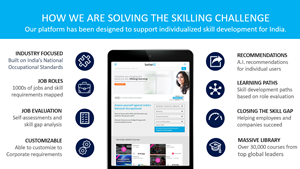
With use of technology, betterU has mapped all job profiles within
the major industries and created a massive database of course
recommendations which are connected to learning content offered by our
global partners. Through a simple and interactive learner assessment,
betterU can now analyse and recommend learning solutions to an
individual by understanding their job interests and assessing their
education and skill levels. After the assessment is complete, betterU
can guide a learner towards appropriate learning paths to help learners
achieve their goals for employment. The Company has been focused on the
skill shortage problem for years and is pleased to announce it has
completed the first prototype of their Upskill Tool. betterU expects to complete their Upskill Tool over the next quarter and be able to support India’s national skills shortages.
betterU, a global education to employment platform, aims to provide
access to quality education from around the world to foster growth and
opportunity to those who want to better their lives. The company plans
to bridge the prevailing gap in the education and job industry and
enhance the lives of its prospective learners by developing an
integrated education-to-employment ecosystem. betterU’s offerings can be
categorized into several broad functions: to compliment school programs
with flexible KG-12 programs preparing children for next stage of
education, to provide access to global educational opportunities from
leading educators, to foster an exceptional educational environment by
providing befitting skills that lead to a better career, to bridge the
gap between one’s existing education and prospective job requirement by
training them and lastly, to connect the end user to various job
opportunities.
Neither TSX Venture Exchange nor its Regulation Services Provider (as
that term is defined in policies of the TSX Venture Exchange) accepts
responsibility for the adequacy or accuracy of this release.
This press release may contain forward-looking statements and
information, which may involve risks and uncertainties. The results or
events predicted in these statements may differ materially from actual
results or events. Factors that might cause a difference include, but
are not limited to, competitive developments, risks associated with
betterU’s growth, the state of the financial markets, regulatory risks
and other factors. There can be no assurance or guarantees that any
statements of forward-looking information contained in this release will
prove to be accurate. Actual results and future events could differ
materially from those anticipated in such statements. These and all
subsequent written and oral statements containing forward-looking
information are based on the estimates and opinions of management on the
dates they are made and expressly qualified in their entirety by this
notice. Unless otherwise required by applicable securities laws, betterU
disclaims any intention or obligation to update or revise any
forward-looking statements, whether because of new information, future
events or otherwise. Readers should not place undue reliance on any
statements of forward-looking information that speak only as of the date
of this release. Further information on betterU’s public filings,
including their most recent audited consolidated financial statements,
are available at www.sedar.com.
Posted by AGORACOM-JC
at 3:41 PM on Thursday, January 31st, 2019
SPONSOR: Esports Entertainment
$GMBL Esports audience is 350M, growing to 590M, Esports wagering is
projected at $23 BILLION by 2020. The company has launched VIE.gg
esports betting platform and has accelerated affiliate marketing
agreements with 190 Esports teams. Click here for more information
GMBL: OTCQB
The top 10 competitors won more than $8 million in combined prizes in 2018, with 7 of the 10 rankings claimed by women.
The prizes earned by this year’s winners were three times larger than that earned by 2017’s top players.
SAN FRANCISCO, Jan. 31, 2019 –Â Skillz, the worldwide leader in mobile eSports, today announced the top mobile eSports athletes of 2018. The top 10 competitors won more than $8 million in combined prizes, with 7 of the 10 rankings claimed by women. The prizes earned by this year’s winners were three times larger than that earned by 2017’s top players.
Rankings
Username
State
Prizes Won
1
Kmamba1090
CA
$1,418,508
2
SirLastBit
OH
$1,321,255
3
HestiaX
NJ
$978,551
4
LegalEnormousPhds
NY
$976,269
5
yutourmaline
NY
$873,526
6
kk8245
VA
$681,863
7
Goinhiking
NC
$639,234
8
jpark87
MI
$627,191
9
zZzSleepyzZz
NY
$625,858
10
CaliCountry5
NJ
$618,005
“When I first started competing on the Skillz platform, I never
realized this was something I could do professionally,” says Jennifer
Park (jpark87), a college engineering student from Westland, Michigan.
“The prizes I’ve earned from playing Skillz games have helped put me
through college.”
The mobile gaming industry is projected to grow into a $70 billion market
in 2019, accounting for over half of the $138 billion gaming space. As
the industry’s revenue has increased, competitive gaming prize pools
have also grown in tandem. Prizes from eSports tournaments such as the
“Dota 2” International topped $25 million last year, now exceeding those
of prestigious offline sports events such as the Indy 500 andthe Masters.
According to eSportsEarnings.com, global eSports prize pools grew 31.5% from 2017 to 2018.
In comparison, the top 10 Skillz competitors generated over a 300% year
over year increase in prizes won, with the top player ranking #6 on the list of highest-earning 2018 athletes across the global eSports industry.
“Top mobile eSports athletes bring the same inspiring dedication you
see in world-class NBA or MLB players to our increasingly digital
world,” says Andrew Paradise, CEO and founder of Skillz. “Similar to how
radio and television revolutionized the future of sports, Skillz is
using mobile technology to do the same for eSports.”
The top Skillz competitors are ranked based upon total tournament
prizes won by each player, excluding any entry fees paid to enter those
tournaments. For more information on Skillz-enabled games and
implementing mobile eSports competitions, visit www.skillz.com or email [email protected].
About Skillz Skillz, the leading mobile eSports
platform, connects the world’s 2.6 billion mobile gamers through
competition. In 2018, Skillz was named to Entrepreneur Magazine’s 100 Brilliant Companies, Forbes’ Next Billion-Dollar Startups, and the Entrepreneur 360. Skillz has also been named the #1 fastest-growing private company in America by Inc. Magazine and a CNBC Disruptor 50.
Over 18 million gamers use Skillz to compete in mobile games across
13,000+ game studios. Founded in 2012, Skillz is headquartered in San
Francisco and backed by leading venture capitalists as well as the
owners of the New England Patriots, Milwaukee Bucks, New York Mets and
Sacramento Kings. To learn more, visit www.skillz.com.
Press Contact Roxie Bostwick Communications Lead Skillz Inc. [email protected]
Education Budget 2019: From tax-free education to an upskilling allowance, here’s what education experts want
By 2020, the average age of people will be 46 years in the US, 42 years in Europe, 48 years in Japan, but only 27 in India.
This means that India’s demographic dividend is a huge scope for us to capture the job market and can be a big boost for the country’s economy.
Roshni Chakrabarty  Here are the education budget expectations from education industry experts and professors for the interim Budget Session 2019.
By 2020, the average age of people will be 46 years in the US, 42 years in Europe, 48 years in Japan, but only 27 in India. This
means that India’s demographic dividend is a huge scope for us to
capture the job market and can be a big boost for the country’s economy.
But this can only happen if today’s youth and students are
provided with the correct skills to help them secure future jobs. For
that, we need a good education budget.
Ahead of the general elections, the government will present an
interim Budget tomorrow, February 1. The last Budget session 2019 of the
present NDA government is likely to be presented by interim Finance
Minister Piyush Goyal in the Lok Sabha, who was given additional charge
of the Finance Ministry as Arun Jaitley has gone to the US for
treatment.
The education budget of 2018 was one of the least valued at
just 3.5 percent. Here is what education experts are expecting from the
Budget session 2019:
1. All-over increase in Education Budget
India needs to increase its Education Budget in the Budget Session 2019.
Ravi Sreedharan, Founder and Director, Indian School of Development Management (ISDM):
“While it might sound ambitious, there is a need to double the
current levels of spending in the two areas of public education and
public health as a percentage of GDP. Spend on Education as a percentage
of GDP is still around 3% versus the aspirational goal of 6%. Lots of
developing and developed countries in the world have already been
earmarking and spending close to this ballpark (as a percentage of GDP)
on education.
Given the widespread inequality and poverty in India, education needs
to play a critical role in bringing about intergenerational social and
economic mobility with primary public education standing out as the most
important area of focus.
Without a good quality government schooling system, it’s
impossible to envision us moving towards a just, equitable, humane and
sustainable society. Without that the potential demographic dividend we
could benefit from is nothing but a pipe dream.”
Rohit Manglik, CEO, EduGorilla:
“The upcoming education budget needs to take initiatives such as
allocating bigger spending on education, provision for proper teacher
training along with higher pay and administrative incentives.
Incentives need to be provided to encourage research in all
disciplines and for augmenting the technical capacity of the central
educational institutions like NCERT, NUEPA, IGNOU and many more.
Furthermore, a comprehensive scheme on lines of Ayushman Bharat can be a great start to improve the quality of education.”
Prof. Indradeep Ghosh, Associate Professor & Dean (Faculty), Meghnad Desai Academy of Economics:
In an election year, it would be only appropriate to expect that the
government will release an optimistic picture of its finances, which is
to say that even though expenditures will be shown to increase on
account of various programmes being announced ahead of elections, the
revenue side will also appear buoyant and on the rise.
The truth of the matter may be more unpalatable, though. India’s
fiscal situation is well known to follow a political cycle, and there is
a real danger that FRBM mandates will not be respected in projections,
and that the signal picked up by foreign investors will be a largely
negative one, irrespective of what the budget actually says.
To allay such fears, the government should try to offer as
realistic a vision as possible of the future course of policy if it is
re-elected, and especially provide indications of how it proposes to
solve critical problems of the Indian economy such as insufficient job
creation and deficient infrastructure.
2. Tax-free education to boost ed-tech
Zishaan Hayath, CEO & Co-founder, Toppr:
“Two key steps need to be made – education needs more funding by the
government, and it must be tax-free. The budget reserved for education
reforms has been constantly declining over the last five years.
Currently, ed-tech is taxed at 18% GST which limits
affordability to high-income groups. Education is not a luxury. In fact,
online learning is the only way to cater to individual needs at a
fraction of the cost. This should be made tax-free to lower after-school
education costs for students.”
Shobhit Bhatnagar, Co-founder, Gradeup:
“In a country with over 200 million students, online education can
play a major role in improving learning outcomes at a large scale. The government needs to actively support early stage industries like ed-tech that can create impact at scale.
Today, the GST rate for all educational services outside of schools
and colleges is 18%, which is same rate bracket as discretionary items
such as perfumes, chocolates etc. The government should move educational services to a no GST or the 5% slab.”
Vineet Chaturvedi, Co-founder, Edureka:
“Speaking specifically of the ed-tech industry, a reduction in GST
would greatly help boost a culture of up-skilling among Indians and this
is indeed the need of the hour for India to maintain an edge in
technical skills.
Education and up-skilling is no luxury and it should not be taxed as such.
It’s said that India lags behind even Sudan when it comes to its
investments in education and healthcare mapped as a measurement of its
commitment to economic growth, according to Institute for Health Metrics
and Evaluation. It’s time to change that.”
Beas Dev Ralhan, CEO, and Founder, NextEducation India Pvt Ltd:
“With the General Budget around the corner, we have high hopes from
the government and expect that a substantial amount would be set aside
to the education sector so that we can lay a stronger foundation for
new-age learning strategies.
The prerequisite for quality education becoming available to
all is the free and easy access to quality e-learning resources. This
can be initiated by the government through technologies such as
artificial intelligence, virtual and augmented reality and cloud
computing.
It is also important to ensure that internet access provided to rural
areas is functional so that students from those parts can use it for
effective self-learning.”
Amol Arora, Vice Chairman & Managing Director – Shemford Group of Futuristic Schools:
“For any country, the most significant returns are those garnered from investments made in its children.
The next generation is going to enter a globalized world and
will be competing for jobs not just against other students but also
innovative technologies that are quickly replacing human jobs.
In order to keep our children in the competition, we need to ramp up
our ed-tech sector in the years to come. To that end, Budget 2019 should
give certain tax breaks to ed-tech startups to enable them to reach
sustainable levels.”
Sampreeth Reddy Samala, Founder and CEO, Worldview Education:
“For any education policy in India to make sense, it needs to address
issues and provide solutions at a scale. From that view, potentially
game-changing tax reforms in the education space are still pending.
There is possibly great potential for vast private energy to be tapped
into if tax reforms are brought into this space to make it attractive
and competitive for private enterprises to enter, innovate and thrive.
Today, every and any educational idea which falls out of the
traditional realm is taxed at par with some of the luxury products. This
has to change to make investments into innovative ideas in education’
attractive which is crucial to meet the larger and current needs of an
aspiring country like India.
This will also help the sector get rid of undesirable
practices of working around these taxation hurdles in the name of the
sector being and meant to be a novel, not for profit one. This is not
only reducing the efficiency of the space but also killing innovation in
education.”
Rohit Manglik, CEO, EduGorilla:
“While the Indian government has done much to safeguard the interests
of all stakeholders of education, including students, the upcoming
interim budget needs to address some important components of the
education sector. Undoubtedly, lowering the GST rates from an existing
18% to expected 5% will make education affordable to students.”
3. Better skill development initiatives
Divya Jain, CEO, and Founder, Safeducate:
“In the previous Budget 2018, the government took key steps in
skilling and also increased the funds. In this Budget session 2019, we
expect that the government should take key steps in raising the
quality of skills to levels demanded by a potential employer or even
required for a person to start one’s own business.
The focus should be on integrating strategies to increase
skilling outcomes and sustain economic growth. Current skill development
initiatives should be integrated with nation-building mission
programmes.
As an organization which provides skilling and get funded from the
government to execute the Skilling programme, we seek some tax benefits.
Constructing the skilling centre
requires a lot of physical material which is being charged along with
GST. We are not being able to reclaim the GST we had paid in the Inward
supplies. Also, we have various certification and degree
programmes in Logistics and Supply chain management where we are not
being exempted from GST.
Support in terms of medical allowance for students that are being trained in skilling programmes
is also required. As technology is changing, the Government needs to
allocate more funds to improve the quality and develop excellence in
Skilling centres. The government has promised and initiated schemes
in Skilling such as PMKVY 2.0, DDU-GKY, NAPS, Bharatmala and Sagarmala,
PMKK etc. These schemes have helped us to reach the rural parts of India
– ‘the real India’.”
Vineet Chaturvedi, Co-founder, Edureka:
“Skilling and continuous learning have become sufficiently important
requirements in today’s competitive professional landscape so much so
that even the Indian government has taken note of it and launched skill
development initiatives.
What could accelerate India’s skill development story even
further and provide fodder to corporate growth is a ‘skilling allowance’
for all tax-paying individuals. Such a rebate that rewards continuous
learning will go a long way in creating an industry relevant workforce
that can make India a skill hot spot.
Continuous learning is a necessity and not just an option anymore and
by treating it on par with necessary allowances such as HRA, LTA, DA
& others, GOI would be doing India a great service. After all,
India’s biggest strength is its human resource.
Such an allowance will also be beneficial to IT, ITes industries
which are subject to frequent skill churn and the ed-tech industry which
has been working towards addressing this skilling need on ground.”
Nikhil Barshikar, Founder and MD at Imarticus Learning:
“With technology disrupting jobs across sectors, it is important to bridge the skilling gap. The budget session 2019 should focus on skill development as it will directly impact the economy for the better.
We strongly feel the need for allocating more funds towards
specialization i.e. in higher and further education, with the vision of
enhancing the training and the research amenities for reskilling the
workforce.
Tax rebates and incentive schemes will encourage educational institutions to expand their operations in Tier 2 & 3 cities.”
Dr. Jamshed Bharucha, Vice Chancellor, SRM University AP, Amaravati:
“The need to invest in the soft skills development within the education sector
is highly important so that qualified, talented and gifted young
Indians are not handicapped in any way by communication abilities that
can impede their success on a national and international stage.”
Amol Arora, Vice Chairman & Managing Director – Shemford Group of Futuristic Schools:
“The government should grant financial incentives for organizations setting up educational institutes in rural and underserved areas.
Currently, the private sector in education is viewed with distrust
which is why concrete steps should be taken to show that public-private
partnerships can be a win-win for all — delivering quality without
fleecing the parents.”
4. Resolution of the angel tax for startups
Siraj Dhanani, Co-Founder and CEO, InnAccel Technologies:
“In the budget session 2019, the govt should continue the
focus on healthcare and invest substantially in upgrading the primary
and secondary health tiers in the country. This upgrade can
leverage the indigenous medical technologies developed specifically for
Indian healthcare needs, and thereby support the Make in India
initiative.
I hope the budget provides a comprehensive resolution to the
angel tax issue being faced by startups, especially ones based on
generating intellectual property like medical technology startups.
Raising capital for startups working on affordable healthcare is
already difficult- it is made more so by this angel tax, which is
effectively a tax on Indian innovation.”
5. Relief for Small and Medium-sized Enterprises (SMEs)
Ankit Gupta, Vice President and COO, Exportersindia.com:
“Despite making huge contributions to the economy, SMEs often face a multitude of challenges that restrict their growth.
Due to numerous issues like lack of sustainability, insufficient funds,
limited access to resources, heavy competition from large entities,
small enterprises often fail to meet their true potential.
Although the ongoing digital revolution has allowed better
connectivity while enabling MSMEs and SMEs to gain exposure to the
global market, the struggle is constant. However, with the 2019 Union
Budget approaching fast, the scenario may change.
Though the recent GST reform has given a huge relief to the
SME sector, easy availability of loans, allocation of money in the
digital lending sector and tax breaks would be our prime expectations
for SMEs from this Budget 2019.”
6. Better student guidance and career counselling
Prateek Bhargava, Founder & CEO, Mindler:
“We at Mindler believe that allocation for funds to drive career
counseling and guidance initiatives are a critical need at the ground
level. There is a big need to drive students towards careers which are
in sync with their abilities rather than blindly following a few career
domain.
While national boards have made the need for guidance services
mandatory, most schools have not implemented the same primarily due to
lack of digital infra to implement state of the art platforms or lack of
certified experts in this domain.
Identifying and mapping talent towards right domains is
critical for our country, which has the largest youth population
globally, if it wants to reap the demographic dividend. We hope the
government will enlarge focus on PPP in providing high-quality career
guidance to school students across India.
Lastly, in keeping with its recent declaration that it is open to
reconsider GST rates on certain components in the education sector, we hope the government will review GST on ancillary services in education.”
7. More research funds
Dr. Jamshed Bharucha, Vice Chancellor, SRM University AP, Amaravati:
“Quality education needs to be made available to all. If we have to
keep up with western nations and with regional neighbours in fields of
science and technology, our educational institutions need to step up
funding on research for a wide range of applications from health
sciences, bio-medical, genomics, data science, machine learning,
agriculture and food production, space and astrophysics.
University-led research can be an important bridge between
ideas and practical applicability in the industry. We need to put in a
greater focus on this and commit resources to centres of excellence that
will tackle the areas where research is most needed and of national
significance. This needs to be done with a sense of urgency on a
national scale.
Because university research needs and national priorities(such as
Defence Tech, Health & Sanitation, Nutrition & Food) are so
closely aligned, Budget 2019 should also focus on University Research
funding.”
8. More focus on teacher training and digital upgradation
Prateek Bhargava, Founder & CEO, Mindler:
“The government of the day’s efforts to drive growth, investment and
embrace technology in education are all steps in the right direction,
however, investment into technology upgradation and teachers training has been falling short.
While this is an interim budget, we hope that it will pave way for
higher allocation in these two critical elements as they will usher in
much-needed improvement in quality outcomes, allowing schools to
leverage the power of digital solutions that bring high quality,
personalization and focus on evaluation of outcomes.”
Zishaan Hayath, CEO & Co-founder, Toppr:
“The education budget should be used to digitise schools at a mass level so that every student can access quality education. It should also be used to upskill teachers and close the gap between the education system and current employer demands.“
Beas Dev Ralhan, CEO, and Founder, NextEducation India Pvt Ltd:
“Training teachers on the latest pedagogies and Information and
Communication Technology (ICT) is the need of the hour as they are
expected to employ innovative teaching methods and make use of digital
tools in the classrooms. However, there is a dearth of 11 lakh adequately qualified teachers in the K-12 segments.
Even though the government is trying to tackle the situation
with initiatives such as Teacher Professional Development courses on
the digital platform Diksha, this issue also needs prioritizing in the
upcoming budget.
We also hope that the government provides the right kind of
infrastructural support for a system of education that is on a par with
global standards, and help Indian students face the challenges of
tomorrow.”
Tags: edtech, india, tsx Posted in All Recent Posts, betterU Education Corp | Comments Off on BetterU Education Corp. $BTRU.ca – Education Budget 2019: From tax-free education to an upskilling allowance, here’s what education experts want $ARCL $CPLA $BPI $FC.ca
Posted by AGORACOM-JC
at 11:46 AM on Thursday, January 31st, 2019
Investment Highlights
Kenbridge property has a measured and indicated resource of 7.14 million tonnes at 0.62% nickel, 0.33% copper
17.5 (21.8 fully diluted) percent equity stake in Eloro Resources and 2 percent NSR in their La Victoria property
Kenbridge Ni Project (ON, Canada)
Advanced stage deposit remains open in three directions, is
equipped with a 623m deep shaft and has never been mined.
Preliminary Economic Assessment completed and updated returned robust project economics and operating costs including a NPV of C$253M and cash costs of US$3.47/lb of nickel net of copper credits.
Plans for Kenbridge include updating PEA,
advancing the project through to feasibility and exploring the open
mineralization at depth
FULL DISCLOSURE: Tartisan Nickel Corp. is an advertising client of AGORA Internet Relations Corp.