Agoracom Blog Home

Author Archive

Bougainville Ventures (BOG:CSE) – Marijuana M&A: Altria Group Opens the Door to Major Deals $CROP.ca $VP.ca NF.ca $MCOA

Posted by AGORACOM-JC at 10:30 AM on Monday, December 10th, 2018
SPONSOR:  Bougainville Ventures Inc (CSE: BOG) Converting irrigated farmland to greenhouse-equipped farmland. Bougainville does not “touch the plant” and only provides agricultural infrastructure as a landlord for licensed marijuana growers.
————————–

While marijuana stocks have pulled back with the chaos of the broader markets in late 2018, we cannot forget about the countless catalysts that are still out there.

One of the major catalysts involves mergers and acquisitions.

Alcohol companies have had significant interest, for example.

Months ago, Constellation Brands increased its stake in Canopy Growth (CGC) by $4 billion.

That came just months after Constellation first took a 10% stake in Canopy to help create nonalcoholic cannabis-infused drinks and other products.

All, as sales of beer fall in the United States, brewers have begun to bet that legalization of marijuana around the globe, especially the United States, will continue to build momentum and sales of cannabis products will take off.

Molson Coors even listed legal cannabis among the biggest possible risks to its business in its annual shareholder report. Even Coca-Cola expressed some interest at one point.

Now, cigarette makers are jumping into the fray, too.


For example, shares of Cronos (CRON) rocketed higher last week on news that Altria Inc. took at 45% stake in the company for $1.8 billion.

“Investing in Cronos Group as our exclusive partner in the emerging global cannabis category represents an exciting new growth opportunity for Altria,” said Howard Willard, Altria’s CEO, as quoted by CNN.

Talks started, as the tobacco industry comes under pressure, as sales have begun to sharply decline. Just last year, cigarette smoking fell to its lowest point in history. Marijuana sales may bring back some of that lost revenue, though.

According to CNBC, “Counting both legal and black-market sales, the total demand for pot is approximately $52.5 billion, Marijuana Business Daily has reported.”

This could potentially lead to other major M&A deals in the industry following Altria and Constellation news. If nothing else, such major deals provide further evidence that the opportunities in the global marijuana industry are much more than just hype.

For Altria to invest $1.8 billion in a company isn’t small change.

We wouldn’t be shocked to see other pot stocks see further M&A interest moving forward.

Stay tuned for more on potential deals right here.

Source: https://www.chasingmarkets.com/news/15c0e6fba8d6e7/Marijuana_M%26A%3A_Altria_Group_Opens_the_Door_to_Major_Deals


#KoreConX partners with Middle East consultancy firm

Posted by AGORACOM-JC at 12:00 PM on Sunday, December 9th, 2018

Metis Management Consultancy will work closely with KoreConX’s office in Dubai

[New York, NY – December 09, 2018] – KoreConX, the first all-in-one platform for companies to manage their business activities, is partnering with Metis Management Consultancy, a UAE-grown consultancy firm focused on providing services to SMEs in the MENA region. The company will become part of the KorePartner’s Ecosystem, a group of selected companies that works closely with KoreConX to ensure that small and medium enterprises have all the elements they need to thrive.

In addition to providing businesses with an all-in-one solution for their management pain points, KoreConX also developed its own fully-compliant Security Token Protocol, using IBM’s Hyperledger Fabric, a permissioned Blockchain. Using KoreConX’s platform, companies are able to issue their Security Tokens (Tokenized & Digitized Securities) and raise capital in multiple jurisdictions.

“Blockchain plays a crucial role in everything that we do at KoreConX. Dubai is taking this technology to the next level, by planning to make the city fully powered by Blockchain by 2020,” said Edwin Lee, director of MENA Region. “Dubai is the place to be when advancing into new technologies and Metis is the company that shares our high standards when it comes to providing companies with the best advice.”

The same feeling is shared by Metis Management Consultancy team.

“We always strive to provide companies with high-quality consulting services and access to the latest tools” said Nayef Shahin, Founder and Managing Partner at Metis. “It is only natural to partner with KoreConX, a team with a deep understanding of compliance, securities regulations and the one to create the only protocol that is fully tracked on chain through their transfer agent service.”

In UAE, SMEs account for over 90 per cent of private enterprises and contribute to nearly 47% of Dubai’s GDP and 52% of its workforce. It is therefore a top priority this sector has access to cutting-edge knowledge, technology and funding.

Metis Management Consultancy is part of the KorePartner ecosystem, a group of selected broker-dealers, secondary market platforms, capital markets platforms, lawyers, compliance, investor relations, accounting, and marketing firms that support the KoreConX security token protocol and adhere to KoreConX governance standards. KoreConX’s KorePartners are from around the globe and bring the necessary expertise that a company will need to launch a fully compliant security token in multiple jurisdictions.

About KoreConX

KoreConX is the world’s first highly-secure permissioned blockchain ecosystem for fully-compliant tokenized securities worldwide.

To ensure compliance with securities regulation and corporate law, the KoreConX all-in-one, AI-based blockchain platform manages the full lifecycle of tokenized securities including the issuance, trading, clearing, settlement, management, reporting, corporate actions, and custodianship. KoreConX connects companies to the capital markets and secondary markets facilitating access to capital and liquidity for private investors.

KoreConX is the first secure, all-in-one platform for private companies to manage their capital market activity and stakeholder communications. Removing the burden of fragmented systems and inefficient tools across multiple vendors, KoreConX offers a single environment to connect companies, investors and broker/dealers. Leveraged for investor relations and fundraising, private companies can share and manage corporate records and investments including portfolio management, capitalization table management, virtual minute book, security registers, transfer agent services and virtual deal rooms for raising capital.

www.KoreConX.io

About Metis Management Consultancy


Metis Management Consultancy is a leading SME business advisor consultancy in the region. Their mission is to enhance their clients’ corporate value by providing them access to tier quality consulting services and expertise across their business domains. Metis make sure that each business gets its own tailored solution according to their own wants and needs while providing direction, guidance, and innovative services to turn their clients’ corporate vision and strategy into operational reality and success.

###

Media Contacts:

KoreConX

Oscar A Jofre

[email protected]

Tartisan Nickel Corp. $TN.ca – Vale doubles down on #nickel ahead of #EV revolution: Andy Home $ROX.ca $FF.ca $EDG.ca $AGL.ca $ANZ.ca

Posted by AGORACOM-JC at 4:02 PM on Friday, December 7th, 2018

SPONSOR: Tartisan Nickel (TN:CSE) The company’s Kenbridge Property has a measured and indicated resource of 7.14 million tonnes at 0.62% nickel, 0.33% copper. Tartisan also has interests in Peru, including a 20 percent equity stake in Eloro Resources and 2 percent NSR in their La Victoria property. Click her for more information

—————–

-Vale, the Brazilian mining giant built on supplying the world’s steel mills with iron ore, is now betting on the electric vehicle (EV) revolution to turn its nickel division around.

-“We believe in this revolution to come,” Chief Executive Fabio Schvartsman told analysts at the company’s investor day presentation in New York this week.

Andy Home

LONDON (Reuters) – Vale, the Brazilian mining giant built on supplying the world’s steel mills with iron ore, is now betting on the electric vehicle (EV) revolution to turn its nickel division around. FILE PHOTO: The logo of Vale SA is pictured in Rio de Janeiro, Brazil, August 7, 2017. REUTERS/Ricardo Moraes/File Photo

“We believe in this revolution to come,” Chief Executive Fabio Schvartsman told analysts at the company’s investor day presentation in New York this week.

The use of nickel in lithium ion batteries will translate into at least 500,000 tonnes of extra demand by 2025, according to Vale, which is planning to play a leading role in meeting the additional need for high-grade metal.

However, to do so, it will have to turn around its troubled New Caledonian operations, a task described by Schvartsman as “maybe our biggest challenge”.

It will also have to gamble that Chinese players led by the Tsingshan steel group don’t make the technological breakthrough that would allow them to convert nickel ore straight into battery-grade nickel.

That would undermine demand for the sort of high-purity material, so-called Class I nickel, that Vale specializes in producing.

STILL WAITING FOR GORO

Vale had been hoping to attract a partner for its Vale New Caledonia (VNC) operations but evidently without success.

It will now go it alone.

What was originally known as the Goro project has been strewn with operational problems ever since it came on stream, two years late, in 2011.

In theory, it’s perfectly positioned to ride the EV revolution, producing the right sort of nickel for processing into batteries with a by-product stream of cobalt, another hot battery metal.

In practice, Vale has never fully mastered the high-pressure-acid-lead (HPAL) technology used to convert ore to nickel oxides.

The original plan envisaged a three-year ramp-up to nameplate capacity of 58,000 tonnes of nickel in oxide and hydroxide. In 2017, its sixth year of operation, it managed 40,000 tonnes.

Alas, even that good run hasn’t lasted into 2018.

Production of what Vale terms “finished nickel products from VNC source material” fell 17 percent in the first nine months of the year to 24,200 tonnes and VNC reported an operating loss of $42 million in the third quarter itself.

Vale management is undeterred.

It has, according to Eduardo Bartolomeo, head of the company’s base metals division, commissioned a “very detailed study to know exactly why we can’t achieve our nameplate capacity.”

The study found that there is no “insurmountable” bottleneck in the plant and Vale’s goal is now to invest $500 million to get the plant operating at 50,000 tonnes per year of nickel products over a two- to three-year time horizon.

It’s not the first time senior Vale management has vowed to fix Goro, but the new-found incentive is the coming electric vehicle revolution.

The decision to double down on New Caledonia is “very simple”, according to Schvartsman. “We will need this operation in order to supply the market because of the growth in the consumption for batteries.”

TSINGSHAN CHALLENGE

That is, unless Chinese steel giant Tsingshan can make good on its ambitions to build an Indonesian plant that can convert nickel ore straight into battery-quality material.

Since Tsingshan’s original announcement in September, the London Metal Exchange (LME) nickel price has fallen from just under $13,000 per tonne to a current $11,000.

Nickel’s shiny electric vehicle premium has been blown away by the prospect of Indonesia’s abundant nickel ore production, currently exclusively destined for the stainless steel sector, being diverted into meeting battery demand.

Such an eventuality could also impact severely demand for the sort of premium nickel product currently produced by Vale.

No-one quite believes Tsingshan’s stated intention of building a plant to produce 50,000 tonnes per year of contained nickel at a cost of $700 million with first production next year. Particularly since it is proposing to use the same HPAL technology that has challenged Vale and other producers in recent years.

But based on Tsingshan’s track record of single-handedly propelling Indonesia into the top ranks of stainless steel producers in super-quick time, no-one’s quite sure either.

Vale’s Schvartsman conceded that “there is no question about the ingenuity of the Chinese” and that over time “this technology will become more competitive in their hands”.

But not next year, nor in all likelihood the year after.

To build a plant that size, using that technology with that amount of investment “is totally impossible”, Schvartsman said.

Tsingshan’s September statement, according to Schvartsman, “is more an issue of communication – there isn’t anything real behind it.”

“Just talk”, agreed Bartolomeo, who noted it would take Tsingshan 18 months just to get a federal marine disposal license. “They have the provisional license but the rules are very strict”.

NOW A BELIEVER

This time last year, when Vale was actively looking for an investment partner in VNC, Schvartsman said it was a test of whether the market really believed that “nickel is something that is important for the future of EVs.”

Would all the future promise “translate into someone who is eager to invest with us to have more nickel in the future”?

The apparent negative response is in all likelihood far more to do with Goro’s problematic past performance than nickel’s future prospects.

The metal seems on track to be an early winner in the materials competition for lithium batteries, partly at the expense of cobalt on price and supply stability grounds.

But the promise still lies largely in the future. Batteries only account for around 5 percent of total nickel demand.

Right now the price remains beholden to its traditional stainless steel drivers. Stainless production ran hot through the first part of this year but is cooling rapidly, an overlooked part of the recent price sell-off.

Nickel inventories, meanwhile, remain elevated. Visible stocks on the LME have been falling but there is a strong suspicion that part of the decline has simply reflected statistically hidden stock building along the supply chain.

Vale has around 60,000 tonnes of idled production capacity, taken off-line at the end of 2017 due to low prices.

That gives it plenty of optionality in lifting output as and when demand from the battery sector takes off.

Because one thing is for sure. Vale is now an official believer in the electric vehicle story.

To reap the full rewards, though, it needs to sort out once and for all its problem child, Goro, and keep its fingers crossed that Tsingshan’s announcement is, for now at least, “just talk”.

Source: https://www.reuters.com/article/us-vale-nickel-ahome/vale-doubles-down-on-nickel-ahead-of-ev-revolution-andy-home-idUSKBN1O61KO

Good Life Networks $GOOD.ca Vital takeouts from the world’s largest programmatic advertising conference $TTD $RUBI $AT.ca $TRMR $FUEL

Posted by AGORACOM-JC at 2:00 PM on Friday, December 7th, 2018

Sponsor: Good Life Networks: Video advertising is the future! Company’s A.I. makes 80,000 calculations / second, targeting 750 million users to deliver higher prices and volume. The company achieved a record $9.7 Million in revenue for 2017 and recently announced entering the video game industry with programmatic technology. Click here for more information

——————

  • In 2018, more than $47 billion in the US was spent on programmatic display advertising with Facebook and Google taking a large chunk of the pie. By 2020, that figure will climb to nearly $69 billion.

Posted By: Ashleigh Footiton:November 28, 2018

After an intense two days spent at the world’s largest conference on programmatic advertising, Programmatic I/O, it was fascinating to see how US online publishers are utilising data and selling inventory programmatically.

In 2018, more than $47 billion in the US was spent on programmatic display advertising with Facebook and Google taking a large chunk of the pie. By 2020, that figure will climb to nearly $69 billion.

In the United States, there are an average of 14.5 programmatic tech partners per publisher, whereas in South Africa, we have an average of just three. This is not a bad situation to be in as our ecosystem is less fragmented and we have more control over our inventory. But it does highlight that programmatic is still in its infancy here.  

One of the US speakers, Taylor Schreiner at Adobe, said, “Organisations are transforming to take advantage of programmatic. Brands are now more hands-on. They have a better understanding of the metrics they are facing, and they’re more specific in their directives to agencies. We’re seeing more clients who now have people in the organisation who are in a position to think about reach across channels.”

First party data, which is essential for publishers, was another big theme that came through. It is a priority as it gives a competitive advantage in fighting against the duopoly that is Google and Facebook, who account for around 50% of programmatic revenue in the US. Their amazing audience intelligence, reach and measurement capabilities which advertisers are not going to pass up keeps them on top.

Relationships are key in this fragmented industry. The display ad tech Lumascape highlighted this fact. There are many touch points available when it comes to making a deal and publishers need to ensure they are talking to all parties involved. There is no such thing as ‘set it and forget it’. Secondly, CPM rates are lost to tech costs and the publisher comes out with only a fraction of what the seller initially spends.

The issue of viewability

The issue of viewability came across a lot throughout the two day conference. A viewable ad is defined as 50% of the pixels of a regular creative or 30% of the pixels of a large size creative, are on an in-focus browser tab on the viewable space of the browser page for a minimum of one continuous second. (This description was even questioned a few times by brands.) As far as many brands were concerned, 100% viewability has to be a non-negotiable and advertisers/buyers should not pay for a non-viewable ad.

Artificial Intelligence was also strong presence with a few interesting developments on the cards. We can’t escape the fact that AI is and will be an essential part of our lives. The Nest Cam Indoor security camera, for instance, learns who the regular members of your household are. If a stranger or visitor is in your home, Nest reports back to you immediately via your connected device. The Ricoh whiteboard is another great AI example – once you’ve made your notes on it you can email the contents to anyone around the world, with full translation capabilities. All of these things will add to the wonder that is big data which ultimately will assist advertisers to better target consumers.

And then there’s brand safety

It was evident that there’s a need for deeper conversations on brand safety between publishers, agencies and brands who all need to understand and explain what brand safety means to each of them. Some brands mentioned that they won’t pay if creative appears in a negative environment. However, they would consider an environment that has a positive spin next to controversial content. Unfortunately, safety tools are screening out these environments if the story contains blacklisted key words. Private market places need to be of more help. 

Ad fraud and fake news is rife in the US industry, and ad fraud specifically, but on a lesser scale, here in South Africa. Publishers are fighting hard against these practices and buyers are turning to technology to assist with eliminating and reducing their ad spend on these practices that deceive.

There are many types of ad fraud but in general challenges in programmatic include invalid traffic (IVT), domain spoofing, page level scripting, ad injection, and poor user experience. Low-quality human traffic is another issue, through paid media channels (including click bait) traffic is pushed to transit hubs by fake authors and instantaneously bounce off these sites, purely to serve ads and receive ad revenue. These are all things that advertisers and publishers need to be cognisant of. Publishers need to adopt ads.txt as a non-negotiable and advertisers need to be selective when buying inventory across the open market.

I learned that a dollar in does not equal a dollar out when it comes to programmatic and intermediaries are more prevalent than thought. But most importantly, relationships are more important now than ever before. Successful partnerships between publishers, agencies and clients are open and honest about what works for them.

The conference gave invaluable insights into the world of programmatic and even though we have some catching up to do, it’s an exciting time in our industry.

Ashleigh Footit is head of techops, programmatic and performance at SPARK Media. She was responsible for establishing the programmatic division for the group in 2015 and have been one of the key drivers in the implementation, management and success of Caxton’s Supply Side and Data Management Platform.

Source: https://themediaonline.co.za/2018/11/vital-takeouts-from-the-worlds-largest-programmatic-advertising-conference/


Esports Entertainment Group $GMBL – Magic: The Gathering launching #Esports league with $10M prize pool $ATVI $TTWO $GAME $EPY.ca $TCEHF $Game.ca $EPY.ca

Posted by AGORACOM-JC at 10:42 AM on Friday, December 7th, 2018
SPONSOR: Esports Entertainment $GMBL – Esports audience is 350M, growing to 590M, Esports wagering is projected at $23 BILLION by 2020. The company has launched VIE.gg esports betting platform and has accelerated affiliate marketing agreements with an additional 42 Esports teams, bringing total to 176 Esports teams. Click here for more information
———————-

Magic: The Gathering tournaments, whether they’re informal competitions at local game shops or large, formal affairs, have been an institution for years. And as announced at the 2018 Game Awards, those tournaments are now being brought into the esports arena with the reveal of Mythic Championship events and a pro league.

Magic: The Gathering has increasingly been digitized this year, with the development of Magic: The Gathering Arena, a new way to play the game online separate from the preexisting Magic: The Gathering Online. Arena is currently in open beta for PC users, with a full release planned for 2019. But even though awareness about Arena may benefit most from this reveal, this new esports structure won’t just apply to the digital version of the game.

The prize pool is split evenly between two ways to play the game. The traditional tabletop game and Arena will each have a $5 million prize pool, with a total of 10 tournaments that begin with the Mythic Championship being held at next year’s PAX East.

The Magic Pro League, meanwhile, will include the 32 top-ranked players in the world. Though everyday players will have means to qualify for championship events (with more details promised for 2019), each of these players is afforded automatic entry and are promised “competitive pro contracts,” according to Wizards of the Coast.

Arena players can also receive an esports starter kit by entering the promo code “GameAwards.”

This move follows in the formalization of several other competitive gaming communities, whether it’s the Overwatch League, Fortnite’s Summer Skirmish events or DotA 2’s The International.

Watch the Game Awards’ new trailers, reveals and winners right here.

Source: https://www.cnet.com/news/magic-the-gathering-launching-esports-initiative-with-10m-prize-pool/

Betteru Education Corp. $BTRU.ca – Is online learning making education easier? $ARCL $CPLA $BPI $FC.ca

Posted by AGORACOM-JC at 9:49 AM on Friday, December 7th, 2018
SPONSOR:  Betteru Education Corp.Connecting global leading educators to the mass population of India. BetterU Education has ability to reach 100 MILLION potential learners each week.

Online Education for India

Online education has become popular among working professionals and students in higher education. These categories of online learners find immense benefit in the autonomy, and flexibility, that these courses offer.

Online courses can be planned into their schedule, which may include full-time employment, internships and caring for a family. It can also help them take out quiet time to study.

Online learning in an education system

Distance learning has been around for a long time, even before technology made it extremely accessible. Traditional schooling is now seeing an increased proliferation of virtual training materials and online courses. Even in a world of tried and tested schooling systems and curricula, the most successful schools are the ones who adapt to the changing times, as well as to the expectations of students, parents and the society.

If online education is here to stay, then what are its implications for traditional learning? Instead of focusing on pros and cons, the conversation we should be having today is about leveraging online learning to make our education system more conductive to learning.

Setting goals, tracking progress and meeting deadlines

Online courses involve setting our own goals, tracking progress and meeting deadlines

Online courses call for a greater amount of motivation and self-discipline than a classroom-based course. A classroom has one or more instructors and peers, who can hold a student accountable for their course-work. In contrast, online courses involve setting our own goals, tracking progress and meeting deadlines.

One does not learn in isolation, so online courses do offer discussion forums, email, and one-on-one support. Technology also adds on to the visual experience by incorporating animations, that can be used interactively for effective teaching, and communication.

The classroom advantage

A school provides structure, support, and a system of rewards and penalties to groom its students. Classroom education has the benefit of face-to-face interactions with peers, which are typically moderated by a teacher.

It provides children, especially those in their early developmental years, with a stable environment for social interactions, helping them develop skills like boundary setting, empathy, and cooperation. This also allows plenty of room for spontaneity, unlike a virtual learning setup.

Online education in the context of schooling

As students’ progress to higher classes, they seek more autonomy and intellectual freedom. Online learning can help them pursue highly individualized learning programmes, possibly even college-level courses. These, combined with hands-on exercises, real-world exploration, and thorough assessments, can be highly beneficial to their learning progress.

Here’s what the Managing Director of Trio World Academy said:

“They can explore their options, by trying out introductory topics from different fields, before committing to a specialization. Online learning platforms can help these students become more independent learners before they make their way into college,” said Naveen K M.

“I believe that we must not hold students back from picking any online course, but instead act as their guide as they navigate through it,” he added.

Teachers and parents should act as anchors and mentors

Teachers and parents should be anchors and mentors

Mobile apps that provide enhanced learning opportunities for school children have become mainstream. Since mobile phones have already found their way into their hands, these apps are being used to supplement classroom learning.

Teachers and parents need to act as anchors and mentors, curating the kind of educational content students are exposed to, during the tricky phase of finding the right career to pursue.

Programmes to support families wishing home-school

Virtual public schools, that offer a full scale K12 education, have already sprung up in some parts of the world. They even offer a combination of the traditional system with online education. There are programmes that provide support to families that wish to home-school their children, in the form of online course material.

These programmes bring parents and teachers into the fold, by involving them into their child’s education from the get-go. However, their effectiveness in the long term needs to be studied.

Online programmes for weaker communities

Online programmes for weaker sections

Online learning programmes will also open up opportunities for children from weaker socio-economic communities, who possess a limited access to learning resources i.e. teachers, textbooks and infrastructure.

It will connect them to a global network of online learners, exposing them to new perspectives. The ideas that they receive, will not be limited by the number of heads in one classroom.

Read: How to judge the quality of any online course before you join one

Online education for educators

Online education can also be designed to be accommodating of a variety of learning styles among students.

“As educators, it is likely that we will have to put in additional efforts to incorporate online learning programmes into the curriculum, in the most suitable manner,” said the managing director.

Online training programmes are helping teachers/educators advance their skills in curriculum implementation, policy, education systems and leadership, both independently and with the support of their institutions.

It lets them collaborate with their peers, and learn new instructional skills, that are relevant to their career. These programmes can help them develop new skills and capabilities in their students, with the help of technology and interdisciplinary approaches.

Education for future

As the overlap of the traditional and online educational worlds is becoming more and more inevitable, we owe it to our students to make their education relevant to their future, through our own ingenuity, passion and careful planning.

-Authored article by Naveen K M, Managing Director, Trio World Academy

Source:https://www.indiatoday.in/education-today/featurephilia/story/online-learning-education-system-1401364-2018-12-03

Technologies of #Blockchain- Part 4: Conclusion

Posted by AGORACOM-JC at 4:28 PM on Wednesday, December 5th, 2018

By Dr. Kiran Garimella

In parts 1-3, we briefly touched on some of the historical foundations of blockchains from computer science and mathematics, including their sub-topics such as distributed systems and cryptography. Specific topics in either of these categories were consensus mechanisms, fault-tolerance, scaling, zero-knowledge proofs, etc.

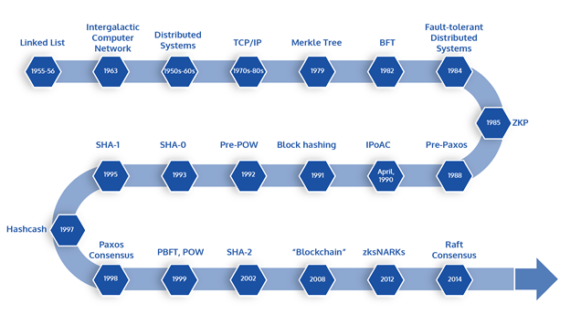
Obviously, this brief series doesn’t do justice. The history of computing and mathematics is rich, with many interconnections and dependencies. The goal of this series was to provide just enough to make the point that the technologies that power blockchain (whether public or private) were built on a well-established foundation of various topics with contributions from real scientists in both industry and academia. The graphic below depicts the broad brush-strokes of development, clearly showing how current blockchain technologies are based on a wide spectrum of historical developments.

Technologies of Blockchain – Historical Timeline

Conclusion
As you can see, a tremendous amount of development that took place for almost half a century made the modern blockchain possible. Bringing these technologies together—almost all of them based not on just techniques but deep mathematical foundations—into a cohesive whole in the form of a bitcoin application was no doubt a tremendous achievement in itself.

Moving forward, we need to keep in mind the initial motivation for each of these technologies, their strengths, their limitations, and determine how to create different architectures based on business needs. A good example of this is to relax the requirements of anonymity, strengthen safety, incorporate recourse, improve security, and incorporate the enormous complexity of regulatory compliance in securities transactions. Making such trade-offs doesn’t detract from the need for public, decentralized blockchains. On the contrary, this strengthens the use of the blockchain technology ‘horizontally’ across many industries and use cases.

In the near future, we expect to see some innovation in blockchains to improve performance and scalability, which is a special challenge for public blockchains. Along the same lines, there will be new consensus mechanisms going mainstream (such as proof-of-stake). For consensus and validation, blockchain researchers are investigating efficient implementation of zero-knowledge proofs and specific variants such as zkSNARKs.


Technologies of #Blockchain Part 3: Cryptography, Scaling, and Consensus #KoreConx

Posted by AGORACOM-JC at 4:19 PM on Wednesday, December 5th, 2018

Kiran Garimella

In Part 2, we saw how a simple concept of a linked list can morph into complex, distributed systems. Obviously, this is a simple, conceptual evolution leading up to blockchain, but it’s not the only way distributed systems can arise. Distributed systems need coordination, fault tolerance, consensus, and several layers of technology management (in the sense of systems and protocols).

Distributed systems also have a number of other complex issues. When the nodes in a distributed system are also decentralized (from the perspective of ownership and control), security becomes essential. That’s where complex cryptographic mechanisms come into play. The huge volume of transactions makes it necessary to address performance of any shared or replicated data, thus paving the way to notions of scaling, sharding, and verification of distributed data to ensure that it did not get out of sync or get compromised. In this segment, we will see that these ideas are not new; they were known and have been working on for several decades.

Cryptography

One important requirement in distributed systems is the security of data and participants. This motivates the introduction of cryptographic techniques. Ralph Merkle, for example, introduced in 1979 the concept of a binary tree of hashes (now known as a Merkle tree). Cryptographic hashing of blocks was implemented in 1991 by Stuart Haber & W. Scott Stornetta. In 1992, they incorporated Merkle trees into their scheme for efficiency.

The hashing functions are well-researched, standard techniques that provide the foundation for much of modern cryptography, including the well-known SSL certificates and the https protocol. Merkle’s hash function, now known as the Merkle-Damgard construction, is used in SHA-1 and SHA-2. Hashcash uses SHA-1 (original SHA-0 in 1993, SHA-1 in 1995), now using the more secure SHA-2 (which actually consists of SHA-256 and SHA-512). The more secure SHA-3 is the next upgrade.

Partitioning, Scaling, Replicating, and Sharding

Since the core of a blockchain is the database in the form of a distributed ledger, the question of how to deal with the rapidly growing size of the database becomes increasingly urgent. Partitioning, replicating, scaling, and sharding are all closely related concepts. These techniques, historically used in enterprise systems, are now being employed in blockchains to address performance limitations.

As with all things blockchain, these are not new concepts either, since large companies have been struggling with these issues for many decades, though not from a blockchain perspective. The intuitively obvious solution for a growing database is to split it up into pieces and store the pieces separately. Underlying this seemingly simple solution lies a number of technical challenges, such as how would the application layer know in which “piece” any particular data record would be found, how to manage queries across multiple partitions of the data, etc. While these scalability problems are tractable in enterprise systems or in ecosystems that have known and permitted participants (i.e., the equivalent of permissioned blockchains), it gets trickier in public blockchains. The permutations for malicious strategies seem endless and practically impossible to enumerate in advance. The need to preserve reasonable anonymity also increases the complexity of robust solutions.

Verification and Validation

Zero-knowledge proofs (ZKP) are techniques to prove (to another party, called the verifier) that the prover knows something without the prover having to disclose what it is that the prover knows. (This sounds magical, but there are many simple examples to show how this is possible that I’ll cover in a later post.) ZKP was first described in a paper, “The Knowledge Complexity of Interactive Proof-Systems” in 1985 by Shafi Goldwasser, Silvio Micali, and Charles Rackoff (apparently, it was developed much earlier in 1982 but not published until 1985). Zcash, a bitcoin-based cryptocurrency, uses ZKPs (or variants called zkSNARKs, first introduced in 2012 by four researchers) to ensure validity of transactions without revealing any information about the sender, receiver, or the amount itself.

Some of these proofs and indeed the transactions themselves could be implemented by automated code, popularly known as smart contracts. These were first conceived by Nick Szabo in 1996. Despite the name, it is debatable if these automated pieces of code can be said to be smart given the relatively advanced current state of artificial intelligence. Similarly, smart contracts are not quite contracts in the legal sense. A credit card transaction, for example, incorporates a tremendous amount of computation that includes checking for balances, holds, fraud, unusual spending patterns, etc., with service-level agreements and contractual bindings between various parties in the complex web of modern financial transactions, but we don’t usually call this a ‘smart contract’. In comparison, even the current ‘smart contracts’ are fairly simplistic.

Read Part 1: The Foundations and Part 2: Distributed Systems

Source: https://www.koreconx.com/2018/11/28/technologies-blockchain-part-3-cryptography-scaling-consensus/

Technologies of #Blockchain – Part 2: Distributed Systems #KoreConX

Posted by AGORACOM-JC at 4:11 PM on Wednesday, December 5th, 2018

Kiran Garimella

We saw in Part 1 that linked lists provide the conceptual foundation for blockchain, where a ‘block’ is a package of data and blocks are strung together by some type of linking mechanism such as pointers, references, addresses, etc. In this Part 2, we will see how this simple concept gives rise to powerful ideas that lay the foundation for distributed systems.

What happens when one of the links in the linked list or one of the computers (aka, ‘nodes’) in a distributed system falls sick (and responds slowly), gets taken down (‘hacked’), or dies? How does the full list (or chain) recover from such tragic events? This brings us to the notion of fault tolerance in distributed systems. Once changes are made to the data in one of the nodes (blocks), how do we ensure that the same information is consistent with other nodes? That introduces the requirement for consensus.

Pushing the analogy of the linked list a bit further, algorithms that manage linked lists are carefully designed not to break the list. Appending links to the end or the front, for that matter, is an easy operation (we just need to make sure that the markers that indicate the start and end of the list are updated correctly). However, removing a link (or member of the chain) or adding one is a bit trickier. When it is necessary to remove or insert into the middle of the list, it’s a bit more complicated, but a well-understood problem with known solutions. We won’t go into the specifics in this article because the intent is not to describe these operations but to convey a high-level historical perspective.

In distributed systems, fault tolerance becomes a very important topic. In one sense, it is a logical extension to managing a linked list on a single computer. Obviously, in real-world applications, each of the nodes in a distributed system are economic entities that depend on other economic entities to achieve their goals. Faults within the system must be minimized as much as possible. When faults are inevitable, recovery must be as quick and complete as possible. Computer scientists began studying the methods of fault tolerance in the mid-1950s, resulting in the first fault-tolerant computer, SAPO, in Czechoslovakia.

Besides fault tolerance, when information needs to be added to the distributed system (a bit like adding, deleting, or updating the elements of a linked list), the different parties must agree. The reason for agreement is that the data that goes into the ‘linked list’ is data that arises out of transactions between these parties. Without agreement, imagine the chaos! My node would record that I sent you $90 while your node would record only $19! Or, if I send you payment for a product, I expect to receive the product. There should be agreement, settlement, and reconciliation between the transacting parties. A stronger requirement in distributed systems is that once the parties agree to something, the data that is agreed upon cannot be changed by one of the parties without the concurrence of the other party or parties. The strongest version of this requirement is ‘immutability’, where it is technically impossible to make any changes to data that is agreed to and committed to the chain.

Fault-Tolerance and Consensus

Distributed systems, therefore, require fault-tolerance, consensus, and immutability in varying degrees, depending on the needs of the business. Mechanisms for fault-tolerance and consensus evolved since the early days. Notable developments are:

  • Byzantine Fault Tolerance (BFT) by Lamport, Shostak, and Pease in 1982, to deal with situations where one or more of the nodes in the distributed system become faulty or malicious.
  • Proof-of-Work (POW), first described in 1993 and the term coined in 1999, which is a technique for providing economic disincentives for malicious attacks. A precursor idea of POW was proposed in 1992 by Cynthia Dwork and Moni Naor, as a means to combatting junk mail—a problem that was already a significant nuisance way back in 1992!* Their solution was to require a sender to solve a computational problem that was easy enough for sending emails normally but becomes computationally expensive for sending massive amounts of junk emails.
  • Hashcash, a POW algorithm, was proposed by Adam Back in 1997. This was used as the basis of POW in bitcoin by Satoshi Nakamoto in 2008, which brought awareness of POW to a much wider audience.
  • A high-performance version of BFT, called Practical Byzantine Fault Tolerance (PBFT), by Miguel Castro and Barbara Liskov, in 1999; and so on.
  • Paxos**, a family of consensus algorithms, has its roots in a 1988 work by Dwork, Lynch, and Stockmeyer, and first published in 1998 (even though conceived several years earlier) by Leslie Lamport.
  • Raft consensus algorithm was developed by Diego Ongaro and John Ousterhout. Published in 2014, it was designed to be a more understandable alternative to Paxos.

State machine replication (SMR) is a framework for fault-tolerance and consensus is a way to resolve conflicts or achieve agreement on the state values. SMR’s beginnings are in the early 1980s, with an influential paper by Leslie Lamport, “Using Time Instead of Timeout for Fault-Tolerant Distributed Systems” in 1984.

In Part 3, we will do a high-level review of mechanisms designed to keep distributed systems secure, consistent, and able to handle large volumes of transactions.

Read Part 1: The Foundations and Part 3: Cryptography, Scaling, and Consensus.


*Their paper, “Pricing via Processing or Combatting Junk Mail”, begins with a charming expression of exasperation: “Some time ago one of us returned from a brief vacation, only to find 241 messages in our reader.”

**No known relation to the blockchain company, Paxos.com

Source: https://www.koreconx.com/2018/11/20/technologies-blockchain-part-2-distributed-systems/

Technologies of #Blockchain – Part 1: The Foundations #KoreConX

Posted by AGORACOM-JC at 4:03 PM on Wednesday, December 5th, 2018

Kiran Garimella

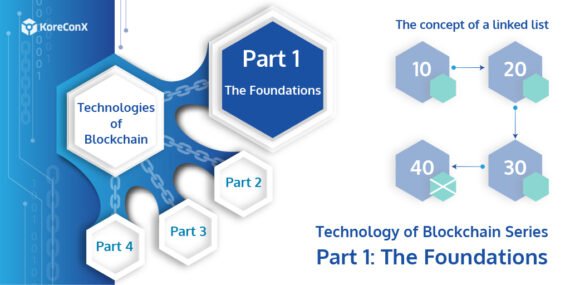
Technologies of Blockchain – Part 1: The Foundations

Blockchain is not just a single technology but a package of a number of technologies and techniques. The rich lexicon in the blockchain includes terms such as Merkle trees, sharding, state machine replication, fault tolerance, cryptographic hashing, zero-knowledge proofs, zkSNARKS, and other exotic terms.

In this four-part series, we will provide a very high-level overview of each of the main components of technology. In reality, the number of technologies, variations, configurations, and considerations of trade-offs are numerous. Each piece in this puzzle was motivated by certain business requirements and technical considerations.

In this first part, we look at the origins of the ‘chain’ and the most important technological advancement that makes blockchain (and all e-commerce) possible, i.e., the Internet.

While there have been genuine innovations within the last decade, blockchain’s underlying technologies are mostly quite old (in computer science time scale). Let us unpack a typical blockchain to trace out the origins of the constituent technologies. In this short post, I’ll only point to a very small (some may say, infinitesimally small) subset of the historical origin of technologies that make the modern blockchain possible. I’ll make no attempt to trace the development of these concepts from origin to the present time (that would fill up several books). The fact that blockchain’s technologies have a long and respectable history should help us gain confidence that blockchain, as a technology, is not some fly-by-night, newfangled idea cooked up by the crypto fandom.

What is less certain and much more controversial is the economic justification for blockchain (or at least some types of blockchain), ranging from the unrealistic expectation that it is a panacea for all of humankind’s ills (most optimistically, for social and economic inequities), to the total and premature dismissal of blockchain in its entirety.

The Beginnings

At the conceptual heart of blockchain is the ‘chain’. By definition, the links of the chain are, well, linked. It’s a list of data elements or packets of information (in blockchain, these are called ‘blocks’) that are linked. A blockchain is, therefore, a type of linked list.

The concept of a linked list was defined by pioneers of computer science and artificial intelligence, Alan Newell, Cliff Shaw, and Herbert Simon, way back in 1955-56.

In the early days of computer science, data and processing power lived on individual computers. Soon, people wanted these computers to ‘talk’ to each other. The grand idea of an Intergalactic Computer Network was put forth by J. C. R. Licklider as early as 1963. Unfortunately, even after half a century of rapid development, we have achieved only a planetary-wide Internet so far. An ‘intergalactic’ network is still a few years away!*

These ideas and the need to connect dispersed computers gave rise to wide-scale distributed systems in the 1960s-70s, with the advent of ARPANET and Ethernet. Technically, these linked computers are not necessarily treated in the same way as a traditional linked list that lived on one computer, but the conceptual idea is similar. When data and computational power get dispersed, layers of management, coordination, and security become increasingly important.

Blockchain would not exist without the Internet, which itself would not exist without TCP/IP, developed by Bob Kahn and Vint Cerf in the 1970s and ‘80s. Along the way, some scientists managed to have some fun too. They carried out an April Fools prank in 1990 by issuing an RFC (1149) for IPoAC protocol (IP over Avian Carriers, i.e., carrier pigeons). The punch line was delivered in April 2001 when a Linux user group implemented CPIP (Carrier Pigeon Internet Protocol) by sending nine data packets over three miles using carrier pigeons. They reported packet loss of 55%. A joke that takes a decade to pull off is practically Saturday night live comedy in Internet time scale!

In part 2, we will see how the extension of the concept of linked list on the Internet leads to distributed systems, the attending challenges, and their solutions.

Source: https://www.koreconx.com/2018/11/14/technologies-blockchain-part-1-foundations/