Posted by AGORACOM-JC
at 10:07 AM on Monday, July 8th, 2019
SPONSOR: ThreeD Capital Inc. (IDK:CSE) Led by
legendary financier, Sheldon Inwentash, ThreeD is a Canadian-based
venture capital firm that only invests in best of breed small-cap
companies which are both defensible and mass scalable. More than just
lip service, Inwentash has financed many of Canada’s biggest small-cap
exits. Click Here For More Information.
New ECB Boss is “Extremely†Pro-Crypto; What Could This Mean for Bitcoin?
Christine Lagarde, who is replacing Mario Draghi as the next head of the ECB on November 1st of this year, has long shown interest in Bitcoin and cryptocurrencies, and has even advocated for state-backed digital currencies that could increase the efficiency of those state’s economies.
Investors and proponents of Bitcoin and the aggregated crypto markets
have long believed that the ultimate pinnacle of adoption would be
found when governments and central banks began growing friendly towards
the nascent technologies.
Now, the nominee who is replacing the outgoing European Central Bank
(ECB) head is pro-crypto herself and has shown tremendous interest in
how the nascent tech can help shape the future’s global economy.
ECB Boss is Pro-Crypto, Will This Help Spark Adoption?
Christine Lagarde, who is replacing Mario Draghi as the next head of
the ECB on November 1st of this year, has long shown interest in Bitcoin
and cryptocurrencies, and has even advocated for state-backed digital
currencies that could increase the efficiency of those state’s
economies.
This past April, Lagarde spoke to CNBC and bullishly noted that crypto and blockchain is currently “shaking the system.â€
“I think the role of the disruptors and anything that is using
distributed ledger technology, whether you call it crypto, assets,
currencies, or whatever … that is clearly shaking the system,†she
noted, tempering this sentiment by adding that “We don’t want to shake
the system so much that we would lose the stability that is needed.â€
Although there is no way to deny that Bitcoin and crypto
are shaking up the current system – or at the very least have the
potential to do so – many critics will write off their utility, so
Lagarde’s openness to the technology is a powerful endorsement.
Will Lagarde Embrace Bitcoin, Or Focus on More Centralized Options?
Although the incoming ECB boss is certainly more open to crypto than
previous ones, it is important to note that her interest seems to be
more in centralized crypto options than in decentralized ones, like
Bitcoin.
Mati Greenspan, the senior market analyst at eToro, explained in an
email that her interest currently seems to be in JPM Coin and XRP.
“Not bitcoin, of course, but she has advocated already for
state-backed cryptocurrencies as well as settlement tokens like XRP and
JPM coin. In this video, we can see her taking notes while listening to Ripple’s CEO Brad Garlinghouse,†Greenspan explained.
Furthermore, Greenspan also explained that crypto certainly won’t be
her main focus as the head of the ECB, as her biggest challenge will be
to “bring unity and prosperity to the various EU States and QE will
probably take precedence over the digital landscape.â€
Regardless of whether or not crypto, Bitcoin, or blockchain are one
of her main focuses, her interest and openness to the technology is
certainly positive for the industry as a whole and may help incubate further adoption.
Posted by AGORACOM-JC
at 9:15 PM on Sunday, July 7th, 2019
SPONSOR: Esports Entertainment
$GMBL Esports audience is 350M, growing to 590M, Esports wagering is
projected at $23 BILLION by 2020. The company has launched VIE.gg
esports betting platform and has accelerated affiliate marketing
agreements with 190 Esports teams. Click here for more information
GMBL: OTCQB
———————–
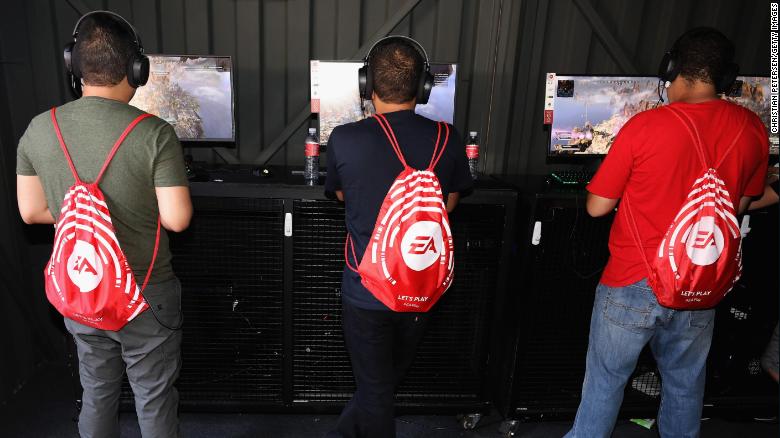
Facing off with Fortnite, Apex is turning to esports
Fortnite soared to the top of the video game world when it launched in 2017.
New York (CNN Business) Fortnite soared to the top of the video game world when it launched in 2017. Electronic Arts’ “Apex Legends,” a similar free-to-play battle royale game, where players fight until the last squad standing, eclipsed “Fortnite” in online views in February.
Apex’s victory was short-lived, and Fortnite surpassed
its viewership the following month. Now EA has plans to get Apex back
on top once again. The company is betting competitions of professional
and amateur gamers — known as esports — will broaden Apex’s audience.
Game enthusiasts play “Apex Legends” during the EA Play 2019 event at the Hollywood Palladium in June.
New features and esports deals
EA made a big play to bolster Apex’s esport credentials in June when it announced a deal with ESPN to allow college and professional esports players to compete in Apex games at two events over the summer.
The game also added a new competitive mode Tuesday that ranks
gamers based on how many wins and kills they can pull off. Fortnite implemented a similar competitive-ranking mode in March.
“Pro teams typically scout from the upper echelon,” said Chris
Hopper, head of esports for North America at Riot Games, which develops
“League of Legends,” one of the biggest esports titles. “But they also
find up-and-coming talent in the ranks immediately below.”
EA is leaning on its partnership with ESPN to stream Apex games
live online and, later, on the air on the ESPN and ABC networks. ESPN’s
director of business development, Kevin Lopes, told CNN Business the
network was attracted to Apex Legends’ rising popularity and esports
potential. The two companies already had an existing esports partnership
over football game “Madden NFL.”
“Making Apex an esport will help drive the audience,” said Michael
Pachter, an analyst at financial services firm Wedbush. “It gives
players something to watch and learn from.”
World’s top gamers vie for $500,000 in prizes at a Fortnite International video game tournament.
The esports industry has attracted millions of viewers across
multiple platforms, and it could reach about $3 billion in market size
in 2022, Goldman Sachs forecasts.
It’s not clear how exactly that translates into money for EA —
esports revenue is hard to pinpoint, though sponsorships and event
ticket sales can all generate revenue to some degree. Apex also makes
money through in-game purchases such as cosmetic upgrades.
But esports can encourage gamers to stick with particular titles
and can keep the game feeling relevant for longer, “both of which lead
to more chances for monetization,” said Nicole Pike, managing director
at Nielsen Esports.
EA estimated during its last earnings call that Apex would bring in
$300 to $400 million next year. For comparison, Fortnite made $2.4
billion in revenue in 2018, according to Nielsen’s SuperData.
Apex vs. Fortnite
“People play Fortnite partly because their friends are on
Fortnite,” said Will Partin, a doctoral candidate at UNC Chapel Hill who
studies esports. “The best-case scenario for the Apex Legends [ESPN]
event is that it exposes the game to a lot of people who haven’t tried
the battle royale genre yet.”
Esports is EA’s latest strategy to try and generate buzz for the
title. When Apex debuted in February, EA paid well-known game streamers
to play Apex for the first 24 hours. EA told CNN Business it stopped
paying them after that.
The marketing bid paid off: Apex attracted 50 million players
within the first month of launch. EA’s chief executive Andrew Wilson
said it was the “fastest-growing new game we’ve ever had” during a May
earnings call.
“It was our way of showing the world, when people go on
[game-streaming platform]
Twitch and it’s one of the top games, you’re like ‘Oh, that looks interesting. What’s that?'” said Vince Zampella, CEO of Respawn, which made Apex. EA acquired the developer in 2017. If people play Apex as a sport, the game could start winning back fan attention and viewership on live-streaming services. Â Some observers think there’s potential for the game to actually succeed as an esports arena. Apex has unique characters and is not updated as frequently as Fortnite, so it’s easier to adapt to, said Will Hershey, co-founder and CEO at the investment advisory firm Roundhill Investments. Â “Ultimately, I believe [Apex] has the potential to be more of an esport, in the traditional sense, than Fortnite does,” he said. Â
Posted by AGORACOM-JC
at 3:30 PM on Thursday, July 4th, 2019
SPONSOR: Good Life Networks (GOOD:TSX-V)
Video advertising is the future! Company’s A.I. makes 80,000
calculations / second, targeting 750 million users to deliver higher
prices and volume. Company announced FY2018 trailing pro forma of ~
$48,000,000 with Adjusted EBITDA of $7,100,000 Click here for more information.
Shopify has previously highlighted the need for dynamic ads and has offered advice on how to automate
it to help boost your brand. However, in 2019, it’s not just enough
that you know when to post on Facebook to get the most engagement: it’s
important that you find a smarter way to advertise.
This article will discuss what programmatic advertising is all about and how you can leverage it for your brand.
Programmatic Advertising Defined
Digiday simplifies programmatic advertising when it said: “It’s using machines to buy ads, basically.â€
Traditionally, ad space was sold and
bought by humans. Requests for Proposal (RFP) were made and sent,
multiple meetings were set, and negations dragged on before the
advertisement was actually published. This meant the advertisers could
be losing valuable real estate if they do not successfully secure an ad
space. On the other hand, agencies may be putting money into ad spaces
that might not actually be seen by their target audience.
Essentially with the automation of
programmatic ad buying, these risks are minimized. Advertisers get an
agreed upon number of impressions per ad space, provided that the
publisher is targeting their buyer personas. Instapage expounds on when
it said that when you buy ad space through software, you rely on “complex algorithms to deliver advertisements contextually.†This also makes the entire ad buying, targeting, and placement process possible in less than a second.
How it works
Agencies and advertisers use a
demand-side platform (DSP) that helps them decide which impressions to
buy from publishers, and how much they are willing to pay for them. On
the other side, the publishers have their own platform, the supply side platform (SSP), which shows available ad spaces.
These two platforms are then paired
in real time, so advertisers can see how their ads are doing. In case
you see an opportunity to amplify or modify your message, then you can
bid for more impressions. If not, then your continuous campaign will run
as planned.
This transparency and flexibility are
what make programmatic advertising a growing industry. As alluded to
earlier, an estimated $84 billion will be spent on programmatic ads in
2019. And with features like cross-device campaigns, and improved retargeting, the industry can only be expected to grow.
How Programmatic Ads Help You Reach the Right Audience
It has always been a challenge to get
ads in front of the right audiences. With programmatic ads, you can
place your ads based on your buyer persona’s age, social status, gender,
and even geographic location. By design, you will be paying for highly
effective and targeted ads that are delivered to the right users at the
right time. This is akin to having your online store work across all devices.
What’s more, once paired with
analytics and its real-time insights, you can get valuable lessons on
how you can improve your campaigns immediately. This has the added
benefit of enhancing your targeting approach so that it will be spot-on
in the future.
Now that you know what programmatic
ads are and how they can be helpful, here is how you can incorporate
them in your strategy this 2019.
How to Maximize Programmatic Ads
1. Use a programmatic model you are comfortable with
While the majority of advertisers are
comfortable with the use of their DSPs, some would want better
flexibility to validate ad buys and ensure that there is no fraud. For
this reason, it is important that you consider your programmatic model
before committing to it long term.
Some brands are opting to go in-house,
particularly since this gives them full control. All aspects of the
campaign—from ideation, execution, and to activation—are controlled by
the company. However, this is far trickier than that. Programmatic
advertising is complex, and unless you have an in-house team that
actually knows what it’s doing, then you could be purchasing ad space
that might not provide optimal returns.
For this reason, many brands are
choosing a hybrid approach, where advertisers can see what their
agencies are buying, and having an internal team (whether through the
agency or in-house) validate these buys.
2. Pool all your data and come up with a sound programmatic strategy
Once you decide on a programmatic
model, then you should consider your strategy. Do not isolate your
creative arm from your agency; rather, bring the two parties together to
come up with creative executions of your programmatic ads.
What this means is that you look at
all your data—your analytics, CRM stats, and market research, as well as
other data sources you may have—and try to see which media type,
location, or device would best appeal to your audience. This way, your
campaign is not a shot in the dark: you are actually running a data-driven programmatic ad campaign, so you are more likely to get better leads.
Go beyond retargeting, and see how
you can get the right response by testing out varying accuracies and
scales of your campaign. Scale it back if you think you’ve gone too far,
or choose a different method if you think your ads are not hitting the
mark.
To come up with a sound strategy,
have a sit down with your data, creative, and agency: talk about your
prospects and goals, and see how efficient your ads should be.
Posted by AGORACOM-JC
at 2:30 PM on Thursday, July 4th, 2019
SPONSOR: Enthusiast Gaming Holdings Inc.
(TSX-V: EGLX) Uniting gaming communities with 80 owned and affiliated
websites, currently reaching over 75 million monthly visitors. The
company exceeded 2018 target with $11.0 million in revenue. Learn More
EGLX: TSX-V ———————————-
It’s the real deal, millennial driven eSports is the next big thing
In 2018, the global eSports market revenue reached US$865 million. According to Statista, global eSports market revenue is forecast to reach US$1.79 billion in 2022, growing at a CAGR of 22.3%.
The number of eSports enthusiasts worldwide was estimated at ~168 million in 2018, and for total global viewers, the forecast for 2019 is ~453 million.
Enthusiast Gaming (TSXV: EGLX)/Aquilini GameCo Inc./Luminosity – The merged group will now include seven eSports teams (including management of the Vancouver Titans Overwatch League franchise), 40 eSports influencers, 80+ gaming media websites, 900+ YouTube and Twitch channels
Think of eSports organizations the same way you would see any other
mainstream sporting organization, for example, the New York Yankees or
Manchester United. eSports organizations operate similarly by building
their brands in the e-gaming ecosystem versus the traditional sports
ecosystem.
A brief history of eSports and how the revenue is distributed across the industry
The first eSports event happened all the way back in October
1972 at Stamford University where students competed on the video game
Spacewar. In more recent years the industry has become professional and
involves large eSports tournaments, prize money, and media deals.
In 2018, the global eSports market revenue reached US$865 million. According to Statista,
global eSports market revenue is forecast to reach US$1.79 billion in
2022, growing at a CAGR of 22.3%. The number of eSports enthusiasts
worldwide was estimated at ~168 million in 2018, and for total global
viewers, the forecast for 2019 is ~453 million.
The major players in the eSports space
Activision Blizzard Inc. (NASDAQ: ATVI) owns the popular Overwatch League as well as World of Warcraft, StarCraft, Diablo, and Hearthstone.
Electronic Arts Inc. (NASDAQ: EA) is headquartered in California. It is the second-largest gaming company in the Americas and Europe by revenue and market capitalization
Take-Two Interactive Software, Inc. (NASDAQ: TTWO) is based in New York City. The Company owns two major publishing labels, Rockstar Games, and 2K.
Tencent Holdings Ltd. (OTCPK: TCEHY) acquired Riot Games and now owns the very popular League of Legends game and also own King of Glory. Tencent is the Chinese leader in eSports game streaming.
Amazon (NASDAQ: AMZN) is a dominant player in the eSports streaming market. The online streaming market in the USA is led by Amazon’s Twitch.
Huya Inc. (NYSE: HUYA) is a spin off from YY Inc. Huya is known as the “Twitch of Chinaâ€. Huya mostly works off a gift model.
Alphabet Inc. (NASDAQ: GOOG) own YouTube Gaming which makes money via subscriptions and advertising.
Enthusiast Gaming (TSXV: EGLX)/Aquilini GameCo Inc./Luminosity – The merged group will now include seven eSports teams (including management of the Vancouver Titans Overwatch League franchise), 40 eSports influencers, 80+ gaming media websites, 900+ YouTube and Twitch channels
Enthusiast Gaming merges with Aquilini GameCo and Luminosity to create a market leader in gaming and eSports
In just four years Enthusiast Gaming has gone from a basement-based
business to form the leading publicly traded eSports and gaming media
organization in North America. Enthusiast Gaming recently announced a
merger agreement
with Aquilini GameCo Inc. and Luminosity that will create a publicly
traded eSports and gaming organization with $22 million in pro forma
revenue and $36 million in cash on closing of the merger, with a
combined global audience reach of approximately 200 million.
CEO of Enthusiast Gaming, Menashe Kestenbaum, stated: “Our vision has
always been to build the largest, vertically integrated eSports and
gaming company in the world. The merger with Aquilini GameCo and
Luminosity was a strategic decision that positions us as a dominant
player in the gaming industry and unlocks access to Luminosity’s 50
million dedicated eSports fans and one of the largest eSports
franchises.â€
eSports companies are doing well and eSports is gaining acceptance
So far 2019 has been a strong period for eSports with some great
returns in H1 2019 for investors including: Huya Inc. (NYSE: HUYA) up
71%, Kuuhubb Inc. (TSXV: KUU) up 81%, Enthusiast Gaming Inc. (TSXV:
EGLX) up 39%, Zynga Inc. (NASDAQ: ZNGA) up 61%, and Electronic Arts Inc.
(NASDAQ: EA) up 33%.
eSport was featured at the 2018 Asian Games as a
demonstration sport, and eSports will be a medal event at the 2022 Asian
Games.
The eSports phenomenon is growing at a rapid pace and
offers many opportunities globally for up to date investors, just ask a
millennial.
“Employees in India are looking forward to picking up new-age skills to make themselves more relevant in the current workforce. upGrad’s highly engaging online learning solution along with CohortPlus’s deep penetration in the community of Data Scientists and Product Managers, will allow us to reach a much larger and relevant audience,†Ronnie Screwvala and Mayank Kumar, Co-founders, upGrad said in a joint statement, published by yourstory.
Bengaluru-based CohortPlus was founded by Srinivasan Narayan
in 2015. It is an online community, which brings together like-minded
career aspirants on a single community platform, where they can network
with each other, ask and clarify doubts, and be abreast of the latest
events in the field of data science and product management.
Members can post their questions and get various perspectives from
industry professionals and can also get assistance for job interviews.
While, upGrad was founded by Ronnie Screwvala, Mayank Kumar, Phalgun Kompalli, and Ravijot Chugh
in 2015. It has introduced 35 programmes in areas such as data science,
technology, and management, and has a paid learner base of 13,000.
On the other hand, according to the Talent Supply Indes (TSI) by
Belong, India has seen more than 400 per cent rise in demand for data
science professionals across varied industry sectors at a time when the
supply of such talent is witnessing a slow growth.
Posted by AGORACOM-JC
at 10:04 AM on Thursday, July 4th, 2019
SPONSOR: ThreeD Capital Inc. (IDK:CSE) Led by
legendary financier, Sheldon Inwentash, ThreeD is a Canadian-based
venture capital firm that only invests in best of breed small-cap
companies which are both defensible and mass scalable. More than just
lip service, Inwentash has financed many of Canada’s biggest small-cap
exits. Click Here For More Information.
—————-
4 crypto trends for the next 5 years
Not long ago, only a handful of accountants dealt in cryptocurrency.
Now, just a few years later, every major financial news outlet dedicates
a portion of its coverage to crypto. Times have changed quickly, so
what will the crypto accounting industry look like in five years and
beyond?
Consider the following four trends in crypto accounting and how they will affect CPAs.
1. Increased automation
As cryptocurrencies further infiltrate the public consciousness,
traditional accounting services will automate more of their work to keep
up with the increased workload. Spreadsheets work well enough for fiat
transactions, but in the volatile crypto environment, static tools can’t
effectively serve anyone with a serious investment in alternative
currencies.
Average consumers today can do their taxes online
through services like TurboTax and H&R Block. Businesses and complex
individual situations require personalized care, but standard programs
can handle the load for most people. Tax programs don’t need to offer
advanced functionality just yet — a few equations on the back end do a
fine job.
But cryptocurrencies make things more complicated.
Accountants need automated tools to track increased crypto complexity,
like cost basis. Without smarter software, experts in the financial
services industry won’t be able to keep up with higher sophistication at
scale. Tax software providers will eventually offer new and highly
automated services for crypto investors, and consumers will pay for
those services using their crypto investments.
AI accountants
Accounting experts will use smarter tools to help their corporate
clients and major investors make better decisions. But the public won’t
need real accountants for their simple crypto investments; they’ll
simply turn to artificial intelligence tools that minimize human
interaction in most accounting scenarios.
The future will see
consumers interact with intelligent AI, machine learning, and bots
capable of natural language processing. Challenging concepts like crypto
cost basis, which can confuse even the sharpest accountants, pose
little threat to intelligent software. Accountants will still have a
place in the world, but their duties will evolve drastically as crypto
demands bring widespread change in the financial industry.
Not
everyone will feel comfortable doing taxes through AI. Accountants will
need to lean on automated tools of their own to keep pace, but
enterprise clients, heavy investors, and people suspicious of advanced
tech will continue to prefer the human touch. With more money going
toward nicer tools and less money going toward human intermediaries,
accountants must specialize and adapt to stay relevant.
3. Knowledge enrichment
Schools and universities will soon offer programs and specialty courses
to educate future accountants, bookkeepers, and CPAs on the intricacies
of crypto. Few schools today offer such services, but the more prominent
cryptocurrencies become, the greater the need will be for new
accountants to understand the rules of digital currency.
Some businesses already offer services to certify accountants
as crypto tax experts, but schools will remain the top trainers in the
accounting world. By educating students before they begin their careers,
universities can prepare graduates to operate effectively in an
industry with broad new responsibilities and expectations. Businesses
and crypto organizations will need new accountants who understand their
evolving needs.
For accountants already out of school, options
for continuing education will evolve from useful to essential. More
crypto trading means more crypto investors and crypto companies. Those
entities need experts who understand the cryptocurrency landscape. If
experienced accountants fail to adapt, fresh faces will gladly take the
business.
4. Updated regulatory standards
Where crypto regulation used to be nonexistent, legislators have
actually made some limited progress. The SEC now has more oversight to
shut down illicit initial coin offerings (ICOs), and the IRS clarified
that cryptocurrencies are property, not currency — at least for now.
But
the more that crypto changes, the more regulations will change with it.
Every business that deals with cryptocurrency will encounter newer,
more robust laws in the years to come. Soon every company and project
that deals with crypto will need an accountant (or accounting service)
with crypto experience to help navigate the unknown.
As new laws
get passed, businesses will invest more heavily in smarter crypto
accounting solutions. Artificial intelligence and machine learning will
do the heavy lifting while human accountants interpret that data to help
executives make smarter business decisions. More technology startups
will emerge to cater to this growing audience. Before long, crypto
accounting will become an industry unto itself.
These changes may seem like far-off concerns for another year, but crypto accounting — like cryptocurrencies themselves — moves quickly. Expectations and the tools to meet them become more complex and sophisticated each day. Accountants must stay vigilant to keep up with the times, or they risk losing ground to a new generation of crypto-savvy competitors. Â
Posted by AGORACOM-JC
at 3:24 PM on Wednesday, July 3rd, 2019
SPONSOR: Esports Entertainment
$GMBL Esports audience is 350M, growing to 590M, Esports wagering is
projected at $23 BILLION by 2020. The company has launched VIE.gg
esports betting platform and has accelerated affiliate marketing
agreements with 190 Esports teams. Click here for more information
GMBL: OTCQB
———————–
Newzoo opens up on $1 billion esports valuation after criticism
Steven R. July 3, 2019
In a lengthy article, the analytics firm opened up on its process and subtly pushed back against implications that they have been overly bullish regarding the future of the industry
It also pulled back the curtain on its valuation methods and offered a breakdown of how it sees the esports industry today.
Newzoo is giving a bit of insight into their frequently cited statistics on the growth of the esports industry.
In a lengthy article,
the analytics firm opened up on its process and subtly pushed back
against implications that they have been overly bullish regarding the
future of the industry. It also pulled back the curtain on its valuation
methods and offered a breakdown of how it sees the esports industry
today.
“For esports data, publicly available financial information is scarce
due to the relative youth of the industry,†Newzoo CEO Peter Warman
said. “We, therefore, partner directly with numerous esports
organizations across the globe… We receive their actual revenue data
each quarter, providing us with a strong data-backed foundation for
forecasting sponsorships, advertising revenues, and media rights deals,
as well as merchandise earnings and fees spent on organizers.â€
Though Newzoo does not specifically name names, the article seems to
be a response to recent wide-ranging discussions that firms have been
overstating esports’ reach and value to prospective investors. These
concerns were detailed at length in a report by Cecilia D’Anastasio of Kotaku,
who tackled this issue on a number of fronts. Kotaku’s anonymous
sources discussed the industry in terms ranging from “inflated†to
“completely unsustainable.â€
The report discusses Newzoo specifically, with esports insiders from
multiple areas of the industry questioning the legitimacy of their
methods. The eye-popping numbers from Newzoo and other similar outlets
offer a great deal of sizzle to uninitiated financiers, possibly without
enough steak to go along with it.
To counter this, Newzoo honed in on its oft-cited $1 billion “global esports market revenue estimate.â€
The number has been thrown around by many different outlets without
proper context, which has led to accusations that the company was
actively trying to inflate the industry. Newzoo gave a detailed
breakdown on how it reached that valuation, accounting for different
regions and areas of the industry.
The chart shows the different sources of revenue and what percentage
that accounts for in each region. This highlights some of the key
differences in business models between major markets, with advertising
being huge in Asia while media rights make up a much larger chunk of
North America.
Despite the post likely being a reaction to claims that its numbers were overstated, Warman stood by his firm’s math.
Posted by AGORACOM-JC
at 10:47 AM on Wednesday, July 3rd, 2019
Investment Highlights
Kenbridge property has a measured and indicated resource of 7.14 million tonnes at 0.62% nickel, 0.33% copper
17.5 (21.8 fully diluted) percent equity stake in Eloro Resources and 2 percent NSR in their La Victoria property
Signed Binding Letter of Intent to Purchase Sill Lake Lead-Silver Property, Ontario Read More
Kenbridge Ni Project (ON, Canada)
Advanced stage deposit remains open in three directions, is
equipped with a 623m deep shaft and has never been mined.
Preliminary Economic Assessment completed and updated returned robust project economics and operating costs including a NPV of C$253M and cash costs of US$3.47/lb of nickel net of copper credits.
Plans for Kenbridge include updating PEA,
advancing the project through to feasibility and exploring the open
mineralization at depth
Sill Lake Silver-Lead property, Sault Ste. Marie Mining Division, Ontario.
Closed the acquisition of the past-producing Sill Lake Silver-Lead
property, Vankoughnet Twp, Sault Ste. Marie Mining Division, Ontario.
Acquisition includes 13 single-cell mining claims and four boundary-cell claims that total some 372.8 hectares.
Lead-zinc-silver mineralization was discovered at Sill Lake in 1892;
since that time sufficient works have been completed so as to define a
(historical) measured and indicated resource of 112,751 tonnes of 134
g/t silver, 0.62% lead, and 0.21% zinc.
A 60 g/t cutoff for silver was used, with no cutoff used for base metals content.
Some 7,000 tonnes was exploited from the Sill Lake Project to
produce a lead-silver concentrate which was sold to nearby smelters.
FULL DISCLOSURE: Tartisan Nickel Corp. is an advertising client of AGORA Internet Relations Corp.
Tags: CSE, nickel, nickel demand, stocks, tsx, tsx-v Posted in All Recent Posts, Tartisan Nickel | Comments Off on CLIENT FEATURE: Tartisan Nickel $TN.ca Kenbridge Property Hosts M&I Resource of 7.14 Million Tonnes at 0.62% #Nickel, 0.33% #Copper $ROX.ca $FF.ca $EDG.ca $AGL.ca $ANZ.ca
Posted by AGORACOM-JC
at 9:53 AM on Wednesday, July 3rd, 2019
SPONSOR: ThreeD Capital Inc. (IDK:CSE) Led by
legendary financier, Sheldon Inwentash, ThreeD is a Canadian-based
venture capital firm that only invests in best of breed small-cap
companies which are both defensible and mass scalable. More than just
lip service, Inwentash has financed many of Canada’s biggest small-cap
exits. Click Here For More Information.
—————-
After Experimenting With Bitcoin and Ethereum, DocuSign Is Accelerating its Blockchain Ambitions
Business team two executive shaking hands after a meeting and conference to sign agreement and become partner in the office, results of their successful teamwork, contract between their firms.
Since its founding in 2003, firms of all sizes and industries have relied on the company to streamline the contract process through its best-in class security, identity authentication, user interface, and integration with leading business suites.
Famed cryptographer Nick Szabo may have coined the term “smart
contract†back in 1994, but DocuSign can make a compelling case for
being its true inventor. Since its founding in 2003, firms of all sizes
and industries have relied on the company to streamline the contract
process through its best-in class security, identity authentication,
user interface, and integration with leading business suites. Today
DocuSign has 500 thousand paying customers, and it earned over $700 million in revenue last year.
However, the company is not resting on its laurels and instead is
seeking ways to improve its service offerings, with much of this
experimentation incorporating blockchain technology. Over the last few
years this testing has included trials, demos, and partnerships on both Bitcoin and Ethereum. The company also joined the Accord Project,
an open-source software initiative that was established to develop a
technology stack for smart agreements. Furthermore, last week the
company invested in a $5.5 million Series A round
for smart contract provider Clause alongside Galaxy Digital with the
goal of making contracts on their DocuSign Agreement Cloud
“self-executing†and “self-aware†in an ongoing fashion, rather than
just one moment in time.
Given the core facets of DocuSign’s business and its research into
blockchain technology and smart contracts, the San Francisco-based
company is in an unrivaled position to assess their utility and
applicability to the needs of today’s businesses. Still, the road to
blockchain adoption has not been a straight line, and the company’s
plans face many of the same hurdles that other potential adopters are
trying to clear. To better understand DocuSign’s future direction, I had
an opportunity to speak with Ron Hirson, DocuSign Chief Product
Officer, who shed additional light on these endeavors, provided context
for the company’s investment in Clause, and offered expectations for how
blockchain will impact the company moving forward.
DocuSign’s Blockchain Strategy Began in 2015
When individuals think of major enterprise users of blockchain, the
first companies that come to mind often include blue-bloods such as
Facebook, IBM, and JP Morgan. However, DocuSign has been experimenting
with the technology since 2015, when it built a “smart-contract meets smart-asset meets smart-payment†demo with Visa on top of the Bitcoin blockchain.
According to Ron, the collaboration aimed to determine whether they
could utilize Bitcoin so that a user could “buy a car while sitting in
the carâ€, and have it start provided that the buyer’s insurance was up
to date.
Initial Forays Offered a Glimpse of Blockchain’s Potential, but Also Challenges
However, as exciting as these experiments were, neither went
mainstream for reasons that will ring familiar to active followers of
the enterprise blockchain space. According to Ron, the POC with Visa was
primarily an opportunity to learn, and the Bitcoin blockchain was
chosen because it was by far the most prominent platform in 2015
(remember Ethereum did not officially launch until July 30, 2015), even
if it was not tailor-made for this use case. Even then Bitcoin’s
limitations in functionality, data storage, and throughput were well
known to industry observers.
It is perhaps for these reasons that the company joined the EEA in
2018 and built its second project on top of Ethereum. However, despite
more functionality, the pilot did not gain widespread adoption because
customers already felt comfortable with DocuSign serving as a store of
record. Ron made it very clear in his conversations to me that most
customers did not see a need for an independent audit trail. He also
noted that education was not a problem, as he and the company “pitched
this broadly, stood on stage, screamed from the mountaintops, about that
we have this capability, and the uptake from customers who are
interested in it is fairly low because they don’t see the need.â€
Speaking more broadly about DocuSign’s global customer base and
blockchain’s shortcomings to this point, Ron underscored the massive
challenge facing technologists and blockchain enthusiasts. He provided a
hypothetical about a client trying to meet its sales goal before the
end of a quarter. Putting himself in the customer’s shoes he said “I
can’t rely on an open source system that may or may be available, may or
may not have the latency that I need, and oh my gosh it is way too
expensive to store all these files. Plus, there is no compelling UI for
me to engage in these kinds of systems.â€
Undaunted and Moving Ahead With a Clearer Vision
In spite of this feedback, Ron and the rest of the company believe in
the potential that blockchain technology has for its product lines, and
it is continuing to drive forward. However, from these initial
experiments, it became clear to the team at DocuSign that for blockchain
technology to transform their business and deliver client value, the
benefits from the technology must move far beyond “nice to haveâ€. In a
sense, the company would need to find a value proposition that was
unavailable before the invention of blockchain technology.
Rationale for the Clause Investment
It is for this reason that as reported last week it invested in smart-contract technology provider Clause.
The startup has built a promising business by leveraging its platform
to enable users to add smart clauses to documents that automate business
processes, workflows, and digital transactions. What this means in
layman’s terms is that contacts that utilize Clause’s technology can run
in the background until a specified date, time, or event and execute
when a certain condition is met. In my conversations with Ron, he
highlighted a demo that the company unveiled at its annual Momentum 2019
conference last month, whereby this new platform could be utilized to authenticate new drivers for a ride-sharing platform on an ongoing and persistent basis.
This speaks to the true potential of this collaboration. DocuSign is
in many ways the epicenter of complex business processes that take place
behind the scenes when a contract is signed. By incorporating these
“smart clauses†into future contracts a lot of this work can become
automated, removing middlemen such as title or escrow agents, offering a
more streamlined and efficient process for all involve parties to an
agreement all the way through to payment.
An Auspicious Start, but Many Challenges Ahead
It is clear that DocuSign is setting its sights much higher this
time. However, much still needs to be developed regarding this
partnership, including which platforms it will run on, the first use
cases, and an initial set of customers. Within this context it is
important to note that Clause’s code can run on top of any blockchain or
non-blockchain platform. Additionally, the collaborators will still
need to find solutions for the scalability, accessibility, and security
problems noted above, not to mention solving these challenges with the
elegant user interfaces that its customers have come to expect. Being
able to work on top of multiple blockchains should help.
Additionally, the partners will need to find and utilize oracles that
never go down and cannot be hacked or manipulated. For readers
unfamiliar with the term, oracles are data feeds that smart contracts
rely on to determine when a condition is met that would cause the
contract to self-execute. Today, there is no foolproof way to prove the
fidelity of an oracle, and it is a long-standing problem that
blockchains cannot differentiate between good and bad data being fed
into the system. For a partnership like this to truly succeed they will
need to find a solution, which is something that the partners dutifully
acknowledge.
Solving these challenges will require heavy lifting, and in
recognition of the size of this undertaking DocuSign has a product
manager and entire engineering team focused on the technology.
Therefore, it seems unlikely that lack of resources will be an issue,
boding well for the future. After all, the prize is big enough to
justify the cost, because if the collaborators succeed, this partnership
has the potential to impact every industry under the sun.
Posted by AGORACOM-JC
at 9:00 PM on Tuesday, July 2nd, 2019
SPONSOR: Enthusiast Gaming Holdings Inc.
(TSX-V: EGLX) Uniting gaming communities with 80 owned and affiliated
websites, currently reaching over 75 million monthly visitors. The
company exceeded 2018 target with $11.0 million in revenue. Learn More
EGLX: TSX-V ———————————-
Esports is gaining ground among sports enthusiasts in Canada. Now, for the first time, players have a new place to call home.