Agoracom Blog Home

Archive for the ‘All Recent Posts’ Category

PyroGenesis $PYR.ca Board Approves PyroGenesis Additive’s Spin-Off; Uplisting Stock to More Senior Exchange $LMT $RTN $NOC $UTX $HPQ.ca $DDD.ca $SSYS $PRLB

Posted by AGORACOM-JC at 1:33 PM on Tuesday, April 16th, 2019
  • Board of Directors is moving forward with the previously announced spin-off of PyroGenesis Additive, a division specializing in developing, commercializing and advancing plasma-atomized metal powder for the additive manufacturing industry.
  • Additionally, the Company is also considering uplisting its stock to a more senior exchange.   

MONTREAL, April 16, 2019 — PyroGenesis Canada Inc. (http://pyrogenesis.com) (TSX-V: PYR) (OTCQB: PYRNF) (FRA: 8PY), a high-tech company, (the “Company”, the “Corporation” or “PyroGenesis”) that designs, develops, manufactures and commercializes plasma atomized metal powder, plasma waste-to-energy systems and plasma torch  products, today announced that the Board of Directors is moving forward with the previously announced spin-off of PyroGenesis Additive, a division specializing in developing, commercializing and advancing plasma-atomized metal powder for the additive manufacturing (“AM”) industry. Additionally, the Company is also considering uplisting its stock to a more senior exchange.   

Mr. P. Peter Pascali, President and CEO of PyroGenesis, provides this update on today’s announcements in the following Q&A format. The questions, for the most part, are derived from inquiries received from investors, and analysts:

Q. The spin-off of PyroGenesis Additive. It has been a long time in the making.

A.  Indeed it has, and for some very good reasons. The space has been rocked with change and we had to ensure that our investors received maximum return from the spin-off, and at values management felt were fair. I believe that there has been no better time than now to move forward with the spin-off. These strategic delays have effectively increased shareholder’s value.

Q.  Could you explain those reasons to readers who are new to the story?

A. Most certainly.

Almost three years to the day, in the spring of 2016, we announced our intention to spin-off our additive manufacturing capabilities to maximize shareholder value and increase options to the Company. The original idea was to consider a small concurrent financing to fund the immediate need which was essentially to have a first system in place producing powders.

Between the announcement and September 2016, while we were weighing the options and various structures the spin-off could take, GE announced that they had acquired Arcam and Concept Laser (both manufacturers of printers which make metal 3D parts).

GE’s acquisitions arguably disrupted the supply chain of titanium powders to the industry with the indirect acquisition of a subsidiary of Arcam which had become the dominant supplier of such powder to the space. It was imperative that we understood the impact of these acquisitions on our decision to spin-off before we moved forward.

Once we understood the impact of the acquisition on the market, we decided to postpone the spin-off until our first powder production system was assembled which was only a few months away. We then waited until the ramp up was completed. These delays removed any doubts, in the marketplace, that we could produce quality powders, and as such, increased the value of the spin-off to current investors.

Given the reception of our powder by the market (in 2018, we were nominated Materials Company of the Year at the 3D Printing Industry Awards, which speaks to how much we had accomplished in such a short time), we felt we were close to a key contract and/or a significant relationship, and decided to wait until one or the other was in hand.

In the summer of 2018, discussions took place with Aubert & Duval which lead to the joint press release of January 8, 2019 describing a mutually exclusive relationship with respect to the distribution of PyroGenesis’ titanium powder to the AM industry in Europe.        

Given what has taken place, and what we know now, management has made a strategic decision to spin-off PyroGenesis Additive at this time.     

Q. Why spin-off PyroGenesis Additive in the first place?

A. There are a number of reasons, but they all boil down to one goal: simplicity.

The reason to spin-off PyroGenesis Additive is primarily to attract an investor base best suited to their unique value proposition, particular business operations, and financial characteristics, thereby maximizing shareholders’ value and placing it in a better position to generate revenues and develop strategic relationships than had it remained part of the PyroGenesis stable of technologies.

The simpler an offering is the easier it is for analysts to understand and value it properly. As it stands now PyroGenesis Additive is part of PyroGenesis Canada Inc’s offerings which include Drosrite™, US Military, and Purevap™, just to name a few, and as such makes it complicated to analyze.  Add to this that analysts typically specialize in one sector or another, and as such may very well be able to fully value PyroGenesis’ Additive’s offering, but would be hard pressed to do equal justice to PyroGenesis’ other business lines, and you have a significantly undervalued group of assets. Spinning one group off would unlock this value.

Simplifying an offering would also make it easier to attract investment. There are large pools of money interested in investing in the AM space, but have no desire to have their funds comingled with unrelated business lines. A spin-off would assure them that such funds would be used for AM alone.

Last but not least, a spin-off creates a well understood entity with which interested parties could joint venture or acquire.
Bottom line: a spin-off creates simplicity, which in and of itself, increases interest, all to the benefit of shareholders.

Q. Any challenges in a spin-off?

A. There are many, but the two that I think are key are timing and structure. The timing and structure of a spin-off is critical to its survivability.  The spin-off must be done in a context where it can grow and mature, not much different from a young adult leaving home.

It is management’s firm belief that given recent announcements, and what we anticipate taking place in the near term, spinning-off PyroGenesis Additive is now overdue.

Q. Are there any other factors motivating your decision to spin-off PyroGenesis Additive at this particular time?

A. Yes. There is a huge interest by our partners to spin-off PyroGenesis Additive for all the reasons given above. This is a major factor in our decision to move forward now.

Q. You also announced today that you are considering an uplisting. Could you describe what this means? 

A. The Company’s stock currently trades on the TSX Venture Exchange (“TSX-V”).  Although a good exchange it does have its limitations.  It may be a good place for a company to list initially but, in time, a company should consider moving to a bigger and better exchange. By bigger and better I mean one which will attract more interest and as such attract greater investment which by default would translate into a higher stock price. This is a natural progression and the TSX-V boasts of the number of companies that have uplisted from their platform.

I think it would be more appropriate to say that we are considering which exchange to uplist on, rather than considering an uplisting. It has already been decided that we have to become listed on a more senior exchange, sooner than later.

Q. What would be the timing and what are the next steps? 

A. Both uplistings and spin-offs require regulatory approval and depending on the type and number of questions from the regulators, will determine the time it takes to complete. Assuming nothing out of the ordinary, either one could take 4-6 months. 

Next steps would be to engage a Canadian based law firm, which we are in the process of doing, and to engage an investment bank. We are currently receiving proposals from investment bankers on both sides of the border.

Q. What could delay the process?

A. As I said the process requires regulatory review and approvals. There could be delays associated with this. Other than that, funds. The process requires capital to complete although a large part of it is success based and back-ended.

Q. Assuming money is not an object, and that the regulatory approval process is not unduly burdensome, when are you targeting these events to be completed?

A. Both in 2019, this year, but failing that, one this year and the other by Q1, 2020.

Q. Do you care to add any concluding remarks?

A.  Yes, I would.

There has been a flurry of developments within our PyroGenesis Additive segment. We started the year by announcing a significant agreement with a multi-billion-dollar European Company to market our powders to Europe on a mutually exclusive basis. This was followed by our unveiling of our NexGen™ Plasma Atomization process with production rates that shattered all published plasma atomization production rates.  Next, we announced that we had shipped specialty powders to a government entity which was quickly followed by the announcement that we had successfully produced titanium powders with the NexGen™.
During this time, we were also nominated for the second year in a row as Materials Company of the Year at the 3D Printing Industry Awards 2019.

There is a consensus building that such news belongs on a better platform. Management concurs, and is taking the necessary steps.

About PyroGenesis Canada Inc.

PyroGenesis Canada Inc., a high-tech company, is the world leader in the design, development, manufacture and commercialization of advanced plasma processes and products. We provide engineering and manufacturing expertise, cutting-edge contract research, as well as turnkey process equipment packages to the defense, metallurgical, mining, advanced materials (including 3D printing), oil & gas, and environmental industries. With a team of experienced engineers, scientists and technicians working out of our Montreal office and our 3,800 m2 manufacturing facility, PyroGenesis maintains its competitive advantage by remaining at the forefront of technology development and commercialization. Our core competencies allow PyroGenesis to lead the way in providing innovative plasma torches, plasma waste processes, high-temperature metallurgical processes, and engineering services to the global marketplace. Our operations are ISO 9001:2015 certified, and have been since 1997. PyroGenesis is a publicly-traded Canadian Corporation on the TSX Venture Exchange (Ticker Symbol: PYR) and on the OTCQB Marketplace. For more information, please visit www.pyrogenesis.com

This press release contains certain forward-looking statements, including, without limitation, statements containing the words “may”, “plan”, “will”, “estimate”, “continue”, “anticipate”, “intend”, “expect”, “in the process” and other similar expressions which constitute “forward- looking information” within the meaning of applicable securities laws. Forward-looking statements reflect the Corporation’s current expectation and assumptions and are subject to a number of risks and uncertainties that could cause actual results to differ materially from those anticipated. These forward-looking statements involve risks and uncertainties including, but not limited to, our expectations regarding the acceptance of our products by the market, our strategy to develop new products and enhance the capabilities of existing products, our strategy with respect to research and development, the impact of competitive products and pricing, new product development, and uncertainties related to the regulatory approval process. Such statements reflect the current views of the Corporation with respect to future events and are subject to certain risks and uncertainties and other risks detailed from time-to-time in the Corporation’s ongoing filings with the securities regulatory authorities, which filings can be found at www.sedar.com, or at www.otcmarkets.com. Actual results, events, and performance may differ materially. Readers are cautioned not to place undue reliance on these forward-looking statements. The Corporation undertakes no obligation to publicly update or revise any forward- looking statements either as a result of new information, future events or otherwise, except as required by applicable securities laws. Neither the TSX Venture Exchange, its Regulation Services Provider (as that term is defined in the policies of the TSX Venture Exchange) nor the OTCQB accepts responsibility for the adequacy or accuracy of this press release.

SOURCE PyroGenesis Canada Inc.

For further information please contact: Clémence Bertrand-Bourlaud, Marketing Manager/Investor Relations, Phone: (514) 937-0002, E-mail: [email protected]  

RELATED LINKS: http://www.pyrogenesis.com/

Esports Entertainment Group $GMBL – #HIVE Berlin: Jens Hilgers, Peter Warman Discuss Trends in #Esports $TECHF $ATVI $TTWO $GAME $EPY.ca $FDM.ca $TNA.ca

Posted by AGORACOM-JC at 9:00 PM on Monday, April 15th, 2019
SPONSOR: Esports Entertainment $GMBL Esports audience is 350M, growing to 590M, Esports wagering is projected at $23 BILLION by 2020. The company has launched VIE.gg esports betting platform and has accelerated affiliate marketing agreements with 190 Esports teams. Click here for more information
GMBL: OTCQB

———————–

HIVE Berlin: Jens Hilgers, Peter Warman Discuss Trends in Esports

  • Warman spoke about gatekeeping in the industry and the challenges of breaking in, and estimated that between himself and Hilgers, they have collectively taken more than 1,000 calls over the years from people who want to get into esports

By: Andrew Hayward

At the HIVE esports business conference in Berlin this week, influential minds from across the industry gathered to discuss the future of esports. Before the wide-ranging panels began, Jens Hilgers and Peter Warman took the stage to explore some of the trends they’ve seen and expect to see in the future.

Both are long-standing fixtures of the esports industry. Hilgers has spent more than two decades in esports, co-founding Turtle Entertainment  and ESL  in 2000 and serving as its CEO until 2010, when he transitioned to the role of chairman of the board until 2015. He has also co-founded G2 Esports  and tools maker DOJO Madness , and is a founding partner in BITKRAFT Esports Ventures . Warman, meanwhile, is the CEO and founder of gaming and esports analytics firm Newzoo , which was established in 2007.

“Every single time that something like that has happened in history, it was the most important and most exciting times for me.”

Warman spoke about gatekeeping in the industry and the challenges of breaking in, and estimated that between himself and Hilgers, they have collectively taken more than 1,000 calls over the years from people who want to get into esports—whether it’s startups, brands, media, or financial services. Carefully explaining the industry to people who are outside of it is critical, although both said that detailing the subject to government representatives is a less enjoyable situation.

“You sometimes have to explain what the hell is going on,” said Warman. Added Hilgers: “I try to avoid those meetings… those are the most frustrating ones.”

Many more people in recent years have seen the boom around esports, said Warman, between the excitement building around the industry and the money flowing into it. But newcomers who think that esports is a completely new thing need to be educated that it’s actually a long-running, gradually-maturing industry, he said.

“We have to explain to people: this esports thing—it’s been around for a long time,” said Warman. “It’s not this ‘hockey stick’ expectation, new industry thing, but a very healthy and growing business.”

Amidst all of the excitement and investment around the space, however, Warman and Hilgers both said that people in the space need to manage expectations for incoming stakeholders, in part to help avoid the possibility of a bubble. Warman added that part of managing expectations is making it clear that the rise of esports is not a standalone thing—that the underlying growth is tied into the popularity gaming and other industries and technologies. It’s also a matter of new generations growing up with gaming, esports, and digital devices.

“You sometimes have to explain what the hell is going on.”

“What I’ve been observing for the last 23 years in my career,” said Hilgers, “is that when we see the growth year-over-year in esports, it’s mostly driven by digital natives growing up with video games and the paradigm of esports.”

Looking back on his career to date, Hilgers pointed to key games that have defined or redefined genres and helped boost esports at that time. He noted the impact of Counter-Strike , World of Warcraft , and League of Legends  in the past, and more recently Fortnite , as each raised the bar for its respective genre and the level of competition and interest around it. If that kind of trend continues, then Hilgers said that we could see another paradigm-shifting competitive game in two to four years’ time that might draw even larger numbers of players and viewers.

“Every single time that something like that has happened in history, it was the most important and most exciting times for me,” said Hilgers, “because these new, genre-defining games truly elevated competitive multiplayer gaming and esports.”

Related Article: ESL’s David Hiltscher on Helping Fans ‘Commit With Their Wallets’ to Teams

Warman pointed to the exponential growth of both gaming and esports over the years compared to other types of popular media. He said that the wider gaming industry’s evolving focus on engaging fans, making them happy, and providing them free tools before expecting any kind of payment is helping to drive that. That’s seen both with free-to-play games and freely-streamed esports tournaments and related content.

“What makes us very special in games is we put time first before money,” he said. “That’s the secret sauce of our business.”

“I think there’s going to be a generation of games going forward that actually will start the design process by reflecting these assumptions in the right way.”

But there’s a fine line to walk, he continued, as some people have more time than money, while others have plenty of money and are willing to spend it within games. Creators in both the game development and esports sides of the games industry need to balance the accessibility on one end with premium features and services on the other. “We are entertaining people who don’t want to spend money or don’t have money, but have a lot of time,” said Warman. “And people that have a shitload of money, and they will all spend it in our game. One single environment has to serve both. Think about it: that’s very, very hard.”

Hilgers spoke about the impact of Fortnite and how its success has come in part from breaking the mold of the battle royale genre. It’s a competitive game, yes, but the colorful experience is also more accessible and targeted at a less die-hard audience. Games like Apex Legends, Call of Duty , and Overwatch  have more of a hardcore fan base, he said, while some Fortnite players simply want to play casually and hang out with friends in the game. It has wide-ranging appeal.

When it comes to the next wave of esports games, however, he said that developers need to consider the viewing experience as much as the gameplay and moment-to-moment action. “Having a game that is equally great to spectate and to watch as it is to play the game will ultimately make for the best esports games,” said Hilgers. He doesn’t believe that most games in the market now were built with that kind of mentality, but that developers are learning lessons from today’s games and their challenges, and that the next generation of esports-ready titles will be better poised to deliver on both fronts.

“I think there’s going to be a generation of games going forward that actually will start the design process by reflecting these assumptions in the right way,” he said, “and that will lead to a greater entertainment offering and elevate esports.”

Source: https://esportsobserver.com/hive-berlin-hilgers-warman/

Enthusiast Gaming $EGLX.ca – #Twitch’s Head of #Esports on the Trends Driving Viewer Engagement $EPY.ca $FDM.ca $WINR $TCEHF $ATVI $TNA.ca

Posted by AGORACOM-JC at 9:15 PM on Sunday, April 14th, 2019

SPONSOR: Enthusiast Gaming Holdings Inc. (TSX-V: EGLX) Uniting gaming communities with 80 owned and affiliated websites, currently reaching over 75 million monthly visitors. The company’s partial 2018 (first 9 months) revenue of $7.4 million representing a 625% increase over the same period in 2017.

Images
EGLX: TSX-V
———————————-

Twitch’s Head of Esports on the Trends Driving Viewer Engagement

  • 2018 was a stellar year for Twitch .
  • According to Twitchtracker, the streaming service grew its average concurrent viewers by 43% to cross the one million average across the entire year, while streamers chasing the dream of Twitch stardom grew by 70% to 3.4M broadcasters per month.

From Fortnite’s  breakout success and Tyler ‘Ninja’ Blevin’s rise to mainstream celebrity status, to Overwatch  driving new styles of interactive engagement with fans – the year was about a lot more than just seeing the statistics continue to climb. It redefined the trends we thought we knew about what streaming is all about and how esports builds its fan dynamics through real-time interactions.

“Battle Royale games are highly competitive and easy to follow. They translate very well to Twitch.”

It also saw a clash of the traditions of team-based esports with the trend of viewers falling in love with Battle Royale as their favorite game genre to watch.

“Battle Royale games are highly competitive and easy to follow. They translate very well to Twitch,” Justin Dellario, head of esports at Twitch, told The Esports Observer. “Twitch viewers thrive on live, shared moments and there is no shortage of that spontaneity in Battle Royale games.

“Best of all, Battle Royale games are simple – fight to be the last one standing – so nobody is left in the dark when they see a best play or big win.”

Dellario joined Twitch in February 2016, and since that time the wider entertainment industry has woken up to the idea that game streaming isn’t a sideshow but an actual competitor to its living room dominance. According to Dellario, the strength of Twitch is its community spirit.

Credit: EA Games

“That’s what today’s young audiences crave: the ability to interact and even influence what they watch. Twitch gives them that opportunity to do so with their fellow fans, their community,” said Dellario.

“People watch Twitch for shared moments, something to enjoy with like-minded people. That’s no different than sports fans gathering at a bar or a friend’s living room to watch a game. How people interact with content and content creators on Twitch builds a live, shared, interactive viewing experience that provides that exact atmosphere from the comfort of wherever you are watching from. That’s what we call multiplayer entertainment – unique, live, unpredictable experiences created by the shared interactions of millions.”

“It’s important to note that while viewer rewards play a part in driving viewership, they also play a part in driving engagement and play time.” 

That blend of interactivity and community is also represented in game developers delivering rewards to viewers, particularly around esports tournaments, as part of using the Twitch platform. And Dellario sees them shifting from a viewer incentive to a community expectation.

“It’s important to note that while viewer rewards play a part in driving viewership, they also play a part in driving engagement and play time,” Dellario said. “They cause players to return to the game to use the rewards, continue to have experiences that keep them tied to the game, and ultimately help drive them back to watching again to complete the loop.

“Developers recognize the need to strengthen this bond with their communities inside and outside of the game.”

One of the deepest integrations between the Twitch fan experience and an esports competition was the launch of the Overwatch League All-Access Pass. For a one-off season subscription price (unique compared to Twitch’s typical monthly subscription system) a viewer gets a special viewing experience with real-time game statistics, options to watch specific player cameras, or combine multiple views to create their own custom viewing experience.

Credit: Blizzard

“We are always looking for ways to enhance the esports broadcast experience for our partners and viewing experience for the fans,” said Dellario. “The Overwatch League All-Access Pass was the result of our work with Blizzard to develop new methods of engagement and learning from the community on how to provide more control in how they watch and experience matches.”

The top personalities on Twitch now single-handedly command audiences just as big, or bigger, than the biggest weekly esports leagues on the platform. So some events are finding new ways to get the best of both worlds through one of the newest trends on Twitch – co-streaming.

“We just saw Ninja gather a large viewing party for Thursday Night Football, bringing the program to people who may not otherwise watch it…”

“Many of our top streamers got successful because they are entertaining commentators of their own gameplay. Therefore, letting an online personality present the content in a way that resonates with their viewer community is a perfect way to find a new audience,” said Dellario.

“Twitch viewers enjoy their content more when they get to enjoy it with commentary from their friends, and especially their favorite personalities. What that creates is a unique viewing experience they can’t get from watching something alone.”

This co-streaming concept is even extending beyond the realm of esports and gaining the attention of traditional sports leagues as well.

“We just saw Ninja gather a large viewing party for Thursday Night Football, bringing the program to people who may not otherwise watch it – cord cutters and cord nevers,” Dellario said.

Credit: Twitch

“That’s, of course, where you might run into challenges. Co-streaming counts on getting the right personalities who can get creative in a way that compliments your content and gets their viewers interested. However, we were able to secure that with the NFL by handpicking which streamers got rights to co-stream Thursday Night Football.”

For Dellario, one of the biggest lessons in his three years at Twitch has been seeing streaming and esports “go hand-in-hand” as commentary, personality, and community make Twitch the preferred place to watch.

With Twitch Rivals, we are further fostering the relationship between esports and streaming.”

“People don’t just turn out for the game. People turn out for personalities in esports, and we have proven that esports help boost personalities through Twitch Rivals,” Dellario said.

“Twitch Rivals is a series of competitions organized by Twitch, which pits our top and growing streamers against each other in varying formats of competition and challenges spanning all types of popular and budding game categories.”

Rivals events use a central broadcast hub as a base for viewers to tune in and catch the big picture coverage, while all participants are streaming their personal point-of-view where their fans – or new fans – can tune in.

“This helps streamers grow their channels while maintaining their traditional programming and broadcast times. With Twitch Rivals, we are further fostering the relationship between esports and streaming,” Dellario said.

Want to hear more about Twitch’s role in the esports industry? Justin Dellario will be a speaker at the HIVE esports business conference in Berlin on April 11, 2019. The first international esports business conference in Europe’s capital of esports. An unprecedented conference format featuring thought leaders of industries adjacent to esports sharing their insights. Click here to reserve your seat!

This interview was conducted by Trent Murray.

Source: https://esportsobserver.com/twitch-hive-berlin-interview/

North Bud Farms Inc. $NBUD.ca – Why business is booming for cannabis extraction companies, despite the supply shortages $WEED.ca $CGC $ACB $APH $CRON.ca $HEXO.ca $TRST.ca $OGI.ca

Posted by AGORACOM-JC at 10:02 AM on Friday, April 12th, 2019

SPONSOR: North Bud Farms Inc. (NBUD:CSE) Sustainable low cost, high quality cannabinoid production and procurement focusing on both bio-pharmaceutical development and Cannabinoid Infused Products. Click Here For More Information

NBUD: CSE

—————

Why business is booming for cannabis extraction companies, despite the supply shortages

  • Although licensed producers are getting into extraction, observers predict it won’t be enough to meet future demand for cannabis in oil-form
  • In the most recent round of cannabis earnings, a little-known company called MediPharm Labs Corp. posted revenue of $10.2 million for the quarter ending Dec. 31, 2018, a figure that placed it comfortably amongst the Top 10 for Canadian cannabis companies.

Vanmala Subramaniam

In the most recent round of cannabis earnings, a little-known company called MediPharm Labs Corp. posted revenue of $10.2 million for the quarter ending Dec. 31, 2018, a figure that placed it comfortably amongst the Top 10 for Canadian cannabis companies.

For a company that does not grow cannabis, MediPharm’s financial performance caught the attention of investors: Within days, its stock soared 30 per cent, and has since maintained that upward trajectory.

Instead of growing, Barrie, Ont.-based MediPharm is one of just a handful in Canada involved primarily in the business of extracting oils from the marijuana plant and turning them into products like gel capsules, or the high-potency concentrates that are expected to become legal later this year.

Although some of the biggest licensed producers such as Canopy Growth Corp., Tilray Inc. and Aurora Cannabis Inc. are either constructing or have constructed their own extraction facilities, industry observers predict that infrastructure simply won’t suffice to meet future demand for cannabis in oil-form.

As such, they predict, companies focusing solely on cannabis extraction will start comprising an increasingly important subsection of the overall industry.

“Cannabis extraction is a huge growth opportunity in Canada. The reason I say that, is because if you look to the U.S., it was not uncommon to see 75 per cent of the market consuming cannabis flower years ago but as product offerings became more differentiated, we saw the market for flower drop to around 40 per cent, and the market for oils surge to over 60 per cent,” said Beau Whitney, a senior economist at the cannabis research firm New Frontier Data who was previously involved in the cannabis extraction business.

Olivier Dufourmantelle, the chief operating officer of Canopy Rivers Corp. — the venture capital arm of Canopy Growth — believes that as the cannabis industry matures over time, it will become increasingly fragmented, with specialists handling each part of the supply chain like any other industry.

“Cannabis extraction companies are analogous to corn syrup extractors, for example. They don’t grow corn, but they buy it, extract the syrup and then sell it to a bottling company like Coke,” said Dufourmantelle.

Indeed, MediPharm has over 20 supply, purchase or sales agreements with a number of licensed producers — they function as the middle-man of sorts in the cannabis supply chain, purchasing dried cannabis, extracting the oil-like substance containing THC or CBD from the plant, and selling it back to the same producers, or to other producers that have requested cannabis extract.

In late March, the company became the first in the country to receive a Health Canada licence exclusively for cannabis oil production which allows it to focus on extracting cannabis concentrates.

“We have reduced the scale-up risk by dealing with many major players because we know it has been difficult for some to scale up, so if we don’t get flower on time from one, we have others to go to,” explained MediPharm chief executive Pat McCutcheon.

MediPharm’s main competitors are Kelowna, B.C.-based Valens Groworks Corp. and Quebec-based Neptune Wellness Solutions. In early April, GMP Securities analyst Martin Landry initiated coverage on all three companies, placing a buy rating on all and substantially increasing their respective target prices.

“The extraction industry is poised to experience rapid growth with the arrival of vape pens, beverages and edibles this fall. Value-added products derived from cannabis extracts could represent 50 per cent of the cannabis industry sales in Canada over time,” Landry wrote in a note.

Unlike extractors focused solely on cannabis however, Neptune has a fallback — in the event demand for cannabis derivatives do not match up to forecasts and the bullish sentiment towards cannabis extractors subsides, the company is in the wellness business and owns a patent for the wildly successful Omega-3 Krill Oil supplement.

MediPharm Labs co-founders Keith Strachan, left, and Pat McCutcheon in one of the company’s extraction clean rooms at their facility in Barrie, Ont. Handout

“We have never been cultivators and we do not intend to. But we do know the wellness business well, and to us, cannabis is a global consumer products phenomenon that does not happen so often. We thought, we got to get in there,” said Neptune’s chief executive Jim Hamilton, whose company was founded in 1998 but only entered the cannabis space three years ago.

Neptune says it has the capacity to extract 6,000 metric tons of cannabis in a year and has multi-year supply agreements with Canopy Growth, the first licensed producer to introduce extract-based CBD-heavy cannabis softgels to the adult-use market. But the company only received its license to process cannabis from Health Canada in early January, and as such, has yet to see revenue from its cannabis business.

At least on paper, Valens Groworks has a smaller processing capacity than Neptune — 240,000 kilograms a year, according to a recent press release from the company. But the company’s president of strategy and investments, Everett Knight says that efficiency in extraction is Valens’ core focus.

“First of all, we have five different kinds of extraction methods at our facility. Most people are only using CO2 as a solvent for extraction. Second of all, we’re extracting at a 90 per cent rate, which means that 90 per cent of the component we want in cannabis, THC or CBD, is being extracted, so we are getting higher yields,” Knight explained.

Last November, the company received a Health Canada licence to sell its extracted product to other licenced producers. The company has agreements with Tilray, Organigram Inc., Canopy Growth and The Green Organic Dutchman but in 2018, its revenues came only from consulting agreements and not from actual sales of cannabis extracts.

For the 2018 fiscal year ending November 30, Valens posted a loss of $15.9 million, which Knight attributes to capacity expansion: “We’re trying to expand to make sure we can make the most for our customers because what we see going into 2020 and 2021 is there are simply not enough extractors to meet the demand out there.”

New Frontier Data’s Whitney believes that companies that either do not align themselves with an extractor or have the financial capacity to vertically integrate and do the extraction themselves are at risk.

“There’s millions upon millions of (square feet of) licensed capacity to grow coming online. Prices for flower are going to decrease markedly so you need to be considering this commoditization of prices and how to diversify your business,” Whitney said.

But Dufourmantelle takes a slightly less bullish stance on the companies that currently exist in the extracting space, saying that while Canopy Rivers’ is looking to invest in extractors, it just hasn’t found the right firm.

The fact that MediPharm appears to be leading the extraction pack by miles is a point of caution for him. “I would warn investors on getting too excited about their earnings. They have the benefit of being in Ontario, and the bulk of cultivators are in Ontario. So they are in the unique position right now of being the sole provider of extraction services, and hence they have price leverage,” Dufourmantelle said.

“The question that remains to be seen is whether they can continue to sustain those numbers over time.”

• Email: [email protected] | Twitter: VanmalaS

Source: https://ottawacitizen.com/cannabis/why-business-is-booming-for-cannabis-extraction-companies-despite-the-supply-shortages/wcm/40e53f7b-f91f-428c-8cc0-2ca97bae0e8d

ThreeD Capital Inc. $IDK.ca – #Blockchain Trends 2019 $HIVE.ca $BLOC.ca $CODE.ca

Posted by AGORACOM-JC at 9:34 AM on Friday, April 12th, 2019

SPONSOR: ThreeD Capital Inc. (IDK:CSE) Led by legendary financier, Sheldon Inwentash, ThreeD is a Canadian-based venture capital firm that only invests in best of breed small-cap companies which are both defensible and mass scalable. More than just lip service, Inwentash has financed many of Canada’s biggest small-cap exits. Click Here For More Information.

Idk large
——————-

Blockchain Trends 2019

  • Blockchain’s evolution over the past few years has been steady and solid.
  • Even so, this groundbreaking technology still has a lot to offer and continues to hold much promise.

By Teodor Stefan, Modex’s Head of Content. Modex helps developers, teams and businesses of all sizes get started on blockchain, providing the full set of tools needed to learn, create, test, deploy and sell smart contracts and DApps.

Continuing from last year’s buzz and the entrance of regulators, blockchain is poised to evolve even further.   A key area is technology for enterprises that require trustless transactions and secure record keeping.
Enterprises can track transactions with greater confidence and security, and blockchain adoption – completely distinct from the cryptocurrency hype or doom – is steadily gaining in enterprise environments.  While some may lament the entry of regulators in 2018, clamping down on ICO projects, and putting in place strict frameworks for compliance, these are signs of a market maturing.

Here’s what we can expect to see in the rest 2019:

Blockchain as a service (BaaS)

While many startups and enterprises are working on their own blockchain solution, it is not always feasible to create, maintain and manage an individual blockchain solution. This is where Blockchain as a Service (BaaS) comes in. Blockchain as a Service (BaaS) is an offering that allows customers to leverage cloud-based solutions to build, host and use their own blockchain apps, smart contracts and functions on the blockchain.  A cloud-based service provider manages all the necessary tasks and activities to keep the infrastructure agile and operational.  We predict Baas will speed up the adoption of blockchain across businesses.

More Security Tokens

In 2018, the utility token market saw a slowdown, so the arrival of security tokens has been one of the hot topics last year. The market has long-waited for the grand entrance of institutional investors, but they have not yet significantly entered the scene. The success of security tokens is contingent on digital asset exchanges being up and running. Alongside crypto exchanges seeking regulatory clearance for security tokens, we also see traditional players like Nasdaq, London Stock Exchange and the Swiss Stock Exchange developing digital asset platforms, signs indicating that market infrastructure will be in place by the second half of this year. As processes stabilize and regulatory concerns are addressed, most likely we will see the launch of several STO projects towards the end of 2019, with major activity in early 2020.

TFT Guide to Security Token Offerings (STOs)

Moving from crypto to digital assets

With several indicators pointing towards the possibility of a global slowdown this year, investors are looking for alternative asset classes. With the developing market for security tokens, there are immense possibilities in the tokenisation of well-performing assets that previously lacked liquidity. Consider healthy Small-Medium Enterprises (SMEs) and Real Estate Assets, that tend to have robust returns, but lack wide market access. While they may not be able to afford public market listing, opening up to global markets of investors could provide an infusion of capital that could help scale their businesses. With over 90% of companies in operation globally listed as SMEs, the potential for growth is significant.

More digital asset services by financial institutions 

This trend started last year and, most likely, will continue in 2019. The user experience of managing your own assets is scary to a lot of people, and there is a strong desire from a business point of view to have custodial services for digital assets. While many businesses are looking for new blockchain use cases, some are embracing cryptocurrency market. Yes, this market has been hit hard last year, with major cryptocurrencies but despite that, people know that cryptocurrency is here to stay, even if they don’t use it themselves in the near future.

Interoperability between blockchains

As the market progresses, there are new blockchain networks showing up, which leads to new chains that offer different speeds, network processing, use-cases. Blockchain interoperability aims to improve information sharing across diverse networks. These cross-chain services improve blockchain interoperability and also make them more practical for day-to-day usage. For instance, with blockchain interoperability, you can send information from EOS to Ethereum blockchain. In 2019, we should see an improvement in the technology that enables blockchain interoperability.

UX Development and scalability

Scalability and performance hurdles affect both enterprise and public adoption. Promising solutions, like sidechains or innovative platforms, are expected to become more sophisticated and adapted this year. Moreover, many blockchain applications now have a mostly complex user interface, which is far from intuitive for the average, non-tech user. In 2019 we expect to see more user-friendly solutions, which are capable of mass adoption both in technology and design.

Convergence between blockchain and the Internet of Things

This topic is quickly picking up steam. IoT adoption is increasing the number of devices and sensors that gather data, and many parties are typically involved in a business transaction based on that data. Blockchain enables safe record-keeping through an immutable ledger, and permits decentralized operations and transactions while preserving trust between all players in the value chain. In 2019, look for the intersection of these two technologies to speed up implementation of both.

More favourable regulations around the world

European countries like SwitzerlandMaltaLithuania, and Lichtenstein will find competition around the world heating up as more and more states will push for additional favorable regulations around blockchain and crypto-ventures. Malaysia, for instance, is planning in Q1 to review its crypto and ICO (Initial Coin Offering) regulations. In addition, governments of various countries will start to explore what blockchain technology can do for them and look for possible use cases.

Stable Coins

Stable Coins could also see a boost in 2019. Cryptocurrencies are the side product of blockchain, but they are volatile. This gives rise and more market traction to Stable Coins. Unlike cryptocurrencies, Stable Coins have stable prices. It is not affected by the market condition and ensures that the stability is maintained all time. Most of the Stable Coins are fiat-backed, but there is still another type of Stable Coins that are backed by commodity, cryptocurrency or belong to the non-collateralized.

Read our coverage on stable coins here

Decentralization of apps, not just of the ledger

2019 should also see more decentralization of apps themselves. Too many applications using a blockchain ledger rely on a centralized application that represents a single point of failure and also a vulnerability that could allow tampering with the data before it gets written to the ledger. The same approach needs to be applied to the application’s logic, which must be decentralized with no single point of control. Each trading partner or member of the ecosystem runs their own app. Building such applications is no easy feat, but it is a required step to ensure wide blockchain adoption for business usage.

Hybrid blockchains

Without doubt, hybrid blockchains should be on your radar in 2019! The hybrid blockchain works by providing the best features and functionality of both public and private blockchain. Hybrid blockchains stand out by offering a customizable solution and also making proper use of what blockchain has to offer – characteristics such as transparency, integrity and security. To name several use-cases of hybrid blockchain: Internet of Things (IoT), banking, supply chain, enterprise services.

Federated blockchains

This year we can also expect to witness a rise in the use of federated blockchain as it gives private blockchain a more customizable outlook. Federated blockchains are similar to private blockchains, but with a simple twist: instead of one organization controlling it, many authorities can control the blockchain and pre-select nodes. The selected group of nodes then ensure that block is validated for processing transactions. Some of the use cases of federated blockchain include insurance claims, financial services, and supply chain management. IBM’s blockchain for food traceability is another good example of federated blockchain.

Source: https://thefintechtimes.com/blockchain-trends-2019/

BetterU Education Corp. $BTRU.ca – #Chegg eyes #India for next level growth, aims to cash in on #edtech boom $ARCL $CPLA $BPI $FC.ca

Posted by AGORACOM-JC at 2:15 PM on Thursday, April 11th, 2019
SPONSOR:  Betteru Education Corp. Connecting global leading educators to the mass population of India. BetterU Education has ability to reach 100 MILLION potential learners each week. Click here for more information.
BTRU: TSX-V

————————

Chegg eyes India for next level growth, aims to cash in on edtech boom

  • Company is studying the market, including other edtech firms, to gauge the feasibility of starting operations in the country.

Listed on the New York Stock Exchange, it is a major player in the connected learning or online education space.

It has a subscription-based model for college students, offering study help, writing and learning tools, tutoring and text book rental.

Currently, India is one of the biggest markets for Chegg for talent and content acquisition, and is employing more than 500 people for the same. In addition to its full-time employees, they also have a network of 80,000 qualified experts and students.

“For us, Chegg India is the hub of content and talent. Also, a chunk of our back end engineering teams that power our technology platform are based out of India. It remains one of the most attractive markets beyond the US, and we will continue to evaluate options,” said Nathan Schultz, president of learning services at Chegg.

The company said that it has over 3.1 million paid subscribers in the US, an increase of 38 per cent year-on-year.

Source: https://www.business-standard.com/article/companies/chegg-eyes-india-for-next-level-growth-aims-to-cash-in-on-edtech-boom-119040600808_1.html

ThreeD Capital Inc. $IDK.ca – Will Technical Factors Push Bitcoin To $50,000 In The Coming Years? $HIVE.ca $BLOC.ca $CODE.ca

Posted by AGORACOM-JC at 2:00 PM on Thursday, April 11th, 2019

SPONSOR: ThreeD Capital Inc. (IDK:CSE) Led by legendary financier, Sheldon Inwentash, ThreeD is a Canadian-based venture capital firm that only invests in best of breed small-cap companies which are both defensible and mass scalable. More than just lip service, Inwentash has financed many of Canada’s biggest small-cap exits. Click Here For More Information.

Idk large
———————

Will Technical Factors Push Bitcoin To $50,000 In The Coming Years?

  • Bitcoin could could experience a parabolic bull run to $50,000, climbing more than 800% from current prices, says a prominent technical analyst.
  • Veteran trader Peter Brandt recently made a bold prediction, stating that bitcoin could reach $50,000 in the next two years.

Charles Bovaird, Contributor 

Bitcoin could could experience a parabolic bull run to $50,000, climbing more than 800% from current prices, says a prominent technical analyst.

Veteran trader Peter Brandt recently made a bold prediction, stating that bitcoin could reach $50,000 in the next two years.

Credited with forecasting bitcoin’s more than 80% decline in 2018, Brandt cited market history and technical analysis when providing this estimate.

“I believe that charts reflect underlying supply and demand fundamentals and that’s how we have to look at it,” he stated on Yahoo Finance YFi PM.

After bottoming out in 2015, bitcoin prices enjoyed a parabolic advance, emphasized Brandt.

Now, he expects cryptocurrencies will once again enter a parabolic bull market.

[Ed note: Investing in cryptocoins or tokens is highly speculative and the market is largely unregulated. Anyone considering it should be prepared to lose their entire investment.]

Analyst Skepticism

While several analysts emphasized that Brandt’s prediction certainly could materialize, many were understandably skeptical, emphasizing their wariness of price forecasts.

“Peter Brandt’s assessment is purely based on technical indicators and market history,” noted Joe DiPasquale, CEO of cryptocurrency fund of hedge funds BitBull Capital.

“While technical analysis has a place in all markets, past performance is no guarantee for future results,” he stated.

“Meanwhile, however, the current rally is consolidating nicely and we can expect further price appreciation if the trend continues,” added DiPasquale. 

Marouane Garcon, managing director of crypto-to-crypto derivatives platform Amulet, urged caution.

“We have to be careful when trying to predict markets,” he noted. 

“Parabolic movements happen once in a blue moon,” said Garcon. 

As a result, “we can’t depend on them as they tell us more about the crowd’s sentiment than the actual value of the asset.”

He emphasized that while market history can prove helpful, “going forward we have to be more careful because the market has matured and the participants have changed.”

Adoption’s Key Role

Several analysts emphasized the key importance of bitcoin expanding its user base, emphasizing that if the digital currency makes enough progress on this front, it could hit $50,000.

“The focus, I believe, should be on adoption instead of price, because the latter follows the former,” said DiPasquale. 

“If Bitcoin adoption continues to grow exponentially in the next two years, we can easily see it hitting the $50,000 mark,” he noted.

“On the other hand, if adoption drives fail and there is no meaningful traction, even $5,000 will be difficult to hold.”

John Hargrave, publisher of Bitcoin Market Journal, also weighed in on this subject:

“As a blockchain gains more users, the price moves up on a quadratic growth curve — similar to [Brandt’s] idea of a parabolic advance.”

Charles Cascarilla, cofounder & CEO of Paxos, offered a similar take. 

“The next wave of growth in this cycle will be driven by adoption from mainstream retail and institutions, markets that are order of magnitudes larger than the current users. In that context, $50k seems possible.”

Disclosure: I own some bitcoin, bitcoin cash and ether.

Source: https://www.forbes.com/sites/cbovaird/2019/04/10/will-technical-factors-push-bitcoin-to-50000-in-the-coming-years/#6ac02f205f00

PyroGenesis Canada $PYR.ca – Mark Cuban-Backed 3D-Printed Rocket Will Boost Canadian Orbital Internet Dreams $LMT $RTN $NOC $UTX $HPQ.ca $DDD.ca $SSYS $PRLB

Posted by AGORACOM-JC at 9:52 AM on Thursday, April 11th, 2019

SPONSOR: PyroGenesis Canada Inc. (PYR:TSX-V) Proven plasma torch processes for US military, 3D powders for aircraft engines and solar grade silicon metal for solar industry. Click here for more information.

Pyr header 1
——————————-

Mark Cuban-Backed 3D-Printed Rocket Will Boost Canadian Orbital Internet Dreams

  • Telesat’s broadband satellites will come to low Earth orbit on the back of 3D-printed rockets
  • A startup company called Relativity Space announced that in 2021 (or perhaps later), they will launch an undisclosed number of Telesat’s satellites using the Terran 1 launch vehicle.
  • Mark Cuban invested $500K

By: Elizabeth Howell

Telesat’s broadband satellites will come to low Earth orbit on the back of 3D-printed rockets. A startup company called Relativity Space announced that in 2021 (or perhaps later), they will launch an undisclosed number of Telesat’s satellites using the Terran 1 launch vehicle. As Telesat battles competitors, including behemoth SpaceX, Relativity says their technology gives their customers an iteration edge.

It’s an ambitious contract given that Relativity hasn’t launched a single satellite yet, but the twentysomething chief executive (Tim Ellis) and chief technology officer (Jordan Noone) are used to bold moves. In 2015, they wanted some startup money and had the idea of asking billionaire Mark Cuban. Instead of taking the obvious route — meeting him on the television show Shark Tank, where he brokers deals with other venture investors — they directly e-mailed him with details of their company, asking for $100,000 in the company’s initial $500,000 funding round. To their surprise, Cuban came up with the full half-million.

Since then, Relativity quickly raised $14 million in a Series A round and another $30 million in Series B — and there’s a Series C planned very shortly, said Noone. “We have a technology approach here that disrupts 60 years of aerospace manufacturing,” he said in an interview. “We’re baselining 3D-printing the entire rocket … using proprietary technology developed in-house.” 

Telesat’s contract is a vote of confidence for Relativity, given that the Canadian satellite giant is among the top five integrators in the world. Relativity said Telesat is the first among this group to work with a venture-backed startup. 

What may have got Telesat’s attention is the ability of Relativity to iterate its rocket components quickly. With 3D printing, Relativity promises a six-month iteration time between vehicles, compared to the traditional three or four years most companies can offer. This means that when it comes to launching constellations of satellites, they can adapt with changing requirements, Noone said.

Telesat isn’t alone in working on a broadband constellation. SpaceX’s Starlink constellation plans an ambitious 12,000 satellites in orbit by the mid-2020s, and it already has two prototypes in orbit. And other companies are also trying to get in on the action, such as OneWeb, since multiple satellites working together in a constellation are cheaper to launch than a more traditional, larger satellite with higher resolution. While the smaller satellites take images with less detail, between them they can revisit a site multiple times a day.

Relativity Space tests its 3D-printed rocket engine, called Aeon.

Relativity Space

Space analyst Chris Quilty, the founder of Quilty Analytics, said Relativity stands out among 100+ new entrants to the launch vehicle sector due its unique manufacturing approach, its ability to fundraise and its management team. He also said it was interesting that Telesat selected Relativity over the more established Firefly Aerospace, although Quilty didn’t speculate as to why.

He added, in an e-mail, that there might be speculation that Telesat’s contract with Relativity was meant to be a “shot across the bow” of Jeff Bezos’ Blue Origin, since Amazon (the company Bezos is more famous for) recently announced its own LEO constellation, called Project Kuiper. He said that’s unlikely, because the two rocket providers launch very different payload masses (half a ton, vs. 45 tons).

Relativity, meanwhile, has grown sixfold in its employee base to keep up with demand. A year ago there were only 14 employees, and this week there are 83. This came in large part due to the Series B funding, as well as their plans to launch a test flight in late 2020 and the first operational flight in early 2021. Being privately backed, Relativity does not disclose its revenues.

The company is focusing fully on its rocket design for the moment, but in future years it plans to apply its 3D printing technology to other aerospace and space contracts. 3D printing allows Relativity to waste no material, and to reduce the machining time from traditional aerospace techniques, Noone said.

Once launches begin, the pace will accelerate quickly. The company has already secured a deal with the U.S. Air Force to launch from Cape Canaveral’s Launch Complex 16. Relativity plans three launches in 2021 and to double their rate annually until they reach at least 12 to 24 launches a year, Noone said. “We’re evaluating options, whether we continue to expand the Terran 1 fleet, or go into other alternatives to scale to low Earth orbit or other orbits at once,” he added.

The long-term version for Relativity is to send a 3D-printed rocket to Mars. The idea there is that colonists could use Relativity’s technology for in situ resource utilization, meaning 3D-printing components on Mars using the resources already on site from Mars. ISRU allows Mars missions to bring less material with them, in favor of living off the land. However, it’s unclear when the first human mission to Mars will be.

Source: https://www.forbes.com/sites/elizabethhowell1/2019/04/11/mark-cuban-backed-3d-printed-rocket-will-boost-canadian-orbital-internet-dreams/?utm_source=TWITTER&utm_medium=social&utm_term=Carrie%2F#21eac6247043

AXEL Partners with #KABN to Support Adoption of #Blockchain Based Platform with User Verification and Attributes Technology

Posted by AGORACOM-JC at 3:10 PM on Wednesday, April 10th, 2019
  • AXEL, a leader in data privacy and data custody announced today a partnership with KABN
  • Using KABN’s BVUP will greatly enhance the value and security levels of AXEL’s ecosystem for existing and new development teams and users, by creating a verification and non-private attribute whitelist, which will improve content development and sharing

LAS VEGAS, NV –AXEL, a leader in data privacy and data custody announced today a partnership with KABN, an integrated financial solutions platform that will implement its Blockchain Verification User Platform (“BVUP”) to the recently launched AXEL.Network, a global, decentralized platform.  Using KABN’s BVUP will greatly enhance the value and security levels of AXEL’s ecosystem for existing and new development teams and users, by creating a verification and non-private attribute whitelist, which will improve content development and sharing.

“Partnering with KABN is a great opportunity to continue providing users everywhere with real solutions for data privacy and ownership,” noted Ben Ow, President and CTO of AXEL. “KABN is a company that shares our vision and offers innovative technology that will strengthen the development of our AXEL.Network platform, as well as build a strong community for our project.” 

AXEL and KABN will be working together to verify users on AXEL’s super node, creating a known community of users.  As the program progresses, more aggregated public attributes data will become available through various incentive and interactive solutions.  This will provide existing and new developers who engage with AXEL, the ability to reach a rapidly growing list of community members, leading to a potentially faster engagement cycle for projects on the AXEL platform. 

“We’re very excited to announce our partnership with AXEL as we assist them with their verification and public attributes program,” said Ben Kessler, CEO KABN. “Together, we will be making it easier for developers and users to engage in the AXEL ecosystem.”

About AXEL

AXEL is committed to providing users with true ownership over their data, with dynamic easy-to-use technology solutions for file sharing, access, security and privacy, transfer, streaming and integration, from one platform.

With operations in North America, Asia and Europe, the company’s veteran team built a suite of proprietary software products already used by millions of people globally, with patented technology and a user-friendly app that works across Windows, Mac, iOS and Android. The AXEL platform allows users to link digital content across all of their devices, without using a third-party. 

The company just launched AXEL.Network, a global decentralized network to help foster the movement from centralized to decentralized computing.  For more information, please visit AXEL or AXEL.Network and follow us on Discord, Twitter and Medium.

About KABN

KABN, an integrated financial service platform offering neo banking type solutions, has received approval by Visa to launch its crypto-linked card and banking wallet program.  KABN has partnered with Transact Payments Ltd, a European e-money institution and Principal Member of Visa, global processor GPS and platform technology provider Pannovate to launch the program in the UK and subsequently the EEA in the 2nd quarter of the year.  

Branded the Pegasus Flyte Visa card, the KABN card program offers an “on/off ramp” conversion process for a variety of cryptocurrencies to fiat together with multi-currency fiat transactions. Cardholders will be able to use their Pegasus Flyte Visa cards to spend in-store, online, and at ATMs wherever Visa is accepted globally. 

The Pegasus Flyte program will also offer a robust loyalty and customer engagement platform. The anchor of the program is KABN ID, a Blockchain and biometrically-based, “Always On” validation and verification process. This patent-pending, GDPR compliant process allows for efficient and frictionless customer acquisition and onboarding.  Learn more at www.kabn.network.

For AXEL, please contact:

Jeremy Forsberg, CMO and VP

[email protected]

702-948-9770

Tartisan Nickel $TN.ca – #Nickel’s Chance to Shine Again $ROX.ca $FF.ca $EDG.ca $AGL.ca $ANZ.ca

Posted by AGORACOM-JC at 2:47 PM on Wednesday, April 10th, 2019

SPONSOR: Tartisan Nickel (TN:CSE)  Kenbridge Property has a measured and indicated resource of 7.14 million tonnes at 0.62% nickel, 0.33% copper. Tartisan also has interests in Peru, including a 20 percent equity stake in Eloro Resources and 2 percent NSR in their La Victoria property. Click her for more information

Tc logo in black
TN: CSE
Fact Sheet
—————————-

Nickel’s Chance to Shine Agai

  • The production of EVs is still small-scale, and last year they accounted for only 2.5% of global vehicle sales, however the 60% growth YoY was significant.
  • Even with consensus trend of a growth rate of 25-30% in sales a year, the share of EVs will grow steadily. April 9, 2019

By Jim Lennon, Managing Director, Red Door Research Ltd

Historically, nickel has been a boom/ bust metal. Over the past 20 years, we’ve seen one of the most incredible booms in this metal followed by a prolonged bust. However, we think this metal is now on the cusp of another boom, due to the likely switch from internal combustion engines to electric vehicles (powered by high-nickel lithium-ion batteries) in the coming decades.

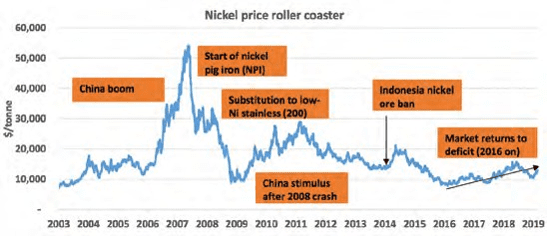
Since the price boom of 2006/07, it has been a rough time for nickel. As one of the main beneficiaries of the take-off in Chinese demand in the 2000s, nickel quickly came became a victim of its own success. After peaking at an all-time high of over $50,000/t in May 2007, prices fell to below $10,000/t by late-2008. High prices led to Chinese substitution away from the standard 300-series stainless steel, which contains 8% nickel, to 200-series stainless steel, containing only 1-2% nickel.

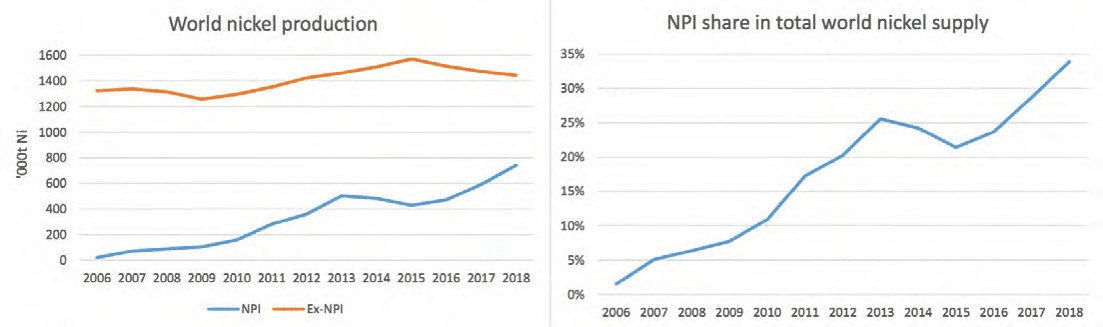
On the supply side, high nickel prices led to the development of a new source of nickel in the form of nickel pig iron. Nickel pig iron is a cheap alternative to pure nickel, used in the production of stainless steel. It’s made in an energy-intensive way, using blast and electric furnaces, and low-grade laterite nickel ores, mainly from the Philippines and Indonesia. Nickel pig iron now accounts for 35% of global nickel supply, compared to near- zero in 2006.

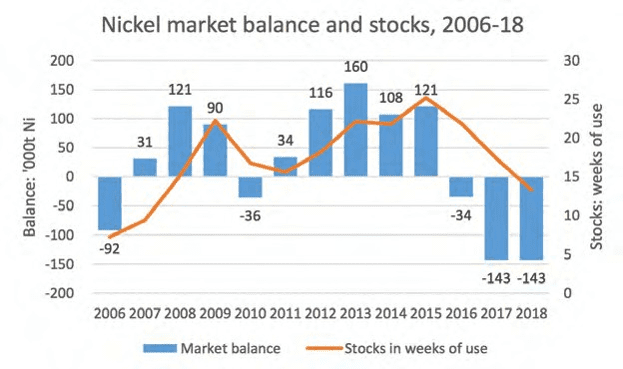
The low-point for nickel prices came in February 2016, when prices dipped below $8,000/t, resulting in over 80% of the global industry losing cash. Combined market inventories reached almost six months of consumption by the end of 2015, one of the highest levels ever seen in this market.

The combination of large closures of supply (over 200,000t) and a steady recovery in global demand has led to a remarkable recovery in the market over the past three years, with prices at one stage doubling from their lows.

The recovery in the past year or so has been hesitant given the still-high level of inventories hanging over the market, and uncertainties in Indonesian and Filipino government policy.

Despite a large deficit between supply and demand last year, prices were also hit by global macroeconomic concerns, including fears of a Chinese slowdown and the negative impact on global growth from a US-China and US-everyone else trade war.

So far, so good. Nickel prices have recovered to levels that are acceptable to most producers, but they still remain well below levels needed to incentivise investment in the next generation of supply. Nickel supply has become reliant on growth in nickel pig iron to meet incremental demand growth, and production by non-nickel pig iron producers in aggregate has been declining in recent years due to massive under investment in sustaining capital (see chart above).

This would be acceptable if the growth in nickel demand would continue to come mainly from stainless steel, but there is a new kid on the block: batteries. The use of nickel in batteries threatens a major transformation of nickel supply and demand over the next decade.

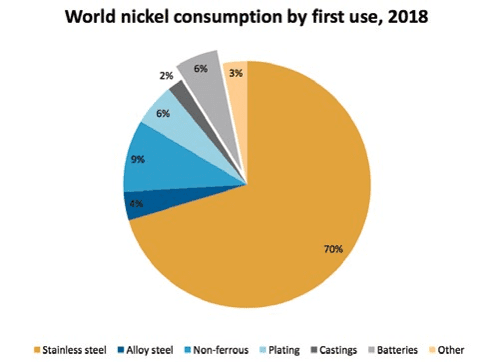
Last year, primary nickel use in batteries was just below 6% of total nickel demand compared with 70% for stainless steel. So far, the impact of nickel use in batteries on nickel pricing has been small, but that’s about to change – and probably sooner than many think.

Driven by governmental policy and environmental concerns, the switchover of the existing car fleet from internal combustion engines to hybrid, and ultimately fully electric vehicles (EVs), is now under way.

The production of EVs is still small-scale, and last year they accounted for only 2.5% of global vehicle sales, however the 60% growth YoY was significant. Even with consensus trend of a growth rate of 25-30% in sales a year, the share of EVs will grow steadily.

The predominant battery technology, at least for the next decade, is lithium-ion batteries. The big kicker for nickel over the other raw materials in the batteries (cobalt, manganese, lithium and graphite) is that, in order to increase the energy density of the batteries (raising the range between charges) and to reduce cobalt usage (perceived to be overly dependent on the Congo for supplies), the amount of nickel used per battery could easily more than double over the next 5-7 years.

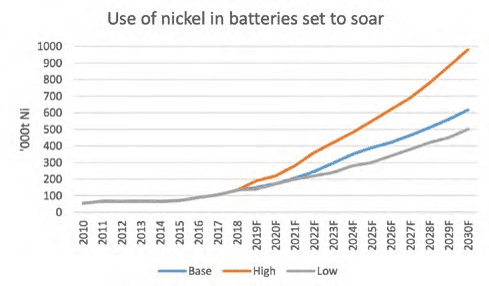
There is massive forecast uncertainty regarding the growth in electric vehicles and the take-up of different battery technologies (see chart below). This is always the case with breakthrough technologies, and history shows that forecasts are almost always too conservative (just look at the move from horses to internal combustion engines, and in the switch from fixed-line phones to mobile phones).

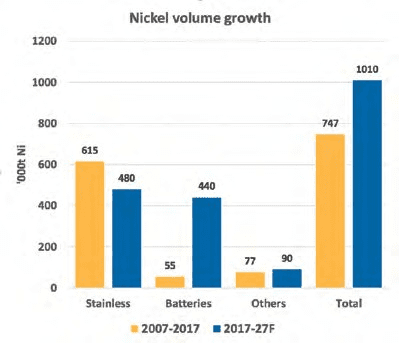
For that reason, we see a skewing of the high-case to the upside. Using the base case forecast, we foresee 440kt growth in nickel use in batteries over the next 10 years. Due to stainless steel’s dominant share of demand, stainless will continue to grow, and the need for new nickel supply in all uses will exceed 1mt, compared with 747kt within the next decade.

The nickel requirements for battery makers are very specific, with the main input being high-purity nickel sulphate. Until now, the main inputs for nickel sulphate production have been nickel-cobalt intermediates from the high-pressure acid leach (HPAL) and nickel leaching processes (nickel-cobalt hydroxides and sulphides), and class 1 nickel powders and briquettes. Class 1 nickel powders and briquettes are preferable to class 1 cathodes, due to their ability to dissolve quickly in sulphuric acid to make nickel sulphate.

We think the bulk of future demand for nickel in batteries will be met by the planned construction of HPAL and its capacity to make nickel-cobalt hydroxides. Projects currently exist in Australia, Turkey, Papua New Guinea, and Indonesia. Demand will also be met by existing nickel powder and briquette producers, who currently sell to the stainless steel industry.

Over the past six months, the nickel market has been rocked by announcements of multiple Chinese investments in Indonesia totalling over 150ktpa of nickel, seemingly at extremely low capital costs (under $20,000/t of nickel capacity) and extremely quick construction times (1-2 years). History suggests that these expectations are too optimistic and that projects built over the past 25 years have a tendency to cost 2-3 times more than original estimates and take 2-3 times longer to build and reach full capacity.

The reality is that all of these projects – and more – will be needed to meet burgeoning demand for nickel for batteries in the 2020s. Nickel prices are likely to rise to the $15-20,000/t range over the next five years as a result of an expected ongoing deficit between supply and demand, and in order to incentivise new investment. Exciting times are ahead for the nickel market.

Source: https://www.theassay.com/base-metals-insight/nickels-chance-to-shine-again/?utm_source=hs_email&utm_medium=email&utm_content=71613403&_hsenc=p2ANqtz-8JIoWa7OqC6R-fKGJOYkC_NK5xdAkGQxL6dSTiVC4tpWg_rth2cXnDXwwqkN8E83Cyk1mecgq1bjNPO6jw7ddOCJUHnA&_hsmi=71613403