Posted by AGORACOM-JC
at 12:00 PM on Tuesday, April 23rd, 2019
SPONSOR: North Bud Farms Inc. (NBUD:CSE) Sustainable low cost, high quality cannabinoid production and procurement focusing on both bio-pharmaceutical development and Cannabinoid Infused Products. Learn More.
NBUD: CSE
—————
Pot stocks are soaring and the cannabis industry is poised for ‘tons of growth’
Publicly traded cannabis companies have reported strong sales since Canada legalized pot last October and several US states voted to approve recreational and medical marijuana use
Cannabis has also gone mainstream thanks to big investments and partnerships between marijuana sellers and blue chip consumer companies.
New York (CNN Business) For decades, though nobody was really sure why, April 20 has been the unofficial holiday for marijuana users and a joke by and about them. Now, though, it’s also a reminder of how quickly marijuana is moving from illegal and a joke to a multi-billion dollar legal business — and a good time for us to take another look at how well cannabis stocks have been doing. Publicly traded cannabis companies have reported strong sales since Canada legalized pot last October and several US states voted to approve recreational and medical marijuana use. Cannabis has also gone mainstream thanks to big investments and partnerships between marijuana sellers and blue chip consumer companies. Corona owner Constellation Brands (STZ) has a more than 35% stake in Canopy Growth (CGC), a Canadian cannabis company that intends to take a bigger step into the United States with plans to buy American cannabis firm Acreage Holdings. Constellation also disclosed Thursday it may eventually boost its stake in Canopy to 50%.  Pot stocks may be a bubble that needs to burst Marlboro-owner Altria (MO) invested $1.8 billion in cannabis producer Cronos Group (CRON). And Tilray (TLRY) is working on cannabis-infused drinks with Budweiser owner AB InBev (BUD). But many of these stocks have soared this year already — Cronos is up nearly 60% so far while Canopy has gained 70% — leading to questions about whether this is just a speculative mania like tulips and dot-com companies.
Bubble or bargain?
“This business is still in its infancy. It’s like investing in
alcohol post-Prohibition. There will be tons of growth,” said Dan
Ahrens, chief operating officer with investment firm AdvisorShares. “But
there are going to be home runs and there will be lots of strikeouts.”
Ahrens thinks that investors need to be patient and selective. But
he believes they will be rewarded — that is, if they wind up picking the
winners.
“These are new, up and coming companies. There is going to be
volatility so you have to be selective,” Ahrens said, adding that he
favors companies that haven’t already shot up because they’ve done big
deals like Canopy and Cronos have.
Ex-NFL player Tiki Barber now invests in pot
AdvisorShares just launched the Pure Cannabis ETF (YOLO),
an actively managed fund that invests in cannabis stocks. Some of its
top holdings are Canadian cannabis companies CannTrust (CTST), Aphria (APHA) and Hexo (HEXO).
Canopy Growth co-CEO: Product opportunity is ‘substantial’05:27
Rob Almeida, global investment strategist with MFS Investment
Management, said investors may be getting ahead of themselves. He’s
worried that cannabis stocks are going to turn out to be an investing
fad like 3D printing and blockchain companies.
“Cannabis is not going to have parabolic growth,” Almeida told CNN Business. “There is a lot of hope and enthusiasm.”
Cannabis prices are falling
One cause for concern: Now that more states are legalizing marijuana use, prices are dropping as competition has increased.
Research firm BDS Analytics, which calculates a consumer price
index for the cannabis industry in the United States, recently reported
that overall prices in February for products such as ingestibles,
topical creams, vaporizers and vape pens and pre-rolled joints, fell
2.7% from February of 2018. Prices were down nearly 2% from the prior
month.
Many of the publicly traded cannabis companies have been reporting a
drop in the retail price in Canada since legalization last October as
well.
Aphria, for example, reported sales this week that missed
forecasts. Shares plunged nearly 15% on the news. But the stock is still
up more than 40% so far in 2019.
More deals likely on the way
A lot of the excitement has to do with expectations of more mergers and partnerships. Aurora Cannabis (ACB),
a Canadian company whose stock has soared 80% this year, recently
announced that it was adding legendary investor and deal maker Nelson
Peltz as an adviser.
That’s led to speculation that Peltz may help Aurora team up with a
consumer products or healthcare company. Tilray, for example, also has a
strategic relationship with generic drug maker Sandoz, a subisidiary of
Novartis (NVS). So other cannabis firms may look to team up with Big Pharma.
Canopy’s plans to buy Acreage could lead to another wave of consolidation too.
Matt Hawkins, managing principal at Cresco Capital Partners and an
investor in Acreage, said in an email to CNN Business that “this is the
moment the cannabis sector knew was coming — consolidation.”
Hawkins added that the deal “will lead to a rush of cannabis
companies merging in order to compete with Canopy/Acreage” and that
“it’s now going to be very hard for early start-ups to enter the space
and compete with the growing/emerging conglomerates.”
In other words, there’s another sign that cannabis is going legit: It’s starting to function just like any other major consumer industry.
Source: https://www.cnn.com/2019/04/19/investing/cannabis-stocks-420/index.html
Tags: CSE, Hemp, Marijuana, stocks, tsx, tsx-v, weed Posted in All Recent Posts, North Bud Farms Inc | Comments Off on North Bud Farms Inc. $NBUD.ca – #Pot stocks are soaring and the #cannabis industry is poised for ‘tons of growth’ $WEED.ca $CGC $ACB $APH $CRON.ca $HEXO.ca $TRST.ca $OGI.ca
Posted by AGORACOM-JC
at 3:35 PM on Monday, April 22nd, 2019
SPONSOR:Â Betteru Education Corp. Connecting global leading educators to the mass population of India. BetterU Education has ability to reach 100 MILLION potential learners each week. Click here for more information.
BTRU: TSX-V
————————
Bringing edtech solutions to the next half billion
As entrepreneurs ride the internet wave to build and provide
disruptive edtech solutions, it is important to remember that we’re only
just scratching the surface with its possibilities.
Today, there are about 260 million students in K12 schools and 30 million in higher education institutions
Further, there are 75 million children in the 3-6 year early childhood category, while at the other end of the age spectrum there are hundreds of millions of working professionals in need of constant upskilling due to the evolving nature of their jobs.
By Namita Dalmia
Today, there are about 260 million students in K12 schools and 30
million in higher education institutions. Further, there are 75 million
children in the 3-6 year early childhood category, while at the other
end of the age spectrum there are hundreds of millions of working
professionals in need of constant upskilling due to the evolving nature
of their jobs.
Families rely on education as a gateway to opportunity and a
meaningful life. Hence, 40% of K12 students go to private schools and
one-fourth students, from both government and private schools, opt for
after-school tuitions. Despite this, learning and employability outcomes
remain poor. Only 26% of Grade 5 students can do a simple division
(ASER 2016), 38% of youth in age 14-18 can apply mathematics to the
real-world problem of calculating ‘discount’ (ASER 2017), and 56% of
employers continue to report talent shortage (Manpower Group 2018).
However, it isn’t all bad news. India’s increasingly mobile-first
outlook offers the solution. In July 2018, 390 million Indians were
consuming nearly 8GB internet data each month. Over the next five years,
half a billion more will come online for the first time due to
declining internet prices and improving connectivity. Given the
education outcomes gap and India’s growth in mobile penetration,
education technology or edtech provides us a tool to level the field.
But in order to capitalise on this opportunity, edtech entrepreneurs
will have to build trust with the users, just like many other sectors
have—for example, bill payments, travel and online shopping. Over the
last few years, we have learnt the following ways in which edtech can
overcome some of these trust issues:
Rooting in sound, holistic pedagogy: Great teachers focus on deep
conceptual learning, real-life applications, personalised feedback and
continuous motivation. While most edtech provides some of these, they
miss out on other crucial elements. These solutions then rely on
successful implementation—at home by parents or in-class by teachers,
which is often lacking. Vedantu—a full-stack, live teaching
solution—bridges this gap by combining the skills of a great teacher
with an AI-personalised platform for individual learning support and
providing an academic mentor for motivational support.
Keeping users at centre: Any edtech solution must keep both teachers
and students at the centre of the solution. For a decade, a large amount
of content has been created and made available but has failed to see
significant pull from users. Doubtnut, a learning app, on the other hand
sees organic adoption and engagement with its doubt resolution feature
that solves pain point of students when they get stuck solving tricky
problems.
Linking & ensuring outcomes: Exam results and competitive
examinations ranks are yardsticks that help parents and schools to
measure outcomes. Offline players like tuition classes have created
brands on the back of the outcomes. Edtechs have surfaced but need to
accelerate outcomes in order to win in the long run. Similarly,
upskilling programmes for working professionals, English language
learning for vocational learners and coding boot camps for university
students can demonstrate success through job placements or increased
wages.
Going beyond ‘academic’ outcomes: Developing competencies like
critical thinking and creativity, and mindsets such as grit and empathy
are vital to quality learning and crucial for learners to succeed as the
workforce of the future. There is an opportunity for entrepreneurs to
build solutions that focus on building 21st century skills and
integrating these in the pedagogy of academic subjects. Code.org is an
example of a platform for building logic, creativity, algorithmic
thinking skills by teaching students how to code.
Optimising pricing: Edtech sold direct to learners will eventually
need to replace offline purchases and not just remain supplemental in
order to create value through monetisation. It must reduce the burden on
both parents’ wallets and students’ time and so a full-stack solution
has higher potential than a fragmented offering. Moreover, offering
trials or small-size purchase options before a full purchase is a useful
strategy to break trust barriers with first-time customers.
Building cultural relevance: A majority of learners are comfortable
in vernacular or bilingual medium of instructions, even when they go to
“English-medium†schools. Platforms like Khan Academy, DIKSHA, Doubtnut
cater to this need. Besides localising content offerings, edtech
entrepreneurs should adopt relevant UI/UX and product flow strategies
that will work with their target segments.
As education entrepreneurs ride the internet wave to build and
provide disruptive edtech solutions, it is important to remember we’re
only just scratching the surface with its possibilities. But there’s no
doubt that the education sector is ready more than ever for disruption
at scale.
The author is principal, Investments, Omidyar Network India, an investment firm focused on social impact
Posted by AGORACOM-JC
at 9:00 PM on Sunday, April 21st, 2019
SPONSOR: Enthusiast Gaming Holdings Inc.
(TSX-V: EGLX) Uniting gaming communities with 80 owned and affiliated
websites, currently reaching over 75 million monthly visitors. The
company’s partial 2018 (first 9 months) revenue of $7.4 million
representing a 625% increase over the same period in 2017.
EGLX: TSX-V ———————————-
As millions of dollars pour in, esports teams offer varying visions of the future
Tens of millions of dollars continue to flow towards top esports organizations, with Gen.G announcing a $46 million investment round Wednesday,
A raise featuring money from a mix of Silicon Valley venture capital firms, figures in traditional sports and actor Will Smith.
Gen.G., the parent company of the Overwatch League’s Seoul Dynasty, recently brought in $46 million in fundraising. (Robert Paul/Robert Paul) ByNoah Smith April 17
Tens of millions of dollars continue to flow towards top esports
organizations, with Gen.G announcing a $46 million investment round
Wednesday, a raise featuring money from a mix of Silicon Valley venture
capital firms, figures in traditional sports and actor Will Smith.
Flush with cash, and in some cases strengthened by the enforced
scarcity of a franchise model in publisher-driven leagues built around
games such as Overwatch and League of Legends, esports organizations are
starting to embark on long-term visions to shore up their positions for
the future. The visions themselves are far from uniform however, as
some seek to emulate traditional sports teams while others see something
quite different, operating more like full-on corporations than merely a
competitive organization.
Akin to European sports clubs that have teams which compete in
various sports — think Maccabi Tel Aviv, Real Madrid, and Bayern Munich —
esports organizations are companies that own teams which participate in
several different video games. But for some their business model
extends into other areas as well, including content creation and
apparel. In this way esports organizations are breaking from the
established business models of traditional sports, based heavily on
television broadcast revenue and box office receipts, to reimagine their
place in a new, online and global industry. The financial ecosystem
around many such outfits encompasses competitive video games, player
streaming on platforms like Twitch and Mixer, original unscripted
content and even gambling.
Cloud9, which raised $50 million last year and $25 million in 2017,
has decided to place some of its upcoming focus and capital on creating a
competitive structure for young players.
“Imagine baseball was invented last week, what would Little League
look like?†said Dan Fiden, president of Cloud9. Fiden said that, unlike
traditional sports which have youth leagues, esports for kids is
completely unstructured.
“Some of the players we sign have never been coached in anything ever,†he said.
The organization’s planned Los Angeles headquarters will feature a
public space where fans can meet up, interact with players, watch games
and it will also contain the “equivalent of the esports little league
diamond,†according to Fiden.
“We want to continue to continue to launch programs like this to
learn how best to organize and coach kids. We want to figure out the
curriculum,†Fiden said, but noted his organization’s core business
remains trying to win games.
Gen.G is also trying to move beyond the footprints of existing sports
teams via its international focus and content production, both common
in an industry that has been always been international and which
considers South Korea to be its Mecca. For content, fans expect access
to top players through Twitch and YouTube.
“We don’t have to just build versions of what we’ve seen yesterday,â€
said Gen,G CEO Chris Park, who was previously a senior executive for
Major League Baseball.
Park said his company will continue to place a heavy focus on growing
in China, Korea (they own the Seoul Dynasty team in Overwatch League),
and the United States.
In a departure from traditional sports, he said Gen.G will not only
be looking to attract top players, but top content creators as well,
since they plan to “create content that shows gaming is a culture and
way of life.â€
The 100 Thieves franchise, which received a high profile investment
from singer Drake, has established itself as an apparel company, with
its limited edition gear quickly selling out after its becomes available online.
The differing approaches illustrate that esports is still very much
amorphous and in its very early stages, even as investor attention —
and money — has arrived en masse. Park said that his organization was
“oversubscribed within hours†of announcing their latest raise. Fiden
said there has been “strong interest†in Cloud9 from investors since
2017.
Last year’s notable raises, in addition to Cloud9, include $38
million for Echo Fox, $37 million for TeamSoloMid, and $26 million,
including money from Michael Jordan, for Team Liquid.
A 2018 Goldman Sachs report
stated that esports have landed venture capital investment totaling
$3.3 billion since 2013, and $1.4 billion as of the middle of last year.
“We [the esports industry] look like the NBA did in late 60s, early
70s,†said Canaan Partners’ Maha Ibrahim, who has led the firm’s
investment in Gen.G.
Driving the spiraling valuations and investments, according to
Ibrahim and fellow investor in Gen.G, Roger Lee, of Battery Ventures,
are a mix of Overwatch League’s exposure on ESPN and an overwhelming
amount of data to support the viability of the enterprise. Seventy-nine
percent of esports viewers are under 35 years old and this audience, on
Twitch and YouTube, outstrips HBO, Netflix, and ESPN combined, according to Goldman Sachs.
Lee believes top esports teams have more visibility than a comparable
baseball team, and that once esports starts “generating more interest,
they’ll be worth the same amount.â€
Ibrahim agreed, saying, “Teams will be billion-dollar entities, of that I am sure.â€
For now, valuations, like those for many start-ups, are based on the
hope that attention will be converted to revenue at some future date. A
plurality of team revenue is from sponsorships, according to Goldman
Sachs, which projects that by 2022 that will shift to come from media rights.
Video games, including the professional competitive element, are not
widely seen as a threat by traditional sports leagues or teams —
especially those like the NBA and most of its franchises, which have
co-opted them. But in Hollywood, games like the Fortnite are
increasingly seen as a threat. Netflix, which is expected to spend $15
billion on shows this year said in a recent shareholder letter that, “We compete with (and lose to) Fortnite more than HBO.”
“This is more than a movement, it’s the next generation of media and media consumption,†Ibrahim said.
Posted by AGORACOM-JC
at 12:16 PM on Thursday, April 18th, 2019
SPONSOR: New Age Metals Inc. The company owns one of North America’s largest primary platinum group metals deposit in Sudbury, Canada. Updated NI 43-101 Mineral Resource Estimate 2,867,000 PdEq Measured and Indicated Ounces, with an additional 1,059,000 PdEq Ounces in the Inferred. Learn More.
NAM: TSX-V
———————
Supply And Demand Outlook Favors Palladium Vs. Platinum
Palladium has outperformed platinum ever since the fundamentals of
supply and demand have changed due to the diesel emissions scandal.
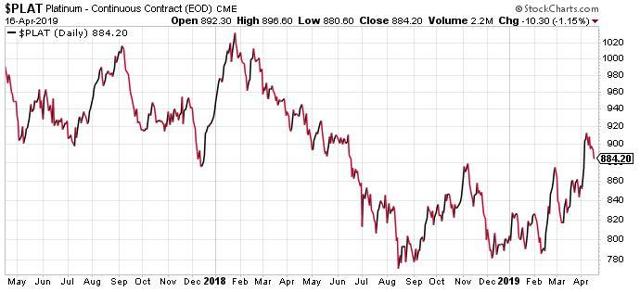
The gap between platinum and palladium has shrunk in recent weeks,
which would break the current trend of palladium outperforming platinum
if it continues.
Both the fundamental and technical pictures point to the trend
staying in place relative to platinum and palladium despite the recent
hiccup.
The biggest source of demand for platinum (PPLT) and palladium (PALL)
is the automotive industry where emission standards are becoming
increasingly stringent. These standards are driving demand for platinum
and palladium due to their ability to help reduce harmful emissions. The
result has been a sort of competition between the two of them.
However, the competition has become somewhat one-sided ever since the
platinum market was rocked in 2015 by the emissions scandal or “Diesel
Gate†involving Volkswagen (OTCPK:VWAGY).
The reason is because platinum is heavily used in vehicles with diesel
engines. On the other hand, palladium is associated with gasoline
engines.
Cars powered by diesel engines have since fallen out of favor, and
people are now turning towards cars powered by gasoline engines. This
trend does not look to change anytime soon, but it’s set to continue for
the foreseeable future. This is bullish for palladium and bearish for
platinum. The result can be seen in the supply and demand equation for
palladium and platinum.
The market for palladium has a deficit with a surplus for platinum
The emissions scandal has fundamentally altered the landscape for
vehicles powered by diesel and gasoline engines and, by extension,
platinum and palladium. The former is seeing demand decrease, and the
latter is seeing demand increase as there is a shift away from
diesel-powered cars towards gasoline-powered cars.
The two tables reveal that the platinum market has a surplus, with
supply exceeding net demand. Except for industrial demand, every other
segment, including autocatalyst, jewelry, and investment, is in decline.
While supplies from mining have stayed roughly the same, platinum
recycling is adding to the surplus of platinum in the market. The trend
is clearly bearish for platinum.
Platinum supply and demand (Unit: 1000 oz)
Supply
2016
2017
2018
South Africa
4392
4449
4471
Russia
717
703
657
Others
988
953
980
Total supply
6097
6105
6108
Demand
Autocatalyst
3342
3218
3052
Jewelry
2412
2400
2363
Industrial
1806
2022
2321
Investment
620
361
89
Total demand
8180
8001
7825
Recycling
-1934
-2072
-2215
Net demand
6246
5929
5610
Surplus/deficit
-149
176
498
Source: Johnson Matthey
The opposite is true for palladium. Supply of palladium falls short
of net demand and is driven primarily by the increased demand in the
autocatalyst segment. Recycling has made more palladium available, but
supplies have yet to eliminate the deficit in the market for palladium.
Overall, the trend for palladium looks to be a lot better compared to
platinum.
Palladium supply and demand (Unit: 1000 oz)
Supply
2016
2017
2018
South Africa
2570
2550
2590
Russia
2773
2406
2840
Others
1417
1405
1450
Total supply
6760
6361
6880
Demand
Autocatalyst
7951
8428
8655
Jewelry
191
173
166
Industrial
1875
1832
1855
Investment
-646
-386
-555
Total demand
9371
10047
10121
Recycling
-2491
-2899
-3212
Net demand
6880
7148
6909
Surplus/deficit
-120
-787
-29
The forecast for 2019 calls for more of the same, assuming there are
no unforeseen events that could disrupt the supply and demand equation.
Platinum will have a surplus, and palladium, a deficit. The trend
established in recent years as shown in the two tables is not expected
to change. That is bullish for palladium, but bearish for platinum.
Divergence in prices for platinum and palladium
As a result of a favorable outlook, palladium prices have vastly
outperformed platinum. While platinum used to command a much higher
price than palladium, the roles have now been reversed, and palladium is
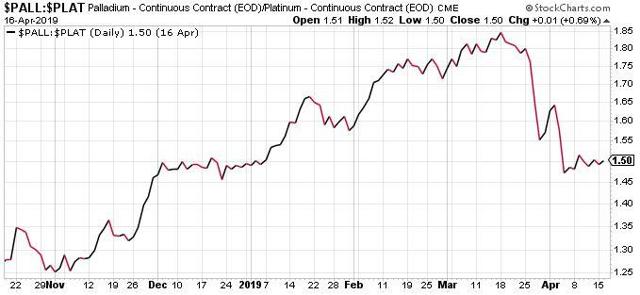
now worth more. The chart below tracks the relationship between
platinum and palladium prices.
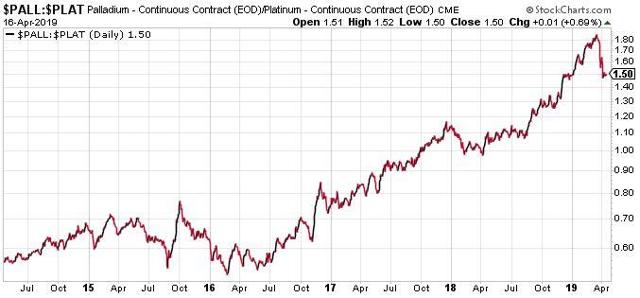
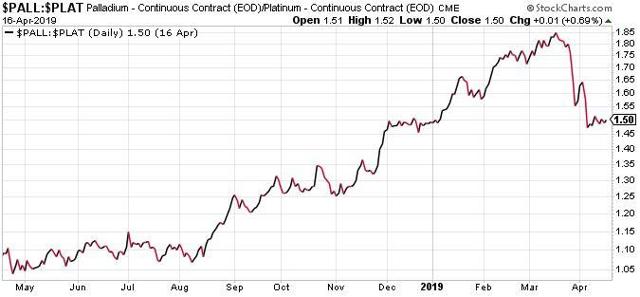
Notice that at its peak in March, a troy ounce of palladium was worth
almost two ounces of platinum. That ratio has now come down, and
palladium is now worth 1.5 ounces of platinum. A significant change, but
still far removed from the days when platinum was more expensive than
palladium.
However, the fact remains that the gap between platinum and palladium
has shrunk with platinum outperforming palladium during this time
frame. The gap could continue to shrink, but it could also begin to
widen as before. Which of the two is more likely to happen will depend
on a few factors that should be taken into consideration.
Can platinum and palladium be substituted for one another in the manufacture of an autocatalyst?
The short answer is yes, but only to a certain extent. While platinum
and palladium are more suitable and preferred in diesel and gasoline
vehicles, respectively, it is not absolutely necessary. The more
expensive palladium becomes relative to platinum, the more manufacturers
may be inclined to look into replacing palladium with platinum in the
manufacture of an autocatalyst. Not necessarily completely, but at least
partially.
In theory, this should act as a cap on palladium relative to
platinum. If the gap in prices between the two becomes too extreme,
precious metal substitution could force the ratio between palladium and
platinum to reverse and narrow. There would be less demand for palladium
and demand for platinum would increase under these conditions. However,
in practice, it is difficult to replace more expensive palladium with
cheaper platinum.
The two precious metals are only needed in trace amounts, and the
price difference would have to be very severe to make a noticeable
difference in the final cost of a vehicle. It also takes a lot of time
and expense to test that changes in precious metal composition in an
autocatalyst meet desired specifications. In a nutshell, while it’s
possible, it’s almost certainly not worth the trouble to replace
platinum with palladium or vice versa.
Why gold prices affect platinum more than palladium
Unlike palladium, platinum prices are more prone to being influenced by the price of gold (GLD).
The reason is because platinum is heavily used in jewelry, much more
than palladium. Because of this, platinum is in direct competition with
gold. In fact, people often have to decide which of the two, gold or
platinum, they will select in a purchase.
People will more often than not pick gold, but they may be tempted to
go for platinum if the former is much more expensive than the latter.
Rising gold prices are, therefore, good for platinum because it makes
platinum a more attractive substitute. But if gold prices fall, then
there is less need for platinum because most people tend to prefer gold.
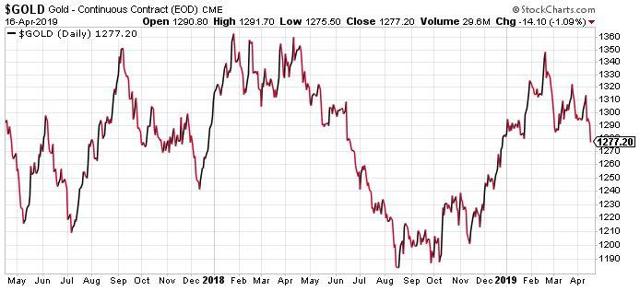
It’s, therefore, necessary that we look at gold when considering
where platinum will go relative to palladium. The ratio between gold and
platinum prices has changed recently as gold prices have gone down. A
previous article discussing why gold is likely to face pressure can be
found here.
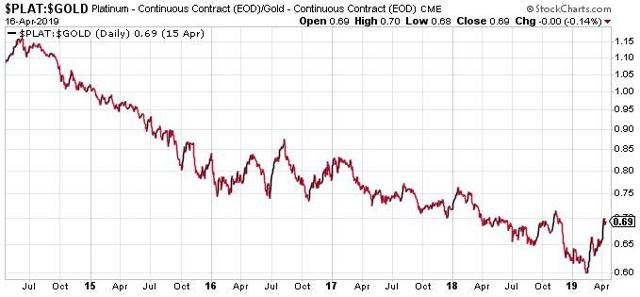
The chart above tracks the relationship between platinum and gold
prices. Notice that while an ounce of platinum was roughly equal to 60%
of gold at its low, the ratio has gone up and is now at almost 70%. What
this basically means is that platinum’s appeal as an alternative has
declined versus gold. This should be seen as a negative for platinum
demand, which could put downward pressure on the price of platinum.
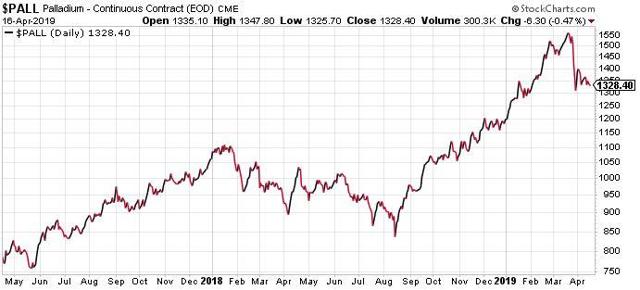
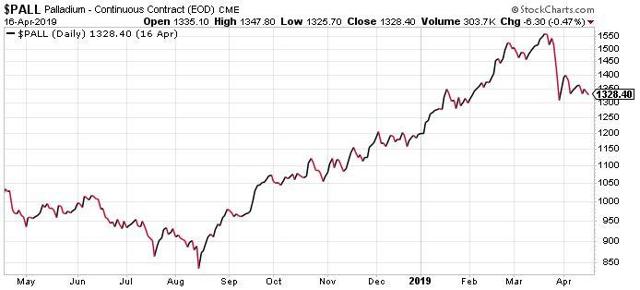
Palladium looks to be priming itself for a big move
Palladium prices have been going sideways after a big drop from their
recent highs. In fact, the chart pattern for palladium resembles that
of a symmetrical triangle or a coil. If this technical analysis is
correct, then a big move may be coming once consolidation is done. The
triangle could resolve to the downside, but it’s more likely to continue
the long-term trend, which is up.
Both the fundamental and technical pictures suggest that a move to
the upside is the most probable outcome. In contrast, platinum is being
held back by a number of issues as a previous article explains here. This would reverse the narrowing of the spread between platinum and palladium and, instead, widen the gap that exists.
The ratio between palladium and platinum has been stuck at around
1.5, as previous charts reveal. This ratio could decrease further, but
the most likely path is for the ratio to resume its previous uptrend
after the time it has spent consolidating. This would be consistent with
the price of palladium outperforming that of platinum.
Palladium will outperform platinum
It’s important to mention that the long-term picture for platinum and
palladium in terms of demand is not a good one. Recent research
suggests that it will one day be possible to make an autocatalyst
without the need for any precious metals such as platinum and palladium.
If this happens, then both metals will be left without their biggest
source of demand.
Furthermore, electrical vehicles are on the rise, and they do not
emit the harmful emissions that platinum and palladium are tasked with
reducing. The challenge for platinum and palladium will be to find new
applications where they can be used. Otherwise, the future of platinum
and palladium does not look all that bright.
Having said that, palladium is most likely to outperform platinum
with both charts and supply and demand in its favor. There is still a
shortage of palladium that the market will not be able to resolve in the
short term. The supply deficit, combined with the recent consolidation
in prices after a major correction, will most likely result in palladium
rising again.
On the other hand, gold is under pressure, and it’s hard to see
platinum doing well when gold is struggling. There is also a surplus of
platinum that will not go away anytime soon. Therefore, barring a major
supply disruption, such as a major strike that drastically reduces
supplies, platinum is highly unlikely to do as well as palladium.
Platinum may have outperformed palladium in recent weeks, but that
should soon reverse.
Posted by AGORACOM-JC
at 11:32 AM on Thursday, April 18th, 2019
SPONSOR: North Bud Farms Inc. (NBUD:CSE) Sustainable low cost, high
quality cannabinoid production and procurement focusing on both
bio-pharmaceutical development and Cannabinoid Infused Products. Click Here For More Information
While cannabis investors are distracted by seeds and crop yields,
corporations with M&A in mind see a more lucrative future in
brand-building and retail.
Cannabis growers have hardly any revenue and their product is still
illegal in their most desirable market, the U.S. That’s not stopping
investors and corporate giants from spending billions of dollars to
take stakes in these companies. They obviously see growth potential. And
yet the question remains, how do you even value a pot business?
Altria Group Inc., the U.S. tobacco leader and maker of Marlboro cigarettes, announced in December that it was buying 45 percent of Cronos Group Inc.,
one of Canada’s growing number of cannabis producers and among the
industry’s high-flying stocks. The $1.8 billion transaction left us
wondering: How did Altria determine that price? After all, in the period
before the deal, Cronos generated sales of less than $4 million – no,
that’s not a typo – and certainly no profits. Recreational pot had only
just become legal in Canada two months earlier. Altria, a $105 billion
market-cap company that rarely does splashy deals, placed immense value
on a barely existent business in a nascent market.
The projected growth of the worldwide cannabis market has some
investors pouring money into newcomer companies with tiny revenue and no
profits
Source: Arcview Market Research, BDS Analytics
It’s a tricky thing to gauge the worth of assets that will
potentially be highly valuable down the road – but are difficult to
quantify just yet. Looking at other industries where this has been the
case is helpful. Even if their businesses aren’t perfect comparisons,
the method of valuing them can be instructive.
Take the natural-resources space, where the focus is often on
non-financial metrics. They include production capacity and tangible
assets, such as proved oil reserves – which is to say, how much fuel a
producer can likely pump from their land. It can be argued that this
is similar to how individual investors already have been gauging
cannabis companies, dazzled by how many kilograms can be produced and
how many acres of greenhouse they have.
But the downside to this approach for cannabis is that it puts too
much emphasis on supply-chain processes that may become commoditized,
and a rudimentary focus on capacity doesn’t capture how the early movers
in this market can differentiate themselves. The industry’s novelty
also distracts from what can be a challenging business from an
operational standpoint. For example, Aphria Inc.’s share price increased
more than elevenfold over the last five years, but in its latest
quarter the business was hamstrung by supply shortages and packaging
issues.
A better comparison for cannabis may be the biotechnology space.
Deals for drug developers involve big, risky bets on future potential
blockbusters. These products may not generate revenue yet, but they aim
to address very specific markets and are expected to have an economic
moat that wards off competition. For pharmaceuticals, that moat comes
from patent exclusivity that prevents copycat versions of a therapy. In
some ways, this is what the more advanced cannabis companies are looking
to accomplish. They won’t have patents in the same way, but they do aim
to create intellectual property and specialized brands that appeal to
certain types of customers. And they want to be first to form those
customer relationships.
Remember, this market will be far more expansive than simply selling a
box of joints. There’s an opportunity to create all sorts of consumer
products, and the marketing can vary widely – from wellness drinks and
beauty items infused with cannabidiol, or CBD (the part of cannabis that
doesn’t deliver a high), to “sin†products like marijuana-infused
edibles, or something more akin to having a glass of wine.
Taking Off
As the recreational cannabis market surpasses the medical one, it
will become increasingly important for companies to create compelling
brands
Source: Arcview Market Research, BDS Analytics
Look at it this way: Altria doesn’t own tobacco farms. It owns
high-margin brands that source from tobacco growers. So when it’s
studying the future of marijuana, it’s not looking solely at production.
It’s looking for unique brands that can be scaled up by a team with the
necessary know-how. In the case of Cronos, CEO Mike Gorenstein said on
the last earnings call that the company is trying to differentiate
itself with pre-rolled joints, adding that innovation around branding
and efficiency will be “a bigger differentiator than just cultivation.â€
Knowing the important role that brand-building will play in the next phase of the cannabis industry’s growth story,
it’s useful to study these companies’ senior management teams and look
for branding and retail pedigree. It’s a good sign that Cronos’s head of
marketing has had stints at PepsiCo Inc. and Mondelez International
Inc., and that Tilray Inc. has a one-time Starbucks Corp. executive
running its retail strategy.
Green Growth Brands Inc., based in Ohio and Ontario, has a deep bench
of such leaders: Its CEO is Peter Horvath, a former executive at
American Eagle Outfitters Inc., Victoria’s Secret and DSW. His key
deputies come from the likes of Abercrombie & Fitch Inc. and Bath
& Body Works. They are rightly emphasizing that retail expertise is a
point of distinction and an advantage as they develop targeted brands
such as Green Lily, aimed at women, and Camp, aimed at active, outdoorsy
types. This brand-centricity seems to be paying off: Even though Green
Growth doesn’t have as large a market capitalization as the
Canada-based players, it recently scored a partnership with Simon
Property Group Inc. to open more than 100 CBD stores in the mall giant’s shopping centers, and its CBD products will be sold in 96 DSW locations.
That U.S. footprint might do it good down the road, as wider
marijuana legalization seems likely. While much of the focus these days
is around the promise of the Canadian market, it’s important not to let
that obscure what should be the cannabis world’s real end game.
Sizing Up The U.S. Prize
California alone has a larger population than Canada, illustrating
why the U.S. remains such a tantalizing opportunity for the cannabis
industry
Source: Statistics Canada, U.S. Census Bureau
And, in general, the Canadian companies that have received such
bountiful investor buzz are at something of a disadvantage on the
branding front, notes Bethany Gomez, a cannabis industry analyst at
Brightfield Group. Because of strict rules in Canada regarding logo size and other packaging details for currently available cannabis products, they are simply limited in how distinctive they can make their presentation.
Wherever it’s sold, if the cannabis business is to grow as big as the
industry’s bulls hope, it is going to have to successfully court
non-users and infrequent users. That’s where newer innovations, such as
edibles and beauty items, may be more important than smokeable
products.
Not Quite Cannabis Crazy
In U.S. markets that have legalized recreational marijuana, many
people are still not consuming cannabis, underscoring the opportunity to
grow addressable market
Source: BDS Analytics Consumer Insights
The companies that become the breakout stars in the legal cannabis
era will be the ones that have a vision for how to create demand for
such goods, whether through curiosity-inducing product, a great in-store
experience or alluring marketing. These capabilities – not merely
spreading more seeds in soil – should be a critical part of valuing the
pot pioneers.
Posted by AGORACOM-JC
at 10:03 AM on Thursday, April 18th, 2019
SPONSOR: Tartisan Nickel (TN:CSE) Kenbridge Property has a measured
and indicated resource of 7.14 million tonnes at 0.62% nickel, 0.33%
copper. Tartisan also has interests in Peru, including a 20 percent
equity stake in Eloro Resources and 2 percent NSR in their La Victoria
property. Click her for more information
Under a 100 percent renewable energy scenario, metal requirements could rise dramatically, requiring new primary and recycled sources
Clean technologies rely on a variety of minerals, principally cobalt, nickel, lithium, copper, aluminum, silver and rare earths. Cobalt, lithium and rare earths are the metals of most concern for increasing demand and supply risks
The growing demand for minerals and metals to build the electric vehicles, solar arrays, wind turbines and other renewable energy infrastructure necessary to meet the ambitious goals of the Paris Climate Agreement could outstrip current production rates for key metals by as early as 2022, according to new research by the UTS Institute for Sustainable Futures.
The study, commissioned and funded by U.S. non-profit organisation
EarthWorks, shows that as demand for minerals such as lithium and rare
earths skyrockets, the already significant environmental and human
impacts of hardrock mining are likely to rise steeply as well. In a
companion white paper, Earthworks makes the case for a broad shift in
the clean technologies sector towards more responsible minerals sourcing.
“We have an opportunity, if we act now, to ensure that our emerging clean energy
economy is truly clean – as well as just and equitable – and not
dependent on dirty mining,” said Payal Sampat, Earthworks Mining
Director. “As we scale up clean energy technologies in pursuit of our
necessarily ambitious climate goals, we must protect community health,
water, human rights and the environment.”
“The responsible materials transition will need to be scaled up just as ambitiously as the 100 percent renewable energy transition,” said Dr Sven Teske, Research Director at the UTS Institute for Sustainable Futures.
Doing so will require a concerted commitment from businesses and
governments, according to the report’s lead author Elsa Dominish, Senior
Research Consultant at the UTS Institute for Sustainable Futures. “We
must dramatically scale up the use of recycled minerals, use materials
far more efficiently, require mining operations to adhere to stringent,
independent environmental and human rights standards, and prioritise
investments in electric-powered public transit.
“The renewable energy transition will only be sustainable if it
ensures human rights for the communities where the mining to supply
renewable energy and battery technologies takes place. If manufacturers
commit to responsible sourcing this will encourage more mines to engage
in responsible practices and certification. There is also an urgent need
to invest in recycling and reuse schemes to ensure the valuable metals
used in these technologies are recovered, so only what is necessary is
mined,” Ms Dominish said.
Research highlights:
Under a 100 percent renewable energy scenario, metal requirements
could rise dramatically, requiring new primary and recycled sources
Clean technologies rely on a variety of minerals, principally
cobalt, nickel, lithium, copper, aluminum, silver and rare earths.
Cobalt, lithium and rare earths are the metals of most concern for
increasing demand and supply risks
Batteries for electric vehicles are the most significant driver of accelerated minerals demand.
Recycled sources can significantly reduce primary demand, but new
mining is likely to take place and new mining developments linked to
renewable energy are already underway
Responsible sourcing is needed when supply cannot be met by recycled sources
Minerals extraction already exacts significant costs on people and the environment, fuelling conflict and human rights
violations, massive water pollution and wildlife and forest
destruction. Most of the world’s cobalt, used in rechargeable batteries
for electric vehicles
and phones, is mined in the Democratic Republic of Congo, often by hand
in unsafe conditions using child labor. Earlier this year in Brazil,
the collapse of two tailings dams at Vale’s Brumadinho iron ore mine
killed hundreds of workers and local residents. Independent research
that analyses decades of data on mine waste dam failures reveals that
these catastrophic failures are occurring more frequently and are
predicted to continue to increase in frequency.
“In Norway, the government tell us we have to sacrifice our fjords to
mine copper for clean energy,” said Silje Karine Muotka, a member of
the Saami Parliament, which is fighting a mine proposal in their
traditional reindeer herding grounds. “I recognise that we need
materials for new technologies, but we should look for ways to get them
that do not harm the environment or threaten native culture.”
“Solar and wind production is growing rapidly, while the cost of clean energy technologies
has continued to fall,” said Danny Kennedy, Managing Director at the
California Clean Energy Fund. “If the clean tech revolution has taught
us anything, it is that humanity possesses boundless capacity for
innovation. Our task is to establish the parameters within which
innovators can innovate to ensure that clean energy is truly clean.”
Earthworks commissioned the ISF research as part of its
newly-launched ‘Making Clean Energy Clean, Just &
Equitable’ initiative, which aims to ensure that the transition to
renewable energy is powered
by responsibly and equitably sourced minerals, minimizing dependence on
new extraction and moving the mining industry toward more responsible
practices.
Posted by AGORACOM-JC
at 4:19 PM on Wednesday, April 17th, 2019
WHY NORTHBUD FARMS?
Canadian regulatory door for CIP (Cannabinoid Infused Products) is opening this year as shown in other legal jurisdictions (Colorado, Washington, Nevada, California)
Infused products sector has become the highest margin segment of the industry
Positioned to be a raw input producer for this space
Currently working with multiple food,
beverage and science companies to provide safe standardized cannabinoid
infused raw inputs for large scale GMP manufacturing of products
Signed Binding Letter of Intent to Enter U.S. Market with Strategic Acquisition of Multi-State Licensed Operator Eureka Vapor Read Release
CHECK OUT OUR RECENT INTERVIEW
FULL DISCLOSURE: NORTHBUD is an advertising client of AGORA Internet Relations Corp.
Tags: CSE, Hemp, Marijuana, stocks, tsx, tsx-v, weed Posted in All Recent Posts, North Bud Farms Inc | Comments Off on CLIENT FEATURE: NORTHBUD $NBUD.ca Signs $20 MILLION Binding LOI For Acquisition of Multi-State Licensed Operator Eureka Vapor WEED.ca $CGC $ACB $APH $CRON.ca $HEXO.ca $TRST.ca $OGI.ca
Posted by AGORACOM-JC
at 11:24 AM on Wednesday, April 17th, 2019
SPONSOR: Enthusiast Gaming Holdings Inc.
(TSX-V: EGLX) Uniting gaming communities with 80 owned and affiliated
websites, currently reaching over 75 million monthly visitors. The
company’s partial 2018 (first 9 months) revenue of $7.4 million
representing a 625% increase over the same period in 2017.
EGLX: TSX-V ———————————-
Will Smith takes slice of Esports team’s US$46 million financing
Actor Will Smith and Japanese soccer legend Keisuke Honda are among the new investors in esports franchise Gen.G, which announced a new $46 million round of financing Wednesday.
Eben Novy-Williams, Bloomberg News
Will Smith reacts at a closing ceremony press conference during the
2018 FIFA World Cup at Luzhniki Stadium on July 13, 2018 in Moscow,
Russia. (Photo by Dan Mullan/Getty Images). , Dan Mullan/Getty Images
Europe
Actor Will Smith and Japanese soccer legend Keisuke Honda are among
the new investors in esports franchise Gen.G, which announced a new $46
million round of financing Wednesday.
Smith and Honda’s Dreamers Fund, a investment vehicle they launched
last year, are joined by Los Angeles Clippers minority owner Dennis Wong
and Michael Zeisser, former chairman of U.S. investments at Alibaba
Group Holding Ltd.
“It’s exciting to see the worlds of technology, media, sports and now
celebrity come together,†said Chris Park, chief executive officer of
Los Angeles-based Gen.G.
Gen.G operates teams in seven different video games and has offices
in China, South Korea and the U.S. Its franchises include the Overwatch
League’s Seoul Dynasty, which will move to South Korea from Los Angeles
next year.
In addition to handling that transition, Gen.G is expanding in China,
investing in player development and trying to increase revenue from
esports-specific areas like streaming and the sale of in-game items.
“The coming years are going see our company really start to
crystallize its identity, not just as a brand, but also as an
enterprise,†Park said.
To that end, Smith and Honda will join 11-time National Basketball
Association All-Star Chris Bosh, already a Gen.G adviser, in helping
grow Gen.G’s media presence. That includes creative and commercial
projects, and helping Gen.G athletes with content creation.
Other new investors in Gen.G include Battery Ventures, New Enterprise
Associates, MasterClass co-founder David Rogier and Stanford
University. Silicon Valley Bank, which helped with the fundraising, is
becoming both an investor and a sponsor.
Posted by AGORACOM-JC
at 10:23 AM on Wednesday, April 17th, 2019
SPONSOR: ThreeD Capital Inc. (IDK:CSE) Led by
legendary financier, Sheldon Inwentash, ThreeD is a Canadian-based
venture capital firm that only invests in best of breed small-cap
companies which are both defensible and mass scalable. More than just
lip service, Inwentash has financed many of Canada’s biggest small-cap
exits. Click Here For More Information.
——————-
Blockchain Goes To Work At Walmart, IBM, Amazon, JPMorgan, Cargill and 45 Other Enterprises
On the Jersey side of the Hudson River just across from Manhattan’s
Financial District, there is a glass-and-steel office tower designed in a
severe International Style aesthetic. “DTCC†is emblazoned across the
top, but few outside of Wall Street realize that in this building,
occupied by the Depository Trust & Clearing Corp., are records for
most of the world’s securities, representing some $48 trillion in
assets—from stocks and bonds to mutual funds and derivatives. In the
1970s, Wall Street created a DTCC predecessor to replace a system that
had been powered by young men running around the cavernous alleys of
lower Manhattan delivering stock certificates from brokerage house to
brokerage house.
DTCC still has paper certificates in its vaults, but records Ârelated
to the 90 million daily transactions it handles are kept electronically
on its servers and backed up in various locations. Thousands of
financial institutions and exchanges in 130 countries rely on DTCC for
custody, clearing, settlement and other clerical Âservices.
In a few months DTCC will begin the largest live implementation of
blockchain, the distributed database technology made popular by the
bitcoin cryptocurrency. Records for about 50,000 accounts in DTCC’s
Trade Information Warehouse, where information on $10 trillion worth of
credit derivatives is stored, will move to a customized digital ledger
called AxCore.
According to Rob Palatnick, DTCC’s chief technology architect, the
warehouse already keeps an electronic “golden record†of events such as
maturity dates, payment calculations and other activities needed to
clear and settle these securities daily. But each participant in a
complicated credit derivatives transaction also keeps its own records,
which must in turn be reconciled multiple times before the investment
matures. By moving those records to the blockchain, visible to all
participants in real time, most of those redundancies won’t be
necessary.
“We’re not talking about eliminating humans and firms,†PaÂlÂatnick
says. “We’re talking about getting rid of layers of databases and
translations between those databases.â€
On the other side of the world, in Taipei, Taiwan, Foxconn, the
electronics giant best known as a manufacturer of iPhones, launched a
Shanghai startup called Chained Finance with a Chinese peer-to-peer
lender. Chained will soon connect Foxconn and its many small suppliers
(and their suppliers’ suppliers) on an Ethereum-based blockchain that
will use its own token and smart contracts (read: automatically
executed) to make payments and provide financing in near real time,
eliminating a daisy chain of paperwork.
“We view blockchain as the skeleton of our work,†says Jack Lee, the
founder of Foxconn’s venture capital arm, which has invested $40 million
in six blockchain startups. “Smart contracts that automatically execute
transactions are the muscles, and tokens are the blood.â€
Welcome to the brave new world of enterprise blockchain, where
corporations are embracing the technology underlying cryptocurrencies
like bitcoin and using it to speed up business processes, increase
transparency and potentially save billions of dollars. At its core,
blockchain is simply a distributed database, with an identical copy
stored on many computers. That facilitates transactions (financial or
otherwise) between individuals (or companies) that don’t know or trust
each other. It’s virtually impossible to cheat, since every transaction
is recorded in many Âplaces and the details of those transactions are
visible to everyone. Companies are already using blockchain to track
fresh-caught tuna from fishing hooks in the South Pacific to grocery
shelves, to speed up insurance claims and to manage medical records.
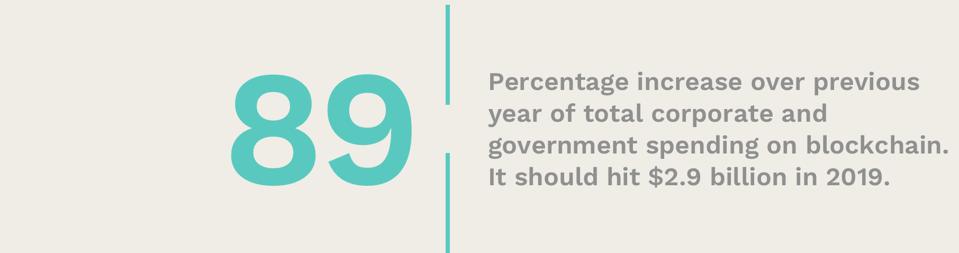
Total corporate and government spending on blockchain should hit $2.9
billion in 2019, an increase of 89% over the previous year, and reach
$12.4 billion by 2022, according to the International Data Corp. When
PwC surveyed 600 “blockchain-savvy†execs last year, 84% said their
companies are involved with blockchain.
To chronicle the rise of so called “enterprise†blockchain, Forbes has
created its first annual Blockchain 50 list of big companies that are
putting the technology to work in Âmeaningful ways. While blockchain’s
first application, cryptocurrency, is struggling to achieve mainstream
adoption, these companies are committing manpower and capital to build
the future on top of shared databases.
The version of a blockchain future these companies are building is,
for the most part, far different from what the founders and early
adopters of blockchain had envisioned. While many cryptoÂcurrency
idealists fantasize about a global, public network of individuals
connected directly and democratically, without middleÂmen, these
companies—many of which are middlemen themselves like DTCC—are building
private networks they will use to profit from centralized management.
Not surprisingly, financial firms—from Allianz to Visa and JPMorgan
Chase—dominate the list. But Blockchain 50 companies run the gamut of
industries, including energy firm BP, retailer Walmart and media company
Comcast.
Because of the lingering bad taste left by bitcoin drug bazaars like
Silk Road and the 2017 digital currency bubble, most companies emphasize
the distinction between crypto and blockchain, shunning the former and
embracing the latter. In some ways the members of the Blockchain 50
represent a bridge between the old and new worlds. Just as internal
computer networks were adopted by companies long before the internet
took off, these firms are starting by adopting distributed ledger
technology at a small scale.
“The era of blockchain tourism has ended,†says Bridget van
Kralingen, Senior Vice President for Platforms & Blockchain. “We’ve
really seen blockchain move from being overshadowed by cryptocurrency to
focus on real business problems and complex processes.â€
In 2009, when Satoshi Nakamoto, bitcoin’s pseudonymous creator,
activated his network, its blockchain was the underlying accounting
system that let anyone with bitcoin transfer money without the need of a
middleman. Transactions are processed in blocks—just a fancy word for a
hunk of data—about every ten minutes, each containing a compressed
version of the previous block, linking them together into a chain.
Instead of relying on a bank or another middleman to keep track of when a
bitcoin leaves one location and arrives at another, the thousands of
computers on the bitcoin network do the work and in exchange for their
efforts are paid in bitcoin.
For most companies this presented a potential problem. While
identities aren’t required to use the bitcoin blockchain, the
transactions themselves are tied to addresses that are publicly
available, meaning that with a bit of work many of these addresses can
be tied to actual people or companies. Thus enterprises like Coca-Cola
and JPMorgan Chase, accustomed to maintaining competitive advantages
based on proprietary processes and control, were initially skeptical of
cryptocurrency.
Businesses also need some control over their data. “The entire
corporate world has been fashioned around who has responsibility over a
particular part of the business flow,†says David Treat, the global head
of Accenture’s Financial Services Blockchain practice. “There can be no
gaps, because that is unacceptable for a multibillion-dollar company.
You cannot have a gap, or you are subject to huge security breaches and
social contract breaches.â€
Perhaps no firm has had a greater influence on the growing corporate
use of blockchain technology than Digital Asset Holdings, a New
York-based startup that hired the former JPMorgan Chase banker Blythe
Masters as its CEO in early 2015. Under Masters, Digital Asset began
making acquisitions and almost immediately purchased a small company
that was in the process of building an “invitation only,†or
permissioned, blockchain. Then in late 2015 Digital Asset donated the
code for its “open ledger†project to the Linux Foundation, which
supports commercial open-source software projects, including the Linux
operating system.
The project was called Hyperledger, and thanks in part to ÂMasters’
connections, its backers read like a who’s who of finance and
technology. Thirty companies are listed as founders, including ABN AMRO,
Accenture, Cisco, CME Group, IBM, Intel, JPMorÂgan Chase, NEC, State
Street, VMware and Wells Fargo. HyperÂledger immediately established
itself as the gold standard for corporate blockchain projects.
What happened next might be considered the Big Bang moment of
enterprise blockchain. In early 2016, IBM donated 44,000 lines of code
to the project, which formed the core of a new blockchain with faster
speeds and increased privacy. No fewer than half of the members of the
Forbes Blockchain 50 are now using that blockchain, known as Hyperledger
Fabric.
“We’ve been very focused on making sure that not only is the
blockchain technology standard but that the documents and data are
standard,†says Marie Wieck, IBM Blockchain’s general manager. “This
standardization allows [the companies] to not spend their time comparing
differences and validity in the documents.â€
Shortly after the launch of Hyperledger, which is a nonprofit
venture, a New York fintech called R3 raised $107 million from the likes
of ING, Barclays and UBS to create a for-profit enterprise blockchain
platform called Corda Enterprise.
As the commercial potential of co-opting blockchain technology became
more apparent, many cryptocurrency startups began to rethink their
models.
For example, San Francisco’s Ripple, originally called OpenCoin and
conceived of as yet another alternative monetary system, expanded its
focus in late 2015 from the cryptocurrency (called ripple and trading as
XRP) to building software for large banks. A bitcoin startup called
Counterparty spawned another company, Symbiont, in March 2015, which
coded a proprietary blockchain that’s now being used by Vanguard for
sharing stock index data. In February 2017, ConsenSys, a Brooklyn-based
collection of crypto companies controlled by one of Ethereum’s founders,
helped launch the Enterprise Ethereum Alliance.
Just as corporate America co-opted counterculture vibes for its
marketing and advertising (“Think Different,†“Don’t Be Evilâ€), its most
forward-thinking businesses are fast incorporating a technology that
was designed in large part to eliminate them.
In insurance, for example, MetLife’s mobile app Vitana bundles
insurance with a test for gestational diabetes that uses a blockchain to
record data and verify and pay claims. In recent testing in Singapore,
where one in five expectant mothers develops gestational diabetes, a
practitioner simply enters a positive test result into a patient’s
electronic medical record and in a matter of seconds MetLife’s smart
contract deposits an insurance payment into that patient’s bank account
to cover the medical expenses associated with the condition. No
paperwork or claim filing necessary.
Similarly, Germany’s Allianz, working with EY, tested moving certain
captive insurance claims processes—often involving many emails,
attachments and phone calls across multiple times zones—to a private
blockchain. The time required to process a claim fell from weeks to
hours.
The French bank BNP Paribas, which has lent money to commodities
traders since the 19th century, is considering using a ledger platform
called Voltron to process letters of credit for traders. Northern Trust
has begun administering private equity funds using Hyperledger Fabric.
Broadridge Financial has been running pilots testing multiple
distributed ledgers for its dominant proxy voting and shareholder
communications business.
“In real time, you know who owns the stock, who’s entitled to vote
and how it’s tied to the universally-agreed-upon shareholder meeting
agenda,†says Michael Tae, Broadridge’s head of strategy.
Golden State Foods, a big McDonald’s supplier that makes more than
400,000 hamburgers per hour, tracks the location and temperature of its
patties with devices like radio-frequency ID tags and Hyperledger
Fabric. The system can immediately alert GSF to conditions that might
lead to spoilage. At the same time, it can optimize inventory levels by
tracking how much meat is in a truck or in a restaurant’s freezer, in
real time.
At this year’s SXSW conference in Austin, Texas, Bumble Bee unveiled
an SAP-built supply-chain blockchain offering complete transparency to
its customers. Soon you will no longer have to take Bumble Bee’s word
for it when its assures you that the 12-ounce package of yellowfin tuna
you just bought was caught by individual fishermen in the South Pacific
and not by a factory ship. The fishing crews, tuna processors and
packers are now entering their own data in real time on Bumble Bee’s
distributed ledger. By summer, Bumble Bee will be sharing that
information with retailers and customers who take the time to check.
From a public relations standpoint alone, Bumble Bee’s SAP blockchain
is likely to bear dividends. In 2017 Greenpeace ranked Bumble Bee 17th
out of 20 tuna brands for its sustainability practices, accusing it of
“greenwashing†a host of bad behaviors with environmentally friendly
marketing.
“Food safety and sustainably sourced product has become an
overwhelmingly important topic in our industry,†says Tony Costa, the
CIO at Bumble Bee. “Leveraging the latest technology enables us to open
it up to more of a public perspective, if you will. So we get out of the
business of managing data. We’re relying on a relationship.â€
In the healthcare business, an estimated 20 cents of every
Âdollar—some $700 billion a year—is wasted because of inefficiencies.
Ciox, a little-known company based in Alpharetta, ÂGeorgia, that manages
medical-records exchanges for 60% of the Âhospitals in the U.S., is
considering developing a private blockchain that healthcare providers
could use—for a fee paid to Ciox—to exchange data. Blockchain 50
enterprises like Ciox and the media giant Comcast, which is toying with
using blockchain to micro-target television advertisements, plan to use
the privacy features of blockchain to profit from their customers’ data
while protecting their identities.
Despite the surge in corporations working on blockchain projects, the
technology is still new, and relatively few have generated significant
revenues or savings.
The one group that is getting rich from the current enterprise
blockchain gold rush: consultants. Deloitte, PwC, KPMG, EY and Tata
Consultancy Services are deploying small armies to preach the virtues of
blockchain to the C-suite and charging huge fees to help companies
implement the technology. (We excluded consultants from the Blockchain
50 because they played a key role in helping us Âcreate the list.)
Deloitte, for example, has 1,400 full-time blockchain employees. India’s
Tata has 1,000 staffers, 600 of them full-time, in its blockchain unit.
Tech firms, including Oracle, SAP and Amazon, are also staking out
their turf.
Part technology firm, part consultant, IBM may be the biggest and
most successful enterprise blockchain company of all. Besides helping
create Hyperledger Fabric, the company has 1,500 staffers—mostly
engineers—devoted to the new technology and reports that its IBM
Blockchain powers 500 client projects.
“The power of any blockchain network is in its participants and its
members,†says IBM’s Wieck. It matters little Âwhether those members are
crypto-idealists or global corporations.
Posted by AGORACOM-JC
at 4:35 PM on Tuesday, April 16th, 2019
PyroGenesis
is one of Canada’s greatest small cap technology companies, with several
successful divisions that are succeeding both globally and at the highest
levels of business. The common denominator for each of them is the
company’s plasma torch technology. For example, 2 US Aircraft Carriers
(and 2 more on the way) have integrated Pyro’s plasma torch technology for
environmental applications. At $13 Billion per carrier now, one can only
imagine the hyper-stringent hoops PyroGenesis had to pass – which puts their
technology at the world class level.
In
addition to other equally impressive applications, the company’s 3D printing
(additive manufacturing) division has also achieved great success in the past
year, culminating with a mutually exclusive partnership agreement with Aubert
& Duval, a subsidiary of the ERAMET Group with 2017 sales of approximately
$CDN 5.4 Billion and assets of approximately $CDN 4.9 billion. For over
100 years, Aubert & Duval has been a world leader in industrializing
high-performance steel, super alloy, aluminum and titanium alloys. More
specifically, they are a recognized supplier of metal powders for additive
manufacturing, serving the Aerospace, Energy, Transport, Medical, Defense,
Automotive and other large scale, demanding markets.
Just
recently, for the second year in a row, the company was nominated for materials
company of the year at the 3D printing awards.
Today,
PyroGenesis announced the spinout of its 3D printing division in order to
unlock value for shareholders and become more attractive to institutional
investors that are strictly focused on 3D printing. In addition, the
company believes that uplisting will also make both the new company and the
existing company more attractive to institutional investors that are precluded
from investing on junior exchanges.
We were
proud to sit down with CEO, Peter Pascali, and discuss all the benefits and
implications of this major development. Grab your favourite drink, sit
back and watch this great interview!