Agoracom Blog Home

Archive for the ‘All Recent Posts’ Category

New Age Metals Inc. $NAM.ca – The Palladium Play – Part 1 $WG.ca $XTM.ca $WM.ca $PDL.ca

Posted by AGORACOM-JC at 9:41 AM on Wednesday, January 9th, 2019

SPONSOR: New Age Metals Inc. (TSX-V: NAM) The company’s new Lithium Division has already made significant acquisitions in Canada and the USA. The company also owns one of North America’s largest primary platinum group metals deposit in Sudbury, Canada. Learn More.

NAM: TSX-V

——————————

The Palladium Play – Part 1

Palladium: The White-Hot Metal Climbed 18% in 2018 and Doubled in Three Years

BY John Ciampaglia

Part 1 in our palladium series provides a primer; Part 2 will explore the unique supply/demand fundamentals that support our bullish outlook.

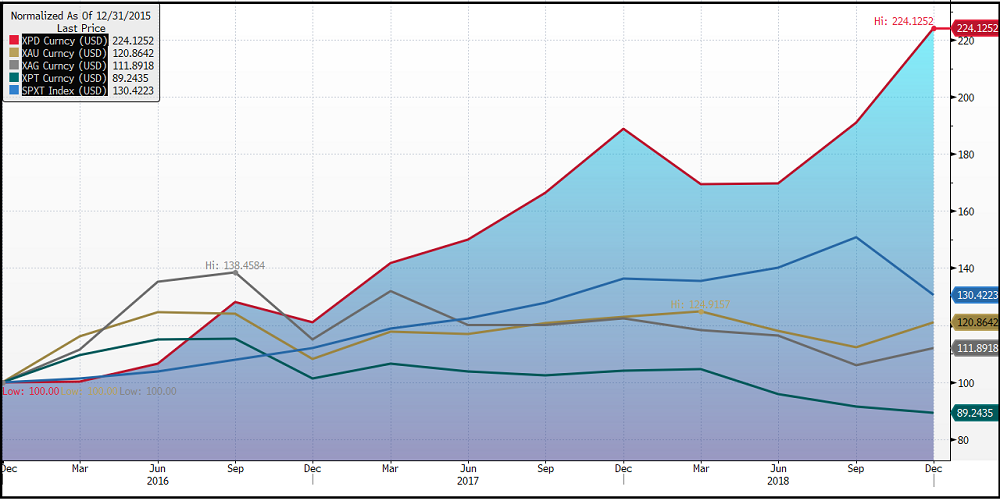
Palladium has been on a multi-year run that shows few signs of abating. For the tumultuous market year 2018, spot palladium gained 18.6% and is up 124% since the beginning of 2016. In comparison, spot gold, platinum and silver all declined last year (1.6%, 14.5%, and 8.5%, respectively), while U.S. equities lost 4.4% in 2018, as measured by the S&P 500 Total Return Index.1

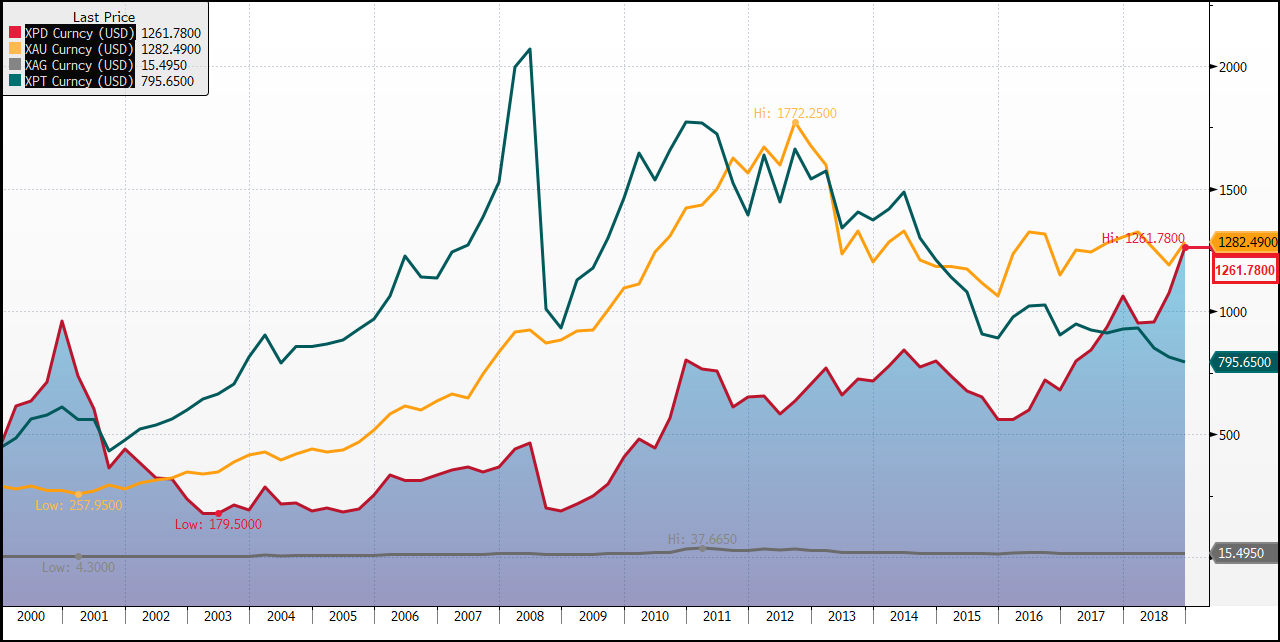
Palladium is close to becoming the most “precious” of precious metals. Palladium passed the $1,000 per ounce mark in late 2017 for the first time since 2001. Palladium’s momentum accelerated in 2018, with its $1,262 price-per-ounce edging close to gold’s $1,282 price by year-end.Palladium was named by its discoverer William Wollaston in 1803, after the asteroid Pallas.

While the escalating U.S.-China trade war hurt many commodities in 2018, it couldn’t dent palladium’s rise. The white metal is primarily used in catalytic converters that reduce pollution from gasoline internal combustion engines (ICEs). Demand for palladium was especially robust last year, as environmental concerns have prompted a global shift from diesel to gasoline and hybrid vehicles. Not even the 2018 slowdown in China’s auto market, the world’s largest, dampened demand.

Palladium’s Stellar Rise

Figure 1. The Hat Trick 

Source: Bloomberg. XPT represents platinum; XAU represents gold; XPD represents palladium, XAG represents silver; SPXT represents S&P 500 Total Return Index.

Figure 2. Annual Performance 2016 – 2018

DatePalladium Price% Annual Change
12/31/2015$ 562.98
12/31/2016$ 680.9620.96%
12/31/2017$ 1,063.5256.18%
12/31/2018$ 1,261.7818.64%
Cumulative Change124.13%

Source: Bloomberg.

Figure 3. The Long View: Palladium Price vs. Gold, Platinum, Silver 2000-2018

Source: Bloomberg. XPT represents platinum; XAU represents gold; XPD represents palladium, XAG represents silver.

Palladium is Very “Precious”

Palladium (chemical symbol “Pd”) is primarily used as an industrial metal and is considered a “precious” metal along with platinum, gold and silver. Both palladium and platinum are far rarer than gold and represent smaller markets. Recent world production of palladium and platinum has averaged about 200 and 175 tonnes per year, respectively, while gold production tallies approximately 3,000 tonnes per year (Read more about Platinum).

Also known as “white gold” or the “bright white metals,” palladium and platinum are members of the Platinum Group Metals (also known as “PGMs,” which also include ruthenium, rhodium, osmium and iridium) and typically co-occur in ore deposits. Their shared chemical origins give palladium and platinum similar characteristics, such as being relatively inert and having high melting points – part of their appeal as catalysts in industrial and automotive applications.

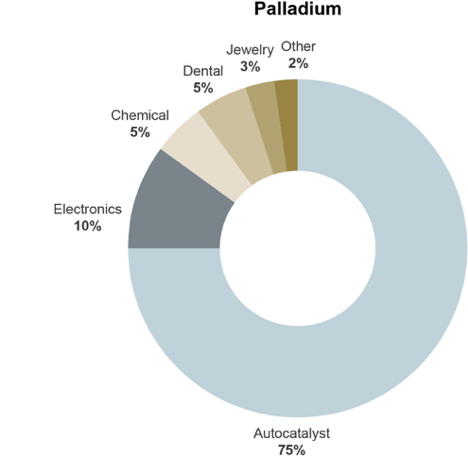
Figure 4. The Automotive Industry is the Largest Pd Consumer – Catalytic Converters

Automakers, who have little flexibility to produce cars without palladium, are being forced to push the price higher to secure their critical supply.

Source: Johnson Matthey. 

Palladium’s primary application is within the auto sector. Though historically more expensive than palladium, platinum was long the primary metal used in catalytic converters, partly because of its stability at the high temperatures required to achieve the conversion. However, in the past decade, automakers have developed technology to achieve nearly the same results with palladium, at a significantly lower cost, causing the automotive industry to transition to palladium.

While palladium is also used in jewelry, electronics, chemical and dental applications, the automotive industry’s need for catalytic converters is the primary factor driving palladium demand. If palladium’s price continues to outpace platinum’s, automakers may return to using platinum. However, analysts predict that any move back to platinum would take at least 18 to 24 months.

Palladium’s Supply Constraints

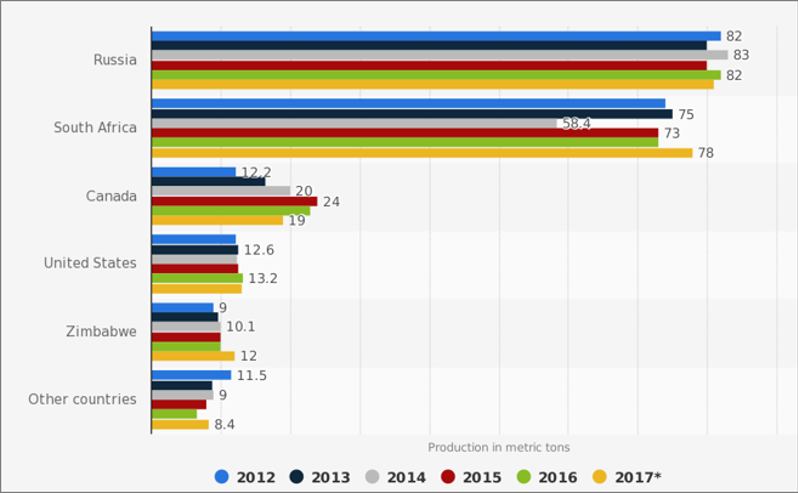
Supply shortages continue to support palladium’s performance, with strong multi-year growth in palladium demand now straining a fixed supply. Palladium is especially scarce and its supply is inelastic since it is usually a by-product of ores that are being mined for other metals, like platinum and rhodium. It is rarely mined on its own. Russia is the world’s largest palladium-producing country, followed by South Africa, Canada, the U.S. and Zimbabwe.

The official level of palladium reserves in Russia is a state secret and many industry participants believe that Russia’s stockpiles of palladium have been largely sold, constraining supply. Supply concerns were further heightened in April 2018 when the U.S. levied more sanctions against Russia.

Figure 5. Palladium Mine Production by Country (Metric Tonnes) 2012-2017

Source: U.S. Geological Survey.

Global demand for palladium, net of the supply provided through recycling, was expected to reach 7.1 million oz. in 2018, exceeding a total supply of 6.9 million oz. This shortfall extends a seven-year trend leading to a current total deficit in the market of 801,000 oz., according to the chemical company, Johnson Matthey.2

Shifting Automotive Demand but Positive Outlook

While no country has outlawed new combustion engines, Norway, China and Germany, among many countries, have implemented frameworks to discontinue long-term ICE production and encourage demand for electric vehicles (EVs) and hybrid-electric vehicles.

The growth of EVs3 could pose a risk to the palladium sector since EVs do not require catalytic converters. On the other hand, the rise of hybrid-electric vehicles could drive palladium demand, since they too require palladium to control pollution. The mining company Norilsk Nickel forecasts that combined palladium use in hybrid and plug-in hybrid — or rechargeable — vehicles in 2019 will be nearly triple that of 2016.

Today, catalytic converter demand accounts for 70% of the palladium demand worldwide. While any threat to palladium’s role within catalytic converters could impact its long-term price outlook, our view is that palladium’s fundamentals should remain strong for at least the next 24 months.

Source: http://sprott.com/insights/the-palladium-play-part-1/

New Age Metals Inc. $NAM.ca – #Palladium Just Smashed Another Record $WG.ca $XTM.ca $WM.ca $PDL.ca

Posted by AGORACOM-JC at 4:54 PM on Tuesday, January 8th, 2019

SPONSOR: New Age Metals Inc. (TSX-V: NAM) The company’s new Lithium Division has already made significant acquisitions in Canada and the USA. The company also owns one of North America’s largest primary platinum group metals deposit in Sudbury, Canada. Learn More.

NAM: TSX-V

——————————

Palladium Just Smashed Another Record

By Elena Mazneva and Yuliya Fedorinova

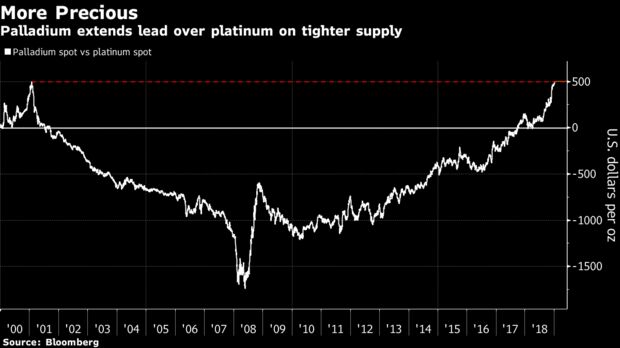
  • Best metal of 2018 now commands $500 an ounce more than rival
  • Substitution in autocatalysts still seen as unlikely: Norilsk

Palladium’s premium to platinum jumped to a record, building on its ranking as the best-performing metal of 2018.

Shortages of the metal used in autocatalysts for gasoline-fueled vehicles sent its price to yet another all-time high, widening the price difference with rival platinum to more than $500 an ounce on Tuesday. Most analysts don’t see supply relief for palladium anytime soon.

Both metals are used in catalytic converters to reduce vehicle emissions. Platinum, the more expensive of the two for most of this century, has seen usage decline from its key consumers, diesel carmakers. Demand slid as consumers turned away from diesel vehicles in the wake of Volkswagen AG’s emissions-cheating scandal.

Platinum is now trading near a 10-year low, at about $821.35 an ounce, while palladium is near its highest, $1,325.13 an ounce.

The widening price gap has spurred speculation that petrol-carmakers may switch from palladium to cheaper platinum. Anton Berlin, head of analysis and market development at Russia’s Norilsk Nickel PJSC, says this is unlikely. Palladium has some features that make it more suitable for gasoline or hybrid cars, like better resistance to higher temperatures.

Switching to platinum would take at least two years and would need additional work and costs to adjust engines and car-exhaust systems, said Berlin, whose company is the world’s biggest palladium miner and fourth in platinum. Manufacturers also need to use more of the precious metal than is needed with palladium, he said.

Berlin believes that overall demand for platinum will recover anyway. The market may even face a deficit if investment demand is sufficient, including bar and coin sales, he said. The World Platinum Investment Council predicted in November that platinum will remain in surplus in 2019, albeit a smaller one than last year.

Source: https://www.bloomberg.com/news/articles/2019-01-08/palladium-smashes-another-record-with-premium-over-platinum

Monarques Gold Corp. $MQR.ca – #Gold price likely buoyed by safe haven demand: HSBC

Posted by AGORACOM-JC at 12:09 PM on Tuesday, January 8th, 2019

SPONSOR: Monarques Gold Corp. produced 4,695 ounces of gold in the recent quarter with revenues of $10 million. Monarques owns close to 300 km² of gold properties, including the Wasamac deposit (measured and indicated resource of 2.6 million ounces of gold), the Beaufor Mine, the Croinor Gold, McKenzie Break and Swanson advanced projects and the Camflo and Beacon mills. Click here for more information.

MQR: TSX-V

—————-

Gold price likely buoyed by safe haven demand: HSBC

  • Gold price gains will likely be driven by fresh safe haven demand on equity concerns, higher financial volatility and economic uncertainty, said HSBC, leading the bank to lift its 2019 average dollar price for the yellow metal to $1,314/oz Tuesday.

London — Gold price gains will likely be driven by fresh safe haven demand on equity concerns, higher financial volatility and economic uncertainty, said HSBC, leading the bank to lift its 2019 average dollar price for the yellow metal to $1,314/oz Tuesday.

The original estimate was $1,292/oz, according to HSBC’s chief precious metals analyst James Steel.

“Gold prices are recovering from heavy investor liquidation and losses throughout much of 2018. Recent equity market declines, higher financial market volatility and other risks are triggering renewed investor demand for bullion,” Steel said. “Geopolitical and trade risks, which unusually did not lift gold last year (due to the strong US dollar), also appear to be turning positive. We believe gold is set to move higher in 2019, especially if the global economic outlook remains uncertain.”

Gold has been toying with the $1,300/oz marker so far in 2019, although for now that target has alluded bullion. Gold was spot bid at $1,284/oz as of 1420 GMT Tuesday.

“Our FX view is for a stronger USD, which may present the greatest threat to gold and will at the least limit rallies. Gold is inversely related to US equities, and we believe an important price driver in 2019 will be equity direction and volatility. Recent equity weakness has buoyed gold,” Steel added.

Looking at positioning, Steel noted that COMEX was net short in 2018 for the first time since 2001, which has since been scaled back. “Further short-covering and builds in longs are likely in 2019,” the analyst said.

Industry lobby group the World Gold Council said Tuesday that gold-backed ETFs continued to rally in December against a backdrop of market volatility, marking the third consecutive month of inflows. Global ETFs increased 3%. or by $3.1 billion, driven by North American and European fund activity, WGC said.

–Ben Kilbey, [email protected]

Source: https://www.spglobal.com/platts/en/market-insights/latest-news/metals/010819-gold-price-likely-buoyed-by-safe-haven-demand-hsbc

Good Life Networks $GOOD.ca – Goldman Sachs Backs Programmatic Outfit Innovid With $30 Million in Funding $TTD $RUBI $AT.ca $TRMR $FUEL

Posted by AGORACOM-JC at 11:18 AM on Tuesday, January 8th, 2019
SPONSOR: Good Life Networks (GOOD:TSX-V) Video advertising is the future! Company’s A.I. makes 80,000 calculations / second, targeting 750 million users to deliver higher prices and volume. Revenue was $10,000,650 for the nine months ended September 30th, 2018, a 142% increase from $4,133,231 reported for the six months ended September 30th, 2017.  Click here for more information.
GOOD: TSX-V

————————————–

Goldman Sachs Backs Programmatic Outfit Innovid With $30 Million in Funding

  • Innovid will use a $30 million investment from Goldman Sachs Private Capital Investing to further its interests in the connected TV sector by building what it claims will be the industry’s only “end-to-end CTV platform” and further its global footprint.

By Ronan Shields

Innovid will use a $30 million investment from Goldman Sachs Private Capital Investing to further its interests in the connected TV sector by building what it claims will be the industry’s only “end-to-end CTV platform” and further its global footprint.

The Series E round brings Innovid’s total funding to $95.1 million, including a $12.5 million debt financing round in 2015 and comes at a time when ad-tech financing is said to be difficult to come by, according to many industry observers, with the company describing it as “pre-IPO funding.”

Innovid was unable to provide insight on when any potential IPO might take place, or which stock exchange it could choose to list on, by the time of publication. Any such listing would buck the trend of ad-tech outfits coming off the public markets, such as when Taptica purchased the buy-side of Tremor Video and Sizmek acquired Rocket Fuel in 2017.

In a statement, Zvika Netter, Innovid CEO, said, “With this funding, Innovid will complete the development of the first end-to-end CTV platform creating a more efficient workflow, while solving industry measurement challenges and expanding its global footprint to meet the evolving needs of its international client base for brands, media and creative agencies, and publishers.”

Innovid works with advertisers including Bank of America, Campbell’s and L’Oreal to help deliver video ads across a host of different platforms including Amazon Fire, Apple TV, Roku and Samsung TV, with an emphasis on interactive ad units.

In particular, it also works with the industry to help advertisers scale how they create, deliver and measure ads across different platforms, with Innovid hoping to use the $30 million to further its footprint in the fast-emerging connected TV space.

Hillel Moerman, head of Goldman Sachs’ Private Capital Investing group, added, “Innovid has differentiated video advertising software and technology, and has the scale and the reach to succeed, with access to significant supply beyond CTV, including platforms such as Facebook, Instagram, YouTube, Snap and others.”

Source: https://www.adweek.com/programmatic/goldman-sachs-backs-programmatic-outfit-innovid-with-30-million-in-funding/

Bougainville Ventures Inc $BOG.ca – Canada’s Cannabis Laws And 5 Burning Questions For 2019 $CROP.ca $VP.ca NF.ca $MCOA

Posted by AGORACOM-JC at 10:06 AM on Tuesday, January 8th, 2019
SPONSOR:  Bougainville Ventures Inc (CSE: BOG) Converting irrigated farmland to greenhouse-equipped farmland. Bougainville does not “touch the plant” and only provides agricultural infrastructure as a landlord for licensed marijuana growers. Click here for more info.
BOG:CSE

—————————————
  • 2018 was a momentous year for cannabis advocates as Canada became the second country (after Uruguay) to legalize recreational marijuana use.
  • Canadians and cannabis companies alike eagerly awaited legalization, but the rollout hasn’t been as smooth as they would have liked.

Andre Bourque Contributor

A marijuana law breakdown by Canadian Province, and five burning industry questions for 2019.Shopify Partners

This is the initial post in what will be a five-part series on the 5 Burning Questions for Canadian Cannabis in 2019. 

2018 was a momentous year for cannabis advocates as Canada became the second country (after Uruguay) to legalize recreational marijuana use. Canadians and cannabis companies alike eagerly awaited legalization, but the rollout hasn’t been as smooth as they would have liked.

The most pressing problem facing the country’s legal weed market is the fact that, in the majority of provinces, suppliers are unable to meet demand. According to MarketWatch, the complexity of scaling up a national legal cannabis supply chain has left many retailers with just a fraction of the promised products. In many areas, the supply shortage may last well into 2019.

Some experts say the bottleneck exists in the regulatory approval by Health Canada of Licensed Processors and Cultivators. “The cultivation and processing capacity exists, but the lack of licensing is keeping that production off the shelves,” Rob McIntyre, CFO of Salvation Botanicals Ltd., told me. His Canadian extraction and formulation company recently agreed to produce cannabis products for U.S.-based Medical Marijuana, Inc. for the Canadian market.

“Health Canada has added significant resources to attempt to shorten the approval process, but the backlog is significant,” McIntyre explained. “In the coming months, we expect to see this supply shortage ease.”

A shortage of marijuana in Canada threatens to undermine one aim of legalization: to tame an illegal trade estimated at about 5.3 billion Canadian dollars annually. Angry consumers say they are returning to their illegal dealers. https://t.co/dZQogk8xGY

— New York Times World (@nytimesworld) November 7, 2018

On the opposite end of a product shortage is strong product pricing for cannabis producers and retailers. A gram of high-quality cannabis in Vancouver, Canada, for example, sold for $752 a gram in November 2018. Meanwhile, in Portland, Oregon, where an overabundance of marijuana is begging to cross state lines, you could buy an entire ounce of similar high-quality cannabis as recently as December.

These initial gains, however short-term they may be, will help Canadian cannabis companies offset their startup costs. “This will quickly help companies recoup the costs of building expensive cultivation facilities,” said Debra Borchardt, CEO of Green Market Report, and Canadian cannabis industry expert. “Once production begins to meet demand, then the prices will fall, which is great for consumers, but will come at a cost to the producers.”

Another less obvious issue is the diversity of cannabis regulations from province-to-province. Though weed is legal everywhere in Canada, for smokers and businesses, where you are in the country will have a huge impact.

Currently, the only constants from province-to-province under the federal Cannabis Act are a possession limit of up to 30g of dried flower (or an equivalent) and a ban on consumption in vehicles. Beyond that, everything from the legal age to the rules on public consumption can be different—though the provinces all share a common goal in discouraging underage use and exposure.

Nationwide, the biggest change in 2019 is the legalization of edible sales, which will occur no later than October 17, 2019—one year after marijuana legalization. Since edibles are more appealing to children, Canadian officials are being much more circumspect about rolling these products out. As Vice points out, it is unclear how the regulations around edibles will play out, since the government hasn’t ruled exactly what it means for a product not to “appeal” to a young person.

Provincial Laws

Here’s a quick breakdown of the current laws in each province, plus news on any upcoming changes in 2019:

.@liftandco produced an easy-to-digest graphic of the new Canadian marijuana laws and retailers by province. The country’s outlets include both the government and private sectors. pic.twitter.com/CDbHa6aArJ

— Andre F Bourque ♕ (@SocialMktgFella) January 8, 2019

Alberta:

You must be 18 years old to consume, buy, possess, and grow. Public consumption laws are the same as tobacco, though you can’t smoke near children. Home cultivation is allowed (up to four plants).

Though the province originally planned for 250 licensed retail stores managed by Alberta Gaming, Liquor, and Cannabis, supply constraints mean it will be 6-18 months before the next stores open after the first 65 opened. The province also allows online sales controlled by the government.

British Columbia:

You must be 19 years old to consume, buy, possess, and grow. Public consumption laws are the same as tobacco, though you can’t smoke near children. Home cultivation is allowed (up to four plants), though they must be hidden from street view.

British Columbia has not put a cap on the number of retail locations, but the licensing process has been slow. The first store opened up in December in Vancouver. Like Alberta, British Columbia allows online sales controlled by the government.

Manitoba:

You must be 19 years old consume, buy, and possess. Public consumption is almost completely restricted. Unlike other provinces, you won’t be able to grow your own weed at home.

By the end of November 2018, only fourteen retailers had been granted licenses. The province will allow for private online and retail stores.

In 2019, the Safe and Responsible Retailing of Cannabis Act will take effect, adding on a 6 percent tax on revenues of licensed cannabis retailers as a “Social Responsibility Fee.”

New Brunswick:

You must be 19 to consume, buy, possess, and grow. You will only be allowed to consume it in a private residence. Up to four household plants are allowed, as long as they are locked and secured.

The province will have 20 government-run locations and permit government-controlled online sales. Like many other provinces, New Brunswick has seen a spate of store shutdowns due to a lack of supply.

Newfoundland and Labrador:

You must be 19 to consume, buy, possess, and grow. You will only be allowed to consume it in a private residence. You can grow up to four plants per household.

Newfoundland and Labrador have a hybrid retail model, with private retailers receiving licenses to sell products controlled by the Newfoundland and Labrador Liquor Corporation. Online sales will go through the government-controlled NLC as well.

Nova Scotia:

You must be 19 to consume, buy, possess, and grow. You will only be allowed to consume it in designated public places. You can grow up to four plants per household, as long as they’re inside.

Nova Scotia Liquor Corporation, a government-run entity, will control online and retail stores, with 12 physical locations available at launch. Similar to other provinces, Nova Scotia faced shortages throughout 2018.

Ontario:

You must be 19 years old to consume to buy, use, posses, and grow. Public consumption laws are the same as tobacco in the province, meaning many public areas—especially ones where children may be—are off limits. There’s a four plant limit per household.

On April 1, 2019, Ontario will begin allowing private retail stores, but for now the only place to get it is through retail and online stores—the aptly names Ontario Cannabis Store—controlled by the Ontario LCBO. Thus far, the rollout has been…buggy. A questionable supply chain has been plagued by mold, mislabeled products, and mites, leading many to return to the black market in the region.

Prince Edward Island:

You must be 19 to consume, buy, possess, and grow. You will only be allowed to consume it in private residences at present. You can grow up to four plants per household, as long as they’re inside and not in reach of children.

Like many other provinces, a government-run entity, the Prince Edward Island Cannabis Management Corporation, will operate retail locations and online sales. At launch, there were four licensed retail locations. Compared to other areas, PEI’s rollout has been relatively smooth.

Quebec:

You must be 18 years old to consume, buy, and possess. Public consumption follows the same rules as tobacco, with smoking at schools and universities expressly prohibited. That may all change if newly proposed laws pass in 2019 which would raise the legal age to 21 and prohibit any smoking in public. Regardless, you cannot grow plants at home.

All online and retail sales are controlled by the Société Québécoise du Cannabis (SQDC). Since pot was legalized in October, retail locations have been closed several days of the week because of the lack of supply.

Saskatchewan:

You must be 19 years old to consume, buy, possess, and grow. Public consumption is prohibited. Four household plants are allowed per household.

Unlike many other provinces, Saskatchewan will have a private distribution system. The province handed out 51 licenses prior to Oct. 17, the day sales became legal, but as of December only a handful of those stores have opened because of supply issues. Online sales are allowed through private retailers.

5 Burning Questions for 2019

2019 marks the first full year of legal cannabis in Canada. 2018 was full of excitement for legalization, plus a whole bunch of disappointment as supply issues affected many parts of the country.

As we head into the new year, these are the biggest questions Canada’s cannabis industry will need to answer.

  1. Will There Be Enough (Legal) Pot in Canada?

It would be an understatement to say that cannabis consumers were not best of buds with the country’s suppliers.

  1. What Trends Will Dominate?

For consumers, the biggest trends for the upcoming year will be the emergence of the edibles market and the expansion of CBD products.

  1. Which IPOs Will Take Flight?

Look for even more U.S.-based companies to offer IPOs in Canada’s markets—and vice versa.

  1. Does the U.S. Legalizing Hemp Jeopardize Canada’s Industry?

In December 2018, the U.S. Congress passed the Farm Bill, an omnibus bill that, among other things, legalized the cultivation of industrial hemp and allows for interstate commerce of hemp-based products for the first time in decades. Though this brings competition to hemp production in North America for the first time, Canada has decades of research and growing experience under its belt already.

  1. How Does Legal Weed Play Out on the International Stage?

As the second country to legalize recreational cannabis-use, Canadians are reveling in their newfound freedom. But it’s unclear how cannabis use will affect international relations.

For better or worse, 2019 will be a telling year for the Canadian cannabis market. Let me know what you think’s going to happen on Twitter (@SocialMktgFella).

Disclaimer: I have no financial interest or positions in the aforementioned companies. This information is for educational purposes and does not constitute financial and/or legal advice.

Andre Bourque (@SocialMktgFella) is a cannabis industry media influencer, brand executive and advisor, blockchain marketer, and cannabis columnist. He specializes in cannabis industry partnerships, distribution, and funding. Andre is the managing director of the cannabis div…MORE

Andre is a cannabis connector and the VP of Bus. Dev. for Verdantis Advisors, a full-service consulting agency.

Source: https://www.forbes.com/sites/andrebourque/2019/01/08/canadas-cannabis-laws-by-province-and-5-burning-questions-for-2019/#1548c5dd4eb3

ThreeD Capital Inc. $IDK.ca – Apple $AAPL and Tesla $TSLA shares on the #blockchain could be the next big thing in #crypto $HIVE.ca $BLOC.ca $CODE.ca

Posted by AGORACOM-JC at 9:15 AM on Tuesday, January 8th, 2019

SPONSOR: ThreeD Capital Inc. (IDK:CSE) Led by legendary financier, Sheldon Inwentash, ThreeD is a Canadian-based venture capital firm that only invests in best of breed small-cap companies which are both defensible and mass scalable. More than just lip service, Inwentash has financed many of Canada’s biggest small-cap exits. Click Here For More Information.

Idk large
———————–
  • Security tokens — digital versions of financial securities like stocks and bonds — are becoming a new buzzword in crypto.
  • Analysts and executives in the industry see security tokens as a development that could reinvigorate the cryptocurrency space.
  • A key difference setting security tokens apart from other cryptocurrencies is that they are asset-backed and fall within regulatory parameters, experts say.

The Apple logo is displayed at the Nasdaq MarketSite just before the opening bell in New York on Thursday, Aug. 25, 2011. Scott Eells | Bloomberg | Getty Images

Cryptocurrencies had a wild 2018, tumbling well below some of the record highs seen toward the end of 2017.

Bitcoin, once worth almost $20,000, plunged last year, closing out 2018 at a price below $4,000. Other major virtual currencies, including XRP and ether, also fell steeply.

Analysts and executives in the industry are increasingly pointing to a fairly new development that could reinvigorate the space: putting securities like stocks and bonds on the blockchain.

So-called security tokens are becoming a new buzzword in crypto. The term is part of a phenomenon in the industry known as “tokenization” — turning real-world assets into digital tokens.

In the case of security tokens, tradable assets like equity and fixed income are transformed into digital assets that use blockchain technology, the virtual ledger of activity that underpins cryptocurrencies like bitcoin.

Security tokens had been talked about for some time, but now one firm is looking to put them to the test.

On Monday, DX.Exchange, an Estonia-based crypto firm, launched a trading platform that lets investors buy shares of popular Nasdaq-listed companies, including Apple, Tesla, Facebook and Netflix, indirectly through security tokens.

Each token is backed by one share of the company traders want to invest in and entitles them to the same cash dividends.

“The crypto community has been talking about security tokens for well over a year now without much progress, so we think the impact will be huge,” Amedeo Moscato, DX’s chief operating officer, told CNBC by email over the weekend.

“By tokenizing stocks of some of the biggest publicly-traded companies like Google, Amazon, Facebook and more, we are opening an untapped market of millions of old and new traders around the globe cutting out the middleman. ”

watch now VIDEO02:40 What is a security token?

Investors will be able to trade the digital stocks round-the-clock, even after markets close, DX says.

“The ability to trade around the clock, with a range of currencies, offers investors both convenience and liquidity,” Dan Doney, co-founder and chief executive of fintech firm Securrency told CNBC by email over the weekend.

But Doney questioned whether DX’s exchange was sound on the regulatory front.

“We’re unsure and even skeptical of DX.Exchange’s model because we don’t think that it’s acceptable to list tokenized shares of a company without shareholder consent,” he said.

“However, we do think that the model can meet regulatory standards if executed properly.”

DX stressed that its digital stocks are classed as derivatives — with the underlying asset being equity of 10 Nasdaq-listed firms — and that its platform is regulated under the European Union’s Mifid II directive. Mifid II, a set of reforms to EU investment services regulation, aims to protect investors and increase transparency and confidence in the industry post-crisis.

Cyprus-licensed firm MPS MarketPlace Securities is holding the stocks in a segregated account. DX built the platform on top of Nasdaq’s Matching Engine technology, which is used across more than 70 international markets.

Experts are pointing to the model as one that could provide a solid form of investment for traders — versus cryptocurrencies like bitcoin, which have proven at times to be highly volatile — as well as a new potential source of fundraising for start-ups and large firms alike. ‘STO’

New security tokens can be issued and sold to investors, similar to how new digital tokens are sold through a crowdfunding method known as an initial coin offering (ICO). This is what’s known as a security token offering (STO).

ICOs were a source of much controversy in the crypto sphere in both 2017 and 2018, with China and South Korea banning the practice and the U.S. Securities and Exchange Commission rapping a number of ventures and founders over alleged illegal activities.

One supposed cryptocurrency start-up called Giza made off with more than $2 million through a fake ICO scam, a CNBC investigation last year showed.

Dubious as the murky world of ICOs is, the funding method at one point eclipsed early-stage venture capital funding. ICO projects raked in almost $6.6 billion in 2017 and $21.5 billion in 2018, according to data provided by ICO listing site CoinSchedule.

The difference with STOs, experts say, is that security tokens are asset-backed and fall within regulatory parameters.

“Security tokens use blockchain to allow for efficient transactions like cryptocurrencies, but are different in all other ways,” Securrency’s Doney said.

”(They) emphasize regulatory compliance, automated regulatory reporting, and represent share interest in value-producing assets. This ultimately provides stable value versus the volatility of crypto.”

Crowdfunding site Indiegogo delved into the world of STOs last year, hosting a platform that let investors indirectly own shares of a luxury ski resort by buying security tokens. That token sale brought in $18 million, according to VentureBeat.

Security tokens and STOs have been compared to “stablecoins,” cryptocurrencies pegged 1:1 to government-backed currencies to avoid the volatility typically seen in the cryptocurrency market. Stablecoins are seen as another potential area for growth in the crypto industry.

Goldman Sachs-backed fintech start-up Circle launched a stablecoin pegged to the U.S. dollar last year, and Chief Executive Jeremy Allaire has told CNBC he thinks “all fiat currency will be crypto” one day.

“Cryptocurrencies and STOs will continue to evolve, and digital stocks are another step in that process,” Daniel Skowronski, DX’s chief executive, told CNBC by email. STOs to ‘ramp into the market’ by mid-2019

Advocates also say that security tokens could reduce the cost of listing a company on the stock market and that they will make it easier to trade less liquid assets like private equity.

And though it may be early days, one expert thinks the trend of tokenizing securities will become a major theme by mid-2019.

“In terms of timing, we hear that mid-2019 is the time-frame when most STOs will be able to ramp into the market,” Lex Soklin, partner and global director of fintech strategy at Autonomous Research, told CNBC by email.

“Given a longer regulatory approval process for these assets (rather than none for ICOs), entrepreneurs have a slower path to market. But perhaps a more stable one.”

Some even believe that, eventually, everything from artwork to real estate will be transformed into digital tokens.

“Over the next decade, we could very well see the tokenization of the entire financial markets,” Mati Greenspan, senior market analyst at eToro, said in a note last week.

“Essentially, anything that has value and can be traded can also be represented as a digital token and traded on a blockchain.”

Source: https://www.cnbc.com/2019/01/07/bitcoin-security-token-and-sto-explained.html

Peeks Social $PEEK.ca Provides an Update on the Launch of Personas Social Network

Posted by AGORACOM-JC at 8:24 AM on Tuesday, January 8th, 2019
  • Personas’ ChatCash service allows users to provide (and charge for) one-on-one private tutorials, consulting services, help desk services and any other service that is typically delivered through one-on-one chat

TORONTO, Jan. 08, 2019 – Peeks Social Ltd. (TSXV:PEEK) (OTCQB:PKSLF) (“Peeks Social” or “the Company”) is pleased to provide an update on the pending launch of the Personas social network (“Personas”).


Personas is an ecommerce enabled video and image sharing social network that provides users with a video chat based payments system (ChatCash). Personas’ ChatCash service allows users to provide (and charge for) one-on-one private tutorials, consulting services, help desk services and any other service that is typically delivered through one-on-one chat

Personas technology and policies are purpose designed to satisfy user demands for a “Hate Free Space” on the internet where personal privacy is protected. Personas provides greater privacy in a variety of ways; for one, by allowing users to segment their social media following into several profiles: friends, family and followers. In addition, as a policy Personas does not sell user data. Future releases of Personas will allow users to create additional profiles on demand.

A significant market opportunity has emerged as a result of rising user concerns over social media privacy, trolling, fake news and misuse of private data. These concerns are reflected in a recent Pew Research Center poll, that reported; “42% of US adult Facebook users have taken a break from the site in the past 12 months for several weeks or more, 54% adjusting their privacy settings and 26% deleting the app from their phone entirely”.  

Major development of release 1.0 of the Personas is complete and is currently in beta testing. Personas will be submitted for approval to the Apple and Google app stores in the coming weeks and subsequently available for download. 

The Peeks Social App can be downloaded in either the Google or Apple app stores, or by visiting www.peeks.social

For further information, please contact:

Peeks Social Ltd. 
Mark Itwaru 
Chairman & Chief Executive Officer 
416-635-5339 
[email protected]

David Vinokurov 
Director Investor Relations 
416-716-9281 
[email protected]

Neither the TSX Venture Exchange nor its Regulation Services Provider (as that term is defined in the policies of the TSX Venture Exchange) has reviewed or accepts responsibility for the adequacy or accuracy of this Release.

Photos accompanying this announcement are available at

http://www.globenewswire.com/NewsRoom/AttachmentNg/eb32c8af-92e5-4fee-9b45-fb5785f17907
http://www.globenewswire.com/NewsRoom/AttachmentNg/a9091444-6880-4313-a5ac-c5be3d9e2ee9
http://www.globenewswire.com/NewsRoom/AttachmentNg/9ddcb784-8335-449c-b6be-55d228d031a6
http://www.globenewswire.com/NewsRoom/AttachmentNg/357956b2-ad13-44da-a0a4-b1eff97885e5

PyroGenesis $PYR.ca Signs Mutually Exclusive Partnership Agreement with Aubert & Duval to Supply Plasma Atomized Titanium Powder to European Union Additive Manufacturing/3D Printing Market

Posted by AGORACOM-JC at 8:19 AM on Tuesday, January 8th, 2019
  • Announced today that it has signed a mutually exclusive Partnership Agreement with Aubert & Duval, together the “Parties”, a subsidiary of the ERAMET Group (2017: Sales: > Can$5.4 Billion; Assets: > Can$4.9 billion; Paris Stock Exchange: ERA.PA).
  • Agreement outlines a multi-step strategy between the Parties to supply plasma atomized titanium powder, on a mutually exclusive basis, to the Additive Manufacturing Market in Europe

MONTREAL, Jan. 08, 2019 – PyroGenesis Canada Inc. (http://pyrogenesis.com) (TSX-V: PYR) (OTCQB: PYRNF) (Frankfurt: 8PY: FRA)  a TSX Venture 50® high-tech company, (the “Company”, the “Corporation” or “PyroGenesis”) a Company that designs, develops, manufactures and commercializes plasma atomized metal powder, plasma waste-to-energy systems and plasma torch products, is pleased to announce today that it has signed a mutually exclusive Partnership Agreement (the “Agreement”) with Aubert & Duval, together the “Parties”), a subsidiary of the ERAMET Group (2017: Sales: > Can$5.4 Billion; Assets: > Can$4.9 billion; Paris Stock Exchange: ERA.PA). The Agreement outlines a multi-step strategy between the Parties to supply plasma atomized titanium powder, on a mutually exclusive basis, to the Additive Manufacturing (“AM”) Market in Europe (the “Market”). The Agreement envisions establishing production capability in the Market on mutually agreeable terms.

Aubert & Duval is a world leader in industrializing high-performance steel, super alloy, aluminum and titanium alloys for over a century. More specifically, they are a recognized supplier of metal powders for additive manufacturing, serving the Aerospace, Energy, Transport, Medical, Defense, Automotive and other large scale, demanding markets.

“Aubert & Duval, founded in 1907, is a recognized supplier of fine metallic powders for AM in demanding markets such as aerospace, energy, medical, defense and automotive,” said Mr. Massimo Dattilo, Vice President of PyroGenesis Additive. “They have a strong metallurgical expertise, and a long history in powder atomization. The addition of PyroGenesis’ capabilities complements their current product offerings in a field in which they are an established supplier. Aubert & Duval has a history of supporting their customers in AM, from the development of product to mass production, and we are happy to partner with them.”

“This Agreement establishes the framework within which Aubert & Duval and PyroGenesis shall work together to distribute the titanium powders manufactured by PyroGenesis to the Market. There are provisions for the expansion of the Market upon mutual agreement by the Parties,” said Mr. P. Peter Pascali, President and CEO of PyroGenesis. “This relationship will undoubtably accelerate our growth in our AM business line and complements our corporate strategy to team up with established players who have an impeccable reputation and a strong balance sheet, to accelerate our growth.  This is a very significant milestone not only for PyroGenesis and Aubert & Duval, but for the industry as a whole.  This strategic partnership speaks to the Parties’ complementary strengths: PyroGenesis’ extensive plasma expertise as the inventor of Plasma Atomization, and Aubert & Duval’s large network of customers, strong balance sheet, and extensive knowledge of the market.”

In a press release issued January 8th, 2019, Jérôme Fabre, Eramet Group’s Deputy CEO in charge of the Alloys division, described the benefits of the partnership as follows: “With our metallurgical expertise for demanding markets such as aeronautics and energy, this partnership with PyroGenesis allows us to complete our offer of metal powders for additive manufacturing, including 3D printing, a growing market of the industry of the future.”

About PyroGenesis Canada Inc.

PyroGenesis Canada Inc., a TSX Venture 50® high-tech company, is the world leader in the design, development, manufacture and commercialization of advanced plasma processes and products. We provide engineering and manufacturing expertise, cutting-edge contract research, as well as turnkey process equipment packages to the defense, metallurgical, mining, advanced materials (including 3D printing), oil & gas, and environmental industries. With a team of experienced engineers, scientists and technicians working out of our Montreal office and our 3,800 m2 manufacturing facility, PyroGenesis maintains its competitive advantage by remaining at the forefront of technology development and commercialization. Our core competencies allow PyroGenesis to lead the way in providing innovative plasma torches, plasma waste processes, high-temperature metallurgical processes, and engineering services to the global marketplace. Our operations are ISO 9001:2015 certified and have been since 1997. PyroGenesis is a publicly-traded Canadian Corporation on the TSX Venture Exchange (Ticker Symbol: PYR) and on the OTCQB Marketplace. For more information, please visit www.pyrogenesis.com

About Eramet:

Eramet is one of the world’s leading producers of:
Manganese and nickel, used to improve the properties of steels, and mineral sands (titanium dioxide and zircon), parts and semi-finished products in alloys and high-performance special steels used by industries such as aerospace, power generation, and tooling.

Eramet is also developing activities with strong growth potential, such as lithium extraction and recycling, called to play a key role in the energy transition and the mobility of the future.

The Group employs around 12,600 people in 20 countries. www.eramet.com

About Aubert & Duval:        

Aubert & Duval, a subsidiary of the Alloys division of the Eramet group, is a metallurgist expert and one of the world leaders in high-performance steels, superalloys, titanium and aluminum. Aubert & Duval designs and develops advanced metallurgical solutions in the form of closed-die forged or forged parts, long products or metal powders for projects in the most demanding industries: aeronautics, energy, defense, nuclear, medical. www.aubertduval.com

This press release contains certain forward-looking statements, including, without limitation, statements containing the words “may”, “plan”, “will”, “estimate”, “continue”, “anticipate”, “intend”, “expect”, “in the process” and other similar expressions which constitute “forward- looking information” within the meaning of applicable securities laws. Forward-looking statements reflect the Corporation’s current expectation and assumptions and are subject to a number of risks and uncertainties that could cause actual results to differ materially from those anticipated. These forward-looking statements involve risks and uncertainties including, but not limited to, our expectations regarding the acceptance of our products by the market, our strategy to develop new products and enhance the capabilities of existing products, our strategy with respect to research and development, the impact of competitive products and pricing, new product development, and uncertainties related to the regulatory approval process. Such statements reflect the current views of the Corporation with respect to future events and are subject to certain risks and uncertainties and other risks detailed from time-to-time in the Corporation’s ongoing filings with the securities regulatory authorities, which filings can be found at www.sedar.com, or at www.otcmarkets.com. Actual results, events, and performance may differ materially. Readers are cautioned not to place undue reliance on these forward-looking statements. The Corporation undertakes no obligation to publicly update or revise any forward- looking statements either as a result of new information, future events or otherwise, except as required by applicable securities laws.

Neither the TSX Venture Exchange, its Regulation Services Provider (as that term is defined in the policies of the TSX Venture Exchange) nor the OTCQB accepts responsibility for the adequacy or accuracy of this press release.

SOURCE PyroGenesis Canada Inc.

For further information please contact: Clémence Bertrand-Bourlaud, Marketing Manager/Investor Relations, Phone: (514) 937-0002, E-mail: [email protected]

RELATED LINKS: http://www.pyrogenesis.com/

INTERVIEW: NORTHBUD $NBUD.ca Discusses Amendment of Licence Application to Add 500K SQ. FT. of Outdoor Cultivation Area

Posted by AGORACOM-JC at 5:04 PM on Monday, January 7th, 2019

Esports Entertainment Group $GMBL – Twitch Sees Significant Growth From In Real Life Streaming in 2018 $ATVI $TTWO $GAME $EPY.ca $TCEHF

Posted by AGORACOM-JC at 10:41 AM on Monday, January 7th, 2019
SPONSOR: Esports Entertainment $GMBL – Esports audience is 350M, growing to 590M, Esports wagering is projected at $23 BILLION by 2020. The company has launched VIE.gg esports betting platform and has accelerated affiliate marketing agreements with an additional 42 Esports teams, bringing total to 176 Esports teams. Click here for more information
—————-

Twitch Sees Significant Growth From In Real Life Streaming in 2018

By The Numbers

  • Total Hours Watched in 2018: 540M (IRL and Just Chatting).
  • Total Hours Watched in 2017: 207.96.
  • Most-Watched Day: June 3 with 2.43M hours watched.
  • Peak CCV: 159.69K on May 29 when Bethesda released a Fallout teaser on its official channel.
  • Most-Watched IRL Channel: Chance “Sodapoppin” Morris with 49.85M hours watched.
  • Most-Watched Just Chatting Channel: Chance “Sodapoppin” Morris with 8.26M hours watched.

Max Miceli

Twitch’s  “In Real Life” or “IRL” category experienced a huge re-work in the fall of 2018 as the platform realized that more streamers were not only using it, but using for a plethora of different reasons.

At the end of September, the category was divided into several new categories including “Just Chatting,” “Sports and Fitness,” “Special Events,” “Food & Drink,” and “Talk Shows & Podcasts.” Before that point, IRL content on Twitch consistently drew some of the strongest viewership week-to-week in 2018 and regularly competed with some of the most-watched games on the platform.

Despite the division of one of Twitch’s most-watched categories, the momentum of IRL wasn’t stalled. If anything it served as a catalyst for its growth. As soon as IRL was divided, “Just Chatting” emerged as one of the most popular forms of content. Streamers regularly began streams by “Just Chatting” with their viewers before they started to get into whatever game they were playing.

Some streamers like Chance “Sodapoppin” Morris even began to expand the scope of what the category could be, and despite just three months of existence, the Just Chatting category on Twitch managed to sneak into rankings as one of the top 10 most-watched types of content for all of 2018. When combined with the success of IRL prior to it’s extinction, the two personality-driven forms of content made up 540M hours watched on Twitch, enough to be the third most-watched category on the platform.  

It wasn’t solely Just Chatting that saw use on the platform either. While Just Chatting was by far the most used subcategory, the other 12 categories that were born from IRL elicited airtime from streamers.

Year-Over-Year

Even though IRL was removed from Twitch on Sept. 26, its 388M hours watched was enough to deliver a massive year-over-year net positive for the category. Without even existing the last three months of the year, IRL had around 180M more hours watched in 2018 than it did in 2017 (207.96M). In just three months, the Just Chatting category alone drew 151.17M hours watched.

The exponential growth of IRL justified its division into sub-categories, but even after the split, Just Chatting averaged more hours watched per month than IRL. As more streamers look to grow their viewership by maintaining interactive communities, the necessity to “just chat” with subscribers and fans has become increasingly important.

Unlike many forms of entertainment, Twitch is most known for its game-driven content and its interactive interfaces. The maturation of Just Chatting and IRL is the most tangible sign of Twitch’s continued growth. Despite its short life, viewership for Just Chatting notably increased in 2018. That was paired with a significant increase in total airtime as well—a sign that influencers are aware of the trend.

Influencer Impact 

IRL is all about the influencer; there isn’t much in the way of esports that comes with “real life” content unless its a Twitch personality giving their thoughts about a recent gaming tournament. Morris seems to have mastered the art of interacting with his viewers in a unique and personal way that keeps them coming back. Not only was he the most-watched IRL streamer, but he led the Just Chatting category once it came into existence. In fact, his channel accounts for eight of the top ten IRL or Just Chatting sessions in 2018.  

As more streamers continue to use Just Chatting—as well as Twitch’s other non-game specific channels—as a way to interact with their chatroom and grow a sense of community among viewers, the opportunity for personal growth and increased sponsorships will proliferate throughout the platform.

While the battle royale craze and Fortnite  have dominated Twitch in 2018, the life of any specific game as a form of personality streaming content is historically limited. As Twitch evolves, the personalities that thrive are the ones that are able to adapt and maintain viewership with their personality—not just their skill at a specific game. This new category’s success and rapid growth are an indication that streamers are becoming privy to the opportunities that are associated with…well…just chatting.

Source: https://esportsobserver.com/twitch-irl-2018/