Agoracom Blog Home

Archive for the ‘All Recent Posts’ Category

TRADING ALERT: (URBF: OTCQB) Urban Barns Foods Up 25% on 182K Shares

Posted by AGORACOM-JC at 2:25 PM on Tuesday, April 7th, 2015

LAST: $0.032 UP: $0.006

Percentage: +25% Vol. 182.7K

—————————–

Why Urban Barns Foods?

      • Unknown story due to no previous IR = best opportunity to get in
      • Tier-1 Customers = Commercial Acceptance
      • 320 square feet = 3 acres of farm production
      • $5M Market Cap = Great Risk/Reward
      • Watch this video clip to see what production looks like
      • Watch this video clip to see what the Executive Chef at Chateau Frontenac has to say

Hub On AGORACOM / Corporate Website

Avalon Rare Metals (TSX and NYSE MKT: AVL) Offers Investors Exposure to Heavy Rare Earths, Tin and Lithium in their Unique Holdings in Canada

Posted by AGORACOM-JC at 11:05 AM on Monday, April 6th, 2015

By Dr. Allen Alper

on 4/5/2015
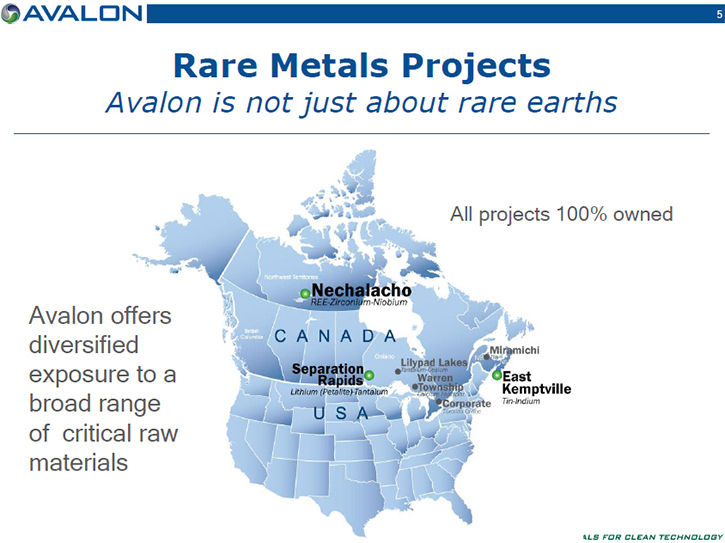
Avalon Rare Metals (TSX and NYSE MKT: AVL) is currently pursuing three advanced projects that consist of critical raw materials such as heavy rare earths, tin and lithium at several different locations in Canada. Their Nechalacho Project contains exceptional heavy rare earth enrichment. Their East Kemptville Project was North America’s only primary tin producer with a significant unmined resource awaiting renewed production. Separation Rapids is the largest undeveloped petalite deposit in the world, a unique high-purity lithium mineral used in glass-ceramics. 

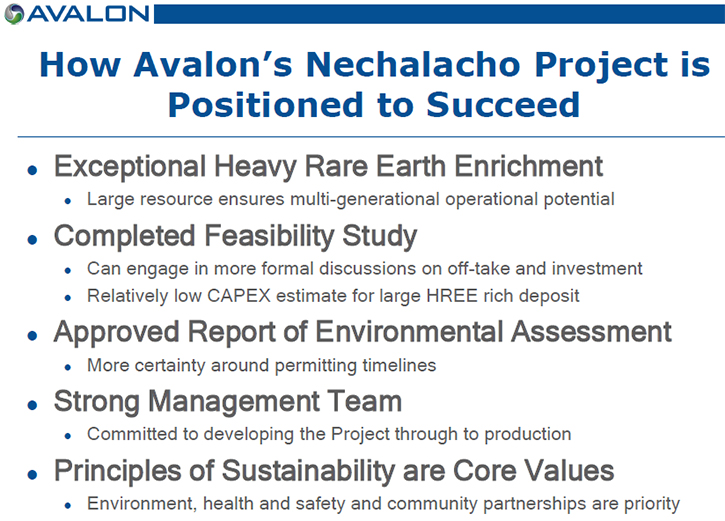
Don Bubar, President and CEO of Avalon Rare Metals (TSX and NYSE MKT: AVL), took a few minutes to speak with Metals News while visiting the PDAC 2015. He said, “We have a number of things going on. As you know, we have been known mainly as a rare earth story for the last six or seven years. The rare earth market has gone quiet since the big spike we saw in prices in 2010 and 2011. It has also gone quiet in terms of investor interest in Avalon. But we are well positioned to ‘hit the pause button’ until investor interest returns because we have completed our feasibility study and all of the related work at the Nechalacho project site in the Northwest Territories.” 

The pause at Nechalacho allows the company to focus on its two other advanced projects. Said Bubar, “We wanted to redirect our energies to where there is more interest in the underlying commodities and we have two other such projects in our portfolio – our Separation Rapids lithium project in Ontario and our East Kemptville tin project in Nova Scotia. Both of these are advanced projects and both tin and lithium are seeing more market interest than the rare earths are at the present time. So we are diverting our attention to those projects for the time being until we see some renewed interest in rare earths.” 

Nechalacho is still a critical part of the company’s long term plan. Mr. Bubar said, “For Nechalacho, it has always been about the heavy rare earth enrichment of the deposit. As all of your readers know, the more advanced projects like those in California and Australia are dominantly light rare earth deposits. The need in the market for additional supply outside China is for the heavy rare earths, which Nechalacho has always been in a position to offer with its relatively high grade resource. We remain the most advanced heavy rare earth development project outside of China.” 


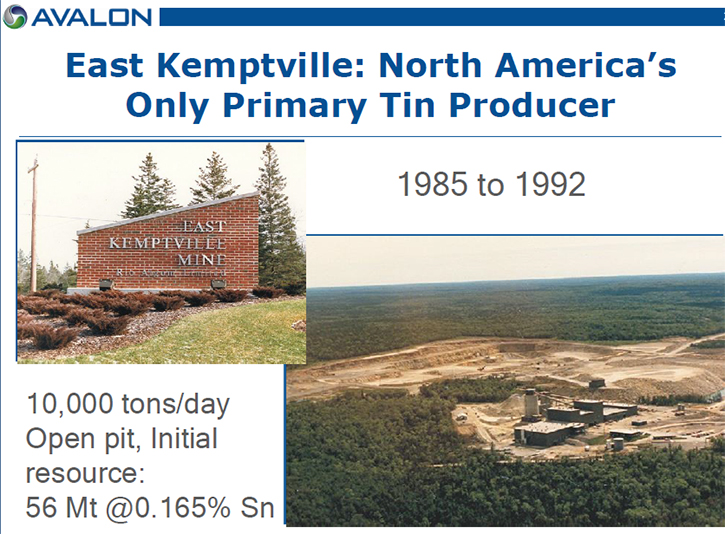
The other projects on which Avalon is focused expose them to the tin and lithium markets which are seeing increasing demand and prices. Said Bubar, “In terms of the other projects, East Kemptville was a producing tin mine in the late 1980’s. It was North America’s only primary tin producer and it only closed down in 1992 because of a collapse in tin prices at the time which was related to the international tin cartel being disbanded, but most of the reserves they identified originally were never mined. Since then, there has been a fundamental change in the tin market. Now the demand is mainly related to a new use in lead-free solders, primarily for electronics applications and now accounts for over 50% of global demand. We have seen steadily rising prices over the last ten years or so and all the analysts are projecting that there is likely to be a deficit in the tin market over the next few years as in the face of diminishing supplies. Lots of people are aware of that. The advantage that East Kemptville has is that, as a brownfields site, it offers a potentially shorter timeline to production. Most of the work to be done is around managing the existing environmental liability that is related to the past operation, then pumping out the pit and building a new mill. If all goes well, we could be in production there in as little as three years which is relatively fast given the timelines that are typically associated with bringing a new greenfields project online. We just published a new economic study – we called it a conceptual redevelopment study – to confirm that there is a sufficiently strong business case to move forward with further work there. The study produced a Capex estimate of about $200 million Canadian.” 


The project also benefits from excellent infrastructure. Said Bubar, “There is a paved road and grid electrical power to the site. There is a community about 50 kilometers away that would welcome some new jobs in this economically- depressed part of the province. The study estimated it would generate 187 full-time jobs. Because we haven’t done quite enough metallurgical work to produce a NI 43-101 compliant PEA, investors will have to wait for the next iteration in order to see the details of the economic model. But we did disclose that the project can generate a healthy operating margin with annual revenues forecast to be double annual operating costs. ” 

Mr. Bubar said, “Our next steps are doing definition drilling on the deposit to bring more of the resource from the inferred category to the indicated category and to recover a bulk sample for metallurgical testing and flow-sheet design. There is also lots of room to expand the resource. Right now, our mineral tenure there is held under a special license which is up for renewal right now. Then we have to work through the process to secure full surface tenure from the surface rights owners before we can move into feasibility study work. We anticipate that will happen in 2015. Basically, this is an asset that we have had in the background for ten years, but have not had the opportunity to move forward until now.” 

As the company adds new projects, Avalon still wants to remain on the rare earth stage. Said Bubar, “Avalon still trades primarily as a rare earth company. As we move East Kemptville forward and tin gets more recognition in the marketplace we should see East Kemptville start to contribute to our market valuation. 

Separation Rapids was our original rare metals project, we acquired in 1996 not long after I started running Avalon. 


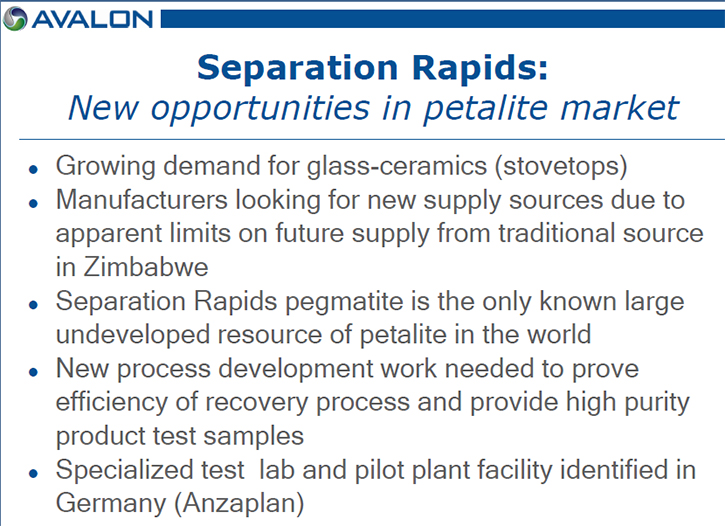
We have held onto it because you have to be opportunistic about bringing industrial minerals projects like these into production. We now see the market is looking for new supply sources of petalite for glasses and ceramics. That is an ideal situation for us as we are the only potential new supplier of size at the moment. The lithium chemical market is also evolving very quickly because of growing demand for rechargeable batteries. The next step is for us to do more sampling for process development work and prove that we can produce high purity lithium minerals and chemicals for these markets. 

Over the 20 years I have been running this Company, We have always offered exposure to a broad range of rare metals and minerals, being ready to supply new demand as it arises. We think this diversification of rare metals assets is a good reason to invest in Avalon.” 

http://avalonraremetals.com/

130 Adelaide St. W, Suite 1901
Toronto, ON M5H 3P5
Tel: (416) 364-4938
Fax: (416) 364-5162
[email protected]

Source: metalsnews.com

5 things you didn’t know about Oman

Posted by AGORACOM-JC at 9:54 AM on Thursday, April 2nd, 2015

2 April 2015 by Jack Carter

C&IT reveals five facts that make the Sultanate of Oman a C&I destination on the rise, including new multi-million pound developments and a range of exciting incentive options.

Muscat, Oman

One million square metre tourism complex planned

As part of wider plans to develop Oman’s tourism sector, the ‘Omagine’ Project in capital Muscat will see the development of a number of four- and five-star hotels, an open theatre, a small marina and a series of restaurants across an area of one million square metres.

Minister of Tourism Ahmed bin Nasser al Mahrzi stated that the project is just one of the major tourism developments in the pipeline for the Sultanate.

New convention & exhibition centre in 2016

The Oman Convention & Exhibition Centre (OCEC) is scheduled to open early 2016 with the aim of turning the country into a serious contender for hosting large-scale conventions and exhibitions. Initially, the venue will include 22,000sqm of event space and a further ten meting rooms, which altogether can host up to 10,000 delegates.

The second phase of the venue is scheduled to be complete in 2017, which will introduce a 3,200-seat auditorium, a 456-seat theatre and two ballrooms that will add another 5,000 people to the OCEC’s total capacity. The development plans also include four hotels that will add 1,000 rooms to the area, a shopping mall and business park.

Target of 10,500 hotel rooms in Muscat by 2018

With two luxury Jumeirah Hotels & Resorts properties, a five-star InterContinental Hotel & Golf Clubhouse and three Millennium & Copthorne properties all in the pipeline, the Sultanate of Oman is targeting a total of 10,500 hotel rooms for Muscat by 2018.

The InterContinetntal Hotel & Golf Clubhouse, which will be located near to Muscat International Airport, is expected to offer 270 rooms, whilst the three new Millennium & Copthorne hotels that are due to open next year will contribute more than 400 rooms to the city.

In the first quarter of 2014, four- and five-star hotels in Oman saw a 20.7% increase in the number of guests, with a total of 368,764.

Oman is the oldest independent Arab state

Oman is the oldest independent state in the Arab world and it has been ruled by the Al-Said family since 1744. In 1970, Sultan Qaboos Bin Said opened the borders of the country after years of international isolation. Tourism has been one of the main sources of revenue for Oman ever since, yet its mountains, ancient cities, and deserts remain largely untouched.

There’s more to Oman than just Muscat

Muscat’s growing infrastructure, ancient culture, and its combination of coastline and mountains instantly makes the capital city a clear favourite among groups. However, the Sultanate has plenty more to offer, from stunning secluded beaches to mountainous peaks where settlements and communities still reside.

A drive down the coast of the Arabian Sea from Muscat is Sur, a quiet coastal town, which is the alleged home of the legendary Sinbad the sailor. The ancient, winding cobbled streets lead down to the Dhow Shipyards, where the boats that famously trawled the Red Sea are still built today.

Inland from Muscat are the Western Hajar Mountains, which stand at 3,010 metres high. Groups can take a safari along the roads and up towards the peak where 400-year-old mud houses that are still occupied today can be found. Hidden in the mountainside’s crevasse is Misfah al Abreen, a quiet garden farmed by local herders.

Source: http://www.citmagazine.com/article/1341169/5-things-didnt-know-oman (Free registration required)

CLIENT FEATURE: Urban Barns Foods (URBF: OTCQB) Capitalizing on the Evolution of Cubic Farming

Posted by AGORACOM-JC at 12:08 PM on Wednesday, April 1st, 2015

What is Cubic Farming?


  • A revolution in Controlled Environment Agriculture (CEA)
  • Propriety, patent-pending, looped conveyer growing system
  • Advanced uniform LED technology
  • Automated watering and nutrients
  • Optimal conditions for crops to transition from seeds to maturity through pre-set germination, growing and harvesting phases.

Why Urban Barns Foods?

  • Unknown story due to no previous IR = best opportunity to get in
  • Tier-1 Customers = Commercial Acceptance
  • 320 square feet = 3 acres of farm production
  • $5M Market Cap = Great Risk/Reward
  • Watch this video clip to see what production looks like
  • Watch this video clip to see what the Executive Chef at Chateau Frontenac has to say

Marquee Customers Include:

Strong Institutional Ownership, 39% Owned By:

Modern Agriculture Needs Green Innovation

The Cubic Farming Advantage

  • 100% controlled environment
  • Growing 365 days a year
  • No pesticides, herbicides or fungicides
  • No GMOs
  • Minimal water requirements
  • Superior nutritional values
  • Longer shelf life
  • Consistency

Consumers Demand Clean Food

  • Globally, the BFY (BETTER FOR YOU) food category is projected to grow by 25% to over $199.8 billion in 2015.
  • GMOs, a major concern for North American consumers
  • 72% of consumers say it is important to avoid GMOs when they shop
  • 40% of consumers say they look for non-GMO claims on food
  • Natural & clean foods are increasingly mainstream
  • Not only for higher income, most educated privileged segment. It is becoming a social movement.


Urban Barns Is the Solution


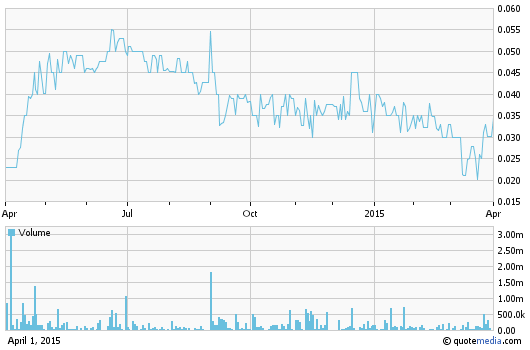
12 Month Stock Chart


CLIENT FEATURE: Xylitol (XYL:TSX-V) Natural Sweetener Co with $2.2M in Revenue for Q3

Posted by AGORACOM-JC at 3:59 PM on Tuesday, March 31st, 2015

Financial Highlights

  • Revenues For the third quarter ended September 30, 2014 was $2.2M versus $1.4M for the same period last year.
  • Revenues for the nine months ended September 30, 2014 was $6.3M versus $3.9M for the same period last year.
  • For the twelve months ended December 31, 2013, sales increased by 87% to $6,508,998, compared to $3,473,053 for the twelve months ended December 31, 2012.

Marquee Customers Include:

Strong Institutional Ownership

  • Dundee Corp 29%
  • SunOpta BioProcess Inc. 26%

What is Xylitol you ask?

  • Xylitol is a sugar alcohol – and no, that doesn’t mean there’s alcohol in it. It’s also known as a polyol. Sugar alcohols contain fewer calories and fewer carbohydrates than other sweeteners. Replacing sugar with xylitol can be helpful if you’re trying to lose weight or even to help prevent weight gain.

What does xylitol taste like?

  • Xylitol is a white crystalline granule that looks and tastes like sugar. The good news is that it doesn’t have the negative side effects associated with sugar. Xylitol is low-calorie, low-carb, diabetic safe and we think it’s guilt free!

Where does your xylitol come from?

  • Xyla brand xylitol is extracted from North American grown hardwood trees, and it’s delicious. We believe the practices employed in the harvesting and processing of our xylitol are ecologically sustainable. Xylitol is also naturally occurring in many fruits and vegetables. Did you know the human body makes about 15 grams of xylitol per day?

Xylitol Canada, Inc. emerged in 2004 as a reseller and distributor of Xylitol and Xylitol products. Based in Toronto, Ontario, the company continued to grow and develop additional brands under the names Sweet Diabetic Delight and Xylitol Canada. Realizing the market potential for high quality, readily available, and consistently priced Xylitol and Xylitol products, the Company broadened its strategic vision in 2009.

Realizing that the void in the Xylitol market was based on inadequate supply and lack of awareness, the company initiated a 2-tier business expansion plan that sought to solve both of these problems. With the vision of a full scale North American Xylitol production facility as a critical element of this strategy, the Company reached out to the Capital markets and formally went public in April of 2010. With the capital base to aggressively address the marketplace, the company immediately began executing its business plan.

Xylitol In The Media

Daytime Toronto – Rogers TV (Aug 2013) – Julie Reid from Xylitol Canada appears with Mari Loewen from Anna Magazine to make some delicious recipes using North American hardwood derived Xyla xylitol.

Daytime Ottawa – Rogers TV (June 2013) – Xylitol Canada’s Julie Reid and naturopath Helene Huot discuss the benefits of Xyla xylitol and share great summer recipes using Xyla.

Is Sugar Toxic? – 60 Minutes (May 4th, 2013) – Sugar is the most addictive substance on earth. It’s also the most dangerous and toxic substance anyone can consume. Sugar has similar affects on the brain like cocaine. Heart disease, cancer, diabetes type II and many more are linked to processed sugar.

Sugary Drinks Linked To 180,000 Deaths Worldwide – CNN (March 19, 2013) – “One in every 100 deaths from obesity-related diseases is caused by drinking sugary beverages,” says study author Gitanjali Singh, a postdoctoral research fellow at the Harvard School of Public Health.

TRADING ALERT: (URBF: OTCQB) Urban Barns Foods Up 19.5% on 285K Shares

Posted by AGORACOM-JC at 12:20 PM on Wednesday, March 25th, 2015

LAST: $0.03 UP: $0.005

Percentage: +19.5% Vol. 285K

—————————–

Why Urban Barns Foods?

  • Unknown story due to no previous IR = best opportunity to get in
  • Tier-1 Customers = Commercial Acceptance
  • 320 square feet = 3 acres of farm production
  • $5M Market Cap = Great Risk/Reward
  • Watch this video clip to see what production looks like
  • Watch this video clip to see what the Executive Chef at Chateau Frontenac has to say

A sneak peek at the next generation of CUBIC FARMINGâ„¢ machines! The company been growing a bounty of sustainable, green, fresh and local produce using our Generation 3 machines, now it’s time for a sneak peek.

Hub On AGORACOM / Corporate Website

Irons in the Fire: NEAH Power Signs New Partnership Deal

Posted by AGORACOM-JC at 12:55 PM on Tuesday, March 24th, 2015

WHITEFISH, MT / March 24, 2015 / The global market for fuel cells is expected to grow at a 22.6% clip between 2014 and 2020 to reach 664.5 GW in size, according to Grand View Research, due to an increasing shift toward renewable energies. Portable applications dominated the market for the energy sources, accounting for 71.2% of total unit shipments in 2013, driven by military applications and other markets requiring energy on-the-go.

In this article, we’ll take a look at NEAH Power Systems Inc.’s (OTC: NPWZ) innovative power solutions and some recent deals that could generate significant shareholder value over the short- and long-term.

Formira HOD(TM) Integrates with BANTAM

NEAH Power Systems’ Formira Hydrogen on Demand – Formira HOD(R) is a reformer platform for direct on-site generation of hydrogen gas. Using the platform, customers can carry a liquid with a better safety profile and generate hydrogen gas at the point of use rather than carrying around dangerous high-pressure gas cylinders. The improved safety profile is particularly helpful in military and commercial applications with a lot at stake.

In a recent shareholder letter, President & CEO Chris D’Couto indicated that the company has been in regular discussions with leading unmanned aerial systems (“UAS”), automotive, off-grid power, and medical device companies regarding the integration of the Formira(TM) technology to improve the safety and performance of off-grid power systems across a wide array of applications.

The technology received a more recent vote of confidence on March 17th when the company entered into an international partnership agreement with Tectonica Australia. By integratingFormira(TM) with the company’s BANTAM(R) System and other new products developed using its integration expertise, NEAH Power Systems has created yet another promising channel for its innovative technology.

SECFilings.com Executive Interview Series | Chris D’Couto / CEO of Neah Power Systems, (NPWZ) fromTDM Financial on Vimeo.

PowerChip(R) is Validated by DRDO

NEAH Power Systems’ PowerChip(R) is a silicon-based fuel cell is capable of operate without air, which makes it ideal for applications where the quality of surrounding air is unpredictable or unavailable. In addition to these unique properties, the fuel fells have higher power densities, lower costs, and more compact form factors that make them perfect for underwater or other critical air-less applications.

In November 2013, the company announced initial orders from India’s Department of Defense Organization (“DRDO”) estimated to be worth $172,000. Management shipped and completed the testing of these units in February of 2015, which represents a critical milestone in the licensing agreement. In the release, the company hinted toward a potential “significant contract” in the future.

The completion of the DRDO order also represents a critical validation of the technology. With a commercial proof-of-concept in place, the company can leverage the deal when selling the same type of units to other customers across a wide range of industries, including many different private sectors. The combination of the short-term DRDO contract and long-term adoption yields a great opportunity.

Buzzbar(TM) Moves into Production

NEAH Power Systems’ BuzzBar(TM) technology suite is designed to take power inputs from a variety of source – from wall outlets to solar panels – and use it to charge a convenient fuel cell that’s comparable in size to many smartphones. After launching on IndieGoGo as the only compact off-grid recharging solution for USB devices, the company has shipped most of its initial orders and is iterating on the product.

According to its 10-K SEC filing, the company has already presented the product to “Big Box” retailers that have expressed and interest and sent proposals to move the purchasing process along. No official agreements have been announced so far, but the potential for a large consumer distribution agreement creates a big potential catalyst for potential investors and existing shareholders.

Shorai Acquisition Adds Revenue

NEAH Power Systems signed a definitive agreement to acquire Shorai Inc., a leading provider of lithium-ion power sports and starter battery solutions for the consumer motorsport industry. With over $4 million in unaudited 2014 revenue and cash flow positive operations, the acquisition provides shareholders with immediate and likely accretive revenue, as well as product and operational (manufacturing, shipping, distribution, brand recognition) synergies between the companies.

Shorai plans to introduce an exciting new control technology in 2015 to improve their competitive position within the performance lithium-ion battery space. In addition, the firm is nearing production of an all-new product that addresses wider markets in motorcycle, automotive, and military sales channels, which could significantly expand its top-line performance and unlock even more value.

Finally, there are many potential synergies between the companies given the similarity of their product lines. Management anticipates numerous product, operational, and marketing synergies, including cross-marketing opportunities with its Formira(TM) and BuzzBar(TM) product lines. Investors may want to keep a close eye on these developments given the potential to accelerate organic revenue.

Valuation & Looking Ahead

NEAH currently has 12 patents, 4 patents pending, and 8 patent applications covering the Formira HOD®, PowerChip(R) and BuzzBar(R) products. The Company has a strong differentiation in the space for its unique technology, has won various awards including Best of What’s New 2010 Popular Science award and MIT Magazine of Innovation and it has already received funding from the likes of the US Navy and Intel Capital.

NEAH Power Systems trades with a market capitalization of just $7.8 million, despite its promising products and potential near-term catalysts. Last quarter, the company reported $179,261 in revenue, which could expand to reach a quarterly run rate of over $1 million following the Shorai acquisition alone. The company’s high gross margins mean only its fixed costs remain to be covered before profits.

With advanced battery companies like Ultralife Corp. (NASDAQ: UBLI) trading at 0.6x EV/Revenue, energy storage companies like ZBB Energy Corporation (AMEX: ZBB) trading at 1.0x EV/Revenue, and fuel cell companies like Plug Power Inc. (NASDAQ: PLUG) trading at nearly 7x EV/Revenue, the company’s modest $9.8 million EV and at least $4 million in revenue suggest it could be undervalued.

In the end, the company has developed stable revenue streams with large potential upside and a near-term cash flow breakeven point. The high margin business could quickly generate significant shareholder value, with its fully-outsourced manufacturing model and customer-funded development.

For more information, visit the company’s website at www.neahpower.com.

Legal Disclaimer:

Except for the historical information presented herein, matters discussed in this release contain forward-looking statements that are subject to certain risks and uncertainties that could cause actual results to differ materially from any future results, performance or achievements expressed or implied by such statements. Emerging Growth LLC is not registered with any financial or securities regulatory authority, and does not provide nor claims to provide investment advice or recommendations to readers of this release. Emerging Growth LLC may from time to time have a position in the securities mentioned herein and may increase or decrease such positions without notice. For making specific investment decisions, readers should seek their own advice. Emerging Growth LLC may be compensated for its services in the form of cash-based compensation or equity securities in the companies it writes about, or a combination of the two. For full disclosure please visit:http://secfilings.com/Disclaimer.aspx.

SOURCE: Emerging Growth LLC

Modern life’s devices under China’s grip?

Posted by AGORACOM-JC at 8:57 AM on Monday, March 23rd, 2015

From smartphones to cars and defense missiles, modern U.S. life depends on rare earth elements but China dominates the industry

Editor’s Note: In September 2014, while we were working on this story, a Pentagon spokesman emailed us to say:

“The Department of Defense is confident in the ability of the defense industry to remain supplied with all necessary rare earths for U.S. defense acquisition programs. The Department continuously monitors and assesses its raw materials requirements, and if necessary, will again take action to ensure their availability to the defense industrial base.”

That confidence is at odds with the Pentagon’s Inspector General’s Office, which issued a report on July 3, 2014 that concluded:

“DoD [Department of Defense] lacked a comprehensive and reliable process to assess REE supply and demand…. [and] As a result, DoD may not have identified all REEs with expected shortfalls, increasing the risk that those shortfalls will adversely affect critical weapons systems production in the DIB, and overall DoD readiness.”


The following is a script from “Rare Earth Elements” which aired on March 22, 2015. Lesley Stahl is the correspondent. Graham Messick and Kevin Livelli, producers.

What do cars, precision-guided missiles and the television you’re watching right now have in common? They all depend on something called rare earth elements, unusual metals that are sprinkled inside almost every piece of high-tech you can think of. Most people have never heard of them. But we have become so reliant on rare earths that a few years ago, an intense global power struggle broke out over their free flow. The reason is that one country has a virtual monopoly – roughly 90 percent — of the mining, refining and processing of rare earths — China. And in 2010, it used that power to disrupt the world’s supply. It’s especially troubling, because it was the United States that started the rare earth revolution in the first place.

Rare earth elements: Not so rare after all

It all began here at this mine in Mountain Pass, California, an hour west of Las Vegas, when geologists first identified rare earth elements deep in the Mojave Desert. They were considered geological oddities, until the 60s when it was discovered that one of these elements, “europium,” enhanced the color red in TV sets and soon the rare earth industry was born.Constantine Karayannopoulos: Rare earth chemistry is fascinating. There’s so many more things that we could be doing with rare earths.

Constantine Karayannopoulos, chairman of Molycorp, which has owned and operated the Mountain Pass mine for six decades, took us to the heart of the operation.

mountainpass.jpg

Mine in Mountain Pass, California
CBS News

Lesley Stahl: Is this considered a big mine?Constantine Karayannopoulos: In terms of rare earth standards, yes. It’s one of the biggest in the world.

Lesley Stahl: Are we actually walking on rare earth elements right now?

Constantine Karayannopoulos: We’re physically on the ore body.

Lesley Stahl: We are right on it?

Constantine Karayannopoulos: It starts at the top of the mine, then comes down and we’re walking on it and it goes in that direction.

So what are rare earth elements? If you ever took high school chemistry you learned that they’re clumped together at the end of the periodic table…atomic numbers 57 through 71… and they have difficult-to-pronounce Greek or Scandanavian names.

Constantine Karayannopoulos: Lanthanum, cerium, neodymium, praseodymium, samarium, terbium…

Some of them are phosphorescent. Erbium amplifies light, and is used in fiber-optic cables. Gadolinium has magnetic properties and is used in MRI machines and X-rays. As for neodymium? You may be carrying some of it in your pocket.

Constantine Karayannopoulos: Next time your phone vibrates, think of us because the vibration motor is a small motor that contains a tiny neodymium magnet in it.

Karayannopoulos showed us around a new model home to illustrate that rare earths are making our appliances energy efficient like state-of-the-art refrigerators, touch screen thermostats, energy efficient light bulbs, the air conditioning systems. They’re also in our cars in the form of catalytic converters, sensors and hybrid car batteries.

Constantine Karayannopoulos: Hybrids, in particular use a lot more because they contain electric motors that would not function without rare earths.

A Prius has roughly 25 pounds of rare earths. And they’re hidden in plain sight in our every day lives, in our computers and gadgets, even the lights and cameras we used to film this story are chock full of rare earths.

Lesley Stahl: What I’m getting from you is that modern life depends on these elements.

Constantine Karayannopoulos: Absolutely.

Despite their name – rare earths are not rare. Small amounts can be found in your backyard. They’re trapped in what looks like ordinary rock.

But there are only a few places on earth with concentrations high enough to mine.

Constantine Karayannopoulos: Rare earths normally are found in very, very low concentrations. This is probably running something in the 25 percent grade.

Lesley Stahl: That’s good?

Constantine Karayannopoulos: Which is remarkable. To anyone who has ever worked with rare earths, this is a thing of beauty.

But getting the rare earths out of that rock is nasty business requiring toxic acids and lots of water. In fact, the mine was shut down by the state of California in 1998 after radioactive water seeped into the surrounding Mojave Desert from an underground pipe. The mine lay dormant for a decade, giving China an opportunity.

Dan McGroarty: The Chinese made a very conscious decision to enter that industry.

Dan McGroarty was special assistant to President George H.W. Bush and today advises the U.S. government on critical materials. When the Molycorp mine closed, he says China was already well on its way to becoming the king of rare earths.

Dan McGroarty: There’s a point at which the lines cross. The United States production declines. Chinese production’s ramping up. Those lines cross somewhere around 1986.

Lesley Stahl: So how did they pull it off? What were the factors that allowed them to basically take this away from us?

Dan McGroarty: Well, the advantage of lower labor costs, would be a place to start. Also, environmentally, very, almost no environmental constraints around mining–safety considerations for the miners doing mining, in huge contrast to the United States. So, that translates directly into lower pricing. And lower pricing can push other people out of the market.

Lesley Stahl: And that’s basically what happened?

Dan McGroarty: That’s basically what happened.

The Chinese also had orders from the top. In a little-noticed speech in 1992, Deng Xiaoping signaled China’s intention to corner the market.

Lesley Stahl: What exactly did he say?

Dan McGroarty: ‘The Middle East has oil. China has rare earths.’

Lesley Stahl: He actually said that, Deng Xiaoping.

Dan McGroarty: Actually said that. I think it’s fair to say, at that point, people in the rest of the world, who had been saying, ‘What are – what is he talking about?’

Lesley Stahl: Just went right over our heads.

Dan McGroarty: I think so.

Lesley Stahl: Did we just not foresee what they foresaw?

Dan McGroarty: It’s extraordinary if they actually foresaw all the uses. Our designers and developers advanced the miniaturized applications for laptops and cell phones while the Chinese were going after the metals and materials out of which these things are actually built.

Lesley Stahl: How did they get the know-how?

Dan McGroarty: An enormous amount of investment. It’s kind of like the Chinese moon shot, the moon program.

China poured billions into the industry, ignoring the consequences. We obtained this video from a freelance cameraman showing the area near Baotou, China’s rare earth capital, where the air, land and water are so saturated with chemical toxins, the Chinese have had to relocate entire villages. This is one of the few places where rare earths are turned into metals, which are then alloyed — or blended — into things like permanent magnets.

Ed Richardson: These are magnets that once you magnetize them, they stay that way.

Ed Richardson, president of the U.S. Magnetic Materials Association, says the most important use of rare earths is in magnets. Only a small amount can produce magnets able to lift a thousand times their weight.

Ed Richardson: This is a cell phone.

He showed us how miniaturized rare earth magnets can be.

Ed Richardson: So I’m going to take it apart layer by layer and we’re going to get to the point where we can actually see the magnets, the rare earth magnets that are inside there.

Lesley Stahl: Oh, let me see this.

Ed Richardson: There’s three little magnets in there.

Lesley Stahl: Oh, one, two, three.

Ed Richardson: Right. If you put the paperclip you can see how it sticks.

Lesley Stahl: And this little tiny thing is the speaker.

Ed Richardson: Right. This is how devices have gotten small, very powerful, because the magnets are so powerful, you don’t have to use much of it.

The U.S. developed this technology, but China bought most of it right out from under us. For instance, in 1995, China bought the biggest American rare earth magnet company, “Magnequench” which was based in Indiana.

Ed Richardson: When they bought the factory, they now had the patents. They now had the equipment. And they actually had some of the Magnequench employees in the United States go to China and teach the people how to make the products.

Lesley Stahl: Did we not understand the strategic importance of keeping that industry here?

Ed Richardson: We didn’t get it and unfortunately the technology was transferred to China before that technology was appreciated. And now, we’re seeing so many, for instance, defense systems that are dependent on it.

Lesley Stahl: Does that make us dependent on China for our defense systems?

Ed Richardson: Oh, we are very dependent on China.

Lesley Stahl: We are dependent on China for our weaponry.

Ed Richardson: Right.

A prime example of that is the new F-35 fighter jet, the most technologically advanced weapons system in history. Each one contains nearly half a ton of rare earths. Former White House Official Dan McGroarty says that’s just for starters.

Dan McGroarty: The guidance systems on weapons system and tomahawk cruise missile, any of the smart bombs have rare earths in them. Lasers. I’d be hard-pressed to name anything that we would consider worth building today and going forward that would not have a rare earth compound in it.

Lesley Stahl: Because of this. Because of the monopoly on rare earths, does China threaten our national security?

Dan McGroarty: Unchecked, yes.

What finally woke up the U.S. government was an incident at sea in 2010. A Chinese fishing trawler rammed a Japanese coast guard ship in a territorial dispute.

The Japanese seized the boat’s captain… and two weeks later, China stopped shipping rare earths to Japan.

Dan McGroarty: The Chinese cut them off. And for 30 to 40 days, the rare earths did not flow to Japan. So it was a real shot across the bow for the Japanese that this is something that you have to be worried with.

It was a wake up call. Finally, 20 years after Deng Xiaoping’s speech, rare earths were on the U.S. radar screen.

[President Obama: This case involves something called rare earth materials…]

President Obama announced a formal complaint to the World Trade Organization against China for creating shortages for foreign buyers and last August the WTO ruled against Beijing.

No one in the Obama administration would talk to us on camera about rare earths and our dependence on China… including the Department of Energy… the Pentagon… or the U.S. trade representative. Even the private sector didn’t want to discuss the problem.

Lesley Stahl: We tried to get interviews with heads of companies that use the magnets and other products coming out of China, and they would not talk to us. Is there fear in high-tech companies that if they say something negative, maybe China won’t sell them what they need?

Dan McGroarty: I think that there is grave concern in these companies, but perhaps not a willingness to talk about that on a street corner.

So what is the U.S. doing to restore the industry here? Out in California, Molycorp was allowed to re-open after it developed new technology that protects the environment. But even when it’s at full capacity, the mine will only produce a fraction of the world’s supply of rare earths.

The Pentagon has begun stockpiling rare earths, and industry is researching new technologies that would replace them.

Lesley Stahl: Do you get any help from the U.S. government? They want to have a rare earth industry here.

Constantine Karayannopoulos: Encouragement, yeah.

Lesley Stahl: Encouragement, that’s it?

Constantine Karayannopoulos: Yeah.

The government is not offering incentives like tax breaks or subsidies that would lure businesses into the market.

Lesley Stahl: What needs to change to bring more of the industry back to the United States?

Constantine Karayannopoulos: First of all, we need to take a long-term view. It took 20 years to lose the dominant position– at least 20 years. And it’s probably going to take us 10, 15 years, if we execute, for some of these supply chains to start coming back.

But trouble is once again looming for the U.S. rare earth industry. Since restarting operations two years ago, Molycorp’s mountain pass mine has yet to turn a profit, and so deeply in debt that just last week, its own auditor warned it may not be able to stay in business.

Source: http://www.cbsnews.com/news/rare-earth-elements-china-monopoly-60-minutes-lesley-stahl/

AGORACOM Welcomes Urban Barns Foods Inc. (URBF: OTCQB) Revolutionizing Cubic Farming

Posted by AGORACOM-JC at 3:36 PM on Thursday, March 19th, 2015

URBF: OTCQB

What is Cubic Farming?


  • A revolution in Controlled Environment Agriculture (CEA)
  • Propriety, patent-pending, looped conveyer growing system
  • Advanced uniform LED technology
  • Automated watering and nutrients
  • Optimal conditions for crops to transition from seeds to maturity through pre-set germination, growing and harvesting phases.

Why Urban Barns Foods?

Marquee Customers Include:

Strong Institutional Ownership, 39% Owned By:

Modern Agriculture Needs Green Innovation

The Cubic Farming Advantage

  • 100% controlled environment
  • Growing 365 days a year
  • No pesticides, herbicides or fungicides
  • No GMOs
  • Minimal water requirements
  • Superior nutritional values
  • Longer shelf life
  • Consistency

Consumers Demand Clean Food

  • Globally, the BFY (BETTER FOR YOU) food category is projected to grow by 25% to over $199.8 billion in 2015.
  • GMOs, a major concern for North American consumers
  • 72% of consumers say it is important to avoid GMOs when they shop
  • 40% of consumers say they look for non-GMO claims on food
  • Natural & clean foods are increasingly mainstream
  • Not only for higher income, most educated privileged segment. It is becoming a social movement.


Urban Barns Is the Solution


Hub On AGORACOM / Read Press Release

KWG Resources Goes Beyond The Press Release to discuss Canadian Securities Exchange Listing

Posted by AGORACOM-JC at 10:38 AM on Tuesday, March 17th, 2015

Frank C. Smeenk, President & Chief Executive Officer of KWG Resources Goes “Beyond The Press Release” to discuss the transfer of the company’s Canadian listing to the Canadian Securities Exchange.


Following Our Interview With Frank Smeenk, AGORACOM Reached Out To The CSE For Comment And Was Able To Interview Rob Cook, Senior Vice President at Canadian Securities Exchange: Watch George and Rob Discuss The Impact Of The KWG Resources Full Migration To The CSE: