Agoracom Blog

The #coronavirus pandemic is reshaping education #Edtech – SPONSOR: BetterU Education Corp. $BTRU.ca $ARCL $CPLA $BPI $FC.ca

Posted by AGORACOM-JC at 12:09 PM on Tuesday, March 31st, 2020

SPONSOR:  BetterU Education Corp. aims to provide access to quality education from around the world. The company plans to bridge the prevailing gap in the education and job industry and enhance the lives of its prospective learners by developing an integrated ecosystem. betterU / Ottolearn launch FREE COVID-19 mobile resource toolkit to fight the global crisis – Click here for more information.

The coronavirus pandemic is reshaping education

  • The International School of Monza is part of the world’s biggest educational technology (edtech) experiment in history
  • With 1.5 billion students out of school and hundreds of millions attempting to learn solely online, the experiment will reshape schools, the idea of education, and what learning looks like in the 21st century

By Jenny Anderson

On Sunday, Feb. 23rd, rumors started that schools in the Lombardy region of Italy—the country’s economic powerhouse—might close. Confirmed cases and deaths from the new coronavirus were soaring. The healthcare system was teetering, and Italy had to dramatically change course in a bid to halt the virus. By evening, the region was in lockdown.

Within 24 hours, Iain Sachdev, principal at the International School of Monza, had organized his teachers and filmed a short video clip for students, faculty, and parents. School would open at 9am on Tuesday, he said. Be patient, he implored. Taking a school online in 24 hours was a massive feat which would be messy. Everyone would be learning.

Five weeks later, the school is still running—unfamiliar in many ways, identical in others. Teachers teach via video conferencing every day. Kids participate using Padlet, a virtual post-it note system that lets students share ideas; and Flipgrid, which lets teachers and students create short videos to share. Students do individual work, group work, and confer with teachers when needed. Sachdev has overhauled the schedule from 50-minute units to longer blocks. Teachers no longer use email, but Microsoft Teams.

The International School of Monza is part of the world’s biggest educational technology (edtech) experiment in history. With 1.5 billion students out of school and hundreds of millions attempting to learn solely online, the experiment will reshape schools, the idea of education, and what learning looks like in the 21st century. The pandemic is forcing educators, parents, and students to think critically, problem-solve, be creative, communicate, collaborate and be agile. It is also revealing that there is another way.

“It’s a great moment” for learning, says Andreas Schleicher, head of education at the OECD.  “All the red tape that keeps things away is gone and people are looking for solutions that in the past they did not want to see,” he says. Students will take ownership over their learning, understanding more about how they learn, what they like, and what support they need. They will personalize their learning, even if the systems around them won’t. Schleicher believes that genie cannot be put back in the bottle.

“Real change takes place in deep crisis,” he says. “You will not stop the momentum that will build.”

But as tech connects people in their homes, its limitations for learning are on display for all the world to see. The crisis has cast a bright light on deep inequalities not just in who has devices and bandwidth, which are critically important, but also who has the skills to self-direct their learning, and whose parents have the time to spend helping. It is a stark reminder of the critical importance of school not just as a place of learning, but of socialization, care and coaching, of community and shared space—not things tech has hacked too well.

The pandemic is giving tech massive insights at scale as to what human development and learning looks like, allowing it to potentially shift from just content dissemination to augmenting relationships with teachers, personalization, and independence. But the way it is has been rolled out—overnight, with no training, and often not sufficient bandwidth—will leave many with a sour taste about the whole exercise. Many people may well continue to associate e-learning with lockdowns, recalling frustrations with trying to log on, or mucking through products that didn’t make sense.

“This may be a short-term commercial opportunity for some vendors, says Nick Kind, senior director at Tyton Partners, an investment banking and strategy consulting firm focused on education. “But for this to become transformational for teachers and learners, you wouldn’t have wanted to start this way.”

When the storm of the pandemic passes, schools may be revolutionized by this experience. Or, they may revert back to what they know. But the world in which they will exist—one marked by rising unemployment and likely recession—will demand more. Education may be slow to change, but the post-coronavirus economy will demand it.

Equity

Moving the world’s students online has starkly exposed deep inequities in the education system, from the shocking number of children who rely on school for food and a safe environment, to a digital divide in which kids without devices or reliable internet connections are cut off from learning completely.

According to OECD data, in Denmark, Slovenia, Norway, Poland, Lithuania, Iceland, Austria, Switzerland and the Netherlands, over 95% of students reported having a computer to use for their work. Only 34% in Indonesia did. In the US, virtually every 15-year-old from a privileged background said they had a computer to work, but nearly a quarter of those from disadvantaged backgrounds did not. These divides will likely worsen, as staggering job losses and a recession devastate the most marginalized in every society, including all their kids.

Schools face a difficult choice: if they don’t teach remotely, all of their students miss out on months of curriculum. If they do, a sizable group of already disadvantaged students will be left out and will fall even farther behind.

The gap between students isn’t limited to internet access; it’s also about the power and privilege of parents. “If you are called to duty right now as a nurse or delivery person, you have no time for homeschool,” says Heather Emerson, managing director for IDEO’s design for learning group. And not every parent has the level of digital literacy necessary to help their kids shift to online learning.

Schleicher says that his optimism for technology uptake is paired with pessimism about what this means for equity. Those from privileged backgrounds will find the tools they need, through parents or tutors or their better-resourced schools. But those from disadvantaged backgrounds will face multiple challenges, from the bottom of Maslow’s hierarchy to the top: food and shelter, which school helped to provide, connections to support children’s learning, and a lack of financial buffers to carry a family through.

“It is clear that this will not reach everyone and it’s not just a matter of access to devices,” he says. “If you don’t know how to learn on your own, if you don’t know how to manage your time, if you don’t have any intrinsic motivation, you won’t be very successful in this environment.”

The OECD is one of many organizations advocating to increase access to open free, online educational resources and digital learning platforms for teachers and students. For schools to succeed, teachers will also need access to training and support.

Meanwhile, the crisis is highlighting the role schools play outside of education. At a moment when schools need to adapt how they teach, many are consumed with how to feed their students. Gwinnett County, Georgia, one of the largest school districts in the US, is feeding 90,000 students a day. “It’s a prime example of how schools have become not just learning institutions, but the heart of the social fabric of America,” Emerson says.

She argues that coronavirus offers an opportunity to see clearly all that teachers are asked to do. That includes everything from meeting the latest state standards, implementing district priorities, mastering new technology platforms, and caring for the physical and emotional well being of their students. She suggests that schools can free up teachers to do more learning.

“What can we do to liberate teachers to focus on their craft?” she said.  “And shouldn’t we pay them wages that match the magnitude of their roles they play in our lives?”

Indeed, the pandemic has woken people up to the challenges of teaching and focused some attention on another equity gap: that of pay for teachers. After one day of home schooling in the US, Twitter lit up with calls for teachers to be paid more than investment bankers.

Classrooms

Many schools were woefully unprepared to move online overnight. Those that were ready may hold clues for the promise, and pitfalls, of e-learning.

Students at the International School of Monza all had MacBooks; last August, all teachers were given them too. Sachdev is aware that as an independent school, it was fortunate to have everyone equipped to learn online. But he also said there were still a lot of pieces that had not been pulled together. “We had the systems in place but we never really used them,” he said.

Julia Peters, who teaches economics and individuals and societies at the International School of Monza, says being forced online has allowed her to moved to a more “flipped classroom” in which students do more learning about basic skills and knowledge at home, via videos or platforms, and then come to school online to do work together. “That way, when they come into the classroom we can work on the higher level skills such as analysis and evaluation,” she says. It’s not a new idea at all, but circumstances are forcing adoption.

Another positive, Peters says, is that software like Microsoft Teams allows her to see her students as they are writing. That allows for real-time feedback, rather than waiting for the work to be completed. She has also found ways of reaching struggling students. Her Grade 7 students are preparing an essay on beliefs, in which they “choose a debatable question” and research it. “While they are independently researching and creating a presentation, I can call a weaker student to a private call and quietly work with them giving them the extra support they need,” she says. That would be harder in a noisy classroom.

And some students who shied away from participation are stepping up. “The quieter, more introverted students can participate more because they are not being seen by their peers,” says Peters.

Naima Charlier, director of teaching and learning at the Nord Anglia International School Hong Kong, says moving everyone online has had plenty of challenges but also has increased teacher confidence around technology and e-platforms. “There’s a massive energy about how to do this incredibly different and difficult thing as well as we possibly can,” she says. Teachers are trying and adjusting and sharing at warp speed what works and what doesn’t.

Sachdev agrees. “Teachers share far more than they normally world,” he said. “Every single teacher can see what others are doing, which isn’t how things typically work.”

No such silver linings exist for the millions of students who can’t get online, or whose schools and teachers do not have the resources to even experiment with e-learning. Depending on how long the pandemic lasts, governments may be forced to find creative ways to get more kids learning.

Technology

What happens to education technology after the coronavirus pandemic fades will rest in part on the quality of the tech itself. Not everyone is optimistic.

HolonIQ, a market intelligence firm for the education market, poses questions twice a year to a panel of more than 2,000 global education executives and investors across public and private institutions and firms, from pre-kindergarten to lifelong learning. In its most recent survey, half of ed tech firms said they were pessimistic about whether the coronavirus pandemic would make things better or worse in the short term.

“There’s a discussion now about how this is a golden era for ed tech, for digital transformation, but more than 50% of ed tech is saying that over the short term, it’s worse or substantially worse off as an organization,” said Patrick Brothers, co-CEO of HolonIQ.

Meanwhile, 91% of educational institutions say they will be worse, or substantially worse off in the short term.

Schleicher, from the OECD, said the pandemic will expose how ed tech has largely failed to do what would be most powerful: leverage the relationship between teacher and learner.

“The big question for me is will we develop an ed tech solution that capitalizes on the relationship between students and teachers, as opposed to just broadcasting stuff,” he says. “I think if we want to give this any chance of success for large numbers of students and learners, the teacher is going to be absolutely key,” especially in the younger years such as primary schools. Pair good teachers, who coach and facilitate, with good content and good tech, and the sky is the limit.

Adaptive, interactive, science-based learning platforms may start to take hold—especially for those using the opportunity of a crisis to help, rather than build market share. Starting in early February, Century Tech, an AI-driven learning platform for schools, made its platform free for all schools who need it. By March, it had expanded the offering to include all students who needed it, too.

Today, the British-based Century is giving training and access to its platform, which combines neuroscience and AI to individualize learning, to schools in 17 countries, including China, Vietnam, South Korea, Japan, the UK, Nigeria and Georgia. Founder Priya Lakhani says anyone who wants it can use it. “This is why we do what we do, and if we can help we should,” she says.

Innovations are abounding, but not in a coordinated manner. Saku Tuominen founded Finnish nonprofit HundrED five years ago, to research education innovations from over 150 countries. In those five years it has studied 5,000 such innovations and packaged 1,164 on its website, with ideas for everything from creativity, to the environment, to “forest schools.” Two weeks ago, HundrED pivoted to work full time on coronavirus. It is in the process of selecting from its library simple innovations that have the potential to work in many places in a home learning environment. One example: the Global Oneness Project, an interactive community series about storytelling in which filmmakers and photographers share their work and explain how stories can connect people.

HundrED is following up with those innovators to see how they are adapting them for the crisis. On April 3rd, a curated list of resources will be released; on the 7th, webinars will be available to train educators. “There is not a lack of tools,” Tuominen said.  But he believes there is aren’t enough ways for the best ideas to be shared.

Beyond tech

So far, coronavirus has offered a stark reminder of the very human nature of schools. Peters, from the International School of Monza, has leapt into online learning, but cannot wait to get back into her building. “Being online, I don’t think you really get a true sense of whether a student is really engaged and properly understanding,” she said. Tech hasn’t solved that most basic of things. “I look forward to the social interaction with the students.”

Sachdev says it has been so hard for teachers to be removed from their students and from each other because teaching is such a human endeavor. “None of us are used to smart working,” he said.

His school’s own journey shows the power of community, along with agile learning. In the first week, he and his team focused on providing seven hours of online learning. By week three, they eased up, freeing up more time for one-on-one and small group support, as well as offline projects. They responded and adapted.

By weeks four and five, a small number of members of the school community were ill or had died. Students had lost loved ones. The school pivoted again. “It’s not about academics,” Sachdev said. “It’s all about wellbeing for students and parents, and managing that from afar.”

Source: https://qz.com/1826369/how-coronavirus-is-changing-education/

Primo Nutraceuticals Inc. $PRMO.ca Signs LOI to enter in to Funding and Share Purchase Agreement for 25% with Beauty Kitchen (Canada) $CROP.ca $VP.ca NF.ca $MCOA

Posted by AGORACOM-JC at 9:39 AM on Tuesday, March 31st, 2020
  • Signed a letter of intent with Heather Marianna, LLC parent company of (“Beauty Kitchen”)
  • The Board of Directors of Primo have approved, in principle, a proposal to acquire and raise funding in respect of its interests in the “Beauty Kitchen” projects into a newly incorporated subsidiary
  • Beauty Kitchen is a company that manufactures fresh handmade beauty care, personal care, and cosmetics products, which was born from the hugely popular Beauty Kitchen YouTube series

VANCOUVER, British Columbia, March 31, 2020 – PRIMO NUTRACEUTICALS INC. (CSE: PRMO) (OTC: BUGVF) (FSE: 8BV) (DEU: 8BV) (MUN: 8BV) (STU: 8BV) (“Primo” or the “Company”) is pleased to announce that it has signed a letter of intent (“LOI”) with Heather Marianna, LLC parent company of (“Beauty Kitchen”) a Nevada company.  The Board of Directors of Primo have approved, in principle, a proposal to acquire and raise funding in respect of its interests in the “Beauty Kitchen” projects into a newly incorporated subsidiary.

Beauty Kitchen proposes a transaction whereby its management team (and affiliates) incorporates a Canadian corporation, tentatively called “Marianna, Inc.” to receive exclusive Canadian distribution rights to its CBD infused and non-CBD infused products in handmade beauty care, personal care, and cosmetic products. Primo will acquire ownership interest of a minimum of 25% in the newly incorporated subsidiary.

Beauty Kitchen is a company that manufactures fresh handmade beauty care, personal care, and cosmetics products, which was born from the hugely popular Beauty Kitchen YouTube series. Founder and CEO, Heather Marianna, skyrocketed in popularity with the launch of her Beauty Kitchen YouTube series in 2012 where she showcased simple, do-it-yourself beauty recipes made with common kitchen household ingredients. The series generated a powerful following of more than 4 million viewers. 

The Company plans to reorganize its operating divisions along with the closing of the acquisition and financing for its subsidiary. It is proposed that the transaction may be carried within a statutory plan of arrangement (the “Spin-Out“) pursuant to the Business Corporations Act (British Columbia) under the “reorganization exemption” under the Securities Act.

The Plan of Arrangement will be subject to the approval of Primo’s shareholders which Primo intends to seek at a special meeting of shareholders (the “Shareholders’ Meeting“). The date for the Shareholders Meeting has not yet been determined. The transaction may be subject to rules of The Canadian Stock Exchange (“CSE“) approval and any Plan of Arrangement requires approval by Court Order of the British Columbia Supreme Court.

The Parties intend to draft and execute a definitive agreement (the “Definitive Agreement”) with detailed terms as soon as practicable, and complete this Transaction on or before April 30, 2020. Terms of the LOI are subject to change as set out in the Definitive Agreement.

Andy Jagpal, President Comments:

“This LOI is our second step into the growing CBD and Natural Health market. Primo’s vision and strategy is to acquire a minority interest in companies like Beauty Kitchen and Thrive as our growth strategy in 2020 and beyond. These two brands along with Primo’s will enter this fledgling Natural Health & CBD market with an online presence as well as retail one too. We are very excited about the value this partnership will bring to the company and its shareholders.”

About Beauty Kitchen
Beauty Kitchen is a company that manufactures fresh handmade beauty care, personal care, and cosmetics products, which was born from the hugely popular Beauty Kitchen YouTube series. The founder, Heather Marianna, a bubbly social media personality, translated her passion for looking and feeling her absolute best into the development of her all-natural beauty and skincare product line. Beauty Kitchen’s founder and CEO, Heather Marianna, skyrocketed in popularity with the launch of her Beauty Kitchen YouTube series in 2012 where she showcased simple, do-it-yourself beauty recipes made with common kitchen household ingredients. The series generated a powerful following of more than 4 million viewers. Beauty Kitchen is regularly featured in: Forbes, The Source, MTV, Bravo, The New York Post, People, Flipsnack, Vegas, Star Magazine, Radar Online and many more media outlets with a large following of celebrities who use their products which include; Sean “Puffy” Combs, Christina Milian, David Arquette, George Lopez, Larissa Lima, Shark Tank’s Barbara Corcoran, Candace Cameron, Jen Harley, Lou Ferrigno, The Real Housewives of Beverly Hills and others. For more information visit: www.beautykitchenonline.com

About Primo Nutraceuticals
Primo Nutraceuticals Inc. (“Primo” or the “Company”) provides strategic capital to the thriving cannabis cultivation sector through ownership and development of commercial real estate and farm friendly properties. Primo is dedicated to funding the rapid growth in production, processing, retail and branding of cannabis and cannabis related products in Canada and the United States. Primo has invested in several brands and is pursuing partnerships with retailers and distribution companies in Canada and the United States. Primo’s management is in the process of building a corporate road map to further vertically integrate the Company, specifically by way of “Primo” branded retail outlets – offering “Thrive,” “Primo,” and a selection of curated partner brands. The Company possesses proprietary formulas for cannabis edibles, topical, and tinctures. Primo is focused on building a strong presence in the hemp industry with the objective of extracting and selling cannabinoids (CBD) products in both Canada and the United States.

On behalf of the Board of Directors

PRIMO NUTRACEUTICALS INC.

“Andy Jagpal”

President and Director

For further information, please contact Zoltan, IR Representative at: 604-722-0305, or; [email protected].

To learn more about what this news means to the shareholders visit

http://primoceuticals.com/https://twitter.com/prmonutrawww.thriveCBD.orgwww.beautykitchenonline.com

FORWARD LOOKING STATEMENTS: This news release contains certain forward-looking statements within the meaning of Canadian securities laws. Forward-looking statements are based on the expectations and opinions of the Company’s management on the date the statements are made. The assumptions used in the preparation of such statements, although considered reasonable at the time of preparation, may prove to be imprecise and, as such, undue reliance should not be placed on forward-looking statements. The Company expressly disclaims any intention or obligation to update or revise any forward-looking statements whether as a result of new information, future events or otherwise.

No regulatory authority has approved or disapproved the information contained in this news release.

The Tech That Could Be Our Best Hope for Fighting #COVID19 —and Future Outbreaks – SPONSOR: CardioComm Solutions $EKG.ca – $ATE.ca $TLT.ca $OGI.ca $ACST.ca $IPA.ca

Posted by AGORACOM-JC at 5:09 PM on Monday, March 30th, 2020

SPONSOR: CardioComm Solutions (EKG: TSX-V) – The heartbeat of cardiovascular medicine and telemedicine. Patented systems enable medical professionals, patients, and other healthcare professionals, clinics, hospitals and call centres to access and manage patient information in a secure and reliable environment.

The Tech That Could Be Our Best Hope for Fighting COVID-19—and Future Outbreaks

  • “The connectivity we have today gives us ammunition to fight this pandemic in ways we never previously thought possible,” says Alain Labrique, director of the Johns Hopkins University Global -mHealth Initiative.

By Alice Park

Battling a pandemic as serious as COVID-19 requires drastic responses, and political leaders and public-health officials have turned to some of the most radical strategies available. What began with a lockdown of one city in China quickly expanded to the quarantine of an entire province, and now entire countries including Italy. While social isolation and curfews are among the most effective ways to break the chain of viral transmission, some health experts say it’s possible these draconian measures didn’t have to become a global phenomenon. “If health officials could have taken action earlier and contained the outbreak in Wuhan, where the first cases were reported, the global clampdown could have been at a much more local level,” says Richard Kuhn, a virologist and professor of science at -Purdue University.

The key to early response lies in looking beyond centuries-old strategies and incorporating methods that are familiar to nearly every industry from banking to retail to manufacturing, but that are still slow to be adopted in public health. Smartphone apps, data analytics and artificial intelligence all make finding and treating people with an infectious disease far more efficient than ever before.

“The connectivity we have today gives us ammunition to fight this pandemic in ways we never previously thought possible,” says Alain Labrique, director of the Johns Hopkins University Global -mHealth Initiative. And yet, to date, the global public–health response to COVID-19 has only scratched the surface of what these new containment tools offer. Building on them will be critical for ensuring that the next outbreak never gets the chance to explode from epidemic to global pandemic.

Consider how doctors currently detect new cases of COVID-19. Many people who develop the hallmark symptoms of the -disease—fever, cough and shortness of breath—-physically visit a primary-care doctor, a health care provider at an urgent-care center or an emergency room. But that’s the last thing people potentially infected with a highly contagious disease should do. Instead, health officials are urging them to connect remotely via an app to a doctor who can triage their symptoms while they’re still at home.

“The reality is that clinical brick-and-mortar medicine is rife with the possibility of virus exposure,” says Dr. Jonathan Wiesen, founder and chief medical officer of MediOrbis, a telehealth company. “The system we have in place is one in which everyone who is at risk is potentially transmitting infection. That is petrifying.” Instead, people could call a telemedicine center and describe their symptoms to a doctor who can then determine whether they need COVID-19 -testing—without exposing anyone else.

Hundreds Flout Louisiana COVID-19 Gatherings Ban

In Singapore, more than a million people have used a popular telehealth app called -MaNaDr, founded by family physician Dr. Siaw Tung Yeng, for virtual visits; 20% of the physicians in the island country offer some level of service via the app. In an effort to control escalating cases of coronavirus there, people with symptoms are getting prescreened by physicians on MaNaDr and advised to stay home if they don’t need intensive care. Patients then check in with their telehealth doctor every evening and report if their fever persists, if they have shortness of breath or if they are feeling worse. If they are getting sicker, the doctor orders an ambulance to take those people to the hospital. Siaw says the virtual monitoring makes people more comfortable about staying at home, where many cases can be treated, instead of flooding hospitals and doctors’ offices, straining limited resources and potentially making others sick. “This allows us to care across distance, monitor patients across distance and assess their progression across distance,” says Siaw. “There is no better time for remote care monitoring of our patients than now.”

Other at-home devices and services currently being used in the U.S. allow patients to measure dozens of health metrics like temperature, blood pressure and blood sugar several times a day, and the results are automatically stored on the cloud, from which doctors get alerts if the readings are abnormal.

Telemedicine also serves as a powerful communication tool for keeping hundreds of thousands of people in a specific region up to date with the latest advice about the risk in their communities and how best to protect themselves. That can go a long way toward reassuring people and preventing panic and runs on health centers and hospitals.

Beyond individual-level care, the data gathered by telemedicine services can be mined to predict the broader ebb and flow of an epidemic’s trajectory in a population. In the U.S., Kaiser Permanente’s tele-medicine call centers are now also serving as a bellwether for an anticipated surge in demand for health services. Dr. Stephen Parodi, national infectious–disease leader at Kaiser Permanente, was inspired by a Google project from a few years ago in which the company created an algorithm of users’ flu–related search terms to determine where clusters of cases were mounting. Parodi started tracking coronavirus–related calls from the health system’s 4.5 -million members in Northern California in February. “We went from 200 calls a day to 3,500 calls a day about symptoms of COVID-19, which was an early indicator of community–based transmission,” he says. “Our call volume was telling us several weeks before the country would have all of its testing online that we have got to plan for a surge in cases.”

Source: https://time.com/5805622/coronavirus-pandemic-technology/

Datametrex $DM.ca Working With US Government Agencies on #Covid19 and #Coronavirus Fake News and Disinformation

Posted by AGORACOM-JC at 1:52 PM on Monday, March 30th, 2020
  • Currently working with various agencies within the United States Government on the mass amount of social media surrounding #coronavirus and #covid19
  • First contract with clients is a pilot for $25,000 USD
  • It was signed on March 12th, 2020 and has a duration of one month

TORONTO, March 30, 2020 — Datametrex AI Limited (the “Company” or “Datametrex”) is pleased to share that Company is currently working with various agencies within the United States Government on the mass amount of social media surrounding #coronavirus and #covid19. We will provide greater detail on the work we are doing once it is completed and our clients approve it for public dissemination. 

The Company wishes to provide further details to this release as requested by IIROC. This first contract with our clients is a pilot for $25,000 USD. It was signed on March 12th, 2020 and has a duration of one month. The clients contacted Datametrex after witnessing the technology at a NATO working group presentation highlighting Nexalogy’s work on #fakenews and #disinformation in the Canadian Federal Elections. This Pilot represents a major milestone for the Company as it is the natural progression to potentially expand into the US market, specifically the US Government.  

“We are thrilled to be working with the US Government on this very important issue. We recently completed work for Democracy Labs on #disinformation in social media regarding #covid19 and #Coronavirus and secured a relationship with Carnegie Mellon University IDeaS. Both announcements assisted in getting Nexalogy in front of the Government Agencies for this current opportunity in the United States. The solid foundation we have built over the past years with our Canadian Government clients like  DRDC, the Canadian Military and NATO have positioned Datametrex to be able to provide military grade solutions for todays social media challenges”, says Marshall Gunter CEO of Datametrex AI.

About Datametrex AI Limited

Datametrex AI Limited is a technology focused company with exposure to Artificial Intelligence and Machine Learning through its wholly owned subsidiary, Nexalogy (www.nexalogy.com).

Additional information on Datametrex is available at: www.datametrex.com

For further information, please contact:

Marshall Gunter – CEO
Phone: (514) 295-2300
Email: [email protected]

Neither the TSX Venture Exchange nor its Regulation Services Provider (as that term is defined in the policies of the TSX Venture Exchange) accepts responsibility for the adequacy or accuracy of this release.

Forward-Looking Statements

This news release contains “forward-looking information” within the meaning of applicable securities laws.  All statements contained herein that are not clearly historical in nature may constitute forward-looking information. In some cases, forward-looking information can be identified by words or phrases such as “may”, “will”, “expect”, “likely”, “should”, “would”, “plan”, “anticipate”, “intend”, “potential”, “proposed”, “estimate”, “believe” or the negative of these terms, or other similar words, expressions and grammatical variations thereof, or statements that certain events or conditions “may” or “will” happen, or by discussions of strategy.

Readers are cautioned to consider these and other factors, uncertainties and potential events carefully and not to put undue reliance on forward-looking information. The forward-looking information contained herein is made as of the date of this press release and is based on the beliefs, estimates, expectations and opinions of management on the date such forward-looking information is made. The Company undertakes no obligation to update or revise any forward-looking information, whether as a result of new information, estimates or opinions, future events or results or otherwise or to explain any material difference between subsequent actual events and such forward-looking information, except as required by applicable law.

Gold Continues to Prove its Safe Haven Status SPONSOR: American Creek $AMK.ca $TUD.ca $SII.ca $GTT.ca $AFF.ca $SEA.ca $SA $PVG.ca $AOT.ca $ESK.ca

Posted by AGORACOM at 12:26 PM on Monday, March 30th, 2020

SPONSOR: American Creek owns a 20% Carried Interest to Production at the Treaty Creek Project in the Golden Triangle. 2019’s first hole averaged 0.683 g/t Au over 780m in a vertical intercept. 2020 drilling plans 18,000 to 20,000 metres from 7-10 drill platforms with four diamond drill rigs. The Treaty Creek property is located in the same hydrothermal system as the Pretivm and Seabridge’s KSM deposits and is fully funded for exploration in 2020. Click Here For More Info

Gold continues to deliver strong relative performance and was up 7.31% on a year-to-date basis through Friday’s close. This compares to -20.96% for the S&P 500 Total Return Index.

AssetYTD1 YR3 YR*5 YR*
Gold Bullion7.31%24.33%9.07%6.32%
S&P 500 TR Index-20.96%-7.58%4.82%6.42%

* Average annual total returns. Bloomberg. Data as of Friday close, 3/27/2020.

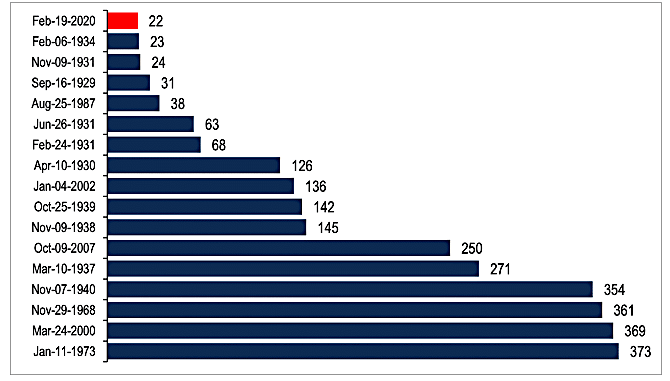
Gold and precious metal equities have been collateral damage during this most recent market correction. The broader markets had become a tinder box with grossly elevated valuation metrics never seen before, coupled with an economy burdened by record amounts of leverage (government, corporate, personal) and widespread investor complacency. All that was required was a spark — enter COVID-19. The speed of the correction was historical. The February to March 30% drawdown was the fastest 30% drawdown of all time (Figure 1). 

For us at Sprott, the corresponding selloff in gold bullion and precious metal equities was not surprising. During violent broader market corrections, liquidity is priority number one. This time was no different as broader markets gapped down in response to the greatest demand shock in modern economic history. This resulted in many entities selling gold bullion to meet liquidity requirements that surfaced because of margin calls, and the shuttering of both credit and debt markets. This pattern is similar to what the market witnessed as the Global Financial Crisis (GFC) unfolded in 2008-2009. 

Figure 1. Feb.-Mar. 2020 Selloff was the Fastest 30% Drawdown in History
Measured by Number of Days

fig 1

Source: BofA Global Research, Bloomberg.

Gold Serves its Function as Portfolio Insurance

Before hypothesizing where we will go from here, it is important to highlight that gold bullion has served its function as portfolio insurance. Year to date through March 27, 2020, gold bullion has appreciated 6.84%, while the S&P 500 Index1 has declined 20.96%. At the same time, gold mining equities have not fared as well gold bullion, because during the early stages of a correction, gold stocks are first and foremost stocks; GDX2 was down 10.45% YTD. 

The GFC as Playbook

As we are seeing today, there was a material demand shock as the GFC unfolded, with demand across economies declining suddenly and sharply.  Although not a perfect analog, the GFC can serve as a playbook. As liquidity became paramount for many market sectors during the GFC, gold bullion was sold to meet liquidity requirements. From the beginning of 2008 to November 12, 2008 (gold bullion’s low price), the S&P 500 fell 41.11%, gold equities (GDX2) cratered 60.60% and gold bullion depreciated by a relatively modest 16.94%. Once the U.S. Federal Reserve (“Fed”) stabilized liquidity conditions, gold bullion and precious metals stocks generated superior absolute and relative returns. From November 12, 2008 to the end of 2009, gold bullion rallied 54.02% and GDX rebounded 138.20%. The S&P 500 declined another 20.62% from November 12, 2008, to its bottom in March 2009 and then appreciated 64.83% to year-end 2009.

Fed Announces Unlimited QE on March 23

This time around, the Fed and the U.S. federal government are pulling no punches. Initially the Fed said it would undertake various operations to provide market liquidity that could total $1.5 trillion. This would include purchases of treasuries across all maturities and repo market operations. President Trump then announced interest on student loans would be waived in addition to a moderate $50 billion emergency aid package. The Fed then announced another $700 billion quantitative easing program which would include purchases of municipal bonds.

This past week, the biggest bazooka of all time was pulled out of the Fed’s arsenal as it amended its previously announced QE program by removing limits on its asset purchases and adding corporate bonds to its list of eligible securities it can purchase. Finally, the U.S. announced a $2.3 trillion fiscal package. The package equates to 10.6% of US GDP. The total budget deficit is expected to widen to at least 11.5% of GDP, which are levels not seen since WWII. The package includes grants (hundreds of billions) and direct payments to taxpayers ($290 billion), both of which are forms of helicopter money.3

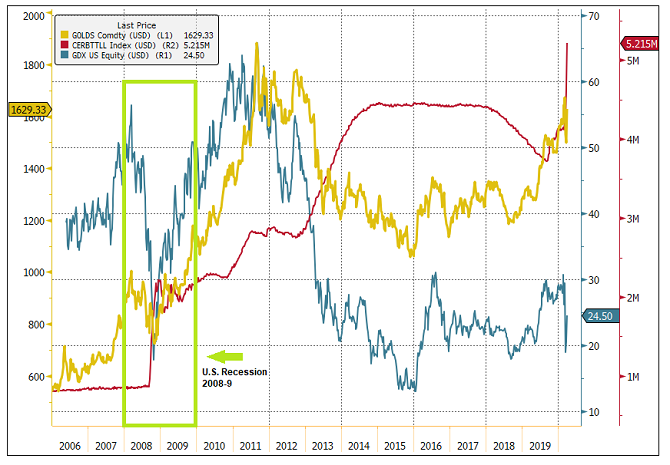
This is very good news for gold bullion and gold equities. There is an 80% correlation between the Fed’s balance sheet and the price of gold bullion. Similar to what occurred during the GFC, gold bullion should move first followed by gold equities (see Figure 2).

A Tailwind for Gold and Gold Stocks

This response has not been limited to the U.S. Globally, we are seeing central banks and governments deploying unprecedented amounts of monetary and fiscal stimulus in response to the economic fallout caused by Covid-19. All these actions should debase fiat currencies while providing a tremendous tailwind for gold bullion and gold equities.

We believe the table is set for a move in gold bullion and gold equities that could dwarf the second half of 2008.

Figure 2. Fed Balance Sheet vs. Price of Gold Bullion and Gold Equities

Fed Balance Sheet vs Gold

Source: Bloomberg. Data as of 3/27/2020. The red line represents reserve credit outstanding in $ trillions ($5.125 trillion as of 3/27/2020). The yellow line is the gold spot price based on GOLDS Comdty Index. The blue line is the price of gold mining equities represented by GDX.3

#Coronavirus: How tech companies are fighting against the pandemic – #Edtech brands step in – SPONSOR: BetterU Education Corp. $BTRU.ca $ARCL $CPLA $BPI $FC.ca

Posted by AGORACOM-JC at 12:16 PM on Monday, March 30th, 2020

SPONSOR:  BetterU Education Corp. aims to provide access to quality education from around the world. The company plans to bridge the prevailing gap in the education and job industry and enhance the lives of its prospective learners by developing an integrated ecosystem. betterU / Ottolearn launch FREE COVID-19 mobile resource toolkit to fight the global crisis – Click here for more information.

Coronavirus: How tech companies are fighting against the pandemic – Edtech brands step in

  • The Coronavirus pandemic has tech players helping in key areas including donating essential equipment, providing cloud solutions, filling in for shut down schools and everything in between.

By: Chetan Nayak

At this point in time, neither the Coronavirus nor the damage it has done to the world needs an introduction. Affecting over 190 countries around the world, the pandemic has brought most industries to a complete standstill. In countries like Italy, Spain and the USA, everything but essential services is on hold. A similar situation has recently hit India.

However, despite the global slowdown, there are brands that are still working. Working not just in their respective fields, but in new avenues, aiming to curb the disease or help those fighting against it. Tech brands across the globe are using their resources for the greater cause. Let’s have a closer look at how companies are making a difference in India.

Smartphone brands to the rescue

Smartphone brands probably have a closer connect with the public than other tech companies. Popular brands like Xiaomi and Vivo have taken steps to improve the ongoing situation in India. Vivo recently donated a large number of N95 masks for doctors and healthcare professionals. Xiaomi went ahead and also provided hazmat suits to the brave doctors who deal with many coronavirus patients on a daily basis. Oppo also announced recently that it has donated 300,000 masks to affected countries apart from China.

Customers in need not abandoned

There are also companies that are extending their warranties and customer-centric services through the lockdown period in India. Brands like Oppo, OnePlus, Realme and Huawei have extended their warranties. Moreover, despite manpower hitting an all-time low, brands are continuing to offer real-time support via email, chat and more. Service centers are still running, and brands are adopting measures like only taking in four customers at a time. Huawei is also providing doorstep repair services for users of the Huawei Watch GT series in India.

There are also leaders who are using their resources to help countries in need. For instance, Alibaba founder Jack Ma sent out a shipment of 1 million masks and 500,000 coronavirus testing kits. The billionaire recently took to Twitter to let people know that the first shipment was on its way to the USA. The Jack Ma foundation also announced in January that it will donate 100 million yuan ($14 million) to support the research and development of a coronavirus vaccine.

Cloud computing – The pandemic’s unsung heroes?

Most countries depend on various websites to keep things running. These include e-commerce platforms that are on war-footing, delivering groceries and other essential items. There are also OTT platforms including Netflix and Amazon Prime Video that people are using at a much higher rate due to them staying at home. Most of these websites and domains are running efficiently and catering to a large population like that of India because of well-run cloud computing.

Players like Google Cloud, Amazon Web Services (AWS) and Microsoft Azure are making the shift from personal to virtual possible. “We have taken measures to prepare and we are confident we will be able to meet customer demands for capacity in response to COVID-19,” said an AWS spokesperson to CRN. Microsoft meanwhile is prioritizing its cloud services to first responders and emergency services. This means that even if the scale of the Coronavirus pandemic grows larger, Microsoft has partnered with governments across the world to support critical infrastructure and emergency management services on priority.

Google is prepared, should Coronavirus make things worse

Meanwhile, Google also has been prepared for unseen circumstances like these. In a recent Google Cloud blog post, the company mentioned that “peak traffic to Google services including cloud, increased by up to 16 percent between February 10 and March 16 in Europe”. Further, it also mentioned that despite the shift from enterprise-grade office networks to people’s personal networks, the company has surplus computational resources. As per the post, in locations like the US, Google is utilizing only 25 percent to 33 percent of its total capacity during peak hours during the Coronavirus pandemic. That still leaves 75 percent to 66 percent of resources to allocate in these regions.

How are e-commerce players in India keeping up

Since March 24, Amazon and Flipkart, India’s largest online retailers, restricted customers from placing orders. Amazon mentioned that it would prioritize the delivery of ‘critical’ items like household staples, packaged food, healthcare, hygiene, and personal safety products. “This also means that we have to temporarily stop taking orders, and disable shipments, for lower-priority products,” wrote the company in a blog post.

Many Amazon customers also reported that their ‘non-essential‘ orders placed before March 24 were canceled as well. Meanwhile, Flipkart started the Coronavirus lockdown by ceasing all operations. It later started operating after a few hours only for grocery and essentials deliveries.

Edtech brands step in

Back in November 2016, digital payments became mainstream in India over the course of a single night. That was the consequence of India’s Demonetisation. Now, popular Edtech platforms in India are temporarily filling in for schools. Taking the opportunity, Edtech platforms Byju’s made all its learning platforms free till April end. Applicable for students from class 1 to 12, the platform will help kids stay on track with the syllabus.

Rival Toppr also offered free access to its live, video classes for school kids till March 31. The company also said that free sessions will be further extended if schools can’t reopen after March. Meanwhile, Unacademy announced 20,000 free live classes for people preparing for various entrance exams. “We want learners to utilize this time…We will support the education system in every way possible to weather the storm,” said Gaurav Munjal, co-founder, and CEO of Unacademy.

Source: https://www.bgr.in/news/coronavirus-how-tech-companies-are-fighting-against-the-pandemic-from-all-fronts-883066/

Barrick Unveils 10-Year Plan to Become World’s Most Valued Gold Miner SPONSOR: Loncor Resources $LN.ca $ABX.ca $TECK.ca $RSG $NGT.to $GOLD $NEM

Posted by AGORACOM at 11:24 AM on Monday, March 30th, 2020

Sponsor: Loncor, a Canadian gold explorer controlling over 2,400,000 high grade ounces outside of a Barrick JV. The Ngayu JV property is 200km southwest of the Kibali gold mine, operated by Barrick, which produced 800,000 ounces of gold in 2018. Barrick manages and funds exploration at the Ngayu project until the completion of a pre-feasibility study on any gold discovery meeting their Tier One investment criteria. Newmont $NGT $NEM owns 7.8%, Resolute $RSG owns 27% Click Here for More Info

This image has an empty alt attribute; its file name is Loncor-Small-Square.png
Barrick unveils 10-year plan to become world’s most valued gold miner
  • Barrick unveiled a 10-year production plan aimed at becoming the most valued bullion company
  • Increasing production to 5 million ounces of gold a year
  • Boosted production at Kibali, Congo’s biggest gold mine, which last year beat its production guidance of 750,000 ounces of gold by a substantial margin, delivering a new record of 814,027 ounces.

Barrick Gold (TSX: ABX) (NYSE: GOLD), the world’s second largest gold miner, has unveiled a 10-year production plan, boosting Barrick’s production to about 5 million ounces of gold a year

The strategy, outlined in its first annual report since its merger with Randgold Resources, includes boosting Barrick’s production to about 5 million ounces of gold a year, with the bulk coming from its North American operations.

President and chief executive officer, Mark Bristow, said Nevada Gold Mines — its recent joint venture with Newmont (NYSE: NEM) — would be the “value foundation” of its business moving forward.

“Already the world’s largest gold mining complex, it holds enormous potential for growth,” Bristow said.

Bristow warned the new guidance might be impacted if operations were disrupted due to efforts to slow the spread of the covid-19.  He called the pandemic “a global disaster which is changing the way we work and live in a radically disruptive process with currently no clear end in sight.”

In the past year, Barrick has been focusing on its tier one assets and has reported strong performance across the group, particularly at Cortez mine in Nevada and Veladero in Argentina.

It has also boosted production at Kibali, Congo’s biggest gold mine, which last year beat its production guidance of 750,000 ounces of gold by a substantial margin, delivering a new record of 814,027 ounces.

Porgera in Papua New Guinea has tier one potential but faces many challenges in the form of legacy issues and an unruly neighbourhood,” Bristow said, adding the mine had exceeded guidance and the company continued to negotiate a 20-year lease extension with the government.

The executive, who took the helm in January 2019, said the work done over the past year had equipped Barrick to move to the next level.

“All in all, I am confident that we are more than capable of delivering on our promise: to build the world’s most valued gold company,” he said.

Bristow noted that Barrick’s definition of value was more wide-ranging and included factors such as economic benefits, the care with which it treated its people, communities and environments, its strategic focus on long-term sustainability and returns for investors.

Work on PUREVAP #Silicon Metal Nano Reactor Continues as $HPQ.ca Provides Update on COVID-19 Outbreak Impact $FSLR $SPWR $CSIQ $PYR.ca $XMG.ca

Posted by AGORACOM-JC at 11:01 AM on Monday, March 30th, 2020
  • Work will continue with respect to activities in which social distancing and best health practices can be observed, such as developing the new PUREVAP™Â Silicon Metal Nano Reactor, (PUREVAP™Â SiNR).

MONTREAL, March 30, 2020  — HPQ Silicon Resources Inc. (“HPQ” or the “Company”) TSX-V: HPQ; FWB: UGE; Other OTC : URAGF; would like to inform shareholders that in response to the ongoing Coronavirus (COVID-19) outbreak, HPQ and its partners PyroGenesis in Montreal, and Apollon in France, and suppliers are respecting the health and safety of employees by encouraging employees to isolate, and work from home as much as possible.  Given the severity of the outbreak and continuing uncertainty regarding the duration and business impact of the virus, the start of the Gen3 Pilot Plant commissioning and testing program is being postponed until further notice.  However, work will continue with respect to activities in which social distancing and best health practices can be observed, such as developing the new PUREVAP™Â Silicon Metal Nano Reactor, (PUREVAP™Â SiNR).

BATTERY INDUSTRY INTEREST IN HPQ CONTINUES TO REMAIN STRONG

Despite the current circumstances, battery industry participants continue to inquire and demonstrate strong interest in our future upstream production capabilities.  Specifically, we are seeing meaningful interest in using our PUREVAP™ RRQ Silicon Metal (Si) as feed stock to manufacture:

So much so that, as soon as possible once the COVID-19 business interruption ends, our primary focus will be on manufacturing sufficient quantities of material to deliver samples to battery manufacturers and research centres. Only once these goals have been attained will we re-deploy assets to the Gen3 Pilot Plant commissioning and testing program. This is the level of importance of this initiative.

“The COVID-19 outbreak, possible recession and low oil prices don’t change the long-term cyclical movement of the Renewable Energy Revolution (“RER”).  HPQ is building a portfolio of unique High Value Silicon Metal products needed for the RER and the short-term business interruption we are experiencing has no bearing on the long-term potential of what we are doing. The continued interest in HPQ from the battery industry despite COVID-19 interruptions provides unequivocal evidence of this,” said Bernard Tourillon, President and CEO HPQ Silicon.  â€œInterest in the potential for Silicon Metal’s potential to contribute to energy storage demand is undeniable and generating massive investments, as well as, serious industry interest. This was true before the COVID-19 outbreak and will be true after.”

About Silicon Metal

Silicon Metal (Si) is one of today’s strategic material needed to fulfil the renewable energy revolution presently under way. Silicon does not exist in its pure state; it must be extracted from quartz (SiO2), in what has historically been a costly and energy intensive process.  

About HPQ Silicon

HPQ Silicon Resources Inc. (TSX-V: HPQ) is developing, with PyroGenesis Canada Inc. (TSX-V: PYR), a high-tech company that designs, develops, manufactures and commercializes plasma – based processes, the innovative PUREVAP™ â€œQuartz Reduction Reactors” (QRR), a process (patent pending), which will permit the One Step transformation of Quartz (SiO2) into High Purity Silicon (Si) at reduced costs, energy input, and carbon footprint that will propagate its considerable renewable energy potential.

HPQ, working with PyroGenesis, is also developing the PUREVAP™ Silicon Metal Nano Reactor (SiNR). This is a proprietary process that uses different purities of Silicon Metal (SI as feedstock), melts them into liquid Si that can then be synthesized into the Spherical Silicon Metal Nano Powders and Nanowires necessary for the next generation of Lithium-ion batteries.  During 2020, the plan is to validate our game changing manufacturing approach by upgrading our existing Gen2 PUREVAP™ QRR reactor into a PUREVAP™ SiNR to produce spherical Silicon Metal (Si) nano-powders and nanowires samples for industry participants and research institutions’.

Concurrently, HPQ is also working with industry leader Apollon Solar to develop a manufacturing capability that uses the High Purity Silicon (Si) made with the PUREVAP™ to make Porous silicon wafers needed for solid-state Li-ion batteries.  We expect that the first Silicon wafer should be ready to be shipped for testing to a battery manufacturer (under NDA) in 2020.

The focus of HPQ focus is to become the lowest cost producer of Silicon Metal (Si), High Purity Silicon Metal (Si), Spherical Si nano-powders and silicon-based composites for next-generation lithium-ion batteries, Porous Silicon Wafers for Solid states batteries and Porous Silicon Powders for Li-ion batteries.

This News Release is available on the company’s CEO Verified Discussion Forum, a moderated social media platform that enables civilized discussion and Q&A between Management and Shareholders. 

Disclaimers:

The Corporation’s interest in developing the PUREVAP™ QRR and any projected capital or operating cost savings associated with its development should not be construed as being related to the establishing the economic viability or technical feasibility of any of the Company’s Quartz Projects.

This press release contains certain forward-looking statements, including, without limitation, statements containing the words “may”, “plan”, “will”, “estimate”, “continue”, “anticipate”, “intend”, “expect”, “in the process” and other similar expressions which constitute “forward-looking information” within the meaning of applicable securities laws. Forward-looking statements reflect the Company’s current expectation and assumptions and are subject to a number of risks and uncertainties that could cause actual results to differ materially from those anticipated. These forward-looking statements involve risks and uncertainties including, but not limited to, our expectations regarding the acceptance of our products by the market, our strategy to develop new products and enhance the capabilities of existing products, our strategy with respect to research and development, the impact of competitive products and pricing, new product development, and uncertainties related to the regulatory approval process. Such statements reflect the current views of the Company with respect to future events and are subject to certain risks and uncertainties and other risks detailed from time-to-time in the Company’s on-going filings with the security’s regulatory authorities, which filings can be found at www.sedar.com. Actual results, events, and performance may differ materially. Readers are cautioned not to place undue reliance on these forward-looking statements. The Company undertakes no obligation to publicly update or revise any forward-looking statements either as a result of new information, future events or otherwise, except as required by applicable securities laws.

Neither the TSX Venture Exchange nor its Regulation Services Provider (as that term is defined in the policies of the TSX Venture Exchange) accepts responsibility for the adequacy or accuracy of this release.

For further information contact
Bernard J. Tourillon, Chairman, President and CEO Tel (514) 907-1011
Patrick Levasseur, Vice-President and COO Tel: (514) 262-9239
http://www.hpqsilicon.com Email: [email protected]

VIDEO: Hollister $HOLL.ca Closes $20,000,000 Acquisition, Adds $16.4M Revenue & $2.5M EBITDA $WEED.ca $CGC $ACB $APH $CRON.ca $OGI.ca $FAF.ca

Posted by AGORACOM-JC at 9:21 AM on Monday, March 30th, 2020

At a time when established Cannabis stocks are struggling due to an inability to actually deliver real businesses, Hollister Biosciences (HOLL:CSE) has been quietly building a real business, products, revenue and customers in 220 of California’s 600 dispensaries …. and growing, including California’s #1 hash infused pre-roll “Hashbone”.  

If that was all Hollister had going, they’d be in great shape with a super bright future and better than most Cannabis companies (small and large) who can’t even get product out the door.  

BUT THERE’S MORE – THE $20,000,000 ACQUISITION THAT COMES WITH $CDN 16.4M REVENUE & $CDN 2.48M EBITDA  

Hollister has closed their purchase of Venom Extracts, one of Arizona’s largest producers of Award-Winning Medical Cannabis Distillate. Just how good is Venom? In 2019, Venom generated $CDN 16.4M in revenue and $CDN 2.48M EBITDA in 2019 … and all of that was just from the state of Arizona.   

In this amazing interview, Venom Founder Jake Cohen discusses Venom’s aggressive plans to expand its brand and success into other states, including California as it benefits from Hollister’s distribution into 220 dispensaries.  Right now, some of you may be thinking, “yeah but everybody thinks they are going to expand” …. but Jake’s words, as well as those of Alex Somjen (President) and Carl Saling (CEO) are backed up by action.    

Specifically, a significant chunk of Venom’s acquisition shares kicks in if/when revenues hit $CDN 30,000 and $CDN 40,000 …. by December 31, 2021.  In my experience, companies joining forces don’t include such terms if there isn’t a reasonable expectation for hitting those numbers.  It doesn’t guarantee it but you can bet they have good reason to believe Venom sales will get to one or both of those numbers in just 21 months from now.  

If you’re looking for Cannabis companies that are going to survive and thrive over this next decade, then grab your favourite beverage and watch this great interview with Carl Saling, Alex Somjen and Jacob Cohen.

DATAMETREX #DM.ca WORKING WITH US GOVERNMENT AGENCIES ON #COVID19 AND #CORONAVIRUS

Posted by AGORACOM-JC at 7:23 AM on Monday, March 30th, 2020
  • Company is currently working with various agencies within the United States Government on the mass amount of social media surrounding #coronavirus and #covid19
  • “We are thrilled to be working with the US Government on this very important issue. We recently completed work for Democracy Labs on #disinformation in social media regarding #covid19 and #coronavirus and secured a relationship with Carnegie Mellon University IDeaS…”

TORONTO, March 30, 2020  — Datametrex AI Limited (the “Company” or “Datametrex”) is pleased to share that the Company is currently working with various agencies within the United States Government on the mass amount of social media surrounding #coronavirus and #covid19. We will provide greater detail on the work we are doing once it is completed and our clients approve it for public dissemination. 

“We are thrilled to be working with the US Government on this very important issue. We recently completed work for Democracy Labs on #disinformation in social media regarding #covid19 and #coronavirus and secured a relationship with Carnegie Mellon University IDeaS. Both announcements assisted in getting Nexalogy in front of the Government Agencies for this current opportunity in the United States. The solid foundation we have built over the past years with our Canadian Government clients like  DRDC, the Canadian Military and NATO have positioned Datametrex to be able to provide military grade solutions for todays social media challenges”, says Marshall Gunter CEO of Datametrex AI.

About Datametrex AI Limited

Datametrex AI Limited is a technology focused company with exposure to Artificial Intelligence and Machine Learning through its wholly owned subsidiary, Nexalogy (www.nexalogy.com).

Additional information on Datametrex is available at: www.datametrex.com

For further information, please contact:

Marshall Gunter – CEO
Phone: (514) 295-2300
Email: [email protected]

Neither the TSX Venture Exchange nor its Regulation Services Provider (as that term is defined in the policies of the TSX Venture Exchange) accepts responsibility for the adequacy or accuracy of this release.

Forward-Looking Statements

This news release contains “forward-looking information” within the meaning of applicable securities laws.  All statements contained herein that are not clearly historical in nature may constitute forward-looking information. In some cases, forward-looking information can be identified by words or phrases such as “may”, “will”, “expect”, “likely”, “should”, “would”, “plan”, “anticipate”, “intend”, “potential”, “proposed”, “estimate”, “believe” or the negative of these terms, or other similar words, expressions and grammatical variations thereof, or statements that certain events or conditions “may” or “will” happen, or by discussions of strategy.

Readers are cautioned to consider these and other factors, uncertainties and potential events carefully and not to put undue reliance on forward-looking information. The forward-looking information contained herein is made as of the date of this press release and is based on the beliefs, estimates, expectations and opinions of management on the date such forward-looking information is made. The Company undertakes no obligation to update or revise any forward-looking information, whether as a result of new information, estimates or opinions, future events or results or otherwise or to explain any material difference between subsequent actual events and such forward-looking information, except as required by applicable law.