Posted by AGORACOM-JC
at 4:03 PM on Monday, February 24th, 2020
In 1948, Winston Churchill said, “Those who fail to learn from history are condemned to repeat it”. Unfortunately, many Cannabis companies aren’t historians and are repeating the dot-com to dot-bomb cycle of raising tons of money but no clue how to build a real business with it.
You know what else we learned from that cycle? Web 2.0 was the birth of companies with real business plans, products, customers and revenues. They went on to dominate the next 20 years.
Enter MOTA Ventures (MOTA:CSE), who has become a leader in online CBD sales into the North American market, thanks to an e-commerce “engine” built by CEO Ryan Hoggan and his team over the past few years at Unified Funding. That engine is so powerful that is has racked up over $200 MILLION in sales from over 1 million paying customers over a number of products, including CBD sales of $25 MILLION by “First Class CBD”, which was acquired by MOTA for $32 MILLION.
The best part for MOTA shareholders? Ryan is highly motivated to continue with his successful ways because Unified Funding can earn an additional $15 MILLION if First Class CBD achieves sales of $62 MILLION. In my experience, companies don’t put bonuses into contracts unless they both believe there is a reasonable belief they can be achieved. Will he hit $62M? Or fall short at the other 2 milestones of $52M and $42M?
Watch this interview and you be the judge. Either way, MOTA shareholders should get their popcorn ready because Ryan has already proven he’s leading MOTA into the Cannabis 2.0 phase. Success is already here, now its just a question of how high MOTA will fly.
Watch this interview and share it with every investor you know!
Posted by AGORACOM-JC
at 9:15 AM on Monday, February 24th, 2020
Announced the appointment of Jeffrey Stoss as Chief Financial Officer of the Company.
Mr. Stoss brings more than 17 years of finance experience to his role at NORTHBUD, with a particular specialty in high-growth environments.
TORONTO, Feb. 24, 2020 — North Bud Farms Inc. (CSE: NBUD) (OTCQB: NOBDF) (“NORTHBUD” or the “Company“) is pleased to announce the appointment of Jeffrey Stoss as Chief Financial Officer of the Company.
“We are pleased to welcome Jeff to our dynamic team as NORTHBUD is at
an exciting time in its development,†stated Sean Homuth, CEO of North
Bud Farms Inc. “Jeff brings specialty experience in accounting and
finance having worked with and advised many public companies over the
years in both Canada and the United States. His leadership and expertise
will be essential in executing our strategic plan and taking the
Company to its next level of growth.â€
Mr. Stoss brings more than 17 years of finance experience to his role
at NORTHBUD, with a particular specialty in high-growth environments.
He is the co-founder and Chief Operating Officer of the outsourced
finance services firm, Positive Venture Group Inc. He has previously
served as CFO for publicly-traded companies and technology start-ups.
Mr. Stoss has professional accountant designations in both Canada and
the United States.
RSU Grants
On February 20, 2020, the Company’s board of directors approved the
grant of 361,000 restricted share units (“RSUsâ€) to certain directors
and consultants of the Company. The RSUs vest in four equal tranches
starting three months from the date of grant. Each vested RSU entitles
the holder thereof to receive one common share of the Company upon
delivery of an exercise notice, in accordance with the Omnibus Plan.
About North Bud Farms Inc.
NORTHBUD, through its U.S. subsidiary Bonfire Brands USA, has
acquired cannabis production facilities in California and Nevada. The
Salinas, California 11-acre farm is actively cultivating cannabis in its
60,000 sq. ft. of licensed greenhouse production space. The Reno,
Nevada property is located on 3.2 acres of land which was acquired
through the acquisition of Nevada Botanical Science, Inc., a world class
cannabis production, research and development facility with 5,000 sq.
ft. of indoor cultivation which holds medical and adult use licenses for
cultivation, extraction and distribution. Through its wholly-owned
Canadian subsidiary, GrowPros MMP Inc., the Company is pursuing a
license under The Cannabis Act, to cultivate in its state-of-the-art
purpose-built cannabis production facility located on 135 acres of
agricultural land in Low, Quebec, Canada.
Neither the CSE nor its Regulation Services Provider (as that term is
defined in the policies of the CSE) accepts responsibility for the
adequacy or accuracy of this release.
Forward-looking statements Certain
statements and information included in this press release that, to the
extent they are not historical fact, constitute forward-looking
information or statements (collectively, “forward-looking statementsâ€)
within the meaning of applicable securities legislation.
Forward-looking statements, include but are not limited to those
identified by the expressions “anticipateâ€, “believeâ€, “planâ€,
“estimateâ€, “expectâ€, “intendâ€, “mayâ€, “should†and similar expressions
to the extent they relate to the Company or its management.
Forward-looking statements, including those regarding the success of
the Company’s licence application, the Company’s ability to execute its
strategic plan, conditions in the cannabis market, the Company entering
agreements in connection with the B2B supply of cannabis and the
Company’s transition into a revenue-generating operational phase of
development are based on the reasonable assumptions, estimates, analysis
and opinions of management made in light of its experience and its
perception of trends, current conditions and expected developments, as
well as other factors that management believes to be relevant and
reasonable in the circumstances at the date that such statements are
made, but which may prove to be incorrect.
Forward-looking statements involve known and unknown risks,
uncertainties and other factors that may cause the actual results,
performance or achievements of the Company to differ materially from any
future results, performance or achievements expressed or implied by the
forward-looking statements. Such risks and uncertainties include,
among others, the risk factors included in the Company’s final long form
prospectus dated August 21, 2018, which is available under the
Company’s SEDAR profile at www.sedar.com.
Accordingly, readers should not place undue reliance on any such
forward-looking statements. Further, any forward-looking statement
speaks only as of the date on which such statement is made. New factors
emerge from time to time, and it is not possible for the Company’s
management to predict all of such factors and to assess in advance the
impact of each such factor on the Company’s business or the extent to
which any factor, or combination of factors, may cause actual results to
differ materially from those contained in any forward-looking
statements. The Company does not undertake any obligation to update any
forward-looking statements to reflect information, events, results,
circumstances or otherwise after the date hereof or to reflect the
occurrence of unanticipated events, except as required by law including
securities laws. This news release does not constitute an offer to sell
or a solicitation of any offer to buy any securities of the Company.
FOR ADDITIONAL INFORMATION, PLEASE CONTACT: North Bud Farms Inc. Edward Miller VP, IR & Communications Office: (855) 628-3420 ext. 3 [email protected]
Tags: Cannabis, CBD, CSE, Hemp, Marijuana, stocks Posted in North Bud Farms Inc | Comments Off on North Bud Farms $NBUD.ca Announces the Appointment of Jeffrey Stoss as Chief Financial Officer $CGC $ACB $APH $CRON.ca $OGI.ca
Posted by AGORACOM-JC
at 7:34 AM on Saturday, February 22nd, 2020
Announced a transition after the definitive close of First Class CBD acquisition
Appointed Ryan Dean Hoggan to Chief Executive Officer
Acquisition of First Class CBD coupled with the upcoming U.S. roll out of the Company’s European CBD brand, Sativida, made the appointment of Mr. Hoggan to Chief Executive Officer a natural fit
Mr. Hoggan brings more than 18 years of leadership, global business development and entrepreneurship experience in the health equipment, medical devices and natural health products sectors
VANCOUVER, BC / February 22, 2020 / Mota Ventures Corp. (CSE:MOTA)(FSE:1WZ:GR)(OTC:PEMTF) (the “Company” or “Mota“) is pleased to announce a transition after the definitive close of First Class CBD acquisition, the Company’s Board of Directors has appointed Ryan Dean Hoggan to Chief Executive Officer. The acquisition of First Class CBD coupled with the upcoming U.S. roll out of the Company’s European CBD brand, Sativida, made the appointment of Mr. Hoggan to Chief Executive Officer a natural fit. Ryan brings a wealth of expertise to this role, being one of the founders of Unified Funding LLC and First Class CBD. Ryan is an experienced strategist, with a strong understanding of building high value consumer brands with significant annual revenue. Ryan’s extensive background in the online e-commerce space will continue to drive the Company’s rapid growth in the US and spearhead its expansion into the European market. The Company intends to continue its roll up strategy of acquiring profitable, well-known CBD brands globally.
Mr. Hoggan brings more than 18 years of leadership, global business
development and entrepreneurship experience in the health equipment,
medical devices and natural health products sectors. Early in his
career, Ryan took on a leadership role in his family business, HOGGAN
Health Industries, where he led operations, business development and
marketing efforts. After identifying an untapped niche in the market, he
founded Hoggan Medical where he went on to launch over 100 health,
fitness and medical device products and negotiated contracts with big
and small customers including the Mayo Clinic, Boeing, Daimler AG and
the Los Angeles Lakers (NBA).
In 2014, Ryan discovered the power of CBD and essential oils – both
personally and professionally – after a personal health scare prompted
him to research and subsequently try holistic products to improve his
health. The experience ultimately led him to become a Partner and
President of Offer Space, LLC and Real Oil, LLC, two rapidly growing
E-commerce and technology companies focused on serving U.S. based and
international consumers in the CBD and natural health products market.
In June 2019, Mr. Hoggan led a strategic divestiture of the businesses
to Unified Funding, LLC to help continue an impressive growth trend.
Through the operations of Unified Funding, LLC, the business has
generated a database of over 4.5 million customer records and
facilitated over $200 million in consumer transactions from more than
one million paying customers in sectors such as beauty, nutrition and
CBD products.
Mr. Hoggan holds a Bachelor of Business Administration (BBA) from
Westminster College, an MBA from The University of Arizona and a Master
of Global Management (MGM) from the Thunderbird School of Global
Management at Arizona State University.
In connection with Ryan’s appointment to CEO, Joel Shacker will
transition to the role of President of the Company and will remain a
member of the board of directors.
“I am very excited to take on the CEO role at Mota and focus the
operations on becoming a global E-commerce CBD company. I am also
excited about the partnership between Unified and Sativida. Unified’s
extensive experience in the U.S. and strong logistics and supply chain
will provide significant support for the launch of the Sativida line in
the U.S. I believe through the direct-to-consumer online platforms we
will become a leader in the CBD space. We plan to aggressively expand
First Class’s existing operations in the U.S. as well as launch a
European expansion, which we anticipate will yield similar results to
our U.S. operations last year,” stated Ryan Hoggan, CEO of the Company.
“We are extremely happy to have someone with Ryan’s extensive
experience stepping into this role. I am confident in his ability to
execute on expanding operations and generating further revenue. I look
forward to continuing to build the Company in my new role as President
and to working with Ryan during his transition to CEO of Mota.” stated
Joel Shacker.
About Mota Ventures Corp.
Mota is seeking to become a vertically integrated global CBD brand.
Its plan is to cultivate and extract CBD into high-quality value-added
products from its Latin American operations and distribute it both
domestically and internationally. Its existing operations in Colombia
consist of a 2.5-hectare site that has optimal year-round growing
conditions and access to all necessary infrastructure. Mota is looking
to establish sales channels and a distribution network internationally
through the acquisition of the Sativida and First Class CBD brands. Low
cost production, coupled with international, direct to customer sales
channels will provide the foundation for the success of Mota.
ON BEHALF OF THE BOARD OF DIRECTORS
MOTA VENTURES CORP. Joel Shacker
President
For further information, readers are encouraged to contact Joel Shacker, President & CEO at +604.423.4733 or by email at [email protected] or www.motaventuresco.com
Neither the Canadian Securities Exchange nor its Regulation Services
Provider (as that term is defined in the policies of the Canadian
Securities Exchange) accepts responsibility for the adequacy or accuracy
of this press release, which has been prepared by management.
All statements in this press release, other than statements of
historical fact, are “forward-looking information” with respect to the
Company within the meaning of applicable securities laws, including with
respect to the Company’s rapid growth in the US and expansion into the
European market,its plans to become a vertically
integrated global CBD brand, its plans to cultivate and extract cannabis
to produce CBD and high-quality value added CBD products in Latin
America for distribution domestically and internationally and its plans
to acquire revenue-producing CBD brands and operations in Europe and
North America. The Company provides forward-looking statements for the
purpose of conveying information about current expectations and plans
relating to the future and readers are cautioned that such statements
may not be appropriate for other purposes. By its nature, this
information is subject to inherent risks and uncertainties that may be
general or specific and which give rise to the possibility that
expectations, forecasts, predictions, projections or conclusions will
not prove to be accurate, that assumptions may not be correct and that
objectives, strategic goals and priorities will not be achieved. These
risks and uncertainties include but are not limited those identified and
reported in the Company’s public filings under the Company’s SEDAR
profile at www.sedar.com. Although the Company has attempted to identify
important factors that could cause actual actions, events or results to
differ materially from those described in forward-looking information,
there may be other factors that cause actions, events or results not to
be as anticipated, estimated or intended. There can be no assurance that
such information will prove to be accurate as actual results and future
events could differ materially from those anticipated in such
statements. The Company disclaims any intention or obligation to update
or revise any forward-looking information, whether as a result of new
information, future events or otherwise unless required by law.
SOURCE: Mota Ventures Corp.
Tags: Cannabis, CSE, Hemp, Marijuana, stocks, tsx, tsx-v, weed Posted in Featured, Mota Ventures Corp. | Comments Off on Mota Ventures $MOTA.ca Announces Transition After Definitive Close of First Class #CBD Acquisition; Ryan Hoggan is New CEO $WEED.ca $CGC $ACB $APH $CRON.ca $HEXO.ca $OGI.ca $FAF.ca
Posted by AGORACOM
at 2:47 PM on Friday, February 21st, 2020
SPONSOR: Labrador Gold – Two successful gold explorers lead the way in the Labrador gold rush targeting the under-explored gold potential of the province. Exploration has already outlined district scale gold on two projects, including a 40km strike length of the Florence Lake greenstone belt, one of two greenstone belts covered by the Hopedale Project. Click Here for More Info
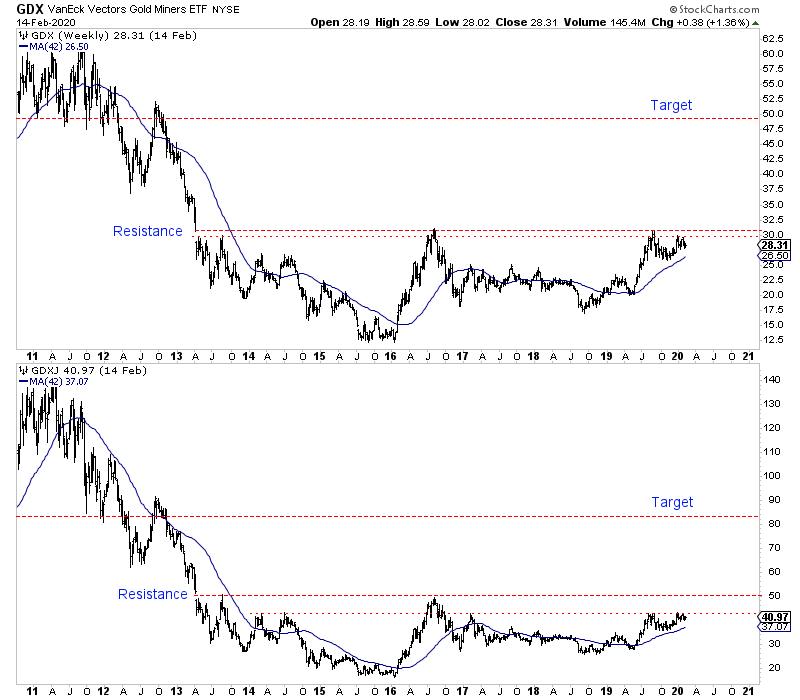
GDX and GDXJ are consolidating bullishly within a now seven-year-long base
Last week, I covered the historical trajectory of the gold stocks and how today compares to the early 1960s.
The late 2015 to early 2016 period marked one of the three best
buying opportunities of the past 100 years (from a secular standpoint),
and gold stocks are in position for sensational performance over the
next 20 years.
That sounds great, but what matters most is the here and now. We do
not want to get caught in a cyclical downturn (which could occur more
than once during this super bull).
Fortunately, the outlook over the next 12 to 18 months is bullish.
The macro-fundamentals are supportive and improving, and the gold stocks
now have a beautiful technical setup that could lead to massive gains.
GDX and GDXJ are consolidating bullishly within a now seven-year-long
base. They are digesting recent gains while holding well above key
support levels and are in position for an eventual explosive breakout.
GDX & GDXJ Weekly Bars
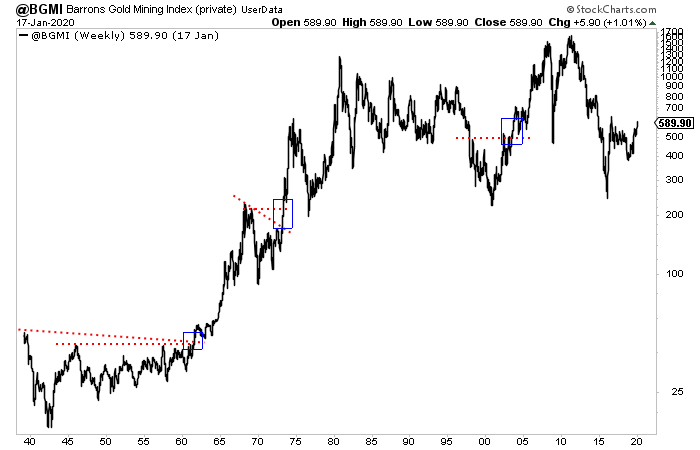
Historically, there have not been many multi-year breakouts with the
potential magnitude of this next one. In using the Barron’s Gold Mining
Index, I only find three.
The breakout in 1964 was a historic, multi-decade breakout that
ushered in an enormous bull market in gold stocks. It was the most
significant inflection point ever for gold stocks.
Later during that bull market, the gold stocks broke a 5-year downtrend and 5-year resistance in 1973, exploding higher.
Barron’s Gold Mining Index
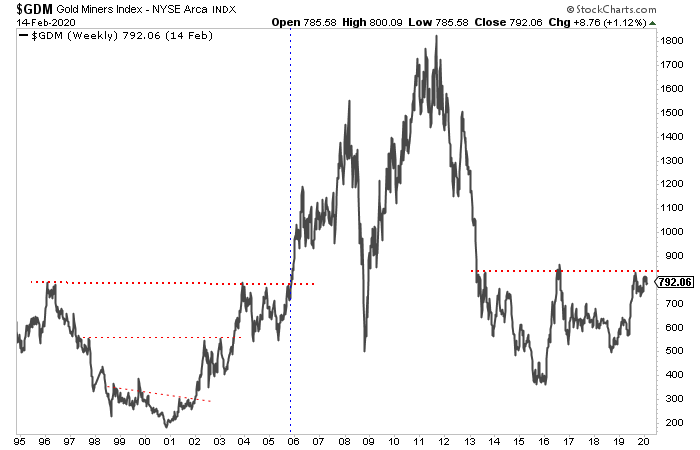
The 2005 breakout compares best with the potential next one.
Like the one in 2005, this next one is setting up several years after
a secular low, following one of the worst bear markets of the past 90
years.
Also, this next breakout could occur following a +7 year-long base,
which is not too far from the +9 year base that was broken in late
2005.
Furthermore, the May 2005 low is similar to September 2018 in that
both followed a mini-bear market that lasted at least 18 months.
We plot the NYSE Arca Gold Miners Index, which is the parent index of GDX.
GDM Weekly Line
Since there are similarities in the setup, perhaps the upside
potential from a new breakout could be similar to that which followed
the 2005 breakout.
I want to focus on GDXJ because we invest in juniors and not seniors. The history of GDXJ back to January 2004 is available on this website.
From its May 2005 low to its peak in November 2007, GDXJ advanced
nearly 4-fold. Once GDXJ surpassed its January 2004 peak, it gained 138%
into that 2007 peak.
GDXJ closed last week just below $41. The measured upside target from
a break past $50 is $83. If GDXJ today duplicated its performance
before and after the 2005 breakout, then it would peak at $100 or $115.
If we get the breakout, then $83 becomes the minimum upside target. In that case, $100 or $115 is hardly a stretch.
Posted by AGORACOM-JC
at 1:00 PM on Friday, February 21st, 2020
SPONSOR: KABN Systems North America Inc.
A Fintech platform focused on Verifying, Managing & Monetizing
Online Identity. KABN’s mission is to create a world-class suite of
products and services that support the decentralized market economy,
globally enabling consumers to manage their digital identity and other
data to create value-based relationships in the financial and loyalty
services arena.
Fintech Trends Everyone Should Look For in 2020
These statistics can’t go wrong as fintech is expected to grow further with companies from around the world pouring in their investments in this sector
A report on these shares that investments in the fintech industry is expected to number over $30 billion in 2020.
2020 is unofficially considered a defining year for various reasons.
Tons of estimations on the growth of industries and sectors across the
globe have 2020 as the year, where things will go uphill. Fintech is no
exception. Pull out any information or statistics on the growth of
fintech, this year stands as the pinnacle of the industry’s growth.
These statistics can’t go wrong as fintech is expected to grow
further with companies from around the world pouring in their
investments in this sector. A report on these shares that investments in
the fintech industry is expected to number over $30 billion in 2020.
With several fintech market players reinvesting in strengthening
their service delivery and IT infrastructure, they are involuntarily
setting up new trends in the market. They are all becoming increasingly
customer-centric, aiming to get more things done in less time with the
help of disruptive technologies.
Here, we break downtrends in the fintech industry to look out for in 2020.
Big Data and Artificial Intelligence for Personalization
Speaking of disruptive technologies, we cannot overlook the impact
concepts like Big Data, artificial intelligence, machine learning, and
deep learning have left on various industries. If an online streaming
platform knows more about our movie preferences than our best friend, it
is only because of complex artificial intelligence algorithms at work.
With the advent of Big Data, it has also become easier for companies
to handle massive amounts of data generation and processing. Now,
fintech companies can understand more about us through our online
behaviour, browsing history and app usage on our likes and dislikes,
preferences, credit and repayment history and more.
With AI being omnipresent across multiple channels, fintech companies
are looking to combine the power of both to deliver better services and
experiences to their users through personalization. If you’ve been into
marketing, you would know the impact personalization has among
consumers. With the combination of these two technologies, we can
experience a one-to-one, focused banking experience in the coming
months.
Blockchain To Shake Up the Industry
Financial institutions have always been eyeing optimum security and
safety and with the onset of Blockchain, they are a step closer to
achieving this. A decentralized and distributed concept that is
fool-proof, Blockchain is everything the fintech industry could ask for.
Some of the plaguing concerns in the fintech industry include frauds
and identity thefts, which cause billions of dollars of losses to
companies every year. With the implementation of Blockchain in this
industry, companies can pave the way for a smarter and safer transaction
and operation.
Besides, it is also revealed that the investments in blockchain are anticipated to hit $6,700mn by the year 2023.
So, in the coming years, we could expect jargons of today like smart
contracts, trading shares, identity management and more to become
mainstream.
Chatbots
Chatbots are AI-powered bots that replicate human interactions. They
have access to the internet and are designed to accurately pull out
specific information depending on the question asked. Most of us are
already talking to a chatbot in a number of scenarios and we aren’t
aware of it. Close to cracking the Turing Test, the implementation of
chatbots will continue to soar to new heights in the coming months.
By the year 2023, it is also expected that close to 826 million hours would be saved by banks with their chatbots
deployment. Also, over 79% of the successful interactions using
chatbots will be through mobile applications in the coming three years.
With the fintech industry being prone to queries and questions from
potential leads, new customers, existing customers and others, chatbots
are the way forward to save time on redundant tasks and use manpower to
focus on niche tasks.
RPA
RPA stands for Robotic Process Automation. In the year 2020, more
companies will invest in deploying RPAs into their systems to optimize
operations and make service delivery more effective. An advanced version
of chatbots, RPA is more like an artificially intelligent colleague
working with you at your workplace.
They were one of the biggest trends to watch out for in the year 2018
and in a span of two years, they have become mainstream enough to be
deployed in companies. With their implementation, companies can further
make their data aggregation and processing more streamlined, offer
better customer service, find and fix loopholes in workflow and take
care of specific tasks like:
Onboarding customers
Verifying and conducting background checks
Data analytics and reporting
Managing compliance processes
Assessing risk and more
Cybersecurity
With digital implementation comes enormous risks. That’s a giveaway.
When companies, especially fintech companies, go digital in terms of
applications and progressive websites, they open up new avenues for
attacks and threats. According to research, over 98% of the top 100 fintech companies across the globe have vulnerabilities despite having proper tech infrastructure in place.
There are also issues of identity theft, fraudulent transactions,
access to sensitive user data and more in this sector. That’s why
cybersecurity stands as one of the priority implementations for the year
2020. Blockchain, AI and other technologies we discussed earlier are
all simultaneously working on optimizing security in this sector.
So, these are the top fintech trends to look out for in the year
2020. If you intend to get a fintech app launched, you need to take care
of all the factors we just discussed. They are trends because they are
inevitable this year.
Tags: canadian fintech, crypto, fintech, Kabn Posted in KABN | Comments Off on Fintech Trends Everyone Should Look For in 2020 – SPONSOR: #KABN Systems North America Inc.
Posted by AGORACOM
at 12:29 PM on Friday, February 21st, 2020
SPONSOR: Lomiko Metals is focused on the exploration and development of minerals for the new green economy such as lithium and graphite. Lomiko owns 80% of the high-grade La Loutre graphite Property, Lac Des Iles Graphite Property and the 100% owned Quatre Milles Graphite Property. Lomiko is uniquely poised to supply the growing EV battery market. Click Here For More Information
An Ivy charger on display at the 2020 Canadian International AutoShow in Toronto. Ontario Power Generation photo
Ivy Charging Network aims to create the “largest and most connected electric vehicle fast-charger network†in the province.
The company is expected to install 160 Level 3 fast-chargers at 73
locations across Ontario, each less than 100 kilometres apart from one
another on average, by the end of 2021.
Electric vehicle charging stations are coming to North Bay and
Temiskaming Shores as part of a new province-wide network being
developed by Hydro One and Ontario Power Generation (OPG).
Media releases from both Hydro One and OPG say they have launched a
new company, Ivy Charging Network, which aims to create the “largest and
most connected electric vehicle fast-charger network†in the province.
The company is expected to install 160 Level 3 fast-chargers at 73
locations across Ontario, each less than 100 kilometres apart from one
another on average, by the end of 2021.
Natural Resources Canada has provided an $8-million repayable
contribution, through its Electric Vehicle and Alternative Fuel
Infrastructure Deployment Initiative, to help build the network.
The Ivy Charging Network opened its first location in Huntsville in
September and an official public launch took place Friday at the 2020
Canadian International AutoShow in Toronto.
“We play a critical role in energizing life in communities across
Ontario. This fast-charger network will create a better and brighter
future through a greener transportation sector while meeting the
evolving energy needs of our customers and all Ontarians,†Hydro One
vice-president of customer service and Ivy Charging Network co-president
Imran Merali said.
“By entering this growing market in partnership with OPG, Hydro One
is expanding our product and service offering to deliver greater value
for our customers, employees, communities and shareholders.â€
Ivy Charging Network is a limited partnership owned equally by Hydro One and OPG.
The company has chosen Greenlots, a member of the Shell Group, as its service provider to operate and manage the network.
“Having delivered the world’s largest single climate change action to
date with the closure of our coal stations, OPG’s clean power serves as
a strong platform to electrify carbon-heavy sectors like
transportation,†fellow Ivy Charging Network co-president and OPG
vice-president of corporate business development and strategy Theresa
Dekker said.
“That’s why we’re so pleased to be partnering with Hydro One on an
initiative that will broaden the benefits of electrification and provide
a reliable, integrated network while ensuring no additional cost to
ratepayers.â€
Nipissing-Timiskaming Liberal MP Anthony Rota applauded the news on
Twitter, while Minister of Innovation, Science and Industry Navdeep
Bains said the federal government is committed to supporting projects
that will bring the country closer to a “competitive, zero-emissions
transportation sector.â€
He added that the network will ensure “Canadian-made solutions are at
the forefront of solving the global climate change crisis, leaving our
children and grandchildren with a healthier planet and cleaner air to
breathe.â€
Posted by AGORACOM
at 11:56 AM on Friday, February 21st, 2020
Sponsor: Affinity Metals (TSX-V: AFF) a Canadian mineral exploration company building a strong portfolio of mineral projects in North America. The Corporation’s flagship property is the Drill ready Regal Property near Revelstoke, BC. Recent sampling encountered bonanza grade silver, zinc, and lead with many samples reaching assay over-limits. Click Here for More Info
Silver is a precious metal with approximately 50% of the demand coming from industrial uses.
It is a “high beta†play on the gold price, more sensitive to global growth and the inflation expectations.
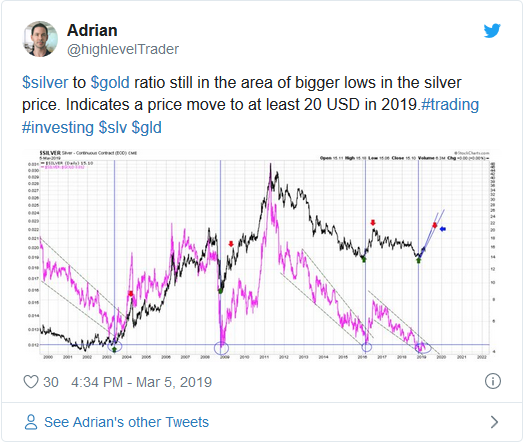
I’m on record for a quite bullish call in gold one year ago. As of today, gold trades approximately 20 % or 300 USD higher.
In March 2019, I also tweeted that the
silver/gold ratio probably made a low and that I expect silver to at
least reach 20 USD in 2019. I was slightly too optimistic, silver made
“only†30 % and hit 19.75 USD.
I have a new strong opinion I would like to share with you.
Silver is a precious metal with approximately 50% of the demand
coming from industrial uses. It is a “high beta†play on the gold price,
more sensitive to global growth and the inflation expectations.
The relationship to gold in more detail: at the beginning of a new
up cycle in precious metals, silver in general lags gold. Later in the
cycle (especially at the end of a certain cycle) silver massively
outperforms gold. After the peak, silver starts to underperform again.
After spending quite some time doing research, today’s situation in
silver looks similar like late 2003 (blue arrow). But here are my
observations:
“History doesn’t repeat itself, but it often rhymes.†– Mark Twain
The a-b-c is a typical bottoming process, with a retest of the lows
(c), a price compression and a well-defined breakout (blue trendline).
During this initial stage, silver rather underperforms gold (see 1 and 2
in the silver/gold ratio).
Later silver consolidates above the 200-week moving average (blue
box), pullbacks finding support at the moving average, exactly like in
2003. Meanwhile, the moving average flattens and even turned upward.
The silver/gold ratio also put in a possible bottom and is close to breaking the dashed blue trendline (yellow box).
If things repeat in a similar way, expect a huge up move in silver
soon. A repeat of 2003-2004 would imply roughly 50 % upside within this
year.
How I play it:
I already have a position in silver, I will increase the position if
silver is able to break and hold above 18.12 USD = higher low. (further
confirmation if gold miners break out and the silver/gold ratio breaks
the downward sloping trendline)
Below 17.48 USD I reduce my position and stay rather defensive until silver is showing strength again.
I personally use futures and I will probably add a call option
(strike 18 USD; March 2021). For most people, a ETF like SLV is probably
a good way to participate.
A word of caution:
First, bold predictions often fail. The above mentioned is just my opinion (as of today).
Further, history is only a guide. The move may take place later, is
not as explosive as in 2003-2004 or will not take place at all.
I see a possibility that the recent virus in China has a quite
negative impact on global growth and on inflation expectations
(S&P500 doesn’t believe it, but copper and oil do). A severe outcome
would probably delay this trade setup. Remember, silver is very
sensitive to inflation expectations.
As already stated, just my opinion and not investment advice. Please
do your own analysis. Investing/trading involves substantial risk of
loss and is not suitable for all people.
Posted by AGORACOM-JC
at 11:30 AM on Friday, February 21st, 2020
SPONSOR: CardioComm Solutions (EKG: TSX-V)
– The heartbeat of cardiovascular medicine and telemedicine. Patented
systems enable medical professionals, patients, and other healthcare
professionals, clinics, hospitals and call centres to access and manage
patient information in a secure and reliable environment.
M-Health Device Market is Booming Worldwide
Mhealth field has emerged as a sub-segment of eHealth, the use of information and communication technology (ICT), such as computers, mobile phones, communications satellite, patient monitors, etc., for health services and information.
According to an analyst firm, around 2.8 million patients worldwide were using a home monitoring service based on equipment with integrated connectivity
By Orian Research on February 21, 2020
According to a Latest market research report titled, ‘M-Health Device
Market’, added on Orian Research. The report has been processed on the
basis of a comprehensive analysis with inputs from industry experts. The
report presents the market scenario and its potential growth prospects
during the forecast period. The report also presents the evaluation of
the competitive landscape of the market. The leading strategies,
collaborations, innovations, and market revenue of the major players has
been elaborated in this report. The approvals and insights on the top
companies prevalent in the market will enable the reader to get
accustomed with the market opportunities that they can tackle with
informed and favorable business strategies
mHealth is an abbreviation for mobile health, a term used for the
practice of medicine and public health supported by mobile devices. The
term is most commonly used in reference to using mobile communication
devices, such as mobile phones, tablet computers and PDAs, and wearable
devices such as smart watches, for health services, information, and
data collection. The mHealth field has emerged as a sub-segment of
eHealth, the use of information and communication technology (ICT), such
as computers, mobile phones, communications satellite, patient
monitors, etc., for health services and information.
According to an analyst firm, around 2.8 million patients worldwide
were using a home monitoring service based on equipment with integrated
connectivity at the end of 2013. The figure does not include patients
that use monitoring devices connected to a PC or mobile phone. It only
includes systems that rely on monitors with integrated connectivity or
systems that use monitoring hubs with integrated cellular or fixed-line
modems.
Global M-Health Device Industry 2020 Market Research Report is spread
across 95 pages and provides exclusive vital statistics, data,
information, trends and competitive landscape details in this niche
sector.
Development policies and plans are discussed as well as manufacturing
processes and cost structures are also analyzed. This report also
states import/export consumption, supply and demand Figures, cost,
price, revenue and gross margins. The report focuses on global major
leading M-Health Device Industry players providing information such as
company profiles, product picture and specification, capacity,
production, price, cost, revenue and contact information.
The M-Health Device market report is a collection of the first-hand
data, subjective, and quantitative assessment by industry experts and
professionals, contributions from industry specialists and industry
participants over the value chain. The report consists of a detailed
analysis of the industry growth trends, micro- and macroeconomic
components, and governing factors, along with the market attractiveness,
within the market segments. The report likewise maps the subjective
impact of the different market factors on the market segments,
sub-segments, and geographies.
Major Players in M-Health Device Market are: • Allscripts • Apple • Athenahealth • Cerner • Ge Healthcare • Philips • Medtronics
This report includes the estimation of market size for value (million
USD) and volume (K Units). Both top-down and bottom-up approaches have
been used to estimate and validate the market size of M-Health Device
market, to estimate the size of various other dependent submarkets in
the overall market. Key players in the market have been identified
through secondary research, and their market shares have been determined
through primary and secondary research.
All percentage shares, splits, and breakdowns have been determined using secondary sources and verified primary sources.
Posted by AGORACOM-JC
at 10:54 AM on Friday, February 21st, 2020
SPONSOR: Datametrex AI Limited
(TSX-V: DM) A revenue generating small cap A.I. company that NATO and
Canadian Defence are using to fight fake news & social media
threats. The company announced three $1M contacts in Q3-2019. Click here for more info.
Latest AI could one day take over as the biggest editor of Wikipedia
“There are so many updates constantly needed to Wikipedia articles. It would be beneficial to automatically modify exact portions of the articles, with little to no human intervention,†said Darsh Shah, a PhD student in MIT’s Computer Science and AI Laboratory, who is one of the lead authors.
Researchers have developed an AI that can automatically rewrite
outdated sentences on Wikipedia, drastically reducing the need for human
editing.
Despite thousands of volunteer editors dedicating many hours towards keeping Wikipedia up to date, editing an estimated 52m articles
seems like an almost impossible task. However, researchers from MIT are
set to unveil a new AI that could be used to automatically update any
inaccuracies on the online encyclopaedia, thereby giving human editors a
robotic helping hand.
In a paper presented at the AAAI Conference on AI, the researchers
described a text-generating system that pinpoints and replaces specific
information in relevant Wikipedia sentences, while keeping the language
similar to how humans write and edit.
The idea is that humans could type an unstructured sentence with the
updated information into an interface, without the need to worry about
grammar. The AI then searches Wikipedia for the right pages and outdated
information, which it then updates in a human-like style.
The researchers are hopeful that, down the line, it could be possible
to build an AI that can do the entire process automatically. This would
mean it could scour the web for updated news on a topic and replace the
text.
Taking on ‘fake news’
“There are so many updates constantly needed to Wikipedia articles.
It would be beneficial to automatically modify exact portions of the
articles, with little to no human intervention,†said Darsh Shah, a PhD
student in MIT’s Computer Science and AI Laboratory, who is one of the
lead authors.
“Instead of hundreds of people working on modifying each Wikipedia
article, then you’ll only need a few, because the model is helping or
doing it automatically. That offers dramatic improvements in
efficiency.â€
Looking beyond Wikipedia, the study also put forward the AI’s
potential benefits as a tool to eliminate bias when training detectors
of so-called ‘fake news’. Some of these detectors train on datasets of
agree-disagree sentence pairs to verify a claim by matching it to given
evidence.
“During training, models use some language of the human-written
claims as ‘give-away’ phrases to mark them as false, without relying
much on the corresponding evidence sentence,†Shah said. “This reduces
the model’s accuracy when evaluating real-world examples, as it does not
perform fact-checking.â€
By applying their AI to the agree-disagree method of disinformation
detection, an augmented dataset used by the researchers was able to
reduce the error rate of a popular detector by 13pc.
Posted by AGORACOM
at 11:37 AM on Thursday, February 20th, 2020
SPONSOR: ZEN Graphene Solutions: An emerging advanced materials and graphene development company with a focus on new solutions using pure graphene and other two-dimensional materials. Our competitive advantage relies on the unique qualities of our multi-decade supply of precursor materials in the Albany Graphite Deposit. Independent labs in Japan, UK, Israel, USA and Canada confirm this. Click here for more information
Scientists at Rice University have made laser-induced graphene using a low-power laser mounted in a scanning electron microscope.
The team at Rice University,
in conjunction with Philip Rack, a Tennessee/ORNL materials scientist,
have pioneered a process to create laser-induced graphene (LIG). LIG has
features that are 60% smaller than the macro version of the material
and almost 10 times smaller than what can be typically achieved using an
infrared laser.
The LIG Process
LIG is a multifunctional graphene foam that is direct-written with an
infrared laser into a carbon-based precursor material. In the Rice
team’s research, this was achieved using a visible 405 nm laser that
directly converts polyimide into LIG, enabling the formation of LIG with
a spatial resolution of 12 µm and a thickness of < 5 µm. This
spatial resolution, enabled by the smaller-focused spot size of the 405
nm laser, represents a 60% reduction in previously reported LIG feature
sizes.
These smaller 405 nm lasers use light in the blue-violet part of the
spectrum. They are much less powerful than the industrial lasers that
are currently being used to burn graphene into materials.
“A key for electronics applications is to make smaller structures
so that one could have a higher density, or more devices per unit
area,†James Tour of Rice University said in a statement. “This method allows us to make structures that are 10 times denser than we formerly made.â€
A scanning electron microscope shows two tracers of LIG on a polyimide film. Image used courtesy of James Tour of Rice University
A New Path Toward Writing Electronic Circuits
To prove the viability of their concept, the researchers made tiny
flexible humidity sensors directly fabricated on polyimide. These
devices were then able to sense human breath in 250 milliseconds.
“This is much faster than the sampling rate for most commercial
humidity sensors and enables the monitoring of rapid local humidity
changes that can be caused by breathing,†said Rice postdoctoral researcher Michael Stanford, lead author of the research team’s paper.
The 405 nm laser is mounted on a scanning electron microscope (SEM)
and burns the top five microns of the polymer. This writes graphene
features as small as 12 microns.
The Rice team believes that this new LIG process could offer a new
path toward writing electronic circuits into flexible materials such as
clothing.
“The LIG process will allow graphene to be directly synthesized for precise electronics applications on surfaces,†added Stanford. With growing interest in the LIG process for use in flexible electronics and sensors, further refinement of this process will expand its utility and potentially see it being used in a range of flexible electronics across all industries.