Posted by AGORACOM
at 8:28 AM on Wednesday, October 7th, 2020
Lomiko Metals Inc. (“Lomiko”) (TSX-V: LMR, OTC: LMRMF, FSE: DH8C) is focused on the exploration and development of graphite for the new green economy. Lomiko has been monitoring actions by government in Canada and the USA that are focused on reducing dependence on Chinese supply of graphite, lithium and other electric vehicle battery materials. Canada and the USA have worked closely and confirmed supply agreements between the two countries.
This press release features multimedia. View the full release here:
“…the United States is 100 percent reliant on imports for graphite, which is used to make advanced batteries for cellphones, laptops, and hybrid and electric cars. China produces over 60 percent of the world’s graphite and almost all of the world’s production of high-purity graphite needed for rechargeable batteries.”
“(i) the United States develops secure critical minerals supply chains that do not depend on resources or processing from foreign adversaries;
(ii) the United States establishes, expands, and strengthens commercially viable critical minerals mining and minerals processing capabilities; and
(iii) the United States develops globally competitive, substantial, and resilient domestic commercial supply chain capabilities for critical minerals mining and processing.”
In September, Congressmen Lance Gooden (R-TX) and Vicente Gonzalez (D-TX) recently introduced a bill that seeks to decrease the U.S.’s dependence on China for critical metals. The bill, dubbed the Reclaiming American Rare Earths (RARE) Act, aims to establish tax incentives for domestic production of rare earths.
The Congressmen statement sounds the alarm regarding critical metals production: “The United States is more dependent than ever on the importation of the resources that drive our economy, enable us to build advanced technology, and ensure our national security,” Gooden’s office said in a release. “Thirty-five of these rare earth minerals are designated by the Department of Interior as ‘critical’, and we source fourteen of them entirely from foreign suppliers. China is a leading supplier for twenty-two of the thirty-five. The RARE Act is specifically designed to change that.”
Earlier this year, Sen. Ted Cruz introduced similar legislation, dubbed the Onshoring Rare Earths Act of 2020, or ORE Act. Further, on December 18, 2019 Canada announced that it had joined the U.S.-led multilateral Energy Resource Governance Initiative (ERGI). ERGI aims to support secure and resilient supply chains for critical minerals by identifying options to diversify supply chains and facilitate trade and industry connections.
Canada, and especially Quebec, are perfectly situated to supply the U.S. with many of the critical minerals it is seeking to secure due to an extensive selection of mineral projects. Also, strong political and economic ties, a stable political, economic and regulatory environment and a robust metals and mining sector. Of the 35 critical metals identified by the U.S., Canada is a sizable supplier of 13 of such minerals including graphite, lithium and manganese to the U.S. and the second-largest supplier of niobium, tungsten and magnesium. Canada also supplies approximately one quarter of the U.S. uranium needs.
“Initial indications are that La Loutre Graphite Property is high-quality and high-grade and thus worthy of development.” stated A. Paul Gill, CEO. “The only operating graphite mine in North America which is the Imerys Graphite & Carbon at Lac-des-Îles, is 30 miles northwest of La Loutre and has operated for 30 years. It reported proven reserves of 5.2 M Tonnes at a grade of 7.42 % Cg in July 1988 before the start of production.” (Reference: Potentiel de la minéralisation en graphite au Québec, N’Golo Togola, MERN, page 31, Conférence Québec Mines, November 24 2016).
Graphite demand is expected to increase exponentially for the mined natural graphite material, as more is used in the production of spherical graphite for graphite in the anode portion of Electric Vehicle Lithium-ion batteries. The near-term goals of the company are as follows:
1) Complete 100% Acquisition of the Property, currently 80% owned by Lomiko Metals.
2) Complete metallurgy and graphite characterization to confirm li-ion anode grade material.
3) Complete a Technical Report to confirm the extent of the mineralization equals or surpasses the nearby Imerys Mine, owned by international mining conglomerate.
A “technical report” means a report prepared and filed in accordance with this Instrument and Form 43-101F1 Technical Report, and includes, in summary form, all material scientific and technical information in respect of the subject property as of the effective date of the technical report;
4) Complete Preliminary Economic Assessment (PEA)
A PEA means a study, other than a pre-feasibility or feasibility study, that includes an economic analysis of the potential viability of mineral resources.
We seek safe harbor. Neither TSX Venture Exchange nor its Regulation Services Provider (as that term is defined in the policies of the TSX Venture Exchange), accept responsibility for the adequacy or accuracy of this release.
Posted by AGORACOM
at 10:01 AM on Tuesday, October 6th, 2020
DONALD TRUMP SIGNS EXECUTIVE ORDER ON THE SUPPLY OF CRITICAL MINERALS Mr. Simon Moores, pictured above, has been covering critical elements for many years and has presented to the US Senate on Critical Metals Supply. There is no doubt that this group has played a major role in alerting the US government to supply issues. Read about the critical work of Benchmark Mineral Intelligence here.
Stocks to Watch: Lomiko Metals Inc. $LMR Manganese X $MN Critical Elements $CRE Excerpts from Executive Order: “the United States is 100 percent reliant on imports for graphite, which is used to make advanced batteries for cellphones, laptops, and hybrid and electric cars. China produces over 60 percent of the world’s graphite and almost all of the world’s production of high-purity graphite needed for rechargeable batteries.” (i) the United States develops secure critical minerals supply chains that do not depend on resources or processing from foreign adversaries; (ii) the United States establishes, expands, and strengthens commercially viable critical minerals mining and minerals processing capabilities; and (iii) the United States develops globally competitive, substantial, and resilient domestic commercial supply chain capabilities for critical minerals mining and processing. Link to Full Executive OrderCEO A. Paul Gill was recently interviewed by The TMX Group which owns the Toronto Stock Exchange. See below.
Posted by AGORACOM
at 9:09 AM on Tuesday, October 6th, 2020
Volatility in the gold market continues.
I’m not sure when it will end.
With the gold market moving mostly sideways, base metals have been on my mind as of late.
Copper, zinc and nickel are all seeing nice strength in their price.
Will it continue?
That’s a great question.
One of the biggest lessons I have learned over the last few years is that markets are complex and, therefore, impossible to predict with any consistency.
As such, I don’t let my view on the metal price dictate how I invest my money in the junior resource sector.
Remember, junior resource companies are speculations on management’s ability to pick the right projects, form action plans to add value and, of course, raise the money needed to execute on their action plan.
Without successful execution, it doesn’t matter how high the metal price goes, there is a high probability of losing money.
With that said, I do like to understand the metals markets as best I can and form a view of where the market is and where it is going.
Let’s take a closer look at the nickel market.
The Musk Effect
“In the short-term, the market is a voting machine and in the long-term, it’s a weighing machine.” ~ Rick Rule
Sentiment or narrative can be a major driver of a market in the short term, however, in the long term, the fundamentals of a company or a metals market need to be solid for gains to be sustained and perpetuated.
The cream always rises to the top.
In my view, the current nickel market is driven more by sentiment than its underlying fundamentals and, therefore, I’m skeptical of whether the nickel price can continue on its trajectory upwards.
Nickel’s bullish sentiment, I believe, has been derived from the comments made by Elon Musk, Billionaire Founder of Tesla, earlier this year.
Musk made a reference to nickel during one of Tesla’s post-earnings conference calls saying,
“Well, I’d just like to re-emphasize, any mining companies out there, please mine more nickel. Okay. Wherever you are in the world, please mine more nickel and don’t wait for nickel to go back to some long — some high point that you experienced some five years ago, whatever. Go for efficiency, obviously environmentally friendly nickel mining at high volume. Tesla will give you a giant contract for a long period of time, if you mine nickel efficiently and in an environmentally sensitive way. So hopefully this message goes out to all mining companies. Please get nickel.”
In my view, these comments set off two narratives;
The first, and arguably the most potent, is Musk’s request for efficient and environmentally sensitive nickel mining.
The second is Musk’s general request for more nickel to be produced.
Environmentally Sensitive Nickel Mining
A big question for me is whether Musk really understands what he is asking for when he says,
“Tesla will give you a giant contract for a long period of time, if you mine nickel efficiently and in an environmentally sensitive way.”
Efficient and environmentally sensitive mining, I find that very vague.
Does it mean he is making a distinction between nickel sulphide and laterite mining?
Or, does it mean, nickel mining operations that derive their power from renewable sources?
Or, is it nickel mining operations that are carbon neutral?
If this narrative is driving the market, more questions need to be asked.
Class #1 Nickel – Sulphide Versus Laterite
For those who don’t know, nickel sulphide mines produce nickel concentrates that are sold to smelters, which then convert the concentrate into the chemical nickel sulphate which is used by battery manufacturers.
In the case of nickel laterite mines, the ore is mined and then processed through a high pressure acid leach (HPAL) circuit, which is then further processed to produce nickel sulphate.
To add, the HPAL process is more complex, requiring more steps to get to the end product and, generally speaking, has a higher carbon foot print due to emissions from the process.
It, therefore, could be the distinction that Musk is trying to make with his comments.
It’s hard to tell.
Renewable Energy Source
No matter how you slice it, most of the energy generated worldwide is still derived from fossil fuels.
Therefore, even if the mining operation is fully electrical, to be deemed environmentally sensitive, you must determine how the electricity was produced.
Was it via nuclear power or renewables?
In fact, you really have to go a step further and realize that the dams for the hydro power, the construction and materials used in nuclear power plants, the solar panels and the wind turbines were all made with metals and/or concrete, which were mined and by equipment that was most likely fueled by fossil fuels.
My point?
Stating a nickel mine has to produce its nickel in an environmentally sensitive way needs to be further defined before it’s a realistic narrative driving the nickel market.
With this said, at the moment, I’m only aware of one junior nickel company that can actually say that it has the potential to be carbon neutral.
That company is FPX Nickel Corp. (FPX:TSXV).
This isn’t meant to be an advertisement for FPX, but the reality is, it’s the only junior nickel company that I can see could even come close to fitting Musk’s criteria.
Remember from my update on FPX earlier this year, I mentioned that UBC and Trent University were collaborating on a research program which is investigating carbon capture and storage at mining sites.
FPX’s Decar Nickel District is at the centre of this research as the study looks to maximize the reaction between carbon dioxide and magnesium silicate mine tailings.
The Decar mine waste is high in Brucite, which makes it a prime candidate for carbon sequestration.
It’s, therefore, possible that a future mine at Decar could be carbon neutral.
Class #1 Nickel
On to the 2nd narrative – Class #1 nickel supply.
I’m bullish on nickel; my bullishness is supported by the overall fundamentals of the market and the potential for the increase in Class #1 nickel demand.
For those who don’t know, 2/3s of nickel demand is from stainless steel.
Therefore, undoubtedly, if you’re bullish on nickel, you’re bullish on stainless steel.
While stainless steel represents the backbone of the nickel market, however, it’s battery demand that holds the potential to really disrupt the nickel market in the future.
Currently, battery manufacturers make up less than 5% of the global 2 Mt nickel market.
Roughly half of the 2Mt market is derived from Class #1 nickel and this is where it gets really interesting.
In 2018, Glencore commissioned CRU to model the metal requirements of a 30% adoption rate of EVs in the global vehicle market.
The results revealed the following:
As you can see, a 30% adoption rate would result in roughly 1.1 Mt of Class #1 nickel demand.
This is interesting because, as I mentioned, the current Class #1 nickel demand worldwide is roughly 1 Mt.
Given the long duration and expense of exploration and development, which is at least 10 years from discovery to construction, it begs the question, where will the nickel come from?
This is a great question and really speaks to the amount of disruption that could occur.
The next most obvious question, therefore, is what are the odds of the EV adoption rate hitting 30% within the next 10 years?
For me, it will be determined by the following points:
In the short term, what is the affect of a 2nd wave of Covid-19 in the last QTR of 2020?
There are a lot of unanswered questions regarding the last quarter of the year, especially when it comes to a 2nd wave of Covid-19. Further lockdowns would be devastating to the economy.
What is the health of the global economy?
High unemployment and a stagnant economy could stall adoption of EVs for as long as the recession or depression lasts.
Will governments around the world give further incentives to purchase EVs?
Especially in the case of poor global economics, I believe governments will have to continue, if not increase, subsidies for EV adoption. For example, we have seen in China, when the subsidy is removed, people stop buying them.
EV infrastructure spending
Large scale EV adoption will require more EV infrastructure to be built, at home, at work and in the public realm – malls, restaurants, highways, etc.
If left to the free market, I would say we are still a ways away from adopting EVs into our everyday life.
But we don’t live in a free market.
Governments around the world are becoming larger and larger parts of the economy and, therefore, destroy any of the logic or economic factors that usually control markets.
I can’t say with any certainty what will or won’t happen, but what I can say is that if the government decides that the push is toward renewable energy and EV adoption, that is where the money will flow.
For instance, it’s rumoured that the Canadian government will soon unveil their version of “The Green New Deal.”
If true, I would guess that it’s very likely we would see some incentive for EV adoption.
The Canadian market is small and, therefore, I don’t foresee it actually making a discernible difference to the EV market on a whole, but if this is indicative of a broader trend, things might actually fall in place.
Future Role of Nickel Laterites
As I outlined earlier, nickel laterites can be processed into Class #1 nickel with the help of the HPAL process.
Back in 2018, Tsinghan, a Chinese company, made the headlines within the nickel space as they toted the ability to construct a 50,000 tonne per year HPAL plant in Indonesia in just over a year, for $700ishM.
Tsinghan has a great reputation in the market for the pioneering of the NPI processing, which revolutionized the nickel market in the early 2000s.
This proclamation was, therefore, taken literally.
The nickel price sunk, as the market determined that the affect of an increase in demand to Class #1 market over time would be quelled if Tsinghan had this ability to construct a HPAL plant of this size, on the tight construction schedule and for under a billion dollars.
In the 2 years since, Tsinghan has experienced many of the historical delays associated with building a HPAL plant.
They have delayed construction and added upfront capital expenditures to continue to move forward with development.
With that said, in my view, I do believe that Tsinghan will be successful in constructing the plant.
Also, I think that as long as the Class #1 nickel market doesn’t require a certain environmental standard in the future, HPAL processing of nickel laterites will help quell some of the disruption caused by the potential surge in Class #1 nickel demand, albeit at a nickel price higher than US$10/lbs.
Nickel Market Fundamentals
Supply and demand fundamentals must be solid for any market to be strong over the long-term.
As I said, in my view, the current uptick in the nickel price is mainly driven by sentiment rather than underlying supply and demand fundamentals.
With that said, I think that there are many points to be bullish about.
Nickel Inventory
Over the last 5 years, the LME nickel inventories have been trending in the right direction.
As you can see from the graph, the inventory levels have steadily fallen since 2017, with a dramatic draw down in 2019.
The dramatic draw, however, was met with almost as dramatic a spike in the 10 months since, and now sits above the 200kt level.
The LME warehouses an inventory of Class #1 and is a key factor in gauging the health of the nickel market.
If we were to begin to see inventories drawn down once again, it would be very bullish for the nickel price, with the proviso that the reason for its depletion could be linked to a sustained source of demand or a permanent loss of supply.
As it stands right now, in a post pandemic world, nickel market analysts are calling for a surplus of supply to end 2020.
This is in sharp contrast to the pre-pandemic nickel market, where analysts were calling for a supply deficit.
NorNickel Corp Presentation – May 2020
Nickel Sulphide Supply
What I find most interesting about nickel sulphides is that not only are their production figures predicted to curtail over the coming years, but the amount of projects awaiting development is low.
Why is this?
In my mind, there are 2 reasons:
First, a bear market in the nickel price, which pre-dates 2016, has stunted exploration.
Second is the fact that exploring for these deep deposits is very costly. Drilling for a deposit at depths greater than 500m adds up quickly. Plus, if you add in the costs associated with tough terrain and weather, you have the perfect storm for short and costly drill seasons.
NOTE: A high percentage of nickel sulphide exploration is concentrated in cold climates – Russia, Finland, Greenland and Canada. Why? Most of the discoverable nickel sulphide deposits found around the equator or in hotter and wetter climates have mostly been converted, by nature, into nickel laterite deposits. Thus, nickel laterite deposits account for up to 70% of the known crustal nickel deposits on the earth.
Constrained nickel sulphide supply has the potential to be very bullish for the nickel price moving forward, however, it will have to be mixed with strong demand to be fully realized.
Nickel Demand
In my view, nickel demand is the key to understanding where the nickel price is headed in the future.
As I outlined earlier in the article, increased demand for Class #1 nickel from battery manufacturers and/or speciality steel makers has the potential to dramatically disrupt the nickel market.
Demand in the range of 500kt to 1Mt of Class #1 nickel per year by 2030 would very quickly reveal the short fall in supply from the nickel sulphide producers, and require much higher nickel prices to allow HPAL processing to economically participate in actively supplying the market.
Concluding Remarks
Generally speaking, I’m very bullish on the long-term potential for higher nickel prices.
With that said, I remain skeptical of the short-term longevity of the current run in the nickel price.
The global economy remains in disarray and, although governments have pledged unlimited amounts of QE to stimulate inflation, I’m still left with many questions about the remaining 3.5 months in 2020.
How will the U.S. election result affect both the U.S. and world economy?
Does a Trump re-election mean the broader stock market can continue upward?
Does a Biden win result in more socialist government policy? If so, what is the fall-out for the American economy?
Will there be a 2nd wave of Covid-19? If so, will governments revert back to complete lockdowns of their economies?
Is the U.S. headed to war with China? The world’s two largest economies remain at odds, with potential conflicts on a range of topics such as, the South China Sea, Covid-19, and human rights violations.
In my view, the next 3.5 months should provide us with a few of the answers to these questions, which will allow us to see more clearly into where things are headed in 2021.
In the end, the fact remains that markets are impossible to predict with any consistency.
Instead, I believe it’s pertinent to remain focused on the reasons why we are speculating in the junior companies.
Understand why a company is undervalued and how they will unlock that value through the execution of their action plans.
Posted by AGORACOM
at 3:12 PM on Wednesday, September 30th, 2020
Lomiko Metals (LMR: TSXV) has discovered high-grade graphite at its La Loutre property in Quebec and is working toward a Pre-Economic Assessment to increase the current resource to 10m/t of 10% Cg (graphite) in order to supply the future demand needs of a burgeoning metals battery market.
LOMIKO METALS Paul A. Gill:
“Initial indications are that La Loutre Graphite Property is high-quality and high-grade and thus worthy of development.” stated A. Paul Gill, CEO. “The only operating graphite mine in North America which is the Imerys Graphite & Carbon at Lac-des-Îles, is 30 miles northwest of La Loutre and has operated for 30 years.
Lomiko is in an ideal position to participate in the Electrical Vehicle market with the potential to become a North American supplier of graphite materials for the emerging battery EV battery market. Here is why:
WoodMac – Graphite…..forecasts that the battery sector would make up more than 35% of demand by 2030, with demand growing by 1.6 million tonnes by that date.
Simon Moores – “There is no doubt now that regardless of how well Tesla’s vehicles continue to sell, raw material availability will be the primary slowing factor on the company scaling.”
Wood Mackenzie highlight the demand impact battery production will have on the raw materials required. ” When it comes to graphite, the report forecasts that the battery sector would make up more than 35% of demand by 2030, with demand growing by 1.6 million tonnes by that date.
2 Reasons Why Battery Demand is Key to Lomiko’s Growth
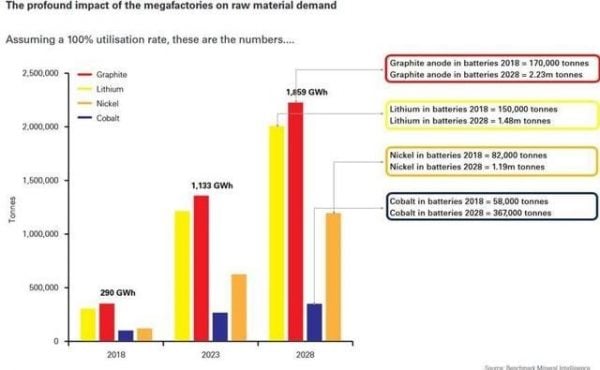
2019 to 2030 demand increase forecast for EV metals as the EV boom takes off – ‘Battery’ graphite demand forecast to grow 10x.
Posted by AGORACOM
at 2:07 PM on Monday, September 28th, 2020
SPONSOR: Lomiko Metals is focused on the exploration and development of minerals for the new green economy such as lithium and graphite. Lomiko has an option for 100% of the high-grade La Loutre graphite Property, Lac Des Iles Graphite Property and the 100% owned Quatre Milles Graphite Property. Lomiko is uniquely poised to supply the growing EV battery market. Click Here For More Information
The company plans to offer a $25,000 vehicle in three years, officials say.
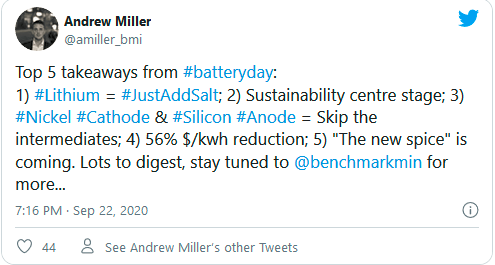
Tesla has announced new, internally-produced batteries for its electric cars, signaling a major shift from the automaker that, if successful, could significantly reduce the cost of electric vehicles.
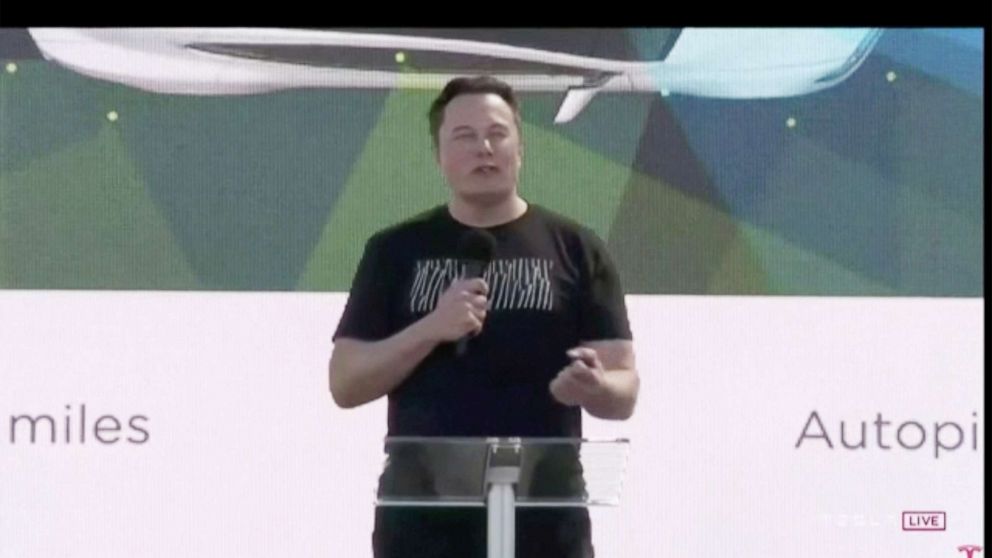
“I think it’s the way all electric cars in the future will be made,” said CEO Elon Musk at Tesla’s “Battery Day” event outside its production facility in Freemont, California, on Tuesday.
Tesla’s new battery cell features a “tabless” design, which the company claims will provide five times the energy, six times the power, and 16% more range compared to its old battery cell.
The company’s current vehicles use batteries sourced from suppliers like Panasonic, where the energy stored in the battery pack is transferred to the car’s drivetrain via a conductive metal tab.
The new battery pack accomplishes the same thing by using a design that integrates a series of small bumps and spikes, which the company hopes will eliminate the need for a tab, and consequently drive down costs and production time. Musk tweeted the tech is “way more important than it sounds,” after the patent was approved back in May.
Courtesy of Tesla Elon Musk conducts Tesla’s “Battery Day” event outside its production facility in Freemont, Calif., S… Elon Musk conducts Tesla’s “Battery Day” event outside its production facility in Freemont, Calif., Sept. 22, 2020.
“This is not just a concept or a rendering; we are starting to ramp up manufacturing of these cells at our pilot ten gigawatt-hour production facility,” said Drew Baglino, Tesla’s Senior Vice President, Powertrain and Energy Engineering.
Tesla also said the new batteries would be 56% less expensive to manufacture and are being developed entirely in-house.
“They own the whole widget,” said Car and Driver Senior Editor of Technology Roberto Baldwin, “which is what gives them the ability to control every aspect, and to tweak as much efficiency as they can out of everything — out of their batteries, out of their motors, out of their inverters.”
Tesla’s investment in its own battery technology doesn’t mean it’s ramping down partnerships with other battery producers, Musk said. In a tweet prior to Tuesday’s event, the CEO said the company plans to “increase, not reduce battery cell purchases from Panasonic, LG & CATL (possibly other partners too.)” He also said the company is predicting shortages in battery cells from those suppliers and is ramping up in-house efforts to mitigate those shortfalls.
Musk said during the event that Tesla is planning to produce 100 gigawatt-hours of battery cells per year by 2022, and three terawatt-hours of cells per year by 2030.
“It allows us to make a lot more cars and a lot more stationary storage,” he said.
Bringing down the cost of battery production is part of Tesla’s plan to eventually sell 20 million vehicles annually — about fifty times more than they sell now, the company said.
“I think twenty million is doable,” said Car and Driver’s Baldwin. “As long as they can continue to grow, and continue to invest and sort of stay ahead of everyone.”
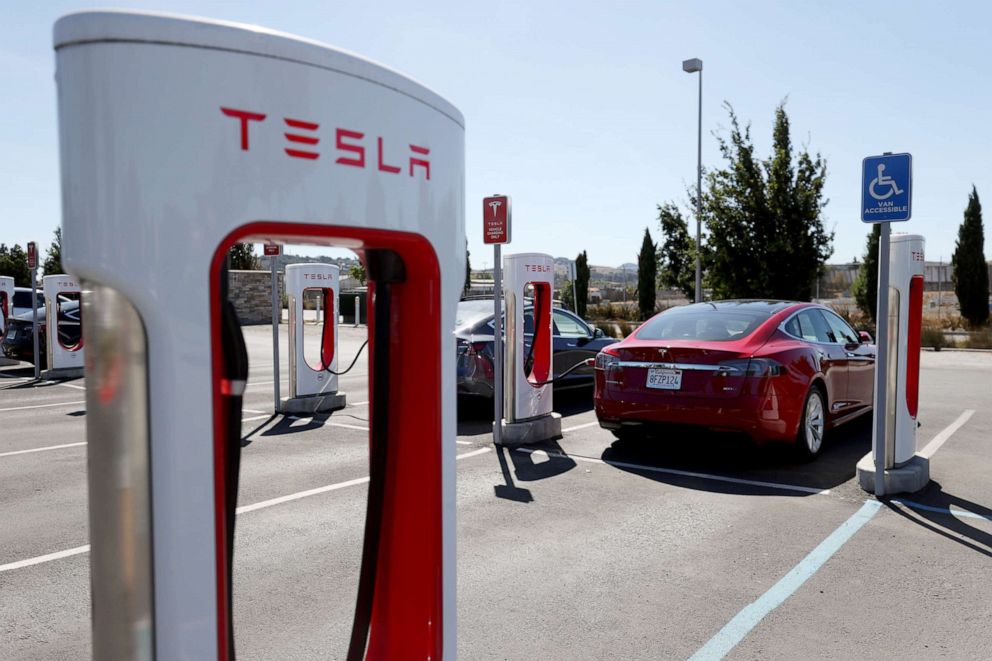
Justin Sullivan/Getty Images Tesla Superchargers charge vehicles in Petaluma, Calif. on Sept. 23, 2020. Tesla Superchargers charge vehicles in Petaluma, Calif. on Sept. 23, 2020.
Part of that 20 million vehicle goal will come from a Tesla model the company is planning to sell for $25,000, expected to be available in about three years. The car, which would undercut Tesla’s current Model 3 sedan as the brand’s cheapest vehicle, would be fully autonomous, Musk said.
“It was always our goal to try to make an affordable electric car,” said Musk.
Musk said that while production on the new batteries is underway, it will take between a year and 18 months to fully ramp up production, and even longer for the technology to show up in actual vehicles.
However, “Tesla has repeatedly set timetables and timelines, and then they’ve missed them,” said Baldwin.
The Model 3 faced significant delays as the company ramped up production in 2017. Since the start of the coronavirus pandemic earlier this year, Tesla has also pushed back planned releases for its “Semi” truck and “Roadster” sports car. But Baldwin says the company is making improvements, noting that the Model Y crossover was released ahead of schedule.
“On the one hand, they’re taking all the learnings they’ve gotten over the past ten, twelve years, and they’re using that to make their batteries better,” Baldwin said. “But there’s still the potential this could be delayed another year, another four years.”
Tesla’s battery announcement comes at a time of increased competition in the electric vehicle market. Earlier this month, Lucid, an EV startup founded by the former head of engineering for Tesla’s own Model S sedan, unveiled an electric sedan called the Air, with a claimed 503 miles of range. General Motors’ “Ultium” battery pack, which the company unveiled earlier this year, is set to underpin 13 new electric vehicle models across four brands, starting with a new “HUMMER” pickup truck.
Volkswagen also says it plans to produce 1.5 million EVs annually by 2025, and unveiled the ID4, an electric crossover SUV that’s expected to have 310 miles of range, on Wednesday.
Posted by AGORACOM
at 9:17 AM on Thursday, September 24th, 2020
TORONTO, ON / September 24, 2020 / Tartisan Nickel Corp. (CSE:TN; OTC PINK:TTSRF; FSE:A2D) (“Tartisan”, or the “Company”) is pleased to update shareholders on the Company’s operations in the Republic of Peru. The Don Pancho polymetallic Silver-Lead-Zinc project (“Don Pancho”) located in the department of Lima, Peru, 110 kilometres north-northeast of Lima, comprising of two concessions totalling 849 hectares. The project is located in a prolific polymetallic mineral belt in central Peru with several operating mines in the area, including Minas de Buenaventura’s silver-lead-zinc-manganese (Ag-Pb-Zn-Mn) Uchucchacua mine located 66 kilometres north of Don Pancho which produced more than 15 million ounces of silver in 2018.
Previous exploration on the property includes an extensive surface mapping and sampling program, geophysics, and a small diamond drilling program conducted by a private Peruvian company in 2014. Mapping and sampling by the previous operators defined two main mineralized zones. The main zone called “Yanapallaca” is an extensive NNW-SSE-trending breccia zone covering a surface area of over 800 metres in length and up to 200 metres in width. Numerous small old workings and three underground drifts exist within this zone. One of the adits crosscut a two metre wide massive sulphide vein grading 106 g/t Ag, 3.26% Pb, 17.56% Zn and 2.58% Mn. Other untested mineralized structures located within this zone that are exposed on surface include chip over 1 metre returning 406 g/t Ag and 27.05% Pb.
The second mineralized zone called “La Cruz” is located several hundreds of metres NE of Yanapallaca shows two mineralized trends. Sampling across the main N-S trend returned 96.6 g/t Ag, 5.53% Pb and 0.88% Zn over 1.50 metres with a crosscutting WNW-ESE structure grading 360 g/t Ag and 12.66% Pb over a 1 metre width. Very little work has been conducted by the previous operators on this prospective area.
Tartisan is pleased to announce the appointment of Carlos Agreda Minaya as the General Manager for Tartisan’s Peruvian subsidiary, Minera Tartisan Peru S.A.C. Mr. Agreda is an experienced manager with a MBA from Peru’s highly reputable ESAN program. Mr. Agreda has extensive experience in permitting, accounting and mineral processing. Mr. Agreda is very knowledgeable of the Company’s Don Pancho property and has submitted the necessary permits to start an underground bulk sampling program. Mr. Agreda is also the General Manager of Peruvian Metals Corp., a Canadian junior explorer in Peru with a processing plant located in Northern Peru where mineral from the Don Pancho will be processed.
Jeffrey Reeder, P.Geo, a qualified person as defined in National Instrument 43-101, has prepared, supervised the preparation of, or approved the scientific and technical disclosure contained in this news release.
About Tartisan Nickel Corp.
Tartisan Nickel Corp. is a Canadian based mineral exploration and development company which owns; the Kenbridge Nickel Project in northwestern Ontario, the Sill Lake Silver Property in Sault St. Marie, Ontario as well as the Don Pancho Silver-Lead-Zinc Project in Peru. The Company has an equity stake in; Eloro Resources Limited, Class 1 Nickel & Technologies Limited and Peruvian Metals Corp.
Tartisan Nickel Corp. common shares are listed on the Canadian Securities Exchange (CSE:TN; US-OTC:TTSRF; FSE:A2D). Currently, there are 101,603,550 shares outstanding (107,203,550 fully diluted).
For further information, please contact Mr. Mark Appleby, President & CEO and a Director of Tartisan Nickel Corp. at 416-804-0280 ([email protected]). Additional information about Tartisan Nickel Corp. can be found at the Company’s website at www.tartisannickel.com or on SEDAR at www.sedar.com.
This news release may contain forward-looking statements including but not limited to comments regarding the timing and content of upcoming work programs, geological interpretations, receipt of property titles, potential mineral recovery processes, etc. Forward-looking statements address future events and conditions and therefore, involve inherent risks and uncertainties. Actual results may differ materially from those currently anticipated in such statements.
The Canadian Securities Exchange (operated by CNSX Markets Inc.) has neither approved nor disapproved of the contents of this press release.
Posted by AGORACOM
at 10:23 AM on Wednesday, September 23rd, 2020
Tartisan Nickel Corp. owns the Kenbridge Nickel Project in northwestern Ontario, the Sill Lake Silver Property in Sault St. Marie, Ontario as well as the Don Pancho Manganese-Zinc-Lead-Silver Project in Peru. The Company has an equity stake in; Eloro Resources Limited, Class 1 Nickel & Technologies Limited and Peruvian Metals Corp. Click Here For More Info
Calling traditional metal refining processes “legacy” and “insanely complicated”, Elon Musk said today his company has re-thought and simplified how lithium and nickel will be processed for his future batteries.
Musk made the comments during a live simulcast presentation of Battery Day held in a parking lot in Fremont, California, near his manufacturing facilities. Musk shared part of the presentation with Drew Baglino, SVP of Powertrain and Energy Engineering at Tesla.
Musk called the traditional cathode process of processing nickel “a big target” due to its high cost
“It’s insanely complicated,” said Musk. “These things just grow up as legacy. We looked at the entire value chain and asked how can we make this as simple as possible.”
Bagnilo and Musk said many steps in the traditional refining method could be skipped resulting in 66% less investment, 76% less processing cost and 0% waste water.
The CEO of FPX Nickel, Martin Turenne, concurred with Musk: mineral processing can be made cleaner and more economical.
“The current methods of processing [nickel] are generally well established, and they’re done for a reason, because they work and because alternatives would be costly or they’re at an unproven stage,” said Turenne in an interview with Kitco after he watched Tesla’s Battery Day presentation.
At his own FPX, Turenne believes his nickel is in a form that would be suitable for batteries with the potential to skip the smelting step.
Musk and Bragnila imagine Tesla factories processing raw nickel powder for processing.
“Raw materials from a mine go to the plant and out comes a battery,” said Bragnila. “We are just consuming the raw nickel powder. It dramalitcally simplifies the raw nickel refining part of the whole process. We can eliminate billions in battery grade nickel intermediate production. It is not needed at all.”
What struck Turenne during the presentation is the forecast level of demand.
“At three terawatt-hours of battery cells per annum by 2030, that would entail approximately annual consumption of 2 million tonnes of nickel. That’s almost the entire scale of the current global nickel output,” said Turenne.
Posted by AGORACOM
at 8:10 AM on Tuesday, September 22nd, 2020
Tartisan Nickel Corp. owns the Kenbridge Nickel Project in northwestern Ontario, the Sill Lake Silver Property in Sault St. Marie, Ontario as well as the Don Pancho Manganese-Zinc-Lead-Silver Project in Peru. The Company has an equity stake in; Eloro Resources Limited, Class 1 Nickel & Technologies Limited and Peruvian Metals Corp.
The federal government is planning investments in the electric vehicle industry to create a domestic supply chain for electric vehicle batteries that could supply the North American market. (Jonathan Hayward/The Canadian Press)
The Liberal government will use the speech from the throne to lay out a plan to create tens of thousands of jobs by connecting Canada’s resource sector with its manufacturing base to produce batteries for electric cars, Radio-Canada has learned.
“We recognize we have a unique opportunity to take advantage of our skilled labour force and we know we have a long and proud history of manufacturing vehicles, planes, ships and trains, and we also have an abundant amount of natural resources,” Innovation, Science and Industry Minister Navdeep Bains told Radio-Canada.
“We could be a world leader in [electric vehicle] battery manufacturing if we leverage our natural resources like lithium, cobalt … nickel, aluminum — the key ingredients that are required in batteries. Then we want to make sure that we manufacture them here and … use them in our trains, our buses, our ships and our planes.”
Bains said the green technology sector is expected to be worth trillions of dollars in the coming years and Canada could take advantage of that market by positioning itself as the chief North American supplier of batteries for electric vehicles.
“Not only do we want to be in a position to be building [electric vehicle] batteries here in Canada for the North American market, we want to be a global leader to take advantage of global opportunities,” he said.
CBC News has confirmed a report which first appeared in the Toronto Star — that the federal government is willing to put up to $500 million, with some money coming from the Ontario government, toward turning Ford’s Oakville plant over to the production of electric vehicles, an investment that could keep the plant open for years to come.
The paper reported that the mass production of electric vehicles and batteries is at the heart of talks between Ford Motor Co. and the union representing its employees.
When asked about the deal yesterday Ontario Premier Doug Ford said negotiations are still ongoing.
“What I can tell you is how important the auto industry is, one of the most important industries in Ontario,” he said during his daily briefing.
“This is good if we move forward. The parts are very important. We would like to manufacture the batteries here rather than bringing the batteries in from out of country. We have the capabilities and the raw materials here. Why can’t we produce the batteries? That’s my big ask to Ford.”
Adding value through manufacturing
Bains also said his government is looking at putting money into high-speed internet access — something he said the country needs more of now, with more and more Canadians working from home.
He also said the federal government is looking at investments in the agriculture sector to help make Canada “a world leader in plant proteins.”
Bains did not say if the agriculture and internet proposals will be a part of the throne speech.
“The bottom line is that we want to take advantage of what we have in Canada,” he said. “And what we have is an incredibly skilled labour workforce, we have natural resources and we have the ability to add value through our manufacturing processing initiatives.”
Posted by AGORACOM
at 8:24 AM on Monday, September 21st, 2020
TORONTO, ON / ACCESSWIRE / September 21, 2020 / Tartisan Nickel Corp. (CSE:TN)(OTC PINK:TTSRF)(FSE:A2D) (“Tartisan”, or the “Company”) is pleased to announce that the Company has appointed Thomas Larsen, Dean MacEachern and Ronald Wortel as advisors to the Company. The Board of Directors welcomes them on behalf of all shareholders.
THOMAS LARSEN, CEO ELORO RESOURCES LTD.
Thomas Larsen is an executive in the resources sector with over 40 years of experience in the investment industry, specializing in corporate finance and management of junior resource companies, raising in excess of $150 million. Mr. Larsen is currently the Chief Executive Officer of Eloro Resources Ltd. and Cartier Iron Corporation. Additionally, Mr. Larsen previously held the position of President and Chief Executive Officer of Champion Iron Limited.
DEAN MACEACHERN, B.SC. (HONS), P.GEO.
Mr. MacEachern has thirty years of exploration experience, seventeen of which were with Falconbridge Limited (now Glencore), where he was involved with significant nickel, copper and zinc discoveries in the Sudbury and Timmins mining camps. He coordinated numerous base and precious metals exploration programs at several of the world’s major operating nickel copper zinc and PGM mining camps, including the Sudbury, Thompson and Abitibi Nickel Camps, the Kidd Creek VMS Camp in Canada and, the Bushveld PGM Camp in South Africa. He has been involved in developing projects with junior exploration companies in Canada, South America, and Europe for base and precious metal. Mr. MacEachern was the former President & CEO of Canadian Arrow Mines Limited.
RONALD WORTEL, B.A.SC. P.ENG., MBA
Mr. Wortel is a finance executive with over 20 years of experience in resource project analysis, transaction due diligence and financing. Starting in 1997, Mr. Wortel provided equity research coverage on the mining equity sector for sell side investment banks: National Bank, Dundee Capital and Northern Securities. Initially he covered the major gold companies and transitioned to the junior resource sector with an emphasis on near term production stories. In 2006, he joined Pathway Asset Management, a resource fund providing flow through funding to exploration companies. Here Mr. Wortel reviewed hundreds of gold and other resource projects as the fund placed over $1 billion into the sector.
CEO Mr. Mark Appleby said, “I am delighted to welcome these three gentlemen with their combined 90 years of experience and expertise in various disciplines. Their counsel should prove to be a valuable asset to the Company”.
About Tartisan Nickel Corp.
Tartisan Nickel Corp. is a Canadian based mineral exploration and development company which owns; the Kenbridge Nickel Project in northwestern Ontario, the Sill Lake Silver Property in Sault St. Marie, Ontario as well as the Don Pancho Manganese-Zinc-Lead-Silver Project in Peru. The Company has an equity stake in; Eloro Resources Limited, Class 1 Nickel & Technologies Limited and Peruvian Metals Corp.
Tartisan Nickel Corp. common shares are listed on the Canadian Securities Exchange (CSE:TN)(OTC PINK:TTSRF)(FSE:A2D). Currently, there are 101,603,550 shares outstanding (fully-diluted 107,203,550).
For further information, please contact Mr. Mark Appleby, President & CEO and a Director of Tartisan Nickel Corp. at 416-804-0280 ([email protected]). Additional information about Tartisan Nickel Corp. can be found at the Company’s website at www.tartisannickel.com or on SEDAR at www.sedar.com.
Posted by AGORACOM
at 8:27 AM on Thursday, September 17th, 2020
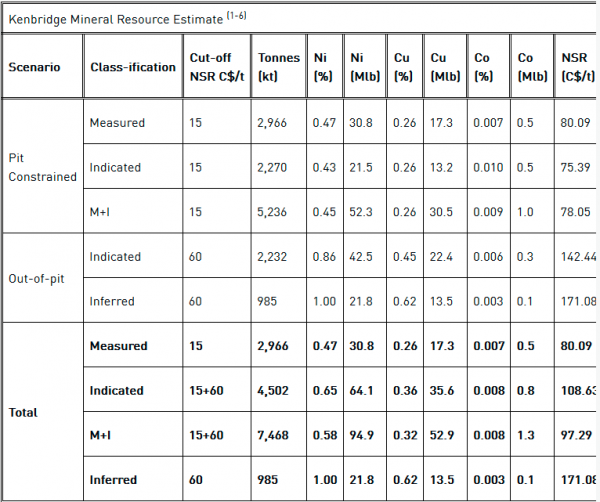
TORONTO, ON / ACCESSWIRE / September 17, 2020 / Tartisan Nickel Corp. (CSE:TN)(OTC:TTSRF)(FSE:A2D) (“Tartisan”, or the “Company”) is pleased to announce that P&E Mining Consultants Inc. has completed a review and re-estimation of the historic NI 43-101 compliant Technical Report and Updated Mineral Resource Estimate of the Kenbridge Nickel-Copper-Cobalt Project, Atikwa Lake Area, NW Ontario.
Updated estimates were done for pit constrained and out-of-pit nickel, copper, and cobalt Mineral Resources. Total Measured & Indicated Mineral Resources based on a Net Smelter Return (NSR) cut-off value of CDN$15 per tonne for pit constrained Mineral Resources and CDN$60 per tonne NSR for out-of-pit Mineral Resources is 7.5 Mt at 0.58% Ni and 0.32% Cu for a total of 95 Mlb of contained nickel. An additional 0.985 Mt at 1.0% Ni and 0.62% Cu (22 Mlb contained nickel) were calculated as Inferred Mineral Resources. The pit constrained Measured & Indicated Mineral Resources total 5.27 Mt of 0.45% nickel; 0.26% copper; and 0.009% cobalt at an NSR cut-off value of CDN$15/tonne. The out-of-pit Measured & Indicated Mineral Resources total 2.23 Mt of 0.86% nickel; 0.45% copper; and 0.006% cobalt. Inferred Mineral Resources out-of-pit total 0.985 Mt at 1.00% nickel; 0.62% copper; and 0.003% cobalt, at an NSR cut-off value of CDN$60/tonne. Details of the Mineral Resource Estimate are shown in Table 1.
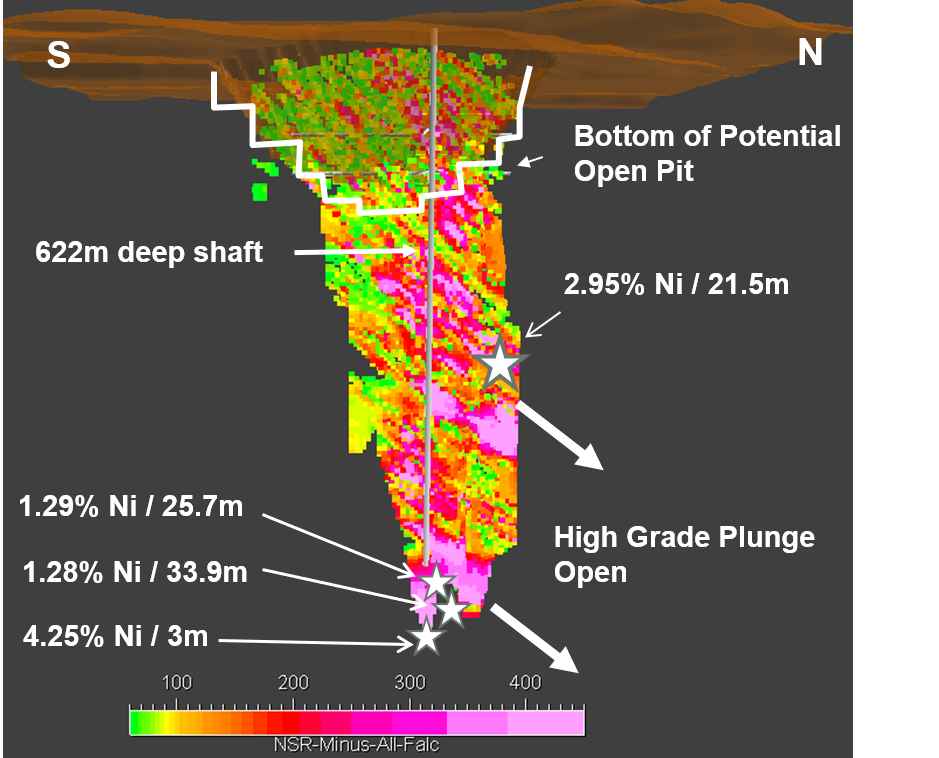
The Kenbridge Property is located in the Kenora – Fort Frances, Ontario area with good access to roads and power. It has a shaft to a depth of 2,042 ft (622 m), with level stations at 150 ft. (45 m) intervals below the shaft collar and two levels developed at 350 ft (107 m) and 500 ft (152 m) below the shaft collar.
Visual inspection of the NSR Block Model for the Kenbridge Deposit shows the highest nickel grades (>2.0%) appear to have a strong down-plunge orientation as illustrated in Figure 1.
A historical Preliminary Economic Assessment (PEA) for the Kenbridge Deposit was completed by Buck et al. in 2008 for Canadian Arrow Mines Limited (now a 100% wholly owned subsidiary of Tartisan Nickel Corp). The PEA was updated by WMT Associates Ltd. in a Canadian Arrow Mines Limited news release dated January 21, 2008, and subsequently updated again in a news release dated September 4, 2008. The Updated PEA was completed by WMT Associates Limited, based on an updated NI 43-101 Mineral Resource Estimate by P&E Mining Consultants Inc. (Canadian Arrow Mines Limited news release dated August 19, 2008) and improved metallurgical recoveries (Canadian Arrow Mines Limited news release dated June 26, 2008). Highlights of the Updated PEA were: average Ni recovery life of mine was 86%; recovered Ni was 84.6 Mlb; NPV 7.5% pre-tax was $253M; and IRR% pre-tax was 65%. The cost, value and financial assumptions used in the Updated PEA were unchanged from the original January 2008 PEA (Buck et al., 2008), including average life of mine, US$10/lb nickel and US$2.50/lb copper prices, and a CD$1.00:US$0.90 exchange rate. Although this PEA is deemed to be historical by the Company, it is thought to be important.
Table 1.
Kenbridge Mineral Resource Estimate (1-6)
Note: Ni =Nickel Cu = Copper, Co = Cobalt, NSR = Net Smelter Return.
1. Mineral Resources, which are not Mineral Reserves, do not have demonstrated economic viability.
2. The estimate of Mineral Resources may be materially affected by environmental, permitting, legal, title, taxation, socio-political, marketing, or other relevant issues.
3. The Inferred Mineral Resource in this estimate has a lower level of confidence than that applied to an Indicated Mineral Resource and must not be converted to a Mineral Reserve. It is reasonably expected that the majority of the Inferred Mineral Resource could be upgraded to an Indicated Mineral Resource with continued exploration.
4. The Mineral Resources in this report were estimated using the Canadian Institute of Mining, Metallurgy and Petroleum (“CIM”), CIM Standards on Mineral Resources and Reserves, Definitions and Guidelines prepared by the CIM Standing Committee on Reserve Definitions and adopted by the CIM Council.
5. The Mineral Resource Estimate was based on US$ metal prices of $7.42/lb nickel, $3/lb copper and $25/lb cobalt.
6. The out-of-pit Mineral Resource grade blocks were quantified above the $60/t NSR cut-off, below the constraining pit shell and within the constraining mineralized wireframes. Additionally, only groups of blocks that exhibited continuity and reasonable potential stope geometry were included. All orphaned blocks and narrow strings of blocks were excluded. The longhole stoping with backfill mining method was assumed for the out of pit Mineral Resource Estimate calculation.
Figure 1. Kenbridge Deposit 3D view illustrating calculated NSR blocks and drill hole intersections of significance.
CEO Mr. Mark Appleby stated, “The Updated Mineral Resource Estimate was necessary to determine if Kenbridge mineralization is potentially extractable under current metal prices and exchange rates. This is a major milestone achieved by the Company as the market conditions for Class 1 nickel sulphide deposits improve. The differences between the previous P&E Mineral Resource Estimate (2008) and the current P&E Updated Mineral Resource Estimate are attributed to changes in metal prices and recalculation of NSR values. The Kenbridge Deposit shows there is great potential to expand the Mineral Resource down-plunge of high-grade intersections such as hole KB07-180 (2.95% Ni, 0.82% Cu/21.5m including 7.2% Ni, 0.67% Cu/5.5m) and also at depth. The deepest hole (end of hole K2010 = 880 m below surface) intersected mineralization grading 4.25% nickel and 1.38% copper over 10.7 ft (3.3 m), indicating that the Deposit remains open at depth. Tartisan plans to expand on these intersections, upgrade the Indicated and Inferred Mineral Resources and test high potential nickel exploration targets, such as the Kenbridge North Target. Additionally, given the market interest in Class 1 nickel deposits, we will look to update the historic Preliminary Economic Assessment completed in 2008 based on this very positive Mineral Resource update.”
The Company plans an aggressive surface exploration and definition drilling plan, in addition to geotechnical, metallurgical and environmental work to advance the Kenbridge Nickel-Copper-Cobalt Project in the upcoming 2020 winter season and into the summer of 2021.
The effective date of the 2020 Updated Mineral Resource Estimate is September 2nd, 2020 and the Technical Report relating to the Updated Mineral Resource has now been filed on SEDAR.
Qualified Person
The technical information in this news release has been prepared in accordance with Canadian regulatory requirements as set out in NI 43-101 and reviewed and approved by Eugene Puritch, P.Eng., FEC, CET, a Qualified Person as defined by NI 43-101.
About Tartisan Nickel Corp.
Tartisan Nickel Corp. is a Canadian based mineral exploration and development company which owns; the Kenbridge Nickel Project in northwestern Ontario, the Sill Lake Silver Property in Sault St. Marie, Ontario as well as the Don Pancho Manganese-Zinc-Lead-Silver Project in Peru.
The Company has an equity stake in; Eloro Resources Limited, Class 1 Nickel and Technologies Limited and Peruvian Metals Corp.
Tartisan Nickel Corp. common shares are listed on the Canadian Securities Exchange (CSE:TN; US-OTC:TTSRF; FSE: A2D). Currently, there are 101,603,550 shares outstanding (103,303 ,550 fully diluted).
For further information, please contact Mr. D. Mark Appleby, President & CEO and a Director of the Company, at 416-804-0280 ([email protected]). Additional information about Tartisan can be found at the Company’s website at www.tartisannickel.com or on SEDAR at www.sedar.com.



.png)

.png)