Agoracom Blog Home

Posts Tagged ‘small cap’

How The #Cannabis Industry Is Coping In 2020 – SPONSOR: Hollister Biosciences $HOLL.ca $WEED.ca $CGC $ACB $APH $CRON.ca $OGI.ca $FAF.ca

Posted by AGORACOM-JC at 9:45 PM on Sunday, May 10th, 2020

SPONSOR: Hollister Biosciences Inc. (HOLL:CSE) A vertically integrated cannabis company with products in 220 California dispensaries and joint ventures, licensing agreement & partnerships with global brands. The company recently closed $20 MILLION deal with Venom Extracts adding $CDN 16.4 million in revenue and $CDN 2.48 million in EBITDA. Learn More

How The Cannabis Industry Is Coping In 2020

  • Canada and most U.S. states with legalized cannabis industries declared dispensaries as essential services, allowing sales to continue throughout the COVID-19 crisis, enabling robust demand to be met
  • Even with strong sales momentum, cannabis stocks broadly suffered during the quarter amid heightened market volatility
  • Early-stage cannabis companies rely heavily on external capital to fuel their growth ambitions, but investors are stepping back from financing riskier industries in the current environment
  • Despite these near-term challenges, we remain optimistic on the longer-term prospects for cannabis as its acceptance grows

Amid widespread COVID-19-related retail store closures, many cannabis dispensaries received “essential business” designations. This allowed cannabis consumers to stock up on medicinal and recreational cannabis, fueling strong sales figures despite a tumultuous Q1 2020. Yet, even with strong sales momentum, cannabis stocks broadly suffered during the quarter amid heightened market volatility. Early-stage cannabis companies rely heavily on external capital to fuel their growth ambitions, but investors are stepping back from financing riskier industries in the current environment. Some cannabis companies are now running low on cash, forcing them to sell stakes at undesirable valuations or scale back operations or staffing.

Despite these near-term challenges, we remain optimistic on the longer-term prospects for cannabis as its acceptance grows. New store openings and the sale of edibles are helping to fuel greater legal consumption. In addition, COVID-19’s economic impact is broadly hurting tax revenues at the local, state, and federal level, potentially providing greater impetus to legalize and tax cannabis. With only about 10% of cannabis sales occurring through legal channels, we believe there is substantial opportunity for continued growth across regulated channels.

Is Cannabis A Consumer Staple?

The COVID-19 crisis is plunging the global economy into recession, yet its impact will not be felt equally across industries. During recessions, consumers may forgo discretionary items like jewelry or electronics, but staples such as essential food and beverages tend to see robust sales. Historically, alcohol and tobacco exhibit staples-like characteristics, demonstrating strong sales despite economic weakness. During the global financial crisis, for example, alcohol consumption increased 7.2% in 2008-09 from 2006-07 levels, while total sales in the consumer discretionary sector fell by -9.35% over that time frame.1,2

Legalized cannabis did not exist during the Great Recession, but recent figures suggest cannabis sales share similar characteristics with alcohol and tobacco. Canada and most U.S. states with legalized cannabis industries declared dispensaries as essential services, allowing sales to continue throughout the COVID-19 crisis, enabling robust demand to be met.

  • Online cannabis purchases in Ontario have surged from 5,000 orders in mid-March to 9,000 orders by mid-April.3
  • Oregon’s cannabis sales increased 37% year over year in March, its highest single-month increase.4
  • Between March 16th and March 22nd, year-over-year sales of recreational cannabis across key US markets, including California, Colorado, Oregon and Alaska, were up 50%.5
  • One of Nevada’s largest cannabis delivery businesses reported a 400% increase in cannabis retail deliveries since March 20th.6

While lockdown may have accelerated cannabis demand, cannabis sales were already on an accelerating path. January and February sales numbers in Canada increased 181% year-over-year to C$154 million and 190% to C$150 million.7 Estimates from Cannabis Benchmarks for March sales show a spike to C$216 million, more than three times March 2019’s sales of C$59 million.8
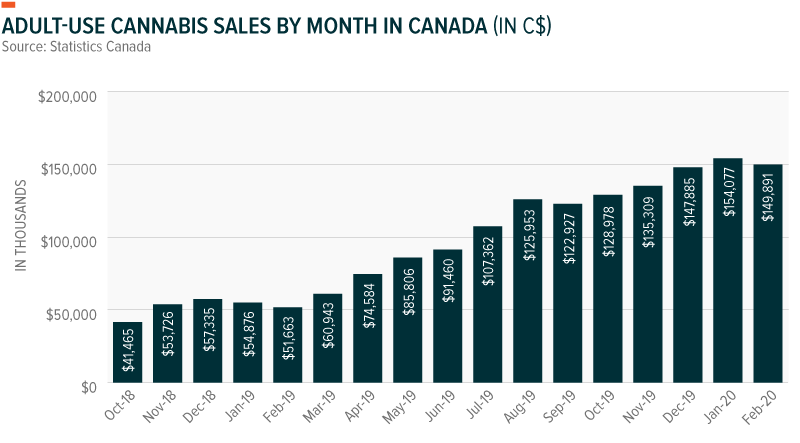
The shift towards greater cannabis acceptance has spurred much of this growth. Cannabis consumers among the legal adult population in Canada grew to 63% at the end of 2019 from 54% in 2018.9

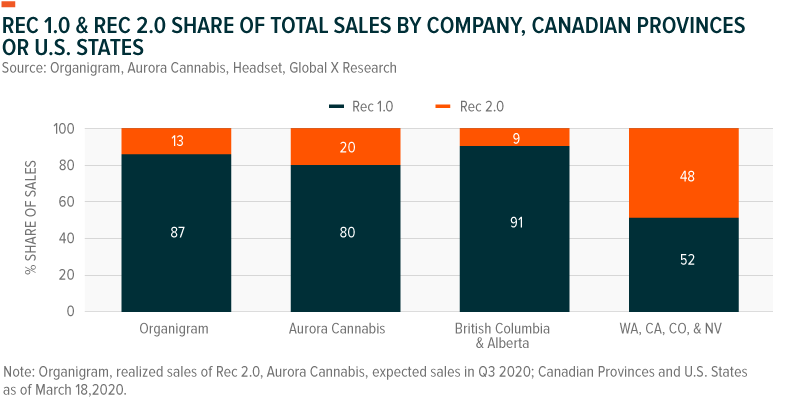
Canada’s new recreational cannabis market, dubbed Rec 2.0, is also fueling growth. Rec 2.0 officially launched at the end of 2019, almost a year after legalization in Canada. Before Rec 2.0, only dried flower and oil were products sold, but now the sale of cannabis beverages, edibles and vapes, among other forms, is permitted. Derivative formats like these account for almost half of sales in mature and developed markets such as Colorado, showing how Rec 2.0 could play a major role in accelerating cannabis sales in Canada. Aurora Cannabis (ACB), for example, recently mentioned that approximately 20% of total sales could come from Rec 2.0 products.10 OrganiGram Holdings (OGI) also reported new Rec 2.0 products to account for 13% of total revenue in its most recent quarter.11
New Store Openings Grow Legal Cannabis’s Market Share

Curbing illicit cannabis sales is on the agenda for many governments around the world. Globally, legal cannabis sales reached $15 billion at the end of 2019, which is less than 10% of the estimated total market of $160 billion.12 Such low penetration both demonstrates the growth opportunity ahead as well as highlights some of the challenges for the legal market. In Canada, for instance, limited dispensary licenses plays a major factor, as recreational cannabis sales per capita are highly correlated to the number of stores.

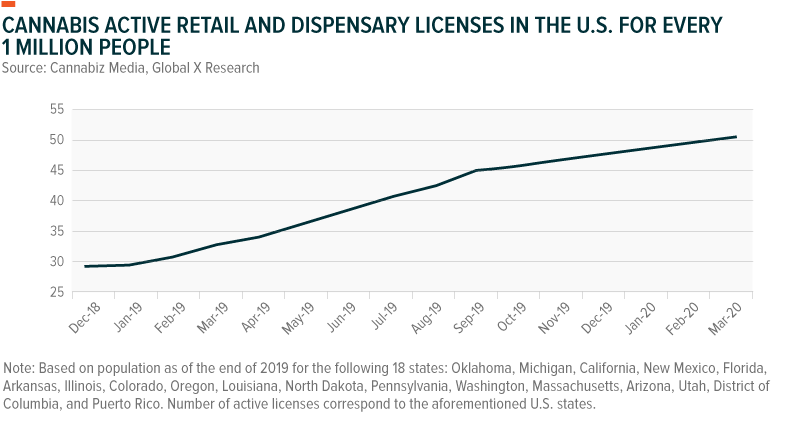
In Q1 2020, Canada opened 191 new stores, bringing its total to 806.13 Ontario, Canada’s most populous province, now has 52 stores, versus just 27 at the end of 2019. But the few dozen stores represent just four per 1 million people. For comparison, Colorado has 180 stores for every 1 million people.14 The store comparison between the two countries is notable, as further licenses should help meet consumer demand and promote greater legal sales.

Within the U.S., active dispensary licenses are up 5.5% year-to-date, with 385 new stores opening around the country.15 Yet, given that the US has nine times more dispensary licenses than Canada, more stores is a less critical factor than wider legalization across populous states or at the broader federal level.
Cannabis Industry Leveraging E-commerce To Further Grow Sales

Oftentimes, crises breed both new problems and new solutions. During this social distancing era, Colorado legalized online sales of recreational cannabis, fulfilling a longstanding request from cannabis companies.16 Cannabis consumers can now order, pay online and pick up at-store. A few other states – Massachusetts, Illinois, Michigan and Oregon – already allow cannabis e-commerce.

In Canada, the Alcohol and Gaming Commission of Ontario (AGCO) authorized cannabis retail stores to offer e-commerce solutions, starting April 7th.17 E-commerce authorization resulted from an emergency order by the Government of Ontario to deter illegal cannabis sales amid physical distance mandates. For now, the measure is temporary, but it includes the possibility of extension.

Financing Cannabis’s Growth

Early-stage industries tend to rely on the capital markets to fund growth. The phenomenon describes a healthy dynamic between those with capital to invest and those seeking capital for growth. The cannabis industry is particularly dependent on capital, as growing, harvesting, packaging and distribution require property, equipment and employees. With high growth expectations, cannabis companies tend to plow their freshly raised capital into various parts of the ecosystem, leaving little cash available to weather a storm. The constant need for new financing can expose weaker companies that may need to raise capital at undesirable terms, or worse, cannot raise additional capital at all.

HEXO Corp. (HEXO), for example, a leading cannabis grower in Canada, recently closed a C$46 million public offering but was forced to sell its equity 20% below its last traded price.18 Other larger players have followed suit, like Tilray (TLRY), which raised C$90 also at a 20% discount.19

There are companies, however, with strong cash positions that may be able to weather this challenging financing environment better than others. Canopy Growth Corp. (CGC) and Cronos Group (CRON) both have over $1 billion in cash & equivalents on their balance sheets. GW Pharmaceuticals (GWPH) holds over $500 million in cash & equivalents. Balance sheet strength allows these companies to potentially wait longer before needing to raise additional outside capital.

COVID-19 Could Expedite Cannabis Legalization

In our article “Themes for Defensive Positioning,” we highlighted that economic downturns can accelerate efforts to find new sources of economic stimulus and tax revenue. Legalizing (and taxing) recreational cannabis is one such avenue states could pursue given its track record of generating economic growth and taxes. Estimates hold that nationwide legalization in the U.S. could generate $132 billion in aggregate tax revenue and more than a million new jobs across the country by 2025.20 Such growth comes not from an unproven, speculative market, but from the conversion of a largely illicit market to a legal, regulated one. Such taxes and economic growth could be particularly welcome given stalling economic growth and swelling debt caused by COVID-19.

This year, several states could legalize recreational use. Virginia recently decriminalized cannabis, joining 27 other states that have taken such actions.21 The bill doesn’t legalize cannabis sales yet, but Virginia’s Governor is also clearing the path for easier access for medicinal uses.22 In New Jersey, lawmakers voted to add legalization to November’s ballot. Should the bill pass, it could add additional pressure to neighboring New York and Connecticut.

Illinois, where legalized cannabis went into effect in January, is the most recent model other states could follow. Illinois has the second-highest tax regime on cannabis sales in the country, where taxes vary from 10% to 25%.23 In Q1, Illinois cannabis stores sold $110 million, generating at least $11 million in tax revenues. Another benchmark is Colorado, which legalized cannabis in 2014. In Q1 2020, Colorado generated $79 million in tax revenue from cannabis-related sales.24 In 2019 alone, the state collected over $300 million in tax revenue, which was earmarked for cannabis regulation, research and schools.25

With a global recession looming, the economic benefits of legalized cannabis could be too enticing for states, provinces and countries to ignore.

Conclusion

The recent increase in cannabis sales in the U.S. and Canada since COVID-19 reflects the non-cyclical nature of cannabis sales. While some cannabis companies may struggle from lack of access to capital during this volatile period, the stronger ones could continue to see substantial growth as they meet robust consumer demand. Trends in new dispensary openings, a shift to e-commerce, and the introduction of new consumable forms of cannabis should further fuel growth across North America. Longer term, the potential for further legalization efforts amid the COVID-19 crisis should provide a tailwind to the industry.

Related ETFs

POTX: The Global X Cannabis ETF seeks to invest in companies across the cannabis industry. This includes companies involved in the legal production, growth and distribution of cannabis and industrial hemp, as well as those involved in providing financial services to the cannabis industry, pharmaceutical applications of cannabis, cannabidiol (i.e., CBD), or other related uses including but not limited to extracts, derivatives or synthetic versions.

Please click on the fund name for current holdings.

Footnotes

1. Jacob Bor, et al. “Alcohol Use During the Great Recession of 2008-2009,” January 29, 2013.

2. U.S. Census Bureau. Discretionary sales including retail sales of Motor Vehicles & Parts, Furnitures, Electronics & Appliances, Clothing, Sporting Goods, General Merchandise, and Miscellaneous Stores. Accessed on April 2020.

3. Cannabis Benchmarks, “Canada Cannabis Spot Index (CCSI)”, April 17, 2020.

4. Willamette Week, “Oregon Cannabis Sales in March Were the Highest Ever for a Single Month,” April 6, 2020.

5. New York Post, “Cannabis sales hit new highs in US and Canada,” March 24, 2020

6. Reno Gazette Journal, “Nevada marijuana deliveries are skyrocketing. Is this the new normal for the pot industry?,” March 30, 2020.

7. Statistics Canada, “Cannabis Stores Sales,” Accessed on April 2020.

8. Cannabis Benchmarks, (n3).

9. BDS Analytics, “How Will “Cannabis 2.0″ Affect the Legal Canadian Market?,” February 18, 2020.

10. Aurora Cannabis, “Q2 2020 Earnings Call Transcript,” February 13, 2020.

11. Organigram, “Organigram Reports Second Quarter Fiscal 2020 Results,” April 14, 2020.

12. Global X ETFs, “Introducing the Global X Cannabis ETF (POTX),” September 19, 2019.

13. Cannabis Benchmarks, (n3).

14. Note: According to CannabizMedia, Colorado has 1,038 active licenses. Per the U.S. Census Bureau, Colorado’s population is 5.759 million people.

15. CannabizMedia, “Cannacurio: Dispensary & Retailer Leaderboard (Q1 2020),” April 13, 2020.

16. The Colorado Sun, “Coronavirus fuels marijuana industry’s push for online sales, delivery in Colorado,” April 13, 2020.

17. Alcohol and Gaming Commission of Ontario, “Ontario Allows Cannabis Delivery and Curbside Pick-up from Authorized Retail Stores During COVID-19,” April 7, 2020.

18. Hexo Corp, “HEXO Corp. Closes $46 Million Underwritten Public Offering,” April 13, 2020.

19. Tilray, “Tilray, Inc. Announces Pricing of its $90.4 Million Registered Offering,” March 13, 2020.

20. The Washington Post, “Study: Legal marijuana could generate more than $132 billion in federal tax revenue and 1 million jobs,” January 10, 2018.

21. Leafly, “Virginia just decriminalized marijuana. Here’s what that means,” April 13, 2020.

22. Marijuana Moment, “Virginia Governor Urges Medical Marijuana Expansion As Amendment To Recently Approved Bill,” April 15, 2020.

23. Illinois Policy, “What you need to know about marijuana legalization in Illinois?,” January 1, 2020.

24. Colorado Department of Revenue, “Marijuana Tax Data,” April 2020.

25. Ibis.

Investing involves risk, including the possible loss of principal. The investable universe of companies in which POTX may invest may be limited. The Fund invests in securities of companies engaged in Healthcare and Pharmaceutical sectors. These sectors can be affected by government regulations, expiring patents, rapid product obsolescence, and intense industry competition. International investments may involve risk of capital loss from unfavorable fluctuation in currency values, from differences in generally accepted accounting principles or from social, economic or political instability in other nations. POTX is non-diversified.

POTX’s investments are concentrated in the cannabis industry, and the Fund may be susceptible to loss due to adverse occurrences affecting this industry. The cannabis industry is a very young, fast evolving industry with increased exposure to the risks associated with changes in applicable laws (including increased regulation, other rule changes, and related federal and state enforcement activities), as well as market developments, which may cause businesses to contract or close suddenly and negatively impact the value of securities held by the Fund. Cannabis Companies are subject to various laws and regulations that may differ at the state/local, federal and international level. These laws and regulations may significantly affect a Cannabis Company’s ability to secure financing and traditional banking services, impact the market for cannabis business sales and services, and set limitations on cannabis use, production, transportation, export and storage. The possession, use and importation of marijuana remains illegal under U.S. federal law. Federal law criminalizing the use of marijuana remains enforceable notwithstanding state laws that legalize its use for medicinal and recreational purposes. This conflict creates volatility and risk for all Cannabis Companies, and any stepped-up enforcement of marijuana laws by the federal government could adversely affect the value of the Fund’s investments. Given the uncertain nature of the regulation of the cannabis industry in the United States, the Fund’s investment in certain entities could, under unique circumstances, raise issues under one or more of those laws, and any investigation or prosecution related to those investments could result in expense and losses to the Fund.

Shares of ETFs are bought and sold at market price (not NAV) and are not individually redeemed from the Fund. Brokerage commissions will reduce returns. Global X NAVs are calculated using prices as of 4:00 PM Eastern Time. The closing price is the Mid-Point between the Bid and Ask price as of the close of exchange. Closing price returns do not represent the returns you would receive if you traded shares at other times. Indices are unmanaged and do not include the effect of fees, expenses or sales charges. One cannot invest directly in an index.

Since the Fund’s shares did not trade in the secondary market until several days after the Fund’s inception, for the period from inception to the first day of secondary market trading in Shares, the NAV of the Fund is used to calculate market returns.

Global X Management Company LLC serves as an advisor to Global X Funds. The Funds are distributed by SEI Investments Distribution Co. (SIDCO), which is not affiliated with Global X Management Company LLC or Mirae Asset Global Investments. Global X Funds are not sponsored, endorsed, issued, sold or promoted by Solactive AG, nor does Solactive AG make any representations regarding the advisability of investing in the Global X Funds. Neither SIDCO, Global X nor Mirae Asset Global Investments are affiliated with Solactive AG.

Source: https://seekingalpha.com/article/4343907-how-cannabis-industry-is-coping-in-2020

CLIENT FEATURE: Eyecarrot Innovations $EYC.ca Createing Faster Brains Through Stronger Eyes $EYPT $KALA

Posted by AGORACOM-JC at 9:15 PM on Sunday, May 10th, 2020

EYC: TSX-V

Trusted and used by some of the world’s top professional sports teams, including:

Why Eyecarrot?

  • Eyecarrot Has Already Started Commercializing Its Vision Therapy Platform
  • Clients Include: 
    • Dallas Stars (NHL)
    • Chicago Cubs (MLB)
    • Sporting KC (MLS)
    • Tennis Canada
    • Showcased During NFL Scouting Combine
  • Company’s Vision Therapy Products Used In:
    • Over 1,500 Practices
    • 20 Countries
  • Flagship “Binovi” Is State-Of-The-Art Platform
    • Measures 14 Key Vision Skills
    • Essential For Maximizing Brain Performance
    • Shipped Over 400 Binovi Units (April 2020)
    • Goal Is 2,500 Binovi Units (End Of 2020)
  • Signed Sports Vision Partnership With Eli Wilson Goaltending
    • World Leader In Goaltending Development
    • 600 Active Goaltending Camp Participants
    • 50,000 Global Aspiring Goaltenders
  • Closed Major Financing In Q1 2020
  • Eyecarrot is now well positioned to further commercialize and capitalize on massive demand for Vision Therapy and Training For Athletes and Education

SEEING IS BELIEVING!

Eyecarrot’s BinoviTM Platform Explained:

Eyecarrot Innovations is an advertising client of AGORA Internet Relations Corp.

Eyecarrot $EYC.ca #Zoom Video Conferencing Integration Supporting 20,000 Vision Performance Professionals Running Remote Binovi Pro Patient Care and Enrolling $EYPT $KALA $ZM

Posted by AGORACOM-JC at 9:07 AM on Wednesday, May 6th, 2020
Eyecarrot | LinkedIn
  • Integrated Zoom (NASDAQ:ZM) video conferencing into the Binovi Training Live initiative
  • Using the real-time capabilities of Zoom conferencing to connect with its network of approximately 20,000 industry professionals,
  • The company is conducting training on Binovi Pro and Binovi Coach applications, including an active customer success Q&A discussion

Toronto, New York – May 6th, 2020 – Eyecarrot Innovations Corp., (Eyecarrot) (TSXV:EYC) | (OTC:EYCCF) | (2EYA:GR), a leader in human performance neurovision software and hardware, is pleased to announce that it has integrated Zoom (NASDAQ:ZM) video conferencing into the Binovi Training Live initiative. Using the real-time capabilities of Zoom conferencing to connect with its network of approximately 20,000 industry professionals, the company is conducting training on Binovi Pro and Binovi Coach applications, including an active customer success Q&A discussion.

Zoom meetings provide live moderated question-and-answer sessions supported by simple registration to the Binovi Platform. Binovi enhances the active management of vision training patients within a diverse client community of neurovision specialists.

“We are forging forward with Zoom integration and have created a tremendous amount of value for our relationships using our Binovi Pro, Binovi Coach, and Binovi Academy resources. With the spread of COVID-19, governments, learning institutions, and businesses are facing a huge paradigm shift to a remote work, training, and eLearning culture. This shift has created an increase in demand for resources to continue operating as close to “status quo” which will lead to a greater adoption of our platform amongst care providers. We are happy to have built a platform that was designed for supporting patients and athletes remotely,” stated Adam Cegielski, Eyecarrot CEO.

With the global coronavirus pandemic disrupting all large gatherings, demand for remote training is surging, which will undoubtedly drive awareness and adoption of the company’s webinar conferencing and remote training platform. Many global companies including Microsoft (NASDAQ: MSFT), Google, Amazon (NASDAQ: AMZN) and Salesforce have enforced work-from-home policies amid the spread of COVID-19. Enforced social distancing protocols have also increased demand for Eyecarrot’s software as optometry clinics, sports vision specialists, and related industry conferences have suspended traditional services, with employees adopting a work-from-home routine.

“By leveraging Zoom’s video conferencing platform, we’re able to extend our presence beyond our usual face-to-face meetings and demonstrate the value and power of the Binovi Platform to prospective users, new users, and existing users, in an effective manner. We plan on further integrating Zoom’s technology into our own as we move forward,” commented Sam Mithani, Eyecarrot CTO.

Recent Eyecarrot News in 2020:

Eyecarrot Sports Vision Partnership with Eli Wilson Goaltending Redefines How 50,000 Aspiring Goalies See the Game

Eyecarrot Innovations Corp. to Acquire ConnectMe Lead Monetization SAAS

Eyecarrot Encourages Clinics to Work Remotely with Binovi Pro Patient Care

Eyecarrot Featured in BTV-Business Television Video Article Exploring Companies Using Innovation to Drive Success

Eyecarrot Announces Vision Training Partnership Agreement with the Dallas Stars

In Depth – Using Binovi for Remote Care

For additional information, please visit https://www.eyecarrot.com/investors

About Eyecarrot Innovations Corp

Eyecarrot is a human performance technology company that has developed Binovi , a hardware and software-centered platform. Binovi combines hardware, software, specialized expert knowledge, and unique big data insights in order to deliver customized one-on-one training and treatment. Binovi is designed for vision optimization and the enhancement of cognitive skills related to human performance. We are working together under a common banner to help neuro-optometry, vision rehabilitation, and vision performance professionals gain measurable results in less time, and with less effort.

Adam Cegielski

Founder | CEO

Sam Mithani PhD
CTO

Investor Relations

Email: [email protected]

Toll-free: 1 (844) 866-6162

https://www.eyecarrot.com/investors/

Forward looking information:

Certain statements contained in this news release constitute “forward-looking information” as such term is used in applicable Canadian securities laws. Forward-looking information is based on plans, expectations and estimates of management at the date the information is provided and is subject to certain factors and assumptions, including, that the Company’s financial condition and development plans do not change as a result of unforeseen events and that the Company obtains regulatory approval. Forward-looking information is subject to a variety of risks and uncertainties and other factors that could cause plans, estimates and actual results to vary materially from those projected in such forward-looking information. Factors that could cause the forward-looking information in this news release to change or to be inaccurate include, but are not limited to, the risk that any of the assumptions referred to prove not to be valid or reliable, that occurrences such as those referred to above are realized and result in delays, or cessation in planned work, that the Company’s financial condition and development plans change, and delays in regulatory approval, as well as the other risks and uncertainties applicable to the Company as set forth in the Company’s continuous disclosure filings filed under the Company’s profile at www.sedar.com . The Company undertakes no obligation to update these forward-looking statements, other than as required by applicable law. Neither TSX Venture Exchange nor its Regulation Services Provider (as that term is defined in the policies of the TSX Venture Exchange) accepts responsibility for the adequacy or accuracy of this release.

Datametrex $DM.ca Obtains Rights to Sell #COVID19 Tests From Two Additional South Korean Manufacturers

Posted by AGORACOM-JC at 7:32 AM on Wednesday, May 6th, 2020
  • Secured non-exclusive rights to sell COVID-19 test kits from two additional South Korean manufacturers, including a kit that is U.S. Food & Drug Administration
  • Approved under Coronavirus Disease 2019 (COVID-19) Emergency Use Authorizations for Medical Devices for the United States, and CE marking certification (for European Economic Area countries, which covers the 27 member states of the EU, the 4 members of EFTA, plus Turkey and the United Kingdom under Brexit

TORONTO, May 06, 2020 – Datametrex AI Limited (the “Company” or “Datametrex”) (TSXV: DM, FSE: D4G, OTC: DTMXF) is pleased to announce that it has secured non-exclusive rights to sell COVID-19 test kits from two additional South Korean manufacturers, including a kit that is U.S. Food & Drug Administration (“FDA”) approved under Coronavirus Disease 2019 (COVID-19) Emergency Use Authorizations for Medical Devices (“EUA”) for the United States, and CE marking certification (“CE”) for European Economic Area (“EEA”) countries, which covers the 27 member states of the EU, the 4 members of EFTA, plus Turkey and the United Kingdom under Brexit.

According to each of the manufacturers, these test kits made are both Nucleic Acid based, which Health Canada is prioritizing the review of. Each of the manufacturers’ test kits have been submitted to Health Canada approval on a fast track basis and, until such approval is granted, these tests may not be sold or used in Canada. The Company is currently working closely with Health Canada to have the approval of the test kits fast tracked. An Interim Order Request for Health Canada has been submitted for 300,000 kits immediately and an additional 100,000 weekly thereafter.

One of the test kits, manufactured by Seasun Biomaterials (“Seasun”) Inc. of South Korea, was authorized on April 27, 2020 by the FDA in the United States for Emergency Use under the EUA by authorized laboratories and has also been approved for use in the EEA with CE marking certification. With regard to the FDA authorization: (1) this test has not been FDA cleared or approved; (2) this test has been authorized by the FDA only for the detection of nucleic acid from SARS-CoV-2, not for any other viruses or pathogens; and (3) this test is only authorized for the duration of the declaration that circumstances exist justifying the authorization of emergency use of in vitro diagnostics for detection and/or diagnosis of COVID-19 under Section 564(b)(1) of the Act, 21 U.S.C. § 360bbb-3(b)(1), unless the authorization is terminated or revoked sooner.

Seasun claims that the average number of specimens that can be tested in a 12 hour period with their U-TOP COVID-19 Real-Time Detection Kit is 3,400. Seasun advises this is the equivalent of approximately 283 tests per hour, and the kit uses dual-labeled peptide nucleic acid probes to detect two distinct regions in ORF1ab and one region in N gene of the SARS-CoV-2 genome in oropharyngeal and nasopharyngeal swab specimens, anterior nasal and mid-turbinate nasal swabs, nasopharyngeal wash/aspirate or nasal aspirate specimens, and sputum. The test runs on any authorized RT-PCR instrument and can be performed by any lab CLIA-certified to perform high-complexity tests.

Seasun is an in vitro diagnostic company that develops molecular diagnostic platforms of infection diseases, cancer as well as genetic and epigenetic disorders. Seasun develops and commercializes innovative real-time PCR-based diagnostic platforms through the development of its proprietary technologies to provide more advanced molecular diagnostic services. Seasun’s test kits will be distributed by its third party distributor, which Datametrex has agreements in place with for distribution globally. The other manufacturer that Datametrex has obtained sales rights from has requested not to be named publicly at this time.

The Company announced on April 21, 2020 the appointments of Dr. Joseph Curtis and Dr. Lisa Palleson-Stallan to the advisory board in anticipation of securing US FDA EUA approval on the test kits. Selling into the US market requires infrastructure and a qualified contact person that can assist not only in identifying opportunities to sell the test kits but also with the compliance requirements. The Company is continuing to work with Health Canada with respect to the application for approval of previously announced iONEBIO Inc. COVID-19 test kits.

“Having seen the urgent need for COVID-19 test kits, Datametrex is doing everything it can to help Canada combat COVID-19 and flatten the curve. In the meantime, having FDA under EUA approved test kits allow us to help our neighbours to the south and any Canadian company with operations in the US and Europe,” says Marshall Gunter, CEO of the Company.

The Company’s ability to fulfill any purchase order for COVID-19 test kits is subject to the availability of inventory at the time of order. Due to the extraordinarily high demand for COVID-19 test, there is volatility in the supply chain and available supply may fluctuate on a daily basis. Datametrex anticipates that it will have little or no upfront costs associated with importing and selling these test kits. Assuming Health Canada approves the test kits and they are subsequently purchased by the Canadian government, the manufacturer will ship the test kits directly to the Canadian government or hospitals, and Datametrex will not be involved in the shipping, warehousing or distribution process.

The Company did not pay consideration to either of the manufacturers to obtain sales rights. Seasun’s application to have its test approved by Health Canada were submitted directly by Seasun, while Datametrex submitted an application for approval with respect to the other manufacturer’s tests.

About CE Marking

CE marking is a certification mark that indicates conformity with health, safety, and environmental protection standards for products sold within the European Economic Area (EEA). The CE marking is also found on products sold outside the EEA that have been manufactured to EEA standards. This makes the CE marking recognizable worldwide even to people who are not familiar with the European Economic Area (the 27 member states of the EU, the 4 members of European Free Trade Association (“EFTA”), plus Turkey and United Kingdom). CE marking also supports fair competition by holding all companies accountable to the same rules. For more information please consult the European Commission website at: CE marking.

About Food and Drug Administration EUA

On February 4, 2020, pursuant to Section 564(b)(1)(C) of the Act, the Secretary of the Department of Health and Human Services (HHS) determined that there is a public health emergency that has a significant potential to affect national security or the health and security of United States citizens living abroad, and that involves the virus that causes COVID-19. Pursuant to Section 564 of the Act, and on the basis of such determination, the Secretary of HHS then declared that circumstances exist justifying the authorization of emergency use of in vitro diagnostics for detection and/or diagnosis of the virus that causes COVID-19 subject to the terms of any authorization issued under Section 564(a) of the Act.

About Datametrex

Datametrex AI Limited is a technology focused company with exposure to Artificial Intelligence and Machine Learning through its wholly owned subsidiary, Nexalogy (www.nexalogy.com). Additional information on Datametrex is available at www.datametrex.com.

For further information, please contact:

Marshall Gunter – CEO
Phone: (514) 295-2300
Email: [email protected]

Jeff Stevens – Advisor
Phone: (647) 400-8494
Email: [email protected]

Neither the TSX Venture Exchange nor it’s Regulation Services Provider (as that term is defined in the policies of the TSX Venture Exchange) accepts responsibility for the adequacy or accuracy of this release.

Forward-Looking Statements

This news release contains “forward-looking information” within the meaning of applicable securities laws. All statements contained herein that are not clearly historical in nature may constitute forward-looking information. In some cases, forward-looking information can be identified by words or phrases such as “may”, “will”, “expect”, “likely”, “should”, “would”, “plan”, “anticipate”, “intend”, “potential”, “proposed”, “estimate”, “believe” or the negative of these terms, or other similar words, expressions and grammatical variations thereof, or statements that certain events or conditions “may” or “will” happen, or by discussions of strategy.

Readers are cautioned to consider these and other factors, uncertainties and potential events carefully and not to put undue reliance on forward-looking information. The forward-looking information contained herein is made as of the date of this press release and is based on the beliefs, estimates, expectations and opinions of management on the date such forward-looking information is made. The Company undertakes no obligation to update or revise any forward-looking information, whether as a result of new information, estimates or opinions, future events or results or otherwise or to explain any material difference between subsequent actual events and such forward-looking information, except as required by applicable law.

St-Georges Announces Permits Have Been Obtained for Iceland #Gold Projects

Posted by AGORACOM-JC at 4:35 PM on Tuesday, May 5th, 2020
  • Received permits, and thus, the green light for its 2020 seasonal work programs for the Vopnafjordur and Trollaskagi gold and polymetallic licenses in Iceland
  • Icelandic mineral licensing authority, Orkustofnun, has today approved the work programs submitted by the Company

Reykjavik – May 5, 2020 St-Georges Eco-Mining Corp. (CSE:SX) (CNSX:SX.CN) (OTC:SXOOF) (FSE:85G1) is pleased to announce that it has received the permits, and thus, the green light for its 2020 seasonal work programs for the Vopnafjordur and Trollaskagi gold and polymetallic licenses in Iceland.

The Company announced on April 24, 2020, that it expected to be able to do work in June and July within the licenses. The Company submitted the work programs for approval on March 31, 2020.

The Icelandic mineral licensing authority, Orkustofnun, has today approved the work programs submitted by the Company.

Covid-19 Impact Assessments

The Icelandic government has further eased its Covid-19 restrictions. The pandemic is expected to have a limited impact on the work programs scheduled to commence shortly.

ON BEHALF OF THE BOARD OF DIRECTORS

“Vilhjalmur Thor Vilhjalmsson”

Vilhjalmur Thor Vilhjalmsson
President and CEO

About St-Georges

St-Georges is developing new technologies to solve some of the most common environmental problems in the mining industry.

The Company controls directly or indirectly, through rights of first refusal, all of the active mineral tenures in Iceland. It also explores for nickel on the Julie Nickel Project & for industrial minerals on Quebec’s North Shore and for lithium and rare metals in Northern Quebec and in the Abitibi region. Headquartered in Montreal, St-Georges’ stock is listed on the CSE under the symbol SX, on the US OTC under the Symbol SXOOF and on the Frankfurt Stock Exchange under the symbol 85G1

The Canadian Securities Exchange (CSE) has not reviewed and does not accept responsibility for the adequacy or the accuracy of the contents of this release.

VIDEO – Imagine AR $IP.ca Praised By Elite Athletes As “The Most Advanced Augmented Reality Mobile Platform In The Marketplace” $SEV.ca $VST.ca $YDX.ca $NTAR.ca

Posted by AGORACOM-JC at 8:35 AM on Tuesday, May 5th, 2020
http://www.smallcapepicenter.com/imagine%20ar%20squre.jpg

If you don’t know what Augmented Reality (AR) is, this quote from Apple CEO Tim Cook is all the motivation you need to get up to speed:  

“AR Will play an important role in how we use technology in the future – and promises to be as influential in our society as the smart phone”  

 AR is essentially a technology that lays digital images and graphics over the real world.     As the name implies, Imagine AR (IP:CSE) is an Augmented Reality Company that enables businesses to create their own mobile phone AR campaigns with no programming or technology experience.  More than just lip service, the Company recently signed a 5-year $300,000 deal with SlapItOn  to provide AR for athletes and celebrities to engage fans.  SlapItOn is owned by elite athletes including the likes of Troy Aikman, Mike Modano and Johnny Damon.  Founder & CEO Mike Vanderjagt stated:  

“ImagineARTM is the most advanced augmented reality mobile platform in the marketplace today. By integrating ImagineARTM with hi-tech vinyl decals, we will be launching our new SlapItOn Interactive product line featuring social media leaders in sports & entertainment globally.”

  If Athletes know a winner when they see one, Imagine AR (IP:CSE) is the Augmented Reality company that allows small cap investors to participate in the growth of the space, which IP says is projected to grow ~ 2,000% in the next 4 years …. that is not a typo! 

IP is not a one trick pony either.  They started commercializing their mobile Augmented Reality Platform long before this deal with SlapItOn.  Clients include:

  • NBA Sacramento Kings
  • Mall Of America
  • AT&T Shape
  • Basketball Hall Of Fame
  • ….. more

As a result, ImagineAR is now well positioned to further commercialize and capitalize on massive demand for Augmented Reality   If our interview with CEO Alen Paul Silverrstieen is any indication, it sounds like the Company’s growth is all but assured in 2020.

Watch this interview or listen by Podcast on Apple, Google, Spotify or your favourite podcaster.

Elon Musk talks #Tesla $TSLA cars playing augmented reality #AR games while driving – SPONSOR: Imagine AR $IP.ca $SEV.ca $VST.ca $YDX.ca $NTAR.ca

Posted by AGORACOM-JC at 5:02 PM on Monday, May 4th, 2020

SPONSOR: Imagine AR Inc. (IP:CSE) (IPNFF:OTCQB) is an Augmented Reality platform that allows businesses to easily launch AR campaigns. Clients Include: NBA Sacramento Kings, Mall of America, AT&T Shape and The Basketball Hall of Fame. Learn More.

http://www.smallcapepicenter.com/imagine%20ar%20squre.jpg

Elon Musk talks Tesla cars playing augmented reality games while driving

  • In a new Twitter comment, Elon Musk talks about possibly developing a game for Tesla cars using augmented reality game while driving… or Minecraft.
  • For the last two years, Tesla has been devoting some resources to integrate video games into its user experience.
  • It plans to do more of that in the future, as Musk says that Tesla’s goal is to increase owners’ happiness and make the ownership experience more fun

Tesla Arcade

Tesla first introduced Teslatari, an emulator of Atari games from the ’70s and ’80s that runs on Tesla vehicle computers in 2018.

They started with a few games, like Asteroids and Pole Position, but Musk said that it was only the beginning of the automaker’s venture into games inside its vehicles.

They want to add more Atari games to the emulator, but Musk has also made it clear they plan to add other games from other companies as well.

In May of last year, the CEO said that they are working on porting the Unity and Unreal video game engines to Tesla vehicles.

Later in 2019, the automaker launched Tesla Arcade, a new app within Tesla’s in-car system to launch several new video games.

The future of Tesla Arcade

Now it sounds like Musk wants to double down on Tesla Arcade with more advanced games, including augmented reality games and online Minecraft.

The CEO posted on Twitter last weekend:

Anyone think they can get a good multiplayer Minecraft working on Teslas? Or maybe create a game that interacts virtually with reality like Pokémon Go while driving safely? Like a complex version of Pac-man or Mario Kart?

It sounds like Musk would like game developers to find ways to run an online multiplayer version of the popular world builder game Minecraft on Tesla’s onboard computer.

The CEO secured a few responses from software engineers regarding that.

But what many people found even more interesting is his suggestion that Tesla vehicles could run some kind of game that interacts with reality, like Pokémon Go, a popular mobile augmented-reality game, but while the vehicle is being driven “safely.”

Someone actually faked running Pokémon Go on a Tesla vehicle years ago.

Source: https://electrek.co/2020/05/04/elon-musk-tesla-minecraft-augmented-reality-video-games/

Datametrex $DM.ca Appoints Todd Shapiro As New Board Of Director And Hosts Investor Update

Posted by AGORACOM-JC at 8:57 AM on Monday, May 4th, 2020
  • Todd Shapiro has joined the board of director
  • Senior management will be hosting an investor update webinar on Tuesday, May 5, 2020, at 1:00 p.m. ET
  • To discuss the company’s fiscal year 2019 results, current developments on the agreement securing the rights to import COVID-19 test kits from South Korea, and the Artificial Intelligence side of the operations

TORONTO, May 04, 2020 – Datametrex AI Limited (the “Company” or “Datametrex”) (TSXV: DM, FSE: D4G, OTC: DTMXF) is pleased to announce Todd Shapiro has joined the board of director. After being a top rated Radio Show host & a brilliant marketing Entrepreneur with over 20 years of experience, he has recently moved on from main stream media to concentrate his efforts on being the CEO of Red Light Holland. Todd currently sits on the Board of Directors for Red Light Holland, JamStacked and Mogul Productions.

Janeen Stodulski stepped down from the board to make a seat available for Todd to join the Board. The Company thanks Janeen for all her efforts and leadership in the board, which helped streamlining and optimizing our operations. The Company wishes Janeen all the best in her future endeavours.

The Company also announces that senior management will be hosting an investor update webinar on Tuesday, May 5, 2020, at 1:00 p.m. ET to discuss the company’s fiscal year 2019 results, current developments on the agreement securing the rights to import COVID-19 test kits from South Korea, and the Artificial Intelligence side of the operations.

Investor Update Webinar Details:

Date: Tuesday, May 5, 2020
Time: 1:00 p.m. ET
RegistrationLink: https://us02web.zoom.us/webinar/register/WN_cOWa6oBCT3WAd7cL4CGKLg

Datametrex plans to answer questions previously sent to [email protected] and during the webinar – at management’s discretion and subject to time constraints. An archived video will be made available on the website.

About Datametrex

Datametrex AI Limited is a technology-focused company with exposure to Artificial Intelligence and Machine Learning through its wholly-owned subsidiary, Nexalogy (www.nexalogy.com).

For further information, please contact:

Marshall Gunter – CEO
Phone: (514) 295-2300
Email: [email protected]

Jeff Stevens – Advisor
Phone: (647) 400-8494
Email: [email protected]

Neither the TSX Venture Exchange nor it’s Regulation Services Provider (as that term is defined in the policies of the TSX Venture Exchange) accepts responsibility for the adequacy or accuracy of this release.

Forward-Looking Statements

This news release contains “forward-looking information” within the meaning of applicable securities laws. All statements contained herein that are not clearly historical in nature may constitute forward-looking information. In some cases, forward-looking information can be identified by words or phrases such as “may”, “will”, “expect”, “likely”, “should”, “would”, “plan”, “anticipate”, “intend”, “potential”, “proposed”, “estimate”, “believe” or the negative of these terms, or other similar words, expressions and grammatical variations thereof, or statements that certain events or conditions “may” or “will” happen, or by discussions of strategy.

Readers are cautioned to consider these and other factors, uncertainties and potential events carefully and not to put undue reliance on forward-looking information. The forward-looking information contained herein is made as of the date of this press release and is based on the beliefs, estimates, expectations and opinions of management on the date such forward-looking information is made. The Company undertakes no obligation to update or revise any forward-looking information, whether as a result of new information, estimates or opinions, future events or results or otherwise or to explain any material difference between subsequent actual events and such forward-looking information, except as required by applicable law.

Falling for China’s Fake #Covid19 News Was Dangerous and Preventable – SPONSOR: Datametrex AI Limited $DM.ca

Posted by AGORACOM-JC at 9:15 PM on Sunday, May 3rd, 2020

SPONSOR: Datametrex AI Limited (TSX-V: DM) A revenue generating small cap A.I. company that NATO and Canadian Defence are using to fight fake news & social media threats. The company is working with US Government agencies on Covid19 and Coronavirus fake news and disinformation. The company also obtained the rights to import and sell COVID-19 test kits from South Korea – Click here for more info.

Falling for China’s Fake Covid-19 News Was Dangerous and Preventable

  • The Chinese government’s consistent record of censorship and manipulation of information during public health crises is in the public domain
  • It’s well documented
  • We would do well to look beyond the official Chinese numbers, rely on the information we can trust, and focus on what’s most important: containing and eradicating the deadly global pandemic.

By: Yaqiu Wang

As Covid-19 continues to cut a grim path across the globe, debates continue to rage about who is to blame. In one of his many moves to shift accountability for his own inept response to the crisis, US president Donald Trump said he would place a hold on funding for the World Health Organization, alleging that the agency “willingly took China’s assurances to face value” and “pushed China’s misinformation.”

But the truth is that everyone—the US government, the WHO, journalists, public health officials, and others—should have known better than to trust Beijing’s claims, whether in its initial dismissal of the possibility of human-to-human transmission, or in its current reports of infection and death-toll numbers. In China’s one-party authoritarian system, officials suppressing information and manipulating data for propaganda or career advancement is nothing new, and likely won’t change any time soon.

The Chinese government’s consistent record of censorship and manipulation of information during public health crises is in the public domain. It’s well documented. We would do well to look beyond the official Chinese numbers, rely on the information we can trust, and focus on what’s most important: containing and eradicating the deadly global pandemic.

Cover-ups, apathy, and inertia

Over the past two decades, Human Rights Watch has extensively documented the Chinese government’s censorship and falsification of information during public health crises. A government worker in southern China told me that she had little confidence in the accuracy of the non-contact digital thermometers she and her colleagues were instructed to use to check local residents’ temperature at checkpoints. “We don’t think they actually work. It was just for show, in case the [national authorities] come to inspect,” she said.

In the 2000s, numerous mass lead poisoning incidents were reported as China was quickly becoming known as “the world’s factory.” In a 2011 report, Human Rights Watch documented that government officials in provinces with high rates of industrial pollution restricted access to lead testing, deliberately withheld or falsified test results, and denied children treatment. Family members and journalists seeking information about the problem were intimidated and harassed.

During the Severe Acute Respiratory Syndrome (SARS) outbreak in 2003, authorities initially underreported infection rates and falsely proclaimed that the “atypical pneumonia” had “already been brought under effective control.” The cover-up contributed significantly to the spread of the disease. Contrary to current WHO praise for the Chinese government’s Covid-19 response, WHO officials at the time repeatedly expressed concern about underreporting and the lack of transparency.

In a 2005 report, Human Rights Watch detailed Chinese authorities’ harassment of AIDS activists and suppression of information that showed that China’s AIDS epidemic was largely caused by government-sponsored unsanitary blood-for-money programs.  In 2004, authorities in Henan, the province hardest hit at the time, said there were 25,036 carriers of HIV in the province, but local doctors and activists, based on their field research in affected villages, estimated that at least one million people had contracted HIV as a result of blood-selling schemes.

In the summer of 2008, for more than a month the Chinese government prohibited the domestic media from reporting on infants being poisoned by toxin-laced milk powder formula—which resulted in at least six deaths and sickened approximately 300,000 children. Ultimately, economic concerns prompted Chinese authorities to let up on media restrictions. Zhao Lianhai, the father of a poisoned-milk victim, was later sentenced to a two-and-a-half-year prison term for exposing the government’s failure to assist child victims.

In 2018, authorities across the country harassed, detained, and persecuted journalists, activists, lawyers, and families of victims for exposing China’s persistent faulty vaccine problems. News articles and social media posts that criticized the government’s failure to regulate the vaccine market properly were routinely censored.

The value of good information

To be sure, ensuring accurate information on the number of people infected with Covid-19 and the number of deaths is not easy, and some governments are admitting this is a challenge that makes containing the global pandemic all the more difficult. But in China, investigations by scientists, journalists, and citizens continue to be suppressed, just as they have been for decades.

The apathy and inertia pervasive within China’s vast bureaucracy hampers both accurate reporting and adequate detection of Covid-19 cases. The country’s history of cover-ups should have served as a warning to anyone reading the news that official Chinese information about the virus simply isn’t reliable.

As the saying goes, fool me once, shame on you; fool me twice, shame on me. No one should be fooled by information put out by the Chinese government the next time around.

Source: https://www.hrw.org/news/2020/04/30/falling-chinas-fake-covid-19-news-was-dangerous-and-preventable

Israel Researchers Launch Clinical Trials To Test #CBD As #COVID19 Treatment Supplement – SPONSOR: Hollister Biosciences $HOLL.ca $WEED.ca $CGC $ACB $APH $CRON.ca $OGI.ca $FAF.ca

Posted by AGORACOM-JC at 9:00 PM on Sunday, May 3rd, 2020

SPONSOR: Hollister Biosciences Inc. (HOLL:CSE) A vertically integrated cannabis company with products in 220 California dispensaries and joint ventures, licensing agreement & partnerships with global brands. The company recently closed $20 MILLION deal with Venom Extracts adding $CDN 16.4 million in revenue and $CDN 2.48 million in EBITDA. Learn More

Israel Researchers Launch Clinical Trials To Test CBD As COVID-19 Treatment Supplement

Israeli researchers have launched three clinical trials that utilize CBD’s anti-inflammatory properties as potential COVID-19 treatment.

  • Israeli scientists have launched clinical trials into whether cannabis can play an effective role in stopping or slowing the coronavirus
  • Though lung health experts have warned smoking marijuana could exacerbate COVID-19 and its spread, Israeli scientists will study cannabidiol (CBD) alongside existing treatment options as a possible solution

By: The Fresh Toast , Benzinga Contributor

Israeli scientists have launched clinical trials into whether cannabis can play an effective role in stopping or slowing the coronavirus. Though lung health experts have warned smoking marijuana could exacerbate COVID-19 and its spread, Israeli scientists will study cannabidiol (CBD) alongside existing treatment options as a possible solution.

Last week, InnoCan Pharma announced a collaboration with Tel Aviv University to instill CBD medicine through exosomes — or the small cell structures created when stem cells multiply. The unconventional method will utilize the exosomes as “homing missiles,” as they can uniquely target cell organs damaged by COVID-19. Researchers then believe CBD’s anti-inflammatory properties will repair the damaged cells through a synergistic effect. As COVID-19 attacks the respiratory system, scientists will have patients receive CBD-enriched exosomes through an inhalation device. Previous studies have shown CBD can help regulate the body’s immune system and reduce inflammation throughout the body.

A second clinical trial will occur over the coming weeks and includes 10 Covid-19 patients currently undergoing treatment in Israel’s Rabin Medical Center. Doctors will combine traditional steroids and CBD, with the belief CBD will enhance the therapeutic potential of the steroids. The trial, conducted by Stero Biotechs in collaboration with Mor Research Application, already has plans to expand treatment to 40 additional patients should it prove successful.

“We estimate that our CBD-based treatment can enhance the current treatment of those patients who are in life-threatening conditions,” Stero Biotechs founder and CEO David Bassa said in a statement. “Hospitalized COVID-19 patients are mostly being treated with steroids and our study is planned to demonstrate the benefit of a combined solution with Steroid treatments. We are hopeful that this study will lead to faster benefit for the growing number of COVID-19 patients in Israel and around the world.”

A third study, launched by Tel Aviv’s Ichilov Medical Center, will investigate whether CBD’s anti-inflammatory properties could lower respiratory symptoms experienced in moderate COVID-19 patients.

Canadian researchers have also announced intentions to study what role cannabis can play in slowing COVID-19. They also believe marijuana’s anti-inflammatory properties could provide a crucial role in potential treatment.

Source: https://www.benzinga.com/markets/cannabis/20/04/15877325/israel-researchers-launch-clinical-trials-to-test-cbd-as-covid-19-treatment-supplement