Posted by AGORACOM
at 3:28 PM on Thursday, August 20th, 2020
Past Drill Highlights:
KRAC11 32m @ 17.5g/t from 2m,
MRTR001(trench) 11m @ 7.97g/t,
MRRC005 10m @ 9.63g/t from 74m,
MRRC040 5m @ 16.9g/t from 33m
KRC022 10m @7.55g/t from 16m
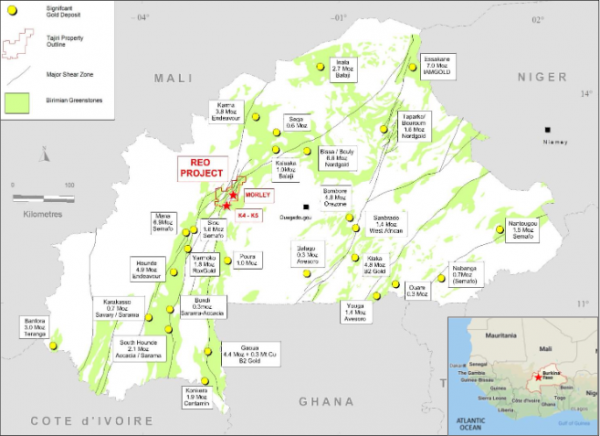
VANCOUVER, BC, Aug. 20, 2020 /CNW/ – Tajiri Resources Corp. (the “Company”) (TSX VENTURE: TAJ) is pleased to announce that it has entered into an agreement with Sahara Natural Resources (or “Sahara’) to provide full support to the Company’s maiden exploration program on the Reo Gold Project located some 130km west of the country’s capital Ouagadougou in Burkina Faso. Sahara is a full-service natural resource contractor and has been providing services globally since 2010. Sahara is accredited with all major stock exchanges. The contract envisages 4,000- 7,000m of RC drilling and 1,500- 2,500m of diamond core drilling with all work to be conducted by and supervised by Sahara. Drilling is expected to start within the next 2 weeks.
The specific focus of the drill campaign will be at the advanced Morley and K4-K5 prospects with drilling commencing at Morley, where the previous project owner Middle Island Resources identified through drilling and trenching a potential high grade gold bearing structure of 3-10m width and 400 metres in strike, The true extent of which remains unknown. The perspectivity of Morley is clearly demonstrated by numerous drill and trench intersections such as:
KRAC11 32m @ 17.5g/t from 2m,
MRTR001(trench) 11m @ 7.97g/t,
MRRC005 10m @ 9.63g/t from 74m,
MRRC040 5m @ 16.9g/t from 33m
KRC022 10m @7.55g/t from 16m
A minimum of 2,000m of RC drilling is scheduled for Morley with the objective of infilling gaps in previous drilling to demonstrating down continuity and extending the zone along strike. With an extensive collection of historical data to provide a blueprint the Company plans to both confirm and expand on the Morley prospect area in the upcoming program, as there are clear signs of potential for a high grade near surface orebody similar in nature to other mines in the region.
After drilling Morley additional work is planned to continue, without pause, at the K4/K5 prospect, where previous scout drilling of approximately 30,000 metres of various methods has identified a large gold bearing system that to date has been defined to be some 4 x 5 km in size. In addition, in 2013 an IP survey was conducted which identified >20 discrete chargeability + resistivity anomalies which correlate with drill intersected mineralisation such as:
MRRC0047 13m @ 2.47g/t from
MRRB1608 12m @ 3.23 from 4m
MRRC0081 16m @ 1.95g/t from 7m,
6m @ 2.27g/t from 54m,
13m @ 2.19g/t from 85m
MRRC0091 10m @ 3.47g/t from 25m
The planned drill program will include 2,000-4,000m of shallow RC drilling to extend strike from historic drill intersections along the chargeability + resistivity anomalies. Drilling will be on 50-100m strep outs and will test 2-3 of the chargeability + resistivity anomalies as proof of concept before the Company embarks on a resource drilling campaign.
In addition the Company will also test 3-6 deep, highly prospective, resistivity/chargeability IP targets with 1,500-2,000m of diamond core drilling to a depth of ~400m. IP surveys have indicated the presence of 6 targets at depths of between 250m-400m below surface that are 2-4 times the intensity of shallower targets and appear 30-50m in width. To date drilling at K4-K5 has been generally shallow with only 5 diamond drill holes ranging from 71-190m depth having been completed. As only one of these drill holes came close to testing a deeper IP target- MRDD 003 drilled – to a depth of 170m – which intersected at the bottom of the hole a silica-chlorite altered granodiorite which returned 2m @ 16.8g/t between 158 and 160 metres. MRDD 003 was drilled in a down dip direction, did not test the most prospective part of the resistivity/chargeability target, and therefore the possibility that a deeper a higher grade mineralisation is related to the highly altered subsurface intrusion and as such presents an exploration target of the highest priority.
Posted by AGORACOM
at 9:56 AM on Wednesday, January 23rd, 2019
Applied for a diamond drilling permit for the Company’s Golden Promise Jaclyn Main Zone (JMZ) and Jaclyn North Zone (JNZ)
In-fill drilling in west half of JMZ within conceptual pit-constrained area.
Explore along projected strike east of JNZ in area of high-grade quartz boulders (boulder samples of 163, 208 and 332 g/t gold
VANCOUVER, BC / ACCESSWIRE / January 23, 2019 / GREAT ATLANTIC RESOURCES CORP. (TSXV.GR) (the “Company” or “Great Atlantic”)
is pleased to announce it has applied for a diamond drilling permit for
the Company’s Golden Promise Gold Property, located in the central
Newfoundland gold belt. The application is for up to 50 drill holes (up
to 6,500 meters) in the northern half of the property at the Jaclyn
Zone, specifically at the Jaclyn Main Zone (JMZ) and Jaclyn North Zone
(JNZ). Pending approval of the drilling permit and financing, the
Company plans to begin drilling during spring 2019, with the following
focus:
In-fill drilling in west half of JMZ within conceptual pit-constrained area.
Both shallow and deeper drilling in central-east region of JMZ.
Provide data for up-dated JMZ mineral resource estimate, engineering studies and studies of mineralizing controls.
Explore
along projected strike east of JNZ in area of high-grade quartz
boulders (boulder samples of 163, 208 and 332 g/t gold – News Release of
August 31, 2017).
The Company recently reported a
National Instrument 43-101 mineral resource estimate for the JMZ (News
Release of December 6, 2018; and Sedar-filed National Instrument 43-101
Technical Report on the Golden Promise Property, Central Newfoundland
(revised), dated December 4, 2018 by Mr. Greg Z. Mosher, M.Sc. App.,
P.Geo., and Mr. Larry Pilgrim, B.Sc., P.Geo.). The reported inferred
mineral resource estimate for the JMZ is as follows:
Resource
Cutoff Au g/t
Au Cap g/t
Au Uncap g/t
Tonnes
Au Ounces Capped
Au Ounces Uncapped
Total
1.1
9.3
10.4
357,500
106,400
119,900
Pit-Constrained
0.6
11.4
14.1
157,300
57,800
71,200
Underground
1.5
7.5
7.6
200,200
48,600
48,700
Mineral Resources are not Mineral Reserves and do not have demonstrated economic viability.
There is no certainty that all or any part of the Mineral Resources estimated will be converted into Mineral Reserves.
Mineral
resource tonnage and contained metal have been rounded to reflect the
accuracy of the estimate, and numbers may not add due to rounding.
Mineral resource tonnage and grades are reported as undiluted.
Contained Au ounces are in-situ and do not include recovery losses
The
majority of 2019 planned diamond drill holes at the Golden Promise
Property will be in-fill drill holes in the west section of the JMZ in
the conceptual pit-constrained area. Some drilling is planned for the
central-east section of the JMZ. Historic drilling in this part of the
JMZ is less concentrated versus the west section. Planned drilling in
the central-east section of the JMZ will include near-surface drilling
to test continuation of gold mineralization to near-surface, and some
deeper holes. The drilling program will provide data for an up-dated JMZ
mineral resource estimate, engineering studies and studies of
mineralizing controls. Up to nine drill holes are planned testing
continuation of the JNZ east along projected strike. The Company
conducted trenching during 2017 along the projected east strike of the
JNZ. The trenching generally failed to reach bedrock due to thick
glacial till. However gold bearing quartz vein boulders were excavated
from multiple trenches, with some boulder samples returning high grade
gold (including 163.99, 208.51 and 332.67 g/t gold: News Release of
August 31, 2017). A qualified person managed the 2017 trenching program
and sampling and verified the analytical data.
The Golden Promise
Property hosts multiple gold bearing quartz veins and is located in a
region of recent significant gold discoveries. The property is located
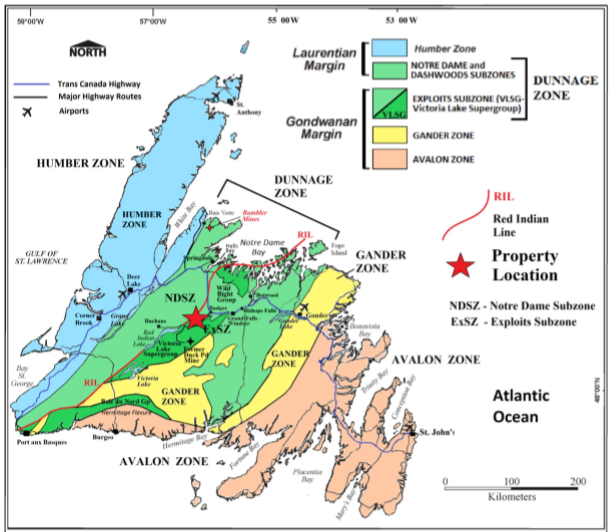
within the Exploits Subzone of the Newfoundland Dunnage Zone. Within the
Exploits Subzone, the property lies along the north-northwestern fringe
of the Victoria Lake Supergroup (VLSG), a volcano-sedimentary terrane.
The northwestern margin of the Golden Promise Property occurs proximal
to, and, in part, contiguous with a major (Appalachian-scale)
collisional boundary, and suture zone, known as the Red Indian Line
(RIL). The RIL forms the western boundary of the Exploits Subzone.
Recent significant gold discoveries in this region of the Exploits
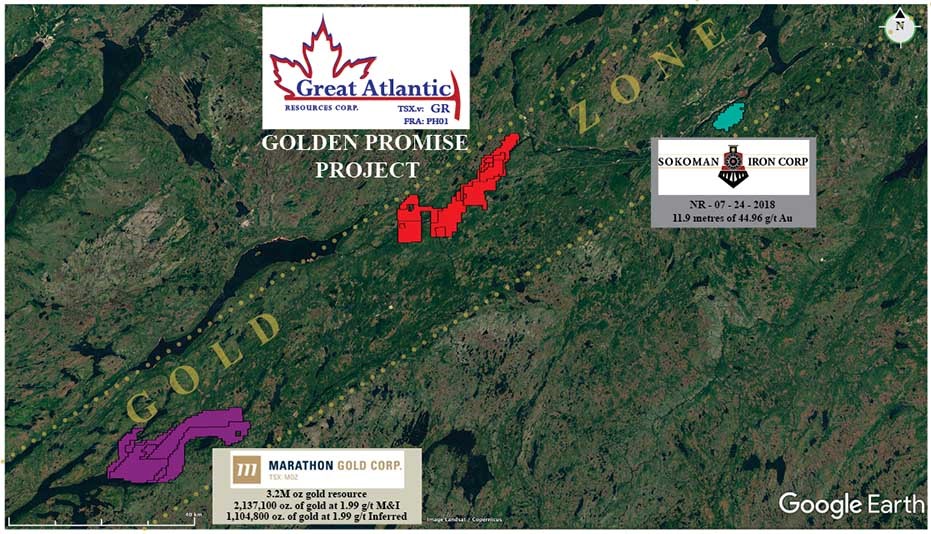
Subzone include those of Sokoman Iron Corp. (TSXV.SIC) at the Moosehead Project and Marathon Gold Corp. (TSXV.MOZ) at the Valentine Lake Gold Camp.
Sokoman Iron Corp. (TSXV.SIC) recently
announced a high-grade gold discovery on its Moosehead Property,
located approximately 40 kilometers east-northeast of the Golden Promise
Property. The discovery was made during the 2018 diamond drilling
program. A drill intersection of 44.96 g/t gold over 11.90 meters core
length was reported including a 1.35 meters core length quartz vein
intersection of 385.85 g/t gold (Sokoman Iron Corp. News Release of July
24, 2018). The Valentine Lake Gold Camp of Marathon Gold Corp. (TSXV.MOZ) is
located approximately 55 kilometers southwest of the Golden Promise
Property. As reported on Marathon’s website, the Valentine Lake Gold
Camp currently hosts four near-surface, mainly pit-shell constrained,
deposits with measured and indicated resources totaling 2,691,400 oz. of
gold at 1.85 g/t gold and inferred resources totalling 1,531,600 oz. of
gold at 1.77 g/t. Readers are warned that mineralization at the
Moosehead Property and Valentine Lake Gold Camp is not necessarily
indicative of mineralization on the Golden Promise Property.
High-grade
gold is reported in quartz veins and quartz vein boulders within the
Golden Promise Property. Gold bearing quartz veins are reported in
multiple areas of the property, including at least 5 gold bearing quartz
vein systems reported in the Jaclyn Zone. Much of the reported
historical exploration within the property has been focused on the
Jaclyn Zone with gold bearing vein systems reported at the JMZ, JNZ,
Jaclyn South Zone, Jaclyn East Zone and Jaclyn West Zone. The majority
of historic drilling (2002-2010) was conducted at the JMZ. Gold bearing
veins and gold bearing float are reported in other regions of the
property. These include the Linda/Snow White vein in the southern region
and the Shawn’s Shot vein in the central region of the property.
As
reported in the National Instrument 43-101 Technical Report on the
Golden Promise Property, Central Newfoundland (revised), dated December
4, 2018 by Mr. Greg Z. Mosher, M.Sc. App., P.Geo., and Mr. Larry
Pilgrim, B.Sc., P.Geo., the JMZ was modelled as a single quartz vein
that strikes east-west and dips steeply to the south. Modelled vein
thickness was based on true thickness derived from quartz vein
intercepts. The estimate is based on 220 assays that were composited to
135 one-meter long composites. A bulk density of 2.7 g/cm3 was used.
Blocks in the model measured 15 meters east-west, 1-meter north-south
and 10 meters vertically. The block model was not rotated. Grades were
interpolated using inverse-distance squared (ID2) weighting and a search
ellipse that measured 100 meters along strike, two meters across strike
and 50 meters vertically. Grades were interpolated based on a minimum
of two and a maximum of 10 composites with a maximum of one composite
per hole so the grade of each block is based on at least two drillholes
thereby demonstrating continuity of mineralization. For the capped
mineral resource estimate, all assays that exceed 65 g/t gold were
capped at 65 g/t gold. All resources were classified as Inferred because
of the relatively wide spacing of drill holes through most of the zone.
Because
part of the vein is near surface the resource estimate was constrained
by a conceptual open pit to demonstrate reasonable prospects of eventual
economic extraction. Generic mining costs of US$2.50/tonne and
processing costs of US$25.00/tonne were used together with a gold price
of US$1,300/ounce. A conceptual pit slope of 45° was assumed with no
allowance for mining loss or dilution. Based on the combined
hypothetical mining and processing costs and the assumed price of gold, a
pit-constrained cutoff grade of 0.6 g/t was adopted. For the
underground portion of the resource a cutoff of 1.5 g/t was assumed. The
cutoff grade for the total resource is the weighted average of the
pit-constrained and underground cutoff grades.
Jaclyn Main Zone Total Inferred Mineral Resource Estimate
Resource
Cutoff Au g/t
Au Cap g/t
Au Uncap g/t
Tonnes
Au Ounces Capped
Au Ounces Uncapped
Total
1.1
9.3
10.4
357,500
106,400
119,900
Pit-Constrained
0.6
11.4
14.1
157,300
57,800
71,200
Underground
1.5
7.5
7.6
200,200
48,600
48,700
Mineral Resources are not Mineral Reserves and do not have demonstrated economic viability.
There is no certainty that all or any part of the Mineral Resources estimated will be converted into Mineral Reserves.
Mineral
resource tonnage and contained metal have been rounded to reflect the
accuracy of the estimate, and numbers may not add due to rounding.
Mineral resource tonnage and grades are reported as undiluted.
Contained Au ounces are in-situ and do not include recovery losses
David
Martin, P.Geo., a Qualified Person as defined by NI 43-101 and VP
Exploration for Great Atlantic, is responsible for the technical
information contained in this News Release.
About Great Atlantic Resources Corp.: Great
Atlantic Resources Corp. is a Canadian exploration company focused on
the discovery and development of mineral assets in the resource-rich and
sovereign risk-free realm of Atlantic Canada, one of the number one
mining regions of the world. Great Atlantic is currently surging forward
building the company utilizing a Project Generation model, with a
special focus on the most critical elements on the planet that are
prominent in Atlantic Canada, Antimony, Tungsten and Gold. On Behalf of the board of directors
“Christopher R Anderson“
Mr. Christopher R. Anderson “Always be positive, strive for solutions, and never give up” President CEO Director 604-488-3900 – Dir
Posted by AGORACOM
at 8:29 AM on Tuesday, January 15th, 2019
Name changed to “ZEN Graphene Solutions Ltd.” effective January 16, 2019.
The unique genesis and microcrystalline structure of the high-purity Albany Graphite mineralization gives ZEN a significant competitive advantage in producing mono-layer to few-layer graphene that is in the highest demand.
Graphene is emerging as the most promising new material in modern times for enhancing the mechanical, electrical and thermal properties of materials used in a broad range of industrial applications.
Thunder
Bay, Ontario–(Newsfile Corp. – January 15, 2019) – Zenyatta Ventures
Ltd. (TSXV: ZEN) (“ZEN” or the “Company”) is pleased to announce that
it has obtained TSX Venture Exchange approval and has changed its name
from “Zenyatta Ventures Ltd.” to “ZEN Graphene Solutions Ltd.” effective
January 16, 2019. The name change reflects the Company’s decision to
focus its development plans for the Albany Graphite Project on the
graphene nano-material product opportunity.
Graphene is emerging
as the most promising new material in modern times for enhancing the
mechanical, electrical and thermal properties of materials used in a
broad range of industrial applications. New innovations are being
announced by researchers around the world on a regular basis with market
demand for graphene growing rapidly. In 2017, there were a total of
13,371 patent filings about graphene worldwide, an upsurge of 30.7% over
the previous year. The global graphene market size stood at roughly
US$85 million in 2017, before growing to nearly US$200million in 2018.
It is now forecast to reach US$1 billion in size by 2023 as new
applications are developed and implemented according to a report
published by Research and Markets in November, 2018.
The
unique genesis and microcrystalline structure of the high-purity Albany
Graphite mineralization gives ZEN a significant competitive advantage in
producing mono-layer to few-layer graphene that is in the highest
demand. Furthermore, in a recent study by Tokyo Tech, researchers
concluded that, due to the size and characteristics of its flakes, the
exfoliation productivity of Albany Graphite performed up to 1500% better
than the researchers’ reference flake graphite materials (see October 2018 news release).
The Company is presently assessing the various graphene conversion
methods developed within its network of collaborative research partners
with the goal of defining various scalable, low-cost, low-energy and
environmentally friendly production methods.
In the near future,
ZEN plans to source the appropriate equipment required for graphene
production and begin working with its partners on new technology
development. The name change is the next logical step for ZEN to clearly
signal to its future customers and investors its commitment to becoming
a global leader in graphene technology. Interestingly, ZEN was
included in the National Graphene Association’s “Top 10 Graphene Companies of 2018” based on the number of posts written about it on Graphene-info.
In
conjunction with the name change, the Company’s new CUSIP number will
be 98935P108 and the ISIN number will be CA98935P1080. The Company’s
trading symbol will remain as “ZEN”.
Non-Brokered Flow-Through Offering
The
Company also announces that 353,250 finders warrants were distributed
by the Company in connection with the Company’s previously announced
private placement of flow-through common shares that closed on December
21, 2019. These warrants will be subject to a hold period until April
22, 2019 in accordance with applicable securities laws.