Posted by AGORACOM-JC
at 9:24 AM on Thursday, April 18th, 2019
SPONSOR: ThreeD Capital Inc. (IDK:CSE) Led by
legendary financier, Sheldon Inwentash, ThreeD is a Canadian-based
venture capital firm that only invests in best of breed small-cap
companies which are both defensible and mass scalable. More than just
lip service, Inwentash has financed many of Canada’s biggest small-cap
exits. Click Here For More Information.
Ethereum Continues to Lead the Way in Enterprise Blockchain Adoption
Most of the world’s largest companies experimenting with blockchain are apparently doing so on Ethereum.
Amongst the notable names are Fidelity, Google, and HTC.
By: Rick D. |
Most of the world’s largest companies experimenting with blockchain
are apparently doing so on Ethereum. Amongst the notable names are Fidelity, Google, and HTC.
Blockchain spending has been increasing dramatically over the last
few years and it looks like the number two crypto by market
capitalisation is leading the way in terms of corporate adoption.
Much of Ethereum’s Fabled EEA Still Interested in the Platform
For many Ether investors, enterprise adoption is all important. In 2017, Enterprise Ethereum Alliance
announcements were often accompanied by massive price surges for the
number two crypto by market capitalisation. Names likes Deloitte,
National Bank of Canada, Samsung
SDS, and Toyota and many more were gradually added to the list.
Meanwhile, investors waited for one of these massive companies to
develop a killer application for the blockchain that requires the use of
vast quantities of Ether, thus sending the price rocketing.
Things have not exactly turned out as many had expected. The
Enterprise Ethereum Alliance (EEA) has not been in the news much of late
and there is no corporate use case of the blockchain that has sent the
price parabolic again. However, development is clearly still going on.
EEA announcements have inspired their fair share of ETH price runs in the past.
Forbes
has just released a list of billion dollar companies experimenting with
blockchain technology. The “Top 50 Billion-Dollar Companies Exploring
Blockchain†is the first part of two similar articles. It will
eventually create a full top 100.
The list shows that most of the world’s largest companies that are
interested in distributed ledger technology are currently looking at
public Ethereum or private Ethereum-derived ledgers to build
applications on. Most companies featured are exploring numerous
blockchains, however.
Of those that prefer other blockchains, Hyperledger, IBM Blockchain,
and Bitcoin all seem popular amongst the corporate giants exploring the
tech.
In an article detailing the new Forbes list, ConsenSys
stated that 24 of the 50 billion-dollar companies are currently
investigating the Ethereum public blockchain, with a further 12 using
Enterprise Ethereum-derived platforms in instead.
The ConsenSys piece goes on to opine:
“It’s likely that the large developer community, existing standards
developed by the EEA, and public compatibility are driving some of
Enterprise Ethereum’s reported dominance.â€
What Are The Biggest of The Big Working on?
Below are some of the more notable companies on the list and the specific blockchains they’re currently exploring:
Amazon — Hyperledger, Gabric, Ethereum (later this year).
IBM — IBM Blockchain, Stellar, Hyperledger Burrow, Sovrin.
JP Morgan Chase — Quorum.
MasterCard — An original blockchain built from the ground up.
Microsoft — Ethereum, Parity, Corda, Hyperledger Fabric.
Nasdaq — Symbiont, Corda, Hyperledger Fabric.
Nestle — IBM Blockchain.
Overstock — Bitcoin, Ethereum, RVN, Florin.
Samsung — Nexledger, Ethereum.
Visa — Hyperledger Fabric.
Walmart — Hyperledger Fabric.
Blockchain Spending Growing Dramatically
According to International Data Corp,
spending on blockchain technology solutions increased by 89 percent
compared to the previous year. It is projected to reach $2.9 billion
this year and $12.4 billion by 2022.
Meanwhile, Deloitte surveyed executives from a range of companies. The results found that 95 percent of those asked were already invested or planned to at some point this year.
Posted by AGORACOM-JC
at 8:10 AM on Thursday, April 18th, 2019
Announced the signing of pilot agreement with Cannvas MedTech Inc.
The partnership installs Cannvas as the exclusive provider of cannabis education to Empower Clinics and its 120,000 patients in the U.S.
Empower Clinics Inc. is launching a pilot program with Cannvas MedTech to place educational kiosks in each of its clinics to advance the education of patients, collection of data and analysis of physician recommended alternative CBD based therapies.
VANCOUVER, April 18, 2019 – EMPOWER CLINICS INC. (CSE: CBDT) (Frankfurt 8EC) (“Empower” or the “Company“), a growth oriented, diversified health and wellness company, is pleased to announce the signing of a pilot agreement with Cannvas MedTech Inc. (“Cannvas”) (CSE: MTEC) (FRA: 3CM)Â (OTCPK: CANVF), a leading digital cannabis education and analytics company, to launch a comprehensive education, data collection and analysis program starting with the installation of a network of standalone on-site Cannvas Kiosks in the Empower network of medical clinics.
“This is an opportunity to bring unbiased cannabis education to a
large population of patients looking for therapies to alleviate a number
of ailments while also learning more about what behaviours may drive
the decision to look at cannabis as an alternative or complementary
treatment,” said Shawn Moniz, Chief Executive Officer,
Cannvas MedTech. “We are thrilled to partner with Empower Clinics to
couple cannabis education with data analysis and better serve their
patients while growing the Cannvas brand across the United States.”
The partnership installs Cannvas as the exclusive provider of
cannabis education to Empower Clinics and its 120,000 patients in the
U.S. Cannvas plans to place its Cannvas Kiosks throughout Empower’s
network of clinics to provide accessible and unbiased cannabis education
to its patients, integrating geo-targeting capabilities to ensure
relevant contextual information across the country. Cannvas will also be
a key data and analytics partner for Empower, providing meaningful
insights on customer behaviours and industry trends and integrating
mutually beneficial existing data partnerships.
“In recent weeks, the Company has been re-positioning its overall
strategy to become a vertically integrated health and wellness company
that connects to its 120,000 patients using a data driven focus to
improve patients’ lives with products, technology and health systems”,
stated Steven McAuley, Empower CEO, “the addition of the
Cannvas educational kiosks, a user friendly and highly interactive
education platform, is a tremendous step forward to making our brand the
thought leader and go to source for content for both patients and the
medical community nationwide.”
Every month Empower hosts informational sessions about alternative treatment options and the potential health benefits with doctors and staff available to answer questions. Cannvas expects to play an active role in the review and implementation of new educational curriculum based on original content from Cannvas.Me.
The Company also plans to begin further pilot initiatives with
Cannvas to provide content and educational links to Cannvas.me and
Cannvas.health directly from the new Empower website www.empowerclinics.com and through the Empower tele-medicine portal.
Empower is a leading owner/operator of a network of physician-staffed clinics focused on helping patients improve and protect their health through innovative physician recommended treatment options. It is expected that Empower’s proprietary product line “Sollievo” will offer patients a variety of delivery methods of doctor recommended cannabidiol (CBD) based products in its clinics, online and at major retailers. With over 120,000 patients, an expanding clinic footprint, a focus on new technologies, including tele-medicine, and an expanded product development strategy, Empower is undertaking new growth initiatives to be positioned as a vertically integrated, diverse, market-leading service provider for complex patient requirements in 2019 and beyond.
ABOUT CANVASS MEDTECH
Cannvas MedTech is a leading digital cannabis education and analytics
company delivering accessible and evidence-based education while
harnessing the power of data to paint a clearer picture of cannabis
consumption across Canada.
For French inquiries: Remy Scalabrini, Maricom Inc., E: [email protected], T: (888) 585-6274
ON BEHALF OF THE BOARD OF DIRECTORS:
Steven McAuley Chief Executive Officer
DISCLAIMER FOR FORWARD-LOOKING STATEMENTS
This news release contains certain “forward-looking statements”
or “forward-looking information” (collectively “forward looking
statements”) within the meaning of applicable Canadian securities laws. All
statements, other than statements of historical fact, are
forward-looking statements and are based on expectations, estimates and
projections as at the date of this news release. Forward-looking statements
can frequently be identified by words such as “plans”, “continues”,
“expects”, “projects”, “intends”, “believes”, “anticipates”,
“estimates”, “may”, “will”, “potential”, “proposed” and other similar
words, or information that certain events or conditions “may” or “will”
occur. Forward-looking statements in this news release include
statements regarding the Company’s proposed name change; new website;
and the expected benefits of same for the Company and its stakeholders.
Such statements are only projections, are based on assumptions known to
management at this time, and are subject to risks and uncertainties that
may cause actual results, performance or developments to differ
materially from those contained in the forward-looking statements,
including: that the proposed acquisitions and partnerships, including
that: the name change may not be approved by the Company’s shareholders
or may not be completed; that the website may not operate as expected;
that the Company may not be able to obtain adequate financing to pursue
its business plan; general business, economic, competitive, political
and social uncertainties; failure to obtain any necessary approvals in
connection with the proposed acquisitions and partnerships; and other
factors beyond the Company’s control. No assurance can be given that any
of the events anticipated by the forward-looking statements will occur
or, if they do occur, what benefits the Company will obtain from them.
Readers are cautioned not to place undue reliance on the forward-looking
statements in this release, which are qualified in their entirety by
these cautionary statements. The Company is under no obligation, and
expressly disclaims any intention or obligation, to update or revise any
forward-looking statements in this release, whether as a result of new
information, future events or otherwise, except as expressly required by
applicable laws.
Investors: Steve Low, Boom Capital Markets, 647-620-5101; For French inquiries: Remy Scalabrini, Maricom Inc., E: [email protected], T: (888) 585-6274; Investors: Steven McAuley, CEO, [email protected], 604-789-2146Copyright CNW Group 2019
Tags: CSE, Hemp, Marijuana, stocks, tsx, tsx-v, weed Posted in Empower Clinics Inc. | Comments Off on Empower $EPW.ca announces partnership with Cannvas Medtech to advance patient education $WEED.ca $CGC $ACB $APH $CRON.ca $HEXO.ca $TRST.ca $OGI.ca
Posted by AGORACOM-JC
at 4:19 PM on Wednesday, April 17th, 2019
WHY NORTHBUD FARMS?
Canadian regulatory door for CIP (Cannabinoid Infused Products) is opening this year as shown in other legal jurisdictions (Colorado, Washington, Nevada, California)
Infused products sector has become the highest margin segment of the industry
Positioned to be a raw input producer for this space
Currently working with multiple food,
beverage and science companies to provide safe standardized cannabinoid
infused raw inputs for large scale GMP manufacturing of products
Signed Binding Letter of Intent to Enter U.S. Market with Strategic Acquisition of Multi-State Licensed Operator Eureka Vapor Read Release
CHECK OUT OUR RECENT INTERVIEW
FULL DISCLOSURE: NORTHBUD is an advertising client of AGORA Internet Relations Corp.
Tags: CSE, Hemp, Marijuana, stocks, tsx, tsx-v, weed Posted in All Recent Posts, North Bud Farms Inc | Comments Off on CLIENT FEATURE: NORTHBUD $NBUD.ca Signs $20 MILLION Binding LOI For Acquisition of Multi-State Licensed Operator Eureka Vapor WEED.ca $CGC $ACB $APH $CRON.ca $HEXO.ca $TRST.ca $OGI.ca
Posted by AGORACOM-JC
at 3:09 PM on Wednesday, April 17th, 2019
SPONSOR: Esports Entertainment
$GMBL Esports audience is 350M, growing to 590M, Esports wagering is
projected at $23 BILLION by 2020. The company has launched VIE.gg
esports betting platform and has accelerated affiliate marketing
agreements with 190 Esports teams. Click here for more information
GMBL: OTCQB
———————–
Growth of eSports shows that video gaming is not just for fun
With players getting sponsorship deals themselves and payments for being on teams, eSports is proof that gaming has grown up recently.
With the eSports market expected to generate $1bn by the end of 2019, it is certainly a growing sector.
When we talk about the modern video game industry, there are some
amazing recent trends that demand attention. Of course, things such as
mobile gaming and virtual reality fall into this category, as do trends
in games themselves, such as the popularity of battle royale-style
titles. However, one aspect of modern video gaming perhaps demands more
attention than any other: eSports.
If you have not come across this niche within gaming yet, then it is
pretty simple to grasp. eSports is professional gaming where teams of
players compete in online or real-world tournaments. With real prize
money on offer to winning teams and many big companies getting involved
with sponsorship, eSports is showing that video games are not just for
fun anymore.
With players getting sponsorship deals themselves and payments for
being on teams, eSports is proof that gaming has grown up recently. With
the eSports market expected to generate $1bn by the end of 2019, it is
certainly a growing sector. Of course, it is perfectly fine to game just
for fun still if you like. However, the rise of professional gaming as a
sport shows that it is no longer confined to that alone.
Popular titles make eSports a success
The eSports tournaments that teams compete in take
place in front of millions of watching viewers, either online or in real
life. This again shows just how far gaming has come from being a bit of
fun with a few friends in your home.
A big part of the attraction for fans is the games that teams play at tournaments. Old-school fighting game tournaments such as Street Fighter are always well received along with other tournaments based on enduringly popular titles such as Counter Strike: Global Offensive (CSGO).
Fans can even bet on the outcome of tournaments now, which only serves
to further show how serious and professional video gaming has become.
Just remember to get the best odds on CSGO betting sites if you fancy putting a wager on!
Aside from the well-received games that eSports tournaments are based on, why is it so popular with gamers and fans?
Easy to access for fans
Many of the eSports tournaments are streamed live online, which makes
them easy to access for fans. Compared to having to travel and cover
the expense of going to real-world sports games, it is much more
convenient. Modern streaming platforms such as Twitch have made it
simple to log on when you have the chance and catch the latest action,
wherever you may be.
Valid career choice
Traditional video gaming in the past was not seen as a legitimate
career choice or something from which you could make money. eSports has
totally changed all this and made playing games a valid career choice
for everyone. Naturally, you have to be pretty good, but if you have
the skills, then you can make a very good living from this sector. Top
player Chen Wei Lin, for example, earns around $250,000 each year!
Diversity of games to watch
eSports is just like any other sport in that it would get pretty
boring if you watched the same thing over and over. It would be like
watching a soccer game between the same two teams every time! One of the
reasons why eSports has exploded though is that it has a wide range of
titles that teams compete in, so you can always find one that you like
to view. From the ones already mentioned above to other big games such
as DOTA 2 or Overwatch, the range of fun to be had with eSports is huge.
Great fun to watch and play
Perhaps the major reason why eSports has got so big so quick is that
it is enjoyable – pure and simple! Playing in the tournaments gives you a
real adrenaline buzz and allows you to do something you enjoy for a
living. Watching the eSports tournaments unfold is also great fun and
gives you a cool way to spend your spare time. Although it is a
professional side to video gaming, it doesn’t mean that you can’t have a
good time as well.
Gaming grows up with eSports
Although eSports is one part of the whole video game industry, it is
arguably the most important right now. It has taken gaming out of the
bedroom as a mere leisure activity and made it a professional activity
that is much more serious and grown up. While playing games in this way
is naturally still fun, eSports has shown that playing video games can
be so much more than that. With projections for the future of eSports
being overridingly positive, the future for this niche and gaming in
general looks good.
Posted by AGORACOM-JC
at 11:24 AM on Wednesday, April 17th, 2019
SPONSOR: Enthusiast Gaming Holdings Inc.
(TSX-V: EGLX) Uniting gaming communities with 80 owned and affiliated
websites, currently reaching over 75 million monthly visitors. The
company’s partial 2018 (first 9 months) revenue of $7.4 million
representing a 625% increase over the same period in 2017.
EGLX: TSX-V ———————————-
Will Smith takes slice of Esports team’s US$46 million financing
Actor Will Smith and Japanese soccer legend Keisuke Honda are among the new investors in esports franchise Gen.G, which announced a new $46 million round of financing Wednesday.
Eben Novy-Williams, Bloomberg News
Will Smith reacts at a closing ceremony press conference during the
2018 FIFA World Cup at Luzhniki Stadium on July 13, 2018 in Moscow,
Russia. (Photo by Dan Mullan/Getty Images). , Dan Mullan/Getty Images
Europe
Actor Will Smith and Japanese soccer legend Keisuke Honda are among
the new investors in esports franchise Gen.G, which announced a new $46
million round of financing Wednesday.
Smith and Honda’s Dreamers Fund, a investment vehicle they launched
last year, are joined by Los Angeles Clippers minority owner Dennis Wong
and Michael Zeisser, former chairman of U.S. investments at Alibaba
Group Holding Ltd.
“It’s exciting to see the worlds of technology, media, sports and now
celebrity come together,†said Chris Park, chief executive officer of
Los Angeles-based Gen.G.
Gen.G operates teams in seven different video games and has offices
in China, South Korea and the U.S. Its franchises include the Overwatch
League’s Seoul Dynasty, which will move to South Korea from Los Angeles
next year.
In addition to handling that transition, Gen.G is expanding in China,
investing in player development and trying to increase revenue from
esports-specific areas like streaming and the sale of in-game items.
“The coming years are going see our company really start to
crystallize its identity, not just as a brand, but also as an
enterprise,†Park said.
To that end, Smith and Honda will join 11-time National Basketball
Association All-Star Chris Bosh, already a Gen.G adviser, in helping
grow Gen.G’s media presence. That includes creative and commercial
projects, and helping Gen.G athletes with content creation.
Other new investors in Gen.G include Battery Ventures, New Enterprise
Associates, MasterClass co-founder David Rogier and Stanford
University. Silicon Valley Bank, which helped with the fundraising, is
becoming both an investor and a sponsor.
Posted by AGORACOM-JC
at 10:23 AM on Wednesday, April 17th, 2019
SPONSOR: ThreeD Capital Inc. (IDK:CSE) Led by
legendary financier, Sheldon Inwentash, ThreeD is a Canadian-based
venture capital firm that only invests in best of breed small-cap
companies which are both defensible and mass scalable. More than just
lip service, Inwentash has financed many of Canada’s biggest small-cap
exits. Click Here For More Information.
——————-
Blockchain Goes To Work At Walmart, IBM, Amazon, JPMorgan, Cargill and 45 Other Enterprises
On the Jersey side of the Hudson River just across from Manhattan’s
Financial District, there is a glass-and-steel office tower designed in a
severe International Style aesthetic. “DTCC†is emblazoned across the
top, but few outside of Wall Street realize that in this building,
occupied by the Depository Trust & Clearing Corp., are records for
most of the world’s securities, representing some $48 trillion in
assets—from stocks and bonds to mutual funds and derivatives. In the
1970s, Wall Street created a DTCC predecessor to replace a system that
had been powered by young men running around the cavernous alleys of
lower Manhattan delivering stock certificates from brokerage house to
brokerage house.
DTCC still has paper certificates in its vaults, but records Ârelated
to the 90 million daily transactions it handles are kept electronically
on its servers and backed up in various locations. Thousands of
financial institutions and exchanges in 130 countries rely on DTCC for
custody, clearing, settlement and other clerical Âservices.
In a few months DTCC will begin the largest live implementation of
blockchain, the distributed database technology made popular by the
bitcoin cryptocurrency. Records for about 50,000 accounts in DTCC’s
Trade Information Warehouse, where information on $10 trillion worth of
credit derivatives is stored, will move to a customized digital ledger
called AxCore.
According to Rob Palatnick, DTCC’s chief technology architect, the
warehouse already keeps an electronic “golden record†of events such as
maturity dates, payment calculations and other activities needed to
clear and settle these securities daily. But each participant in a
complicated credit derivatives transaction also keeps its own records,
which must in turn be reconciled multiple times before the investment
matures. By moving those records to the blockchain, visible to all
participants in real time, most of those redundancies won’t be
necessary.
“We’re not talking about eliminating humans and firms,†PaÂlÂatnick
says. “We’re talking about getting rid of layers of databases and
translations between those databases.â€
On the other side of the world, in Taipei, Taiwan, Foxconn, the
electronics giant best known as a manufacturer of iPhones, launched a
Shanghai startup called Chained Finance with a Chinese peer-to-peer
lender. Chained will soon connect Foxconn and its many small suppliers
(and their suppliers’ suppliers) on an Ethereum-based blockchain that
will use its own token and smart contracts (read: automatically
executed) to make payments and provide financing in near real time,
eliminating a daisy chain of paperwork.
“We view blockchain as the skeleton of our work,†says Jack Lee, the
founder of Foxconn’s venture capital arm, which has invested $40 million
in six blockchain startups. “Smart contracts that automatically execute
transactions are the muscles, and tokens are the blood.â€
Welcome to the brave new world of enterprise blockchain, where
corporations are embracing the technology underlying cryptocurrencies
like bitcoin and using it to speed up business processes, increase
transparency and potentially save billions of dollars. At its core,
blockchain is simply a distributed database, with an identical copy
stored on many computers. That facilitates transactions (financial or
otherwise) between individuals (or companies) that don’t know or trust
each other. It’s virtually impossible to cheat, since every transaction
is recorded in many Âplaces and the details of those transactions are
visible to everyone. Companies are already using blockchain to track
fresh-caught tuna from fishing hooks in the South Pacific to grocery
shelves, to speed up insurance claims and to manage medical records.
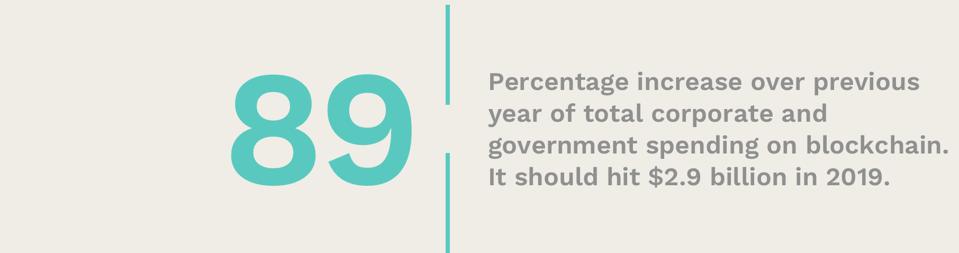
Total corporate and government spending on blockchain should hit $2.9
billion in 2019, an increase of 89% over the previous year, and reach
$12.4 billion by 2022, according to the International Data Corp. When
PwC surveyed 600 “blockchain-savvy†execs last year, 84% said their
companies are involved with blockchain.
To chronicle the rise of so called “enterprise†blockchain, Forbes has
created its first annual Blockchain 50 list of big companies that are
putting the technology to work in Âmeaningful ways. While blockchain’s
first application, cryptocurrency, is struggling to achieve mainstream
adoption, these companies are committing manpower and capital to build
the future on top of shared databases.
The version of a blockchain future these companies are building is,
for the most part, far different from what the founders and early
adopters of blockchain had envisioned. While many cryptoÂcurrency
idealists fantasize about a global, public network of individuals
connected directly and democratically, without middleÂmen, these
companies—many of which are middlemen themselves like DTCC—are building
private networks they will use to profit from centralized management.
Not surprisingly, financial firms—from Allianz to Visa and JPMorgan
Chase—dominate the list. But Blockchain 50 companies run the gamut of
industries, including energy firm BP, retailer Walmart and media company
Comcast.
Because of the lingering bad taste left by bitcoin drug bazaars like
Silk Road and the 2017 digital currency bubble, most companies emphasize
the distinction between crypto and blockchain, shunning the former and
embracing the latter. In some ways the members of the Blockchain 50
represent a bridge between the old and new worlds. Just as internal
computer networks were adopted by companies long before the internet
took off, these firms are starting by adopting distributed ledger
technology at a small scale.
“The era of blockchain tourism has ended,†says Bridget van
Kralingen, Senior Vice President for Platforms & Blockchain. “We’ve
really seen blockchain move from being overshadowed by cryptocurrency to
focus on real business problems and complex processes.â€
In 2009, when Satoshi Nakamoto, bitcoin’s pseudonymous creator,
activated his network, its blockchain was the underlying accounting
system that let anyone with bitcoin transfer money without the need of a
middleman. Transactions are processed in blocks—just a fancy word for a
hunk of data—about every ten minutes, each containing a compressed
version of the previous block, linking them together into a chain.
Instead of relying on a bank or another middleman to keep track of when a
bitcoin leaves one location and arrives at another, the thousands of
computers on the bitcoin network do the work and in exchange for their
efforts are paid in bitcoin.
For most companies this presented a potential problem. While
identities aren’t required to use the bitcoin blockchain, the
transactions themselves are tied to addresses that are publicly
available, meaning that with a bit of work many of these addresses can
be tied to actual people or companies. Thus enterprises like Coca-Cola
and JPMorgan Chase, accustomed to maintaining competitive advantages
based on proprietary processes and control, were initially skeptical of
cryptocurrency.
Businesses also need some control over their data. “The entire
corporate world has been fashioned around who has responsibility over a
particular part of the business flow,†says David Treat, the global head
of Accenture’s Financial Services Blockchain practice. “There can be no
gaps, because that is unacceptable for a multibillion-dollar company.
You cannot have a gap, or you are subject to huge security breaches and
social contract breaches.â€
Perhaps no firm has had a greater influence on the growing corporate
use of blockchain technology than Digital Asset Holdings, a New
York-based startup that hired the former JPMorgan Chase banker Blythe
Masters as its CEO in early 2015. Under Masters, Digital Asset began
making acquisitions and almost immediately purchased a small company
that was in the process of building an “invitation only,†or
permissioned, blockchain. Then in late 2015 Digital Asset donated the
code for its “open ledger†project to the Linux Foundation, which
supports commercial open-source software projects, including the Linux
operating system.
The project was called Hyperledger, and thanks in part to ÂMasters’
connections, its backers read like a who’s who of finance and
technology. Thirty companies are listed as founders, including ABN AMRO,
Accenture, Cisco, CME Group, IBM, Intel, JPMorÂgan Chase, NEC, State
Street, VMware and Wells Fargo. HyperÂledger immediately established
itself as the gold standard for corporate blockchain projects.
What happened next might be considered the Big Bang moment of
enterprise blockchain. In early 2016, IBM donated 44,000 lines of code
to the project, which formed the core of a new blockchain with faster
speeds and increased privacy. No fewer than half of the members of the
Forbes Blockchain 50 are now using that blockchain, known as Hyperledger
Fabric.
“We’ve been very focused on making sure that not only is the
blockchain technology standard but that the documents and data are
standard,†says Marie Wieck, IBM Blockchain’s general manager. “This
standardization allows [the companies] to not spend their time comparing
differences and validity in the documents.â€
Shortly after the launch of Hyperledger, which is a nonprofit
venture, a New York fintech called R3 raised $107 million from the likes
of ING, Barclays and UBS to create a for-profit enterprise blockchain
platform called Corda Enterprise.
As the commercial potential of co-opting blockchain technology became
more apparent, many cryptocurrency startups began to rethink their
models.
For example, San Francisco’s Ripple, originally called OpenCoin and
conceived of as yet another alternative monetary system, expanded its
focus in late 2015 from the cryptocurrency (called ripple and trading as
XRP) to building software for large banks. A bitcoin startup called
Counterparty spawned another company, Symbiont, in March 2015, which
coded a proprietary blockchain that’s now being used by Vanguard for
sharing stock index data. In February 2017, ConsenSys, a Brooklyn-based
collection of crypto companies controlled by one of Ethereum’s founders,
helped launch the Enterprise Ethereum Alliance.
Just as corporate America co-opted counterculture vibes for its
marketing and advertising (“Think Different,†“Don’t Be Evilâ€), its most
forward-thinking businesses are fast incorporating a technology that
was designed in large part to eliminate them.
In insurance, for example, MetLife’s mobile app Vitana bundles
insurance with a test for gestational diabetes that uses a blockchain to
record data and verify and pay claims. In recent testing in Singapore,
where one in five expectant mothers develops gestational diabetes, a
practitioner simply enters a positive test result into a patient’s
electronic medical record and in a matter of seconds MetLife’s smart
contract deposits an insurance payment into that patient’s bank account
to cover the medical expenses associated with the condition. No
paperwork or claim filing necessary.
Similarly, Germany’s Allianz, working with EY, tested moving certain
captive insurance claims processes—often involving many emails,
attachments and phone calls across multiple times zones—to a private
blockchain. The time required to process a claim fell from weeks to
hours.
The French bank BNP Paribas, which has lent money to commodities
traders since the 19th century, is considering using a ledger platform
called Voltron to process letters of credit for traders. Northern Trust
has begun administering private equity funds using Hyperledger Fabric.
Broadridge Financial has been running pilots testing multiple
distributed ledgers for its dominant proxy voting and shareholder
communications business.
“In real time, you know who owns the stock, who’s entitled to vote
and how it’s tied to the universally-agreed-upon shareholder meeting
agenda,†says Michael Tae, Broadridge’s head of strategy.
Golden State Foods, a big McDonald’s supplier that makes more than
400,000 hamburgers per hour, tracks the location and temperature of its
patties with devices like radio-frequency ID tags and Hyperledger
Fabric. The system can immediately alert GSF to conditions that might
lead to spoilage. At the same time, it can optimize inventory levels by
tracking how much meat is in a truck or in a restaurant’s freezer, in
real time.
At this year’s SXSW conference in Austin, Texas, Bumble Bee unveiled
an SAP-built supply-chain blockchain offering complete transparency to
its customers. Soon you will no longer have to take Bumble Bee’s word
for it when its assures you that the 12-ounce package of yellowfin tuna
you just bought was caught by individual fishermen in the South Pacific
and not by a factory ship. The fishing crews, tuna processors and
packers are now entering their own data in real time on Bumble Bee’s
distributed ledger. By summer, Bumble Bee will be sharing that
information with retailers and customers who take the time to check.
From a public relations standpoint alone, Bumble Bee’s SAP blockchain
is likely to bear dividends. In 2017 Greenpeace ranked Bumble Bee 17th
out of 20 tuna brands for its sustainability practices, accusing it of
“greenwashing†a host of bad behaviors with environmentally friendly
marketing.
“Food safety and sustainably sourced product has become an
overwhelmingly important topic in our industry,†says Tony Costa, the
CIO at Bumble Bee. “Leveraging the latest technology enables us to open
it up to more of a public perspective, if you will. So we get out of the
business of managing data. We’re relying on a relationship.â€
In the healthcare business, an estimated 20 cents of every
Âdollar—some $700 billion a year—is wasted because of inefficiencies.
Ciox, a little-known company based in Alpharetta, ÂGeorgia, that manages
medical-records exchanges for 60% of the Âhospitals in the U.S., is
considering developing a private blockchain that healthcare providers
could use—for a fee paid to Ciox—to exchange data. Blockchain 50
enterprises like Ciox and the media giant Comcast, which is toying with
using blockchain to micro-target television advertisements, plan to use
the privacy features of blockchain to profit from their customers’ data
while protecting their identities.
Despite the surge in corporations working on blockchain projects, the
technology is still new, and relatively few have generated significant
revenues or savings.
The one group that is getting rich from the current enterprise
blockchain gold rush: consultants. Deloitte, PwC, KPMG, EY and Tata
Consultancy Services are deploying small armies to preach the virtues of
blockchain to the C-suite and charging huge fees to help companies
implement the technology. (We excluded consultants from the Blockchain
50 because they played a key role in helping us Âcreate the list.)
Deloitte, for example, has 1,400 full-time blockchain employees. India’s
Tata has 1,000 staffers, 600 of them full-time, in its blockchain unit.
Tech firms, including Oracle, SAP and Amazon, are also staking out
their turf.
Part technology firm, part consultant, IBM may be the biggest and
most successful enterprise blockchain company of all. Besides helping
create Hyperledger Fabric, the company has 1,500 staffers—mostly
engineers—devoted to the new technology and reports that its IBM
Blockchain powers 500 client projects.
“The power of any blockchain network is in its participants and its
members,†says IBM’s Wieck. It matters little Âwhether those members are
crypto-idealists or global corporations.
Posted by AGORACOM-JC
at 9:31 AM on Wednesday, April 17th, 2019
Company has officially acquired a 20% ownership interest in Natural Plant Extract of California (NPE).
Under the terms of the agreement, Marijuana Company of America has committed to contribute $2,000,000 in total cash to the project, as well as common shares of the Company with a value of $1,000,000.
Escondido, California–(April 17, 2019) – MARIJUANA COMPANY OF AMERICA INC.(OTCQB: MCOA) (“MCOA” or the “Company“), an innovative hemp and cannabis corporation, is pleased to announce that the Company has officially acquired a 20% ownership interest in Natural Plant Extract of California (NPE).
Under the terms of the agreement, Marijuana Company of America has
committed to contribute $2,000,000 in total cash to the project, as well
as common shares of the Company with a value of $1,000,000. In
exchange, the Company will own a 20% equity position in NPE. In
addition, MCOA and NPE have also officially signed a Joint Venture
Agreement (JV) to establish Viva Buds as a premier cannabis delivery
company. Both NPE and MCOA will share in the profits on a fifty-fifty
basis.
Viva Buds Inc. will serve as the marketing arm for NPE subsidiary
Northern Lights Distribution’s (NLD) new retail cannabis delivery
service in California, first starting with delivery services to Los
Angeles County and then rolling out to other major cities throughout the
state. NLD will contribute up to $300,000 in inventory of cannabis
products to assist in the start-up of this venture, and MCOA will
provide a vast array of marketing services and technology to promote and
build its Viva Buds brand.
NPE owns both state and city licenses
for volatile manufacturing, distribution and retail delivery of
cannabis products. NPE will manage all operations pertaining to
distribution, manufacturing and delivery of cannabis products, and MCOA
will provide capital, consulting and marketing services. NPE is
currently operating as a distributor and is completing the build-out of
its manufacturing facility, which is expected to be completed and fully
operational in August 2019.
Regarding the acquisition, Alan Tsai,
CEO of NPE, stated, “We are excited to be one of the first California
licensed cannabis companies to partner with a publicly traded company in
the US. We believe that partnering with an established company such as
Marijuana Company of America will help to build Viva Buds and establish
our foothold early by securing manufacturing and distribution contracts
with key players in the California cannabis market. We expect that this
strategic partnership will be mutually beneficial to both companies.”
Don Steinberg, MCOA CEO, stated, “After a great deal of due diligence and strategic planning, we are happy to execute an agreement to purchase ownership in NPE. This is a major step in staying true to our name Marijuana Company of America and entering into the marijuana industry in California. We have aspirations of becoming a major distributor, delivery service and manufacture in California. NPE is ahead of most of the competition in the state in terms of permitting, build-out and licensing.”
About Marijuana Company of America, Inc. MCOA is a corporation that participates in: (1) product research and development of legal hemp-based consumer products under the brand name “hempSMART™,” which targets general health and well-being; (2) an affiliate marketing program to promote and sell its legal hemp-based consumer products containing CBD; (3) leasing of real property to separate business entities engaged in the growth and sale of cannabis in those states and jurisdictions where cannabis has been legalized and properly regulated for medicinal and recreational use; and, (4) the expansion of its business into ancillary areas of the legalized cannabis and hemp industry, as the legalized markets and opportunities in this segment mature and develop.
About Natural Plant Extracts of California NPE is
a fully licensed cannabis manufacturing, distribution and non-store
front retail delivery. The Company has secured its licenses with the
state of California and city of Lynwood, CA. For more information about
the Company, please visit its website at https://nldistribution.com
The owners and founders of NPE are marijuana industry veterans with
decades of experience in establishing retail, manufacturing and
distribution of cannabis in California, including obtaining the first
retail dispensary licenses in Los Angeles, CA.
Forward Looking Statements This
news release contains “forward-looking statements,” which are not
purely historical and may include any statements regarding beliefs,
plans, expectations or intentions regarding the future. Such
forward-looking statements include, among other things, the development,
costs and results of new business opportunities and words such as
“anticipate”, “seek”, intend”, “believe”, “estimate”, “expect”,
“project”, “plan” or similar phrases may be deemed “forward-looking
statements” within the meaning of the Private Securities Litigation
Reform Act of 1995. Actual results could differ from those projected in
any forward-looking statements due to numerous factors. Such factors
include, among others, the inherent uncertainties associated with new
projects, the future US and global economies, the impact of competition,
and the Company’s reliance on existing regulations regarding the use
and development of cannabis-based products. These forward-looking
statements are made as of the date of this news release, and we assume
no obligation to update the forward-looking statements, or to update the
reasons why actual results could differ from those projected in the
forward-looking statements. Although we believe that any beliefs, plans,
expectations and intentions contained in this press release are
reasonable, there can be no assurance that any such beliefs, plans,
expectations or intentions will prove to be accurate. Investors should
consult all of the information set forth herein and should also refer to
the risk factors disclosure outlined in our annual report on Form
10-12G, our quarterly reports on Form 10-Q and other periodic reports
filed from time to time with the Securities and Exchange Commission. For
more information, please visit www.sec.gov.
Tags: CSE, Hemp, Marijuana, stocks, tsx, tsx-v, weed Posted in Marijuana Company of America | Comments Off on Marijuana Company of America $MCOA Completes Agreement for Cannabis Extraction, Distribution and Delivery Licenses $AERO $CBDS $CGRW $APH.ca $GBLX $ACG $ACB $WEED.ca $HIP.ca
Posted by AGORACOM-JC
at 4:35 PM on Tuesday, April 16th, 2019
PyroGenesis
is one of Canada’s greatest small cap technology companies, with several
successful divisions that are succeeding both globally and at the highest
levels of business. The common denominator for each of them is the
company’s plasma torch technology. For example, 2 US Aircraft Carriers
(and 2 more on the way) have integrated Pyro’s plasma torch technology for
environmental applications. At $13 Billion per carrier now, one can only
imagine the hyper-stringent hoops PyroGenesis had to pass – which puts their
technology at the world class level.
In
addition to other equally impressive applications, the company’s 3D printing
(additive manufacturing) division has also achieved great success in the past
year, culminating with a mutually exclusive partnership agreement with Aubert
& Duval, a subsidiary of the ERAMET Group with 2017 sales of approximately
$CDN 5.4 Billion and assets of approximately $CDN 4.9 billion. For over
100 years, Aubert & Duval has been a world leader in industrializing
high-performance steel, super alloy, aluminum and titanium alloys. More
specifically, they are a recognized supplier of metal powders for additive
manufacturing, serving the Aerospace, Energy, Transport, Medical, Defense,
Automotive and other large scale, demanding markets.
Just
recently, for the second year in a row, the company was nominated for materials
company of the year at the 3D printing awards.
Today,
PyroGenesis announced the spinout of its 3D printing division in order to
unlock value for shareholders and become more attractive to institutional
investors that are strictly focused on 3D printing. In addition, the
company believes that uplisting will also make both the new company and the
existing company more attractive to institutional investors that are precluded
from investing on junior exchanges.
We were
proud to sit down with CEO, Peter Pascali, and discuss all the benefits and
implications of this major development. Grab your favourite drink, sit
back and watch this great interview!
Posted by AGORACOM-JC
at 1:33 PM on Tuesday, April 16th, 2019
Board of Directors is moving forward with the previously announced spin-off of PyroGenesis Additive, a division specializing in developing, commercializing and advancing plasma-atomized metal powder for the additive manufacturing industry.
Additionally, the Company is also considering uplisting its stock to a more senior exchange. Â
MONTREAL, April 16, 2019 — PyroGenesis Canada Inc. (http://pyrogenesis.com) (TSX-V: PYR) (OTCQB: PYRNF) (FRA: 8PY), a high-tech company, (the “Company”, the “Corporation†or “PyroGenesis”) that designs, develops, manufactures and commercializes plasma atomized metal powder, plasma waste-to-energy systems and plasma torch products, today announced that the Board of Directors is moving forward with the previously announced spin-off of PyroGenesis Additive, a division specializing in developing, commercializing and advancing plasma-atomized metal powder for the additive manufacturing (“AMâ€) industry. Additionally, the Company is also considering uplisting its stock to a more senior exchange. Â
Mr. P. Peter Pascali, President and CEO of PyroGenesis, provides this
update on today’s announcements in the following Q&A format. The
questions, for the most part, are derived from inquiries received from
investors, and analysts:
Q. The spin-off of PyroGenesis Additive. It has been a long time in the making.
A. Indeed it has, and for some very good
reasons. The space has been rocked with change and we had to ensure that
our investors received maximum return from the spin-off, and at values
management felt were fair. I believe that there has been no better time
than now to move forward with the spin-off. These strategic delays have
effectively increased shareholder’s value.
Q. Could you explain those reasons to readers who are new to the story?
A. Most certainly.
Almost three years to the day, in the spring of 2016, we announced
our intention to spin-off our additive manufacturing capabilities to
maximize shareholder value and increase options to the Company. The
original idea was to consider a small concurrent financing to fund the
immediate need which was essentially to have a first system in place
producing powders.
Between the announcement and September 2016, while we were weighing
the options and various structures the spin-off could take, GE announced
that they had acquired Arcam and Concept Laser (both manufacturers of
printers which make metal 3D parts).
GE’s acquisitions arguably disrupted the supply chain of titanium
powders to the industry with the indirect acquisition of a subsidiary of
Arcam which had become the dominant supplier of such powder to the
space. It was imperative that we understood the impact of these
acquisitions on our decision to spin-off before we moved forward.
Once we understood the impact of the acquisition on the market, we
decided to postpone the spin-off until our first powder production
system was assembled which was only a few months away. We then waited
until the ramp up was completed. These delays removed any doubts, in the
marketplace, that we could produce quality powders, and as such,
increased the value of the spin-off to current investors.
Given the reception of our powder by the market (in 2018, we were
nominated Materials Company of the Year at the 3D Printing Industry
Awards, which speaks to how much we had accomplished in such a short
time), we felt we were close to a key contract and/or a significant
relationship, and decided to wait until one or the other was in hand.
In the summer of 2018, discussions took place with Aubert & Duval
which lead to the joint press release of January 8, 2019 describing a
mutually exclusive relationship with respect to the distribution of
PyroGenesis’ titanium powder to the AM industry in Europe.
Given what has taken place, and what we know now, management has made
a strategic decision to spin-off PyroGenesis Additive at this time.
Q. Why spin-off PyroGenesis Additive in the first place?
A. There are a number of reasons, but they all boil down to one goal: simplicity.
The reason to spin-off PyroGenesis Additive is primarily to attract
an investor base best suited to their unique value proposition,
particular business operations, and financial characteristics, thereby
maximizing shareholders’ value and placing it in a better position to
generate revenues and develop strategic relationships than had it
remained part of the PyroGenesis stable of technologies.
The simpler an offering is the easier it is for analysts to understand and value it properly. As
it stands now PyroGenesis Additive is part of PyroGenesis Canada Inc’s
offerings which include Drosrite™, US Military, and Purevap™, just to
name a few, and as such makes it complicated to analyze. Add to this
that analysts typically specialize in one sector or another, and as such
may very well be able to fully value PyroGenesis’ Additive’s offering,
but would be hard pressed to do equal justice to PyroGenesis’ other
business lines, and you have a significantly undervalued group of
assets. Spinning one group off would unlock this value.
Simplifying an offering would also make it easier to attract
investment. There are large pools of money interested in investing in
the AM space, but have no desire to have their funds comingled with
unrelated business lines. A spin-off would assure them that such funds
would be used for AM alone.
Last but not least, a spin-off creates a well understood entity with which interested parties could joint venture or acquire. Bottom line: a spin-off creates simplicity, which in and of itself, increases interest, all to the benefit of shareholders.
Q. Any challenges in a spin-off?
A. There are many, but the two that I think
are key are timing and structure. The timing and structure of a
spin-off is critical to its survivability. The spin-off must be done in
a context where it can grow and mature, not much different from a young
adult leaving home.
It is management’s firm belief that given recent announcements, and
what we anticipate taking place in the near term, spinning-off
PyroGenesis Additive is now overdue.
Q. Are there any other factors motivating your decision to spin-off PyroGenesis Additive at this particular time?
A. Yes. There is a huge interest by our
partners to spin-off PyroGenesis Additive for all the reasons given
above. This is a major factor in our decision to move forward now.
Q. You also announced today that you are considering an uplisting. Could you describe what this means?
A. The Company’s stock currently trades on
the TSX Venture Exchange (“TSX-Vâ€). Although a good exchange it does
have its limitations. It may be a good place for a company to list
initially but, in time, a company should consider moving to a bigger and
better exchange. By bigger and better I mean one which will attract
more interest and as such attract greater investment which by default
would translate into a higher stock price. This is a natural progression
and the TSX-V boasts of the number of companies that have uplisted from
their platform.
I think it would be more appropriate to say that we are considering
which exchange to uplist on, rather than considering an uplisting. It
has already been decided that we have to become listed on a more senior
exchange, sooner than later.
Q. What would be the timing and what are the next steps?
A. Both uplistings and spin-offs require
regulatory approval and depending on the type and number of questions
from the regulators, will determine the time it takes to complete.
Assuming nothing out of the ordinary, either one could take 4-6 months.
Next steps would be to engage a Canadian based law firm, which we are
in the process of doing, and to engage an investment bank. We are
currently receiving proposals from investment bankers on both sides of
the border.
Q. What could delay the process?
A. As I said the process requires
regulatory review and approvals. There could be delays associated with
this. Other than that, funds. The process requires capital to complete
although a large part of it is success based and back-ended.
Q. Assuming money is not an object, and that the
regulatory approval process is not unduly burdensome, when are you
targeting these events to be completed?
A. Both in 2019, this year, but failing that, one this year and the other by Q1, 2020.
Q. Do you care to add any concluding remarks?
A. Yes, I would.
There has been a flurry of developments within our PyroGenesis
Additive segment. We started the year by announcing a significant
agreement with a multi-billion-dollar European Company to market our
powders to Europe on a mutually exclusive basis. This was followed by
our unveiling of our NexGen™ Plasma Atomization process with production
rates that shattered all published plasma atomization production rates.
Next, we announced that we had shipped specialty powders to a
government entity which was quickly followed by the announcement that we
had successfully produced titanium powders with the NexGen™. During
this time, we were also nominated for the second year in a row as
Materials Company of the Year at the 3D Printing Industry Awards 2019.
There is a consensus building that such news belongs on a better
platform. Management concurs, and is taking the necessary steps.
PyroGenesis Canada Inc., a high-tech company, is the world leader in the design, development, manufacture and commercialization of advanced plasma processes and products. We provide engineering and manufacturing expertise, cutting-edge contract research, as well as turnkey process equipment packages to the defense, metallurgical, mining, advanced materials (including 3D printing), oil & gas, and environmental industries. With a team of experienced engineers, scientists and technicians working out of our Montreal office and our 3,800 m2 manufacturing facility, PyroGenesis maintains its competitive advantage by remaining at the forefront of technology development and commercialization. Our core competencies allow PyroGenesis to lead the way in providing innovative plasma torches, plasma waste processes, high-temperature metallurgical processes, and engineering services to the global marketplace. Our operations are ISO 9001:2015 certified, and have been since 1997. PyroGenesis is a publicly-traded Canadian Corporation on the TSX Venture Exchange (Ticker Symbol: PYR) and on the OTCQB Marketplace. For more information, please visit www.pyrogenesis.com
This press release contains certain forward-looking statements,
including, without limitation, statements containing the words “may”,
“plan”, “will”, “estimate”, “continue”, “anticipate”, “intend”,
“expect”, “in the process” and other similar expressions which
constitute “forward- looking information” within the meaning of
applicable securities laws. Forward-looking statements reflect the
Corporation’s current expectation and assumptions and are subject to a
number of risks and uncertainties that could cause actual results to
differ materially from those anticipated. These forward-looking
statements involve risks and uncertainties including, but not limited
to, our expectations regarding the acceptance of our products by the
market, our strategy to develop new products and enhance the
capabilities of existing products, our strategy with respect to research
and development, the impact of competitive products and pricing, new
product development, and uncertainties related to the regulatory
approval process. Such statements reflect the current views of the
Corporation with respect to future events and are subject to certain
risks and uncertainties and other risks detailed from time-to-time in
the Corporation’s ongoing filings with the securities regulatory
authorities, which filings can be found at www.sedar.com, or at www.otcmarkets.com. Actual
results, events, and performance may differ materially. Readers are
cautioned not to place undue reliance on these forward-looking
statements. The Corporation undertakes no obligation to publicly update
or revise any forward- looking statements either as a result of new
information, future events or otherwise, except as required by
applicable securities laws. Neither the TSX Venture Exchange, its
Regulation Services Provider (as that term is defined in the policies of
the TSX Venture Exchange) nor the OTCQB accepts responsibility for the
adequacy or accuracy of this press release.
Posted by AGORACOM-JC
at 11:30 AM on Tuesday, April 16th, 2019
Announced that the Board of Directors has approved the implementation of the necessary steps to spin-off PyroGenesis Additive,
A division specializing in developing, commercializing and advancing plasma-atomized metal powder for the additive manufacturing industry
MONTREAL, April 16, 2019 — PyroGenesis Canada Inc. (http://pyrogenesis.com) (TSX-V: PYR) (OTCQB: PYRNF) (FRA: 8PY), a high-tech company, (the “Company”, the “Corporation†or “PyroGenesis”) that designs, develops, manufactures and commercializes plasma atomized metal powder, plasma waste-to-energy systems and plasma torch products, today announced that the Board of Directors has approved the implementation of the necessary steps to spin-off PyroGenesis Additive, a division specializing in developing, commercializing and advancing plasma-atomized metal powder for the additive manufacturing industry.
The terms of the spin-off are not yet agreed to, and will be
disclosed once they have been confirmed and approved by the Board.
Furthermore, it is expected that the spin-off will not represent more
than 50% of the assets of the Company.
“The reason to spin-off PyroGenesis Additive is primarily to attract
an investor base best suited to their unique value proposition,
particular business operations, and financial characteristics, thereby
maximizing shareholders’ value and placing it in a better position to
generate revenues and develop strategic relationships than had it
remained part of the PyroGenesis stable of technologies,†said Mr. P.
Peter Pascali, President and CEO of PyroGenesis. “A spin-off creates
simplicity which in and of itself increases interest, all to the benefit
of shareholders.â€
PyroGenesis Canada Inc., a TSX Venture 50® high-tech company, is the world leader in the design, development, manufacture and commercialization of advanced plasma processes and products. We provide engineering and manufacturing expertise, cutting-edge contract research, as well as turnkey process equipment packages to the defense, metallurgical, mining, advanced materials (including 3D printing), oil & gas, and environmental industries. With a team of experienced engineers, scientists and technicians working out of our Montreal office and our 3,800 m2 manufacturing facility, PyroGenesis maintains its competitive advantage by remaining at the forefront of technology development and commercialization. Our core competencies allow PyroGenesis to lead the way in providing innovative plasma torches, plasma waste processes, high-temperature metallurgical processes, and engineering services to the global marketplace. Our operations are ISO 9001:2015 certified, and have been since 1997. PyroGenesis is a publicly-traded Canadian Corporation on the TSX Venture Exchange (Ticker Symbol: PYR) and on the OTCQB Marketplace. For more information, please visit www.pyrogenesis.com
This press release contains certain forward-looking statements,
including, without limitation, statements containing the words “may”,
“plan”, “will”, “estimate”, “continue”, “anticipate”, “intend”,
“expect”, “in the process” and other similar expressions which
constitute “forward- looking information” within the meaning of
applicable securities laws. Forward-looking statements reflect the
Corporation’s current expectation and assumptions and are subject to a
number of risks and uncertainties that could cause actual results to
differ materially from those anticipated. These forward-looking
statements involve risks and uncertainties including, but not limited
to, our expectations regarding the acceptance of our products by the
market, our strategy to develop new products and enhance the
capabilities of existing products, our strategy with respect to research
and development, the impact of competitive products and pricing, new
product development, and uncertainties related to the regulatory
approval process. Such statements reflect the current views of the
Corporation with respect to future events and are subject to certain
risks and uncertainties and other risks detailed from time-to-time in
the Corporation’s ongoing filings with the securities regulatory
authorities, which filings can be found at www.sedar.com, or at www.otcmarkets.com.
Actual results, events, and performance may differ materially. Readers
are cautioned not to place undue reliance on these forward-looking
statements. The Corporation undertakes no obligation to publicly update
or revise any forward- looking statements either as a result of new
information, future events or otherwise, except as required by
applicable securities laws. Neither the TSX Venture Exchange, its
Regulation Services Provider (as that term is defined in the policies of
the TSX Venture Exchange) nor the OTCQB accepts responsibility for the
adequacy or accuracy of this press release.