Posted by AGORACOM-JC
at 10:01 AM on Wednesday, February 27th, 2019
SPONSOR: ThreeD Capital Inc. (IDK:CSE) Led by
legendary financier, Sheldon Inwentash, ThreeD is a Canadian-based
venture capital firm that only invests in best of breed small-cap
companies which are both defensible and mass scalable. More than just
lip service, Inwentash has financed many of Canada’s biggest small-cap
exits. Click Here For More Information.
——————-
Blockchain Fund Launches With $22 Million Round Backed By Roger Ver
Switzerland-based Pangea Blockchain Fund is making its debut after closing a $22 million seed round backed by crypto investor Roger Ver.
Announcing the news on Wednesday, Pangea said other investors in the round included Copernicus Asset Management, a Swiss firm regulated by the country’s Financial Market Supervisory Authority. Copernicus is also acting as investment manager for the fund.
Pangea will invest in “transformative†blockchain startups around the
world to provide them with an early-stage capital boost and other
resources. The aim is to focus on the “commercial and industrial
applications†of blockchain technology, and there are no plans to invest
in cryptocurrency, the fund said.
The fund’s Swiss investment advisor is Blockchain Investment Advisory
Sagl, while U.S.-based Blockchain Investment Advisory LLC is acting as
sub-advisor. Pangea expects to cap its fundraising at $200 million.
James Duplessie, co-founder of Blockchain Investment Advisory Sagl,
said he believes blockchain technology will “fundamentally alter the way
society collaborates, transacts, governs and brings new concepts to
life.â€
He continued:
“Blockchain technology has the potential to change the nature of the
systems that lie beneath the things we do every day and could be the
greatest driver of value creation in our lifetime.â€
Maggie Rokkum-Testi, chief investment officer of Copernicus Asset
Management, added that the use cases for “a transparent, verifiable
register of data transactions are endless.â€
Blockchain Investment Advisory Sagl will also launch a Swiss-based incubator to be called Ticino Labs in the coming months.
Tags: blockchain, tsx Posted in ThreeD, ThreeD Capital | Comments Off on ThreeD Capital Inc. $IDK.ca – Blockchain Fund Launches With $22 Million Round Backed By Roger Ver $HIVE.ca $BLOC.ca $CODE.ca
Posted by AGORACOM-JC
at 1:26 PM on Tuesday, February 26th, 2019
SPONSOR: ThreeD Capital Inc. (IDK:CSE) Led by
legendary financier, Sheldon Inwentash, ThreeD is a Canadian-based
venture capital firm that only invests in best of breed small-cap
companies which are both defensible and mass scalable. More than just
lip service, Inwentash has financed many of Canada’s biggest small-cap
exits. Click Here For More Information.
——————-
$66 Million Building to Be Tokenized on Ethereum Blockchain in Record Deal
ICP is about to put this idea to the test. The company plans to tokenize some $260 million in four private real estate and debt transactions, starting with a WeWork-occupied building in downtown Miami, Florida.
For Patrick O’Meara, there is a world of difference between security tokens and tokenized securities.
A security token merely means an issuer is selling a crypto token in
compliance with securities laws. But with a tokenized security, “it’s a
whole different world,†where blockchain technology gives investors an
unprecedented level of transparency, said O’Meara, chairman and chief
executive officer of Inveniam Capital Partners (ICP).
ICP is about to put this idea to the test. The company plans to
tokenize some $260 million in four private real estate and debt
transactions, starting with a WeWork-occupied building in downtown
Miami, Florida. Announced Tuesday, the firm intends to sell tokenized
shares of the building, valued at $65.5 million, likely the largest
piece of real estate to be financed this way to date.
The company placed a deposit on the building last month using an
unspecified amount of bitcoin. Once the other three deals are finalized,
ICP will be auctioning off shares in the assets, represented by ERC-20 tokens on the ethereum blockchain, in the coming weeks.
Shares in the four assets will be sold through what is known as a Dutch auction,
meaning potential investors will place their own bids outlining how
many shares they want, what price they would like to pay per share and
which cryptocurrency they would like to pay with.
Inveniam will accept bids denominated in the top 50 cryptocurrencies by market cap at launch.
When the sale concludes, tokens will be distributed in order from the highest bids to the lowest, O’Meara told CoinDesk.
“The price that every bidder pays will be based on the lowest price
of the last successful bid dependent upon the bidder’s fiat-to-crypto
conversion rate limit,†a press release noted.
In order to participate, potential buyers must hold at least $10
million in crypto, with a minimum purchase of $500,000. The sale will be
conducted in accordance with private placement rules issued by the U.S.
Securities and Exchange Commission, according to Inveniam.
Tokenized transparency
Perhaps more ambitious than the auction, however, is what ICP intends to do with the tokens representing each share.
A Wall Street veteran,
O’Meara explained that typically, shares come with large amounts of
data, from how they are created, as well as data collected through its
life and performance – which could be 20 or 30 years in the case of some
debt offerings. ICP will put all of this data onto its platform and
associate it with a token, he said.
“We built our entire software, our stack, everything we do, the way
we tokenize the instrument is so the enormous amount of data that’s
associated with the financial instrument … can be aggregated and is
attached to the token,†he explained.
One of the benefits to collecting all of this data into one system is that it is suddenly “uniquely searchable,†he said.
At present, legal documents are converted into PDFs or similar file types, which make them difficult to search through.
If, instead, a company stores the hash and a cipher that is
associated with a legal document on a blockchain, it allows for these
documents to be stored in their native form.
“We can store those documents in their native form, Word, Excel,
because an Excel table in a PDF document is uniquely useless,†he said,
adding:
“If we can store all this data in its native form, and the way that
we have surety is because of the hash and the cypher … you can literally
trace, as a regulator, every document associated with this
transaction.â€
This allows a large amount of data to be stored, which in turn can
allow the investing world to make decisions based on quantitative data
in a way that was not as accessible before, O’Meara said.
Other offerings
In addition to the WeWork building, Inveniam plans to tokenize shares
for a student housing facility in North Dakota, which is being valued
at approximately $90 million; a North Dakota water pipeline worth $50
million; and a multi-family housing facility in southwest Florida worth
$75 million.
Like the WeWork auction, shares from each building will be sold as tokens and can only be purchased using cryptocurrency.
The proceeds will be converted into their fiat equivalents before being passed to the buildings’ sellers, O’Meara noted.
The company may launch other projects as part of this transaction as well prior to the auction’s starting date.
All told, the total value of the four properties will add up to $260 million.
Future of real estate?
Tokenized real estate has become an increasingly popular use case for
blockchain in recent months. Templum Markets, a token trading platform
and advisor, sold a security token representing shares in a Colorado ski resort last year, accepting U.S. dollars, bitcoin and ethereum.
Similarly, security token startup Harbor is selling 955 shares in a high-rise building in South Carolina, though each share is only worth $21,000.
Harbor CEO Josh Stein told CoinDesk last November that using
tokenized shares allowed the company to more easily track shareholders
and verify that they are compliant with relevant securities laws.
Posted by AGORACOM-JC
at 12:00 PM on Tuesday, February 26th, 2019
The River Valley Project is the largest
undeveloped primary PGM mineral resource in North America. The Project
has excellent infrastructure and is within 100 kilometres of the Sudbury
Metallurgical Complex. The Project is 100% owned by New Age Metals.
Palladium continues to reach new
all-time highs and as of February 26, 2019 it was priced at over $1,500
USD/oz. This represents a 45% price increase in the last 12 months.
(Source: https://www.kitco.com/charts/livepalladium.html)
The amended January 9, 2019 NI 43-101
Mineral Resource Estimate on the River Valley Project confirms that the
River Valley Project has 2,867,000 Measured and Indicated Palladium
Equivalent (PdEq) ounces, with 1,059,000 PdEq ounces in Inferred at a
0.35 g/t and 2.0 g/t PdEq cut-off for open pit and underground
respectively. See the January 15, 2019 press release to read more on the newest resource estimate.
The Project’s first economic study a
Preliminary Economic Assessment (PEA) is slated to be completed on or
before the end of Q2 2019.
The Company is actively seeking a strategic partner for our Genesis PGM Project in Alaska.
February 26th, 2019 / Rockport, Canada – New Age Metals Inc. (NAM) (TSX.V: NAM; OTCQB: NMTLF; FSE: P7J.F) Harry Barr, Chairman & CEO, stated; We are pleased to update our shareholders and interested parties as to our ongoing activities in both our PGM and Lithium divisions. Specifically, give a progress update on the River Valley Project Preliminary Economic Assessment (PEA). Exploration and development plans for both PGM and Lithium divisions in 2019, highlight the current PGM market and particularly Palladium price trends, and finally reviewing our corporate awareness program for 2019.”
River Valley PGM Project Goals & Objectives
During the next year the company’s exploration & development objectives are as follows:
1.Complete the re-stated resource calculation (Q1 2019);
2.Complete the Projects first economic study, PEA (Q2 2019);
3.Solicit a strategic partner to aid in further exploration and development of the Project;
4.Complete surface exploration on
additional target areas based on recommendations of the updated 43-101
and the 2017/2018 geophysics (slated for Q3-Q4 2019);
5.Conduct 5000 metre drill program focusing in the northern portion of the Project;
6.Our corporate mandate is to build a
series of open pits (bulk mining) over the 16 kilometers of
mineralization. We will concentrate on site and ship concentrates to
Sudbury.
River Valley PGM Project Goals & Objectives
NAM commissioned
both P&E Mining Consultants (P&E) and DRA Americas (DRA) to
complete the Project’s first economic study, a Preliminary Economic
Assessment (PEA) in August 2018. The study is underway and expected to
be released at the previously stated time of June 2019. Thus far we can
report the following:
– Resource calculation updated for recent trailing average metal price increase by P&E.
– Preliminary mining, processing and G&A costs determined by P&E and DRA.
– Preliminary process plant recoveries determined by DRA.
– Initial pit optimizations complete by P&E.
– Recently commenced exploring open pit phasing sequence by P&E.
– Commenced geotechnical pit slope review by MDEng.
The objective of
the PEA would be to create a mine plan, mine schedule, a capital cost
estimate, and operating cost estimate incorporated into a financial
model to provide total cash flow, net present value (NPV), and internal
rate of return (IRR).
Platinum Group Metal Prices & Performance
Palladium (Pd) has thus far, been a shining
star in terms of commodities in 2019 and we expect the supporting
fundamentals to contribute to escalating prices. Most recently the price
of Pd, our primary metal at River Valley, has hit an all-time high
price of over $1,500 USD per oz. There
are various reasons why this price movement has occurred and more to
suggest that Pd price may continue to rise. First, there are continued
supply deficits forecasted for Pd and in 2019 alone it is expected to be
an estimated 615,000 ounces. It is also worthwhile to note the
possibility of supply disruptions in South Africa, which provides the
majority of the Pd supply. Next, according to SFA Oxford, the allowable
limits of carbon monoxide (CO) and hydrocarbon (HC) from gasoline
passenger vehicles in China will be reduced by 60% by 2025 (SFA Oxford,
2019). Pd is the metal which reduces both CO and HC and therefore we can
expect increased Pd loadings in all gasoline passenger vehicles to
successfully meet these limits. The Chinese emission standard story
tends itself to the increase in Pd demand to grow by 500,000 ounces by
2021. To summarize, the Palladium fundamentals and forecasts align well
with the timeline for development of our River Valley Project.
Recently the World Platinum Investment
Council forecasted a deficit in Platinum production for the next 5
consecutive years. Palladium for the 10 years from 2008-2017, has
averaged 21.5% per annum while Gold averaged only 5.8% per annum over
that same period. Both Platinum and Palladium, (outside of their
extensive uses in catalytic converters which convert harmful gasses from
hydrocarbon emissions into less harmful substances in vehicles), are
considered precious metals, like Gold and are seen as a store of value.
2019 Mineral Resource Update
On January 9, 2019 NAM filed its latest
Mineral Resource Estimate on the River Valley Project. The May 2018
Resource Estimate presented a global mineral inventory. The January 2019
Resource presents a pit constrained mineral resource that shows
reasonable prospects for eventual economic extraction. The results of
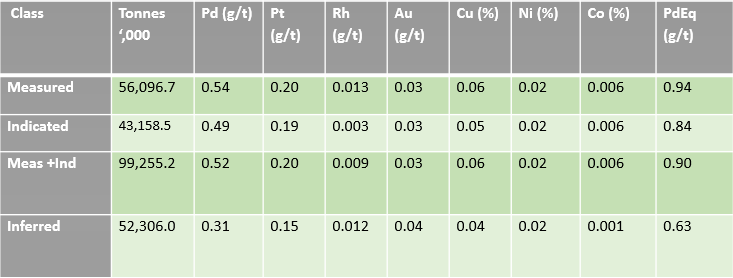
the updated Mineral Resource Estimate are tabulated in Table 1 below
(0.35 g/t PdEq open pit and 2.0 g.t PdEq underground cut-off). This
43-101 Technical Report is available on SEDAR.
Table 1: Results from the amended NI 43-101 Mineral Resource Estimate.
Click Image To View Full Size
Class
PGM + Au (oz)
PdEq (oz)
PtEq (oz)
Measured
1,394,000
1,701,000
1,701,000
Indicated
983,000
1,166,000
1,166,000
Meas +Ind
2,377,000
2,867,000
2,867,000
Inferred
841,000
1,059,000
1,059,000
Notes
1.CIM definition standards were followed for the Mineral Resource Estimate.
2.The 2018 Mineral Resource models used
Ordinary Kriging grade estimation within a three-dimensional block model
with mineralized zones defined by wireframed solids.
3.A base cut-off grade of 0.35 g/t PdEq
was used for reporting Mineral Resources in a constrained pit and 2.00
g/t PdEq was used for reporting the Mineral Resources under the pit.
6.Mineral Resources that are not Mineral Reserves do not have economic viability
7. The Inferred Mineral Resource in this
estimate has a lower level of confidence than that applied to an
Indicated Mineral Resource and must not be converted to a Mineral
Reserve. It is reasonably expected that the majority of the Inferred
Mineral Resource could be upgraded to an Indicated Mineral Resource with
continued exploration.
This stated resource will closely relate to
the resource that will be reported in the upcoming PEA slated to be
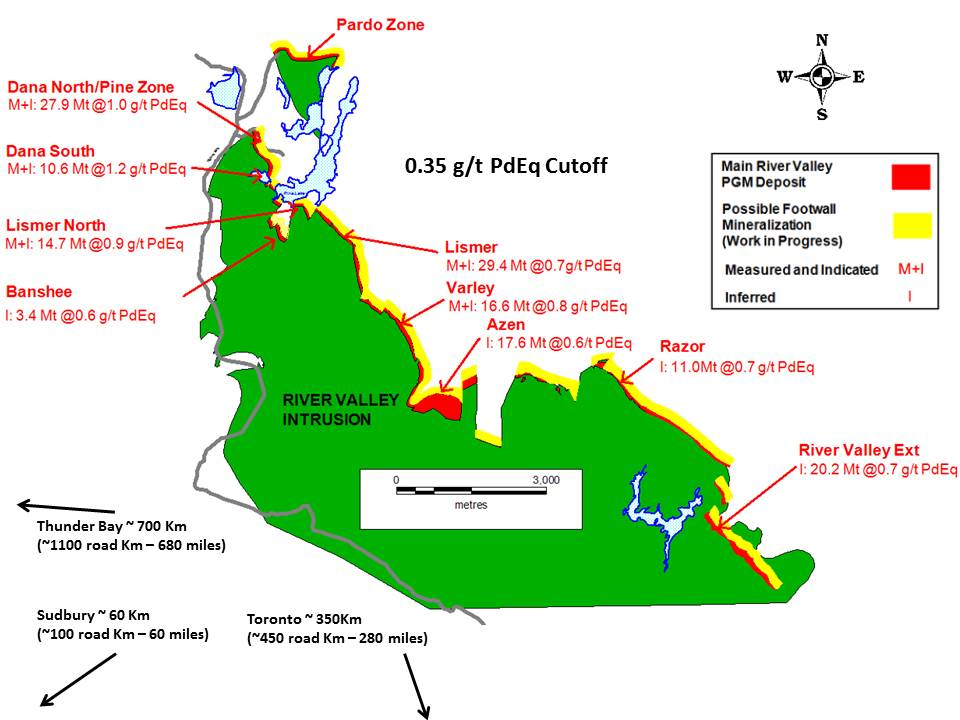
completed in Q2 2019. See Figure 1 which shows the mineral resource
reported in each area of the River Valley Project.
Click Image To View Full Size
Figure
1: The Yellow Band represents the footwall potential area of the River
Valley Deposit based on the results of the Pine Zone where footwall
mineralization was noted to extend 150 metres eastward from the Pine
Zone/ T3 main deposit. At present the only area that has confirmed
footwall mineralization is in the Pine Zone (defined from 2015 to 2017
drilling). Geophysics and exploration are in progress to test other
areas of the Deposit. Management’s specific focus is to outline a
sufficient potentially economic Mineral Resource in the northern portion
of the Project, and subsequently develop a series of open pits (bulk
mining), crush,and concentrate on site, and ship the concentrates to Sudbury for metallurgical extraction.
2019 Exploration Plan for River Valley PGM Project
To date an approximate 160,441 metres (481,323 feet) in 710 drill holes have
been conducted by the company as operator on the River Valley Project.
Several independent 43-101 compliant resource estimates have previously
been generated for the deposit through the exploration and development
phases. The River Valley Deposit’s
present resource, with approximately 2.9M PdEq ounces in Measured Plus
Indicated mineral resources and near-surface mineralization, covers a
total of 16 kilometers of strike. The company continues to explore and enhance the River Valley PGM Deposit.
After the ground proofing and surface
exploration program conducted in Summer 2018 which followed up on the
most recent induced polarization survey by Abitibi, NAM management has
designed a 5000 metre drill programs to test the new geophysical
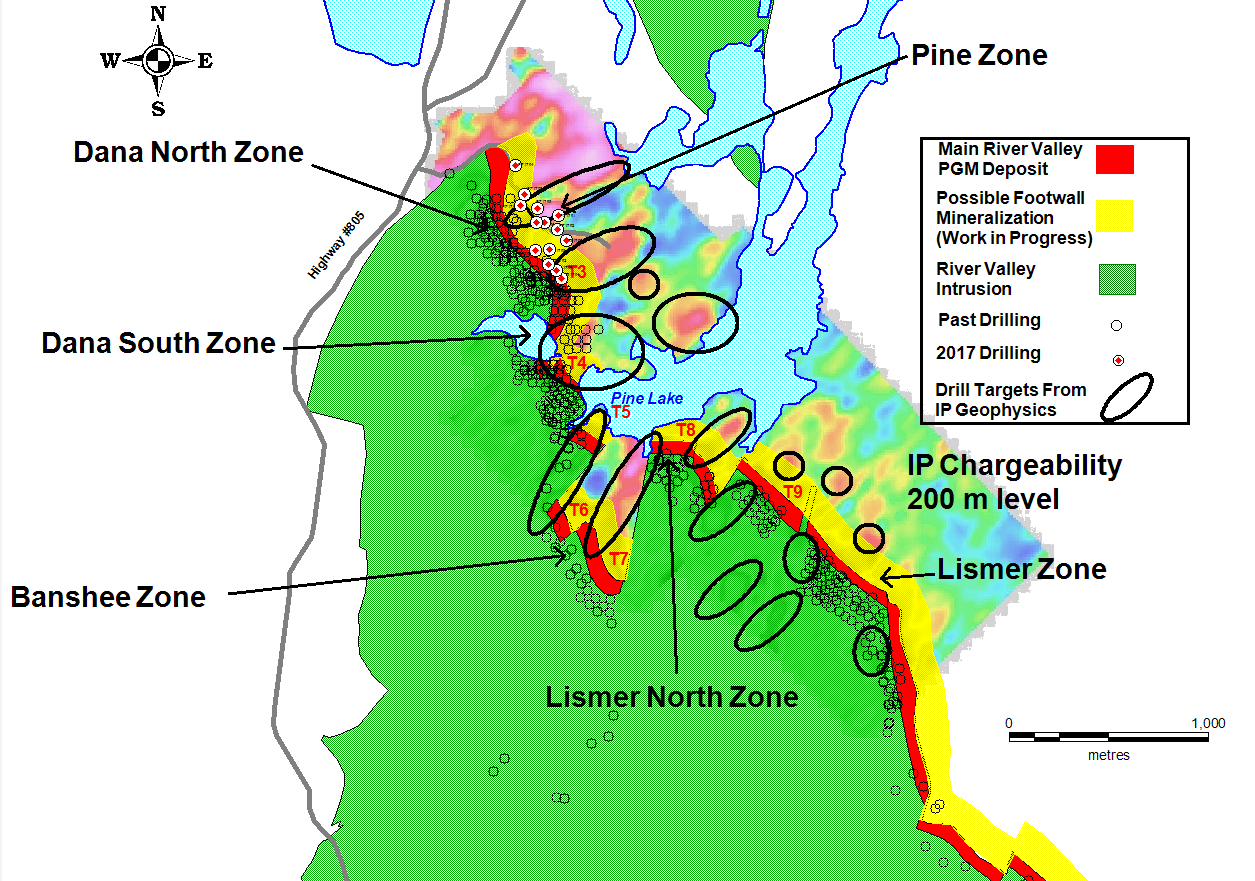
anomalies. See Figure 2 below which shows these new geophysical
anomalies and potential targets for the next stage of drilling at River
Valley superimposed over the upper 4 kilometres of the project map.
Click Image To View Full Size
Figure 2:
Northern portion of the project with superimposed 2018 merged IP at
-100 level. Retrieved from River Valley Geophysical review by Geoscience
North (Alan King, P. Geo., M.Sc.)
2019 Exploration Plans for Lithium Division
The Company has eight pegmatite hosted
Lithium Projects in the Winnipeg River Pegmatite Field, located in SE
Manitoba. In 2018 NAM conducted surface exploration programs on our
Lithman East, Lithman North, Lithium One and Lithium Two projects. The
programs consisted of reviewing, characterising and sampling all of the
known surface pegmatites. Samples were taken from the Eagle and FD5
pegmatites on Lithium Two and returned results of up to 3.8% Li2O. On
Lithium One, samples were taken from the known Silverleaf and Annie
pegmatites and not only returned significant Li20 assays of up to 4.1%
but heightened levels of Rubidium Oxide (Rb2O).
In 2019, the Company plans to drill on both
Lithium One and Lithium Two. Drill permits have been applied for and
the company is awaiting approval from the province.
Conferences This Quarter
In late January, our Chairman & CEO
Harry Barr travelled to South Africa and attended two 1-2-1 style
conferences with over 40 booked meetings with mine finance companies,
major mine companies, institutions, stock brokers, and high net worth
individuals. The trip was very successful and we are currently following
up on several new opportunities that were generated from these
meetings. In the meantime, the company is preparing for the upcoming
PDAC 2019 (March 3 to 6). The company has secured a meeting place and is
currently organizing meetings with parties interested in our PGM and
Lithium divisions.
Opt-in List
If you have not done so already, we encourage you to sign up on our website (www.newagemetals.com) to receive our updated news.
QUALIFIED PERSON
The contents contained herein that relate
to Exploration Results or Mineral Resources is based on information
compiled, reviewed or prepared by Carey Galeschuk, a consulting
geoscientist for New Age Metals. Mr. Galeschuk is the Qualified Person
as defined by National Instrument 43-101 and has reviewed and approved
the technical content of this news release.
On behalf of the Board of Directors
“Harry Barr”
Harry G. Barr
Chairman and CEO
For further information on New Age Metals, please contact Anthony Ghitter, Business Development at 613-659-2773, or [email protected]
Neither the TSX Venture Exchange nor its
Regulation Services Provider (as that term is defined in the policies of
the TSX Venture Exchange) accepts responsibility for the adequacy or
accuracy of this release.
Cautionary Note Regarding Forward Looking
Statements: This release contains forward-looking statements that
involve risks and uncertainties. These statements may differ materially
from actual future events or results and are based on current
expectations or beliefs. For this purpose, statements of historical fact
may be deemed to be forward-looking statements. In addition,
forward-looking statements include statements in which the Company uses
words such as “continue”, “efforts”, “expect”, “believe”, “anticipate”,
“confident”, “intend”, “strategy”, “plan”, “will”, “estimate”,
“project”, “goal”, “target”, “prospects”, “optimistic” or similar
expressions. These statements by their nature involve risks and
uncertainties, and actual results may differ materially depending on a
variety of important factors, including, among others, the Company’s
ability and continuation of efforts to timely and completely make
available adequate current public information, additional or different
regulatory and legal requirements and restrictions that may be imposed,
and other factors as may be discussed in the documents filed by the
Company on SEDAR (www.sedar.com), including the most recent reports that
identify important risk factors that could cause actual results to
differ from those contained in the forward-looking statements. The
Company does not undertake any obligation to review or confirm analysts’
expectations or estimates or to release publicly any revisions to any
forward-looking statements to reflect events or circumstances after the
date hereof or to reflect the occurrence of unanticipated events.
Investors should not place undue reliance on forward-looking statements.
Tags: palladium, tsx Posted in Featured, New Age Metals | Comments Off on New Age Metals $NAM.ca Provides an Update on the Platinum Group Metals (PGM) and Lithium Divisions $WG.ca $XTM.ca $WM.ca $PDL.ca $GLEN
Posted by AGORACOM-JC
at 8:49 AM on Tuesday, February 26th, 2019
Announced that the United States Patent and Trademark Office issued the Company a patent for the formulation of its flagship CBD product, hempSMART™ Brain.
hempSMART Brain is a wellness product formulated with a proprietary composition of natural ingredients and cannabidiol (CBD) for the enhancement of brain function.
Escondido, California–(February 26, 2019) – MARIJUANA COMPANY OF AMERICA INC. (OTCQB: MCOA) (“MCOA” or the “Company“), an innovative hemp and cannabis corporation, is proud to announce that the United States Patent and Trademark Office issued the Company a patent for the formulation of its flagship CBD product, hempSMART™ Brain.
hempSMART Brain is a wellness product formulated with a proprietary
composition of natural ingredients and cannabidiol (CBD) for the
enhancement of brain function. The U.S. Patent Office issued patent
number 10,201,553. To view the patent on hempSMART™ Brain visit the link here.
Dianna Steinberg, Head of Product Development, commented, “This
patent represents the hard work of the whole team involved in this
formulation. Their invaluable insight into the goal of using CBD with
additional supplements in a synergistic fashion to produce a fabulous
product is a tribute to their dedication.”
Donald Steinberg, CEO, commented, “This patent award signifies
advances we achieved and are continuing to work toward as a company to
produce products of the highest quality. As we continue to build the
hempSMART brand on a global basis, our receipt of this patent will
provide the Company with recognition of the advances being made at
Marijuana Company of America.”
Trevor Muehlfelder, Legal Project Manager on the patent application
for H Smart Inc., observed: “Having been involved with this application
from the beginning, it is rewarding to see the U.S. Patent Office
recognize the unique and innovative values of the Company’s personal
wellness products utilizing cannabidiol and other synergistic
ingredients. This is our first patent to date and corroborates the
Company’s continuing commitment to developing natural wellness products
utilizing CBD for everyone.”
About Marijuana Company of America, Inc. MCOA is a corporation which participates in: (1) product research and development of legal hemp-based consumer products under the brand name “hempSMART™”, that targets general health and well-being; (2) an affiliate marketing program to promote and sell its legal hemp-based consumer products containing CBD; (3) leasing of real property to separate business entities engaged in the growth and sale of cannabis in those states and jurisdictions where cannabis has been legalized and properly regulated for medicinal and recreations use; and, (4) the expansion of its business into ancillary areas of the legalized cannabis and hemp industry, as the legalized markets and opportunities in this segment mature and develop.
About Our hempSMART Products Containing CBD The
United States Food and Drug Administration (FDA) has not recognized CBD
as a safe and effective drug for any indication. Our products containing
CBD derived from industrial hemp are not marketed or sold based upon
claims that their use is safe and effective treatment for any medical
condition as drugs or dietary supplements subject to the FDA’s
jurisdiction.
Forward Looking Statements This
news release contains “forward-looking statements” which are not purely
historical and may include any statements regarding beliefs, plans,
expectations or intentions regarding the future. Such forward-looking
statements include, among other things, the development, costs and
results of new business opportunities and words such as “anticipate”,
“seek”, intend”, “believe”, “estimate”, “expect”, “project”, “plan”, or
similar phrases may be deemed “forward-looking statements” within the
meaning of the Private Securities Litigation Reform Act of 1995. Actual
results could differ from those projected in any forward-looking
statements due to numerous factors. Such factors include, among others,
the inherent uncertainties associated with new projects, the future U.S.
and global economies, the impact of competition, and the Company’s
reliance on existing regulations regarding the use and development of
cannabis-based products. These forward-looking statements are made as of
the date of this news release, and we assume no obligation to update
the forward-looking statements, or to update the reasons why actual
results could differ from those projected in the forward-looking
statements. Although we believe that any beliefs, plans, expectations
and intentions contained in this press release are reasonable, there can
be no assurance that any such beliefs, plans, expectations or
intentions will prove to be accurate. Investors should consult all of
the information set forth herein and should also refer to the risk
factors disclosure outlined in our annual report on Form 10-12G, our
quarterly reports on Form 10-Q and other periodic reports filed from
time-to-time with the Securities and Exchange Commission. For more
information, please visit www.sec.gov.
For more information, please visit the Company’s websites at:
Posted by AGORACOM-JC
at 12:33 PM on Monday, February 25th, 2019
SPONSOR: Bougainville
Ventures Inc (CSE: BOG) Converting irrigated farmland to
greenhouse-equipped farmland. Bougainville does not “touch the plantâ€
and only provides agricultural infrastructure as a landlord for
licensed marijuana growers. Click here for more info.
BOG:CSE —————————————
Nearly 1 in 6 Canadians Have Used Marijuana Since Recreational Pot Was Legalized
New data from Statistics Canada offers an inside look at cannabis consumption rates based on province, gender, and age.
The sky seems to be the limit for the legal marijuana industry.
According to the most bullish forecast from Wall Street investment firm Cowen Group, the legal weed industry could surpass soda in global sales by 2030 and generate $75 billion in yearly revenue.
More immediately, a co-authored report from Arcview Market Research and BDS Analytics has called for 38% global sales growth in 2019 to $16.9 billion.
Sean Williams Feb 23, 2019 at 10:51AM
The sky seems to be the limit for the legal marijuana industry.
According to the most bullish forecast from Wall Street investment firm Cowen Group, the legal weed industry could surpass soda in global sales by 2030 and generate $75 billion in yearly revenue.
More immediately, a co-authored report from Arcview Market Research and
BDS Analytics has called for 38% global sales growth in 2019 to $16.9
billion. No matter how you analyze the data, that’s a lot of green to go
around; and it’s a big reason why pot stocks have been virtually
unstoppable since the year began.
Although the United States would represent the largest cannabis
market in the world by sales if it were legalized at the federal level,
it’s our northerly neighbor Canada that’s leading the charge on
marijuana reform. Having become the first industrialized country in the world,
and only second overall behind Uruguay, to legalize adult-use pot in
October, Canada looks to be on track for an estimated $5.9 billion in
annual sales by 2022.
Image source: Getty Images.
An inside look at the average Canadian cannabis user
But just how quickly are Canadians adapting to this legalized
environment? For that answer, I turn to Statistics Canada, the national
statistics office that gathers information on Canada’s economy,
environment, and society.
Recently (as of Feb. 21, 2019), Statistics Canada released self-reported data
on consumers’ use of cannabis over the past three months. As a
refresher, marijuana legalization occurred roughly four months ago,
although the first month was a supply-side disaster. That means the past
three months of use should give us a really good idea of what the
typical Canadian consumer looks like.
According to the data, which Statistics Canada will continue to
update, 15.4% of all citizens, or nearly 1 out of 6 Canadians, have used
cannabis over the past three months. As you can imagine, usage
statistics tend to vary by region, gender, and age. For instance, Quebec
had the lowest percentage of people using marijuana over the past three
months (13.6%), while the lesser-populated Nova Scotia had the highest
percentage by far at 21.6%. Newfoundland and Labrador and New Brunswick
were also significantly above the national self-reported average in
three-month use rates.
In terms of gender, men were significantly more likely than women (19.4% vs. 11.3%) to have consumed cannabis recently.
Finally, as you might expect, pot use over the past three months was
considerably higher among younger people than older folks. Overall,
27.4% of Canadians aged 15 to 24 and 23.2% of those aged 25 to 34 used
cannabis over the past three months. Meanwhile, just 5.2% of seniors
aged 65 and up and 10.4% of Canadians aged 55 to 64 used weed recently.
Even though the older generation has more disposable income, it’s these
younger adults that are the future of the legal weed industry.
Image source: Getty Images.
Cannabis consumption rates are likely to rise — here’s why
Although there were no major surprises here, there are some relatively interesting takeaways to be made.
For example, an average use rate of just 15.4% might seem rather low,
but it’s not factoring in two pretty important catalysts. First,
there’s the fact that marijuana growers are still in the early stages of
ramping up their production. Aurora Cannabis (NYSE:ACB), which is my selection to lead the country with 700,000 kilograms of peak annual production,
is only producing at an annual run rate of 120,000 kilos right now. By
the end of the current calendar quarter, Aurora Cannabis should be
yielding more than 150,000 kilos annually, but it’s going to take
perhaps 12 to 24 more months before Aurora is operating on all
cylinders. When consumers have access to ample demand and the per-gram
price for dried cannabis flower comes down a bit, we’re liable to see
usage rates increase.
The second catalyst is the expected legalization of new consumption
options by this fall. When the Cannabis Act was signed into law last
June, and legal product sales commenced on Oct. 17, 2018, it only
included dried flower, cannabis oil, and sprays. Alternative products
such as edibles and cannabis-infused beverages aren’t yet legal.
That, however, is expected to change by no later than Oct. 17, 2019,
according to an outline presented by Health Canada. Edibles and infused
beverages containing cannabidiol (CBD), the nonpsychoactive cannabinoid
best known for its medical benefits, are expected to be especially
important in luring in new users.
The provincial-use data is also interesting in that it highlights one potential under-the-radar grower: OrganiGram Holdings (NASDAQOTH:OGRMF). The New Brunswick-based OrganiGram is the only Atlantic grower expected to yield more than 100,000 kilograms
per year when at full production capacity. Its geographic location
gives it competitive advantages in New Brunswick, Nova Scotia, and
Newfoundland and Labrador. Sure, these are far less populated regions
than, say, Ontario or Quebec, but it nevertheless allows OrganiGram a
foothold in these potentially higher-use provinces and territories.
OrganiGram was already a value stock among its peers, but it’s now that
much more intriguing following the release of this data.
Image source: Getty Images.
I believe this data also demonstrates the scope of opportunity awaiting Shopify (NYSE:SHOP) and its e-commerce platform. A number of large growers and provinces, including Ontario,
have chosen to utilize Shopify’s sales platform for online and
brick-and-mortar sales. Aside from simply being the sales platform of
choice, Shopify offers marijuana companies purchasing data on consumers
for pretty much the first time ever. With this being a cash-dominated
industry, it’s been virtually impossible for growers and retailers to
understand their customer base. With Shopify, this is going to change,
and both producers and retailers will be able to more directly target
consumers.
Ultimately, the legal weed industry is still in its infancy in
Canada. That means we’re liable to see this data shift as Health Canada
adjusts the boundaries of what’s legal and growers and retailers come to
better understand their customers.
Posted by AGORACOM-JC
at 11:53 AM on Monday, February 25th, 2019
RECENT HIGHLIGHTS
SIGNED A COOPERATION AGREEMENT FOR THE EMERGENCY MEDICAL SERVICES MARKETS
Will enable them to provide real-time monitoring of patients while in transit on the ground or in the air.
CHUSJ is one of the top 10 mother-child hospitals in the World, with over 3500 births a year.
Has over 1500 nurses, over 500 Doctors and over 200 researchers on staff.
COMPLETED SALE OF FIVE STAR-A.D.S SYSTEMS TO ALMASRIA UNIVERSAL AIRLINES
Announced that AlMasria Universal Airlines of Egypt has decided to
proceed with the installation and activation of the STAR-A.D.S.® System
across all five (5) of its current aircraft fleet, which includes A-320,
A-321, A330 and B737 aircraft.
BOMBARDER JOINT RESEARCH AND DEVELOPMENT PROGRAM
Joint research and development program with Bombardier and other
industrials and universities of Canada is progressing very positively.
The STAR-A.D.S. ® system which is at the heart of the program, after
having been validated and extensively used by the aircraft
manufacturer, has now been transferred to another flight test vehicle to
complete the flight testing and the data collection.
EMERGENCY MEDICAL SERVICES APPLICATIONS
Star’s Land System Aided Medical Monitoring system for ground
ambulance applications has undergone a series of demonstrations by a
care organization in North America.
Its airborne parent system, the In-Flight System Aided Medical
Monitoring system (STAR-ISAMM™â€), has now been demonstrated to several
stakeholders of the commercial and civil air ambulance market.
CHECK OUT OUR RECENT INTERVIEW
FULL DISCLOSURE: Star Navigation Systems Group Ltd. is an advertising client of AGORA Internet Relations Corp.
Posted by AGORACOM-JC
at 11:04 AM on Monday, February 25th, 2019
SPONSOR: ThreeD Capital Inc. (IDK:CSE) Led by
legendary financier, Sheldon Inwentash, ThreeD is a Canadian-based
venture capital firm that only invests in best of breed small-cap
companies which are both defensible and mass scalable. More than just
lip service, Inwentash has financed many of Canada’s biggest small-cap
exits. Click Here For More Information.
——————-
Mastercard, Amazon and Accenture Partner To Establish Transparent Blockchain Supply Chain
Mastercard, Amazon and Accenture plan to connect consumers and producers through its work on a blockchain-based supply chain.Getty
Today Accenture introduced a “circular supply chain†allowing consumers to make more sustainable choices about what they buy. Consumers are also able to tip producers, directly rewarding them for their choices in production.
All of this is made possible through digital identity management and blockchain technology.
Accenture is collaborating with
Mastercard, Amazon Web Services, Everledger and Mercy Corps to build its
supply chain capability. Everyday, whether we think about it or not, we
interact with a global supply chain, for example when we shop, and
these innovations could help us better navigate the system. A recent Nielsen study
shows nearly two-thirds of Americans want a frictionless online
shopping experience and want to support more efficient and eco-friendly
farming and manufacturing. The problem today is that we don’t have much
access to how things are made or who makes them.
David Treat, a managing director and global blockchain lead at Accenture says,
Over the past several years, we have built upon our
longstanding identity work with a focus on the more than 1 billion
people in this world who lack any form of recognized identity. We saw
directly linking consumers and the value created at the end of a supply
chain directly back to help small producers at the beginning as critical
to actually driving real social and environmental change.â€
Treat says Accenture and its partners
are working on in-store, web and app-based implementations where
consumers could scan a unique digital identifier on an item registered
to the people who produced it. Scanning the tag on a pair of jeans, for
example, would give customers its supply chain origins from start to
finish, along with the opportunity to send a token of appreciation to
the people who produced them. This allows the system to benefit not
just huge corporations who know the system well, but also individuals
such as smallholder farmers, who grow crops on small plots of land.
For the 3.4 billion people –
almost half the world’s population – that still struggle to meet basic
needs, we believe that digital technologies are largely untapped.â€
says Tara Nathan, Executive Vice President, Humanitarian &
Development at Mastercard, “Through our work with smallholder farmers in
Kenya, India, Mexico and elsewhere, we’ve deployed digital solutions
helping to drive commercially sustainable social impact – and we
understand that collaboration is essential for this journey.â€
Why Blockchain?
A blockchain provides a public, independent digital record called
Distributed Ledger Technology (DLT). By distributing a public ledger,
Amazon, Mastercard, Accenture, consumers and smallholder farmers can all
interact with the same information without risk of someone altering the
data.
DLT could benefit consumers and
farmers interacting across the supply chain, helping people across the
entire process by increasing transparency and sharing profits more
deliberately throughout.
Source:
https://www.forbes.com/sites/leslieankney/2019/02/25/accenture-mastercard-and-amazon-partner-to-establish-transparent-blockchain-supply-chain/#393a39341f81
Posted by AGORACOM-JC
at 9:30 AM on Monday, February 25th, 2019
The HeartCheck(TM) CardiBeat and GEMS(TM) Mobile App Supports Both
iOS and Android Smartphones for use in Consumer, Clinical Research and
Telemedicine Cardiac Monitoring Solutions
Received approval from the US Food and Drug Administration (“FDA“) for the over-the-counter sales and marketing of their device agnostic GEMS™ Mobile smartphone app and their newest handheld, heart rhythm monitor, the HeartCheckTM CardiBeat
Both have been cleared as a Class II medical device and are available for sale direct to consumers.
Toronto, Ontario–(February 25, 2019) – CardioComm Solutions, Inc. (TSXV: EKG) (“CardioComm” or the “Company“), a leading global provider of consumer heart monitoring and electrocardiogram (“ECG“) acquisition and management software solutions, has received approval from the US Food and Drug Administration (“FDA“) for the over-the-counter (“OTC”) sales and marketing of their device agnostic GEMS™ Mobile smartphone app and their newest handheld, heart rhythm monitor, the HeartCheckTM CardiBeat. Both have been cleared as a Class II medical device and are available for sale direct to consumers.
Of significance is the GEMSTM Mobile smartphone app, a slimmed down
version of the Company’s hospital-based software named Global ECG
Management System (GEMSTM). In addition to supporting CardioComm’s own
CardiBeat device, GEMSTM Mobile is the only ECG management iOS and
Android smartphone app that has the ability to connect to several
different manufacturers’ ECG monitoring devices. The first release of
GEMSTM Mobile will give people the choice to work with up to two other
handheld ECG monitors, both of which are already cleared for sale by the
FDA in the US.
CardioComm was the first company to bring an ECG device and software
to market for direct to consumer sales in North America and to enable
anyone to see their ECG without a physician prescription. Software is
the keystone element for such innovations and CardioComm expects to
leverage the GEMS™ Mobile app in bringing new and additional
advancements to personalized health and remote patient monitoring
solutions.
The Bluetooth enabled and rechargeable CardiBeat allows a medical
grade ECG recording to be taken by holding the device in both hands or
by holding the device in the right hand and against the left side of the
chest. This second option is more accurate for diagnosing arrhythmias
such as atrial fibrillation and atrial flutter. This represents a
significant diagnostic advantage over other devices currently on the
market.
GEMS™ Mobile allows Smartphones and tablets to receive ECGs from
HeartCheck™ devices for post-event or real-time/continuous cardiac
monitoring. Feedback through the app is near-real-time and allows the
user to view and generate a report of their own ECG which may be
automatically shared with one’s physician. For those who want their ECGs
reviewed, GEMS™ Mobile provides access to CardioComm’s SMART Monitoring
ECG reading service for a professional review of the ECG for the
presence of a number of potential arrhythmias.
GEMS™ Mobile is expected to be available on Apple’s App Store and on
Google Play in March and will be free with the purchase of a
HeartCheckTM ECG device. Pricing of the HeartCheckTM CardiBeat will be
announced shortly.
To learn more about CardioComm’s products and for further updates
regarding HeartCheck™ ECG device integrations please see the Company’s
websites at www.theheartcheck.com and www.cardiocommsolutions.com.
About CardioComm Solutions
CardioComm Solutions’ patented and proprietary technology is used in
products for recording, viewing, analyzing and storing
electrocardiograms for diagnosis and management of cardiac patients.
Products are sold worldwide through a combination of an external
distribution network and a North American-based sales team. CardioComm
Solutions has earned the ISO 13485 certification, is HIPAA compliant and
holds clearances from the European Union (CE Mark), the USA (FDA) and
Canada (Health Canada).
This release may contain certain forward-looking statements and
forward-looking information with respect to the financial condition,
results of operations and business of CardioComm Solutions and certain
of the plans and objectives of CardioComm Solutions with respect to
these items. Such statements and information reflect management’s
current beliefs and are based on information currently available to
management. By their nature, forward-looking statements and
forward-looking information involve risk and uncertainty because they
relate to events and depend on circumstances that will occur in the
future and there are many factors that could cause actual results and
developments to differ materially from those expressed or implied by
these forward-looking statements and forward-looking information.
In evaluating these statements, readers should not place undue
reliance on forward-looking statements and forward-looking information.
The Company does not assume any obligation to update the forward-looking
statements and forward-looking information contained in this release
other than as required by applicable laws, including without limitation,
Section 5.8(2) of National Instrument 51-102 (Continuous Disclosure Obligations).
Neither TSX Venture Exchange nor its Regulation Services Provider (as
that term is defined in policies of the TSX Venture Exchange) accepts
responsibility for the adequacy or accuracy of this release.
Tags: EKG, stocks, tsx, tsx-v Posted in All Recent Posts, CardioComm Solutions | Comments Off on Innovation Continues as the FDA Clears CardioComm Solutions’ $EKG.ca Novel ECG Smartphone App and Heartcheck(TM) Device for Direct to Consumer Sales
Posted by AGORACOM-JC
at 12:38 PM on Friday, February 22nd, 2019
SPONSOR: North Bud Farms Inc. (NBUD:CSE) Sustainable low cost, high
quality cannabinoid production and procurement focusing on both
bio-pharmaceutical development and Cannabinoid Infused Products. Click Here For More Information
NBUD: CSE
—————
Cannabis edibles, plant proteins and other food trends to watch for in 2019
Canada is high on cannabis edibles
Cannabis will soon be a major driver in the food and beverage category.
This year should see edible products incorporated into Bill
C-45 (the Cannabis Act), opening up opportunities for health foods and
supplements, snack foods, packaged meals, restaurants and tourism.
A recent Deloitte report found that 58 per cent of current Canadian cannabis users intend to consume edibles once they’re legalized.
Food continues to find its way into the consciousness of Canadians.
It’s in our news feed, on our television screens and, more and more,
part of our day-to-day conversations. The challenge is to separate the
fact from the fiction, the ephemeral from the soon-to-be everyday. The
University of Guelph’s newest Food Focus Trends Report highlights six key trends likely to be front and centre this year.
Flexitarians on the rise
While vegans and vegetarians get all the attention, the flexitarians
are rapidly growing in number — and in clout. A flexitarian is someone
who is eating less meat rather than giving it up entirely.
Almost 85 per cent of Canadians claim to eat at least one vegetarian
meal per month, with nearly 50 per cent saying they do so at least once a
week. Despite only seven to eight per cent of Canadians identifying as
vegetarian or vegan, the conscious consumption of flexitarians will
likely have a profound impact on the quantity and types of meat we eat
as well as spurring the growth of protein alternatives.
By choosing to eat less meat, consumers are likely to indulge in more premium cuts while sacrificing staples like ground beef.
Plant-based proteins are also sure to grow in popularity, as are
those from previously taboo sources, such as insects. Canada’s new Food Guide also recommends an increased focus on plant-based foods.
Should Canada’s meat industry be concerned? Possibly, but increased
international demand should keep overall prices in our country steady
for the foreseeable future and population growth here will also continue
to increase the total demand for meat.
Easing fears about gene-editing
If comic books and horror movies have taught the average Canadian
anything, it’s that nothing good ever comes from playing with genes.
Unfortunately, fiction can sometimes be more believable than facts.
When it comes to agriculture, gene editing increases yields, develops
tolerances to things like drought or pests, removes allergens (to make
gluten-free wheat, for example) and enhances nutritional quality.
And the biggest benefit
may be for the world’s poor. Basically, gene editing is doing what
animal and plant breeders have been doing for hundreds and hundreds of
years, only in a way that’s much faster, much cheaper and much more
specific.
The only challenge? Reducing unfounded fears and communicating the
incredible potential of genetically modified crops and foods in a way
that Canadians can fully embrace.
So shouldn’t we all be behind the bee? It’s not that simple.
While they are essential for some crops, other crops rely on methods
of pest control that are associated with the decline of pollinators.
As we’ve seen with the neonicotinoids debate, striking a delicate
balance between the needs of farmers and the protection of pollinators
is an ongoing challenge and a goal that will not be easily achieved.
Canada is high on cannabis edibles
Cannabis will soon be a major driver in the food and beverage
category. This year should see edible products incorporated into Bill
C-45 (the Cannabis Act), opening up opportunities for health foods and
supplements, snack foods, packaged meals, restaurants and tourism.
A recent Deloitte report found that 58 per cent of current Canadian cannabis users intend to consume edibles once they’re legalized.
But these highs do have some potential lows — work will need to be
done to ensure proper dosing and to prevent unintended secondary
consumption by children and pets.
As well, the path to market for cannabis products in Canada goes
through three different pieces of legislation: the Cannabis Act, the
Controlled Drugs and Substances Act and the Food and Drugs Act.
In addition, products for medical consumers must also meet the Access
to Cannabis for Medical Purposes Regulations that are included in the
Controlled Drugs and Substances Act. But with the total market estimated
at more than $7 billion (on par with Canada’s wine industry), the
future is nonetheless bright for cannabis companies.
Prospering in a time of protectionism
The whirlwind of trade deals and disputes in the past few years has
left many Canadians reeling. While there has been much hand-wringing
over inter-provincial barriers, NAFTA/USMCA and new agreements with
Europe and the Pacific Rim, freer trade in food has actually provided
Canadian farmers with markets that are hungry for our products.
Plus, Canadian consumers have benefited and now enjoy a wider range of affordable food products.
The one downside? Our regulated dairy industry, along with other
supply managed commodities, has ceded nearly 10 per cent of its market
through recent trade deals.
This will not only be painful for the dairy sector, but it isn’t
likely to result in lower prices for Canadians — although we will
probably see a broader array of cheeses and other dairy products.
Overall, though, trade has been good for Canada and will continue to be
for the foreseeable future.
Growing divide between food & farms
Farms may feed people, but they have very little to do with the price you pay for food.
Fluctuating prices of agricultural commodities like corn, wheat or
soybeans often fuel news stories but the reality is the increases in
food prices Canadians have seen over the years have been relatively
consistent.
Put simply, food and farm prices are not the same and the relationship between the two continues to weaken. Today, the farmers’ share
of the food dollar is around 20 per cent — higher for less processed
foods (nearly 50 per cent for eggs) and lower for more processed foods
(two per cent for corn, which is used as a sweetener in manufactured
food products).
While the effect of low commodity prices may be felt in farming
regions and associated industries, it has little impact on Canadians
when they’re checking off their grocery lists — and that isn’t expected
to change in 2019.
MUMBAI — India, widely considered the birthplace of the number zero,
has a proud mathematics tradition. So it came as a shock to Byju
Raveendran when he learned that many middle school students were unable
to do basic arithmetic.
This was before 2011, and the struggle continues. In 2018, one study
by a nongovernmental organization found that 56% of eighth-graders could
not solve a three-digit by one-digit division equation.
Raveendran, who calls himself an “accidental entrepreneur,” is
determined to crack the problem with his $4 billion startup Byju’s, the
most valuable education venture anywhere.
The 38-year-old wants to do more than that, though — he is out to change the way the rest of the world learns, too.
Byju’s exemplifies a new wave of Indian startups that are tackling
social issues, like inadequate medical care or poor logistics, rather
than trying to compete in fields such as ride-hailing or e-commerce. And
the company has made believers out of Facebook founder Mark
Zuckerberg’s philanthropic foundation, Chinese tech giant Tencent Holdings and the World Bank Group’s International Finance Corp.
All have invested, helping to make Byju’s the fifth-largest unicorn
in India, out of 14 startups with valuations of at least $1 billion as
of January, according to U.S. research firm CB Insights.
Byju’s educational approach centers on a freemium app, combining free
access with subscriptions. It features slick and colorful videos with
animations designed to keep children captivated. “I help [students]
visualize concepts instead of just discuss theories,” Raveendran told
the Nikkei Asian Review.
The app has been downloaded 30 million times and attracted 2 million
paying subscribers. Three or four months into a subscription, Byju’s
conducts an online assessment and, depending on the student’s progress,
assigns a personal mentor.
The company appears to be getting results both educationally and, to an extent, financially.
Akshath Mugad, an 11th-grade student preparing for exams in Mumbai,
and his sister Akriti Mugad, a seventh-grader, have been using the app
for the past three months.
Akshath has never taken private tutoring. He said most such programs
move at their own pace, out of sync with the school curriculum. But
since the Byju’s app is personalized and covers everything from physics
and chemistry to biology and math, he is able to keep up with his class.
Meenakshi Mugad, their mother, said it is hard to tell how much the
app helps until they take a test. “But I can see them taking interest in
the lessons without me having to push them to study. That’s a
positive.”
An International Finance Corp. study on Byju’s last year found that 92% of 20,000 parents reported improvement in grades.
When it comes to earnings, Byju’s is not yet profitable, but it has
doubled its revenue over the past three years. For the fiscal year
through March, it expects to log 15 billion rupees ($209 million) in
revenue, triple the previous year’s figure.
For the fiscal year ended March 2018, Byju’s nearly halved its net loss, to 372 million rupees from 618 million rupees.
The company employs around 3,200, including a large video, animation
and information technology team that produces clips that simplify
subjects for students in grades four through 12. It also offers
materials to help with entrance exams for engineering, medical, civil
service and business schools.
The videos range from 30 seconds to 25 minutes depending on the
subject, and users spend an average of 64 minutes a day on the app.
Behind the scenes, the venture uses artificial intelligence to
recommend the learning materials that are best suited to a particular
user. “We’re focused on deepening understanding, not having children
memorize things to pass tests,” said Raveendran, who serves as CEO of
operating company Think & Learn, though the business goes by its
brand name.
An overreliance on rote memorization is often considered one
shortcoming of Indian education. The country of 1.3 billion also faces a
shortage of over 500,000 elementary school teachers, while 14% of
government-run secondary schools do not have the prescribed minimum of
six instructors, according to a report by the Centre for Budget and
Governance Accountability and Child Rights and You.
A high school class in the state of Uttar Pradesh: The country of 1.3
billion faces a shortage of teachers and schools. (Photo by Kosaku
Mimura)
The India Brand Equity Foundation estimates the country needs 200,000
more schools, 35,000 more colleges, another 700 universities and 40
million more seats in vocational training centers.
Overcrowded classrooms, a lack of teachers in suburbs and rural areas
and generally low government spending on education have all given rise
to a major side industry: tutoring.
Most of these services give students more face time with teachers but do little to inspire.
Byju Raveendran speaks to the Nikkei Asian Review at his company’s headquarters in Bangalore. (Photo by Rosemary Marandi)
“Traditionally, parents tend to believe that the right education can
be imparted only in a face-to-face manner, preferably in a classroom,”
Raveendran said. “Also, in India and several parts of the world,
learning is driven by the fear of exams rather than the love of
learning. The mindset has been our biggest challenge.”
It was in this environment that Raveendran carved a niche.
Raveendran, who hails from the southern coastal village of Azhikode
in the state of Kerala, was a standout student himself. While traveling
the world as an engineer for a British shipping company, he came home
for a holiday and took the entrance exam for the country’s top business
schools, the Indian Institutes of Management. He scored in the 100th
percentile.
Yet he did not enroll. He had found his true vocation helping friends
prepare for the same test. He went from holding impromptu sessions for
his buddies to speaking to 1,200 people in packed auditoriums.
The success of these sessions prompted Raveendran and some of his
students to try creating videos. In 2011, when he started the company,
he had some of the best and brightest producing content. His first eight
employees were all former students who had attended top business
schools and gained experience at well-known companies like Boston
Consulting Group.
Early backers included Mohandas Pai, a former CFO of information
technology consultancy Infosys, who had attended one of Raveendran’s
auditorium lectures. The first round of venture capital funding came in
2013.
Along the way, Raveendran leveraged his own star power as a renowned
tutor, and later brought in Bollywood superstar Shahrukh Khan as a
pitchman. The spread of affordable smartphones in India also helped
Byju’s take off.
Investors appreciate the founder’s determination to monetize the app in an age where many expect online content for free.
GV Ravishankar, Sequoia Capital’s managing director for India, wrote
in a note about Byju’s that most education technology companies cite
large numbers of visits or downloads of free content. The plan always
seems to be to monetize someday in the future.
“With so many resources available online, there is limited perceived
value if something is offered free,” Ravishankar wrote. “Parents are not
looking for free ways to make their child successful. They are looking
for The Best Way! Have the courage to charge for the value you provide.”
Byju’s packages start from $160 a year, a significant sum in a country where annual per capita income averages around $1,670.
Its closest competitor, Toppr, has attracted 5 million users with
stories and games and charges $70 to $352. The Khan Academy, a U.S.
nonprofit organization, posts video breakdowns of complex math and
science on YouTube for free.
N Chandramouli, chief executive of TRA Research, thinks Byju’s has
taken coaching to a different level. “It has created a sense of
curiosity among the students. … Their style of communicating has been
very subtle, it is targeted at the child, not the parent. They are
changing the way kids learn and preparing them to face life.”
Raveendran said the challenge is not just to persuade parents to pay
for content, but to raise awareness of online tutorials in the first
place. He also expects a wave of technology-driven change in Indian
education.
“There is no place for complacency for us,” Raveendran said. “We need to grow and grow fast.”
To help spur that growth, Byju’s in 2017 started recruiting teachers
from across the English-speaking world to come and record videos in its
Bangalore studios. The company looks for educators with large followings
on YouTube and pays them to participate, hoping their fans will follow
them to the Byju’s app. The company would not say how much it pays the
teachers.
Byju’s is growing through acquisitions, as well. It has made four so
far, aimed at either securing content or extending its global reach.
The latest came in January. Fresh off a $540 million round of funding
from South African media company Naspers and the Canada Pension Plan
Investment Board, the unicorn announced a $120 million deal for Osmo, a
U.S. developer of online learning tools that mix in offline activities.
Byju’s wanted to make an acquisition “that will eventually help us
launch in a new market,” Raveendran had told Nikkei before the deal.
By the July-September quarter, Byju’s plans to make its app available
in the U.S. and some Commonwealth countries such as the U.K., Australia
and New Zealand on a trial basis. The startup will introduce materials
for kids ages 5 to 8 in these countries, with a heavier emphasis on
game-based learning than pure visuals.
“We are in the process of building a product for international
markets,” the founder said, adding some of the most popular YouTube
teachers are helping with this.
Raveendran is confident parents outside India will buy what Byju’s is selling.
Harish HV, a former partner at Grant Thornton India, agrees. “In the
Western world,” he said, “those who get the benefit of education would
definitely be willing to pay and will pay. It would depend on the
product they introduce there, how they market it. I don’t see a
problem.”
Whatever happens abroad, Raveendran sees the huge Indian market as a
strong backbone. He is aiming for an initial public offering in two or
three years and reckons the company will be successful enough at home to
go ahead. “By that time we will generate enough money from the Indian
business itself,” he said.
But Raveendran harbors bigger ambitions.
“We have the required talent and capabilities [to] create a product
for students across the globe,” he said. “Currently, there are no
products like Byju’s Learning App which can reach out to such a large
number of students and create great engagement at the same time.
“We strongly believe that such a product can come out of India.”
Chennai: Bengaluru’s Mariam Fatima, a middle school social s ..