Agoracom Blog Home

Posts Tagged ‘tsx’

House Intelligence Committee chairman praised #Facebook policy on #deepfakes – SPONSOR: Datametrex AI Limited $DM.ca

Posted by AGORACOM-JC at 3:53 PM on Thursday, January 16th, 2020

SPONSOR: Datametrex AI Limited (TSX-V: DM) A revenue generating small cap A.I. company that NATO and Canadian Defence are using to fight fake news & social media threats. The company announced three $1M contacts in Q3-2019. Click here for more info.

House Intelligence Committee chairman praised Facebook policy on deepfakes

  • Other lawmakers not so impressed; add other social media platforms not doing enough

Jan 15, 2020 | Anthony Kimery

House Permanent Select Committee on Intelligence Chairman Rep. Adam Schiff (D-CA) said Facebook’s announcement this past week of its “new policy which will ban intentionally misleading deepfakes from its platforms is a sensible and responsible step, and I hope that others like YouTube and Twitter will follow suit.”

Schiff cautioned, however, that, “As with any new policy, it will be vital to see how it is implemented, and particularly whether Facebook can effectively detect deepfakes at the speed and scale required to prevent them from going viral,” emphasizing that “the damage done by a convincing deepfake, or a cruder piece of misinformation, is long-lasting, and not undone when the deception is exposed, making speedy takedowns the utmost priority.”

Schiff added he’ll “also be focused on how Facebook deals with other harmful disinformation like so-called ‘cheapfakes,’ which are not covered by this new policy because they are created with less sophisticated techniques but nonetheless purposefully and maliciously distort an existing piece of media.”

Not all lawmakers – or privacy rights advocates and groups — concerned about this problem, though, were as impressed as Schiff with Facebook’s new policy, Enforcing Against Manipulated Media, which was announcement by Facebook Vice President for Global Policy Management Monika Bickert only days before she testified last week before the House Committee on Energy and Commerce Subcommittee on Consumer Protection and Commerce hearing on, “Americans at Risk: Manipulation and Deception in the Digital Age.”

Subcommittee Chairwoman Rep. Jan Schakowsky (D-IL), chastised “Congress [for having] unfortunately taken a laissez faire approach to regulating unfair and deceptive practices online over the past decade and platforms have let them flourish,” the result of which has been “big tech failed to respond to the grave threat posed by deep-fakes, as evidenced by Facebook scrambling to announce a new policy that strikes me as wholly inadequate, since it would have done nothing to prevent the altered video of Speaker Pelosi that amassed millions of views and prompted no action by the online platform.”

Similarly, Democratic Presidential candidate Joe Biden’s spokesman Bill Russo stated, “Facebook’s announcement is not a policy meant to fix the very real problem of disinformation that is undermining face in our electoral process, but is instead an illusion of progress. Banning deepfakes should be an incredibly low floor in combating disinformation.”

Schakowsky and other subcommittee members didn’t seem much assuaged by either Bickert or the other witnesses who testified at the hearing that Facebook’s policy goes far enough.

She declared that, “Underlying all of this is Section 230 of the Communications Decency Act, which provided online platforms like Facebook a legal liability shield for 3rd party content. Many have argued that this liability shield resulted in online platforms not adequately policing their platforms, including online piracy and extremist content. Thus, here we are, with big tech wholly unprepared to tackle the challenges we face today,” which she described as “a topline concern for this subcommittee.” We “must protect consumers regardless of whether they are online or not. For too long, big tech has argued that ecommerce and digital platforms deserved special treatment and a light regulatory touch.”

In her opening statement, Schakowsky further noted that the Federal Trade Commission “works to protect Americans from many unfair and deceptive practices, but a lack of resources, authority, and even a lack of will has left many American consumers feeling helpless in the digital world. Adding to that feeling of helplessness, new technologies are increasing the scope and scale of the problem. Deepfakes, manipulated video, dark patterns, bots, and other technologies are hurting us in direct and indirect ways.”

“People share millions of photos and videos on Facebook every day, creating some of the most compelling and creative visuals on our platform,” Bickert said in announcing Facebook’s policy, but conceded “some of that content is manipulated, often for benign reasons, like making a video sharper or audio more clear. But there are people who engage in media manipulation in order to mislead,” and these “manipulations can be made through simple technology like Photoshop or through sophisticated tools that use artificial intelligence or ‘deep learning’ techniques to create videos that distort reality – usually called deepfakes.”

“While these videos are still rare on the Internet” Bickert said, “they [nevertheless] present a significant challenge for our industry and society as their use increases.”

“As we enter 2020, the problem of disinformation, and how it can spread rapidly on social media, is a central and continuing national security concern, and a real threat to the health of our democracy,” Schiff said, noting that “for more than a year, I’ve been pushing government agencies and tech companies to recognize and take action against the next wave of disinformation that could come in the form of ‘deepfakes’ — AI-generated video, audio, and images that are difficult or impossible to distinguish from real thing.”

Schiff pointed to experts who testified during an open hearing of the Intelligence Committee last year that “the technology to create deepfakes is advancing rapidly and widely available to state and non-state actors, and has already been used to target private individuals …”

Schiff said in his response to Facebook’s policy that he intends “to continue to work with government agencies and the private sector to advance policies and legislation to make sure we’re ready for the next wave of disinformation online, including by improving detection technologies, something which the recently passed Intelligence Authorization Act facilitates with a new prize competition,” which Biometric Update earlier reported on.

Bickert said Facebook’s “approach has several components, from investigating AI-generated content and deceptive behaviors like fake accounts, to partnering with academia, government and industry to exposing people behind these efforts,” underscoring that “collaboration is key. Across the world, we’ve been driving conversations with more than 50 global experts with technical, policy, media, legal, civic and academic backgrounds to inform our policy development and improve the science of detecting manipulated media,” and, “as a result of these partnerships and discussions, we are strengthening our policy toward misleading manipulated videos that have been identified as deepfakes.”

“Going forward,” she stated, Facebook “will remove misleading manipulated media if it meets the specific detailed criteria she briefly outlined in announcing the social media giant’s new policy.

She described criteria as applying specifically to content which “has been edited or synthesized – beyond adjustments for clarity or quality – in ways that aren’t apparent to an average person and would likely mislead someone into thinking that a subject of the video said words that they did not actually say, and, it is the product of artificial intelligence or machine learning that merges, replaces or superimposes content onto a video, making it appear to be authentic.”

However, she called attention to the fact that the new policy “does not extend to content that is parody or satire, or video that has been edited solely to omit or change the order of words,” highlighting that, “consistent with our existing policies, audio, photos or videos, whether a deepfake or not, will be removed from Facebook if they violate any of our other Community Standards including those governing nudity, graphic violence, voter suppression, and hate speech.”

She further stated that “videos that don’t meet these standards for removal are still eligible for review by one of our independent third-party fact-checkers, which include over 50 partners worldwide fact-checking in over 40 languages,” under the new Facebook policy. And, “If a photo or video is rated false or partly false by a fact-checker, we significantly reduce its distribution in News Feed, and reject it if it’s being run as an ad.”

“And, critically,” she stressed, “people who see it, try to share it, or have already shared it, will see warnings alerting them that it’s false.”

Bickert said the company believes that “this approach is critical to our strategy, and one we heard specifically from our conversations with experts,” exclaiming that “if we simply removed all manipulated videos flagged by fact-checkers as false, the videos would still be available elsewhere on the Internet or social media ecosystem.” Thus, she expressed, “by leaving them up and labelling them as false, we’re providing people with important information and context.”

“Our enforcement strategy against misleading manipulated media also benefits from our efforts to root out the people behind these efforts,” she continued, pointing out that, “Just last month, we identified and removed a network using AI-generated photos to conceal their fake accounts,” and Facebook “teams continue to proactively hunt for fake accounts and other coordinated inauthentic behavior.”

“We are also engaged in the identification of manipulated content, of which deepfakes are the most challenging to detect,” she continued, explaining “that’s why last September we launched the Deep Fake Detection Challenge, which has spurred people from all over the world to produce more research and open source tools to detect deepfakes.”

Meanwhile, in a separate effort by Facebook, the company has “partnered with Reuters, the world’s largest multimedia news provider, to help newsrooms worldwide to identify deepfakes and manipulated media through a free online training course,” Bickert adding, noting that “news organizations increasingly rely on third parties for large volumes of images and video, and identifying manipulated visuals is a significant challenge. This program aims to support newsrooms trying to do this work.”

She concluded by saying that, “As these partnerships and our own insights evolve, so too will our policies toward manipulated media. In the meantime, we’re committed to investing within Facebook and working with other stakeholders in this area to find solutions with real impact.”

“Facebook wants you to think the problem is video-editing technology, but the real problem is Facebook’s refusal to stop the spread of disinformation,” House Speaker Nancy Pelosi Deputy Chief of Staff Drew Hammill responded in a tweet.

Facebook was roundly chastised for seemingly only to be concerned about deepfake videos rather than all the other tech that’s been used – and admitted by Facebook — to manipulate audio and text that’s also deliberately meant to deceive viewers and readers.

“Consider the scale. Facebook has more than 2.7 billion users, more than the number of followers of Christianity. YouTube has north of 2 billion users, more than the followers of Islam. Tech platforms arguably have more psychological influence over two billion people’s daily thoughts and actions when considering that millions of people spend hours per day within the social world that tech has created, checking hundreds of times a day,” the subcommittee heard from Center for Humane Technology President and Co-Founder Tristan Harris.

“In several developing countries like the Philippines, Facebook has 100 percent penetration. Philippines journalist Maria Ressa calls it the first ‘Facebook nation.’ But what happens when infrastructure is left completely unprotected, and vast harms emerge as a product of tech companies’ direct operation and profit?”

Declaring that “social organs of society [are] left open for deception, Harris warned that “these private companies have become the eyes, ears, and mouth by which we each navigate, communicate and make sense of the world. Technology companies manipulate our sense of identity, self-worth, relationships, beliefs, actions, attention, memory, physiology and even habit-formation processes, without proper responsibility.”

“Technology,” he said, “has become the filter by which we are experiencing and making sense of the real world,” and, “in so doing, technology has directly led to the many failures and problems that we are all seeing: fake news, addiction, polarization, social isolation, declining teen mental health, conspiracy thinking, erosion of trust, breakdown of truth.”

“But, while social media platforms have become our cultural and psychological infrastructure on which society works, commercial technology companies have failed to mitigate deception on their own platforms from deception,” Harris direly warned. “Imagine a nuclear power industry creating the energy grid infrastructure we all rely on, without taking responsibility for nuclear waste, grid failures, or making sufficient investments to protect it from cyber attacks. And then, claiming that we are personally responsible for buying radiation kits to protect ourselves from possible nuclear meltdowns.”

“By taking over more and more of the ‘organs’ needed for society to function, social media has become the de facto psychological infrastructure that has created conditions that incentivize mass deception at industrialized scales,” he quantified the issue, starkly adding, “Technology companies have covertly ‘tilted’ the playing field of our individual and collective attention, beliefs and behavior to their private commercial benefit,” and that, “naturally, these tools and capabilities tend to favor the sole pursuit of private profit far more easily and productively than any ‘dual purpose’ benefits they may also have at one time — momentarily — and occasionally had for culture or society”

Hill staffers involved in this issue advised to watch for “more aggressive” legislation emanating from “the variety of committees and subcommittees” with authority “to do something.”

Indeed. Energy and Commerce Committee Chairman Frank Pallone, Jr. (D-NJ), said in his opening statement that Congress needs to move “forward to beginning to get answers “so that we can start to provide more transparency and tools for consumers to fight misinformation and deceptive practices.”

“While computer scientists are working on technology that can help detect each of these deceptive techniques, we are in a technological arms race. As detection technology improves, so does the deceptive technology. Regulators and platforms trying to combat deception are left playing whack-a-mole,” he acknowledged.

“Unrelenting advances in these technologies and their abuse raise significant questions for all of us,” he concluded, asking, “What is the prevalence of these deceptive techniques,” and, “how are these techniques actually affecting our actions and decisions?”

But, more importantly – from a distinctly legislatively regulatory position – he posited, “What steps are companies and regulators taking to mitigate consumer fraud and misinformation?”

Source: https://www.biometricupdate.com/202001/house-intelligence-committee-chairman-praised-facebook-policy-on-deepfakes

Empower Clinics $CBDT.ca – Lawmakers press Trump officials to change federal #marijuana rules $WEED.ca $CGC $ACB $APH $CRON.ca $HEXO.ca $OGI.ca

Posted by AGORACOM-JC at 3:16 PM on Thursday, January 16th, 2020

SPONSOR:

Why Empower Clinics

  • A leading owner/operator of physician staffed health and pain management clinics.
  • Patient database of over 165,000 patients 
  • Platform generating $1.4M USD (9 months ending Sept. 30, 2019)
  • Proprietary technology platforms including Electronic Health Records portal and e-Commerce for CBD product distribution
  • Recently launched CBD extraction facility
  • First extraction system capacity = 6,000 Kg per year.
  • CBD based products are poised to be a $20B global industry by 2022
  • Medical cannabis is poised to be a $100B global industry by 2025

——–

Lawmakers press Trump officials to change federal marijuana rules

By Nathaniel Weixel – 01/15/20 04:40 PM EST

  • House lawmakers are growing increasingly frustrated with restrictions on federal marijuana research and are putting pressure on regulators to change the rules.
  • While 33 states have legalized marijuana for medicinal purposes, federal research is extremely restricted.

During a House Energy and Commerce Health Subcommittee hearing Wednesday, bipartisan lawmakers pressed officials from the Food and Drug Administration, Drug Enforcement Administration (DEA) and National Institute on Drug Abuse about obstacles to studying the safety and effectiveness of cannabis products, including hemp-based cannabidiol. 

“States’ laws and federal policy are a thousand miles apart. As more states allow cannabis, the federal government still strictly controls and prohibits it, even restricting legitimate medical research,” said subcommittee Chairwoman Anna Eshoo (D-Calif.).

All of the administration officials at the hearing agreed the current studies on the benefits and health consequences of marijuana are inadequate. However, they indicated that changes are not going to be immediately forthcoming, as more studies are needed.

Marijuana is a Schedule I drug, meaning it is in the same category as drugs like heroin and LSD. According to the federal government, it has a high potential for abuse and no accepted medical value.

Drug schedules were first established by former President Nixon as part of the 1970 Controlled Substances Act. Marijuana was put into Schedule I at that time, and has remained there ever since. 

Democrats expressed frustration at the hurdles potential researchers have to overcome. 

“Federal prohibition has failed, from our criminal justice system to our health care system to our state and local governments that are forced to navigate an impossible landscape,” said Rep. Joe Kennedy III (D-Mass.).

Researchers need approval from three separate agencies, which can sometimes take upwards of a year. Once approved, they’re only allowed to research cannabis grown by a government-authorized farm at the University of Mississippi. 

That facility has been the sole grower of federally approved marijuana since 1968. 

Researchers and lawmakers from both parties have said the single source is too limiting, but experts said officials across multiple administrations have not provided an adequate reason why marijuana research is so restricted. 

“Researchers are in a catch-22. They can’t conduct cannabis research until they show cannabis has a medical use, but they can’t show cannabis has a medical use until they can conduct research,” Eshoo said.

DEA senior policy adviser Matthew Strait said the agency is aware of the limitations, and has drafted new regulations that would allow additional marijuana growers. 

The DEA in August announced it would begin taking steps to expand the number of federally approved marijuana growers, but it first needed to develop new regulations to evaluate the applications.

Strait said the agency has drafted those rules and submitted them to the White House for regulatory review. Agency staff will be on a call tomorrow to discuss them, he said.  

Strait was also pressed about removing marijuana from the list of controlled substances. 

The DEA has the authority to change the scheduling of marijuana, or completely remove it from the list of controlled substances without input from Congress, but it has yet to do so. 

Advocates are pushing the House to pass the Marijuana Opportunity, Reinvestment and Expungement Act, which would deschedule marijuana. 

But some Republicans expressed concern about completely removing marijuana from the controlled substances list. Instead, they indicated an openness to changing its schedule to make it easier to research.

“Descheduling cannabis is a step too far and one I would not support,” said Rep. Greg Walden (Ore.), the top Republican of the full committee. Any discussion of descheduling must be preceded by a fuller understanding of the potential risks associated with cannabis use — which we currently do not have.”

Walden added that rescheduling cannabis may help improve the research landscape.

“We need more research and better data. Americans are consuming more cannabis and policy decisions on this substance have been made in a virtual information vacuum,” Walden said.

Source: https://thehill.com/policy/healthcare/478472-lawmakers-press-trump-officials-to-change-federal-marijuana-rules

NORTHBUD $NBUD.ca – High demand: Ontario’s online #Cannabis 2.0 products sell out fast $CGC $ACB $APH $CRON.ca $OGI.ca

Posted by AGORACOM-JC at 2:56 PM on Thursday, January 16th, 2020

SPONSOR: NORTHBUD (NBUD:CSE) Sustainable low cost, high quality cannabinoid production and procurement focusing on both bio-pharmaceutical development and Cannabinoid Infused Products. Learn More.

High demand: Ontario’s online Cannabis 2.0 products sell out fast

By David George-Cosh

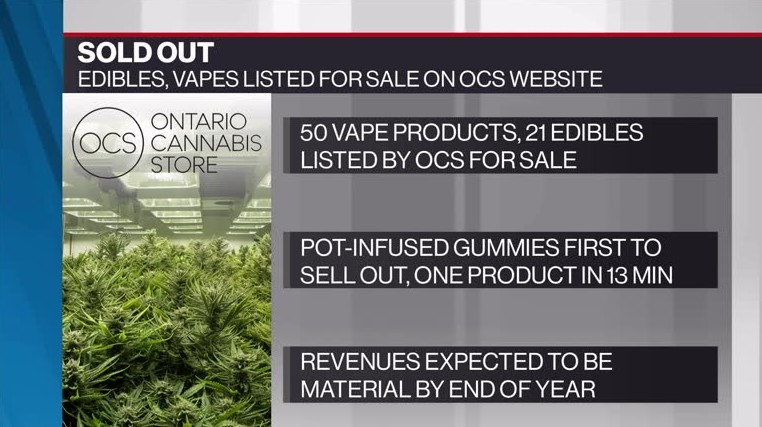
More than 2,000 people placed orders within the first hour that cannabis-infused edibles and vape products became available for sale on the Ontario Cannabis Store’s website, a spokesperson told BNN Bloomberg.

Beginning Thursday at 9 a.m. ET, the website listed 50 vape products and 21 pot-infused gummies for sale, a slight increase from the number of items available at Ontario’s brick-and-mortar cannabis retailers.

More than 3,000 people were waiting in a “digital queue” before the online sales began. Due to the high demand, the website experienced several crashes for some products, while all “soft-chew” items, or gummies, were sold out within the first 30 minutes.

OCS spokesperson Daffyd Roderick told BNN Bloomberg the government agency is managing the website’s traffic issues and plans to replenish any sold-out items after bricks-and-mortar stores have been allotted an equal share of available product.

“We know the licensed producers are working hard to make more products available and we’re confident that these growing pains will be moved through in relatively short order,” Roderick said.

While some of the next-generation cannabis products on the website have been available at physical Ontario cannabis stores since earlier this month, the various cannabis-infused cookies, soft chews, mints, tea and vapes for sale represent a potential new windfall for the country’s pot producers, who have been stymied over the past year with softer-than-expected revenue from dried flower products.

Raymond James analysts said in a recent report that cannabis producers should report material revenue from the latest rollout of Cannabis 2.0 products in the second-half of this year.

Cannabis Canada is BNN Bloomberg’s in-depth series exploring the stunning formation of the entirely new — and controversial — Canadian recreational marijuana industry. Read more from the special series here and subscribe to our Cannabis Canada newsletter to have the latest marijuana news delivered directly to your inbox every day.

Source: https://www.bnnbloomberg.ca/high-demand-ontario-s-online-cannabis-2-0-products-sell-out-fast-1.1375048

INTERVIEW: $HPQ.ca Moves One Nano Step Closer To #Silicon For #Li-Ion #Batteries $FSLR $SPWR $CSIQ $PYR.ca $XMG.ca

Posted by AGORACOM-JC at 8:47 AM on Thursday, January 16th, 2020

Current And Future Doctors Are More Than Ready to Use #Mhealth Wearables – SPONSOR: CardioComm Solutions $EKG.ca – $ATE.ca $TLT.ca $OGI.ca $ACST.ca $IPA.ca

Posted by AGORACOM-JC at 2:36 PM on Wednesday, January 15th, 2020

SPONSOR: CardioComm Solutions (EKG: TSX-V) – The heartbeat of cardiovascular medicine and telemedicine. Patented systems enable medical professionals, patients, and other healthcare professionals, clinics, hospitals and call centres to access and manage patient information in a secure and reliable environment.

Current And Future Doctors Are More Than Ready to Use mHealth Wearables

A Stanford Medicine survey finds that doctors, residents and medical students are finding value in data drawn from mHealth wearables – and they’re using them as well. But they aren’t getting the training they need or want.

  • Current and future physicians are eager to use self-reported data from patients with mHealth wearables
  • In fact, they’re using wearables themselves to track health concerns.  

By Eric Wicklund

January 14, 2020 – Current and future physicians are eager to use self-reported data from patients with mHealth wearables – in fact, they’re using wearables themselves to track health concerns.

That’s one takeaway from Stanford Medicine’s 2020 Health Trends Report, which finds that physicians are ready to use mHealth and telehealth tools even if they aren’t getting the right training to use new technology. Instead, they’re looking for the help they need to apply connected health concepts to healthcare.

“We found that current and future physicians are not only open to new technologies but are actively seeking training in subjects such as data science to enhance care for their patients,” Lloyd Minor, MD, Dean of the Stanford University School of Medicine, said in a press release. “We are encouraged by these findings and the opportunity they present to improve patient outcomes. At the same time, we must be clear-eyed about the challenges that may stymie progress.”

The survey shows an eagerness among those practicing medicine (or getting ready to enter the field) to use connected health technology, including consumer-facing mHealth wearables, even as questions remain on their reliability and some payers are reluctant to cover their use.

According to the survey, which gathered the thoughts of more than 700 physicians, residents and medical students around the country, 83 percent of physicians and 79 percent of students and residents see value in self-reported data from patients using wearables. Almost 80 percent say that data holds value in clinical care management.

And they know from experience. Roughly half of those surveyed are using wearables, with 60 percent of students and residents and 71 percent of physicians saying they use digital health data to inform their own health decisions.

That said, those surveyed don’t think they’re getting the right training on how to use the technology.

Only 18 percent of students and residents said the education they’re now getting is “very helpful,” while 44 percent of physicians said their training was either “not very helpful” or “not helpful at all.” This should put pressure on teaching hospitals to improve curricula and training programs.

It’s also compelling current and future physicians to find new sources of information to prepare them for a digital health workplace – at a time when stress and burnout is high in the medical ranks.

According to the survey, 73 percent of medical students and 47 percent of physicians are seeking additional training, primarily in how to use digital health data. Roughly a third are looking for help on how to use artificial intelligence tools.

“The rise of the data-driven physician represents an opportunity to positively transform medicine and improve health outcomes by bringing new technologies and insights to the patient bedside,” Stanford Medicine officials said in the press release. “However, as it stands today, medical professionals still feel insufficiently trained to do so. Moreover, promising medical talent is being held back by challenges such as achieving work-life balance and student debt.”

Source: https://mhealthintelligence.com/news/current-and-future-doctors-are-more-than-ready-to-use-mhealth-wearables

#Instagram begins to hide retouched images – SPONSOR: Datametrex AI Limited $DM.ca

Posted by AGORACOM-JC at 1:05 PM on Wednesday, January 15th, 2020

SPONSOR: Datametrex AI Limited (TSX-V: DM) A revenue generating small cap A.I. company that NATO and Canadian Defence are using to fight fake news & social media threats. The company announced three $1M contacts in Q3-2019. Click here for more info.

Instagram begins to hide retouched images

With the desire to stop the images that convey fake news on its platform, Instagram is starting to hide pictures that have been artistically retouched.

In order to fight fake news, Instagram announced some new features last month. Like content considered offensive, Instagram now blurs images that convey false information. The social network further limits the scope of the suspicious publication and does not make it appear in the Explorer menu, or via hashtags. If the war on fake news starts with a good intention, it would seem that the algorithm of the social network works a little too well. Certain artistic photos retouched in a significant way have thus been assimilated to fake news and have been hidden on the social network.

As spotted PetaPixel , Toby Harriman, a photographer based in San Francisco, realized this while browsing his Instagram feed. He explains that he fell for the first time on the famous screen indicating that the hidden publication would be false information. Curious, the photographer still tried to click, before realizing that it was only a photo of a man from behind surrounded by mountains of all colors.

We understand the reason why Instagram considered that the image conveyed false information, since it was heavily retouched in order to change the color of the mountains. It is clear, however, that the author of the photo had an artistic approach here and did not seek to convey false information. Officially, Instagram recognizes that its fake news detection system uses “a combination of user feedback and technology” . The verified photo is then sent to independent fact-chekers, who determine whether the photo distorts reality. If so, Instagram will limit the scope of the post, and hide it from the users’ news feed.

Source: https://industrynewsdesk.com/instagram-begins-to-hide-retouched-images/

Matrix Partners backs #Edtech startup #Toddle SPONSOR: BetterU Education Corp. $BTRU.ca $ARCL $CPLA $BPI $FC.ca

Posted by AGORACOM-JC at 10:30 AM on Wednesday, January 15th, 2020
SPONSOR:  BetterU Education Corp. aims to provide access to quality education from around the world. The company plans to bridge the prevailing gap in the education and job industry and enhance the lives of its prospective learners by developing an integrated ecosystem. Click here for more information.

Matrix Partners backs edtech startup Toddle

  • Educational technology startup Toddle has raised its first institutional funding round, led by Matrix Partners India.
  • Better Capital and angel investors such as Swiggy co-founder Rahul Jaimini also participated in the capital raising, Deepanshu Arora, cofounder of Toddle told ET, without disclosing the funding amount.

By: Sanghamitra Kar

Educational technology startup Toddle has raised its first institutional funding round, led by Matrix Partners India.

Better Capital and angel investors such as Swiggy co-founder Rahul Jaimini also participated in the capital raising, Deepanshu Arora, cofounder of Toddle told ET, without disclosing the funding amount.

Bengaluru-based Toddle, which helps teachers streamline curriculum planning, documentation, parent communication and analytics, was founded last year by Arora and Parita Parekh.

Arora and Parekh earlier ran a network of pre-schools in Ahmedabad, Mumbai and Hyderabad. Toddle says it has more than 10,000 teachers on its platform.

“Today’s teachers are very tech-savvy and use technology for a variety of needs. The struggle is that they have to juggle between multiple tools to solve for these needs. Our goal is to simplify the entire teaching and learning cycle with one seamless and intuitive solution,” Arora said.

The company plans to use the money to cater to more educational segments.

“Having been educators themselves, the Toddle team has built a product that is revolutionizing the way teachers plan, interact and collaborate with other teachers, students and parents,” said Rajat Agarwal, Director, Matrix India.

The Indian ed-tech market is expected to reach $2 billion by 2021, according to a report by KPMG and Google.

Source: https://tech.economictimes.indiatimes.com/news/startups/matrix-partners-backs-edtech-startup-toddle/73257867

Storming the Gates: How ‘Crypto Davos’ Became a Thing SPONSOR: ThreeD Capital $IDK.ca $HIVE.ca $BLOC.ca $CODE.ca

Posted by AGORACOM-JC at 9:43 AM on Wednesday, January 15th, 2020

SPONSOR: ThreeD Capital Inc. (IDK:CSE) Led by legendary financier, Sheldon Inwentash, ThreeD is a Canadian-based venture capital firm that only invests in best of breed small-cap companies which are both defensible and mass scalable. More than just lip service, Inwentash has financed many of Canada’s biggest small-cap exits. Click Here For More Information.

Storming the Gates: How ‘Crypto Davos’ Became a Thing

  • In recent years the WEF Meeting has come under fire as a place where wealthy elites gather to discuss solutions to problems they helped create and perpetuate – problems many blockchain startups are working to solve.
  • But the reality of Davos lies somewhere between these two extremes.

This is part of a series of op-eds previewing the World Economic Forum in Davos, Switzerland. CoinDesk will be on the ground in Davos from Jan. 20–24 chronicling all things crypto at the annual gathering of the world’s economic and political elite. Follow along by subscribing to our pop-up newsletter, CoinDesk Confidential: Davos.

Sandra Ro is the CEO of the Global Blockchain Business Council (GBBC), which is organizing the four-day Blockchain Central Davos event.

The annual meeting of the World Economic Forum (WEF), renowned as a place where business executives, government officials, entrepreneurs and NGO leaders convene to create positive change, is days away.

In recent years the WEF Meeting has come under fire as a place where wealthy elites gather to discuss solutions to problems they helped create and perpetuate – problems many blockchain startups are working to solve. But the reality of Davos lies somewhere between these two extremes.

So why engage? Why do we keep going back?

WEF 2020

2020 is special: It’s the 50th anniversary of the WEF, a non-profit foundation created in 1971 to engage society’s foremost political, business and cultural leaders to shape global, regional and industry agendas.

This year’s WEF theme is “Stakeholders for a Cohesive and Sustainable World.”

Some of the broad questions to be asked: What does “stakeholder capitalism” mean? Is it tracking progress towards the Paris Agreement and the United Nations Sustainable Development Goals (SDGs)? How does technology fit in?

“With the world at such critical crossroads, this year we must develop a ‘Davos Manifesto 2020’ to reimagine the purpose and scorecards for companies and governments,” said Klaus Schwab, founder and executive chairman of the WEF.

If the world is at a crossroads, what is the role of cryptocurrencies, digital assets and blockchain? And who gets to shape and influence this future?

In short, should “Crypto Davos” collaborate with the established elites?

Crypto Davos, four+ years in the making

Crypto pioneers set up shop with Davos side events four or five years ago. These were modest gatherings to discuss the future of cryptocurrencies. Very few elites knew what this was, or paid it much attention.   

Just as bitcoin and ethereum began as organic grassroots initiatives, Crypto Davos grew mainly by group chats and word of mouth. However, by 2018, Crypto Davos reached peak excess, coinciding with the boom of ICOs. This was followed by muted numbers in 2019 with the bust, and now, in 2020, a mix of Crypto Davos stalwarts are returning alongside mainstream corporations that are ahead of the curve in embracing blockchain and, sometimes, cryptocurrency. (Unfortunately, the mantra of “blockchain good, crypto bad” lingers in certain corporate and government circles, though it is dissipating over time.)

What happens at WEF’s official gathering is important, but most who have attended Davos previously know that “the Promenade” is a beehive of activity around cryptocurrencies, blockchain, AI, cybersecurity and other emerging technologies. Many crypto people who attend Davos never step foot inside the main event and do not hold a coveted “white badge.” Instead, they hang out on the Promenade and participate in a myriad of panels, networking events and meetings, mixed with late-night partying and bonding.

The Promenade blockchain events are in high demand and considered cutting edge, thereby attracting some high-profile leaders who might seem out of place under normal, stodgier circumstances. Seeing rock stars, actors, CEOs, billionaires, social-impact entrepreneurs and developers together is not unusual at Crypto Davos.

Where else do you see both Jamie Dimon and Jamie Oliver walking down the same block within meters of each other? Or Michael Douglas walking into an MIT-hosted lunch on AI and blockchain? (Seriously, that happened back in 2017.)

So why did a bunch of crypto people start coming to Davos in the first place? Switzerland’s crypto-friendly environment partially explains the attraction.

But the secret sauce of Davos is not just about discussing important ideas.

Once you make it to this normally sleepy town, you are jumbled together with 30,000 influential people on a few blocks of a “main street.” It makes for an intense and rewarding four days of networking and deal-making, which sets the tone for the rest of the year.

Crossover appeal

Crypto Davos, despite its outsider status, has influenced and changed the course of mainstream Davos.

Just look at 2020’s big thematic on “stakeholders in a cohesive and sustainable world,” which covers everything from economics to climate change to technology, and includes topics like digital identity, digital asset regulation and central bank digital currencies (CBDCs).

In 2020, many, if not most, corporations participating at Davos have internal blockchain projects and/or are members of digital asset groups. Five years ago, the CEOs of these same corporations probably did not know blockchain existed.

Crypto Davos has profoundly influenced the interest and growth of digital assets and blockchain technology among some of the most elite institutions, governments and world leaders.

Not bad for a bunch of outsiders.

Selling out?

To the cynics and anti-establishment crowd, we debate every year why we pay exorbitant rates to put together an event at Davos. The high costs, occasionally not-so-subtle hostility from the mainstream, increasingly strict town council rules and the general logistics nightmare are enough to deter most.

However, we return, because our supporters love attending. Why? Because we have met some of the most awe-inspiring people at Davos, from rocket scientists to world leaders to humanitarians.

With a combination of bright, motivated people, ideas turn into action here: from investments to business deals to project launches. No matter how great the tech, we are humans who make connections by meeting each other, spending time with each other and, ultimately, collaborating with each other.  

The key for Crypto Davos is to keep influencing and building bridges with the establishment to yield the societal change we want. Blockchain works best when it’s collaborative. The same holds true at Davos: Crypto Davos can improve and scale with the resources of large institutions; Establishment Davos can reimagine business models and government services to create a more equitable and functional society.

This grand experiment works best if people collaborate across geographies and disciplines.

Long live Crypto Davos (at least until the next better version comes along).

Source: https://www.coindesk.com/storming-the-gates-how-crypto-davos-became-a-thing

BlackRock CEO says the climate crisis is about to trigger ‘a fundamental reshaping of finance’ SPONSOR: $HPQ.ca Silicon $FSLR $SPWR $CSIQ $PYR.ca $XMG.ca

Posted by AGORACOM-JC at 9:07 AM on Wednesday, January 15th, 2020

SPONSOR: HPQ-Silicon Resources HPQ: TSX-V aiming to become the lowest cost producer of Silicon Metal and a vertically integrated and diversified High Purity, Solar Grade Silicon Metal producer. Click here for more info.

BlackRock CEO says the climate crisis is about to trigger ‘a fundamental reshaping of finance’

  • In an annual letter to CEOs published Tuesday, BlackRock chief executive Larry Fink said: “Climate change has become a defining factor in companies’ long-term prospects.”
  • “But awareness is rapidly changing, and I believe we are on the edge of a fundamental reshaping of finance,” he added.
  • BlackRock’s assets under management totaled almost $7 trillion in the third quarter of 2019.

Sam Meredith

The chief of the world’s largest money manager believes the intensifying climate crisis will bring about a fundamental reshaping of finance, with a significant reallocation of capital set to take place “sooner than most anticipate.”

In an annual letter to CEOs published Tuesday, BlackRock Chief Executive Larry Fink said: “Climate change has become a defining factor in companies’ long-term prospects … But awareness is rapidly changing, and I believe we are on the edge of a fundamental reshaping of finance.”

BlackRock’s assets under management totaled almost $7 trillion in the third quarter of 2019.

Fink’s comments come as business leaders, policymakers and investors prepare to travel to Davos, Switzerland for the World Economic Forum next week.

The theme at this year’s January get-together, which is often criticized for being out of touch with the real world, has been designated as “Stakeholders for a Cohesive and Sustainable World.”

“Climate change is almost invariably the top issue that clients around the world raise with BlackRock. From Europe to Australia, South America to China, Florida to Oregon, investors are asking how they should modify their portfolios,” Fink continued.

“And because capital markets pull future risk forward, we will see changes in capital allocation more quickly than we see changes to the climate itself.”

“In the near future — and sooner than most anticipate — there will be a significant reallocation of capital,” he added.

‘Defining issue of our time’

Alongside 20 other young climate activists, Sweden’s Greta Thunberg has called on all of those attending the World Economic Forum in the Swiss Alps to stop the “madness” of ongoing investments in fossil fuel exploration and extraction and “completely divest” from fossil fuels.

In an op-ed for The Guardian, published Friday, Thunberg — who was catapulted to fame for skipping school every Friday to hold a weekly vigil outside Swedish parliament in 2018 — said global leaders must also “end all fossil fuel subsidies.”

Protesting against political inaction over climate change, the 17-year-old sparked an international wave of school strikes — also known as “Fridays for Future” — with millions of other children following suit in cities around the world last year.

The United Nations has recognized climate change as “the defining issue of our time,” with a recent report calling the crisis “the greatest challenge to sustainable development.”

‘Climate change is different’ to other crises

“Over the 40 years of my career in finance, I have witnessed a number of financial crises and challenges — the inflation spikes of the 1970s and early 1980s, the Asian currency crisis in 1997, the dot-com bubble, and the global financial crisis,” BlackRock’s Fink said.

“Even when these episodes lasted for many years, they were all, in the broad scheme of things, short-term in nature. Climate change is different.”

“Even if only a fraction of the projected impacts is realized, this is a much more structural, long-term crisis. Companies, investors, and governments must prepare for a significant reallocation of capital,” he added.

Australia has drawn global attention in recent months, with the country currently experiencing one of its worst bush fire seasons on record.

Record high temperatures and drought exacerbated by the climate crisis have ignited blazes that have killed more than two dozen people and destroyed 2,000 homes since September.

More than a billion animals in Australia are thought to have been killed by raging wildfires in the last couple of months too.

Clarification: This report was revised to give updated figures for the effects of the Australian bush fires.

Source: https://www.cnbc.com/2020/01/14/blackrock-ceo-larry-fink-says-climate-change-will-soon-reshape-markets.html?__source=iosappshare%7Ccom.apple.UIKit.activity.Message

Gen2 PUREVAP™ Proof of Concept Test Demonstrates Capacity to Produce Spherical Nano Powders From Silicon Metal for the Lithium-Ion Battery Market – $HPQ.ca Silicon Resources $FSLR $SPWR $CSIQ $PYR.ca $XMG.ca

Posted by AGORACOM-JC at 8:09 AM on Wednesday, January 15th, 2020
  • PUREVAPTM Gen2 reactor was modified to test if it could produce Nano-powders
  • A key milestone was reached when the proof of concept test successfully produced spherical nano-powders from silicon metal as raw material, with a primary size <500 nanometre (<0.5 µ)

MONTREAL, Jan. 15, 2020 —HPQ Silicon Resources Inc.(“HPQ” - “The Company”)TSX-V: HPQ; FWB: UGE; Other OTC : URAGF; (“HPQ”) would like to update shareholders on progress made by HPQ and PyroGenesis Canada Inc. (TSX-V: PYR) (“PyroGenesis”) regarding manufacturing Silicon Metal (Si) nano-powders for next generation Lithium (Li-ion) Si batteries.

GEN2 PUREVAPTM USED TO SYNTHESIZE SPHERICAL NANO POWDERS (SIZE <0.5 µ) FROM SILICON (Si)

The PUREVAPTM Gen2 reactor was modified to test if it could produce Nano-powders.  A key milestone was reached when the proof of concept test successfully produced spherical nano-powders from silicon metal as raw material, with a primary size <500 nanometre (<0.5 µ).

Scanning electron microscope (SEM) images taken of the spherical nano-powders produced by the GEN2 PUREVAPTM

Image A is available at https://www.globenewswire.com/NewsRoom/AttachmentNg/e54d3d4f-276e-473a-b2f3-b336cdeb0698

Image B is available at https://www.globenewswire.com/NewsRoom/AttachmentNg/d8c8a42a-3c2b-4e5e-86e3-d958f60c2523

SPHERICAL NANOSCALE SILICON POWDERS KEY TO HIGHER ENERGY DENSITY LI-ION BATTERIES

Spherical Silicon Metal Nano-Powders have been identified as a key factor that will allow the manufacturing of high-performance Li-ion batteries using Silicon Metal (Si) anodes needed to deliver on the research promises of an almost tenfold (10x) increase in the specific capacity of the anode, inducing a 20-40% gain in the energy density of Li-ion batteries.  Current manufacturing methods for Silicon Metal Nano-Powders are expensive, not very scalable and not commercially feasible with US$ 30,000/kg1 selling prices.  HPQ and PyroGenesis are working to change that with our new approach.

MASSIVE ENERGY STORAGE DEMAND CANNOT BE MET UNLESS SILICON ANODES REPLACE GRAPHITE

The Li-ion battery is the dominant technology in energy storage while graphite, a fairly low energy density material compared to other anode materials, is the dominant anode material in for Li-Ion batteries.

A graph accompanying this announcement is available at https://www.globenewswire.com/NewsRoom/AttachmentNg/a443d48f-5db8-4da0-8072-dd53ea4317e3

Present anode technology limits the use of Silicon Metal (Si) powders to a blended form with graphite, resulting in less than 10 wt% Si in Li-ion batteries.  This explains the limited performance improvement achieved to date.

A recent report by Wood Mackenzie Power projects that energy storage deployments are estimated to grow 1,300% from a 12 Gigawatt-hour market in 2018 to a 158 Gigawatt-hour market in 2024.  This is why, even at these low content levels, demand for Silicon Metal powders is estimated to represent an addressable market of US $ 1B by 20222 expanding at a CAGR of 38.9% between 2019 – 2024.

HPQ AND PYROGENESIS WELL POSITIONED TO ASSUME FIRST MOVER ADVANTAGE IN THE MARKET

Building upon the success of the modified Gen2 PUREVAP™ proof of concept test, PyroGenesis is designing additional process improvements to the modified Gen2 PUREVAP™ Reactor in order to demonstrate the commercial potential of the high yield, low cost process we are developing to produce Spherical Silicon Metal (Si) nano-powders for the Li-ion batteries markets.

This represents a unique multibillion-dollar business opportunity that could subsequently lead to the wide scale adoption of our Material in the battery market.  If this occurs, HPQ and PyroGenesis would then be well positioned to assume a dominant market position.  In Q1 2020, the plan is to have the fully modified Gen2 PUREVAPTM reactor operational to validate that our approach both works and is scalable while also producing samples for industry participants and research institutions.

“PyroGenesis has a long the track record of taking high-technology projects from proof of concept to global commercial scalability, so if anybody has the knowhow to use the silicon metal produced by HPQ PUREVAP™QRR and make spherical Silicon Metal (Si) nano-powders for use as high-capacity anode materials in the next generations Li-ion batteries, it is them,” said Bernard Tourillon, President and CEO HPQ Silicon. “Silicon Metal’s potential to meet energy storage demand is undeniable and generating massive investments, as well as, serious industry interest, so our timing could not be better.”

“We are delighted by the PUREVAP™ Gen2’s recent test results from which it has established a very important proof of concept for the production of spherical nano powders for the Lithium-ion batteries market,” said M. P Peter Pascali, President and CEO of PyroGenesis Canada Inc. “The success of this testing paves the way for an interesting business opportunity for both PyroGenesis and HPQ. The goal is to significantly increase the performance of Li-ion batteries, currently in demand, using silicon metal (Si) anodes, at a competitive cost. The potential from the battery and energy storage markets alone is estimated, on first review, to be quite significant.”

About Silicon Metal

Silicon Metal (Si) is one of today’s strategic materials needed to fulfil the renewable energy revolution presently under way. Silicon does not exist in its pure state; it must be extracted from quartz, one of the most abundant minerals of the earth’s crust and other expensive raw materials in a carbothermic process.

About HPQ Silicon

HPQ Silicon Resources Inc. (TSX-V: HPQ) is developing, with PyroGenesis Canada Inc. (TSX-V: PYR), a high-tech company that designs, develops, manufactures and commercializes plasma base processes, the innovative PUREVAPTM “Quartz Reduction Reactors” (QRR), a truly 2.0 Carbothermic process (patent pending), which will permit the One Step transformation of Quartz (SiO2) into High Purity Silicon (Si) at prices that will propagate its considerable renewable energy potential.  The Gen3 PUREVAPTM QRR pilot plant that will validate the commercial potential of the process is scheduled to start during Q1 2020.

HPQ, working with PyroGenesis, is also developing a process that can take the High Purity Silicon (Si) made by the PUREVAPTM and manufacture Spherical Silicon Metal nano-powders for Next Gen Li-ion batteries.  During Q1 2020, the plan is to validate our game changing manufacturing approach using a modified Gen2 PUREVAPTM reactor to produce spherical Silicon Metal (Si) nano-powders samples for industry participants and research institutions’.

Concurrently, HPQ is also working with industry leader Apollon Solar to develop a manufacturing capability that uses the High Purity Silicon (Si) made with the PUREVAP™ to make Porous silicon wafers needed for solid-state Li-ion batteries.  The first Silicon wafer should be ready to be ship for testing to a battery manufacture (under NDA) during Q1 2020.

Finally, with Apollon Solar, we are also looking into developing a metallurgical pathway of producing Solar Grade Silicon Metal (SoG Si) that will take full advantage of the PUREVAPTM QRR one-step production of Silicon (Si) material of 4N+ purity with low boron count (< 1 ppm).

All in all, HPQ focus is becoming the lowest cost producer of Silicon Metal (Si), High Purity Silicon Metal (Si), Spherical Si nano-powders for Next Gen Li-ion batteries, Porous Silicon Wafers for Solid states Li-ion batteries, Porous Silicon Powders for Li-ion batteries and Solar Grade Silicon Metal (SoG-Si).

This News Release is available on the company’s CEO Verified Discussion Forum, a moderated social media platform that enables civilized discussion and Q&A between Management and Shareholders. 

Disclaimers:

The Corporation’s interest in developing the PUREVAP™ QRR and any projected capital or operating cost savings associated with its development should not be construed as being related to the establishing the economic viability or technical feasibility of any of the Company’s Quartz Projects.

This press release contains certain forward-looking statements, including, without limitation, statements containing the words “may”, “plan”, “will”, “estimate”, “continue”, “anticipate”, “intend”, “expect”, “in the process” and other similar expressions which constitute “forward-looking information” within the meaning of applicable securities laws. Forward-looking statements reflect the Company’s current expectation and assumptions and are subject to a number of risks and uncertainties that could cause actual results to differ materially from those anticipated. These forward-looking statements involve risks and uncertainties including, but not limited to, our expectations regarding the acceptance of our products by the market, our strategy to develop new products and enhance the capabilities of existing products, our strategy with respect to research and development, the impact of competitive products and pricing, new product development, and uncertainties related to the regulatory approval process. Such statements reflect the current views of the Company with respect to future events and are subject to certain risks and uncertainties and other risks detailed from time-to-time in the Company’s on-going filings with the security’s regulatory authorities, which filings can be found at www.sedar.com. Actual results, events, and performance may differ materially. Readers are cautioned not to place undue reliance on these forward-looking statements. The Company undertakes no obligation to publicly update or revise any forward-looking statements either as a result of new information, future events or otherwise, except as required by applicable securities laws.

Neither the TSX Venture Exchange nor its Regulation Services Provider (as that term is defined in the policies of the TSX Venture Exchange) accepts responsibility for the adequacy or accuracy of this release.

For further information contact
Bernard J. Tourillon, Chairman, President and CEO Tel (514) 907-1011
Patrick Levasseur, Vice-President and COO Tel: (514) 262-9239
http://www.hpqsilicon.com Email: [email protected]

1 Source: Quotation from a producer (Confidential), Media article
2 Source Marketandmakerts.com 

Image A SEM X 75000 Resolution

Nano-powder picture taken with a SEM and a resolution X 75,000
Image B SEM X 100000 resolution

SEM Image of Nano-powders taken with X 100,000 resolution
IMAGE C – Energy density of anode materials

Graph representing The Energy Density of anode materials for batteries

Source: GlobeNewswire (January 15, 2020 – 8:00 AM EST)

News by QuoteMedia
www.quotemedia.com