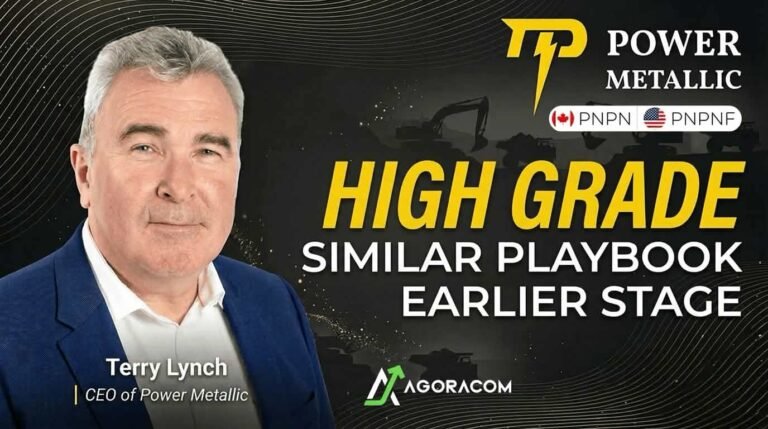
In a recent long form video interview with AGORACOM (see link at the end of this article), Power Metallic Mines Inc. CEO Terry Lynch outlined the company’s strategic pivot toward de-risking its flagship NISK project, drawing explicit parallels to Foran Mining’s successful $3.6 billion acquisition by Eldorado Gold and explaining why the company’s current $250 million market capitalization may represent an opportunity for investors.
Lynch explained that Power Metallic’s Lion Zone deposit contains approximately the same amount of contained metal tonnage as Foran’s McIlvenna Bay project—roughly 800,000 metal contained tons—while potentially offering greater exploration upside in a jurisdiction with superior infrastructure.
AGORACOM Beyond The Mic Feature Article Issued On Behalf of Power Metallic Mines Inc.
May 14, 2026 4:30 PM EST
Following the Foran Blueprint: From Exploration to Economic Study
Power Metallic has fundamentally shifted its development strategy in 2026, moving away from the pure exploration model that characterized companies like Filo and Great Bear Resources toward the systematic de-risking approach that made Foran Mining an attractive acquisition target.
“We had to look in the mirror,” Lynch explained, noting that despite operational successes throughout 2025—including 95% metallurgical recovery rates and a six-fold expansion of the land package—the stock declined from $1.70 in late January to $0.85 in March. “We needed to take a page out of Foran’s book of de-risking the project in the investor’s mindset.”
The new roadmap includes two critical milestones:
Mineral Resource Estimate (MRE) – Q3 2026: Power Metallic accelerated its MRE timeline, pulling forward the planned release from Q1 2027 to July or August 2026. Analyst estimates for the deposit range from 7 million to 16.5 million tonnes, with copper equivalent grades (a measure that converts all metals to a single copper value for comparison) projected between 4.25% and 7%.
To put these numbers in perspective, the average producing copper mine globally operates at 0.4% copper grade. Power Metallic’s projected grades would be 10 to 17 times higher than that industry standard.
Preliminary Economic Assessment (PEA) – Q4 2026: Following the MRE, the company will release a PEA that applies rigorous economic modeling to the deposit, including metallurgical processing, recoveries, payables (the portion of metal a smelter pays for), taxes, transportation, and operating costs. Lynch stated his view that the company may bypass the typical pre-feasibility study stage and move directly to a full feasibility study, suggesting confidence in the deposit’s economic viability.
“We think this is like a no-brainer mine,” Lynch stated. “My feeling is we’ll probably go from the PEA direct to feasibility because there will be no need to go to pre-feasibility.”
The Foran Comparison: Similar Metal, Lower Entry Point
The comparison to Foran Mining was central to Lynch’s investor thesis. Foran’s management team spent years de-risking McIlvenna Bay through metallurgical studies, feasibility work, securing Project of Canada status, bringing in Agnico Eagle as a minority shareholder, and raising approximately $900 million to advance toward production.
“Of course, Foran is worth more than Power Metallic right now, and deservedly so,” Lynch acknowledged. “They’ve done an amazing job. My point was just to say, look, at the end, it all starts with the metal contained tons.”
Power Metallic’s current market capitalization of approximately $250 million US compares to the $3.6 billion Eldorado Gold paid for Foran. If Power Metallic’s MRE confirms similar contained metal tonnage, Lynch argues investors are currently buying the deposit for “20, 25 cents on the dollar” of what it could ultimately be worth, with significant exploration upside that isn’t yet priced in.
High-Grade Drill Results: 30 Times Average Mine Grade
The Lion Zone continues to deliver drill results that stand out in the sector. In the interview, Lynch highlighted recent intersections including 22 meters of 11.46% copper equivalent—approximately 30 times the grade of the average producing copper mine.
These shallow, high-grade intercepts have significant economic implications. “The depth means that we’ll be able to open pit probably the first two or three years of this project,” Lynch explained. Open-pit mining (surface mining rather than underground tunneling) is substantially less expensive, requiring smaller capital investment, fewer workers, less equipment, and reduced energy consumption.
Power Metallic’s internal estimates suggest the Lion Zone could be brought into production for approximately $400 million in capital expenditure, compared to the $900 million Foran required—a function of much higher grades requiring far less rock to be moved and processed.
“If you’ve got to move a lot of rock and you got to crush 0.4% to get the metal out, you’re going to have a massive capital investment,” Lynch noted. “Conversely, if you’re producing 5% or 6% copper equivalent, you’re moving one-tenth or one-fifteenth the rock.”
Metallurgical Recovery: The Polymetallic Advantage
One concern Lynch addressed directly was investor skepticism about polymetallic deposits (deposits containing multiple valuable metals). Lower-grade polymetallic systems have historically underperformed expectations due to processing complexity.
Power Metallic put that concern to rest in January 2026 when SGS Canada Inc., one of the world’s leading metallurgical testing laboratories, reported locked-cycle test results showing high recoveries: 98.9% copper, 93.9% palladium, 96.8% platinum, 85% gold, and 88.9% silver.
“We just put out state-of-the-art lock cycle tests from the biggest metallurgist on the planet, SGS, and we produced 95% across-the-board recoveries,” Lynch said. “Stop fearing this. This thing is going to come out like butter.”
The revenue mix from the Lion Zone is projected at approximately 45% copper, 20% platinum, 20% palladium, 10% gold, and 5% silver—a diversified basket of metals that reduces commodity price risk.
The Path to Production: Financing and Strategic Partnership
Lynch outlined a clear financing pathway that reflects the advantages of developing a high-grade deposit in a mining-friendly jurisdiction. In Canada, projects with completed feasibility studies typically receive:
- 50% project financing from banks
- 30% tax credit from the federal government (convertible to cash)
- 25% tax abatement from the Province of Quebec in the first year (when the mine generates positive cash flow)
Given the projected $400 million capital requirement, these incentives would cover approximately $320 million, leaving a manageable equity financing gap. Additionally, Lynch noted the company could sell a silver or gold stream (pre-selling future production at a discount in exchange for upfront capital) to cover any remaining equity needs.
Before moving to construction, Power Metallic plans to conduct a strategic partnership process in fall 2026, targeting a 10% investment from a major mining company at what Lynch believes will be a billion-dollar valuation following the PEA release.
NASDAQ Listing: Accessing American Capital
Power Metallic confirmed plans to list on NASDAQ in Q3 2026 using a new American Depository Share (ADS) structure that avoids the need for a share consolidation. The company will bundle five common shares into a single ADS unit that trades on NASDAQ, meeting the exchange’s price requirements without reducing share count.
“With NASDAQ, you don’t have to do it [consolidation]. So it’s like, if you don’t have to and you get NASDAQ, why even go through any of the consternation?” Lynch said.
The NASDAQ listing is designed to provide access to the deep pool of American institutional capital that has historically driven valuations in the mining sector, particularly for deposits approaching the production stage.
Exploration Upside: The District-Scale Opportunity
Beyond the Lion Zone itself, Lynch emphasized that orthomagmatic deposits (the geological type Power Metallic has discovered) are extraordinarily rare—only 20 have been found in the history of global mining—and all 20 are significantly larger than Power Metallic’s current footprint.
“The smallest one is about a million and a quarter contained tons,” Lynch noted. “So if we’re at 800,000, we’re going to be growing at least 50% to get to be the smallest. The average is more than three [million], which would be four or five times from here. And the biggest are more than 10.”
Power Metallic has 40 drill holes awaiting assay results from the winter 2026 program and plans an additional 35,000 to 40,000 feet of drilling through the rest of the year. The company is also deploying muon tomography, an advanced geophysical technique that uses cosmic rays to image density variations in rock up to 800 meters deep—technology that has successfully doubled resources at other projects.
“Our geologists found this deposit. They’ve found other deposits like this around the world. They’re great at what they do,” Lynch said. “You don’t want to bet against these guys. They’re going to find more of this.”
Insider Conviction: Putting Money Where Their Mouth Is
Lynch revealed that over the past two years, the Lynch family has been the second-largest investor in Power Metallic behind Robert Friedland, contributing over $5 million. Lynch personally purchased 700,000 shares in the open market over the past 90 days.
“I’m over-concentrated for sure, but I just so believe in this, that we’re going to be able to execute,” Lynch said. “I always believe great mines get paid. We’re going to get paid. One way or another, we’ll bring it to production and get paid, or we’ll get taken over by somebody bigger that writes us a monster check.”
The company’s shareholder base includes some of mining’s most prominent investors: Robert Friedland (founder of Ivanhoe Mines), Rob McEwen (CEO of McEwen Mining), and Gina Rinehart (chairwoman of Hancock Prospecting), collectively representing billions of dollars in successful mining investments.
Location Advantage: Quebec vs. Global Alternatives
Throughout the interview, Lynch emphasized the jurisdictional advantages of developing the NISK project in Quebec, Canada, rather than in geopolitically complex regions where many polymetallic deposits are located.
“This is in Quebec. It’s a surface deposit. It’s off the road. It’s super high grade. It’s shallow. It’s got power on the property. Roads you could drive on to the property. We’ve got a village of 1,500 people right there. We’ve got massive local support,” Lynch said, contrasting this with deposits in Russia or politically unstable regions in Africa.
The project is located near existing infrastructure including Hydro-Quebec power transmission lines and has strong support from local First Nations communities, particularly the James Bay Cree, who assisted the company in securing additional exploration lands previously restricted by Hydro-Quebec.
The Mining Supercycle Thesis
Lynch made a broader case for the mining sector, noting that mining companies currently represent less than 1% of the S&P 500, down from 11% in the 1970s, despite the physical world’s continued dependence on extracted materials.
“Either you grow something or you extract it. There’s only two ways to get real physical products,” Lynch said, pointing to Robert Friedland’s recent comments at the White House about the strategic importance of mining.
Lynch argued that massive artificial intelligence infrastructure projects requiring copper, power transmission, and data centers cannot all be built given current materials supply constraints, creating a fundamental supply-demand imbalance that will drive commodity prices and mining equity valuations higher.
“I made the bold claim that there’ll be more millionaires made in mining in the next five years than in tech,” Lynch said.
Conclusion: A Clear Path Forward
Power Metallic’s strategic shift toward systematic de-risking represents a recognition that investor sentiment in 2026 demands clear economic milestones rather than exploration news alone. By accelerating the MRE and committing to a PEA by year-end, the company is providing the catalysts that institutional investors require to build positions ahead of potential production decisions.
With approximately 800,000 contained metal tons projected at grades 10 to 30 times higher than average producing mines, metallurgical recoveries exceeding 95%, and a pathway to production in one of the world’s best mining jurisdictions, Power Metallic is positioning itself to follow the Foran Mining playbook from discovery through de-risking to potential takeout or production.
For investors who missed Foran’s run from exploration discovery to $3.6 billion acquisition, Lynch’s message was direct: “You definitely don’t miss it. These things are going from one to 10, and some of them are going to go to 100.”
TO WATCH THE FULL VIDEO GO TO: https://www.youtube.com/playlist?list=PLfL457LW0vdKpsitlRX13GnPGO9EqeJq5
AGORACOM Beyond the Mic is Powered by AGORACOM’s AI Content Agents.
Power Metallic Mines Inc. Is A Client Of AGORA Internet Relations Corp. https://agoracom.com/ir/Agoracomupdates/forums/discussion/topics/796135-DISCLAIMER-AND-DISCLOSURE/messages/2399000
Last modified: July 27, 2026