Posted by AGORACOM
at 3:31 PM on Friday, January 31st, 2020
SPONSOR: ZEN Graphene Solutions: An emerging advanced materials and graphene development company with a focus on new solutions using pure graphene and other two-dimensional materials. Our competitive advantage relies on the unique qualities of our multi-decade supply of precursor materials in the Albany Graphite Deposit. Independent labs in Japan, UK, Israel, USA and Canada confirm this. Click here for more information
The recent report published on Natural Graphite Market Research Report
analyzes various factors impacting the growth trajectory of this
industry. Primary and secondary research is employed to determine the
development aspects and growth path in Natural Graphite Market on the
global, regional and country-level scale. The historic, present and
forecast situations impending the Natural Graphite Industry dynamics,
competition as well as growth constraints are comprehensively studied.
This report is a complete blend of technological innovations, market
risks, opportunities, risks, challenges, and niche Natural Graphite
Industry segments.
Major companies present globally in this report are as follows:
Steel & Refractories Carbon brushes Batteries Automotive parts Lubricants Others
The important market trends, prominent players, product portfolio, manufacturing cost analysis, product types and pricing structure are presented. All crucial factors like Natural Graphite market dynamics, challenges, opportunities, restraints are studied in this report.Â
The up-to-date market information presents the competitive structure
of Natural Graphite Industry to help players in analyzing the
competitive structure for growth and profitability. The notable features
of this report are Natural Graphite Market share based on each product
type, application, player, and region. Profit estimation for all market
segments and sub-segments and consumption ratio.
Key Deliverables of Natural Graphite Research Report are mentioned below:
Renumeration analysis for each application is covered.
Market share per Natural Graphite application is projected during 2020-2026. Consumption aspects for the same are covered.
Natural Graphite Market drivers which will enhance the commercialization matrix to enhance the business sphere is explained.
Vital information regarding challenges, risks, SWOT analysis of top players, and market share is covered.
Consumption rates in Natural Graphite Industry for major regions namely North America, Europe, Asia-Pacific, MEA, South America and the rest of the world is covered.Â
Research Methodology of Natural Graphite Market:
The primary and secondary research methodology is used to gather data
on parent and peer Natural Graphite Market. Industry experts across the
value chain participate in validating the market size, revenue share,
supply-demand scenario, and other key findings. The top-down and
bottom-up approach is used in analyzing the complete market size and
share. The key opinion leaders of Natural Graphite Industry like
marketing directors, VPs, CEOs, technology directors, R&D managers
are interviewed to gather information on supply and demand aspects.
For secondary data sources information is gathered from company
investor reports, annual reports, press releases, government and company
databases, certified journals, publications, and other various other
third-party sources.
Table of Contents Is Segmented As Follows:
Report Overview: Product definition, overview, scope, growth rate comparison by type, application, and region from 2020-2026 is covered.
Executive Summary: Vital information on industry trends, Natural Graphite market size by region and growth rate for the same is provided.
Profiling of Top Natural Graphite Industry players:
All top market players are analyzed based on gross margin, price
revenue, sales, production, and their company details are covered.
Regional Analysis: Top regions and countries are analyzed to gauge the Natural Graphite industry potential and presence on the basis of market size by product type, application, and market forecast. The complete analysis period is from 2014-2026.Â
Posted by AGORACOM
at 2:02 PM on Friday, January 31st, 2020
SPONSOR: Lomiko Metals is focused on the exploration and development of minerals for the new green economy such as lithium and graphite. Lomiko owns 80% of the high-grade La Loutre graphite Property , Lac Des Iles Graphite Property and the 100% owned Quatre Milles Graphite Property. Lomiko is uniquely poised to supply the growing EV battery market. Click Here For More Information
UPS’ venture capital arm, UPS Ventures, has completed a minority investment in Arrival,
which makes electric vehicle (EV) platforms and purpose-built vehicles.
Along with the investment in Arrival, UPS also announced a commitment
to purchase 10,000 electric vehicles to be built for UPS with priority
access to purchase additional electric vehicles.
UPS will collaborate with Arrival to develop a wide range of electric
vehicles with Advanced Driver-Assistance Systems (ADAS). The technology
is designed to increase safety and operating efficiencies, including
the potential for automated movements in UPS depots.
UPS will initiate testing ADAS features later in 2020. Future vehicle
purchases are contingent on successful tests of initial vehicles.
Vehicle purchase prices will not be disclosed.
UPS continues to build an integrated fleet of electric vehicles,
combined with innovative, large-scale fleet charging technology. As
mega-trends like population growth, urban migration, and e-commerce
continue to accelerate, we recognize the need to work with partners
around the world to solve both road congestion and pollution challenges
for our customers and the communities we serve.
Electric vehicles form a cornerstone to our sustainable urban
delivery strategies. Taking an active investment role in Arrival enables
UPS to collaborate on the design and production of the world’s most
advanced electric delivery vehicles.—Juan Perez, UPS chief information and engineering officer
Arrival takes a ground-up approach to the design and production of
its electric vehicles, enabling an efficient path toward mass adoption.
The company produces its own major core vehicle components: chassis,
powertrain, body and electronic controls. Arrival vehicles also use a
modular design with standardized parts, a method that reduces
maintenance and other costs of ownership.
UPS has been a strong strategic partner of Arrival’s, providing
valuable insight into how electric delivery vans are used on the road
and, importantly, how they can be completely optimized for drivers.
Together, our teams have been working hard to create bespoke electric
vehicles, based on our flexible skateboard platforms that meet the
end-to-end needs of UPS from driving, loading/unloading and back-office
operations. We are pleased that today’s investment and vehicle order
creates even closer ties between our two companies.—Denis Sverdlov, Arrival chief executive
Arrival will build the vehicles in micro-factories, using
lightweight, durable materials the company designs and creates in-house.
As an investor, UPS has the option to fast-track orders as necessary. UPS expects to deploy the EVs in Europe and North America.
Arrival is the first commercial vehicle manufacturer to provide
purpose-built electric delivery vehicles to UPS’ specifications and with
a production strategy for global scale. Since 2016, UPS and Arrival
have collaborated to develop concepts of different vehicles sizes.
The companies previously announced they would develop a
state-of-the-art pilot fleet of 35 electric delivery vehicles to be
trialed in London and Paris. Additionally, UPS announced a pioneering
new approach to electric charging and storage that has now been deployed
in UPS’s central London facility.
Posted by AGORACOM
at 2:17 PM on Thursday, January 30th, 2020
SPONSOR: Vertical Exploration is developing its St. Onge Wollastonite as a soil additive for optimizing marijuana growth. Recently engaged AGRINOVA’s Phase 1 Reseach program also demonstrated Wollastonite can potentially become BNQ certified for agricultural use in Quebec. Recently signed distribution agreement with AREV Brands International to Supply St-Onge Wollastonite to the Cannabis and Hemp Industries. Click Here for More Info.
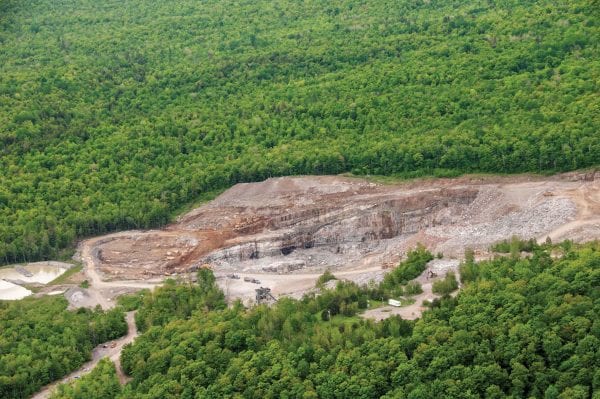
The former NYCO Minerals wollastonite mine. Photo by Carl Heilman II.
The Imerys ore processing operation in Willsboro is closed until
further notice for cleaning of asbestos that has contaminated its
wollastonite products.
A representative of union workers at the plant said the plant
shutdown is temporary, and a plant spokesman preferred to call it a
suspension of work.
The France-based Imerys, which acquired the former NYCO Minerals
mining and processing operations in 2016, learned of the problem this
summer from a customer. The closure brings the latest round of job uncertainties for a mine that
New York voters in 2013 agreed to support by amending the state
constitution to allow an Adirondack land swap that has yet to happen.
“A third party told them about asbestos. It’s in the ore,†said Ray
Bettis, a representative of the United Auto Workers, the union for about
40 workers at the processing operation in Willsboro.
He said the entire workforce was called into a meeting on Wednesday
afternoon. Many were relieved that the announcement was not that the
plant was closing altogether, Bettis said.
Ryan Toohey, a spokesman for the company, confirmed the contamination
problem and said the company intends to reopen for business. He
emphasized the plant’s difficulties are not related to the bankruptcy
protection sought on Wednesday by Imerys Talc America.
The Chapter 11 bankruptcy announcement was related to lawsuits
alleging that the Imerys Talc subsidiaries are liable for products that
have caused ovarian cancer and asbestos-related mesothelioma.
Wollastonite is a mineral used in ceramics, paints, plastics and auto-body parts.
In Essex County, the plant closure also worried workers because of
repeated statements by company officials that sales of wollastonite at
Willsboro, mined by Imerys in nearby Lewis, have been weak.
The plant has been closed since its third shift on Tuesday. The
workers are being paid during the closure, Bettis said, and many will
return on Monday to clean the premises. They will wear masks, he said.
Tests revealed trace levels of asbestos, and only in some products,
the company said, and no contamination in the plant’s air. Toohey issued
a statement that said Imerys has no reason to believe the wollastonite
or the products sold are unsafe for handling and use.
“Out of an abundance of caution, we are temporarily suspending
production and are working to identify the earliest possible date to
resume production with ore that meets our standards,†the company said.
“We remain committed to producing high-quality wollastonite in
Willsboro.â€
The company, which has cut staff and farmed out some work in the past
few years, has 59 employees. It had employed more than 100 six years
ago.
It will be throwing out tons of ore and product from the past 12
months. When workers clean the plants in Willsboro they will be wearing
enhanced safety gear because of expected dusty conditions.
Mark Buckley, a former administrator at the plant who served as its
safety and health director, said an asbestos contamination issue arose
about 16 years ago when a customer discovered the problem. At that time,
the company closed for a few days of cleaning and investigation.
Workers needed to be fitted for masks for protection then. The root of
the asbestos was a rock formation adjoining the ore mine, he said.
The new issue surfaced amid inspections by the U.S. Mine Safety and
Health Administration, which sends inspectors into the plant at least
twice a year. Already, the plant has received 33 citations for
violations this year, according the MSHA web site. An MSHA spokesman was
unavailable.
The plant has a long history as a major employer for mining and
plant processing jobs in the Adirondack hamlets of Lewis and Willsboro,
though Imerys has discontinued its mining employment and contracts the
work to a Vermont excavator.
The plant also received the uncommon opportunity from New York voters
to swap state forest preserve land for the rights to mine wollastonite
in an area of Lewis known as Lot 8. Imerys has yet to take advantage of
that opportunity, granted after heavy lobbying from the former owners
who said they needed Lot 8 to preserve jobs. Voters approved a trade of
200 acres in the Jay Mountain Wilderness for lands of equal or greater
value.
John Brodt, a spokesman for the Imerys mining division, said Imerys
intends to continue testing the ore at Lot 8. Imerys wants to capitalize
on the mining opportunity extended by voters in 2013, he said.
An application, submitted late last year, is pending before the state
Department of Environmental Conservation to conduct horizontal drilling
from the company’s land adjacent to Lot 8, he said. The goal is to add
to previously collected test data before determining the value of Lot 8.
If the company and the state arrive at a land swap deal, the Lot 8 acquisition could happen in 2022, Brodt said.
Posted by AGORACOM
at 1:12 PM on Thursday, January 30th, 2020
https://youtu.be/swY2-K4DXSI
The Morning Drive: The Electric Vehicle Revolution Featuring Lomiko Metals
What is the Upside for Lomiko? We are glad you asked that question! That’s why we need sunglasses. Below is a news report regarding our nearest neighbor that has gone through the PEA and Feasibility process with the result being a Discounted Net Present Value of $ 750 million and a $50+ million market capitalization.
Please note current tonnage amount at Lomiko’s La Loutre Graphene Battery Zone is 3%-3.6% and there is 36 million tonnes in the defined area. The new Refractory Zone at La Loutre was drilled in 2019 and will add much more tonnage, but more importantly, it will increase the grade reported in the new 43-101! Please see the drill map
After a Preliminary Economic Assessment, the La Loutre Project should generate a much larger Discounted Net Present Value than our current market capitalization of $ 4 million.
From news agency Stockwatch: Pierre Renaud and Eric Desaulniers’s Nouveau Monde Graphite Inc. (NOU), unchanged at 20 cents on 219,000 shares, has signed a benefit-sharing agreement with the Municipality of Saint-Michel-des-Saints. Mr. Desaulniers, President and CEO, puts a colourful spin on the arrangement, which he says has strengthened the social, economic and environmental development partnership between the company and the town. Rejean Gouin, mayor of Saint-Michel, is proud of the deal, adding that he is “certain that it will benefit all citizens as well as future generations.”
Matawinie hosts nearly 96 million tonnes indicated at 4.28 per cent graphite and 14 million tonnes inferred at 4.19 per cent, all of it in the West zone of the company’s Tony claim block. A feasibility study, completed late in 2018, was based on a reserve of nearly 60 million tonnes at 4.35 per cent graphite, enough to last about a generation. The study contemplated a mine capable of producing 100,000 tonnes of graphite per year, enough to support a discounted net present value of $750-million after taxes. Still, before the town sees the annual cheques covering 3 per cent of after-tax cash flow, Mr. Desaulniers will have to find the $276-million to build the mine and get it running.
For more information on the Company, review the website at www.lomiko.com, contact A. Paul Gill at 604-729-5312 or email: [email protected].
Posted by AGORACOM
at 10:58 AM on Wednesday, January 29th, 2020
Sponsor: Loncor is a Canadian gold exploration company that controls over 2,400,000 high grade ounces outside of a Barrick JV.. The Ngayu JV property is 200km southwest of the Kibali gold mine, operated by Barrick, which produced 800,000 ounces of gold in 2018. Barrick manages and funds exploration at the Ngayu project until the completion of a pre-feasibility study on any gold discovery meeting the investment criteria of Barrick. Click Here for More Info
The market is buzzing with
speculation about Barrick Gold Corp. CEO Mark Bristow’s next move, with
Freeport-McMoRan, owner of the giant Grasberg copper and gold mine in
Indonesia, regarded as a potential takeover target.
A tough-talking South African on a mission to shake up the mining
industry. For years the name that would have sprung to mind was Glencore
boss Ivan Glasenberg, but not any more. The sector has another
swashbuckling executive to watch: Mark Bristow, head of Barrick Gold.
Since the geologist took control of the world’s second-biggest gold
miner just over a year ago he has been a whirlwind of activity.
Highlights of the past 12 months include a hostile bid for its arch
rival — now a partner in a joint venture — a buyout of struggling
subsidiary Acacia Mining and more than US$1 billion of asset sales.
But this is just the beginning for 61-year-old Bristow, an adrenalin
junkie who enjoys big game hunting and flying planes. “It has been an
amazing year,†he said during a wide-ranging interview. “We now have a
solid foundation to build on and probably the strongest balance sheet in
the gold industry.â€
The market is buzzing with speculation about Bristow’s next move,
with Freeport-McMoRan, owner of the giant Grasberg copper and gold mine
in Indonesia, regarded as a potential takeover target.
Bristow recently described copper as a “strategic metal†because of
the role it would play in the shift to a greener economy. “The new, big
gold mines are going to come out of the young geologies of the world,â€
he said. “And in young rocks, gold comes in association with copper or
vice versa.â€
Asked if he had discussed the merits of a deal with Freeport chief
executive Richard Adkerson, Bristow said there had been “conversationsâ€
but these had been more theoretical.
“As the leader of the most valuable gold company in the world, I
should be looking at the world’s best gold mines,†he said. “It makes
sense for us to be interested in looking at Grasberg and asking
ourselves whether Freeport is going to remain an independent company or
not.â€
A workaholic who maintains a punishing travel schedule, Bristow
became chief of Barrick in early 2019 after the Toronto-listed company
consummated a nil-premium merger with Randgold Resources, the
Africa-focused miner he built into one of the world’s largest gold
producers.
The idea behind the deal was to create a gold company focused around
five “tier one assets,†mines capable producing more than 500,000oz of
gold annually for at least a decade. The merged entity would be run the
“Randgold Way†— the decentralised, hands-on management philosophy
espoused by Bristow.
When the Randgold merger was announced in September 2018 there were
worries about how Bristow would work alongside Barrick’s executive
chairman John Thornton, a no-nonsense ex-Goldman Sachs banker.
However, Bristow and his close-knit team of executives have been
given their head to run the company. One of his first moves on taking
the helm was to cut almost 100 jobs at Barrick’s head office in Toronto
in an effort to shape what he calls a “lean, mean machine at the top.â€
He has also changed the management teams across nearly all of the
Barrick assets.
Analysts and investors say Bristow has delivered on the big promises
he made at the time of the merger: balance sheet deleveraging, reducing
head office costs and asset sales.
“If the gold price stays around US$1,500 an ounce and we generate the
same sort of free cash flow as [2019 and] deliver on the rest of our
promises as far as realizing the sale of non-core assets we will have
zero net debt [by the end of 2020],†Bristow said.
Barrick and arch rival Newmont Corporation’s deal to combine their
mines in Nevada into a joint venture, after Barrick dropped its hostile
bid for the latter, has also won plaudits. This has been reflected
in Barrick’s share price, which has risen 76 per cent since the Randgold
merger was announced — outperforming Newmont (46 per cent) and the gold
price (31 per cent).
Barrick Gold Corp’s stock chart since the merger with Rangold was announced Sept. 24, 2018. Bloomberg
Still, some investors lament the passing of Randgold. One top-20
shareholder said it would have delivered a better share price
performance had it remained independent — a view backed up by recent
results, which show the Randgold side of the portfolio continuing to
sparkle while the Barrick portion struggles.
Randgold also boasted a generous dividend policy, something Barrick
has yet to match. Analysts estimate Barrick’s dividend would need to
rise two to three times from where it is today to be comparable to
Randgold’s payout. Bristow said Barrick would look at a long-term
dividend policy once its 10-year strategic plan is put in place early
this year. Barrick also remains a very complex business with assets
in the Americas, Africa and Asia, leaving Bristow and his management
team stretched.
“There is a core of 10 Randgold executives who run the business. They
used to fly around all the assets once a quarter,†said one analyst who
used to follow Randgold but does not cover Barrick. “That is more
difficult to do now given the size and scale of the business.â€
A photo of Rangold’s open-pit gold mine in the Democratic Republic of Congo in 2014. Rangold Resources
James Bell, an analyst at RBC Capital Markets, also said the
integration of the two companies had become more complicated because
some of the assets flagged as potentially noncore at the time of the
Barrick deal were now seen as less disposable.
“A good example is Porgera [a mine in Papua New Guinea]. This was an
asset initially flagged as noncore but that’s an asset the company is
now very excited about because management have seen the geological
potential,†he added.
Bristow said Barrick would continue to divest assets where it makes
“good, commercial senseâ€, citing the recent sale of its stake in the
Massawa gold project in Senegal for an upfront payment of US$380
million.
Bristow, who had open heart surgery in 2017 after a doctor spotted a
problem during a routine medical to renew his pilot’s licence, said he
did not know when he would step down.
“I don’t have a particular timeframe but I gave the market a [promise
of at least a] full five years. I am certainly committed to that,†he
said, adding that there was already a pool of executives that are
qualified to lead the organization. “And you can imagine how much better
they are going to be with a bit of coaching in the next couple of
years.â€
Posted by AGORACOM
at 2:07 PM on Tuesday, January 28th, 2020
SPONSOR: American Creek owns a 20% Carried Interest to Production at the Treaty Creek Project in the Golden Triangle. 2019’s first hole averaged of 0.683 g/t Au over 780m in a vertical intercept. The Treaty Creek property is located in the same hydrothermal system as the Pretivm and Seabridge’s KSM deposits. Click Here For More Info
Excerpts from Crescat Capital November Newsletter:
Precious Metals
Precious metals are poised to benefit from what we consider to be the
best macro set up we’ve seen in our careers. The stars are all
aligning. We believe strongly that this time monetary policy will come
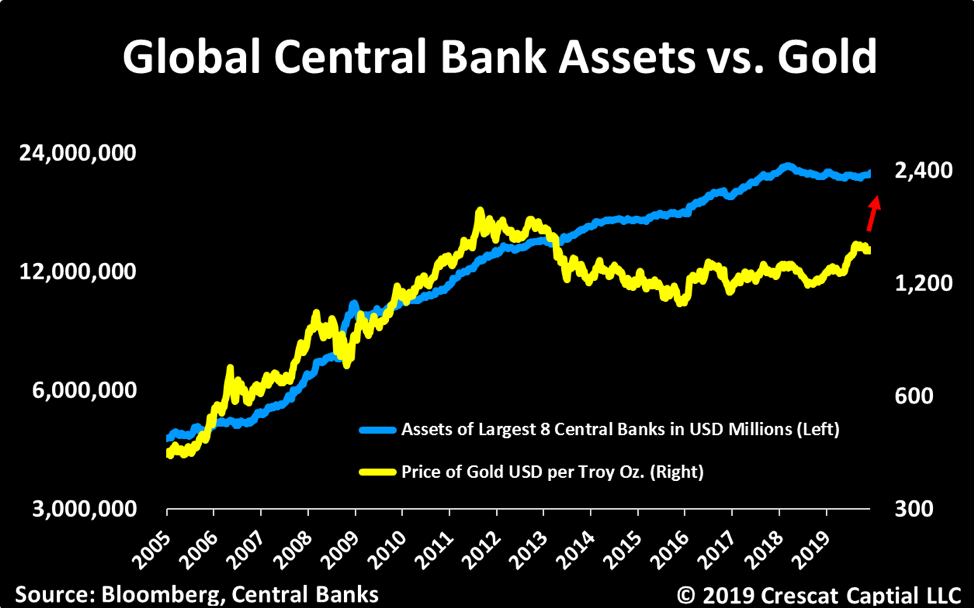
at a cost. Look in the chart below at how the new wave of global money
printing just initiated by the Fed in response to the Treasury market
funding crisis is highly likely to pull depressed gold prices up with
it.
The imbalance between historically depressed commodity prices
relative to record overvalued US stocks remains at the core of our macro
views. On the long side, we believe strongly commodities offer
tremendous upside potential on many fronts. Precious metals remain our
favorite. We view gold as the ultimate haven asset to likely outperform
in an environment of either a downturn in the business cycle, rising
global currency wars, implosion of fiat currencies backed by record
indebted government, or even a full-blown inflationary set up. These
scenarios are all possible. Our base case is that governments and
central banks will keep their pedals to the metal to attempt to fend off
credit implosion or to mop up after one has already occurred until
inflation becomes a persistent problem.
The gold and silver mining industry is precisely where we see one of
the greatest ways to express this investment thesis. These stocks have
been in a severe bear market from 2011 to 2015 and have been formed a
strong base over the last four years. They are offer and incredibly
attractive deep-value opportunity and appear to be just starting to
break out this year. We have done a deep dive in this sector and met
with over 40 different management teams this year. Combining that work
with our proprietary equity models, we are finding some of the greatest
free-cash-flow growth and value opportunities in the market today
unrivaled by any other industry. We have also found undervalued
high-quality exploration assets that will make excellent buyout
candidates.
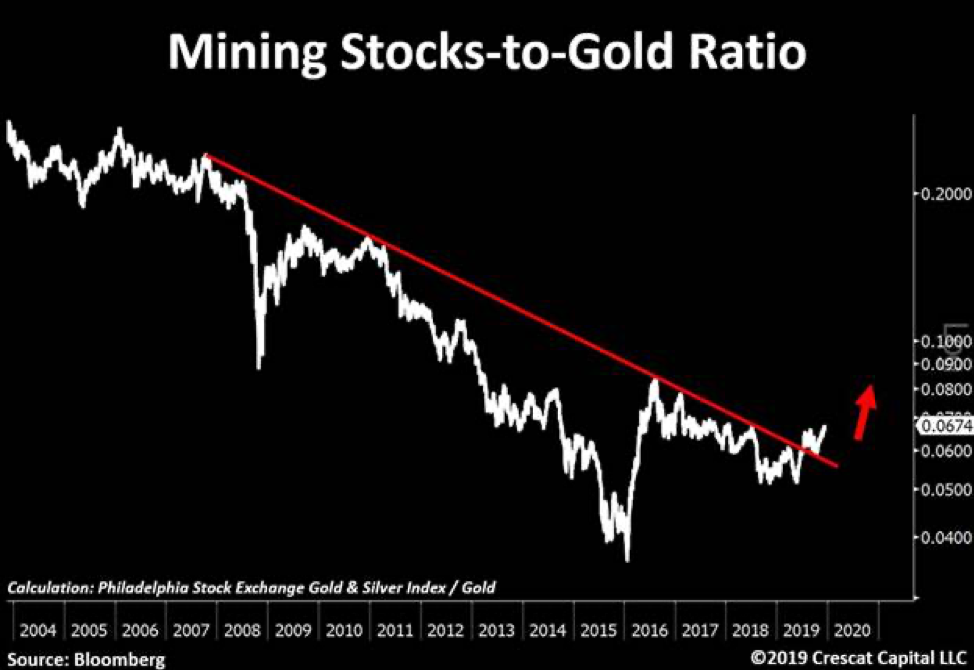
We recently point out this 12-year breakout in mining stocks relative
to gold now looks as solid as a rock. In our view, this is just the
beginning of a major bull market for this entire industry. We encourage
investors to consider our new Crescat Precious Metals SMA strategy which
is performing extremely well this year.
Zero Discounting for Inflation Risk Today
With historic Federal debt relative to GDP and large deficits into
the future as far as the eye can see, if the global financial markets
cannot absorb the increase in Treasury debt, the Fed will be forced to
monetize it even more. The problem is that the Fed’s panic money
printing at this point in the economic cycle may hasten the unwinding of
the imbalances it is so desperate to maintain because it has perversely
fed the last-gasp melt up of speculation in already record over-valued
and extended equity and corporate credit markets. It is reminiscent of
when the Fed injected emergency cash into the repo market at the peak of
the tech bubble at the end of 1999 to fend off a potential Y2K computer
glitch that led to that market and business cycle top. After 40
years of declining inflation expectations in the US, there is a major
disconnect today between portfolio positioning, valuation, and economic
reality. Too much of the investment world is long the “risk parityâ€
trade to one degree or another, long stocks paired with leveraged long
bonds, a strategy that has back-tested great over the last 40 years, but
one that would be a disaster in a secular rising inflation environment.
With historic Federal debt relative to GDP and large deficits into
the future as far as the eye can see, rising long-term inflation, and
the hidden tax thereon, is the default, bi-partisan plan for the US
government’s future funding regardless of who is in the White House and
Congress after the 2020 elections. The market could start discounting
this sooner rather than later. The Fed’s excessive money printing
may only reinforce the unraveling of financial asset imbalances today as
it leads to rising inflation expectations and thereby a sell-off in
today’s highly over-valued long duration assets including Treasury bonds
and US equities, particularly insanely overvalued growth stocks. We
believe we are in the vicinity of a major US stock market and business
cycle peak.
Posted by AGORACOM
at 1:57 PM on Tuesday, January 28th, 2020
SPONSOR: Lomiko Metals is focused on the exploration and development of minerals for the new green economy such as lithium and graphite. Lomiko owns 80% of the high-grade La Loutre graphite Property , Lac Des Iles Graphite Property and the 100% owned Quatre Milles Graphite Property. Lomiko is uniquely poised to supply the growing EV battery market. Click Here For More Information
According
to research by BloombergNEF, European automakers and governments will
move toward helping curb global warming with stricter carbon emissions
regulations, which could force an electric-vehicle revolution.
In the United States, electric vehicles are primarily being purchased
by consumers that want to take action on their own. Fuel is cheap, the
country doesn’t have a real climate change plan, and large vehicles like
pickups are king. All of this means that there’s little incentive,
beyond the $7,500 federal tax credit, to purchase an EV. That, though,
isn’t the case in other countries like China and, soon to be Europe.
EV Revolution Coming This Year
According
to a report by Bloomberg and a forecast from BloombergNEF, Europe will
see an electric revolution in 2020. The outlet states that the country’s
government will soon look to cut carbon emissions from vehicles as part
of a plan to curb global warming. This, in turn, will force automakers
to introduce electric vehicles.
Bloomberg claims that sales of
electric cars are set to increase to 2.5 million units in 2020. That
figure represents an increase of 20 percent from 2019.
Just like this year, China will continue to lead the way forward for sales. But the country recently decided to reduce subsidies for EV owners,
which could help Europe gain a larger piece of the market. The outlet’s
forecasting claims that Volkswagen’s push to become an electric-vehicle
force will boost the number of electrified vehicles in Europe. In
total, the outlet expects 800,000 electric cars to be sold in Europe in
2020.
“The long-term future is really bright, but in the short
term we’re expecting growth to be relatively slow,” said Colin
McKerracher, an analyst at BloombergNEF. “You’re still in the middle of
this transition, from a market driven by direct subsidies toward one
driven by a combination of real consumer demand and other big policy
mechanisms.”
Better Prices, More Infrastructure Coming
Another
important aspect of electric vehicles that will help sales increase in
Europe are decreasing lithium-ion battery prices. The outlet states that
prices per kilowatt-hour will hit roughly $135 – approximately 13
percent lower than in 2019. With the increase of battery production,
better battery designs, and more sales, battery prices are expected to
tumble.
All of these things mean that more chargers will be
needed. Luckily, public chargers are expected to rise to 1.2 million, up
from 880,000 last year. The increase in chargers will come in part from
governments and energy companies looking to expand infrastructure to
support the increase in demand for electric cars.
Another
interesting trend to look at in 2020 include other forms of electrified
transportation. A few companies, even automakers, showcased flying electric cars at CES.
While it’s unlikely that one would come out in 2020, it’s likely
something that more companies will pursue this year. Other forms of
transportation, including boats could go electric in 2020, too.
Posted by AGORACOM
at 12:39 PM on Tuesday, January 28th, 2020
SPONSOR: Gratomic Inc. (TSX-V: GRAT) Advanced materials company focused on mine to market commercialization of graphite products, most notably high value graphene based components for a range of mass market products. Collaborating with Perpetuus, Gratomic will use Aukam graphite to manufacture graphene products for commercialization on an industrial scale. For More Info Click Here
In the weeks since the Physics World team kicked off the new year by testing a pair of graphene headphones, we’ve received a steady stream of comments about our review and a related segment on our weekly podcast. A few people have asked our opinion of other graphene headphones, and one man went so far as to question whether the “graphene†label he found on an inexpensive pair of headphones was anything more than “misleading click-baitâ€.
I can’t judge any product I haven’t tried, and I also can’t judge a product’s graphene content without taking it apart and getting experts to analyse it. However, with those two caveats firmly in place, here are two facts to consider should you happen to be in the market for graphene headphones (and, by extension, graphene anything).
First, a lot of things contribute to how a pair of headphones will sound. The physical composition of the headphone drivers (graphene, PET, cellulose, or whatever) is only one factor. Others include the method by which those drivers create sound (this blog post explains a few of the possibilities, and their trade-offs); the quality of the other electronics; and simple things like how well the headphones fit over/in your ears. Some of these things are more expensive to optimize than others. The graphene headphones I tested are a high-end product with, it appears, a high-end price, so I suspect they are pretty good at the non-graphene-related aspects of headphone design – and that much of their cost comes from that, not from the graphene.
Second, graphene exists in many forms, with many price points. A lot of physicists are interested in ultra-pure, single-layer graphene, which has amazing electronic properties. This “physicists’ graphene†is difficult (and expensive) to make in macroscopic quantities. However, others are more interested in graphene’s mechanical properties, such as strength and rigidity. To get these properties, you don’t need ultra-pure single-layer graphene. You can get by with a cheaper type, which for argument’s sake I will term “materials scientists’ graphene†(this is an oversimplification, but it conveys the right feel). The proprietary graphene-based material in the headphones I tested was most likely in this category.
But even this type of graphene is expensive relative to a third type
of graphene, which is cheap enough to be added in bulk to substances
like paint
or resin to improve their heat transport and/or electrical
conductivity. As I understand it, this “engineers’ graphene†functions
like a superior version of graphite, and manufacturers are selling it by
the kilo (and maybe, soon, by the tonne).
I’m not trying to start a three-way brawl between physicists,
materials scientists and engineers about which type of graphene is
better. They all have their uses,
and they all qualify as graphene. But here’s the problem: a product can
advertise itself, accurately, as containing graphene even if the
graphene it contains is not of a type or quantity that’s going to make a
difference to its performance. What’s more, if an unscrupulous
manufacturer wants to put graphite in its product and call it
“grapheneâ€, it’s hard for ordinary consumers to know the difference. To
the naked eye, graphene and graphite both look like gritty black
powders. You need more sophisticated testing equipment to distinguish
between them, and between the various grades of graphene.
Certification is a huge issue
for the graphene industry, and a lot of people are working on it.
However, until there’s a strong framework for regulation, the next best
thing is probably to look for independent endorsements by people and
organizations who know what they’re talking about. The headphones I
tried were endorsed by the co-discoverer of graphene, Kostya Novoselov,
as making good use of the material. Since then, I’ve learned of a different make of graphene headphones that has been endorsed by an industry body called the Graphene Council. However, until someone gives Physics World
its own product-testing lab and qualified technicians to run it, that’s
about all I can say – except to add that there are some graphene
products I definitely won’t be testing with my colleagues.
Posted by AGORACOM
at 8:30 AM on Tuesday, January 28th, 2020
Significant upside potential identified at 1,675,000 oz (20.78 Mt @ 2.5 g/t Au) Imbo Concession since 2014 resource estimate
TORONTO, Jan. 28, 2020 — Loncor Resources Inc. (“Loncor” or the “Company“) (TSX: “LN”; OTCQB: “LONCF”) is pleased to provide an update on its activities within the Ngayu Greenstone Belt, where the Company has a dominant foot-print through its joint venture with Barrick Gold (Congo) SARL (“Barrickâ€) and on its own majority-owned prospecting licences and exploitation concessions.
The Ngayu Archean Greenstone Belt of northeastern Democratic Republic of the Congo (the “DRCâ€)
is geologically similar to the belts which host the world class gold
mines of AngloGold Ashanti/Barrick’s Kibali mine in the DRC and
AngloGold Ashanti’s Geita mine in Tanzania. Gold mineralization at Ngayu
is spatially related to Banded Ironstone Formation (“BIFâ€),
which is the case at both Kibali and Geita and is highlighted in
Figures 1 and 2 below. The Ngayu belt is significantly larger in extent
than the Geita belt.
Adumbi Deposit Since the Company’s acquisition of
71.25% of the KGL-Somituri gold project from Kilo Goldmines Ltd. in
September 2019, Loncor has focussed on the Imbo exploitation concession
in the east of the Ngayu belt where an Inferred Mineral Resource of
1.675 million ounces of gold (20.78 million tonnes grading 2.5 g/t Au,
with 71.25% of this Inferred Mineral Resource being attributable to
Loncor via its 71.25% interest) was outlined in January 2014 by
independent consultants Roscoe Postle Associates Inc (“RPAâ€)
on three separate deposits, Adumbi, Kitenge and Manzako (see Figures 3
and 4 below). In this study, RPA made a number of recommendations on
Adumbi, which were subsequently undertaken during the period 2014-18.
The Company’s geological consultants Minecon Resources and Services
Limited (“Mineconâ€) has been assessing the implications of this additional exploration data on Adumbi, which are summarised below.
Additional Drilling RPA recommended additional
drilling at Adumbi to test the down dip/plunge extent of the
mineralization. In 2017, four deeper core holes were drilled below the
previously outlined RPA inferred resource over a strike length of 400
metres and to a maximum depth of 450 metres below surface. All four
holes intersected significant gold mineralization in terms of widths and
grade and are summarised below:
Borehole
From(m)
To(m)
Intercept Width(m)
True Width(m)
Grade (g/t) Au
SADD50
434.73
447.42
12.69
10.67
5.51
SADD51
393.43
402.72
9.29
6.54
4.09
SADD52
389.72
401.87
12.15
7.01
3.24
419.15
428.75
9.60
5.54
5.04
SADD53
346.36
355.63
9.27
5.70
3.71
391.72
415.17
23.45
14.43
6.08
The above drilling results which are shown on the longtitudinal
section (see Figure 5 below), indicate that the gold mineralization is
open along strike and at depth. The drilling of an additional 12 core
holes has the potential to significantly increase the Adumbi mineral
resource as highlighted on the longitudinal section.
Survey and Georeferencing The Adumbi drill hole
collars, trenches, and accessible adits/portals have now been accurately
surveyed and the data appropriately georeferenced. In addition, all
accessible underground excavations and workings have been accurately
surveyed. The new and improved quality of the exploration data will have
positive implications on potential future classification of the mineral
resources.
Re-logging of All Drill Holes The re-logging of
drill holes after the RPA study has defined the presence of five
distinct geological domains in the central part of the Adumbi deposit
where the BIF unit attains a thickness of up to 130 metres (see Figure 4
below). From northeast to southwest:
Upper BIF Sequence: an interbedded sequence of BIF and chlorite schist, 45 to 130 metres in thickness.
Carbonaceous Marker: a distinctive 3 to 17 metre thick unit of black carbonaceous schist with pale argillaceous bands.
Lower BIF Sequence: BIF interbedded with quartz carbonate, carbonaceous and/or chlorite schist in a zone 4 to 30 metres wide.
Footwall Schists: similar to the hanging wall schist sequence.
In the central part of Adumbi, three main zones of gold mineralization are present. These include mineralisation:
Within the Lower BIF Sequence.
In the lower part of the Upper BIF Sequence. Zones 1 and 2 are
separated by the Carbonaceous Marker, which is essentially
unmineralized.
A weaker zone in the upper part of the Upper BIF Sequence.
The lack of a detailed geological model in the previous resource
estimates resulted in wireframes being constructed using only assay
values with little regard to geological domains. This has resulted in
wireframes cross-cutting the geology which could have resulted in
underestimating the previous resource estimate.
Relative Density (“RDâ€) Measurements The increase
in the sample population coupled with the application of a more rigid
RD determination procedure based on recommendations from the RPA
resource study, indicates that the new RD measurements from both
mineralized and unmineralized material and from the various material
types and lithologic units have improved the confidence in the relative
RD determination to be applied to any future resource estimates.
Relative to the 6 oxide RD measurements used for tonnage estimation in
the RPA model, 297 oxide RD measurements within the mineralised domain
were undertaken during the review work. For the transition and fresh
material, equal number of determinations relative to the previous RD
sample volumes were undertaken with the review process employing more
rigid RD determination procedures.
Table 1 below indicates significate positive variance between the
previous model RD and the reviewed work for the oxide and transition
materials.
Table 1: Summary of Previous and Reviewed Mineralised Average RD Measurements
Material Type
RD used in Previous RPA Model
Additional RD Determinations
RD Variance (%)
Oxide
1.80
2.45
36.1
Transition
2.20
2.82
28.2
Fresh
3.00
3.05
1.7
Oxidation and Fresh Rock Surfaces The re-logging
of the core as per the RPA recommendations identified major differences
between the depths of Base of Complete Oxidation (BOCO) and Top of Fresh
Rock (TOFR), and the depths used by RPA in the 2014 model. In the RPA
model, the BOCO was negligible and the TOFR corresponded approximately
to the re-logged BOCO. The deeper levels of oxidation that were observed
during the re-logging exercise should have positive implications for
the Adumbi project with respect to ore type classification and
associated metallurgical recoveries and mining and processing cost
estimates.
Adit Sampling and Georeferencing Following the
accurate surveying of the 10 historical adits and appropriately
georeferencing, the 796 adit samples (1,121 metres in total) when
applied should have positive implications on the data spacing and
classification of any future mineral resources.
In summary, most of the previous recommendations from the 2014 RPA
mineral resource study on Adumbi have been undertaken. In addition, the
previously recommended LIDAR survey by RPA was completed this month over
Adumbi by Southern Mapping of South Africa.
The results of all the above tasks coupled with the higher current
gold price compared with the previous study in 2014 indicate significant
upside at Adumbi. Minecon is undertaking further studies to better
quantify this significant upside. At present and subject to the Company
securing the necessary financing, the Company is planning to drill the
additional 12 deeper holes at Adumbi and then commence a preliminary
economic assessment when an updated mineral resource study will be
undertaken.
Ongoing studies are also continuing by Minecon on further assessing
the data elsewhere on the Imbo exploitation concession including Kitenge
and Manzako.
As announced in November 2019, joint venture partner and operator
Barrick has identified a number of priority drill targets within the
1,894 square kilometre joint venture land package (the “JV Areasâ€)
at Ngayu and that are planned to be drilled during the current dry
season. Drill targets include Bakpau, Lybie-Salisa and Itali in the Imva
area as well as Anguluku in the southwest of the Ngayu belt and
Yambenda in the north. As per the joint venture agreement signed in
January 2016, Barrick manages and funds exploration on the JV Areas at
the Ngayu project until the completion of a pre-feasibility study on any
gold discovery meeting the investment criteria of Barrick. Subject to
the DRC’s free carried interest requirements, Barrick would earn 65% of
any discovery with Loncor holding the balance of 35%. Loncor will be
required, from that point forward, to fund its pro-rata share in respect
of the discovery in order to maintain its 35% interest or be diluted.
About Loncor Resources Inc. Loncor
is a Canadian gold exploration company focused on two projects in the
DRC – the Ngayu and North Kivu projects. Both projects have historic
gold production. Exploration at the Ngayu project is currently being
undertaken by Loncor’s joint venture partner Barrick Gold Corporation
through its DRC subsidiary Barrick Gold (Congo) SARL (“Barrickâ€).
The Ngayu project is 200 kilometres southwest of the Kibali gold mine,
which is operated by Barrick and in 2018 produced approximately 800,000
ounces of gold. As per the joint venture agreement signed in January
2016, Barrick manages and funds exploration at the Ngayu project until
the completion of a pre-feasibility study on any gold discovery meeting
the investment criteria of Barrick. Subject to the DRC’s free carried
interest requirements, Barrick would earn 65% of any discovery with
Loncor holding the balance of 35%. Loncor will be required, from that
point forward, to fund its pro-rata share in respect of the discovery in
order to maintain its 35% interest or be diluted.
Certain parcels of land within the Ngayu project surrounding and
including the Makapela and Yindi prospects have been retained by Loncor
and do not form part of the joint venture with Barrick. Barrick has
certain pre-emptive rights over these two areas. Loncor’s Makapela
prospect has an Indicated Mineral Resource of 614,200 ounces of gold
(2.20 million tonnes grading 8.66 g/t Au) and an Inferred Mineral
Resource of 549,600 ounces of gold (3.22 million tonnes grading 5.30 g/t
Au). Loncor also recently acquired a 71.25% interest in the
KGL-Somituri gold project in the Ngayu gold belt which has an Inferred
Mineral Resource of 1.675 million ounces of gold (20.78 million tonnes
grading 2.5 g/t Au), with 71.25% of this resource being attributable to
Loncor via its 71.25% interest.
Resolute Mining Limited (ASX/LSE: “RSG”) owns 27% of the outstanding
shares of Loncor and holds a pre-emptive right to maintain its pro rata
equity ownership interest in Loncor following the completion by Loncor
of any proposed equity offering. Newmont Goldcorp Corporation (NYSE:
“NEM”; TSX: “NGT”) owns 7.8% of Loncor’s outstanding shares
Additional information with respect to Loncor and its projects can be found on Loncor’s website at www.loncor.com.
Qualified Person Peter N. Cowley, who is President of
Loncor and a “qualified person” as such term is defined in National
Instrument 43-101, has reviewed and approved the technical information
in this press release.
Technical Reports Certain additional information with
respect to the Company’s Ngayu project is contained in the technical
report of Venmyn Rand (Pty) Ltd dated May 29, 2012 and entitled “Updated
National Instrument 43-101 Independent Technical Report on the Ngayu
Gold Project, Orientale Province, Democratic Republic of the Congo”. A
copy of the said report can be obtained from SEDAR at www.sedar.com and
EDGAR at www.sec.gov.
Certain additional information with respect to the Company’s recently
acquired KGL-Somituri project is contained in the technical report of
Roscoe Postle Associates Inc. dated February 28, 2014 and entitled
“Technical Report on the Somituri Project Imbo Licence, Democratic
Republic of the Congo”. A copy of the said report, which was prepared
for, and filed on SEDAR by, Kilo Goldmines Ltd., can be obtained from
SEDAR at www.sedar.com. To the best of the Company’s knowledge,
information and belief, there is no new material scientific or technical
information that would make the disclosure of the KGL-Somituri mineral
resource set out in this press release inaccurate or misleading.
Cautionary Note to U.S. Investors The
United States Securities and Exchange Commission (the “SEC”) permits
U.S. mining companies, in their filings with the SEC, to disclose only
those mineral deposits that a company can economically and legally
extract or produce. Certain terms are used by the Company, such as
“Indicated” and “Inferred” “Resources”, that the SEC guidelines strictly
prohibit U.S. registered companies from including in their filings with
the SEC. U.S. Investors are urged to consider closely the disclosure in
the Company’s Form 20-F annual report, File No. 001- 35124, which may
be secured from the Company, or from the SEC’s website at
http://www.sec.gov/edgar.shtml.
For further information, please visit our website at www.loncor.com,
or contact: Arnold Kondrat, CEO, Toronto, Ontario, Tel: + 1 (416) 366
7300.
Posted by AGORACOM
at 5:17 PM on Monday, January 27th, 2020
SPONSOR: Gratomic Inc. (TSX-V: GRAT) Advanced materials company focused on mine to market commercialization of graphite products, most notably high value graphene based components for a range of mass market products. Collaborating with Perpetuus, Gratomic will use Aukam graphite to manufacture graphene products for commercialization on an industrial scale. For More Info Click Here
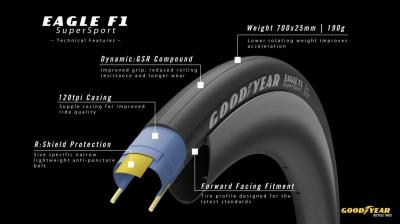
Goodyear developed a proprietary compound enhanced with graphene
The rubber is able to deliver low rolling resistance, improved grip in the dry and wet and long-term durability.
Famous tire and rubber company Goodyear has launched two new bicycle tyres, Eagle F1 and Eagle F1 Supersport utilizing graphene technology and weighing just 180g for a 23mm model.
The
new Eagle F1 is an “ultra-high-performance all-round road tire†and the
Eagle F1 Supersport, which is even lighter, is aimed at the upper
echelons of competition and will be suited to road racing, time trial
and triathlon where speed trumps all other requirements.
Goodyear has developed a proprietary compound enhanced with graphene and “next-generation amorphous (non-crystalline) spherical Silica†to create what it labels Dynamic:GSR. The result of this is said to be a rubber that is able to deliver low rolling resistance, improved grip in the dry and wet and long-term durability.
he Eagle F1 comes in five width options from 23 to 32mm, while the Eagle F1 Supersport comes in three widths from 23 to 28mm.
To
produce the new tire Goodyear has invested in its own factory in Taiwan
and has developed a process that allows much greater control over the
construction of the tire. It didn’t share too many details, but it
believes this enhanced precision contributes to significant weight
savings.
Currently the new Eagle F1 and F1 Supersport are only
available as clincher tube-type tires, but a tubeless tire is reportedly
in the pipeline for a launch later this year.
The new tires will cost from £45 and be in shops in February.