Posted by AGORACOM-JC
at 4:58 PM on Monday, February 10th, 2020
SPONSOR: New Age Metals Inc.
The company owns one of North America’s largest primary platinum
group metals deposit in Sudbury, Canada. Updated NI 43-101 Mineral
Resource Estimate 2,867,000 PdEq Measured and Indicated Ounces, with an
additional 1,059,000 PdEq Ounces Inferred. Learn More.
Palladium Wave Analysis 10 February, 2019
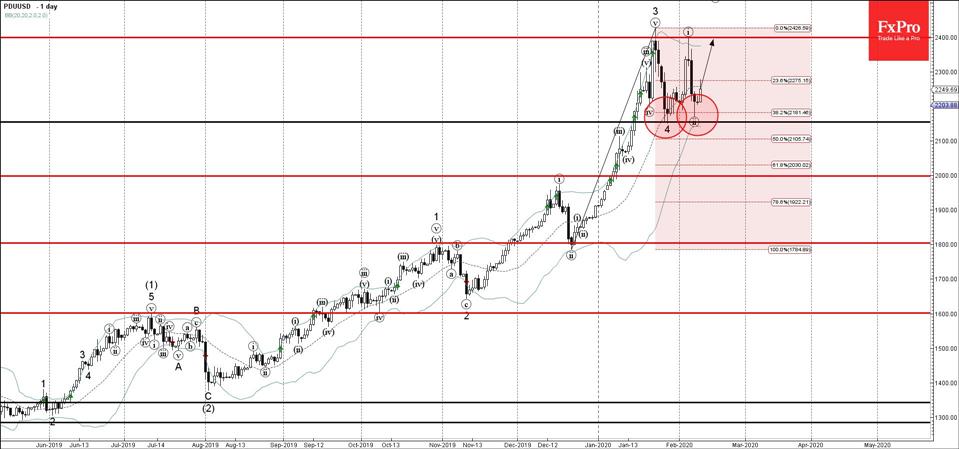
Palladium reversed from support area
Likely to rise to 2400.00
Palladium recently reversed up from the support zone located between
the key level 2155.00 (low of the previous short-term correction 4),
lower daily Bollinger Band and the 38.2% Fibonacci correction of the
pervious upward impulse 3 from December.
The upward reversal from this support area created the daily Japanese candlesticks reversal pattern Hammer.
Palladium is likely to rise further toward the next resistance level 2400.00 (top of the pervious impulse waves 3 and (i)).
Posted by AGORACOM-JC
at 3:51 PM on Monday, February 10th, 2020
SPONSOR: NORTHBUD (NBUD:CSE)
Sustainable low cost, high quality cannabinoid production and
procurement focusing on both bio-pharmaceutical development and
Cannabinoid Infused Products. Learn More.
Everything Canadians need to know about Legalization 2.0
Edibles, extracts, topicals, and vapes are finally legal in Canada. Billed as Legalization 2.0, the regulations came into effect on October 17, 2019 and products have slowly begun to trickle onto the market ever since.
Edibles, extracts, topicals, and vapes are finally legal
in Canada. Billed as Legalization 2.0, the regulations came into effect
on October 17, 2019 and products have slowly begun to trickle onto the
market ever since.
From how to consume, to what to consume, here’s everything Canadians need to know about Legalization 2.0.
Edibles 101
Cannabis-infused edibles are now available for sale through licensed
retailers in Canada, though there are strict rules around marketing and
dosing, including a limit of 10 mg of THC per packaged item.
Edibles in the form of food products, lozenges, and
beverages can produce effective, long-lasting, and safe experiences.
These forms of cannabis can also produce unpredictable effects that may feel like overdose symptoms. The difference is, of course, the dose, although it’s worth noting that while consuming too much can feel very unpleasant, no one has ever died from it.
It can take anywhere from 30 minutes to four hours for an edible to
fully kick in. Health Canada suggests that adults who use cannabis,
regardless of how they consume it, shouldn’t combine it with alcohol,
nicotine or other drugs.
Posted by AGORACOM-JC
at 3:41 PM on Monday, February 10th, 2020
Highlights
Lithium Processing: technology initiatives, patent formalization, battery recycling process and lithium metal manufacturing;
Pilot plant potentially de-risked through discussions with ready-built facilities;
Montreal, Montreal -Â February 10, 2020 – St-Georges Eco-Mining Corp. (CSE:SX)Â (CNSX:SX.CN)Â (OTC:SXOOF) (FSE:85G1)Â would like to update its shareholders on its on-going corporate developments.
In
the past six months, St-Georges has successfully executed its strategy
to strengthen and expand its focus on its green extraction metallurgical
processes development and re-center its exploration efforts on energy
metals in Quebec and Iceland. The team has also added a
Palladium-Rhodium project in Quebec and has advanced its Thor Gold
Project in Iceland to drill-ready status. Significant changes in the
Company operations, namely the sale of King of the North in September
and the spin-off of ZeU Crypto Networks Inc. in December, has allowed
the Company to free up resources that can now be allocated to the core
competencies of the Company.
Highlights
– Lithium Processing: technology initiatives, patent formalization, battery recycling process and lithium metal manufacturing;
– Pilot plant potentially de-risked through discussions with ready-built facilities;
– Hydro-Dam Project in Iceland advancing on its environmental permits;
– Status of Other Holdings.
Mineral Processing Research & Development
Lithium Processing Technology
Stage
I of the development of the Company’s lithium processing technology, in
collaboration with Iconic Minerals (TSX-V: ICM), was completed in the
first half of 2019 (See July 24, 2019 Press Release). Following the
delivery of the Stage I independent report to ICM, St-Georges has
accelerated the work and obtained results on many tasks that are part of
Stage II and Stage III of the planned development.
On-going testing has confirmed, so far, the portability of the process developed for sediments to hard rock sources of lithium.
The
Company is looking at opportunities to apply its technologies to other
advanced mining projects, in particular, ones that currently produce
spodumene concentrate, but have not yet decided to build an expensive
tech plant for refining. Potential adopters of the technology have been
identified, and discussions initiated. In addition, the Company is
looking at the potential to retrofit existing facilities. Management
will update the public on the status of these discussions when
materiality requires it.
St-Georges
filed the final documentation with the US Patent Office allowing its
patent application to move from its provisional status to the formal
patent application stage. The Company also filed a PCT application for
the same patent potentially giving it protection in an additional 152
countries. The final version of the patent application now allows for
the recovery of lithium from recycled batteries. St-Georges intends to
position itself as an ideal partner to provide strategic materials to
the battery industry, which includes recycling and recovery of the new
generation of batteries, including solid-state batteries. Additionally,
this patent application covers recycling as well as lithium metal and
alloys manufacturing.
Pilot Plant(s)
St-Georges’
management and the metallurgical team have worked on the design, the
sourcing of equipment, and the financial aspects of its proposed pilot
plant for the better part of the last six months. In an effort to lower
the risk of the proposal, the team has initiated discussions with
ready-built facilities with extra capacity. This could allow St-Georges
to build its pilot plant’s processing circuit faster with only minor
modifications to the ready-built facilities. Early estimates confirm
that capital expenditure should only be a fraction of the original
budgeted cost as the Company will be leasing the facilities long-term.
The Company expects to have secured an agreement for the pilot plant
facilities in Q2 2020.
Mineral Exploration
Julie Nickel Project
Following
last year’s fieldwork, the Company’s geological team and exploration
sub-contractors are planning additional drilling on the Julie Nickel
property. The exploration plan for the coming years will be presented to
the local stakeholders and First Nations in Q1, and the updated
permitting request should be filed by Q2 for work in early summer.
Additional bulk sampling should be performed to advance a nickel-iron
initiative by the Company’s metallurgical team.
Preliminary discussions are on-going with a ferronickel consortium planning a project in Quebec.
Manicouagan Palladium-Rhodium Project
Much
like the Julie Project, the Manicouagan Project has nickel and copper
that meets the conventional concentrates requirements based on the type
of sulphates it contains. Additionally, the recrystallized nature of
this region lends itself to higher recoveries of each crystal form and
better conversion.
The
presence of well-known high-grade Palladium-Rhodium-Ruthenium surface
showings (See January 27, 2020, Press Release), regardless of size,
allows St-Georges to significantly reduce its costs to acquire PGE
concentrate material for metallurgical bench testing of its processing
and refining metallurgical process for Palladium-Rhodium-Ruthenium.
St-Georges
exploration team is planning a pre-drilling surface campaign to obtain
permitting to intervene on-site in mid-summer. At the same time,
St-Georges’ management is having early-stage discussions with potential
farm-in or earn-in partners to advance the project at a faster pace.
Borealis EHF
The
hybrid decentralized and distributed ledger-driven derivative trading
platform is coming together at a good pace. Regulatory discussions are
now in control of the timeline for the delivery of the platform.
Islensk Vatnsorka Hf – Iceland Hydro-Electric Dam Project
Islensk
informed the Company that the permitting process is moving within the
expected timeline and according to expectations. The Company still
believes that the project will be fully permitted by the end of 2020.
Iceland Resources EHF/St-Georges Iceland ltd
On
August 21, 2019, the Icelandic authorities approved St-Georges’
previously disclosed work program for the coming year (See March 2, 2019
Press Release). The core projects have seen a fair share of exploration
work, while some secondary projects have been repeatedly delayed due to
extreme weather conditions in northern and eastern Iceland.
Work
on the Thor Gold Project has brought it to drill-ready status. Surface
rights and environmental conditions are no longer problematic, and the
Company has requested a legal opinion to confirm that it can drill on
the sole basis of its central government license.
The
Company did, however, take samples at Thor during the winter season
that are currently being analyzed. The Company is now preparing a bulk
sample program at Thor. The material will be sent to be processed in
Canada as soon as the weather allows it sometime in Q2.
The
Company is currently in discussions to acquire the balance of the
surface rights that escape its ownership on the project and is looking
to acquire the last portion equity own by a third party in the Thor Gold
Project.
Status of other holdings
The Company currently holds the following assets as of January 31, 2020.
Vilhjalmur Thor Vilhjalmsson, President and CEO of St-Georges, commented: “(…)
the last six months have been for the Company both challenging but
exciting. With the successful listing of ZeU Crypto Networks Inc., the
sale of KOTN, funding above market prices, and now faster-than-expected
progress in regards to the pilot plant, the team has shown its
capabilities to deliver.”
St-Georges
is developing new technologies to solve some of the most common
environmental problems in the mining industry. The Company controls
directly or indirectly, through rights of first refusal, all the active
mineral tenures in Iceland. It also explores for nickel-copper-cobalt
and Palladium-Palladium-Rhodium-Ruthenium on the Julie Nickel Project
& the Manicouagan Palladium-Rhodium Project on the Quebec’s North
Shore. Headquartered in Montreal, St-Georges’ stock is listed on the CSE
under the symbol SX, on the US OTC under the Symbol SXOOF and on the
Frankfurt Stock Exchange under the symbol 85G1.
The
Canadian Securities Exchange (CSE) has not reviewed and does not accept
responsibility for the adequacy or the accuracy of the contents of this
release.
Posted by AGORACOM-JC
at 2:15 PM on Monday, February 10th, 2020
SPONSOR: Datametrex AI Limited
(TSX-V: DM) A revenue generating small cap A.I. company that NATO and
Canadian Defence are using to fight fake news & social media
threats. The company announced three $1M contacts in Q3-2019. Click here for more info.
Jigsaw’s work requires forecasting the most urgent threats facing the
internet, and wherever we traveled these past years — from Macedonia to
Eastern Ukraine to the Philippines to Kenya and the United States — we
observed an evolution in how disinformation was being used to manipulate
elections, wage war, and disrupt civil society. By disinformation we
mean more than fake news. Disinformation today entails sophisticated,
targeted influence campaigns, often launched by governments, with the
goal of influencing societal, economic, and military events around the
world. But as the tactics of disinformation were evolving, so too were
the technologies used to detect and ultimately stop disinformation.
Using technology to detect manipulated images
Beginning in 2016 we began working with researchers and academics to
develop new methods for using technology to detect certain aspects of
disinformation campaigns. Together with Google Research and academic partners, we developed an experimental platform called Assembler to test how technology can help fact-checkers and journalists identify and analyze manipulated media.
Debunking images is a time consuming and error-prone process for
fact-checkers and journalists. To verify the authenticity of images,
they rely on a number of different tools and methods. For example,
Bellingcat, a group of researchers and investigative journalists
dedicated to in-depth fact-checking, lists more than 25 different
tools and services available to verify the authenticity of photos,
videos, websites, and other media. Fact-checkers and journalists need a
way to stay ahead of the latest manipulation techniques and make it
easier to check the authenticity of images and other assets.
Assembler brings together multiple image manipulation detectors from
various academics into one tool, each one designed to spot specific
types of image manipulations. Individually, these detectors can identify
very specific types of manipulation — such as copy-paste or
manipulations to image brightness. Assembled together, they begin to
create a comprehensive assessment of whether an image has been
manipulated in any way. Experts from the University of Maryland,
University Federico II of Naples, and the University of California,
Berkeley each contributed detection models. Assembler uses these models
to show the probability of manipulation on an image.
Additionally, we built two new detectors to test on the platform.The
first is the StyleGAN detector to specifically address deepfakes. This
detector uses machine learning to differentiate between images of real
people from deepfake images produced by the StyleGAN deepfake
architecture. Our second model, the ensemble model, is trained using
combined signals from each of the individual detectors, allowing it to
analyze an image for multiple types of manipulation simultaneously.
Because the ensemble model can identify multiple image manipulation
types, the results are, on average, more accurate than any individual
detector.
“These days working in multimedia forensics is extremely stimulating.
On one hand, I perceive very clearly the social importance of this
work: in the wrong hands, media manipulation tools can be very
dangerous, they can be used to ruin the life and reputation of ordinary
people, commit frauds, modify the course of elections,†said Dr. Luisa
Verdoliva, Associate Professor at the Department of Industrial
Engineering at the University Federico II of Naples and Visiting
Scholar, Google AI. “On the other hand, the professional challenge is
very exciting, new attacks based on artificial intelligence are
conceived by day, and we must keep a very fast pace of innovation to
face them. Collaborating in Assembler was a great opportunity to put my
knowledge and my skills concretely to the service of people. In addition
I came to know wonderful and very diverse people involved in this
project, all strongly committed in this fight. Overall a great
experience.â€
The Current: Exposing the architecture of disinformation campaigns
Jigsaw is an interdisciplinary team of researchers, engineers,
designers, policy experts, and creative thinkers, and we’ve long wanted
to find a way to share more of our team’s work publicly, especially our
research insights. That’s why I’m excited to introduce the first issue
of The Current, Jigsaw’s new research publication that illuminates complex problems through an interdisciplinary approach — like our team.
Our first issue is, as you might have guessed, all about
disinformation — exploring the architecture of disinformation campaigns,
the tactics and technology used, and how new technology is being used
to detect and stop disinformation campaigns.
One feature of this inaugural issue is the Disinformation Data Visualizer. Jigsaw visualized the research from the Atlantic Council’s DFRLab on
coordinated disinformation campaigns around the world and shows the
specific tactics used and countries affected. The Visualizer is a work
in progress. We’re sharing this with the wider community to enable a
dialogue about the most effective and comprehensive disinformation
countermeasures.
An ongoing experiment
Disinformation is a complex problem, and there isn’t any simple
technological solution. The first step is to better understand the
issue. The world ought to understand how disinformation campaigns are
increasingly being used as a way of manipulating people’s perception of
important issues. We’re committed to sharing our insights and publishing
our research so other organizations can examine and scrutinize
different ways to approach this issue. We’ll be sharing more updates
about Jigsaw’s work in this space over the coming few months.
In the meantime we’d like to express our gratitude to our academic
partners, our partners within Google, and the courageous publishers and
journalists who are committed to using technology to bring people the
truth, wherever it leads: Chris Bregler, Larry Davis, Alexei Efros, Hany
Farid, Andrew Owens, Abhinav Shrivastava, Luisa Verdoliva, and Emerson
Brookings, Graham Brookie and the Atlantic Council’s DFRLab team.
Posted by AGORACOM-JC
at 1:15 PM on Monday, February 10th, 2020
SPONSOR: CardioComm Solutions (EKG: TSX-V)
– The heartbeat of cardiovascular medicine and telemedicine. Patented
systems enable medical professionals, patients, and other healthcare
professionals, clinics, hospitals and call centres to access and manage
patient information in a secure and reliable environment.
mHealth Market Is Generating Revenue of $10.5 billion by 2020, at CAGR 33.5% Growth Rate
Global mHealth market was valued at $10.5 billion in 2014 and is expected to grow at a CAGR of 33.5% during 2015-2020.
Mobile health provides health service and information through mobile communication devices to address the health priorities and concerns. The advanced mobile and wireless technologies have transformed the face of healthcare services across the globe and are rendering the growth of mHealth market.
Moreover, the continued growth in coverage of mobile cellular networks, rapid advances in mobile technologies & applications, increasing lifestyle diseases and growing awareness among patient population in emerging economies, are some of the key factors fostering the growth of mHealth market. On contrary, the lower accuracy of the devices, technology’s infancy in middle and lower income economies, weak reimbursement coverage, uncertainty in government regulations in certain regions, and low adoption among ageing population is hampering the market growth to a certain extent.
The major chunk of mHealth devices market – i.e. ~71% – is
collectively commanded by BP monitors, blood glucose monitors and
cardiac monitors. The largest share of these monitors can be attributed
to increased affordability of mobile compatible devices, integration of
innovative technologies in monitoring devices and the increasing
lifestyle disease such as diabetes, stroke, COPD, ischemic heart to name
a few. Within mHealth services, diagnostic, monitoring and treatment
services collectively hold about 74% of the market. The rapid growth of
mHealth services market is attributed to rising government initiatives,
increasing mHealth awareness programs in underdeveloped regions etc.
Geographically,
North America and Europe constitute the two largest markets for mHealth
and collectively accounted for 67% of the market revenue in 2014. They
are expected to continue its hold on the global market throughout the
forecast period. Early adoption of innovative technology, large patient
population and high capacity to pay for services are some of the key
factors responsible for the growth of mHealth market in these regions.
However, the market outlook across developing economies is looking
favorable and strong owing to the increasing awareness of chronic
diseases, favorable government regulations and increased healthcare
expenditure. Philips healthcare, Bayer Healthcare and Sanofi are some of
the key companies enjoying a strong foothold in mHealth market,
especially in Asian countries.
Tags: EKG, mhealth, small cap stocks, stocks, tsx, tsx-v Posted in CardioComm Solutions | Comments Off on #Mhealth Market Is Generating Revenue of $10.5 billion by 2020, at CAGR 33.5% Growth Rate – SPONSOR: CardioComm Solutions $EKG.ca – $ATE.ca $TLT.ca $OGI.ca $ACST.ca $IPA.ca
Posted by AGORACOM-JC
at 12:45 PM on Monday, February 10th, 2020
SPONSOR: BetterU Education Corp.
aims to provide access to quality education from around the world. The
company plans to bridge the prevailing gap in the education and job
industry and enhance the lives of its prospective learners by developing
an integrated ecosystem. Click here for more information.
The Landscape Of Edtech: Mapping The Innovation Revamping Education In India
Over $1.8 Bn has been invested into Indian edtech startups from 2014 to 2019
The test prep segment has the highest capital inflow and the greatest demand in India
India’s tech economy growth has pushed the demand for skill development solutions
From classrooms to smart devices, the medium of education and learning in India has gone through a paradigm shift. With over 665 Mn
wireless internet subscribers (Q3 2019), India has seen a massive 14%
increase in the addressable base for internet services in just one year.
This rate of adoption has meant great things for startups and digital
products and services and has given rise to personalisation and
convenience when it comes to the school curriculum and off-classroom
learning.
The growing popularity of online learning has provided a major push
to two of the top subsectors in the edtech market— test preparation
(from K-12 to entrance exams) and online certification. To put this into
perspective, between 2014 to 2019, startups in test prep and online
certification startups earned a whopping 88% ($1.6 Bn) of the total
capital inflow in edtech.
The skewness in funding and investor interest for test prep and
online certification startups is in line with the prevalence of the
grades-first mentality in the Indian market as well as the need for
skilled tech labour. These products are highly in demand in the Indian
market because they mirror the traditional climb up the education ladder
— preparation for exams and getting the right certificate for
employment.
Posted by AGORACOM-JC
at 12:10 PM on Monday, February 10th, 2020
SPONSOR: PRIMO NUTRACEUTICALS INC.
(CSE: PRMO) (OTC: BUGVF) (FSE: 8BV) (DEU: 8BV) (MUN: 8BV) (STU: 8BV)
provides strategic capital to the thriving cannabis cultivation
sector through ownership and development of commercial real estate
properties. The company also offers fully built out turnkey facilities
equipped with state-of-the-art growing infrastructure to cannabis
growers and processors. Click here for more info.
CBD’s Touted Therapeutic Benefits Help Loosen Regulatory Constraints
Global cannabidiol market is expected to reach USD 9.69 Billion by 2025 while registering a CAGR of 32.6% during the forecast period.
NEW YORK, Feb. 10, 2020 – Most regions that have approved medical cannabis typically see doctors prescribe CBD-based medications to their patients. CBD, or cannabidiol, is a derivative of the hemp plant, yet is unlike its counterpart, THC, which is derived from the marijuana plant. Nowadays, the FDA acknowledges that CBD can possibly become a legitimate alternative medical treatment to a number of traditional therapeutics, further highlight the health benefits associated with the compound. However, the agency is requiring researchers to provide more data on the efficacy of CBD in order for CBD to become an approved medicinal treatment, prompting them to conduct large-scale clinical trials. “As legislation expands rapidly worldwide, the volume of efficacy data is growing, as are legitimate clinical trial studies,” says Liam McGreevy, Chief Executive Officer of Ethnopharm, a European cannabis company specializing in genetics and distribution, “This data will enable us to better understand the effects of the various cannabinoids and terpenes, their synergistic effect and how their impact links to the individual’s genetics or biomarkers.
This data is key to understanding the most effective combinations and
strengths for various conditions, moving towards targeted personalized
medicines.” And according to data compiled by Grand View Research, the
global cannabidiol market is expected to reach USD 9.69 Billion
by 2025 while registering a CAGR of 32.6% during the forecast period.
Global Payout, Inc. (OTC: GOHE), Auxly Cannabis Group Inc. (OTC: CBWTF),
Puration Inc. (OTC: PURA), Green Organic Dutchman Holdings Ltd. (OTC:
TGODF), Liberty Health Sciences Inc (OTC: LHSIF)
As the cannabis industry continues to develop, lawmakers and federal
agencies are actively working towards expanding the market. Recently,
the U.S. Department of Agriculture (USDA) provided an update on its
interim final rule process for hemp. According to the USDA, hemp
production in the U.S. has seen a resurgence in the last five years;
however, it remains unclear whether consumer demand will meet the
supply. High prices for hemp, driven primarily by demand for use in
producing CBD, relative to other crops, have also driven increases in
planting. As such, producer interest in hemp production is largely
driven by the potential for high returns from sales of hemp flowers to
be processed into CBD oil.
And after extensive consultation with the Attorney General, the USDA
issued the following interim final rule to establish the domestic hemp
production program and to facilitate the production of hemp, as set
forth in the 2018 Farm Bill: The USDA upholds the 0.3% threshold as out
of its jurisdictional hands as written into the law. Furthermore, the
lack of remedies for testing noncompliance raised suggestions that
farmers be allowed to ship to processors who could remove the THC to
keep the crop viable. Another subject of worry was the requirement (as
described in the Federal Register) that laboratories be certified by the
Drug Enforcement Administration (DEA), and crops tested within 15 days
prior to harvest. Yet, by the end of January, only 44 labs existed to
support more than 16,000 licensed farmers. Accordingly, the industry
expects to remain bureaucratically constrained yet again after other
fundamental supply-chain bottlenecks limited output and producers’
ability to bring their crops to market.
Tags: CBD, Hemp, Marijuana, stocks, tsx, tsx-v Posted in PRIMO Nutraceuticals Inc. | Comments Off on PRIMO Nutraceuticals Inc. $PRMO.ca – #CBD’s Touted Therapeutic Benefits Help Loosen Regulatory Constraints $CROP.ca $VP.ca NF.ca $MCOA
Posted by AGORACOM-JC
at 11:02 AM on Thursday, February 6th, 2020
For some reason, we all take online privacy and identity for granted. In the real world, we have someone verify who we are at the airport, banks and even bars by presenting ourselves in person, along with documentation (passport, drivers license, etc.)
But online we just punch in our credit card + CVV number (that one on the back) to access or buy just about anything. The problem, as we’ve long known, is the recipient of your info has no idea if its really you, or the waiter you gave your credit card to last night at dinner.
For decades, we’ve accepted it as a cost of the convenience of credit cards, which is built into the ridiculously high % rates charged by credit card companies.
That’s all about to change. People and governments have figured out over the past couple of years (see FACEBOOK) that too many companies know too much about us and use it to fill their pockets with insane amounts of money …. while sharing nothing with us.
Legislation has already been enacted and more is coming that will force EVERY company to re-think their business models. The free ride is over for them and just beginning for us.
Enter KABN. Watch this from your device, or listen to it in your car, bus or dentist’s waiting room. KABN is private but has already announced a proposed RTO.
We’re banging the table on how things are going to change beyond recognition this decade. KABN is one of the companies making it possible.
Posted by AGORACOM-JC
at 4:01 PM on Tuesday, February 4th, 2020
SPONSOR: Datametrex AI Limited
(TSX-V: DM) A revenue generating small cap A.I. company that NATO and
Canadian Defence are using to fight fake news & social media
threats. The company announced three $1M contacts in Q3-2019. Click here for more info.
The technology that could save us from deepfake videos
Israeli startup Cyabra’s technology detects expertly doctored videos as well as the bots powering fake social-media profiles.
It’s November 2020, just days before the US presidential election, and a video clip comes out showing one of the leading candidates saying something inflammatory and out of character. The public is outraged, and the race is won by the other contender.
The only problem: the video wasn’t authentic. It’s a “deepfake,â€
where one person’s face is superimposed on another person’s body using
sophisticated artificial intelligence and a misappropriated voice is
added via smart audio dubbing.
The AI firm Deeptrace uncovered 15,000 deepfake videos online in
September 2019, double what was available just nine months earlier.
The technology can be used by anyone with a relatively high-end
computer to push out disinformation – in politics as well as other
industries where credibility is key: banking, pharmaceuticals and
entertainment.
Israeli startup Cyabra is one of the pioneers in identifying deepfakes fast, so they can be taken down before they snowball online.
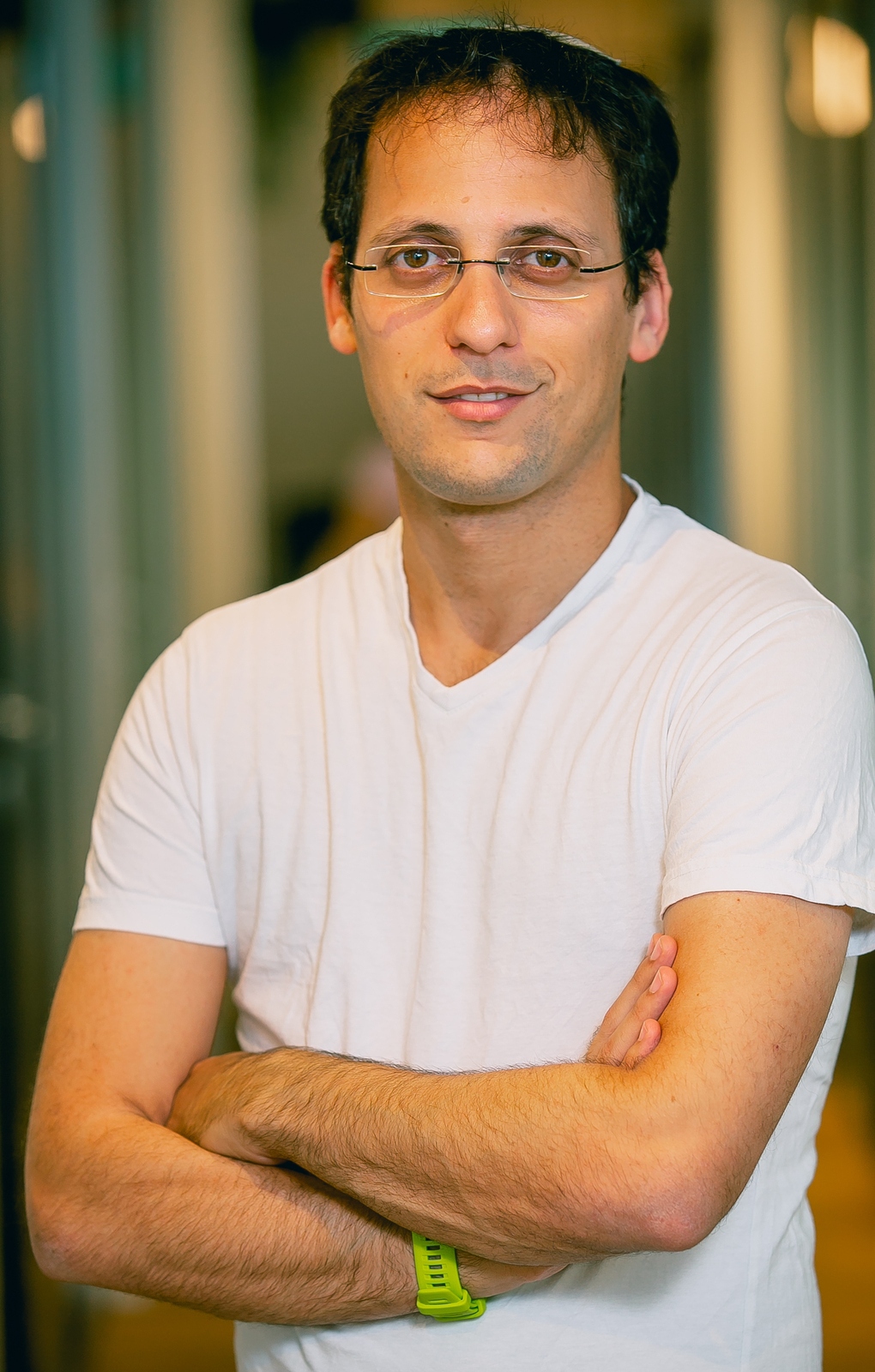
Cyabra cofounder and CEO Dan Brahmy. Photo: courtesy
Cyabra CEO Dan Brahmy tells ISRAEL21c that there are two ways to
train a computer algorithm to analyze the authenticity of a video.
“In a supervised approach, we give the algorithm a dataset of, say,
100,000 pictures of regular faces and face swaps,†he explains. “The
algorithm can catch those kinds of swaps 95 percent of the time.â€
The second methodology is an “unsupervised approach†inspired by a surprising field: agriculture.
“If you fly a drone over a field of corn and you want to know which
crop is ready and which is not, the analysis will look at different
colors or the way the wind is blowing,†Brahmy explains. “Is the corn
turning towards its right side? Is it a bit more orange than other parts
of the field? We look for those small patterns in videos and teach the
algorithm to spot deepfakes.â€
Cyabra’s approach is more sophisticated than traditional methods of
ferreting out deepfakes – looking at metadata, for example, of where was
the picture taken, what kind of camera was used and on what date it was
shot.
“Our algorithm might not know the exact name of the manipulation
used, but it will know that the video is not real,†Brahmy says.
Only a computer program can spot telltale signs the human eye would
miss, such as eyeglasses that don’t fit perfectly or lip movements not
perfectly synched with movements of the chin and Adam’s apple, Brahmy
tells ISRAEL21c.
Staying a few steps ahead
Cyabra’s technology detects inauthentic nuances that the human eye would miss. Photo: courtesy
Deepfake detection technology must continually evolve.
In the early days – all the way back in 2017, when deepfakes first
started appearing – fake faces didn’t blink normally. But no sooner had
researchers alerted the public to watch for abnormal eye movements than
deepfakes suddenly started blinking normally.
“To have a durable edge, you need to be a year or two ahead, to make sure no one can re-do what you just did,†Brahmy says.
That’s important both in catching the deepfakers and for a company like Cyabra to stay ahead of the competition.
Cyabra’s edge is that two of its four cofounders came out of IDF
intelligence divisions where they looked for ways to foil terrorist
groups trying to create fake profiles to connect with Israelis.
In addition, former Mossad deputy director Ram Ben Barak is on the company’s board of directors.
Fake social-media profiles
Cyabra’s deepfake detection technology was only released in the last
month. For most of the past two years, since the company was founded, it
has been focused on spotting fake social-media profiles.
Cyabra cofounder and COO Yossef Daar. Photo: courtesy
Brahmy cofounderYossef Daar claims there are 140 million fake
accounts on Facebook, 38 million on LinkedIn, and 48 million bots on
Twitter.
These, too, are not easy to detect.
Researchers from the University of Iowa discovered that some 100
million Facebook “likes†that appeared between 2015 and 2016 were
created by spammers using around a million fake profiles.
Cyabra’s machine-learning algorithms run some 300 unique parameters
to determine profile authenticity. A three-day-old profile with 700
friends whose user has no footprint outside of Facebook raises a red
flag, for example.
In the 2016 U.S. elections, fake profiles on social media were the biggest problem – deepfakes didn’t exist yet.
By now, though, you’ve probably seen a few deepfakes yourself: Facebook CEO Mark Zuckerberg bragging about having “total control of billions of people’s stolen data,†former US President Obama using a profanity to describe President Trump or Jon Snow apologizing for the writing in season 8 of “Game of Thrones.â€
Brahmy says the leadup to the 2020 election season is the right time to offer Cyabra’s solution.
Investors agree. Cyabra has raised $3 million from TAU Ventures and
$1 million from the Israel Innovation Authority. The 15-person company
started in The Bridge, a seven-month Tel Aviv-based accelerator
sponsored by Coca-Cola, Turner and Mercedes. Now they’re based at TAU
Ventures with a small presence in the United States as well.
Public and private sector clients
Cyabra’s clients prefer not to be named, although Brahmy did tell
ISRAEL21c that 50% of its clients are in the public sector –
governmental organizations or agencies – and the other half are “in the
world of sensitive brands: consumer product, food and beverage, media
conglomerates.â€
“Imagine you’re in the business of providing unbiased information and
suddenly 500 bots send you a message with a falsified picture and
you’re ready to publish it. We want to be there five seconds before you
pull the trigger, to let you know it’s false,†says Brahmy.
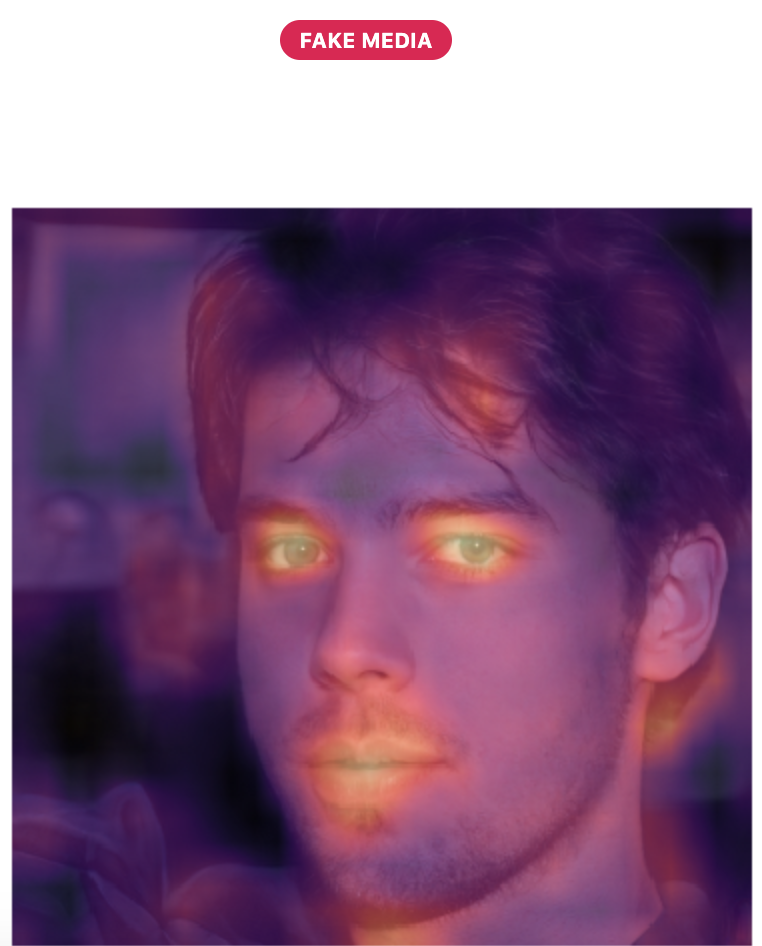
This heatmap shows the level of doctoring done to a picture or
frame in a video. Emphaized areas represent more heavily forged pieces
of content. Image courtesy of Cyabra
Cyabra leaves the task of fact-checking content for “fake news†to other companies such as NewsGuard and FactMata. (Neither company is Israeli.)
There are also other companies dealing with deepfakes and fake
profiles. But, Brahmy says, “we’re the only one doing both, with the
technical capability to detect deepfakes along with cross-channel
analysis to detect the bots [powering fake social media profiles], all
under one roof.â€
Facebook announced in January 2020 that it is banning deepfakes intended to mislead rather than entertain. But can Facebook really get ahead of all the deepfakes out there – and those to come?
If Cyabra and companies like it succeed, the next time you see a
politician or celebrity saying something you find reprehensible, it
might just be true.
Posted by AGORACOM-JC
at 2:58 PM on Tuesday, February 4th, 2020
MONTREAL, Feb. 04, 2020 — PyroGenesis Canada Inc. (http://pyrogenesis.com) (TSX-V: PYR) (OTCQB: PYRNF) (FRA: 8PY), a high-tech company, (the “Company”, the “Corporation†or “PyroGenesis”) that designs, develops, manufactures and commercializes plasma atomized metal powder, plasma waste-to-energy systems and plasma torch products, issues this press release in response to recent trading activity in its shares, and stock price decline.
The Company does not usually opine on stock price and trading
activity, however, given the recent decline, and inquiries from
investors, the Company confirms the following:
Everything material has been disclosed by the Company in either its
press releases or quarterly reports. PyroGenesis further confirms that
none of the contracts press released are at risk. Last but not least,
the Company wishes to reassure PyroGenesis’ shareholders that we remain
on track with our current and prospective projects, and that all
contracted projects are being worked on, and such activity will be
reflected in Q1 2020 results.
About PyroGenesis Canada Inc.
PyroGenesis Canada Inc., a high-tech company, is the world leader in
the design, development, manufacture and commercialization of advanced
plasma processes and products. We provide engineering and manufacturing
expertise, cutting-edge contract research, as well as turnkey process
equipment packages to the defense, metallurgical, mining, advanced
materials (including 3D printing), oil & gas, and environmental
industries. With a team of experienced engineers, scientists and
technicians working out of our Montreal office and our 3,800 m2
manufacturing facility, PyroGenesis maintains its competitive advantage
by remaining at the forefront of technology development and
commercialization. Our core competencies allow PyroGenesis to lead the
way in providing innovative plasma torches, plasma waste processes,
high-temperature metallurgical processes, and engineering services to
the global marketplace. Our operations are ISO 9001:2015 and AS9100D
certified, and have been since 1997. PyroGenesis is a publicly-traded
Canadian Corporation on the TSX Venture Exchange (Ticker Symbol: PYR)
and on the OTCQB Marketplace. For more information, please visit www.pyrogenesis.com.
This press release contains certain forward-looking statements,
including, without limitation, statements containing the words “may”,
“plan”, “will”, “estimate”, “continue”, “anticipate”, “intend”,
“expect”, “in the process” and other similar expressions which
constitute “forward- looking information” within the meaning of
applicable securities laws. Forward-looking statements reflect the
Corporation’s current expectation and assumptions and are subject to a
number of risks and uncertainties that could cause actual results to
differ materially from those anticipated. These forward-looking
statements involve risks and uncertainties including, but not limited
to, our expectations regarding the acceptance of our products by the
market, our strategy to develop new products and enhance the
capabilities of existing products, our strategy with respect to research
and development, the impact of competitive products and pricing, new
product development, and uncertainties related to the regulatory
approval process. Such statements reflect the current views of the
Corporation with respect to future events and are subject to certain
risks and uncertainties and other risks detailed from time-to-time in
the Corporation’s ongoing filings with the securities regulatory
authorities, which filings can be found at www.sedar.com, or at
www.otcmarkets.com. Actual results, events, and performance may differ
materially. Readers are cautioned not to place undue reliance on these
forward-looking statements. The Corporation undertakes no obligation to
publicly update or revise any forward- looking statements either as a
result of new information, future events or otherwise, except as
required by applicable securities laws. Neither the TSX Venture
Exchange, its Regulation Services Provider (as that term is defined in
the policies of the TSX Venture Exchange) nor the OTCQB accepts
responsibility for the adequacy or accuracy of this press release.
SOURCE PyroGenesis Canada Inc.
For further information please contact: Rodayna Kafal, Vice President Investors Relations and Strategic Business Development, Phone: (514) 937-0002, E-mail: [email protected]