Agoracom Blog Home

Archive for the ‘All Recent Posts’ Category

VIDEO: Affinity Metals $AFF.ca Discusses Significant Silver Discovery at their Regal Project in B.C $SII.ca $TUD.ca $GTT.ca $AMK.ca $OSK.ca $RKR.ca

Posted by AGORACOM-JC at 9:37 AM on Wednesday, April 22nd, 2020
Affinity Metals Corp. Enters into Agreement to Acquire the Regal ...

Rob Edwards discusses the extraordinary exploration results at the ALLCO Project and the implications of discovering such a significant discovery hole at their Regal Pollymettalic Property in the Kootenay Arc, B.C.

The numbers show there is a considerable source of mineralization on the property to create 11.10 meters of 143.29 g/t silver including 0.55 meters of 2612.0 g/t,   only further exploration will continue to define the limits of the Allco area and other the Major targets Affinity has plans for developing during the 2020 exploration season.

Take a seat and grab your favorite beverage and have a listen to the remarkable story that is Affinity Metals.

Bank of America Calling for $3,000 Gold in 18 Months SPONSOR: Loncor Resources $LN.ca $ABX.ca $TECK.ca $RSG $NGT.to $GOLD $NEM

Posted by AGORACOM at 8:52 AM on Wednesday, April 22nd, 2020

Sponsor: Loncor, a Canadian gold explorer controlling over 2,400,000 high grade ounces outside of a Barrick JV. The Ngayu JV property is 200km southwest of the Kibali gold mine, operated by Barrick, which produced 800,000 ounces of gold in 2018. Barrick manages and funds exploration at the Ngayu project until the completion of a pre-feasibility study on any gold discovery meeting their Tier One investment criteria. Newmont $NGT $NEM owns 7.8%, Resolute $RSG owns 27% Click Here for More Info

This image has an empty alt attribute; its file name is Loncor-Small-Square.png
  • The analysts noted that the Federal Reserve: “Can’t print gold.”

(Kitco News) – Bank of America commodity analysts just keep getting more bullish on gold as the weeks go by.

The bank said in a report last week that gold ’s technical momentum could drive prices to an all-time high this year; in a new report published Tuesday, analysts have officially increased their bullish outlook, saying that gold prices could hit $3,000 within 18 months, a 50% increase from its previous forecast

Along with increasing its 18-month target, the bank said that it sees gold prices averaging $2,063 an ounce in 2021.

“As economic output contracts sharply, fiscal outlays surge, and central bank balance sheets double, fiat currencies could come under pressure. And investors will aim for gold,” the analysts said.

Although a strong U.S. dollar and weak physical jewelry demand in Asia could be headwinds for the gold market, the analysts said that the Federal Reserve has provided enough momentum to propel investment demand and prices higher.

Economists at Bank of America have warned that the Federal Reserve’s balance sheet as a percentage of GDP could rise 20% to 40% this year. According to reports last week, the Federal Reserve’s balance sheet hit a record high of $6.42 trillion, up more than 50% from levels reported during the first week of March.

The analysts noted that the Federal Reserve: “Can’t print gold.”

“Beyond traditional gold supply and demand fundamentals, financial repression is back on an extraordinary scale. Rates in the US and most G-10 economies will likely be at or below zero for a very long period of time as central banks attempt to push inflation back above their targets,” the analysts said.

Although investor sentiment has improved slightly during the last few weeks, the bank’s analysts said that there is still more bad news ahead. They noted that economists are forecasting a 30% decline in the U.S. GDP in the second quarter as the economy was grounded after all non-essential businesses were closed and citizens were requested to stay at home.

“As central banks rush to expand their balance sheets and backstop the economy, a lot of risks could effectively be socialized, boosting the appeal of gold,” the analysts said.

Weak economic growth does not bode well for equity markets, the analysts said, adding that this will be another factor supporting higher gold prices.

“The positive equity/gold correlations are a possible sign that equity markets may not have fully bottomed and that the gold market has further room to run, in our view. The trigger here could be an extension of lockdown restrictions over the next few weeks,” the analysts said.

Despite the strong bullish sentiment, Bank of America does see some risks in the marketplace. Along with weak physical demand, the analysts said that central bank gold purchases are expected to slow this year.

They also noted that lower market volatility could also weigh on gold prices.

Source:https://www.kitco.com/news/2020-04-21/Bank-of-America-calling-for-3-000-gold-in-18-months.html

Mota Ventures $MOTA.ca Raises $2.8 Million in Additional Private Placement $APH.ca $GBLX $PFE $ACG.ca $ACB.ca $WEED.ca $HIP.ca $WMD.ca $CGRW

Posted by AGORACOM at 8:03 AM on Wednesday, April 22nd, 2020
https://s3.amazonaws.com/s3.agoracom.com/public/companies/logos/564664/hub/MOTA_Large.png

VANCOUVER, BC / ACCESSWIRE / April 22, 2020 / Mota Ventures Corp. (CSE:MOTA)(FSE:1WZ:GR)(OTCPINK:PEMTF) (the “Company“) is pleased to announce that it has completed a further offering (the “Offering“) of 9,944,000 units (each, a “Unit“) by way of non-brokered private placement at a price of $0.28 per Unit for gross proceeds of $2,784,320. Each Unit consists of one common share of the Company, and one common share purchase warrant (each, a “Warrant“) exercisable to acquire an additional share at a price of $0.38 for a period of twenty-four months, expiring on April 21, 2022. When combined with the earlier offering completed by the Company on April 1, 2020, the Company has raised gross proceeds of $4,504,320.

The Company anticipates utilizing the proceeds of the Offering to further develop and market products in North America and Europe using its ecommerce sales channels, to satisfy compensation obligations owing to employees based on services provided to the Company and the satisfaction of performance metrics and for general working capital purposes. In connection with completion of the Offering, the Company has paid $75,120 and issued 262,857 common shares and 268,287 Warrants to certain arms-length parties who assisted in facilitating the Offering. The Company has also issued 142,857 Warrants to an arms-length consultant, as partial consideration for services provided to the Company.

All securities issued in connection with the Offering are subject to a four-month-and-one-day statutory hold period in accordance with applicable securities law.

About Mota Ventures Corp.

Mota Ventures is seeking to become a vertically integrated global CBD brand. Its plan is to cultivate and extract CBD into high-quality value-added products from its Latin American operations and distribute it both domestically and internationally. Its existing operations in Colombia consist of a 2.5-hectare site that has optimal year-round growing conditions and access to all necessary infrastructure. Mota is looking to establish sales channels and a distribution network internationally through the acquisition of the Sativida and First Class CBD brands. Low cost production, coupled with international, direct to customer sales channels will provide the foundation for the success of Mota Ventures.

ON BEHALF OF THE BOARD OF DIRECTORS
MOTA VENTURES CORP.

Joel Shacker
President

For further information, readers are encouraged to contact Joel Shacker, President, at +604.423.4733 or by email at [email protected] or www.motaventuresco.com

CLIENT FEATURE: Tartisan Nickel $TN.ca Kenbridge Property Hosts M&I Resource of 7.14 Million Tonnes of 0.62% Nickel + 0.33% Copper – $ROX.ca $FF.ca $EDG.ca $AGL.ca $ANZ.ca

Posted by AGORACOM-JC at 2:05 PM on Tuesday, April 21st, 2020
Tc logo in black

Investment Highlights

  • Kenbridge property has a measured and indicated resource of 7.14 million tonnes at 0.62% nickel, 0.33% copper
  • 17.5 (21.8 fully diluted) percent equity stake in Eloro Resources and 2 percent NSR in their La Victoria property

Kenbridge Ni Project (ON, Canada)

  • Advanced  stage  deposit  remains open  in  three  directions,  is  equipped with a 623m  deep  shaft  and  has  never  been  mined
  • Preliminary  Economic Assessment completed and updated returned robust project 
    economics and operating costs including  a  NPV  of  C$253M  and  cash costs of US$3.47/lb of nickel net of  copper credits
  • Plans for Kenbridge include updating PEA, advancing the project through to feasibility and exploring the open mineralization at depth

Recent News

  • Company has completed a Spectral Analysis Survey
  • Survey covered the patented and single-cell mining claims that make up the historic land position which contains the Kenbridge Deposit and the surrounding area, identifying several new exploration targets not only for nickel, copper, cobalt, but also for potential gold occurrences
  • Analysis Survey shows the distribution and intensity of up to 304 minerals, with the first pass showing up to 16 minerals
  • Each mineral can be classified into an exploration relevance for base metals, precious metals and industrial metals

Tartisan CEO Mark Appleby said, “the survey picked out the Kenbridge Deposit, and has shown the possible extension to the Kenbridge Deposit and three additional trends that relate directly to underlying geology and structure implicit in the Kenbridge Deposit. Of significant interest, the survey found two gold trends as well, which include the Violet and Nina historic gold occurrences. One of the occurrences is almost 54 hectares in size and covers almost all of three of our staked claims on the border of the Kenbridge property.”

Industry News

INDUSTRY BULLETIN: Nickel prices jump after Vale trims output target

INDUSTRY BULLETIN: Nickel prices get a boost from pandemic-driven ore supply tightness

INDUSTRY BULLETIN: Have the next crop of battery metals producers been oversold?

INDUSTRY BULLETIN: The thematic case for nickel

Click Here to View Kenbridge 43-101 Technical Report

FULL DISCLOSURE: Tartisan Nickel Corp. is an advertising client of AGORA Internet Relations Corp.

MUST WATCH: KABN Systems North America Online “Ask Me Anything” Event

Posted by AGORACOM-JC at 12:28 PM on Tuesday, April 21st, 2020

KABN Systems North America is in the business of verifying, managing and monetizing online Digital Identity.

Digital Data is the new “Gold”!

KABN North America empowers users to verify, protect, manage and profit from their Digital Identity.  With the recent changes to working, shopping, educating and playing from home, online usage and engagement is growing.

KABN’s business is:

  • About providing consumers with no-cost tools to manage their Digital Identity and profit from the public data.
  • Focused online making us Covid-19 resistant.
  • Relevant to 100% of the online, digital market.
  • Optimized for commercial partnerships in Financial Services, eCommerce, Education, Government, Healthcare, Technology, Gaming & more.
  • Built, scalable, proven and in market today.
  • Aligned with online revenue trends.
  • Run by a veteran team of successful industry leaders.
  • In process of a proposed RTO transaction for public listing.

CBD In Medicine: Relief and Regulation SPONSOR: Mota Ventures $MOTA.ca $APH.ca $GBLX $PFE $ACG.ca $ACB.ca $WEED.ca $HIP.ca $WMD.ca $CGRW

Posted by AGORACOM at 11:40 AM on Tuesday, April 21st, 2020
  • Neuropharmacologist and Functional Medicine practitioner Dr Elisabeth Philipps tells MCN about the therapeutic benefits of CBD and talks about CBD regulation.

MCN speaks to Dr Philipps about the science behind the health benefits of CBD and the need for standardised regulation of CBD food supplements.

Dr Elisabeth Philipps is a neuropharmacologist and practitioner in Functional Medicine with over 18 years’ experience. She operates a thriving health consultancy in the UK specialising in CBD, brain and gut health; where she provides expert opinion for private clients, corporate business programmes, the national media, specialist healthcare publications and health companies.

How did you first become aware of the endocannabinoid system and the therapeutic benefits of cannabis?

I’m a neuropharmacologist by training, so I’ve been aware of the medicinal therapeutic benefits of cannabis for a number of years. The endocannabinoid system was only discovered in the 1990s so it’s actually a relatively recent system that we’ve known about in the body, but it’s only been in the last two to three years that my focus has become much more intense on the endocannabinoid system, medicinal cannabis and CBD oil supplements; because of the rise in profile of those products.

What are the potential dietary benefits of consuming CBD or hemp?

The two products are quite different: hemp is extract of the whole plant, so the dietary benefits of hemp normally come from the hemp seed – you could have the seeds ground or sprinkled on top of your food, for example; maybe hemp seed oil which makes a good salad dressing. Hemp oil extracts are rich in very beneficial omega-3 and omega-6 essential fatty acids; you also find things like protein and fibre as well as minerals and vitamins: magnesium and phosphorus, for example, are found within the hemp seeds themselves.

CBD is an even more refined extract from the hemp plant flowers rather than the seeds, so there’s not so much [in the way of] dietary benefit; but it contains the compounds such as the phytocannabinoids, and other compounds such as flavonoids and terpenes, which can confer health benefits; so you get the dietary benefits from hemp seeds and hemp seed oil and you get other health benefits from consuming CBD.

What kind of conditions and ailments do you find that people are using CBD for?

[There are] three primary areas that people find CBD works for them: the sleep area, to help improve the quality of sleep; people report being able to [get to] sleep more easily, stay asleep and feel more refreshed when they wake up. [The second area is] pain, which comes in many different forms – it can be nerve pain or neurogenic pain or inflammatory pain, so conditions such as arthritis, for example, or more acute conditions such as sporting injuries or general inflammatory injuries. People report taking CBD oil as helping to reduce the response to pain. What’s been very interesting in the study of CBD and phytocannabinoids in pain pathways is that not only is it blocking the pain pathways themselves in the spinal cord and brain, but also CBD acts within the parts of the brain that helps change our perception of pain. That’s really key, because it’s how we respond to the pain signals in our bodies that gives us the intensity of the experience; so CBD is an important component of a programme to help manage different types of pain.

The third area that I find CBD can really help is in mood, in particular [for patients who are] feeling anxious or stressed. CBD has this ability, through various pathways in the brain, to help balance the systems that help us feel better, to improve wellbeing, to improve our mood. CBD works at the neurotransmitter level, transmitting chemicals in the brain that send signals to help provide a balance. There are a number of studies coming in: they’re relatively small scale, but they’re looking at CBD oil for anxiety and for sleep and they have showed improvement in those areas; but the science is beginning to play catch-up now as well.

What is the science behind the effects of CBD on different symptoms?

CBD interacts with our own endocannabinoid system and I think that’s really key, because when you take a medicine it’s a very blunt tool: it either turns something on or turns something off; it blocks a response or it produces a response. CBD is lot more subtle than that within the body, because it works within the endocannabinoid system and that system is spread throughout our body – the endocannabinoid system is in the gut, the brain, in the immune cells, in the lungs, in the skin – so that’s why CBD can have such a diverse number of effects.

We produce our own cannabinoids within the body to stimulate and produce effects; and CBD helps balance the body’s production and the body’s ability to activate the endocannabinoid system through its own naturally produced mediators. There’s a lot of science showing how CBD acts within the endocannabinoid system and produces its responses.

What advice do you have for consumers when choosing a brand or product to ensure it is good quality and does not contain any unlisted ingredients?

This can be a very confusing area, because there are so many products that have hit the market. First of all, a CBD food supplement is legal in the UK if it contains less than 0.2% THC or tetrahydrocannabinol. That is the cannabinoid which causes the commonly associated high or buzz that you get from marijuana; it’s only present in hemp in very low levels anyway and it’s been stripped out of CBD oil. You need to ensure that you’re taking a legal product that contains less than 0.2% THC; and you can do that by asking the company for a certificate of analysis.

Every batch of CBD oil that a reputable company receives will have had a third-party laboratory testing [conducted] on that particular batch of oil, which will have a batch number so it can all be traced. That will show the breakdown of the different cannabinoids and the different constituents of that particular oil so you’ll be able to see not only that it contains the legal limit or less of THC, but the amount of CBD that it says on the label as well – that’s where the product can vary drastically, so you need to have a look at that certificate of analysis to show that it contains the CBD that you want. You will find some companies selling 0% THC products, which are very useful especially if you are drug tested for work or if you’re a professional athlete. The Banned Substances Control Group (BSCG) can test for THC and other banned substances and can provide a certificate to show that you don’t have any of those substances within your product. Reputable companies should have their certificates of analysis on their websites; or have a chat with them and they should provide that information for you.

How do you anticipate the market will evolve in over the next few years?

This is a very interesting time for CBD and medical cannabis: there’s obviously a lot going on and there’s a lot in the news. I think there needs to be more CBD regulation within the industry, because there’s a wide range of products on the market that differ in terms of their CBD content and what they purport to have in them; so there needs to be more CBD regulation, there’s no doubt about that. Equally [there is a question of] how that CBD regulation is brought in: the industry is playing catch-up in a way because the popularity of the product has grown exponentially in the last few years.

What we need to see is regulation, working with food standards agencies and [other regulators] at a government level. I think that will evolve over the next few months and years; and it’s going to be [because of] FourFive and other reputable companies that are working with the regulators, to help the industry in a way that protects it and still provides consumers with quality products.

Working on the assumption that further CBD regulation is likely to be introduced, do you expect this to impact patients using these products?

There is no doubt that the CBD regulation will change; and that it needs to protect the industry in terms of protection of products and protect consumers as well. I think it’s a case of companies and experts working with both agencies and the regulators: the impact on patients is our primary concern; and we are working towards avoiding any impact so there is seamless availability of quality products on the market. That is a goal that everyone is working to at the moment: every country is different and we’re just going to have to keep working together to make sure that high quality products [are going] to be readily available.

Do you anticipate Brexit having an impact, either positive or negative, on CBD regulation and medicinal cannabis regulation?

Brexit will potentially free up time and space for this topic to be higher up agendas. I believe that Brexit has possibly moved discussions of CBD and medical cannabis off the table or further down the list [of priorities]. I do think we’ll see more discussions happening in the next few weeks and months as Brexit resolves. At the moment we’re still working under European guidelines, in terms of the food supplement side at least, but it will be interesting to see how that pans out as we leave Europe; and as with many different areas of Brexit it’s still a bit of an unknown as to how EFTA’s [the European Free Trade Association] regulations and rules will affect the Food Standards Agency on the UK side. There will definitely be more discussion around this, certainly in the groups that I’m involved with; and we know that there are greater discussions to be had in the next few months.

Dr Elisabeth Philipps
Nutritional Therapist
www.hartwellnutrition.co.uk

SOURCE: https://www.healtheuropa.eu/cbd-in-medicine-relief-and-regulation/99418/

The Gold / Silver Ratio: It Will Keep On Climbing SPONSOR: Affinity Metals $AAF.ca $SII.ca $TUD.ca $GTT.ca $AMK.ca $OSK.ca $RKR.ca

Posted by AGORACOM at 10:31 AM on Tuesday, April 21st, 2020

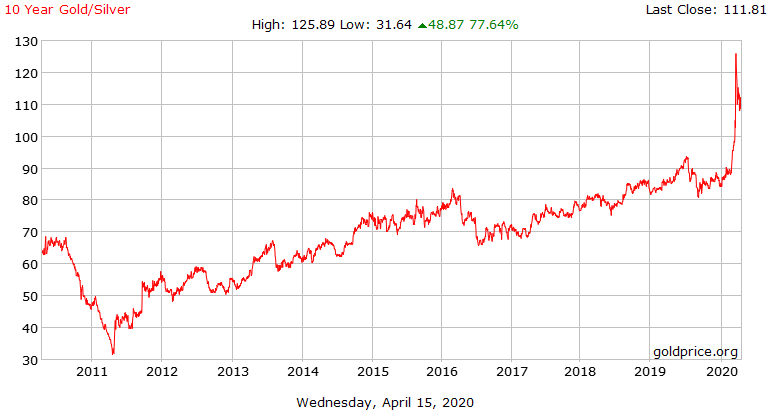
The gold silver ratio has been rising for nine years.

There are many commentators suggesting that the gold silver ratio is nearing a top at present. Here and here are good examples. I am not of that opinion and consider that it will keep climbing for the next 10 years at least. Below is a chart of the gold silver ratio (Source)

As you can see, the chart shows that the gold silver ratio hit a high of 125.89 on the 18th March 2020 and has since declined back to 111.81 (16/4/20). It is likely over time to retest and break the recent highs and then keep on climbing.

The analysis

To understand why the ratio is going to keep on climbing, we need to look at how gold and silver are used.

Silver

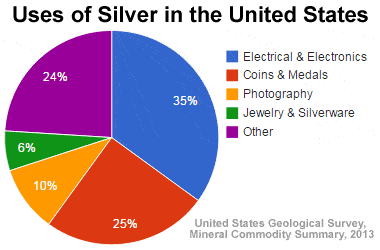
Below is the breakdown of the percentage usage of silver in the US:

Source

As you can see, 45% is used in photography and electrics. The other category (24%) is a mix of energy use, brazing and soldering, chemical production, mirror production and medicine (see link above). In total therefore 69% is used in industry. Only 31% is used in jewelry and coins (silver kept in circulation).

Gold

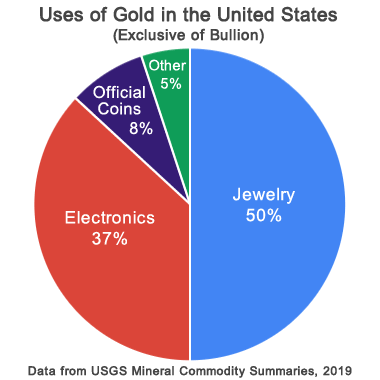
Below is a breakdown of the percentage uses of gold in the US:

Source

Industrial use of gold is only 37%, but 58% is used in coins and jewelry (gold kept in circulation).

Conclusion

As silver is 69% used in industry and gold only 35%, silver is much more sensitive to the strength of the economy than gold is. The last economic cycle in the US was the weakest in modern economic history. Real potential GDP was 1.6% from 2008 to 2018 (Source). This is the lowest 10-year rate since before the Second World War. The gold silver ratio is therefore doing exactly what you would expect it to do in a weak economic backdrop. It is steadily rising. If the economy remains weak after the present recession, I would expect that the gold silver ratio will continue to rise. So will it remain weak?

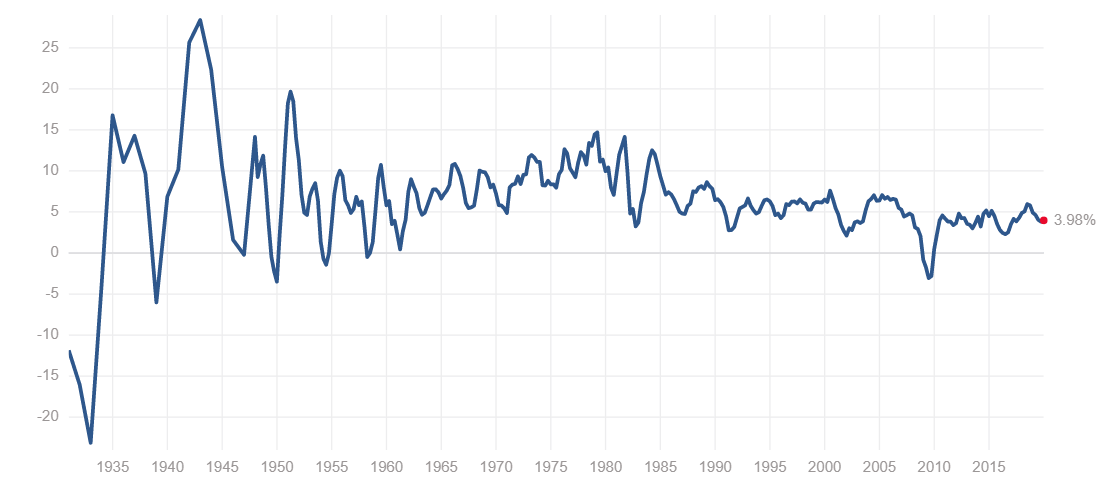
Here is a link to the latest Hoisington Investment Management March report. Their conclusion is that growth and inflation will remain weak, despite the massive money printing and stimulus presently being rolled out by the US government and Federal Reserve. I heartily agree with this analysis. Below is a long-term chart of US GDP:

Source

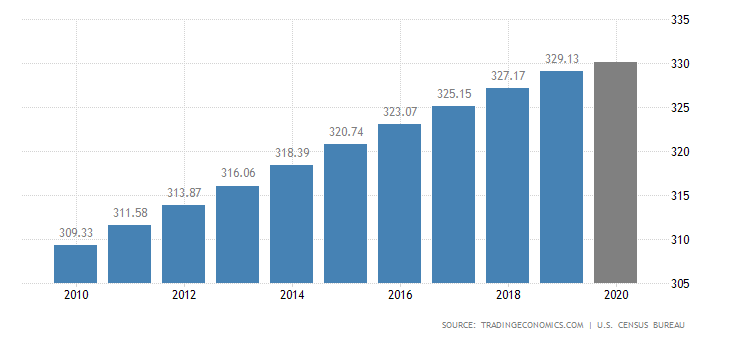
Growth peaked during the second world war and has been steadily falling since then. Since the war, average growth is falling at .7 of a percent every 10 years. As the US government and Federal Reserve are insistent on bailing out all industries and companies, productivity will remain low. This is because the weak companies will not be eliminated, allowing a re-allocation of the capital from the weak to the strong. Below is the population growth of the US economy for the last decade:

The 2019 growth rate was .6 of 1%. With slow population growth and slow productivity growth, the growth rate of the US economy must remain weak. GDP growth is the product of the change in population growth and the change in productivity growth. If both are weak, GDP must remain weak.

Implications

For investment (not trading) purposes, it is clear that if the gold silver ratio keeps climbing, gold will outperform silver on a long-term basis. If you like precious metals to diversify your portfolio, you should buy gold and not silver. It may well be that the gold silver ratio trades lower in the short term and is a good trade, but it is not the way to go if you are an investor. It is also clear that gold miners will outperform silver miners. I presently have no exposure to any silver mining stocks (although some of my gold miners produce silver as a byproduct). Don’t be fooled into thinking that just because the gold silver ratio has hit a high and is now falling that it will mean revert. We are in a low growth environment for the foreseeable future and the ratio will behave accordingly!

SOURCE: https://seekingalpha.com/article/4338404-gold-silver-ratio-will-keep-on-climbing

NORTHBUD $NBUD.ca – Virtual 4/20: How the #Cannabis Industry Is Adapting Its Signature Holiday for Quarantine $CGC $ACB $APH $CRON.ca $OGI.ca

Posted by AGORACOM-JC at 9:30 PM on Monday, April 20th, 2020

SPONSOR: NORTHBUD (NBUD:CSE) Sustainable low cost, high quality cannabinoid production and procurement focusing on both bio-pharmaceutical development and Cannabinoid Infused Products. The company recently received Canadian Cultivation Licence for its Quebec Facility. Learn More.

Virtual 4/20: How the Cannabis Industry Is Adapting Its Signature Holiday for Quarantine

Dispensaries get creative, and celebrities join in, as gatherings give way to livestreams

  • Despite all the gloom facing society as 4/20 approaches, it’s predicted to be a massive sales day, contributing to what BDS Analytics thinks will be a 30% jump in retail cannabis sales this year to $17 billion.

  By T.L. Stanley Harvest House of Cannabis  

Many cannabis fans are as devoted to their unofficial holiday, April 20, as some people are to Christmas, Halloween or the Fourth of July. In recent years, as cannabis has grown in mainstream acceptance and legality, 4/20 has been marked with parties and concerts, stadium-sized festivals and pot versions of pub crawls.

But not this year, as the coronavirus response has blocked public gatherings, gutted the experiential industry, canceled nearly every major 4/20 event and substantially altered marketers’ approaches  to the day.

The celebrations will go on, though, as organizers pivot from real-world to virtual gatherings, lining up talent like Wiz Khalifa, Billy Ray Cyrus, Berner and Kid Astronaut for marathon live streams that revelers can watch from the safety of their couches.

Delivery services are prepped for heavy volume in the wake of a record-setting mid-March sales surge, and brands in the space are giving consumers quarantine-friendly ideas to replace their usual in-person meetups and smokeouts. “This is a chance for the cannabis community to model to the rest of the world how holidays should be handled during periods of social crisis.” —Steve DeAngelo, co-founder, Harborside dispensary

Dispensaries in states where they’re considered “essential businesses”—and therefore allowed to stay open, while following strict safety protocols and social distancing rules—are leaning into their curbside pickup and contactless delivery options. They’ll be trying to discourage exactly the kinds of crowds at their venues that they’ve actively fostered in the past.

Mainstream, non-cannabis brands that have latched onto the holiday with psychedelic stoner-cliched ads and memes may sit it out all together, similar to this year’s approach to April Fools’ Day, so as not to appear flip or insensitive (or simply wasteful with their resources) during the current pandemic and economic downturn.

All things considered, 4/20 is expected to shed some of the raucous overkill and “amateur night” feel of the recent past in favor of a more thoughtful, subdued vibe.  

“You don’t generally associate 4/20 with restraint,” says Steve DeAngelo, a longtime cannabis activist and co-founder of the Harborside dispensary chain in the Bay Area. “But this is a chance for the cannabis community to model to the rest of the world how holidays should be handled during periods of social crisis.”

Taking no chances, the mayor of San Francisco has publicly warned cannabis devotees not to travel to or gather in the famously open-minded destination, known for its 4/20 meet-ups in places like Golden Gate Park. “We will cite people. We will arrest people if necessary,” London Breed says in an Instagram video. And the Washington State Liquor and Cannabis Board sent out a list of do’s and don’ts to licensed businesses, telling them not to schedule events, hire food trucks or live bands or try in any way to attract large crowds.

Another green rush

Despite all the gloom facing society as 4/20 approaches, it’s predicted to be a massive sales day, contributing to what BDS Analytics thinks will be a 30% jump in retail cannabis sales this year to $17 billion. 

One of the previous high water marks for the industry was April 20, 2019, when recreational cannabis sales increased more than 100%, versus the prior week, in states like California, Colorado, Nevada and Washington, according to cannabis data firm Headset.

“Since 4/20 is on a Monday this year, the sales uptick could start over the weekend or maybe even mid-week,” says Liz Connors, Headset’s director of analytics.

Weedmaps, a national cannabis delivery platform, is girding for a second green rush, following the March spike in sales as stay-at-home mandates were announced. “Conservative estimates could very well put us around eight times the order volume over our baseline, and four to five times what we typically see on this holiday annually,” according to CMO Juanjo Feijoo.

Source: https://www.adweek.com/creativity/virtual-4-20-how-the-cannabis-industry-is-adapting-its-signature-holiday-for-quarantine/

Battery Materials Developer to Collaborate On Battery Anode Plant SPONSOR: Gratomic $GRAT.ca $SRG.ca $NGC.ca $LLG.ca $GPH.ca $NOU.ca #TODAQ

Posted by AGORACOM at 6:35 PM on Monday, April 20th, 2020
http://blog.agoracom.com/wp-content/uploads/2019/09/GRAT-square2.png

SPONSOR: Gratomic Inc. (TSX-V: GRAT) Advanced materials company focused on mine to market commercialization of graphite products, most notably high value graphene based components for a range of mass market products. Collaborating with Perpetuus, Gratomic will use Aukam graphite to manufacture graphene products for commercialization on an industrial scale. For More Info Click Here

 â€œThe execution of this LOI is part of NextSource’s downstream growth plan and brings together one of the best global processors of graphite anode material and one of the most prominent suppliers of graphite anode material to automotive OEMs globally,” says NextSource Materials president and CEO Craig Scherba.

“This letter of intent to partnership on a SPG plant with such established partners positions NextSource to be a significant and dominant future supplier of high-quality flake graphite to major battery anode customers globally and simultaneously gaining an immediate foothold into the high-growth markets for electric vehicles, as well as the burgeoning energy storage market that will be reliant on graphite anode material,” he adds.

As announced in October 2018, NextSource Materials signed a 10-year offtake agreement with an unnamed Japanese trading company to purchase 20 000 tpa of Molo’s trademarked SuperFlake graphite for use in battery anode applications for electric and hybrid vehicles.

NextSource’s Japanese partner is a major supplier of SPG for anode material in lithium-ion batteries for electric vehicle and hybrid vehicle applications. Its electric vehicle and hybrid vehicle automotive anode customers are global and currently supply graphite anode material to the majority of Japanese automotive OEMs.

Since 2018, NextSource Materials and its Japanese partner have been in discussions regarding potential supply chain collaboration to supply value-added graphite material using SuperFlake graphite concentrate.

Meanwhile, NextSource Materials’Chinese partner is one of the top processors of spheronized and purified graphite for the electric vehicle and hybrid vehicle markets and has verified that NextSource’s SuperFlake graphite concentrate meets or exceeds all quality requirements for SPG material for electric vehicle and hybrid vehicle automotive applications.

Its electric vehicle and hybrid vehicle anode customers are global, including the North American market and its interest in the partnership with NextSource and the its Japanese partner is to have an additional SPG facility located outside of China and close to a high-quality mine source of flake graphite to supply international automotive OEM customers.

The Molo graphite project is a fully permitted, feasibility-stage project that ranks as one of the largest-known and highest quality flake graphite deposits in the world and is the only project with SuperFlake graphite.

SOURCE: https://www.miningreview.com/east-africa/battery-materials-developer-to-collaborate-on-battery-anode-plant/

80% of Americans believe they read #coronavirus “fake news” in the early stages of the epidemic – SPONSOR: Datametrex AI Limited $DM.ca

Posted by AGORACOM-JC at 5:34 PM on Monday, April 20th, 2020

SPONSOR: Datametrex AI Limited (TSX-V: DM) A revenue generating small cap A.I. company that NATO and Canadian Defence are using to fight fake news & social media threats. The company is working with US Government agencies on Covid19 and Coronavirus fake news and disinformation Click here for more info.

80% of Americans believe they read coronavirus “fake news” in the early stages of the epidemic

  • A Pew survey of 8,914 US adults found that 4 in 5 Americans believe they were misled by the media about the coronavirus situation
  • About half of the participants gave examples of this misinformation, and at least a part of it wasn’t actually fake news

by Mihai Andrei

We’ve been covering the COVID-19 pandemic since January, when it was still a “mysterious virus in Wuhan”. Like everyone else, we didn’t know what to make of it at first — and we were shocked to see how quickly and dramatically the situation developed.

We did our best to cover the available information accurately, but we noticed something weird happening in the comment section and the emails we were getting. A lot of people were upset with our coverage and felt like we weren’t communicating the threat properly — about half of the complaints were saying we were exaggerating the risks. The other half claimed we weren’t explaining the risks enough. Source: Pew Research Center.

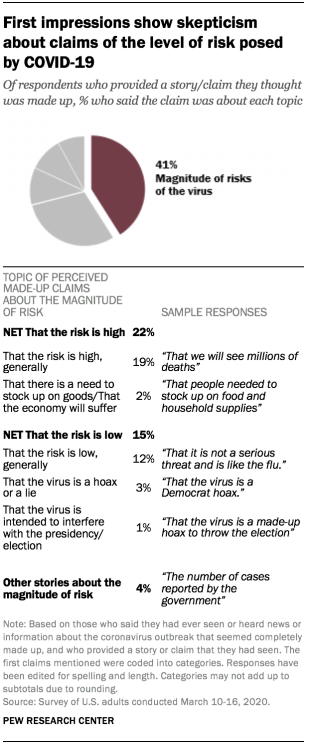
A similar feeling seems to be reported in much of the American population. The largest group of responses in the Pew survey (41% of all who provided claims) felt they were misled about the level of risk. The sentiment was divided into two roughly equal sides: 22% felt the information falsely elevated the risk, while 15% felt it downplayed the risk. In particular, people in the latter group cited not only the media but also the administration and the president, who promised an early end to the problem and repeatedly underplayed the risks posed by the coronavirus.

It’s safe to say that President Trump’s intervention has been a major contributor to misinformation, as he repeatedly came out saying that the coronavirus is less dangerous than the flu. But this statement was also found in several media outlets. Just as the administration fumbled its response on multiple levels, so, too, did the media by taking too long in communicating a clear message about the coronavirus situation.

It was only on March 15 when the CDC told the country to stop gathering in groups, and at the time, the virus was already spreading in the US. The government also urged people not to buy any type of face masks, but then changed its recommendation, causing even more confusion.

Americans’ opinions are also mixed about how much misinformation they have seen. According to the Pew survey, 12% believe they’ve seen “a lot”, and 20% believe they’ve seen “none at all”, with the rest stating that they’ve seen “some” or “not much” misinformation.

Source: https://www.zmescience.com/science/80-of-americans-believe-they-read-coronavirus-fake-news-in-the-early-stages-of-the-epidemic/