Posted by AGORACOM-JC
at 12:32 PM on Thursday, June 13th, 2019
SPONSOR: Esports Entertainment
$GMBL Esports audience is 350M, growing to 590M, Esports wagering is
projected at $23 BILLION by 2020. The company has launched VIE.gg
esports betting platform and has accelerated affiliate marketing
agreements with 190 Esports teams. Click here for more information
GMBL: OTCQB
———————–
Milken-Backed Immortals Makes Esports’ First $100 Million Deal
They acquired Infinite Esports from Texas Rangers co-owners
The resulting company becomes competitor in four major esports
Immortals Gaming Club, an esports business backed by Meg Whitman and
the family of Michael Milken among others, acquired Infinite Esports
from two of the owners of the Texas Rangers baseball team, marking what
the buyers said is the industry’s first $100 million deal.
The transaction merges Los Angeles-based Immortals, best known for
its Valiant team in the Overwatch League, with the parent of OpTic
Gaming, one of the more prominent teams in the League of Legends
Championship Series. Its fans are known as the Greenwall.
“We expect there’s going to be general consolidation in the
industry,†Immortals Chief Executive Officer Ari Segal said an
interview. “This is the first wave of that.â€
Milken-Backed Immortals CEO on Esports’ $100 Million Deal
Immortals Gaming Club CEO Ari Segal speaks to Bloomberg’s Chris Palmeri at E3 in Los Angeles.
(Source: Bloomberg)
The valuation includes the purchase price, debt and other
liabilities, including franchise fees still owed to the leagues. The
Immortals’ lineup of games will also include Call of Duty, which is
launching a new league, and Counter-Strike: Global Offensive, meaning
the company now competes in four major esports.
Based on the equity consideration in the transaction, Infinite
stockholders collectively become the largest shareholder of Immortals
Gaming Club, according to a spokesman, with AEG continuing to hold the
biggest single stake. Neil Leibman and Ray Davis, co-owners of the Texas
Rangers, will become shareholders in Immortals as part of the deal.
Growing Business
Esports, where fans watch professional video-game players compete
online and in arenas, is among the fastest-growing businesses in
entertainment, attracting big money investors from the world of media
and sports. Last week, the owners of the Philadelphia 76ers and the New
Jersey Devils bought a majority stake in Clutch Gaming, a professional team owned by the Houston Rockets.
The deal marks a return to League of Legends competition for
Immortals, which was co-founded in 2015 by Noah Whinston, a college
dropout and esports enthusiast. Immortals operated a team, but failed to
get a franchise in the League of Legends Championship Series when
parent Riot Games offered them two years ago. They plan to sell the
Houston Outlaws franchise in the Overwatch League.
Immortals raised $30 million in a follow-on offering last month. The
overall business is now valued at $250 million, according to a person
familiar with the terms who wasn’t authorized to speak publicly.
Posted by AGORACOM-JC
at 8:41 AM on Thursday, June 13th, 2019
Further to the Israeli sponsorship research agreement announced in the Company’s news release dated May 14, 2019, management is pleased to announce that it has paid a 10% deposit to ESEV R&D to begin the formulations process on the water soluble cannabis-based (CBD) supplement energy drink
The final report will include; clinical trials results, sourcing of ingredients, PH balance, nutritional chart, shelf-life, as well as cost of ingredients and contacts.
VANCOUVER, British Columbia, June 13, 2019 – BOUGAINVILLE VENTURES INC. (“Bougainville” or the “Company”) (CSE:BOG) (Frankfurt:8BV)Further to the Israeli sponsorship research agreement announced in the Company’s news release dated May 14, 2019, management is pleased to announce that it has paid a 10% deposit to ESEV R&D to begin the formulations process on the water soluble cannabis-based (CBD) supplement energy drink. The final report will include; clinical trials results, sourcing of ingredients, PH balance, nutritional chart, shelf-life, as well as cost of ingredients and contacts.
Andy Jagpal, President, Comments:“We
have already begun sourcing a local bottling company to handle the
production and processing of the CBD energy drink once the formulations
are ready. We are adamant about bringing the energy drink formulation to
market and feel we have developed the right relationships to get the
job done right.â€
WORMCASTING TRANSACTION FINANCING UPDATE
Further to the Company news release dated June 11, 2019, management
is pleased to announce that it has paid-off the final outstanding
payment of USD$120,000 owed to Worm Castings Farms Inc. pursuant to
Bougainville’s obligation under the Worm Castings Share Exchange
Agreement.
OROVILLE CAMPUS UPDATE
Further to the Company news release dated April 1, 2019, management
would like to announce that the tenant grower is waiting to receive
final occupancy approval from the Washington State Liquor and Cannabis
Board (“WSLCBâ€) to begin planting. The tenant expects a visit to the
site by the WSLC in the near future and is planning to plant a 20,000
sq. ft. out-door crop.
In addition, the Company wishes to correct an error in its news
release dated May 1, 2019 in which the Company announced that a private
placement with gross proceeds of $190,000 for 3,166,666 Units at a price
of $0.06 per Unit (the “Private Placementâ€) had closed. The Private
Placement was oversubscribed for 3,316,666. The remainder of the news
release dated May 1, 2019 is accurate and the oversubscribed Private
Placement was closed on May 1, 2019 with the amount of $199,000 for
3,316,666 Units
About Bougainville Ventures, Inc. Bougainville
Ventures Inc. is dedicated to rapid growth in production, processing,
retail and branding of cannabis and cannabis related products. Currently
the company provides strategic capital to the thriving cannabis
cultivation sector through ownership and development of commercial real
estate properties. We offer fully built out turnkey facilities equipped
with state-of-the-art growing infrastructure to cannabis growers and
processors. Also, the Company is focused on building a strong presence
in the hemp industry with the objective of extracting cannabinoids (CBD
& CBN) in both Canada and the United States. With our flagship Hemp
project in Oregon State the Company has proprietary, patent-pending hemp
root oil extraction technology and formulas for cannabis topicals and
tinctures.
http://bougainvilleinc.com/
On behalf of the Board of Directors BOUGAINVILLE VENTURES INC.
Andy Jagpal, CEO and Director
For further information, please contact Andy Jagpal at [email protected] or 1-888-395-7816
FORWARD LOOKING STATEMENTS: This news release contains certain
forward-looking statements within the meaning of Canadian securities
laws. Forward-looking statements are based on the expectations and
opinions of the Company’s management on the date the statements are
made. The assumptions used in the preparation of such statements,
although considered reasonable at the time of preparation, may prove to
be imprecise and, as such, undue reliance should not be placed on
forward-looking statements. The Company expressly disclaims any
intention or obligation to update or revise any forward-looking
statements whether as a result of new information, future events or
otherwise.
No regulatory authority has approved or disapproved the information contained in this news release.
Posted by AGORACOM-JC
at 9:43 AM on Monday, June 10th, 2019
Joining us on this episode is Peter P. Swistak, President/CEO of Vertical Exploration.
The company has recently received positive results from its Phase 1
Research and Development program that was conducted by AGRINOVA using
wollastonite from the Company’s St-Onge deposit. All of the research and
testing in the Phase 1 program was managed and monitored by AGRINOVA, a
highly-regarded Center for Research and Innovation in Agriculture in
Quebec, in an effort to optimize the potential agricultural uses of
wollastonite and help improve production methods for farmers and
agricultural companies located in Quebec.
Posted by AGORACOM-JC
at 9:26 AM on Monday, June 10th, 2019
Further to the Press Release dated April 29th, 2019, the company has
been awarded a contract of approximately $20M (first year revenues),
plus a net present value (using a 5% discount rate) of all subsequent
year’s revenues of $35M, giving the Contract a total value of over $55M.
Peter Pascali, President and CEO of PyroGenesis joins us to discuss the contract and exactly what it means for the company.
Sit back and relax, grab a coffee, let us know what you think.
Posted by AGORACOM-JC
at 1:46 PM on Thursday, June 6th, 2019
SPONSOR: Tartisan Nickel (TN:CSE)
Kenbridge Property has a measured and indicated resource of 7.14
million tonnes at 0.62% nickel, 0.33% copper. Tartisan also has
interests in Peru, including a 20 percent equity stake in Eloro
Resources and 2 percent NSR in their La Victoria property. Click her for more information
Nickel market participants should invest in production for electric vehicle (EV) batteries soon or they will eventually regret not doing so, EV sector experts said at Fastmarkets’ 7th International Nickel Conference in Amsterdam on Wednesday June 5
EV market penetration will reach 22-30% between 2019 and 2030, according to Ken Hoffman, of management consultant McKinsey,
AMSTERDAM — Nickel market participants should invest in production for electric vehicle (EV) batteries soon or they will eventually regret not doing so, EV sector experts said at Fastmarkets’ 7th International Nickel Conference in Amsterdam on Wednesday June 5.
Panel experts believed the risk of not investing in nickel production was greater than choosing not to take that option because of their bullish prognosis for nickel demand and the three-month price of nickel on the London Metal Exchange.
EV market penetration will reach 22-30% between 2019 and 2030, according to Ken Hoffman, of management consultant McKinsey, and Thomas Hohne-Sparborth, of specialist consultant Roskill. This will be driven by cleaner, greener European regulations affecting the automotive sector.
But this will not be confined to Europe. EV demand is growing in Asia, with 2.1 million units sold in China alone in 2018 and a projected 3 million units to be sold in 2019. This would constitute a huge increase over 2012, when fewer than 50,000 units were sold, one panelist noted.
Indeed, EV sales in the first quarter of 2019 rose by 118% year on year to 254,000 units in China alone, with 500 factories in the country supporting EV production.
The EV panel experts also believe producers are on the verge of providing batteries with better energy density and vehicles with a 1,000km range, making them more desirable for consumers.
Battery production must increase to meet this demand and panelists indicated that nickel is the EV battery metal of choice. They forecast this will likely remain the case for the next five to seven years at least, leading to an increase in nickel demand, along with the price.Â
“I am very bullish [on the price of nickel],†Hohne-Sparborth said. “Over the medium term, three to five years, you can get enough nickel units out of some active plants in Indonesia. Tsingshan [Holding’s Indonesian smelter on the island of Sulawesi] can come on-stream very quickly [and] $12,500-13,000 per tonne
[for nickel]
would be a good price incentive for such projects.â€
Tsingshan Group produces around 170,000 tonnes per year of nickel in
metal in Indonesia from its three NPI output phases, which have 20
rotary kiln electrical furnace (RKEF) lines. The group’s fourth NPI
production phase will come on stream in early 2019, taking its total NPI
output to 200,000-210,000 tpy of nickel in metal.
Despite the
potential for a short-term oversupply of nickel, pressure on Class 1
refined nickel products will arise following this projected growth in
battery demand. As a result, nickel prices are expected to move higher.
The LME’s three-month nickel contract closed the official session at
$11,800 per tonne on June 5.
“Some of the higher-cost
producers might need a slightly higher incentive price. We estimate
$17,000 per tonne,†Hohne-Sparborth said.
“In the longer term,
from 2025 onward, with all the projects that we are currently aware of
the gap in the market [caused by demand outstripping supply] could only
be filled with an incentive price in the $20,000-per-tonne range. We
think, long term, the price of nickel will be in the
mid-$20,000-[per-tonne] range,†he added.
The experts on the
panel did not believe that competing battery technologies that do not
use nickel, such as hydrogen fuels cells, were a threat.
“Even if technology changes,†Hoffman said, “there will be a shortage of nickel for batteries by 2025 whatever happens.â€
The promise of edtech has been there for a long time.
Last two years, the sector has been getting attention and it is turning into real opportunities,†says GV Ravishankar, managing director of Sequoia Capital in India, who has several investments in edtech firms in Asia.
Tan Zhai Yun  Â
Technology has changed the way people learn. From massive open online courses (MOOCs) to virtual classrooms such as Blackboard and on-demand video tutors, education technology (edtech) has emerged as a rapidly growing sector, especially in Asia. It has also attracted a lot of investor interest.
“The promise of edtech has been there for a long time. But I think in
the last two years, the sector has been getting attention and it is
turning into real opportunities,†says GV Ravishankar, managing director
of Sequoia Capital in India, who has several investments in edtech
firms in Asia.
Edtech refers to technology that is used to develop tools for the
education sector. For example, it could be in the form of classroom
management software that enables virtual classrooms, interactive apps
that educate users on various topics or platforms that connect tutors
and students virtually.
The recent boom in Asia is driven by factors such as the growing
mobile penetration rate, affordable internet access, willingness by
parents to pay for education and a strong demand for supplementary
education materials.
One of Sequoia’s investee companies is BYJU’S, an Indian edtech that
is attempting to fill the gap left by a lack of good teachers. It offers
students a personalised learning journey into subjects such as maths
and science via online videos, animations and illustrations in a mobile
app.
Sequoia also has an investment in Edusys, which provides professional
certification and test preparation courses in online, classroom and
hybrid formats. “We are quite bullish on the trend because we are seeing
consumers adapt to online learning models quickly. The younger
generation is very comfortable learning online. So, from our
perspective, we think the market is ripe [for investments],†says
Ravishankar.
Jeffrey Paine, managing partner of Golden Gate Ventures (GGV), sees
the edtech sector as a relatively new segment. Investors must choose
carefully, depending on the country and target market, whose needs may
differ widely. GGV is invested in KooBits, a Singapore-based edtech firm
that teaches math online.
“China is leading the way with edtech. The US tends to have
alternative high schools or universities, whereas India tends to have a
bit more video-based learning and a lot of focus on K-12 [kindergarten
to 12th grade] maths and science,†says Paine.
“In Southeast Asia, Vietnam is growing fast, from K-12 content and
corporate training on how to use Microsoft Excel to online video-based
English tutoring. In Malaysia, one example is a company called
EduAdvisor, which helps inform people who are going overseas to apply
for schools.â€
EduAdvisor has received venture capital funding from 500 Startups and
the KK Fund, according to Pitchbook, a US-based data provider in the
areas of venture capital, private equity and mergers and acquisitions.
According to a 2016 report by UK-based consultancy IBIS Capital, the
edtech market is projected to grow at a compound annual growth rate of
17% to US$252 billion in 2020 globally. While the US previously led the
pack, Asia is currently experiencing the fastest growth in investments
in the sector, going from 46% of the global market to 54%.
This is particularly true for China. According to a 2017 report by
Pitchbook, the biggest edtech venture capital deals had been found in
Greater China in the past five years. Three of the top five edtech
investments since 2012 have also been in the country.
This has led to the birth of several edtech unicorns, including
VIPKid and Yuanfudao. The former is an online English learning platform
while the latter is a homework assistance app. Users can take a picture
of their arithmetic homework, for instance, and the app will use
artificial intelligence to check the answers.
India has an edtech unicorn in BYJU’S, which received Chan Zuckerberg
Initiative’s first investment outside of the US. Some of the big
players in Indonesia and Vietnam are Ruangguru, a marketplace for
private tutoring, and Topica Edtech Group, whose offerings include live
English tutoring and bachelor’s degree programmes online.
Ravishankar believes that the edtech trend is being driven by the
prevalence of computing and smartphones in the hands of end-consumers.
“For example, a huge population in India began to have access to really
affordable broadband in recent years and this is the first time they are
experiencing the internet. That has allowed many companies to reach out
to hundreds of millions of people and it enables consumers to
experience the power of education through technology,†he says.
The other major factor driving edtech investments in Asia is the high
value that parents attach to education. This results in a greater
willingness to pay for education in markets such as China, India and
Southeast Asia.
“Perhaps this goes back to the market structure some of these
countries have. In the US, most people go to public schools, which have
delivered reasonably good quality education. That is why people there
are not as used to paying for education. But in China and India, people
are willing to pay so their children can find jobs. In India, education
is seen as a way of getting out of poverty and getting a well-paying
job,†says Ravishankar.
This means the kinds of edtech companies serving Asian and Western
countries are different. In the US, many edtech firms focus on selling
to school districts whereas in Asia, they may target parents.
“We have seen an example in China in the form of VIPKid. It has a
very interesting model of teaching English to Chinese students through
teachers who are in the US. It leverages the language advantage that
English-speaking countries have to teach students in China, where there
is a huge demand to learn English. That is possible because high-quality
internet access is widely available,†says Ravishankar.
Opportunities in edtech
Edtech companies with the most potential for growth tend to be those
that serve consumers directly or provide content that supplements the
school curriculum. “That is because there are so many students in that
age group and younger people are more comfortable with technology,†says
Ravishankar.
This is especially true for subjects such as English and maths, the
mastery of which can boost the chances of a child getting a good job in
the future. There are many popular edtech companies in the region
targeting those who want to learn English such as the Topica Edtech
Group in Vietnam and Globish Academia in Thailand.
“In Singapore and Malaysia, students learn from courses provided by
edtech companies just like they would by going for offline tuition
classes. You have to take your SPM, so you need to go for tuition
classes where they teach you how to pass your exam,†says Paine.
“The services provided by these companies may be homework-driven. It
could be that I am stuck doing my homework and I need a social network
to teach me how to solve problems. It could be a live video tutoring
session or online curriculum.â€
GGV invested in KooBits because of its track record over the years.
The latter is now used by students in countries such as the Philippines
and Indonesia. The reputation of the Singaporean maths curriculum —
which has been ranked the best in the world by some international
agencies — has increased the attractiveness of the company in the eyes
of its potential customers.
There are also opportunities in the working adults segment, a group
that could comprise more serious learners with a greater willingness to
pay for these services. Sequoia invested in India-based Eruditus, which
partners Ivy League Schools in the US and top universities in the UK to
offer online courses for professionals.
“It [Eruditus] puts some of its undergraduate education programmes
online. This is for professionals who want to learn things such as data
science or the new generation of technology tools that are impacting
management today,†says Ravishankar.
While this idea is not new — it was popularised through MOOCs run by
those like Coursera and Khan Academy — a new set of players, such as
Eruditus, have changed the game for this sub-segment of providers, says
Ravishankar. Users learn online together in a virtual class, listening
to the same teacher in the same time period. They have projects, group
work and online discussion sessions.
“It is an online application of the offline student environment. I
think they have created models that allow for substantially higher
completion rates compared with MOOCs because this creates familiarity
among the cohort. These companies came up in the last few years and we
are pretty optimistic about what that means for edtech and higher
education,†says Ravishankar.
Edtech companies in Asia face a few common challenges. One of them is
gaining the trust of users. Second, the cost of acquiring customers can
be quite high because of the online competition for users.
The business-to-consumer market is where the future of edtech is, in
Ravishankar’s view. That is because business-to-business edtech
companies face challenges in selling their solutions. “That model has
been traditionally hard to scale because you have school networks that
are highly disorganised. Selling to them and collecting money from them
have been tough,†he says.
Posted by AGORACOM-JC
at 2:00 PM on Wednesday, June 5th, 2019
SPONSOR: New Age Metals Inc.
The company’s new Lithium Division has already made significant
acquisitions in Canada and the USA. The company also owns one of North
America’s largest primary platinum group metals deposit in Sudbury,
Canada. Updated NI 43-101 Mineral Resource Estimate 2,867,000 PdEq
Measured and Indicated Ounces, with an additional 1,059,000 PdEq Ounces
in the Inferred. Learn More.
NAM: TSX-V
———————
These Mining Superpowers Supply the World’s Lithium. Now They Want to Make Batteries, Too.
The race by Tesla Inc., Samsung SDI Co. and other technology giants
to secure supplies of lithium — a key ingredient in batteries for
electric vehicles and smartphones — is creating a unique chance for two
global mining superpowers to reap more value from their natural
resources.
Australia and Chile are looking to lithium to help them escape a
cycle that for decades has had the two nations digging out minerals such
as iron ore and copper, only to see them refined and turned into
valuable products abroad.
Almost three-quarters of the world’s lithium raw materials come from
mines in Australia or briny lakes in Chile, giving them leverage with
customers scrambling to tie-up supplies. The mining nations hope to
bring refining and manufacturing plants that could help kickstart
domestic technology industries.
The first moves in that plan are beginning to take shape.
Scraping a shovel into a patch of dirt near the Australian port city
of Bunbury in March, an executive for U.S.-based lithium leader
Albemarle Corp. heralded a A$1bn ($690m) plan to build the world’s
biggest processing plant of its type. Meanwhile, in Mejillones, northern
Chile, South Korea’s Samsung SDI and Posco are planning to jointly
develop a facility to make chemical components used in batteries.
“Chile and Australia have the advantage,†said Daniela Desormeaux,
chief executive officer at Santiago-based consulting firm SignumBOX.
They have the lithium and “at the same time state incentives, so
companies transforming the raw material can set up shop there.”
Mining rock and exporting it is a familiar story for Australia and
Chile. Australia, the world’s biggest producer of iron ore, has shipped
billions of tons of the steelmaking raw material to mills in Japan and
China since the 1960s. Chile, the world’s largest source of copper,
exports over half of its shipments as semi-refined concentrate.
“It’s an interesting economic model,†Peter Klinken, chief scientist
of Western Australia and an adviser to the state’s government, told a
February conference in Perth. “Take a big rock, make a little rock, put
it on a ship, and then buy something really expensive back in return.â€
The supply of lithium-ion batteries will need to jump more than
10-fold by 2030, BloombergNEF forecasts, with electric vehicles to
account for more than 70 percent of that demand. That’s prompting end
users to act, and Volkswagen AG and Volvo Cars have both struck
long-term supply deals since April.
Where’s the Value?
The first step on the lithium value ladder is refining the raw
material, something that’s currently done mostly in China. Ore from
mines or lithium-rich saline solution from underground lakes in South
America is concentrated into a silvery-gray powder that is sent to be
purified and refined into lithium hydroxide and lithium carbonate. Those
chemicals in turn are processed with materials such as nickel or cobalt
to produce battery electrodes, or with solvents to make electrolytes,
the key parts of the cells that are assembled into batteries.
Each step up the ladder affords more opportunity for profit. By 2025,
the market for mined lithium raw material may be worth $20bn, compared
with $43bn for refined products and $424bn for battery cells, according
to a base case scenario outlined in a 2018 study published by the
Australia-based Association of Mining and Exploration Companies.
Two major lithium miners operating in Chile, Sociedad Quimica &
Minera de Chile SA, or SQM, and Albemarle were only allowed to expand
production on condition that they sell a quarter of their output at the
lowest market price to companies that will develop the materials within
the country. SQM, which already carries out some processing in Chile, is
expanding its domestic capacity.
The strategy is “a golden key†to build a higher-value lithium
industry in Chile, said Sebastian Sichel, executive vice president of
government development agency Corfo, which owns the lithium concessions
in the Atacama desert and issues licenses to miners.
Three separate groups — Chile’s Molibdenos y Metales SA, or Molymet,
China’s Sichuan Fulin Industrial Group Co., and a consortium of Samsung
SDI and Posco — last year pledged to invest a total of about $754m to
build lithium-cathode and lithium-cell factories in Chile to win access
to Albemarle’s material. A second auction in April offered similar
access to SQM’s product, with winners expected to be announced early
next year.
New refining and chemical production capacity will offer Chile
additional revenue, while earnings from lithium exports are also
forecast to rise. The commodity has the potential to become one of the
country’s largest exports after copper, salmon and wine, Sichel said.
Australia could generate more than A$50bn ($35bn) in annual revenue
and support about 100,000 jobs by developing a battery materials sector,
according to a 2018 study for a regional development agency. That
compares with about A$1bn currently in annual lithium exports.
Australia’s government in April pledged A$25m to support a five-year
research program to expand its battery supply chain.
China’s Tianqi Lithium Corp. will later this year begin selling
lithium hydroxide from a new processing facility in Kwinana, south of
Perth. Tesla, battery maker LG Chem Ltd. and Mitsui & Co. have
agreed to supply deals for output from a rival plant nearby that’s being
built by Chile’s SQM and an Australian partner.
Efforts by Australia and Chile to wrest more control over refining
from China are being helped by trade tensions. “They could definitely
challenge China†in the next-step processing of lithium, said James
Jeary, an analyst at CRU Group in London. Lithium producers will
increasingly integrate mining and refining capacity, he said.
“We are hearing more and more that diversity of supply is critical,â€
said Phil Thick, Tianqi’s general manager in Australia. The producer’s
Kwinana plant will mainly supply customers in North America and Europe,
or carmakers in those regions via their suppliers in South Korea and
Japan, he said.
China’s in Charge
The producers plan to do more than just first-stage refining. Western
Australia has developed a “Lithium Valley†strategy to span the supply
chain. Chile also hopes to manufacture battery cells.
But there are major hurdles. Neither country has a major car
industry, and the auto sector typically prefers component suppliers to
be close to manufacturing hubs. The technical challenge of producing
battery components may require imported expertise. Costs and
environmental concerns are also factors.
A dispute between Corfo and Albemarle has already delayed progress
for Molymet, the Samsung SDI and Posco consortium, and Sichuan Fulin in
Chile, prompting concern the groups could opt to invest in battery
projects elsewhere. In Australia, lithium producer Neometals Ltd. has
delayed a plan to build a refinery, citing higher-than-expected costs.
There may only be a brief window for Chile or Australia to get a
foothold in the battery industry as rival mining nations join the fray.
Argentina and Bolivia have saline deposits near the border with
Chile. Countries from Serbia to Mali are keen to extract deposits in
their territory, and Russia, which has been producing lithium products
for more than 60 years for its nuclear industry, is already trying to
attract higher-value investment by setting up one of the world’s largest
lithium-ion battery plants in Novosibirsk with Chinese partner Thunder
Sky Group.
Persuading battery makers to set up operations in Australia or Chile
will require state incentives, said Vivas Kumar, a principal consultant
at industry adviser Benchmark Mineral Intelligence and previously a
member of Tesla’s battery supply chain team.
Lowering the cost of battery cells “continues to be the most
important focus area across all major companies,†Kumar said. Automakers
“are increasingly becoming involved with their cell manufacturing
partners’ supply chains in recognition of this.â€
Sichel at Corfo believes lithium offers Chile a chance to escape the
so-called resources curse, where mineral booms suck in investment at the
expense of manufacturing.
If we don’t do this, “there is a gigantic risk that our growth keeps
depending on the next hot commodity,†he said. “We remain stuck, unable
to make the jump to developed-nation status.â€
Addressing India’s Reskilling Challenge – A Report By AIM
Even with the third-largest developer base and a substantial tech-savvy talent pool, India lags behind its peers on major AI indicators.
This is despite a thriving startup ecosystem, high-growth companies which have made a substantial investment in setting up CoEs and the Government investing in building a robust tech infrastructure.
Behind the AI and data analytics boom, lies the story of a massive talent gap as workforce struggles to remain employable. The skills’ shelf life has shortened, with technology changing exponentially over the last decade, skills that were relevant at the beginning of the career have become obsolete. In order to remain employable, the workforce needs to reskill to take advantage of new opportunities. The rise of edtech companies in India is not surprising, given the huge clamour for continuous learning that has taken root in the professional sphere. This is backed by the rise of emerging technologies — artificial intelligence, its subset machine learning and data science which has spawned a booming job market revolving around new technologies that has substantially transformed India’s IT labour market.
The changing job economy has resulted in new opportunities for the
Indian workforce. As estimated by a consulting major, AI has the
potential to add US$957 billion, or 15 percent of India’s current gross
value in 2035. The booming economy, fuelled by AI and advanced analytics
requires more Indians to enter the workforce with a different
skill-set. As per our estimate, close to 97,000 AI positions lie vacant
in India.
But,
the challenges are also increasing multifold — on the one hand India
Inc is struggling with disruptions like automation that are redefining
jobs and secondly, it is grappling with finding the right talent with
the right skillset for AI/ML and data science teams. Meanwhile, the
upcoming generation that will enter the workforce soon is fed on an
outdated curriculum that hasn’t kept up with the industry’s demands.In
our report, we dig into the educational stakeholder landscape to see how
they are transforming the skills market by developing training courses
and certification programmes that correspond to in-demand skills
required today. We look at the type of educational institutions offering
data and analytics programs; how the educational landscape is changing
in response to the heightened demand for analytics skills and what needs
to be done to fill the skill gap.
The second half of the report looks at our last three years ranking
data to find out the winning attributes that have helped analytics
institutes rank on top consistently and how other training institutes
have fared over the last three years.Key Highlights
The online reskilling market is estimated to be $93 million and is expected to grow at a rate of 38%.
As compared to other educational categories (secondary supplemental
education providers and GMAT/ GRE/GATE test preparation providers) the
reskilling market is more mature
Current market is largely B2C driven but educational stakeholders are also actively catering to the B2B segment
Reskilling market in India is driven by the needs of a large working population looking for industry-relevant skills
Online key players are also moving towards blended educational
solutions by creating offline touchpoints to provide peer interaction
Emphasis on personalised learning has led to mentorship and offline
touchpoints that helps students gain handson experience for particular
concepts
Business Analytics course was the starting point, besides this,
other courses that are gaining traction are Artificial Intelligence,
Machine Learning, Data Science & Analytics & Data Engineering
Partnerships between analytics education providers and universities in offering niche courses
Higher demand for short-term diploma courses in in-demand areas such as Blockchain, Data Science and Machine Learning
Virtual classroom concept that began in 2014 has brought high quality analytics education more accessible
Key tools learnt are R, SAS, Python, on big data end Hive, Pig, Hadoop and in AI/ML end Tensorflow and Keras
Key Players In The Reskilling Market
In order to capitalise on these opportunities, IT companies,
educators and policymakers need to develop a deeper understanding of the
existing workforce, the skill-set required in the future, and the gaps
that will need to be addressed. This implies that these three key
players need to align the broader economic developer agenda with the
shifting job market and work towards building a strong talent that has
the baseline and digital skills required for current landscape. At the
Government level, policy makers will have to assess secondary and
postsecondary education and align it with the skills that are required
for tomorrow. Many leading Indian IT majors have undertaken
employer-training initiatives, pre-employment training and have also
provided their own courseware. Collectively, the key stakeholders can
foster a workforce development ecosystem and provide domain specific
training with a job-first approach. Given this scenario — educational
stakeholders have made a very strong business case for reskilling the
workforce and have actively partnered with renowned educational
institutions to launch technical certifications and degree programmes
tailored to fill the skill gap.
Analytics Education Landscape
The nature of analytics education has evolved over the last few years
and a mix of models have emerged in the online and offline space to
accommodate the changing requirements of students. Learners seek a
career-focused analytics education augmented by classroom setting that
prepare them for job functions in data analytics space.
• In cases where learning is delivered purely online, participants
look for realtime learning in a format that allows learners to pursue it
at their own pace
• Candidates look for course content created by top instructors, with
industry and university collaboration to provide a well-rounded
analytics education
• Executive programs are also in high demand as these are intended
for senior professionals who want to renew their skillset and understand
how data can be helpful in managerial decision making
• In case of executive analytics courses, technical skills such as
data management are augmented by soft skills such as business
understanding and communication
• Analytics education providers in India mostly offer Business
Analytics (BA) and Business Intelligence (BI) programs that combine
analytical number crunching, reporting and visualization techniques
Learning Formats
The learning formats can be broadly put under 4 categories:
Self-paced learning delivered via recorded video content
Instructor-Led live classroom sessions delivered online
Blended learning format with classroom and online delivery
Bootcamps for intensive, in-person learning that provides a hands-on experience
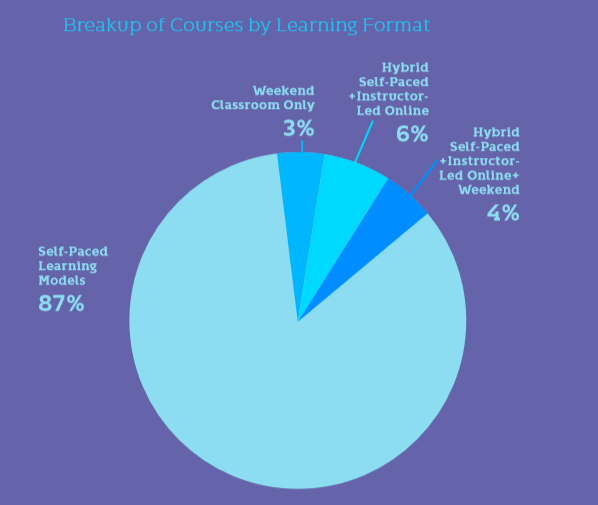
Around 87 percent of analytics courses from private training institutes are delivered in the self-paced learning models
6 percent are delivered in the hybrid (Self-paced and Instructor-Led
online) format and 4 percent in Instructor Led weekend and self-paced
format
There’s only a 3 percent uptake for weekend classroom format
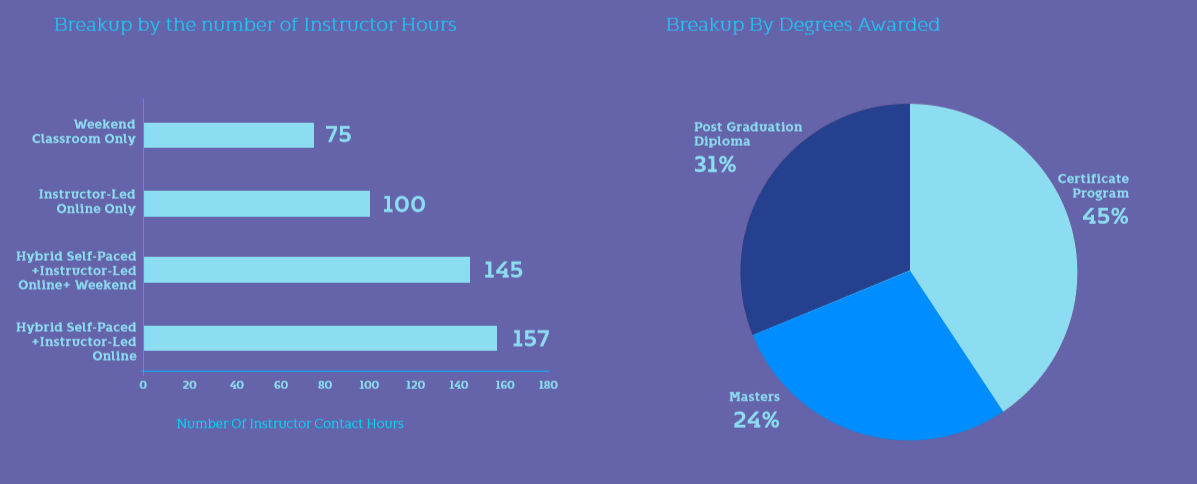
On average, analytics courses by private institutes offer 105 hours of instructor contact hours
The hybrid model of self-paced + online Instructor-Led courses has the highest number of contact hours at 157.
The blended learning opportunity allows learners to get continuous feedback and participate in real-time assessment
Weekend-only model has the least contact hours at 75
For those looking for face-to-face learning environment, weekend model is the best fit
Digging Deeper: India’s ed-tech space is more than Byju’s
While trying to understand India’s edtech space, it is worth remembering what a huge market it is.
A joint study by Google and KPMG had estimated that the online education sector in India would grow at a compounded annual growth rate (CAGR) of 52% to $1.96 billion by 2021.
Due to acute disparity in learning levels caused by social, economic,
geographic and other factors, India may be in the danger of
under-utilising or losing out on the untapped capital of human
potential. Education technology (edu-tech/edtech) could play a vital
role in meeting the learning needs of underserved sections of the
populace. In this space, the name we hear loudest is Byju’s, the
Bangalore-based company valued at over four billion dollars (or five,
according to some estimates), which raised $540 million from Naspers and
others just last year. It is the fourth most valued startup in the
country. Unacademy, which much like Byju’s also offers online tutoring
to students, has raised 38.5 million dollars to date. Last year in
December, Toppr, another edtech startup which claims to have six million
users, had raised $35 million led by education-focused investor Kaizen
Private Equity. CollegeDekho has raised upwards of 13 millions dollars
to date. Even Mukesh Ambani seems to want a slice of the Indian edtech
pie considering he bought a 38.5% stake in Noida-based startup
Extramarks. Byju’s might have put Indian edtech on the global map, but
increasingly, the space is more than just Byju’s.
India’s education market, estimated to grow to $5.7 billion by 2020,
has emerged as a lucrative opportunity for edtech startups and VCs
alike. On this edition of Digging Deeper with Moneycontrol, we will try
to understand both the potential of edtech startups and the reasons why
some of them have succeeded spectacularly in what was, just a few years
ago, a relatively unexplored field.
Growing interest
A recent Financial Express report cited a study by Karthik
Muralidharan of the University of California at San Diego, Abhijeet
Singh of the Stockholm School of Economics and Alejandro J Ganimian of
the NYU Steinhardt School, according to which, incorporation of
educational technology can help accurately assess learning levels and
customise pedagogical support to bridge intra-classroom gaps.
Andhra Pradesh, we are told, is pioneering tech-enabled pedagogy, and
as an early-bird adopter of edu-tech, it will be leagues ahead of other
states. The piece said, “The state, from the current academic year,
will be using Personalised Adaptive Learning (PAL), or software-based
assessment of the academic standing of the students in a classroom. PAL
will first assess the student’s comprehension levels and then prescribe
targeted learning. Students will take the test online, and based on
their individual reports, remedial coaching will be provided. Apart from
facilitating tailored learning, PAL will also ease monitoring of impact
of remedial classes via dashboards for individual students where
teachers can track progress.â€
PAL is being rolled out in over 2,600 schools in Andhra Pradesh.
After tests in 56 schools proved successful, many schools will engage
with PAL via laptop but others will do so over tablets.
The initiative, as per a report in The New Indian Express, will
involve intensive training of teachers, school administration and
bureaucrats, and is expected to impact over 2.5 million children. Andhra
Pradesh is, in fact, experimenting with edtech in a big way.
According to the piece, after introducing QR codes in non-language
subject textbooks, the state is now doing the same for language
textbooks for classes VI-X.
The NIE said, “Scanning the QR codes assigned to different chapters,
students can access supplementary video lectures or tutorials. They can
also use the QR codes to take quick, online assessment tests that will
help them, their parents and teachers measure their actual levels of
comprehension.
Such an ecosystem surely makes addressing gaps in learning levels
easier than the conventional method, of remedial classes. Also, given
boards like CBSE are now increasing reliance on schools’ own assessment
of learning levels, by mandating compulsory internal assessment for
boards, pedagogy propped by technology can be made to deliver more
efficiently.â€
At another level, edtech start ups are benefitting from growing interest not just in India but also from overseas markets.
Big numbers
The News Minute carried a report recently which spoke about how New
Delhi-based edtech startup XploraBox raised an undisclosed amount in
funding from SucSEED Venture partners. The four founders of XploraBox
include Rishi and Shweta Das, Dhirendra Meena and Rishabh Gupta. The
startup was founded in 2015. The funds will be used to scale up and
establish overseas presence beginning with North America and GCC
countries as it targets a revenue of Rs 100 crore in 3 years. The other
investors to have participated in this round include Green Shoots
Capital, Metaform Ventures LLC, JITO Angel Network, SWAN Angel Network
etc.
And what has Xplorabox been up to? Well, it has come up with a
business model that has a subscription box for learning through play in
children. We quote, “The basic objective is to try and wean away the
kids, aged between two and twelve, from TV and mobile and channelise
their attention to other constructive activities. Learning through fun’
is their mantra, with fun stories and educational activities which are
offered through their boxes. The company has served more than 50,000
customers and dispatching kits to over 500 cities every month.â€
According to Rishi, on an average, children are spending over 3 hours
every day in front of screens and that is impacting their brain
development. Xplorabox provides modules to boost essential developmental
skills of the children. The startup believes that the 50,000 customers
they have serviced so far have reported excellent response and more
products could get launched in the coming months.
The aim is to provide learning aids that can enhance various
developmental skills like motor skills, cognitive skills etc in children
to counter issues like Computer Vision Syndrome (CVS), unhealthy
posture, and increasing cases of myopia (shortsightedness).
The startup is looking at prospects running into billions with the
large population of kids in the target age group and hopes to tap into
more potential markets.
Wider horizons
The edtech market keeps expanding and reinventing itself. In a recent
development, Byju’s and Disney may launch a co-branded new app
targeting kindergarten to Class 3 students. The Economic Times reported,
“The partnership is in line with Byju’s aspirations to expand beyond
India into other large English-speaking markets such as the US, UK, and
Australia.
Disney Byju’s Early Learn, as the service is called, will be a
standalone app that is likely to go live sometime next week. There have
been talks that Disney has made a financial investment into Byju’s, but
that has not come through yet, sources said. Apart from using the name
of the Burbank, California-headquartered company, the app will boast of
characters from popular Disney brands such as Cars, Toy Story and
Frozen.â€
Byju’s has entered into a revenue-sharing agreement with the media
company. While the exact terms of the deal could not be ascertained, it
is learnt to be in the range of a 10-15% revenue share that Disney
usually sets.
ET said, “While Byju’s will oversee all content created for the app,
Disney is expected to work closely with the edtech firm to ensure
stories are weaved around its characters. Kids using the app will get to
watch video-based tutorials that will feature its popular cartoon
characters. Even though the current deal with Disney is strictly a
revenue-sharing agreement, Byju’s has been in talks with the media giant
to explore an opportunity for investments as well. In March, when
Byju’s raised $25 million in funding from General Atlantic, its
valuation jumped to $5.4 billion, making it the fourth most valuable
private Internet company in India.â€
Customer acquisition and other challenges
With time, edtech companies are dealing with challenges like growing
customer acquisition costs. A recent ETtech piece addresses this very
issue. It points out how India’s fast-growing educational technology
space is now going full steam ahead to build organic user acquisition
channels.
The average cost-per-click on digital channels goes up 5-7% every
year organically, but it could be around 30% year-on-year for edtech
since it is seasonal for most players, according to industry-watchers.
Moreover, India suffers from extremely low conversion rates as courses
are often large-ticket purchases.
The report says increasing cost of user acquisition has forced
players like Edureka to acquire 60% users organically through free
YouTube videos and high-quality blogs. Still, the company spends Rs 1
crore every month on digital marketing.
Lovleen Bhatia, co-founder and CEO of Edureka says and we quote, “You
can’t win with Google and Facebook, so you need to find other channels
of acquiring customers. For us, our blog, community and YouTube videos
have worked well so far.â€
Edureka is also working on an AI chatbot that will advise users on
how to build their careers and Bhatia hopes that the counselling bot,
which they are trying to make open source, will add to customer
acquisition .
Byju’s, mentions the piece, a leader in the K12 education sector, is
looking at television as it freezes digital ad spends. The company has
begun advertising regionally, with celebrity endorsers. They have
launched campaigns with Mohanlal in Kerala and Mahesh Babu in AP and
Telangana and plan to launch many regional ads in the coming year and
their spend on TV advertising will be roughly 20% of their total
revenue. Byju’s reported Rs 1,400 crore in revenues in the previous
fiscal, and is expecting a twofold growth in the current year.
The piece also mentions Simplilearn, another e-learning platform for
tech professionals, which gets 1.5 million monthly visitors on its site,
out of which 50,000 convert into enquiries. Out of that, 10,000-12,000
end up buying its services. Krishna Kumar, CEO of Simplilearn, says in
the piece that 40% of its inbounds are from referrals and another big
chunk from free video uploads on YouTube. It would have otherwise spent
$1.5 million each month on digital channels just to sustain current
inbound traffic, he says.
Eruditus, an online executive training platform, says a majority of
its users come through ads on Google, Facebook, LinkedIn and Pinterest.
Ashwin Damera, CEO of Eruditus, says in the article, the cost per lead
for its course on Design Thinking, which it does in partnership with
MIT, is $15 in India versus $35 in the US. However, acquiring users in
India is more expensive as conversion rates are five times lower than in
the US.
Big players
On an earlier podcast, we had examined the boom in the e-learning
business scape in India and profiled e-learning companies like Vedantu,
which in November 2018, had managed to raise $11 million in a Series B
funding round. Vedantu, as is well-known, is an interactive online
tutoring platform where teachers provide school tuitions to students
over the internet, using a real-time virtual learning environment named
WAVE, a technology built in-house.
This brings us to the point we began with. Such technological
development initiatives push e-learning beyond regular pedagogical
methods. Companies are making learning sessions more personalized by
tracking the student’s attention span and concept understanding using
machine learning, facial recognition etc.
While trying to understand India’s edtech space, it is worth
remembering what a huge market it is. A joint study by Google and KPMG
had estimated that the online education sector in India would grow at a
compounded annual growth rate (CAGR) of 52% to $1.96 billion by 2021.
The idea that brick and mortar structures are obsolete for expansive learning is at the core of the e-learning boom in India.
It’s not just Vedantu, but most e-learning businesses including
Byju’s and Unacademy understand the limitations of conventional teaching
and learning and the potential of technology-driven educational models
that can reinvent themselves to keep up with the evolving needs of the
students. Technology has undoubtedly a wider reach than brick and mortar
structures and content startups can reach up to 200-300 million new
internet users from tier 2 and tier 3 cities.
Just to refresh your memory, Unacademy has raised a neat $21 million
in a Series C round and Byju’s unicorn status as India’s fourth most
valuable start-up behind Paytm, Ola, and Oyo, is only too well known.
What is a unicorn in business terms? Well, it is a privately held
startup company valued at over $1 billion. The term was coined in 2013
by venture capitalist Aileen Lee, choosing the mythical animal to
represent the statistical rarity of such successful ventures. The
brand’s success story is now a Harvard Business School case study no
less.
What are the factors contributing to this boom?
The upsurge in e-learning enterprises could partly be attributed to
inexpensive data costs and the increased access to high-speed internet,
and with half a billion more Indians expected to be online for the first
time in the near future, there is no reason to think small.
Some other big dreamers in this space are Meritnation, Cuemath and Toppr and Byju’s is a success story to emulate for many.
Mint has reported and we quote, “Byju’s is part of a small but
growing number of tech startups that have rapidly grown their businesses
and consistently attracted blue-chip investors. In July 2017, Byju’s
raised about $40 million from Tencent Holdings Ltd, months after raising
$30 million from Verlinvest. Since starting out in 2008, Byju’s has
raised over $240 million from Tencent, Verlinvest, Chan Zuckerberg
Initiative, Sequoia Capital, Lightspeed Venture Partners and Aarin
Capital, among others.â€
Quality education is not equally dispersed in India and that has
fuelled the need for e-learning modules. Roman Saini, co-Âfounder and
chief educator of Unacademy had written in Hindustan Times on November
8, 2018 and we quote, “The education divide in India with respect to
quality and accessibility has existed for far too long. It is difficult
for the existing physical infrastructure to meet the learning needs of
the burgeoning population of our country which will touch 1.5B by 2030
and 1.7B by 2050 (equal to the population of China and USA combined).
Digital is gaining acceptance across numerous sectors and it is only
right that the education sector too reaps benefits of this digital
transformation.â€
There are barriers created by inadequate infrastructure, concentrated
content and language issues that prevent large numbers of
knowledge-hungry demographics from the benefits of a global education.
As he says, “It is impossible to have great teachers in each and
every village/district in India. Similarly, the best teachers should not
be restricted to certain institutes of the world. This is where
e-learning comes in. It can level the playing field for all students.
Students, in both rural and urban areas, can get access to the best
learning resources, learn at their own pace and in the comfort of their
own homes. Another key advantage with e-learning is that it is much
easier to design courses with the latest online reference material than
publishing crores of books.â€
The possibility that online education could benefit India’s youth,
that forms more than 50% of the population, is exciting for e-learning
entrepreneurs, educators and potential learners.
New methodologies
E-learning predictably expands the scope, depth and reach of
information with interactive tools, AI and technology as well as live
online interaction.
Byju Raveendran believes e-learning can develop and inculcate
personal initiative in students and that bodes well for their future
success as opposed to the “spoon feeding†that conventional education
dispenses.
He told Mint in April 2017, that even when he was not an education
entrepreneur, he was known for pre-exam hacks and shortcuts that made
him an exceptional student. After nailing a perfect score in CAT twice,
and after turning down interview calls from all the Indian Institutes of
Management (IIMs), and working abroad for a couple of years, he decided
to take six months out to see what would happen if what he had learnt
was taught with a structure.
So successful was his module, recalls Mint, that Raveendran started
conducting workshops on the weekend, with the classes growing in
popularity. When one classroom wasn’t enough to accommodate students, he
booked an auditorium with a seating capacity of 1,200. From jet setting
across India to teach, he decided to take his modules to students and a
success story was born in 2011.
At the core of his teaching module and business model is not
derivation but independence, logic and life skills. Soon he started
using a video format. As Mint informed, his high-production-value videos
and content caters to the K-12 (kindergarten-Class XII) segment, with
more than 500 members in the research and development team.
Mint also reported that there are about 20 million children between
Classes VI and XII in India who have access to the Internet and take
private coaching classes, which translates to an addressable market
opportunity of about $2.5 billion, according to research by consulting
firm RedSeer Consulting. Not surprising then that since launching in
2015, the Byju’s app has had more than six million downloads. The number
of people who buy its premium service is growing every month, claims
the firm.
What also benefits the company is that a student starting young with
Byju’s will possibly continue with the company and it is then looking at
a four-year or seven-year timeline with the same user.
Byju’s has also designed personalized learning through what it calls a
“knowledge graph.†The app learns which concepts a student may need
more practice at, and adjusts learning plans accordingly.
Raveendran also told Mint and we quote, “Our product and go-to-market
are both targeted at students. B2C is our only channel. We’re not
trying to change the system. It can easily coexist with the system. It’s
not a replacement of teachers.â€
Byju’s dream is to take education deeper and try and bridge India’s
rural and urban divide and to create a learning culture where students
learn and not just memorize. And develop a life-long thirst for
knowledge that was earlier restricted by the fear of exams. The Byju’s
smartphone app—and portal apart from offering study material for classes
4-12, also offers help to succeed at competitive exams like JEE, NEET,
CAT, IAS, GRE and GMAT.
The positively disruptive force of e-learning
A Sunday Guardian piece by Priya Singh about just how digital
technology has proved to be a disruptive force for the education sector
in India and has changed the old paradigms of teaching.
She wrote, “According to this new model of education, driven for the
most part by digital technology, the teacher is sidelined, as content—as
learning—takes centre stage.â€
She also cites Byju’s success to prove her point, and mentions the
numbers that deserve to be repeated here. The platform now has over 22
million registered users, 1.4 million paid subscribers, an addition of
1.5 million registered users every month, more than 100% growth and the
pride of becoming the first Asian company to get investment from the
Chan Zuckerberg Initiative, the philanthropic organisation founded by
Facebook’s boss Mark Zuckerberg and his wife Priscilla Chan. And all
this was achieved in just three years.
The possibilities of learning online are inexhaustible and Coursera, a
California-based online learning platform that offers certified courses
from the world’s best universities—including Yale, Princeton and
Stanford—has been adding rapidly to its subscriber base in India.
Raghav Gupta, Director, India and APAC, Coursera told Sunday
Guardian, “India has a lot to gain from online learning. About one
million people enter the workforce every month with no guarantee that
they will have the competencies to succeed in jobs of the future. Even
as technology renders many skills obsolete, online learning will be the
transformative force that empowers millions to acquire new skills. We
see this trend reflected in our growth in India. We now have 3.3 million
Indian learners on the platform, while adding 60,000 new users every
month. Our platform is giving employers and professionals the
much-needed opportunity to access the best and most relevant content the
world has to offer and learn the skills needed to compete in the new
economy.â€
Another big player, says the piece, is edX, a “massive open online
course†(MOOC) platform, founded by the Massachusetts Institute of
Technology and Harvard University. It offers courses on subjects like
artificial intelligence, machine learning, data science, business and
management, leadership, soft skills, and so on.
And not just students but teachers can benefit from e-learning by
referring to online courses taught by world-class professors and adopt
flip-learning pedagogy.
Observers and most e-learning businesses agree though that classroom learning cannot be replaced but it can surely be updated.
The piece quotes Divya Gokulnath of Byju’s, “Technology has played a
key role in disrupting this sector and will continue to shape the
teacher-student relationship by offering better accessibility,
distribution and formats of delivery.â€
The dream of learning from a Harvard professor in a small Indian town,
no longer seems impossible and the chalk and talk module may be in for a
long-term overhaul. The world is becoming a smaller place each day, and
with it, the dreams of children everywhere in the world are becoming
bigger. And edtech is helping them realizing these dreams.
Source: https://www.moneycontrol.com/news/podcast/digging-deeper-indias-ed-tech-space-is-more-than-byjus-4053471.html