Posted by AGORACOM-JC
at 10:39 AM on Tuesday, June 4th, 2019
Investment Highlights
Kenbridge property has a measured and indicated resource of 7.14 million tonnes at 0.62% nickel, 0.33% copper
17.5 (21.8 fully diluted) percent equity stake in Eloro Resources and 2 percent NSR in their La Victoria property
Signed Binding Letter of Intent to Purchase Sill Lake Lead-Silver Property, Ontario Read More
Kenbridge Ni Project (ON, Canada)
Advanced stage deposit remains open in three directions, is
equipped with a 623m deep shaft and has never been mined.
Preliminary Economic Assessment completed and updated returned robust project economics and operating costs including a NPV of C$253M and cash costs of US$3.47/lb of nickel net of copper credits.
Plans for Kenbridge include updating PEA,
advancing the project through to feasibility and exploring the open
mineralization at depth
FULL DISCLOSURE: Tartisan Nickel Corp. is an advertising client of AGORA Internet Relations Corp.
Posted by AGORACOM-JC
at 10:19 AM on Tuesday, June 4th, 2019
SPONSOR: ThreeD Capital Inc. (IDK:CSE) Led by
legendary financier, Sheldon Inwentash, ThreeD is a Canadian-based
venture capital firm that only invests in best of breed small-cap
companies which are both defensible and mass scalable. More than just
lip service, Inwentash has financed many of Canada’s biggest small-cap
exits. Click Here For More Information.
——————-
Apple Publishes Bitcoin Icons & ‘CryptoKit’; iPhone Crypto Wallet Coming?
The new Mac Pro is grabbing the headlines while a ‘CryptoKit’ for developers is getting crypto adopters excited. | Source: Photo by Brittany Hosea-Small
By CCN: Apple’s Worldwide Developer Conference (WWDC) is underway, and while most of the focus is on iOS3, Apple quietly revealed a new upgrade for developers called CryptoKit.
Apple also released its new icon set for designers which feature four bitcoin logo
It begs the question, what are Apple’s plans for cryptocurrency integration?
Apple’s Frederic Jacobs announced new CryptoKit for developers
Apple CryptoKit: a path to a hardware wallet?
CryptoKit provides developers with a new toolkit for cryptographic
functionality. It means app developers can integrate operations like hashing, key generation, and encryption. In particular, CryptoKit will facilitate the use of public and private key management.
“Use public-key cryptography to create and evaluate digital
signatures, and to perform key exchange. In addition to working with
keys stored in memory, you can also use private keys stored in and
managed by the Secure Enclave.â€
Viktor Radchenko, founder of TrustWallet, said CryptoKit brings Apple one step closer to full hardware wallet functionality.
“Only a few steps away before you can turn your phone into a hardware wallet.â€
TrustWallet’s Viktor Radchenko said Apple is one step closer to facilitating a hardware wallet
Apple’s Frederic Jacobs, part of the cryptographic and security
engineering team, said CryptoKit is “a fast and secure Swift API to
perform cryptographic operations.â€
Jacobs did not respond to a request for further comment at the time of publishing.
Apple bitcoin icons
The company also released the new San Francisco icon set designed for
iOS3. Among the set of 1,000 icons are four bitcoin logos. Two circular
BTC logos and two square. There are no ethereum logos or any other
cryptocurrency.
Apple releases new icon set complete with bitcoin logos
The new icon set means developers can easily integrate bitcoin icons into their apps.
Apple’s CryptoKit will allow developers to perform common cryptographic operations, such as:
“Compute and compare cryptographically secure digests†and “generate
symmetric keys, and use them in operations like message authentication
and encryption.â€
For developers, it provides a toolkit to build more secure apps and frees apps from handling raw pointers.
The tech giant will reveal more about CryptoKit in a WWDC session on Wednesday.
Still too early to predict Apple’s crypto plans
It’s too early to draw any conclusions about Apple’s cryptocurrency
plans, if there are any. But at least Apple is providing the tools for
cryptocurrency developers to build on iOS. For now, consider this the
start of a much longer story.
Ben is a journalist with a decade of experience covering financial
markets. His writing has appeared in The Huffington Post and he worked
at Block Explorer, the world’s longest-running source of Blockchain
data. Reach him at benjamin-brown.uk
Posted by AGORACOM-JC
at 2:54 PM on Monday, June 3rd, 2019
SPONSOR: Tartisan Nickel (TN:CSE)
Kenbridge Property has a measured and indicated resource of 7.14
million tonnes at 0.62% nickel, 0.33% copper. Tartisan also has
interests in Peru, including a 20 percent equity stake in Eloro
Resources and 2 percent NSR in their La Victoria property. Click her for more information
Years of underinvestment, long lead times for mine development and a coming surge of electric vehicle demand are all bullish factors for nickel, said Michael Beck, managing director at Regent Advisors.
Beck spoke to Kitco News at Palisade Global’s Hard Asset Conference in Georgia on Jekyll Island held mid-May.
Nickel is a key component of lithium-ion batteries, and Beck said
Tesla’s next generation of lithium-ion batteries uses more of the
element.
“The ramp-up of demand is just beginning,” said Beck.
“Electric vehicles are going to impose a new demand source on nickel
that never really existed before. It takes seven to 10 years to bring on
new nickel projects. So you have the makings I thinkâ??at least this is
our thesisâ??of a perfect storm.”
Interview is edited for clarity.
Kitco: What impact is the electrical vehicle revolution going to have on nickel?
Michael Beck: Nickel is probably the single most
important metal component in battery fabrication. It’s where all of the
energy is stored and increasing the battery chemistries are being
refined to allow the inclusion of as much nickel as possible. The more
nickel, the higher the energy density of the battery. And nickel is
particularly interesting from a supply-demand outlook because of the
collapse of nickel prices in 2007. The commodity has remained relatively
depressed. The current nickel price is US$12,000 a tonne versus the
high in 2007, which was $15,000 a tonne. And in this intervening almost
12 years there was no material investment in new nickel capacity. The
last 12 years has been a draw down of excess inventory, and that’s
coming to an end. The ramp-up of demand is just beginning.
Electric vehicles are going to impose a new demand source on nickel
that never really existed before, particularly for class one nickel. It
takes seven to 10 years to bring on new nickel projects. So you have the
makings I think, at least this is our thesis, of a perfect storm. You
have a baked in structural deficit for the next 12 years. You have seven
to ten years lead time to bring in new capacity, and all of a sudden
you have inventories in the next 18 months going down to almost zero.
You also have this new demand source that never existed for nickel. So
that gets us rather interested as prospective investors. And in the
universe of metals it’s our favorite. We think in the next two to three
years you’re going to see a major up-tick of nickel price, and that’s as
shortages emerge and that’s what’s going to be required to get new
investment in the sector.
Kitco: Why is nickel important for electric vehicles?
Michael Beck: Well it’s interesting. Elon Musk said a
couple of years ago that really lithium-ion batteries was a misnomer.
It should be really called nickel-iron, and that’s because that’s the
energy density of a battery. The energy is stored by the nickel units.
And if you look at an average Model 3, it consumes something on the
order of 30 kilograms of nickel. And increasingly the cathode makers,
which are really the principal components for battery fabrication, are
tinkering with chemistries that use more nickel. The higher the energy
density, the longer range you have on the vehicle. It is the most
important element in in a battery. Without nickel you don’t have the
energy storage.
Kitco: If you have a nickel thesis, how does this play out in the junior space?
Michael Beck: It’s a little bit of a challenge
because the world’s largest nickel producer, at least in the Western
world, is Vale. But Vale is really an iron ore producer. Nickel
represents probably less than 15 percent of the company’s portfolio. So
if you buy Vale, you’re not really getting nickel. You’re getting an
iron ore share. Vale has its own challenges. It has a rather impaired
balance sheet, which is why it trades where it does. Another interesting
nickel producer that we own is Independence Group NL out of Australia.
They have a market cap of about a $1.5B, and the company is growing its
nickel production. But you’re right, there aren’t a lot of opportunities
to invest in existing nickel producers, because they’re few and far
between.
Maybe the most interesting in the larger cap of established players
is Norilsk. They’re the number two nickel producer, and they’re based in
Russia. That’s probably the single best large-cap way to get exposure
to nickel. It has a good dividend yield. It’s a major producer of the
metal, and when nickel goes up, their share price goes up accordingly.
At the smaller cap end of the spectrum, there are a bunch of smallish
nickel explorers and emerging developers.
One that we like particularly is a company called Giga Metals. It’s
listed on the TSX. Even though it has a market capitalization of less
than $10 million, it happens to own the world’s second-largest
undeveloped nickel sulfide deposit. Nickel sulfide is the preferred form
of nickel for the production of class one nickel, which is what is
required for a battery fabrication. We think the company is completely
mis-priced asset, and we look at it as an un-dated call option on
nickel. So if our thesis on nickel is correct and nickel goes from
$12,000 a tonne to $20,000 a tonne and then perhaps beyond to $50,000 a
tonne where it peaked in 2007, then this stock will be
disproportionately re-rated and you have a chance, if your thesis is
right, to make 10 to 20 times your money. If you’re wrong, maybe the
market cap goes from where it is today, from $8 million to $4 million.
So we like to see those kinds of bets. There is another company that’s
sort of similar, and it’s an asset is not nearly as large but it’s
called Grid Metals, and it has a relatively advanced smaller nickel
sulfide deposit in Manitoba and it has a market cap of $3 to $4 million
dollars.
But again any of these companies, whether they’re at the microcap end
of the spectrum or whether they’re big established producers like
Norilsk or somebody in between, will benefit when the nickel price
rises. We’ve got a fair degree of conviction about our thesis: the
adoption rates for EV will accelerate. Nickel shortages will emerge, and
all these companies with nickel exposure will benefit.
Posted by AGORACOM-JC
at 1:10 PM on Monday, June 3rd, 2019
SPONSOR: Esports Entertainment
$GMBL Esports audience is 350M, growing to 590M, Esports wagering is
projected at $23 BILLION by 2020. The company has launched VIE.gg
esports betting platform and has accelerated affiliate marketing
agreements with 190 Esports teams. Click here for more information
GMBL: OTCQB
———————–
Global Esports Popularity Give Gamer Companies Reason To Be Bullish
Esports have joined the big leagues, Goldman Sachs analysts wrote in a recent report about the new subsection of the video game industry. China aside, the esports industry already has a larger audience than Major League Baseball.
Goldman estimates the monthly size of competitive esports gamers, 167 million as of year-end 2018, will hit 276 million by 2022, basing their forecast on a NewZoo survey.
Right now, somewhere in China, bulldozers and crane operators are building a new theme park. It’s not the latest Lionsgate Park you’ve read about, centered around themed attractions based on movies like Hunger Games. Oh, it’ll have roller coasters and stuff. But this amusement park is different. It’s designed for gamers.
Esports have joined the big leagues, Goldman Sachs analysts wrote in a recent report
about the new subsection of the video game industry. China aside, the
esports industry already has a larger audience than Major League
Baseball.
Goldman estimates the monthly size of competitive esports gamers, 167
million as of year-end 2018, will hit 276 million by 2022, basing their
forecast on a NewZoo survey.
“China has been ahead of the curve on this; all of Asia really,†says
Menashe Kestenbaum, CEO of Enthusiast Gaming in Toronto. “If you see an
arena jam-packed with gamers, it’s probably somewhere in China or South
Korea,†he says.
Bill Coan, the CEO of ITEC Entertainment, the guys behind China’s
gamer theme park now under construction in a “top secret location,†is
predicting the future of the gaming industry, driven in part by esports.
Picture arenas where gamers in bulky headphones are playing video games
on large, concert-size screens against some of the best players in the
world (who will have the cooler headphones).
“If we are as successful at this as I think we will be, every city will want one,†he says.
Asia’s online population dwarfs other regions. It’s hard to compete
with 3 billion people between China and India alone. In China, they
watch gamers teach how to get to the next level in a shooting game or
compete head-to-head in teams on streaming content providers.
The esports NBA draft: Chiquita Evans poses for photographs with
Brendan Donohue after being selected as the 56th pick overall by the
Warriors Gaming Squad for the NBA’s 2K League on March 5, 2019, in New
York.
Frank Franklin II/ASSOCIATED PRESS
In the U.S., they do the same, watching gamers on YouTube and
Twitch. Some fans are not even gamers. Instead, they are watching it for
the personalities themselves, commenting on their game play.
Dan & Phil, two U.K. guys who play The Sims and make
videos of themselves playing it, have more views on a five-minute upload
to their YouTube channel than prime-time news programs on CNN, MSNBC
and Fox. (They’ve recently gone on a YouTube hiatus.)
For live streaming games in the U.S., Amazon’s seven-year-old Twitch.TV is No. 1.
According to Goldman Sachs, the total number of minutes spent
watching gamers play or discuss video games on Twitch rose 22% from 2016
to 2017 to 355 billion minutes.
Esports have long been popular in Asia. Now the North American market is growing at breakneck speeds. Newzoo projects that the North American region will have generated $335 million in industry revenue, and will account for over a third of global esports revenue.
“I know this is big. I left my regular career for this world,†says
Kestenbaum, 34, who considers himself more than just a gaming hobbyist.
“This is a whole new industry, a bit like the old video gaming industry,
but also more of an entertainment and advertising model like
traditional sports. That’s an emerging market.â€
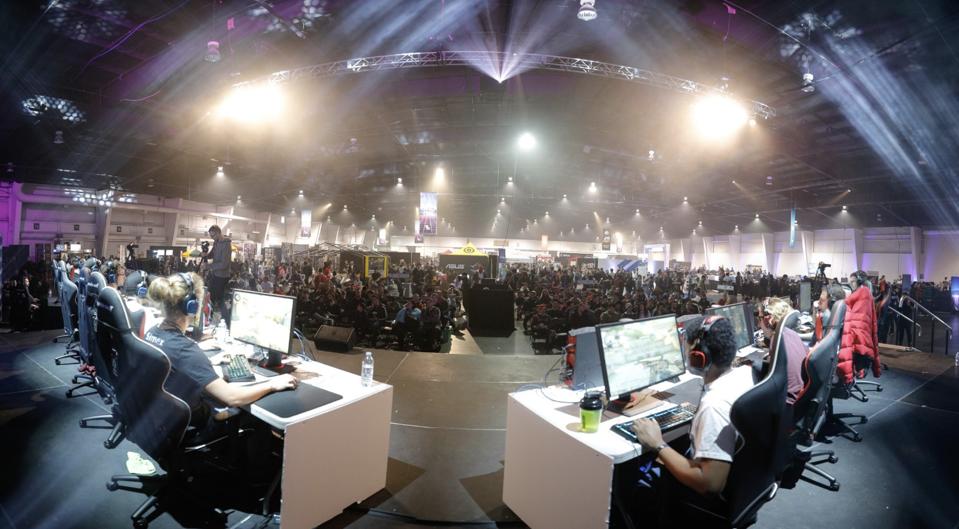
EGLX BELL main stage on March 11, 2018 during the Counter-Strike: Global Offensive semifinals.
Enthusiast Gaming Image. Used by Permission.
Kestenbaum says he grew up in a family of rabbis. He studied and
later taught theology in Israel while moonlighting as the blogger
“Nintendo Enthusiast†back in 2001. Like everyone else in the business
of gaming content, he learned he had a Field of Dreams in his backyard.
If you built it around gaming in the early 2000s, the fans would come.
Four years ago, Kestenbaum built Enthusiast Gaming in Toronto with
around $4 million in seed capital. He built it on the idea that hobbyist
and lifestyle gamers were reaching a critical mass like traditional
sports. Enthusiast’s network of gaming websites, including the old
Nintendo Enthusiast and Daily Esports, have a combined 150 million
visitors each month, based on April Google Analytics. Monthly visitors
across the network was 2 million monthly visitors in 2015 and has
doubled since it went public in October 2018. In mid-May, Enthusiast
Gaming stock was up 171% since their IPO, beating the MSCI Canada.
In terms of page views and users in the gaming information category,
Enthusiast Gaming rose to the top 5 since going public, according to
Comscore.
All of this serves a testament to the growth in the video gaming industry. Some games (think Fortnite) easily have more revenue than TV and movies.
The model for companies like this is relatively straightforward:
exploit gaming by making it the new Hollywood, the new Disney World, and
the new major league sports wrapped in one. Jumble it all together, and
package it like you were packaging any other entertainment. Sort of
like being the ESPN, NBA and a team sponsor rolled all into one: the
distributor, the platform brand, and the gamer team. Within the
subsection of esports, companies sell tickets to events no different
than they would a concert. In the future, these games, in aggregate,
will earn as much or more than the Superbowl due to a global audience.
“The content consumption in esports is going grow; not only the
streaming of the gaming events themselves, but also the popularity of
the gamers and influencers is growing. They are celebrities and brand
ambassadors,†says Henri Holm, CEO, FandomSports. They launched a mobile
gaming app this month that bridges traditional sports with video game
sports, creating content around the two.
“There is the learning aspect of watching gamers on any given
platform or channel, and there is the entertainment aspect of it,†says
Holm. “It all rakes in so many eyeballs. And that changes the entire
advertising landscape. Advertisers will follow.â€
Esporting events account for around 9% of gaming companies revenue.
Media rights are another 14%. Most of the money comes from corporate
sponsors of events and online advertising. It’s the same model
worldwide.
Activision signed a two-year $90 million deal with Twitch to
distribute Overwatch League in North America. The Overwatch League is a
professional esports league for players of the video game Overwatch. Like traditional sports, it has permanent teams and regular season play for prize money.
As esports evolves, content providers will compete for gaming leagues
like traditional broadcasters compete for major sporting events.
Imagine, Fortnight championships only on an Enthusiast Gaming channel. That’s the game plan.
Investors are tuned in.
Esports companies like Cloud9, founded in 2013, have 27 venture
capital funds invested. The Santa Monica-based gaming company that
sponsors teams in League of Legends, Call of Duty and Counter-Strike
got $53.6 million in its latest Series B round, almost half
Enthusiast’s current market cap fully diluted right now at $130 million.
Kestenbaum did 12 acquisitions this year, including a $20 million purchase
in April of The Sims Resource (TSR), the largest Sims community in the
world. Worth noting, TSR is the largest female video gaming content site
in the world and is ranked on Quantcast’s Top 25 websites with the
highest concentration of female audience in the U.S., close behind
Oprah.com, according to the company. TSR gets 2.5 billion page views per year, based on Google Analytics.
“We rather create partnerships than build organically,†Kestenbaum
says. “Alibaba and Tencent want to do this here. And with the China
trade war they may be more apt to do something with us in Canada than
with the U.S.,†he says, adding that most of their content traffic comes
from the U.S. They also have offices in Los Angeles.
Alibaba has partnered with Enthusiast at their gamer event EGLX in Toronto. The event is named after their ticker symbol.
Last year, Alibaba ran a tournament for various games at EGLX.
Players from different countries competed against each other in games
including Counter-Strike and Dota, a capture-the-flag type of team esport that’s big in China.
EGLX is growing, though it has nothing to do with the Chinese.
It’s gamers. Hobby gamers and lifestyle gamers, who Kestenbaum refers
to as “the mother lode†for companies in the space, are everywhere
today.
In 2016, EGLX sold around 12,000 tickets. Last year they hit 55,000
attendees. The event is one-part expo with gamers in cosplay visiting
booths, testing games and buying merchandise, and one-part competitive
video game arena. Youtubers with large online followings play against
fans. Mitch Marner, a Toronto Maple Leafs hockey player, played a
competitive round of Fortnite for charity.
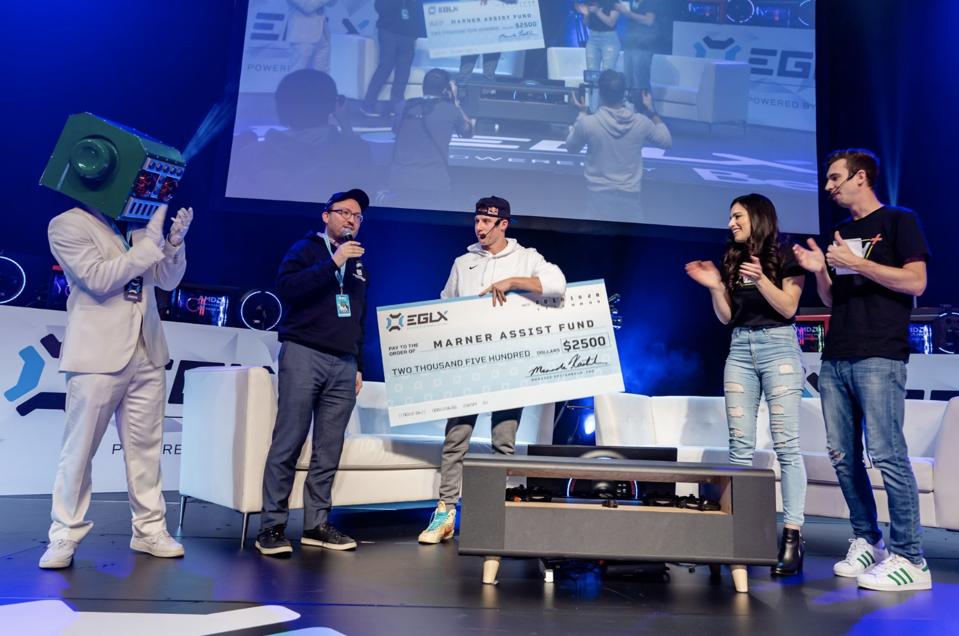
Kestenbaum presents NHL player Mitch Marner with a check for his
Fortnite charity match against a gamer from Chai Lifeline, a nonprofit
working with cancer patients. Destructoid’s mascot and the Kinda Funny
Games team look on.
Enthusiast Gaming. Used by Permission.
Their esports matches had combined payouts of $100,000, and were held
in a 100,000-square-foot room. When they do this again in October,
Enthusiast says it will need 200,000 square feet because there was not
enough room last time.
Enthusiast is running a rookie gamer program called Rising Stars. Think American Idol for big-dream video gamer fanatics. If lucky, lifestyle players might get a sponsor.
“There is a lot of content you can create around that scenario alone,†Kestenbaum says.
Holm’s from FandomSports agrees. Last year they found a soccer super
fan in Joinville, Brazil. “We flew him from Brazil to St. Petersburgh in
Russia to watch Brazil play Costa Rica. For us, it was a content
cost. We made him a star and put his journey on our website and Youtube
channel. Brands love to be a part of that.â€
It’s a fantasy world. But it’s easier to become a virtual athlete
than a real one. Universities from the U.S. to China are getting in on
the act. They’re teaching students how to manage events, how to play
games. It all sounds ridiculous, but many schools said the same about
ice hockey and soccer a hundred years ago.
Video game teams have a fan base just like the New York Yankees have
fans. Those teams earn real money. The Fortnite Tournament Prize pool is
$100 million. Yes, teams have to practice.
Individual gamers are the new celebrity.
Not a rock concert. Overwatch gamer fans watch a competition at a packed Barclays Arena in July 2018. (AP Photo/Mary Altaffer)
ASSOCIATED PRESS
Ninja, an online personality who live-streams himself playing video
games on Twitch and was a part of Luminosity Gaming, a Canadian esports
team backed by the owners of the Vancouver Canucks, makes around $1
million—per month, according to eSportsearnings.com.
Dota—a game whose artistry alone would impress the world’s
best graphic novel illustrator—paid out $25.5 million at the
International Dota 2 at Rogers Arena in Vancouver last August. This
year’s International Dota 2 Championship is going to the Mercedes Benz
Arena in Shanghai in August.
To put the Dota prize money into perspective, it pays twice that of Wimbledon and The Masters PGA golf tournaments.
Goldman Sachs forecasts esports audiences to reach 194 million this
year. Next year will be bigger. They have to watch those games
somewhere, physically and online. “I wouldn’t be surprised if you see an
esports arena at Disney someday,†says Coan from ITEC.
How long before Disney or Universal buy the rights to the Super Mario Brothers?
The U.S. and Canada are the largest esports market, with revenues of
$409.1 million, according to NewZoo’s 2019 Global Esports Market
Report.
China is bringing up the rear. The Chinese market for esports will
generate an estimated $210 million this year, overtaking Western Europe
to come in second place after North America.
“It all stems from the lifestyle gamer,†says Kestenbaum. “They’re
the type of gamer who consumes content about video games the way someone
in the market checks Bloomberg. They go to events. They pay to meet and
play with celebrity gamers. Gaming is no longer only about game
publishers selling a gaming app or a console game for Nintendo,†he
says. “There are cultures around these things. You can be Twitch and
provide a platform and watch people play and talk about your favorite
game,†he says.
Yes, Dan and Phil have taken their Sims gaming enthusiasm to
a live studio audience at arenas in the U.S. They were in Providence,
Rhode Island, at the Dunkin Donuts Center late last year.
Kestenbaum sums it all up for investors: “The opportunities here are absolutely enormous.â€
For media or event bookings related to Brazil, Russia, India or China, contact Forbes directly or find me on Twitter at @BRICBreaker
Posted by AGORACOM-JC
at 10:54 AM on Monday, June 3rd, 2019
Canadian pot edibles, topicals market worth $2.7B: Deloitte
Armina Ligaya, The Canadian Press
Canadian market for next-generation cannabis products is worth an estimated $2.7 billion annually, with edibles contributing more than half, according to a new report from Deloitte.
TORONTO — The Canadian market for next-generation cannabis products is worth an estimated $2.7 billion annually, with edibles contributing more than half, according to a new report from Deloitte.
This spending once the final edible pot regulations roll out in the
coming months is expected to be on top of the roughly $6-billion
estimated domestic market for recreational and medical cannabis, the
consultancy said Monday.
Consumers are looking to snap up these new pot products in addition
to the dried flower, oils, plants and seeds they have been buying from
legal retailers since legalization last fall, a recent survey of 2,000
Canadians conducted by Deloitte suggests.
The first wave of legalization last October was quite limited in
terms of product range and the type of consumer, said Jennifer Lee,
Deloitte Canada’s cannabis national leader.
“When we legalize in October again for edibles, we are in a world
where the formats and the assortment is much broader,” she said. “The
use cases are much broader.”
Canada is gearing up to legalize cannabis-infused foods, beverages,
topicals and other next-generation products in the coming months, once
Ottawa rolls out the final regulations.
Pot companies, as well as food and beverage makers, have been
preparing to roll out their own pot-infused products which they
anticipate will appeal to a broader audience — particularly those who
aren’t interested in smoking weed.
The federal government wrapped up its consultation on the draft
edible rules in February, and has said the regulations must be brought
into force no later than Oct. 17, 2019.
Deloitte estimates that roughly $1.6 billion will be spent on edibles
in Canada, followed by cannabis-infused beverages at $529 million and
topicals at $174 million. Spending on concentrates is expected to hit
$140 million, followed by tinctures at $116 million and capsules at $114
million.
Roughly half of likely edible users surveyed by Deloitte say they
plan to consume gummy bears, cookies, brownies or chocolate at least
every three months.
The global market for alternative cannabis products is expected to
nearly double over the next five years, the consultancy added.
Lee doesn’t expect these new products to eat into revenues from existing categories in Canada, at least in the early days.
“Over time, in the long term, you may,” she said. “But right now,
there’s too much demand in the market and there’s not enough product.”
Legal pot retailers, both government and privately owned, have been
contending with a shortage of cannabis since legalization last October,
but have said the situation has improved in recent months.
For example, the Alberta government lifted its moratorium on new cannabis retail licences, citing an increase in the pot supply.
Deloitte’s market estimates for cannabis 2.0 products reflect overall
Canadian consumer demand, but realizing the market’s full potential too
may take some time. Many of the new pot products may not be available,
or available in sufficient quality, come October, Deloitte said.
Companies should take a three- to five-year view on the market, said Lee.
“The regulations will need time to settle, even after legalization in October,” she said.
While this presents a growth opportunity for companies readying
themselves for the next wave of the green rush, it may come at the
expense of sales in more established industries.
“Our research is showing that the occasions that consumers use the
product, i.e. mostly edibles, overlap a lot with alcohol … On a
limited wallet, there are going to be tradeoffs,” Lee said.
As well, consumers view topical cannabis products such as lotions
used for ailments such as pain as a potential replacement for other
medicinal products, Deloitte’s survey showed.
“This could be cause for concern for the traditional pharmaceutical
sector, as 45 per cent of current consumers and 48 per cent of likely
consumers say they see cannabis topicals as an alternative to
prescription medications, not a complement,” Deloitte said in the
report.
Deloitte surveyed 2,000 adult Canadians online between Feb. 26 and March 11.
According to the polling industry’s generally accepted standards,
online surveys cannot be assigned a margin of error because they do not
randomly sample the population.
Cannabis Canada is BNN Bloomberg’s in-depth
series exploring the stunning formation of the entirely new – and
controversial – Canadian recreational marijuana industry. Read more from
the special series here and subscribe to our Cannabis Canada newsletter to have the latest marijuana news delivered directly to your inbox every day.
EdTech Start-up Business: Scope & Opportunity in India
The start-up of EdTech or Educational Technology was quite simple. Computers helped in teaching arithmetic and some grammar to young school students. The concept was elementary. And it happened long before the internet had invaded our home. With the internet, modern devices and highly sophisticated software available at every nook & corner
The start-up of EdTech or Educational Technology was quite simple.
Computers helped in teaching arithmetic and some grammar to young school
students. The concept was elementary. And it happened long before the
internet had invaded our home.
With the internet, modern devices and highly sophisticated software
available at every nook & corner of even the semi-developed cities
in India. Now, the scope of reach of education has widened like never
before. The impact of Edtech on education, society in general, is
amazing. And this sector as a business opportunity is within the grasp
of all aspiring start-ups.
What is EdTech?
“A picture is worth a Thousand words.â€
With technology being introduced in the field of education, you would
find audios, videos and 3D animation, instead of that Picture. This has
made learning far more dynamic and interactive.
To define simply, any technology that supports education is EdTech.
Today, we don’t imagine school as only a blackboard, a teacher and
some desks. Present day student receives and uploads homework
assignments on the school portal. The rise in EdTech start-up has meant
that they can practice Mathematics online, understand the Biology images
using 3D techniques. Quick and accurate checks help in enhancing the
performance of the students. Such has been the rise in educational
technology.
The true essence of EdTech lies in using technological advances to
improve the education system. It facilitates learning and improves
performance by creating and managing appropriate technology tools.
EdTech Start-ups have changed Learning to e-Learning.
Scope of EdTech Start-up
When every moment of our daily life is being shaped by technology,
then how can education be any different? Technology is making a huge
impact in the field of education as well.
Over the past few years, you must have noticed the immense growth of
EdTech start-up. The companies which started-up in EdTech, even a few
years ago, have gained ground. They have managed to touch unfathomable
heights in business.
A leading example is BYJU’s, the EdTech and Online Tutoring Firm
started up in 2011. In March 2019, it was the world’s most valued
EdTech company at $5.4 billion (Rs 37,000 crore), according to
Wikipedia.
Due to all these developments, people are finding it worth to invest in this innovative new concept.
EdTech start-ups are transforming lives and reinventing businesses.
To provide more data and numbers:
India stands at 145 out of the 191 countries on the Education Index, as per UN,
Its rank is 168 out of 234 countries as per UNESCO with a literacy rate of 72%,
India is ranked at 72 out of the 73 countries considered by OECD.
If you are an aspiring entrepreneur, this data might mean an exciting opportunity for you.
Scope in India
“We, Indians have always had a fixation with education.â€
Any country’s education needs can be met by the government up to a
certain level. Unless innovation is introduced, all systems end up
eventually. This is where entrepreneurship comes in. To bring a
freshness of ideas into the system. India has a whole industry in
education. In waiting for entrepreneurs to take advantage of their
opportunities.
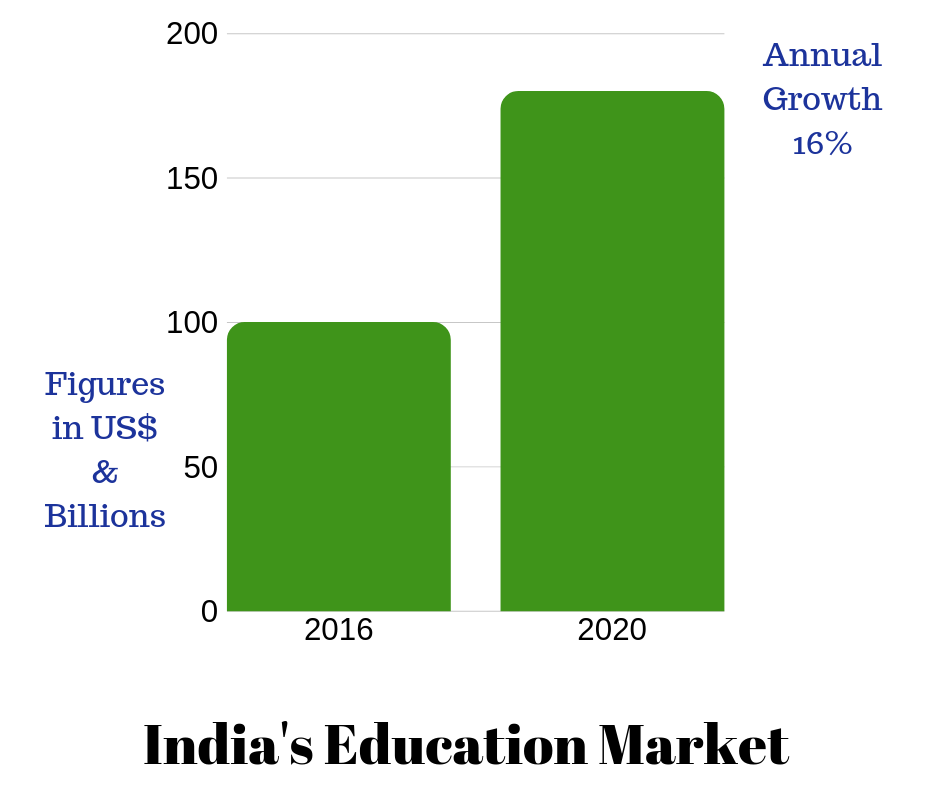
In the year 2016, the Indian Education Industry was valued at $100
billion. This is expected to almost double by 2020 to $180 billion. The
increase in literacy rate and digital learning would be instrumental in
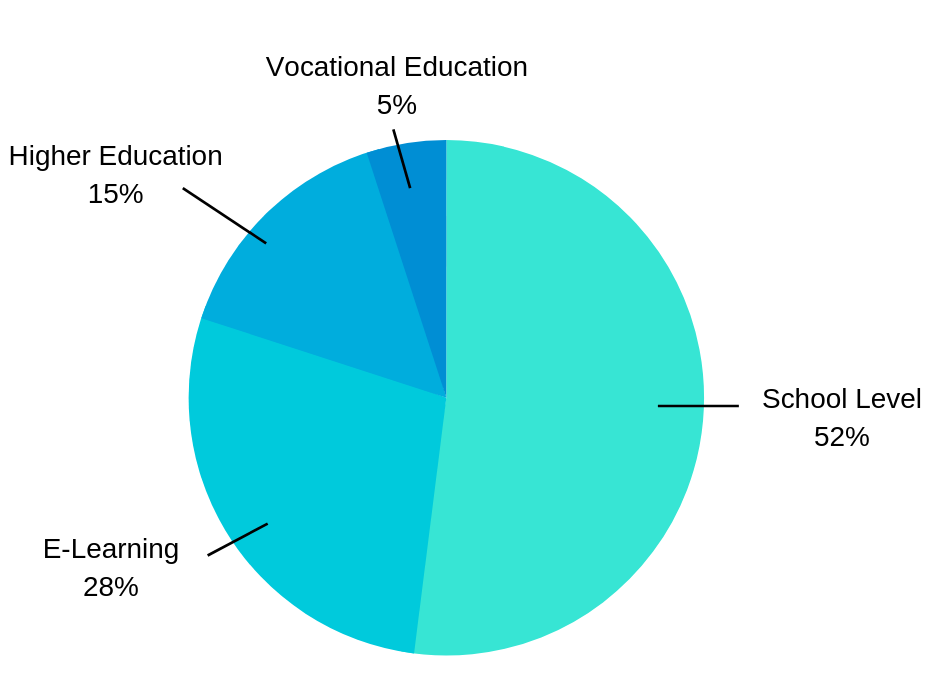
this growth. EdTech itself was estimated at $2 billion. The School
segment consists of primary and secondary school education. This forms
52% of the education industry. This segment offers the biggest
opportunities for development.
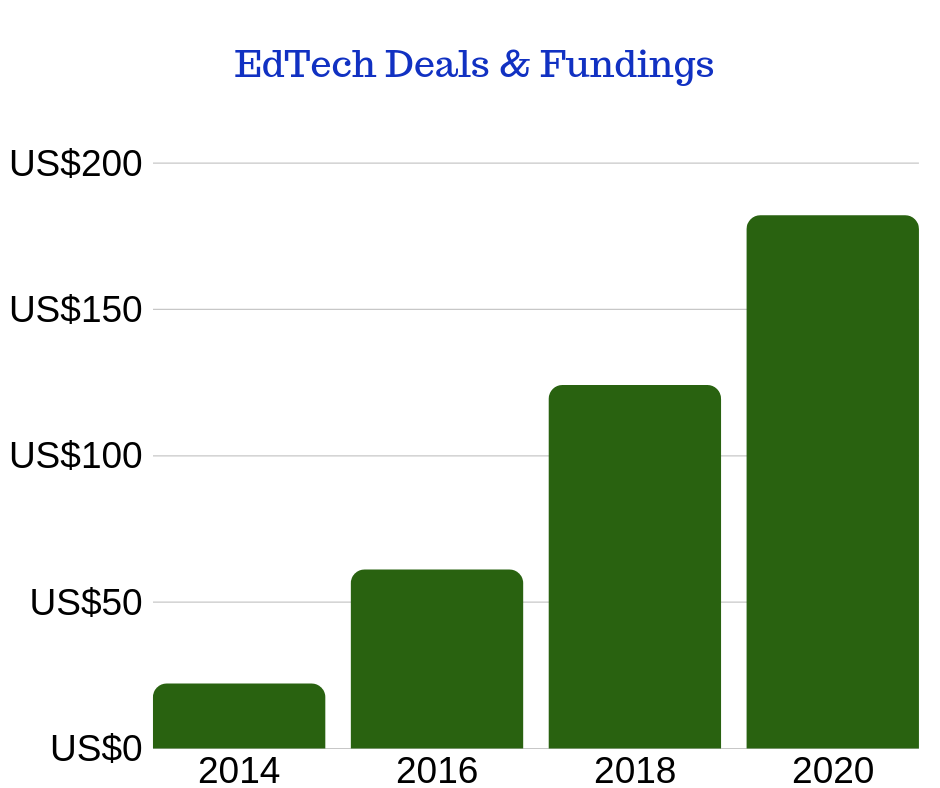
Education, including EdTech, has seen a rise in funding. While 4-5
years ago, the annual investment was approx US$20 million. However, the
total funding has seen an extraordinary hike. It has been forecasted as
exceeding US$ 180 million for the year 2020.
Viewing this data, you won’t be surprised to know that major
investors from all over the world are paying close attention to the
developments in Indian EdTech start-up scenario. Some have already
jumped in the fray. In the private sector, Tata Consultancy Service
(TCS) has teamed up with IIM, to give you one example.
The government has also accepted its importance.
Funding for your EdTech start-up may come from both private and
government sources. For example Start-Up India. This is a program by the
Central Government. It has been set up with the objective to promote
start-ups by providing easier bank loans. Another initiative is Atal
Innovation Mission or AIM. It seeks to promote entrepreneurship. Then
there is the Swayam initiative. A program that is planned to offer about
200 e-courses and another 10,000 e-courses under the AICTE.
Some important foreign players are also entering the market. They are
investing to support EdTech start-up. They are Goldman Sachs, Times
Internet, Mark Zuckerberg’s investment fund, to name a few.
Important Factors to Consider
“Every Path to Success is riddled with Challenges.â€
Incorporating an EdTech company and making your start-up work may not
be as smooth as it seems. You may face many difficulties with
your EdTech start-up. For instance, if you are thinking of setting up an
institution supporting school education, an endorsement from school may
boost your start-up to succeed. But the question is how do you get that
necessary endorsement? For that, you may need to prove to them that you
would add value to their brand as well.
On the roadway to success, you will find yourself faced with many
such challenges and mistakes. And you would need to encounter those.
You must strategise your entrance into the EdTech Start-up market. You would need to team up with some technology specialists. You can choose to collaborate with educators. You may follow tips from experts. Of course, a great way to start will be thinking up a new and unique idea.
Below we suggest some strategies and ideas that you may want to
follow to succeed in this highly competitive world of EdTech Start-ups:
Identify your Niche: The first step will be to identify
what exact problem your EdTech Start-up will be solving. This Solution
Statement will clearly suggest your niche. What field do you want to
cater to the education sector?
The Hierarchy for your EdTech Start-up: Before getting company registration
for your business, each promoter/founder must be clear about their
roles, authorities, responsibilities and respective share in the
business. Deciding on these unavoidable and awkward topics first hand
would give each one of you a sense of security. It leads to better
involvement. And avoid many complications in future.
Learn from Others: Join some community of entrepreneurs
from the same field. Get exposed to the work style of other EdTech
directors. More the number, better the exposure and learning. Evaluate
which one is suitable for yourself. Which one would be easiest for you
to adapt to? Develop a mix and refined to suit your business. You may
also make friends. So they would share their personal experiences. The
challenges they must have faced and how they could overcome them.
Proximity to the Audience: You should place yourself
near to a good educational institution. A university would be best. You
can take help of the university students to help you would in project
completions, undertake researches and other initial tasks. With their
innovative ideas, you can test your concept on them.
Testing: The product or service get tested by real
testing. Presenting your product in the real market is the actual test.
No matter how good your team is, some mistakes do slip by. The Beta
Testing will check what errors have been ignored. It will also test the
viability of your product.
Quality: The quality of the services you would be
providing is a key factor to consider. Even if the technology you use is
cutting edge, it would still be very difficult for your EdTech Start-up
to succeed if you do not support it with great educational content.
Building the Team: The core of an EdTech Start-up is
technology. It needs to be kept up-to-date. Regular upkeep is an
important factor for success. To serve this purpose you would need a
strong and stable technology team. The team should not only be hired on
the basis of their existing skill set and qualifications. They must also
have the eagerness to learn and improve themselves. They should be
proactive enough to work out solutions to problems. The work culture of a
start-up is different from that of the corporates that have been
running for some time. You are responsible to hire responsible persons
for the success of your EdTech Start-up. They should be willing
to adjust according to the demands.
Keep Room to Upgrade: All innovative ideas are a work
in progress. No product is final. There is always room for improvement
and upgrade. Once your course has been launched, try to listen to the
customers. Later you can incorporate those new ideas, features and needs
into your course. This way your course will get better. Therefore, it
is advisable not to spend too much time in going live with your product.
Keep improving it periodically to keep it up-to-date with the current
latest technology.
Sales & Marketing: The sales of your product must
reach the required level as anticipated at the start. You need to spread
the word about your new EdTech Start-up on various media platforms. You
may need to keep a separate fund out of the budget for the marketing.
Keep evaluating the sales numbers frequently. Keep revising and
improving on the sales and marketing plans.
Keep on learning: Knowledge and education keep
evolving. And because you have decided to start your business as an
educational institution, you must never get tired of learning. This will
keep you updated with the latest trends in technology. Many sources are
available online as well. The technology gets upgraded almost daily. So
try to use the best and the latest one for your business.
“Learning is a Continuous Process.â€
Make adjustments: You may have planned very carefully
the operations and growth of your business. But some circumstances may
come up causing you to change or drop out. You may get faced with
certain situations right at the time when you feel all has been set and
your business is ready to fly. be adaptable. The EdTech practices keep
changing and you may need to adjust accordingly. It may be financial,
strategic, legal or a change in the business model.
“Change is inevitable.â€
Funding: Funding is the primary concern for all
enterprises. Many great ideas have not taken shape because they didn’t
have the backing of sufficient funds. To incorporate an innovative idea
in your EdTech Start-up, you should try to connect with various sources.
The single funding source can put restrictions on some of the workable
ideas. Sometimes, the source may not be able to provide financial help,
as frequently as required.
Don’t lose sight of your Goal: You have decided to
start a business in the sector which shapes the future. Be it the
student, her family, those who are connected to her. Those who will
connect to her in the future. Remember to keep the values of teaching
intact. The virtuosity will also give a boost to your business. Because
you are adding not only qualifications to a resume but moulding a
person.
Work on the Feedbacks: You must keep a way of receiving
feedback open in your product. You can invite other educators to try
out your products, apps, tools. You can also provide teachers with
Professional Development courses. This will assist them in using your
technology. Their feedback may prove to be invaluable to the survival of
your start-up. You should work to take regular feedback from the
students and the teacher. And work to improve your product. If users are
satisfied then they’ll be encouraged to use and recommend your product.
Posted by AGORACOM-JC
at 10:16 AM on Friday, May 31st, 2019
Announced that the CEO, Mr. Photis Peter Pascali, had increased his beneficial ownership in the Company to 52.82% from 50.37%, an increase of approximately 2.5%.
MONTREAL, May 31, 2019 — PyroGenesis Canada Inc. (http://pyrogenesis.com) (TSX-V: PYR) (OTCQB: PYRNF) (FRA: 8PY), a high-tech company, (the “Company”, the “Corporation†or “PyroGenesis”) a Company that designs, develops, manufactures and commercializes plasma atomized metal powder, plasma waste-to-energy systems and plasma torch products, wishes to clarify today, due to numerous inquiries, the transaction that took place yesterday wherein it was announced that the CEO, Mr. Photis Peter Pascali, had increased his beneficial ownership in the Company to 52.82% from 50.37%, an increase of approximately 2.5%.
As this transaction involved the CEO, a significant investor in the
Company, the Company was obliged to issue an early warning report which
regretfully has caused confusion.
In the transaction, Mr. Pascali acquired 3,385,715 Common Shares, plus Warrants for C$1,862,143.25.
The Company would like to clarify the fact that this was not a
private placement, no money was received by the Company and no new
shares or warrants were issued by the Company.
It was announced that Mr. Pascali acquired the Common Shares and
Warrants for investment purposes and may, from time to time, acquire or
dispose of ownership or control or direction over some or all of the
existing securities or over additional securities of PyroGenesis.
PyroGenesis Canada Inc., a high-tech company, is the world leader in the design, development, manufacture and commercialization of advanced plasma processes and products. We provide engineering and manufacturing expertise, cutting-edge contract research, as well as turnkey process equipment packages to the defense, metallurgical, mining, advanced materials (including 3D printing), oil & gas, and environmental industries. With a team of experienced engineers, scientists and technicians working out of our Montreal office and our 3,800 m2 manufacturing facility, PyroGenesis maintains its competitive advantage by remaining at the forefront of technology development and commercialization. Our core competencies allow PyroGenesis to lead the way in providing innovative plasma torches, plasma waste processes, high-temperature metallurgical processes, and engineering services to the global marketplace. Our operations are ISO 9001:2015 and AS9100D certified, and have been since 1997. PyroGenesis is a publicly-traded Canadian Corporation on the TSX Venture Exchange (Ticker Symbol: PYR) and on the OTCQB Marketplace. For more information, please visit www.pyrogenesis.com.
This press release contains certain forward-looking statements,
including, without limitation, statements containing the words “may”,
“plan”, “will”, “estimate”, “continue”, “anticipate”, “intend”,
“expect”, “in the process” and other similar expressions which
constitute “forward- looking information” within the meaning of
applicable securities laws. Forward-looking statements reflect the
Corporation’s current expectation and assumptions and are subject to a
number of risks and uncertainties that could cause actual results to
differ materially from those anticipated. These forward-looking
statements involve risks and uncertainties including, but not limited
to, our expectations regarding the acceptance of our products by the
market, our strategy to develop new products and enhance the
capabilities of existing products, our strategy with respect to research
and development, the impact of competitive products and pricing, new
product development, and uncertainties related to the regulatory
approval process. Such statements reflect the current views of the
Corporation with respect to future events and are subject to certain
risks and uncertainties and other risks detailed from time-to-time in
the Corporation’s ongoing filings with the securities regulatory
authorities, which filings can be found at www.sedar.com, or at www.otcmarkets.com. Actual
results, events, and performance may differ materially. Readers are
cautioned not to place undue reliance on these forward-looking
statements. The Corporation undertakes no obligation to publicly update
or revise any forward- looking statements either as a result of new
information, future events or otherwise, except as required by
applicable securities laws.
Neither the TSX Venture Exchange, its Regulation Services
Provider (as that term is defined in the policies of the TSX Venture
Exchange) nor the OTCQB accepts responsibility for the adequacy or
accuracy of this press release.
Posted by AGORACOM-JC
at 3:22 PM on Thursday, May 30th, 2019
Entered into a share purchase agreement dated May 29, 2019, with BWA Group PLC (PZ: BWAP)
An arm’s length company listed on the London NEX Exchange a minority shareholders of Kings of the North Corp., owned at 50.18% by SX, pursuant to which BWA will acquire of all the issued and outstanding shares of KOTN for an aggregate consideration of CAD $7,500,000 or approximately 4,400,000 GBP.
Baie-Comeau / May 30, 2019 – St-Georges Eco-Mining Corp. (CSE: SX)(OTC: SXOOF) (FSE: 85G1) is pleased to announce it entered into a share purchase agreement dated May 29, 2019, with BWA Group PLC (PZ: BWAP) , an arm’s length company listed on the London NEX Exchange in the United Kingdom and incorporated under the laws of England and Wales, and the minority shareholders of Kings of the North Corp., owned at 50.18% by SX, pursuant to which BWA will acquire of all the issued and outstanding shares of KOTN for an aggregate consideration of CAD$7,500,000 or approximately 4,400,000 GBP.
Mark Billings, Chairman of
SX, and President and CEO of KOTN commented: “Both Kings of the North
and St-Georges are happy to have concluded this transaction with BWA.
This is the first step in accessing funds to develop properly the assets
that have been assembled in KOTN. We look forward to working with our
new colleagues in the United Kingdom, which provides exposure of our
Company to one of the largest financial markets in the world.”
At the time of closing of
the Acquisition, KOTN will own a 100% beneficial interest in a suite of
mineral exploration properties in the Province of Quebec, other than the
properties known as the Villebon, Hemlo North, and Nova Gold properties
in respect of which KOTN will hold an option to acquire between 65% and
100%, upon the terms and condition detailed below.
The Purchase Price
will be funded with the issuance by BWA of the sterling equivalent of
$7,500,000 unsecured, convertible interest-free loan notes (the “Notes“)
with an initial repayment date three years after issue. The conversion
terms are such that SX and its related parties cannot own more than 29%
of the equity of BWA. The minimum conversion price is ?0.005 per share
at the time of conversion. SX will receive Notes in the principal amount
of $3,763,301.80 in exchange for the KOTN Interest.
The Acquisition is
conditional upon: (i) BWA raising a minimum of ?500,000 (approximately
$850,000) through the issuance of new BWA shares, BWA subscribing to
$300,000 in common shares (each a “SX Share“) in the capital of SX at a price equal to the 10 VWAP at the time of issue, subject to a minimum of $0.10 per Share (the “SX Subscription“), and (iii) the consent of the shareholders of BWA.
Upon completion of the
transaction Mr. Vilhjalmur Thor Vilhjalmsson, the President and CEO of
SX will be appointed CEO and a director of BWA.
Concurrent Transactions
Prior to entering into the SPA, KOTN secured the following assets and option:
– 100% interest,
subject to a 3% NSR royalty, of which half may be bough back for
$3,000,000, in the Winter House property in consideration of the
issuance of 7,200,000 common shares (each a “Share“) in the capital of KOTN (the “WH Acquisition“);
– Option to acquire up to an 85% interest in the Hemlo North property from Canadian Orebodies Inc. (TSXV: CORE),
in consideration of the issuance of 1,296,976 Shares and $750,000 in
exploration expenditures on or before March 31, 2020 for an initial 50%,
$350,000 in 15% convertible notes and a further $750,000 in exploration
expenditures on or before March 31, 2021 for an additional 25%, and a
final to 10% upon the delivery of a positive feasibility study;
– Option to acquire up to a
100% interest, subject to a 1.8% NSR royalty, of which half may be bough
back for $1,000,000, in the Nova Gold property from prospectors., in
consideration of the issuance of 1,482,258 Shares, $1,000,000 in
exploration expenditures as follows: $400,000 on or before August 28,
2020, and $300,000 on or before each of August 28, 2021 and 2022, and
cash payment of $300,000 to be made on August 28, 2021 and 2022; and
– Option to acquire up to a 65% interest, subject to a 2% NSR royalty, of which 1% may be
bough back for $3,000,000, in the Villebon property from SX, in
consideration of the issuance of 741,130 Shares and $3,000,000 in
exploration expenditures as follows: $200,000 on or before May 28, 2020,
$500,000 $200,000 on or before May 28, 2021, $1,00,000 on or before May
28, 2022, and $1,300,000 on or before May 28, 2023.
KOTN also settled aggregate debts of $504,000 through the issuance of 1,867,645 Shares (the “Debt Settlement“), and SX subscribed to 1,111,693 Shares for an aggregate subscription price of $300,000.
All securities issued under
the SX Subscription will be subject to a hold period expiring four
months and one day from the date of issuance.
Related-party transaction
Portions of the WH
Acquisition and Debt Settlement, are considered to be a “related party
transaction” for purposes of Multilateral Instrument 61-101 – Protection of Minority Security Holders in Special Transactions (“MI 61-101“).
The Corporation is relying on exemptions from the formal valuation and
minority shareholder approval requirements available under MI 61-101.
The Corporation is exempt from the formal valuation requirement in
section 5.4 of MI 61-101 in reliance on sections 5.5(a) and (b) of MI
61-101 as the fair market value of each transaction is not more than the
25% of the Corporation’s market capitalization, and no securities of
the Corporation are listed or quoted for trading on prescribed stock
exchanges or stock markets. Additionally, the Corporation is exempt from
minority shareholder approval requirement in section 5.6 of MI 61-101
in reliance on section 5.7(b) as the fair market value of each
transaction is not more than the 25% of the Corporation’s market
capitalization. The board of directors of the Corporation approved the
WH Acquisition and Debt Settlement, with Frank Dumas, Frank Dumas, Neha
Tally, Mark Billings, Peter Smith and Gerry Nichols having declared a
conflict of interest in, and abstaining from voting on, the matters
being considered.
ON BEHALF OF THE BOARD OF DIRECTORS
“Mark Billings”
Mark Billings, Chairman
About St-Georges
St-Georges is developing new technologies to solve the some of the most common environmental problems in the mining industry.
The Company controls
directly or indirectly, through rights of first refusal, all of the
active mineral tenures in Iceland. It also explores for nickel on the
Julie Nickel Project & for industrial minerals on Quebec’s North
Shore and for lithium and rare metals in Northern Quebec and in the
Abitibi region. Headquartered in Montreal, St-Georges’ stock is listed
on the CSE under the symbol SX, on the US OTC under the Symbol SXOOF and
on the Frankfurt Stock Exchange under the symbol 85G1.
Cautionary Statements Regarding Forward-Looking Information
Certain
statements included herein may constitute “forward-looking statements”.
All statements included in this press release that address future
events, conditions, or results, including in connection with the
prefeasibility study, its financing, job creation, the investments to
complete the project and the potential performance, production, and
environmental footprint of the ferrosilicon plant, are forward-looking
statements. These forward-looking statements can be identified by the
use of words such as “may”, “must”, “plan”, “believe”, “expect”,
“estimate”, “think”, “continue”, “should”, “will”, “could”, “intend”,
“anticipate”, or “future”, or the negative forms thereof or similar
variations. These forward-looking statements are based on certain
assumptions and analyses made by management in light of their
experiences and their perception of historical trends, current
conditions, and expected future developments, as well as other factors
they believe are appropriate in the circumstances. These statements are
subject to risks, uncertainties, and assumptions, including those
mentioned in the Corporation’s continuous disclosure documents, which
can be found under its profile on SEDAR (www.sedar.com).
Many of such risks and uncertainties are outside the control of the
Corporation and could cause actual results to differ materially from
those expressed or implied by such forward-looking statements. In making
such forward-looking statements, management has relied upon a number of
material factors and assumptions, on the basis of currently available
information, for which there is no insurance that such information will
prove accurate. All forward-looking statements are expressly qualified
in their entirety by the cautionary statements set forth above. The
Corporation is under no obligation, and expressly disclaims any
intention or obligation, to update or revise any forward-looking
statements, whether as a result of new information, future events or
otherwise, except as expressly required by applicable law.