Adult learners prefer university degrees, but short courses gaining popularity too
New Delhi: A certificate from a college is still the most important thing for Indian learners, but many in the country would now consider taking up short online courses too, according to data from a survey of more than 1,000 Indians by British multinational publishing and education firm Pearson.
One in three Indian learners would consider doing a university master’s degree in the next three years, but one in four learners would also consider taking up short courses, either free or paid, ..
Tags: education, tsx Posted in All Recent Posts, betterU Education Corp | Comments Off on Betteru Education Corp. $BTRU.ca – Adult learners prefer university degrees, but short courses gaining popularity too $ARCL $CPLA $BPI $FC.ca
Posted by AGORACOM-JC
at 12:08 PM on Tuesday, January 15th, 2019
The amended January 9, 2019 NI 43-101 Mineral Resource Estimate confirms that the River Valley Project has 2,867,000 Measured and Indicated PdEq ounces, with 1,059,000 PdEq ounces in Inferred at a 0.35 g/t and 2.0 g/t PdEq cut-off for open pit and underground respectively.
The amended and restated Mineral Resource Estimate presents a Mineral Resource that demonstrates reasonable prospects for eventual economic extraction.
The new pit constrained Mineral Resource will be more representative of the potentially economic portion of the Mineral Resource that will be disclosed in the upcoming 2019 Preliminary Economic Assessment (PEA).
River Valley is the largest undeveloped primary PGM Mineral Resource in North America. The Project has excellent infrastructure and is within 100 kilometres of the Sudbury Metallurgical Complex. The Project is 100% owned by New Age Metals.
The Project’s first economic study (Preliminary Economic Assessment) is slated to be completed on or before the end of Q2 2019.
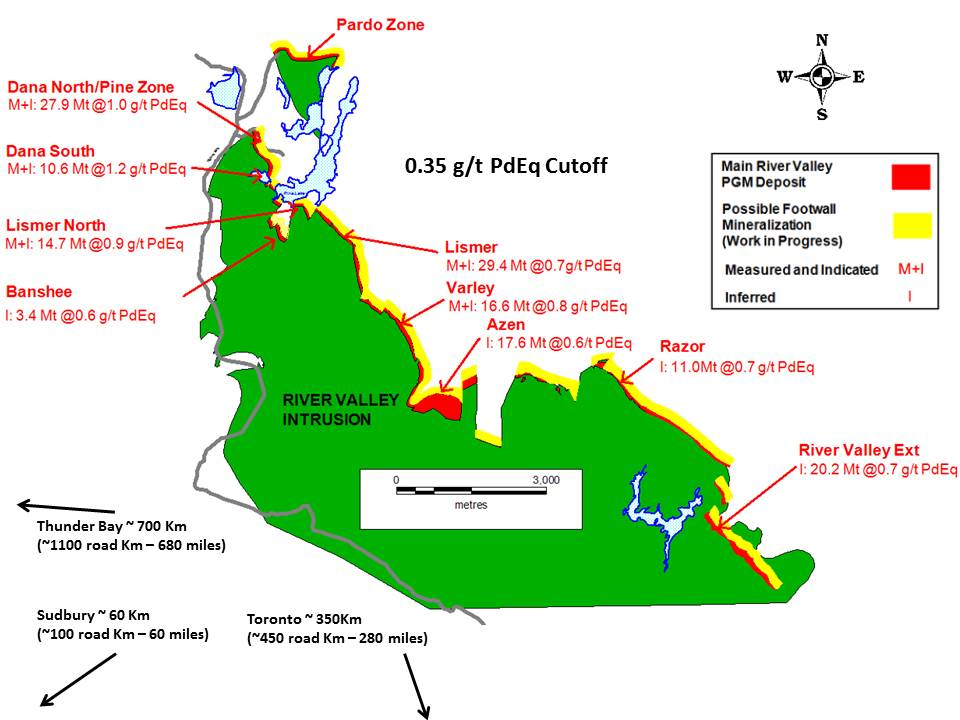
January 15, 2019 / Rockport, Canada – New Age Metals Inc. (NAM) (TSX.V: NAM; OTCQB: NMTLF; FSE: P7J.F) Harry Barr, Chairman & CEO, stated; “The company is pleased to update our shareholders with the new amended May 2018 NI 43-101 Mineral Resource Estimate of the River Valley Platinum Group Metals (PGM) Project. As a result of a review by the British Columbia Securities Commission (“BCSC”) the Company is clarifying the Technical Report on its River Valley PGM Project filed on May 7, 2018. WSP Canada Inc. (WSP) under the supervision of Todd McCracken, P. Geo., completed the Mineral Resource estimation. Management believes this study has upgraded the open pit bulk mining potential of this project. The May 2018 Technical Report presented a global mineral inventory whereas the January 2019 Technical Report presents a pit constrained Mineral Resource that shows reasonable prospects for eventual economic extraction. Our objective is to complete the Project’s first economic study, a Preliminary Economic Assessment (PEA) on or before the end of Q2 2019. The second objective is to continue to explore and develop the entire 16 kilometres of mineralization throughout the contact zone (current established Mineral Resource) and test the new footwall discovery that has potential to extend throughout the overall Project.” (See Figure 1)
WSP Canada, under the supervision of
Todd McCracken, P. Geo (Manager-Mining at WSP Canada) has recently
amended the 2018 NI 43-101 Mineral Resource estimation of the River
Valley PGM Deposit in the Sudbury Mining District of Ontario, Canada. The
new Mineral Resource Estimate has incorporated all the past data,
geophysics, new drilling since 2015 and the River Valley Extension
(RVE), including the additional drilling in the new footwall discoveries
Pine Zone and T3.
The
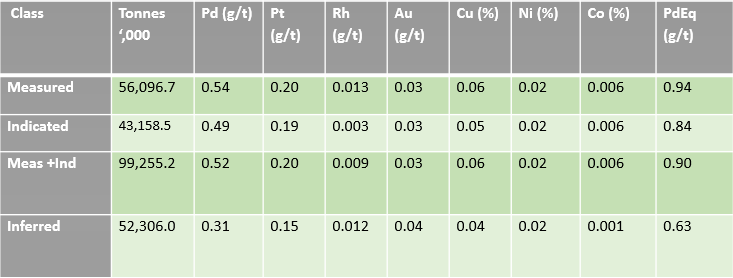
results of the updated Mineral Resource Estimate are tabulated in Table 1
below (0.35 g/t PdEq open pit and 2.0 g.t PdEq underground cut-off).
This 43-101 Technical Report is available on SEDAR.
Table 1: Results from the amended NI 43-101 Mineral Resource Estimate.
Click Image To View Full Size
Class
PGM + Au (oz)
PdEq (oz)
PtEq (oz)
Measured
1,394,000
1,701,000
1,701,000
Indicated
983,000
1,166,000
1,166,000
Meas +Ind
2,377,000
2,867,000
2,867,000
Inferred
841,000
1,059,000
1,059,000
Notes:
1.CIM definition standards were followed for the Mineral Resource Estimate.
2.The 2018 Mineral Resource models used
Ordinary Kriging grade estimation within a three-dimensional block model
with mineralized zones defined by wireframed solids.
3.A base cut-off grade of 0.35 g/t PdEq
was used for reporting Mineral Resources in a constrained pit and 2.00
g/t PdEq was used for reporting the Mineral Resources under the pit.
6.Mineral Resources that are not Mineral Reserves do not have economic viability
7. The Inferred Mineral Resource in this
estimate has a lower level of confidence than that applied to an
Indicated Mineral Resource and must not be converted to a Mineral
Reserve. It is reasonably expected that the majority of the Inferred
Mineral Resource could be upgraded to an Indicated Mineral Resource with
continued exploration.
Click Image To View Full Size
Figure
1: The Yellow Band represents the footwall potential area of the River
Valley Deposit based on the results of the Pine Zone where footwall
mineralization was noted to extend 150 metres eastward from the Pine
Zone/ T3 main deposit. At present the only area that has confirmed
footwall mineralization is in the Pine Zone (defined from 2015 to 2017
drilling). Geophysics and exploration are in progress to test other
areas of the Deposit. Management’s specific focus is to outline a
sufficient potentially economic Mineral Resource in the northern portion
of the project, and subsequently develop a series of open pits (bulk
mining), crush,and concentrate on site, and ship the concentrates to Sudbury for metallurgical extraction.
CONFERENCES THIS QUARTER
In late January, our Chairman & CEO
Harry Barr is travelling to South Africa attending two 1-2-1 style
conferences with over 25 pre-booked meetings with mine finance
companies, major mine companies, institutions, stock brokers, and high
net worth individuals.
OPT-IN LIST
If you have not done so already, we encourage you to sign up on our website (www.newagemetals.com) to receive our updated news or click here.
ABOUT NAM’S PGM DIVISION
NAM’s flagship project is its 100% owned River Valley PGM Project (NAM Website – River Valley Project)
in the Sudbury Mining District of Northern Ontario (100 km east of
Sudbury, Ontario). See results from the most recent NI 43-101 Mineral
Resource update above in Table 1. NAM management and consultants are
currently designing a complete drill program to be executed in 2019 for
the River Valley Project. This plan will consider previously proposed
drill parameters and will be based on the most recent geophysical
assessment and consultant expertise. The projects first economic study, a
Preliminary Economic Assessment (PEA) is underway and is being overseen
by Mr. Michael Neumann, P.Eng., a veteran mining engineer and one of NAM’s directors. See
the most recent press releases for the River Valley Project PEA which
details the appointment of P&E Mining Consultants Inc. and DRA
Americas to jointly conduct the study, dated July 25, 2018 and August 1, 2018 respectively. Our new Fall Chairman’s message can be accessed at our website (www.newagemetals.com) .
On April 4th, 2018, NAM signed an agreement with one of Alaska’s top geological consulting companies. The companies stated objective is to acquire additional PGM and Rare Metal projects in Alaska. On April 18th, 2018,
NAM announced the right to purchase 100% of the Genesis PGM Project,
NAM’s first Alaskan PGM acquisition related to the April 4th
agreement. The Genesis PGM Project is a road accessible, under
explored, highly prospective, multi-prospect drill ready Palladium (Pd)-
Platinum (Pt)- Nickel (Ni)- Copper (Cu) property. A
comprehensive report on previous exploration and future phases of work
was completed by Avalon Development of Fairbanks Alaska in August 2018
on Genesis. A full sampling program will be conducted to continue
to outline additional mineralization along the 800-metre by 40-metre
mineralized zone
On August 29, the Avalon report was
submitted to NAM, management is actively seeking an option/joint-venture
partner for this road accessible PGM and Multiple Element Project using
the Prospector Generator business model.
QUALIFIED PERSON
The
contents contained herein that relate to Exploration Results or Mineral
Resources is based on information compiled, reviewed or prepared by Todd
McCracken, P.Geo. an employee of WSP and independent of New Age Metals.
Mr. McCracken is the Qualified Person as defined by National Instrument
43-101 and approves the content of this news release.
On behalf of the Board of Directors
“Harry Barr”
Harry G. Barr
Chairman and CEO
Neither the TSX Venture Exchange nor its
Regulation Services Provider (as that term is defined in the policies
of the TSX Venture Exchange) accepts responsibility for the adequacy or
accuracy of this release.
Cautionary Note Regarding Forward
Looking Statements: This release contains forward-looking statements
that involve risks and uncertainties. These statements may differ
materially from actual future events or results and are based on current
expectations or beliefs. For this purpose, statements of historical
fact may be deemed to be forward-looking statements. In addition,
forward-looking statements include statements in which the Company uses
words such as “continue”, “efforts”, “expect”, “believe”, “anticipate”,
“confident”, “intend”, “strategy”, “plan”, “will”, “estimate”,
“project”, “goal”, “target”, “prospects”, “optimistic” or similar
expressions. These statements by their nature involve risks and
uncertainties, and actual results may differ materially depending on a
variety of important factors, including, among others, the Company’s
ability and continuation of efforts to timely and completely make
available adequate current public information, additional or different
regulatory and legal requirements and restrictions that may be imposed,
and other factors as may be discussed in the documents filed by the
Company on SEDAR (www.sedar.com), including the most recent reports that
identify important risk factors that could cause actual results to
differ from those contained in the forward-looking statements. The
Company does not undertake any obligation to review or confirm analysts’
expectations or estimates or to release publicly any revisions to any
forward-looking statements to reflect events or circumstances after the
date hereof or to reflect the occurrence of unanticipated events.
Investors should not place undue reliance on forward-looking statements.
Tags: PGM, stocks, tsx Posted in All Recent Posts, Lithium, New Age Metals | Comments Off on New Age Metals $NAM.ca Updated NI 43-101 Mineral Resource Estimate 2,867,000 PdEq Measured and Indicated Ounces, with an additional 1,059,000 PdEq Ounces in the Inferred Classification River Valley #Platinum Group Metal Deposit, Sudbury, Ontario #Palladium #PGM
Posted by AGORACOM-JC
at 10:28 AM on Tuesday, January 15th, 2019
SPONSOR: New Age Metals Inc.
(TSX-V: NAM) The company’s new Lithium Division has already made
significant acquisitions in Canada and the USA. The company also owns
one of North America’s largest primary platinum group metals deposit in
Sudbury, Canada. Learn More.
NAM: TSX-V ——————————-
Discovery of mineral used in batteries has drills turning around Snow Lake
The growing prominence of electrified vehicles may be of huge benefit to Snow Lake, which is home to a large lithium find. The commodity is used in batteries
One of the hubs of activity for a mineral vital in the world’s drive to electrification is around Snow Lake, 200 kilometres east of Flin Flon.
Ian Froese · CBC News · Posted: Jan 12, 2019 6:00 AM CT | Last Updated: January 12
It may not offset the hundreds of mining jobs that northern Manitoba is losing, but exploration companies are bullish on the potential for lithium.
One of the hubs of activity for a mineral vital in the world’s drive
to electrification is around Snow Lake, 200 kilometres east of Flin
Flon.
“If we get three or four mines going up there again, we could
probably get 500 directly employed people,” said geologist Dale Schultz,
who is collaborating with a new mining company called Snow Lake
Resources.
It’s a lofty goal, but then lithium, used in batteries, is a hot
commodity in the expected electrification of our society,
including vehicles. And jurisdictions are taking notice: only months ago
the B.C. government promised it would take steps to ensure all new cars
and trucks sold in the province are emission-free by 2040.
That means the resource will become more valuable as time goes on, Schultz says.
“That’s the common wisdom right now.”
Betting on lithium
In and around Snow Lake, drills are turning for lithium.
Snow Lake Resources has dibs on a 6.3-million-tonne resource
estimate, while Far Resources is digging into an initial resource of 1.1
million tonnes.
The exploration comes amid a downturn in the province’s mining industry.
The sector faced a body blow last year when Hudbay announced its
intentions to pull up stakes in Flin Flon by 2021 due to a lack of ore
in the ground. In another setback, Vale laid off 169 employees last year
at its Thompson mine.
To save even some of those Hudbay positions, Snow Lake is being held
up as a saving grace. The miner expects to transfer employees to the
Stall mill, Lalor mine and a refurbished New Brit Gold mill, all near
Snow Lake.
It will lessen the blow, but it won’t save all 800 Hudbay jobs at risk in Flin Flon.
A helicopter view of a drill rig Far Resources is using to uncover lithium deposits. (Far Resources )
That’s where further exploration may come into play.
In addition to the play for lithium, Rockcliff Metals, a Toronto-based miner, is after a gold deposit in the region.
Toby Mayo, president and CEO of Far Resources, says there’s no
denying the demand for lithium can lift the fortunes of Snow Lake.
“There’s no reason why a huge number of additional discoveries can’t be made that will really put Snow Lake on the map — again.”
Hope during a downturn
Snow Lake has a storied mining history, but is subject to the whims of the industry’s cyclical nature.
Mayor Peter Roberts acknowledges his northern community may be
approaching a time when a stream of Flin Flon residents come to their
community to work, instead of a flow of citizens travelling in the
opposite direction.
He’s encouraged by any sign of drilling, but said he cannot hang his
hopes on firms which haven’t started mining yet. In the meantime, he’s
hopeful that Hudbay, still exploring in the region, can strike riches.
“As long as there is exploration, there’s always hope for a longer future,” he said.
In Manitoba, senior mining companies intended to spend $41.3 million
toward exploration in 2018, while junior miners invested $6.3 million
toward the same task, according to Natural Resources Canada figures.
Ken Klyne, president of the Manitoba Prospectors and Developers
Association, said provincial exploration can rise again by simplifying
the permitting process and reducing the need for onerous consultations.
Tags: lithium], stocks Posted in All Recent Posts, New Age Metals | Comments Off on New Age Metals Inc. $NAM.ca – Demand for lithium expected to put a charge in Manitoba’s mining sector $GLEN $LIC.ca $LIX.ca
Posted by AGORACOM-JC
at 9:59 AM on Tuesday, January 15th, 2019
SPONSOR: ThreeD Capital Inc. (IDK:CSE) Led by
legendary financier, Sheldon Inwentash, ThreeD is a Canadian-based
venture capital firm that only invests in best of breed small-cap
companies which are both defensible and mass scalable. More than just
lip service, Inwentash has financed many of Canada’s biggest small-cap
exits. Click Here For More Information.
————————
HSBC suggests it might have found a… use for blockchain?
HSBC claims to have settled three million foreign exchange (FX) transactions and made payments worth $250,000 using distributed ledger technology (DLT).
The bank said it had made “significant efficiencies” while using its DLT product, HSBC FX Everywhere, for the past year – suggesting the risk-averse financial sector is treating blockchain technology as a legitimate biz tool.
Says it used tech to settle 3 million forex transactions, $250k in payments last year
HSBC claims to have settled three million foreign exchange (FX)
transactions and made payments worth $250,000 using distributed ledger
technology (DLT).
The bank said it had made “significant efficiencies” while using its
DLT product, HSBC FX Everywhere, for the past year – suggesting the
risk-averse financial sector is treating blockchain technology as a
legitimate biz tool.
In a statement, the bank revealed it had been using a
share-permissioned ledger for payments on its internal balance sheets.
“It transforms the process around intra-company foreign exchange
activity, automating several manual procedures and reducing reliance on
external settlement networks.”
The DLT was used for 3 million FX transactions and 150,000 payments,
which HSBC admitted was a small proportion when compared with
traditional processes.
The much-hyped technology has long been criticised by observers who
see it as a solution in search of a problem, as over-eager vendors stick
the buzzword on everything they can.
A recent study
of its use in the international development sector found no evidence of
success – rather just “a proliferation of press releases, white papers,
and persuasively written articles”.
Up until now, the most common example of a practical use of
blockchain – where it was being used to solve a problem in a way other
tech couldn’t – has been in supply chain management, although such
deployments haven’t been a raging success for a variety of reasons.
HSBC’s announcement, which discusses three main benefits for its use
in FX trading, is also notable because risk-averse financial
institutions are typically regarded as being less keen on untested
emerging technologies.
But the bank’s interim global head of FX and commodities, Richard
Bibbey, said that it was now looking into using DLT to help
multinational clients with multiple treasury centres and cross-border
supply chains to “better manage foreign exchange flows within their
organisations”.
In listing the benefits, HSBC said the singularity, transparency and
immutability provided by DLT created a “shared, single version of the
truth of intra-company trades” from execution to settlement, reducing
“risk of discrepancy and delay”.
Meanwhile, confirmation and settlement can be automated by matching
and netting transactions – reducing costs and reliance on external
settlement network – and a consolidated, global view of cash flows and
certainty of funds “supports greater balance sheet optimisation”. ®
Posted by AGORACOM
at 8:29 AM on Tuesday, January 15th, 2019
Name changed to “ZEN Graphene Solutions Ltd.” effective January 16, 2019.
The unique genesis and microcrystalline structure of the high-purity Albany Graphite mineralization gives ZEN a significant competitive advantage in producing mono-layer to few-layer graphene that is in the highest demand.
Graphene is emerging as the most promising new material in modern times for enhancing the mechanical, electrical and thermal properties of materials used in a broad range of industrial applications.
Thunder
Bay, Ontario–(Newsfile Corp. – January 15, 2019) – Zenyatta Ventures
Ltd. (TSXV: ZEN) (“ZEN” or the “Company”) is pleased to announce that
it has obtained TSX Venture Exchange approval and has changed its name
from “Zenyatta Ventures Ltd.” to “ZEN Graphene Solutions Ltd.” effective
January 16, 2019. The name change reflects the Company’s decision to
focus its development plans for the Albany Graphite Project on the
graphene nano-material product opportunity.
Graphene is emerging
as the most promising new material in modern times for enhancing the
mechanical, electrical and thermal properties of materials used in a
broad range of industrial applications. New innovations are being
announced by researchers around the world on a regular basis with market
demand for graphene growing rapidly. In 2017, there were a total of
13,371 patent filings about graphene worldwide, an upsurge of 30.7% over
the previous year. The global graphene market size stood at roughly
US$85 million in 2017, before growing to nearly US$200million in 2018.
It is now forecast to reach US$1 billion in size by 2023 as new
applications are developed and implemented according to a report
published by Research and Markets in November, 2018.
The
unique genesis and microcrystalline structure of the high-purity Albany
Graphite mineralization gives ZEN a significant competitive advantage in
producing mono-layer to few-layer graphene that is in the highest
demand. Furthermore, in a recent study by Tokyo Tech, researchers
concluded that, due to the size and characteristics of its flakes, the
exfoliation productivity of Albany Graphite performed up to 1500% better
than the researchers’ reference flake graphite materials (see October 2018 news release).
The Company is presently assessing the various graphene conversion
methods developed within its network of collaborative research partners
with the goal of defining various scalable, low-cost, low-energy and
environmentally friendly production methods.
In the near future,
ZEN plans to source the appropriate equipment required for graphene
production and begin working with its partners on new technology
development. The name change is the next logical step for ZEN to clearly
signal to its future customers and investors its commitment to becoming
a global leader in graphene technology. Interestingly, ZEN was
included in the National Graphene Association’s “Top 10 Graphene Companies of 2018” based on the number of posts written about it on Graphene-info.
In
conjunction with the name change, the Company’s new CUSIP number will
be 98935P108 and the ISIN number will be CA98935P1080. The Company’s
trading symbol will remain as “ZEN”.
Non-Brokered Flow-Through Offering
The
Company also announces that 353,250 finders warrants were distributed
by the Company in connection with the Company’s previously announced
private placement of flow-through common shares that closed on December
21, 2019. These warrants will be subject to a hold period until April
22, 2019 in accordance with applicable securities laws.
Posted by AGORACOM-JC
at 11:05 AM on Monday, January 14th, 2019
RECENT HIGHLIGHTS
COMPLETED SALE OF FIVE STAR-A.D.S SYSTEMS TO ALMASRIA UNIVERSAL AIRLINES
Announced that AlMasria Universal Airlines of Egypt has decided to
proceed with the installation and activation of the STAR-A.D.S.® System
across all five (5) of its current aircraft fleet, which includes A-320,
A-321, A330 and B737 aircraft.
BOMBARDER JOINT RESEARCH AND DEVELOPMENT PROGRAM
Joint research and development program with Bombardier and other
industrials and universities of Canada is progressing very positively.
The STAR-A.D.S. ® system which is at the heart of the program, after
having been validated and extensively used by the aircraft
manufacturer, has now been transferred to another flight test vehicle to
complete the flight testing and the data collection.
EMERGENCY MEDICAL SERVICES APPLICATIONS
Star’s Land System Aided Medical Monitoring system for ground ambulance applications has undergone a series of demonstrations by a care organization in North America.
Its airborne parent system, the In-Flight System Aided Medical Monitoring system (STAR-ISAMM™â€), has now been demonstrated to several stakeholders of the commercial and civil air ambulance market.
CHECK OUT OUR RECENT INTERVIEW
FULL DISCLOSURE: Star Navigation Systems Group Ltd. is an advertising client of AGORA Internet Relations Corp.
Posted by AGORACOM-JC
at 10:12 AM on Monday, January 14th, 2019
SPONSOR: Tartisan Nickel (TN:CSE) The company’s Kenbridge Property
has a measured and indicated resource of 7.14 million tonnes at 0.62%
nickel, 0.33% copper. Tartisan also has interests in Peru, including a
20 percent equity stake in Eloro Resources and 2 percent NSR in their La
Victoria property. Click her for more information
TN:CSE
———————
Investors bet on nickel prices and nickel stocks to rally in 2019
Class 1 nickel demand forecast to increase 17 fold from 2017 to 2025 due to the EV boom
According to McKinsey research if annual electric vehicle (EV) production reaches 31 million vehicles by 2025 as expected then demand for high-purity class 1 nickel is likely to increase significantly from 33 Kt in 2017 to 570 Kt in 2025
Use of nickel has been traced as far back as 3,500 BC. In more recent
times nickel has been used in coins (a nickel), but is best known for
its use in stainless steel driven mostly by Chinese construction. With
the current negative sentiment due to the US-China trade war and some
mild slowdown in China, nickel prices have fallen to a low level, as
have the nickel miners. Provided we don’t head into a significant China
or global slowdown, any resolution in the trade war with China should
lead to some recovery in nickel prices and the nickel miner’s stock
prices.
Class 1 nickel demand forecast to increase 17 fold from 2017 to 2025 due to the EV boom
According to McKinsey research if annual electric vehicle (EV)
production reaches 31 million vehicles by 2025 as expected then demand
for high-purity class 1 nickel is likely to increase significantly from
33 Kt in 2017 to 570 Kt in 2025. Class 1 nickel is the “high purityâ€
nickel that is used in electric vehicle lithium ion batteries. The
stainless steel industry uses both class 1 and class 2 nickel (lower
purity) and is the main driver of overall nickel demand.
McKinsey also states that “a shortfall in class 1 nickel production
seems increasingly likely as current low nickel prices do not support
class 1 nickel capacity expansions and alternative strategies, as a
result, not only will nickel prices likely need to move towards
incentive pricing but the future pricing mechanism is likely to reflect
two distinct nickel products: class 1 and class 2. At the same time we
expect to see two distinct nickel price mechanisms emerge reflecting two
distinct commodities: class 2 nickel, primarily for use in stainless
steel production, trading at a lower price that reflects its abundant
supply; and class 1 nickel trading at LME prices – or above for high-end
nickel powders and pellets used to make nickel sulfates – reflecting
required incentive prices.â€
The key to understand here is that the nickel sulfide ore miners have
a distinct cost advantage when producing the nickel sulfate required
for EV batteries, and demand for class 1 (high purity) nickel is set to
skyrocket.
Posted by AGORACOM-JC
at 9:07 AM on Monday, January 14th, 2019
SPONSOR: ThreeD Capital Inc. (IDK:CSE) Led by
legendary financier, Sheldon Inwentash, ThreeD is a Canadian-based
venture capital firm that only invests in best of breed small-cap
companies which are both defensible and mass scalable. More than just
lip service, Inwentash has financed many of Canada’s biggest small-cap
exits. Click Here For More Information.
—————————
Blockchain: New Frontiers
Blockchain is a technology that offers reliable transactions thanks to decentralized record-keeping.
The best-known applications of “blockchain” technology are still the alternative currencies, of which Bitcoin remains the most prominent.
But it looks more and more as if the main near-term expansions of the blockchain technology are not going to be about currencies, but instead relate to other kinds of ownership, transactions, and record-keeping.
Both papers offer a verbal and intuitive sketch of how the
blockchain technology works. Here’s a taste of the explanation from
Boucher, Nascimento and Kritikos:
“Blockchain offers the same record-keeping functionality but
without a centralised architecture. The question is how it can be
certain that a transaction is legitimate when there is no central
authority to check it. Blockchains solve this problem by decentralising
the ledger, so that each user holds a copy of it. Anyone can request
that any transaction be added to the blockchain, but transactions are
only accepted if all the users agree that it is legitimate, e.g. that
the request comes from the authorised person, that the house seller has
not already sold the house, and the buyer has not already spent the
money. This checking is done reliably and automatically on behalf of
each user, creating a very fast and secure ledger system that is
remarkably tamper-proof. Each new transaction to be recorded is bundled
together with other new transactions into a ‘block’, which is added as
the latest link on a long ‘chain’ of historic transactions. This chain
forms the blockchain ledger that is held by all users. …”
Thus, anyone can download the blockchain of all transactions.
But who has an incentive to update and check the blockchain? Blockchain
technology relies on “miners” to do this job. Miners need to spend
computing resources to solve a complicated algorithm before they can add
a block of transactions to the blockchain, and they are paid either by
users of blockchain services or by the system itself. Again, Boucher,
Nascimento and Kritikos explain:
“This work is called ‘mining’.
Anybody can become a miner and compete to be the first to solve the
complex mathematical problem of creating a valid encrypted block of
transactions to add to the blockchain. There are various means of
incentivising people to do this work. Most often, the first miner to
create a valid block and add it to the chain is rewarded with the sum of
fees for its transactions. Fees are currently around €0.10 per
transaction, but blocks are added regularly and contain thousands of
transactions. Miners may also receive new currency that is created and
put into circulation as an inflation mechanism.
“Adding a new block to the chain
means updating the ledger that is held by all users. Users only accept a
new block when it has been verified that all of its transactions are
valid. If a discrepancy is found, the block is rejected. Otherwise, the
block is added and will remain there as a permanent public record. No
user can remove it. While destroying or corrupting a traditional ledger
requires an attack on the middleman, doing so with a blockchain requires
an attack on every copy of the ledger simultaneously. There can be no
‘fake ledger’ because all users have their own genuine version to check
against. Trust and control in blockchain-based transactions is not
centralised and black-boxed, but decentralised and transparent. These
blockchains are described as ‘permissionless’, because there is no
special authority that can deny permission to participate in the
checking and adding of transactions.”
When blockchain is used for Bitcoin, the blockchain records the
ownership of each bitcoin, and when each bitcoin is transferred to
another user. But the users themselves remain (although sufficiently
motivated law enforcement can sometimes find a way in). Bitcoin has been
in the news lately because it has been experiencing a price spike.
This recent spike, while it certainly gladdens the heart of
those who already hold bitcoins, is actually part of the reason why
bitcoin is not an especially good currency. Useful currencies are
relatively stable in value! In most modern economies, traditional
currencies typically allow transactions that are already relatively
fast, secure, and cheap. For most people, it’s not clear how they would
benefit from using bitcoin for transaction purposes. Pisa and Juden
explain (footnotes and citations omitted):
To usurp the role of national currencies, bitcoin would first
need to fulfill some (though perhaps not all) of the core functions that
money provides, including serving as a medium of exchange, a unit of
account, and a store of value. Currently, bitcoin does none of these
things very well: its extreme volatility prevents it from being a good
store of value and unit of account, and retailers and consumers—who
appear satisfied with the cost/benefit tradeoffs associated with using
credit cards—have not accepted the currency widely enough to consider it
a reliable medium of exchange. National governments also present an
obstacle: currently, no government allows taxes to be paid with
bitcoin, which reduces the incentives for individuals and companies to
use it.
“Even if national governments choose
not to resist broader usage of bitcoin, there are questions about the
technology’s ability to scale due to the speed of the network.
Currently, the Bitcoin blockchain can process a maximum of seven
transactions per second. To put this in context, Visa processes an
average of 2,000 transactions per second and has a peak capacity of
56,000 transactions per second. Increasing the speed of the Bitcoin
network could be accomplished through increasing block size. This is
technically feasible, but some network participants have resisted it,
since it would increase the cost of mining bitcoin and give more control
to larger entities, leading to greater centralization of the network.
Finally, there are concerns about the energy intensity of mining.
Although estimates vary widely, some indicate that bitcoin mining could
consume 14,000 megawatts of electricity by 2020, which is comparable to
Denmark’s total energy consumption.”
But although bitcoin and virtual currencies may not be likely
to take over the money supply anytime soon, the blockchain technology
can be adapted for a considerable array of other purposes. Here are some
suggestions about these other purposes.
Ownership of Digital Media (as explained by Boucher, Nascimento, and Kritikos)
“When consumers purchase books and
discs, they come to own physical artefacts that they can later sell,
give away or leave as part of their inheritance. There are limitations
to their rights, for example they should not distribute copies, and
should pay royalties if they broadcast the content. In buying the
digital equivalent of this same media, consumers know they will not gain
ownership of a physical artefact, but many do not realise that they do
not gain ownership of any content either. Rather, they enter into a
licensing agreement which is valid for either a period of time or a
fixed number of plays. These licences cannot be sold, given away or even
left as part of an inheritance. Building a collection of
legitimately-owned digital music, literature, games and films often
comes at a cost similar to that of a collection of various discs and
books with the same content. It is a substantial lifelong investment but
one that cannot be transferred and that expires on death. While older
generations might take pleasure in reliving the tastes and experiences
of loved ones via the boxes of vinyl, books and games they left behind,
today’s children may not enjoy the same access to their parent’s digital
content. Could blockchain technology help resolve these and other
problems with digital media? …
“The blockchain could be used to
register all sales, loans, donations and other such transfers of
individual digital artefacts. All transactions are witnessed and agreed
by all users. Just like transactions in a bank account or land registry,
artefacts cannot be transferred unless they are legitimately owned.
Buyers can verify that they are purchasing legitimate copies of MP3s and
video files. Indeed, the transaction history allows anyone to verify
that the various transfers of ownership lead all the way back to the
original owner, that is, the creator of the work. The concept could be
combined with smart contracts so that access to content can be lent to
others for fixed periods before being automatically returned, or so that
inheritance wishes could be implemented automatically upon registration
of a death certificate. … Using blockchain technology in this way
could for the first time enable consumers to buy and sell digital copies
second hand, give them away or donate them to charity shops, lend them
to friends temporarily or leave them as part of an inheritance – just as
they used to with vinyl and books – while ensuring that they are not
propagating multiple unlicensed copies.”
Management of Global Supply Chains (as explained by Boucher, Nascimento, and Kritikos)
“Blockchain-based applications have
the potential to improve supply chains by providing infrastructure for
registering, certifying and tracking at a low cost goods being
transferred between often distant parties, who are connected via a
supply chain but do not necessarily trust each other. All goods are
uniquely identified via ‘tokens’ and can then be transferred via the
blockchain, with each transaction verified and time-stamped in an
encrypted but transparent process. This gives the relevant parties
access whether they are suppliers, vendors, transporters or buyers. The
terms of every transaction remain irrevocable and immutable, open to
inspection to everyone or to authorised auditors. Smart contracts could
also be deployed to automatically execute payments and other procedures.
“Several companies, innovators and
incumbents are already testing blockchain for record-keeping in their
supply chains. Everledger enables companies and buyers to track the
provenance of diamonds from mines to jewellery stores and to combat
insurance or documentation fraud. For each diamond, Everledger measures
40 attributes such as cut and clarity, the number of degrees in pavilion
angles and place of origin. They generate a serial number for each
diamond, inscribed microscopically, and then they add this digital ID to
Everledger’s blockchain (currently numbering 280 000 diamonds). This
makes it possible to establish and maintain complete ownership
histories, which can help counteract fraud and support police and
insurance investigators tracking stolen gems. It also allows consumers
to make more informed purchasing decisions, e.g. to limit their search
to diamonds with a ‘clean’ history that is free from fraud, theft,
forced labour and the intervention of dubious vendors who are linked to
violence, drugs or arms trafficking. …
Wal-Mart, the world’s largest retailer, is trialling Blockchain
for food safety. It is expected that a Blockchain-based accurate and
updated record can help to identify the product, shipment and vendor,
for instance when an outbreak happens, and in this way get the details
on how and where food was grown and who inspected it. An accurate record
could also make their supply chain more efficient when it comes to
delivering food to stores faster and reducing spoilage and waste.
International Financial Transactions (as explained by Pisa and Juden)
“The cost and inefficiency associated with making international
payments across certain corridors present a barrier to economic
development. Whether it is a business making an investment in a
developing country, an emigrant sending money back home, or an aid
organization funding a project abroad, moving resources from rich to
poorer countries ultimately requires money to be sent across borders.
… [C]onducting these transactions through the formal financial system
can involve considerable cost and delay. Cross-border payments are
inefficient because there is no single global payment infrastructure
through which they can travel. Instead, international payments must
pass through a series of bilateral correspondent bank
relationships, in which banks hold accounts at other banks in other
countries. The number of such relationships that a bank is willing to
maintain is limited by the cost of funding these accounts as well as the
risk of conducting financial transactions with banks who lack strong
controls to prevent illicit transactions …
“One consequence of the fragmented
global payments system is the high cost of remittances, which are an
enormously important source of development financing. Roughly $430
billion of remittances were sent to developing countries in 2016, nearly
three times as much as official aid. The global average cost of
sending remittances worth $200 is 7.4 percent but varies greatly across
corridors: for example, the average cost of sending $200 from a
developed country to South Asia is 5.4 percent, while the cost of
sending the same value to sub-Saharan Africa is 9.8 percent (World Bank
2017). …
Small and medium-sized businesses face similar costs when
conducting cross-border payments. Industry surveys suggest that
approximately two-thirds of cross-border businesses are unhappy with the
delays and fees associated with using traditional bank transfers for
sending international payments …
“Using a bitcoin-based company to
send remittances to countries that have deep bitcoin exchange markets
can be cheaper than using traditional MTOs. For example, sending a $200
remittance from the United States to the Philippines with Rebit.ph
currently costs 3 percent, while World Remit, an established MTO that
relies on the traditional system of bank wires, charges 3.5 percent.
However, in most corridors, bitcoin-based remittance companies have not
been able to offer fees that are substantially lower than traditional
players. As a result, many have closed, while others have shifted to
emphasizing business-to-business payments …”
Public record-keeping and land registries (from both sets of authors)
Boucher, Nascimento, and Kritikos write:
“The most immediate applications of
blockchain technology in public administrations are in record keeping.
The combination of time-stamping with digital signatures on an
accessible ledger is expected to deliver benefits for all users,
enabling them to conduct transactions and create records (e.g. for land
registries, birth certificates and business licences) with less
dependence upon lawyers, notaries, government officials and other third
parties. …
“The Estonian government has
experimented with blockchain implementations enabling citizens to use
their ID cards to order medical prescriptions, vote, bank, apply for
benefits, register their businesses, pay taxes and access approximately 3
000 other digital services. The approach also enables civil servants to
encrypt documents, review and approve permits, contracts and
applications and submit information requests to other services. This is
an example of a permissioned blockchain, where some access is restricted
in order to secure data and protect users’ privacy. …
“Several countries including Ghana,
Kenya and Nigeria have begun to use blockchains to manage land
registries. Their aim is to create a clear and trustworthy record of
ownership, in response to problems with registration, corruption and
poor levels of public access to records. Sweden is also conducting tests
to put real estate transactions on blockchain, in this case to allow
all parties (banks, government, brokers, buyers and sellers) to track
the progress of the transaction deal in all its stages and to guarantee
the authenticity and transparency of the process while making
considerable time and cost savings.
“The Department for Work and
Pensions in the UK have also trialled the use of blockchain technology
for welfare payments. Here, citizens use their phones to receive and
spend their benefit payments and, with their consent, their transactions
are recorded on a distributed ledger. The aim of the initiative is to
help people manage their finances and create a more secure and efficient
welfare system, preventing fraud and enhancing trust between claimants
and the government. The UK government is also considering how blockchain
technology could enable citizens to track the allocation and spending
of funds from the government, donors or aid organisations to the actual
recipients, in the form of grants, loans and scholarships.”
Pisa and Juden write:
“The idea of storing land titles on a
blockchain has obvious appeal. Most importantly, sharing a land
registry across a distributed network greatly enhances its security by
eliminating “single point of failure†risk and making it more difficult
to tamper with records. It could also increase transparency by allowing
certified actors (including, potentially, auditors or mon-profit
organizations) to monitor changes made to the registry on a near
real-time basis, and enhance efficiency by reducing the time and money
associated with registering property. …
“A blockchain cannot, however,
address problems related to the reliability of records. This is an
obvious point but one that is often overlooked. As noted earlier, the
blockchain is a “garbage in, garbage out†system: if a government
uploads a false deed to a blockchain (either out of carelessness or
deceit), it will remain false. This suggests that using the technology
to store land records works best in places where the existing system for
recording land titles is already strong. This was certainly the case in
Georgia, which initiated a project with The Bitfury Group and the
Blockchain Trust Accelerator in 2016 to register land titles on a
blockchain. … Bitfury’s pilot project in Georgia has reportedly been a
success. By February 2017, NAPR had registered more than 100,000
documents and the Georgian government announced a new agreement with
Bitfury to expand the use of blockchain technology to other government
departments. The question now is whether this success can be replicated
in less favorable environments. Bitfury will face this challenge in
Ukraine where it recently reached agreement with the Ukrainian
government to put all its electronic records (not just land titles) onto
a blockchain.”
Private and Validated Proof of Identity (as explained by Pisa and Juden, citations and footnotes omitted)
A number of countries have recently enacted digital
identification systems for their citizens, including most notably India,
but also Estonia, Pakistan, Peru, and Thailand. However, these are not
blockchain systems, but rather a combination of ID numbers, biometric
markers (like fingerprints or iris scans), and cryptography (where a
person needs to know a private code). Governments are not likely to
outsource the identification of their citizens to blockchain technology.
The question is whether it might be useful to use blockchain to provide
a private proof of identification that people might use for other
purposes, alongside their government ID, while having greater control
over their private information. The authors explain:
“Because of the weaknesses of
centralized and federated ID solutions, and the belief that people
should have greater control over their own personal data and the value
derived from it, some ID experts have turned their focus to developing
“user-centric†or “self-sovereign†systems. These systems aim to shift
control to individuals by allowing them to “store their own identity
data on their own devices, and provide it efficiently to those who need
to validate it, without relying on a central repository of identity
data.†Until recently such a solution seemed technically infeasible, but
blockchain technology appears to make it possible.
“Several benefits arise from storing
certified attributes on a blockchain. The first is privacy: Alice can
control both who she shares her personal information with and how much
information she shares. The second is security, as the absence of a
centralized database eliminates single point of failure risk. The system
is also more convenient, since it allows users to provide verified
information with the touch of a button rather than having to access and
submit a wide variety of documents. Finally, a blockchain provides an
easy and accurate way to trace the evolution of ID attributes since each
change is time-stamped and appended to the record preceding it.
“The idea of a self-sovereign ID
system based on blockchain is close to becoming a reality. For example,
SecureKey and IBM are now piloting a digital ID system in Canada using
the Linux Foundation’s open-source Hyperledger Fabric blockchain. The
project connects the Canadian government (including national and
provincial government agencies) with the country’s largest banks and
telecoms on a permissioned blockchain network. These participating
companies and agencies play a dual role of certifying users’ attributes
and providing digital services. The project is expected to go live in
late 2017, at which time Canadian consumers will be able to opt into
the network to access a variety of egovernment and financial services by
sharing verified attributes stored on a mobile phone.”
Transparency and Coordination of Financial Aid (as described by Pisa and Juden)
“An example of the first model is an
application called Stoneblock developed by the company Neocapita. Still
in an early stage of development, the platform will allow actors along
the development supply chain (including donors, recipients, implementing
partners, and auditors) to simultaneously track information about how a
project is progressing and the flow of funding. The company is also
exploring the use of smart contracts that would trigger disbursement of
funds tied to performance metrics. In most cases, human observers would
report metrics onto a blockchain (e.g., reporting the number of children
attending a school) but in others, electronic meters could play the
same role (e.g., measuring the amount of water produced by a well). By
allowing all participants on the network to view the same information at
the same time, using a blockchain to share project data could
dramatically reduce administrative overhead. Storing records on a
blockchain would also make them essentially tamper-proof, thereby
reducing the potential for misappropriation.”
These papers include other possible applications:
blockchain-enabled records of when a patent application occurred;
blockchain-enabled voting; “smart contracts,” which might involve
provisions for payments related to in loans, insurance payments, or
wills that can be automatically carried out when prespecified dates or
conditions occur; and even talk of setting up “decentralized autonomous
organizations” on blockchain that would own assets and could carry out a
set of contractual commitments with humans, firms, and other autonomous
organizations. The alternative currencies like bitcoin get the
headlines, but my guess is that these alternative frontiers for the
application of blockchain technology are going to be considerably more
important very soon — if they aren’t more important already.
Posted by AGORACOM-JC
at 8:39 AM on Monday, January 14th, 2019
Announced that Mr. Derek Theriault has been hired as National Sales Director and Michael Olders has been hired as Director Operations and Logistics.
Derek Theriault, National Sales Director Michael Olders, Director Operations and Logistics
ORLEANS, Ontario, Jan. 14, 2019 — Tetra Natural Health, a subsidiary of Tetra Bio-Pharma Inc., a leader in cannabinoid-based drug discovery and development (TSX VENTURE:TBP) (OTCQB:TBPMF), is pleased to announce that Mr. Derek Theriault has been hired as National Sales Director and Michael Olders has been hired as Director Operations and Logistics.
Derek Theriault, National Sales Director – has 20
years’ experience within the pharmaceutical industry and has held
various sales and leadership roles during this time. He was pivotal to
the launch of several companies including the development of their sales
forces and penetration of the Canadian market. Derek has a proven track
record for strategically building market-share for several brand name
medications, over-the-counter (OTC) drugs and natural products. Derek is
recognized for his ability to lead sales teams as well as to help grow
the talent base within the organization while reaching and surpassing
the milestones that were set forth. He is also known for his passion for
coaching, his strong ethical standards and his ability to respond to
seize opportunities.
“I am very proud to add Derek Theriault and Michael Olders to the
Tetra Natural Health management team. Their combined solid experience
and track records with OTC drugs and natural health products will enable
us to grow our portfolio of products and our commercial results
significantly over the coming year and contribute to the consolidated
results of Tetra Bio-Pharma,†says Richard Giguere, Chief Executive
Officer of Tetra Natural Health.
About Tetra Natural Health: Tetra Natural Health
inc. is a subsidiary of Tetra Bio-Pharma inc. that focuses on
identification, development and marketing of hemp or cannabis-based
natural health products, or cannabinoids-based products authorized for
sale by Health Canada.
About Tetra Bio-Pharma: Tetra Bio-Pharma (TSX-V: TBP) (OTCQB: TBPMF) a biopharmaceutical leader in cannabinoid-based drug discovery and development with a Health Canada approved and FDA reviewed clinical program aimed at bringing novel prescription drugs and treatments to patients and their healthcare providers. Tetra Bio-Pharma has subsidiaries engaged in the development of an advanced and growing pipeline of Bio Pharmaceuticals, Natural Health and Veterinary Products containing cannabis and other medicinal plant-based elements. With patients at the core of its mission, Tetra Bio-Pharma is focused on providing rigorous scientific validation and safety data required for inclusion into the existing bio pharma industry by regulators, physicians and insurance companies. For more information visit: www.tetrabiopharma.com
Neither the TSX Venture Exchange nor its Regulation Services
Provider (as that term is defined in the policies of the TSX Venture
Exchange) accepts responsibility for the adequacy or accuracy of this
release.
Forward-looking statements Some statements in
this release may contain forward-looking information. All statements,
other than of historical fact, that address activities, events or
developments that the Company believes, expects or anticipates will or
may occur in the future (including, without limitation, statements
regarding potential acquisitions and financings) are forward-looking
statements. Forward-looking statements are generally identifiable by use
of the words “may”, “will”, “should”, “continue”, “expect”,
“anticipate”, “estimate”, “believe”, “intend”, “plan” or “project” or
the negative of these words or other variations on these words or
comparable terminology. Forward-looking statements are subject to a
number of risks and uncertainties, many of which are beyond the
Company’s ability to control or predict, that may cause the actual
results of the Company to differ materially from those discussed in the
forward-looking statements. Factors that could cause actual results or
events to differ materially from current expectations include, among
other things, without limitation, the inability of the Company to obtain
sufficient financing to execute the Company’s business plan;
competition; regulation and anticipated and unanticipated costs and
delays, the success of the Company’s research and development
strategies, the applicability of the discoveries made therein, the
successful and timely completion and uncertainties related to the
regulatory process, the timing of clinical trials, the timing and
outcomes of regulatory or intellectual property decisions and other
risks disclosed in the Company’s public disclosure record on file with
the relevant securities regulatory authorities. Although the Company has
attempted to identify important factors that could cause actual results
or events to differ materially from those described in forward-looking
statements, there may be other factors that cause results or events not
to be as anticipated, estimated or intended. Readers should not place
undue reliance on forward-looking statements. While no definitive
documentation has yet been signed by the parties and there is no
certainty that such documentation will be signed The forward-looking
statements included in this news release are made as of the date of this
news release and the Company does not undertake an obligation to
publicly update such forward-looking statements to reflect new
information, subsequent events or otherwise unless required by
applicable securities legislation.