Posted by AGORACOM-JC
at 12:54 PM on Friday, January 4th, 2019
PEEK: TSX-V
WHAT IS PEEKS?
Peeks
is a live streaming platform where people can interact and transact in
real time by sending cash tips as appreciation for content and or
selling goods and services to their live viewers.
HIGHLIGHTS
Platform generated gross revenue of $2.1 million during Q2 2019, up from $1.3 million during Q2 2018;
User
sessions were 6.50 million for the three months ended August 31, 2018,
as compared to 4.63 million for the three months ended August 31, 2017
(and as compared to 6.20 million for the three months ended May 31,
2018).
The Shifting landscape
Digital marketing spend is projected to grow from $57.3B USD in 2014 to $103.4B USD in 2019
Viewers spend 8x longer with live video than on demand: 42.8 min vs. 5.1 min      Â
Live video is outpacing growth of other types of online video with 113% increase in add growth yearly  Â
100,000,000 internet users watch online video everyday
By 2019 online video will be responsible for 80% of global internet traffic.
In the U.S. online video will be responsible for 85% of domestic US traffic
Posted by AGORACOM-JC
at 10:09 AM on Friday, January 4th, 2019
Announced the appointment of Alan Alden to the Board of Directors
Mr. Alden has been a specialist in advising remote gaming companies located in Malta since 2000, when he advised the first remote gaming companies as the Senior Manager of Enterprise Risk Services at Deloitte & Touche (Malta)
BIRKIRKARA, Malta, Jan. 04, 2019 — Esports Entertainment Group, Inc. (GMBL:OTCQB) (or the “Company”), a licensed online gambling company with a specific focus on esports wagering and 18+ gaming, is pleased to announce the appointment of Alan Alden to the Board of Directors.
Mr. Alden has been a specialist in advising remote gaming companies
located in Malta since 2000, when he advised the first remote gaming
companies as the Senior Manager of Enterprise Risk Services at Deloitte
& Touche (Malta). In 2006 Alan set up Kyte Consultants Ltd, a
company that specialised in the remote gaming and payment card sectors,
to assist companies located in Malta. In 2009, Alan became a founding
director in Contact Advisory Services Ltd, a licensed Company Service
Provider (CSP) that offers a complete service to its customers, from
company incorporation, to licensing for gaming and financial
institutions.
Since 2010, Alan has served as the General Secretary of the Malta
Remote Gaming Council. Alan is a certified CISSP and CISA. Alan was also
the founding President of the ISACA Malta Chapter between 2005 -2008.
In 2015, Alan became a Part Time Lecturer on IT Auditing at the
University of Malta.
Mr. Alden stated, “I am very pleased to have been offered this
opportunity by Esports Entertainment Group, as they are an ambitious
company with vision, a solid strategy and an exciting and unique product
offering. I look forward to working with the team and hope I am able to
assist them in achieving their objectives.â€
Grant Johnson, CEO of Esports Entertainment Group stated, “Alan’s
experience in finance, Gambling and regulatory matters make him uniquely
qualified as a board member for our company. We are excited to have him
join our Board, as he will be a major asset in our future plans.â€
ABOUT VIE.GG
vie.gg
offers bet exchange style wagering on esports events in a licensed,
regulated and secured platform to the global esports audience, excluding
jurisdictions that prohibit online gambling. vie.gg features wagering on the following esports games:
Counter-Strike: Global Offensive (CSGO)
League of Legends
Dota 2
Call of Duty
Overwatch
PUBG
Hearthstone
StarCraft II
This press release is available on our Online Investor Relations
Community for shareholders and potential shareholders to ask questions,
receive answers and collaborate with management in a fully moderated
forum at https://agoracom.com/ir/EsportsEntertainmentGroup
Redchip investor relations Esports Entertainment Group Investor Page: http://www.gmblinfo.com
Esports Entertainment Group, Inc. is a licensed online gambling company with a specific focus on esports wagering and 18+ gaming. Esports Entertainment offers bet exchange style wagering on esports events in a licensed, regulated and secure platform to the global esports audience at vie.gg. In addition, Esports Entertainment intends to offer users from around the world the ability to participate in multi-player mobile and PC video game tournaments for cash prizes. Esports Entertainment is led by a team of industry professionals and technical experts from the online gambling and the video game industries, and esports. The Company holds licenses to conduct online gambling and 18+ gaming on a global basis in Curacao, Kingdom of the Netherlands and the Kahnawake Gaming Commission in Canada. The Company maintains offices in Antigua, Curacao and Warsaw, Poland. Esports Entertainment common stock is listed on the OTCQB under the symbol GMBL. For more information visit www.esportsentertainmentgroup.com.
FORWARD-LOOKING STATEMENTS The
information contained herein includes forward-looking statements. These
statements relate to future events or to our future financial
performance, and involve known and unknown risks, uncertainties and
other factors that may cause our actual results, levels of activity,
performance, or achievements to be materially different from any future
results, levels of activity, performance or achievements expressed or
implied by these forward-looking statements. You should not place undue
reliance on forward-looking statements since they involve known and
unknown risks, uncertainties and other factors which are, in some cases,
beyond our control and which could, and likely will, materially affect
actual results, levels of activity, performance or achievements. Any
forward-looking statement reflects our current views with respect to
future events and is subject to these and other risks, uncertainties and
assumptions relating to our operations, results of operations, growth
strategy and liquidity. We assume no obligation to publicly update or
revise these forward-looking statements for any reason, or to update the
reasons actual results could differ materially from those anticipated
in these forward-looking statements, even if new information becomes
available in the future. The safe harbor for forward-looking statements
contained in the Securities Litigation Reform Act of 1995 protects
companies from liability for their forward-looking statements if they
comply with the requirements of the Act.
Posted by AGORACOM-JC
at 10:01 AM on Friday, January 4th, 2019
RECENT HIGHLIGHTS
COMPLETED SALE OF FIVE STAR-A.D.S SYSTEMS TO ALMASRIA UNIVERSAL AIRLINES
Announced that AlMasria Universal Airlines of Egypt has decided to
proceed with the installation and activation of the STAR-A.D.S.® System
across all five (5) of its current aircraft fleet, which includes A-320,
A-321, A330 and B737 aircraft.
BOMBARDER JOINT RESEARCH AND DEVELOPMENT PROGRAM
Joint research and development program with Bombardier and other
industrials and universities of Canada is progressing very positively.
The STAR-A.D.S. ® system which is at the heart of the program, after
having been validated and extensively used by the aircraft
manufacturer, has now been transferred to another flight test vehicle to
complete the flight testing and the data collection.
EMERGENCY MEDICAL SERVICES APPLICATIONS
Star’s Land System Aided Medical Monitoring system for ground
ambulance applications has undergone a series of demonstrations by a
care organization in North America.
Its airborne parent system, the In-Flight System Aided Medical
Monitoring system (STAR-ISAMM™â€), has now been demonstrated to several
stakeholders of the commercial and civil air ambulance market.
Posted by AGORACOM-JC
at 8:55 AM on Friday, January 4th, 2019
SPONSOR: ThreeD Capital Inc. (IDK:CSE) Led by
legendary financier, Sheldon Inwentash, ThreeD is a Canadian-based
venture capital firm that only invests in best of breed small-cap
companies which are both defensible and mass scalable. More than just
lip service, Inwentash has financed many of Canada’s biggest small-cap
exits. Click Here For More Information.
—————–
Falling Crypto Prices Aren’t Stopping Real Blockchain Progress
While public exchanges have been consolidating their hold on the market, private blockchains are getting to work by delivering real business value for enterprises.
Paul Brody is EY’s global innovation leader for blockchain. The views expressed are his own.
The following is an exclusive contribution to CoinDesk’s 2018 Year in Review.
Plunging cryptocurrency values in 2018 and the collapse of the
money-for-nothing white paper market in initial coin offerings (ICOs)
took much of the focus last year for many people when it came to
blockchain mindshare.
All of that marketplace drama, however, concealed an enormous amount
of real progress for the technology that will, slowly but surely, lay
the foundation for a robust revival of the blockchain markets in the
future.
Over the last year, the market did provide lots of drama related to
ICOs. Nearly a quarter of all the ICOs from 2017 lost most of their
value, and the market as a whole declined by nearly two- thirds.
The first half of 2018 was no better. There were nearly 1,000 ICOs
every month, but only 5% of them raised more than $1 million – with one,
EOS, raising around $4 billion.
Not only did the bulk of the money raised go to a very small number
of the ICOs, but nearly every aspect of the world of blockchain also
became more consolidated and, dare I say, centralized, in 2018 – rather
counterintuitive for blockchain, since decentralization is at its core.
Public blockchains consolidate
According to a study
by EY that examined the ICOs’ progress and investment
returns, ethereum, which is the dominant platform and shows the highest
activity among developers and on social media, became even more
dominant, with more than 95% of all ICOs and funds raised.
The market for exchanges consolidated rapidly as well, with 73% of
daily trading volume in the first half of the year taken by the top 10
exchanges. Though the full-year numbers are yet to be updated, that
trend seems set to continue.
The biggest exchanges are consolidating their positions in part by
rapidly maturing their processes and approach to regulatory compliance.
Know-your-customer procedures are being tightened and many of the big
exchanges are, or soon will be, audited by some of the major financial
services organizations (EY included). These same exchanges have been
beefing up their security as well, with fewer large-scale thefts in 2018
than in 2017.
Another big trend last year in the world of public blockchains was
the surge in popularity of stablecoins of all kinds, mostly based on
fiat currencies. While stablecoins offer some advantages, including
stability, they do raise the single most important question remaining
for public blockchains: why are they useful?
Parking money in a stablecoin is beneficial if it’s between
investments or purchases as a way to avoid volatility, but it’s not a
very good investment in and of itself. The purpose of capital markets is
to allocate capital to productive uses and, at least for the moment,
that doesn’t seem to be happening. For public blockchains in 2019, this
is the single most important question.
Private blockchains deliver
While public exchanges have been consolidating their hold on the
market, private blockchains are getting to work by delivering real
business value for enterprises. At EY, a number of systems entered
production status, including our software licensing solution with Microsoft and a maritime insurance joint venture with Maersk and Guardtime.
Looking at the enterprise space, there are three key learnings from the work with blockchain in 2018.
First and foremost, the biggest rule in blockchain seems to be: “If
it ain’t broke, don’t fix it.†Over and over again, when companies are
working on projects where blockchain seemed to be an excellent fit, they
did not move forward because they already found a solution to their
problem. Despite the fact that blockchain in nearly every case would be
better, that isn’t necessarily enough to justify replacing already
existing processes, given the cost and risk.
Second, and very closely related to the first learning, is the
primacy of solving real problems. While chief innovation officers
sometimes love to do blockchain proofs of concept, the technology is far
past that. It’s all about the focus on productizing and solving
solutions for line-of-business executives — with real ROI. If one can,
with confidence, point to an ROI from a solution, then there’s no need
to worry about which blockchain platform or future comes to pass. There
is a return from this investment, no matter what.
Finally, and perhaps most importantly, it is clear that companies are
prioritizing operations before finance. While tracking products and
assets as they move through the supply chain is useful, there are a lot
of financial services that could add value, from the very simple
approach “payment upon delivery,†to complex services like factoring
receivables and trade finance.
However, in most cases, companies want to achieve confidence in their
operational systems before closing the loop with payments and financial
services, a challenge they will start to take up at the start of 2019.
Posted by AGORACOM-JC
at 2:34 PM on Thursday, January 3rd, 2019
SPONSOR:Â Betteru Education Corp. Connecting global leading educators to the mass population of India. BetterU Education has ability to reach 100 MILLION potential learners each week. Click here for more information.
——–
Google and KPMG estimates India’s online education industry to grow eight-fold to reach $1.96 billion by 2021
Growing EdTech Market in India: Key Catalyst
India is witnessing demographic dividends, implying more and more
people, students and professionals alike are undertaking smart courses
in order to improve knowledge base to gain a competitive edge in their
careers.
This phenomenon has convinced analysts of the immense growth prospects of the burgeoning EdTech industry in India.
Reducing internet costs and increasing internet penetration in the
country are other notable factors favoring the growth prospects of
EdTech industry.
In fact, a research report
from Google and KPMG estimates India’s online education industry to
grow eight-fold to reach $1.96 billion by 2021. Further, the study
projects paid users in EdTech to grow six times from 1.6 million in 2016
to 9.6 million in 2021.
MicrosoftMSFT has introduced Surface Go tablet in India exclusively through Bengaluru, India-based e-commerce company, Flipkart. Recently, the company commenced shipping of the device, with prices ranging from INR 38,599 to INR 50,999.
The different variants of the new tablet series come with storage
capacity of 64 GB and 128 GB, with 4 GB and 8 GB RAM, respectively.
Notably, Surface Go was introduced by Microsoft in a bid to explore
the low-priced tablet market to take on Apple’s budget iPads, and
Alphabet’s lower-priced Chromebook.
The company had unveiled Surface Go device around Jul 10, 2018 which
was made available in early August, with prices ranging from $399 to
$549 in the United States.
We believe that availability of Surface Go in India will position the
company well to capitalize on the emerging EdTech market. Furthermore,
the enhanced security and performance features hold promise in the
growing enterprise market in the country.
Microsoft is likely to benefit from the competitive pricing of its
Surface Go device. The latest Samsung Galaxy Tab S4 with 64 GB capacity
is priced approximately at INR 57,900.
In the words of Country General Manager, Consumer & Devices at
Microsoft India, Priyadarshi Mohapatra, “Globally and in India, it’s
encouraging to see the rapidly growing Surface community in both
consumer and enterprise.”
Enhanced Security & Performance Features Hold Key
The compact Surface Go features a 10-inch screen and weighs 522 grams
(or 1.15 pounds), lighter than its prevailing Surface counterparts.
Further, the latest series is equipped with Intel’s INTC processor and graphic chips.
Additionally, the device has a decent nine hour battery life and canfunction with optional keyboard, mouse and Surface Pen 2.
Surface Go’s Windows Hello facial recognition option feature for logging-in and Windows 10 S mode, makes it a compelling option.
In a bid to enhance security and performance, users can utilize Microsoft Store appsincluding Microsoft Edge to browse safely.
Enterprises may avail Windows 10 Proto safeguard business
infrastructure with robust security features. Windows Autopilot enables
users to configure Surface Go from the cloud, in turn simplifying the IT
processes a great deal.
Growing EdTech Market in India: Key Catalyst
India is witnessing demographic dividends, implying more and more
people, students and professionals alike are undertaking smart courses
in order to improve knowledge base to gain a competitive edge in their
careers. This phenomenon has convinced analysts of the immense growth
prospects of the burgeoning EdTech industry in India.
Reducing internet costs and increasing internet penetration in the
country are other notable factors favoring the growth prospects of
EdTech industry.
In fact, a research report from Google and KPMG estimates India’s
online education industry to grow eight-fold to reach $1.96 billion by
2021. Further, the study projects paid users in EdTech to grow six times
from 1.6 million in 2016 to 9.6 million in 2021.
Enemy’s Enemy an Ally?
One important point to note in this latest development is that
Microsoft selected Flipkart’s e-commerce platform to launch Surface Go
in India. Notably, Amazon AMZN and Flipkart are the two major players in Indian e-commerce market. Additionally, Walmart WMTacquired a 77% stake in Flipkart.
Microsoft Azure directly competes with Amazon’s cloud platform Amazon
Web Services (“AWS”) in the cloud market. Walmart which competes with
Amazon in the retail and e-commerce market has selected Azure cloud platform.
When we join the loose ends, it makes sense to say that “my enemy’s enemy is my friend.”
Our Take
Microsoft is well poised to benefit from robust adoption of Surface
Go on the back of improving EdTech and enterprise scenario in India.
We believe the availability of Surface Go will aid the company in
bolstering competitive strength in the direct consumer market, primarily
in EdTech market in India.
Notably, Surface revenues increased 14% (same at cc) in first-quarter
fiscal 2019 on a year-over-year basis on the back of strong performance
of the latest editions – Surface Book 2 and Surface Go.
Moreover, Microsoft Surface series of devices have registered
considerable double-digit growth in India in this year, as per
Priyadarshi Mohapatra’s statement to IANS. The incremental sales from
India will eventually benefit the top line.
Posted by AGORACOM-JC
at 1:31 PM on Thursday, January 3rd, 2019
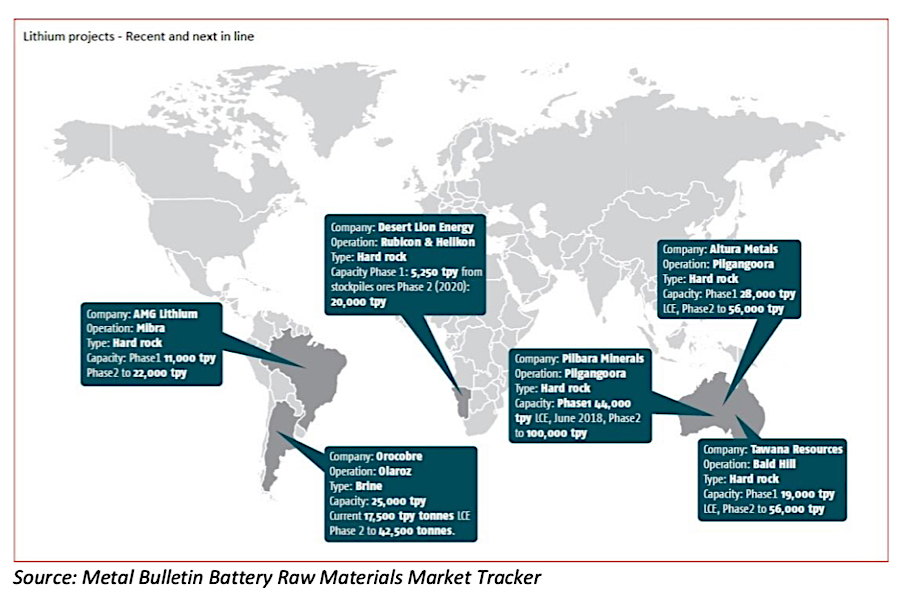
SPONSOR: New Age Metals Inc. (TSX-V: NAM) The company’s new Lithium Division has already made significant acquisitions in Canada and the USA. The company also owns one of North America’s largest primary platinum group metals deposit in Sudbury, Canada. Learn More.
———————–
Blackwater founder launches fund to invest in electric car battery metals
Blackwater founder Erik Prince aims to raise as much as $500 million to invest in metals needed for making the batteries that power electric vehicles (EVs), the Financial Times reports.
Fund will focus mainly on cobalt, copper and lithium assets
Erik Prince, the founder of controversial U.S. private security firm Blackwater and an informal campaign adviser to President Donald Trump, is looking to raise as much as $500m to invest in metals used in the batteries that power electric cars. (Image courtesy of Miller Center | Flickr.)
Blackwater founder Erik Prince aims to raise as much as $500 million
to invest in metals needed for making the batteries that power electric
vehicles (EVs), the Financial Times reports.
Prince, who besides starting the controversial private security
company is known for have been an informal campaign adviser to US
President Donald Trump, said the fund will bring unexplored deposits
into production and then sell them to large miners after four to five
years.
The fund will focus mainly on cobalt, copper and lithium assets located mainly in Africa and Asia, Prince told FT.com.
“For all the talk of our virtual world, the innovation, you can’t
build these vehicles without minerals that come from generally weird,
hard-to-access places,†he said.
Metals such as cobalt, lithium, nickel and copper have seen demand soar in recent years as the shift away from
cars powered by fossil fuels gains momentum and mining companies are
investing billions of dollars into developing deposits of those key
commodities.
Experts expect the need for the commodity from battery makers alone to jump 650% by 2027, while overall demand is forecast to rise more than threefold in the next nine years.
Prices, however, are projected to drop in the early 2020s as a result
of an ever-rising number of projects expected to come online.
Prince sold Blackwater in 2010, after it was hit with a series of
lawsuits. Since then, he’s been running Frontier Services Group, which
provides integrated security, logistics and insurance services in
frontier markets and is backed by Hong Kong investor Chun Shun Ko and
China’s CITIC Group.
Frontier has also invested in a bauxite mine in Guinea, and identified a copper and cobalt deposit in the Congo.
Prince’s sister Elisabeth Dee DeVos is Trump’s education secretary.
Posted by AGORACOM-JC
at 8:36 AM on Thursday, January 3rd, 2019
Announced the hiring of two key executives and the opening new global headquarters in Malta.
Malta was chosen due to its strategic location within the European Union, as well as, access to a highly educated and multi-lingual workforce, especially in the fields of online gambling.Â
BIRKIRKARA, Malta, Jan. 03, 2019 — Esports Entertainment Group, Inc. (GMBL:OTCQB) (or the “Company”), a licensed online gambling company with a specific focus on esports wagering and 18+ gaming, is pleased to announce the hiring of two key executives and the opening of our new global headquarters in Malta.
Malta was chosen due to its strategic location within the European
Union, as well as, access to a highly educated and multi-lingual
workforce, especially in the fields of online gambling. The Malta
office launch includes two (2) key executive hires and will serve as the
new global headquarters of the Company, with additional personnel
expected to be added through 2019 as the Company ramps up development of
its esports betting operations through vie.gg, the world’s first and most transparent esports betting exchange.
NEW ADDITIONS TO EXECUTIVE TEAM
The Company is pleased to announce the hiring of the following two key executives:
Adrien J. Lefèvre – Chief Risk & Compliance Officer
Adrien has served as a Compliance Officer, including Regulatory
Compliance Officer and Money Laundering Reporting Officer in the gaming
industry since 2015, including his most recent position with The Multi
Group Ltd. He will be responsible for creating an integrated risk
framework, assess risk, quantify risk limits, develop plans to mitigate
risks and manage any new license applications in any regulated
jurisdictions. His extensive experience at all levels of compliance
will be invaluable as Esports Entertainment Group pursues additional
gambling licenses in 2019 to further strengthen its market position and
rapidly expand into new geographic regions.
Jenny Pace – Head Of Payments
Jenny has specialized in payments processing for almost 25 years,
including her most recent position as Country Manager and Director of
Western Union Business Solutions in Malta since 2009, where she
maintained full leadership and operational control. Her list of
responsibilities will be extensive, including but not limited to,
managing our relationships with banks, credit card companies and payment
processors, as well as, insuring vie.gg
provides its players with the most up to date payment options. Given
the speed at which the payments world is changing, her extensive
payments experience and industry relationships will be critical to the
success of Esports Entertainment Group.
Grant Johnson, CEO of Esports Entertainment Group, stated, “The
opening of our Malta office and the addition of our newest executives is
a new milestone for Esports Entertainment Group. Malta is a full EU
member nation that provides greater resources and the infrastructure
necessary to continue our growth. The addition of Jenny and Adrien
significantly strengthens our regulatory and operational expertise.â€
ABOUT VIE.GG
vie.gg
offers bet exchange style wagering on esports events in a licensed,
regulated and secured platform to the global esports audience, excluding
jurisdictions that prohibit online gambling. vie.gg features wagering on the following esports games:
Counter-Strike: Global Offensive (CSGO)
League of Legends
Dota 2
Call of Duty
Overwatch
PUBG
Hearthstone
StarCraft II
This press release is available on our Online Investor Relations
Community for shareholders and potential shareholders to ask questions,
receive answers and collaborate with management in a fully moderated
forum at https://agoracom.com/ir/EsportsEntertainmentGroup
Redchip investor relations Esports Entertainment Group Investor Page: http://www.gmblinfo.com
Esports Entertainment Group, Inc. is a licensed online gambling company with a specific focus on esports wagering and 18+ gaming. Esports Entertainment offers bet exchange style wagering on esports events in a licensed, regulated and secure platform to the global esports audience at vie.gg. In addition, Esports Entertainment intends to offer users from around the world the ability to participate in multi-player mobile and PC video game tournaments for cash prizes. Esports Entertainment is led by a team of industry professionals and technical experts from the online gambling and the video game industries, and esports. The Company holds licenses to conduct online gambling and 18+ gaming on a global basis in Curacao, Kingdom of the Netherlands and the Kahnawake Gaming Commission in Canada. The Company maintains offices in Antigua, Curacao and Warsaw, Poland. Esports Entertainment common stock is listed on the OTCQB under the symbol GMBL. For more information visit www.esportsentertainmentgroup.com
FORWARD-LOOKING STATEMENTS The information contained herein includes forward-looking statements. These statements relate to future events or to our future financial performance, and involve known and unknown risks, uncertainties and other factors that may cause our actual results, levels of activity, performance, or achievements to be materially different from any future results, levels of activity, performance or achievements expressed or implied by these forward-looking statements. You should not place undue reliance on forward-looking statements since they involve known and unknown risks, uncertainties and other factors which are, in some cases, beyond our control and which could, and likely will, materially affect actual results, levels of activity, performance or achievements. Any forward-looking statement reflects our current views with respect to future events and is subject to these and other risks, uncertainties and assumptions relating to our operations, results of operations, growth strategy and liquidity. We assume no obligation to publicly update or revise these forward-looking statements for any reason, or to update the reasons actual results could differ materially from those anticipated in these forward-looking statements, even if new information becomes available in the future. The safe harbor for forward-looking statements contained in the Securities Litigation Reform Act of 1995 protects companies from liability for their forward-looking statements if they comply with the requirements of the Act.
Posted by AGORACOM-JC
at 9:52 AM on Wednesday, January 2nd, 2019
SPONSOR: Esports
Entertainment $GMBL Connecting global leading educators to the mass
population of India. BetterU Education has ability to reach 100 MILLION
potential learners each week. Click here for more information
———————–
Ninja made almost $10 million in 2018 with Fortnite
He also made more than $500,000 “on a good month†of 2018.
Ninja is used to working in quantities of 10 million at this point. He became the first Twitch streamer to reach that number of followers in the platform in early August 2018, and has since amassed 2.8 million more.
He also has 20 million YouTube subscribers and said he has 60,000 Twitch subscribers in a recent video for Wired.
Fortnite streamer and gaming star Tyler “Ninja†Blevins earned almost $10 million in 2018, he told CNN reporter Dave Briggs.
The streamer also said he loses “tens of thousands of dollars†when
he’s not streaming, and that he earns “a lot more†than $500,000 “on a
good month.†Ninja’s interview was published on Dec. 31, which makes
these values the most accurate to assess the streamer’s financial
success in 2018.
Ninja said most of the revenue he gets from streaming comes from ads,
like the ones he rolls or the brands he shows on screen when he’s live
playing the game. His monthly revenue also takes Twitch subscriptions
into account, which vary between $4.99 to $24.99 per subscriber
depending on how much each one chooses to pay every month.
Ninja is used to working in quantities of 10 million at this point.
He became the first Twitch streamer to reach that number of followers in
the platform in early August 2018,
and has since amassed 2.8 million more. He also has 20 million YouTube
subscribers and said he has 60,000 Twitch subscribers in a recent video for Wired.
Ninja’s earnings are a consequence of his ever-increasing popularity. He streamed Fortnite in Times Square for the ball drop on New Year’s eve, went to several TV shows in the second half of 2018, and shattered a Twitch concurrent viewers record on an individual channel when streaming with rapper Drake.
Ninja refrained from detailing how much he makes from every source of
revenue he has today, but he said he has to be constantly streaming to
avoid losing viewers, subscribers, and money as a consequence.
He told CNN he streamed nearly 4,000 hours of Fortnite in 2018.
Ninja’s earnings and popularity are still dependent on Fortnite’s
popularity since it’s the only game he’s been streaming. Regardless of
what the future holds for Ninja, he’s one of the most financially
successful Twitch streamers of 2018.
Posted by AGORACOM-JC
at 9:09 AM on Wednesday, January 2nd, 2019
SPONSOR: ThreeD Capital Inc. (IDK:CSE) Led by
legendary financier, Sheldon Inwentash, ThreeD is a Canadian-based
venture capital firm that only invests in best of breed small-cap
companies which are both defensible and mass scalable. More than just
lip service, Inwentash has financed many of Canada’s biggest small-cap
exits. Click Here For More Information.
———————
Even as the hype surrounding blockchain reportedly subsides, it argues that their offerings of regulator-approved infrastructure for crypto are a major watershed in the sector becoming mainstream.
A further example, the Review continues, is the improvement in smart contract technology that will enable its use in multiple legal contexts — making the crypto adage “code is law†one step closer to becoming an accepted reality.
News
MIT Technology Review has published an article today, Jan. 2, arguing that 2019 is the year in which blockchain will become mundane. The Review is a magazine that is independent but wholly-owned by the United States Massachusetts Institute of Technology (MIT).
The article gives a laconic overview of its take on the recent
history of blockchain, claiming that the technology was “a revolution
that was supposed to disrupt the global financial system†in 2017, but
that it was a disappointment in 2018 — in light of the significant
decline in the valuations of virtually all blockchain-based crypto
assets and currencies.
Nonetheless, the Review argues, on the cusp of the new year, many
“innovative-sounding projects are still alive and even close to bearing
fruit.†Together with several large corporations’ plans to launch major
blockchain-based projects this year, 2019 is thus reportedly set to be
“the year that blockchain technology finally becomes normal.â€
As an example of the impending transformation of the sector, the Review cites the forthcoming entries of stalwart Wall Street players such as New York Stock Exchange (NYSE) owner Intercontinental Exchange (ICE) and investment giant Fidelity into the cryptocurrency business.
Even as the hype surrounding blockchain reportedly subsides, it
argues that their offerings of regulator-approved infrastructure for
crypto are a major watershed in the sector becoming mainstream.
A further example, the Review continues, is the improvement in smart
contract technology that will enable its use in multiple legal contexts —
making the crypto adage “code is law†one step closer to becoming an
accepted reality.
The article’s final argument is that this normalization of the
technology and the sector will entail a significant reshaping of the
ideology that gave cryptocurrencies and blockchain their first impetus.
Crypto’s roots as an anti-government movement is being upended, the
article claims, by the advent of national cryptocurrencies — whether
they be Venezuela’salready-launched controversial oil-backed cryptocurrency the Petro, or other states’ plans for their own state-backed coins.
A further example given is the endorsement of exploring the case for central bank-backed cryptocurrencies (CBDCs) by International Monetary Fund (IMF) head Christine Lagarde this fall.
Almost one year ago, in mid-January 2018, Cointelegraph published
an analysis of the heat surrounding the blockchain revolution —
encapsulated by the lucrative possibilities of businesses using the tech
as a buzzword in their name to cash in on the over-hyped market.
Posted by AGORACOM-JC
at 10:27 AM on Friday, December 28th, 2018
SPONSOR: ThreeD Capital Inc. (IDK:CSE) Led by
legendary financier, Sheldon Inwentash, ThreeD is a Canadian-based
venture capital firm that only invests in best of breed small-cap
companies which are both defensible and mass scalable. More than just
lip service, Inwentash has financed many of Canada’s biggest small-cap
exits. Click Here For More Information.
———————
Do you know that Gartner
has predicted that “Blockchain’s business value-add will grow to
slightly over $360 billion by 2026, then surge to more than $3.1
trillion by 2030”?
Neeraj Sabharwal
Technologist at Xavient and hands-on leader with cloud and big data expertise. Exploring blockchain solutions.
I know that most of you have probably heard initial coin offerings and cryptocurrencies. But what about enterprise blockchain?
ICOs have made a significant impact — both in a positive sense and
in a negative one — across several industries thanks to blockchain. The
positive impact comes in the form of raising awareness about blockchain
technology, and the negative side of things stems from the misguided
conflation of blockchain and cryptocurrency.
Do you know that Gartner
has predicted that “Blockchain’s business value-add will grow to
slightly over $360 billion by 2026, then surge to more than $3.1
trillion by 2030”?
In a sense, we as technologists are betting on the future, and based
on my experience in the blockchain industry, there is a need for a
product or software to help businesses to get ready for a better future
by increasing revenue on their investments and reducing cost to deploy
smart contracts.
We are almost to 2019, and what’s the story now?
According to Accenture
research, 2015 was the year of blockchain exploration and investment,
which led to early adopters embracing the technology in 2016 and 2017.
Accenture’s prediction is that from 2018 to 2024, there will be
significant growth, as we will see more validated information from
lessons learned and new use cases, better software, service providers
and accurate clarity on all the hype of cryptocurrency. Maturity in
regard to blockchain adoption will kick in by 2025.
There is a need of simplicity when it comes to any new technology,
and I believe that once we have a simpler approach to deploy smart
contract and blockchain then it can open the door to more opportunities.
It’s also why I believe one of the top trends in 2019 to watch for is
blockchain as a service. Companies like Amazon, IBM and Microsoft stand
to benefit
from the potential widespread adoption of blockchain, indicating that
big players are likely working on figuring out the true implementation
of blockchain as an enterprise solution.
Also, there are lots of companies, particularly in the financial
sector, that have already either created their own blockchain projects
or are invested in blockchain startups. Visa, for example, released its B2B Connect
platform earlier this year to facilitate cross-border
business-to-business (B2B) payments via blockchain. And Goldman
Sachs and JPMorgan are among a group of companies that have invested $32 million in enterprise blockchain startup Axoni.
So what exactly is blockchain as a service?
It’s a platform that comprises multiple blockchain technologies and
enables developers to write and execute smart contracts without spending
time on deploying and managing the blockchain. To understand this in
detail, let me draw a picture for all of you to understand how
blockchain as a service and smart contract as a service can enable
businesses to use blockchain.
Let’s look at health care as an example, where you may just want to
share patient information between various health care providers. So,
let’s say in this context your application is based on
exchanging patient information between hospitals, insurance companies
and pharmacies. Your traditional application connects to software that
provides a blockchain-based gateway that lets you store and process
information from blockchain in the form of blockchain as a service,
which can then lead to the idea of smart contract templates. I won’t go
into the details of the smart contract, but just to provide some
background: A smart contract is a piece of code that runs on blockchain
and executes various business rules and logic to make sure that only
relevant information is being processed and exchanged. Also, if there is
a need of any checks or validations on the information before it’s
being published, then smart contract provides that, too.
There are a couple of options to get started with BaaS and SCaaS. You
can either build a blockchain team or center of excellence and create
your own BaaS or you can leverage cloud-based solutions, such as Microsft Azure, AWS or IBM. As of writing this article, Google is a little behind with its own offerings, but nevertheless, it too has its own blockchain initiative.
There are also various startups that are based on their own version
of blockchain as a service that use technologies covered either by the
above-listed cloud vendors or uses open source technologies.
While blockchain is still a nascent technology, that doesn’t mean
enterprises aren’t looking for ways to put it to good use. I think you
can expect to see more blockchain-as-a-service offerings in 2019.