Agoracom Blog Home

Archive for the ‘All Recent Posts’ Category

Esports Entertainment Group $GMBL Signs Super Affiliate SickOdds.com, One of the World’s Fastest Growing Esports Betting Comparison Sites $ATVI $TTWO $GAME $EPY.ca $TCEHF

Posted by AGORACOM-JC at 8:10 AM on Tuesday, December 11th, 2018
  • Announced the signing of an Affiliate Marketing Agreement with SickOdds.com, one of the world’s fastest growing esports betting comparison sites
  • VIE.gg, the world’s first and most transparent esports betting exchange, will serve as the only bet exchange on www.SickOdds.com.

ST. MARY’S, Antigua, Dec. 11, 2018 — Esports Entertainment Group, Inc. (GMBL:OTCQB) (or the “Company”), a licensed online gambling company with a specific focus on esports wagering and 18+ gaming, is pleased to announce the signing of an Affiliate Marketing Agreement with SickOdds.com, one of the world’s fastest growing esports betting comparison sites.  VIE.gg, the world’s first and most transparent esports betting exchange, will serve as the only bet exchange on www.SickOdds.com.

SICKODDS GENERATES THOUSANDS OF ESPORTS FAN REFERRALS PER MONTH FOR PARTNERS

SickOdds.com, founded in 2017 by esports and digital marketing experts Tom Wade and Nick Pateman, has quickly become one of the fastest growing esports betting comparison sites globally. The site covers dozens of esports titles in-depth, as well as, offering reviews of all the top esports betting providers. Thousands of esports fans are referred to betting partners listed on the site every month.

In May 2018 SickOdds.com signed a strategic partnership with London-based iGaming firm Seven Star Digital to accelerate growth in the burgeoning esports market. Seven Star Digital was the introducing party that connected Esports Entertainment Group and SickOdds.com.

Tom Wade, Co-Founder of SickOdds.com stated, “We’re excited to collaborate with Esports Entertainment Group’s innovative betting exchange VIE.gg. Their range of esports titles and Tier 1 & 2 match coverage, along with unique coverage of Pool betting, makes Vie.gg a very exciting prospect in the esports betting scene.”

Grant Johnson, CEO of Esports Entertainment Group stated, “This partnership with Sick Odds is another significant milestone for Esports Entertainment Group in terms of both business development and third party validation of our place within the esports industry. We look forward to a long and prosperous relationship with them for many years to come.”

VIE.GG

vie.gg offers bet exchange style wagering on esports events in a licensed, regulated and secured platform to the global esports audience, excluding jurisdictions that prohibit online gambling. vie.gg features wagering on the following esports games:

  • Counter-Strike: Global Offensive (CSGO)
  • League of Legends
  • Dota 2
  • Call of Duty
  • Overwatch
  • PUBG
  • Hearthstone
  • StarCraft II 

This press release is available on our Online Investor Relations Community for shareholders and potential shareholders to ask questions, receive answers and collaborate with management in a fully moderated forum at https://agoracom.com/ir/EsportsEntertainmentGroup

RedChip investor relations Esports Entertainment Group Investor Page: 
http://www.gmblinfo.com

About Esports Entertainment Group

Esports Entertainment Group, Inc. is a licensed online gambling company with a specific focus on esports wagering and 18+ gaming. Esports Entertainment offers bet exchange style wagering on esports events in a licensed, regulated and secure platform to the global esports audience at vie.gg.  In addition, Esports Entertainment intends to offer users from around the world the ability to participate in multi-player mobile and PC video game tournaments for cash prizes. Esports Entertainment is led by a team of industry professionals and technical experts from the online gambling and the video game industries, and esports. The Company holds licenses to conduct online gambling and 18+ gaming on a global basis in Curacao, Kingdom of the Netherlands and the Kahnawake Gaming Commission in Canada. The Company maintains offices in Antigua, Curacao and Warsaw, Poland. Esports Entertainment common stock is listed on the OTCQB under the symbol GMBL.  For more information visit www.esportsentertainmentgroup.com

FORWARD-LOOKING STATEMENTS
The information contained herein includes forward-looking statements. These statements relate to future events or to our future financial performance, and involve known and unknown risks, uncertainties and other factors that may cause our actual results, levels of activity, performance, or achievements to be materially different from any future results, levels of activity, performance or achievements expressed or implied by these forward-looking statements. You should not place undue reliance on forward-looking statements since they involve known and unknown risks, uncertainties and other factors which are, in some cases, beyond our control and which could, and likely will, materially affect actual results, levels of activity, performance or achievements. Any forward-looking statement reflects our current views with respect to future events and is subject to these and other risks, uncertainties and assumptions relating to our operations, results of operations, growth strategy and liquidity. We assume no obligation to publicly update or revise these forward-looking statements for any reason, or to update the reasons actual results could differ materially from those anticipated in these forward-looking statements, even if new information becomes available in the future. The safe harbor for forward-looking statements contained in the Securities Litigation Reform Act of 1995 protects companies from liability for their forward-looking statements if they comply with the requirements of the Act.

Contact:

Corporate Finance
1-268-562-9111
[email protected]

Media & Investor Relations Inquiries
AGORACOM 
[email protected]
http://agoracom.com/ir/eSportsEntertainmentGroup

U.S. Investor Relations 
RedChip 
Dave Gentry
407-491-4498
[email protected]

CLIENT FEATURE: Kuuhubb $KUU.ca Mobile Video Gaming And Apps For Women; $US 4.9M Quarterly Revenues, +50M Downloads, 14M Quarterly Users $TCEHY $ATVI $CYOU

Posted by AGORACOM-JC at 4:42 PM on Monday, December 10th, 2018
KUU: TSX-V

Why Kuuhubb?

  • Quarterly gross* revenue of $4.9M
  • All time app downloads of +50M
  • Quarterly* sessions of +200M
  • Quarterly* active users of +14M
  • Partnerships: Kellogg’s and Samsung
  • Aggressive Global Growth Plans Now Underway
  • Japan Already Established Japan Mobile Revenues
  • Have Surpassed The USA For 3 Consecutive Years
  • India, Korea and China Are Forthcoming
  • Global Social App Comparables Are Trading At $58/Monthly Active User (MAU) (Excluding Facebook)

The Company’s Differentiator? Kuuhubb Delivers Mobile Gaming & Lifestyle Apps Geared Towards Female Audiences. KUU Is Now Focusing On Asian Markets, The World’s Largest & Fastest Growing Mobile Games Market

Portfolio

Kuuhubb growth is undeniable, with rapid growth in revenues quarter over quarter.  The company’s flagship app (Recolor) has experienced strong growth in downloads, sessions and monthly active users, indicating a winning product

Hub On AGORACOM /Corporate Profile

FULL DISCLOSURE: Kuuhubb is an advertising client of AGORA Internet Relations Corp.

Good Life Networks $GOOD.ca – Own A Brand? Why You Should Pay Attention To Programmatic In 2019 $TTD $RUBI $AT.ca $TRMR $FUEL

Posted by AGORACOM-JC at 12:24 PM on Monday, December 10th, 2018
SPONSOR: Good Life Networks (GOOD:TSX-V) Video advertising is the future! Company’s A.I. makes 80,000 calculations / second, targeting 750 million users to deliver higher prices and volume. Revenue was $10,000,650 for the nine months ended September 30th, 2018, a 142% increase from $4,133,231 reported for the six months ended September 30th, 2017.  Click here for more information.
———————-
  • Currently, over 80% of all digital display ad spending in the U.S. is programmatic, and those numbers are expected to increase.
  • Programmatic advertising is done by computer systems that automate the process of buying, selling and optimizing ad placements on digital media.

Own A Brand? Why You Should Pay Attention To Programmatic In 2019

Ofer Garnett

CTO & Co-Founder of mobile growth marketing platform YouAppi, bringing nearly 20 years of R&D experience to make mobile engaging.

Digital advertising has grown steadily over the last two decades with no signs of slowing. As consumers shift to mobile, brands have digitally migrated.

Currently, over 80% of all digital display ad spending in the U.S. is programmatic, and those numbers are expected to increase. Programmatic advertising is done by computer systems that automate the process of buying, selling and optimizing ad placements on digital media. Advances in machine learning and smart algorithms have proven far more reliable than humans in determining ideal timing and location to reach a desired audience. Where the focus used to be on finding websites that generally attracted the same audience as your product, programmatic allows you to drill down on an individual’s digital behavior and place an ad in front of the eyes most likely to engage.

But if you think programmatic advertising is best left to your marketing department, think again. Reaching consumers digitally has never been more important — or more challenging. Deeply segmented platforms, shifting consumer preferences, stricter privacy laws, and increasing expectations of more direct, personalized and highly relevant ad content make it harder than ever to reach your customer at the right time and place with the right message. Programmatic looks to be the key to driving meaningful digital engagement in 2019, with several promising trends.

Technology Will Address Current Market Challenges

Most programmatic ad spend is done in real time via real-time bidding (RTB), which buys ad inventory on a per-impression basis and works much like financial market trading. The prominent protocol is OpenRTB, and it’s had its fair share of critics. As the ecosystem has grown, it’s become increasingly problematic for brands to trust the data, protect themselves from fraud and maintain brand integrity and safety.

A new version, OpenRTB 3.0, has finished beta and is expected to release before the end of 2018. This is the most significant overhaul of OpenRTB since its inception in 2010, and it delivers enhanced visibility into the process of programmatic buying and selling. I expect adoption of the 3.0 protocol to be significant throughout 2019, as brands are eager for greater transparency and clarity. OpenRTB 3.0 is not backward compatible, however. Significant effort from all participating parties in programmatic — buying systems, selling systems and the exchanges — will be required to make this migration. Whether you oversee your company’s marketing or not, it’s important to understand the direction of the technology in order to ensure your ad dollars are spent in the smartest and safest way possible.   Source: https://www.forbes.com/sites/forbestechcouncil/2018/12/06/own-a-brand-why-you-should-pay-attention-to-programmatic-in-2019/#6b2c36d3175e

#KoreConX partners with Middle East consultancy firm

Posted by AGORACOM-JC at 12:00 PM on Sunday, December 9th, 2018

Metis Management Consultancy will work closely with KoreConX’s office in Dubai

[New York, NY – December 09, 2018] – KoreConX, the first all-in-one platform for companies to manage their business activities, is partnering with Metis Management Consultancy, a UAE-grown consultancy firm focused on providing services to SMEs in the MENA region. The company will become part of the KorePartner’s Ecosystem, a group of selected companies that works closely with KoreConX to ensure that small and medium enterprises have all the elements they need to thrive.

In addition to providing businesses with an all-in-one solution for their management pain points, KoreConX also developed its own fully-compliant Security Token Protocol, using IBM’s Hyperledger Fabric, a permissioned Blockchain. Using KoreConX’s platform, companies are able to issue their Security Tokens (Tokenized & Digitized Securities) and raise capital in multiple jurisdictions.

“Blockchain plays a crucial role in everything that we do at KoreConX. Dubai is taking this technology to the next level, by planning to make the city fully powered by Blockchain by 2020,” said Edwin Lee, director of MENA Region. “Dubai is the place to be when advancing into new technologies and Metis is the company that shares our high standards when it comes to providing companies with the best advice.”

The same feeling is shared by Metis Management Consultancy team.

“We always strive to provide companies with high-quality consulting services and access to the latest tools” said Nayef Shahin, Founder and Managing Partner at Metis. “It is only natural to partner with KoreConX, a team with a deep understanding of compliance, securities regulations and the one to create the only protocol that is fully tracked on chain through their transfer agent service.”

In UAE, SMEs account for over 90 per cent of private enterprises and contribute to nearly 47% of Dubai’s GDP and 52% of its workforce. It is therefore a top priority this sector has access to cutting-edge knowledge, technology and funding.

Metis Management Consultancy is part of the KorePartner ecosystem, a group of selected broker-dealers, secondary market platforms, capital markets platforms, lawyers, compliance, investor relations, accounting, and marketing firms that support the KoreConX security token protocol and adhere to KoreConX governance standards. KoreConX’s KorePartners are from around the globe and bring the necessary expertise that a company will need to launch a fully compliant security token in multiple jurisdictions.

About KoreConX

KoreConX is the world’s first highly-secure permissioned blockchain ecosystem for fully-compliant tokenized securities worldwide.

To ensure compliance with securities regulation and corporate law, the KoreConX all-in-one, AI-based blockchain platform manages the full lifecycle of tokenized securities including the issuance, trading, clearing, settlement, management, reporting, corporate actions, and custodianship. KoreConX connects companies to the capital markets and secondary markets facilitating access to capital and liquidity for private investors.

KoreConX is the first secure, all-in-one platform for private companies to manage their capital market activity and stakeholder communications. Removing the burden of fragmented systems and inefficient tools across multiple vendors, KoreConX offers a single environment to connect companies, investors and broker/dealers. Leveraged for investor relations and fundraising, private companies can share and manage corporate records and investments including portfolio management, capitalization table management, virtual minute book, security registers, transfer agent services and virtual deal rooms for raising capital.

www.KoreConX.io

About Metis Management Consultancy


Metis Management Consultancy is a leading SME business advisor consultancy in the region. Their mission is to enhance their clients’ corporate value by providing them access to tier quality consulting services and expertise across their business domains. Metis make sure that each business gets its own tailored solution according to their own wants and needs while providing direction, guidance, and innovative services to turn their clients’ corporate vision and strategy into operational reality and success.

###

Media Contacts:

KoreConX

Oscar A Jofre

[email protected]

Tartisan Nickel Corp. $TN.ca – Vale doubles down on #nickel ahead of #EV revolution: Andy Home $ROX.ca $FF.ca $EDG.ca $AGL.ca $ANZ.ca

Posted by AGORACOM-JC at 4:02 PM on Friday, December 7th, 2018

SPONSOR: Tartisan Nickel (TN:CSE) The company’s Kenbridge Property has a measured and indicated resource of 7.14 million tonnes at 0.62% nickel, 0.33% copper. Tartisan also has interests in Peru, including a 20 percent equity stake in Eloro Resources and 2 percent NSR in their La Victoria property. Click her for more information

—————–

-Vale, the Brazilian mining giant built on supplying the world’s steel mills with iron ore, is now betting on the electric vehicle (EV) revolution to turn its nickel division around.

-“We believe in this revolution to come,” Chief Executive Fabio Schvartsman told analysts at the company’s investor day presentation in New York this week.

Andy Home

LONDON (Reuters) – Vale, the Brazilian mining giant built on supplying the world’s steel mills with iron ore, is now betting on the electric vehicle (EV) revolution to turn its nickel division around. FILE PHOTO: The logo of Vale SA is pictured in Rio de Janeiro, Brazil, August 7, 2017. REUTERS/Ricardo Moraes/File Photo

“We believe in this revolution to come,” Chief Executive Fabio Schvartsman told analysts at the company’s investor day presentation in New York this week.

The use of nickel in lithium ion batteries will translate into at least 500,000 tonnes of extra demand by 2025, according to Vale, which is planning to play a leading role in meeting the additional need for high-grade metal.

However, to do so, it will have to turn around its troubled New Caledonian operations, a task described by Schvartsman as “maybe our biggest challenge”.

It will also have to gamble that Chinese players led by the Tsingshan steel group don’t make the technological breakthrough that would allow them to convert nickel ore straight into battery-grade nickel.

That would undermine demand for the sort of high-purity material, so-called Class I nickel, that Vale specializes in producing.

STILL WAITING FOR GORO

Vale had been hoping to attract a partner for its Vale New Caledonia (VNC) operations but evidently without success.

It will now go it alone.

What was originally known as the Goro project has been strewn with operational problems ever since it came on stream, two years late, in 2011.

In theory, it’s perfectly positioned to ride the EV revolution, producing the right sort of nickel for processing into batteries with a by-product stream of cobalt, another hot battery metal.

In practice, Vale has never fully mastered the high-pressure-acid-lead (HPAL) technology used to convert ore to nickel oxides.

The original plan envisaged a three-year ramp-up to nameplate capacity of 58,000 tonnes of nickel in oxide and hydroxide. In 2017, its sixth year of operation, it managed 40,000 tonnes.

Alas, even that good run hasn’t lasted into 2018.

Production of what Vale terms “finished nickel products from VNC source material” fell 17 percent in the first nine months of the year to 24,200 tonnes and VNC reported an operating loss of $42 million in the third quarter itself.

Vale management is undeterred.

It has, according to Eduardo Bartolomeo, head of the company’s base metals division, commissioned a “very detailed study to know exactly why we can’t achieve our nameplate capacity.”

The study found that there is no “insurmountable” bottleneck in the plant and Vale’s goal is now to invest $500 million to get the plant operating at 50,000 tonnes per year of nickel products over a two- to three-year time horizon.

It’s not the first time senior Vale management has vowed to fix Goro, but the new-found incentive is the coming electric vehicle revolution.

The decision to double down on New Caledonia is “very simple”, according to Schvartsman. “We will need this operation in order to supply the market because of the growth in the consumption for batteries.”

TSINGSHAN CHALLENGE

That is, unless Chinese steel giant Tsingshan can make good on its ambitions to build an Indonesian plant that can convert nickel ore straight into battery-quality material.

Since Tsingshan’s original announcement in September, the London Metal Exchange (LME) nickel price has fallen from just under $13,000 per tonne to a current $11,000.

Nickel’s shiny electric vehicle premium has been blown away by the prospect of Indonesia’s abundant nickel ore production, currently exclusively destined for the stainless steel sector, being diverted into meeting battery demand.

Such an eventuality could also impact severely demand for the sort of premium nickel product currently produced by Vale.

No-one quite believes Tsingshan’s stated intention of building a plant to produce 50,000 tonnes per year of contained nickel at a cost of $700 million with first production next year. Particularly since it is proposing to use the same HPAL technology that has challenged Vale and other producers in recent years.

But based on Tsingshan’s track record of single-handedly propelling Indonesia into the top ranks of stainless steel producers in super-quick time, no-one’s quite sure either.

Vale’s Schvartsman conceded that “there is no question about the ingenuity of the Chinese” and that over time “this technology will become more competitive in their hands”.

But not next year, nor in all likelihood the year after.

To build a plant that size, using that technology with that amount of investment “is totally impossible”, Schvartsman said.

Tsingshan’s September statement, according to Schvartsman, “is more an issue of communication – there isn’t anything real behind it.”

“Just talk”, agreed Bartolomeo, who noted it would take Tsingshan 18 months just to get a federal marine disposal license. “They have the provisional license but the rules are very strict”.

NOW A BELIEVER

This time last year, when Vale was actively looking for an investment partner in VNC, Schvartsman said it was a test of whether the market really believed that “nickel is something that is important for the future of EVs.”

Would all the future promise “translate into someone who is eager to invest with us to have more nickel in the future”?

The apparent negative response is in all likelihood far more to do with Goro’s problematic past performance than nickel’s future prospects.

The metal seems on track to be an early winner in the materials competition for lithium batteries, partly at the expense of cobalt on price and supply stability grounds.

But the promise still lies largely in the future. Batteries only account for around 5 percent of total nickel demand.

Right now the price remains beholden to its traditional stainless steel drivers. Stainless production ran hot through the first part of this year but is cooling rapidly, an overlooked part of the recent price sell-off.

Nickel inventories, meanwhile, remain elevated. Visible stocks on the LME have been falling but there is a strong suspicion that part of the decline has simply reflected statistically hidden stock building along the supply chain.

Vale has around 60,000 tonnes of idled production capacity, taken off-line at the end of 2017 due to low prices.

That gives it plenty of optionality in lifting output as and when demand from the battery sector takes off.

Because one thing is for sure. Vale is now an official believer in the electric vehicle story.

To reap the full rewards, though, it needs to sort out once and for all its problem child, Goro, and keep its fingers crossed that Tsingshan’s announcement is, for now at least, “just talk”.

Source: https://www.reuters.com/article/us-vale-nickel-ahome/vale-doubles-down-on-nickel-ahead-of-ev-revolution-andy-home-idUSKBN1O61KO

Good Life Networks $GOOD.ca Vital takeouts from the world’s largest programmatic advertising conference $TTD $RUBI $AT.ca $TRMR $FUEL

Posted by AGORACOM-JC at 2:00 PM on Friday, December 7th, 2018

Sponsor: Good Life Networks: Video advertising is the future! Company’s A.I. makes 80,000 calculations / second, targeting 750 million users to deliver higher prices and volume. The company achieved a record $9.7 Million in revenue for 2017 and recently announced entering the video game industry with programmatic technology. Click here for more information

——————

  • In 2018, more than $47 billion in the US was spent on programmatic display advertising with Facebook and Google taking a large chunk of the pie. By 2020, that figure will climb to nearly $69 billion.

Posted By: Ashleigh Footiton:November 28, 2018

After an intense two days spent at the world’s largest conference on programmatic advertising, Programmatic I/O, it was fascinating to see how US online publishers are utilising data and selling inventory programmatically.

In 2018, more than $47 billion in the US was spent on programmatic display advertising with Facebook and Google taking a large chunk of the pie. By 2020, that figure will climb to nearly $69 billion.

In the United States, there are an average of 14.5 programmatic tech partners per publisher, whereas in South Africa, we have an average of just three. This is not a bad situation to be in as our ecosystem is less fragmented and we have more control over our inventory. But it does highlight that programmatic is still in its infancy here.  

One of the US speakers, Taylor Schreiner at Adobe, said, “Organisations are transforming to take advantage of programmatic. Brands are now more hands-on. They have a better understanding of the metrics they are facing, and they’re more specific in their directives to agencies. We’re seeing more clients who now have people in the organisation who are in a position to think about reach across channels.”

First party data, which is essential for publishers, was another big theme that came through. It is a priority as it gives a competitive advantage in fighting against the duopoly that is Google and Facebook, who account for around 50% of programmatic revenue in the US. Their amazing audience intelligence, reach and measurement capabilities which advertisers are not going to pass up keeps them on top.

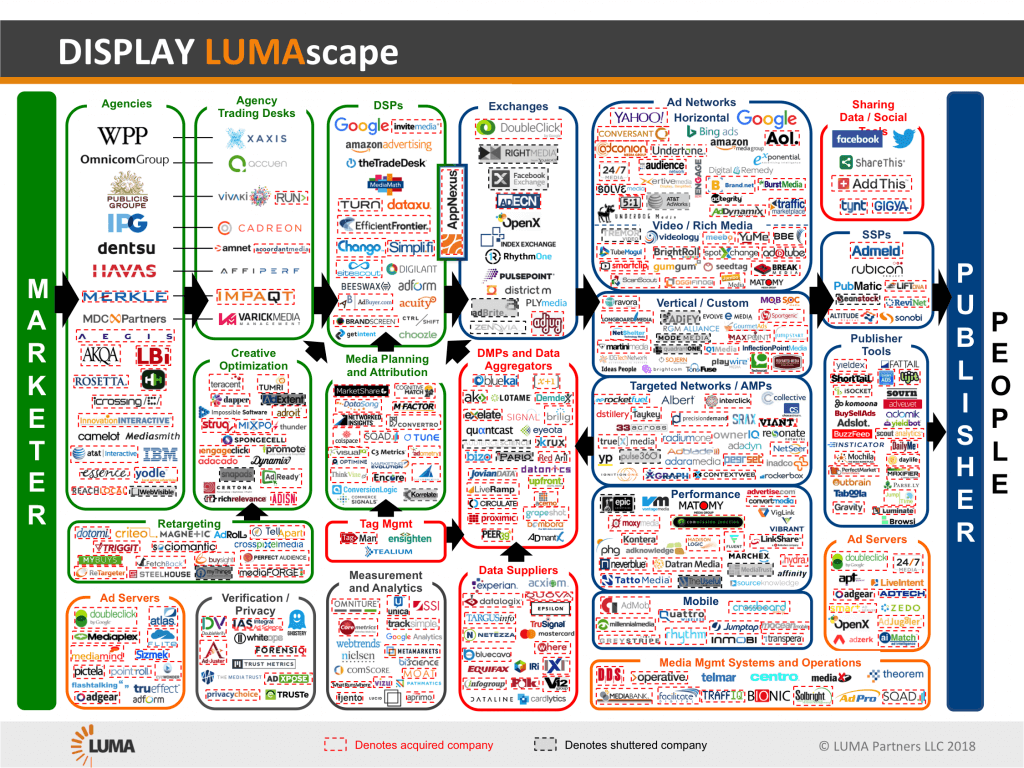
Relationships are key in this fragmented industry. The display ad tech Lumascape highlighted this fact. There are many touch points available when it comes to making a deal and publishers need to ensure they are talking to all parties involved. There is no such thing as ‘set it and forget it’. Secondly, CPM rates are lost to tech costs and the publisher comes out with only a fraction of what the seller initially spends.

The issue of viewability

The issue of viewability came across a lot throughout the two day conference. A viewable ad is defined as 50% of the pixels of a regular creative or 30% of the pixels of a large size creative, are on an in-focus browser tab on the viewable space of the browser page for a minimum of one continuous second. (This description was even questioned a few times by brands.) As far as many brands were concerned, 100% viewability has to be a non-negotiable and advertisers/buyers should not pay for a non-viewable ad.

Artificial Intelligence was also strong presence with a few interesting developments on the cards. We can’t escape the fact that AI is and will be an essential part of our lives. The Nest Cam Indoor security camera, for instance, learns who the regular members of your household are. If a stranger or visitor is in your home, Nest reports back to you immediately via your connected device. The Ricoh whiteboard is another great AI example – once you’ve made your notes on it you can email the contents to anyone around the world, with full translation capabilities. All of these things will add to the wonder that is big data which ultimately will assist advertisers to better target consumers.

And then there’s brand safety

It was evident that there’s a need for deeper conversations on brand safety between publishers, agencies and brands who all need to understand and explain what brand safety means to each of them. Some brands mentioned that they won’t pay if creative appears in a negative environment. However, they would consider an environment that has a positive spin next to controversial content. Unfortunately, safety tools are screening out these environments if the story contains blacklisted key words. Private market places need to be of more help. 

Ad fraud and fake news is rife in the US industry, and ad fraud specifically, but on a lesser scale, here in South Africa. Publishers are fighting hard against these practices and buyers are turning to technology to assist with eliminating and reducing their ad spend on these practices that deceive.

There are many types of ad fraud but in general challenges in programmatic include invalid traffic (IVT), domain spoofing, page level scripting, ad injection, and poor user experience. Low-quality human traffic is another issue, through paid media channels (including click bait) traffic is pushed to transit hubs by fake authors and instantaneously bounce off these sites, purely to serve ads and receive ad revenue. These are all things that advertisers and publishers need to be cognisant of. Publishers need to adopt ads.txt as a non-negotiable and advertisers need to be selective when buying inventory across the open market.

I learned that a dollar in does not equal a dollar out when it comes to programmatic and intermediaries are more prevalent than thought. But most importantly, relationships are more important now than ever before. Successful partnerships between publishers, agencies and clients are open and honest about what works for them.

The conference gave invaluable insights into the world of programmatic and even though we have some catching up to do, it’s an exciting time in our industry.

Ashleigh Footit is head of techops, programmatic and performance at SPARK Media. She was responsible for establishing the programmatic division for the group in 2015 and have been one of the key drivers in the implementation, management and success of Caxton’s Supply Side and Data Management Platform.

Source: https://themediaonline.co.za/2018/11/vital-takeouts-from-the-worlds-largest-programmatic-advertising-conference/


Esports Entertainment Group $GMBL – Magic: The Gathering launching #Esports league with $10M prize pool $ATVI $TTWO $GAME $EPY.ca $TCEHF $Game.ca $EPY.ca

Posted by AGORACOM-JC at 10:42 AM on Friday, December 7th, 2018
SPONSOR: Esports Entertainment $GMBL – Esports audience is 350M, growing to 590M, Esports wagering is projected at $23 BILLION by 2020. The company has launched VIE.gg esports betting platform and has accelerated affiliate marketing agreements with an additional 42 Esports teams, bringing total to 176 Esports teams. Click here for more information
———————-

Magic: The Gathering tournaments, whether they’re informal competitions at local game shops or large, formal affairs, have been an institution for years. And as announced at the 2018 Game Awards, those tournaments are now being brought into the esports arena with the reveal of Mythic Championship events and a pro league.

Magic: The Gathering has increasingly been digitized this year, with the development of Magic: The Gathering Arena, a new way to play the game online separate from the preexisting Magic: The Gathering Online. Arena is currently in open beta for PC users, with a full release planned for 2019. But even though awareness about Arena may benefit most from this reveal, this new esports structure won’t just apply to the digital version of the game.

The prize pool is split evenly between two ways to play the game. The traditional tabletop game and Arena will each have a $5 million prize pool, with a total of 10 tournaments that begin with the Mythic Championship being held at next year’s PAX East.

The Magic Pro League, meanwhile, will include the 32 top-ranked players in the world. Though everyday players will have means to qualify for championship events (with more details promised for 2019), each of these players is afforded automatic entry and are promised “competitive pro contracts,” according to Wizards of the Coast.

Arena players can also receive an esports starter kit by entering the promo code “GameAwards.”

This move follows in the formalization of several other competitive gaming communities, whether it’s the Overwatch League, Fortnite’s Summer Skirmish events or DotA 2’s The International.

Watch the Game Awards’ new trailers, reveals and winners right here.

Source: https://www.cnet.com/news/magic-the-gathering-launching-esports-initiative-with-10m-prize-pool/

Betteru Education Corp. $BTRU.ca – Is online learning making education easier? $ARCL $CPLA $BPI $FC.ca

Posted by AGORACOM-JC at 9:49 AM on Friday, December 7th, 2018
SPONSOR:  Betteru Education Corp.Connecting global leading educators to the mass population of India. BetterU Education has ability to reach 100 MILLION potential learners each week.

Online Education for India

Online education has become popular among working professionals and students in higher education. These categories of online learners find immense benefit in the autonomy, and flexibility, that these courses offer.

Online courses can be planned into their schedule, which may include full-time employment, internships and caring for a family. It can also help them take out quiet time to study.

Online learning in an education system

Distance learning has been around for a long time, even before technology made it extremely accessible. Traditional schooling is now seeing an increased proliferation of virtual training materials and online courses. Even in a world of tried and tested schooling systems and curricula, the most successful schools are the ones who adapt to the changing times, as well as to the expectations of students, parents and the society.

If online education is here to stay, then what are its implications for traditional learning? Instead of focusing on pros and cons, the conversation we should be having today is about leveraging online learning to make our education system more conductive to learning.

Setting goals, tracking progress and meeting deadlines

Online courses involve setting our own goals, tracking progress and meeting deadlines

Online courses call for a greater amount of motivation and self-discipline than a classroom-based course. A classroom has one or more instructors and peers, who can hold a student accountable for their course-work. In contrast, online courses involve setting our own goals, tracking progress and meeting deadlines.

One does not learn in isolation, so online courses do offer discussion forums, email, and one-on-one support. Technology also adds on to the visual experience by incorporating animations, that can be used interactively for effective teaching, and communication.

The classroom advantage

A school provides structure, support, and a system of rewards and penalties to groom its students. Classroom education has the benefit of face-to-face interactions with peers, which are typically moderated by a teacher.

It provides children, especially those in their early developmental years, with a stable environment for social interactions, helping them develop skills like boundary setting, empathy, and cooperation. This also allows plenty of room for spontaneity, unlike a virtual learning setup.

Online education in the context of schooling

As students’ progress to higher classes, they seek more autonomy and intellectual freedom. Online learning can help them pursue highly individualized learning programmes, possibly even college-level courses. These, combined with hands-on exercises, real-world exploration, and thorough assessments, can be highly beneficial to their learning progress.

Here’s what the Managing Director of Trio World Academy said:

“They can explore their options, by trying out introductory topics from different fields, before committing to a specialization. Online learning platforms can help these students become more independent learners before they make their way into college,” said Naveen K M.

“I believe that we must not hold students back from picking any online course, but instead act as their guide as they navigate through it,” he added.

Teachers and parents should act as anchors and mentors

Teachers and parents should be anchors and mentors

Mobile apps that provide enhanced learning opportunities for school children have become mainstream. Since mobile phones have already found their way into their hands, these apps are being used to supplement classroom learning.

Teachers and parents need to act as anchors and mentors, curating the kind of educational content students are exposed to, during the tricky phase of finding the right career to pursue.

Programmes to support families wishing home-school

Virtual public schools, that offer a full scale K12 education, have already sprung up in some parts of the world. They even offer a combination of the traditional system with online education. There are programmes that provide support to families that wish to home-school their children, in the form of online course material.

These programmes bring parents and teachers into the fold, by involving them into their child’s education from the get-go. However, their effectiveness in the long term needs to be studied.

Online programmes for weaker communities

Online programmes for weaker sections

Online learning programmes will also open up opportunities for children from weaker socio-economic communities, who possess a limited access to learning resources i.e. teachers, textbooks and infrastructure.

It will connect them to a global network of online learners, exposing them to new perspectives. The ideas that they receive, will not be limited by the number of heads in one classroom.

Read: How to judge the quality of any online course before you join one

Online education for educators

Online education can also be designed to be accommodating of a variety of learning styles among students.

“As educators, it is likely that we will have to put in additional efforts to incorporate online learning programmes into the curriculum, in the most suitable manner,” said the managing director.

Online training programmes are helping teachers/educators advance their skills in curriculum implementation, policy, education systems and leadership, both independently and with the support of their institutions.

It lets them collaborate with their peers, and learn new instructional skills, that are relevant to their career. These programmes can help them develop new skills and capabilities in their students, with the help of technology and interdisciplinary approaches.

Education for future

As the overlap of the traditional and online educational worlds is becoming more and more inevitable, we owe it to our students to make their education relevant to their future, through our own ingenuity, passion and careful planning.

-Authored article by Naveen K M, Managing Director, Trio World Academy

Source:https://www.indiatoday.in/education-today/featurephilia/story/online-learning-education-system-1401364-2018-12-03

$GR.ca Great Atlantic Resources Corp. Files 43-101 Report on Golden Promise Project, Newfoundland $SIC.ca $MOZ.ca $LAB.ca

Posted by AGORACOM at 2:35 PM on Thursday, December 6th, 2018

https://s3.amazonaws.com/s3.agoracom.com/public/companies/logos/564603/hub/GREATATLANTIC_LOGO_TESTER-e1480712241913.jpg

  • Completed 43-101 includes a mineral resource estimate (Inferred ) for the Jaclyn Main Zone, Golden Promise
  • Golden Promise hosts multiple gold bearing quartz veins and is located in a region of recent significant gold discoveries
  • significant gold discoveries in this region include those of Sokoman Iron Corp. (TSXV.SIC) at the Moosehead Project and Marathon Gold Corp. (TSXV.MOZ) at the Valentine Lake Gold Camp.


VANCOUVER, BC / ACCESSWIRE / December 6, 2018 / GREAT ATLANTIC RESOURCES CORP. (TSX-V: GR) (the “Company” or “Great Atlantic”) announces that it has received and filed on SEDAR a National Instrument 43-101 Technical Report, dated December 4, 2018 (revising a previous filed version dated November 28, 2018) (the “Report“) on the Company’s Golden Promise Gold Property, located in the central Newfoundland gold belt. The report was completed by Mr. Greg Z. Mosher, M.Sc. App., P.Geo., and Mr. Larry Pilgrim, B.Sc., P.Geo. The amendments in the December 4 version of the technical report principally relate to disclosure of QA/QC programs in Part 11 and data verification in Part 12. The material conclusions of both versions of the Report are the same.

The Report includes the following mineral resource estimate (Inferred resources) for the Jaclyn Main Zone, the maiden resource estimate for the Company on the property:

Resource Cutoff Au g/t Au Cap g/t Au Uncap g/t Tonnes Au Ounces Capped Au Ounces Uncapped
Total 1.1 9.3 10.4 357,500 106,400 119,900
Pit-Constrained 0.6 11.4 14.1 157,300 57,800 71,200
Underground 1.5 7.5 7.6 200,200 48,600 48,700

(To view the full-sized image, please click here)

The Golden Promise Property hosts multiple gold bearing quartz veins and is located in a region of recent significant gold discoveries. The property is located within the Exploits Subzone of the Newfoundland Dunnage Zone. Within the Exploits Subzone, the property lies along the north-northwestern fringe of the Victoria Lake Supergroup (VLSG), a volcano-sedimentary terrane. The northwestern margin of the Golden Promise Property occurs proximal to, and, in part, contiguous with a major (Appalachian-scale) collisional boundary, and suture zone, known as the Red Indian Line (RIL). The RIL forms the western boundary of the Exploits Subzone. Recent significant gold discoveries in this region of the Exploits Subzone include those of Sokoman Iron Corp. (TSXV.SIC) at the Moosehead Project and Marathon Gold Corp. (TSXV.MOZ) at the Valentine Lake Gold Camp.


(To view the full-sized image, please click here)


(To view the full-sized image, please click here)

High-grade gold is reported in quartz veins and quartz vein boulders within the Golden Promise Property. Gold bearing quartz veins are reported in multiple areas of the property, including at least 5 gold bearing quartz vein systems reported in one zone referred to as the Jaclyn Zone, located in the northern half of the property. Much of the reported historical exploration within the property has been focused on the Jaclyn Zone with gold bearing vein systems reported at the Jaclyn Main, Jaclyn East, Jaclyn West, Jaclyn North and Jaclyn South Sub-zones. The majority of historic drilling (2002-2010) was conducted at the Jaclyn Main Zone. Significant historical work is also reported in the southwest region of the property at the Linda / Snow White vein, including grab sample reported to return 105 and 232 g/t gold, a reported channel sample returning 29.7 g/t gold / 0.5 meters, and a diamond drillhole intersection of 19.5 g/t gold / 1.15 meter core length. Gold bearing veins and gold bearing float are reported in other regions of the property.

The Report includes a mineral resource estimate for the Jaclyn Main Zone, the only area within the Property for which sufficient data exists to support a mineral resource estimate. The resource estimate was completed by Mr. Greg Z. Mosher, M.Sc. App., P.Geo.


(To view the full-sized image, please click here)

The current mineral resource estimate for the Jaclyn Main Zone is based on assays from 107 drillholes (2002 – 2010). The drill core from most of these holes has been preserved at a Provincial Government storage facility in Buchans, NL. As part of the data verification process prior to the resource estimate, core from five (5) holes, representing a range of contained gold grades and locations within the zone, were examined and six (6) quarter-core samples were collected from three of these holes for verification of the original assay values. The six check samples were assayed for gold in 2018 at ALS Canada in North Vancouver. The following table shows the comparison of original and check assay values.

Drill Hole From (m) To (m) Length (m) Original Au g/t Check Au g/t Sample #
GP02-09 47.6 48.3 0.7 1.4 1.455 CNF10434
GP02-09 48.3 48.7 0.4 1.0 0.005 CNF10435
GP06-51 153.5 153.8 0.3 14.1 25.1 CNF13676
GP06-51 153.8 154.2 0.4 9.4 4.27 CNF13677
GP07-74 181.0 181.5 0.5 5.2 1.79 CNF19937
GP07-74 181.5 182.0 0.5 2.4 0.083 CNF19938

Discrepancies between the original and check assays are attributable to the fact that 1) original and check samples were collected from different portions of the core; 2) the gold is particulate in nature and therefore a high degree of variability exists between the half-core and quarter-core samples; and 3) the original samples were assayed using screened metallics to capture any coarse particles of gold whereas the check samples were of too small a volume to permit the use of screening and therefore some gold particles may not have been captured by the analytical process.

Original assay certificates for approximately 60% of the Jaclyn Main Zone assays were checked against assay values in the dataset used for the mineral resource estimate and no discrepancies were found. The results of QA/QC monitoring of drill core samples submitted for analysis during the period 2004 – 2008 and 2010 – 2011, were compiled and assessed. These measures include use of standards, blanks and duplicate samples, although not all measures were employed in all programs. Regardless, all QA/QC metrics fall within acceptable limits.

The zone was modelled as a single quartz vein that strikes east-west and dips steeply to the south. Modelled vein thickness was based on true thickness derived from quartz vein intercepts. The estimate is based on 220 assays that were composited to 135 one-meter long composites. A bulk density of 2.7 g/cm3 was used. Blocks in the model measured 15 meters east-west, 1-meter north-south and 10 meters vertically. The block model was not rotated. Grades were interpolated using inverse-distance squared (ID2) weighting and a search ellipse that measured 100 meters along strike, two meters across strike and 50 meters vertically. Grades were interpolated based on a minimum of two and a maximum of 10 composites with a maximum of one composite per hole so the grade of each block is based on at least two drillholes thereby demonstrating continuity of mineralization. For the capped mineral resource estimate, all assays that exceed 65 g/t gold were capped at 65 g/t gold. All resources were classified as Inferred because of the relatively wide spacing of drill holes through most of the zone.

Because part of the vein is near surface the resource estimate was constrained by a conceptual open pit to demonstrate reasonable prospects of eventual economic extraction. Generic mining costs of US$2.50/tonne and processing costs of US$25.00/tonne were used together with a gold price of US$1,300/ounce. A conceptual pit slope of 45° was assumed with no allowance for mining loss or dilution. Based on the combined hypothetical mining and processing costs and the assumed price of gold, a pit-constrained cutoff grade of 0.6 g/t was adopted. For the underground portion of the resource a cutoff of 1.5 g/t was assumed. The cutoff grade for the total resource is the weighted average of the pit-constrained and underground cutoff grades. The resource estimate for conceptual pit-constrained and underground at various gold cutoff grades and total resource estimate are tabulated as follows:

Jaclyn Main Zone Inferred Mineral Resource Estimate: Pit-Constrained

Cutoff Au g/t Au Cap g/t Au Uncap g/t Tonnes Au Ounces Capped Au Ounces Uncapped
10 21.9 28.5 63,300 44,600 57,900
5 16.4 20.5 101,100 53,300 66,700
4 15.2 18.9 112,300 54,900 68,300
3 14.1 17.5 124,000 56,300 69,600
2 13.7 17 128,400 56,700 70,000
1.5 13.2 16.3 134,100 57,000 70,300
1 11.8 14.6 151,500 57,700 71,000
0.8 11.5 14.2 155,700 57,800 71,100
0.6 11.4 14.1 157,300 57,800 71,200
0.4 11.4 14 157,800 57,800 71,200
0.2 11.4 14 158,200 57,800 71,200

Mineral Resources are not Mineral Reserves and do not have demonstrated economic viability.
There is no certainty that all or any part of the Mineral Resources estimated will be converted into Mineral Reserves.
Mineral resource tonnage and contained metal have been rounded to reflect the accuracy of the estimate, and numbers may not add due to rounding.
Mineral resource tonnage and grades are reported as undiluted.
Contained Au ounces are in-situ and do not include recovery losses.

Jaclyn Main Zone Inferred Mineral Resource Estimate: Underground

Cutoff Au g/t Au Cap g/t Au Uncap g/t Tonnes Au Ounces Capped Au Ounces Uncapped
10 15.7 15.7 51,100 25,700 25,800
5 11.1 11.2 111,300 39,800 39,900
4 10.1 10.2 130,800 42,600 42,700
3 9.1 9.1 155,400 45,300 45,500
2 8 8.1 184,500 47,700 47,800
1.5 7.5 7.6 200,200 48,600 48,700
1 7 7 218,500 49,300 49,500
0.8 6.7 6.7 230,400 49,700 49,800
0.6 6.5 6.5 239,300 49,900 50,000
0.4 6 6 262,100 50,200 50,400
0.2 5.2 5.2 305,100 50,600 50,800

Mineral Resources are not Mineral Reserves and do not have demonstrated economic viability.
There is no certainty that all or any part of the Mineral Resources estimated will be converted into Mineral Reserves.
Mineral resource tonnage and contained metal have been rounded to reflect the accuracy of the estimate, and numbers may not add due to rounding.
Mineral resource tonnage and grades are reported as undiluted.
Contained Au ounces are in-situ and do not include recovery losses.

Jaclyn Main Zone Total Inferred Mineral Resource Estimate

Resource Cutoff Au g/t Au Cap g/t Au Uncap g/t Tonnes Au Ounces Capped Au Ounces Uncapped
Total 1.1 9.3 10.4 357,500 106,400 119,900
Pit-Constrained 0.6 11.4 14.1 157,300 57,800 71,200
Underground 1.5 7.5 7.6 200,200 48,600 48,700

Jaclyn Main Zone Block Model


(To view the full-sized image, please click here)

As discussed previously in this News Release, significant recent gold discoveries in the central Newfoundland gold belt within the Exploits Subzone include that of Sokoman Iron Corp. and Marathon Gold Corp. Sokoman Iron Corp. (TSXV.SIC) recently announced a high grade gold discovery on its Moosehead Property, located approximately 40 kilometers east-northeast of the Golden Promise Property. The discovery was made during the 2018 diamond drilling program. A drill intersection of 44.96 g/t gold over 11.90 meter core length was reported including a 1.35 meter core length quartz vein intersection of 385.85 g/t gold (Sokoman Iron Corp. News Release of July 24, 2018). The Valentine Lake Gold Camp of Marathon Gold Corp. (TSXV.MOZ) is located approximately 55 kilometers southwest of the Golden Promise Property. As reported on Marathon’s website, the Valentine Lake Gold Camp currently hosts four near-surface, mainly pit-shell constrained, deposits with measured and indicated resources totaling 2,691,400 oz. of gold at 1.85 g/t gold and inferred resources totalling 1,531,600 oz. of gold at 1.77 g/t. Readers are warned that mineralization at the Moosehead Property and Valentine Lake Gold Camp is not necessarily indicative of mineralization on the Golden Promise Property.

The Report may be subject to review by the British Columbia Securities Commission.

David Martin, P.Geo., a Qualified Person as defined by NI 43-101 and VP Exploration for Great Atlantic, is responsible for the technical information contained in this News Release.

On Behalf of the board of directors

“Christopher R Anderson

Mr. Christopher R Anderson ” Always be positive, strive for solutions, and never give up ”
President CEO Director
604-488-3900
[email protected]

About Great Atlantic Resources Corp.: Great Atlantic Resources Corp. is a Canadian exploration company focused on the discovery and development of mineral assets in the resource-rich and sovereign risk-free realm of Atlantic Canada, one of the number one mining regions of the world. Great Atlantic is currently surging forward building the company utilizing a Project Generation model, with a special focus on the most critical elements on the planet that are prominent in Atlantic Canada, Antimony, Tungsten and Gold.

$AAX.ca Advance Gold Update On Exploration Plans

Posted by AGORACOM at 1:31 PM on Thursday, December 6th, 2018

https://s3.amazonaws.com/s3.agoracom.com/public/companies/logos/564631/hub/advance-gold-large.png

  • Phase 2 identified 30 epithermal veins that remain open at depth and along strike
  • 1000m to the northeast lies the SG3 target area,  which is a feeder system type target.
  • Plan to drill deeper into the vein system to look for the boiling point in epithermal veins

Vancouver, British Columbia–(Newsfile Corp. – December 6, 2018) – Advance Gold Corp. (TSXV: AAX) (“Advance Gold” or “the Company”) is pleased to provide an update on exploration plans for its Tabasquena project near Ojocaliente, Mexico. Based on the phase 2 drilling program, and historical work completed by the geological survey of Mexico, a dual track drilling program is being planned.

The recently completed drilling in phase 2, has identified a series of epithermal veins (more than 30), which have only been drilled above the boiling point and remain open at depth and along strike. Approximately 1000 metres to the northeast, the SG3 target area, is a structural intersection mapped and sampled by the geological survey of Mexico which is a feeder system type target.

Allan Barry Laboucan, President and CEO of Advance Gold Corp. commented: “Now that we have established that there is a large cluster of epithermal veins at Tabasquena, we are also eager to explore for feeder system type targets. Our plan to drill deeper into the vein system to look for the boiling point in our epithermal veins, combined with stepping out into other areas of the property gives us a good chance to open things up.

“Past work by the geological survey of Mexico, at the SG3 target area, has mapped a key structural intersection to the northeast of the vein system and a coincident gold anomaly.

“The more work we do on the property, the more it becomes clear that we are looking at a large epithermal vein system, and other compelling targets on the project. We are looking forward to more drilling to test these targets in our phase 3 drilling.”

Julio Pinto Linares is a QP, Doctor in Geological Sciences with specialty in Economic Geology and Qualified Professional No. 01365 by MMSA., for Advance Gold and is the qualified person as defined by National Instrument 43-101 responsible for the accuracy of technical information contained in this news release.

Other News

The Company is cancelling the previously announced, see November 2/2018 news release, private placement. It proposes to undertake a non-brokered private placement of units at a price of $0.06 (6 cents) per unit for gross proceeds of up to $300,000. Each unit shall consist of one common share in the capital of the company and one common share purchase warrant.

Each warrant shall entitle the holder to purchase one common share at a price of $0.08 (8 cents) per share at any time within 24 months of the date of issuance. All securities to be issued under this private placement will be subject to a four-month resale restriction.

The company intends to close the private placement immediately following the satisfaction of customary closing conditions, including receipt of all regulatory approvals. There are no material facts or material changes relating to the company that have not been previously disclosed.

Advance Gold will use the net proceeds of this private placement for general corporate purposes and to advance its Tabasquena silver project in Zacatecas, Mexico.

About Advance Gold Corp. (TSXV: AAX)

Advance Gold is a TSX-V listed junior exploration company focused on acquiring and exploring mineral properties containing precious metals. The Company acquired a 100% interest in the Tabasquena Silver Mine in Zacatecas, Mexico in 2017, and the Venaditas project, also in Zacatecas state, in April, 2018.

The Tabasquena project is located near the Milagros silver mine near the city of Ojocaliente, Mexico. Benefits at Tabasquena include road access to the claims, power to the claims, a 100-metre underground shaft and underground workings, plus it is a fully permitted mine.

Venaditas is well located adjacent to Teck’s San Nicholas mine, a VMS deposit, and it is approximately 11km to the east of the Tabasquena project, along a paved road.

In addition, Advance Gold holds a 14.5% interest on strategic claims in the Liranda Corridor in Kenya, East Africa. The remaining 85.5% of the Kakamega project is held by Acacia Mining (63% owned by Barrick Gold).

For further information, please contact:
Allan Barry Laboucan,
President and CEO
Phone: (604) 505-4753
Email: [email protected]

Corporate website: www.advancegold.ca