Agoracom Blog Home

Archive for the ‘All Recent Posts’ Category

AGORACOM Welcomes Kuuhubb KUU.ca – Mobile Video Gaming And Apps For Women; $US 6.2 Million Quarterly Revenues, 33 Million Downloads and 7 Million Monthly Active Users

Posted by AGORACOM-JC at 8:42 AM on Wednesday, February 14th, 2018

Kuihub large

Why Kuuhubb?

  • $US 6.2 Million Quarterly Revenues
  • 33 Million Downloads
  • 7 Million Monthly Active Users (MAU)
  • Partnerships: Kellogg’s and Samsung
  • Aggressive Global Growth Plans

The company has identified two niche segments with blockchain based smart contract / transaction functionality, easily integrated into mobile gaming specific platforms.

Portfolio

Kuuhubb has shown strong performance indicators with a steady increase in revenues quarter over quarter.  The company’s flagship app (Recolor) has experienced a steady increase in user downloads.

Recolor (Flagship) Overview


Kuuhubb To Acquire Valiance UG

A leading mobile Esports Company and Developer of Blockchain-enabled Gaming Platform

  • Recently Signed term sheet
  • blockchain enabled Valiance esports platform is designed to support both mobile esports competitors and content creators
  • Adding Valiance to company portfolio offers enterance into mobile esports gaming, the fastest growing segment of the multi-billion dollar esports industry

Recently Signed Marketing Collaboration Agreement With Receptiv

Focused on Expanding Global Brand Partnerships For Recolor

  • Receptiv, a leading mobile video advertising company collaborating to bring new brands to Recolor (digital coloring app)
  • Recolor has featured dedicated brand coloring task silos for Kellogg, Fazer, and Lionsgate movies “My Little Pony” and “Wonder
  • On average, brand coloring campaigns on Recolor deliver more than 60 million banner views and 300,000 coloring tasks created by users

Kuuhubb Featured On BNN

 Corporate Video

Global Network

12 Month Stock Chart

Analysts See Potential For Further Gains In #Palladium, #Platinum Prices $NAM.ca $WG.ca $XTM.ca $WM.ca

Posted by AGORACOM-JC at 3:41 PM on Tuesday, February 13th, 2018
  • Interest in platinum and palladium has grown significantly over the years as investors set their sights beyond gold and silver
  • A low correlation with other asset classes and a supply constrained outlook have seen exchange-traded funds proliferate and a maturing futures market has broadened the appeal of the sector
Tuesday February 13, 2018 11:27

(Kitco News) – While the shine has come off Platinum Group Metals in the past month, some analysts continue to see potential for the precious metals throughout the year.

After a stellar 2017, palladium has led the selloff in the PGM market, dropping more than 13% from its all-time highs seen a month ago. March palladium futures last traded at $982.30 an ounce. At the same time, the spread has closed between platinum and palladium, with platinum falling nearly 6% in the last month. April platinum futures last traded at $977.20 an ounce.

Commodity analysts at BMO Capital Markets said that outflows in PGM-backed exchange-traded funds could provide short-term headwinds for the market; but, they added that fundamentals of stable demand and shrinking supply could provide some support for prices through the rest of the year.

“Interest in platinum and palladium has grown significantly over the years as investors set their sights beyond gold and silver. A low correlation with other asset classes and a supply constrained outlook have seen exchange-traded funds proliferate and a maturing futures market has broadened the appeal of the sector,” they noted. “However, changing market dynamics in the PGM market have prompted investors to rotate out of longer-term, buy-and-hold ETF investments as they instead increasingly favor shorter-term speculative play.

Looking forward, the Canadian bank sees more potential for platinum over palladium.

“The mood seems to be changing, and in recent weeks spot prices have closed the gap on palladium with the spread narrowing to within $10/oz. Fundamentally, with global auto sales growth slowing, and potential for platinum replacement in catalysts, we expect the average platinum price to be $50/oz higher than palladium this year,” he said in the report.

Marcus Garvey, an analyst at the world’s largest bank, ICBC Standard Chart, also sees the potential for PGM prices through 2018. In a report Monday, he said that he expects platinum prices to average above $1,000 an ounce as the market benefits from a weaker U.S. dollar. However, he added that he still sees more potential for palladium, expecting the metal to outperform, seeing prices averaging $1,080 an ounce this year.

“Not only do palladium’s fundamentals remain supportive but platinum’s supply-demand balance is also improving. Absent a full-blown macro-market panic, therefore, expect both markets to find support in fairly short order,’ he said.

Garvey noted that both platinum and palladium face some supply issues as the market adjusts to declining auto sales. Palladium is the critical metal used in catalytic converters in gasoline engines and platinum is used in diesel engines. Garvey added that for platinum, strong jewelry demand help to compensate for weak industrial demand.

While both ICBC and BMO see further potential for PGMs in 2018, both firms highlighted growing uncertainty as electric vehicles gain more market share in the auto sector, reducing demand for gasoline and diesel-powered engines.

“Although EV sales are growing rapidly, they are coming from a low base and, globally, will only take a small fraction of the combined gasoline and diesel share between now and 2020,” said Garvey. “We, therefore, continue to monitor EV developments closely but do not yet find them to have a significant impact on our PGM market balances.”

Analysts at BMO were slightly more pessimistic noting “Given the rise of EVs and subsequent strategy shift from car makers, there is a school of thought that the demand outlook for auto catalysts is one in terminal decline.”

By Neils Christensen

For Kitco News

Source: http://www.kitco.com/news/2018-02-13/Analysts-See-Potential-For-Further-Gains-In-Palladium-Platinum-Prices.html

betterU Education Corporation $BTRU.ca Signs Definitive Agreement and Provides Update on $100 Million Investment

Posted by AGORACOM-JC at 12:20 PM on Tuesday, February 13th, 2018

Betteru large

  • Announced that on February 1st, 2018 Treasure Union Limited and the Corporation executed a definitive agreement
  • Definitive Agreement solidifies the terms and conditions required to complete the final details for the US$100M equity investment in betterU

OTTAWA, Feb. 13, 2018 — betterU Education Corp. (TSX-V:BTRU) (FRANKFURT:5OGA), (the “Corporation” or “betterU”), is pleased to announced that on February 1st, 2018 Treasure Union Limited (“TU”) and the Corporation executed a definitive agreement (the “Definitive Agreement”). The Definitive Agreement solidifies the terms and conditions required to complete the final details for the US$100M equity investment in betterU, previously announced on November 3rd, 2017, November 24th, 2017 and January 16th 2018.

The Corporation would also like to provide an update on the timing for the delivery of funds and issuance of shares.

The Definitive Agreement includes several conditions precedent that are required to complete prior to closing. These include:

  • TU to Establish Cayman Island Fund. TU is establishing the fund to support the investment into betterU (the “Fund”). TU has confirmed that the name of the Fund will be ‘Cayman Island DGS Holdings’. They have also confirmed that the bankers of DGS Holdings will be HSBC. TU has further stated that it is expected that the process to establish the Fund will be completed by the end of February, early March 2018;
  • TUCapital. TU indicated that the Fund will establish several additional subsidiary companies to support their investment targeted companies, including betterU. A new corporation (“TUCapital”) will be incorporated by the Fund and will hold the shares of betterU.
  • Execution of Subscription Agreement. Once incorporated, TUCapital will execute a subscription agreement for 33,333,333 shares at US$3.00/share of betterU. Mr. Kenny Ho, currently the CFO of TU and the lead representative between the overseas investment group and betterU, will be appointed as the Chairman of TUCapital along with Mr. George Mueck as the President and CEO. Mr. Mueck is a Canadian businessman having worked closely with Mr.Ho for many years overseas as well as for several decades with Tony Keenan, betterU’s Chairman. Both individuals will have the authority to enter into the Subscription Agreement. This is expected to be completed by mid-March 2018;

Funds are expected to be available for issuing from the Fund to TUCapital between March 15th and the 31st and shortly afterwards to betterU. Only a date range for receipt of funds has been provided by TU to betterU. TU continues to manage the process between the Corporation and the Investor and does not have direct control over the funds until TUCapital has been established.

betterU continues to be optimistic in the closing timeframe of this equity investment deal and continues to advance its efforts in the hiring of key global leaders, office expansion, infrastructure set-up and much more to support their growth projections post funding.

About betterU

betterU, a global education marketplace, aims to provide access to quality education from around the world to foster growth and opportunity to those who want to better their lives. The company plans to bridge the prevailing gap in the education and job industry and enhance the lives of its prospective learners by developing an integrated education-to-employment ecosystem. betterU’s offerings can be categorized into several broad functions: to compliment school programs with flexible KG-12 programs preparing children for next stage of education, to provide access to global educational opportunities from leading educators, to foster an exceptional educational environment by providing befitting skills that lead to a better career, to bridge the gap between one’s existing education and prospective job requirement by training them and lastly, to connect the end user to various job opportunities.

www.betterU.ca and www.betterU.in

Neither TSX Venture Exchange nor its Regulation Services Provider (as that term is defined in policies of the TSX Venture Exchange) accepts responsibility for the adequacy or accuracy of this release.

This press release may contain forward-looking statements and information, which may involve risks and uncertainties. The results or events predicted in these statements may differ materially from actual results or events. Factors that might cause a difference include, but are not limited to, competitive developments, risks associated with betterU’s growth, the state of the financial markets, regulatory risks and other factors. There can be no assurance or guarantees that any statements of forward-looking information contained in this release will prove to be accurate. Actual results and future events could differ materially from those anticipated in such statements. These and all subsequent written and oral statements containing forward-looking information are based on the estimates and opinions of management on the dates they are made and expressly qualified in their entirety by this notice. Unless otherwise required by applicable securities laws, betterU disclaims any intention or obligation to update or revise any forward-looking statements, whether because of new information, future events or otherwise. Readers should not place undue reliance on any statements of forward-looking information that speak only as of the date of this release. Further information on betterU’s public filings, including their most recent audited consolidated financial statements, are available at www.sedar.com.

For further information, please visit  http://www.betteru.ca/investor-overview/

On behalf of the Board of Director,
betterU Education Corp.
Brad Loiselle, CEO

For further information:

Investor Relations
1-613-695-4100 Ext. 233
Email: [email protected]

Sovereign Wealth Funds Investing In #Gold For “Long Term Returns” – PwC $AMK.ca $EXS.ca $MQR.ca

Posted by AGORACOM-JC at 10:50 AM on Tuesday, February 13th, 2018
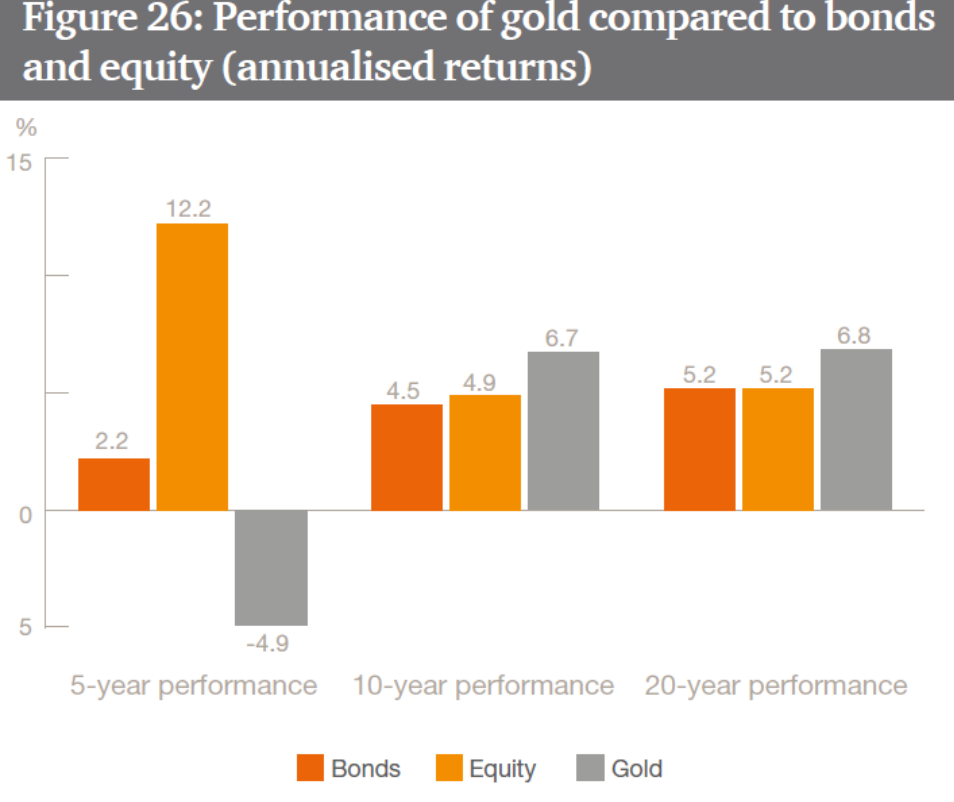
  • Gold has outperformed equities and bonds over the long term – PwC Research
  • Gold is up 6.7% and 6.8% per annum over 10 and 20 year periods; Stocks and bonds returned less than 5.2% respectively over same period (see PwC table)
  • From 1971 to 2016 (45 years), “gold real returns were approximately 10% while inflation increased 4%”
  • Gold also valuable due to lack of correlation and hedge against inflation, currency devaluation and uncertainty

Source: PwC  Research via Bloomberg and WGC data

In new research, entitled ‘The rising attractiveness of alternative asset classes for Sovereign Wealth Funds‘ PwC explain how gold is viewed as an important diversifier by sovereign wealth funds, as both an important hedge and for long term returns.

PwC now class gold as a ‘re-emerging asset class’ on the basis of its long-term out performance of stocks and bonds, low correlation with traditional assets, resilience and high liquidity.

Gold along with private equity, real estate and infrastructure now accounts for 23% of a total $7.4 trillion of assets under management by sovereign wealth funds.

The report notes that from a peak of 40% in 2013, sovereign wealth funds’ investment into fixed income instruments such as government bonds declined to 30% by 2016. Due to record low bond yields, the funds decided to turn their attention to alternative assets to enhance returns.

The report notes the impressiveness of both gold’s long-term performance and low correlation to other assets in the long-term, compared to other alternatives.  In the short-term the benefit of gold’s liquidity is noted:

“[It] has one of the highest rates of daily volumes exchanged and can provide protection against short and medium term market corrections.”

The 23% allocation is expected to increase going forward, despite slight increases in rates recently and because of the likelihood of continuing very low interest rates.

This report comes at a time when we are seeing a growing interest by both large institutions and family offices in gold investment.

Like sovereign wealth funds, they are encouraged by gold’s long-term returns, high liquidity and resilience against economic shocks.

Long term outperformance to traditional asset classes

As we have seen in recent years gold, like all assets, has periods when it underperforms. This has been in the short-term in the last 3 to 5 years, but in the long-term – such as a 10, 20 or 40 year period, it is an entirely different story.

Indeed, gold’s recent underperformance, makes its long term outperformance all the more impressive.

The report shows that in the last ten years, gold delivered returns of 6.7% per annum, outperforming equities and bonds which returned just 4.9% and 4.5% respectively. This return was slightly greater over a 20-year period when gold returned 6.8% per annum, compared to equities and bonds which returned just 5.2% and 5.2%.

Over the long term, gold is one of the top three performing assets along with real estate and private equity.

“Gold’s long-term performance is attributed to three factors: increased demand from emerging markets, central banks becoming net buyers, and the emergence of new products, such as gold-based ETFs, which have simplified investing and made the material more accessible.” – PwC

PwC also note the importance of gold when it comes to protecting against currency devaluation:

“By introducing alternatives into the portfolio, the value of investments can be protected against a possible decrease in purchasing power of the currency the investments are denominated in. This can be done through instruments whose returns are somehow linked to inflation or have perceived intrinsic value. Assets with perceived intrinsic value, such as commodities, should increase in price alongside CPI. In cases of extreme inflation for example, gold has historically performed well, outpacing that inflation by 10%…gold performed well during inflationary periods. For example, from 1971 to 2016, gold real returns were approximately 10% while inflation increased 4% year-over-year.”

Gold doesn’t follow: Low correlation with traditional asset classes

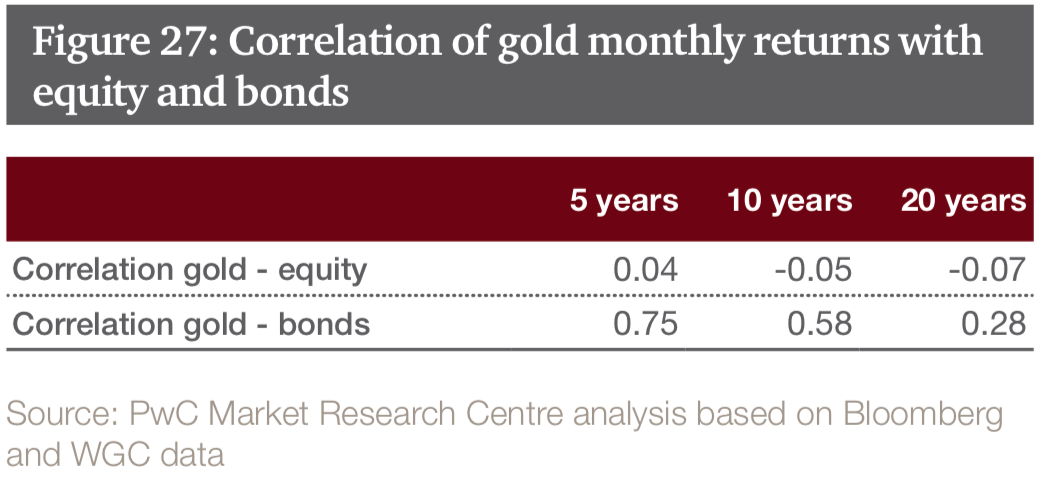
“Gold can be a useful addition to investment portfolios compared to other commodities, due to lower correlation with traditional asset classes. Between June 1997 and June 2017, the correlation between gold and equity returns was close to zero (-0.07), thus showing its diversification benefit. The asset class maintains only a negative correlation over a ten-year period as well, standing at -0.05. Gold is more correlated with bond returns, standing at 0.58 on a ten-year basis, and at 0.28 on a twenty-year correlation (see Figure 27)…Gold has, over all considered time periods, no statistically significant correlation with hedge funds, private equity, infrastructure, and real estate.”

As with the other factors discussed by PwC this is pertinent for all considering investing in gold, from retail and pension investors, larger institutions and family offices. Much of gold’s low correlation is due to the fact that it is less affected by economic cycles and geo-political risks than other financial assets. This means it shows resilience at times when others are showing weakness.

This has been seen in recent days when stock markets saw massive volatility and very sharp corrections and gold was essentially flat. Year to date in 2018, gold is nearly 1.7% higher while many stock indices are down sharply – Euro Stoxx 50 is down more than 4%  year to date.

Resilient asset class during crises and instability

The gold price performs well in times of financial crises and extreme market events. During these times the correlation benefits become even more important, so it can provide portfolio insurance since it minimises portfolio losses.  PwC explain that this is what distinguishes gold from other assets:


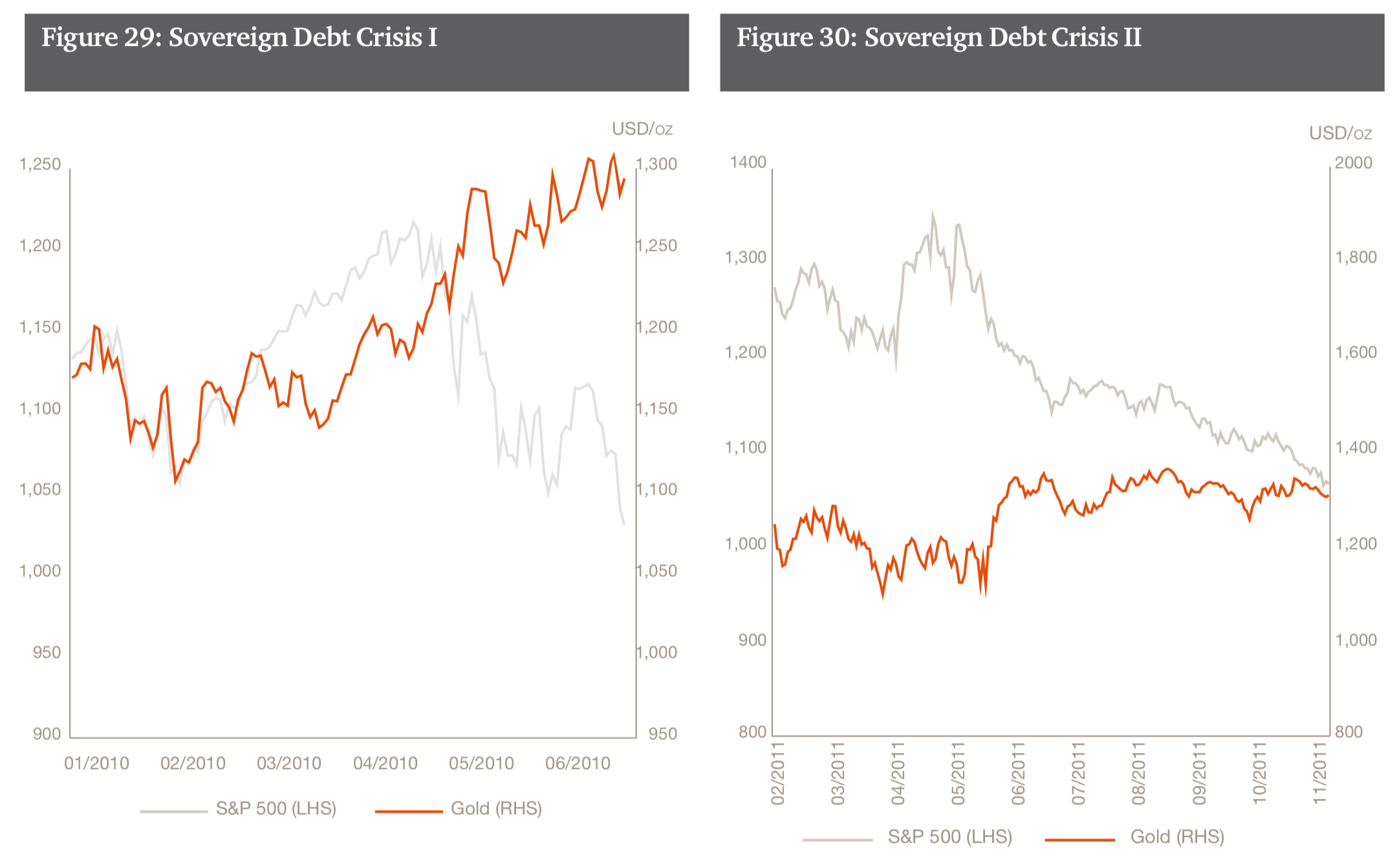
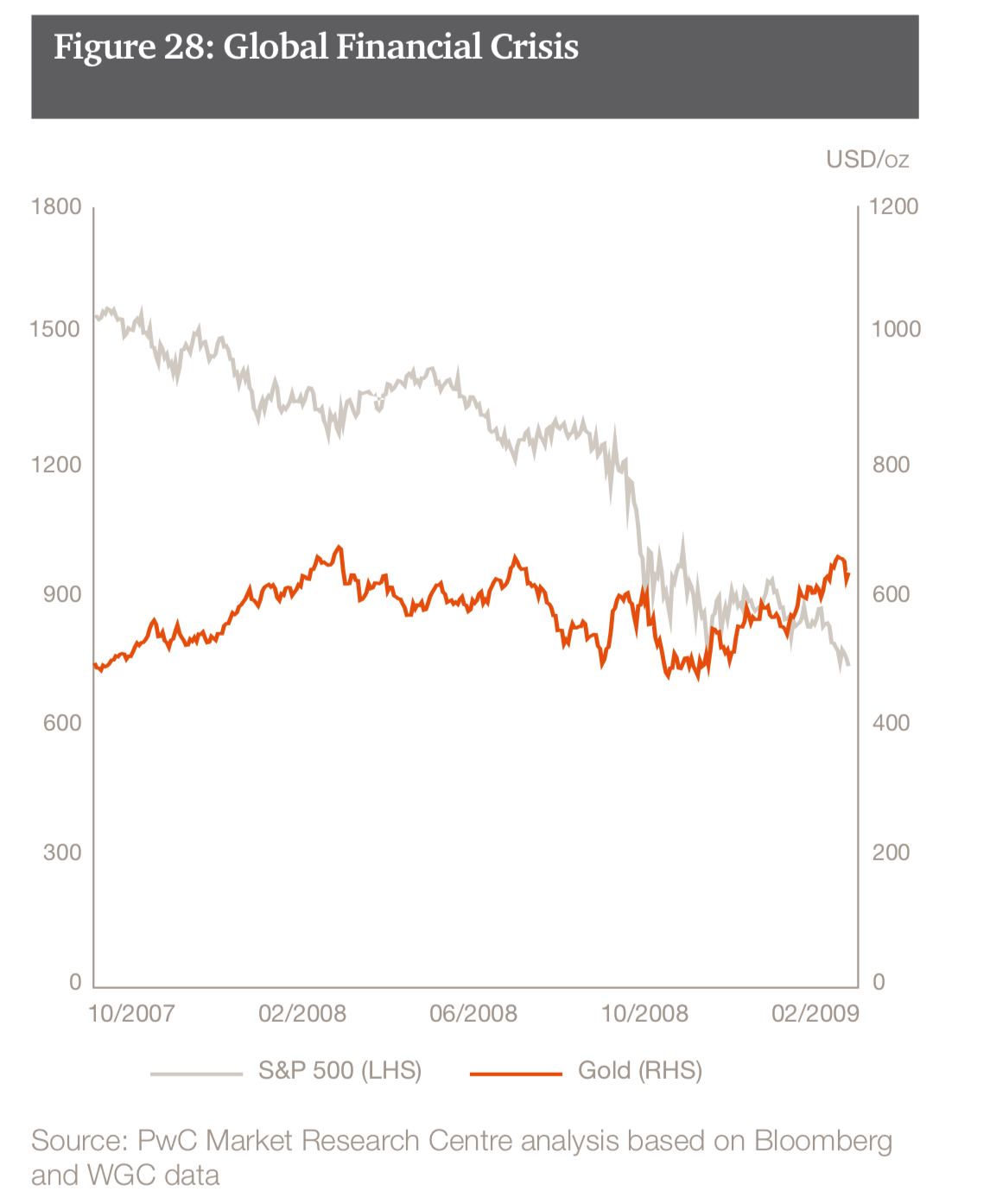
“Gold has delivered negatively correlated returns when equity indices, such as S&P 500, have plummeted. Figure 28, 29, and 30 show gold’s performance during episodes of acute market crisis (GFC and the Sovereign Debt Crisis I and II). In these cases, the gold price started to rise significantly as the S&P 500 index decreased. Generally speaking, the gold price per ounce rose as investors perceived uncertainty in the stock markets, and decreased as these markets gave signs of normalisation.”

After the bloodbath of the last week, S&P500 investors will be interested to hear how gold correlates to the market”

“Among alternatives, when examining the correlation of returns with the S&P 500 index, gold is an excellent diversifier presenting the lowest correlation on a five-, ten-, and twenty- year basis (0.04, -0.05, -0.07 respectively).”

Liquid gold

The asset is particularly liquid in contrast to many of the other assets considered by SWFs, this is something very beneficial according to PwC:

” Stabilization funds may, in particular, benefit from adding gold among their holdings as they are required to hold highly liquid assets to counter the effects of sudden macroeconomic shocks.

Gold has distinguished itself from other alternative asset classes as it has been more liquid, with USD 224 bn traded on average on a daily basis in 2016″.

Conclusion: Investment and pension case for gold is strong

PwC do not beat about the bush when it comes to their positivity towards  gold as an investment. They synopsise and elucidate many of gold’s benefits which we have long been highlighting in recent years:

“All these features suggest that gold as an investment class can offer reliable support, not only during uncertain market and political conditions, such as periods of high inflation, stock market crashes, and geopolitical instability, but also under normal market conditions.”

They clearly see gold as playing a crucial role in the portfolios of sovereign wealth funds and indeed the majority of investors across the spectrum.

“The investment case for gold, during periods of market uncertainty, has proven to be strong, with the price of gold having surged rapidly and having countered the negative effects of adverse market conditions. Hence, investors can consider gold for diversification and long-term performance.”

Pwc Report on gold can be accessed here

Watch the PwC World Gold Council interview about the report here

Related Content

Research: Gold As a Safe Haven Asset

CNBC: Is gold the ultimate safe haven?

News and Commentary

Gold steady on weaker dollar ahead of U.S. price data (Reuters.com)

Asian markets continue upswing as global rebound continues (MarketWatch.com)

Gold recoups half of last week’s loss as dollar softens (MarketWatch.com)

U.S. runs January budget surplus of $49 billion, Treasury says (MarketWatch.com)

VIX manipulation costs investors billions, whistle-blower tells CFTC (Bloomberg.com)


Source: Goldchartsrus via Goldseek

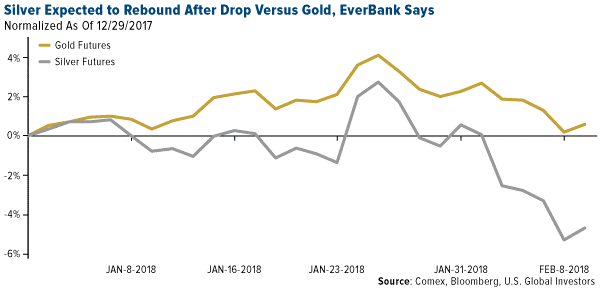
Silver Expected To Rise After Drop Versus Gold – Everbank (GoldSeek.com)

Gold demand in technology sector advances in 2017 for the first time since 2010 (ScrapRegister.com)

Insider trading has been rife on Wall St – The Economist (Economist.com)

The Fed’s Impossible Choice, In Three Charts (DollarCollapse.com)

When Will It End? Bloodied Traders Are Seeking Clues (Bloomberg.com)

Gold Prices (LBMA AM)

13 Feb: USD 1,329.40, GBP 955.04 & EUR 1,077.61 per ounce
12 Feb: USD 1,321.70, GBP 955.19 & EUR 1,077.45 per ounce
09 Feb: USD 1,316.05, GBP 945.58 & EUR 1,072.84 per ounce
08 Feb: USD 1,311.05, GBP 944.87 & EUR 1,071.13 per ounce
07 Feb: USD 1,328.50, GBP 956.12 & EUR 1,075.95 per ounce
06 Feb: USD 1,344.65, GBP 962.50 & EUR 1,083.52 per ounce
05 Feb: USD 1,337.10, GBP 947.20 & EUR 1,072.49 per ounce

Silver Prices (LBMA)

13 Feb: USD 16.61, GBP 11.94 & EUR 13.46 per ounce
12 Feb: USD 16.43, GBP 11.86 & EUR 13.39 per ounce
09 Feb: USD 16.36, GBP 11.83 & EUR 13.37 per ounce
08 Feb: USD 16.35, GBP 11.70 & EUR 13.36 per ounce
07 Feb: USD 16.69, GBP 12.02 & EUR 13.52 per ounce
06 Feb: USD 16.81, GBP 12.07 & EUR 13.59 per ounce
05 Feb: USD 16.88, GBP 12.01 & EUR 13.56 per ounce

https://news.goldcore.com/

Source: http://news.goldseek.com/GoldSeek/1518511260.php

#Blockchain explained: It builds trust when you need it most $SX $SX.ca $SXOOF $IDK.ca $AAO.ca

Posted by AGORACOM-JC at 2:01 PM on Monday, February 12th, 2018
  • Blockchain is best known as the technology behind the cryptocurrency bitcoin — a digital currency whose value soared above $19,000 over the last year before slumping to half that when the frenzy subsided
  • But blockchain is so much more, potentially easing the doubts and uncertainties that dog so much of life — whether buying a used car from a stranger, having faith that a piece of fruit really is organic, or knowing that a prescription drug isn’t counterfeit
  • Blockchain, in effect, hard-wires trust into transactions or data that we might otherwise be more cautious about

Here’s everything you need to know about the technology powering the bitcoin cryptocurrency today and, soon, a myriad of services that will change your life.

This is part of “Blockchain Decoded,” a series looking at the impact of blockchain, bitcoin and cryptocurrency on our lives.

These days, we’re having a harder and harder time trusting each other.

Trust is an essential part of ordinary living, whether it’s picking mechanics based on Yelp reviews, sliding credit cards into gas station fuel pumps or heeding our doctor’s advice. But our trust has been eroding for years. In the US, only 33 percent of us felt we could trust our government in 2017 — a decline of 14 percentage points from 2016, according to Edelman’s annual trust barometer study. Trust in businesses dropped from 58 percent to 48 percent, too, while media (fake news!) and social networks also took a hit.

That’s a problem. The less trust you have, the harder everything becomes. Did that job candidate really graduate from college? Did your brother-in-law really repay that loan?

But there’s an unlikely solution that might help restore enough faith in strangers to make our lives a bit easier: an encryption technology called blockchain.

Blockchain is best known as the technology behind the cryptocurrency bitcoin — a digital currency whose value soared above $19,000 over the last year before slumping to half that when the frenzy subsided. But blockchain is so much more, potentially easing the doubts and uncertainties that dog so much of life — whether buying a used car from a stranger, having faith that a piece of fruit really is organic, or knowing that a prescription drug isn’t counterfeit. Blockchain, in effect, hard-wires trust into transactions or data that we might otherwise be more cautious about.

“It’s revolutionary,” said Mark Siegel, an investor at Menlo Ventures.

Bitcoin’s value has soared and plunged over the last year, and it’s hard to separate the sensible from the scams among the 1,500 other cryptocurrencies. But blockchain has enjoyed more stable appeal.

Indeed, staid companies like IBM, Microsoft and Intel are offering blockchain as just another software tool to get business done. Other companies dabbling in blockchain include Goldman Sachs, Nasdaq, Walmart and Visa.

Because blockchains work as a secure digital ledger, a bumper crop of startups are hoping to bring it to voting, lotteries, ID cards and identity verification, graphics rendering, welfare payments, job hunting and insurance payments.

A lot of that revolution could be invisible to you, taking place inside and among businesses. But it’s potentially a very big deal. Analyst firm Gartner estimates that blockchain will provide $176 billion in value to businesses by 2025 and a whopping $3.1 trillion by 2030.

How does blockchain actually work?

OK, strap yourself in, because this gets a bit hairy.

A good place to start is the name: a blockchain is an ever-growing set of data blocks. Each block records a collection of transactions — for example, that you now hold the title to the car you bought or that you paid a car dealer to get it.

IBM and Maersk have a partnership to use blockchain to smooth shipping operations. A single blockchain can help exporters, shipping companies, port authorities and importers cooperate.

Maersk

That may sound simple, but here’s a difference between blockchain and the Department of Motor Vehicles. Today, the government stores the information on its own central computer. Blockchains, though, distribute it across a group of computers — maybe even thousands of them. Each has its own copy of the blockchain transactions.

That decentralization and synchronization means no single party controls the data. If one business sells an asset to another, each sees the same data. There’s no need for lawyers at one company to call the other if their accounting databases disagree, because there’s only one accounting database.

Cryptography — mathematical methods of keeping data secret and proving identity — now enters the picture when it comes to recording transactions. Blockchain uses the same cryptographic key technology that keeps hackers from sniffing your credit card number when you type it into an e-commerce website. One digital key ensures only you can enter a transaction to the blockchain involving your assets, and another digital key lets someone else confirm it really was you who added the transaction.

“You can take a network of parties that didn’t have prior experience working with each other — that didn’t have reason for trust — and still find a way to build a transaction record or a history of the truth,” said Brian Behlendorf, executive director for the Linux Foundation’s Hyperledger project for blockchain software.

Indelible ink

Another fundamental part of the blockchain is called immutability — its resistance to tampering or other changes. To understand it, you need to understand another cryptographic concept called the hash.

Hashing reduces data to a bunch of seemingly random characters — for example, the hash of the phrase “the quick brown fox” is “9ECB36561341D18EB65484E833EFEA61EDC74B84CF5E6AE1B81C63533E25FC8F” using an encoding method called SHA-256. Tweaking just one letter in the phrase produces a completely different hash, and you can’t go backward to figure out the original data from the hash.

With blockchain, hashes are linked together so any minute change is immediately visible, not just for the block housing it but for all other blocks added later. With red flags that big for changes that small, you can see why auditors would get excited.

“It’s like doing the crossword puzzle in ink instead of pencil,” said Marie Wieck, head of IBM’s 1,500-employee blockchain group. “You will see if you change your answer to 3 across from moon to star.”

That’s no fun for embezzlers accustomed to hiding behind dodgy or altered records. Cryptocurrencies can offer anonymity to criminals, which is why it’s been popular for things like the WannaCry ransomware that locked up people’s computers until they paid up. But blockchain makes it easier to find the digital scene of the crime — especially with private blockchains that networks of business partners can set up to cooperate.

Mining madness

The process for locking down a block onto the blockchain so it can’t be changed, at least today, is called mining.

And it’s a problem.

Here’s how it works. When you and others announce transactions to a blockchain network, computers on that network race to solve a complicated mathematical puzzle based on those transactions. A computer that succeeds announces it to the network, and the transaction is accepted if other computers verify that none of the assets in question were already used. That’s what’ll keep you from selling the same concert ticket twice on a blockchain-based ticket market. (Citizen Ticket and Active Ticketing are working on this.)

Cryptocurrency mining computers like this Antminer S9 from Bitmain may look modest, but when stacked by the thousands there’s immense horsepower to make today’s blockchains work.

Bitmain

But today’s mining approach, called “proof of work,” has huge drawbacks.

For one thing, mining works most profitably on powerful computers that consume immense amounts of electrical power. For example, bitcoin mining today uses about as much power as the country of Singapore, enough to power 4.4 million houses, according to cryptocurrency analyst firm Digiconomist. That amount is growing.

For another, transactions are relatively slow. Blockchain transactions can race past transactions that rely on middlemen and reconciliation procedures, like escrow accounts for home purchases or international money transfers. But bitcoin transactions can take about 10 minutes, which is why cryptocurrencies today aren’t useful for just buying something in a store.

There’s lots of work to free blockchain from the problems of transaction speed and energy consumption, though. One idea, “proof of stake,” uses no significant computing power and looks to be the future for the Ethereum Project, which is responsible for the ether cryptocurrency.

If bitcoin was the first generation of blockchain and Ethereum the second, there are a number of people hoping their project will catch on as the third.

Tezos, for example, hopes to build in better governance so its technology can move forward without the troubles bitcoin and Ethereum have suffered, said Tezos CEO Kathleen Breitman, speaking at the Techonomy conference in November — though ironically, Tezos has suffered governance problems of its own with a spat over its own management. Another challenger is Dfinity. Its chief scientist, Dominic Williams, promises transaction speeds 600 times faster than Ethereum, which today is only a bit faster than bitcoin.

Smart contracts

The original blockchain was described in a 2008 bitcoin paper by Satashi Nakamoto, a pseudonym for a person or perhaps group that unified some ideas into the first working cryptocurrency. The idea became reality with the release of open-source bitcoin software in 2009. The bitcoin blockchain now records about 300 million transactions and counting.

But ether has popularized a newer idea called smart contracts. These are programs that run on the Ethereum network and take automated if-this-then-that actions. For example, a smart contract could look for the highest bid in an auction at a certain time and automatically transfer ownership rights to the auction winner.

Bitcoin is based on blockchain technology. The surging price helped generate new interest that’s withstood the recent plunge in bitcoin value.

Yahoo Finance

“When companies sign a contract, it’s enforced by a judge or lawyers in a court,” said Vipul Goyal, an associate professor in Carnegie Mellon University’s cryptography group. “Smart contracts are enforced by cryptographic mechanisms in the code. Enforcing the contract is much cheaper and much faster — almost instant.”

With smart contracts, blockchain could help automate lots of computing operations, including ones humans never touch. Your electric car could wait for favorable electricity prices before deciding when to charge itself from the grid, solar panels or in-home batteries, then the blockchain could handle accounting among all the parties.

Goyal expects blockchain will help automate all sorts of transactions. For example, if it’s used to register your car purchase, that could trigger a cascade of other operations, like transferring the car’s cryptographic keys that let its owner unlock the car.

“This is much more efficient than going to the DMV and filling out paperwork,” he said. “It’s also more secure, because these keys cannot be forged. The seller can’t make copies of the key and try to steal the car.”

The ties that bind

Expect to see blockchain showing up in particular where there are groups of interlinked organizations. That could include one company and its suppliers, or it could be consortiums of competitors and and their suppliers.

For example, IBM has a blockchain partnership with a long list of food suppliers and grocery retailers, including Dole, Kroger, Nestlé, Tyson Foods and Walmart.

The basic attention token, developed by browser maker Brave Software, uses blockchain to oversee online ad payments that can flow among advertisers, publishers and anyone using its browser.

Brave Software

Another blockchain project comes through browser startup Brave, which relies on the technology to change online advertising in a way that improves performance and privacy while giving browser users a cut of the proceeds. Blockchain accounting, using a digital payment mechanism called the basic attention token (BAT), enables direct payments among advertisers, publishers and browser users — for example an advertiser paying a publisher or a reader making a small one-off payment for a news article without buying a subscription.

It’s transparent, so anyone can see exactly how many BATs were transferred and check that Brave didn’t illicitly siphon any off, Brave CEO Brendan Eich said.

But for companies averse to sharing data with competitors, blockchain’s transparency is a difficulty. There are mechanisms for handling the challenge, Behlendorf said.

“In most networks, you have a balance between data that can be kept private, but enough public that you can attest to its veracity,” Behlendorf said.

Another way blockchain could bring many parties together is property records.

There are thousands of counties in the US, each with its own record of who owns what. One startup, Propy, hopes to digitize those records, mirroring the records initially the way title companies do, but also storing them on the blockchain, said CEO Natalia Karayaneva.

If county clerks saw the benefit, they could gradually move to the system — it’s decentralized, not Propy’s own database. Propy hopes to profit by taking a percentage of the sales it facilitates, but at the same time, it also hopes to cut purchasers’ costs — for example by eliminating the thousands of dollars that title insurance can cost.

Slow down there a minute

For something as hyped as blockchain, with millions of dollars raised, you have to expect some backlash. There’s plenty, starting with the criticism that blockchain would have already taken off if it’s so great and concerns that it’s abetting cryptocurrency shenanigans. There’s also the concern that poorly written code could leave a faulty foundation.

Overinflated expectations are nothing new to the tech industry, though, and there are enough serious players engaged that it’s hard to dismiss blockchain as all sizzle and no steak. Expect a winnowing as reality sets in.

“In 2018, we expect to see a number of projects stopped that should never have been started in the first place,” said Forrester analyst Martha Bennett.

She points out plenty of other areas where blockchain falls short of its promises. The immutability comes at a cost, lacking some of the mechanisms for recourse found in today’s slower processes. Companies cooperating to set up their own private blockchains, rather than using public ones like Ethereum, must have some trust already to set up rules for access and governance.

Here’s another hitch: getting everybody on board. For example, Automaker Renault hopes for a blockchain to lock down car maintenance records. After all, who wouldn’t want to know if the used car you’re thinking of buying made lots of trips to the repair shop? It turns out the seller may not share your enthusiasm for that much transparency.

So it’s not perfect. But it doesn’t have to be. Blockchain just has to be better than what we have today. There are a lot of underhanded cryptocurrency dealings, but regulators are now reining in abuses, said Rick Levin, chairman of the financial technology and regulation team at the AmLaw law firm Polsinelli. Likewise, engineers are hammering out improvements to blockchain and big names like Nasdaq and Goldman Sachs are embracing it.

“I don’t think it’s just going to vanish,” Levin said. “There’s too much energy behind this.”

Source: https://www.cnet.com/news/blockchain-explained-builds-trust-when-you-need-it-most/

Neptune and Tetra Bio-Pharma $TBP.ca Enter Co-Development Agreement for Purified Cannabinoid Oil-Based Products targeting Pain and Inflammation $AERO $CBDS $CGRW $APH.ca $GBLX

Posted by AGORACOM-JC at 8:27 AM on Monday, February 12th, 2018

Logo tetrabiopharma rgb web

  • Entered into an agreement for the co-development, commercialization and marketing of purified cannabinoid oil-based products
  • Will address pain and inflammation relief applications for the natural health products and pet veterinary markets

LAVAL, QUÉBEC–(Feb. 12, 2018) – Tetra Bio-Pharma Inc. (“Tetra”) (TSX VENTURE:TBP)(OTCQB:TBPMF) and Neptune Technologies & Bioressources Inc. (“Neptune”) (NASDAQ:NEPT)(TSX:NEPT) today announced that they entered into an agreement for the co-development, commercialization and marketing of purified cannabinoid oil-based products to address pain and inflammation relief applications for the natural health products and pet veterinary markets.

“We are proud to partner with a company like Neptune. Their know-how in extraction, performed in a state of the art GMP facility, is a great asset to have for the cannabis medicinal/pharma oil market. This combined to Tetra’s expertise in the development of products for the prescription drug and pharma retail market, makes this partnership truly one of a kind. Leveraging our complementary expertise in research, regulatory affairs, science, formulation, and delivery forms, we intend to commercialize these new products in preparation of the forthcoming retail cannabis market in Canada, and a RX veterinary North American market,” stated Bernard Fortier, Chief Executive Officer (CEO) of Tetra.

”We are excited to partner with Tetra, a biopharmaceutical leader in the development of cannabinoid-based novel drugs and treatments. The products that will be co-developed will be supported by research as well as our unique formulation and delivery system knowledge, which are key components of our mission to deliver differentiated science-based, value-added products,” said Jim Hamilton, President and CEO of Neptune.

The veterinary health care market is expected to reach US $39.7 billion by 2021, registering a CAGR of 8.06% during 2017-2022 (the forecast period)1. Veterinary medicines are associated with treatment, diagnosis, and prevention of diseases among animals. It covers a variety of animal species, both, in domestic and wild.

1 Mordor intelligence October 2017: Veterinary Health Care Market – Growth, Trends and Forecast (2017-2022).About Neptune Technologies & Bioressources Inc.

Neptune is a wellness products company, with more than 50 years of combined experience in the industry. The Corporation formulates and develops turnkey solutions available in various unique delivery forms, offers specialty ingredients such as MaxSimil®, a patented ingredient that may enhance the absorption of lipid-based nutraceuticals, and a variety of other marine and seed oils. Neptune also sells premium krill oil directly to consumers through web sales at www.oceano3.com. Leveraging our scientific, technological and innovative expertise, Neptune is working to develop unique extracts and formulations in high potential growth segments, such as medical and wellness cannabinoid-based products.

Neptune is also pursuing opportunities in the prescription drug markets, through its 20% investment in Acasti Pharma Inc. (“Acasti”). Acasti focuses on the research, development and commercialization of omega-3 phospholipid therapies for the treatment of severe hypertriglyceridemia.

The Company’s head office is located in Laval, Quebec.

About Tetra Bio-Pharma

Tetra Bio-Pharma (TSX VENTURE:TBP)(OTCQB:TBPMF) is a biopharmaceutical leader in cannabinoid-based drug discovery and clinical development. Tetra is focusing on three core business pillars: clinical research, pharmaceutical promotion and retail commercialization of cannabinoid-based products. More information at: www.tetrabiopharma.com.

Forward Looking Statements

Statements in this press release that are not statements of historical or current fact constitute “forward-looking statements” within the meaning of the U.S. securities laws and Canadian securities laws. Such forward-looking statements involve known and unknown risks, uncertainties, and other unknown factors that could cause the actual results of Neptune to be materially different from historical results or from any future results expressed or implied by such forward-looking statements. In addition to statements which explicitly describe such risks and uncertainties, readers are urged to consider statements labeled with the terms “believes,” “belief,” “expects,” “intends,” “anticipates,” “will,” or “plans” to be uncertain and forward-looking. Readers are cautioned not to place undue reliance on these forward-looking statements, which speak only as of the date of this press release. Forward-looking information in this press release includes, but is not limited to, information or statements about our ability to successfully develop, produce, supply, promote or generate any revenue from the sale of any cannabis-based products for medical use, as well as the results of any clinical trials associated thereto.

The forward-looking statements contained in this press release are expressly qualified in their entirety by this cautionary statement and the “Cautionary Note Regarding Forward-Looking Information” section contained in Neptune’s latest Annual Information Form (the “AIF”), which also forms part of Neptune’s latest annual report on Form 40-F, and which is available on SEDAR at www.sedar.com, on EDGAR at www.sec.gov/edgar.shtml and on the investor section of Neptune’s website at www.neptunecorp.com. All forward-looking statements in this press release are made as of the date of this press release. None of Neptune and Tetra undertake to update any such forward-looking statements whether as a result of new information, future events or otherwise, except as required by law. The forward-looking statements contained herein are also subject generally to other risks and uncertainties that are described from time to time in Neptune’s and Tetra’s public securities filings with the Securities and Exchange Commission and/or the Canadian securities commissions, as applicable. Additional information about these assumptions and risks and uncertainties is contained in the Neptune’s AIF under “Risk Factors” or in Tetra’s MD&A under “Risk Factors”.

Neither NASDAQ, the Toronto Stock Exchange nor the TSX Venture Exchange accepts responsibility for the adequacy or accuracy of this release.

SOURCE: Neptune Technologies & Bioressources Inc. & Tetra Bio-Pharma Inc.

Neptune Wellness Solutions
Mario Paradis
VP & CFO, Neptune
[email protected]
1.450.687.2262 x236

Investor Relations Contact (Canada)
Pierre Boucher
MaisonBrison
1.514.731.0000
[email protected]

Investor Relations Contact (U.S.)
Ed McGregor/Jody Burfening
LHA, IR
1.212.838.3777
[email protected]

Tetra Bio-Pharma Inc.
Dr. Anne-Sophie Courtois, DVM
Vice President, Marketing & Communications
[email protected]
O: (438) 899-7575

For media information, please contact:
Daniel Granger
[email protected]
ACJ Communication
O: 1 514 840 7990 / M: 1 514 232 1556

INTERVIEW – $GGX.ca Discusses Aggressive Exploration Initiative Within Prolific Golden Triangle #Gold #Mining $PVG $AMK.ca $SA $SEA.ca

Posted by AGORACOM-JC at 8:20 AM on Friday, February 9th, 2018

Ggx large

  • Focused in southern BC’s prolific Golden Triangle
  • Strategy is to prove up existing reserves and begin small scale production on the Gold Drop mine
  • Located 40 km from Grand Forks, British Columbia in geologically prospective ground in the well-mineralized Greenwood District
  • Property has seen high grade gold production

Private Syndicate: GGX Gold owns nine percent of a private syndicate focused on project generation within the Golden Triangle. The private syndicate includes some of the original team members that generated, prospected and staked the Coffee Creek claims.

HPQ Silicon Resources $HPQ.ca Provides Beauce #Gold Fields Spin-out Update

Posted by AGORACOM-JC at 2:54 PM on Thursday, February 8th, 2018

Hpq large

  • Spin-out of gold assets to Beauce Gold Field by way of a court-approved Plan of Arrangement (the Plan) has reached a new threshold
  • Plan will subject to the approval of the company’s shareholders at the next Annual General and Special Meeting, subject to a Final Court approval.

MONTRÉAL, QUÉBEC–(Feb. 8, 2018) – HPQ Silicon Resources Inc (“HPQ”) (TSX VENTURE:HPQ)(FRANKFURT:UGE)(OTC PINK:URAGF) is pleased to inform shareholders that the spin-out of gold assets to Beauce Gold Field (¨BGF¨) by way of a court-approved Plan of Arrangement (the Plan) has reached a new threshold.

Patrick Levasseur of HPQ Silicon stated, “Following the strong support we received from the community for the Beauce Gold Field project, we are eager to move the spin-out forward as soon as possible.” Mr Levasseur further stated “After more than a century of major historical placer gold mining in the Beauce, the time has come to find an answer as to where did the placer gold come from and to explore for a hard rock gold deposit”

Beauce Gold Fields Spinout to be done by Plan of Arrangement

As previously announced last August 15, 2017, the Company is proceeding with the spinout of its gold assets to the Beauce Gold Fields Inc subsidiary, by way of a court-approved Plan of Arrangement and a proposed listing on the TSX-Venture Exchange. The Plan will subject to the approval of the company’s shareholders at the next Annual General and Special Meeting, subject to a Final Court approval.

The Company has retained the services of legal and Fairness opinion advisors. Various property agreements have been signed between HPQ and BGF regarding projects, mining claims, certain rights and royalty agreements that will only become effective if BGF successfully becomes a TSX-V public listed company.

Upon reception of the final Court approval the board of HPQ will determine date of record, for distribution of BGF shares as a dividend, subject to the approval of the TSX-V.

Further details and updates will be provided to shareholders and other stakeholders via news releases only.

About Beauce Gold Fields

BGF is a wholly owned subsidiary of HPQ Silicon. It is in the process of “Spinning Out” its gold assets into BGF, a new public junior gold company, subject to approval by TSX-V.

The Beauce Gold Fields project is a unique, historically prolific gold property located in the municipality of Saint-Simon-les-Mines in the Beauce region of Southern Quebec. Comprising of a block of 152 claims 100% owned by HPQ, the project area hosts a six kilometre long unconsolidated gold-bearing sedimentary unit (a lower saprolite and an upper brown diamictite). The gold in saprolite indicates a close proximity to a bedrock source of gold, providing possible further exploration discoveries. The property was also hosts numerous historical gold mines that were active from 1860s to the 1960s.(see HPQ SEDAR-filed report)

A Beauce Gold Fields presentation is available. It can be downloaded via link below
http://www.hpqsilicon.com/wp-content/uploads/2017/07/BGF-Presentation-V-Jul-2017.pdf

This news release is available on the company’s CEO Verified Discussion Forum, a moderated social media platform that enables civilized discussion and Q&A between Management and Shareholders. Powered by Agoracom.

Other Corporate issues:

In accordance with the agreement between HPQ-Silicon and AGORACOM (see HPQ (Uragold) press releases July 18, 2014 and April 15, 2016), extended by both Parties for additional periods ending July 15, 2018 under the same terms and conditions, on January 25, 2018, HPQ-Silicon Board has approved the issuance of 166,176 common shares at a deemed price of $0.085 per share to pay $14,125 for services rendered during the period from July 16, 2017, ending October 15, 2017. Furthermore, HPQ Board has also approved the issuance of 117,708 common shares at a deemed price of $0.12 per share to pay $14,125 for services rendered during the period from October 16, 2017, ending January 15, 2018.

About HPQ Silicon

HPQ Silicon Resources Inc. is a TSX-V listed resource company planning to become a vertically integrated and diversified High Purity, Solar Grade Silicon Metal (SoG Si) producer and a manufacturer of multi and monocrystalline solar cells of the P and N types, required for production of high performance photovoltaic conversion.

HPQ goal is to develop, in collaboration with industry leaders that are experts in their fields of interest, the innovative metallurgical PUREVAP™ “Quartz Reduction Reactors (QRR)” process (patent pending), which will permit production of the highest efficiency SoG Si. The pilot plant equipment that will validate the commercial potential of the process is on schedule for 2018.

Disclaimers:

This press release contains certain forward-looking statements, including, without limitation, statements containing the words “may”, “plan”, “will”, “estimate”, “continue”, “anticipate”, “intend”, “expect”, “in the process” and other similar expressions which constitute “forward-looking information” within the meaning of applicable securities laws. Forward-looking statements reflect the Company’s current expectation and assumptions, and are subject to a number of risks and uncertainties that could cause actual results to differ materially from those anticipated. These forward-looking statements involve risks and uncertainties including, but not limited to, our expectations regarding the acceptance of our products by the market, our strategy to develop new products and enhance the capabilities of existing products, our strategy with respect to research and development, the impact of competitive products and pricing, new product development, and uncertainties related to the regulatory approval process. Such statements reflect the current views of the Company with respect to future events and are subject to certain risks and uncertainties and other risks detailed from time-to-time in the Company’s on-going filings with the securities regulatory authorities, which filings can be found at www.sedar.com. Actual results, events, and performance may differ materially. Readers are cautioned not to place undue reliance on these forward-looking statements. The Company undertakes no obligation to publicly update or revise any forward-looking statements either as a result of new information, future events or otherwise, except as required by applicable securities laws.

Neither the TSX Venture Exchange nor its Regulation Services Provider (as that term is defined in the policies of the TSX Venture Exchange) accepts responsibility for the adequacy or accuracy of this release.

Shares outstanding: 192,679,213

Bernard J. Tourillon
Chairman and CEO
(514) 907-1011

Patrick Levasseur
President and COO
(514) 262-9239
www.HPQSilicon.com

INTERVIEW: Explor Resources $EXS.ca Discusses TPW Property with A 609K oz Indicated / 470K Inferred #GOLD Resource just 13Km from Timmins $EXN.ca $HBE.ca $OSK.ca

Posted by AGORACOM-JC at 2:20 PM on Thursday, February 8th, 2018


St-Georges Eco-Mining $SX.ca $SXOOF Announces Amendment to the Letter of Intent Between its Subsidiary #ZeU Crypto Networks Inc. and Tiande $HIVE.ca $BLOC.ca $CODE.ca

Posted by AGORACOM-JC at 8:17 AM on Thursday, February 8th, 2018

  • Letter of intent dated January 12, 2018 relating to an asset acquisition between SX’s subsidiary, ZeU CLrypto Networks Inc. and Qingdao Tiande Blockchain Information Technology Co. Ltd. has been amended
  • Proposed acquisition is subject to a number of terms and conditions, including but not limited to, the completion of a concurrent financing not less than $10,000,000 and up to $30,000,000 that can be done in tranches and the receipt of all necessary regulatory, corporate and third party approvals

Montreal, February 8, 2018 / St-Georges Eco-Mining Corp. (CSE: SX) (OTC: SXOOF) (FSE: 85G1) announced today that its previously announced letter of intent dated January 12, 2018 relating to an asset acquisition between SX’s subsidiary, ZeU Crypto Networks Inc. and Qingdao Tiande Blockchain Information Technology Co. Ltd. has been amended. The general terms of the LOI, which referred to Qingdao Tiande Technologies Limited instead of Qingdao, were previously announced by press release dated January 14, 2018.

ZeU, Qingdao and Beijing Tiande Technologies Inc. (“Beijing” and collectively with Qingdao, “Tiande”) entered into the amendment to the LOI (the “Amendment”), which has extended the date by which the parties will conclude the execution of a definitive agreement on or around February 19, 2018 or such later date as may be mutually agreed upon by the parties. The proposed acquisition is subject to a number of terms and conditions, including but not limited to, the completion of a concurrent financing not less than $10,000,000 and up to $30,000,000 that can be done in tranches and the receipt of all necessary regulatory, corporate and third party approvals.

The Amendment also revised the consideration structure, such that the proposed Acquisition will now be settled through the issuance of 75,000,000 common shares of ZeU (each a “Share”) and 75,000,000 Share purchase warrants (each a “Warrant”) on Closing and an additional 75,000,000 Shares after the issuance of the 20th patent derived from the intellectual property and patent application acquired from Tiande. Each Warrant will be exercisable at a price of CND$1.00 for a period of three (3) years following the date ZeU completes a transaction pursuant to which its Shares will either be listed on a recognized stock exchange in North America, or will be exchanged for common shares of a reporting issuer listed on a recognized stock exchange in North America.

Frank Dumas, President & CEO of St-Georges and of ZeU Crypto Networks commented: “The Acquisition required an extensive due diligence effort and has its own particular challenges. We are happy with the current progress and we can now see the finish line ahead of us. Some elements that are ‘sensitive’ to third party sovereign entities increased the expected workload. The current proposal should allow Tiande to operate in China as an exclusive partner to ZeU, giving ZeU the exclusive ownership and right to develop and commercialize the technologies outside of China and would also call for the establishment of a “Canadian Intellectual Property (IP) Container” and a “Chinese Intellectual Property (IP) Container” allowing for a “Chinese Source Code” to be exclusively used in China without any possibility for North American oversight. In order to facilitate the due diligence requirement, Tiande is giving access to its Sandbox installation to third parties interested in running live tests with the ZeU protocol. Institutions that are considering subscribing to the current financing effort are welcome to use the Sandbox platform.”

ON BEHALF OF THE BOARD OF DIRECTORS

“Frank Dumas”

FRANK DUMAS, PRESIDENT & CEO

About St-Georges

St-Georges is developing new technologies to solve the some of the most common environmental problems in the mining industry.

The Company controls directly or indirectly, through rights of first refusal, all of the active mineral tenures in Iceland. It also explores for nickel on the Julie Nickel Project & for industrial minerals on Quebec’s North Shore and for lithium and rare metals in Northern Quebec and in the Abitibi region. Headquartered in Montreal, St-Georges’ stock is listed on the CSE under the symbol SX, on the US OTC under the Symbol SXOOF and on the Frankfurt Stock Exchange under the symbol 85G1.

The Canadian Securities Exchange (CSE) has not reviewed and does not accept responsibility for the adequacy or the accuracy of the contents of this release.

Compliance and medias contact: 514.295.9878