Agoracom Blog Home

Archive for the ‘All Recent Posts’ Category

U.S. Searches For “Agoracom” Skyrockets With Bloomberg / CNBC TV Campaign. “Gold Stocks” Too.

Posted by AGORACOM at 9:35 AM on Thursday, October 9th, 2008

On September 15, we announced the commencement of 30-second television ads on Bloomberg and CNBC in the United States, as well as, BNN in Canada.  Unlike search engine marketing, it can be used to be hard to measure the effectiveness of offline branding campaigns because potential new visitors don’t call you.  If we were specifically marketing our IR services, you could measure the number of prospect calls or web inquiries.

Fortunately, we now have Google Trends. Google Trends analyzes how many searches have been done for a specific term, relative to the total number of searches for that specific term over time. In this case, I wanted to see the search trend for “AGORACOM” in the United States.

In order to make comparisons easy and put them in relative terms, Google assigns the searches over time a  baseline score of 1.00.  As such, anything above 1.00 since September 15 is a good sign and anything below 1.00 is a bad sign. How good or bad would depend on how far off 1.00 the trend is.

So what is the trend for AGORACOM so far? A Google Trends chart is worth 1,000 words:

The spike is so big that the baseline of 1.00 looks like we had no searches at all in 2008 when, in fact, the spike meant the chart had to be set to increments of 10.  To put this into perspective, Imagine what the chart of a small-cap stock would look like if it was trading pretty healthy in and around $1.00 for most of the year and then suddenly spiked to almost $20.

I do concede this is still early and we will have to check this again in 30 days – but we are off to a great start.

AMERICANS SEARCHING FOR “GOLD STOCKS”

If you want to take a look at your own trends, go here.  You can view a search trend for the entire world or for a specific country.  The caveat is that Google Trends doesn’t give you reports on thinly traded search terms. As such, if your corporate name doesn’t register, try things like your industry.  For example, I queried “Gold Stocks” and the following tells me that Americans are becoming VERY interested in them!

If you are a small-cap CEO and don’t recognize the power of Web 2.0 by now, I give up 🙂

Regards,
George

More Evidence Of Looming Capitulation – And Buying Opportunity Of A Lifetime

Posted by AGORACOM at 6:11 PM on Wednesday, October 8th, 2008

In keeping with my theme of how to turn market turmoil to your advantage for both CEO’s and investors, this Globe article serves as further evidence that capitulation is near. Capitulation is the point where investors are overwhelmed with pressure and want out at any cost, as clearly demonstrated by the following quote:

“You’re seeing all of this volatility, and retail investors need to deal with that.
And they don’t want to deal with it. They’re willing to sell, because they aren’t
worried about missing out on a big rally. They think that’s a small price to pay
for the sanity of sleeping well at night.”

If you’re an investor with even a little bit of cash, this is going to be one of the best buying opportunities of your life.

If you’re a CEO of a small-cap company, this is the time to place your company head and shoulders above your peers so that investors come to you once they’ve calmed down.

Regards,
George

Photo courtesy of The Economist

TSX Biggest Movers – Are Gold Stocks Diverging And Making Their Run?

Posted by AGORACOM at 5:45 PM on Wednesday, October 8th, 2008

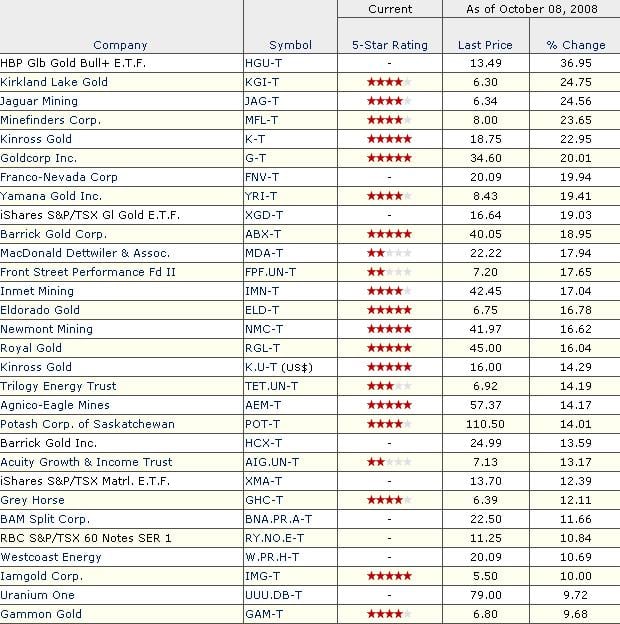
This is courtesy of my lead biz dev guy, Scott Purkis. Take a look at the biggest % gainers on the TSX today. Hopefully, this is a sign that gold/metal stocks are de-coupling from the major indexes and taking on a life of their own. Still early but I’ll make sure Scott keeps me updated:

[CLICK ON THE IMAGE FOR CLEARER VERSION]

Regards,
George

We Need Capitulation To Get Back To Business

Posted by AGORACOM at 6:13 PM on Tuesday, October 7th, 2008

There it is.  I said it.  I will say what nobody else wants to say.  1987 was painful but Black Monday put it all to an end and we moved forward.

If you are a small-cap CEO and believe in the long-term future of your company, then you needn’t worry about a couple of days of panic selling. You’ll be far beyond this in a couple of years.

If you are a small-cap investor and believe in the long-term future of your holdings, then take advantage of capitulation, add to your position and thank-me in 2-3 years when you are paying your child’s college tuition in cash.

Now, let’s get it over with so we can move forward.

Regards,
George

Best Investor Relations Practices During Market Turmoil

Posted by AGORACOM at 8:53 AM on Tuesday, October 7th, 2008

If you are a small-cap or micro-cap CEO and looking for investor relations guidance during these challenging markets, then you have come to the right place.

First, it is important to understand that during this kind of market environment, investor relations is not just about increasing your share price.  Every company is getting hit, so to think you can buck that trend isn’t realistic.

Rather, your goals in this environment are:

  • Short Term – To mitigate any further losses to your market capitalization.
  • Longer Term – To take advantage of competitors with weak or non-existent strategies and capitalize on current opportunities.

Both goals are heavily dependent on your IR communications and strategy.  A properly executed strategy will yield great long-term results, while running for cover and failing to communicate is a guaranteed recipe for disaster.

With all this in mind, here is the AGORACOM recipe for success during periods of market turmoil.

1]  Silence Is Death – Have you ever had a friend or family member owe you money but suddenly become hard to get a hold of? How did you feel? Do not make your shareholders feel this way or they’ll write you off as a bad debt and was their hands clean of you. This is no time to duck for cover if you believe in your business, your plan, your management team and your board.

2]  Provide Long-Term Vision – Investors are worried by these short-term market gyrations.  It is your job to get shareholders to look beyond this gyration and remind them that you are building a long-term business that will survive and thrive beyond 2008.

3]  Accentuate Your Strengths – Provide shareholders with a press released corporate update that discusses the strength of your product / services / project / technology (depending on the business you are in).  Be sure to also address the long-term viability and strength of your industry.  Remind investors that there will always be a widget industry and you are one of the companies that will be benefiting from it.

4]  State Of The Union – Support your corporate update with a multi-media “state of the union”.  Specifically, tape an audio or video address for your shareholders that conveys confidence.  If your text based corporate update in step 2 provides the facts that assure investors, your multi-media address will provide your shareholders with confidence they are in the right hands.  No matter what the context, people need to hear from their leaders.

5]  You’re Not Bullet Proof – Be honest about any negative impacts to your operations.  Shareholders don’t expect you to be bullet-proof, so openly telling them about the 2 or 3 items in your business that have been impacted demonstrates an honest and realistic management team.

6]  Competitor Weakness – Though you should never specifically name a competitor, do to tell investors about any significant problems with your competitors, some of whom will not make it through this period due to poor planning or business models.

7]  Business As Usual – Do not hold back press releases as part of a market timing strategy.  Yes, be careful not to issue press releases on a specific morning where futures are showing significant weakness but it is business as usual, so get on with your business and continue issuing press releases.

8]  New Blood – Never, ever stop looking for new investors.  You are in a position to benefit from the following two ways:

First, we all know that a significant portion of small-cap and micro-cap stocks are unfortunately built upon unviable business models.  That is the nature of the business.  Shareholders in those companies will see the writing on the wall, take their tax losses and start looking for high-quality alternatives that can help them get back above water over the next 12-24 months. Be that alternative!

Second, investors that were smart enough to raise cash earlier in the year will be looking to come back into the markets over the next 2-3 months.  They will be looking for good companies with good management teams executing a plan that will succeed over the next 2-3 years. Be there when they come knocking!

CONCLUSION

If you need any more proof about the validity of this plan, I ask you to once again follow the AGORACOM experience.  Despite the fact markets are going through tough times, we have managed to maintain a status quo and actually grow while other investor relations firms suffer.

Why? We practice what we preach.  We communicate with and help our customers as much as ever, while continuing to market ourselves via search engines, our blog, e-mail newsletters and business television ads to attract new customers.

If you follow our plan, never lose site of the fact that you currently have great shareholders and remember there are millions of other shareholders looking for companies like yours, you will succeed in mitigating short-term losses while maximizing long-term success.

Regards,
George

UPDATE: IR Web Report picked up our story when they posted their own piece on this important subject. Take 5 minutes to read it because IRWR is a neutral, well-respected publisher of online investor relations strategies and its principal, Dominic Jones, has consulted to some pretty major companies around the world.  You will note he stresses using Web 2.0 tools to negotiate quickly, broadly and efficiently.

He also refers to another pretty good list of IR best practices during market turmoil by Johnson Communications. You will note a lot of crossover with my list, as well as, some other good points.

Why Wall Street CEO’s Must Go To Jail And Payback Billions In Bonuses

Posted by AGORACOM at 10:56 PM on Monday, October 6th, 2008

“The truth is, through criminal neglect and competence, the people at the
top of these firms chose to look away, to take more risk, to enrich themselves
and to put shareholders and indeed, the country itself and the country’s
economy at risk.  It is truly not only a shame, it is a crime”  – 60 Minutes

Forget the blame game, forget the justified rants of anger. US taxpayers were asked to risk $700 Billion for a Wall Street bailout that may not even work – but do they really know why?

The rest of the world has been swept up in this crisis, with citizens all over the world afraid their banks are going to shut down – but do they really know why?

I’ll get to the why in a second.

In the meantime, as the world sweats, CEO’s at Lehman, Bear Stearns, AIG, Fannie, Freddie, etc., etc. each walked away with tens and even hundreds of millions of dollars in cash and stock.  Lehman CEO, Richard Fuld, himself walked away with $480,000,000 (yes, 480 million) since 2000. That equates to $60,000,000 per year for a guy that drove Lehman into bankruptcy and significantly contributed to the current crisis.

Yes, Fuld “feels horrible about what happened” but I suspect $480,000,000 goes a long way towards treatment of his horror.

Other CEO’s that feel horrible:

Stanley O’Neal, Merrill Lynch’s former CEO, took home compensation with an estimated value of $145.2 million from 1997 to 2007, according to Equilar. Sorry, forgot to add that he received a $161-million retirement package when he was ousted in October.

Kerry Killinger, who last month lost his job as CEO of the failing Washington Mutual, took home pay valued at $98 million, Equilar said.

THE WHY

They all did it by selling garbage they knew would not pay – and then selling insurance against the garbage that they knew they could not cover.  To avoid regulation, they didn’t call it “insurance”, they called it a “credit default swap”.

How big is the market for credit default swaps? $50 – 60 TRILLION dollars.  We can’t be sure because it is an unregulated market.

In short, they were smart enough to create a $50 Trillion industry and call it something that would escape regulation – but they couldn’t see the implosion coming?

How about this – they just ignored it for as long as they could collect $60,000,000 per year and then F$%K everybody else when it all collapsed because “I got paid”.

Thanks to Paul Kedrosky, who found this fantastic 60 Minutes segment that you absolutely need to watch.  In case you never thought about it, had any doubts as to Wall Street’s guilt, or simply needed the hard evidence/info necessary to back up your claims, this is the video to watch. A great use of 12 minutes of your time.

UPDATE: One small but juicy piece of good news is that Richard Fuld was knocked out cold at a gym by one hell of a pissed off investor. One punch and out.

UPDATE 2: October 9th and Dylan Ratigan of CNBC is very pissed on CNBC after Dow falls 680 points … wants people to go to jail. Welcome to the club Dylan, we’ve got jackets!

Regards,
George

AGORACOM Grandich Deal Covered By Financial Post

Posted by AGORACOM at 11:16 AM on Monday, October 6th, 2008

I am happy to announce that our acquisition of www.grandich.com and appointment of Peter Grandich as Chief Commentator has been covered by Grant Surridge of the Financial Post. The coverage comes within a larger article about the migration of newsletters to online formats.

It was a sign of the times last Friday when investing guru Peter Grandich
agreed to sell his Grandich Letter to Toronto-based online investment community
Agoracom.com and join the site as a blogger. “The paper newsletter, so to speak,
is just going to be a dinosaur,” Mr. Grandich said. “Everybody is going to go to
the Web for any type of reading.”
…full story.

Regards,
George

Bailout Bill At Risk Of Severe Backlash If Markets Suffer Bad Week

Posted by AGORACOM at 6:02 AM on Monday, October 6th, 2008

Given the fact most American citizens view the Bailout Bill as exactly that, a bailout, who is going to explain the drop in markets on Friday and what is now looking to be a bad Monday?

More importantly, If they perceive the Bailout Bill as an outright failure right out of the gate, what kind of backlash can we expect from a very, very angry nation? Will they demand the Bill be repealed? Or, at the very least, demand no further infusions be made beyond what has already been made?

If the markets continue this morning’s trends throughout the week, we could be looking at a severe crisis of confidence within the United States.

Regards,
George

Breaking Financial News – 6:30 AM EST – Buckle Up. World Markets Battered.

Posted by AGORACOM at 5:48 AM on Monday, October 6th, 2008

If the bailout bill was supposed to stabilize markets, somebody forgot to tell investors around the world.  I woke up this morning to find the following:

  • Asian Markets – > Down 4 %- 5%
  • Euro Exchanges – > Down 5.5%
  • US Futures – > Dow, S&P, Nasdaq down 2.1 – 2.5%
  • Overnight Dollar Libor – > 2.37% vs 2%

On the green side, gold is up $15 to $851.

On the green side (for the economy) oil has fallen below $90.

Regards,
George

TechCrunch Gets It All Wrong.

Posted by AGORACOM at 10:13 PM on Sunday, October 5th, 2008

Dan Kimerling over at TechCrunch identifies that companies like Google, Six Apart and Plaxo were born during bleak times – but then makes the mistake of drawing a causal connection between their success and the subsequent economic turnaround. As a result, he states the following:

“Given the current economic environment, continued technological innovation
is one of the things that is likely to turn the economy around and help
restore confidence in the health of the world wide economic engine.”

Sorry Dan but you are way off with your conclusion. Saying that great tech innovations lead the economy out of tough times is as illogical as saying terrible tech innovations sitting in the TC death pool are leading the economy into tough times.

THE TRUE MORAL OF THE STORY

The true moral of the story is that – in tough times – people create tools with real utility and real business models. There is neither the patience, nor the money for kids with “cool” ideas (aka DeadPool), so entrepreneurs are forced to get back to the basics in tough times and create technologies that can actually be utilized by people willing to pay for them. They are adopted into the mainstream and flourish as the economy inevitably enters recovery and prosperity.

This only further supports my well documented rants that the last 4 years has seen far too much emphasis on “cool” but utterly useless tools. It is no coincidence – but it is ironic – that the cool phase occurs as VC’s become flush with cash thanks to the success of real technologies born out of tough times.

Unfortunately, the availablity of funds leads to waaayyy too many dumb ideas, which are only accentuated by blogs such as TechCrunch that get caught up in the mania, which only leads to waaayyy more dumb ideas.

SURPRISE !! DUMB IDEAS DON’T LAST

Unfortunately – but inevitably – dumb ideas don’t last. If you need any further proof, just take a look at both the size of the TC Dead Pool and it’s accelerating rate of growth. VC’s get squeezed by the lack of exits and suddenly people in Silicon Valley are shocked at the drop off in VC funding.

TechCrunch itself is an example of this when Dan states the following in his post:

“VC funding, essential for many startups, will not come if VC funds
do not see IPOs occurring because the IPO market is all but non-existent
and corporate buyers cannot go to credit markets in order to fund acquisitions.”

Unlike Dan, however, I won’t make the mistake of creating a causal connection betwen crappy technology innovations and a weakening economy. Crappy technologies suffer in a weak economy, they don’t create a weak economy.

Likewise, great technologies are born out of scarcity and flourish in a growing economy, they don’t create it.

I hate to see the economy in a recession – but at least I can look forward to smart people once again creating great technologies.

Regards,
George