Posted by AGORACOM-JC
at 10:18 AM on Wednesday, April 1st, 2020
Announced today that it has received US$400K (approx. CA $550K) under an exclusive agreement with a US based tunneling company
The Client’s name will remain anonymous for confidentiality and competitive reasons
“Yes, this is a new agreement. Yes, it has nothing to do with the pandemic. Yes, it can be executed under the current travel and work-from-home restrictions, and yes it has all the makings of a long-term relationship,†said Mr. Peter Pascali, CEO of PyroGenesis Canada Inc.
MONTREAL, April 01, 2020 — PyroGenesis Canada Inc. (http://pyrogenesis.com) (TSX-V: PYR) (OTCQB: PYRNF) (FRA: 8PY), a high-tech company, (the “Company”, the “Corporation†or “PyroGenesis”) that designs, develops, manufactures and commercializes plasma atomized metal powder, plasma waste-to-energy systems and plasma torch systems, is pleased to announce today that it has received US$400K (approx. CA $550K) under an exclusive agreement (the “Agreementâ€) with a US based tunneling company (the “Clientâ€). The Client’s name will remain anonymous for confidentiality and competitive reasons.
“Yes, this is a new agreement. Yes, it has nothing to do with the pandemic. Yes, it can be executed under the current travel and work-from-home restrictions, and yes it has all the makings of a long-term relationship,†said Mr. Peter Pascali, CEO of PyroGenesis Canada Inc. “We are proud to be able to announce this relationship, particularly given the current environment where investors are more focused on multiple secure revenue streams. It is important to underscore the fact that this relationship was not born out of the current crisis and, as such, is expected to continue well after the pandemic is behind us.â€
In the scope of work, currently being defined under this Agreement, PyroGenesis will not only develop and supply high-powered plasma torches, specifically designed for tunneling applications, but will also be intimately involved in all aspects of design and development for the entire project. Upon success, the Client is committed to purchase exclusively, and PyroGenesis is committed to exclusively supplying, plasma torches and auxiliary equipment for these applications. The scope of work will be comprised of several phases, each defined by the results from the former. The Company has received an initial down payment of US$400K (approx. CA $550K) under this Agreement.
PyroGenesis’ high-powered plasma torch will be used to replace traditional tunneling methods. An important benefit in using plasma-based tools versus traditional methods, is its potential to drill through all geologies with greater flexibility in size diameter, while at the same time being more economical, efficient and environmentally friendly.
“This Agreement, once again, underscores our plasma torch expertise, and we are pleased to be applying it to a very unique and significant opportunity,†said Mr. Alex Pascali, Business Development Manager of PyroGenesis. “This highlights the fact that we not only sell plasma torches, but also provide the expertise required to develop cutting edge plasma-based applications. The Company continues to increase revenues and reduce risk by diversifying its customer base with a standard product offering. This is just one of many exciting developments at PyroGenesis these days.â€
About PyroGenesis Canada Inc.
PyroGenesis Canada Inc., a high-tech company, is the world leader in the design, development, manufacture and commercialization of advanced plasma processes and products. We provide engineering and manufacturing expertise, cutting-edge contract research, as well as turnkey process equipment packages to the defense, metallurgical, mining, advanced materials (including 3D printing), oil & gas, and environmental industries. With a team of experienced engineers, scientists and technicians working out of our Montreal office and our 3,800 m2 manufacturing facility, PyroGenesis maintains its competitive advantage by remaining at the forefront of technology development and commercialization. Our core competencies allow PyroGenesis to lead the way in providing innovative plasma torches, plasma waste processes, high-temperature metallurgical processes, and engineering services to the global marketplace. Our operations are ISO 9001:2015 and AS9100D certified, and have been since 1997. PyroGenesis is a publicly-traded Canadian Corporation on the TSX Venture Exchange (Ticker Symbol: PYR) and on the OTCQB Marketplace. For more information, please visit www.pyrogenesis.com.
This press release contains certain forward-looking statements, including, without limitation, statements containing the words “may”, “plan”, “will”, “estimate”, “continue”, “anticipate”, “intend”, “expect”, “in the process” and other similar expressions which constitute “forward- looking information” within the meaning of applicable securities laws. Forward-looking statements reflect the Corporation’s current expectation and assumptions and are subject to a number of risks and uncertainties that could cause actual results to differ materially from those anticipated. These forward-looking statements involve risks and uncertainties including, but not limited to, our expectations regarding the acceptance of our products by the market, our strategy to develop new products and enhance the capabilities of existing products, our strategy with respect to research and development, the impact of competitive products and pricing, new product development, and uncertainties related to the regulatory approval process. Such statements reflect the current views of the Corporation with respect to future events and are subject to certain risks and uncertainties and other risks detailed from time-to-time in the Corporation’s ongoing filings with the securities regulatory authorities, which filings can be found at www.sedar.com, or at www.otcmarkets.com. Actual results, events, and performance may differ materially. Readers are cautioned not to place undue reliance on these forward-looking statements. The Corporation undertakes no obligation to publicly update or revise any forward- looking statements either as a result of new information, future events or otherwise, except as required by applicable securities laws. Neither the TSX Venture Exchange, its Regulation Services Provider (as that term is defined in the policies of the TSX Venture Exchange) nor the OTCQB accepts responsibility for the adequacy or accuracy of this press release.
SOURCE PyroGenesis Canada Inc.
For further information please contact: Rodayna Kafal, Vice President Investors Relations and Strategic Business Development Phone: (514) 937-0002, E-mail: [email protected] www.pyrogenesis.com
Posted by AGORACOM
at 10:05 AM on Wednesday, April 1st, 2020
SPONSOR: Lomiko Metals is focused on the exploration and development of minerals for the new green economy such as lithium and graphite. Lomiko owns 80% of the high-grade La Loutre graphite Property, Lac Des Iles Graphite Property and the 100% owned Quatre Milles Graphite Property. Lomiko is uniquely poised to supply the growing EV battery market. Click Here For More Information
Beyond lithium-ion technology, graphene can enhance the performance of next generation lithium-sulphur batteries. The battery promises lower costs due to the use of widely available sulphur as the cathode. Combined with a lithium metal anode and improvements to specific energy (Wh/kg) have also been achieved. Unfortunately, there are similarities between silicon and sulphur in that sulphur is also prone to stability issues – polysulphides tend to dissolve and diffuse to the anode where they react and cause a loss of active material. Furthermore, sulphur is not conductive and also expands during lithiation, though not to the extremes of silicon, and so requires both conductive additives and space within the electrode for the sulphur to expand into. Norwegian start-up Graphene Batteries employ a graphene network which provides a conductive network, space for volume expansion and may also help to trap polysulphides from diffusing to the anode. Nevertheless, the lithium-sulphur chemistry is still at the very early stages of commercialisation with various performance parameters needing to be improved upon and demonstrated.
The highly specific surface area and conductivity of graphene meant its first application in energy storage, that gained traction, was not in batteries but supercapacitors (capacitance is directly proportional to surface area). The theoretical specific capacitance of a single graphene layer is 550 F/g, 3-4 times the capacitance achieved from activated carbon in organic electrolyte (the incumbent electrode material). Companies are exploring μF chips through to kF modules for IoT devices through to wind turbines and off-road vehicles. All are looking at different ways to cost-effectively incorporate graphene without re-stacking or by appropriately modifying the surface. Unfortunately, the use of graphene has so far resulted in minimal improvements to specific capacitance or energy density. Graphene has been able to further improve power density but given power and fast charge/discharge capability are already strengths of supercapacitors, it is unlikely to unlock significant new markets.
Graphene can help enable lithium-sulphur technology and improve supercapacitor performance but IDTechEx believe they are most likely to occupy niche positions in the energy storage market, see “Advanced Li-ion & Beyond Li-ion Batteries 2018-2028â€. Li-ion technology is set to dominate over the coming decade and here, graphene can play an important role. Analysts at UK-based market research company, IDTechEx, cover various aspects of the energy storage and graphene markets, assessing the trends, bottlenecks and market potential of new materials and technologies. The newly updated report “Li-ion Batteries 2020-2030†provides a comprehensive view of the Li-ion market and the opportunities for new materials, while the report “Graphene, 2D Materials and Carbon Nanotubes 2019-2029†provides detailed analysis of the titled materials, their commercial progress and their prospects moving forward. For the full portfolio of energy research available from IDTechEx please visit www.IDTechEx.com/research/ES.
Posted by AGORACOM-JC
at 7:29 AM on Wednesday, April 1st, 2020
Work done for the United States Government clearly identifies attempts by Chinese authorities to create a divide amongst Americans on how the administration and Trump are handling #COVID19
TORONTO, April 01, 2020 — Datametrex AI Limited (the “Company†or “Datametrexâ€) is pleased to share a summary of the work done for the United States Government and a link to the report which clearly identifies attempts by Chinese authorities to create a divide amongst Americans on how the administration and Trump are handling #COVID19. This work was commissioned by an agency for the United States Government and involved collecting and analyzing a massive amount of social media data. Â
Datametrex examined millions of social media documents over the last month tracking Chinese involvement in the online discussions surrounding the COVID-19 and coronavirus. Datametrex found significant attempts by both Chinese authorities and news agencies to manipulate the media and shift the blame for the COVID-19 outbreak to the United States. Additional attempts at media manipulation and narrative shaping included attempts to frame dialogue from US President Trump as racist and show the Trump administration as an impediment to the worldwide recovery from the pandemic while framing Chinese President Xi as a strong leader on the world stage.
“We are thrilled to be working with the US Government on this very serious topic, this report goes to show that social media warfare goes beyond attempts to tamper with elections as we clearly identified during the Canadian Federal Elections. The Company is open for business in the US and we look forward to working with more government agencies and corporate clients on disinformation, propaganda, fake news in social media,†says Marshall Gunter, CEO of the Company
Datametrex AI Limited is a technology focused company with exposure to Artificial Intelligence and Machine Learning through its wholly owned subsidiary, Nexalogy (www.nexalogy.com). Additional information on Datametrex is available at: www.datametrex.com
For further information, please contact:
Marshall Gunter – CEO Phone: (514) 295-2300 Email: [email protected]
Neither the TSX Venture Exchange nor its Regulation Services Provider (as that term is defined in the policies of the TSX Venture Exchange) accepts responsibility for the adequacy or accuracy of this release.
Forward-Looking Statements
This news release contains “forward-looking information” within the meaning of applicable securities laws. All statements contained herein that are not clearly historical in nature may constitute forward-looking information. In some cases, forward-looking information can be identified by words or phrases such as “may”, “will”, “expect”, “likely”, “should”, “would”, “plan”, “anticipate”, “intend”, “potential”, “proposed”, “estimate”, “believe” or the negative of these terms, or other similar words, expressions and grammatical variations thereof, or statements that certain events or conditions “may” or “will” happen, or by discussions of strategy.
Readers are cautioned to consider these and other factors, uncertainties and potential events carefully and not to put undue reliance on forward-looking information. The forward-looking information contained herein is made as of the date of this press release and is based on the beliefs, estimates, expectations and opinions of management on the date such forward-looking information is made. The Company undertakes no obligation to update or revise any forward-looking information, whether as a result of new information, estimates or opinions, future events or results or otherwise or to explain any material difference between subsequent actual events and such forward-looking information, except as required by applicable law.
Posted by AGORACOM-JC
at 7:21 AM on Wednesday, April 1st, 2020
Announced that patient visits in corporate clinics increased by 593%% in March 2020 versus the same period in 2019,
total patient visits of 2,160 in March 2020 compared to 364 in March 2019
1Q 2020 patient visits increased by 478% versus the same period 2019, with total patient visits of 5,717 in 1Q 2020 compared to 1,196 in 1Q 2019.
VANCOUVER, BC / April 1, 2020 / EMPOWER CLINICS INC. (CSE: CBDT) (OTC: EPWCF) (Frankfurt 8EC) (“Empower” or the “Company”), a vertically integrated and growth-oriented life sciences company, is pleased to announce that patient visits in corporate clinics increased by 593%% in March 2020 versus the same period in 2019, with total patient visits of 2,160 in March 2020 compared to 364 in March 2019.
1Q 2020 patient visits increased by 478% versus the same period 2019, with total patient visits of 5,717 in 1Q 2020 compared to 1,196 in 1Q 2019.
“These are unprecedented times, yet our team members remain dedicated to supporting patients every day, at record levels, using new operational techniques and safety protocols” said Steven McAuley, Chairman & CEO of Empower. “I am so proud of our management, our staff’s willingness to adjust to changing times, and our commitment to the daily needs of patients.”
The Company has also entered into to a new tele-medicine service agreement that will provide access to our physicians across multiple states, offering current and new modalities to existing and new patients. Additional announcements about the Company’s digital health initiatives will be forthcoming.
The Company has also issued a total of 600,000 stock options priced at $0.05 CAD to investor relation service providers and to a Director of the Company.
ABOUT EMPOWER
Empower is a vertically-integrated health & wellness brand with it’s first hemp-derived CBD extraction facility under development, the Company produces its proprietary line of cannabidiol (CBD) based products and distributes products through company owned and franchised clinics, with wholesale partnerships, online channels and with new retail opportunities nationwide in the U.S. The company is a leading multi-state operator of a network of physician-staffed wellness clinics, focused on helping patients improve and protect their health, through innovative physician recommended treatment options. The company has commenced activity on how to connect its significant data, to the potential of the efficacy of alternative treatment options related to hemp-derived cannabidiol (CBD) therapies.
For French inquiries: Remy Scalabrini, Maricom Inc., E: [email protected], T: (888) 585-MARI
DISCLAIMER FOR FORWARD-LOOKING STATEMENTS
This news release contains certain “forward-looking statements” or “forward-looking information” (collectively “forward looking statements”) within the meaning of applicable Canadian securities laws. All statements, other than statements of historical fact, are forward-looking statements and are based on expectations, estimates and projections as at the date of this news release. Forward-looking statements can frequently be identified by words such as “plans”, “continues”, “expects”, “projects”, “intends”, “believes”, “anticipates”, “estimates”, “may”, “will”, “potential”, “proposed” and other similar words, or information that certain events or conditions “may” or “will” occur. Forward-looking statements in this news release include statements regarding; the Company’s intention to open a hemp-based CBD extraction facility, the expected benefits to the Company and its shareholders as a result of the proposed acquisitions and partnerships; the effectiveness of the extraction technology; the expected benefits for Empower’s patient base and customers; the benefits of CBD based products; the effect of the approval of the Farm Bill; the growth of the Company’s patient list and that the Company will be positioned to be a market-leading service provider for complex patient requirements in 2019 and beyond. Such statements are only projections, are based on assumptions known to management at this time, and are subject to risks and uncertainties that may cause actual results, performance or developments to differ materially from those contained in the forward-looking statements, including; that the Company may not open a hemp-based CBD extraction facility; that legislative changes may have an adverse effect on the Company’s business and product development; that the Company may not be able to obtain adequate financing to pursue its business plan; general business, economic, competitive, political and social uncertainties; failure to obtain any necessary approvals in connection with the proposed acquisitions and partnerships; and other factors beyond the Company’s control. No assurance can be given that any of the events anticipated by the forward-looking statements will occur or, if they do occur, what benefits the Company will obtain from them. Readers are cautioned not to place undue reliance on the forward-looking statements in this release, which are qualified in their entirety by these cautionary statements. The Company is under no obligation, and expressly disclaims any intention or obligation, to update or revise any forward-looking statements in this release, whether as a result of new information, future events or otherwise, except as expressly required by applicable laws.
Posted by AGORACOM-JC
at 6:11 PM on Tuesday, March 31st, 2020
SPONSOR: New Age Metals Inc. The company owns one of North America’s largest primary platinum group metals deposit in Sudbury, Canada. Updated NI 43-101 Mineral Resource Estimate 2,867,000 PdEq Measured and Indicated Ounces, with an additional 1,059,000 PdEq Ounces Inferred. Learn More.
Precious metals investors had an excellent 2019, with gold, silver, platinum and palladium seeing sustained growth over a 12-month period. Gold eclipsed the critical resistance barrier of $1,500 per ounce in September. Other metals saw even more impressive growth, but none more than palladium, the most valuable of the four major precious metals. Palladium, a lustrous platinum-group metal, saw a price increase of 59% on the year. Silver experienced a more modest gain of 15.3% over the same period, and platinum boasted a 21.6% year-end gain.
Overall, the 2019 precious metals market was a dream come true for investors.
As CEO of an international alternative assets firm, I’ve helped countless investors diversify their investment portfolios and 401(k)/IRA retirement accounts with precious metals. With the knowledge gathered from over a decade of experience, I’ve put together a list of metals with the best upside potential in the year ahead.
Silver: Modest Upside, Moderate Risk
Silver is perhaps the most unique precious metal. China is by far the world’s largest silver consumer due to its massive industrial economy and manufacturing sector, which utilizes silver in the production of solar panels, electric vehicle parts and more.
However, production slowdowns due to the spread of the novel coronavirus could limit industrial output and cause a decline in global silver demand. Ultimately, I predict that silver will remain a strategic metal with industrial applications that will likely see moderate price increases in 2020. The extent to which it increases will be dependent on the current pandemic and whether Chinese and U.S. leaders successfully negotiate a phase-two trade deal.
Gold: A Blue-Chip Holding
There’s little doubt that gold will perform reasonably well in 2020. I observed gold entering a bull market in 2019 due to increased geopolitical risk, U.S. economic uncertainty, low U.S. bond yields and a repo market scare. Today, many of those growth conditions remain in place.
The yellow metal thrives during times of global economic crises. Since the United Kingdom formally left the European Union (EU) on January 31, and U.S. President Trump’s trade agenda with China remains unclear, there is a high degree of uncertainty in the global economy. If the EU continues to unravel or if another constituent member signals its intention to leave, I expect gold prices to surge. Likewise, if the implementation of the phase-one U.S.-China trade deal is rolled back, we will likely see an uptick in the price of gold.
Other circumstances, such as a rapidly expanding repo market and the potential for further cuts to the federal funds rate, point to strong growth for gold in the year ahead. Debt loads are increasing among both corporations and governments, which also indicate growth potential for gold.
Platinum: A Riskier Investment
Platinum is coming out of an over seven-year bear market that saw its price stagnate amid consistent growth across all other precious metals. Despite being rarer than gold, platinum is used in a range of industrial applications, including in the production of satellite technologies and fuel cells in electric vehicles, as well as in healthcare instruments such as pacemakers.
Three-quarters of the world’s platinum supply is mined in South Africa. However, many of the leading mines in the country have been mired in controversy following human rights scandals and disruption by labor union action. How these controversies and disruptions will play out in 2020 will have an effect on the price of the precious metal.
At best, I expect platinum to see low to moderate growth in 2020. It’s more likely, however, that platinum prices will stagnate given low investment in South African mines.
Investing In Precious Metals In 2020
Overall, I conclude that the precious metals market in 2020 is looking up. The same forces responsible for last year’s jaw-dropping growth remain in place today, and analysts have no reason to suspect these conditions to change in the months ahead. Trade tensions, geopolitical escalation and equity market volatility point toward another year of growth.
This means it’s a good time for entrepreneurs to invest in gold and other high-growth precious metals. During times of great volatility and economic crisis, precious metals can add much-needed diversification to your portfolio so you can safeguard more of your wealth and weather the storm when traditional asset markets suffer and sales decline.
Gold will likely be the safest pick, followed by palladium, with silver a sleeper pick at third. I predict that gold will remain a safe haven store of value during economic and political uncertainty, which makes it a blue-chip investment in 2020 for those looking to achieve diversification and insulate their portfolio against stock and bond market volatility. However, more risk-tolerant investors may consider allocating a minority share of their precious metal allocation to palladium and silver as well.
Tags: CSE, palladium, PGM, PGM Demand, Platinum Posted in New Age Metals | Comments Off on Precious Metal Growth Potential In 2020 – SPONSOR: New Age Metals $NAM.ca $WG.ca $XTM.ca $WM.ca $PDL.ca $GLEN #Palladium #Platinum #PGM
Posted by AGORACOM
at 4:21 PM on Tuesday, March 31st, 2020
SPONSOR: Labrador Gold – Two successful gold explorers lead the way in the Labrador gold rush targeting the under-explored gold potential of the province. Exploration has already outlined district scale gold on two projects, including a 40km strike length of the Florence Lake greenstone belt, one of two greenstone belts covered by the Hopedale Project. Recently acquired 14km of the potential extension of the new discovery by New Found Gold’s Queensway project to the south.Click Here for More Info
Dear Investors:
Are you looking for securities to buy to take advantage of the
carnage in the financial markets from the coronavirus? Baron Rothschild,
the 18th-century British banker advised that “The time to buy is when
there’s blood in the streets, even if it is your own.†He made a fortune
buying government bonds in the panic that followed the Battle of
Waterloo against Napoleon. But it’s not sovereign debt of the world’s
superpowers that is on sale today; it’s not the S&P 500 or Dow
either.
US government bonds already had their biggest year-over-year rally
ever, and at record low yields, they are no bargain. As for US stocks,
it’s only the first month after what we believe was a historic market
top. The problem is that the pandemic just so happened to strike at the
time of the most over-valued US stock market ever based on a composite
of eight valuation indicators tracked by Crescat, even higher than 1929
and 2000. It also hit after a record long bull market and economic
expansion. The stock market was already ripe for a major downturn based
on an onslaught of deteriorating macro and fundamental data even before
the global health emergency.
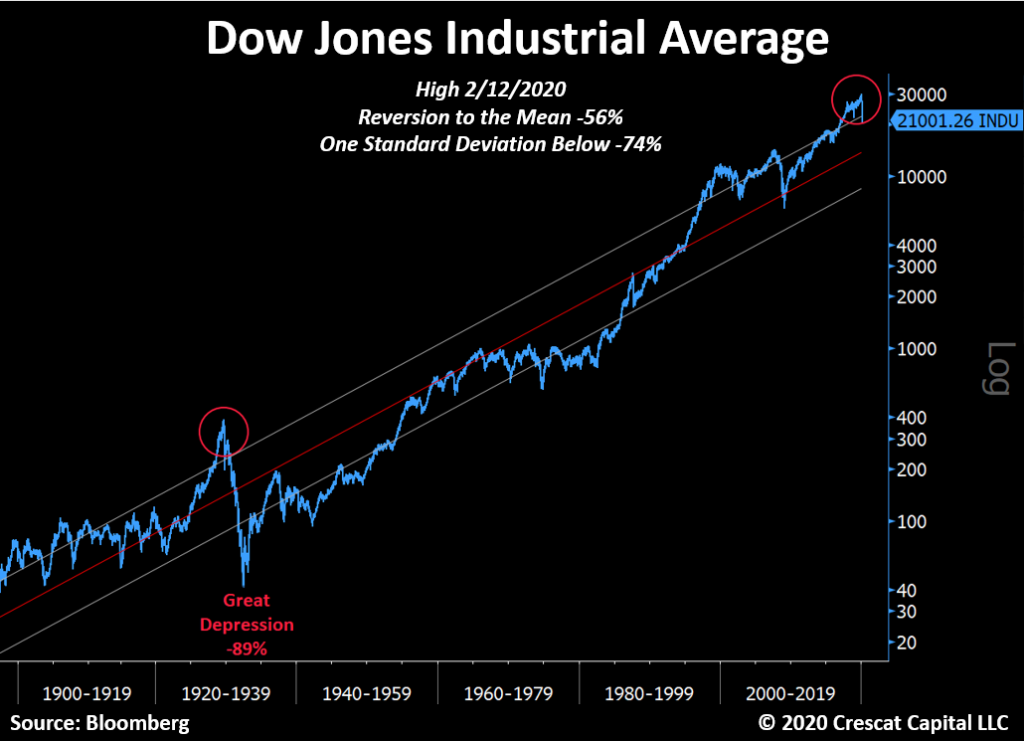
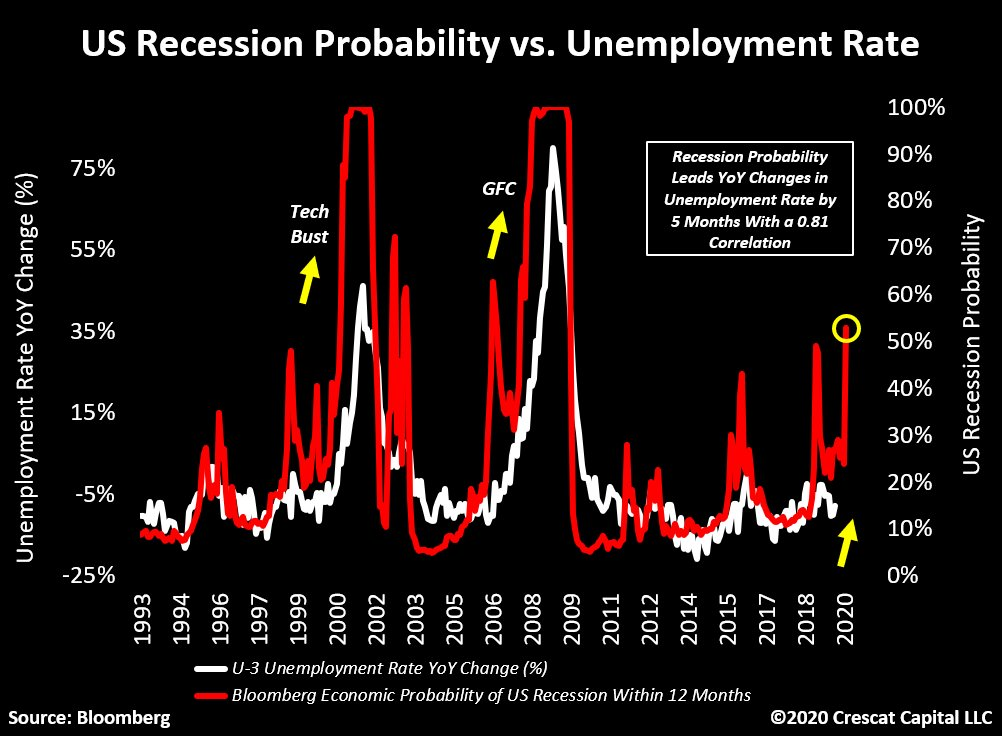
As we show in the chart above, we believe there is much more downside
still ahead for US stocks as a major global recession from nosebleed
debt-to-GDP levels has only just begun. Corporate earnings are now
poised to plunge and unemployment to surge. These things are perfectly
normal. There is a business cycle after all. It must play out as always
to purge the economy and markets of their sins and prepare the way for
the next growth phase. From the February top for large cap stocks, it
would take a 56% selloff just to get to long term mean valuations, a 74%
decline to get to one standard deviation below that. In the worst bear
markets, valuations get to two standard deviations below the mean. Such
realities happened at the depth of the Great Depression, the 1973-4 bear
market, and the 1982 double-dip recession. 1932 was an 89% drop from
the peak. The initial decline in this market so far is comparable to
1929 in speed and magnitude. There will certainly be bounces, but even
after an almost 30% fall in the S&P 500 through yesterday’s close,
we are not even close to the “blood in the street†valuations that
should mark the bottom for stocks in the current global recession that
has only just begun.
But value investors do not have to despair today. There is one area
of the stock market that already offers historic low valuations and an
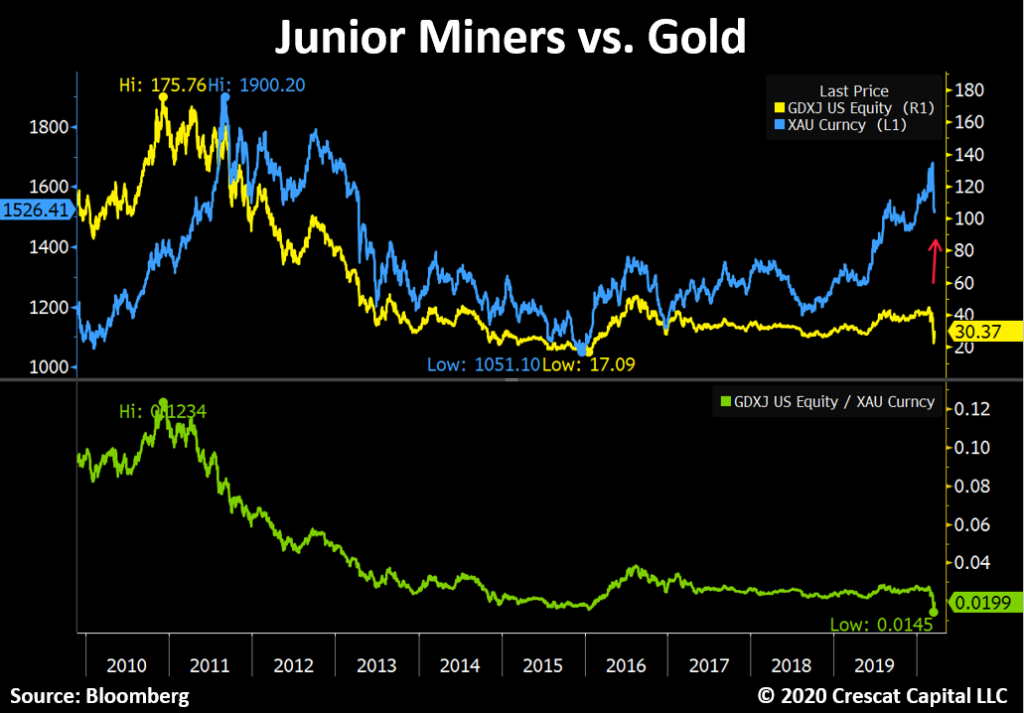
incredible buying opportunity right now. Small cap gold and silver
mining companies just retested the lows of a 9-year bear market. Last
Friday, they were down 84% from their last bull market peak in December
2010! This was a double-bottom retest at a likely higher low compared to
the January 2016 low when they were down 87%. Now that is what we call
mass murder! In the chart below, we show that precious metals juniors
reached record low valuations last Friday relative to gold which is
still up 18% year-over-year. Mad value. Look at that beautiful
divergence and base. The baby was thrown out with the bathwater in a
mass margin call. Last time the ratio was in this vicinity, junior gold
and silver miners rallied 200% in 8 months. Crescat owns a portfolio of
premier, hand-picked juniors as part of our precious metals SMA and in
both hedge funds where clients can gain exposure today. We significantly
increased our exposure in our hedge funds amidst the massacre last
week.
The entire precious metals group was a casualty of a liquidity
crisis, the forced margin call selling for stocks and corporate credit
at large in the precipitous market decline. But it was also a victim of a
meltdown in dubious levered gold and silver ETF products. These
products such as JNUG and NUGT already had a horrific tracking error.
Nobody should have ever been investing in them in the first place. Gold
stocks are volatile enough on an unlevered basis.
The chief culprit in the ETF space last week was the $3 billion
leveraged assets, Direxion Daily Jr. Gold Bull 3x ETF. It absolutely
imploded, dropping 95% through last Friday from its recent high on
February 21. The fiasco in JNUG was insult to injury for long-time
precious metals investors, especially those invested in silver and in
junior miners. It was also an incredible buying opportunity that Crescat
took advantage of, especially in its hedge funds, where the profits
from our short positions at large allowed us to step up. Last week’s
action may have marked a major bottom for precious metals mining stocks
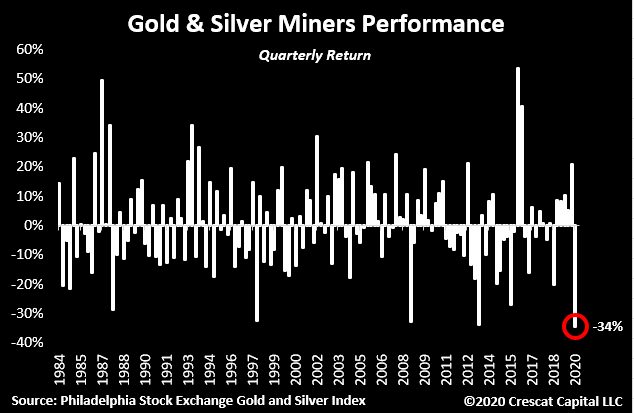
and ideally a bottom for battered silver this week. As of Friday, miners
were on track for their worst quarter ever as we show below.
The gold and silver stock selloff has exposed enormous free cash flow
yields today among precious metals mining producers of 10, 20, 30, 40,
even 50%. This is completely opposite the stock market at large.
Meanwhile, the pure-play junior mining explorers have some of the
world’s most attractive gold and silver deposits that can be bought at
historic low valuations to proven reserves and resources in the ground.
These companies are the beneficiaries of under-investment in exploration
and development by the senior producers over the entire precious metals
bear market. That rebound may have started yesterday in the mining
stocks especially the juniors. It is a historic setup right now for the
entire precious metals complex. Central banks are coming in, guns
blazing.
Meanwhile, the fundamentals have never been better for gold and
silver prices to rise making the discounted present value of these
companies even better. Global central bank money printing is poised to
explode which is important because the world fiat monetary base is the
biggest single macro driver of gold prices. Gold itself is already
undervalued relative to global central bank assets which targets gold at
$2400 an ounce today.
At the same time, the price of gold is the biggest macro driver of
the price of silver, which is gold on steroids. Silver today is the
absolute cheapest it has ever been relative to gold and represents an
incredible bargain. We think silver is poised to skyrocket along with
mining stocks in what should be one of the biggest V-shaped recoveries
in the entire financial markets in the near term.
As we have shown in our prior letters, when the yield curve first
inverts by 70% or more, there is a high probability of a recession and
bear market. At that point, historically it has paid to buy gold and
sell stocks for the next 2 years. We went above 70% inversions in August
2019. At Crescat, we continue to express both sides of this trade in
our hedge funds and our firm at large. The gold-to-S&P 500 ratio is
up 28% since last August. The first part of the move was mostly driven
by the rise in gold. Since February 19, its been driven by the decline
in stocks. Now we’re at the place where historically both legs start to
work in tandem, and yesterday that was evident with one of our best days
ever in both Crescat hedge funds.
The Fed has not exhausted all its bullets. It has many forms of
monetary stimulus. It can print more money and take interest rates into
negative territory if need be. As the downturn in the business cycle
becomes more pronounced, these policies will become increasingly called
upon. That’s precisely what we are seeing today. Rate cuts everywhere,
QE announcements, even forms of helicopter money are being implemented.
It won’t save the economic cycle from its normal course, instead, it
should only invigorate the reasons for owning precious metals. Central
bank money printing and inflationary fiscal policy will almost certainly
intensify. This is incredibly bullish for precious metals. We are in a
global synchronized debasement environment. Gold has already been
appreciating in all major fiat currencies in the world over the last
year.
While yields continue to make historic lows worldwide, in real terms
they have reached even more extreme levels. For instance, the US 10-year
yield is now almost 2 percentage points below inflation. This just
further strengthens our precious metals’ long thesis.
Even investment grade (IG) bonds are now blowing up. Implied
volatility for IG bonds is surging! It’s now at its highest level since
the Great Recession. Last week, the LQD (ETF) plunged 8% in 3 days,
which is equivalent to a 10 standard deviation move. Declines as such
only happened one other time in history, September 2008. We believe the
corporate debt market crisis has just begun.
Stocks are acting like it’s the Great Depression again and we believe
a recession has already begun. The probability for a US recession, as
measure by this Bloomberg indicator, just surged above 50%. It’s
currently at its highest level since the global financial crisis. This
indicator leads changes in unemployment by 5 months with a 0.81
correlation. It suggests that the labor market has peaked.
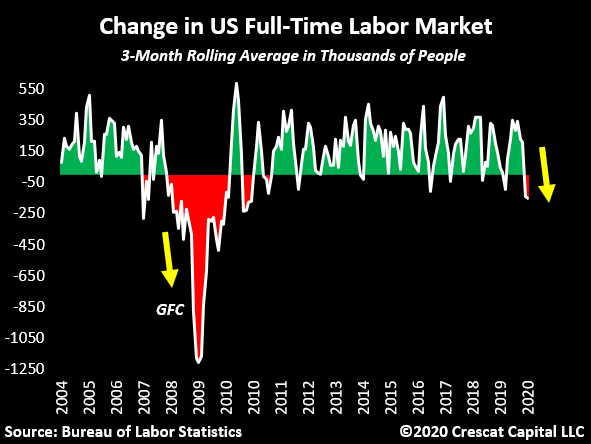
We have also recently noted that the number of full-time employed
people is now contracting. This was already rolling over in January.
With the recent impacts from the virus outbreak, we believe this number
will be plunging imminently.
Macro Trade of the Century
Crescat’s “Macro Trade of the Century†has been working phenomenally
well since the market top. We believe our in-depth analysis looking at
the history of economic cycles and the development of macro models is
paying off tremendously. This is just the beginning of this three-legged
trade. The global economy has just entered a recession and the
fundamental damage of the virus outbreak on an already over-leveraged
economy will be greater than anything we have ever seen. We have massive
underfunded pensions with governments and corporations record indebted,
while wealth inequality is at an extreme across the globe. It is not
the ideal mix for asset prices that remain grossly overvalued worldwide.
When investors ask us if our macro themes to position for the
downturn have already played out, the answer is absolutely not. There is
so much more to go. We explain it in three ways:
1) The bursting of China’s credit bubble, the largest we’ve seen in
history, has yet to materialize in its most brutal manner. As macro
imbalances unfold worldwide, the Chinese current account should only
continue to shrink and exacerbate its dollar shortage problem. We expect
that a large devaluation in its currency versus USD is coming soon. We
haven’t seen anything yet. We remain positioned for this in an
asymmetric way through put options in our global macro fund in the yuan
and the Hong Kong dollar.
2) Except for last year, gold, silver, and the precious metals’
miners haven’t yet performed in the way we think they will. Instead they
have recoiled in a major way YTD. Meanwhile, central banks are clearly
losing control of financial markets and further monetary stimulus
appears unavoidable. The entire precious metals’ industry should benefit
from this macro backdrop. The near- and medium-term upside opportunity
in the entire precious metals complex has never looked more attractive
than it does today.
3) Equity markets remain about 30% above their median valuations
throughout history. The coming downturn is one that will likely not stop
at the median. As we showed above, we believe there is much more
downside ahead for stocks at large before we reach the trough of the
current global recession.
In our hedge funds, we added significantly to our precious metals
positions with gains from our short sales late last week. We have also
recently been harvesting profits in some of the most beaten down of our
shorts. We remain net short global equities but much less so than a
month ago and with less gross exposure overall. As a value-oriented
global macro asset management firm, we believe there is so much more to
play out as the economic cycle has only just begun to turn down. We are
not perma-bears, but we are determined to capitalize on this downturn.
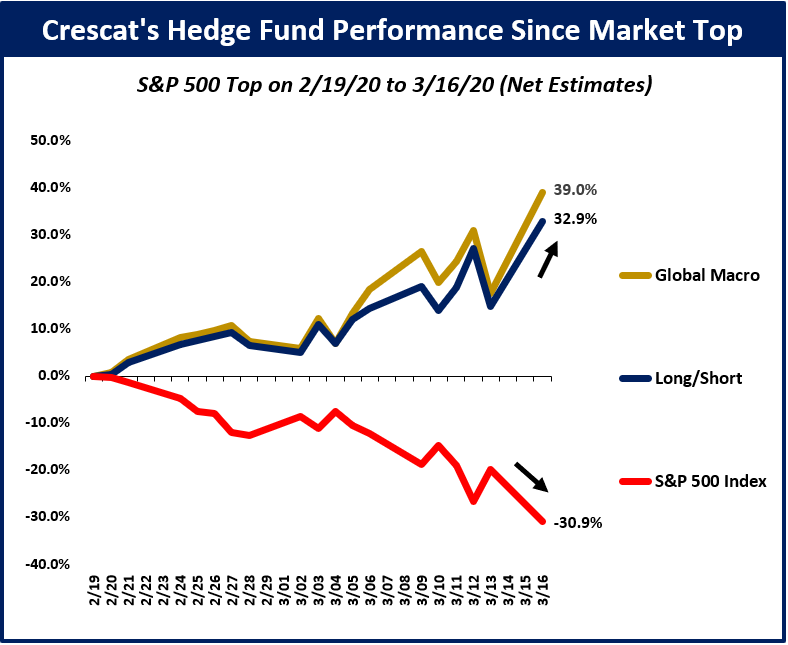
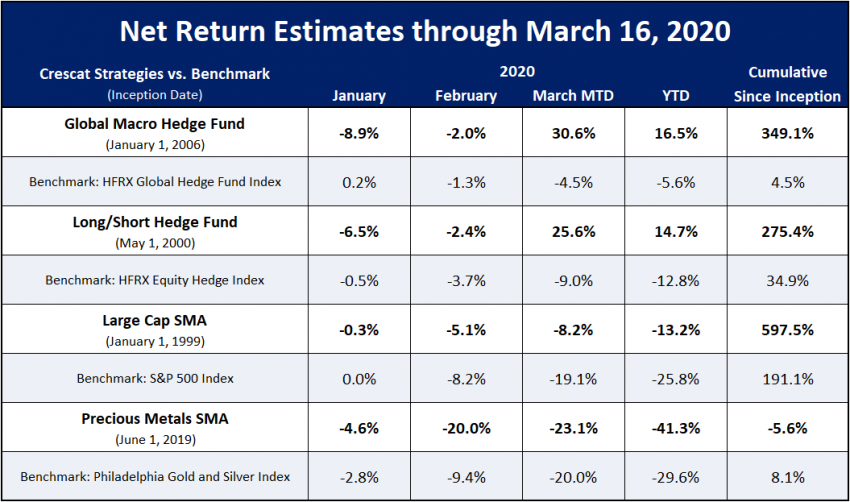
Crescat Performance Update
We have been telling our hedge fund clients for the past several
quarters that we have been tactically positioned for a market and
economic downturn ripe to unfold. Indeed, it has finally begun. Below,
we show how our hedge funds have been performing since the top in the
S&P 500 on February 19:
If you are interested in learning more about Crescat or investing with us, we encourage you to contact Linda Carleu Smith at [email protected] or (303) 228-7371.
Posted by AGORACOM-JC
at 4:02 PM on Tuesday, March 31st, 2020
SPONSOR: CardioComm Solutions (EKG: TSX-V)
– The heartbeat of cardiovascular medicine and telemedicine. Patented
systems enable medical professionals, patients, and other healthcare
professionals, clinics, hospitals and call centres to access and manage
patient information in a secure and reliable environment.
‘Smart’ devices help reduce adverse outcomes of common heart condition
mHealth devices, such as fitness trackers, smart watches and mobile phones, may enable earlier AF detection, and improved AF management through the use of photoplethysmography (PPG) technology
AF is the most common heart rhythm disturbance, affecting around one million people in the UK. People with AF are at increased risk of having a stroke and dying, as well as heart failure and dementia
A new study, published in the Journal of the American College of Cardiology,
highlights the feasible use of mobile health (mHealth) devices to help
with the screening and detection of a common heart condition.
Atrial fibrillation (AF) is a heart rhythm condition that causes an
irregular and sometimes, abnormally fast heart rate. In AF, the heart’s
upper chambers (atria) contract randomly and sometimes so fast that the
heart muscle cannot relax properly between contractions. This reduces
the heart’s efficiency and performance—but also leads to a higher risk
of blood clots.
AF is the most common heart rhythm disturbance, affecting around one
million people in the UK. People with AF are at increased risk of having
a stroke and dying, as well as heart failure and dementia. Currently,
low detection due to lack of visible symptoms and non-adherence are
major problems in current management approaches for patients with
suspected AF.
Photoplethysmography technology
mHealth devices, such as fitness trackers, smart watches
and mobile phones, may enable earlier AF detection, and improved AF
management through the use of photoplethysmography (PPG) technology.
PPG is a simple and low-cost optical technique that can be used to
detect blood volume changes in the microvascular bed of tissue. It is
often used non-invasively to make measurements at the skin surface.
To help determine whether a mHealth technology-supported AF
integrated management strategy would reduce AF-related adverse events,
compared to usual care, an international team of researchers, led by
Associate Professor Guo from Chinese PLA General Hospital in Beijing,
and Professor Gregory Lip, Lead for the Liverpool Centre for
Cardiovascular Science (LCCC)/Price-Evans Chair of Cardiovascular
Medicine at University of Liverpool, conducted a randomised trial.
Central to the study was mobile health technologies developed by
leading global technology companies, with a focus on using wearable
smart devices such as those from Huawei, working in conjunction with a
specially developed mobile app. These pieces of equipment and software
can monitor a person’s vital signs with great detail and, most
importantly for this study, 24 hours a day.
The specially designed mobile app
not only charted the patient’s biometrics, it afforded clinicians the
ability to offer integrated care throughout the duration of the trial.
Doctors were able to periodically assess the patient’s updated
statistics and contact them through the app to offer advice via the ABC
care pathway. The ABC pathway, developed in part by the LCCS’ Professor
Gregory Lip, is a set of guidance for patients and clinicians, which
aims to promote a streamlined holistic approach to the management of AF, and ensure that the danger of complications is minimised.
The researchers enrolled a cluster of 3,324 AF patients aged over 18
years from 40 cities across China. The patients were randomized with
1678 receiving usual care and 1646 receiving integrated care based on a
mobile AF Application (mAFA) incorporating the ABC Pathway: ‘A’ Avoid
stroke; ‘B’ Better symptom management; ‘C’ Cardiovascular and other
comorbidity risk reduction. All patients were followed up in outpatient
clinics at 6 and 12 months.
Results
Upon completion of the study, the researchers were able to show that
occurrences of stroke, systemic thromboembolism, death and
rehospitalisation were significantly lower with those patients in the
mHealth intervention group compared to those undergoing usual care (1.9%
compared with 6%). Rehospitalisation rates were also notably reduced,
with only 1.2% of patients in the intervention group needing to be
readmitted to hospital, in comparison to 4.5% of patients in the control
group.
In addition to these positive figures, subgroup analyses by gender,
age, type of condition, risk score and comorbidities, demonstrated
consistently lower risks for the composite outcome for patients
receiving the mAFA intervention compared to usual care.
These results show an undeniable benefit for the adoption of an
integrated approach to monitoring and treating cardiac conditions such
as AF.
With smart technologies such as phones, watches and integrated smart
home systems becoming increasingly accessible and affordable, the
ability for clinicians and researchers to adopt this technology to
passively and unobtrusively gather a seemingly unlimited amount of data
and information on the global health population is offering boundless
opportunity for assessing and treating all manner of diseases and
conditions.
Integrated care approach
Associate Professor Guo, said: “Our study clearly highlights the need
for an integrated care approach to holistic AF care, supported by
mobile health technology, as it help to reduce the risks of
rehospitalisation and clinical adverse events.”
Professor Lip, said: “Improved AF care requires early detection which
enables the implementation of the priorities of AF management, which is
as ‘easy as ABC’: Avoid stroke; Better symptom optimisation;
Cardiovascular and risk factor management. Our clinical trial shows how
the mAFA App and smart devices can improve detection of AF and the
holistic management of AF patients, improving outcomes in this common
heart rhythm disorder.”
Posted by AGORACOM
at 3:04 PM on Tuesday, March 31st, 2020
Sponsor: Affinity Metals Corp. (TSX-V: AFF) is a Canadian mineral exploration company building a strong portfolio of mineral projects in North America. The Corporation’s flagship property is the drill ready Regal Property near Revelstoke, BC where Affinity Metals is making preparations for a spring drill program to test two large Z-TEM anomalies. Click Here for More Info
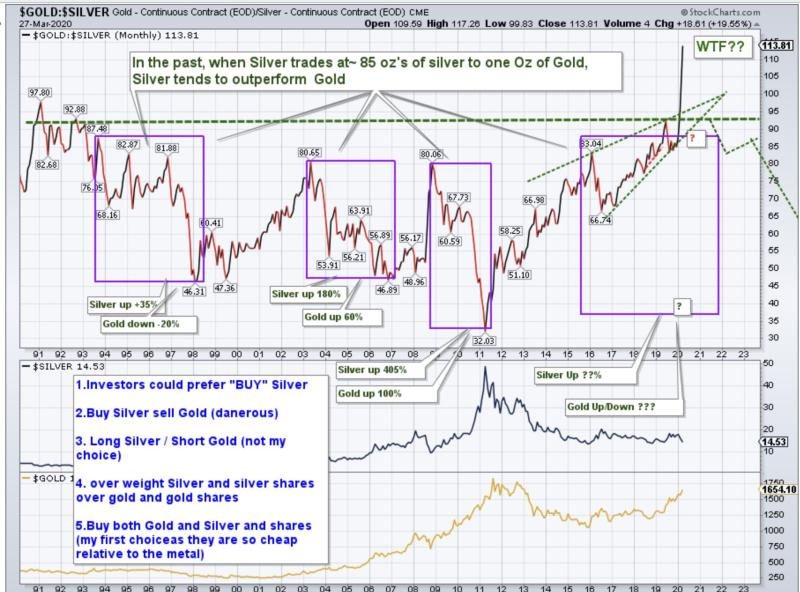
When we don’t understand the present, we can turn to the past. It is
believed the natural ratio in the earth’s crust is ~10 ounces of silver
for one ounce of gold.
Back in 3000 BC in Mesopotamia (modern day Turkey, Iraq, Iran),
silver and gold were used to enable trade at a rate of 5 ounces of
silver to 1 ounce of gold. For about 2,000 years, from 1670 B.C. to 432
AD, the rate was between a low of 9 to 1 in 59-44 BC to a high of 18 to 1
in 422 AD.
For the next 1,000 years from 527 to1453, the price was roughly 15 to
1. For the next three centuries the ratio was a low of 10.75 to 1 to a
high of 15.52 to 1.
When the United States passed its first coinage law in 1792, the
ratio was fixed at 15 to 1 but at that rate gold was considered
undervalued and disappeared from circulation, so to correct the
situation Congress moved the ratio to 16 to 1 in 1834.
At that rate gold was slightly overvalued and silver undervalued and
silver coins began to disappear and were dropped from the list of coins
by the Act of February 12, 1873, or the “Crisis of 1873,” and so
thereafter the U.S. was on the Gold Standard, which became law in the
Gold Act of March 14, 1900. (Hint: two 60 year cycles to today).
In 1919 the ratio was 15.20 to 1; by 1932 the ratio was up to 72.27 to 1 or about five times.
John Newell
is a portfolio manager at Fieldhouse Capital Management and president
and CEO of Golden Sky Minerals Corp. He has 38 years of experience in
the investment industry acting as an officer, director, portfolio
manager and investment advisor with some of the largest investment firms
in Canada. Newell is a specialist in precious metal equities and
related commodities and is a registered portfolio manager in Canada
(advising representative)
Posted by AGORACOM
at 2:51 PM on Tuesday, March 31st, 2020
SPONSOR: Lomiko Metals is focused on the exploration and development
of minerals for the new green economy such as lithium and
graphite. Lomiko owns 80% of the high-grade La Loutre graphite
Property, Lac Des Iles Graphite Property and the 100% owned Quatre
Milles Graphite Property. Lomiko is uniquely poised to supply the
growing EV battery market. Click Here For More Information
It would be wrong to say that wireless charging systems are more
efficient today than wired systems. Even in wireless charging systems,
the phone needs to touch a device, but there are a lot of waves moving
in the air, and MIT researchers are working on a project where we can
use the wasted energy to charge our devices.
Terahertz radiation consists of high-frequency waves in the
electromagnetic spectrum between infrared and microwaves. These waves
are produced by devices that send Wi-Fi signals. Although these
irradiations are very difficult to use, the new method the MIT team has
found seems interesting.
Working principle of the device: It is worth
noting that at this stage the system is still in the project phase and
has not been tested yet. “We are surrounded by electromagnetic waves in
the frequency range of Terahertz radiation. If we turn this energy into
an energy that we can use in everyday life, it helps us fight the energy
problems we face,†said Hiroki Isobe, one of the scientists who led the
study.
The device produced by the team is known as a terahertz rectifier and
consists of a small graphene layer with a boron nitride layer
underneath and an antenna on both sides. These antennas collect
terahertz waves from the air in the environment and strengthen the
signals passing to the graphene. These allow electrons to flow in the
same direction and generate direct current. Graphene must be as pure as
possible, as any foreign matter will affect electron scattering, the
team said. Boron nitride layer is also used to prevent this.
Although Terahertz rectifier produces a small amount of energy at
first, it may be enough to charge small devices. The team first states
that this device can be used in pacemakers. This device, which may have
good results for wireless charging, is expected to be manufactured and
tested.
Posted by AGORACOM-JC
at 12:09 PM on Tuesday, March 31st, 2020
SPONSOR: BetterU Education Corp.
aims to provide access to quality education from around the world.
The company plans to bridge the prevailing gap in the education and job
industry and enhance the lives of its prospective learners by
developing an integrated ecosystem. betterU / Ottolearn launch FREE
COVID-19 mobile resource toolkit to fight the global crisis – Click here for more information.
The coronavirus pandemic is reshaping education
The International School of Monza is part of the world’s biggest educational technology (edtech) experiment in history
With 1.5 billion students out of school and hundreds of millions attempting to learn solely online, the experiment will reshape schools, the idea of education, and what learning looks like in the 21st century
On Sunday, Feb. 23rd, rumors started that schools in the Lombardy
region of Italy—the country’s economic powerhouse—might close. Confirmed
cases and deaths from the new coronavirus were soaring. The healthcare
system was teetering, and Italy had to dramatically change course in a
bid to halt the virus. By evening, the region was in lockdown.
Within 24 hours, Iain Sachdev, principal at the International School of Monza, had organized his teachers and filmed a short video clip
for students, faculty, and parents. School would open at 9am on
Tuesday, he said. Be patient, he implored. Taking a school online in 24
hours was a massive feat which would be messy. Everyone would be
learning.
Five weeks later, the school is still running—unfamiliar in many
ways, identical in others. Teachers teach via video conferencing every
day. Kids participate using Padlet, a virtual post-it note system that
lets students share ideas; and Flipgrid, which lets teachers and
students create short videos to share. Students do individual work,
group work, and confer with teachers when needed. Sachdev has overhauled
the schedule from 50-minute units to longer blocks. Teachers no longer
use email, but Microsoft Teams.
The International School of Monza is part of the world’s biggest educational technology (edtech) experiment in history. With 1.5 billion students
out of school and hundreds of millions attempting to learn solely
online, the experiment will reshape schools, the idea of education, and
what learning looks like in the 21st century. The pandemic is forcing
educators, parents, and students to think critically, problem-solve, be
creative, communicate, collaborate and be agile. It is also revealing
that there is another way.
“It’s a great moment†for learning, says Andreas Schleicher,
head of education at the OECD. “All the red tape that keeps things
away is gone and people are looking for solutions that in the past they
did not want to see,†he says. Students will take ownership over their
learning, understanding more about how they learn, what they like, and
what support they need. They will personalize their learning, even if
the systems around them won’t. Schleicher believes that genie cannot be
put back in the bottle.
“Real change takes place in deep crisis,†he says. “You will not stop the momentum that will build.â€
But as tech connects people in their homes, its limitations for
learning are on display for all the world to see. The crisis has cast a
bright light on deep inequalities not just in who has devices and
bandwidth, which are critically important, but also who has the skills
to self-direct their learning, and whose parents have the time to spend
helping. It is a stark reminder of the critical importance of school not
just as a place of learning, but of socialization, care and coaching,
of community and shared space—not things tech has hacked too well.
The pandemic is giving tech massive insights at scale as to what
human development and learning looks like, allowing it to potentially
shift from just content dissemination to augmenting relationships with
teachers, personalization, and independence. But the way it is has been
rolled out—overnight, with no training, and often not sufficient
bandwidth—will leave many with a sour taste about the whole exercise.
Many people may well continue to associate e-learning with lockdowns,
recalling frustrations with trying to log on, or mucking through
products that didn’t make sense.
“This may be a short-term commercial opportunity for some vendors,
says Nick Kind, senior director at Tyton Partners, an investment banking
and strategy consulting firm focused on education. “But for this to
become transformational for teachers and learners, you wouldn’t have
wanted to start this way.â€
When the storm of the pandemic passes, schools may be revolutionized
by this experience. Or, they may revert back to what they know. But the
world in which they will exist—one marked by rising unemployment and
likely recession—will demand more. Education may be slow to change, but
the post-coronavirus economy will demand it.
Equity
Moving the world’s students online has starkly exposed deep
inequities in the education system, from the shocking number of children
who rely on school for food and a safe environment, to a digital divide in which kids without devices or reliable internet connections are cut off from learning completely.
According to OECD data, in
Denmark, Slovenia, Norway, Poland, Lithuania, Iceland, Austria,
Switzerland and the Netherlands, over 95% of students reported having a
computer to use for their work. Only 34% in Indonesia did. In the US,
virtually every 15-year-old from a privileged background said they had a
computer to work, but nearly a quarter of those from disadvantaged
backgrounds did not. These divides will likely worsen, as staggering job
losses and a recession devastate the most marginalized in every
society, including all their kids.
Schools face a difficult choice: if they don’t teach remotely, all of
their students miss out on months of curriculum. If they do, a sizable
group of already disadvantaged students will be left out and will fall
even farther behind.
The gap between students isn’t limited to internet access; it’s also
about the power and privilege of parents. “If you are called to duty
right now as a nurse or delivery person, you have no time for
homeschool,†says Heather Emerson, managing director for IDEO’s
design for learning group. And not every parent has the level of
digital literacy necessary to help their kids shift to online learning.
Schleicher says that his optimism for technology uptake is paired
with pessimism about what this means for equity. Those from privileged
backgrounds will find the tools they need, through parents or tutors or
their better-resourced schools. But those from disadvantaged backgrounds
will face multiple challenges, from the bottom of Maslow’s hierarchy to
the top: food and shelter, which school helped to provide, connections
to support children’s learning, and a lack of financial buffers to carry
a family through.
“It is clear that this will not reach everyone and it’s not just a
matter of access to devices,†he says. “If you don’t know how to learn
on your own, if you don’t know how to manage your time, if you don’t
have any intrinsic motivation, you won’t be very successful in this
environment.â€
The OECD is one of many organizations advocating to increase access
to open free, online educational resources and digital learning
platforms for teachers and students. For schools to succeed, teachers
will also need access to training and support.
Meanwhile, the crisis is highlighting the role schools play outside
of education. At a moment when schools need to adapt how they teach,
many are consumed with how to feed their students. Gwinnett County,
Georgia, one of the largest school districts in the US, is feeding
90,000 students a day. “It’s a prime example of how schools have become
not just learning institutions, but the heart of the social fabric of
America,†Emerson says.
She argues that coronavirus offers an opportunity to see clearly all
that teachers are asked to do. That includes everything from meeting the
latest state standards, implementing district priorities, mastering new
technology platforms, and caring for the physical and emotional well
being of their students. She suggests that schools can free up teachers
to do more learning.
“What can we do to liberate teachers to focus on their craft?†she
said. “And shouldn’t we pay them wages that match the magnitude of
their roles they play in our lives?â€
Indeed, the pandemic has woken people up to the challenges of
teaching and focused some attention on another equity gap: that of pay
for teachers. After one day of home schooling in the US, Twitter lit up
with calls for teachers to be paid more than investment bankers.
Classrooms
Many schools were woefully unprepared to move online overnight. Those
that were ready may hold clues for the promise, and pitfalls, of
e-learning.
Students at the International School of Monza all had MacBooks; last
August, all teachers were given them too. Sachdev is aware that as an
independent school, it was fortunate to have everyone equipped to learn
online. But he also said there were still a lot of pieces that had not
been pulled together. “We had the systems in place but we never really
used them,†he said.
Julia Peters, who teaches economics and individuals and societies at
the International School of Monza, says being forced online has allowed
her to moved to a more “flipped classroom†in which students do more
learning about basic skills and knowledge at home, via videos or
platforms, and then come to school online to do work together. “That
way, when they come into the classroom we can work on the higher level
skills such as analysis and evaluation,†she says. It’s not a new idea
at all, but circumstances are forcing adoption.
Another positive, Peters says, is that software like Microsoft Teams
allows her to see her students as they are writing. That allows for
real-time feedback, rather than waiting for the work to be completed.
She has also found ways of reaching struggling students. Her Grade 7
students are preparing an essay on beliefs, in which they “choose a
debatable question†and research it. “While they are independently
researching and creating a presentation, I can call a weaker student to a
private call and quietly work with them giving them the extra support
they need,†she says. That would be harder in a noisy classroom.
And some students who shied away from participation are stepping up.
“The quieter, more introverted students can participate more because
they are not being seen by their peers,†says Peters.
Naima Charlier, director of teaching and learning at the Nord Anglia
International School Hong Kong, says moving everyone online has had
plenty of challenges but also has increased teacher confidence around
technology and e-platforms. “There’s a massive energy about how to do
this incredibly different and difficult thing as well as we possibly
can,†she says. Teachers are trying and adjusting and sharing at warp
speed what works and what doesn’t.
Sachdev agrees. “Teachers share far more than they normally world,â€
he said. “Every single teacher can see what others are doing, which
isn’t how things typically work.â€
No such silver linings exist for the millions of students who can’t
get online, or whose schools and teachers do not have the resources to
even experiment with e-learning. Depending on how long the pandemic
lasts, governments may be forced to find creative ways to get more kids
learning.
Technology
What happens to education technology after the coronavirus pandemic
fades will rest in part on the quality of the tech itself. Not everyone
is optimistic.
HolonIQ, a market intelligence firm for the education market, poses
questions twice a year to a panel of more than 2,000 global education
executives and investors across public and private institutions and
firms, from pre-kindergarten to lifelong learning. In its most recent survey,
half of ed tech firms said they were pessimistic about whether the
coronavirus pandemic would make things better or worse in the short
term.
“There’s a discussion now about how this is a golden era for ed tech,
for digital transformation, but more than 50% of ed tech is saying that
over the short term, it’s worse or substantially worse off as an
organization,†said Patrick Brothers, co-CEO of HolonIQ.
Meanwhile, 91% of educational institutions say they will be worse, or substantially worse off in the short term.
Schleicher, from the OECD, said the pandemic will expose how ed tech
has largely failed to do what would be most powerful: leverage the
relationship between teacher and learner.
“The big question for me is will we develop an ed tech solution that
capitalizes on the relationship between students and teachers, as
opposed to just broadcasting stuff,†he says. “I think if we want to
give this any chance of success for large numbers of students and
learners, the teacher is going to be absolutely key,†especially in the
younger years such as primary schools. Pair good teachers, who coach and
facilitate, with good content and good tech, and the sky is the limit.
Adaptive, interactive, science-based learning platforms may start to
take hold—especially for those using the opportunity of a crisis to
help, rather than build market share. Starting in early February,
Century Tech, an AI-driven learning platform for schools, made its platform free for all schools who need it. By March, it had expanded the offering to include all students who needed it, too.
Today, the British-based Century
is giving training and access to its platform, which combines
neuroscience and AI to individualize learning, to schools in 17
countries, including China, Vietnam, South Korea, Japan, the UK, Nigeria
and Georgia. Founder Priya Lakhani says anyone who wants it can use it.
“This is why we do what we do, and if we can help we should,†she says.
Innovations are abounding, but not in a coordinated manner. Saku Tuominen founded Finnish nonprofit HundrED
five years ago, to research education innovations from over 150
countries. In those five years it has studied 5,000 such innovations and
packaged 1,164 on its website, with ideas for everything from
creativity, to the environment, to “forest schools.†Two weeks ago, HundrED pivoted to work full time
on coronavirus. It is in the process of selecting from its library
simple innovations that have the potential to work in many places in a
home learning environment. One example: the Global Oneness Project,
an interactive community series about storytelling in which filmmakers
and photographers share their work and explain how stories can connect
people.
HundrED is following up with those innovators to see how they are
adapting them for the crisis. On April 3rd, a curated list of resources
will be released; on the 7th, webinars will be available to train
educators. “There is not a lack of tools,†Tuominen said. But he
believes there is aren’t enough ways for the best ideas to be shared.
Beyond tech
So far, coronavirus has offered a stark reminder of the very human
nature of schools. Peters, from the International School of Monza, has
leapt into online learning, but cannot wait to get back into her
building. “Being online, I don’t think you really get a true sense of
whether a student is really engaged and properly understanding,†she
said. Tech hasn’t solved that most basic of things. “I look forward to
the social interaction with the students.â€
Sachdev says it has been so hard for teachers to be removed from
their students and from each other because teaching is such a human
endeavor. “None of us are used to smart working,†he said.
His school’s own journey shows the power of community, along with
agile learning. In the first week, he and his team focused on providing
seven hours of online learning. By week three, they eased up, freeing up
more time for one-on-one and small group support, as well as offline
projects. They responded and adapted.
By weeks four and five, a small number of members of the school
community were ill or had died. Students had lost loved ones. The school
pivoted again. “It’s not about academics,†Sachdev said. “It’s all
about wellbeing for students and parents, and managing that from afar.â€