Agoracom Blog

#Platinum Group Metals Continue to Shine – SPONSOR: New Age Metals $NAM.ca $WG.ca $XTM.ca $WM.ca $PDL.ca $GLEN

Posted by AGORACOM-JC at 4:51 PM on Friday, December 20th, 2019

SPONSOR: New Age Metals Inc. The company owns one of North America’s largest primary platinum group metals deposit in Sudbury, Canada. Updated NI 43-101 Mineral Resource Estimate 2,867,000 PdEq Measured and Indicated Ounces, with an additional 1,059,000 PdEq Ounces Inferred. Learn More.

Platinum Group Metals Shine

  • An incredible year in the palladium market continues to the end.
  • Platinum shows some signs of life.

By: Andrew Hecht

It could be an excellent time to start thinking about renaming the Platinum Group Metals. After all, since 2016, the price action in rhodium and palladium has left the namesake head of the group in the dust. Platinum has been a laggard. The old title as “rich man’s gold” is as inappropriate from an investment perspective today as it is from a social one.

Meanwhile, the price action in platinum in 2019 was not that bad. The platinum futures market looks like it will post a double-digit percentage gain compared to its closing price at the end of 2018. If the price action in the other members of the precious metals sector, including gold, palladium, and rhodium, are harbingers of the future for platinum, 2020 could turn out to be an exciting year for devotees of the metal that has not lived up to its reputation as a rare precious and industrial metal.

Meanwhile, the precious metals sector of the commodities market is barreling into 2020 after a bullish run in 2019. The Aberdeen Standard Physical Precious Metals Basket Shares ETF (NYSEARCA:GLTR) holds long positions in gold, silver, platinum, and palladium bullion. A diversified approach to the sector could be an excellent way to spread risk going into the new decade that is just around the corner.

Rhodium is the star

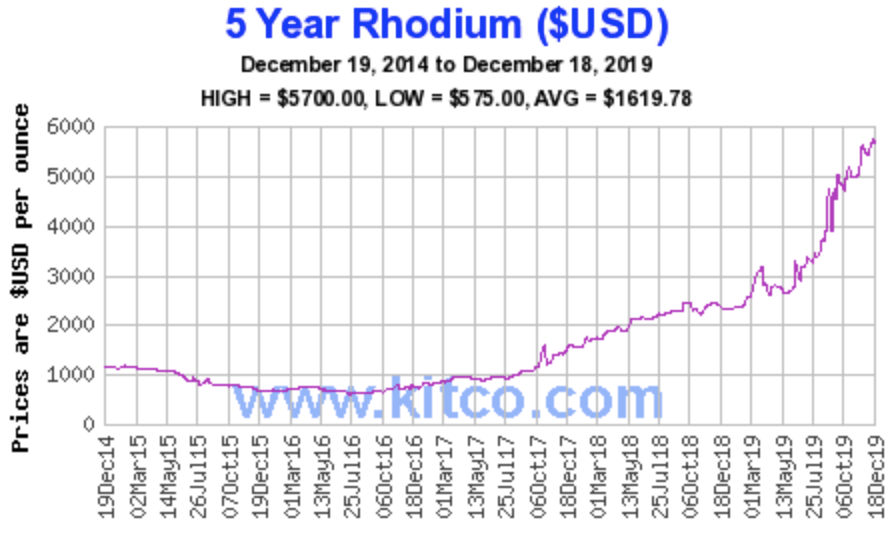
In 2016, the price of rhodium fell to a low at $575 per ounce. Rhodium is a byproduct of South African platinum output. The weakness in the platinum price, which fell to the lowest level since 2003 in 2018 when the price reached $755.70 per ounce, caused a decline in south African platinum production. Less platinum mining caused a deficit in the rhodium market, which does not trade on the futures exchange. In the physical market, the price of rhodium took off like a rocket ship.
Source: Kitco

As the chart highlights, rhodium was trading at a midpoint value of $5,840 per ounce on December 19, over ten times higher than the price in 2016. The deficit in the rhodium market could continue to push the price higher in 2020, and a test of the all-time high at just over $10,000 per ounce could be in the cards for the platinum group metal. Rhodium has been the best performing PGM over the past years. In 2019 alone, the price more than doubled, moving from below the $2,500 level at the end of 2018 to almost $6,000 per ounce on December 17.

An incredible year in the palladium market continues to the end

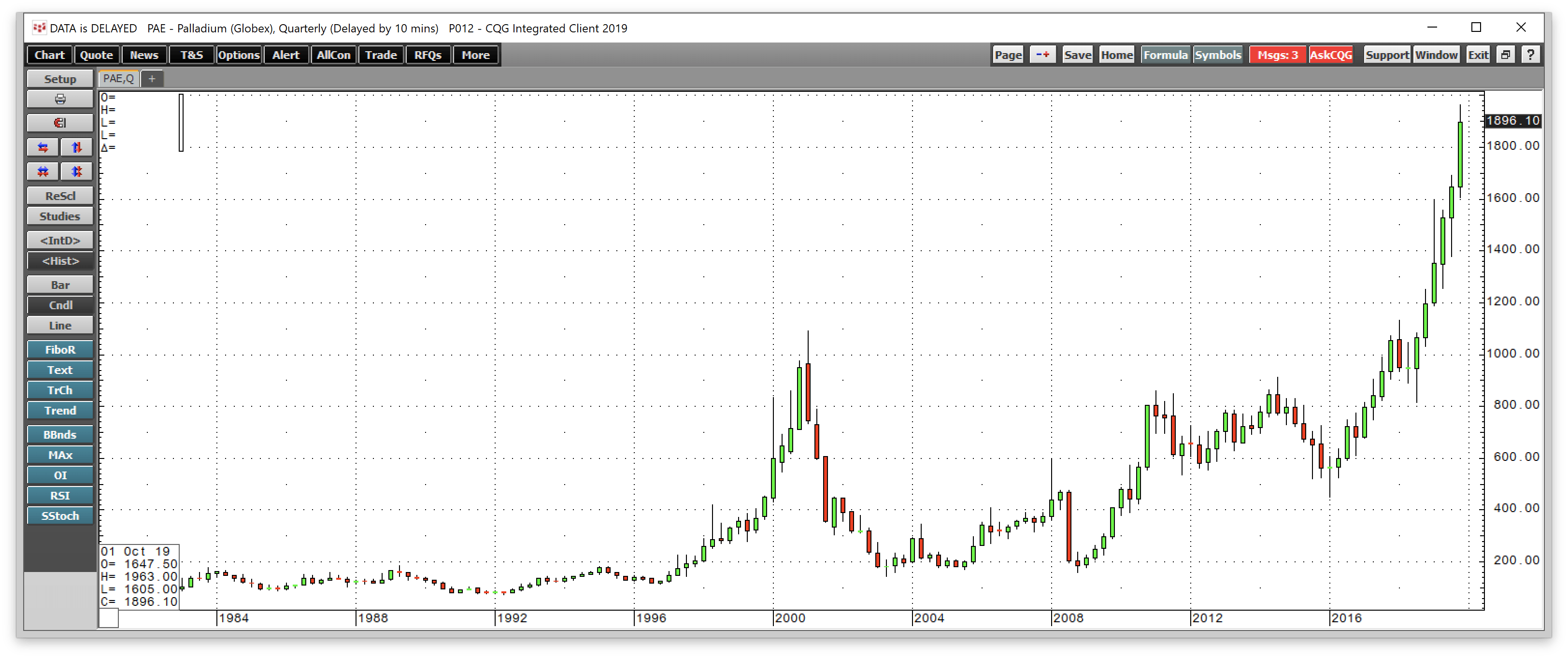
While rhodium is the metal with the most impressive percentage gain since the 2016 low, the price action in palladium pushed the price of the metal to a series of new all-time highs throughout 2019.
Source: CQG

The quarterly chart of nearby NYMEX palladium futures illustrates that, before 2017, the all-time peak came in 2001 at $1,090 per ounce. Palladium blew through that high like a hot knife goes through butter and has posted gains in the past seven consecutive quarters. The price was approaching the $2,000 per ounce level as of last week when it hit a high at $1,974.60 on the active month March futures contract on December 17.

The ascent of palladium is a function of the rising demand for catalytic converters for gasoline-powered automobiles. The “phase one” trade deal between the US and China could stabilize the Chinese economy lifting requirements for new cars and palladium-based catalytic converters in the world’s most populous nation. On the supply side of the fundamental equation for palladium, supplies come from South Africa and Russia. In Russia, platinum group metals are a byproduct of nickel output.

Platinum shows some signs of life

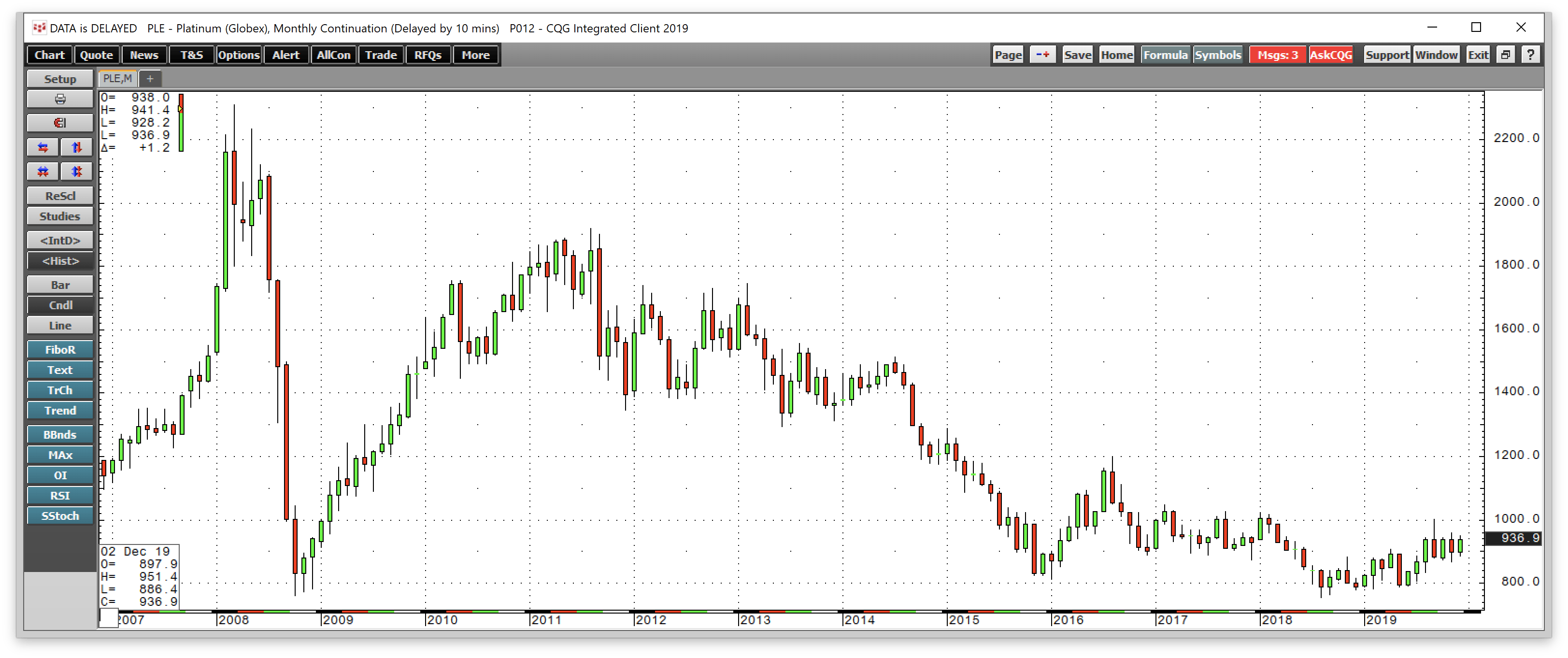
The price action in platinum has lagged rhodium and palladium over the past years, and 2019 has been no exception. However, platinum looks set to post a gain for the year that is coming to an end.
Source: CQG

The monthly chart shows that platinum closed 2018 at $788.50 and was trading around the $937 level on December 19. Platinum looks set to deliver a double-digit percentage gain as it was 18.8% higher than the 2018 closing price. However, its performance pales in comparison to the palladium and rhodium markets.
Source: CQG

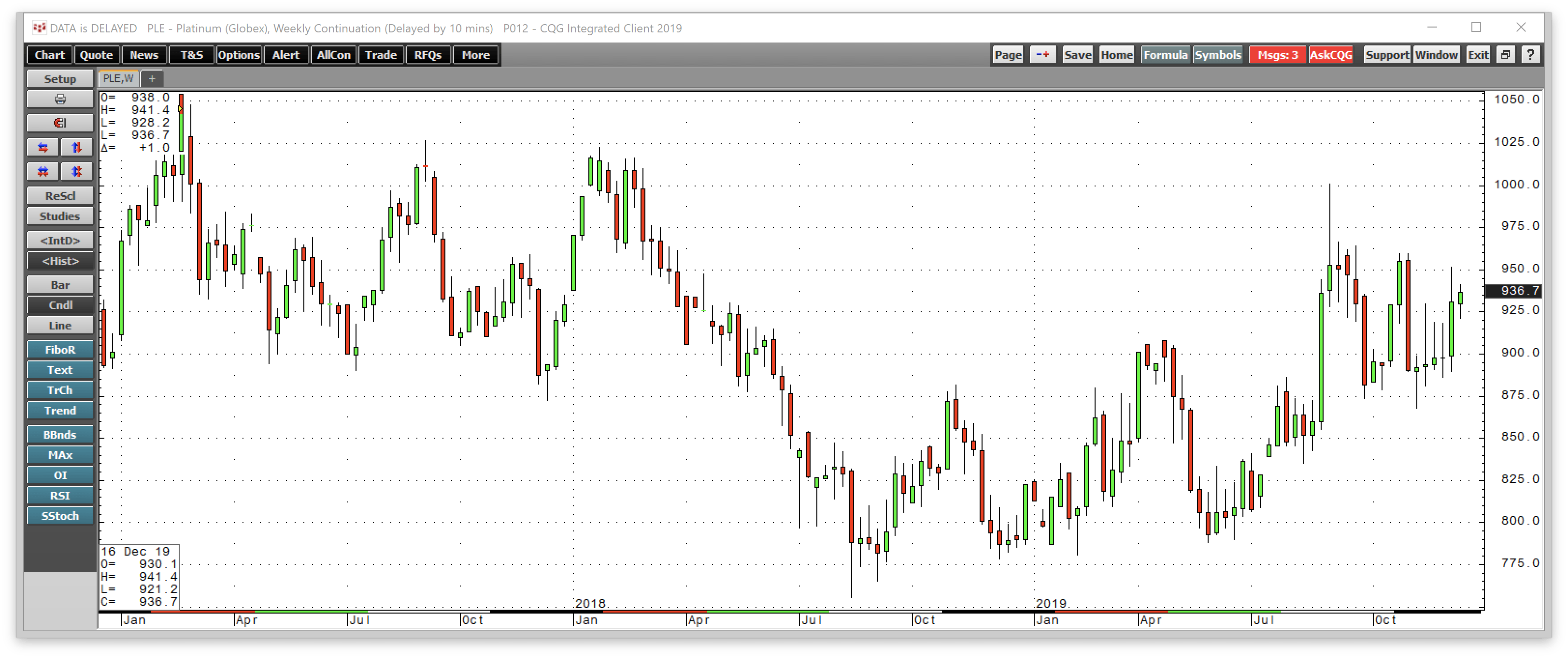
The weekly chart displays that platinum has made higher lows and higher highs throughout 2019. The price range in the platinum market has been from $787.30 and $1,000.80 on the continuous futures contract. At $937 on December 19, the price of platinum around $43 above its midpoint for the year. While platinum is not breaking any records, the price action is going into 2020 in a bullish trend.

Industrial and precious metal

Platinum group metals have a myriad of industrial applications. Aside from automobile catalytic converters, the dense metals with high resistance to heat are required in oil and petrochemical refining, fiberglass manufacturing, medical devices, and a host of other applications. Of the three metals, platinum is the densest, with the highest boiling and melting point. Therefore, platinum can serve as a substitute for rhodium and palladium in industry.

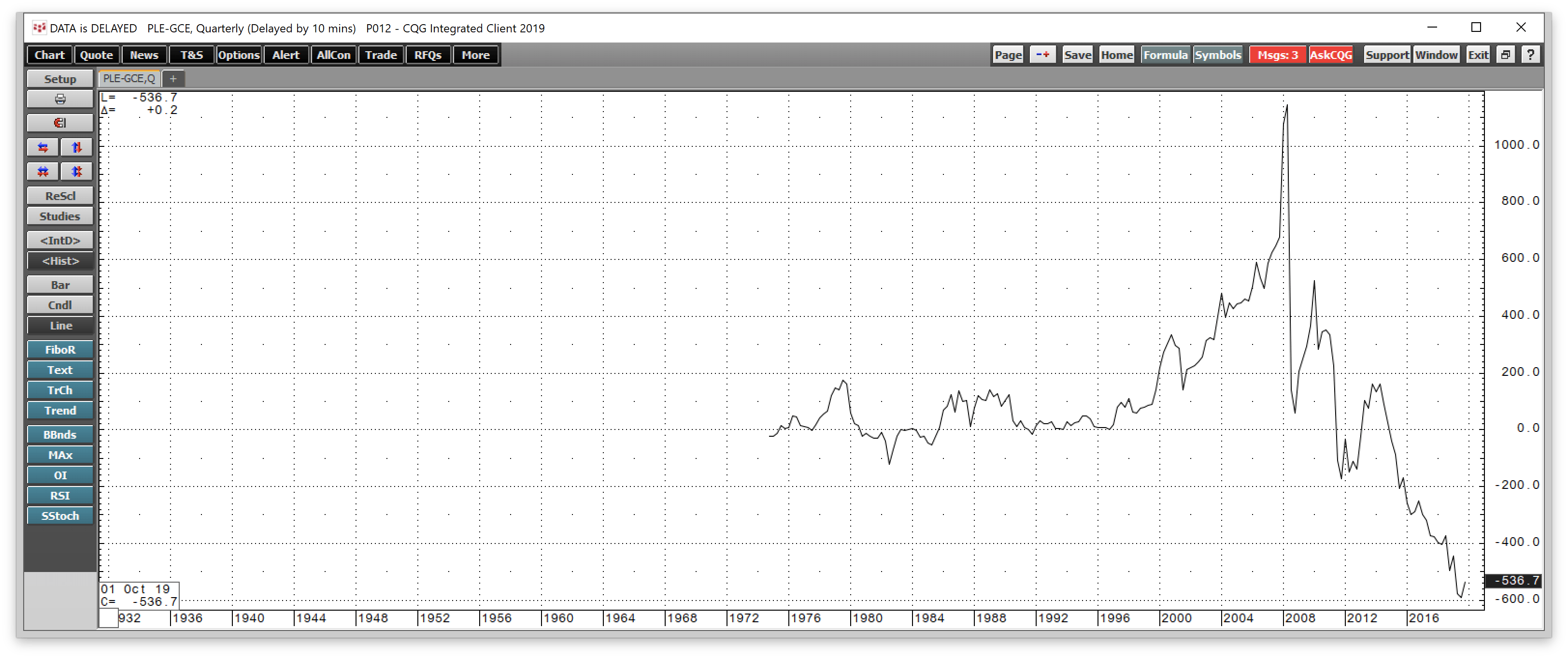
Platinum also has a history as a financial asset and a store of value. Since the 1970s, platinum had mostly traded at a premium to gold as it is over ten times rarer than the yellow metal when it comes to annual output.
Source: CQG

The quarterly chart shows that platinum traded to an over $1,140 premium to gold in 2008, but it slipped to a discount in 2014 and never looked back. After falling to a low at a $600 discount to gold in 2019, platinum was still over $537 below the yellow metal on December 19.

Platinum moved almost 19% higher in 2019, gold broke out to the upside in June but slightly lagged platinum so far in 2019.

The GLTR ETF holds long positions in two of the three platinum group metals

Precious metals are going into the new decade on a bullish note after posting across the board gains in 2019. The low level of global interest rates could cause a continuation of bullish price action in 2020.

An ETF product that offers a diversified approach to a precious metals investment is the Aberdeen Standard Physical Precious Metals Basket Shares ETF. The fund summary for GLTR states:

The investment seeks to reflect the performance of the price of physical gold, silver, platinum and palladium in the proportions held by the Trust, less the expenses of the Trust’s operations. The Shares are designed for investors who want a cost-effective and convenient way to invest in a basket of Bullion with minimal credit risk.

Source: Yahoo Finance

The most recent top holdings of GLTR include:

Source: Yahoo Finance

GLTR has net assets of $463.08 million and trades an average of 22,754 shares each day. The ETF product charges an expense ratio of 0.60%.

Platinum continues to offer the most compelling value proposition in the precious metals sector at around the $930 per ounce level. However, the trend in all of the precious metals will enter 2020 in bullish mode.

The Hecht Commodity Report is one of the most comprehensive commodities reports available today from the #2 ranked author in both commodities and precious metals. My weekly report covers the market movements of 20 different commodities and provides bullish, bearish and neutral calls; directional trading recommendations, and actionable ideas for traders. I just reworked the report to make it very actionable!

Disclosure: I/we have no positions in any stocks mentioned, and no plans to initiate any positions within the next 72 hours. I wrote this article myself, and it expresses my own opinions. I am not receiving compensation for it (other than from Seeking Alpha). I have no business relationship with any company whose stock is mentioned in this article.

Source: https://seekingalpha.com/article/4313462-platinum-group-metals-shine

BGL Metals Insider Says Nickel Forecasted to Shine – SPONSOR Tartisan #Nickel $TN.ca – $ROX.ca $FF.ca $EDG.ca $AGL.ca $ANZ.ca

Posted by AGORACOM-JC at 3:02 PM on Friday, December 20th, 2019

SPONSOR: Tartisan Nickel (TN:CSE)  Kenbridge Property has a measured and indicated resource of 7.14 million tonnes at 0.62% nickel, 0.33% copper. Tartisan also has interests in Peru, including a 20 percent equity stake in Eloro Resources and 2 percent NSR in their La Victoria property. Click her for more information

Tc logo in black

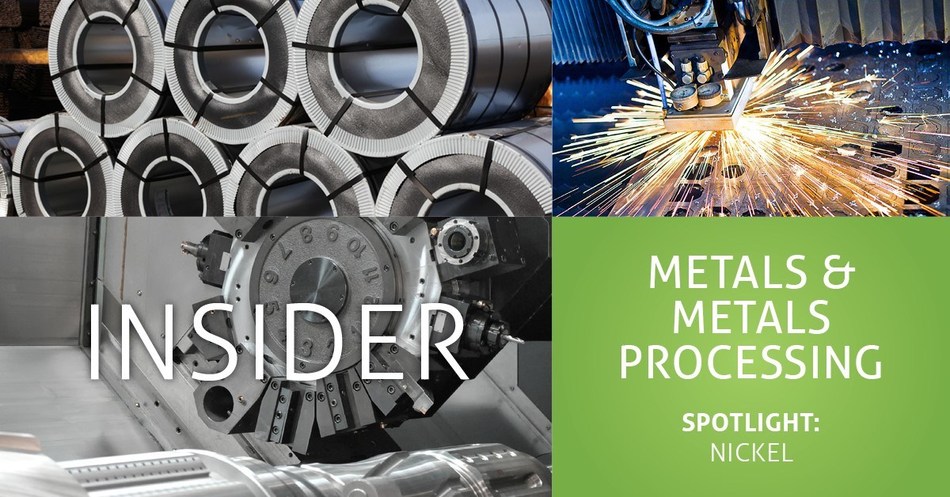
BGL Metals Insider Says Nickel Forecasted to Shine

  • While stainless steel has historically been the primary end market for nickel, increased adoption of electrification in vehicle production is shifting demand for the material with advancements in battery technology
  • This structural shift is expected to change the supply and demand dynamics within the nickel market

CHICAGO and CLEVELAND, Dec. 18, 2019 – Technological advancements in the transportation industry are setting the stage for a surge in nickel demand, according to the Metals Insider, an industry report released by Brown Gibbons Lang & Company (BGL). While stainless steel has historically been the primary end market for nickel, increased adoption of electrification in vehicle production is shifting demand for the material with advancements in battery technology. This structural shift is expected to change the supply and demand dynamics within the nickel market.

Technological advancements in the transportation industry are setting the stage for a surge in nickel demand, according to the Metals Insider, an industry report released by Brown Gibbons Lang & Company (BGL). While stainless steel has historically been the primary end market for nickel, increased adoption of electrification in vehicle production is shifting demand for the material with advancements in battery technology.

Industry participants cite battery demand as a transformational development for the nickel industry, with vehicle electrification and global tightening of emissions standards key drivers underpinning market growth:

  • Market forecasts quantify the shift to electric mobility, which predict a nearly five-fold increase in electric vehicle (EV) models by 2030, when one in five passenger cars sold globally will be battery electric vehicles. Government initiatives are driving EV growth, notably stringent enforcement of emissions standards supported by targeted bans on internal combustion engine vehicle sales.
  • Nickel consumption in EV batteries could expand ten-fold by 2025, with battery demand projected to more than triple to an estimated 15 percent market share– up from 4 percent today.
  • Major nickel producers are validating the demand shift and investing to support double-digit volume growth, with nickel integral to strategic business models. Manufacturing capacity, raw materials availability, and advancements in new battery technologies are critical variables that will impact the supply outlook.

The nickel market is expected to undergo a structural shift across the value chain that will impact supply demand dynamics for stainless steel and nickel producers, distributors, manufacturers, and the major end markets they serve, with the oil & gas, aerospace, and food industries among the large consumers of the nickel- bearing material.

About Brown Gibbons Lang & Company
Brown Gibbons Lang & Company is a leading independent investment bank and financial advisory firm focused on the global middle market. The firm advises private and public corporations and private equity groups on mergers and acquisitions, divestitures, capital markets, financial restructurings, valuations and opinions, and other strategic matters. BGL has investment banking offices in Chicago, Cleveland, and Philadelphia, and real estate offices in Chicago, Cleveland, Denver, San Antonio, and San Diego. The firm is also a founding member of Global M&A Partners, enabling BGL to service clients in more than 30 countries around the world. Securities transactions are conducted through Brown, Gibbons, Lang & Company Securities, Inc., an affiliate of Brown Gibbons Lang & Company LLC and a registered broker-dealer and member of FINRA and SIPC. For more information, please visit www.bglco.com

Source: https://www.prnewswire.com/news-releases/bgl-metals-insider–nickel-forecasted-to-shine-300976918.html

Spyder Cannabis $SPDR.ca Announces MOU with HighBreed Growth has Expired $CGC $ACB $APH $CRON.ca $HEXO.ca $OGI.ca

Posted by AGORACOM-JC at 2:28 PM on Friday, December 20th, 2019

Spyder Cannabis Announces MOU with HighBreed Growth has Expired

  • Previously announced Memorandum of Understanding with HighBreed Growth Corp. has expired pursuant to its terms
  • Under the MOU signed on September 5, 2019, the parties intended to complete a business combination that would result in a reverse take-over of Spyder Cannabis by HGBGC
  • Company’s common shares will resume trading on the TSXV at market open on December 24, 2019

Vaughan, Ontario–(December 20, 2019) – Spyder Cannabis Inc. (TSXV: SPDR) (“Spyder Cannabis” or the “Company“), an established Canadian cannabis accessory and vape retailer, announces its previously announced Memorandum of Understanding (the “MOU“) with HighBreed Growth Corp. (“HBGC“) has expired pursuant to its terms. Under the MOU signed on September 5, 2019, the parties intended to complete a business combination that would result in a reverse take-over of Spyder Cannabis by HGBGC. Given that the transaction will no longer proceed, the Company does not, at the present time, intend to proceed with a delisting from the TSX Venture Exchange (the “TSXV“).

The Company’s common shares will resume trading on the TSXV at market open on December 24, 2019

About Spyder

Founded in 2014 Spyder is an established chain of three high-end vape stores in Ontario, with stores located in Woodbridge, Scarborough and Burlington. The Spyder brand is defined by its high-quality proprietary line of e-juice, liquids and exclusive retail deals, dispensed in uniquely designed stores creating the optimal customer experience. Spyder is building off this leading retail, distribution and branding eCig and vapes company and is pursuing expansion into the legal cannabis market. Spyder has developed a scalable retail model with aggressive expansion plan to create a significant retail footprint with targeted and

FOR ADDITIONAL INFORMATION, PLEASE CONTACT:

For more information, please contact:

Spyder Cannabis Inc.
Dan Pelchovitz
President & Chief Executive Officer
Contact: Investor Relations
Phone: 1-888-504-SPDR (1-888-504-7737)
Email: [email protected]

Cautionary Statements

Neither the TSX Venture Exchange nor its Regulation Services Provider (as that term is defined in the policies of the TSX Venture Exchange) accepts responsibility for the adequacy or accuracy of this release.

Certain statements contained in this press release constitute forward-looking information. These statements relate to future events or future performance. The use of any of the words “could”, “intend”, “expect”, “believe”, “will”, “projected”, “estimated” and similar expressions and statements relating to matters that are not historical facts are intended to identify forward-looking information and are based on the Company’s current belief or assumptions as to the outcome and timing of such future events. Actual future results may differ materially. In particular, this release contains forward-looking information relating to the satisfaction of the closing conditions contemplated under the Agreement. Various assumptions or factors are typically applied in drawing conclusions or making the forecasts or projections set out in forward-looking information. Those assumptions and factors are based on information currently available to the Company. Risk factors that could cause actual results or outcomes to differ materially from the results expressed or implied by forward-looking information include, among other things: the TSX Venture Exchange declining to accept the transaction, the landlord not consenting to the Lease Assginment, changes in tax laws, general economic and business conditions; and changes in the regulatory regulation. The Company cautions the reader that the above list of risk factors is not exhaustive. The forward-looking information contained in this release is made as of the date hereof and the Company is not obligated to update or revise any forward-looking information, whether as a result of new information, future events or otherwise, except as required by applicable securities laws. Because of the risks, uncertainties and assumptions contained herein, investors should not place undue reliance on forward-looking information. The foregoing statements expressly qualify any forward-looking information contained herein.

To view the source version of this press release, please visit https://www.newsfilecorp.com/release/50991

ThreeD Capital Inc. $IDK.ca – How To Keep Your #Crypto Safe Against Exchange Hackers #Bitcoin #Ethereum $HIVE.ca $BLOC.ca $CODE.ca

Posted by AGORACOM-JC at 12:00 PM on Friday, December 20th, 2019

SPONSOR: ThreeD Capital Inc. (IDK:CSE) Led by legendary financier, Sheldon Inwentash, ThreeD is a Canadian-based venture capital firm that only invests in best of breed small-cap companies which are both defensible and mass scalable. More than just lip service, Inwentash has financed many of Canada’s biggest small-cap exits. Click Here For More Information.

How To Keep Your Crypto Safe Against Exchange Hackers

  • Exchange hacks appear to be one of the critical problems without any kind of a solution in sight. 
  • This year alone, there have been several high-profile attacks.

By Adrian Barkley

Despite all the developments and innovations in the cryptocurrency space over recent years, exchange hacks appear to be one of the critical problems without any kind of a solution in sight. These days, cryptocurrencies are far more distributed across hundreds of exchanges than they were back in 2014 when Mt.Gox was hit, derailing the price of Bitcoin overnight. Nevertheless, exchanges remain prime targets for hackers. 

This year alone, there have been several high-profile attacks. Cryptopia was one of the first, subject two separate incidents that ultimately crippled the New Zealand-based exchange, causing it to close its doors for good.

After that, Singaporean DragonEx and Korean Bithumb were both targeted, before trading behemoth Binance was hit in May this year. Although the company was quick to reassure users that their account balances were protected by its insurance fund, the attack left a smear on Binance’s previously unblemished record of security. 

The latest exchange to fall prey to hackers is Upbit, which lost $50 million worth of ETH in late November. 

So, what are crypto users to do, to keep their funds safe? In light of the ongoing hacking issues, many exchanges are now starting to sell themselves on their enhanced security measures. 

Going the Extra Mile to Prevent Attacks

For a while, two-factor authentication was the established means of ensuring user account. However, many exchanges are now taking additional measures, such as IP binding. This means that you can restrict access to your exchange accounts to only a single IP address. If someone attempts to log in from another machine than your own, you’ll be notified. 

Singaporean exchange ecxx is one example of an exchange following this practice, along with other measures to help keep your funds safe from theft. The exchange keeps user funds in cold wallets, requiring multiple signatures from the company to access. 

Earlier this year, QuadrigaCX users found their funds had gone missing after the exchange founder died abroad as the only person holding the private keys to access his company’s wallet. Multi-signature wallets are a way of protecting against this risk. 

Furthermore, ecxx has integrated with MyInfo, the government of Singapore’s user portal. It enables Singaporean citizens and residents to interact with government agencies and private companies online. The integration offers local users in Singapore a trusted means of logging on to the ecxx platform with their existing MyInfo credentials. 

For institutions, ecxx has also partnered with Ledger, one of the global leaders in digital asset cold storage. Professional traders and investors can choose to have their funds stored in a Ledger Vault, meaning that ecxx doesn’t take custody of funds at all. 

Decentralized Exchanges – a Non-Custodial Solution

Another option for exchanging tokens without incurring the security risks of hacking is to use a decentralized exchange (DEX.) A DEX generally doesn’t take custody of your accounts, meaning that you’re solely responsible for fund security. 

At this point in the evolution of cryptocurrency, users have their pick of DEXs, with various different models for enabling trading. However, a critical challenge of peer-to-peer DEXs is that many are underused, meaning they suffer from low liquidity. Unless you’re trading Bitcoin or one of the major alts, you may find your trade left hanging while the matching engine searches for a counterpart with whom to trade. Therefore, it makes sense to find a DEX with high liquidity. 

IDEX is one of the more popular DEXs, meaning that liquidity is less of a challenge. Users manage their funds via the platform’s Ethereum-based smart contract. Users can access the smart contract via four methods – a Metamask wallet, a Ledger Nano S cold storage wallet, a Keystore file, or a manual private key entry. 

Another safe option is to use a liquidity protocol, which is a kind of DEX using a third token to enable swaps between a wide variety of tokens. Bancor and Uniswap are both examples of liquidity protocols. 

Wallets

If you do prefer to stick with centralized exchanges, then conventional wisdom says that you should only keep your funds in your exchange account when you’re actively trading. Therefore, if you’re planning on keeping your investments in crypto, get yourself a wallet. Hot storage wallets such as Atomic or Edge are very easy to get started using only a smartphone app. 

An even safer option for long-term HODLers is to use a cold storage wallet such as a Ledger Nano S or Trezor. Just make sure you have a safe method of storing your recovery seed.

Source: https://cryptodaily.co.uk/2019/12/how-to-keep-your-crypto-safe-against-exchange-hackers

This #Edtech Unicorn Turned Profitable After Tripling Its Revenue in FY19 – SPONSOR: BetterU Education Corp. $BTRU.ca $ARCL $CPLA $BPI $FC.ca

Posted by AGORACOM-JC at 10:42 AM on Friday, December 20th, 2019
SPONSOR:  BetterU Education Corp. aims to provide access to quality education from around the world. The company plans to bridge the prevailing gap in the education and job industry and enhance the lives of its prospective learners by developing an integrated ecosystem. Click here for more information.

This Edtech Unicorn Turned Profitable After Tripling Its Revenue in FY19

  • Online education market is expected to grow to $1.96 billion by 2021
  • 52 per cent compounded annual growth from 2016, according to a 2017 report published by Google and research firm KPMG

By: Shreya Ganguly

Increased Internet penetration and availability of smartphones has made its way into making the world smaller. Technology is also disrupting the education market where the former is leveraged to make learning more engaging and reach students at places with poor schooling infrastructure. One of the giants in this space, BYJU’s turned profitable and recorded a revenue of INR 1,341 crore for the fiscal year which ended on March 31, 2019. This is thrice the amount of INR 490 crore in FY18.

According to the edtech Unicorn, deeper penetration of its services across India and increase in numbers of paid subscribers are the primary drivers of growth.

“We have exceeded our financial goals that we set at the beginning of the year. Expanding our base across smaller towns and cities and introducing new products have been pivotal to our growth. With 60 per cent of our students based outside the metros, the aspiration and need for quality learning has never been higher,” said Mrinal Mohit, chief operating officer, BYJU’s. 

BYJU’s Growth In Numbers

According to the company, it recorded a net profit of  INR 20 crores in FY 18-19. Its gross revenues also increased to INR 1480 crores from INR 520 crores, last fiscal.  

BYJU’s claims to have over 40 million registered users and 2.8 million paid subscribers currently. According to the company, the average number of minutes a student spends on the app has increased from 64 minutes to 71 minutes per day over the last 12 months and the annual renewal rates are as high as 85%. 

“This year, we also launched our product for young learners (Grades 1-3), which completed our learning offerings from grades 1 – 12.  We are also planning to reach out to deeper parts of India by launching programs in vernacular languages. We strongly believe that we have the capability to create a global product that can revolutionize learning for students across the world,” Mohit said. 

Future Plans

The company is now aimed at doubling its revenue to INR 3,000 crore for the current financial year. Apart from this, Mohit also revealed that the company will also soon launch BYJU’s online tutoring which will further accelerate growth and profitability for the current fiscal.

Edtech Market in India

The online education market is expected to grow to $1.96 billion by 2021, a 52 per cent compounded annual growth from 2016, according to a 2017 report published by Google and research firm KPMG.

Online disruption in the education market takes the classroom directly inside the homes of the students thereby getting wider reach. Apart from this, technological development is making education a more interactive experience for children, thereby increasing their engagement rather than one-way classroom lectures. Also, online lectures allow one-on-one attention to students to help them grow at their own pace.

Currently, apart from BYJU’s notable players such as Unacademy, Toppr, Safeducate and GradeUp are looking to disrupt the edtech market.

Source: https://www.entrepreneur.com/article/344017

ZEN Graphene Solutions $ZEN.ca – Provides Corporate Update $LLG.ca $FMS.ca $NGC.ca $CVE.ca $DNI.ca

Posted by AGORACOM at 8:33 AM on Friday, December 20th, 2019

ZEN Graphene Solutions Ltd. (TSXV: ZEN) (“ZEN” or the “Company“) has closed its previously announced private placement of flow-through common shares of the company and reports that it was oversubscribed. The company raised $1.21-million in respect of the offering, which will be used to finance the 2020 environmental baseline field program and community engagement work on the company’s Albany graphite project.

The offering consisted of the issuance of 3.025 million flow-through common shares at a price of 40 cents per flow-through common share for aggregate gross proceeds of $1.21 million. Finders’ fees in an aggregate amount of $54,840 were paid by the company in connection to the offering.

The flow-through common shares issued in connection with the offering will be subject to a hold period until April 20, 2020, in accordance with applicable securities laws.

Graphene Production and Graphene Oxide Research Update

The Company is moving forward with graphene production and anticipates that small-scale graphene related production will commence before the end of Q1 2020. The first batch of equipment for the purification small-scale pilot plant was delivered this week. In the coming months, ZEN is aiming to setup small-scale graphite purification and graphene-related production facilities including Graphene Quantum Dots (GQDs) and Graphene Oxide (GO). These products will be available for research and development, application development and for commercial use.

In addition, the Company reports that Prof. Aicheng Chen and his team at the University of Guelph was recently awarded a $310,000, three-year NSERC CRD grant to continue developing an environmentally friendly and commercially scalable electrochemical process to produce GO and GQDs. ZEN looks forward to continuing its strong collaborative relationship with Prof. Chen and his team.

Graphene in Aluminum Products $450,000 Alliance Grant

The Company together with an industrial collaborator in the aluminum business are jointly supporting a Natural Sciences and Engineering Research Council (“NSERC”) Alliance grant application by Dr. Lukas Bichler, a materials engineer from the University of British Columbia in Okanagan. This application followed promising results earlier this year where Dr. Bichler and his team used ZEN’s graphene products in aluminum alloys. NSERC recently approved the $450,000, three-year Alliance grant. ZEN looks forward to working with its aluminum industrial collaborator and Dr. Bichler to create innovative aluminum products for the automotive industry.

Environmental Baseline Program Update

The Company reports that in late November, the first full open water field season for the environmental baseline program for the Albany Project came to a successful close. All the program objectives were met with a wide range of data collected over a period of eight months. The collected data initiates the physical and biological characterization of the site needed for project development planning and regulatory permitting. ZEN is working closely with ERM Canada Ltd.’s (“ERM”) team of scientists, biologists, and engineers. Members from the Constance Lake First Nation (“CLFN”) were also important members of the field teams providing local knowledge and supported the process of data collection (click here to see CLFN videos of the various field activities). ERM is leading the desktop and fieldwork associated with this program on behalf of ZEN. ERM is a leading global provider of environmental, health, safety, social and sustainability consulting services with over three decades of experience in the Canadian mining industry.

About ZEN Graphene Solutions Ltd.

ZEN is an emerging graphene technology solutions company with a focus on the development of graphene-based nanomaterial products and applications. The unique Albany Graphite Project provides the company with a potential competitive advantage in the graphene market as independent labs in Japan, UK, Israel, USA and Canada have independently demonstrated that ZEN’s Albany Graphite/Naturally PureTM is an ideal precursor material which easily converts (exfoliates) to graphene, using a variety of mechanical, chemical and electrochemical methods.

For further information:

Dr. Francis Dubé, Chief Executive Officer
Tel: +1 (289) 821-2820
Email: [email protected]

Gratomic $GRAT.ca – Gratomic Receives First Two Purchase Orders For Pre-Graphene Graphite From TODAQ $GRAT.ca $SRG.ca $NGC.ca $LLG.ca $GPH.ca $NOU.ca

Posted by AGORACOM at 8:29 AM on Friday, December 20th, 2019
http://blog.agoracom.com/wp-content/uploads/2019/09/GRAT-square2.png
  • First of two monthly graphite purchase orders to the value of US$ 6 Million as part of an aggregate US$25,000,000 deal spanning over 39 months payable in Toda Notes (“TDN”)
  • The deal between TODAQ and Gratomic Inc. is powered by the TDN digital asset
  • Graphite to sit in TDN reserve backstop to underpin the true value of the digital asset

Gratomic Inc. (“Gratomic” or the “Company”) (TSX-V:GRAT)(FRANKFURT:CB81) a vertically integrated graphite to graphenes, advanced materials development company announces it has received its first two purchase orders for a total of USD 6 Million following a previously announced supply agreement on October 17, 2019 (https://gratomic.ca/gratomic-signs-deal-to-supply-graphite-to-todaq/) for an aggregate of USD $25,000,000 of graphite in an all-digital-asset deal from TODAQ STAR Program Phase 1 Corp, a subsidiary of TODAQ Holdings. The purchase orders are each for 600 tonnes of graphite valued at USD $6,000,000 solely payable in TDN at a price of USD$0.10 per TDN for an aggregate of TDN 60,000,000 that is to be delivered within 90 days.

Subsequent to the success of the initial delivery, TODAQ will place one additional order of 600 tonnes of graphite with 30 day intervals bringing the total to 1800 tonnes of graphite for USD $9,000,000 in consideration for the issuance of an aggregate of 90 million TDN. Thereafter, TODAQ will place orders on a monthly basis with the value of USD $484,848.49 based on both the purchase price for graphite and the exchange between USD and TDN applicable at the time over a period of 39 months.

The agreement marks the first steps towards a significant journey for Sovereignty Tech pioneer TODAQ, with a strategic intention towards both building its TDN rewards program and allowing cryptographic ownership of commodities so that all business, people and markets can transact quickly with security and long-term stability. Furthermore, the graphite will sit in the TDN reserve backstop as part of a diverse set of commodities to underpin the true value of deployed TDN with physical substance and utility.

No mineral resources, let alone mineral reserves demonstrating economic viability and technical feasibility, have been delineated on the Aukam Property. The Company is not in a position to demonstrate or disclose any capital and/or operating costs that may be associated with satisfying the terms of the Todaq Supply Agreement.

Gratomic wishes to emphasize that Supply Agreement is conditional on Gratomic being able to bring the Aukam project into a production phase, and for any graphite being produced to meet certain technical and mineralization requirements.

Gratomic continues to move its business towards production and as part of its business plan, expects to obtain a National Instrument 43-101 Standards of Disclosure for Mineral Projects technical report to help it ascertain the economics of Aukam. Presently the Company uses its existing pilot processing facility to produce certain amounts of graphite concentrate from accumulated surface graphite.

Risk Factors

The Company advises that it has not based its production decision on even the existence of mineral resources let alone on a feasibility study of mineral reserves, demonstrating economic and technical viability, and, as a result, there may be an increased uncertainty of achieving any particular level of recovery of minerals or the cost of such recovery, including increased risks associated with developing a commercially mineable deposit.

The Supply Agreement provides that if Gratomic is unable to deliver graphite in accordance with the orders from Todaq, Todaq has the right to refuse to take any subsequent attempt to fulfil the order, terminate the agreement immediately, obtain substitute product from another supplier and recover from the Company any costs and expenses incurred in obtaining such substitute product or suing for damages under the contract.

Historically, such projects have a much higher risk of economic and technical failure. There is no guarantee that production will begin as anticipated or at all or that anticipated production costs will be achieved.

Failure to commence production would have a material adverse impact on the Company’s ability to generate revenue and cash flow to fund operations. Failure to achieve the anticipated production costs would have a material adverse impact on the Company’s cash flow and future profitability.

Steve Gray, P.Geo. has reviewed, prepared and approved the scientific and technical information in this press release and is Gratomic Inc’s “Qualified Person” as defined by National Instrument 43-101 – Standards of Disclosure for Mineral Projects.

About TODAQ

TODAQ serves businesses, financial institutions and governments, offering a true digital asset ownership management platform for secure and efficient settlement. Leveraging the TODA protocol, each asset maintains an immutable, sovereign record of ownership. TODAQ aims to enhance the right of ownership over digital assets through the use of cryptographic and legal techniques to replace intermediaries. In 2019, TODAQ officially launched the TODA Note (TDN) as a fungible digital payment and loyalty asset. To learn more about TODAQ and TDN, please visit https://todaq.net and https://tdn.network, questions should be directed to [email protected].

About Gratomic Inc.

Gratomic is an advanced materials company focused on mine to market commercialization of graphite products most notably high value graphene based components for a range of mass market products. Gratomic is collaborating with a leading European manufacturer of graphenes to use Aukam graphite to manufacture graphene products for commercialization on an industrial scale. The company is listed on the TSX Venture Exchange under the symbol GRAT.

For more information: visit the website at www.gratomic.ca or contact:

Arno Brand, Co-CEO, +1 416-561-4095

E-mail inquiries: [email protected]

The Future of Nickel: Tensions, Trade Bans and Technology – SPONSOR Tartisan #Nickel $TN.ca – $ROX.ca $FF.ca $EDG.ca $AGL.ca $ANZ.ca

Posted by AGORACOM-JC at 5:22 PM on Thursday, December 19th, 2019

SPONSOR: Tartisan Nickel (TN:CSE)  Kenbridge Property has a measured and indicated resource of 7.14 million tonnes at 0.62% nickel, 0.33% copper. Tartisan also has interests in Peru, including a 20 percent equity stake in Eloro Resources and 2 percent NSR in their La Victoria property. Click her for more information

Tc logo in black

The future of nickel: tensions, trade bans and technology

  • It’s an interesting time for nickel on the global markets
  • Prices have risen dramatically despite trade tensions between the US and China, and are expected to explode as Indonesia and the Philippines prepare for nickel export bans

By Umar Ali

Indonesia’s export ban

With increased demand for stainless steel production and recent developments in technologies such as electric vehicles, demand for nickel is higher than ever. Unfortunately, this demand is struggling against an increasingly tightening supply of the essential metal.

In response to the risk of this increasing demand tightening local supply, the Indonesian government announced in September 2019 a ban on the export of raw nickel ores, bringing the ban forward from 2022 to January 2020.

According to GlobalData analyst David Kurtz, this ban is intended to produce value-added nickel products, stimulate domestic processing of ore, and make the country a hub for electric vehicle production.

Indonesia is the largest global producer of nickel and a major supplier of the metal to China’s stainless steel industry; in anticipation of the ban, Chinese producers are building up nickel inventories.

This has increased the price of nickel significantly, with prices at the end of September 2019 reaching more than $16,000 per tonne, an increase of more than 60% from January. When the ban was announced, nickel prices increased by 8.8% to reach a peak of $18,620 per tonne, the highest price since 2014.

While over half of Indonesia’s nickel is processed in the country, around 218,000 tonnes of the metal is unprocessed and would be affected by the ban, which represents around 10% of global demand.

Concerns over supply have led to LME nickel warehouse stock levels dropping by almost 50% since the announcement of the ban, with Reuters reporting that stocks have fallen to 79,800 tonnes, the lowest since January 2009, as of 24 October 2019.

Potential for the Philippines?

The mining sector in the Philippines is expected to benefit from the supply gap created by this export ban, with the country’s nickel industry having suffered in recent years.

As the second-largest producer of nickel, the Philippines accounted for nearly 16% of global production in 2018.

However, production volumes fell sharply in 2016 when the country’s Department of Environment and Natural Resources launched an audit process for over 40 metallic mines, resulting in a number of suspensions and 27 closures. Of these 27 mines, 19 were involved in nickel production, resulting in a drop in nickel production of over 100kt.

Since the shutdowns, output has steadily increased but has become dependent on a smaller number of operations, particularly in the mining region of Caraga. According to Kurtz, the ban in Indonesia “paves the way for higher exports of nickel from the Philippines to China.”

However the shutdowns in the Philippines, as well as the lower quality of nickel ore in the Philippines compared to Indonesia, are expected to challenge this financial growth. The lower grade of nickel ore in the Philippines is a particular problem for Chinese operators, as it affects the ability of nickel pig iron producers to achieve the necessary purity mix for stainless steel production.

With China being a significant importer of nickel, particularly for its stainless steel production, the ongoing trade dispute between the US and China has had a considerable influence on nickel prices.

Prior to the announcement of Indonesia’s export ban, nickel prices fell steeply in the second half of 2018, but has eased in anticipation of trade talks later in 2019. Indonesia’s export ban has also allowed the price of nickel to fare better than other metals such as copper, avoiding the longer-term financial concerns seen across the resources sector.

Future prospects

Primary nickel production is forecast to rise by 9-10% in 2019 to reach 2.4MT, primarily driven by an increase in Indonesia from rising production in new mines. Demand for nickel in China is expected to grow over 2.1Mt, as opposed to the 1.6Mt estimated for 2019.

According to analytics from GlobalData, the number of electric vehicles is expected to increase from 1.6 million in 2018 to 6.8 million in 2023, and the demand for nickel for lithium-ion batteries is expected to quadruple over this period from 3-4% in 2019.

With the export bans in place, nickel prices are expected to remain high while stocks remain low. However, any escalation of the trade tensions between the US and China could lead to a fall in prices, and there remains the possibility of Indonesia relaxing their export ban (as it did previously in 2017 for a ban established in 2014).

This reversal applied to operators working on building processing capacity, and came about due to losses incurred by stated-owned nickel exporter PT Aneka Tambang as well as a need to ease the country’s budget deficit.

Source: https://www.mining-technology.com/features/the-future-of-nickel-tensions-trade-bans-and-technology/

ThreeD Capital Inc. $IDK.ca – #Gaming Is Key to the Mass Adoption of #Crypto #Bitcoin #Ethereum $HIVE.ca $BLOC.ca $CODE.ca

Posted by AGORACOM-JC at 4:29 PM on Thursday, December 19th, 2019

SPONSOR: ThreeD Capital Inc. (IDK:CSE) Led by legendary financier, Sheldon Inwentash, ThreeD is a Canadian-based venture capital firm that only invests in best of breed small-cap companies which are both defensible and mass scalable. More than just lip service, Inwentash has financed many of Canada’s biggest small-cap exits. Click Here For More Information.

Gaming Is Key to the Mass Adoption of Crypto

  • A whole new exciting world of value is being coded into life right now by gamers
  • While it may be a far cry from the lofty ideals of banking the unbanked and taking down the global banking system, gaming is gearing up to be a massive force in the crypto space

By Lark Davis

A whole new exciting world of value is being coded into life right now by gamers. While it may be a far cry from the lofty ideals of banking the unbanked and taking down the global banking system, gaming is gearing up to be a massive force in the crypto space.

Addictively fun games will draw a whole new base of users into the crypto economy. Gamers are an excellent target market for adoption because many gamers are a touch more tech savvy than the average internet user and tend to be a bit more open to new ideas.

Just imagine this — a gamer beating a monster, picking up a rare item, selling that item for Ether (ETH) on a secondary market, and then using that Ether to buy a new hat online. This creates a whole new network of value that is liquid, fast and global — and most importantly, taps into gamers’ existing behavior: playing games.

But for this exciting future to transpire, games need to be fun… addictively fun. Up until now, most crypto games have been little more than retro 1980s throwbacks — with very simple graphics and limited playability — which is nice for nostalgia but will not add anything significant to the crypto economy. However, a new class of games is changing this scenario and is set to take crypto games into the leagues of the truly great online games.

NFTs pave the way

Before looking at some examples, it is important to note that all of this has been enabled by nonfungible token technology, which allows for the proliferation of in-game digital assets on public blockchains.

Gaming could possibly be one of the major contributors to the crypto economy, with game developers making new token standards and technical developments that benefit the entire ecosystem — as well as the players of these games generating significant on-chain activity that helps to feed the miners. So, let us not make the mistake of thinking that crypto games are not lifting their weight in terms of ecosystem development.

Here are a couple of examples of what is being built and played.

Gods Unchained is bringing the wonder and excitement of a collectible card game like Magic: The Gathering to Ethereum. Gods Unchained is graphically enticing and has a great in-game flow of animations that keep the action rolling. The game has already attracted thousands of players to tournaments and continues to find a growing community of enthusiasts. Under the hood, players own the cards that they play with, storing the unique nonfungible tokens in their Ethereum wallet. Rarity is provable on-chain, and swaps on the secondary market are seamless. In February, a card sold for $62,000, which is astonishing for such a new game and really underlines the excitement building around crypto games.

Related: Blizzard Bans Hearthstone Player, Blockchain Comes to Rescue

Then, there is the Enjinverse, which is a growing multi-game experience that allows for in-game items to be used and moved seamlessly between dozens of games. Enjin itself is one of the most important cryptocurrencies in the gaming realm. One of the most interesting games in the Enjinverse is Age of Rust, which is a post-apocalyptic sci-fi adventure with stunning graphics and an enticing story. Looking at the popularity of games like Dead Space or Fallout, it becomes clear that Age of Rust stands a good chance of gaining significant popularity.

While the game itself is exciting, it is the underlying tech that really makes Age of Rust stand out: Not only are Enjin assets interoperable between games, but they also have value baked into them. So, regardless of the long-term outcome of the game itself, the items you acquire in the game all are forged with Enjin tokens melted into the in-game asset. These assets can be melted back down at any time, enabling you to claim the tokens underpinning the value of the item — as well as creating increased scarcity for the item class, as once it is melted, that item it gone forever.

Here are some major players to watch. Enjin is working closely with Unity, which accounts for nearly half of all game developers globally. Cocos has 1.4 million game developers using its engine, and the launch of its blockchain is likely to bring many of those developers over. Loom is focused on interchain operability and on enabling fun, user-facing games that will draw more users into crypto — with such titles as Neon District, which is a Blade Runner-esque RPG.

According to the recent research conducted by a gaming and e-sport analytics provider, the gaming industry as a whole is expected to be worth $180 billion by 2021, so the opportunity for crypto gaming is massive. For players, there will be better experiences; for developers, there will be more tools to attract players to their games; and for investors, there will be the ability to own the cryptos that will be at the forefront of a major trend — but that has not yet taken off.

Source: https://cointelegraph.com/news/gaming-is-key-to-the-mass-adoption-of-crypto

CardioComm Solutions $EKG.ca – What’s App? – End of Year Round-up on #Mhealth App Developments $ATE.ca $TLT.ca $OGI.ca $ACST.ca $IPA.ca

Posted by AGORACOM-JC at 3:52 PM on Thursday, December 19th, 2019

SPONSOR: CardioComm Solutions (EKG: TSX-V) – The heartbeat of cardiovascular medicine and telemedicine. Patented systems enable medical professionals, patients, and other healthcare professionals, clinics, hospitals and call centres to access and manage patient information in a secure and reliable environment.

What’s App? – End of Year Round-up on mHealth App Developments

  • Advantages of mHealth apps include streamlining the exchange of health information and a better user experience
  • From a data perspective, apps can use big data to analyse unstructured data and identify patterns and environmental factors that will improve patient treatment

Mason Hayes & Curran

An Irish Times special report estimates that over seven million patients worldwide are actively using digital health apps as part of their care plan. The availability of remote and mobile healthcare solutions relating to fitness, wellbeing, health and medical treatment could be life-changing for those living in countries lacking easy access to medical care.

Advantages of mHealth apps include streamlining the exchange of health information and a better user experience. From a data perspective, apps can use big data to analyse unstructured data and identify patterns and environmental factors that will improve patient treatment.

Government adoption

With this in mind, many governments are encouraging the uptake of mHealth apps.

In the UK, the NHS website has a digital library showcasing mHealth apps. It lists mHealth apps that have been deemed as clinically safe. The functionality of the apps is varied and provides services like repeat prescriptions services, speech and language therapy, and instant access to medical records. Patients can even use certain apps to monitor their conditions such as diabetes.

The HSE in Ireland is following the lead of the NHS. It is working with Orcha, a company that reviews health apps, to provide an Irish eHealth app library that lists apps reviewed by Orcha.

Orcha assesses mHealth apps’ data use policies and compliance with relevant standards. It rates the app out of a maximum score of 100, with a lower score indicating that there may be issues that the user should investigate before using the app. Clinical assurance and user experience are also rated to help users and clinicians compare mHealth apps.

The Irish eHealth app library to date lists over 700 mHealth apps. The HSE points out that the library is a tool for users to identify and compare apps themselves but it is not intended to promote or recommend any particular app.

Other developments

Other recent developments in the mHealth sector include:

  • A WhatsApp style messaging app developed by junior doctors that the developers claim could save the NHS £44m a year. The app helps NHS workers exchange patient information, make clinical decisions, manages their workload in a legally compliant forum and removes the need for pagers. Currently more than 100 NHS hospitals and care commissioning groups in the UK are using the app.
  • An app that monitors children’s temperature. It uses a patch to wirelessly monitor the baby’s temperature and sends alerts to smartphones. Unlike a typical thermometer, children do not have to be woken from their sleep to obtain temperature readings.
  • Tablets with micro ingestible sensors embedded in the pills that can alert smartphones when the pills touch the stomach lining of patients. The developers believe this could be useful for the treatment of mental illnesses if medication compliance is proving difficult. It could also be an invaluable tool for pharmaceutical companies or medical institutions to record timings of ingestion of medications during clinical trials.
  • A device and accompanying app that takes ECG recordings via electrodes. The AI system of the software performs an automatic analysis and informs the patient of their heart rhythm. This data can then be sent directly to the patient’s clinician for further analysis and consultation. The product has already launched in the UK.
  • A skin mapping app that incorporates AI technology. The app is designed to detect new moles or marks on the skin. These are one of the most common warning signs of melanoma and early detection can improve the success rate of treatment.
  • Adia Health provides at-home finger prick fertility blood tests, a preconception plan to help improve fertility health and access to fertility specialists remotely.

At a broader level, technologies like blockchain, the Internet of Things and AI / augmented reality are taking mHealth to the next level.

Despite this, the technological advancement and wider adoption of mHealth apps brings important legal responsibilities. From a medical standpoint, mHealth apps can be very useful, but they can never replace the advice of someone’s own clinician.

Regulatory considerations

Depending on their functionality, some mobile apps and standalone software may fall within the definition of a ‘software medical device’. Any mHealth app deemed to be a software medical device will be subject to onerous obligations regarding safety, compliance and post market surveillance.

You can read more about the compliance and liability aspects of mHealth apps and upcoming changes to the law in our recent articles: ‘When is a Health and Fitness App not just an App? and Diagnosis on Demand: Potential of Healthcare Apps.

Health data and data protection

Earlier this year, the British Medical Journal warned that popular mHealth apps may not be keeping personal data about medical conditions confidential and users may not be aware of how the data they provide on these apps is being shared.

In Ireland, mHealth apps must comply with laws like the General Data Protection Regulation (GDPR) and the Irish Data Protection Acts 1988 – 2018. The Data Protection Acts transpose into Irish law the EU’s Law Enforcement Directive and adopt specific rules to regulate the processing of personal data for the purposes of health research.

At a basic level, mHealth apps that process personal data revealing information about an individual’s health will attract more stringent data protection obligations as this data is ‘special category data’ under data protection law. Processing any special category data is only allowed in the limited circumstances set out in Article 9 of the GDPR.

As the vast majority of mHealth apps are designed to operate online they are vulnerable to cyber-security threats. The GDPR make it essential for a data controller to adopt robust security practices for personal data, which may include pseudonymising or encrypting it.

Code of Conduct on privacy for mHealth apps

The Code of Conduct on privacy for mHealth apps aims to regulate and secure the personal data gathered by mHealth apps and promote trust among users. The Code has not yet been approved and the European Commission is working with industry stakeholders to encourage the further development of the current draft Code.

What the future holds

There have been many new developments in 2019 in the mHealth app sector. It is reassuring that governments are encouraging more widespread adoption of digital healthcare solutions by healthcare

practitioners and individuals. However, if mHealth apps are to truly flourish, individuals must trust the mHealth industry and how it is regulated.

Many mHealth apps have access to vast amounts of sensitive health information. There are important data protection implications if special category data relating to individual’s health is collected and processed. Given the increased privacy and security risks, tech companies and app developers must be aware of the data protection laws and ensure they are complying with them. From a transparency perspective, they should also ensure users are aware of how the data they provide on mHealth apps is being shared.

From a regulatory point of view, it would be prudent for tech companies and app developers to determine if an app is a software medical device. If so, they should ensure they are meeting their obligations regarding safety, compliance and post market surveillance and keep up to date with regulatory changes due to take effect next year.

We also hope 2020 brings progress in finalising the draft Code of Conduct on privacy for mHealth apps that will set out practical guidance for app developers on data protection principles when developing mHealth apps.

Source: https://www.lexology.com/library/detail.aspx?g=3f0c2427-242b-4299-81d9-bff80740161c