Posted by AGORACOM-JC
at 12:29 PM on Thursday, December 19th, 2019
SPONSOR: BetterU Education Corp.
aims to provide access to quality education from around the world.
The company plans to bridge the prevailing gap in the education and job
industry and enhance the lives of its prospective learners by developing
an integrated ecosystem. Click here for more information.
Indian EdTech Unicorn Byju’s Lands $540M to Expand Globally
Indian Edtech firm Byju’s has raised $540 million in funding round led by South Africa’s Naspers Ventures and the CPP Investment Board, the Canada Pension Plan Investment Board.
With this investment, it is aiming to become the world’s most valuable education technology business.
by StartupWorld Staff       Â
Before one year ago, Byju’s revenue expanded to $208 million from $73.2 million. Earlier this year, the Bangalore headquartered startup valued to $5.75 billion in its preceding financing round. By March 31, 2020, it is going to double its income to $422 million. With this new investment, Byju’s will come in the ranking top valuable startups in India like Paytm, Oyo, and Ola.
Founded in 2011 by Byju Raveendran,
Byju’s has become quite popular among students in India. It mainly
focuses on maths and science subjects and around 35 million students in
India are using the app. It has app felicitating Indian regional
languages, and it is also aiming to launch its new version app for
English speaking students in other countries in 2019.
Byju’s had reported a net loss of $4
million on revenue in the last fiscal year. However, this financial year
is very profitable for the company including taxes and all other
expenses in its net profit.
Byju’s simplifies the process of
learning complex subjects to students through its app. The tutors
explain tough theories and calculations through day-to-day experiences.
Currently, it has 2.8 million paying subscribers and 40 million
registered students globally. The app helps students who are pursuing
undergraduate and graduate courses. Besides, it is gaining more
popularity in small towns in India.
Chief operating officer of Byju’s Mrinal Mohit
said that the startup is going to analyze more new products along with
‘Online Tutoring’ to expand its growth and get more profits in the
coming year.
As part of the global expansion, the
startup is planning to enter some of the countries such as the US, UK,
Australia, and New Zealand. This year, it acquired Osmo, a Palo-Alto
based education startup for $120 million. Osmo is popular among 5 to 12
age group children in the US.
Posted by AGORACOM-JC
at 11:47 AM on Thursday, December 19th, 2019
Signed an agreement with Endocanna, to licence and distribute Endo.dna™ test kits through its network of clinics and market directly to the Company’s 165,000 patient database, and as a standard offering in the Sun Valley Health franchise program
Company plans to partner with Endocanna for their Endo.Aligned™ Formulations program to create, manufacture, produce and distribute specialized CBD based products utilizing the Company-Heritage joint venture extraction centre in Sandy, OR.
VANCOUVER, BC / December 19, 2019 / Endocanna Health Inc. (“Endocanna“), a research and development biotechnology company specializing in endocannabinioid DNA testing, and a partly owned subsidiary of Heritage Cannabis Holdings Corp. (CSE:CANN) (“Heritage“) partners with Empower Clinics to distribute Endo.dna™ test kits and develop Endo.Aligned™ product formulations.
EMPOWER CLINICS INC. (CSE:CBDT) (OTC:EPWCF) (Frankfurt:8EC) (“Empower” or the “Company“), a vertically integrated and growth-oriented CBD life sciences company, is pleased to announce it has signed an agreement with Endocanna, to licence and distribute Endo.dna™ test kits through its network of clinics and market directly to the Company’s 165,000 patient database, and as a standard offering in the Sun Valley Health franchise program.
In addition, the Company plans to partner with Endocanna for their Endo.Aligned™
Formulations program to create, manufacture, produce and distribute
specialized CBD based products utilizing the Company-Heritage joint
venture extraction centre in Sandy, OR.
“Empower with its clinic network, large patient base and numerous
physicians are an ideal distribution partner for Endocanna,” said Steven
McAuley, Empower’s Chairman and CEO. “As we strive to be a leader in
patient care and efficacy, having deeper insights about our patients
unique DNA profile allows our physicians to provide even more effective
cannabis based treatment options. Then, translating that knowledge into
new product formulations with Endocanna, will greatly enhance the
long-term shareholder value we are creating.”
“We are pleased to collaborate with a life sciences company like
Empower to develop a custom endocannabinoid-based therapeutic efficacy
model,” says Len May, Endocanna Health CEO and founder. “Our goal at
Endocanna Health is to identify and optimize cannabinoid-based therapies
based on an individual’s DNA while mitigating potential adverse-events
and drug interactions. The data will support DNA validation along with
peer-to-peer efficacy feedback, and provides key data to support our
mission in facilitating the highest quality, consistent, personalized,
endo-aligned cannabinoid products.”
The Endo·dna test analyzes specific DNA markers to provide a
personalized report, Endo·Decoded, that can help guide decisions for
choosing the right cannabinoid products with the right:
Formulation – full-spectrum or broad-spectrum
Dose – the amount you take and when you take it
Delivery – flower, aerosol, vaping, sublingual (under the tongue), topical, or edible
The Endo·Decoded report helps consumers uncover optimal cannabinoid
ratios and terpene profiles for their specific genetic makeup.
Endocanna’s customized endocannabinoid genomics super-chip and algorithm
provides consumers with:
Ideal cannabinoid ratios and terpene profiles, methods of delivery or consumption, and dosing.
Suggestions for specific terpenes and cannabinoids to seek out or to avoid.
Individualized risks or benefits from using cannabinoids.
Suggestions commercially available products and brands most aligned with individual genetics and formulations suggestions.
ABOUT EMPOWER CLINICS INC.
Empower is a leading owner/operator of a network of physician-staffed
clinics focused on helping patients improve and protect their health
through innovative uses of medical cannabis. It is expected that
Empower’s proprietary product line “Sollievo” will offer patients a
variety of delivery methods of doctor recommended cannabidiol (CBD)
based product options in its clinics, online and at major retailers.
With over 165,000 patients, an expanding clinic footprint, a focus on
new technologies, including tele-medicine, and an expanded product
development strategy, Empower is undertaking new growth initiatives to
be positioned as a vertically integrated, diverse, market-leading
service provider for complex patient requirement’s in 2019 and beyond.
ABOUT ENDOCANNA HEALTH INC.
Endocanna is a biotechnology research company that utilizes a
patent-pending process for its cannabinoid DNA variant report,
Endo·Decoded™ and product- matching algorithm, Endo·Aligned™. Endo·dna™
provides two ways to submit DNA for analysis, either collected through a
simple saliva swab or a direct upload of genetic data files from
popular DNA testing services like Ancestry, 23andMe, Family TreeDNA, or
MyHeritageDNA. Endocanna’s HIPAA compliant and secure health and
wellness portal, Mydna.live, provides customers with a personalized
experience where they can access their Endo·Decoded report and
Endo·Aligned formulation suggestions for their specific genotype. In
2019, cannabis producer Heritage Cannabis Holdings (CSE:CANN)(OTC:HERTF)
acquired a 30 percent stake in Endocanna Health Inc.
ON BEHALF OF THE BOARD OF DIRECTORS:
Steven McAuley Chief Executive Officer
CONTACTS:
Investors: Steve Low Boom Capital Markets [email protected] 647-620-5101
For French inquiries: Remy Scalabrini, Maricom Inc., E: [email protected], T: (888) 585-MARI
DISCLAIMER FOR FORWARD-LOOKING STATEMENTS
This news release contains certain “forward-looking statements”
or “forward-looking information” (collectively “forward looking
statements”) within the meaning of applicable Canadian securities laws.
All statements, other than statements of historical fact, are
forward-looking statements and are based on expectations, estimates and
projections as at the date of this news release.Forward-looking statements
can frequently be identified by words such as “plans”, “continues”,
“expects”, “projects”, “intends”, “believes”, “anticipates”,
“estimates”, “may”, “will”, “potential”, “proposed” and other similar
words, or information that certain events or conditions “may” or “will”
occur. Forward-looking statements in this news release include
statements regarding: endocanna agreement; the Company’s intention to
open a hemp-based CBD extraction facility; the expected product
development and manufacturing; the expected benefits to the Company and
its shareholders as a result of the proposed JV. Such statements are
only projections, are based on assumptions known to management at this
time, and are subject to risks and uncertainties that may cause actual
results, performance or developments to differ materially from those
contained in the forward-looking statements, including that: Heritage
and Empower may be unable to agree on terms of a definitive agreement
with respect to the JV; that the Company may not open a hemp-based CBD
extraction facility; that legislative changes may have an adverse effect
on the Company’s business and product development; that the Company may
not be able to obtain adequate financing to pursue its business plan;
general business, economic, competitive, political and social
uncertainties; failure to obtain any necessary approvals in connection
with the proposed JV or extraction facility; and other factors beyond
the Company’s control. No assurance can be given that any of the events
anticipated by the forward-looking statements will occur or, if they do
occur, what benefits the Company will obtain from them. Readers are
cautioned not to place undue reliance on the forward-looking statements
in this release, which are qualified in their entirety by these
cautionary statements. The Company is under no obligation, and expressly
disclaims any intention or obligation, to update or revise any
forward-looking statements in this release, whether as a result of new
information, future events or otherwise, except as expressly required by
applicable securities laws.
SOURCE: Endocanna Health Inc.
Tags: CSE, Hemp, Marijuana, stocks, tsx, tsx-v, weed Posted in Empower Clinics Inc. | Comments Off on Empower Clinics $CBDT.ca Completes Agreement With Heritage Cannabis Subsidiary Endocanna Health $WEED.ca $CGC $ACB $APH $CRON.ca $HEXO.ca $OGI.ca
Posted by AGORACOM
at 9:56 AM on Thursday, December 19th, 2019
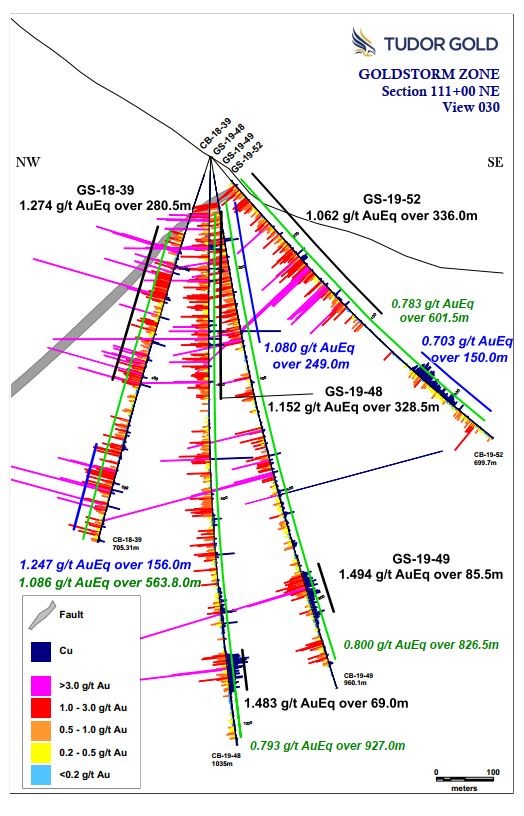
American Creek Resources (TSXV: AMK) (OTC Pink: ACKRF) (the “Corporation” or “American Creek”) is pleased to announce its partner Tudor Gold has concluded the interpretation of a copper-silver mineralized zone, the ‘CS 600 Horizon’,
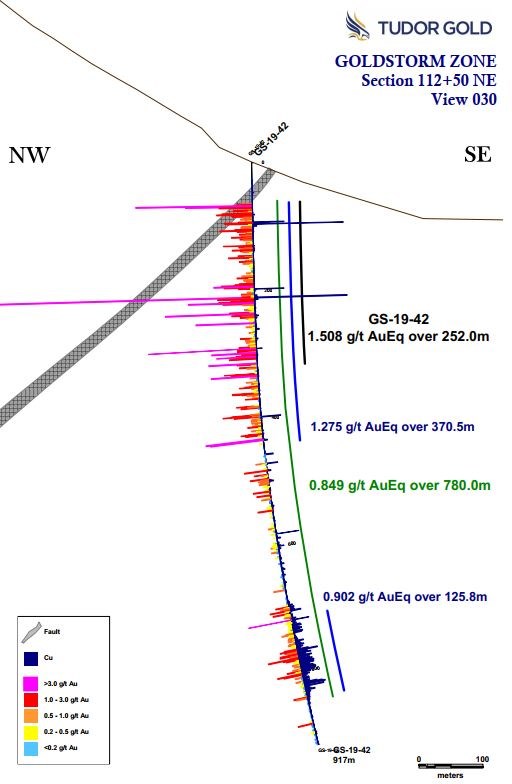
within the Goldstorm Zone. Composite grades for drill holes GS19-42,
47, 48, 49, 52 and CB18-39 were re-calculated utilizing the copper and
silver grades obtained from the 2019 drill-hole program. These holes are
located in the northeastern-most area of the project. The copper and
silver mineralization contributed greatly to increasing the gold
equivalent content of all drill holes that cut the new copper-rich ‘CS 600 Horizon’.
The largest increase in gold equivalent content to the ‘300 Horizon’
was from GS19-42. The gold-only grade previously reported for the 370.5 m interval was 1.097 gpt Au. After adding the copper-silver mineralization, the gold metal equivalent content has increased to 1.275 gpt Au Eq over the same 370.5metre interval. This was due mainly to the elevated silver grades.
Copper grades were very consistent within the ‘CS 600 Horizon’. Grades ranged from approximately
0.16% Cu to 0.34% Cu over intervals of 69m to 151.5m in holes GS19-42,
47, 48, 49 and 52. These intercepts led to the largest gold equivalent
increases within the Goldstorm System.
Silver grades averaged as high as 10 gpt within both the ‘300 Horizon’ and the ‘CS 600 Horizon’ and the metal appears to occur throughout the entire Goldstorm System.
Vice President of Project Development, Ken Konkin P.Geo. comments:“The
newly discovered copper-rich ‘CS 600 Horizon’ is a very important
feature of the Goldstorm System. The presence of copper and silver
mineralization gives this discovery a true polymetallic nature yet it
remains a gold-dominant project. Copper grades appear to be increasing
with depth within the ‘CS 600 Horizon’. In the following weeks our
technical team will continue to examine the rest of the drill holes to
re-compute the gold-equivalent grades to include copper and silver
throughout the entire system.”
Table l provides gold equivalent composites from
five drill holes completed on three sections that cut the ‘300 Horizon’
and the ‘CS 600 Horizon’ within the Goldstorm System. Although the sixth
hole in this table (CB18-39) did not intersect the ‘CS 600 Horizon’,
the Au Eq composite increased the grade of the intercept by over 11%
within the ‘300 Horizon’. Sections attached demonstrate that the copper
pulse is un-like the main gold mineralization within the ‘300 Horizon’
as the ‘CS 600 Horizon’ appears to be dipping sub-parallel to the main
Treaty Thrust Fault (TTF1) shown in section 111+00 NE. The Company’s
Press Release dated October 24th provides the drill collar data
including drill hole location, elevation, inclination, azimuth and drill
hole length.
* All assay grades are uncut and intervals reflect drilled intercept
lengths. True widths of the mineralization have not been determined. HQ
and NQ2 diameter core samples were sawn in half and typically sampled at
standard 1.5m intervals.
**Prices used to calculate the AuEq metal content are: Gold $1322/oz,
Ag: $15.91/oz, Cu: $2.86/lb. All metals are reported in USD and
calculations do not consider metal recoveries.
The goal is to design a diamond drill hole program that will
fast-track the exploration program for 2020 with the objective to begin
the Mineral Resource Estimate work at the end of the 2020 field season.
Tudor hopes to accomplish as much drilling needed to bring a Measured
and Indicated Mineral Resource Estimate forward as quickly as possible.
Walter Storm, President and CEO, stated: “These
new gold equivalents are extremely encouraging as our technical team
continues to take positive steps advancing Tudor Gold’s flagship Treaty
Creek Au-Ag-Cu project. During the following months our geologist and
engineers will continue to work with the geological model and begin to
prepare the diamond drill hole proposal for 2020 .”
Darren Blaney, President and CEO of American Creek, stated:“The
Goldstorm deposit on Treaty Creek continues to amaze us. Its scale has
grown exponentially over the last two years to close to a billion tonnes
and these recent calculations are giving us a more accurate indication
of the grades within the system. The focus has been on the 300 zone as
it’s a gold enriched area just below the surface giving it great
potential to be open pitted, and now we’re starting to see the
tremendous potential at depth in the CS 600 zone. The Goldstorm is open
at depth and to the north and east which is where these pulses of copper
and silver are becoming more concentrated. With power and the highway
only 20km down the valley, and the deposit increasing in size
exponentially, the Goldstorm truly has the potential to be a world class
deposit.”
The Treaty Creek Project is a Joint Venture with Tudor Gold owning
3/5th and acting as operator. American Creek and Teuton Resources each
have a 1/5th interest in the project. American Creek and Teuton are both
fully carried until such time as a Production Notice is issued, at
which time they are required to contribute their respective 20% share of
development costs. Until such time, Tudor is required to fund all
exploration and development costs while both American Creek and Teuton
have “free rides”.
The Treaty Creek Project lies in the same hydrothermal system as
Pretium’s Brucejack mine and Seabridge’s KSM deposits with far better
logistics.
Drill core samples were prepared at MSA Labs’ Preparation Laboratory
in Terrace, BC and assayed at MSA Labs’ Geochemical Laboratory in
Langley, BC. Analytical accuracy and precision are monitored by the
submission of blanks, certified standards and duplicate samples inserted
at regular intervals into the sample stream by Tudor Gold personnel.
MSA Laboratories quality system complies with the requirements for the
International Standards ISO 17025 and ISO 9001. MSA Labs is independent
of the Company.
Qualified Person
The Qualified Person for this news release for the purposes of
National Instrument 43-101 is the Company’s Vice President of Project
Development, Ken Konkin, P.Geo. He has read and approved the scientific
and technical information that forms the basis for the disclosure
contained in this news release.
American Creek is a Canadian junior mineral exploration company with a
strong portfolio of gold and silver properties in British Columbia.
Three of those properties are located in the prolific “Golden Triangle”;
the Treaty Creek and Electrum joint venture projects with Tudor
Gold/Walter Storm as well as the 100% owned past producing Dunwell Mine.
The Corporation also holds the Gold Hill, Austruck-Bonanza, Ample
Goldmax, Silver Side, and Glitter King properties located in other
prospective areas of the province.
For further information please contact Kelvin Burton at: Phone: 403 752-4040 or Email: [email protected]. Information relating to the Corporation is available on its website at www.americancreek.com
Posted by AGORACOM-JC
at 9:31 AM on Thursday, December 19th, 2019
As 2019 comes to a close, sit back and watch CEO Paul Gill provide a compelling year-end recap. With a high grade graphite resource already in place, growing and situated in North America, Lomiko Metals (LMR:TSXV) believes it is on the verge of becoming a supplier to multiple gigafactories being built in North America to support the electric vehicle boom.
Posted by AGORACOM
at 3:03 PM on Wednesday, December 18th, 2019
Sprott is eager to believe junior gold miners are on the verge of striking the motherlode, but skeptical of nearly everything else related to the industry
One week before Halloween, Canada’s biggest gold enthusiast,
the septuagenarian billionaire Eric Sprott, wearing a neatly pressed tuxedo,
bounded onto a stage in a downtown Toronto ballroom and accepted his induction
into Canada’s Investment Industry Hall of Fame.
He declared himself both humbled and honoured, and then
rollicked into the wee hours of the night at his home in a nearby tower with
expansive views of the city’s sparkling skyline. The next morning, though 75
and technically retired, he showed up at his office, grumbling about a lack of
sleep, but dressed in a magenta-coloured, paisley button-up, ready for a 9 a.m.
meeting with a penny stock exploration company.
“I keep reading that people are never making (gold)
discoveries, the rate of discoveries is going down,†he said, occasionally
rubbing his temples and closing his eyes. “The funny thing, well, I guess I’m
the sucker then because I keep buying guys who say they’re making discoveries.â€
Just as the price of gold often moves in the opposite
direction of the stock market, Sprott has a strong contrarian streak that means
he also often moves in the opposite direction of the market. For example, this
past spring, after years of middling precious metal prices and declining
discoveries had led most investors to abandon Canada’s gold and silver
explorers, he decided to go all-in.
Sprott launched an investment blitz, the likes of which the
junior mining precious metals sector had seldom seen, doling out somewhere
between $200 and $300 million in a matter of just a few months to acquire large
stakes in about two dozen companies, most of which have never earned a dollar
of revenue
His investments between May and July accounted for about one
in every four dollars raised by junior miners, according to Vancouver-based
market research firm Oreninc. During that time, gold prices started to rise,
breaking through US$1,400 in June for the first time in six years, bringing
some investors back to the major miners — exactly where Sprott doesn’t want to
be.
“They’re the worst place to put money, okay?†he said.
Putting his money where his mouth is, he has been selling his position in Kirkland Lake Gold Ltd., one of, if
not the lowest-cost gold producers and one of the best-performing stocks on the
S&P/TSX Composite Index since 2016.
Sprott was an early investor in Kirkland Lake, was appointed
chairman in 2015, and one year later helped engineer its merger with Newmarket
Gold Inc., a small gold producer in Australia. Not long after, the newly merged
company discovered high-grade veins at two mines, which propelled its stock
upwards to $63 per share.
Many investors pride themselves on not selling when a stock
hits a bump, but Sprott said it is equally important to not sell when the stock
rises, at least not until it’s gone up five or even 10 times, a so-called
tenbagger.
“I’ve had lots of tenbaggers and the important thing is to
stay in it,†he said.
But when his stake in Kirkland Lake reached about $1.3
billion earlier this year, and it looked like gold prices would keep rising,
Sprott said he decided it was time to sell.
“Here’s what I say to the management of Kirkland Lake: you
will not be the No. 1 performing stock this year,†he said during an interview
in October. “You will not be, because companies like Eldorado (Gold Corp.) and
Detour (Gold Corp.) are going to kick your butt.â€
And yet, Sprott — who found out about the deal on a day he
was meeting with a junior mining company seeking investment — elected to
support the deal, and waxes enthusiastic about Detour.
It’s one of the reasons why Sprott doesn’t much care about Canada’s major gold miners.
The
best-run companies might provide 20- or 30-per-cent returns, or maybe
100 per cent in a few cases, but Sprott would rather invest in a company
that might strike gold and give him a 500-per-cent return, or even a
coveted 1,000-per-cent return.
In
July, Sprott had bought about 10 million shares at $3.10, meaning he
made about $25 million or a 75-per-cent return in just a few months. But
he was nonplussed, saying the buyout may have come a little early.
“You’ve got to have the dream, right?†he said. “You’ve got to have the dream you’re going to find something.â€
Therein
lies Sprott’s biggest paradox: he’s eager to believe that junior gold
miners are on the verge of striking the motherlode, but skeptical of
nearly everything else related to the gold industry.
You’ve got to have the dream, right? You’ve got to have the dream you’re going to find somethingEric Sprott
After a five-decade career in the financial
services industry, during which he worked as an investment banker and
founded an eponymous empire that includes fund and asset management
firms, a brokerage firm, bullion storage and more businesses, he is
skeptical of commercial banks, major precious metals miners, central
banks, the stated rate of annual inflation and, perhaps above all, gold
and silver prices.
“One of the things about the media, they never
talk about the gold conspiracy,†he said. “Look at the guys who are
paying fines for spoofing the precious metals markets. Every two weeks
some guy’s paying a fine.â€
Case in point, U.S. prosecutors in
September filed criminal charges against three JPMorgan Chase & Co.
bankers for allegedly spoofing the precious metals market, which means
placing fake orders and then quickly cancelling them to manipulate the
price. The indictment alleged a decade-long conspiracy.
Sprott
believes the futures market — where investors can buy options that
essentially allow them to place bets on the price of gold or silver
without actually having to own any of the metals — allows commercial
banks to exert way too much influence on the market for physical metals.
Stacked gold bars in Germany.
Michaela Handrek-Rehle/Bloomberg files
As someone who stockpiles bullion, and often gives it out as
a gift, he watches the prices of silver and gold so closely it often
colours his mood.
This fall, Sprott was out fishing for grouper on
a staffed boat somewhere warm on a Friday when he normally records his
podcast. In spite of his idyllic circumstances, he sounded distinctly
downtrodden when he called in to the podcast.
“I’ve had better days, you know, it’s a bit of a tough one,†he said.
As
the podcast progressed, it soon became clear that gold and silver
prices were both down, about four and six per cent, respectively, and
options market manipulation appeared to be the reason to him.
Juan
Carlos Artega, director of investment research at the World Gold
Council, is skeptical that banks are having a significant effect on gold
or silver prices through the futures market, but believes options do
have an impact on short-term prices.
As
someone who stockpiles bullion, and often gives it out as a gift, he
watches the prices of silver and gold so closely it often colours his
mood
“What you find is that the gold price is
responding to demand-and-supply dynamics including those on the
(options) market, but it’s only one component,†he said.
Artega
said central bank and consumer buying, production numbers, recycling,
investment in gold-backed exchange-traded funds and a host of other
factors play a role in determining long-term prices.
Sprott would
hear none of it, and said he’s long disagreed with the World Gold
Council about many things. His skepticism of the futures market ties in
to his skepticism of the financial market writ large.
“We have a weird financial system; it doesn’t make any sense to a rational thinker,†he said.
Gene
McBurney, co-founder of GMP Securities LP, once a competitor of Sprott
Inc. in the investment business and now a friend, said part of the key
to understanding Sprott is that he enjoys entertaining other people with
provocative comments.
Fine gold coins at a bullion dealer in London.
Chris Ratcliffe/Bloomberg files
“He’s told people there’s no gold in Fort Knox; that kicks off an interesting conversation,†he said.
But
McBurney added that he believes Sprott is extremely well versed in the
companies in which he invests, and he has even given some of his
personal money to Sprott to manage.
Peter Grosskopf, chief
executive of Sprott Inc., the asset management firm Sprott founded and a
mentee, said Sprott is always covered as being this “unbelievable gold
bug,†but there’s a lot more to it than that.
“I mean, he’s a savant at what he does,†said Grosskopf, who added that it’s not easy to explain how Sprott does what he does.
That’s
mainly because Sprott is investing in companies that have no revenue,
which means standard investment metrics, such as internal rate of
return, aren’t necessarily useful, never mind that he said they’re not
something he would use.
He’s a savant at what he doesPeter Grosskopf, chief executive of Sprott Inc.
Instead, he attempts to value companies based on whether they are likely to discover a deposit of precious metals.
Of
course, even if a company discovers a deposit, it would still need to
figure out whether it makes economic sense to extract the deposit,
including how much it would cost to build and operate a mine, which
requires further calculations about energy costs, transportation,
processing and refining, and so on.
Sprott said he focuses solely
on the deposit and how big it could be. Though he has no education in
geology, he said he has devised his own valuation method, which involves
looking at a few variables to determine the potential size of a
deposit.
“I want to turn it into numbers, like, okay, what could
this thing earn?†he said. “You know, you multiply the strike by the
depth by the width by 2.7 specific gravity times the ounces — it’s just
four or five things you’ve got to multiply, five things.â€
People
close to him said he studies junior mining companies and can recall the
details of his investments better than most fund managers.
“The
guy gets up at ungodly hours, he might get up at 2 a.m. studying,†said
Conor O’Brien, a former capital markets manager who joined Sprott in May
to help with the investment blitz. “Neither one of us are geologists,
we’re just financial people that can do mathematics, as opposed to the
geology. We more kind of conceptualize, and dream and kind of multiply.â€
Putting
his latest investment spree of more than $200 million in perspective,
the TSX Venture Exchange’s junior mining sector through August was on
course to raise $2 billion for all of 2019, about 27 per cent less than
it did in 2009.
Sprott takes a birdshot approach to investment
that spreads his money far and wide, so that his portfolio contains
companies exploring for high-grade and low-grade mines, potential
open-pit and potential underground mines, and so on.
“Most of them won’t make it,†he said. “But what about the ones that do? If I’m in early and I stay the ground, I press the bet. It’s like being at a table with a winning run, you keep doubling down.â€
Grosskopf said Sprott calls it “stealing value,†not because he’s
conning anyone, but because he’s investing in assets the market has
mispriced. He said the billionaire is an expert trader, adept at sizing
up an opportunity and timing his entrance and exit.
And because of
his outsized profile, recently juiced by his epic returns while
chairman of Kirkland Lake, there are hordes of investors who will follow
his lead, Grosskopf said.
Not all of Sprott’s bets work out, of course. In 2017, Sprott said he invested in Garibaldi Resources Corp., a nickel explorer, based on comments he read on an online chat board.
Its
stock surged 1,731 per cent that year, and Sprott has continued to
invest even though two years later, its stock has declined from a peak
above $4 in late 2017 to 87 cents today.
“They’re for sure
drilling, we know that, and they’ve announced some holes, and they’ve
got more to go,†Sprott said. “They haven’t found the motherlode they’re
looking for. Even I’ll say that.â€
Sprott’s vast ownership may
also have a downside: It’s not easy to liquidate his positions in
companies without attracting attention. But his vast wealth also means
he’s relatively insulated from a lot of threats, such as dilutive
financings or litigation, that smaller investors can’t afford to
participate in.
He also owns a private gold mining company in
Nevada called Jerritt Canyon Gold LLC, which he said made its first
profit in the third quarter.
Kevin Small, vice-president of
operations at that mine, said Sprott likes to be generous. In April, he
said Sprott showed up at the site and handed out silver coins to several
hundred people who work there.
“He said when you guys make lots of money, I’ll give you each a gold coin, but he hasn’t been back yet,†Small said.
Eric Sprott at his induction into Canada’s Investment Industry Hall of Fame in October.
Peter J. Thompson/National Post
But he added that Sprott has been investing heavily in the
operation, which has a capacity to produce 280,000 ounces of gold per
year, and predicted the company would soon be well known.
Colleagues
also add that he can be unrelenting when judging a company’s financial
performance. Case in point, one of his biggest gripes with Kirkland Lake
is that he wants it to increase its dividend, an issue he once again
raised in October after the miner posted solid quarterly results.
Kirkland
Lake pays a quarterly dividend of four cents, and chief executive Tony
Makuch said he may consider raising it, but the company still needs to
spend money on exploration so it can improve its reserves of gold.
“We’re
not an industry people should be buying for dividends,†Makuch said.
“You should be buying bank stocks or something else. If you look at our
share price, that comes from investing in new projects.â€
It’s a sentiment that Sprott would likely agree with.
“I still have a lot of money in Kirkland and it’s a great company, but it’s not a tenbagger from here,†he said. “And I like tenbaggers as opposed to 100 per cent. It’s just my nature.â€
Posted by AGORACOM
at 2:47 PM on Wednesday, December 18th, 2019
The global tire market acknowledges that employing graphenes within tire treads, walls and the inner linings can make tires lighter, provide better grip and reduce rolling resistance to an extent that is not possible with existing tire compounds
Key to the ability for Gratomic to establish the first mass-market Mine to Graphene to Tire, is the production of large quantities of graphenes nano surface modified to enhance tire performance
Gratomic is developing and commercializing its Graphene Processing capacity in Wales through its partnership with Perpetuus carbon technologies and prepared an additional 2 tonnes of Graphite concentrate for converting into high quality Graphenes targeted for the use and development of several high value Graphene applications.
TireOutperformance Categories:
Rolling resistance
Braking/grip on wet and ice roads
Abrasion resistance
Tires, enhanced with surface engineered graphenes, produced a greater
than 30% increase in wear resistance over the competing Brand Tires,
equating to an additional +30% mileage before the tire was needed to be
replaced.
Furthermore,
the results of testing carried out by industry experts employing
industry standard dynamic mechanical analysis (DMA) showed a significant
improvement in rolling resistance, which indicated a greater than 30%
improvement in fuel economy (increased MPG).
Results showed a greater than a 40% improvement in both wet and ice braking.
About Gratomic Inc.
Gratomic is an advanced material company focused on mine to market
commercialization of graphite products, most notably high-value
graphene-based components for a range of mass market products.
Posted by AGORACOM-JC
at 1:39 PM on Wednesday, December 18th, 2019
SPONSOR: CardioComm Solutions (EKG: TSX-V)
– The heartbeat of cardiovascular medicine and telemedicine. Patented
systems enable medical professionals, patients, and other healthcare
professionals, clinics, hospitals and call centres to access and manage
patient information in a secure and reliable environment.
Remote Patient Monitoring, Reimbursement Topped Headlines in 2019
Top mHealth trends in 2019 included remote patient monitoring,
telehealth reimbursement, substance use disorder care, chronic disease
management, and direct-to-consumer mHealth technology.
Based on our most clicked stories in 2019, those trends included remote patient monitoring, telehealth reimbursement and coding, behavioral health/substance use disorder care, chronic disease management strategies, and direct-to-consumer mHealth technologies.
As 2019 comes to an end, healthcare organizations are
reflecting on the trends and stories that most influenced their
behaviors in the past year. Based on our most clicked stories in 2019,
those trends included remote patient monitoring, telehealth
reimbursement and coding, behavioral health/substance use disorder care,
chronic disease management strategies, and direct-to-consumer mHealth
technologies.
In the following article, mHealthIntelligence.com will break down these trends, as well as the strategies and best practices industry leaders developed in response.
Remote patient monitoring
In 2019, healthcare organizations looked to invest in remote
patient monitoring (RPM) solutions to transition to value-based care.
Many healthcare leaders expected these solutions to support high-risk
chronically ill patients whose conditions are considered unstable and at
a risk for hospital admission.
Specifically, 88 percent of providers who were surveyed by health IT thought leaders earlier this year had invested or were evaluating investments in RPM technologies.
RPM solutions have been proven to be clinically effective as an
early symptom management tool for chronically ill patients, who
represented about 45 percent of the US population according to the
survey. These solutions allowed risk-bearing organizations to remotely
monitor patients with chronic conditions to help control healthcare
costs, improve care quality, and increase access to care for patients in
underserved areas.
In addition, these solutions helped manage value-based risk associated with large patient populations with chronic conditions.
“The ability of the device to simultaneously record multiple
variables such as heart rate and accelerometer data allowed us to more
accurately determine the patient’s state, whether he/ she is active,
sedentary, asleep, or not currently using the device,†the researchers
reported.
Because remote patient monitoring is becoming more widespread,
more healthcare organizations are implementing RPM into their health
systems. Recently, Humana announced
a partnership with Philips Health to launch a remote member monitoring
pilot for certain Medicare Advantage members with severe congestive
heart failure (CHF).
“Our goal is to continue to find ways to help our Medicare
Advantage members stay longer and safer in their homes,†Susan Diamond,
president of Humana’s Home Business segment, said in a press release.
Telehealth reimbursement and coding
Along with remote patient monitoring, telehealth has been
extremely vital for healthcare in 2018 and will continue to play a
significant role going into the new year. But healthcare organizations
are still waiting on reimbursement and billing policies to catch up to
telehealth adoption..
One of the top read stories from 2019 was the American Medical
Association’s (AMA) creation of new codes for the use of telehealth and
behavior assessment and intervention services. These codes “more
accurately reflect current clinical practice that increasingly
emphasizes interdisciplinary care coordination and teamwork with
physicians in a primary care and specialty setting,†the association
stressed.
The goal for the new codes was to expand pathways for
physicians across the US who deal with diverse patients, including those
from underserved areas, and those who have any access to care they may
need.
CMS has followed suit, implementing the
AMA and its Digital Medicine Payment Advisory Group to include new
telehealth codes in the 2018 Medicare physician fee schedule. And in the
beginning of this year, CMS released its 2020 physician fee schedule
that included numerous additions that will enable more reimbursement for
connected health services next year.
In October of this year, Pennsylvania tried again to pass comprehensive telehealth legislation after the bill was denied last year because of disagreements over payment parity.
State Senator Elder Vogel introduced The Telemedicine Act (SB
857), which aimed to establish definitions for telemedicine and
telehealth, provide temporary evaluation and treatment guidelines for
reimbursement, and give state departments up to two years to draft
permanent rules and regulations.
The new bill includes remote patient monitoring technologies,
which gives providers the opportunity to use these connected health
services. About a dozen states have passed legislation demanding payment
parity for telehealth, but most have failed because of strong
opposition from healthcare payers.
Addressing substance abuse using mHealth
An estimated
115 people die each day from opioid abuse, an issue that has become
more widespread in the past decade. Healthcare providers have been
actively searching for a solution to tackle this issue, and many have
found a pathway to success using mHealth and telehealth technology.
Applying MHealth and telehealth technology to addiction treatment is expected
to make one of the biggest impacts on substance use disorder care.
Connected health platforms allow providers to work with the individual
patient anytime they need to, and are able to see what the patient
experiences each day.
“We’re building a panoramic view of your life,†said Jacob
Levenson, CEO of MAP Health Management, a Texas-based national network
of almost 100 addiction treatment providers. The organization has
adopted digital health tools for care management and coordination of
substance use disorder patients.
The smartphone is also a great tool for addiction treatment, as it offers both
a platform for population health programs and individual treatments.
Healthcare providers are able to send out messages offering support or
information via text, SMS, or e-mail to large groups at any time. They
can also personalize messages for individuals, connecting information to
one’s habits, location, or medical record.
MHealth apps are becoming increasingly more popular tools. Apps
could feature surveys, messaging or chat rooms, links to resources,
messaging with care providers or a substance abuse specialist, and a 911
link for immediate help.
“Medical devices, including digital health devices like mobile
medical apps, have the potential to play a unique and important role in
tackling the opioid crisis,†FDA Commissioner Scott Gottlieb, MD, said
in a press release
featured on the FDA website. “We must advance new ways to find tools to
help address the human and financial toll of opioid addiction.â€
Chronic disease management strategies
While MHealth platforms were important for addressing the
opioid crisis, the solutions have also been useful for chronic disease
management. A growing number of Americans are suffering from more than
one chronic condition, prompting more healthcare providers to take the
appropriate measures to tackle this issue in 2019.
For example, in January, Omada Health, a digital therapeutics
company that focuses on obesity-related chronic conditions, created a
cognitive behavioral therapy program (CBT) for those dealing with
depression and anxiety.
“Depression and anxiety are a known barrier to healthy
behaviors including medication adherence, optimal nutrition, and seeking
timely preventive care. With the addition of CBT curriculum, we can
more fully support our participants as they manage their conditions.
And, through our digital platform, we can do it at scale,†Carolyn
Bradner Jasik, MD, Omada’s Vice President of Medical Affairs, explained
in a press release.
The challenge going into the coming years is developing a
digital health platform that is able to integrate different programs and
allow for easy access for both patients and providers.
A few weeks ago, a Pennsylvania health system also created a telehealth and remote patient monitoring platform
to allow patients living with ALS to receive at home care. Most
patients with ALS have to travel hours for meetings with doctors and
specialists, which can prove to be challenging. But the telehealth
platform allows the meetings to be held at home.
Heart failure (HF) patients receiving targeted virtual behavior
therapy found significant improvements in self-care, a recent study published in
the journal Circulation found. The study conducted by Humana and AbleTo
found a correlation between improving behavioral health care and
co-existing physical conditions. The study also noted improvements in
self-care, depression symptoms, and awareness of physician
recommendations among patients that received HF-focused virtual
behavioral therapy over eight weeks.
Chronic disease management is vital to reduce costs by
addressing the patient’s illness or condition with maximum clinical
outcomes, while helping beneficiaries control their disease in an
effective way.
Direct-to-consumer mHealth technology
The healthcare industry is facing major disruption from
non-traditional companies, like Amazon, Google, and Apple. The mHealth
space has been no different according to the top stories from 2019.
In September of this year, Amazon prepared to take on the direct-to-consumer telehealth industry through its new platform,
Amazon Care. Amazon Care is a virtual care clinic offering telehealth
and mHealth services for its employees in the Seattle area, including
on-demand access to a clinician online messaging for healthcare
questions, a prescription service, and the option of scheduling an
appointment through Seattle-based Oasis Medical.
Apple Watch can be used by clinicians to detect atrial
fibrillation. But will care providers rely on these devices to present
them with accurate information?
A survey of
420,000 individuals conducted by researchers at the Stanford University
School of Medicine found that over an eight month span, the Apple Watch
detected an irregular heart rate in .52 percent of individuals or 2,161
people. And almost three-quarters of the users who were notified about
an irregular pulse contacted a care provider for further treatment.
“The study’s findings will help patients and clinicians
understand how devices like Apple Watch can play a role in identifying
atrial fibrillation, a deadly and often undiagnosed disease,†Mintu
Turakhia, MD, an associate professor of cardiovascular medicine, said in
the press release.
“Additionally, these important findings lay the foundation for further
research into the use of emerging wearable technologies in clinical
practice and demonstrate the unique potential of large-scale app-based
studies.â€
In addition, a Gallup survey this month showed that nearly one
in five Americans are using an mHealth wearable. Adults younger than 55
are twice as likely to use or have used mHealth. And individuals older
than 55 and women, are more interested in using mHealth than men. About
half of the women respondents under 55 said they use or have used
mHealth in the past. While men over age 55 are the least likely to use
or have used the technology.
Jefferson Health recently partnered
with Quick’r Care to create a mHealth platform to allow patients to
choose their correct care path. Through JeffConnect’s virtual care
service. Consumers will have on-demand video access to health system’s
care providers.
“This is what people who feel bad need right now, right when
they begin to feel sick,†added Stephen K. Klasko, MD, president of
Thomas Jefferson University and CEO of Jefferson Health. “Working with
Quick’rCare allows us to expand our commitment to healthcare with no
address.â€
Overall, Apple products are designed to make healthcare more
human. Devices are meant to protect patient data and give easy
accessibility to everyone who uses Apple products. Patients are able to
access medical records and communicate from at home if needed. But
providers continue to question whether the information they are
receiving is accurate, as with new technologies, there isn’t always this
guarantee.
Posted by AGORACOM
at 11:45 AM on Wednesday, December 18th, 2019
Sponsor: Affinity Metals (TSX-V: AFF) a Canadian mineral exploration company building a strong portfolio of mineral projects in North America. The Corporation’s flagship property is the Drill ready Regal Property near Revelstoke, BC. Recent sampling encountered bonanza grade silver, zinc, and lead with many samples reaching assay over-limits. Further assaying of over-limits has been initiated, results will be reported once received. Click Here for More Info
Central bankers have been voracious buyers of gold during the last two years, and analysts look for that trend to continue in 2020.
Through the end of October, net official-sector purchases this year
totaled 562 metric tons, reported Alistair Hewitt, director of market
intelligence with the World Gold Council. That 56.2-tons-a-month average
puts sales on pace to roughly match the 656 tons bought in 2018, which
were the most central-bank purchases since 1967, according to WGC data.
“This year has been exceptionally strong. We think that next year,
net buying will continue at a high level, even if it’s not as high as
this year,†said Philip Newman, director of the London-based consultancy
Metals Focus.
Goldman Sachs looks for global central banks to collectively acquire
around 650 tons in 2020, while Standard Chartered is projecting
central-bank purchases will total 525 tons.
“It’s still elevated,†said Suki Cooper, precious-metals analyst with
Standard Chartered. “That is still firmly on the buy side.â€
‘Safe, liquid and generates returns’
Hewitt commented that central banks are looking at three main
criteria when deciding to expand the amount of gold they hold within
their foreign-exchange reserves.
“For a central bank, gold is a fantastic asset because it’s safe, liquid and generates returns over the long term,†Hewitt said.
He also listed two more factors why the central-bank buying has suddenly jumped in recent years.
“One issue is we are seeing heightened geopolitical tensions,†Hewitt
said, with these involving major gold-buying countries and economies.
“Central banks are looking toward gold to balance some of that risk.
“We’ve also got negative rates and yields for a large number of sovereign bonds.â€
Newman added that many central banks are “trying to get away†from
the U.S. dollar. This is especially the case with Russia due to U.S.
sanctions, he added.
As recently as 2017, most of the official-sector buying came from a
handful of central banks, including Russia, Turkey and Kazakhstan. But
in 2018 and 2019, there have been a slew, including some that had not
been in the market for years.
“You’ve got a whole range of buyers,†Newman said.
The largest buyers during the first 10 months of the year were Turkey
with 144.8 tons; Russia, 139; Poland, 100; and China, 95.8.
Others include Kazakhstan, 26.9 tons; India, 17.7; Qatar, 11; Ecuador, 10.6; Serbia and the U.K., 9.9; Argentina, 7; Colombia, 6.1; Kyrgyz Republic, 3.2; Mongolia, 2.3; Belarus, 1.9; Guinea, 0.9; Egypt and Mauritania, 0.7; Albania and Malta, 0.6; and Ukraine and Greece, 0.3.
Goldman Sachs projected that central-bank purchases could amount to as much as 22% of global supplies during 2019.
Central banks ‘buy for an extended period’
Hewitt looks for official-sector buying momentum to continue.
Central banks tend to put a lot of thought into decisions to buy –
with a long, rigorous policy-making process — and purchase the metal
for strategic reasons, rather than simply reacting to day-to-day moves
in the price, Hewitt said.
“Once these people start buying, they continue to buy for an extended
period of time,†Hewitt said. For instance, he pointed out that
Kazakhstan has been a regular gold buyer since 2010.
“Both trade tensions and negative yields are still here,†Hewitt
said. “They may rear their ugly heads again and become more pronounced,
or they may fade away and become less pronounced. But those underlying
forces will remain ever present in the market. Certainly in the next
year or so, those two factors should continue to support and underpin
central-bank demand for gold.â€
Observers pointed out that not only have central-bank gold purchases
been strong, but sales have been light. Back in 1999, when European
central banks were selling the metal, they began following central-bank
sales agreements to try to limit how much was sold in any one year and
thereby keep this from being a destabilizing force in the gold market.
These agreements have been discontinued, Hewitt noted. Commerzbank
analysts pointed out they were no longer necessary since hardly any
European central banks are selling anyway. Germany’s central bank sells a
modest amount each year only for its coin-minting program, Hewitt said.
“The market was not bothered by the central-bank gold agreement
coming to an end, partly because the gold market is very different from
what it was in 1999,†Hewitt said, adding that there “dramatic sellingâ€
back then.
“The gold market today is just more diverse, more resilient and more
liquid. That’s why the market just shrugged its shoulder when the
central-bank gold agreement came to an end.â€
Further, analysts at Commerzbank, in their 2020 outlook, commented
that one or more Western European central banks might even enter the
market as a gold buyer.
“One possible candidate is the Dutch central bank (DNB), which in
October published a remarkable statement about the role of gold on its
website,†Commerzbank said. “In it, it described gold as an anchor of
trust for the financial system. According to the DNB, gold reserves
could serve as the basis for a new beginning in the event of a system
collapse.
“If one or more Western central banks indeed started to actively buy
gold, this would attract considerable attention and spark market
reactions.â€
Posted by AGORACOM-JC
at 11:07 AM on Wednesday, December 18th, 2019
SPONSOR: BetterU Education Corp.
aims to provide access to quality education from around the world.
The company plans to bridge the prevailing gap in the education and job
industry and enhance the lives of its prospective learners by developing
an integrated ecosystem. Click here for more information.
Edtech Firm Springboard Raises $11 Mn From Reach Capital, Others To Expand Operations
Pearson Ventures, IFC, Costanoa Ventures, Learn Capital, and Blue Fog Capital also participated in funding round
Springboard will invest funds in expanding operations, adding more courses, hire more employees
Springboard has also partnered with US-based tech giant Microsoft
San Francisco and Bengaluru-based online edtech startup Springboard
has raised $11 Mn in a post-Series-A funding round led by Reach Capital.
Venture capital companies such as Pearson Ventures, International
Finance Corporation (IFC), as well as its existing investors Costanoa
Ventures, Learn Capital, and Blue Fog Capital also participated in the
funding round.
With the recently raised funds, Springboard will expand its
operations, add more courses, and bring more talent to the company. “We
will use this funding to grow our Indian presence with more courses in
design and software engineering and continue our expansion into
additional geographies,†said Vivek Kumar, Springboard India’s managing
director.
Though the current employee strength of the company stands at 130,
Springboard plans to increase the headcount to over 200 in the next few
quarters.
Springboard has also partnered with US-based tech giant Microsoft to
train and provide jobs to 5,000 students in the analytics profession
over the next three years through its new Data Analytics Career Track
platform, which is co-developed by the tech company.
Further, in this partnership, Microsoft will provide educational
content and access to its tools. On the other hand, Springboard will
provide mentorship, support and career services.
Founded in 2013 by Gautam Tambay and Parul Gupta, Springboard
is a workforce upskilling edtech startup that offers online courses and
extensive mentor-based learning for early and mid-level professionals
in data science, UX design, digital marketing, and other technology
areas. The company has so far raised $20 Mn in funding.
Highlighting the need for upskilling of developers which comes in
every three to five years, Kumar said that the company’s
industry-designed programmes, combined with in-depth, one-on-one
mentorship and career guidance, enable people to achieve their full
potential.
The company claims to have enrolled over 14K students for its
programmes worldwide. Notably, in 2019, the company has launched three
new programmes for tech learners in India. “Springboard plans to grow
its Indian presence with more courses in design and software
engineering,†Kumar was quoted as saying.
Kumar further claimed that for its skilling courses, the company has
so far maintained a 99.9% success rate in job guarantee programmes.
According to a report
by Google and KPMG, the edtech market is expected to have a significant
impact on the online education sector, which has the potential to touch
$1.96 Bn by 2021 from $247 Mn at present.
The Indian education market is vast, complex, and has innumerable
existing gaps. So, despite the proliferation of both Indian and foreign
edtech companies, there is still enough scope to leverage the upskilling
game.
In India, Springboard competes with startups such as Udacity,
Coursera, Udemy, and Progate which are also leveraging their online
platforms in helping tech employees upskill their skills and remain
relevant to the changing times.
Posted by AGORACOM-JC
at 10:12 AM on Wednesday, December 18th, 2019
SPONSOR: PRIMO NUTRACEUTICALS INC.
(CSE: PRMO) (OTC: BUGVF) (FSE: 8BV) (DEU: 8BV) (MUN: 8BV) (STU: 8BV)
provides strategic capital to the thriving cannabis cultivation
sector through ownership and development of commercial real estate
properties. The company also offers fully built out turnkey facilities
equipped with state-of-the-art growing infrastructure to cannabis
growers and processors. Click here for more info.
Lawmakers pressure FDA to make clear guidelines on CBD
With the passing of the 2018 Farm Bill, farmers, manufacturers and consumers are keeping a watchful eye on the agency and how they might address compliance for the thousands of companies selling the product and the millions of consumers vying to use it.Â
June 25, 2019, Senator Ron Wyden sent a letter to the Department of Health and Human Services and the Food and Drug  Administration urging both entities to provide clarity around CBD products derived from hemp.
The FDA has been under a magnifying glass since hemp was declassified
as a schedule I drug, having formerly fallen under the thumb of the
Controlled Substances Act of 1970.
With the passing of the 2018 Farm Bill, farmers, manufacturers and
consumers are keeping a watchful eye on the agency and how they might
address compliance for the thousands of companies selling the product
and the millions of consumers vying to use it.
Yet silence and lack of clarification on a potential path towards
compliance for supplement producers has left many chomping at the bit
for the agency to come up with regulatory guidelines for selling Food
and dietary supplements containing CBD. In the interim, well-established
companies such as Next Green Wave, Inc. (Next
Green Wave, NGW:CSE | NXGWF:OTCQX) have continued to solidify their
position in the market, ready and able to serve the exponentially
growing demand of what promises to be a $20 plus billion-dollar
industry.
A Slow and Arduous Process
In Wyden’s letter, the lawmaker criticized the FDA’s indication that
it could take up to 3 to 5 years for the FDA to implement final
regulations for companies to lawfully sell CBD infused foods, calling
the suggestion “unacceptable.†Wyden wrote that he urges the FDA to
quickly implement “enforcement discretion guidelines†by August 1, then
issue an interim final rule pending a permanent rule so that companies
will have clarity on how CBD in food and dietary products will be
regulated.
This argument may have fallen on attentive ears, but as of the date
of this publication, the FDA has yet to provide any clear established
guidelines. Although the agency has wielded their powers against a
handful of “bad actorsâ€, their approach seems to be that of “wait and
see†with regards to due process.
The letter penned by Wyden also stressed the economic impact growers
in states like Oregon would benefit from by allowing CBD to be in more
products, but are halted until the FDA gives the okay that CBD in
ingestible products is lawful to sell and okay to use.
However, this isn’t the first letter Wyden
has sent to the agency regarding a regulatory pathway to CBD
commercialization. In January the lawmaker co-authored a letter with
Senator Jeff Merkley telling the FDA they must revamp current
legislation around offering CBD products. Both senators advised former
commissioner Scott Gottlieb to “immediately begin updating regulations
for hemp-derived CBD and other hemp-derived cannabinoids, and give U.S.
producers more flexibility in the production, consumption, and sale of
hemp products,†according to the letter.
FDA is listening to public demand for clear CBD regulations
The FDA has slowly but surely has been taking measures to develop
guidelines around selling CBD ingestible-products. In late May, the
agency held a public hearing allowing stakeholders the opportunity to
share their reasons why the FDA-regulation for CBD food and dietary
products is crucial, according to the Chicago Tribune.
The agency also gave a chance for the public to weigh in on CBD
regulation by opening a public docket for individuals to add comments.
The deadline to submit comments was July 16, and the agency received
over 3,000 comments, according to the Chicago Tribune. In conjunction
with the open docket, the FDA also published an article July 17 echoing the agency’s stance on CBD and concern for public safety.
“We recognize that there is significant public interest in these
products, for therapeutic purposes and otherwise,†the article said. “At
the same time, there are many unanswered questions about the science,
safety, and quality of many of these products. As we approach these
questions, we do so as a science-based regulatory agency committed to
our mission of protecting and promoting public health.â€
In the “Listening to and learning from stakeholders†section of the
article, the FDA insists that relative questions must be answered in
order to develop a clear pathway to regulate CBD products which include
the following:
How much CBD is safe to consume in a day? How does it vary depending on what form it’s taken?
Are there drug interactions that need to be monitored?
What are the impacts on special populations, like children, the elderly, and pregnant or lactating women?
What are the risks of long-term exposure?
In a second article published on the same day, the FDA stressed it has not approved any CBD products besides Epidiolex,
a drug which treats seizures caused by epilepsy. And is currently
working to figure out how CBD will affect body parts, special
populations and pets.
Since both the public hearing and window to submit comments to the
FDA have both passed, the agency says it will review submitted
information and intends to follow up with its findings “around the end
of summer/early fall,†according to the Chicago Tribune.
It is unclear if the FDA will tentatively meet this deadline, but the
agency will most likely continue to be pressured by lawmakers and the
public to provide a regulatory framework around the selling and
obtaining CBD food and dietary supplements.