Posted by AGORACOM
at 8:37 AM on Wednesday, December 18th, 2019
Trace Analytics Inc. is a leading scalable
analytics cannabis/cannabinoid laboratory poised to meet the demands for
mandated regulatory cannabis/cannabinoid testing
WSDA contracted Trace Analytics for the purpose of doing
cannabinoid profiling for the State’s industrial hemp program to ensure
the percentages of certain cannabinoids are below Federal limits
Applied BioSciences Corp.
(OTCQB:APPB) (“Applied” or the “Company”), today announced that the
Washington State Department of Agriculture (WSDA) has extended its
contract for services with Applied’s majority owned subsidiary, Trace Analytics Inc. (“Trace”).
The WSDA contracted Trace beginning in July 2019 for the testing of
Industrial Hemp samples and percentage testing for delta
9-tetrahydrocannabidiol (THC) and delta 9-tetrahydocannabinolic acid
(THC-A) to ensure the percentages of certain cannabinoids are below
Federal limits.
“We are grateful for our relationship with the WSDA and are pleased
to continue cannabinoid profiling for the WSDA’s Industrial Hemp
program. The testing and reporting of results that we have conducted to
date have demonstrated the quality of our analytics and our dedication
to ensuring compliance with Federal limits,” stated Jason Zitzer, Chief
Operating Officer of Trace Analytics. “We provide expert consulting
services to government entities at all levels around the world and are
appreciative to WSDA to have been selected as the sole lab to conduct
their testing. This contract extension provides another opportunity
toward establishing a higher quality for cannabis and hemp testing.”
Trace Analytics Inc. is a leading cannabis science and technology
company with significant footprints in lab testing, research and
development and licensing. Trace Analytics was started by a group of
scientists who specialized in analytical chemistry, genetics and
molecular biology, focused on ensuring compliance with public safety
standards and end user safety. Trace Analytics is in the process of
expanding throughout the United States, and globally with the goal of
helping the rest of the world adopt “best practices” in cannabis and
hemp testing. The Company also provides expert consulting services to
legislators and regulators in many countries, states and municipalities
around the world.
Based on Applied BioSciences’ stated strategic corporate shift to
focus on its BioPharma division and the development and
commercialization of novel therapeutics that target the endocannabinoid
system (ECS), the Company is currently evaluating a strategic
transaction of Trace Analytics. Applied is currently in late-stage
discussions and expects to close the transaction by year end.
About Applied BioSciences Corp.
Applied BioSciences is a vertically integrated company focused on the
development and commercialization of novel, science-driven, synthetic
cannabinoid therapeutics / biopharmaceuticals that target the
endocannabinoid system to treat a wide-range of diseases across multiple
therapeutic areas. We also deliver high-quality consumer and OTC
THC-free CBD products that promote overall health and wellbeing as well
as state-of-the-art testing and analytics capabilities to our customers.
For more information, visit appliedbiocorp.com and connect with the Company on Twitter, Facebook and LinkedIn.
Posted by AGORACOM-JC
at 5:57 PM on Tuesday, December 17th, 2019
SPONSOR: BetterU Education Corp.
aims to provide access to quality education from around the world.
The company plans to bridge the prevailing gap in the education and job
industry and enhance the lives of its prospective learners by developing
an integrated ecosystem. Click here for more information.
Can Better Internet Connectivity in India Give Education a Push?
Leveraging internet connectivity, edtech apps are personalising practice sessions for millions of children
Using advanced technology like artificial intelligence and machine learning, edtech apps study individual student behaviour
By: Zisshan Hayath
Let’s go back to the time when Facebook first made its entrance in
India. Most people didn’t have computers at home – and they would end up
travelling a few kilometres just to reach a cyber cafe and access
social networks. Instant messages and emails received slower replies and
even owning a mobile phone was a luxury for the youth. Cheap mobile
data was unheard of.
In just a little over a decade, the scene in India is completely
different. Every other person, especially in urban areas, has access to
mobile phones and laptops. India has one of the cheapest mobile data
plans in the world. This has revolutionised the way mobile phones are
used, even perceived.
Today, mobile devices have gone beyond their primary role of
interpersonal connectivity. Today, mobile devices are a mode of
convenience, entertainment, consumerism and education.
Initially, the term e-learning was only used in the context of large
scale MNCs helping their employees learn on the go by eliminating
classrooms. In the span of a few years, of the 300 million school going
students, several million have registered themselves on e-learning apps.
So how is internet connectivity helping Indian students learn better for better results?
Accessibility:
In a traditional learning setup, quality teachers, books, and
infrastructure are only concentrated in metros and education hubs. With
the internet becoming easily affordable, eLearning apps leverage this
connectivity to ensure that every child in in the country has access to
high-quality teachers. Using live classes, children can watch India’s
best teachers explain complex concepts, ask questions, and get them
answered in real-time.
Personalisation:
The teacher-student ratio in Indian classrooms is extremely skewed,
with one teacher for about 30-35 students on average. This number gets
worse in tier II and III cities. Due to this, teachers cannot give
students any personal attention. They use a one-size-fits-all approach
for every child, without considering their aptitude, grasping power,
strengths, and weaknesses. Due to India’s vast population and weak
infrastructure, it is a mammoth task to improve this.
However, this can be easily resolved using edtech. Leveraging
internet connectivity, edtech apps are personalising practice sessions
for millions of children. Using advanced technology like artificial
intelligence and machine learning, edtech apps study individual student
behaviour.
Using this data, they start every student’s practice at a level that
they’re comfortable with. The difficulty of questions is then increased
until the student meets their individual learning goals.
24×7 Instant Doubt Resolution:
One of the key hindrances in every student’s learning journey is
doubts. In a classroom set up, students end up waiting for weeks, if not
months until the teacher completes the syllabus and then organises
doubt-solving sessions. The end result is that the student’s learning
journey is affected and so is their understanding of not just the topic
in question, but other topics as well. They end up rote learning these
topics, but this does not help when they appear for national level board
or competitive exams.
Using internet connectivity, learning apps have created a
chat platform where students can ask their questions. They are instantly
connected to an expert who resolves their doubt for them in under a
minute.
In fact, this platform, often called Live Doubts or Doubts on Chat
has become so popular, that edtech apps are using natural language
processing to create a bot that can answer student doubts instantly,
based on the millions of questions asked earlier. If the bot cannot find
an answer, or if the student has any further questions, the student can
choose to chat with a live expert. As of now, over 25 percent of all
doubts are solved using this bot.
Internet is bringing a revolution in every industry across India.
From booking a cab to movie tickets, groceries, and games – every
industry has undergone a major shift for the better. It’s now time for
parents to embrace edtech and help their children learn better.
(Zishaan Hayath is the Founder and CEO of Toppr, a learning app
that provides personalised learning for students studying for boards,
Olympiads, and various engineering and medical competitive exams.)
Chennai: In little over 3 months since video platform Tiktok ..
Posted by AGORACOM
at 4:06 PM on Tuesday, December 17th, 2019
SPONSOR: Applied BioSciences is a vertically integrated company focused on the development and commercialization of novel, science-driven, synthetic cannabinoid therapeutics / biopharmaceuticals that target the endocannabinoid system to treat a wide-range of diseases across multiple therapeutic areas Click Here for More Info
Some of us consume cannabis for its mind-altering effects, while others
seek symptom relief. But cannabis wouldn’t get us high or have some of
its therapeutic benefits if our bodies didn’t already contain a
biological system capable of interacting with its active chemical
compounds, like THC.
Our
endocannabinoid system does just that. But it isn’t there just to allow
us to enjoy the effects of our favorite strain. It serves a vital
purpose for our health and well-being because it regulates key aspects
of our biology. So, what’s it doing, and how does it work?
Homeostasis: Staying in the Goldilocks zone
To understand the human endocannabinoid system, it’s helpful to know a
little about one of the most fundamental concepts in biology:
homeostasis. And the best way to understand homeostasis is to think of
Goldilocks and the three bears.
That classic fairy tale illustrated the idea that the best outcome
often lies somewhere in the middle, between two extremes. We don’t want
things too hot or too cold, but just right.
Homeostasis is the concept that most biological systems are actively
regulated to maintain conditions within a narrow range. Our body doesn’t
want its temperature to be too hot or too cold, blood sugar levels too
high or too low, and so on. Conditions need to be just right
for our cells to maintain optimum performance, and exquisite mechanisms
have evolved to draw them back to the Goldilocks zone if they move out.
The body’s endocannabinoid system (ECS) is a vital molecular system for
helping maintain homeostasis—it helps cells stay in their Goldilocks
zone.
Key pieces of the endocannabinoid system (ECS)
Because of its crucial role in homeostasis, the ECS is widespread
throughout the animal kingdom. Its key pieces evolved a long time ago,
and the ECS can be found in all vertebrate species.
The three key components of the ECS are:
Cannabinoid receptors found on the surface of cells
Endocannabinoids, small molecules that activate cannabinoid receptors
Metabolic enzymes that break down endocannabinoids after they are used
Cannabinoid receptors
Cannabinoid receptors sit on the surface of cells and “listen†to
conditions outside the cell. They transmit information about changing
conditions to the inside of the cell, kick-starting the appropriate
cellular response.
There are two major cannabinoid receptors: CB1 and CB2. These aren’t
the only cannabinoid receptors, but they were the first ones discovered
and remain the best-studied. CB1 receptors are one of the most abundant
receptor types in the brain. These are the receptors that interact with THC to get people high.
CB2 receptors are more abundant outside of the nervous system, in
places like the immune system. However, both receptors can be found
throughout the body (Figure 1).
Figure 1: Where are CB1 and CB2 receptors located in the body?
The CB1 and CB2 receptors are key players in the endocannabinoid system
(ECS). They are located on the surface of many different types of cells
in the body. Both receptors are found throughout the body, but CB1
receptors are more abundant in the central nervous system, including on
neurons in the brain. In contrast, CB2 receptors are more abundant
outside of the nervous system, including cells of the immune system.
Endocannabinoids
Endocannabinoids are molecules that, like the plant cannabinoid THC,
bind to and activate cannabinoid receptors. However, unlike THC,
endocannabinoids are produced naturally by cells in the human body
(“endo†means “within,†as in within the body).
There are two major endocannabinoids: anandamide and 2-AG (Figure 2).
These endocannabinoids are made from fat-like molecules within cell
membranes, and are synthesized on-demand. This means that they get made
and used exactly when they’re needed, rather than packaged and stored
for later use like many other biological molecules.
Figure 2: Anandamide and 2-AG are the two major endocannabinoids.
Cannabinoids are a class of molecules characterized by their ability to
activate cannabinoid receptors like CB1 and CB2. Anandamide and 2-AG
are the two major endocannabinoids produced naturally in the body. THC
is the psychoactive plant cannabinoid produced by Cannabis. All
three of these cannabinoids can activate the CB1 and CB2 receptors,
although each one has a different potency at each receptor.
Metabolic enzymes
The third piece of the endocannabinoid triad includes the metabolic
enzymes that quickly destroy endocannabinoids once they are used. The
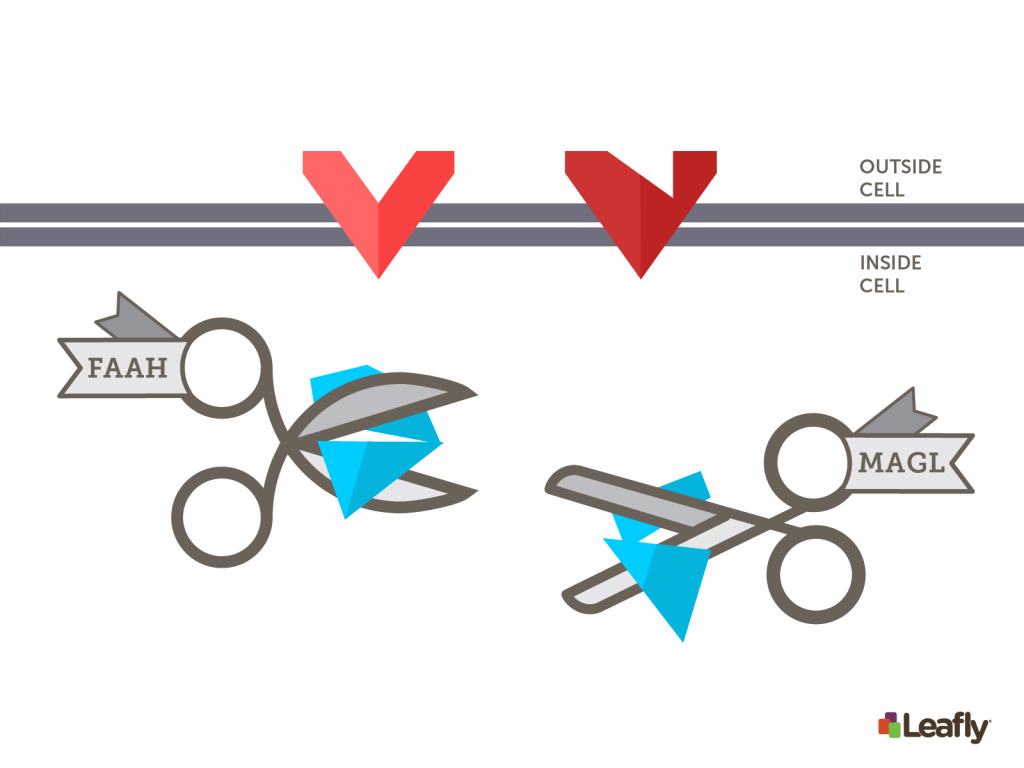
two big enzymes are FAAH, which breaks down anandamide, and MAGL,
which breaks down 2-AG (Figure 3). These enzymes ensure that
endocannabinoids get used when they’re needed, but not for longer than
necessary. This distinguishes endocannabinoids from many other molecular
signals in the body, such as hormones or classical neurotransmitters,
which can persist for many seconds or minutes, or get packaged and
stored for later use.
Figure 3: FAAH and MAGL are the key enzymes of the endocannabinoid system.
Enzymes are molecules that accelerate chemical reactions in the body,
often for breaking down molecules. FAAH and MAGL are key players in the
ECS because they quickly break down endocannabinoids. FAAH breaks down
anandamide, while MAGL breaks down 2-AG. These enzymes break down
endocannabinoids very quickly, but are not effective at breaking down
plant cannabinoids like THC.
The three key components of the ECS can be found within almost every
major system of the body. When something brings a cell out of its
Goldilocks zone, these three pillars of the ECS are often called upon to
bring things back, thus maintaining homeostasis. Because of its role in
helping bring things back to their physiological Goldilocks zone, the
ECS is often engaged only when and where it’s needed. Dr. Vincenzo Di Marzo, Research Director at the Institute of Biomolecular Chemistry in Italy, put it to us this way:
“With the ‘pro-homeostatic action of the ECS’ we mean
that this system of chemical signals gets temporarily activated
following deviations from cellular homeostasis. When such deviations are
non-physiological, the temporarily activated ECS attempts, in a space-
and time-selective manner, to restore the previous physiological
situation (homeostasis).â€
In other words, the ECS helps bring things back to the biological Goldilocks zone.
Below we will consider examples of how the ECS helps maintain
homeostasis in two areas: the firing of brain cells in the nervous
system, and the inflammatory response of the immune system.
Endocannabinoid regulation of brain cell firing
Brain cells (neurons) communicate by sending electrochemical signals
to each another. Each neuron must listen to its partners to decide
whether it will fire off its own signal at any given moment. However,
neurons don’t like to get too much input—there’s a Goldilocks zone. If
they get overloaded by signals, it can be toxic. That’s where
endocannabinoids come in.RelatedHow Does Cannabis Consumption Affect the Brain?
Consider a simplified scenario with one neuron listening to two
others. One of these two neurons might become overactive and send too
many signals to the neuron that’s listening. When that happens, the
neuron that’s listening will make endocannabinoids specifically where
it’s connected to the overactive neuron. Those endocannabinoids will
travel back to the “loud†neuron where they bind to CB1 receptors,
transmitting a signal that instructs it to quiet down. This brings
things back to the Goldilocks zone, maintaining homeostasis (Figure 4).
Figure 3: Endocannabinoid signals regulate how active our brain cells are.
Under normal circumstances (top-left), a given brain cell (neuron) will
get just the right amount of input from its partners—not too much, not
too little. However, some of its partners can become overactive, and
send an excessive number of signals (top-right). The neuron that’s
listening will detect this, and release endocannabinoids that tell the
other neuron to quiet down (bottom). This kind of mechanism helps
maintain homeostasis because it helps prevent neurons from sending out
too many signals.
As the example above illustrates, endocannabinoids travel backwards,
which is why they’re known as retrograde signals. Most of the time,
information flow between neurons is strictly in one direction, from
“sender†neurons that release neurotransmitter signals to “receiverâ€
neurons that listen to those signals. Endocannabinoids allow receiver
neurons to regulate how much input they’re getting, and they do this by
sending retrograde signals (endocannabinoids) back to overactive sender
neurons.
But the brain isn’t the only organ that needs to maintain
homeostasis. Every other system of the body, from the digestive to the
immune system, needs to carefully regulate how its cells are
functioning. Proper regulation is crucial for ensuring survival.
Endocannabinoid regulation of inflammation
Inflammation is a natural protective reaction the immune system has
in response to infection or physical damage. The purpose of inflammation
is to remove pathogens (germs) or damaged tissue. The inflamed area is
produced by fluid and immune cells moving into the area to do the dirty
work and return things to their Goldilocks zone.
It’s important that inflammation be limited to the location of damage
and doesn’t persist longer than needed, which can cause harm. Chronic
inflammation and auto-immune diseases are examples of the immune system
getting activated inappropriately. When that happens, the inflammatory
response lasts too long (which results in chronic inflammation) or gets
directed toward healthy cells (which is known as auto-immunity).RelatedCannabis and Arthritis
In general, endocannabinoids seem to suppress or limit the immune system’s inflammatory signals. Professor Prakash Nagarkatti,
Vice President for Research at the University of South Carolina whose
laboratory studies endocannabinoid regulation of immune responses, told
us how tweaking the ECS might be a good way to treat inflammatory
diseases.
“Most of our research demonstrates that endocannabinoids
are produced upon activation of immune cells and may help regulate the
immune response by acting as anti-inflammatory agents. Thus,
interventions that manipulate the metabolism or production of
endocannabinoids may serve as a novel treatment modality against a wide
range of inflammatory disease.â€
Consider a normal immune response triggered by a bacterial infection.
First, immune cells detect the presence of bacteria and release
pro-inflammatory molecules that tell other immune cells to come and join
the fight. Endocannabinoids get released as well (Figure 4), which also
signal to other immune cells for assistance and likely help limit the
inflammatory response so it isn’t excessive. By tightly regulating
inflammation, the immune system can destroy germs or remove damaged
tissue, and then stop. This prevents excessive inflammation, allowing
cells, and thus the body, to return to the Goldilocks zone.
Figure 4: Endocannabinoids help regulate inflammation.
Under normal conditions (top-left), cells of the immune system patrol
the body, on alert for any intruders, such as bacteria. During a
bacterial infection (top-right), immune cells detect the presence of
bacteria and then release a variety of molecules to help mount a
defensive attack (bottom). These signals include pro-inflammatory
molecules (small circles) that help recruit more immune cells to the
site of infection. Endocannabinoids (small diamonds) also get released,
and likely help regulate the magnitude and extent of this inflammatory
response.
How do plant cannabinoids like THC and CBD interact with the endocannabinoid system?
The reason that plant cannabinoids have psychoactive and medicinal
effects within the body is, in large part, because we have an
endocannabinoid system (ECS) that they can interact with. For example,
THC gets you high because it activates the CB1 receptor within the brain. Endocannabinoids like anandamide also activate CB1.
So why aren’t we constantly high?
A couple big reasons. First, THC doesn’t interact with CB1 receptors
in exactly the same fashion as the body’s natural endocannabinoids.
Second, the metabolic enzymes that quickly break down endocannabinoids
like anandamide don’t work on THC, so THC lingers around for much
longer.
It’s important to remember that molecules like cannabinoids and other
neurotransmitters rarely interact with only one receptor type; they
often interact with many. The plant-based cannabinoid CBD illustrates
this nicely, as it interacts with numerous receptor types
in the brain. So, while plant cannabinoids may activate the same
cannabinoid receptors as endocannabinoids, they will likely interact
with several other receptors and therefore have distinct effects.
CBD is also interesting because it can affect overall levels of
endocannabinoids in the brain, referred to as “endocannabinoid tone.â€
CBD inhibits the FAAH enzyme, which breaks down anandamide. Thus, CBD
can increase anandamide levels by preventing FAAH from breaking it down.
Inhibiting the FAAH enzyme has been shown to be a useful strategy for
treating anxiety disorders, and some of CBD’s anti-anxiety properties may come from its ability to inhibit this enzyme and thereby increase endocannabinoid tone.
Summary
The endocannabinoid system (ECS), comprised of cannabinoid receptors,
endocannabinoid molecules, and their metabolic enzymes, is a crucial
molecular system that the body uses to help maintain homeostasis.
Because of its vital role in making sure that cells and systems remain
in their physiological Goldilocks zone, the ECS is tightly regulated; it
gets deployed exactly when and where it’s needed. However, this doesn’t
mean that activating the ECS, through consumption of cannabis or by any
other means, will always make things just right.
Like any other complex biological system, the ECS can go awry. “If
deviation from physiological homeostasis is prolonged, due to either
external factors or chronic pathological conditions, the eCS can lose
its time- and space-selective mode of action and start affecting
inappropriate cells,†Dr. Di Marzo explained. “In these cases, the ECS,
instead of being beneficial, may actually contribute to disease
progression.â€
It’s important to remember that activating the ECS, through cannabis
consumption or by any other means, isn’t a cure-all. Like most of
biology, it’s complicated.
By understanding the biological Goldilocks principle (homeostasis),
and how the ECS illustrates this at the cellular level, we can more
deeply appreciate why we have an ECS to begin with, and how a variety of
cannabis-based therapies might actually work. The presence and critical
function of the ECS across many systems of the body, including the
nervous and immune systems, explains why such a wide variety of ailments
and disease states are responsive to cannabis-based interventions.
References
Gunduz-cinar O, Hill MN, Mcewen BS, Holmes A. Amygdala FAAH and
anandamide: mediating protection and recovery from stress. Trends
Pharmacol Sci. 2013;34(11):637-44. [PDF]
Ligresti A, De petrocellis L, Di marzo V. From Phytocannabinoids to
Cannabinoid Receptors and Endocannabinoids: Pleiotropic Physiological
and Pathological Roles Through Complex Pharmacology. Physiol Rev.
2016;96(4):1593-659. [PDF]
Nagarkatti P, Pandey R, Rieder SA, Hegde VL, Nagarkatti M.
Cannabinoids as novel anti-inflammatory drugs. Future Med Chem.
2009;1(7):1333-49. [PDF]
Pertwee RG. The diverse CB1 and CB2 receptor pharmacology of three
plant cannabinoids: delta9-tetrahydrocannabinol, cannabidiol and
delta9-tetrahydrocannabivarin. Br J Pharmacol. 2008;153(2):199-215. [PDF]
Wilson RI, Nicoll RA. Endocannabinoid signaling in the brain. Science. 2002;296(5568):678-82. [PDF]
Zlebnik NE, Cheer JF. Beyond the CB1 Receptor: Is Cannabidiol the
Answer for Disorders of Motivation? Annu Rev Neurosci. 2016;39:1-17. [PDF]
Posted by AGORACOM-JC
at 3:58 PM on Tuesday, December 17th, 2019
SPONSOR:ThreeD Capital Inc. (IDK:CSE)
Led by legendary financier, Sheldon Inwentash, ThreeD is a
Canadian-based venture capital firm that only invests in best of breed
small-cap companies which are both defensible and mass scalable. More
than just lip service, Inwentash has financed many of Canada’s biggest
small-cap exits. Click Here For More Information.
Will 2020 Be The Year Of Enterprise Bitcoin?
Bitcoin is the most popular digital asset in the institutional trading world as it has the best trading options available, both spot and derivatives, proven track record with the longest history and availability of data.
This made some of the largest financial services institutions highly interested and in 2019 we saw the birth of several bitcoin products like Bakkt’s physically delivered bitcoin futures, Fidelity Digital Assets bitcoin custody solution and TD Ameritrade’s trading offerings.
Biser Dimitrov
It also the case for the large enterprises looking at blockchain as technology and wanting to innovate using easier payments over fast and secure transaction networks and processes built around smart contracts? Can they use the bitcoin blockchain as a foundation and place their middleware stack and end-user decentralized Web 3 and decentralized finance (DeFi) applications on top?
So far the majority of enterprise-focused blockchain development has
been done on permissioned and private blockchain protocols like
Hyperledger Fabric and R3’s Corda. This is mostly due to the fact that
they offer sufficient privacy, scalability and transaction finality
guarantees. Compared to them, development on top of the bitcoin
blockchain was not seriously considered until recently when in May,
Microsoft announced their permissionless, Decentralized Identifier (DID) network called ION
running exclusively on top of the bitcoin blockchain. That triggered a
shift in the sentiment that developers and enterprises should also
consider bitcoin as a potential layer for enterprise blockchain
development. For example, companies like Bitfury are already making
significant progress with enterprise-tailored blockchain offerings like blockchain as a service (BaaS) using bitcoin as a base layer.
Let’s review how bitcoin stacks up as an enterprise-ready development platform. According to a recent Ernst & Young study among decision makers across the U.S., Europe and Asia, the major reasons to consider blockchain in general are:
· Preservation of data integrity – In this area
bitcoin is the absolute winner as the most trusted and secure public
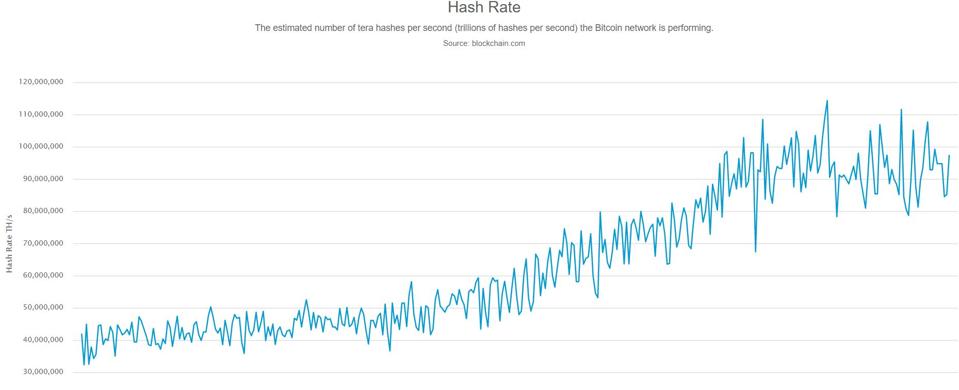
blockchain. The bitcoin blockchain is currently secured by 97
quintillion hashes per second, or EH/s. Data integrity is priority
number one for the maintainers of the bitcoin blockchain and they are
very restrictive about any new feature that can introduce security bugs
and potentially compromise the integrity of the protocol. The accuracy
and consistency of the data can be easily observed and analyzed by
simple blockchain explorers as well as by using surveillance tools like
Elliptic, Elementus and Chainalysis.
· Ability to build new revenue/business models –
Bitcoin currently has a $128 billion liquid market cap so building new
models on top of it can unlock new significant revenue channels.
Furthermore, the increased adoption of Layer 2 technology like the
Lightning Network, which operate via channels and enable cheap and fast
payments, will enable new business processes and ways to revenue.
· Increased operational efficiency – Since 2010,
when certain opcodes were taken out of the core protocol, smart
contracts were considered taboo in bitcoin. Lately, with the development
of Blockstream’s Liquid and the new RSK framework, Schnorr signatures and Taproot will make smart contracts–like executions possible via sidechains.
Posted by AGORACOM-JC
at 2:53 PM on Tuesday, December 17th, 2019
SPONSOR: New Age Metals Inc.
The company owns one of North America’s largest primary platinum
group metals deposit in Sudbury, Canada. Updated NI 43-101 Mineral
Resource Estimate 2,867,000 PdEq Measured and Indicated Ounces, with an
additional 1,059,000 PdEq Ounces Inferred. Learn More.
Deficit-hit palladium takes aim at $2,000 ceiling in record run
“Supply is tight in the palladium market and when you’re adding the speculation about a potential pick-up in demand due to recovery in the global economy, you have a perfect storm of bullish news continuing to keep it supported,†Saxo Bank analyst Ole Hansen said.
(Reuters) – Scarce palladium soared on Tuesday, nearing a breach of the $2,000 an ounce level for the first time, with a “phase one†U.S.-China trade deal driving prospects of a pick-up in demand and helping the autocatalyst metal extend a record run.
Palladium was up 0.6% at $1,989.58 an ounce at 1035 GMT, after hitting an all-time high of $1,998.43.
“Supply is tight in the palladium market and when you’re adding the
speculation about a potential pick-up in demand due to recovery in the
global economy, you have a perfect storm of bullish news continuing to
keep it supported,†Saxo Bank analyst Ole Hansen said.
However, he added: “Liquidity is poor, which means that if we see a
correction, it can be quite brutal and could take palladium back down
towards $1,850, although there are no signs of that right now.â€
The phase one trade deal has been “absolutely completedâ€, a top White
House adviser said on Monday. However, Chinese officials have been more
cautious, emphasizing the dispute has not been completely settled.
Palladium, used mainly in vehicle catalytic converters, has gained
more than 57% so far this year because of a sustained supply crunch.
“We look set for an imminent test above $2,000,†MKS PAMP said in a note.
Elsewhere, gold prices rose due to uncertainty driven by a lack of concrete details about the interim trade deal.
Spot gold rose 0.2% to $1,478.41 per ounce. U.S. gold futures were also up 0.2%, at $1,482.90.
The trade dispute will be an influencing factor for gold throughout
next year, said Commerzbank analyst Daniel Briesemann, adding a phase
two deal would be much more difficult since a lot of critical issues had
been left out of the current agreement.
“We must be prepared for some volatility and uncertainty. It’s not yet a done deal.â€
Gold, considered a safe investment during political and economic
uncertainty, has gained about 15% this year, mainly driven by the
17-month-long tariff war and its impact on the global economy.
Also helping bullion, European stocks slid from record highs on
reports that Britain’s prime minister was ready to play rough in Brexit
talks, souring sentiment somewhat after a record rally during the Asian
session on the trade optimism.
Silver was 0.2% higher at $17.07 per ounce, while platinum gained 0.3% to $932.32.
Posted by AGORACOM-JC
at 11:59 AM on Tuesday, December 17th, 2019
SPONSOR: CardioComm Solutions (EKG: TSX-V)
– The heartbeat of cardiovascular medicine and telemedicine. Patented
systems enable medical professionals, patients, and other healthcare
professionals, clinics, hospitals and call centres to access and manage
patient information in a secure and reliable environment.
Mobile Health (MHealth) Technologies Market Projected to Gain Significant Value
The global mHealth market should reach $46.2 billion by 2021 from $13.2 billion in 2016 at a compound annual growth rate (CAGR) of 28.6%, from 2016 to 2021.
Report Scope:
This new report on mobile health will provide a brief description of
the current status of the industry and recent developments. It presents
the changing environment, in terms of new challenges and opportunities
for app development, remote monitoring and networking medical data. The
report analyzes the market trends, leading service providers,
therapeutic markets and the most popular mHealth applications, in terms
of downloads and revenues.
Report Includes:
– A global overview of the mobile health technology market. –
Analyses of global market trends, with data from 2014 and 2015,
estimates for 2016, and projections of compound annual growth rates
(CAGRs) through 2021. – A presentation of the changing mobile health technology environment in terms of new challenges and rising opportunities. – Information regarding market trends, leading service providers, therapy markets, and the most popular mHealth applications.
– Insight into the second generation of mHealth devices, projected
regulatory patterns, and innovative devices and services to be launched
in the near future. – Company profiles of major players in the industries covered.
Report Summary
Mobile health (mHealth) is the use of mobile and wireless
technologies to support healthcare systems and achieve healthcare
objectives. Digital health solutions have the potential to improve the
quality of healthcare, to democratize medical knowledge and provide
healthcare to billions or people who have limited or no access to
services. The provision of healthcare remains high on the economic and
political agenda and continues to demand a huge share of gross domestic
product (GDP) in industrialized countries, where an aging population and
increase in the prevalence of chronic noncommunicable diseases (NCDs)
remains a challenge.
mHealth can provide better and more consistence solutions within the
global healthcare environment and will change the way services are
provided in the future. Smart devices and wearable are empowering
individuals to more effectively manage their care, raising awareness,
providing continuous monitoring and disseminating of information to the
patient and healthcare professionals; driving a more proactive,
patient-centric healthcare system.
Posted by AGORACOM-JC
at 10:27 AM on Tuesday, December 17th, 2019
SPONSOR: PRIMO NUTRACEUTICALS INC.
(CSE: PRMO) (OTC: BUGVF) (FSE: 8BV) (DEU: 8BV) (MUN: 8BV) (STU: 8BV)
provides strategic capital to the thriving cannabis cultivation
sector through ownership and development of commercial real estate
properties. The company also offers fully built out turnkey facilities
equipped with state-of-the-art growing infrastructure to cannabis
growers and processors. Click here for more info.
Here’s Why Dollar General Has High Hopes for CBD
By: Rich Duprey
Dollar General (NYSE: DG) is jumping on the CBD bandwagon, announcing it intends to start selling products infused with cannabidiol in 1,100 stores across seven states by spring 2020
Limiting its selection of goods to topical products such as creams, ointments, bath bombs, bath salts, and face masks. Edibles are not part of the plan.
Yet where grocery stores, shoe stores, pharmacies, and wellness stores
have all previously said they, too, were joining the conga line of
retailers selling CBD products, the dollar store chain’s entry has a
greater chance of boosting its bottom line.
Image source: Getty Images.
Business is growing like a weed
Unlike many other retailers and even rival Dollar Tree, Dollar General is on fire, giving a master class in discount retailing
in the third quarter. Sales rose 9% to $7 billion on a near-5% increase
in comparable-store sales, generating a 13% rise in earnings per share.
Management also raised top- and bottom line guidance for the year.
It was tough to pick out a category that was best, as it saw
across-the-board sales increases, but it was enough for the discount
chain to know it needed to pick up the pace of expansion. Where it
expects to open 975 new stores this year, it plans on opening another
1,000 in 2020. In all, Dollar General will be involved in 20% more real
estate projects next year than it was this year.
That’s important because as it continues to reach further into all
regions of the country, getting closer to its target customer, CBD
products afford it the opportunity to accelerate that growth.
The madness of cannabis
Marijuana,
cannabis, and cannabidiol all live in a legal purgatory. Although a
number of states have legalized marijuana for personal use, it
officially remains a controlled dangerous substance at the federal
level.
Cannabis, on the other hand, essentially comprises two categories,
marijuana and hemp, with the major difference being the presence of
tetrahydrocannabinol, or THC, the psychoactive compound that gets a user
high. While hemp does contain THC, it is at very low levels and not
enough to get someone high. The 2018 Farm Bill removed hemp and hemp-derived products from its list of controlled dangerous substances.
CBD is one of over 100 compounds found in cannabis, but unlike THC,
it doesn’t get you high. Also, where marijuana has very little CBD, hemp
has a lot. Many also believe CBD has a variety of therapeutic
properties, and though some studies have seemingly backed up the claim,
there haven’t been very many studies, and the long-term implications
from its use are still unknown.
A green business
The Food and Drug Administration is slow-walking the
formulation of a coherent policy on CBD, which has put many retailers
in limbo on just how best to proceed. What the FDA was clear about in
its recent policy update, however, was that it is illegal to add CBD to
food or supplements. That’s why you see retailers opting for topical
applications of the compound.
Cannabidiol has another benefit for the retail industry in that it
enjoys over dried cannabis, or so-called legal weed. Consumers have
demonstrated willingness to pay up for the compound, and there is a
plentiful supply of CBD, suggesting profits will remain stable.
That’s an attractive feature for low-margin businesses like grocery
stores. But Dollar General, which sells merchandise at many different
price points, tends to make up in volume what it loses out in product
markups. Driving down the cost of CBD-infused products could cause
consumers to flock to its stores.
And for a discount chain, Dollar General is a relatively
high-profit-margin business. Over the past five years, its operating
margins stand at almost 9% and net margins are 6%. But compare that with
other retailers that have announced they will be selling CBD products.
Retailer
5-Year Operating Margin
5-Year Net Margin
Dollar General
8.9%
6%
Dollar Tree
8.4%
2.5%
CVS Health
5.6%
2.6%
Rite Aid
1.6%
2.1%
Walgreens
4.6%
3.5%
Kroger
2.6%
1.9%
Data source: Morningstar.
A smoking hot opportunity
The retail market is expected to be the biggest contributor
to CBD’s growth, accounting for 60% of the forecast $20 billion in
annual sales. Dollar General has the potential to bring CBD products to
more people and attract a bigger share of the market because of its
value proposition.
While there may be questions about the viability and efficacy of the
CBD in the products it offers (a question that looms over all retailers
selling CBD products), CBD has a higher chance of moving the needle for
Dollar General than it does for anyone else.
Source: https://www.nasdaq.com/articles/heres-why-dollar-general-has-high-hopes-for-cbd-2019-12-17
Posted by AGORACOM-JC
at 5:20 PM on Monday, December 16th, 2019
SPONSOR: NORTHBUD (NBUD:CSE)
Sustainable low cost, high quality cannabinoid production and
procurement focusing on both bio-pharmaceutical development and
Cannabinoid Infused Products. Learn More.
Ontario sold the most cannabis in first year of legalization
Ontario accounted for $217 million in recreational cannabis sales — or 24 per cent of the overall Canadian market
From October 2018 to September 2019, followed by Alberta and Quebec, which sold $196 million and $195 million worth, respectively
Cannabis retailers in Ontario sold the most cannabis of any province
in the first year following legalization, even though there was only one
online store and 24 brick-and-mortar stores in operation for most of
that period, according to new Statistics Canada data.
Ontario accounted for $217 million in recreational cannabis sales —
or 24 per cent of the overall Canadian market — from October 2018 to
September 2019, followed by Alberta and Quebec, which sold $196 million
and $195 million worth, respectively.
The year following legalization saw more than 400 brick-and-mortar
stores established across the country. Total adult-use cannabis sales
from online retail stores amounted to $908 million for that period, far
short of many estimates prior to legalization.
For instance, a June 2018 report from CIBC estimated that legal
cannabis sales could reach $6.5 billion by 2020, with the potential to
yield $1 billion in EBITDA. A similar report by Deloitte had forecast
the legal cannabis market to generate $4.3 billion in sales in the year
following legalization.
The StatsCanada data also observed a sharp decline in the number of
consumers who purchased cannabis online, in tandem with the growth of
the number of retail stores across the country. The share of online
sales declined from 43.4 per cent in Oct. 2018 to just 5.9 per cent the
following September, while the number of brick-and-mortar stores rose 88
per cent between March and July 2019.
Online retail stores — most of which are operated by provincial
wholesalers — made approximately $120 million in the year following
legalization, while brick-and-mortar stores raked in the remaining $788
million in sales.
Indeed, government-run stores have been struggling. Ontario Cannabis
Retail Corp. which operates the Ontario Cannabis Store, lost $42 million
in its latest fiscal year ending March 31, 2019. In New Brunswick,
Cannabis NB, the crown corporation in charge of selling cannabis,
recently said it was looking for a buyer, as losses piled up.
On a per capita basis, British Columbia reported the lowest sales
values in the country at $10 per capita in the year following
legalization. Ontario did not fare much better on that measure, with a
per capita sales value of $15. Alberta, by contrast, had one of the
highest per capita sales values at $45.
Statistics Canada attributed these vast differences to varying access
to cannabis stores. In Ontario, for instance, just nine per cent of
residents lived within a three kilometre distance to a cannabis store,
whereas in Alberta — the province with the highest number of stores — 50
per cent of residents lived within three kilometres of a cannabis
store.
The Canadian cannabis industry has, for the most part, struggled to
meet expectations from both investors and consumers, with price, quality
and accessibility being the key reasons why the sector did not take off
at a rate many had hoped it would.
While the first few months of legalization were characterized by a
supply shortage, the production ramp-up in the latter half of 2019 has
now created the opposite problem: oversupply.
Cannabis producers are urging the Ontario government to open up the
licensing process for retail stores, which they hope will lead to a
sharp growth in the number of stores across Canada’s most populous
province.
Posted by AGORACOM-JC
at 4:24 PM on Monday, December 16th, 2019
SPONSOR: New Age Metals Inc.
The company owns one of North America’s largest primary platinum
group metals deposit in Sudbury, Canada. Updated NI 43-101 Mineral
Resource Estimate 2,867,000 PdEq Measured and Indicated Ounces, with an
additional 1,059,000 PdEq Ounces Inferred. Learn More.
Palladium prices rally to record high
“Palladium has been on a multi-year run that shows few signs of abating,†John Ciampaglia, chief executive officer of Sprott Asset Management
Palladium futures rallied Friday to their highest settlement on
record, extending last year’s advance and narrowing their price spread
with gold to the smallest in roughly 16 years.
“Palladium has been on a multi-year run that shows few signs of
abating,†John Ciampaglia, chief executive officer of Sprott Asset
Management, wrote in a recent report. “Palladium is close to becoming
the most ‘precious’ of precious metals.â€
Palladium, which is used in pollution-controlling catalytic
converters on gasoline-powered vehicles, has been significantly
narrowing its spread with gold prices.
‘Palladium is close to becoming the most “precious†of precious metals.’ John Ciampaglia, Sprott Asset Management
On Friday, March palladium added $34.10, or 2.8%, to settle at
$1,234.40 an ounce. The finish was the highest based on FactSet records
dating back to November 1984, topping the previous record settlement of
$1,201.30 from Dec. 19.
February gold fell $9, or 7%, to finish at $1,285.80 an ounce dulled
investment demand in the yellow metal. That helped narrow its spread
with palladium futures down to $51.40, the lowest since November 2002,
according to Dow Jones Market Data. The last time palladium settled
higher than gold was in October 2002.
Overall, growing global demand for the industrial metal has fed worries about tighter supplies.
“While the escalating U.S.-China trade war hurt many commodities in
2018, it couldn’t dent palladium’s rise,†said Ciampaglia. “Demand for
palladium was especially strong last year, as environmental concerns
have prompted a global shift from diesel to gasoline and hybrid
vehicles.â€
“Not even the 2018 slowdown in China’s auto market, the world’s largest, dampened demand,†he said.
Auto sales in China, the biggest global market, were on track for
their annual decline in three decades after plunging 16% in November.
News Friday on progress toward a U.S.-China trade deal was upbeat,
however. China’s Commerce Ministry confirmed that a delegation of U.S.
officials will travel to Beijing for a new round of trade talks on
Monday and Tuesday, .
“Supply shortages continue to support palladium’s performance, with
strong multi-year growth in palladium demand now straining a fixed
supply,†Ciampaglia said. “Palladium is especially scarce and its supply
is inelastic since it is usually a by-product of ores that are being
mined for other metals, like platinum and rhodium.â€
Posted by AGORACOM-JC
at 2:29 PM on Monday, December 16th, 2019
SPONSOR: CardioComm Solutions (EKG: TSX-V)
– The heartbeat of cardiovascular medicine and telemedicine. Patented
systems enable medical professionals, patients, and other healthcare
professionals, clinics, hospitals and call centres to access and manage
patient information in a secure and reliable environment.
Digital Health Market Latest Innovations and Industry Analysis
Rapid Adoption of mHealth Technologies Drives the Market
“Rising number of government initiatives aimed at promoting digital health solutions will enable growth in the market,â€
The Global Digital Health Market is driven by several factors. “Rising number of government initiatives aimed at promoting digital health solutions will enable growth in the market,†said a lead analyst at Fortune Business insights. “In the coming years the digital health market is estimated to benefit from the uptake of IT in the medical industry,†he added. With the increasing use of smartphones across the world the demand for digital health services is growing owing to the rising adoption of mhealth apps.
Other factors such as the rising demand for in-house remote
monitoring devices and increasing geriatric population will catalyze
growth of the digital health and wellness services. Digital health over
the past few years has become a game changer in the digital health
industry. Digital health services help in monitoring diseases and
provide access to electronic information of patients through tablets or
mobiles. Doctors can check the complete digital health record of their
patients and accordingly offer the best consultation. All the factors
mentioned above are anticipated to boost the digital health market
during the forecast period.