Posted by AGORACOM-JC
at 4:03 PM on Friday, January 11th, 2019
SPONSOR: ThreeD Capital Inc. (IDK:CSE) Led by
legendary financier, Sheldon Inwentash, ThreeD is a Canadian-based
venture capital firm that only invests in best of breed small-cap
companies which are both defensible and mass scalable. More than just
lip service, Inwentash has financed many of Canada’s biggest small-cap
exits. Click Here For More Information.
——————–
The New York City Economic Development Corporation’s (EDC) new Blockchain Center opened Thursday, and intends to begin testing the tech’s use cases next fall, Bloomberg reported Thursday.Â
The center is part of a partnership with the venture capital fund Future\Perfect Ventures and the Global Blockchain Business Council trade organization.
New York City may begin testing blockchain technology for various use cases later this year.
The New York City Economic Development Corporation’s (EDC) new
Blockchain Center opened Thursday, and intends to begin testing the
tech’s use cases next fall, Bloomberg reported Thursday. The
center is part of a partnership with the venture capital fund
Future\Perfect Ventures and the Global Blockchain Business Council trade
organization.
It is unclear at this time which areas these use cases may cover. The EDC
is a non-profit corporation which aims to support economic growth
within the city. It acts as New York’s official economic development
corporation.
New York City itself has contributed $100,000 to the new Blockchain
Center, and the facility will continue to raise funds through corporate
partnerships and membership dues.
Microsoft Corporation and IBM have already partnered with the center,
Future\Perfect Ventures managing partner Jalak Jobanputra told
Bloomberg.
The new center, based in the Flatiron District, will offer classes on
coding and host lectures aimed at both developers in the space and the
general public.
The move comes as a number of crypto startups began laying off
employees due to an ongoing bear market, but this is not necessarily a
concern for the center.
Ana Arino, chief strategy officer with the EDC, told Bloomberg that the center was “playing the long game,†adding:
“It’s a nascent technology, so there’s bound to be uncertainty around
this evolution from year to year. While we don’t know what the future
holds, we want to make sure we have a seat at the table shaping it.â€
A number of companies are beginning to set up shop within New York, including Coinbase, which opened a new office in the city last fall. Canaan, a maker of bitcoin mining hardware, is also reportedly considering launching an initial public offering in the city.
The EDC did not respond to a request for comment by press time.
Posted by AGORACOM
at 11:40 AM on Friday, January 11th, 2019
Acquired a majority stake in Trace Analytics, Inc., a leading testing and analytics company.
The team has over 65 years of experience in the testing and analytics space and a full-time staff of nine employees including, two Ph.D. analytical chemists and five other scientists.
A recent report from Coherent Market Insights1 estimates that the global cannabis testing market is projected to grow 13.2% year-over-year through 2026, when it is expected to surpass $1.5 billion USD.
Applied BioSciences products use base ingredients that are USDA Organic and non-GMO. Offering Vegan, sugar-free, 99% Pure CBD Isolate infused. The products are formulated with CBD extracted from pesticide-free, organically grown, domestically produced, High-CBD Industrial Hemp. Lab-tested and guaranteed Pesticide and Chemical-free. Our proprietary blends also contain USDA certified organic botanicals, herbals and essential oils to provide synergy with other healing elements found in nature.
On December 20, 2018, President Trump signed the US Farm Bill into law. The new law defines hemp as an agricultural product for the first time in 50 years and allows American farmers to plant and harvest hemp. This will allow farmers and researchers of hemp to receive the same benefits as farmers and researchers of other crops, including the ability to apply for insurance and federal grants
Applied BioSciences early stage investment in Hightimes Magazine is valued at approximately $1.75 Million at assumed IPO Pricing of $11.00
Posted by AGORACOM-JC
at 11:02 AM on Friday, January 11th, 2019
SPONSOR: Good Life Networks (GOOD:TSX-V)
Video advertising is the future! Company’s A.I. makes 80,000
calculations / second, targeting 750 million users to deliver higher
prices and volume. Revenue was $10,000,650 for the nine months ended
September 30th, 2018, a 142% increase from $4,133,231 reported for the
six months ended September 30th, 2017. Click here for more information.
GOOD: TSX-V
————————————–
2018 was a big year in the advertising tech and marketing tech arenas, filled with blockbuster acquisitions and rising new technologies, such as programmatic mobile buying which became mainstream.
So, what will be the big industry-defining trends in 2019? What trends will continue and what will drop off in the new year?
2018 was a big year in the advertising tech and marketing tech
arenas, filled with blockbuster acquisitions and rising new
technologies, such as programmatic mobile buying which became
mainstream.
So, what will be the big industry-defining trends in 2019? What trends will continue and what will drop off in the new year?
Here are my top predictions for 2019:
OTT/connected TV will come into its own
Over-the-top television (OTT) and video streaming units (think Roku
and Chromecast, for starters), along with connected TV apps such as
Netflix, Amazon and Hulu have dramatically reshaped the television and
video landscape. Once upon a time, software was eating the world. Now, it’s video’s turn.
Despite the incredible growth so far of OTT and connected TV, this is only the beginning. In 2019, expect both video outlets to be even more pervasive.
So, what does this mean for advertisers and marketers? Certainly,
paid channels such as Netflix, HBO Now, etc. will continue to do well,
but the majority of consumers are not willing to pay for more than two
outlets/channels at a time. As such, I predict that both advertisers and
OTT app publishers will invest further in seamless, effective
advertising options in the next year.
“Ad-supported OTT will prove to be a strong contender for television
advertising dollars as more and more viewers shift away from traditional
television,†says Kedar Gavane, Vice President at Comscore. “Today, OTT
delivers the best of TV with the capability to precisely target viewers
down to the zip code level, and use factors like demographics,
lifestyle and interests. More advanced analytics tools are enabling
advertisers to target the right audience, buy the highest quality
inventory and measure OTT campaign results more effectively.â€
There will be greater accountability in advertising and adtech
In Gartner’s “2018 Hype Cycle for Digital Marketing and Advertising”,
we see mobile marketing analytics, ad verification and multitouch
attribution as past the peak of inflated expectations and nearing the
trough of disillusionment. Why is that?
To me, this all points to how everyone in the adtech space is looking
for greater accountability, transparency and insights in regard to
their spending and actions. According to Yory Wurmser, eMarketer’s principal retail analyst, this will be one of the biggest issues marketers must face head-on in 2019.
This is also why more brands will bring their efforts in-house in
2019, along with a greater focus more on cross-device and multitouch
attribution. It also helps to explain why adtech that increases reach
and revenue alongside transparency, like programmatic ad buying and
unified ad auctions, will be increasingly prevalent in the new year too.
“The biggest issue in mobile marketing today is trust. As more and
more companies enter the fray, with varying levels of technology and
frankly, legitimacy, it becomes increasingly difficult for buyers to
ascertain what is real and what isn’t,†says Mike Brooks, SVP of Revenue
at WeatherBug. “That said, as more and more advanced types of fraud are
being uncovered and taught to even the most basic buyers, the
advertisers in the mobile space are going to optimize their spends
toward partners they can trust to not perpetrate these schemes. I think
this is finally the year where advertisers start talking with their
money and moving it to people they trust and business models they
understand.â€
5G will lead to unforeseen advances
For both adtech and martech specifically, and really for the world at
large, 5G has the potential to be immensely disruptive. Autonomous
vehicles and drones could be the tip of the iceberg as far as potential
applications are concerned. Its effects on society could defy
imagination!
Think for a moment, about all the changes that came about as a result
of 4G and LTE. Without it, there’s no Uber, no WeChat and no Facebook
— at least, not in the way we consume them now. Truthfully, the entire
app economy may not have taken off if we were all still relying on 3G.
I believe a similar shift will occur with a wider 5G rollout.
Everyone — including advertisers and marketers — should prepare now
for our upcoming digital out-of-home lives.
Tech will increasingly work the way we do, not the other way around
Perhaps the most revolutionary feature of the iPhone was its
touchscreen display. Simply by poking and tapping the screen, we can now
do just about everything. It’s so easy and intuitive to use, even for
the less technologically savvy.
Unlike laptops and desktops, mobile devices cater to how we work
naturally, as opposed to typing or using a mouse. Going into 2019, and
beyond, expect more technology to cater to and center around how humans
naturally interact with the world.
Voice is a prime example of this. Why type something out when you can
speak it in less time? Voice communication is far more natural to us,
and technology is really beginning to catch up. The same concept applies
to computer vision and visual search, which Yory Wurmser thinks will
really take off in 2019.
This is also why I think VR has a way to go. The headsets are currently too clunky and not as seamless as they need to be.
So, what does all this mean for adtech and martech specifically? One
of the main reasons why we’ve seen so much consolidation in our space
over the past few years is because companies realize they need greater
resources and long-term support in order to fully develop these kinds of
future-focused endeavors.
Data will become an even more valuable asset to marketers
Data may have been the new oil
since 2017, but that doesn’t mean advertisers and marketers have yet to
fully grasp its true value. Expect that to change though in 2019, as
data-led initiatives become the norm.
Gartner thinks
Data-Driven Marketing is five to 10 years away, but I predict it will
arrive in force sooner than that. Laws such as GDPR in the EU and the
California Consumer Privacy Act that took effect in 2018 show that
governments are valuing advertising and marketing data just as much.
This will especially be true in the realm of artificial intelligence
and machine learning. Through AI, brands will be able to better find the
right audiences and offer them more effective ads, among many other use
cases. Marketing will be propelled forward by AI in 2019.
Will I Be Proven Right?
Of course, with any prediction, there’s always a chance I will be
wrong. However, regardless of what actually occurs in 2019, it’s safe to
say that disruptive change is afoot for the adtech and the martech
space. Exactly how much and in what ways, only time will tell.
Abhay Singhal is the co-founder and President of Advertising Cloud at InMobi.
Sequoia India Led $40 Mn Series C Funding Round In Edtech Company Eruditus
Existing investor Bertelsmann India Investments also participated in the round
The funding will be used to increase its course offerings in technical subjects
It also plans to expand its multilingual offerings
Edtech company the Eruditus group
which runs Eruditus Executive Education and its online division Emeritus
has raised $40Mn (INR 281 Cr) in a Series C funding round which was led
by Sequoia India. The round also saw participation from existing
investor Bertelsmann India Investments.
The company will use this funding to
increase its course offerings in technical subjects such as data
science, machine learning, blockchain and cybersecurity. It also plans
to expand its language offerings to include Portuguese and Mandarin, in
addition to English and Spanish.
“We will use the proceeds of this
latest fundraise to create a more immersive and adaptive learning
platform, to expand our multilingual capabilities, and to ensure that
our omnichannel offerings are readily available to our students
on-the-go,†said Ashwin Damera, cofounder of Eruditus and director at
Emeritus.
Eruditus: Targeting A 10X Hike In Student Enrollment
Eruditus, founded in 2010 by Chaitanya Kalipatnapu and Ashwin Damera,
provides executive education programmes in association with global
business schools such as MIT, Columbia, Harvard Business School, INSEAD,
Tuck at Dartmouth, Wharton, UC Berkeley and London Business School.
These programs are held for six to eight months and can be available via on campus, off campus and online modes.
The company is looking to enroll 30K
students from more than 80 countries in the current financial year. It
also aims to increase its enrollment by more than 10 times within the
next five years across certificate courses and online degrees.
Eruditus had earlier raised $8.16 Mn (INR 57.4 Cr) in a Series B funding round led by Bertelsmann India Investments in 2017. Earlier in July, it had raised $2.2 Mn (INR 16 Cr) in a debt financing round from Innoven Capital.
Edtech Funding In India
The edtech sector has been recently
gaining popularity among the investors. In 2017, edtech witnessed a 30%
hike in terms of investments with international funding touching a new record of $9.52 Bn (INR 67,010 Cr).
Last month, Hyderabad-based edtech startup Toppr has raised funding
of $35 Mn (INR 246.13 Cr) from Kaizen Private Equity and existing
investors SAIF Partners, Helion Ventures, Kaizen PE and Eight Roads
Ventures.
Edtech unicorn BYJU’S raised $540 Mn
(INR 3,800 Cr) in Series F funding from Canada Pension board’s
investment arm CPPIB Investment Board Private Holdings, Naspers Ventures
BV and General Atlantic Singapore TL Pvt Ltd, boosting its valuation to
$4 Bn (INR 28,155 Cr).
According to a report
by the India Didactics Association, the online education industry in
India is projected to grow almost eight times to hit $1.96 Bn (INR
13,795 Cr) by 2021. It also added that the number of paid users in the
segment is expected to grow six-fold to reach 9.6 Bn by 2021.
A report
by Google-KPMG said that reskilling and online certification courses
accounted for about 38% of the total online education market as of 2017.
Posted by AGORACOM
at 8:34 AM on Friday, January 11th, 2019
Update on fully permitted 2019 bulk sampling program on the Albany Graphite Project, located in northern Ontario
Purpose of the program is to recover a large sample of the graphite mineralization in order to generate graphene product samples for market development purposes
Program to generate up to 40 tons of 99.8% purity graphene pre-cursor material, with a budget of 3$M derived from recent financing.
Thunder Bay, Ontario–(January 11, 2019) – Zenyatta Ventures Ltd. (TSXV: ZEN) (“Zenyatta”, “ZEN” or “Company”) is
pleased to provide an update on its now fully permitted 2019 bulk
sampling program on the Albany Graphite Project, located in northern
Ontario near the communities of Constance Lake First Nation and Hearst.
The main purpose of the program is to recover a large sample of the
graphite mineralization in order to generate graphene product samples
for market development purposes. The program is expected to generate up
to 40 tons of 99.8% purity graphene pre-cursor material. The total
budget for the program is $3 million, to be funded with the proceeds of
the recently completed flow-through financing.
The Company has now received the final two permits required from the
Ministry of Northern Development and Mines: one for permission to
collect the 990 tonne sample and offer graphene produced from the sample
for sale to prospective future customers; and second, an exploration
permit to drill the large diameter reverse circulation drill holes
required to recover the sample from the overburden-covered Albany
Deposit.
The Company has also received permission from the Ministry of Natural
Resources and Forestry to build three ice bridge creek crossings along
the proposed winter access road to the drill site which will largely
utilize pre-existing forestry roads, a bridge and the 2013 winter trail.
Now that the program is fully permitted and funded, preparation of the
winter road will get underway immediately. The drilling is expected to
be completed by the end of March 2019 following which processing work on
the bulk sample can begin.
Peter Wood, P. Eng., P. Geo. is the qualified person for the purposes
of National Instrument 43-101 and has reviewed, prepared and supervised
the preparation of the technical information contained in this news
release.
Zenyatta’s Albany Graphite Project hosts a large and unique quality
deposit of highly crystalline graphite. Independent labs in Japan, UK,
Israel, USA and Canada have demonstrated that Zenyatta’s Albany
Graphite/Naturally PureTM easily converts (exfoliates) to graphene using
a variety of simple mechanical and chemical methods. The deposit is
located in northern Ontario just 30km north of the Trans-Canada Highway,
near the communities of Constance Lake First Nation and Hearst.
Important nearby infrastructure include hydro-power, natural gas
pipeline, a rail line 50 km away and an all-weather road just 10 km from
the deposit.
To find out more on Zenyatta Ventures Ltd., please visit our website at www.zenyatta.ca.
A copy of this press release and all material documents with respect of
the Company may be obtained on Zenyatta’s SEDAR profile at www.sedar.ca.
Posted by AGORACOM-JC
at 3:57 PM on Thursday, January 10th, 2019
SPONSOR: Esports Entertainment $GMBL Esports audience is 350M, growing to 590M, Esports wagering is projected at $23 BILLION by 2020. The company has launched VIE.gg esports betting platform and has accelerated affiliate marketing agreements with an additional 42 Esports teams, bringing total to 176 Esports teams. Click here for more information
—————-
Esports Trends in 2019: From Mobile Esports to Endemic Partnerships
China to tighten control on video games
Southeast Asia (SEA) esports will rise in 2019
Esports venues will continue to develop around the world
College competitive video gaming is becoming more popular in North America
The future of mobile esports in 2019
Esports players will be featured in more marketing campaigns by non-endemic companies
Steam won’t be the only leading marketplace for video games in 2019
At the beginning of the year, marketing intelligence firm Newzoo
released a list of trends focusing on the gaming and esports landscape
in 2019. The company covered topics as diverse as the rise of digital
stores, China’s regulatory clamp-down on the gaming industry, and the
intensifying frequency of partnerships between non-endemic brands and
esports competitors.
Newzoo’s trends to watch in 2019. Photo credit: Newzoo trends.
China’s Ethics Committee Takes an Aim at the Video Gaming Industry
At the end of 2018, a newly-set regulatory body in China, the Ethics Game Committee,
issued recommendations to several high-grossing games in the country,
outlining issues with the “morality and values†propagated by the titles that had made it on the list.
While not banning the games outright, as clarified by The Esports Observer (TEO),
the Committee charted a course for 2019 where the government would have
a much greater say in what games arrive on the market. As a result,
companies will have to either adapt.
Domestic tech giants, such as Tencent, are already thinking of avoiding part of these regulations by setting-up a digital store in Hong Kong
and selling their games abroad. The newly-outlined provisions will also
force the hand of foreign developers to either adjust their titles or
focus on other emerging and well-developed markets, such as Southeast Asia, Japan, South Korea and the established bastions of gaming to the West.
The Rise of Southeast Asia (SEA) Gaming
Southeast Asia (SEA) is going to prove a particularly vibrant market with the global audience reaching 31.9 million, according to Newzoo. Malaysia already played host to one of the largest Dota 2 events in 2018, The Kuala Lumpur Major, as part of the new competitive season for the popular MOBA title.
“Southeast Asia (SEA) boasts the fastest-growing esports audience, which will reach 31.9 million in 2019.” – Newzoo
Click To Tweet
Places like Malaysia are marked by a strong grassroots community with organizations such as Geek Farm successful launching teams across multiple high-grossing titles, including PlayerUnknown’s Battlegrounds (PUBG), Dota 2 and mobile esports games, such as Mobile Legends: Bang Bang.
Streaming is also a popular segment in SEA where entire esports
communities are formed in social media around the idea of sharing
streams in pursuit of recognition.
According to Newzoo, up and coming titles in the region include games, such as Hearthstone, NBA 2K and Tekken 7. Another important development in the region is the arrival of the 2019 Southeast Asian Games which will introduce esports as a medaled discipline.
There is a lot of untapped potential in SEA that western companies
and event organizers are only now beginning to realize. Again, in Asia,
the MMA League ONE has decided to expand into esports,
vowing to run multiple events across Asia, drawing on its expertise in
organizing large competitions.
Building Esports Venues Is Gathering Steam
The idea of esports arenas where fans can attend in person has been gaining traction, fast-tracked by organizations such as the Overwatch League (OWL) and even the Call of Duty World League (CWL).
Official competitive events part of the LoL World Championship and Dota
2 International has attracted significant interest, but it’s league
formats as the OWL and CWL that are changing the game by creating
permanent locations for fans to flock to during competitive seasons and
in the interim periods.
— HyperX Esports Arena Las Vegas (@HyperXESALV) January 10, 2019
In 2018, the HyperX Esports Las Vegas Arena at the Luxor
became one of the first venues to offer both a place for competitive
gameplay and spaces for gamers of varying skill levels to interact.
Apart from the fully decked-out arenas, HyperX unveiled its Esports Truck arena, mobile venue caring high-quality gear and a dedicated broadcasting studio.
Full Sail University’s $6-million arena project in Florida will be the largest arena for collegiate esports.
Click To Tweet
Esports venues are not built just by game developers and leagues. Full Sail University’s $6-million arena project in Florida will be the largest arena for collegiate esports. Full Sail University is part of the National Association of Collegiate Esports (NACE).
Collegiate Esports Seem to be on a Fast-Track to Success
Collegiate esports are another fast-developing culture in North America. NACE has so far signed over 100 institutions of higher learning, fielding competitors among multiple competitions, including Overwatch, League of Legends, and most recently Hi-Rez Studios’ SMITE and Paladins.
Universities have been quick to develop their varsity programs,
introducing a number of opportunities for those interested in esports as
a competitive format and those keen on assuming a managerial role
within the industry.
According to Newzoo, the mobile experience will become far more
engrossing in 2019, creating even more engaging titles. So far, some of
the most popular games on mobile to qualify as esports have been:
Mobile Legends: Bang Bang
Arena of Valor
Honor of Kings
Fornite
PUBG
Clash Royale
Clash of Titans
Admittedly, not all of these titles are excessively popular, although Fortnite iOS raked in nearly $455 million
in 2018 alone in terms of game revenue. The game pulled off $69 million
in December (although that number clearly fluctuated throughout 2018), Sensor Tower reported recently.
Arena of Valor is another title that left its mark
on 2018, with 1.120.455 people watching the Arena of Valor International
Championship 2018, as per Esports Charts’ data.
Meanwhile, Supercell’s Clash Royale and Clash of Titans
have been expanding their communities, although the preferred choice of
entertainment (from esports standpoint) has been Clash Royale. The game
already features 44 esports organizations worldwide, which has landed
it traction and despite the fairly fresh concept of “mobile esports†in
the West, the segment has been doing just fine.
In 2018, Blizzard announced Diablo Immortal and
stated their plans to launch every game they have for mobile. While the
news wasn’t particularly well-met, by Blizzard fans especially.
Neverhtless, the company seems confident in pushing ahead with its
mobile ambitions. Meanwhile, Diablo Immortal’s official trailer must be
one of the most down-voted game teasers in history (at least on
YouTube).
More Player Branding Partnerships Arriving in 2019
“RAMZES doesn’t have enough facial hair to be the face of Gillette” – Roman Dvoryankin, Virtus Pro Manager
In 2018, we saw League of Legends player Uzi become part of the Nike
Chinese “Dribble &†marketing campaign alongside mainstream athletes
such as LeBron James. Dota 2 Virtus.Pro’s Alexey “Solo†Berezin was featured in a Head & Shoulders campaign while teammate Roman “RAMZES666†Kushnarev was the face of a new Gillette commercial.
Posted by AGORACOM-JC
at 3:11 PM on Thursday, January 10th, 2019
SPONSOR: North Bud Farms Inc. (NBUD:CSE) Sustainable low cost, high
quality cannabinoid production and procurement focusing on both
bio-pharmaceutical development and Cannabinoid Infused Products. Click Here For More Information
Marijuana is going mainstream and Wall Street has started to notice. Recreational marijuana is now legal in Canada.
And even though there is still a federal ban on pot in the United States, Washington has started to loosen some regulations on other products derived from cannabis, including hemp, following the recent passage of the Farm Bill.
New York (CNN Business)Marijuana is going mainstream and Wall Street has started to notice. Recreational marijuana is now legal in Canada. And even though there is still a federal ban on pot in the United States, Washington has started to loosen some regulations on other products derived from cannabis, including hemp, following the recent passage of the Farm Bill.
Several states have also legalized recreational and medical marijuana. That’s why Vivien Azer of Cowen & Co. is extremely bullish about the prospects for cannabis companies. Â
Azer is the first analyst at a major stock research firm to start coverage of cannabis companies. She held a call with reporters on Tuesday to discuss her views on the sector. Azer covers Canada’s Canopy Growth (CGC) and Tilray (TLRY) as well as US-based cannabis packaging maker KushCo (KSHB). Â She now thinks the market for cannabis in the United States will reach $80 billion by 2030. That sales potential has already attracted the interest of several alcoholic beverage and tobacco giants seeking growth as booze and cigarette sales slump. Â
Azer expects more deals like this, particularly from the beverage makers. The rationale: Drink companies view cannabis as a product that could lessen demand for beer, wine and hard alcohol, particularly as more US states legalize marijuana. Â “Consumers say they cut back on alcohol when they mix alcohol and cannabis,” Azer said during the conference call Tuesday, adding that she would not be surprised to see Diageo (DEO), the maker of Johnnie Walker, Ketel One and Guinness, to eventually make a deal to get into the cannabis market along with other spirits companies. Â
Although Azer is predicting strong demand for legal cannabis in Canada, the United States and other parts of the world, she still thinks that many of the pot stocks got ahead of themselves leading up to the legalization of marijuana in Canada in October — and that is why many of them have fallen in the past few months. Â
She added that some dispensaries in Canada were faced with shortages of marijuana and also couldn’t handle demand for online orders. Some were forced to delay shipments. That’s led to some choppy sales in the first few weeks since legalization. Â “It comes down to fundamentals. So is it surprising to see the cannabis stocks sell off after Canada’s legalization? No. The runup was too far too fast and there were some companies that reported revenue misses,” Azer said. Â
A worker collects cuttings from a marijuana plant at the Canopy Growth Corporation facility in Smiths Falls, Ontario. Â Azer concedes that the stocks may remain volatile for a bit because they have attracted so much interest from more fickle individual investors, as opposed to big institutions like mutual funds and hedge funds. Â
But she argues that the stocks will stabilize once more long-term investors join some of the short-term traders and start buying them. That might happen sooner rather than later as Wall Street recognizes that marijuana is becoming a legitimate consumer product. Â
Piper Jaffray initiated coverage on Canopy and Tilray on Wednesday with outperform ratings. Canadian companies Aurora (ACB) and Aphria (APHA) have recently begun listing in the US, too, which means analysts may begin covering them as well. Â Source: https://www.cnn.com/2019/01/09/investing/cannabis-stocks-canopy-tilray-alcohol-tobacco-cowen/index.html
Posted by AGORACOM-JC
at 2:03 PM on Thursday, January 10th, 2019
SPONSOR: ThreeD Capital Inc. (IDK:CSE) Led by
legendary financier, Sheldon Inwentash, ThreeD is a Canadian-based
venture capital firm that only invests in best of breed small-cap
companies which are both defensible and mass scalable. More than just
lip service, Inwentash has financed many of Canada’s biggest small-cap
exits. Click Here For More Information.
——————————
The $100B Blockchain Proof Of Concept Hiding In Plain Sight
Last year, perceptions of blockchain technology were caught in the crossfire of both cryptocurrency’s swift peak and dramatic plunge.
It’s not surprising: cryptocurrency is the first and most visible application of blockchains, and many people think they are one and the same.
Last year, perceptions of blockchain technology were caught in the
crossfire of both cryptocurrency’s swift peak and dramatic plunge. It’s
not surprising: cryptocurrency is the first and most visible application
of blockchains, and many people think they are one and the same. It may
be convenient and easy to use price or market cap to summarize the
industry narrative. But it’s incorrect. The blockchain space is vast,
spanning industries, each with different adoption curves and
opportunities—and the nuanced value of the nascent technology isn’t
reflected in these numbers. In fact, focusing on these metrics obscures
what is really happening inside the space, putting execs at risk of
developing blind spots that hide potentially disruptive development as
it gathers steam.
But as billions poured into cryptocurrency in 2018, we did we learn
something meaningful. The world got a high-stakes proof of concept
exploring if blockchains could really be a way to safely
transfer digital value from one party to another. Even as large-scale
hacks of companies with poor custody practices filled the news, millions
of people around the world contributed to a global battle test to see
if the technology could safely hold or transfer, at times, well over a
hundred billion dollars of digital value in the form of
blockchain-driven cryptocurrency. This revealed challenges ahead (the
need to evolve consensus and governance mechanisms, improve user
experience, and get to regulatory clarity, to name just a few). But it
also showed us that yes, blockchains can safely transfer digital value.
So how are businesses reacting? Corporations are paying attention,
working hard to understand how this functionality translates to their
industry, and how it shapes potential disruption. Here are several
insider perspectives on where we are today, and where companies are
investing in the technology as we go into 2019:
Jessica Groopman, Industry Analyst and Founding Partner, Kaleido Insights:
The market seems to be entering a winter, as AI did two or three
times before its commercial boom. These kinds of shakeouts are
ultimately a good thing because they help distinguish fact from fantasy.
There are signals that suggest this will be a mild winter, rather than a
full hibernation. First, several adjacent spaces that will influence
adoption are growing, like AI, encryption techniques, and digital
identity management. Second, we see some steps towards mainstreaming,
with regulatory actions, consolidation in crypto-exchanges like
Coinbase, and virtually all of the world’s largest technology companies
building dedicated blockchain-based teams and products. Third,
investment is moving away from speculation, such as in ICOs, and towards practical investmentslike
smart contracts platforms, data exchanges, and prime use cases. One of
most powerful things blockchain has done for business is teach us to think blockchain, i.e. to question the efficacy of centralized processes and think about value chains more strategically.
Brian Lio, CEO of research and advisory firm Smith + Crown:
The current markets are a poor reflection of the actual pace and type
of development that is going on right now. We are seeing increasingly
large brands and sophisticated multi-national organizations realize this
technology has the potential for both disruption and opportunity. They
are starting to perceive there is risk in leaving it up to others to
figure out first. More and more companies are understanding they need to
build their front lines, to understand the power this technology offers
so they can start to prepare for or even take a lead in building what a
blockchain-influenced future looks like for their particular industry.
It’s happening across quite a few industries. Companies are becoming
more public about their exploration, but we are also seeing thoughtful,
innovative foundational work being done behind the scenes as well.
David Post, Managing Director, IBM Blockchain Ventures
We have a high degree of confidence that 2019 will be the year that
enterprise blockchain networks—especially those addressing strategic
industry use cases—will begin to emerge at scale. Blockchain business
models will continue to mature, with both companies and the venture
community helping to shape how these blockchain networks evolve. A
variety of compelling concepts are emerging in financial services,
supply chain, and media and entertainment. And we will see strategically
important networks move to production, as companies partner with
startups to solve complex challenges via the improved trust and
transparency delivered by blockchains.
Linda Pawczuk, principal at Deloitte Consulting LLP
As we head into 2019, supply chain continues to be one of the largest enterprise applications for the technology—in a recent survey
we found 53% of the execs surveyed stated they have ongoing supply
chain use cases for blockchain. We’re seeing pharmaceutical companies,
logistics providers, retailers, government agencies, and technology
firms all working to enhance logistics network visibility via blockchain
technology. We’re also seeing increased investment in digital
recordation, digital identity and IoT from corporates. In the same
survey, greater than 44% claimed to be working on an active use case
using blockchain in at least one of these spaces.
Lou Kerner, Founding Partner of venture firm and advisory CryptoOracle:
Shakeouts are a natural part of our economic system. Economies with
no shakeouts are the unhealthy ones. We’re still in the infrastructure
phase of investing, building the rails that the industry will use to
grow applications and services, and companies like R3 (enterprise
blockchain), Coinbase (trading platform), Circle (finance company), and
Ledger (wallet) are still attracting investment. The crypto bulls, like
myself, believe crypto is a thing. The question is less ‘if’, than
‘when’. The companies getting the most funding today either have
rapidly growing user bases or have great teams going after large
opportunities, like stablecoins.
These insiders paint a measured counterpoint to the gloom and doom of
headlines focused on crypto markets. However, “crypto winter†has
certainly impacted blockchain entrepreneurs, with the price drop
triggering sometimes fatal collateral damage to young businesses. Smith +
Crown’s ICO Tracker shows the Initial Coin Offering (ICO) market chilled from 113 in December 2017 to just three in December 2018
. Poor treasury management practices created cash crises for upstart
companies that kept funds in cryptocurrency after an ICO. Consensys and
Steemit, two well-known firms in the space, reported layoffs in December
while many smaller companies are quietly shutting down.
But as the market plunged, it released another kind of pressure. The
misperception of cryptocurrency price as an indicator of blockchain
potential had triggered overinflated expectations of blockchain
technology. In the (relative) quiet after the fall, blockchain
entrepreneurs now have the space in which to explore how to build on
last year’s work to create something truly meaningful. From the outside,
and next to 2018’s drama, measured but steady progress may feel almost
boring. But inside the community, something very exciting continues to
brew. It just requires more nuanced perception to see it.
I am the founder and CEO of Unblocked Future, a consultancy that
helps executives to drive adoption at the forefront of emerging tech. We
help companies communicate their vision, resonate with stakeholders,
and activate communities for change. I’m also the author of ‘Unblock…
Posted by AGORACOM
at 11:35 AM on Thursday, January 10th, 2019
Collaborating with Perpetuus Carbon Technologies Ltd. to develop and market material-enhancing-graphite-derived graphenes and graphene hybrids for tire elastomers
Gratomic and Perpetuus are currently in collaboration to build on Perpetuus’ capability to initially provide 500 tonnes of surfaced modified graphenes per annum to support the volumes required by the tire manufacturing industry
Currently shipped 2.25 tonnes of Graphite concentrate to Perpetuus
Perpetuus undertook to build three specialized process tooling chambers (“Chambersâ€) to be used solely for processing Graphite from Gratomic’s Aukam Graphite mine in Namibia.
Exploring options to exploit polymer composites, energy capture and storage applications markets.
63% interest in The Aukam vein graphite deposit with an option to earn an additional 10% for USD 180 000
The only jurisdiction outside Sri Lanka with foreseeable lump graphite production and competitive grade
Existing mine infrastructure (open pit and adits) allowed for rapid restart of operations
Construction started on 10,000 tonne per annum processing plant
Bulk sampling of dump material over 2 months resulted in stockpile of graphitic material grading up to 82.1%
Letter of intent to provide up to 5,000 tonnes of graphitic material a year for graphite anode market
Developing graphitic foil market
Long term lease agreement in place with land owner
Aggressively developing other industrial applications such as Lubricants, special rust proof coatings
FULL DISCLOSURE: Gratomic is an advertising client of AGORA Internet Relations Corp.
Posted by AGORACOM
at 11:17 AM on Thursday, January 10th, 2019
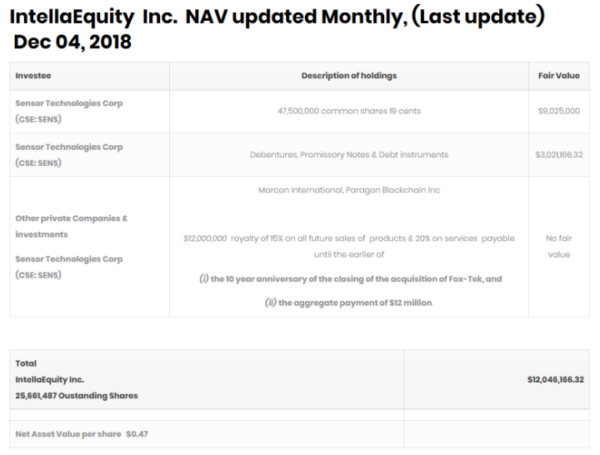
Intellaequity to issue 25.61M Sensor shares to holders
Sensor shares will be distributed to resident holders of Intellaequity shares.
The distribution will be completed through two distributions, one distribution of 12,805,743 Sensor shares The second distribution of 12,805,744 Sensor shares.
The first distribution will be distributed to holders of Intellaequity shares on record as of close of business Jan. 15, 2019. The record date of the second distribution will be fixed by the board of directors of the corporation.
FULL DISCLOSURE: IntellaEquity Inc. is an advertising client of AGORA Internet Relations Corp.