Posted by AGORACOM
at 8:18 AM on Monday, December 17th, 2018
Studies are being conducted on the tailings material generated from processing the Albany Graphite mineralization for potential application as a partial cement replacement material
Based on an initial review of Albany tailings chemistry, this material would meet both CSA and ASTM standards as a potential partial cement replacement in concrete.
Potential to have positive implications for project economics by reducing costs for tailings disposal and creating a potential by-product revenue stream.
Thunder Bay, Ontario–(Newsfile Corp. – December 17, 2018) – Zenyatta Ventures Ltd. (TSXV: ZEN) (“Zenyatta”,“ZEN” or “Company”) is
pleased to provide an update on its process development work for the
Albany Graphite Project. In addition to its ongoing metallurgical
testwork program being carried out at SGS Canada Inc. (“SGS”), studies
are being conducted on the tailings material generated from processing
the Albany Graphite mineralization for potential application as a
partial cement replacement material. This work is being conducted by Dr.
Ahmad Rteil at the University of British Columbia, Okanagan campus
(“UBC-O”). Dr. Rteil reports that, based on an initial review of Albany
tailings chemistry, this material would meet both CSA and ASTM standards
as a potential partial cement replacement in concrete. If this is
confirmed, it will have positive implications for project economics by
reducing costs for tailings disposal and creating a potential by-product
revenue stream.
The concept for using the Albany Graphite
tailings material as a potential cement replacement arose from
discussions with Dr. Rteil in the context of the Company’s market
development work for graphene applications in concrete. After a review
of technical data on the Albany tailings provided by ZEN, Dr. Rteil
observed that the tailings’ chemical and physical properties are
consistent with the requirements for it to be used in concrete. In
order to confirm this, the Company has delivered two drums of tailings
material (from both the East Pipe and the West Pipe) to Dr. Rteil’s
laboratory for further evaluation. Testwork is now underway which
includes 90-day strength measurements on concrete made with tailings
used as cement replacement and results are expected within four months.
Metallurgical TestworkUpdate
The
Company also confirms that the metallurgical testwork program for the
Albany graphite deposit has now been completed. While Zenyatta is
awaiting the final report from SGS, recent test results reported support
the conclusions described in the Company’s news release dated July 16,
2018. These include achieving a purity of around 99.8%, an overall
recovery of approximatively 90% with lower energy and reagent
consumption and more efficient recycling of the leach solutions when
compared with the original process developed for the 2015 PEA.
Additionally, the new process further de-risks commercial
implementation.
The most recent work, conducted at the SGS
Lakefield facility, is a continuation of a program which was initiated
in 2017. The main purpose of this work was to determine the effect of
the recycling process streams within an integrated process which
includes two stages of purification and removal of impurities from leach
solutions. Previous work had only tested each of the unit operations in
isolation. Moving forward, this process will be used on ZEN’s upcoming
bulk sample to produce high-purity graphite product which will be used
as the precursor material for scaling up graphene production using both
mechanical and chemical exfoliation methods. The graphene produced and
derivative products will be used for market development and price
discovery purposes.
Peter Wood, P. Eng., P. Geo. andJames
Jordan, P. Eng. are the qualified persons for the purposes of National
Instrument 43-101 who have reviewed, prepared and supervised the
preparation of the technical information contained in this news release.
SGS performed analyses of all purified Albany graphite samples by
direct ash analysis using a platinum crucible, according to a validated
method that also accurately quantifies key trace level impurities by
subsequent inductively coupled plasma – optical emission spectrometry
analysis.
Posted by AGORACOM
at 12:06 PM on Saturday, December 15th, 2018
Phase 1 Drilling Identified 4 Epithermal Veins -3 Have Demonstrated Greater Thickness at Depth:
AGT-02 Tabasquena intersected 19m of core and is discovery hole of 1.7m of 9.64g/t gold in first 10 metres assayed.
AGT-03 La Nina (OxideZone)
La Chiquita – 4.70m Intersection from (109.25 to 113.95) in AGT-04
AGT-04 Intersected new Vein Yaki for 0.8m, crosscutting La Chiquita vein for 4.70m,the Tabasquena vein for 10 metres in the oxide zone & the La Nina vein for 11m (129-140m depth)
Phase 2 Drilling Identified 30 new Epithermal veins in 2 drill holes
FULL DISCLOSURE: Advance Gold is an advertising client of AGORA Internet Relations Corp.
Posted in Advance Gold, All Recent Posts | Comments Off on CLIENT FEATURE: Advance Gold ( AAX.TSX) Discovery Hole at Tabasquena of 1.7m of 9.64g/t Gold
Posted by AGORACOM
at 9:50 AM on Saturday, December 15th, 2018
The recently completed drilling in phase 2 identified a series of 30 epithermal veins
Approximately 1000m to the northeast, the SG3 Target area, is a structural intersection mapped and sampled by the geological survey of Mexico which is a feeder system type target.
Now that we have established that there is a large cluster of epithermal veins at Tabasquena, we are also eager to explore for feeder system type targets. Our plan to drill deeper into the vein system to look for the boiling point in our epithermal veins
Vancouver, British Columbia–(Newsfile Corp. – December 6, 2018) –
Advance Gold Corp. (TSXV: AAX) (“Advance Gold” or “the Company”) is
pleased to provide an update on exploration plans for its Tabasquena
project near Ojocaliente, Mexico. Based on the phase 2 drilling program,
and historical work completed by the geological survey of Mexico, a
dual track drilling program is being planned.
The recently completed drilling in phase 2, has identified a series
of epithermal veins (more than 30), which have only been drilled above
the boiling point and remain open at depth and along strike.
Approximately 1000 metres to the northeast, the SG3 target area, is a
structural intersection mapped and sampled by the geological survey of
Mexico which is a feeder system type target.
Allan Barry Laboucan, President and CEO of Advance Gold Corp. commented: “Now
that we have established that there is a large cluster of epithermal
veins at Tabasquena, we are also eager to explore for feeder system type
targets. Our plan to drill deeper into the vein system to look for the
boiling point in our epithermal veins, combined with stepping out into
other areas of the property gives us a good chance to open things up.
“Past work by the geological survey of Mexico, at the SG3 target area, has mapped a key structural intersection to the northeast of the vein system and a coincident gold anomaly. . “The more work we do on the property, the more it becomes clear that we are looking at a large epithermal vein system, and other compelling targets on the project. We are looking forward to more drilling to test these targets in our phase 3 drilling.”
Julio Pinto Linares is a QP, Doctor in Geological Sciences with
specialty in Economic Geology and Qualified Professional No. 01365 by
MMSA., for Advance Gold and is the qualified person as defined by
National Instrument 43-101 responsible for the accuracy of technical
information contained in this news release.
Other News
The Company is cancelling the previously announced, see November
2/2018 news release, private placement. It proposes to undertake a
non-brokered private placement of units at a price of $0.06 (6 cents)
per unit for gross proceeds of up to $300,000. Each unit shall consist
of one common share in the capital of the company and one common share
purchase warrant.
Each warrant shall entitle the holder to purchase one common share at
a price of $0.08 (8 cents) per share at any time within 24 months of
the date of issuance. All securities to be issued under this private
placement will be subject to a four-month resale restriction.
The company intends to close the private placement immediately
following the satisfaction of customary closing conditions, including
receipt of all regulatory approvals. There are no material facts or
material changes relating to the company that have not been previously
disclosed.
Advance Gold will use the net proceeds of this private placement for
general corporate purposes and to advance its Tabasquena silver project
in Zacatecas, Mexico.
About Advance Gold Corp. (TSXV: AAX)
Advance Gold is a TSX-V listed junior exploration company focused on
acquiring and exploring mineral properties containing precious metals.
The Company acquired a 100% interest in the Tabasquena Silver Mine in
Zacatecas, Mexico in 2017, and the Venaditas project, also in Zacatecas
state, in April, 2018.
The Tabasquena project is located near the Milagros silver mine near
the city of Ojocaliente, Mexico. Benefits at Tabasquena include road
access to the claims, power to the claims, a 100-metre underground shaft
and underground workings, plus it is a fully permitted mine.
Venaditas is well located adjacent to Teck’s San Nicholas mine, a VMS
deposit, and it is approximately 11km to the east of the Tabasquena
project, along a paved road.
In addition, Advance Gold holds a 14.5% interest on strategic claims
in the Liranda Corridor in Kenya, East Africa. The remaining 85.5% of
the Kakamega project is held by Acacia Mining (63% owned by Barrick
Gold).
For further information, please contact: Allan Barry Laboucan, President and CEO Phone: (604) 505-4753 Email: [email protected]
Posted by AGORACOM-JC
at 4:28 PM on Friday, December 14th, 2018
SPONSOR: ThreeD Capital Inc. (IDK:CSE) Led by
legendary financier, Sheldon Inwentash, ThreeD is a Canadian-based
venture capital firm that only invests in best of breed small-cap
companies which are both defensible and mass scalable. More than just
lip service, Inwentash has financed many of Canada’s biggest small-cap
exits. Click Here For More Information.
————-
Fintech on Blockchain is fast disrupting the financial industry
The speed and scale of this disruption will mainly depend on the adoption of the new economy by the users
Fintech on Blockchain is fast disrupting the financial industry. The
speed and scale of this disruption will mainly depend on the adoption of
the new economy by the users. People have spoken, everyone is tired of
black boxes, we want to be the ones to determine how much we pay for the
transfer of information and finances between us.
Why long, expensive money/asset/information transfers with the
participation of several intermediaries through multi-layer systems? We
do not wait for days to send urgent mail across the world. We expect the
technology to work for us. Then why should we accept long lead times
for cross-border payments? Could it be a question of trust?
Perhaps, we still rely on traditional banks to provide consultancy,
security or dispute resolutions. We rely on banks to protect us to
ensure that the counterparty will meet obligations. Banks are seen by
government institutions, as guarantors for safeguarding our rights and
contract agreements.
But the problem remains; banks are slow at solving our problems and
this slows down the markets. Time costs money and, in order to
validate each other, we are paying huge commissions to third parties
for this process. Anonymity does not exist, yet we want to understand
that those who we deal with go through a clear verification procedure to
provide the legitimacy of transactions.
One interesting company which aims to offer change the way banking is done is Platio.
It claims to be one of the first fully licensed companies that aims to
provide the complete spectrum of services in its multi-asset banking
system. Platio’s function is banking as a service and its CFO, Irina
Berkon certainly has her ideas clear on where blockchain and fintech are
going.
“The future is in blockchainization and tokenization of the finance
industry. Blockchain is the most convenient environment in which AML
regulation can be applied. All transactions have trusted track records.
The wide spread of blockchain in the finance industry results in
self-regulation of the financial system and the best option for further
development, Berkon says.
Now, let’s not confuse blockchain with unregulated crypto
transactions. Legitimacy and regulation of all transactions is required.
As soon as the asset is converted into cash, regulation must kick in.
For people in their early and
mid-twenties, when reflecting on their parent’s life, though full of
admiration for putting up what they had to in order to get where they
wanted to go, feel that since tomorrow is never guaranteed, there is a
little more emphasis on living in the moment whilst still planning and
saving for the future.
The idea that a bank could be part of
that, instead of being the nightmare that they tend to be, with
inconvenient opening times and red tape galore is very intriguing. Now
when I previously stated that there is a bigger sense of carpe diem with
millenials, I do not mean in a frivolous way. Rather however they seem
to invest more in wellness.
Millennials would perhaps gladly
invest 20 minutes of their precious time into a TED talk, on the off
chance that it might inspire us or change our perspective. A criticism
aimed at forty-somethings like me would be that we will never bother to
listen to someone not known to be an expert on a subject, talk about it.
We would be full of questions like, “Why should I listen to him/her?â€
or “What does she/he know about anything?â€
Moreso in today’s world of social
media, where most of us seem so connected…but only on the surface, are
really quite lonely. Again the idea of emotionally connecting to a bank
is really quite radical. Moreover, a bank that goes the extra mile and
tries to connect you to like-minded individuals or a community even to
help them reach their full potential, their authentic self.
With other online banking apps and
systems, like Revolut being such a hit, clearly there is a huge gap in
the market that is yearning to be filled. Mazlow
is meant to help to foster excellence and help twenty-somethings reach
their full potential by not only being a bank, but also a mentor on
their journey through life. To embark with them on their personal
development journey.
Having been an entrepreneur from an
early age, initially in the Sports & Entertainment sectors and more
recently as an Ambassador for a Blockchain technology company, Mazlow
founder Kash Amini said that he came to realize that consumers are
looking for much more than just a product or service.
Mazlow founder Kash AminiMazlow
“What is missing from most
businesses, and particularly in finance, is a focus on authenticity and
an investment in aesthetics that will cultivate and foster an emotional
connection between the product or service and the ultimate end user, the
consumer themselvesâ€.
Mazlow claims to have pioneered the
theory of the hierarchy of needs, the pinnacle of every human’s life
being self-actualization – to be your own authentic self. They promise
to help people to become their authentic self by helping them grow their
community so they feel supported enough to succeed. Though it may seem
like a millennial’s dreamboat, we struggle to see how speeches and a
community can really lead to growth and so-called self-actualization.
Ever looking to the future, Mazlow
also gives users access to 5 cryptocurrencies – which is supposedly the
next big horizon in finance and banking. Designed by a veteran
entrepreneur, Mazlow is certainly promising and is definitely an
original idea however it remains to be seen whether they can actually
deliver on all that they pledge. A personal touch is certainly needed in
the cold world of banking but catering to the specific niche of
millennials may backfire altogether. After all, everyone wants to reach
their potential, however, whether financial health really could lead to
overall well being may be a bit of a stretch.
I am an established journalist with over 15 years of experience in
politics, economy and sports journalism. I have now specialized in
crypto and blockchain and have taken on several high profile jobs in
this space.
Posted by AGORACOM-JC
at 11:20 AM on Friday, December 14th, 2018
SPONSOR: Enthusiast Gaming Holdings Inc. (TSX-V: EGLX) Uniting gaming communities with 80 owned and affiliated websites, currently reaching over 75 million monthly visitors. The company has year to date revenue of $7.4 million representing a 625% increase over the same period in 2017. Click here for more information.
———————-
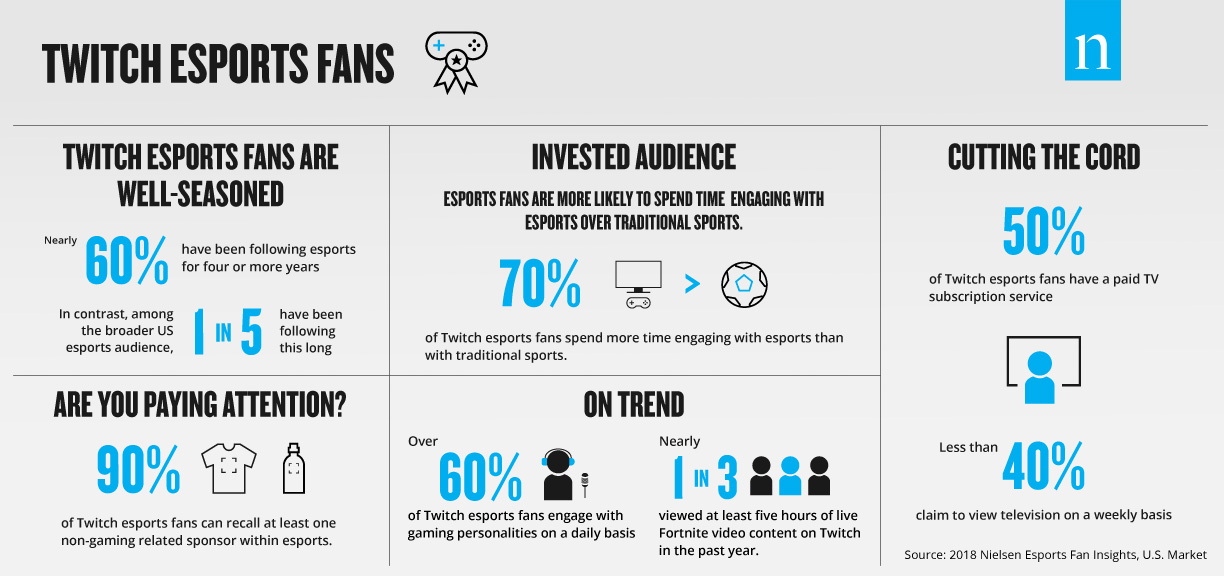
Nielsen announced an in-depth research study of esports fan attitudes and behaviors in the U.S. to feature data from Twitch.
Nielsen combined survey-based attitudes and preference data with Twitch viewership and behavior data from more than 2,000 U.S. esports fans who viewed esports content related to major titles like League of Legends, Overwatch League, Fortnite, and more over the past year.
Nielsen announced an in-depth research study of esports fan attitudes
and behaviors in the U.S. to feature data from Twitch. Nielsen combined
survey-based attitudes and preference data with Twitch viewership and
behavior data from more than 2,000 U.S. esports fans who viewed esports
content related to major titles like League of Legends, Overwatch
League, Fortnite, and more over the past year.
The result of this Nielsen and Twitch Esports Fan research study is a
set of rich data that marketers, rights holders, and esports
organizations can use to unlock the value of Twitch’s audience at a
detailed level. The data will guide those looking to make informed
decisions for investments, sponsorship and advertising, as well as help
esports organizations effectively demonstrate the unique value their
audience brings to the industry.
Some of the high-level insights from the Nielsen Esports study of the Twitch U.S. esports audience include:
Twitch esports fans are well-seasoned with nearly 60% following
esports for four or more years. In contrast, among the broader U.S.
esports audience, only 1 in 5 have been following this long, with 23%
new to esports within the past year.
50% of Twitch esports fans have a paid TV subscription service; less than 40% claim to view television on a weekly basis.
90% of Twitch esports fans can recall at least one non-gaming related sponsor within esports.
Esports fans are more likely to spend time engaging with esports
over traditional sports – Twitch fans significantly so, with 70%
dedicating more time to esports than traditional.
Over 60% of Twitch esports fans engage with gaming personalities on a
daily basis, and nearly one in three viewed at least five hours of live
Fortnite video content on Twitch in the past year.
“As we continue to support our esports clients, a common theme has
been their need for an even more detailed view of the esports audience
to support data-driven business decisions,†says Nicole Pike,
Managing Director, Nielsen Esports. “At Nielsen, we know the power of
viewership and how it can enrich an already valuable data set like our
Fan Insights work. Given Twitch’s depth of content and reach across
esports properties, we are thrilled to have the opportunity to work with
them since this marks a natural evolution for our annual research.â€
“Twitch caters to the many interests of gamers with esports among the more popular types of entertainment we offer,†says Andrea Garabedian,
VP, Advertiser Marketing, Twitch. “By providing Nielsen with an
opportunity to survey our community, they were able to surface data that
reflects the passionate nature of our esports fans. Based on the amount
of time these gamers spend on our service and their familiarity with
the scene, from the games to the sponsors, it is clear that Twitch
represents an ideal destination for brands trying to connect with this
audience.â€
Nielsen collected the Twitch Esports Fan data via an online survey
deployed among a representative group of U.S.-based users from the
Twitch Research Power Group (RPG). The Twitch RPG is Twitch’s
proprietary panel comprised of over 50,000 Twitch viewers and allows the
brand to instantly tap into the pulse of its community. Members of the
Twitch RPG who opted into the survey ranged from ages 18-40. Along with
the survey invitation, Twitch shared anonymized behavioral viewership
data from survey respondents across top esports leagues/tournaments and
20 different game titles.
Nielsen will incorporate key findings into its annual Nielsen Esports
Report for the U.S. market, as well as leverage the data for consulting
services. The data from this landmark research are currently available
in the form of syndicated or custom analysis in addition to Nielsen’s
survey results among the broader esports fan base in the U.S. plus 10
other global markets.
Posted by AGORACOM-JC
at 9:40 AM on Friday, December 14th, 2018
Virginia-based connected health provider Creo Wellness, LLC (confirm the companies have committed to integrate CardioComm’s ECG monitoring service technologies and ECG devices to support the CREO physician network’s management of patients and enhance the services offered through the CREO patient engagement platform
ECG technology integration across CREO’s platform to be launched in 2019
Toronto, Ontario–(December 14, 2018) – CardioComm Solutions, Inc. (TSXV: EKG) (“CardioComm” or the “Company” or “CCS“), a leading global provider of consumer heart monitoring and electrocardiogram (“ECG“) acquisition and management software solutions, and Virginia-based connected health provider Creo Wellness, LLC (“CREO“) confirm the companies have committed to integrate CardioComm’s ECG monitoring service technologies and ECG devices to support the CREO physician network’s management of patients and enhance the services offered through the CREO patient engagement platform.
CREO developed and supports its home-based, physician-directed
patient care software platform to improve the health outcomes of its
patients. CREO selected CardioComm as a preferred ECG services solutions
provider to enhance its patient care software platform, specifically
CardioComm’s over-the-counter (“OTC“) HeartCheck™
handheld ECG devices, and its traditional ECG monitoring services, such
as Holter, resting 12 lead and 14 day event monitoring.
CREO’s platform is currently used by many employers, hospital and
physician groups who collectively manage up to 300,000 patients each
month. CREO estimates that the number of managed patients per month
using its platform will triple to 900,000 by 2020.
CardioComm will integrate its GEMS™ Mobile Smartphone app into CREO’s
existing mobile application and workflow to support the option to
record an ECG at any time. All ECG’s will be managed through
CardioComm’s cloud-based GEMS™ Flex software. All ECGs will be ready by
the Company’s SMART Monitoring ECG reading service. CREO will be
notified of any reviewed ECGs with abnormalities. The ECGs will also be
flagged for remote review by the patient’s physician based on the
severity of the abnormality found.
The partnership between CREO and CCS will bring new product offerings
to the USA market in early 2019. For CardioComm Solutions, this will
generate multiple new revenue streams resulting from the licensing of
CardioComm’s GEMS™ cloud and Smart phone app ECG management tools, the
purchase of GEMS™ compatible OTC and Rx ECG devices and a fee-for-use
based on CardioComm’s SMART Monitoring ECG reading service. CREO will
place the devices into their patient care software platform, which will
be prescribed through CREO member physicians. Use of these devices will
generate revenue through the provision of ECG readings under established
USA Current Procedural Terminology (“CPT“) codes. CREO
will manage all CPT code billings for the ECG services performed. CPT
codes are maintained by the American Medical Association to provide
information about medical services and procedures among physicians,
coders, patients, accreditation organizations and payers.
All ECGs will be managed by CardioComm’s cloud-based GEMS™ Flex
software where all ECGs will be interpreted by the Company’s SMART
Monitoring ECG reading service. CREO will be notified of any reviewed
ECGs with abnormalities which will be flagged for remote review by the
patient’s physician in accordance with the severity of the abnormality
found.
Both companies expect that at least 30% of CREO patients will require
ECG monitoring ranging from routine baseline recordings to regular
daily monitoring for prolonged periods of time. The first phase of
technology integration is expected to be completed in Q1 2019, followed
by the full launch of the ECG services across the CREO platform.
To learn more about CardioComm’s products and for further updates
regarding HeartCheck™ ECG device integrations please visit the Company’s
websites at www.cardiocommsolutions.com and www.theheartcheck.com.
About Creo Wellness, LLC
Founded in 2015, Creo Wellness, LLC is a private digital health
solutions company that offers healthcare providers a truly connected
population health platform that is integrated with their electronic
medical record. Creo’s solutions offer a hyper-personalized patient
centric approach to improved health outcomes, cost reduction and patient
engagement. See how we create change at www.creochange.com. On Facebook, Creo Wellness, LLC. On Twitter @creowellness.
CardioComm Solutions’ patented and proprietary technology is used in
products for recording, viewing, analyzing and storing
electrocardiograms for diagnosis and management of cardiac patients.
Products are sold worldwide through a combination of an external
distribution network and a North American-based sales team. CardioComm
Solutions has earned the ISO 13485:2016 certification, is HIPAA
compliant and holds clearances from the European Union (CE Mark), the
USA (FDA) and Canada (Health Canada).
This release may contain certain forward-looking statements and
forward-looking information with respect to the financial condition,
results of operations and business of CardioComm Solutions and certain
of the plans and objectives of CardioComm Solutions with respect to
these items. Such statements and information reflect management’s
current beliefs and are based on information currently available to
management. By their nature, forward-looking statements and
forward-looking information involve risk and uncertainty because they
relate to events and depend on circumstances that will occur in the
future and there are many factors that could cause actual results and
developments to differ materially from those expressed or implied by
these forward-looking statements and forward-looking information.
In evaluating these statements, readers should not place undue
reliance on forward-looking statements and forward-looking information.
The Company does not assume any obligation to update the forward-looking
statements and forward-looking information contained in this release
other than as required by applicable laws, including without limitation,
Section 5.8(2) of National Instrument 51-102 (Continuous Disclosure Obligations).
Neither TSX Venture Exchange nor its Regulation Services Provider (as
that term is defined in policies of the TSX Venture Exchange) accepts
responsibility for the adequacy or accuracy of this release.
Posted by AGORACOM-JC
at 11:10 AM on Thursday, December 13th, 2018
NBUD:CSE
WHY NORTHBUD FARMS?
Canadian regulatory door for CIP (Cannabinoid Infused Products) is opening in 2019 As shown in other legal jurisdictions (Colorado, Washington, Nevada, California)
Infused products sector has become the highest margin segment of the industry
Positioned to be a raw input producer for this space
Currently working with multiple food, beverage and science companies to provide safe standardized cannabinoid infused raw inputs for large scale GMP manufacturing of products
Announced Creation of “1017†Distribution and Signing of a LOI to Acquire Janey’s Cannabis Line
 NORTHBUD Construction Update, Everything is on schedule!
FULL DISCLOSURE: North Bud Farms is an advertising client of AGORA Internet Relations Corp.
Tags: Hemp, Marijuana Stocks Posted in All Recent Posts, North Bud Farms Inc | Comments Off on CLIENT FEATURE: North Bud Farms $NBUD.ca sustainable low cost, high quality cannabinoid production and procurement $ACB $WEED.ca $HIP.ca
Posted by AGORACOM-JC
at 10:06 AM on Thursday, December 13th, 2018
SPONSOR: Esports Entertainment $GMBL – Esports audience is 350M, growing to 590M, Esports wagering is projected at $23 BILLION by 2020. The company has launched VIE.gg esports betting platform and has accelerated affiliate marketing agreements with an additional 42 Esports teams, bringing total to 176 Esports teams. Click here for more information
————–
Intel and esports company ESL have extended a long-standing
partnership, signing a three-year, $100 million deal designed to boost
the profile of electronic sports worldwide.
Intel will provide the technology — including high-powered computer
processors and 5G — for some of the best-known esports events through
2021
Participants in the Intel Extreme Masters tournament in Chicago, November 2018.
Intel-ESL
Intel and
esports company ESL have extended a long-standing partnership, signing a
three-year, $100 million deal designed to boost the profile of
electronic sports worldwide, the companies announced Thursday.
Under the deal, Intel will provide multiple layers of technology —
including its high-powered “Core†computer processors and 5G — for some
of the biggest esports events through 2021. The semiconductor giant will
also work alongside ESL to create new events seen around the globe. ESL
runs multiple esports leagues and tournaments worldwide.
The Intel Extreme Masters, an ESL-run league sponsored by Intel, is
set to enter its 14th season as the longest-running global professional
gaming circuit. As part of the deal, another tournament will be added to
the roster with the IEM event in China set to be converted into a
stand-alone event.
The $100 million investment marks an even deeper foray into esports
for Intel, at a time when many big brands are entering the industry. The
company has sponsored ESL events for 18 years — making Intel one of the
first major companies to dive into the now-exploding esports space,
which is expected to surge to $1.4 billion in 2020, according to
estimates from research firm Newzoo.
The deal makes the Intel-ESL (formerly known as the Electronic Sports
League) affiliation the biggest brand and technology partnership in the
esports space, the companies said.
John Bonini, Intel’s vice president and general manager of virtual
reality, gaming and esports, told CNBC the company is “very proud to
have been a key part in growing esports.†The partnership creates more
long-term, sustainable paths in the industry, he said.
“It puts substantial weight behind [Intel’s commitment to esports],
and allows us and our partners at ESL to create new opportunities with
the next 15 years in mind,†Bonini said.
Mark Cohen, ESL’s senior vice president of global brand partnerships,
said Intel’s commitment represents the next phase in the rapid rise of
esports.
“For a really long period of time, there were a lot of one-year
deals, sometimes two-year deals, in esports,†he said. “Now other big
brands and traditional entertainment companies have started to invest,
and it’s allowed us to have an approach and strategy that’s pretty
identical to traditional sports entertainment,†Cohen said.
Posted by AGORACOM-JC
at 4:39 PM on Wednesday, December 12th, 2018
For the purpose of the execution of the Plan of Arrangement, HPQ subsidiary, Beauce Gold Fields Inc (“BGFâ€) has closed the $550,000 private placement required for the listing on the TSX-Venture Exchange
Submitted to the Exchange the Listing Application (Form 2B) under the reserved stock symbol BGF
MONTREAL, Dec. 12, 2018 — HPQ Silicon Resources Inc (“HPQâ€) (TSX VENTURE:HPQ)(FRANKFURT:UGE)(OTC PINK:URAGF) is pleased to inform shareholders that, for the purpose of the execution of the Plan of Arrangement, HPQ subsidiary, Beauce Gold Fields Inc (“BGFâ€) has closed the $550,000 private placement required for the listing on the TSX-Venture Exchange (“Exchangeâ€) and has submitted to the Exchange the Listing Application (Form 2B) under the reserved stock symbol BGF.
Once the Company receives satisfactory review of the Listing
Application, it will set (in collaboration with the Exchange) the
declaration date, record date, payment date of the distribution and
finally, the listing date of BGF shares on the Venture Exchange.
Patrick Levasseur, President and CEO of HPQ Beauce Gold Fields subsidiary stated, “We
are working closely with the Exchange to complete this listing process
that will allow HPQ to unlock the full potential value of the Beauce
Gold property through a fresh new entity starting with a tight capital
structure.†Mr. Levasseur also stated “The Beauce is Canada’s
last underexplored historical placer mining camp. It’s similar to the
placer to hard rock exploration projects in the Yukon or the Cariboo
district in BC, that were both placer gold mining camps as well, but
recently had major gold discoveries. Combining our large claims holding
in St-Simon-Les-Mines together with our increasing knowledge of the
geology, we believe we have narrowed the search in exploring for a hard
rock gold depositâ€.
The Private Placement is for:
3,500,000 hard-cash units (HC Units) at the price of $0.10 per HC Unit for total of $350,000.00
1,666,666 flow-through units (FT Units) at the price of $0.12 per FT Unit for total of $200,000.00
Each HC Unit will be comprised of one common share and one common
share purchase warrant of the Company to purchase one common share at
the price of $0.15 per share. Each FT Unit will be comprised of one
flow-through common share and one-half of one common share purchase
warrant, with each full warrant allowing the holder to purchase one
common share at the exercise price of $0.18 per share. The warrants are
valid until December 15, 2020.
In connection with the placement, the company paid Finders’ fees as follows:
1) $2,400 to Leede John Gable Inc., and the issuance of 24,000
warrants entitling the Agent to purchase 24,000 common shares at a price
of $0.15 per share for a period of 24 months until December 15, 2020;
2) $6,560 to Stephen Avenue Securities Inc. and the issuance of 40,000
warrants entitling the Agent to purchase 40,000 common shares at a price
of $0.15 per share and 4,800 warrants entitling the Agent to purchase
4,800 common shares at a price of $0.18, for a period of 24 months until
December 15, 2020; 3) the issuance to Falkenberg Holding Ltd and to
Gathering Waters Ltd 8,000 warrants entitling the Agents to purchase
8,000 common shares at the price of $0.15 as well as 1,600 warrants
entitling the Agents to purchase 1,600 common shares at the price of
$0.18 for a period of 24 months until December 15, 2020;
About Beauce Gold Fields
BGF is a wholly owned subsidiary of HPQ Silicon into which HPQ gold
assets were transferred. Subject to approval by TSX-V, HPQ is in the
process of listing BGF as a new public junior gold company, following
the approval by shareholders during HPQ AGM held on Aug. 10, 2018, of
the proposed terms of the plan of arrangement.
The Beauce Gold Fields project is a unique, historically prolific
gold property located in the municipality of Saint-Simon-les-Mines in
the Beauce region of Southern Quebec. Comprising of a block of 152
claims 100% owned by HPQ, the project area hosts a six kilometre long
unconsolidated gold-bearing sedimentary unit (a lower saprolite and an
upper brown diamictite). Textural observations (angularity) of gold
nuggets suggest a relatively proximal source and therefore a short
transport distance. The gold in saprolite indicates a close proximity to
a bedrock source of gold, providing possible further exploration
discoveries. The property was also hosts numerous historical gold mines
that were active from 1860s to the 1960s (see HPQ SEDAR-filed report).
HPQ Silicon Resources Inc. is a TSX-V listed resource company
planning to become a vertically integrated and diversified High Purity,
Solar Grade Silicon Metal (SoG Si) producer and a manufacturer of multi
and monocrystalline solar cells of the P and N types, required for
production of high performance photovoltaic conversion.
HPQ’s goal is to develop, in collaboration with industry leaders,
PyroGenesis (TSX-V: PYR) and Apollon Solar, that are experts in their
fields of interest, the innovative PUREVAPTM “Quartz Reduction Reactors
(QRR)â€, a truly 2.0 Carbothermic process (patent pending), which will
permit the transformation and purification of quartz (SiO2) into high
purity silicon metal (Si) in one step and reduce by a factor of at least
two-thirds (2/3) the costs associated with the transformation of quartz
(SiO2) into SoG Si. The pilot plant equipment that will validate the
commercial potential of the process is on schedule to start mid-2019.
For further information contact
Bernard J. Tourillon, Chairman, President and CEO HPQ Tel (514) 907-1011 Patrick Levasseur, COO HPQ, President and CEO BGF Tel: (514) 262-9239 www.HPQSilicon.com
Shares outstanding: 222,284,053
Disclaimers:
This news release does not constitute an offer to sell or a
solicitation of an offer to buy nor shall there be any sale of any of
the securities in any jurisdiction in which such offer, solicitation or
sale would be unlawful. The securities have not been and will not be
registered under the United States Securities Act of 1933, as amended
(the “U.S. Securities Act”) or the securities laws of any state of the
United States and may not be offered or sold within the United States or
to, or for the account or the benefit of, U.S. persons (as defined in
Regulation S un der the U.S. Securities Act) unless registered under
the U.S. Securities Act and applicable state securities laws or pursuant
to an exemption from such registration requirements.
This press release contains certain forward-looking statements,
including, without limitation, statements containing the words “may”,
“plan”, “will”, “estimate”, “continue”, “anticipate”, “intend”,
“expect”, “in the process” and other similar expressions which
constitute “forward-looking information” within the meaning of
applicable securities laws. Forward-looking statements reflect the
Company’s current expectation and assumptions, and are subject to a
number of risks and uncertainties that could cause actual results to
differ materially from those anticipated. These forward-looking
statements involve risks and uncertainties including, but not limited
to, our expectations regarding the acceptance of our products by the
market, our strategy to develop new products and enhance the
capabilities of existing products, our strategy with respect to research
and development, the impact of competitive products and pricing, new
product development, and uncertainties related to the regulatory
approval process. Such statements reflect the current views of the
Company with respect to future events and are subject to certain risks
and uncertainties and other risks detailed from time-to-time in the
Company’s on-going filings with the securities regulatory authorities,
which filings can be found at www.sedar.com.
Actual results, events, and performance may differ materially. Readers
are cautioned not to place undue reliance on these forward-looking
statements. The Company undertakes no obligation to publicly update or
revise any forward-looking statements either as a result of new
information, future events or otherwise, except as required by
applicable securities laws. Neither the TSX Venture Exchange nor its
Regulation Services Provider (as that term is defined in the policies of
the TSX Venture Exchange) accepts responsibility for the adequacy or
accuracy of this release.
Posted by AGORACOM
at 3:10 PM on Wednesday, December 12th, 2018
Intends to distribute 25,611,487 common shares in the capital of Sensor Technologies Corp. to shareholders of the Corporation by way of a return of capital.
The Sensor Shares will be distributed to resident holders of IntellaEquity , shares will be paid on the basis of one (1) Sensor Share for every one (1) IntellaEquity shares outstanding.
IntellaEquity shareholders are not required to pay for the Sensor Shares they receive by way of the Distribution
Toronto, Ontario–(Newsfile Corp. – December 12, 2018) –
IntellaEquity Inc. (CSE: IEQ) (the “Corporation” or “IntellaEquity”)
announces today that it intends to distribute an aggregate of 25,611,487
common shares (the “Sensor Shares”) in the capital of Sensor
Technologies Corp. (“Sensor”) to shareholders of the Corporation by way
of a return of capital.
The Sensor Shares will be distributed to resident holders of
IntellaEquity shares (the “Distribution”). The Distribution will be paid
on the basis of one (1) Sensor Share for every one (1) IntellaEquity
shares outstanding. The Distribution will be completed through two (2)
distributions, one distribution of 12,805,743 Sensor Shares and the
second distribution of 12,805,744 Sensor Shares. The first distribution
will be distributed to holders of IntellaEquity shares on record as of
close of business January 15, 2019. The record date of the second
distribution will be fixed by the board of directors of the Corporation.
IntellaEquity shareholders are not required to pay for the Sensor
Shares they receive by way of the Distribution, to tender or surrender
their IntellaEquity shares, or to take any other action in connection
with the Distribution, other than providing a declaration of residency.
No Sensor Shares will be issued to shareholders who are (or are
deemed to be) non-residents of Canada. Rather, such Sensor Shares will
be delivered to a custodian and non-residents will be required to
forward to the custodian the amount of withholding tax that such
shareholder is required to pay. In the event that the shareholder does
not forward such amount, the custodian shall retain such number of
Sensor Shares necessary to cover the amount of the withholding tax
payable. The balancer of the Sensor Shares will be forwarded to the
shareholder.
Shareholders who fail to provide a declaration of Canadian residency
in the form that will be provided will be deemed to be a non-resident
for these purposes. Canadian shareholders who hold their shares in the
Corporation through a brokerage or other account are therefore urged to
contact their brokers to avoid being deemed a non-resident.
The Corporation also announces that it has amended the exercise price
and extended the expiry date of the 994,000 outstanding common share
purchase warrants (the “Warrants”) of the Corporation, which were issued
in connection with a private placement completed on December 18, 2015.
Each Warrant, as amended, entitles the holder thereof to purchase one
common share of the Corporation at any time until the close of business
on December 18, 2020 at an exercise price of $0.10 per common share.
The Warrants will be amended, effective December 18, 2018, to amend
the exercise price of the warrants from $1.50 to $0.10 and to extend the
term of such warrants from December 18, 2018 to December 18, 2020. All
other provisions of the Warrants will remain the same. Insiders of the
Corporation do not hold any of the outstanding Warrants.
About Sensor
Sensor Technologies Corp. is a publicly listed company whose shares
trade through the facilities of the CSE under the symbol “SENS”. The
company develops non-intrusive asset health monitoring sensor systems
for the oil and gas market to help operators track the thinning of
pipelines and refinery vessels due to corrosion/erosion, strain due to
bending/buckling and process pressure and temperature. The Corporation’s
FT fiber optic sensor and corrosion monitoring systems allow cost
effective, 24/7 remote monitoring capabilities to improve scheduled
maintenance operations, avoid unnecessary shutdowns, and prevent
accidents and leaks.
About the Corporation
IntellaEquity is a publicly traded company, it is a diversified
investment and venture capital firm focused on providing investors with
long-term capital growth by investing in a portfolio of undervalued
companies and assets. The investment portfolio may be comprised of
securities of both public and private issuers primarily in technology,
artificial intelligence, blockchain and may also include investments in
certain other sectors, including water, green energy, and alternative
energy. Target investments shall encompass companies at all stages of
development, including pre-initial public offering and/or early-stage
companies requiring start-up or development capital, as well as
intermediate and senior companies.
Tags: #IEQ.ca, #SensorTech Posted in IntellaEquity | Comments Off on $IEQ.ca IntellaEquity to Issue Return of Capital to Shareholders and Amends Warrant Terms