Posted by AGORACOM-JC
at 11:01 AM on Tuesday, August 20th, 2019
SPONSOR: Esports Entertainment
$GMBL Esports audience is 350M, growing to 590M, Esports wagering is
projected at $23 BILLION by 2020. The company has launched VIE.gg
esports betting platform and has accelerated affiliate marketing
agreements with 190 Esports teams. Click here for more information
GMBL: OTCQB
———————–
Ford launches its own esports virtual racing teams
Ford plans to launch its own esports virtual racing teams. Under the name Fordzilla, the company will recruit top esports drivers for teams in France, Germany, Italy, Spain and the UK.
The company will also invite star players to form a European team with select members from each national team.
The Fordzilla teams will compete in games like Forza Motorsport 7, developed by Microsoft Game Studios’ Turn 10 Studios. According to Ford, millions of people play Forza games each month, and one million players choose Ford vehicles.
Ford has partnered with Microsoft Game Studios before, and a few years ago, the top prize in the first-ever Forza Racing Championship was a 2017 Ford Focus RS. We don’t know what prizes Ford will offer to its driving teams, but recruitment begins at Gamescom in Germany this week.
Posted by AGORACOM-JC
at 10:09 AM on Tuesday, August 20th, 2019
SPONSOR: Spyder Cannabis (SPDR:TSXV)
went public just a couple of months ago and hit the ground running
with 5 operating Canadian retail locations – and a 6th one on the way
via an 8,000 sq ft super store in Alberta. Most companies would be
ecstatic to have this number of locations – but Spyder just announced a
major move into the United States, with a 5 location deal for boutique
stores up and down the US Eastern seaboard. The news gets better. If
all goes well with these 5 locations, the US outlet partner has a total
of 39 locations across 20 states for Spyder to grow into to. Click here for more info.
(TSX-V: SPDR)
Statistics Canada releases a bong full of new cannabis data
Statistics Canada released a whack of statistics on August 15 that shed some insight into the almost five million Canadians who consumed cannabis during the first half of 2019.Â
About 77% of Canadians who said they used cannabis during the first half of 2019 consumed dried cannabis, while 26% consumed edibles. Other reported ways of consuming cannabis were as liquid concentrates (20%), cannabis oil cartridges or vape pens (19%), and hashish or kief (16%).Â
Among the findings were that more men consume cannabis than do women,
and that men consume cannabis more frequently than women. Men also
consume cannabis for non-medical reasons more than women do.
Cannabis/Shutterstock
Another big takeaway was that 42% of Canadians who consumed cannabis
said that they bought at least some of their cannabis from black-market
dealers in the first half of the year.
The stats were all part of Statistics Canada’s National Cannabis
Survey (NCS), which continued to show that males and females older than
age 15 differ in how they obtain and consume cannabis products.
Females, for example, more often reported getting cannabis from
family and friends than their male counterparts, That may explain why
fewer females said they paid for the cannabis they consume. The study
didn’t go into how many people stole cannabis, although it noted that 4%
got their cannabis in an unspecified way.
Females are more likely to use an alternative method to consume cannabis, such as putting it on the skin or under the tongue.
Males are more likely to report consuming dried cannabis and hashish.
To monitor cannabis consumption before and after Canada legalized
cannabis last October, the nation’s number cruncher has been conducting
the NCS every three months since 2018.
Males almost twice as likely as females to have consumed cannabis
Males (21%) were almost twice as likely to have used cannabis in the
first half of 2019 as females (12%), according to the NCS. This held
true for every age group except seniors aged 65 and older.
Almost three in five females reported never having consumed cannabis (59%), compared with just over half (51%) of males.
About one-third of Canadians reported having tried cannabis in the past but are not current users.
Males more likely to use cannabis daily or almost daily
Statistics Canada said in its August 15 release that research has
shown that using cannabis regularly and over a long period of time has
been associated with the “risk of dependence and poor mental healthâ€
According to combined data from the first half of 2019, males (8%)
were twice as likely to report daily or almost daily use as females
(4%). Males were also more likely than females to consume cannabis on a
weekly and a monthly basis but equally as likely to report occasional
use (defined here as once or twice over the three-month reference
periods).
Males are more likely to use cannabis for non-medical reasons
Statistics Canada asked Canadians to say whether they used cannabis
for medical purposes and had a medical document, for medical purposes
without a medical document or simply for fun, or what some call
recreational use.
Just over one-fifth of males aged 15 and older reported consuming
cannabis in the first half of 2019. More than half of these males (52%)
reported using cannabis exclusively for non-medical reasons, while
about 30% reported using it for both medical and non-medical reasons,
and about one-fifth reported medical reasons (with or without medical
documentation).
Meanwhile, 12% of females said that they consuming cannabis in the
first half of 2019. Their reasons were fairly evenly split, between
those who said it was for non-medical use, medical use or a mix of
both.
Cannabis products and consumption methods
About 77% of Canadians who said they used cannabis during the first
half of 2019 consumed dried cannabis, while 26% consumed edibles. Other
reported ways of consuming cannabis were as liquid concentrates (20%),
cannabis oil cartridges or vape pens (19%), and hashish or kief (16%).
More males (82%) said they consumed dried cannabis, compared with
females (67%). Males (19%) were also more likely to have consumed
hashish or kief, compared with females (12%).
While a majority of both males and females use dried cannabis, for
49% of males and 41% of females, it is the only form of cannabis that
they consumed.
Conversely, females (23%) were almost twice as likely as males (12%)
to report using only products other than dried cannabis. Other products
include edibles, oil cartridges and vape pens.
Smoking remains the most common method of consuming cannabis, with
68% of males and 62% of females choosing this method in the first half
of 2019, according to Statistics Canada.
At 14%, females were almost three times more likely than males (5%)
to have consumed cannabis through methods such as the application of
products on the skin or under the tongue.
Buying cannabis
Males are more likely to purchase cannabis while females are more likely to get it from family and friends for free.
Approximately one-quarter of Canadians who consumed cannabis in the
first half of 2019 did not pay for it, with female consumers (29%) more
likely than males (22%) to consume it without having paid for it,
according to the survey.
Nearly half of all cannabis consumers (48%) reported buying at least
some of their cannabis from a legal source, such as a legally authorized
retailer or an online licensed producer.
There was 42%, however, who said that they bought at least some of
their cannabis from illegal sources, such as a drug dealer, while 37%
said that they used cannabis that they got from, or shared among,
friends and family.
Growing cannabis, either by the users or by someone else, was a
supply source for about 8% of consumers, while 4% reported another
source, although Statistics Canada did not specify what that source
might be.
For the first time, analysis of the sources of cannabis by type of
consumer (those who obtained it from one source and those who obtained
it from multiple sources) is available. This more detailed examination
revealed that 29% of all current users got their cannabis exclusively
from legal sources.
In general, males and females access cannabis from the same sources
and in similar numbers, but with one notable difference: a relatively
larger proportion of females (42%) than males (33%) report friends and
family as their cannabis source.
Quality and safety remain foremost consideration when deciding where to buy cannabis
Three-quarters of Canadians (76%) who consumed cannabis in the first
half of 2019 said quality and safety was an important consideration when
buying it, while 42% primarily considered price.
Other important factors when buying cannabis were accessibility, location and availability of a preferred potency.
While both males and females share many of the same considerations
when obtaining cannabis, there are a few differences. For example,
females (22%) were twice as likely as males (11%) to cite sales support
as being important, while proportionally more males (19%) placed a
higher value on anonymity and discretion than did females (12%). More
males (20%) said that availability of a preferred strain of cannabis was
important than did females (11%.)
Males are more likely to report that they will use cannabis in next three months
More males (25%) than females (16%) said they thought that they would
use cannabis in the next three months. That is higher than the 21% of
males and 12% of females who currently consume cannabis.
Virtually all Canadians (99%) who reported having never consumed
cannabis indicated that they will not use cannabis in the next three
months. In contrast, most daily or almost daily (94%) and weekly (87%)
users think that they will continue to consume cannabis over the next
three months and at a similar pace.
Former users (12%) and those who use cannabis less than once a month
(27%) were more likely to report that they will increase their
consumption in the coming three months than were people who have never
used cannabis (1%).
Second quarter 2019: Almost five million Canadians report using cannabis
From mid-May to mid-June 2019, about 4.9 million or 16% of Canadians
aged 15 and older reported using cannabis in the previous three months,
according to Statistics Canada.
This was unchanged from data collected from provinces a year ago,
when recreational cannabis use was illegal. It is also unchanged from
the last time estimates for from territorial capitals were collected.
In the second quarter of 2019, 24% of Nova Scotians and 20% of
Albertans reported using cannabis in the previous three months. That is
above the average for the rest of Canada (other provinces and
territorial capitals combined).
Cannabis use in the previous three months was also above the national
average in all three territorial capitals: Whitehorse (24%),
Yellowknife (30%) and Iqaluit (32%). Meanwhile, current use was lower
than the national average in Quebec (10%).
Cannabis consumption in the second quarter of 2019 was essentially
unchanged from the same quarter in 2018, prior to legalization. However,
the number of Canadians aged 65 and older reporting cannabis use
increased from 3% to 5% over this period, while cannabis use among 15-
to 64-year-olds was stable (ranging from 10% to 25%, depending on the
age group).
Posted by AGORACOM-JC
at 8:19 AM on Tuesday, August 20th, 2019
Announced that its common shares will begin trading on the OTCQB Venture Market at the opening of the market on August 20th, 2019 under the stock symbol (OTC: EPWCF)
VANCOUVER, Aug. 20, 2019 – EMPOWER CLINICS INC. (CSE: CBDT) (Frankfurt: 8EC) (OTC: EPWCF) (“Empower” or the “Company“), a vertically integrated and growth-oriented CBD life sciences company, and a multi-state operator of medical health & wellness clinics in the U.S., today announced that its common shares will begin trading on the OTCQB Venture Market at the opening of the market on August 20th, 2019 under the stock symbol (OTC: EPWCF).
Empower Clinics Inc. (OTCQB: EPWCF) now trades on the OTCQB Venture
Market for early stage and developing U.S. and international companies.
Companies are current in their reporting and undergo an annual
verification and management certification process. Investors can find
Real-Time quotes and market information for the company on http://www.otcmarkets.com.
In addition, Empower’s shares will continue to be listed on the
Canadian Securities Exchange (CSE) under the ticker symbol “CBDT,” as
well as on the Frankfurt Stock Exchange under the ticker symbol “8EC.”
“Our listing on the OTCQB Venture Market in the United States
complements Empower’s listings on the Canadian and Frankfurt Stock
Exchanges, respectively, broadening our investment base as we accelerate
our growth strategy in the global medical cannabis and wellness
sectors,” said Steven McAuley, Empower CEO. “This is a
timely milestone, as we have a robust pipeline of activity tied to
product development, business development, M&A and, overall company
expansion.”
ABOUT OTC MARKETS GROUP INC.
OTC Markets Group Inc. (OTCQX:
OTCM) operates the OTCQX® Best Market, the OTCQB® Venture Market and
the Pink® Open Market for 10,000 U.S. and global securities. Through
OTC Link® ATS and OTC Link ECN, the company connects a diverse network
of broker-dealers that provide liquidity and execution services. OTC
Markets enables investors to easily trade through the broker of their
choice and enable companies to improve the quality of information
available for investors. To learn more about how OTC Markets creates
better informed and more efficient markets, visit www.otcmarkets.com.
ABOUT EMPOWER
Empower is a vertically integrated and growth-oriented CBD life
sciences company, and a multi-state operator of medical health &
wellness clinics, operating the Sun Valley Health™ clinic brand www.sunvalleyhealth.com, for its nine corporate locations and for franchises in the United States. As a CBD product manufacturer under the Sollievo™
brand, the company distributes its lines through clinics, online and
through retail partners. Extraction operations are currently being
developed in the Company’s new extraction facility in Oregon.
ON BEHALF OF THE BOARD OF DIRECTORS:
Steven McAuley Chief Executive Officer
DISCLAIMER FOR FORWARD-LOOKING STATEMENTS
This news release contains certain “forward-looking statements”
or “forward-looking information” (collectively “forward looking
statements”) within the meaning of applicable Canadian securities laws. All
statements, other than statements of historical fact, are
forward-looking statements and are based on expectations, estimates and
projections as at the date of this news release. Forward-looking statements
can frequently be identified by words such as “plans”, “continues”,
“expects”, “projects”, “intends”, “believes”, “anticipates”,
“estimates”, “may”, “will”, “potential”, “proposed” and other similar
words, or information that certain events or conditions “may” or “will”
occur. Forward-looking statements in this news release include
statements regarding; the Company’s intention to open a hemp-based CBD
extraction facility, the expected benefits to the Company and its
shareholders as a result of the proposed acquisitions and partnerships;
the terms of the proposed acquisitions and partnerships; the
effectiveness of the extraction technology; the expected benefits for
Empower’s patient base and customers; the benefits of CBD based
products; the effect of the approval of the Farm Bill; the growth of the
Company’s patient list and that the Company will be positioned to be a
market-leading service provider for complex patient requirements in 2019
and beyond. Such statements are only projections, are based on
assumptions known to management at this time, and are subject to risks
and uncertainties that may cause actual results, performance or
developments to differ materially from those contained in the
forward-looking statements, including; that the Company may not open a
hemp-based CBD extraction facility; that the hemp-based CBD extraction
facility may not be fully operation by Q2 2019 if at all; that
legislative changes may have an adverse effect on the Company’s business
and product development; that the Company may not be able to obtain
adequate financing to pursue its business plan; general business,
economic, competitive, political and social uncertainties; failure to
obtain any necessary approvals in connection with the proposed
acquisitions and partnerships; and other factors beyond the Company’s
control. No assurance can be given that any of the events anticipated by
the forward-looking statements will occur or, if they do occur, what
benefits the Company will obtain from them. Readers are cautioned not to
place undue reliance on the forward-looking statements in this release,
which are qualified in their entirety by these cautionary statements.
The Company is under no obligation, and expressly disclaims any
intention or obligation, to update or revise any forward-looking
statements in this release, whether as a result of new information,
future events or otherwise, except as expressly required by applicable
laws.
Posted by AGORACOM-JC
at 9:00 PM on Monday, August 19th, 2019
STAR-A.D.S.® (Airborne Data Service)
Real-time on-board, tracking, flight monitoring and analysis system that provides a virtual window into an aircraft
STAR-A.D.S. ® system installed on a major VVIP private operator in
the Mid-East has been operating for more than one year now, to the
satisfaction of the customer.
Discussions are being finalized to expand the installation of the
STAR solution of real-time monitoring to the rest of the customers’
fleet
Contract for 5 aircraft installations with a scheduled flights airline in Egypt has been implemented
First installation is scheduled for Fall 2019 as scheduling permits,
with the balance of fleet installations to match the C-check schedule
of the remaining aircraft in the fleet.
Production of 27 STAR-A.D.S.® System units has commenced in order to meet ongoing requirements
FULL DISCLOSURE: Star Navigation Systems Group Ltd. is an advertising client of AGORA Internet Relations Corp.
Posted by AGORACOM-JC
at 11:45 AM on Monday, August 19th, 2019
SPONSOR: Enthusiast Gaming Holdings Inc. (TSX-V: EGLX) Uniting gaming communities with 80 owned and affiliated websites, currently reaching over 75 million monthly visitors. The company exceeded 2018 target with $11.0 million in revenue. Learn More
EGLX: TSX-V
Prize pot of $30 million at Fortnite World Cup shows eSports’ rapid growth
The recent Fortnite World Cup had a total prize pool of $33m and the top winners took away several million each.
By: Federico Winer, PhD researcher, Loughborough University
The American teenager took home the largest-ever payout for a single player in an eSports tournament.
His win reflects the growing popularity of the game and the power of the eSports market. British teenager Jaden Ashman shared $2.25m with his teammate as the runners-up in the doubles competition.
The finals, at the end of July, followed ten weeks of competition involving more than 40m competitors and a total prize pot of over $30m. The tournament packed out the 23,771-seat Arthur Ashe stadium at Flushing Meadows, New York’s largest tennis arenas.
Fortnite Battle Royale is emerging as one of the most popular
computer games with an estimated 250m players around the world.
Essentially, it is a First-Person Shooter game where players fight to
survive in a battle against other human players. Unlike some other games
in this genre, such as PUBG or Counter-Strike,
its graphics are cartoonish, which means parents of teenage players are
less likely to object to the content – it doesn’t look violent of
feature excessive blood, bullets and bombs.
Fortnite is rising to prominence in an increasingly lucrative market.
Out of 7.6 billion people on the planet, there are approximately 2.2 billion gamers.
This includes social gaming, mobile gaming, as well as free-to-play and
pay-to-play multiplayer gaming. Of these players, there are about 380m
eSports viewer fans – 165m of them regular viewers and 215m occasionals.
Epic Games, publisher of Fortnite, attracts players by making the game itself free to play. But they also sell “V-Bucks†to the players, which cost US$9.99 per 1,000 and can be spent on a variety of customisation and enhancements for players’ characters.
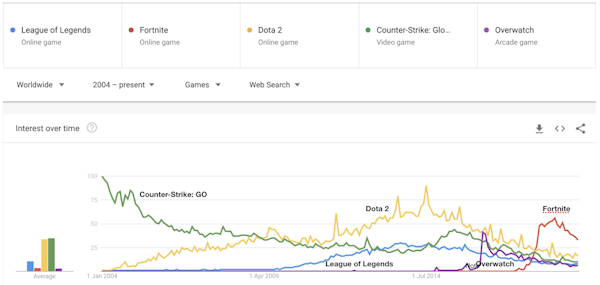
Evolution of eSports titles’ popularity, breakdown by searches in Google, 2004-present. Google Trends, 2019b, Author provided
None of these influence the actual performance of the character in
the battle – accuracy and pace still depend on the skill of the
individual competitor. This is similar to most eSports titles. But according to research firm Superdata, between its release in July 2017 and May 2018 Fortnite netted US$1.2 billion in revenue.
Competitive edge
So what exactly are eSports? They are defined as competitive
tournaments involving electronic games – especially among professionals.
Players compete in leagues or play for an audience on a live-streaming
service in exchange for payment, which can range to several million
dollars for the most successful players.
Top players and teams are well remunerated. Forbes
reported that the “average starting North America League of Legends
Championship Series (NA LCS) player salary is now over US$320,000, with
over 70% of the players performing on multi-year contractsâ€. An article in Business Insider
in 2018 reveals that top teams such as Evil Geniuses earn more than
US$10m a year in revenue. This is almost the same budget as a top second division team from La Liga, in Spain.
The recent Fortnite world cup had a total prize pool of $33m
and, as we have heard, the top winners took away several million each.
Even players who ranked as lowly as 65-108 took away $50,000 for their
pains.
When it comes to training for competition, you could be forgiven for
thinking that eSports players are not like traditional athletes,
building strength and endurance over long hours in the gym or pounding
the streets. But, as the growth in prize money means the potential
rewards for success grow ever larger, a new generation of eSports
professionals is finding that fitness aids concentration. Some of the
more successful teams are even drafting in coaches from other sports.
I have connected with several teams and, even in those with low
budgets, they are aware of the importance of their physical and mental
well-being through nutrition and exercise to perform better in games.
What’s next?
ESports look to be here to stay, but the degree of success will
depend on a variety of factors, including general entertainment trends,
industry governance and the possibility of government censorship in
certain regions. To help the various players in the market understand
consumers better and react proactively to changes in the business
environment, it is essential to highlight the critical value of eSports
data – something that I have been researching for some time.
The huge and rapid growth of eSports – and the massive revenues this
promises – are thought by many industry insiders to be indicative of a
bubble. Commenting on headlines which implied that gaming tournaments
were “bigger than the Superbowlâ€, Sebastian Park, vice-president of
eSports with the Houston Rockets (which owns a majority stake in
professional League of Legends team Clutch Gaming) said recently: “When I read a lot of these papers, I don’t know where they derive 50% of those numbersâ€.
For the health of the industry, it’s critical to be able to establish
how different esports industry stakeholders are collecting data and
information from the fans to understand their behaviour and consumer
trends. There has been speculation that Nielsen, which has been
collecting data on TV viewing since the 1950s, is working on a solution. This could be the next big step in establishing eSports credibility.
Posted by AGORACOM-JC
at 10:31 AM on Monday, August 19th, 2019
SPONSOR: Bougainville
Ventures Inc (CSE: BOG) provides strategic capital to the thriving
cannabis cultivation sector through ownership and development of
commercial real estate properties. The company also offers fully built
out turnkey facilities equipped with state-of-the-art growing
infrastructure to cannabis growers and processors. Click here for more info.
—————–
The CBD boom is reshaping America’s farmland
As the CBD boom continues, farmers across the country are ditching their former crops in favor of something more chill: hemp.
According to US Department of Agriculture data, the amount of farmland planted with hemp quadrupled in the past year, Quartzreports.
How did this all happen so fast?
Two words — decriminalization and demand.
First, the 2018 Farm Bill made hemp farming legal last year, allowing
farmers to start producing hemp plants as long as they are less than
0.3% THC by dry weight.
Then, when the first CBD products appeared — mostly in pain-relieving wellness products — they were hugely successful.
Demand for CBD-infused everything soon followed… Now, shoppers can buy CBD-infused fast food burgers (thanks, Carl’s Jr.),
tea, honey, beer, chocolate, dog treats, bath salts, deodorants,
protein powders, hot sauce, coffee, gummy candy, shampoo, and face
creams… and the list goes on.
But all that CBD comes from hemp…
And all that hemp has to be grown
So farmers are scrambling to grow the newest, chillest cash crop.
Even farmers who formerly had no interest in hemp are starting to grow
it.
Why? Consider this: An acre of soybeans will make a farmer $500. An acre of hemp could make them as much as $30k.
For now, hemp farming may be a great deal for farmers. But regulators have yet to develop proper oversight practices, and some industry groups worry that hemp prices are still too volatile to take seriously.
No one knows when the high (prices) will wear off…
“The boom is coming mostly from word-of-mouth reports about hemp’s profitability,†reports the Hemp Industry Daily.
For now, growth is poised to continue: Planting of industrial hemp
increased 368% from 2018 to 2019, outpacing all other crops, and some
big producers — like Ben & Jerry’s — have expressed interest in buying CBD but are holding off until federal laws become more clear.
But if it turns out that the market for CBD dog treats isn’t as big
as it’s being billed, the CBD boom could quickly go bust for the farmers
who put all their hemp in one basket…
Posted by AGORACOM-JC
at 10:19 AM on Monday, August 19th, 2019
SPONSOR: Tartisan Nickel (TN:CSE)
Kenbridge Property has a measured and indicated resource of 7.14
million tonnes at 0.62% nickel, 0.33% copper. Tartisan also has
interests in Peru, including a 20 percent equity stake in Eloro
Resources and 2 percent NSR in their La Victoria property. Click her for more information
After dropping below US$5 a pound at the end of 2018, metal reaches US$7.31 Friday
Worries about supply and expected demand for electric cars kept pushing up the price of nickel this week
Metal staying above US$7.31 a pound on the London Metals Exchange on Friday.
Prices are up by 50 per cent the start of the year, when nickel was
struggling to stay above US$5 a pound. Prices haven’t risen this fact in
a decade. Indonesia, one of the biggest suppliers in the world, plans
to ban exports in 2022, and rumours the ban could be imposed sooner has
accounted for some of nickel’s recent strength, analysts say.
Kieran Clancy, assistant commodities economist at UK-based Capital Economics, told Bnamericas on Friday that global supply shortages are expected to worsen since no major mines are coming into operation any time soon.
“What’s more, there are a number of tail risks, the most notable of
which being the prospect that Indonesia implements a ban on nickel ore
exports sooner than 2022, although they now have significant domestic
smelting capacity which would cushion the blow somewhat,” Clancy said.
And in a livewiremarkets.com
story Friday, Eddy Haegel of BHP said demand for high grade nickel
(which is mined in Sudbury) for electric car batteries will really take
off sometime next year.
“We do not expect to see a meaningful impact on the nickel market
from batteries until the mid – late 2020s,†Haegel said. “Only then, do
we expect to see serious industry investment by Class 1 nickel
producers.
“However, we will not rest waiting for that day to arrive. We are
actively developing options to position ourselves for this
once-in-a-generation opportunity.’’
Posted by AGORACOM-JC
at 9:08 AM on Monday, August 19th, 2019
Since the 2015 commencement of the Company’s quest to improve the global economics and supply concerns of the Silicon market, the PUREVAP™ project has reached several substantial operational milestones:
Unique Proprietary Capability of converting low quality inputs in to high purity Silicon (Si) [2];
Production yields may exceed 90% of input material;
Demonstrating to the market that the technology functions as expected.
MONTREAL, Aug. 19, 2019 – HPQ Silicon Resources Inc. – TSX-V: HPQ; OTCPink: URAGF; FWB: UGE – (“HPQ†or “the Companyâ€) is pleased to present the market with key metrics on the impact of the Company’s progress since the H2 2018 closing of a CDN$ 5,250,000 financing1 and provide guidance for H2 2019 for the PUREVAP™ Quartz Reduction Reactor (QRR) technology.
Since the 2015 commencement of the Company’s quest to improve the
global economics and supply concerns of the Silicon market, the PUREVAP™ project has reached several substantial operational milestones:
Unique Proprietary Capability of converting low quality inputs in to high purity Silicon (Si) [2];
Production yields may exceed 90% of input material3;
Demonstrating to the market that the technology functions as expected.4
The potential economic implications for the global downstream Silicon
market and shareholders is extremely significant in that the HPQ PUREVAP™ QRR technology may:
Reduce raw material cost by 50%, representing a direct 20% reduction in OPEX5;
Reduce HPQ Silicon Manufacturing CAPEX by 90% or more versus all other manufacturer6.
The addressable market for PUREVAP™ Silicon (“Siâ€) is
enormous with applications growing beyond just solar. The market for
standard grade material is estimated to increase from US$ 7.5B in 2018
to US$ 12B in 20237.
The global solar energy market is forecasted by Deutsche Bank to grow
10x by 2035 to be a US $ 400B industry. The Solar Grade Silicon
(“SoG-Siâ€) sub-market is expected to grow from US $7.1B to US $11.8B by
20288.
Although not commercialized it is well publicized that silicon could replace graphite anodes in Lithium batteries. As reported by CNBC,
private Venture Capital backed firms are exploring the use of silicon
in batteries and are positioning to provide the auto industry with the
solutions it needs to substantially improve vehicle performance.
Presently, Silicon content in lithium-ion battery anodes is roughly 6%
and is estimated to represent an addressable market value of US $ 1B by
20229. If Silicon replaces other materials in batteries, this new
addressable market will grow exponentially.
Bernard Tourillon, President & CEO of HPQ Silicon Resources Inc. stated: “HPQ is ready to solve the real world challenges facing Silicon markets today. We are ready to start commercializing our PUREVAP™
QRR technology. We are aiming to completely revolutionize the economics
of the $24B industry and create significant cash flow.†Mr. Tourillon continued: “In
the coming months we will be meeting with end users to see exactly what
specs they will be needing for their applications and tweaking our
output for them.â€
In H2 of 2019 the Company anticipates that the Gen3 Pilot Plant will
be operational and should prove scalability. Throughout H2 the Company
will be meeting with industry participants and, by the end of H2, start
sending test material from the Gen2 unit with a goal of booking orders
for material produced by the Gen3 Pilot Plant, as soon as operationally
feasible.
Silicon (Si) is one of today’s strategic materials needed to fulfil
the renewable energy revolution presently under way. Silicon does not
exist in its pure state; it must be extracted from quartz, one of the
most abundant minerals of the earth’s crust and other expensive raw
materials in a carbothermic process.
About HPQ Silicon
HPQ Silicon Resources Inc. is a TSX-V listed company developing, in
collaboration with industry leader PyroGenesis (TSX-V: PYR) the
innovative PUREVAPTM “Quartz Reduction Reactors†(QRR), a truly
2.0 Carbothermic process (patent pending), which will permit the
transformation and purification of quartz (SiO2) into Metallurgical
Grade Silicon (Mg-Si) at prices that will propagate its significant
renewable energy potential.
HPQ is also working with industry leader Apollon Solar to develop a
metallurgical pathway of producing Solar Grade Silicon Metal (SoG Si)
that will take full advantage of the PUREVAPTM QRR one-step
production of high purity silicon (Si) and significantly reduce the
Capex and Opex associated with the transformation of quartz (SiO2) into
SoG-Si.
HPQ focus is becoming the lowest cost producer of Silicon (Si), High
Purity Silicon (Si) and Solar Grade Silicon Metal (SoG-Si). The pilot
plant equipment that will validate the commercial potential of the
process is on schedule to start in 2019.
This News Release is available on the company’s CEO Verified Discussion Forum, a moderated social media platform that enables civilized discussion and Q&A between Management and Shareholders.
Disclaimers:
The Corporation’s interest in developing the PUREVAP™ QRR and any
projected capital or operating cost savings associated with its
development should not be construed as being related to the establishing
the economic viability or technical feasibility of the Company’s
Roncevaux Quartz Project, Matapedia Area, in the Gaspe Region, Province
of Quebec.
This press release contains certain forward-looking statements,
including, without limitation, statements containing the words “may”,
“plan”, “will”, “estimate”, “continue”, “anticipate”, “intend”,
“expect”, “in the process” and other similar expressions which
constitute “forward-looking information” within the meaning of
applicable securities laws. Forward-looking statements reflect the
Company’s current expectation and assumptions, and are subject to a
number of risks and uncertainties that could cause actual results to
differ materially from those anticipated. These forward-looking
statements involve risks and uncertainties including, but not limited
to, our expectations regarding the acceptance of our products by the
market, our strategy to develop new products and enhance the
capabilities of existing products, our strategy with respect to research
and development, the impact of competitive products and pricing, new
product development, and uncertainties related to the regulatory
approval process. Such statements reflect the current views of the
Company with respect to future events and are subject to certain risks
and uncertainties and other risks detailed from time-to-time in the
Company’s on-going filings with the securities regulatory authorities,
which filings can be found at www.sedar.com. Actual results, events, and
performance may differ materially. Readers are cautioned not to place
undue reliance on these forward-looking statements. The Company
undertakes no obligation to publicly update or revise any
forward-looking statements either as a result of new information, future
events or otherwise, except as required by applicable securities laws.
Neither the TSX Venture Exchange nor its Regulation Services
Provider (as that term is defined in the policies of the TSX Venture
Exchange) accepts responsibility for the adequacy or accuracy of this
release.
For further information contact Bernard J. Tourillon, Chairman, President and CEO Tel (514) 907-1011 Patrick Levasseur, Vice-President and COO Tel: (514) 262-9239 http://www.hpqsilicon.com Email: [email protected]
Posted by AGORACOM-JC
at 9:11 PM on Sunday, August 18th, 2019
30 days ago, American Creek Resources (AMK:TSXV) was well known only amongst investors that believe in the Golden Triangle of Northern B.C. Then, it all changed overnight when Eric Sprott stated the following on July 19, 2019 about the Company’s Treaty Creek project:
“It’s drilling a monster play just like the GT Gold play … It’s in the perfect logistical place to develop it …. what we’re shooting for is to define a 10 or 20-million-ounce discovery, so you’re paying nothing for this discovery.â€
To add further fuel to the fire, the Company’s JV partner is Tudor Gold, whose CEO (Walter Storm) startup funded Osisko to a $4.5 BILLION market cap. Drill results were so good at the end of July that Tudor Gold brought in a second drill, while Eric Sprott personally invested $1,000,000 into AMK 8 days later. If 3rd party validation is important to you in the world of gold exploration, it doesn’t get better than having Eric Sprott and Walter Storm in your corner.
Grab your favourite cold beverage and watch this interview with CEO Darren Blaney and Investor Relations officer Kelvin Burton …. the laughter and smiles on their faces are priceless.
Posted by AGORACOM-JC
at 7:03 PM on Sunday, August 18th, 2019
Filed this week with the US Patent Office a provisional patent application for a New Internet Communication Protocol
The protocol will enable a smoother transition of legacy systems into the distributed digital economy, or Web 3.0.
Montreal – August 18, 2019 – St-Georges Eco-Mining Corp. (CSE:SX)(OTC:SXOOF) (FSE:85G1) is pleased to inform the public that its subsidiary, ZeU Crypto Networks Inc., has filed this week with the US Patent Office a provisional patent application for a New Internet Communication Protocol. The protocol will enable a smoother transition of legacy systems into the distributed digital economy, or Web 3.0.
ZeU’s Internet of Ledgers
starts with a communication protocol enabling infinite, distributed, and
trustless network connections on data, executable code, digital assets,
and the next big thing yet to be invented.
The US Provisional Patent: “A
Method and System for a Transactional Decentralized Communication
Protocol Infrastructure; (Using ZeU Cross-Chain Multi-Chain Atomic
Swap)”
This patent describes a
method to create a highly-scalable, smart contract-less communication
protocol, much like TCP/IP, using distributed consensus, an atomic
transaction framework, Unspent Transaction Output (UTXO), and a
Byzantine Fault Tolerance standard. This protocol leverages the
cross-chain, multi-chain particularities of ZeU’s Atomic Swap.
Decentralized Transactional Communication Protocol (DTCP)
The Decentralized
Transactional Communication Protocol (DTCP) is a grassroots alternative
to tackle DLT-based industry problems such as interoperability and
scalability. It enables any number of participants to communicate in a
transactional way. They can exchange data (even executable code or
direct streaming bytes packets) or digital assets or both. It can create
communication channels in a continuous or one-time manner. The protocol
does not use blockchain or a token and is ledger-agnostic, as it uses a
user protocol-centric approach to decentralized escrows. It is
decentralized utilizing a network of nodes, which mine the transaction
in a specific way.
The protocol leverages
participants’ virtual machines (VM) to create a scalable alternative to
Lightning Networks or state channels.
The protocol uses a mix of
distributed VMs and derives asymmetric encryption (BIP32), multisig
digital wallets, and a transactional flow. To settle on mutually agreed
terms, participants synchronize and accept the mutual terms of
communications, much like TCP/IP and SSL handshakes, to establish
commitments. The protocol is built for all participants and nodes to
verify the authenticity and the validity of any transactional request.
It uses a decentralized escrow system to disable double-spends and other
such attacks.
The protocol is Byzantine
fault-tolerant and follows a UTXO approach using the concept of
commitment rollbacks. These rollback commitments are established at the
same time as the request commitments on a hard fail or a timeout-based
on the length, i.e. number of Participants, in the transaction chain.
The protocol can enable use cases such as:
– High Volume/Speed Trading;
– Micropayments;
– DApp ledger interoperability;
– Streaming;
– Exchange of distributed executable logic, similar to smart contracts.
Frank Dumas, CEO of ZeU Crypto Networks, commented: “(…) DTCP
is built for Web 3.0. It’s a grassroots way to redefine asynchronous
distributed communication in a decentralized way which removes the need
for trust between third parties. It will enable interoperability,
scalability, and a token-less economic model in the world of digital
assets as data, cryptocurrency, and distributed executable code, such as
smart contracts, using methods similar to the emergence of internet
protocols (…) as a communication protocol, DTCP is ledger-agnostic and
enables any number of participants in any transaction. As the web
transit to the digital economy, this protocol allows any participant to
create their own mini internet with other participants (…) this newest
addition to ZeU’s IP portfolio should grow our pool of commercial
opportunities exponentially. To accelerate its universal adoption, a
dedicated team will be working around the clock to publish a
comprehensive proof of concept to use by third-party developers before
year-end. (…)
Use Cases of the DTCP Protocol
Use Case 1: High volume micropayments for streaming involving Alice, Bob, and Chris
Alice has an online paid
streaming engine (AliceApp) and distributes content to her users in
exchange for crypto micro-payment. Bob and Chris are consumers of
Alice’s service. Bob pays in ETH and Chris in BTC. Bob and Chris put an
amount of asset (1 ETH, 0.1 BTC) into their AliceApp account by enabling
it to be held in escrow. Note that Alice does NOT have the funds yet,
but she can prove the funds exists and are available.
Bob and Chris create a streaming request, i.e., a transaction request, by clicking on the video to start.
AliceApp will start trading
streaming packets in exchange for Bob and Chris’ pseudo-transaction
signed receipt, perhaps 0.00001 ETH or 0.000001 BTC per megabytes. The
payments are settled only when one of the two conditions are met.
– Agreed schedule, e.g., AliceApp as a 24h settlement cycle;
– The total committed amount of any participant is met, e.g., Chris has reached 0.1 BTC.
Use Case 2: DApp interoperable remittance system with David, Esther, and Kate
DavidApp is a gambling DApp
enabling participants to bet on live sporting matches built on EOS.
EstherApp is a remittance micro-payment system built on BCH. Kate is a
DavidApp user. David is using EstherApp to reward the winner using the
user’s chosen asset.
Kate is playing DavidApp by
sending her bet from her mobile device while she is enjoying the match.
Every time she places a bet, she sends the related data and an asset,
e.g., 0.00001 ETH, which she has requested to be rewarded with BCH.
Multiple times within the established time frame, e.g., the length of
the match, Kate wins, and DavidApp responds with a winning event in
which he rewards Kate with 0.01 BCH.
Kate receives her BCH, if
applicable, from EstherApp at the end of the match, the agreed cycle.
She was able to bet hundreds of times, sometimes winning, sometimes
losing. David also has access to the ETH at the end of the match.
EstherApp exchanges a sum of ETH for the required BCH and the EOS to pay
for the platform bandwidth.
EstherApp may use a multilateral atomic swap with its affiliated partner to ensure liquidity in any requested digital asset.
Use Case 3: Decentralized Liquidity Pool with George, Hannah, Iris, Jared & Kalvin
All
Liquidity Pool Participants desire easy access to each other’s
available assets to create liquidity for their application, e.g.,
EstherApp in Use Case 2.
– George has BTC
– Hannah has BCH
– Iris has LTC
– Jared has XRP
– Kalvin has ETH
All
participants commit funds to the pool. Note that none of the other
participants have access to any of the funds but can have their funds
returned.
The participants can
exchange pseudo-transactions, either micro or macro, which will only
settle once the agreed-upon cycle is met or any participant has reached
their committed funds.
Note
that the participants can use a transaction bridge to automate the
repopulation/refund of their escrow accounts using distributed code
logic and trusted signals, i.e., oracles, e.g. a DApp signal based on
asset fluctuation price.
ON BEHALF OF THE BOARD OF DIRECTORS
“Frank Dumas”
FRANK DUMAS
DIRECTOR & COO, ST-GEORGES ECO-MINING
PRESIDENT & CEO, ZEU CRYPTO NETWORKS
The
Canadian Securities Exchange (CSE) has not reviewed and does not accept
responsibility for the adequacy or the accuracy of the contents of this
release.